Unknown's avatar

In Remembrance

“In Remembrance”

1 Corinthians 11:23-26 (11:24) – April 14, 2022

          Many people wonder about Maundy Thursday. Some know it is a part of Holy Week, the final week when Jesus was on earth. It’s also called Holy Thursday, the day that Jesus washed His disciples’ feet. But, many people are not even sure about what “Maundy” means, anyway? “Maundy” comes from the Latin word mandatum (or commandment). It’s used for our Lord Jesus’ words “I give you a new commandment,” spoken at that Passover dinner on the night before the Crucifixion. In other words, commemorated tonight.            

This service tonight is not just for adults – by no means! One of my favorite biblical commentators is Carolyn Brown, a retired Presbyterian Children’s Ministry Director. She notes that, sadly, many congregations do not encourage children or even young people to attend these Holy Week services. “The fact that it is on a school night makes it easy to decide that children will not be able to come and therefore to neither plan for their presence nor encourage them and their families to come.  After a few years of such expectations it takes more than one or two “children are welcome” notes to reverse the trend.” [1]

We are going to celebrate the Lord’s Supper tonight, as is celebrated at many churches. Many congregations and churches do not include children in observing Communion! Why on earth did this happen? Paul reminded his readers that our Lord Jesus commanded His disciples – His followers – to partake or participate in the Lord’s Supper. And, whenever we partake, we do this in remembrance of Jesus! Meals and memory do get all tied up together, don’t they?

Paul wrote to his friends and former church members when he wrote the letters to the Corinthian church. This was a church that was fighting. The congregation members had some serious issues! Looking at Paul’s letter as a whole, people were bickering, arguing, and sometimes even bringing lawsuits against each other. And in the middle of all of Paul’s advice to the church members, he puts this marvelous assurance of the presence of the risen Lord Jesus! Paul also corrects some other practices, like eating in joint congregational meals.

“The supper of unity has become one of disunity. As Paul says, “When the time comes to eat, each of you goes ahead with your own supper, and one goes hungry and another becomes drunk . . . do you show contempt for the church of God and humiliate those who have nothing?” (11: 21-22) The major conflict is between the “haves” and “have-nots,” the rich and the poor, revealing the socioeconomic tension at the Corinthian table.” [2] 
          Talk about problems in the church today! Differences between the “haves” and “have-nots,” conflict between believers of different languages, leaving out the children and the young people, plus fighting between people who have differing (even conflicting) beliefs about the meaning of the Lord’s Supper! What sort of joining together, or unifying demonstration of followers of Jesus Christ is this?

Stories are important on this night. The key story we highlight is the bread and cup of the Last Supper.  But, the failure of the church in Corinth to gather as a loving community to celebrate communion is also important! And, we all need to remember the commemoration of the Passover dinner is also part of this special night. Meals and memory are important!

In the letter to the Corinthian church, “Paul is not talking about the Lord’s Supper as a liturgical rite in a church building. At this point in history, there were no separate buildings for Christian worship. The Lord’s Supper was a meal eaten by a community in private homes, pot-luck style. The Lord’s Supper happened as part of the common meal.” [3]

In fact, some churches do celebrate Communion on special occasions in this way – commonly called a Love Feast, congregations gather around a table for a meal. They break bread with one another, with the Lord’s Supper as a highlight of this meal.

Paul had a concern for the proper eating and drinking of the Eucharist at this first-century common meal: “For whenever you eat this bread and drink this cup, you proclaim the Lord’s death until He comes.” Equally important, Paul wants us to recognize the body of Christ in our brothers and sisters. “To properly discern the body at the table means that we cannot come while leaving others uninvited and unwelcomed, or without mourning their absence. We cannot leave the table and be content to leave anyone hungry. To discern the body in the Supper will send us into the world with new eyes and new hearts, to encounter Christ there.” [4]

We come to the Communion table for a whole host of reasons, then! We give a clear invitation to families to join all God’s people! Everyone hears the stories of the most important days of the year and celebrates this holy sacrament that was introduced on that night.  Remember, “the Eucharist has added power on Maundy Thursday.  Just to be there participating in the sacrament on this night says that I am one of God’s people.”  All of us are God’s people!  Because each of us are welcomed at this table, I belong. You belong. God extends a welcome to each one of us.

Who would Jesus welcome to His table? Each one. Every one. Even you, even me. Amen! 


[1] http://worshipingwithchildren.blogspot.com/2014/02/year-holy-or-maundy-thursday-april-17.html

[2] http://www.theafricanamericanlectionary.org/PopupLectionaryReading.asp?LRID=67

[3] Ibid.

[4] https://www.workingpreacher.org/commentaries/revised-common-lectionary/maundy-thursday/commentary-on-1-corinthians-1123-26-12

@chaplaineliza

(Suggestion: visit me at my other blogs: matterofprayer: A Year of Everyday Prayers. #PursuePEACE – and  A Year of Being Kind . Thanks!

Unknown's avatar

Blessed Is the One Who Comes!

“Blessed Is the One Who Comes!”

Luke 19:28-40 (19:38) – April 10, 2022

            The Palm Sunday procession is a much-loved tradition in many churches. Some churches get the whole congregation involved! Have you ever been in a Palm Sunday procession? I have, when my older children were small. Families were encouraged to march together that year. The whole congregation was invited to participate!

            Have you ever thought of what Jesus might do if He were making a Palm Sunday procession today? If Jesus were to ride into our town today, what would be His means of transportation? How would Jesus enter the city? Perhaps a big, shiny black SUV, surrounded by His security personnel? (I mean, His disciples?) I leave that to you to think about.

            From all the descriptions of the Palm Sunday Triumphant Entry in all four Gospels, this big procession is what we are looking at today in our scripture passage. Except, Jesus did not ride a big white horse when He rode into town. That is exactly what a powerful king would have done, in Jesus’s day! What, a donkey-riding king? How ridiculous!

Let’s take a closer look. Here’s the situation: It’s almost Passover, the most important religious observance of the year. A great number of faithful Jews from near and far come to Jerusalem, in pilgrimage, in commemoration of the exodus event.  

Jesus comes, too. He publicly, intentionally enters Jerusalem, even though the religious leaders are not very pleased with Him or what He has been doing for the past few years. Even though Luke does not mention the prophecy in the book of Zechariah (which the other Gospels do), Jesus’s disciples must have known about the prophecy of an entry into Jerusalem riding on a donkey. This was clearly a scene with “Messiah” written all over it.  

This Sunday is the last Sunday in Lent, and the last petition in the Lord’s Prayer we examine. This Sunday, we highlight “for Thine is the kingdom, and the power and the glory, forever!” What more appropriate day to highlight this petition? Today is the day that many people in Jerusalem welcome their King, their Messiah. And Jesus does not sneak into the city, all hush-hush. No! He comes in with a procession. With crowds of people waving palms and shouting “Hosanna!” and “Blessed is the King who comes in the name of the Lord!”

What is the meaning of those cries of “Hosanna” and “Blessed is the King?” If we look at Psalm 118, we’ll find these words written by the psalmist. This was the usual Passover greeting one person would give another, except with the addition of the word “King.” And just to let you all know, the majority of the crowd in Jerusalem on that Palm Sunday morning understood what they were quoting—they were intentionally welcoming someone they hoped would be their Messiah, their King! Someone who would save them from the awful situation they were in.

            There was a disconnect between the people and their limited understanding, and what Jesus actually was going to do. But I’m getting ahead of myself by rushing on to later in Holy Week. We are still here on Palm Sunday. And many people are still excited to welcome the Rabbi Jesus—their hoped-for Messiah—into the city. They are hoping He will save them from the Romans and maybe, possibly, become their King. Except they had an earthly King in mind, an earthly, powerful Messiah!

Let’s read on in our scripture passage for today. Dr. Luke makes another striking statement. He starts to mention “peace.” “Peace in heaven, and glory in the highest!” What on earth is Luke mentioning “peace” for?

This sentence is an echo of the Gloria in excelsis Deo that the angels—the heavenly host—sang at the birth of the baby Jesus, several decades before. I know the heavenly host gave the shepherds good news of great joy, but wouldn’t that be good news for anybody? I know that was good news at the time Jesus was born, but isn’t that good news for today, as well? Peace? Glory in the highest? The difference is that at Jesus’s birth, it was peace on earth. Now, the crowd is saying “Peace in heaven.”

            When Jesus enters Jerusalem, the crowd prays for peace in heaven. But, the coming of Jesus causes a division. It causes anything but peace on earth. The theologian Tom Mullen in his book Laughing Out Loud and Other Religious Experiences makes this statement about his denomination the Society of Friends: “They work for peace — and if you really want to cause conflict, you work for peace” So it was for the Rabbi Jesus—the Messiah Jesus riding into Jerusalem. For all that Jesus wanted to bring peace, His message created division, tension, and crisis—as seen by the violent reaction of the religious leaders.

            Thank God, Jesus is more powerful than any division, any tension, any crisis. He entered the city not as an earthly King, not as a conqueror, not to set up a nationalistic empire, but as the True Redeemer of Israel. And not of just Israel, but also of the whole world. This Holy Week is where all of the prophecies focus to a fine point, and reveal the Rabbi Jesus as not only the Messiah and King, but also as the Suffering Servant. The Lamb of God, sent to take away the sins of the world.

            As we remember this Passover time, this Holy Week, we can thank God that our Lord Jesus did enter Jerusalem. As a King, as a Messiah, yes! But, also as our Redeemer and Savior. Praise God, Jesus is our Redeemer and Savior, just as much as He was Redeemer and Savior for that crowd at the procession in Jerusalem on that Palm Sunday. In the first century, Jesus came to save His people from their sins. Even today, Jesus wants us to know He came to save people from their sins. Praise God, He came to save you and me, too! Amen! And amen!

@chaplaineliza

(Suggestion: visit me at my other blogs: matterofprayer: A Year of Everyday Prayers. #PursuePEACE – and  A Year of Being Kind . Thanks!

Unknown's avatar

Hallowed Is Christ Jesus

“Hallowed Is Christ Jesus”

Philippians 3:4b-14 (3:8-9) – April 3, 2022

            Lots of words are old-fashioned. To say it another way, lots of words in the dictionary are words not much used today. Many people don’t know quite what they really mean. Have you ever thought about the word “hallowed?” I know, we say the word regularly when we pray the Lord’s Prayer. But, what does that word truly mean?

            In our Scripture reading today from Philippians chapter 3, Paul makes some audacious, over-the-top statements about himself. But more than that, Paul makes some extraordinary statements about Jesus. Paul’s total commitment is to Jesus Christ. Paul gives and lives as he does because he knows God (Jesus Christ) is hallowed. Sadly, many people do not have a clear idea about the word hallowed.  Before we can pray the Lord’s Prayer with understanding, we all need to learn that hallowed is another word for holy. Separated. Set apart[1]

            Think about it: “Our Father, who art in heaven, hallowed be Thy name.”

            Let’s back up, and take a closer look at this reading. Paul starts out by clearly boasting about himself. Writing to fellow believers in Philippi, Paul admits that his heritage and reputation could give him more reason than most people to place confidence in his spiritual pedigree. [2] This is one place where we can learn a great deal about the Apostle Paul! He goes over his resume, essentially, ticking off his wonderful credentials one by one. This is a surefire way to lift himself up, certainly. Talk about being a show-off!

            Do you recognize anyone you know in these words of Paul? I am reminded of people who are obsessed with important credentials, boastful and really full of themselves. This could be people trying awfully hard to get ahead, to claw their way to the top, by making sure their resume is top notch. Only having the best of the best listed on that piece of paper!

            Was this kind of activity putting God first? And, what about these boastful, obsessed people – do they have any sort of relationship with God? Do they consider God holy, or hallowed? Or do they ever think of God at all, except for paying God lip service on those occasional times when they recited the Lord’s Prayer?

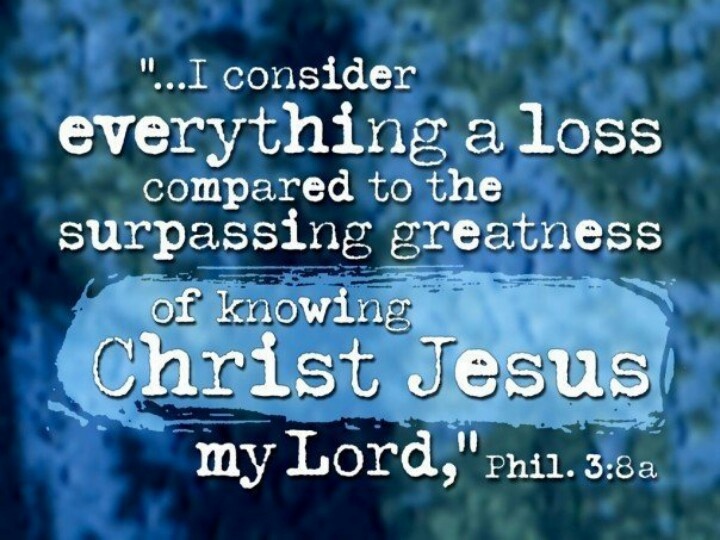
            But, those are only the first three verses of our reading. Paul does an abrupt about-face in verses 7 and 8. But whatever were gains to me I now consider loss for the sake of Christ. What is more, I consider everything a loss because of the surpassing worth of knowing Christ Jesus my Lord, for whose sake I have lost all things.” See how the Apostle Paul makes another extraordinary statement? The overwhelming grace of God – the surpassing worth of knowing Christ – calls Paul to a new, heavenly set of values.

            We will shortly be celebrating Communion, after this sermon. Here at this church, we do not usually say the Sanctus as a part of the Communion liturgy, since we use a shorter form of that section of the service. This part of the Communion liturgy is quite ancient. Here is the Sanctus: “Holy! Holy! Holy! Lord, God of Hosts! Heaven and earth are full of your glory!”  

            See how this statement fits into that Godly set of values from the Apostle Paul! “Our Father, who art in heaven, hallowed be Thy name.”

I invite you to consider the Sanctus when saying the beginning of the Lord’s Prayer. Imagine joining everyone who ever lived, lives now, and is already in heaven saying together that God’s name is hallowed. Because – God truly is holy!

What does Paul say next? “I consider [my worldly gains] garbage, that I may gain Christ and be found in him, not having a righteousness of my own that comes from the law, but that which is through faith inChrist—the righteousness that comes from God on the basis of faith.” Paul describes the value of all these worldly gains – all his marvelous resume – comparing it to the value system of the kingdom of Christ Jesus his Lord — complete rubbish! Absolute trash! That is where his outstanding resume belongs, compared to Christ Jesus our Lord!

               The Gospel reading for today comes from John 12, where Mary anoints Jesus’ feet while He is at dinner, in preparation for His death. “Like Mary pouring out her love by pouring expensive perfume, Paul shows his love and desire to know Christ by pouring out his credentials and achievements, his life, and considering them all rubbish (the Greek word also means “dung” and “excrement”) in comparison to the life to be gained in Christ.” [3]

            How much more can we consider our Lord to be holy? How much more meaningful can it be to say “Our Father, who are in Heaven, hallowed be Thy name,” compared to worldly credentials, or mere human achievements – compared to Christ Jesus our Lord.

            Paul’s goal, and our goal, is to know Christ! That holy, hallowed, set-apart Son of God, the one who reconciled us to God and bestowed upon all of us God’s gift of His righteousness. Praise God, Christ has redeemed us and we now walk in the newness of life.

            One last call to action, from the Apostle Paul: we are to straighten our priorities. Follow God’s priorities, God’s values, and follow Jesus. Make it your priority – my priority – our calling to know Christ intimately, and the power of His resurrection. Then, we surely can pray “Our Father, who art in heaven, hallowed be Thy name,” not only understand it, but mean it, too! Thanks be to God.

@chaplaineliza

(Suggestion: visit me at my other blogs: matterofprayer: A Year of Everyday Prayers. #PursuePEACE – and  A Year of Being Kind . Thanks!


[1] http://worshipingwithchildren.blogspot.com/2016/02/year-c-fifth-sunday-in-lent-march-13.html

[2] https://desperatepreacher.com//texts/phil3_4/phil3_4.htm

[3] https://desperatepreacher.com//texts/phil3_4/phil3_4.htm

Unknown's avatar

The Parable of the Forgiving Father

“The Parable of the Forgiving Father”

Luke 15:11-32 (15:21) – March 27, 2022

            This week we come to a story from Jesus that is beloved by many. One of the best known of the parables, one that resonates with the heart and soul of many. It’s the story of two brothers and a father, the story of discontent and disgruntlement, the story of wandering in a far country, the story of return, and most of all, the story of forgiveness, reconciliation and redemption.

Eileen began this parable with the first half of the Scripture reading this morning. We set the stage with the Rabbi Jesus teaching amongst a large crowd. The tax collectors and sinners crowded close to hear Him, but some prim and proper townsfolk objected. (Objected both to the “dregs of society” and to the Rabbi Jesus welcoming and teaching them.)

            When prim and proper folk gripe and complain about you or your friends showing a loving, caring welcome to others, what is your response? We know what Jesus’ response was: this parable of two brothers and a father.

            We know what happened. The younger brother became discontented with his lot, his place in life and in the family. I am not sure whether you know, but upon their father’s death, the older son would receive twice as much as the younger son. That was the culture and custom of the Jewish tradition at that time. The younger son would only receive one third of the father’s assets – after the father died. But – the father in this parable was still alive, and well, and able to walk, talk and reason.

            Can you believe the audacity of this son, asking right now for what he would receive after his father’s death…before the death actually happened? This was unheard of! What kind of disrespect was this? The height of disrespect from this discontented, disgruntled son!

            One title this parable could have is “The Story of the Lost Son,” because the younger brother goes to a far country, spends all his money in riotous, profligate living, eventually doesn’t have a penny to his name, and is forced to herd pigs for a farmer just to scrape by and earn a pittance. After feeling sorry for himself, the younger brother finally wakes up.

            Let’s hear what Dr. Luke says about this younger brother: “17 “When he came to his senses, he said, ‘How many of my father’s hired servants have food to spare, and here I am starving to death! 18 I will set out and go back to my father and say to him: Father, I have sinned against heaven and against you. 19 I am no longer worthy to be called your son; make me like one of your hired servants.’ 20 So he got up and went to his father.”

            Did you hear? This son came to his senses! He realized how good he had it in his father’s house! At least this younger brother had the sense to return to his father.

            Meanwhile, we have the older brother, back at home. This brother is doing his duty, working in the fields, obedient to his father’s wishes. Except, what was his attitude? Was he sour? Resentful? Feeling locked in and in a boxed-in place? Could this parable featuring the older brother also be called “the Story of the Lost Son?” Can we see some discontent and disgruntlement coming from the older son?

            Let’s move to the father, and hear the next part of the story. ““But while the son was still a long way off, his father saw him and was filled with compassion for him; he ran to his son, threw his arms around him and kissed him. 21 “The son said to him, ‘Father, I have sinned against heaven and against you. I am no longer worthy to be called your son.’ 22 “But the father said to his servants, ‘Quick! Bring the best robe and put it on him. Put a ring on his finger and sandals on his feet. 23 Bring the fattened calf and kill it. Let’s have a feast and celebrate. 24 For this son of mine was dead and is alive again; he was lost and is found.’ So they began to celebrate.”

            Hold it! Now we are going to get further information about the discontented older brother. On the surface, he’s the perfect son. Always obedient, always compliant. Except, listen to this:25 “Meanwhile, the older son was in the field. When he came near the house, he heard music and dancing. 26 So he called one of the servants and asked him what was going on. 27 ‘Your brother has come,’ he replied, ‘and your father has killed the fattened calf because he has him back safe and sound.’ 28 “The older brother became angry and refused to go in. So his father went out and pleaded with him. 29 But he answered his father, ‘Look! All these years I’ve been slaving for you and never disobeyed your orders. Yet you never gave me even a young goat so I could celebrate with my friends. 30 But when this son of yours who has squandered your property with prostitutes comes home, you kill the fattened calf for him!’

            We focus again on the father. If we had a title of this parable from the father’s point of view, it could very well be “The Story of the Forgiving Father.” Yes, he freely forgave the younger son for his extreme disrespect, for spending all his father’s hard-earned money, and for crawling back home in such a disreputable condition. Plus, the father was loving and welcoming to his older son, the one who seemed to be permanently disgruntled, with a huge chip on his shoulder.

            Sometimes, this totally loving, caring, welcoming father seems like a dream, a fantasy, something we could only hope for and never see in real life. Can anyone possibly be that fantastic and marvelous parent to their children? Or, am I – are we – just too jaded and cynical? Has life just beaten us down too much?

            I have news for all of us. With this parable, Jesus lifts up the father as an example, as an image of God our Heavenly Parent. Jesus wants us to see how much God loves each one of us, and how willing our loving, caring God is to welcome us home. Even going so far as to run down the road to embrace us when we return in penitence and tears, or when we stay at home doing our duty in self-righteous disgruntlement and discontent.

            Yes, God forgives! And yes, we are to do the same. As the petition of the Lord’s Prayer says, “forgive us our sins, as we forgive those who sin against us.” We need to continue to strive to forgive others, exactly in the same way and with the same loving, forgiving heart that God our Heavenly Parent had. Remember, the father ran down the road to forgive the prodigal – God offers forgiveness to both prodigal sons, all wayward children, no matter what.

            Remember, what a loving, caring God we have. Always loving, caring and welcoming toward each one of us. Amen.

@chaplaineliza

(Suggestion: visit me at my other blogs: matterofprayer: A Year of Everyday Prayers. #PursuePEACE – and  A Year of Being Kind . Thanks!

Unknown's avatar

Not Your Thoughts

“Not Your Thoughts”

For My thoughts are not your thoughts, Nor are your ways My ways, says the LORD. 9 For as the heavens are higher than the earth, So are My ways higher than your ways, And My thoughts than your thoughts.

Isaiah 55:3-11 (55:8) – March 20, 2022

            Have you ever listened to children or young people talking amongst themselves? It can be fascinating, to be sure. I am thinking of listening in on a conversation where the young people talked about wishes. “Oh, I wish I had…!” or, “I wish I was…!” Wishing for things we don’t have or can’t ever do. Like, wishing for ten million dollars, or for a unicorn or a flying car. Or young people wishing they could go to a special camp, or make the travel team or do really well in school. I can almost hear the rest of that wish: “if only, if only, THEN I’d be happy!” 

            In our reading today, the prophet tells us “Seek the Lord while he may be found; call on God while he is near. Let the wicked forsake their ways and the unrighteous their thoughts. Let them turn to the Lord, and he will have mercy on them, and to our God, for he will freely pardon.” How many people here have thought their own thoughts, not God’s thoughts? How many have gone their own way, and not concerned themselves with God and what God wants, at all? (And I include myself in that number, too! I am guilty, too.)

            Let’s face it. Haven’t we all – at one time or another – wanted stuff that was really outrageous? And, wasn’t at all what God wanted in our lives? “But, if only I could have that cool car – or fancy house – or prestigious job – if only, if only, THEN I’d be happy!”

            But, what about God? What does the Lord want for us? I know I have asked God to show me – periodically. But, not all the time, and not even most of the time. Face it, I am pretty selfish most of the time, saying “I want what I want when I want it!” I have a feeling that you might be in the same boat, wanting the same sorts of things. Not what God wants.

            There’s a problem here in the scripture passage, in Isaiah 55:7. The prophet mentions the wicked, who are pursuing their own wicked ways. They are not following after the Lord. They are not even close to doing what the Lord wants them to do. These wicked people don’t even know about what they’re missing. “Let the wicked forsake their way, and the unrighteous their thoughts.” So, these wicked people, these unrighteous guys are even thinking bad thoughts, thoughts that are not pleasing to the Lord.

            We’re talking about some pretty negative people, and some pretty negative actions, where some people actively go out of their way to be disobedient and disruptive. Some people are like that. The Bible often talks about those kinds of actions and that particular kind of people. Except – don’t you and I act like that (and even think like that) every once in a while? And maybe more often than that?

            To remind everyone, our sermon series this Lent is on the Lord’s Prayer. This week, we are highlighting “Thy kingdom come, Thy will be done, on earth as it is in heaven.” With as often as we pray the Lord’s Prayer, I suspect God would be really pleased if we took this part of the prayer seriously. In other words, God would be so pleased if we did – and said – and thought things that were pleasing to God, and that would give God glory!

            We know what many of the things that please God look like. We can even make a list! In God’s kingdom, there is enough for everyone: enough food, enough shelter, enough healthcare. In God’s kingdom, everyone feels loved and loves others. In God’s kingdom, people find ways of settling problems other than war and conflict and fighting. In God’s kingdom, when there are hurting people and abusive problems, people forgive each other and reconcile.

            The Bible tells us, again and again, in both the Hebrew Scriptures and the New Testament, that ”what is now true every day in heaven will one day be true on earth – especially if we all work to make that happen.” [1]

Sure, we can be disappointed when we finally get the things we have wanted for a long time, those things we think we wanted, and find out after all that they do not make us happy after all. Remember what I said: “I want what I want when I want it!” Except, sometimes it can really be difficult for me – for you – for us to figure out what we truly need, in God’s eyes, and what we selfishly or willfully want, where God is not even in the picture.

This reading from Isaiah 55 as well as the petition of the Lord’s Prayer highlight putting God and God’s will first and foremost in our lives. How can we do that? By putting God’s Word first and foremost in our lives, too. God is a God who works in the lives of people – in your life and mine. Even when we are down, depressed, sick, lonely, or feeling far away from the Lord, we can remember who our God is. The Lord will give us hope even in the most dire, the most sad, the most far-away times. Why? Because our God is a God who keeps promises and works in our lives. [2]

Our reading today urges us all to turn to the Lord. “Seek the LORD while he may be found, call upon God while he is near;”

The Lord is closer than I thought! God is right here, johnny-on-the-spot! And I have a sneaking suspicion the Lord is right next to ME, right next to you, whenever we earnestly look. And, I know God’ll be right there, immediately, whenever I call.

@chaplaineliza

(Suggestion: visit me at my other blogs: matterofprayer: A Year of Everyday Prayers. #PursuePEACE – and  A Year of Being Kind . Thanks!


[1] http://worshipingwithchildren.blogspot.com/2016/01/year-c-third-sunday-in-lent-february-28.html

[2] http://www.word-sunday.com/Files/a/15-a/FR-15-a.html

“God Works!” (Sunday 15A) Larry Broding’s Word-Sunday.Com: A Lectionary Resource for Catholics.

Unknown's avatar

God, Our Light

“God, Our Light”

Psalm 27:1-10 (27:1) – March 13, 2022

            When I set the theme for the Second Sunday in Lent about three weeks ago, I had no idea that there would be an actual war being waged, right now. The Russian army is attacking Ukraine as we speak, and all the horrors of modern-day warfare are a reality, all across the country of Ukraine. Psalm 27 means so much to many of the Ukrainian people right now.

            As this congregation highlights another petition of the Lord’s Prayer, “Deliver us from evil,” we are brought up sharply by the traumatic situation in our own world. We can turn on war news, from both national as well as international media. Videos and photos are – sadly – readily accessible, and the news is heart-rending. No matter which side you are on.

            Wasn’t this the case when King David wrote this psalm, so many centuries before?

            Wars, rumors of wars, battles, skirmishes, fighting – and King David writes this song of praise to the Lord, to thank the Lord for deliverance from evil.

            King David was certainly no stranger to fighting and to war. After King Saul ran David off into the Judean wilderness (a harsh and unhospitable place, the same place where Jesus went after His baptism), David stayed away from Jerusalem for years. Even though David was rightfully anointed by the prophet Samuel as king of Israel, David would not lift his hand against King Saul. At the same time, David was essentially a guerilla leader of 600 battle-hardened fighters, for years. They also would do mercenary fighting, while on the run from King Saul and the troops of Israel. And, that was just the beginning of David being a fighter.

            As we see from both 1 and 2 Samuel, David knew what he was talking about when he wrote these psalms about the Lord delivering him and his men from evil – from war, and from fighting. David was on the run from King Saul for over ten years. And, he was no coward! However, he thanked God that God watched over him and kept him from evil – kept him from being overtaken by the troops of King Saul, as well as foreign troops he was fighting against.

            You and I are not fighting battles against opposing armies, but we still can come to God, praying this psalm for our safety. You and I might consider evil to be bad stuff. Bullies who intimidate and harass. Robbers who steal purses or take cell phones or wallets. Car-jackings, vindictive anger, abusive behavior, vandals who destroy property. All of these are evil, and we can pray for God to protect us from all of these, plus many more.

            As our commentator Beth Tanner says, “With all of the violence in our world, Christians are faced almost daily with a decision to live in fear, or despite their fear, to trust in God and God’s promises.“ [1] “Deliver us from evil” is a powerful prayer! A prayer of trust and assurance in God’s provision, in God’s ability to keep us safe, whatever our situation.

            Yet, the world has had many, many wars through the centuries. Many, many periods of fighting, ethnic strife, border conflicts, and even genocides. Horrific atrocities committed, and whole societies, entire countries stricken by death and destruction. How can anyone lift up their hearts to God in such catastrophic times?

We know, too, God wants us to be hospitable, even in such times. “To choose to remain true to God’s principles of hospitality feels frightening as well. Terrorists and Refugees come from the same places. Gun violence comes out of nowhere and even those places we considered safe are safe no longer. Fear threatens to defeat the gifts of trust and hospitality.” [2]

            It is so interesting that King David seems to waver back and forth, from the sure certainty of God’s saving power to fear of some kind of situation where David’s enemies are trying to “devour his flesh,” as Psalm 27:2 tells us. Whatever the specific problems or fighting happens to be, we suspect God may turn away. Don’t you, sometimes? Even if you are usually firm in faith and fervent in prayer, sometimes…stuff happens. People fail us. Situations baffle us. How can we cope? What is there to do? God, help us!  Sometimes we need to step back, take a deep breath, and think of difficult things as a child might. The best child’s translation of this part of the prayer is “Lord, save us from all the bad stuff that happens.” [3]

And yet,” right in the middle of his expressions of fear, the Psalmist also declares his confident faith that God’s presence is like a light that keeps him safe.” [4] Our Scripture reading today, Psalm 27, remains as a beacon. This encourages us to come to God even as we find ourselves afraid. Even, afraid out of our wits.

We might find ourselves praying the Lord’s Prayer, and saying it by rote, without even concentrating on the words as they come out of our mouths. Yet – “Lent is a time to ask the deep questions of our faith. We can repeat the fears of the past, or trust a new ending to God. It is never easy, but it is the call of God on our lives. This psalm invites us to believe again that our faith in God will never desert us, no matter what happens. Life without fear is not possible, but faith can call us to live into God’s will for our life instead of reducing our lives because of our fears and insecurities.” [5]

Yes, “deliver us from evil” is a powerful prayer, indeed. Yes, we can be afraid, and yes, God can alleviate our fears. If we want to dispel the darkness of fear, we can affirm that God is indeed our light and our salvation. We can all say amen to that!

@chaplaineliza

(Suggestion: visit me at my other blogs: matterofprayer: A Year of Everyday Prayers. #PursuePEACE – and  A Year of Being Kind . Thanks!


[1]   https://www.workingpreacher.org/commentaries/revised-common-lectionary/second-sunday-in-lent-3/commentary-on-psalm-27-3

[2]   Ibid.

[3]  http://worshipingwithchildren.blogspot.com/2016/01/year-c-second-sunday-in-lent-february.html

[4]   https://thewakingdreamer.blogspot.com/2014/01/what-do-we-have-to-fear.html

“What Do We Have To Fear?” Alan Brehm, The Waking Dreamer, 2016.

[5]   https://www.workingpreacher.org/commentaries/revised-common-lectionary/second-sunday-in-lent-3/commentary-on-psalm-27-3

Unknown's avatar

An Opportune Time

“An Opportune Time”

Luke 4:1-13 (4:13) – March 6, 2022

            Have you ever been tempted? For little (and sometimes, bigger) people, these do not need to be big temptations. Smaller, everyday temptations can be troublesome enough. Like, a plate of delicious cookies left on the counter. Or, a cool item – like a late-model smart phone, or a fancy set of ear pods – left unattended in a very public place. Or even, some test answers in such plain view that you can hardly help but see them on the desk nearby. [1]

            What do we do, with such delicious temptations practically begging us to give in?

            This is the first Sunday of Lent, and our Scripture reading today is from Luke’s Gospel: the narrative of the temptation of Jesus. Each week in Lent we will look at one of the phrases of the Lord’s Prayer. They will not be in order, but they all are there. Today’s connection is to “lead us not into temptation, but deliver us from evil.”

            We all know what temptation is. (Don’t we?) I gave several examples just now. Sometimes people can see temptation a mile away, and do the right thing right away. Other times, the temptation can sneak up on us. Or, be overwhelming, or even seductive and alluring. And then, you all know what happens. We give in to temptation.

            As we followed the Gospel reading this morning, the reading from Luke started with Jesus being led into the wilderness to be tempted by the Devil for 40 days.    A verse from Hebrews gives us additional insight into the “why” of it. Jesus was “tempted in every way as we are,” and yet He did not sin. He had no sin. Even thought the Devil tried his best (or, worst) to tempt away at Jesus, Jesus did not succumb. Jesus did not fall prey to any of the presentations, any of the temptations.

This first Sunday in Lent we are reminded of just several days ago, when so many people around the world had ash crosses put on their foreheads. Yes, that was the visible symbol. Ash Wednesday also means self-examination, and confession, and admitting that each of us is limited, imperfect, and each of us needs to face our own mortality. Our sinfulness, too. [2]

            Face it, each of us is only here on earth for a brief time. Psalm 103 tells us that “14 for God knows how we are formed, God remembers that we are dust. 15 The life of mortals is like grass, they flourish like a flower of the field; 16 the wind blows over it and it is gone, and its place remembers it no more.”

That is the reminder of the Ash Wednesday cross, and the liturgical words said at the beginning of Lent each year: “dust you are, to dust you shall return” is what we hear as the ashes are applied to our foreheads. We are marked with mortality for this Lenten journey, and that is sobering enough for anyone. And on top of that, we are called to be self-reflective and to contemplate where we fall short. By extension, we come to the first Sunday of Lent, and are encouraged to do the same thing because we are all marked with mortality,

Our Lord Jesus was led into the wilderness, because that is where you and I commonly live. Wasn’t He a human being just as we are? Jesus was out there hungry and hurting just as we are hungry and hurting, too. Jesus was tempted in all things, just as we are, too.

Most of all, we may be tempted by shortcuts. Wasn’t Jesus tempted by the Devil by that very thing – shortcuts? Sure, all the kingdoms of the world will eventually belong to Jesus, except not just yet. But, the Devil tempts Jesus with those exact things. “All of these kingdoms will be yours right now, if you bow and worship me!” The same with the temptation of loaves of bread. “Turn these stones into bread. You know how easy it will be! Come on, you can do it!” And again, the Devil brought Jesus to the highest place on the Temple and said, “see, if you jump off, God will for sure save you. Angels will come and lift you up! You know they will – come on, I bet you won’t do it. I double dog dare you!

Each of these temptations are shortcuts to power, glory and majesty, which are the Son of God’s by right. Except, the Devil twists them, and tries to convince us all that it’s okay. It’s what God would want…isn’t it? Just as the Devil tried to convince our Lord Jesus, tried of offer Him to claim these glorious things without suffering, without dying, the easy way. Take a shortcut. We may be tempted to take that shortcut, too! [3]   

Our reading ends with an ominous note that the Adversary went away until an opportune time. We could spend some time speculating on when that opportune time might have been for Jesus. But it might be better for us to realize that opportune times come all too often in our lives, and that the Devil can sneak up on us unaware, too.

We all need help to stay on God’s path. We all need someone who will help us to stay focused on God, and especially not to take shortcuts, as tempting as they may be. We can “find someone who can help keep us on track. Find someone who will help us think about the choices we make. Find someone who will fill us out. Better yet, find a group of someones – a community of faith that will help make sure we think with a full mind.” [4]

Won’t you continue walking with Jesus? I pray that we all can stick together and keep on the journey to the Cross. That is the best way to avoid temptation that I’ve found yet: stick close to Jesus. Amen!

@chaplaineliza

(Suggestion: visit me at my other blogs: matterofprayer: A Year of Everyday Prayers. #PursuePEACE – and  A Year of Being Kind . Thanks!


[1] http://worshipingwithchildren.blogspot.com/2016/01/year-c-first-sunday-in-lent-february-14.html

[2] https://www.umcdiscipleship.org/worship-planning/gathered-up-in-jesus/first-sunday-in-lent-year-c-lectionary-planning-notes

[3] https://www.umcdiscipleship.org/worship-planning/gathered-up-in-jesus/first-sunday-in-lent-year-c-lectionary-planning-notes

[4] Ibid.

Unknown's avatar

Reconciled to God

“Reconciled to God”

2 Corinthians 5:20-6:2 (5:20-21) – March 2, 2022

            I am part of a local pastors’ group. We have periodic Zoom calls, and we support each other and encourage each other. This group has been gathering together for almost two years, since shortly after the pandemic shut down happened in March 2020. Some jokester in the group was talking about the difficulties and challenges of this whole long pandemic and COVID experience. He said that this had been the longest, Lent-iest Lent he had ever experienced.

            Isn’t it the truth? Hasn’t this whole long period of time been similar to an especially challenging Lenten journey? A huge, overlong Lent-iest Lenten expedition? Except, here we are again, at the beginning of another Lent, in 2022.

            Except, we have already been through such a challenging time. Months and months of separation, of Zoom calls and meetings, of fear and anxiety and disgruntlement. And for many among us, months of worry and grieving so many losses. Losses of normalcy. Losses of expected events, holidays, weddings, graduations, and other gatherings. On top of which is the loss of many loved ones who may have died of COVID, or of something else. But, the weariness and mourning of so much continuing loss, separation and grief can be overwhelming.

            And now, we add Lent to the mix. Yes, we all have sinned and fallen short of the glory of God, as Paul reminds us in Romans 3. This is a clear truth. We know where we fall short, and we sorely feel our grief and losses. Yet, this is not a time to wallow too much in our sinfulness.

               That is why these words from the Apostle Paul seem especially moving to me on this Ash Wednesday. As Paul says, “We are therefore Christ’s ambassadors, as though God were making his appeal through us. We implore you on Christ’s behalf: Be reconciled to God.”

            We are far enough past the beginning of January to look back and see where New Year’s resolutions have failed and promises made to ourselves often lie broken. When Paul quotes from Isaiah 49 in verse 6:2, this is a prophetic wake-up call from the Apostle Paul. We reorient our lives before God in just this way: Be reconciled to God! As Paul shouts (in the imperative verb form!), “Hey, you! Be reconciled!” It’s not just a polite suggestion.

            Digging deeper, our commentator Karoline Lewis says, “Reorienting life before God often necessitates a radical call outside of oneself to be reconciled to others. Being reconciled to God is not just another individualistic resolution or self-improvement step. Instead, it means being messengers of reconciliation, working together in a cooperative grace, and participating in God’s reconciling activity to win back the world.” [1]

            Paul calls himself Christ’s ambassador, official representative, or political emissary. By extension, we are all Christ’s ambassadors; we are all sent with His message of reconciliation to the world. That’s not only to the world, but individually, too. We are ambassadors to our neighbor next door, to the friend down the street, to the relative we call on the phone or those we send a Facebook or Instagram message to.

            Yes, we can see the ambassador part, and the message of reconciliation part, but what do we do with our sin? Paul tells us right here. God reconciles all of us (to Godself!) by making Jesus Christ, the Messiah, the righteous one who knew no sin (!!) to be sin for us. Jesus shouldered all that huge burden of sin so that you and I might become the righteousness of God, as Paul says in verse 21. [2]

            This action of God is a liturgical or symbolic action, as well. Through this reality, God enacts the transfer of sin. God trades Christ’s righteousness for our sinfulness: something of immeasurable worth for something completely worthless. Or, as I learned in a straight-forward anagram decades ago, it’s all God’s grace. God’s riches at Christ’s expense. Praise God!

            I turn to some suggestions from Karoline Lewis. Now that we are embarking upon another Lenten journey, what will you – will I – do for Lent to be meaningful to you?

            Instead of giving up something for Lent this season, instead, why don’t we choose something to embrace? “Not something “to do” but something “to be.” Something that gives you joy, that nurtures you. It’s okay to have joy during Lent. It’s okay to think about how you will take care of yourself during Lent. It’s okay to imagine a Lent that does not have to have as its primary mood that of sacrifice. Your starting point for Lent matters. You can suffer through Lent. Or, you can choose to move through Lent from a place of wonder and gratitude: wondering where God might show up, what God might reveal in this dormant time, this time set aside so as to anticipate life, a time that looks forward to glimpses of new creation [and resurrection].” [3]  

            What a good suggestion! I encourage you to do something that gives you joy in the Lord, and leads you back to that place of wonder, that place of nurture where you can feel God’s presence with you. Suggestions? Walk in nature. Sing in the shower. Listen to soothing music. Read and journal. Play with your children (or grandchildren). Garden. All of these involve God’s creation, and all of these can be stress-relievers. Be creative! Find joy, wonder and gratitude this Lent, and you will find yourself closer to God.

            Amen, and amen.

@chaplaineliza

(Suggestion: visit me at my other blogs: matterofprayer: A Year of Everyday Prayers. #PursuePEACE – and  A Year of Being Kind . Thanks!


[1] https://www.workingpreacher.org/commentaries/revised-common-lectionary/ash-wednesday/commentary-on-2-corinthians-520b-610-5

[2] https://www.workingpreacher.org/commentaries/revised-common-lectionary/ash-wednesday/commentary-on-2-corinthians-520b-610-10

[3] https://www.workingpreacher.org/dear-working-preacher/choose-your-lent

Unknown's avatar

Are We Speechless?

“Are We Speechless?”

Luke 9:28-36 (9:36) – February 27, 2022

            Have you ever been totally in awe? Awe can be a jaw-dropping experience, when you and I are so filled with amazement that words totally escape us. I consider myself fairly good with words (what my husband calls a wordsmith). I must admit that from time to time, I have been filled with shock and awe so much that I find myself without words. I wonder whether that has ever happened to you?

Remember, Jesus took His inner circle of disciples with Him to the top of that mountain, Mount Tabor. Dr. Luke mentions the three disciples speechless and filled with awe. Can you imagine how the disciples looked, by reading the last verse of our Scripture reading?

            We return to the Bible to read the narrative of the Transfiguration this morning. We see Jesus high and lifted up. Two thousand years ago, and yet, immediate and present right here with us. Despite all of the horrible and heartbreaking things that are happening all around us, we still can find ourselves speechless. At Jesus, transfigured before our eyes.  

Yes, Dr. Luke talks of Peter, James and John being awestruck by Jesus’ transfiguration on the mountaintop. But, what exactly does “transfigured” mean? Is that just a churchy word that gets thrown around sometimes in worship services and bible studies? And, nobody really ever defines what it means!

This word only appears here, in the narratives of this event from Matthew, Mark and Luke – and those are the only times it appears. This word is made up of two parts or roots. (Remember back to grammar class in school?) These two key parts “Trans” (change) and “figure” (shape or form) define what happened in this event. 

First, I’d like for us to consider the hymn “Fairest Lord Jesus.” This was the hymn we sang in church at the opening of worship today. The final line links to the transfiguration saying “Jesus shines brighter; Jesus shines purer than all the angels heaven can boast.” Here we see a tangible image of brightness, of visible glory.

Another well-known hymn pictures this event on the mountaintop. “Holy, Holy, Holy” has a familiar tune; have you ever really thought about the words? Let me lift up the 3rd verse. “Holy, holy, holy! Though the darkness hide Thee, Thought the eye of sinful man Thy glory may not see; Only Thou are holy—there is none beside Thee, Perfect in pow’r, in love and purity.”

We sing praises to the Messiah, our Lord Jesus, the Lord God Almighty, at whose feet every knee will bow. Yes, we all are sinful, and our eyes cannot be lifted to see the glorified Lord Jesus Christ. Yet God has this glory-filled event recorded by Matthew, Mark and Luke for us to read. 2000 years later. And, it still renders those who read the account speechless.

            Remember, God the Heavenly Father (for that is what Jesus calls God) did not do this for Jesus. Jesus knew who and what He was, and He was secure in His own Personhood and being.  God did this for the disciples. The disciples had been living with Jesus every day for several years. They went everywhere with Him, ate with Him, even bunked down by Him at night. [1] You get to know a person very well if you do that for long enough. The disciples knew that Jesus was something special, even though they were not quite sure what that meant. Yet – Peter, James and John were amazed, speechless by the incredible events that happened on the mountain.

            Perhaps you have known a special person in your own life, someone you knew when you were young, or someone you met along life’s journey. Pastor Sharron Blezard said, “Some folks just seem vividly alive, almost glowing, and full of the presence of the Holy Spirit. Maybe you know someone like this, a person whose life is so well grounded in Christ’s grace and love that she or he appears unfazed by the storms of life, radiant in the face of adversity, eyes and heart always fixed on God. Surely this person has dwelt in the presence of the Divine.” [2] These special folks are a blessing to all they encounter. I have been blessed to know a few of these exceptional people. But, they were people, God’s creations, just like you and me.

By wrapping Jesus in a glorious, shining cloud and incredible clothes, God was telling the disciples something all-important. God is telling all of us the exact same thing. “Jesus is much more than a special person. Jesus is Emmanuel, God-with-you.”  

“Peter, James, and John were awestruck by Jesus’ transfiguration on the mountaintop. Their lives were forever altered by the experience; they were changed. We can be changed, too, by encountering God deeply and regularly. In fact, I believe that it is impossible to be in deep relationship with God through prayer, worship, study, service, fellowship, and sharing and not be transfigured.”

Dr. Luke doesn’t stop with that mountaintop experience. “Jesus and the disciples got right back down to the work of ministry–in this case healing a possessed boy. We may plan and vision and dream, and that is all well and good, but our vision must have hands and feet to carry it forward. How is your congregation doing that now? What might it do in the future?” [3]

Do you hear? We don’t stay parked on that mountain. God has too much for us to do! Yes, proclaim God’s Good News! And, yes, get involved in ministry, in whatever way you can. That’s what we are all called to do. And, the awe-inspiring image of Jesus, high and lifted up, will continue to give us encouragement as we minister – one day at a time. Alleluia, amen!

@chaplaineliza

(Suggestion: visit me at my other blogs: matterofprayer: A Year of Everyday Prayers. #PursuePEACE – and  A Year of Being Kind . Thanks!


[1] http://worshipingwithchildren.blogspot.com/2016/01/year-c-transfiguration-of-lord-february.html

[2] https://www.stewardshipoflife.org/2013/02/changed/

“Changed,” Sharron R. Blezard, Stewardship of Life, 2013.

[3] Ibid.

Unknown's avatar

We Ought to Love WHO?

“We Ought to Love WHO?”

Luke 6:27-36 (6:35) – February 20, 2022

            Who has ever grumbled at people? Who has ever been frustrated with people? Who has ever been downright angry with people? Are these people you know, your friends? Perhaps you felt that way about your loved ones, your family? We have all had that happen, from time to time. And sometimes, more often than that. But – that is when we are angry with our friends or family. Jesus says something quite different about our enemies. What would Jesus do?

            Our Lord Jesus talks Godly behavior in our Scripture reading today from Luke 6. Here are just a couple of verses: 27 “But to you who are listening I say: Love your enemies, do good to those who hate you, 28 bless those who curse you, pray for those who mistreat you 30 Give to everyone who asks you, and if anyone takes what belongs to you, do not demand it back. 31 Do to others as you would have them do to you.”

            As we listen to Jesus’ words, we might think to ourselves, “We ought to love WHO? That’s a tall order, Lord! Pretty near impossible!”

            Let’s back up, and see where these words come from. One of my favorite commentators Karoline Lewis tells us to take the long view, to consider where Jesus is coming from in this section of the Gospel of Luke. Our Scripture reading today comes from Luke’s Sermon on the Plain. What came just before this sermon, before Luke’s version of the Beatitudes? “Jesus has just named apostles from the crowd of his disciples and these blessings and woes on the plain are his first words to the newly commissioned. ‘Whoa! Stop right there! Before we go any further, here’s what you need to know.’[1] Jesus uses some interjections, a grammatical term for the typical exclamation words “Hey!” “Whoa!” and “Watch out!”

            This reminds me of certain times when my children (now in their 20’s and 30’s) were small. They would bicker and fight back and forth, and the last thing they would want to do would be listen to me, their mother. Sometimes, one or the other would be so frustrated or angry they would burst out, “You’re not the boss of me!” Too often, we don’t like to have people boss us around, either. However, Jesus is trying to get the disciples’ attention. And, He is trying to get our attention, too. Jesus says, “Listen up, people!”

Many people think of the Gospel of Matthew’s Sermon on the Mount as one of the high points of Jesus’s preaching ministry. In case you did not know, the material covered in the Sermon on the Mount is summarized in Luke’s Sermon on the Plain, in about one third of the space. Jesus did say a lot of controversial things, a lot of which got Him into serious hot water with religious leaders. But, “love your enemies” is a particularly troublesome statement. 

            Hating your enemies is only natural. Hating people who do bad things to you, who speak mean words to us – and about us! – who actively go out of their way to be mean and nasty – that would be only natural. That is, according to the wisdom of the world. Except – Jesus tells us we are not of the world any longer. In multiple places in Scripture, in both the Hebrew Scriptures and the New Testament, followers of God are called to another way of living.

In this Sermon on the Plain (as well as the Sermon of the Mount), Jesus reminds us of a different way, a Godly way. A way that is God-honoring. Except, Jesus uses expressive and arresting words to get us to listen! “Whoa! Here’s what’s important, disciples of mine. Whoa! Here’s what you need to hold on to.”

When many people hate others, revenge is a natural outgrowth of that hatred. Our Lord Jesus and His teaching go in the opposite direction of hatred and revenge. ”Don’t be quick to revenge but try to find a way of reconciliation. Jesus wants to change the spirit of irritation, anger and hatred inside of us. Irritation, anger, hatred and retaliation only seem to heap gasoline on the fire of conflict. Jesus is teaching his disciples another way of dealing with revenge.” [2] Yes, and another, God-honoring way to deal with hatred, too.

That’s all very well, but how can I change how I feel inside? My toes were stepped on! My feelings were really bruised! I was badly hurt! I was injured, even abused!! What do I do with all of that?”

Let me tell you: I may not be able to change the way I feel (or you feel), deep down. But, God can. At times, it happens right away. More often, the process is gradual. The important part is to get to the point that you are willing. Willing to be willing. Willing to let God help you. Help you to be forgiving, to let go of the hurt, the pain, the desire for revenge. And, God will come alongside of you and help.

There are certain situations that are very damaging. Damaging to people’s psyche, sometimes their physical bodies, and not least, their souls. I am thinking of horrible situations of abuse, of pain and degradation. I would not demand anyone to do anything that would cause even more pain and suffering, in the case of trauma and intense hurt. I would suggest that God might gently come alongside and help begin the healing process. Little by little. And, there are reputable counselors, medical professionals, therapists and social workers who are especially  trained to help in those cases, too.

Still, Jesus’ words have great effect. We are to listen up! And, follow Jesus.

Carolyn Brown, retired Director of Children’s Ministries, has a great way to summarize this section of Luke. “Love your enemies. Do good to those who hate you.  Pray for those who are mean to you. Do to others as you would have them do to you. Love and do good to all without expecting anything in return.” [3]

I come back to the question of the day: What Would Jesus Do? He calls us to go. Do that. And if you need help? Ask Jesus. He will help us to love everyone, and help us to follow Him.

@chaplaineliza

(Suggestion: visit me at my other blogs: matterofprayer: A Year of Everyday Prayers. #PursuePEACE – and  A Year of Being Kind . Thanks!


[1] https://www.workingpreacher.org/dear-working-preacher/woes-and-whoas

[2] http://www.sermonsfromseattle.com/series_c_loving_your_enemies_and_people_you_dont_like_GA.htm

[3] http://worshipingwithchildren.blogspot.com/2019/01/