Unknown's avatar

Joy for Those Who Wander

“Joy for Those Who Wander”

Luke 2:1-7 (2:4-5) – December 14, 2025

            When some thing or some reading or some sermon is so familiar, so recognizable, are you tempted to tune it out? Turn it off?

I am preaching from an alternative lectionary, enlarging our Advent meditation on Dr. Luke’s so-familiar chapters. Today, I preach from the beginning of Luke chapter 2. Such a recognizable narrative! It has everything a story needs! Not only promise and heritage, not only memory and mystery. But, hearing an old story yet again brings its own kind of anticipation!

Although, the familiarity surrounding today’s reading is a particular problem for preachers. How do we make the reading fresh, bring it to life again, imbue it with that something extra special enough to cause people to tune in rather than tune out?

            Let us listen again to a portion of today’s reading: “And everyone went to their own town to register.So Joseph also went up from the town of Nazareth in Galilee to Judea, to Bethlehem the town of David, because he belonged to the house and line of David. He went there to register with Mary, who was pledged to be married to him and was expecting a child.”

            Joseph and Mary began to travel from Nazareth in the north of Galilee up to Bethlehem. A suburb of Jerusalem, really. A small town on the outskirts of the capital city, a good ways to the south of Galilee. We find Mary and Joseph (probably without a donkey – sorry to all of the lovers of traditional Christmas cards, everywhere) on the road, walking south to register for the census. And, they were not the only ones on the road.

            Can you see yourself – can I see myself – on the road? Are we all in transit, traveling along, not anywhere particularly fixed? Even those of us who have lived in the same place for a long time, is there something about your life, about our walk with God that makes you think that we all are on the road? Could it be that we all are wandering from one place to another, and not having a definite place to call home?

            The apostle Paul speaks of the temporary nature of this world, of this earthly tent we all inhabit. He says in 2 Corinthians 5, “For we know that if the earthly tent we live in is destroyed, we have a building from God, an eternal house in heaven, not built by human hands.” So, with that to look forward to, it gives us all a heavenly perspective to view our earthly tents, and the journey each of us is on, in this wide world today.

            Which brings us back to considering: the long trip for the census. And, since Bethlehem was the ancestral home of King David, that meant there were quite a lot of people who had to be counted who were descended from David. Including Joseph. Remember the genealogy written in the Gospel of Matthew?

            Speaking of descendants of David, I am sorry to prick the other balloons of belief in the traditional Christmas carols and traditions. “It would be unthinkable that Joseph, returning to his place of ancestral origins, would not have been received by family members, even if they were not close relatives.” Presbyterian missionary and pastor Dr. Kenneth Bailey, who is renowned for his studies of first-century Palestinian culture, comments:

“Even if he has never been there before he can appear suddenly at the home of a distant cousin, recite his genealogy, and he is among friends. Joseph had only to say, ‘I am Joseph, son of Jacob, son of Matthan, son of Eleazar, the son of Eliud,’ and the immediate response must have been, ‘You are welcome. What can we do for you?’” [1]

            I know this might be news to you – and it was to me. Jesus was not born in a cave or far on the outskirts of town, out adjacent to the field surrounding Bethlehem. However, this still does not let us off the hook for considering the larger question. Mary and Joseph were traveling, and were on the way, in between. According to Biblical record, they did not have very much money at all. (Although, because of the generous dictates of hospitality, they must have been put up in some cousin’s home while they were sojourning in Bethlehem.)

            I still would like to know! Our position as believers in the one true God makes us sojourners in this world; and this position is so similar to Mary and Joseph’s position as sojourners or travelers, too. Is there any solidarity for others today who are transient, who are traveling or sojourning, especially young families? Perhaps with mothers who are great with child at this time of the year, and are looking for even a temporary place to lay their heads?

             We can take this unexpected look at the Holy Family one step further. I remember a suburban church I attended a number of years ago. One of the smaller trees near the front door to the sanctuary was practically covered with blue ribbons. A sign was posted next to the tree, saying “While celebrating One homeless Family, these ribbons ask us to remember the homeless with us today.” I had never thought about the Holy Family in that way before. It’s God’s unexpected manner of opening our eyes, and displaying the new or different way we can look at Mary and Joseph and the baby Jesus.

            As we consider the birth of the baby Jesus in Bethlehem, as the Holy Family was traveling through, we can see this birth as so much more than simply a claim or confession of the church. As you and I are sojourners through this world, so we also are traveling through. Jesus, God’s eternal Son, the Second Person of the Trinity, emptied Himself. He willingly put Himself in this human flesh and became incarnate of the Virgin Mary. And, this is the most important part! This miraculous birth shows us the truth of our God. Our God loves us so much that the only way to really, truly show us how much was to become one of us. The Baby born in Bethlehem. [2]

            The baby Jesus, His parents Mary and Joseph – the Holy Family was on the way, traveling. Sojourning, and so are we. We are travelers, looking forward to that heavenly home, prepared for us in heaven. Are you on the road with us? On the way with Jesus?

            I close with two verses from a much beloved Christmas carol, collected in Appalachia by John Jacob Niles around 1900. Listen and hear the words of traveling, of being on the way.

 When Mary birthed Jesus, ’twas in a cow’s stall/with wise men and farmers and shepherd and all.
but high from God’s heaven a star’s light did fall, /and the promise of ages it did then recall.

I wonder as I wander, out under the sky, /how Jesus the Savior did come for to die
for poor ordinary people like you and like I; /I wonder as I wander, out under the sky.

            Alleluia, amen.

@chaplaineliza

(Suggestion: visit me at my other blogs: matterofprayer: A Year of Everyday Prayers. #PursuePEACE – and  A Year of Being Kind . Thanks!)


[1] https://www.psephizo.com/biblical-studies/once-more-jesus-was-not-born-in-a-stable/

[2] https://www.workingpreacher.org/dear-working-preacher/christmas-preaching

Unknown's avatar

Peace for Those Who Wait

“Peace for Those Who Wait”

            Waiting. I can remember waiting while being pregnant. Waiting for the weeks to pass. Waiting for another prenatal visit. Especially waiting during that last month. And, waiting for the labor pains finally to kick in and to get going, for the baby to finally be born. (Each of my pregnancies involved long labors.)

            I can relate to our Gospel reading from Luke chapter 1 today! Waiting! Waiting for something huge to happen. Waiting for babies to be born.

Except, Mary found herself in the early months of pregnancy without the protection of a husband or partner. I have a feeling she and Joseph were having continuing dialogue about her being pregnant, and not by Joseph. That must have been awkward, to say the least! We find that Mary traveled and went to her older cousin Elizabeth’s house, some distance away, for several months. Elizabeth’s home must have been a sanctuary in an unpeaceful time for Mary, while she was in a time of waiting.

Let us look at the current day, and focus on the United States. Things today, situations here and now are certainly not peaceful. We are looking at the second Sunday in Advent, and the second candle on the Advent wreath signifies the candle of Peace. Can you and I possibly find peace in an unpeaceful world?

Is there a way to look for God’s peace in a turbulent and tumultuous time?

As I said last week, we are well used to seeing Mary as a sweet, calm, quiet, almost docile follower of God’s will for her life. Last week, I brought up the fact that Mary, our Mary that Dr. Luke tells us about, was also a prophet! As a prophet, she brought hope to the world. Was it possible that Mary also brought peace to an unpeaceful world?  

This prophetic role, this insight is a new way of looking at Mary for me. New for me, and I hope enlightening to you, too. As we consider the call of the prophets in the Hebrew Scriptures, and consider the call of Mary by the angel Gabriel, we see all the familiar, classic steps: we see God’s initial call to Mary, God’s task, Mary the prophet’s objection, God’s reassurance, and Mary the prophet’s acceptance of call. [1]

All of these are found in Mary’s conversation with the angel Gabriel in the account of the Annunciation, found in Luke chapter 1. I was struck by – you might say, gobsmacked by – the clarity of all those classic steps of the prophet’s call displayed, and I had never seen it before. Sure, I had approached this insight in years past, even preaching about how Mary was a radical by singing about such radical ideas.

Even though I have been well acquainted with the first chapter of Luke for decades, the further concept of Mary as God’s chosen prophet never fully clicked with me. Until now.

As we go on to look at the Canticle that Mary sings, I want to bring before us the earth-shattering idea that “Luke portrays her in a startling role: one that shakes up the way we’ve been brought up to think of her and invites us to stop observing her and start imitating her.” [2]

Can you listen with open ears to Mary sing of God who “has brought down rulers from their thrones but has lifted up the humble,” and “has filled the hungry with good things but has sent the rich away empty.” This is a classic story (or song) about the “haves” and the “have-nots,” and we can guess who Mary associates herself with! The Jewish people are definitely downtrodden; the Roman empire certainly has them under their collective boot heel. Nevertheless, Mary’s prophetic notes of joy ring out for all to hear in the Magnificat!

Remember, Mary’s song, giving glory, magnifying God, is also clearly a radical protest song. As she sings about the injustice not only in her hometown, but within the whole occupied Jewish nation, any peace but a forced “peace” was the furthest thing from the minds of the Roman occupiers. Yet, “the new world Mary sings about here isn’t elusive or unquantifiable at all. The hope she holds onto is one passed on to her from her ancestors: from Hannah, who sang this hymn of reversal and revolution in the Hebrew scriptures, to the Psalmist, who echoed praise to God for raising the poor from the dust and lifting the needy out of their desperation.” [3]

One of my favorite interpretations of the Canticle Mary sings, the Magnificat, is a newer song written by artist Rory Cooney, set to a traditional Irish tune called “Star of the County Down.” It is presented as a story-song with refrain: “Though the nations rage from age to age, we remember who holds us fast: God’s mercy must deliver us from the conqueror’s crushing grasp. This saving word that our forebears heard is the promise which holds us bound, ‘til the spear and rod can be crushed by God, who is turning the world around.” [4]

Can you believe how radical, how revolutionary an idea this was (and is)? Especially to a large group of people who have been poor, downtrodden, and left on the outskirts for generations, perhaps for centuries? What good news – even marvelous news – this would be to such a group of people, to know that God not only loves them, but God cares about each of them, and is actively coming to their defense, to fill their stomachs and right their wrongs!

Here in the United States, right now, we have a large segment of the population becoming fearful and anxious. Not only about the economic situation for individuals and families, but also the current political situation. The roaming of ICE agents and Department of Homeland Security walking freely, touchy and eager to display their confounding and overwhelming strength, their power over.

How striking and similar is this to the occupying Roman army in first century Palestine? Some striking and sadly similar parallels between the first and twenty-first centuries. In both cases, God’s love was and is displayed, overcoming worldly power.

As the Canticle of the Turning says in the last verse, “Though the nations rage from age to age, we remember who holds us fast: God’s mercy must deliver us from the conqueror’s crushing grasp. This saving word that our forbears heard is the promise that holds us bound, ‘Til the spear and rod be crushed by God, who is turning the world around.” [5]

  Let those with ears to hear, hear the words of the prophet Mary. Alleluia, amen.

@chaplaineliza

(Suggestion: visit me at my other blogs: matterofprayer: A Year of Everyday Prayers. #PursuePEACE – and  A Year of Being Kind . Thanks!)


[1] http://www.patheos.com/progressive-christian/mary-reluctant-prophet-alyce-mckenzie-12-17-2012.html

[2] Ibid.

[3] The Do Not Be Afraid Advent Devotional – © 2022 Illustrated Ministry, LLC

[4] Cooney, Rory, “Canticle of the Turning,” (GIA Pulications, Inc. Chicago, IL: 1990)

[5] Ibid.

Unknown's avatar

Hope, for Mary and for Us

“Hope, for Mary and for Us”

Luke 1:26-45 (1:38) – November 30, 2025

            I have a secret confession to make. I am greatly thankful that I have never had to take a job in retail. As I said to my husband this past weekend, I would have quit after the first day, simply because of the constant, cheesy, sometimes saccharin-sweet Christmas music that is piped in over the PA system at every retail store I go into. This is done for about two months before Christmas. And, that’s a long, long time to hear Christmas carols and songs, non-stop.

            And yet – and yet, as we consider this alternative Advent Bible reading from Luke chapter 1 today, I invite you to come with me back in time, to a time before there even was a Christmas. We are not only going to time-travel, but we are going to ocean-hop, too. Let us go to the modest home of a teenager named Mary, living with her parents in Palestine, around the beginning of the first century of the Common (or, Christian) Era.

            This teenaged girl – really, young woman, as she was in that time and place – had an angel visitation. We even find out the Angel’s name, Gabriel. The few times that the angel Gabriel appears in the Bible (that we know of), are times of great importance. Especially this appearance, when Gabriel heralds the birth of the coming Messiah! But, we haven’t gotten there yet. Mary is in her parents’ home when the angel suddenly arrives, about to upend everything concerning Mary and her life as she knows it.  

            Another very important fact: the country where Mary is living, and her people, the Jews, are under Roman rule. Palestine is an occupied country, like so many other regions and nations under the boot of Rome and the powerful Roman army. Palestine doesn’t sound much like a “Silent Night, Holy Night,” where “all is calm, all is bright.” Does it?

            Our mighty God does not wait until everything is perfect, or everything is calm and placid, to work wonders and miracles. God sent the angel Gabriel to a teenager in a modest house, in a country under military occupation. Not to the ruling classes, not to the king’s family in his luxurious palace, but to an unlikely young woman in a backwater town.

            Let us shift gears and move our focus to the modern day. Here in the United States, we have a great deal of internal struggle! Things today are certainly not perfect, or calm or placid. As we mark the first Sunday in Advent, the first candle on the Advent wreath is called the candle of Hope. Can you and I possibly find hope in an atmosphere of anxiety? Of uncertainty? Overwhelmed by pervasive negativity, with the American people’s attitudes filled with division, derision and defensiveness?

            Let’s return to Mary and the angel. How does Gabriel lead off in this conversation from Luke chapter 1? 28 The angel went to her and said, “Greetings, you who are highly favored! The Lord is with you.” Admittedly, Mary wonders what on earth is going on! Dr. Luke tells us, Mary “was greatly troubled at his words and wondered what kind of greeting this might be.” I dare say you and I would be greatly troubled, too, if we were to encounter an angel!

            Sure enough, Gabriel announces to Mary that she is highly favored, and that “you will conceive and give birth to a son, and you are to call him Jesus. 32 He will be great and will be called the Son of the Most High. The Lord God will give him the throne of his father David, 33 and he will reign over Jacob’s descendants forever; his kingdom will never end.”

Mary probably knew her place in society of her time, as a female, as a second-class citizen. Mary “is common, ordinary, of little account in her world and definitely not the stuff of legends…and she knows it. Only after expressing her wonder and dismay, and then hearing again Gabriel’s affirmation and promise, does she manage to summon the courage to believe that God has indeed favoring her by working in her and through her for the health of the world.” [1] What was Mary’s response to the angel? 38 “I am the Lord’s servant,” Mary answered. “May your word to me be fulfilled.”

We all know very well that our teenaged Mary became pregnant by the Holy Spirit, and gave birth to the baby Jesus in Bethlehem. We are well used to seeing Mary as a sweet, calm, quiet, almost docile follower of God’s will for her life. However, I would like to suggest that Mary was also a prophet! As a prophet, she would also be a bringer of hope to the world!

This prophetic role, this insight is a new way of looking at Mary for me. New for me, and I hope enlightening to you, too. As we consider the call of the prophets in the Hebrew Scriptures, and consider the call of Mary by the angel Gabriel, we see all the familiar, classic steps: we see God’s initial call, God’s task, the prophet’s objection, God’s reassurance, and the prophet’s acceptance of call. [2]

 I will say more about this next week, when we take a look at the Canticle that Mary sings, but I want to bring before us the earth-shattering idea that “Luke portrays her in a startling role: one that shakes up the way we’ve been brought up to think of her and invites us to stop observing her and start imitating her.” [3]

 I know that the Christmas carol “Once in Royal David’s City” calls mother Mary “mild,” and the typical portrayal of her on Christmas cards is calm, placid and docile. But, how can this mild depiction of Mary cause our hearts to be hopeful, today? Especially when it seems that the whole world is uncertain, the current political situation is contentious, and our society in the United States is fractured and broken?

            While Mary’s specific task is specific to her, the prophetic call remains open to everyone. God can call each one of us to a prophetic role, especially at this time of Advent, at this grateful and expectant time of year when people are looking up, looking outward, looking for hope. We can all be like Mary, the prophet, bearing good news to everyone.

            Alleluia, amen.

@chaplaineliza

(Suggestion: visit me at my other blogs: matterofprayer: A Year of Everyday Prayers. #PursuePEACE – and  A Year of Being Kind . Thanks!


[1] https://www.workingpreacher.org/dear-working-preacher/favored-ones

[2] http://www.patheos.com/progressive-christian/mary-reluctant-prophet-alyce-mckenzie-12-17-2012.html

[3] Ibid.

Unknown's avatar

God’s Kind of Love

“God’s Kind of Love”

(I was privileged to celebrate the wedding of two of my friends last weekend! Here is the meditation I gave at the wedding.)

1 John 4:13-17 (4:17) – November 15, 2025

            Weddings are wonderful events. Brides and grooms try their best to make them meaningful, personalized, and one-of-a-kind! This is especially true about the music chosen.

I have strong feelings about certain songs that are featured at weddings. I won’t name any specific song, but I think you can recognize them when you hear them. I’m thinking of hearts and flowers, sappy songs that highlight love as a warm and fuzzy, surface-kind-of feeling. What happens when that warm and fuzzy feeling called “love” goes away?

We are here today to celebrate the wedding of our two friends. How wonderful, how fitting that we also talk about celebrating how much we love one another! Not a sappy, fuzzy kind of love, but a kind of love that goes the distance. A deep-down love that endures.

Many people, indeed, many ministers lift up the Bible reading from 1 Corinthians 13, where the Apostle Paul talks all about love. The “Love Chapter” from the New Testament is a wonderful statement about love.

I am a chaplain, and it’s part of my job description to talk about the Bible. How does the Bible describe love? I prefer the Apostle John and his marvelous description, his plain words on the subject of love – God’s love. Our Bible reading from the first letter of John written to his scattered church members describes love – the way God sees love. St. John writes: “Dear friends, since God so loved us, we also ought to love one another. 12 No one has ever seen God; but if we love one another, God lives in us and God’s love is made complete in us.”

Here in this description, St. John tells his friends all about love – God’s love. And, John raises love to the next level. Or, perhaps another way of describing it: John raises the bar for measuring love. “Since God so loved us, we also ought to love one another.”

When I think of the number one example of love, I think of our Lord Jesus, while He was here on this earth. I think of how Jesus lived, how He acted, and how He carried out His ministry. Jesus showed us how to love, by displaying love in action. Jesus truly showed His friends (as well as all the world) a life of love – and caring and compassion for all people.

            What better thing to do than to think of our Lord Jesus, when He was here on this earth, and ask ourselves “What would Jesus do?” How would Jesus act?  Who would Jesus love?”

            In recovery circles, a common saying is “do the next right thing.” I had a friend in recovery, of blessed memory, who is now with the Lord. He always tried his very best to be loving, caring and giving. He knew that common recovery saying very well, except he would change one word. He would often say “do the next loving thing.” That’s how to fulfill John’s definition of love from 1 John chapter 4.

            So – what would Jesus do? Do the next loving thing. Go. Do that.

            Alleluia, amen.

@chaplaineliza

(Suggestion: visit me at my other blogs: matterofprayer: A Year of Everyday Prayers. #PursuePEACE – and  A Year of Being Kind . Thanks!

Unknown's avatar

Stand Firm in Benediction!

“Stand Firm in Benediction!”

2 Thessalonians 2:13-17 (2:16-17) – November 9, 2025

            It’s sometimes difficult to be persistent! To hold on, and continue working, continue trying, despite delays and disappointments and detours. Isn’t it? Continuing to work all alone, standing by and standing up when others fall away. Even just being faithful, and doing what you promised to do can be a real trudge up a long, winding road, up a steep and lonely hill.

            It’s a good thing that as we live the Christian life, so often we are in community with each other! Isn’t it easier and more companionable to be traveling together, or working on a project together, or carrying a load together, with a group of friends?

            That’s what the Apostle Paul was writing about, here in this second letter to the young church in Thessalonica. When Paul and his friends were on their second missionary journey, they had only spent a short time in that city before they needed to leave. This was a young church that Paul planted, and Paul had already sent one letter to the believers there. He sent this second one to correct some misunderstandings and to renew the Thessalonian believers’ hope in Christ.

            We are focusing on this small section right in the middle of Paul’s letter. He breaks away from giving further instruction on the confusing timing of our Lord Jesus Christ’s return to giving encouragement to his fellow believers. “But we ought always to thank God for you, brothers and sisters loved by the Lord, because God chose you as firstfruits to be saved through the sanctifying work of the Spirit and through belief in the truth. 14 He called you to this through our gospel, that you might share in the glory of our Lord Jesus Christ.”

            When I hear about churches and pastors today who really focus on the “end times,” and about the prophecies in both the Hebrew Scriptures as well as the few times in the New Testament that refer to the Second Coming, I often roll my eyes. If you have ever read or heard of the books on the End Times, the books are so much dominated by fear and anxiety, by persecution of Christians by cartoonish bad guys. Those same churches and pastors so often advise their congregations of strict rule-following, and black-and-white do’s and don’ts.

            Yes, I did read that first portion of the assigned reading from 2 Thessalonians 2 this past week, and I did not feel led to write a sermon on it. However, I continued reading in chapter 2, and found Paul encouraging his Thessalonian friends, and thanking God for them!

As commentator Mariam Kamell says, “Christians can be confident, encouraged people because we know that we are held as first fruits by God’s choice, preserved through the Spirit. In Paul’s paradigm there is neither room for pride in our efforts to improve the world, nor despair at the state of the world around us. For Paul, all of this talk about the end is to encourage us in our security in Christ and draw us ever further in the Spirit’s sanctifying work.” [1]

            So, we are not to despair over the End Times! We are not to be fearful and cower in the shadows, dominated by fear and anxiety! Instead, we are to rejoice, and be hopeful in our security and salvation in our Lord Jesus Christ.

            Paul then says, “so then,” which is very similar to his connecting word “therefore.” As one of my Bible instructors used to say when I was attending a Christian college for undergrad, “See what “therefore” is there, for! Why is Paul using this particular connecting word?  “15 So then, brothers and sisters, stand firm and hold fast to the teachingswe passed on to you, whether by word of mouth or by letter.”

            I know things and people and situations in this world today can be really scary, and even make us want to hide under the covers! Especially when we consider persecution and lawlessness – however, God has the final word. “Don’t worry about what will happen when you (or people you love) die and don’t worry about what will happen when you grow up or get to be a teenager or [grown-up].   Instead, think about today.  Live as God’s person today.  Do the best you can and know that God is with you.” [2]  

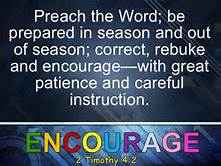
            Isn’t that wonderful encouragement for all of us? Instead of cowering in fear, or being a strict rule-follower or else! We are to know we are God’s people, followers of Jesus Christ, and led by the Spirit of God. Paul prays that the Thessalonian believers are to be encouraged – in their inner being.

“This is clearly a ministry of the indwelling Spirit of Christ. Against the wiles of this age, may we look in faith to the one who constantly surprises us with his love and inspires us with courage and confidence, enabling us to stand firm and not be overwhelmed by the vagaries of life. Our God will buttress us in our faith; this we can rightly ask in prayer, believing.” [3]

            The apostle Paul is truly being encouraging to his friends. Yes, they had some misunderstandings about what Paul preached to them, which Paul clarified. Yes, some of these believers were acting in ways displeasing or disappointing to our God, but at the end of the day and the end of this letter, Paul wanted to give encouragement and hope, not fear and dismay! We are to be cautious around churches and ministers who want to fix, manage and control every aspect of life! Paul leads with the grace of Christ, and the love of God. Period.

            And then, what should burst out of Paul but a benediction! Just as in the middle of the letter to the Ephesians, here at the end of the second chapter to the Thessalonians is a marvelous benediction. We will close with Carolyn Brown’s wonderful paraphrase of Paul’s words:

            “Remember that God loves you.  God chose you to hear about that love and to know the stories of Jesus.  Do not forget them.  Live by them every day.  And may God who created the whole universe, Jesus who showed us how much God loves us, and the Holy Spirit who guides us be with you giving you courage and strength to be God’s people every day.” [4]

@chaplaineliza

(Suggestion: visit me at my other blogs: matterofprayer: A Year of Everyday Prayers. #PursuePEACE – and  A Year of Being Kind . Thanks!


[1] https://www.workingpreacher.org/commentaries/revised-common-lectionary/ordinary-32-3/commentary-on-2-thessalonians-21-5-13-17-3

[2] https://worshipingwithchildren.blogspot.com/2016/09/year-c-proper-27-32nd-sunday-in.html

[3]  https://www.lectionarystudies.com/sunday32caiie.html

[4] https://worshipingwithchildren.blogspot.com/2016/09/year-c-proper-27-32nd-sunday-in.html

Unknown's avatar

A Time for Everything

“A Time for Everything”

Ecclesiastes 3:1-8, 11 (3:1, 11) – November 2, 2025

Time has a funny way of getting away from us, doesn’t it? Time can be rushing by while you and I are sitting, watching, on a treadmill or a big hamster wheel. Time is elastic, sometimes stretching out, tedious while we are waiting, other times jam-packed with events and decisions and happenings all on top of each other!

Our reading from Ecclesiastes 3 tells us a lot about time. This reading tells us about different facets of life, too. There is a time for everything. Everything under the sun.

This book of Ecclesiastes is traditionally thought to be written by the older King Solomon. We are pretty clear about Solomon’s birth and death dates. Scholars place this book about 935 or so, BCE. Again, this was late in Solomon’s life. As you and I consider this chapter 3, I invite you to consider the older Solomon. He was born with a silver spoon in his mouth, for sure. One of the favored sons of King David, he had it all! Money, property, women, power. The country of Israel was at peace, too! So, as he wrote this book, he was writing from a reflective, almost contemplative point of view.

I want us to zero in on Ecclesiastes chapter 3. One of my favorite commentators is Carolyn Brown, now retired Director of Children’s Ministry at a PC/USA church. She wrote a comprehensive collection of readings for each of the weeks of the 3-year Revised Common Lectionary cycle. I have often quoted her insights, as I will today.

            In this reading, our preacher lists 14 pairs of opposites. These opposites come from all areas of life, and some of these opposites are stark, and some are especially illuminating. In verse 2, as we see in a large part of the world, there are the changes of the seasons. All you and I need to do is to look outside and view the glory of the changing seasons in the colorful display of the leaves on the trees! We cannot plant seeds outside right now. It is not the time of year for that.  We can’t plant seeds in the winter, or harvest them in the spring.

            Verse 6 reminds us there are times we need to save things carefully – like putting aside clothes to wear again, or wear at a different season. There are other times when we need to let things go – like giving away old clothes or toys or other stuff we have outgrown. And, in verse 7, we see there is a time to be silent, and conversely, definitely a time to speak out! Sometimes, it is hard to know which time it is. [1] Hard, even soul-searching, indeed!

            As I considered this reading in depth, and in particular for my sermon preparation, my thoughts return again and again to verses 1 and 2. “There is a time for everything, and a season for every activity under heaven: a time to be born and a time to die.” Both birth and death are  part of God’s plan for our lives. Both birth and death are part of the cycle or circle of life.

            My online friend Michelle van Loon had this penetrating reflection. “King David’s last recorded message to his people includes words that foreshadow the message of the book of Ecclesiastes, which was written long after David’s death: David said, “We are here for only a moment, visitors and strangers in the land as our ancestors were before us. Our days on earth are like a passing shadow, gone so soon without a trace.” (1 Chron 29:15 NLT)” [2]

            These times today are uncertain times. As workplaces are restructured, businesses merge or close, or other structures in our lives are disrupted, many people lose their livelihoods. People across the country, even across the world, are in a place of not knowing, not understanding what is going on. Moreover, during the past week here in Chicago there is the uncertainty, even the trauma for our children, young people and seniors of watching masked, armed men pull people out of cars and off of sidewalks. Disappearing them, as unnamed troops habitually do in other countries with strong-arm governments. What kinds of long-term, traumatic reactions and effects are being sown in countless lives, hearts and brains here and now?

I have now been studying trauma and its effects on people observing traumatic events for almost two years, for my doctoral studies. This devastating activity in my own hometown and suburbs is completely beyond my understanding, given what I know about the founding of this country, and its welcome to immigrants from Germany, Poland, and an orthodox Jewish family – who I count as my ancestors. Which brings us full circle to All Saints Sunday, and lifting up the saints from this church, and from other churches and places and spaces throughout the world.

            Verse 4 from Ecclesiastes chapter 3 tells us, “a time to weep and a time to laugh, a time to mourn and a time to dance.” There are times when life is sad and we cry, for good reason. There are other times when life is so happy that we laugh a lot. We may prefer the happy, laughing times. But, God is with us in both happy and sad times. [3]  

            What is dawning on my mind and heart from this Scripture reading is that God has indeed set times and places in all of our lives. Yes, there are appointed times, and seasons for things and events to happen. Yes, there even is a time for churches to be planted, just as there is for churches to close. God indeed has the last word. God can make a way through. God opens a window in the skies, in the everlasting, sometimes sunny, sometimes cloudy day Solomon paints for us. God does indeed make everything beautiful in its time! Everything is in God’s time.

            I remind myself that I can be reassured, and comforted by these thoughts. We need to remember that God holds everything and all of us through it all, in all of our times. We can have certainty of God’s unending love. After all, it is because of my surety in God’s amazing and unending love that I have allowance and ability to explore, to even wonder about these important questions about time and the different facets of life, as highlighted by Ecclesiastes 3. As we pass from one season of time into another, I invite us all to ask: what comes to mind as we reflect on what has been, and as we begin to think about and articulate our hopes for what will be? [4]

We can reflect upon the saints who were in this place, and in other places we remember. “It is a ‘yes’ to God’s life moving through all things, calling us forward to changed lives and changed communities.” [5] And, we can look forward to the time that God has for all of us that lies ahead of each one of us.  

         As the litany we will share later in this service tells us, “Now, as we journey from this house into the future, we give you thanks O God. Be with us in thanksgiving as we move into other communities that will allow us to share the story, break the bread and live abundantly with God.  Alleluia, amen.

@chaplaineliza

(Suggestion: visit me at my other blogs: matterofprayer: A Year of Everyday Prayers. #PursuePEACE – and  A Year of Being Kind . Thanks!


[1] https://worshipingwithchildren.blogspot.com/2013/11/new-years-day-years-b-c.html

[2] A reflection post from Facebook, from Michelle Van Loon on October 23, 2025.

[3] https://worshipingwithchildren.blogspot.com/2013/11/new-years-day-years-b-c.html

[4] http://words.dancingwiththeword.com/2013/12/a-new-years-reflection.html

[5] https://www.patheos.com/resources/additional-resources/2010/12/happy-sacred-new-year-bruce-epperly

Unknown's avatar

God’s Law in Our Hearts

“God’s Law in Our Hearts”

Jeremiah 31:31-34 (31:33) – October 26, 2025

            Relationships are foundational to life. Positive, negative, distant, close.  Both of my parents are gone now, but I had a relationship with both of them. My sisters and brothers—again, I have relationships with them. Members of my extended family, too, are included in my list of relationships. Also my friends, acquaintances, colleagues, even my enemies. All of these people have relationships with me. Think about yourself. You have relationships with many, many people, too. Most of these people I just mentioned, if not all of them. Positive or negative, distant or close. We all have relationships—or friendships—with many people.

            But what about God? What kind of relationship do you and I have with God? Is that relationship good? Even wonderful? Is it close? Or distant? Bumpy at times?

            Our scripture reading for today talks about this relationship. Here. On this Reformation Sunday, we celebrate our clear relationship with God, the relationship that Martin Luther celebrated! But, the prophet is talking about it from God’s perspective. God’s view of the relationship, or the friendship, if you will.

            God wants to be friends. We’re not talking about a distant God, a God Who wound up the universe like a watch, put it on some shelf, and then walked away and promptly forgot all about it. No!! God wants to be in a relationship.

            If we look at this passage, we see that God had a relationship—a friendship, we could say—with the nation of Israel. God was the one Who started it. See what verse 32 says? God took the nation of Israel by the hand when God led them out of Egypt. God wanted the friendship. Israel did not start the relationship.

            We can compare that friendship to God’s friendship with us. God wants us as friends, too!  Just like the nation of Israel, God goes out of His way to make friends with us. You and me. Each and every one of us. God approaches us.

            But something happened. Something awful! The nation of Israel was not a faithful friend to God. The relationship was disrupted, broken. But God didn’t break it. No! Israel did. Remember the many, many times in the Hebrew Scriptures that Israel ran away from God? Or forgot about God? Or just plain ignored God? Time after time, we can read about how the nation stumbled, resisted, or was unfaithful to their friendship. Their relationship.

            A number of times in the various prophets’ writings, the relationship between God and Israel is pictured as a marriage. God is the husband, and Israel is the wife. God is always faithful, and Israel is not. Israel stumbles, falls, ignores her God, or just plain runs away in disobedience. Here in verse 32, the prophet tells us that Israel is unfaithful.

            What about us? What about you and me, in our on-again, off-again relationship with God? That is what Martin Luther talked about, so often. He had a real and abiding sense of his own sinfulness, his own unfaithfulness to God.

Isn’t it a lot the same with us? Don’t we stumble, or fall? Haven’t we forgotten about God a lot of the time, or even been unfaithful to our Lord? I’m thinking of sin. Putting other things in God’s place. Making other things or other people in our lives more important to us than God. 

            Our relationship with God is broken! Disrupted. Sometimes we grow so used to sinning, to being apart from God, that you and I cannot choose to do anything else.

            What a predicament! Our relationship with God—under the Old Covenant—is gone. Destroyed. We are sunk, there is not a chance for you and for me. But, wait! God does not leave us there! God still wants to be friends with us! With you, and with me.

God loves us so much that God is ready and willing to forgive our sin. Forgive us when we stumble and fall, when we put other things or other people in God’s place. God is ready to forgive absolutely. Unconditionally.

God’s nature is not punishing or arbitrary, but instead loving and forgiving. As Rev. Sharon Blezzard says, “as a Lutheran Christian I am called to re-formation on a continual basis. Even though I do die daily to sin, I also rise to newness of life; therefore, I am indeed always being made new. Thanks to the amazing gift of grace in Christ Jesus, I have options! I have a future, right here and right now.” [1]

            Just like Joseph, ruler of Egypt, freely forgave his brothers at the end of Genesis when they stood before him, God is more than willing to forgive us. Joseph’s brothers did some awful things to Joseph, but Joseph was ready and willing to forgive their treachery because of his love for them and for his father Jacob. How much more then is God able to forgive us for our falling short, for our running away, even for our disobedience! God loves us so much! . . .  God loves us this much! (spreads arms wide)

            This forgiveness is heart language, from God. The foundation of this forgiveness comes from our new knowledge of God, written on our hearts. And what is our response to God’s love? God’s forgiveness? God’s reconciling embrace? You and I have the opportunity to live changed lives, as changed people—from the inside out. God is not willing that anyone should be strangers, but instead that all would have the opportunity to be friends with God. Best friends.

God says it! Our Lord will be our God. We will be God’s people. And that’s a promise. That’s forgiveness. That’s the opportunity that each of us has to be with God, forever.

            Alleluia, amen.

@chaplaineliza

(Suggestion: visit me at my other blogs: matterofprayer: A Year of Everyday Prayers. #PursuePEACE – and  A Year of Being Kind . Thanks!


[1] https://www.stewardshipoflife.org/2015/10/oh-the-options/

Unknown's avatar

Continue – Persist – Be Faithful!

“Continue – Persist – Be Faithful”  

2 Timothy 3:14-4:5 (4:1-3) – October 19, 2025

Have you seen the comics lately? I’m sure everyone here is familiar with the comics section of the newspapers–the daily comics in black and white, and the Sunday comics in full color–even if you don’t read them regularly. Can you picture this scene from the comics? A single panel, showing two business men by an office water cooler. One looks like a boss, and he says to the other, “If there’s one thing I hate, it’s a yes-man. Isn’t that right, Baxter?”

We chuckle, because we all are familiar with that kind of attitude. I’m sure we can recognize that tendency in other guises, other forms. In some other places, not only a place of employment but also clubs, associations, even places of worship. Getting some yes-man to tell us what we want to hear . . . not what’s good for us to hear, not what we need to hear, but instead what we want to hear. This kind of black-and-white attitude is going way overboard!  

            As we consider this Bible reading from 2 Timothy chapter 3 today, let us reflect again on these words from the older man Paul to his young friend Timothy: “But as for you, continue in what you have learned and have become convinced of, because you know those from whom you learned it, 15 and how from infancy you have known the Holy Scriptures, which are able to make you wise for salvation through faith in Christ Jesus.”

            I suspect that Paul – and his friends, the other disciples, and other, older believers – could easily relate dozens of times that they had experiences in the faith communities they called home. Experiences where “yes-men” (or, “yes-people”) put in their definite opinions, where one group of people held up “tradition” as the gold medal standard, and everything had to bow before “tradition.” This “traditional” group of believers sound as intolerant as the “black-and-white” people I mentioned just before. A pendulum swinging way to one side or the other.

            Our commentator Dr. Dirk Lange says, “We have always done it this way” can mean anything from the worship of the early church to what a congregation has done for just the past twenty years. The writer to this particular church community, and especially to this follower named Timothy calls upon tradition. It is not to be ignored! “Continue in what you have learned” and not just recently but since your childhood.” [1]  You and I need to sit up straight and find out exactly what the older man Paul had to say about tradition! Or, is it about the Word of God, instead?

            The Hebrew Scripture reading for this Sunday comes from Jeremiah 31, and tells us that “The day will come when God’s word will not be on stone tablets or in books, but written into our very hearts.” This reading from 2 Timothy and the reading from Jeremiah are all about the Word of God! Except, how does that square with a concentration on tradition?

            When a pendulum swings, especially if it swings widely, we can watch the wide swing get more and more extreme. This is so similar to observing people with firm, set-in-their-ways opinions and manner of thinking and behavior.    

            Our writer Paul tells Timothy he could be sure of one thing: his firm foundation of the Word of God, taught to him by reliable elders in the faith. Not twisting this way and that, not susceptible to following “tradition” blindly, like so many sheep.

             But, Paul does not stop there. This is a letter to Timothy, after all. Timothy is a church leader, a pastor of a congregation, and Paul uses this letter to not only give advice to his younger friend, but to advise and instruct. “Timothy is instructed to be a faithful student and teacher of the Word.  Under that is the belief that to be a strong, true church a congregation must be made up of people who know their Bible well.” [2]  Not in the sense of bashing others over the head with their superior biblical knowledge, no! No, we are to use the Bible as a standard, as a measuring tape or yard stick to guide others along the road of journeying with Jesus.

            We have the assurance, from our scripture passage today, that Timothy had the opportunity to know God. He had the opportunity to read some of the same texts we have to read today! Timothy was instructed, from the time he was very young, in the way of salvation through Jesus Christ. His mother and grandmother were both women of faith, and Timothy grew up in a believing household, a household that put God first.

            The descriptive words to Timothy that Paul uses here are important: teaching, correcting, training. “The Scripture invites us into a pattern of gospel living. It does not provide “yes” and “no” answers to every situation, every question, every dilemma. Those who have “confessed” the faith in life-threatening situations understand that there are many gray areas, hard to resolve through Scripture alone (take the example of Dietrich Bonhoeffer or Martin Luther King, Jr.).”  [3]

I consider the commands in this passage to be good advice to anyone wanting to follow Christ more nearly, even in gray areas, even through difficult times. We are to proclaim the message. Communicate the Good News! In whatever way we can. How do we put it into practice? How do we live the Christian life? Now what, in other words?

            This command may give some people pause. How can I preach the Good News? Another way of thinking about it is . . . telling what God has done in your life. What has God done for you? How has God made a difference in your life? How has God made a difference in mine? What new things have you and I learned from the Lord lately? What an opportunity it is to share these things with others, with our friends, with those who might not know God.

            Thank God we have been given this Good News! I can tell about God’s faithfulness in my busy, hectic life. I can praise God for helping me to walk the Christian walk, one day at a time, and so can you. That’s truly something to celebrate. That’s truly Good News to share. Alleluia, amen.

@chaplaineliza

(Suggestion: visit me at my other blogs: matterofprayer: A Year of Everyday Prayers. #PursuePEACE – and  A Year of Being Kind . Thanks!


[1]  https://www.workingpreacher.org/commentaries/revised-common-lectionary/ordinary-29-3/commentary-on-2-timothy-314-45

[2] https://worshipingwithchildren.blogspot.com/2013/09/year-c-proper-24-29th-sunday-in.html

[3] https://www.workingpreacher.org/commentaries/revised-common-lectionary/ordinary-29-3/commentary-on-2-timothy-314-45

Unknown's avatar

Have Mercy on Us!

“Have Mercy on Us!”

Luke 17:11-19 (17:13) – October 12, 2025

            Ever been to the dentist, or the doctor, with a health complaint? Of course, you have! You all—we all have, at one time or another. Thank goodness, we live here, in the suburbs of Chicago. It is fairly easy to get good—or even, excellent medical and dental care, as opposed to the rural spaces in the United States, where health care is not as accessible. And, can you imagine outside of this country?

            Imagine living in the first century of the Common Era. In Jesus’ day, doctors were rare even in mid- to large-sized towns. When people had health complaints, there were some homeopathic remedies, true. And local healers, people who were good with herbs, poultices, and ointments. But for continuing problems or chronic diseases? There weren’t many options for any other kind of health care.

            Let us set the scene. Dr. Luke tells us, “Now on his way to Jerusalem, Jesus traveled along the border between Samaria and Galilee. 12 As he was going into a village, ten men who had leprosy met him.”  We have a situation with some chronically ill people. These people had skin diseases. Commonly referred to as leprosy, these skin afflictions could be anything from severe eczema to Hansen’s disease, what we now know today as leprosy. And any disfiguring skin problem, in between.chronic

            In Jesus’ day, there were priests and Levites stationed all throughout the land of Israel. These official people were not only on duty for the Sabbath day, for religious observance, but they had several other important duties under the law of Moses. Did you know that the priests and Levites could make rulings on whether a person was too disfigured, too blemished to live in close quarters with the rest of the townspeople?  True facts!

            This was an early example of a health code. The priests and Levites were among the first health inspectors! Because some of these skin diseases were contagious, and so the people who had them would contaminate others, the priests and Levites would have to exile them. Kick these former upstanding people out of town. Out of society, and isolated. Marginalized. Exiled. Called ‘unclean.’ Living far away from everyone and everything they once held dear. Ringing bells to warn others not to come near them. That was the situation for these ten lepers we read about in Luke’s Gospel today. What a lonely existence for these poor people.

            The Rabbi Jesus was on His way to Jerusalem with His disciples when he met these ten men, on the border between Galilee and Samaria. This is yet another time that our Gospel writers tell us that “Jesus is again in a border region, again crossing boundaries and wandering where he probably shouldn’t go, and again healing people with whom he has no business interacting.” [1] Commentator Dr. Davis Lose reminds us that Jesus is again doing something out of the ordinary. In fact, extraordinary!  

            Let us consider that this unconventional Rabbi Jesus is not only crossing geographical boundaries and wandering – traveling where “good, rule-keeping Jews” just don’t go. But, Jesus is also interacting with these ten lepers! These men obviously kept at a distance from all other “normal” or “regular” people, except I am certain they had heard of this miracle-working Rabbi! Can’t you just hear the anguish and the hoping-against-hope in their voices as they cry out, “Jesus, Master, have mercy upon us!”  

            Jesus’ response is simple. Straight-forward. “Go, show yourselves to the priests. I can just imagine these ten men, told by Jesus to go and show themselves to the priests in town. Except, Jesus told them to go before He had done the act of visibly healing them from their skin disease. They needed to act, they needed to start to go before they saw what had happened.

            Have you ever needed to go on faith, and start an action, go on a trip, take a step without knowing for sure that God is right there with you? And, the whole idea of a borderland, an in-between place that is neither one place or the other. Doesn’t God meet us right there, before healing is completely complete?  [2]

That’s all Jesus says to them. The verb in Greek means ‘show, or point out something to someone.’ Remember, I said the priests were the health inspectors of that day? Can you understand these ten guys, isolated, banished, marginalized. And Jesus says, “Go, show yourselves to the priests.”

            Lo and behold, “as they went”—that is, in the going—“they were cleansed.” Do you understand? These poor, lonely people believed Jesus, had faith, and were healed as a result. We are not told exactly how they discovered it, but it probably didn’t take too long.

            One ex-leper, out of the original ten—one ex-leper comes back to thank Jesus. Glorifies God! Comes to Jesus and prostrates himself at His feet. Once the Samaritan realized he’d been healed, he couldn’t help but turn back and share his joy and thanksgiving with Jesus.

            Thanksgiving is like that. When it’s genuine, it’s spontaneous—you recognize you’ve been blessed and can’t help but share your joy through thanksgiving.

“Have you ever noticed just how powerful it is not only to receive blessing but also to name it and give thanks for it? Maybe you’re at dinner with family or friends, then you lean over to another, or maybe raise your glass in a toast, and say, “This is great. This time, this meal, you all. Thank you.” And in seeing and giving thanks, the original blessing is somehow multiplied. You’ve been blessed a second time.” [3]

The Samaritan knows he’s been given a gift and can’t help turning around to say something. In doing so, he’s given a second gift: He leaves his encounter with Jesus not only healed but also blessed in his own recognition of healing, blessed at being drawn into deeper relationship with the one he thanks, blessed at hearing himself commended for having great faith.

Imagine the huge difference that must have made in his life. That’s the way thanksgiving works—in giving thanks for gifts given to us, we are blessed again. We can all say alleluia, Thanks be to God!

@chaplaineliza

(Suggestion: visit me at my other blogs: matterofprayer: A Year of Everyday Prayers. #PursuePEACE – and  A Year of Being Kind . Thanks!


[1] https://www.workingpreacher.org/dear-working-preacher/second-blessing

[2] https://www.umcdiscipleship.org/worship-planning/choosing-faith/eighteenth-sunday-after-pentecost-year-c-lectionary-planning-notes/eighteenth-sunday-after-pentecost-year-c-small-groups

[3] https://www.workingpreacher.org/dear-working-preacher/second-blessing

Unknown's avatar

In These Last Days

“In These Last Days”

Hebrews 1:1-4 (1:2) – October 5, 2025

            Can you think of an excellent host or hostess you know? Perhaps one or your friends or family? Celebrating or hosting is a big part of coming together as friends, as family, for all kinds of festive occasions. Some people are especially blessed with the skills, gifts and graces that are part and parcel of being a wonderful host or hostess. Today is World Communion Sunday, and our Lord Jesus is our heavenly Host today at this service.

But first, we need to take a closer look at our Scripture reading for today. The letter to the scattered Hebrews (Jews who believe in Jesus as their Messiah) was a circulating letter, traveling from place to place, copied and sent from one small group of believers, one congregation to the next. In order to understand this letter more deeply, we need to look at it as directed to people with a Jewish understanding, and a Jewish viewpoint.

“God spoke to our ancestors in many times/ways through the prophets, but now God speaks through the Son” – in the same way, we can view the older Hebrew Scriptures as God speaking through the prophets (and writers of narrative and poetry), but now (as in the New Testament), God speaks through the Son, our Lord Jesus Christ – especially in the Gospels.

Jesus – before He came to the earth and emptied Himself of all God-hood to become a little baby born in Bethlehem – created the universe at the beginning of time, and Jesus is the one who will possess all things at the end of time. So, before the beginning and after the end – there was the Son long before His incarnation, the second person of the Trinity. Before the universe, before the Big Bang and all things were created, there was the pre-incarnate Son.

 Plus – Jesus sustains/continues/upholds the universe with His powerful Word. The Word that had the creative force in the beginning of time!

Let’s think about that creative force for a moment. In chapters 8 and 9 in The Magician’s Nephew, one of the Chronicles of Narnia, C.S. Lewis has the Great Lion Aslan walking around on a brand new world. The Lion is singing, and the sheer creative force is magnificent, as shown by the reaction of all creation, land, water and sky to the sounds and the notes of Aslan’s powerful, creative voice. [1]

Yet, that is not all! We can see the writer of the letter to the Hebrews goes on to tell us more about what Jesus did. After Jesus finished His work on earth and achieved forgiveness for all sins for all human beings (for all time), the resurrected, ascended Jesus SAT DOWN in heaven. This goes along with what Paul says in the first chapter of the letter to the Ephesians, 1:20-22, which sounds quite a lot like Hebrews 1:3 from our reading today.

In the worship in the Temple before the first century CE, even at the time that the Rabbi Jesus was walking around Palestine for three years before His death, resurrection and ascension into heaven, Jewish priests continually stood up when they did their work in the Temple. That was the way of it. That was how priests went about their priestly duties, continually standing before the Lord, continuing to offer sacrifices for sins, making atonement for the sins of everyone who came to them.

Except – our Lord Jesus was not like the earthly priests. The apostle Paul said Jesus sat down in heaven, and no longer had to continually stand and continue to offer sacrifices to the Lord. Here in our reading today, the writer of the letter to the scattered Hebrews (or, Jews) tells them that Jesus “sat down in heaven at the right side/hand of God, the Supreme Power.”

As our commentator Carolyn Brown retells these three verses from Hebrews chapter 1, she says “Jesus was one with God at the beginning of everything and will be one with God after everything ends. Jesus worked with God on creating the whole world and keeps taking care of it. In Jesus of Nazareth God lived among us as a person and allowed himself to be crucified. Jesus is God in human skin.  Everything we know about Jesus tells us what God is like.  Jesus Christ forgives us.” [2]

Do you understand how powerful that declaration is? As one of what I consider one of the most meaningful gospel songs says, “Jesus paid it all! All to Him I owe, Sin had left a crimson stain, He washed it white as snow.” This is one of the reasons we celebrate Communion, or the Lord’s Supper, because we are so grateful to Jesus for being the Lamb of God, who as our reading today tells us, “achieved the forgiveness of sins for all human beings.”

The first Sunday of October is World Communion Sunday in most congregations.  Not only set apart for children and young people, but for everyone. “That means raising awareness that Christians all around the world are one big family.  We may have skin of different colors, wear different clothes, speak different languages, and do all sorts of different things, but we are all baptized and we all share communion.” [3] 

Do you hear? All believers, worldwide, are all one big family. That means that we all come together around the communion table, from north and south, from east and west, from every tribe and people-group and nationality. Across national borders, regardless of languages spoken, paying no attention to differences of politics, or of allegiances, of national dress, or of regional separations.

All of these earthly differences do not matter to eternity. Jesus tells us so. All are welcome at the Lord’s table. And, it is His table. As I have said many times before, on many Communion Sundays in the past 11 and a half years, this is not St. Luke’s table. It is not the United Church of Christ’s table. It is not the Protestant Church’s table. Instead, this is the Lord’s table, and our Lord Jesus says all are welcome.

We can see how great God’s love is for humanity through the incarnation. Yes, God sent God’s son to earth to become human, live among us, and die for us. And, on this World Communion Sunday, we remember how our Lord Jesus provided communion for us, as a sacrament, a means of grace, and to remember Him.

Through the centuries, all believing Christians have celebrated this meal, this Lord’s Supper, in remembrance of Him. “Today, through World Communion, we also celebrate that though each church does things differently, we each and all of us need God and God’s grace. By participating together around the world in Holy Communion, we celebrate our common need for God, and together we celebrate receiving His love and grace.” [4]

This weekend is a jam-packed weekend, indeed. Not only is today World Communion Sunday, but yesterday was the feast day of St. Francis of Assisi. Many faith traditions celebrate with a Blessing of the Animals this weekend. St. Francis is not only a patron saint of animals, he is also the patron of all creation, or the natural world.

As we reflect on our Lord Jesus, God’s Son before the beginning of time and after the end of time, I want to end our sermon today with a benediction; the final verse from the hymn that is attributed to Francis, “All Creatures of Our God and King.”

Let all things their Creator bless, and worship Him in humbleness,
O praise Him! Alleluia!
Praise, praise the Father, praise the Son, and praise the Spirit, Three in One! O, let us praise God, indeed! Alleluia, amen.

@chaplaineliza

(Suggestion: visit me at my other blogs: matterofprayer: A Year of Everyday Prayers. #PursuePEACE – and  A Year of Being Kind . Thanks!


[1] Lewis, C.S., The Magician’s Nephew (Macmillan Publishing Co., New York NY, Collier Books edition: 1970), 101, 104-07.

[2] https://worshipingwithchildren.blogspot.com/2012/09/year-b-proper-22-27th-sunday-in.html

[3] Ibid.

[4] https://onthechancelsteps.wordpress.com/2013/09/22/same/

Unknown's avatar

Abide in God’s Shelter!

“Abide in God’s Shelter!”

Psalm 91:1-6, 14-16 (91:2) – September 28, 2025

            I have had a number of times in my life where there was a lot of uncertainty. I am thinking of one extended time, in particular. When my older daughters were toddlers and preschoolers, my former husband and I did not have any health insurance. For years. Our girls were small, and we lived paycheck to paycheck, barely scraping by. For years.

            Times like these are downright scary, whether people have economic problems (like my family did), or health reversals, emotional or psychological concerns, or physical safety!  

            Listen to a first-person account from one of our commentators. This happened to him in rural India while he visited a missionary outpost. “As we were climbing a steep rugged narrow path, Premakar, our home missionary of Dangs cautioned us, “Wagh, Wagh” (tiger). We stopped and our torches flashed at the beast which was 200 yards away. Its glittering eyes menacingly glared at us. In spite of the blinding lights it was advancing towards us. Helpless we turned to Jesus in prayer. To our great relief the beast slinked away. We continued our journey. But within a few yards our petromax [our bright lights] failed. Just imagine our plight! It seemed ages before the petromax was fixed. After a short while a poisonous snake slithered past us and the promises of Psalm 91 sustained us.” [1]

I am not sure if you have ever had such a wild time of uncertainty in your life, but it can be beyond worrisome. Times like that can make a person anxious, fearful, even frantic. Our commentator goes on: “Thankfully the cobras and other poisonous vipers were in hibernation during my stay in the mountain village of Chikaldara. The tigers and bears, while inhabiting the area, did not harm me either. Nevertheless, my sense of danger was much more intense while walking in the darkness or through the tall grass, where some creatures could be lurking.” [2]

Just listen to these words from our reading today, Psalm 91. “Surely he will save you from the fowler’s snare and from the deadly pestilence. You will not fear the terror of night, nor the arrow that flies by day, nor the pestilence that stalks in the darkness, nor the plague that destroys at midday.”

            This reading describes a lot of unpleasant, downright dangerous things that can happen to a person. “There is a thread in this psalm that feels … dangerous. Angels will bear you up so you won’t dash your foot on a stone? Treading on lions and snakes? No scourge will come near your tent? Dangerous, and conditional: Those who love me I will deliver; I will protect those who know my name. What about those who don’t know, because they haven’t been told or haven’t been told in a way that makes sense to them? What about those who don’t know how to love You yet? Are they, are we just on our own if we find ourselves in that category, temporarily or permanently?” [3]

            I care deeply and feel for any frightened, anxious people. For, that is exactly what this psalm mentions. This psalm cautions, and gives insight, allowing you and me to get a picture of what part God plays as we go through all the trials and struggles of life.

            Verse 1 is the starting point for this psalm, the lens that aids us in reading the rest of the psalm. “God delivers because God is our shelter. God will rescue us when we call because we live in God’s shadow. People need to feel safe and secure to be brave. Notice that the psalmist encounters pestilence, arrows, and destruction as they live in the shadow of the Almighty. We need the security of abiding in God so that we can brave the trials and struggles of this life together.[4]  Can you think of a time of uncertainty in your life when you felt for sure that God was with you? When you knew for sure that God was your shelter, or shadow, or refuge? God can send this assurance into our hearts.

            And sometimes, even if it’s an extended time of uncertainty like the one my family with young children and I went through for several years straight – economic insecurity – God is still there. There is a saying: I believe in the sun even if it is not shining. In the same way, I believe in God even if the path ahead is rocky. You and I can have a deep sense of being held by God, even when answers are unclear. God can be trusted!

God is present even though we go through scary times or personal difficulties. Whether people have economic problems (like I did), or health reversals, or emotional or psychological concerns, we can trust in God’s presence. Even at the same time while we are afraid! The two feelings are not mutually exclusive, especially when we consider some really serious things like natural disasters, regional conflicts, or other catastrophes that happen beyond our control.   

            Let’s look at the last verses of this psalm. 14 “Because he loves me,” says the Lord, “I will rescue him; I will protect him, for he acknowledges my name.15 He will call on me, and I will answer him; I will be with him in trouble, I will deliver him and honor him.”

Can you imagine God speaking these words directly to you? Can you hear God saying to you, “I will rescue you, I will protect you. I will be with you in trouble and deliver you.” How does that feel, to have God lovingly responding with words of rescue, protection and long life? It is so comforting and protecting, to have God saying these things to me, personally! It is a promise I – we – didn’t even know we needed. Truly, it is a reminder that God really does see and respond to our deepest needs and cries of our hearts. [5]

            Right now, we can create a sense of safety. Here and now. We can take time to breathe. Right now. Breathe in, deeply – and breathe out, slowly. Let’s do it again. Breathe in, deeply – and breathe out, slowly. Breathing calms each of our collective nervous systems. Roll your shoulders slowly, backwards, and forwards. And, continue to breathe.

            We are, indeed, safe, living in the shelter of God. Please, bring that safety to others. Invite others to abide in God’s shelter, no matter what is happening in each individual life, in each personal situation. Because, difficult things will continue to happen. Troubles and challenges continue to crop up unexpectedly. And – and, each of us is held in God’s hand. We all can bravely face the world with strength and hope. We can all trust in God’s presence, knowing that our security comes from our God, who truly is our refuge and fortress. Alleluia, amen.

@chaplaineliza

(Suggestion: visit me at my other blogs: matterofprayer: A Year of Everyday Prayers. #PursuePEACE – and  A Year of Being Kind . Thanks!

(I would like to express appreciation for the Rev. Anthony J. Tang, one of the ministers at First United Methodist Church of Dallas TX, and his excellent small groups presentation featured on www.umcdiscipleship.org. Several of these suggestions come from that presentation.)


[1] https://bible.org/seriespage/9-psalm-91-psalm-safety

[2] Ibid.

[3] https://www.umcdiscipleship.org/worship-planning/i-will-call-upon-the-lord/sixteenth-sunday-after-pentecost-year-c-lectionary-planning-notes/sixteenth-sunday-after-pentecost-year-c-preaching-notes

[4] https://www.umcdiscipleship.org/worship-planning/i-will-call-upon-the-lord/sixteenth-sunday-after-pentecost-year-c-lectionary-planning-notes

[5] https://www.umcdiscipleship.org/worship-planning/i-will-call-upon-the-lord/sixteenth-sunday-after-pentecost-year-c-lectionary-planning-notes/sixteenth-sunday-after-pentecost-year-c-small-groups

Unknown's avatar

Prescription for Prayer

“Prescription for Prayer”

1 Timothy 2:1-8 (2:1-3) – September 21, 2025

It’s good to be in the habit of doing certain things. Say, going to the gym. Exercise is a beneficial thing, and if I go to the gym on a regular basis, like three times a week, I will be healthier for it. Same for other things—like practicing the piano, practicing swimming or square dancing—it’s beneficial to get into the habit of regular repetition, week in, and week out.   

Worship and prayer are regular, comfortable things, things many churches do the same way, week in and week out. Here in our scripture reading today, Paul gives his younger friend Timothy some words of wisdom. Recommendations, if you will, of some things Timothy’s church can do in worship and prayer that will be beneficial to them all.

Reading again from 1 Timothy 2, “I urge, then, first of all, that petitions, prayers, intercession and thanksgiving be made for all people— for kings and all those in authority, that we may live peaceful and quiet lives in all godliness and holiness. This is good, and pleases God our Savior.”

I’ll stop right there. Not because the rest of the reading is unimportant. No! But, because Paul has so many ideas that are bursting out of him one on top of the other, I am afraid we might be overloaded if I read them all.

I am on social media, daily. I feature some things regularly, including my Daily Prayer posts. I have posted Daily Prayers on my public Facebook page for five years now. I see it as something I can contribute for my Facebook friends, and for friends of friends, too. I post a prayer each evening that I find meaningful, and I hope they can be helpful to others, too.

Other people have regular habits or practices of prayer and meditation. That is what the Apostle Paul talks about here! I am in a doctoral program for Spiritual Direction, which some people refer to as spiritual companionship. That’s coming alongside of another person, or a small group of people, being a long-term companion. Walking with them, sitting with them through their joys and through their difficulties and sorrows. I have a heart for listening to people’s stories, challenges, and difficulties in their lives. Plus, I pray with people through these things.

You recognize that is what we do in church, don’t you? In our Intercessory Prayers each week, we – as a congregation – come alongside of individuals and families and pray with them through their joys, challenges, and various difficulties. That is exactly what Paul tells Timothy to do here! This reading is a prescription for intercessory prayer in a worship service!

I know that believers and followers of Christ, Paul and Timothy were very much in the minority in their communities. The majority opinion and the overwhelming cultural context for both of them was one of a worldly avarice, where people were concerned about “me, first!” and “where’s mine?” This call to intercessory prayer was very counter-cultural!

Let’s look again at what Paul recommends. Paul begins the chapter by encouraging Timothy to offer prayers for all members of the human family during church services.He wants petitions, prayers, intercession and thanksgiving – all integral parts of praying – to be made for all people. That is not just for a few, or a family, or “only for our little, insular group of people.” No! Paul is recommending to Timothy that we pray for ALL people.

He mentions prayer in the terms of: petitions (humble, general requests to God), intercessions (requests, pleading for those in need), supplications (requests for ourselves, especially when faced with a crisis) and thanksgivings (expressing gratitude for blessings we receive). [1] All people need to be held up to God in prayer.

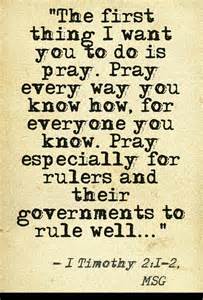
That means for everyone. Period. Even for mean people. Even for people we disagree with. Even for people who don’t look like us. As the modern translation from “The Message” of this reading begins, “Pray every way you know how for everyone you can.” Period.

Especially in the past few years in this country, division, discord, and dissension of large portions of the American population has only speeded up in the last few years, fueled by increasingly divisive rhetoric, shrill podcasts, and fraught news reports, as well as the regional and national conversations.

As Rev. Sharon Blezzard said, “Good news doesn’t usually sell publications or improve ratings. It takes bombast, divisiveness, and catty, snarky repartee to make headlines, not prayerful peacemakers standing in the breach attempting to reknit brokenness in quiet relationship building and listening. But we are called to a different way of being, to a stewardship of self and other that places value on people, on relationships, and on the building up of community.[2]

God has not called us to be snarky or mean, nasty or divisive. God does not want big bullies on God’s team. I have never heard of God approving of or cheering on hateful, spiteful Christians, either.

Instead, when we “Pray every way you know how for everyone you can.,” Paul reminds Timothy that “This is good, and pleases God our Savior, who wants all people to be saved and to come to a knowledge of the truth.”

Remember what the situation was for Paul and Timothy, and for all other believers in that first-century time and place. It is the same for us, today!  “We are called to be counter-cultural witnesses to God’s love, mercy, and saving grace. We cannot be a witness if our hearts are filled with hate. We cannot love our neighbors if we aren’t willing to get to know them, and certainly not if we aren’t willing to stop working violence against one another.” [3]

      Paul tells us we are to pray for all people; and we are to follow Paul’s lead in supplications, prayers, intercessions and thanksgivings. The intention of such prayers is so that we Christians in society will be able to live tranquil and quiet lives. This isn’t me saying it. It’s the apostle Paul! 

Regardless of whether there is peace in our church, peace in our neighborhood, or peace in our country, prayer is always a good idea. Having a close relationship with our Lord and Savior Jesus Christ is the reason we are here. Praise God! Thank You, Jesus. Alleluia, amen.

@chaplaineliza

(Suggestion: visit me at my other blogs: matterofprayer: A Year of Everyday Prayers. #PursuePEACE – and  A Year of Being Kind . Thanks!


[1] http://www.lectionarystudies.com/sunday25ce.html Rev. Bryan Findlayson, Lectionary Bible Studies and Sermons, Pumpkin Cottage Ministry Resources.

[2] https://www.stewardshipoflife.org/2016/09/calling-all-prayerful-peacemakers/

[3] Ibid.

Unknown's avatar

Losing and Finding!

“Losing and Finding!”

Luke 15:1-7 (15:7) – September 14, 2025

            Lost and found—this concept is very real and meaningful to many people, especially children. I have four children, and at various times, they have had to go looking for various possessions of theirs. You know, small items, things that were very precious to them somehow got lost. And oftentimes, they went looking everywhere for those precious things.

            I can remember when my son was younger, probably in first grade. He had a favorite stocking cap he wore almost every day in the winter. He wore it to school, out to play, on the weekends, almost everywhere. And then, one day it got lost. My son could not find it anywhere. He was heartbroken at the loss of this precious stocking cap—precious to my son, at least. We searched everywhere—and I mean everywhere—in the house, in the car, in his classroom, in his locker. He even looked in the lost and found at his school. Sadly, we never could find it.

Can you relate? Have you ever lost anything that was precious to you? Maybe not valuable in a monetary sense, but precious to you, your very favorite. And let’s go further. What about the things that are worth a great deal? Valuable in a very special way, in terms of both monetary and sentimental value. Losing something precious can be quite a blow.

            This is exactly what our Lord Jesus talked about in our scripture passage today. He tells the parables of the lost things. In fact, one nickname for this chapter, Luke 15, is the chapter of the lost things—the parables of the lost sheep, the lost coin, the lost son.

            Dr. Luke sets the scene for us. He says, “Now the tax collectors and sinners were all gathering around to hear Jesus. But the Pharisees and the teachers of the law muttered, “This man welcomes sinners and eats with them.” Tax collectors and “sinners” were two groups of people who were especially hated by the good, synagogue-going Jews! And, especially by the Jewish leaders, the Pharisees and teachers of the Jewish law, who had particularly high standing in their local community! How dare that upstart Rabbi Jesus waste His time with riff-raff, with no-good, low-class, dregs of society?  

            And, that’s not all the Rabbi Jesus is doing! “Eating — that is, sharing table fellowship — is a mark of camaraderie, acceptance, and friendship. And so in eating with tax collectors and sinners, Jesus is demonstrating a deep and abiding acceptance of those society has deemed beyond the moral pale.” [1] 

            In response to this complaining and carping from the Jewish leaders, Jesus has a response. Three responses, in fact. This week we look at His first parable, the parable of the Lost Sheep. As with many of the parables of Jesus, this one starts out in a straight-forward manner, but somehow doesn’t set quite right.

Jesus says, “Suppose one of you has a hundred sheep and loses one of them. Doesn’t he leave the ninety-nine in the open country and go after the lost sheep until he finds it?” In other words, if you are a shepherd, you put the other 99 sheep at risk! You leave them in the wilderness, with no protection or shelter while you go seeking the one that is lost! And, how about that lost sheep? How does that sheep feel? Lonely? Hungry? Injured? Scared?

From an accounting, balance-statement point of view, the loss of one percent of your stock or flock is an acceptable business loss. Why do we need to leave 99 sheep at dangerous risk? Just for one, single, measly little sheep? But, God does not take that point of view!

Sometimes, people – individuals – get lost. Can you and I relate? “Sometimes you can identify why you feel lost and other times you simply feel unmoored — unable to give a name or reason for a sense of confusion, disorientation, bewilderment, abandonment, loneliness — all of which can be manifestations of lostness.” [2]

            I work during the week as a full-time hospice chaplain. It is sometimes my heartbreaking job to go to see patients in dementia, and sometimes even severe dementia. I would like us to listen to this heartfelt vignette from Pastor Janet Hunt, about a longtime family friend.

“Norma became not only a family friend. She was our church secretary (back when we called them that) at my home congregation for forty years. What I especially remember most about that time was that she would listen and answer and go deeper with me about whatever it was we had learned in class that morning. There are a lot of people whose influence factors into one heeding the call to become a pastor. Norma was certainly one of those for me.

“I know that I am blessed to serve not so far from home for I have the chance sometimes, still, to connect with those I knew when I was young. I especially knew it this last Saturday morning for Norma’s son called me up to ask my thoughts about nursing home options here. Both of their parents’ health are failing and her Alzheimer’s Disease, in particular, is making this next move necessary. 

“Sunday afternoon I went to see Norma. I sat down next to her daughter and we visited a while. I don’t know for sure if she really remembered me or not, but her smile was as radiant as it ever was. Before I left, I asked if I could pray with her. She placed her hand palm down on the tray table in front of her. I put my hand on top of hers and her daughter put her hand on top of mine. I prayed simply and briefly – asking for God’s protection and strength and peace. When Norma took her hand back, she wiped her eyes for those words had somehow broken through. 

“She may only have pretended to remember me, but still she knows somehow that God remembers her. Slowly but surely the disease that is erasing her memory will not finally erase what matters most. In some ways, she may seem ‘lost’ to those who have loved her, but she is not lost to God. I expect, or at least I hope, that in that moment she knew God’s persistent love embracing her once more. ‘Found’ once more, I hope her comprehension of God’s tender love for her never leaves her.” [3]

No matter how we are lost, how we are wandering in the wilderness, in the hospital or care center, or when we concentrate so much on our physical or financial situation, or in the busy-ness of life, running from place to place – God never stops seeking us. We know who is loving and caring and seeking for each of us.

Which of you, Jesus asks, would go to such lengths to search and find and then welcome back and celebrate? Truth be told, none of us would. But God would. [4] Our Good Shepherd goes after me, and after you, too. He searches for us, and makes sure that we are back with Him, in the place of security and protection, and says, “Rejoice with me! For I have found my sheep that was lost!” To me, the news about our good Shepherd is the best news in the world. Alleluia, amen.

@chaplaineliza

(Suggestion: visit me at my other blogs: matterofprayer: A Year of Everyday Prayers. #PursuePEACE – and  A Year of Being Kind . Thanks!


[1] https://www.workingpreacher.org/dear-working-preacher/lost

[2]  https://www.workingpreacher.org/dear-working-preacher/lost-and-found

[3] http://words.dancingwiththeword.com/2013/09/lost-and-found.html

[4] https://www.workingpreacher.org/dear-working-preacher/lost

Unknown's avatar

God Knows Us Full Well

“God Knows Us Full Well”

Psalm 139:1-6, 13-18 (139:14) – September 7, 2025

If you look at the news online, or on television, or listen to the radio or podcasts, many people often look for knowledgeable experts. Experts in their field or craft. People who know things. Think about it: cooking shows have culinary experts, home repair shows have building experts, news reports have experts in various fields, talk shows have behavioral experts to help solve the relationship problems of society, even newspapers have horoscopes written by psychics who are supposedly experts in astrology. Expert opinions!

            This craving for information, for people who know about things … I am afraid that I get sucked right into it. I go to people who are experts in their fields, and try to pick their brains and get what information I can, so I can masquerade as a sort of an expert, too. I like to think I know about things. And, I do. I know lots of things. I know lots about how to be a chaplain, and about music, and about the Bible, but that doesn’t hold a candle to the amount God knows! 

            God knows—now there is an expert opinion. Let’s look at the scripture reading for today. “O LORD, You have searched me and known me, You know when I sit down and when I rise up, You discern my thought from far away.” That truly is knowing. God knows every part of me. King David wrote this psalm many centuries ago, and its message still strikes home and hits my heart with penetrating directness.

            These verses from this psalm are among the most direct and poetic description of God’s omniscience in the whole Bible. Omniscience. Knowing absolutely everything. That’s a pretty scary thought, if we sit down and think about it.  It’s a good thing that God is loving, caring and merciful. We just have a shadow of understanding about how God knows us, yet it’s a loving, caring and intimate knowing. The omniscience of our knowing by our heavenly Father.

            When a word is repeated in a passage in the Bible, that is a way of underlining that word, indicating that word is particularly important. The Hebrew word “yada,” or “to know,” appears in today’s reading four times. The emphasis of this rich biblical word, this “concept of ‘knowledge’ is a critical element of meaningful relationship. We are to know God, just as God knows us.” [1]

            When you and I contemplate God, the totality, the tremendous experience of God’s knowledge is just “too wonderful” for us! That is us, as limited humans, trying to understand and contemplate the Lord. That is the eternal God who created the heavens and the earth! We read here in Psalm 139 that God’s capacity for knowing is utterly beyond comprehension, so far beyond us limited humans that we feel like we are reaching up to touch the moon, much less the stars in the sky. King David said, “so high that I cannot attain it,” in verse 6. And yet – God wants to be known! Known by us.

            This Sunday is when the church in Scotland celebrates the beginning of the season of Creation, when we celebrate God creating the world, the galaxy, the whole universe. As we contemplate God’s vast creative power, let us consider the creation of a single human life. Our psalmist considers it, too! Verse 13 says, “For you created my inmost being; you knit me together in my mother’s womb.” This is a glimpse of the psalmist’s understanding of the nature of God, of knowing God!

“This points to a God whose love for God’s own creation extends to concern, since this human creation is finite and therefore not perfect. Yet, it does not lessen but instead heightens the amazing and magnificent artistry of God’s creation. Indeed, this recognition becomes reason for praising God and affirming the self’s ultimate worth in the sight of God (v. 14).” [2]

God knows. God knows my circumstances, knows whether I’m sitting or getting up or lying down. God even knows what I’m thinking, before I can say a word. Talk about being an expert! The Lord knows my psychological makeup, my emotions and my heart, so much better than I do myself.

            It’s a good thing to get to know ourselves. It’s a worthy study, and one that would be useful in helping us to understand others. I like to tell myself that I know myself pretty well. I’ve seen a therapist for a number of years who has helped me come to understand my own thoughts and emotions better. He’s helped me to understand how I relate to others and why I act and react in certain ways. At times, after years of therapy, I may fancy myself somewhat of an expert on myself. But in reality, I am not. Sometimes I may think I am, but I’m just fooling myself.

            God knows everything about me, too. Everything. God knows all the flaws, all the rough spots, every praiseworthy feature as well as everything that isn’t. And–here’s the amazing part–God loves me anyway! Even with all that intimate knowledge about every single aspect of our character as well as our character flaws, God loves us anyway!

And, it isn’t just all about me. God knows each of us in the same way. He knows each one of you, intimately, too. The Lord has searched you and known you, and is acquainted with all your ways. And, God loves each of us, even more intensely than we can possibly imagine.

            Sometimes, certain authors have a way of capturing an idea in a special way. It’s that way with Max Lucado, a recent Christian author for both children and adults. I know I have referenced this before, and it’s just so good that I have to quote it again! This is a quote from Prayer: A Heavenly Invitation, which describes just the idea I’ve been trying to communicate.

            ”If God had a refrigerator, your picture would be on it. If He had a wallet, your photo would be in it. He sends you flowers every spring and a sunrise every morning. Whenever you want to talk, He’ll listen. He can live anywhere in the universe, and He chose your heart. And the Christmas gift He sent you in Bethlehem? Face it, friend. He’s crazy about you.” [3]

            Friends, God knows all about us, and He loves us anyway. What else can we do but fall on our knees before God in praise, thanksgiving and adoration? Thank God for His boundless love towards you and towards me.

            Alleluia, amen.

@chaplaineliza

(Suggestion: visit me at my other blogs: matterofprayer: A Year of Everyday Prayers. #PursuePEACE – and  A Year of Being Kind . Thanks!


[1] https://www.workingpreacher.org/commentaries/revised-common-lectionary/second-sunday-after-epiphany-2/commentary-on-psalm-1391-6-13-18-2

[2] http://www.theafricanamericanlectionary.org/PopupLectionaryReading.asp?LRID=27

[3] Prayer: A Heavenly Invitation – Max Lucado

Unknown's avatar

Sacrifice of Praise

“Sacrifice of Praise”

Hebrews 13:5-8, 15-16 (13:15) – August 31, 2025

            Have you ever known anyone who was really proper? Always every hair in place, always did the socially acceptable thing, and never put a toe out of line? Imagine a stern teacher, keeping order in the classroom by a mere look and a slow stare. Someone with high standards. Thinking about satisfying this kind of person makes me anxious, and nervous. I always need to be on my best behavior, minding my p’s and q’s. Just being around someone like this puts me on edge.

            But, what about putting God into the conversation? I know we are probably stretching our imaginations, but it is hard to imagine God wearing a wrinkled shirt, or with a sloppy haircut, or having a dirty face. For that matter, isn’t God perfect? Isn’t God prim and proper, always doing the right thing, never stepping out of line? Doesn’t God have incredibly high standards? Don’t we need to be on our best behavior with God, minding our p’s and q’s? Doesn’t that sum up many people’s conception of God?

Our Scripture reading today can sound like a list of rules. Do this! And, do that! And, don’t do this other thing! I can just imagine several stern Heavenly angels frowning, shaking their fingers at me if I step out of line!

However, the letter to the Hebrews was written to a bunch of scattered Jews who believed in Jesus as their Messiah, scattered in small groups throughout Asia Minor. What we know as Turkey, today. They had been chased out of Palestine by the Jewish and Roman authorities. Many of these scattered Hebrews were refugees. Migrants. People chased out of the land of their birth by an oppressive government that was out to imprison them, if not kill them, because they claimed Jesus as Lord and Messiah. So similar to migrants throughout history who come to other countries seeking asylum, because the place where they were born is very dangerous.

That is the background of the small congregations receiving this letter. This letter was copied and sent from place to place, a breath of fresh air, sound biblical teaching coming to these small groups of believers in Jesus.

Let us turn to our reading today, from Hebrews 13. At the beginning of the reading, the writer of this letter talked about sacrifice—the sacrifice for sin, which was one major way the Jews came before God in worship. In the time of the Jewish temple, it was common for Jews to bring animal offerings to God to make up for sins, to cover their sins and the sins of their loved ones, under the old covenant. One first-century Jewish idea of God was distant, angry, and even vengeful. God had incredibly high standards. God was someone to be placated. Even today, many people have that kind of view of God—a scary view. Not the view of God as loving, caring, and kind, at all.

However, we are going to flip that idea of a distant, angry, scary God. Many, many people are in fear for their religious beliefs. Governments throughout history have been cruel, indeed. Is the fear, anger and disturbance of the powerful governments today much different from the fear, anger and disturbance of the powerful people of Jesus’ day? I think not.

If we consider the wider picture today, around the world, countless followers of Christ are being actively and bitterly persecuted. It’s happening right now, in dozens of countries, officially sanctioned by their governments. Just as it was in the first century, for the small scattered congregations of Jesus followers.  

True, these scattered Hebrews in small groups have good reason to be afraid! On edge! Ready to run again. However, at the heart of this letter is a Kingdom ethic that turns worldly values upside down. Much like my summer sermon series of three years ago, when I preached on the Beatitudes, the first section of our Lord Jesus’s Sermon on the Mount from Matthew 5. That summer we looked at the Topsy Turvy Teachings of Jesus, talking about our service to others, loving mercy and kindness, and even being glad when we are persecuted, for Christ’s sake

Here, today, we can see the practical teachings in Hebrews chapter 13 as teachings of God’s Kingdom, a topsy turvy teaching which tells us that “greatness is revealed through serving others, worship is expressed in doing good, and righteousness is rooted in trusting God and acting with love. This radical re-ordering of values calls believers to live in a way that reflects the grace, justice and compassion of Christ.” [1] Truly, a topsy turvy way of living, then and now.

Instead of “pie in the sky” theological platitudes, this reading today talks about practical ways of living – and acting. These are practical ways to love others, just as Jesus told us to do. When Meier’s Bakery was donating many baked goods to our church, up until just a few years ago, we would donate those baked goods in turn to a local YMCA, for their men’s residence, which had many low-income residents. And then when we needed to stop that during the COVID shutdown, I quickly found another mission that was very grateful to receive those baked goods.

I’ve spoken about this worthy mission outreach before. A Just Harvest, which is located a block from the Howard Street El station, serves a hot meal to 200 to 250 low-income people every day, 365 days a year. This Christian group with their radical hospitality has boots on the ground. They truly welcome the stranger and reach out. They truly experience Christ’s constancy and amazing grace on a regular basis. In their daily ministry and outreach, they also rely on the Lord, as do the people in poverty they serve.[2]

            As we imitate these friends in welcoming the stranger, can there be a better way for any of us to be freed from fear, and become free to serve and praise and really live for God?

            And finally, as our instructions from Hebrews tell us, we can expand our vision of worship. Not just worship at 10:00 on Sunday morning! No, “True worship, the writer says, includes not just praise on our lips, but generosity and good works. I remind everyone: we are not doing these good works to get on God’s good side! No, the point of our good works is in response to what Jesus has done for us. Just as the whole book of Hebrews tells us!

Our freely given good works, generosity and radical welcome to all are “sacrifices pleasing to God.” It’s a complete picture of faith—one that blends word and deed, praise and practice, belief and behaviour.” [3]

            Yes, we truly bring God our sacrifice of praise! And, with boots on the ground, we can truly welcome the stranger and reach out in radical hospitality. And, we truly experience Christ’s constancy and amazing grace on a regular basis. What a way to live, the Jesus way.

Alleluia, amen.

@chaplaineliza

(Suggestion: visit me at my other blogs: matterofprayer: A Year of Everyday Prayers. #PursuePEACE – and  A Year of Being Kind . Thanks!


[1] https://www.churchofscotland.org.uk/worship/weekly-worship/weekly-worship-2025-august/31-august-twelfth-sunday-after-pentecost-year-c

[2] https://www.stewardshipoflife.org/2016/08/to-be-continued/

[3] https://www.churchofscotland.org.uk/worship/weekly-worship/weekly-worship-2025-august/31-august-twelfth-sunday-after-pentecost-year-c

Unknown's avatar

God Says, “Don’t Be Afraid!”

God Says, “Don’t Be Afraid!”

Jeremiah 1:4-10 (1:5) – August 24, 2025

Babies can be wonderful. The coming of a baby into the world is certainly a big event, with all the attendant hustle and bustle, all of the excitement and exhaustion. With all the babies that have been born into this world over the millenia, we’re going to look at one baby in particular … the prophet Jeremiah.

Here in the first chapter of Jeremiah, we can take a peek at God’s perspective on the birth of a baby. When we look at verse 1:4, the LORD is saying to Jeremiah, “Before I formed you in the womb, I knew you.” Wow. God knew Jeremiah before Jeremiah was just a tiny group of cells, growing inside of his mother’s uterus. Double wow. The same thing could be said about countless other people, too. God knew me before I was born. The Lord knew everyone in this room, too. It is truly awesome to think about how intimately God knows each one of us.

King David talks about this in Psalm 139. We get another glimpse at how intimately God is acquainted with each one of us. Starting at verse 13, “For it was You who formed my inward parts, You knit me together in my mother’s womb. My frame was not hidden from You, when I was being made in secret, intricately woven in the depths of the earth. Your eyes beheld my unformed substance.” We can see that God surely knows us, far better than we know ourselves.

We are celebrating going back to school this Sunday. God knows each and every student who is returning to school, and I believe the Lord is watching over every school, every training program, and all internships, all over the world. When I prayed the Blessing of the Backpacks, I was thinking of not only the students associated with this church, but all students, across this country and in the whole wide world. Bless each one!

Which brings me back to the young Jeremiah. This is the beginning, the first chapter of his very challenging prophetic book. Our Scripture reading today is Jeremiah’s call story, when he was just a young teenager. He was not even a grown-up! And, God called out Jeremiah for a special purpose, as we can see: “But the Lord said to me, “Do not say, ‘I am too young.’ You must go to everyone I send you to and say whatever I command you. Do not be afraid of them, for I am with you and will rescue you,” declares the Lord.”

 We can all remember times at school when certain kids were picked on. Perhaps even you or a friend or brother or sister of yours was called names! Usually, to establish some sort of pecking order in the classroom. “Still, most name calling makes people look ‘less’ in the eyes of people around them.” [1]  What were – what are – some of those names? Sadly, I can identify some of the names, like wimp, bully, jock, geek, baby, sissy, cry-baby, bird brain, smarty pants, etc. that are hurled at others.

Just think of how differently people look and feel when we say instead “child of God.” Because, that is exactly what each of us is! Each one of us is a unique creation of God, and each one of us is fearfully and wonderfully made! And, God knows each of us, intimately!

God mentions all this to Jeremiah, because God was watching Jeremiah from the very beginning. And, God saw Jeremiah even before he was born, and God appointed him a prophet, “This, of course, came as startling news to Jeremiah who, apparently, had not had any previous inkling that this could be his life’s work. Maybe it did not even sound that good to him, either. In any event, he starts to do what any number of divinely appointed figures in the Bible have done: he resists the call. He makes up an excuse.” [2]

We can see that Jeremiah did not feel ready to do what God wanted.  “I’m too young. I’m not a public speaker. What could a child like me have to say anyway, and who’d listen even if I tried? No, no, Sovereign God, you’ve got the wrong guy. I’m no one special!”

Be sure that God sometimes calls each of us to do things we feel we are not ready to do or that we are not brave enough to try. That happens in offices, on the factory or hospital floor, in all kinds of classes and just hanging out at school. “When it does, our challenge is to remember what God told Jeremiah: God had given him everything he needed and God would be with him helping him know what to do and say.” [3]

We can see from this Scripture reading that God touched Jeremiah. God put His hand on the teenager. Wow. What an awesome thing, having the God of the universe call on Jeremiah … and to think that God can put His hand on you and on me, too. But—funny thing—God doesn’t always call us in the way that we expect, or in the way that we want God to, but God is always there for us. God is always available to each of us. God calls each one of us, in God’s timing.

Here is an example of an everyday person who was called by God, saw a need, and stepped up to the plate. One of my commentators tells the story:

“Most people I have ever heard speaking of their start in vocations similar to those of Moses and Jeremiah begin not with a burning bush or an audible voice, but with a deep conviction that whatever else they may do, and no matter how they might or might not establish their bona fides, it is the task itself that draws them in. Eula Hall, who describes herself as a ‘hillbilly activist,’ an Appalachian woman with an eighth-grade education and a burning sense of purpose, told me many years ago how she came to found the Mud Creek Health Clinic in southeastern Kentucky to provide health care for the poor: “I looked, and I said to myself, ‘taint right like this, no medical service here, taint right. Somebody needs to act.’ I guess that somebody was me.” [4]

Often now in such a time as this which is like no other many of us have known, we would do well to hear Jeremiah’s call as our own. For God extends not only the call, but also promises to accompany us as we seek to follow. [5] It doesn’t matter our age, young, elderly, or in the middle. It doesn’t matter where we are, at home, school, work, or on the street.

Yes, God called Jeremiah. Yes, God touched Jeremiah. And God calls to each of us today. God was with Jeremiah through the difficult times of his life and ministry, and the Lord promises to be with us, too, through thick and thin, through the difficult times as well as the wonderful times. We can forever be thankful that God is always there with us.  Alleluia, amen!

@chaplaineliza

(Suggestion: visit me at my other blogs: matterofprayer: A Year of Everyday Prayers. #PursuePEACE – and  A Year of Being Kind . Thanks!


[1] https://worshipingwithchildren.blogspot.com/2016/07/year-c-proper-16-21st-sunday-in.html

[2] https://cepreaching.org/commentary/2016-01-25/jeremiah-14-10/

[3] https://worshipingwithchildren.blogspot.com/2016/07/year-c-proper-16-21st-sunday-in.html

[4] https://www.workingpreacher.org/commentaries/revised-common-lectionary/fourth-sunday-after-epiphany-3/commentary-on-jeremiah-14-10

[5] https://dancingwiththeword.com/the-call-of-jeremiah-still-speaks/

Unknown's avatar

A Foreign Neighbor’s Thankfulness

“A Foreign Neighbor’s Thankfulness”

The Healing of the Ten Lepers – Luke 17:11-19

Luke 17:11-19 (17:19) – August 10, 2025

One thing I have noticed that is really sad is when someone is left all alone – on purpose! Not necessarily picked on and jeered at, although that can be horrible, too! But, sometimes a person can just be left alone, left out, isolated, even shunned.

In our Scripture reading today, we have exactly that happening. Except, the Jewish community was required to do this, to ignore or turn their backs on someone! This was a serious matter. Skin diseases were not anything anyone wanted to fool around with. Because medicine and treatment centuries ago was rudimentary and simple, there were not many things doctors and medical providers had that was in any way effective.

Plus, the Law of Moses specifically instructed the Jewish people to keep their distance from anyone with a skin disease, and not allow them to mingle with people who did not have skin diseases. All of these people with skin diseases were referred to as “lepers,” and they had to cry out, “Leper! Unclean!” so everyone else would get a warning not to get anywhere near. These people were outside of their society, forever out of reach. Forever away from their families, their friends, their community, and their synagogue.

Just so everyone here knows what the situation was, for these ten people, as we consider our Scripture reading today, this severe, shunning treatment was what happened wherever these poor people with skin diseases went.

Let us listen again to these words from Dr. Luke, chapter 17: “Now on his way to Jerusalem, Jesus traveled along the border between Samaria and Galilee. 12 As he was going into a village, ten men who had leprosy met him. They stood at a distance 13 and called out in a loud voice, ‘Jesus, Master, have pity on us!’”

Here is the situation, the set-up. We have ten men who have banded together, as a group of lepers. They obviously have heard of this Jesus of Nazareth, and are actively seeking healing! The Rabbi Jesus hears them cry out, and responds immediately. Jesus offered immediate and profound healing to all ten men!

This kind of immediate healing is sometimes difficult for us to wrap our heads around. From time to time, I have faithful believers who come to me as a hospice chaplain and tell me, trustingly, “I have faith to believe God, and believe that my loved one in hospice will get well.” Or, “I believe in miracles, and I know that God will hearken to our voice.”

Yes, I believe in God, I believe in miraculous healing, and I believe that God heals in many different ways. Perhaps God wants to have the patient receive ultimate healing, to leave this world and enter God’s presence? Perhaps God wants to see that person face to face? And yes, we all have an expiration date.  

Whatever the reason, nine of the ten men did not return to the Rabbi Jesus to thank Him for their immediate healing. Except – one man did. “The others are too busy getting back into their proper societal position. And who could blame them? After all, they were just following Jesus’ instructions, right? The one who returns is a real outsider – a Samaritan – who took a chance, who followed his heart and gave thanks to the one who really mattered.” [1]

This man, this Samaritan was in a precarious position. Not only was he rejected by the Jewish community because of his ethnicity, he was also ostracized because of his health condition. If you all remember, I have been preaching a summer sermon series on Fred Rogers. Many of these sermons have also been about outsiders, about people rejected by their communities, rejected from their neighborhoods.  

No one enjoys being shut out of their community, and ignored by their neighbors! Not in the first century, and not in the twenty-first, either.

This is the last week in our summer sermon series on Fred Rogers, of the television show Mister Rogers’ Neighborhood, which aired on PBS for more than 30 years. As I’ve said in weeks past, I have great respect for Fred Rogers. I have even said a number of times (only partly humorously) that when I grow up, I want to be Mister Rogers.

 Fred Rogers was revolutionary in his treatment of people, especially children. He considered children to be very significant individuals, worthy of respect and caring and love. “The most controversial thing Fred Rogers ever did is tell children that they are special. That their lives have value simply because they exist. That they don’t have to do anything sensational to be deserving of love.” [2] The same could be said of these people with skin diseases, and the same could be said of each and every person in the whole wide world.

These ten lepers were shunned, were passed over, were not even considered “people” by most of those at a distance from them. But, none of that mattered to Jesus. He considered each one a valued, special person, a creation of God. No matter what their health condition, no matter what their ethnicity.

Jesus offered a gift of profound healing to the ten who approached him that day. I wonder how you and I might be agents of such healing in our world today. Indeed, in a world too often marked by fear and division, might healing just be ours to offer (and in turn, receive) if we simply reached out with a word of kindness, curiosity, or affirmation even to someone we have never seen before who we may never see again? Or to one who we have passed by a thousand times (as those ten lepers must have been passed by a thousand, thousand times) without even noticing before?” [3]

I know I often ask in my sermons “what would Jesus do?” Who would Jesus heal? Who would Jesus love?”

This week, again, I am going to change up my question, and ask “what would Fred Rogers do?” Who would Fred love? Who would Fred call his neighbor? I think, everyone. Each and every person. Go. Go, and do that.

Alleluia, amen.

(A big thank you to the online resources for Mr. Rogers Day – the Sunday nearest March 20th, Fred Rogers’ birthday. These resources come from the Presbyterian Church (USA). https://www.pcusastore.com/Content/Site119/Basics/13792MrRogersIG_00000154465.pdf )

@chaplaineliza

(Suggestion: visit me at my other blogs: matterofprayer: A Year of Everyday Prayers. #PursuePEACE – and  A Year of Being Kind . Thanks!


[1] https://www.stewardshipoflife.org/2013/10/first-and-always-give-thanks/

[2] https://www.thedailybeast.com/we-need-mr-rogers-now-more-than-ever-but-do-we-deserve-him/

[3] http://words.dancingwiththeword.com/2016/10/the-tenth-leper-and-how-god-is-already.html

Unknown's avatar

Ganging Up on a Neighbor

“Ganging Up on a Neighbor”

John 8:1-11 (8:7) – August 3, 2025

Have you ever watched a bunch of people gang up on one poor person? I’m thinking in elementary school, in the playground. Or, what about at the lunch table in high school? Even in the break room at work? A few mean words can turn nasty, fast! Sometimes if it goes too far, a group of people really start to pick on one poor person, or shun them, even ostracize them! And worst of all, the people doing the shunning can be such hypocrites!

Now we are entering the sketchy neighborhood of our Scripture reading for this morning. We have a group of Jewish leaders, big shots in their synagogues. You know what happened. These Jewish leaders have grabbed a woman in the very act of adultery. She may have been a married woman, and she was having sex with a man who was not her husband.  

The Rabbi Jesus has been talking with and discussing with groups of these leaders for some time. And, Jesus has been very successful at dialoging with these leaders, too! But, wait – they finally think they have got a situation that the Rabbi Jesus cannot squirm out of!

“Imagine the sense of urgency and the heightened emotions of the crowd swarming in on Jesus as he taught in the temple. They put this woman in front of the crowd. The Pharisees used her as an item, an object, a thing to entrap Jesus. I can imagine the contempt in the Pharisee’s voice as he asked, ‘Teacher, this woman was caught in the act of adultery. . . . Moses commanded us to stone such women. Now what do you say?’” [1]

Now, wait just a moment! The Jewish leaders have dragged this woman in front of Jesus, in front of the crowd in the Temple, and are accusing her, with baited breath! I can just see the crowd getting all agitated and upset! “Of course the Law of Moses tells us that adultery is bad! Of course this woman is guilty – our Jewish leaders say so! Of course she should be punished!” I can just hear the voices and noises of the crowd becoming more and more frantic and angry!

And, what does Jesus do? Nothing. He does not respond. He does not fly off the handle, as some people would. He does not react abruptly to the leaders or the crowd, either. Instead, Jesus stooped down and began writing on the ground with His finger. Finally, after the Jewish leaders kept badgering Him with questions, the Rabbi Jesus does respond.

Except, that makes me wonder. I know in our culture, in the United States, we do not stone people. Except, we still will ignore, and even jeer at people sometimes. We still practice shunning individuals in this country, sometimes.

These Jewish leaders and big shots at their synagogues seemed to have it all together. Except, these men were hypocrites, all the way! Saying one thing and doing another is the height of hypocrisy! I suspect these men – because the Jewish leaders were all men – these men felt fully justified in themselves. Fully self-righteous, and they couldn’t be bothered with pesky little things like their own repeated sin, or their conscience pricking them on the inside.

 I want each of us to understand how damaging it is to say one thing but do something totally different. “Do as I say, not as I do!” This is definitely the work of a hypocrite.

 “Hypocrisy creates barriers, harms relationships, and leads people away from God. In Matthew 23:27, Jesus calls out the Pharisees, saying, ‘Woe to you, scribes and Pharisees, hypocrites! You are like whitewashed tombs, which appear beautiful on the outside, but inside are full of dead men’s bones.’ The Pharisees focused on appearing holy, while ignoring God’s call to live with integrity and compassion.” [2]

The angry leaders who brought the woman to Jesus clearly were accusing and vicious towards the unnamed woman, and considered her simply a thing, an object of sin. I wonder whether they even considered the fact that this woman was a person of worth, or that she was created by God, just as much as each of them were? These were ways in which these leaders of the community could certainly live out God’s call to live each day with integrity and compassion – which the Rabbi Jesus did each day.

Jesus did not suddenly react or defend either Himself or the woman. Instead, He slowed down the frenetic emotion and action. Jesus reflected, and listened. Finally, Jesus made a comment. I imagine Him making that comment in a quiet but firm voice: “Let any one of you who is without sin be the first to throw a stone at her.” Then, “those who heard began to go away one at a time, the older ones first, until only Jesus was left, with the woman still standing there.”

Our summer sermon series features Fred Rogers, of Mister Rogers’ Neighborhood. We have considered several serious narratives from the Gospels during this series, and this week is no exception. Fred Rogers was no stranger to serious matters. A number of his television shows discussed very serious things – to children, yes, but also to adults. Divorce, death, war, and even the terrorist activity in 2001, on 9/11.

Fred Rogers excelled at listening to people. “Reflective listening, which does not imply agreement, pauses your agenda and aims to understand first. Fred listened intently and often agreed with the children since he was tuned into their fears and frustrations. [One of Fred’s signature messages,] ‘I like you just the way you are’ can’t get any more validating – pure emotional gold.” [3]

When Jesus practiced reflective listening in this extremely emotional situation in the Temple, we can see how tuned in Jesus was to the crowd’s fears and frustrations. And then, He turned the situation around, even turned it on its head by stating to the accusers in a quiet but firm voice: “Let any one of you who is without sin be the first to throw a stone at her.”

Jesus saw this woman as someone worthy of respect, a creation of God, unlike the men who accused her. Jesus’ words and actions offers this woman self-reflection and changed behavior at the realization of sin, just as He offered to the Jewish leaders and the crowds, multiple times throughout His ministry.  “Jesus’s actions were scandalous because they broadened acceptance, extended mercy and forgiveness to the undeserving, and brought justice to the overpowered and abused. Will the church ever do the same?[4]

Yes, today’s Scripture reading is extremely serious. And yes, Jesus makes His offer of grace and mercy, forgiveness and compassion to this woman, to the Jewish leaders who accused her, to the crowd, and to each one of us today. We can live honest, compassionate lives, with kindness and humility, today.

Here’s a challenge: “try to pay close attention to any moments when you might feel yourself slipping into judgment or hypocrisy. Maybe it’s a small thought about someone’s behavior, or a reaction to something they said. When you notice this, take a step back and remind yourself that we aren’t perfect either. Instead of letting judgment grow, try saying a silent prayer—for that person and for yourself. Ask God to help you see them through His eyes, with compassion and understanding.” [5]

I know I often ask in my sermons “what would Jesus do?” Who would Jesus forgive?

This week, I am going to change up my question, and ask “what would Fred Rogers do?” Who would Fred listen to? Who would Fred call his neighbor? I think, everyone. Each and every person, no matter who. Go. Go, and do that.

Alleluia, amen.

(A big thank you to the online resources for Mr. Rogers Day – the Sunday nearest March 20th, Fred Rogers’ birthday. These resources come from the Presbyterian Church (USA). https://www.pcusastore.com/Content/Site119/Basics/13792MrRogersIG_00000154465.pdf )

@chaplaineliza

(Suggestion: visit me at my other blogs: matterofprayer: A Year of Everyday Prayers. #PursuePEACE – and  A Year of Being Kind . Thanks!


[1] https://www.cbeinternational.org/resource/four-important-lessons-we-can-learn-from-jesus-and-the-woman-in-john-8/

[2] https://young-catholics.com/14808/exploring-hypocrisy-free-lesson-plan/

[3] https://www.psychologytoday.com/us/blog/the-full-picture/202302/mister-rogers-remembered-since-we-need-him-now

[4] https://www.cbeinternational.org/resource/four-important-lessons-we-can-learn-from-jesus-and-the-woman-in-john-8/

[5] https://young-catholics.com/14808/exploring-hypocrisy-free-lesson-plan/

Unknown's avatar

A Foreign Neighbor’s Faith

“A Foreign Neighbor’s Faith”

Matthew 15:21-28 (15:28) – July 27, 2025

When I worked as a hospital chaplain at Swedish Covenant Hospital (now called Swedish Hospital), more than 10 years ago, one of the points of working there highlighted was the multi-cultural setting of that hospital and that neighborhood. The ZIP code that Swedish is in is one of the most diverse in the country, in all kinds of ways. In terms of languages spoken, various countries of origin, differing faith traditions, and wide economic differences in that ZIP code alone make Swedish Hospital a unique place to work, of great cultural diversity.

In our Scripture reading today, the Rabbi Jesus traveled up north of the Sea of Galilee, on the border of Palestine. It was in an area called the Decapolis, the Ten Cities, which also was a multi-cultural crossing point. Perhaps not as widely diverse as the ZIP code around Swedish Hospital, but with a number of diverse cultures, faith traditions, and languages spoken.

Our Gospel writer Matthew was quite particular about how he presented the information in his Gospel, which was written specifically for a Jewish audience. Let us look at how Matthew begins this vignette in the life of the Rabbi Jesus. “Jesus withdrew to the region of Tyre and Sidon. 22 A Canaanite woman from that vicinity came to him, crying out, ‘Lord, Son of David, have mercy on me! My daughter is demon-possessed and suffering terribly.’”

We learn a lot from these two sentences! Matthew wants his readers to know where the Rabbi Jesus had gone – into the area of the Decapolis, on the border of Israel – and that this woman who came to Jesus for help is not Jewish, but instead is a Canaanite woman – what the Gospel writer Mark in his parallel account calls a Syro-Phoenician woman.

The Canaanites were hated by the Jews, and were among those the Jews termed “Gentiles,” since they were polytheists and prayed to various gods like Baal and Asherah.

Up until this point, Jesus had ministered to very few people who were not Jewish. So, here we are, in a cross-cultural situation. Here the spotlight shines on a woman who is not Jewish, asking Jesus for help. And, help not for her, but for her daughter, who is suffering terribly! This request is familiar territory for the Rabbi Jesus, certainly!  

I have mentioned the Rev. Janet Hunt before. She tells a heartfelt story, some of which I repeat here. “Mental illness carries all kinds of stigma today. I have known this since I was a child and we experienced it in our own family. Back then it was something whose name you whispered.  I’m not sure it is so very different now.  When I was young during that time during the prayers of the church where we stood in silence and remembered people in need, I would close my eyes shut tight and silently plead for Aunt Donna’s healing. It didn’t come.” [1]
            In the case of our Gospel narrative, we are not sure what is the matter with this daughter of the Canaanite woman. Certainly, it could well be mental illness! This was often seen as demon-possession in past centuries. Mental illness carried a huge stigma in the first century, just as now, in the twenty-first.

It is Jesus’s response that is surprising. Or rather, His non-response. “The disciples, obviously aggravated by her persistence, ask Jesus to deal with her request so that they can be on their way. Jesus then explains that his mission (under the authority of God) is to call out the faithful remnant of Israel. This doesn’t deny a future mission to the Gentiles, only that for the present, ‘salvation is from the Jews.’” [2]

The all-important point of this narrative comes from this mother, this neighbor from a different neighborhood. Our summer sermon series this summer is all about Fred Rogers. He met with a lot of different people from many, many different neighborhoods. Diverse cultures, and from foreign shores, or neighborhoods, too. As this Biblical narrative continues, the woman speaks to Jesus again. “The woman came and knelt before him. “Lord, help me!” she said.26 Jesus replied, “It is not right to take the children’s bread and toss it to the dogs.” 27 “Yes it is, Lord,” she said. “Even the dogs eat the crumbs that fall from their master’s table.”

28 Then Jesus said to her, “Woman, you have great faith! Your request is granted.” And her daughter was healed at that moment.

Did you hear? This woman from a different culture, from a different neighborhood, had great faith! Jesus acknowledges that, and her daughter is miraculously healed at that moment! It is marvelous that this faithful foreign woman – who knew that Jesus was the Chosen One of God, and called Jesus by the Messianic title “Son of David” – did indeed have great faith!

Except, where does that leave us today? What are we supposed to do with this narrative from Matthew’s Gospel? As commentator Karoline Lewis tells us, “A lot of how we talk about faith indeed ends up being about measurement. Life’s consequences are attributed to whether or not someone had enough faith, whatever the circumstance may be. “Just have faith!” Well, how much? It doesn’t seem like a little will do. And how do you get more? Are you stuck with what you have? Are we genetically disposed to a certain level of faith?” [3]

I sometimes wonder whether I would have had even half, even a quarter of the amount of faith this Canaanite woman had! I suspect that these are the kinds of issues about faith with which all of us struggle — and which we may likely hear in the Canaanite woman’s deep, heartbreaking request. “We wonder at the faith that is already working within her.  Even though she is a Gentile, somehow she sees Jesus as having come for her as well.[4]

At the same time, I do not want us to assume that because we do not have great faith that the Lord Jesus turns His back on us, or refuses to do anything for us at all. Which is what false teachers of the Gospel often tell their followers: “Oh, you did not receive that healing – or that answer to prayer – because you just didn’t have enough faith!”

No, Christianity is not a cheap marketplace, or a mercenary vending machine in the sky where we deposit our money and miracles and healings magically come forth. No, this Canaanite woman had faith in the Lord Jesus, the Messiah, the Son of David. She developed a relationship with Jesus. And, it all started with a mother’s willingness not only to speak, but to shout.  For the sake of love. For the sake of a much beloved daughter, desperately ill.

Our faith in God – your faith and mine – “lays claim on how you are in the world, how you choose to be, how [each of us] decide to live, in each specific moment of your life…. faith is not a fixed collection of beliefs but a state of being. Your faith is great, not because of what you do, but because of who you are.” [5]

Fred Rogers had a wide variety of diverse neighbors in Mister Rogers’ Neighborhood. These were both real neighbors in the real neighborhood, and the puppets and people of the Neighborhood of Make-Believe. They all interacted with one another with kindness and respect. Fred Rogers tells us, “As different as we are from one another, as unique as each one of us is, we are much more the same than we are different. That may be the most essential message of all, as we help our children grow toward being caring, compassionate, and charitable adults.” [6]

Yes, Jesus healed this daughter of a neighbor from a different neighborhood, a foreign neighborhood. As you and I travel through different neighborhoods in our lives, we can have the same openness, care and compassion that Jesus had. That Fred Rogers had.  

Be like Jesus. Be like Fred Rogers. Go into multicultural places with openness and respect, care and compassion. Go, do that.

(A big thank you to the online resources for Mr. Rogers Day – the Sunday nearest March 20th, Fred Rogers’ birthday. These resources come from the Presbyterian Church (USA). https://www.pcusastore.com/Content/Site119/Basics/13792MrRogersIG_00000154465.pdf )

@chaplaineliza

(Suggestion: visit me at my other blogs: matterofprayer: A Year of Everyday Prayers. #PursuePEACE – and  A Year of Being Kind . Thanks!


[1] http://words.dancingwiththeword.com/2014/08/a-mothers-cry.html

[2] https://www.lectionarystudies.com/studyg/sunday20ag.html

[3] https://www.workingpreacher.org/dear-working-preacher/getting-great-faith

[4] http://words.dancingwiththeword.com/2014/08/a-mothers-cry.html

[5] https://www.workingpreacher.org/dear-working-preacher/getting-great-faith

[6] https://www.misterrogers.org/articles/he-helped-us-with-our-relationships-with-others/ 

Unknown's avatar

A Neighbor and His Daughter

“A Neighbor and His Daughter”

Matthew 9:18-26 (9:25) – July 20, 2025

Welcome to the neighborhood! St. Luke’s Church neighborhood, that is.

I am continuing with our summer sermon series on Mister Rogers. You know, Fred Rogers, of Mister Rogers’ Neighborhood. I watched the television show with my small children – all four of them, at various times. I so appreciated Fred’s gentle, caring, loving way of speaking to everyone. Not only the children. He was the real deal. Fred was a genuine, caring, compassionate person, interested in everyone and everything. And, especially in children.

We are looking at a Scripture reading today that highlights a child, this week. Actually, it highlights both a girl child and a sick, unmarried woman, two people who were second-class citizens in the society of Jesus’s day. Women, especially unmarried women, were second-class, as were children. The only people who were of any worth in first-century society were males, and especially free males who owned property.  

But, let us leave this social class commentary for another day. I want us to concentrate on, first of all, the man who approaches the Rabbi Jesus, to ask if He could come and heal his daughter who is very sick. Actually, this narrative appears in three of the four Gospels: Matthew, Mark and Luke. There are slight differences in the telling of the narrative. In two accounts, the sick girl is still living, but at the point of death. In Matthew’s account, she has already died. In any of these narratives, it is a terrible tragedy for this father.

We understand that if two individuals are eye-witnesses to a car accident, but see it from the opposite sides of the street, we will have two different perspectives of the same accident. Just so here. Just so with the three writers of the Gospels. We see slightly different accounts of the same incident. With Matthew’s account, the father comes to Jesus, begging Him to come and heal his daughter – his dead daughter.

The father Jairus is the leader of the local synagogue. Not just a common attender or member, but the leader. He comes to the rabbi Jesus for help in a time of severe need. He must have been at the end of his rope, the end of all of his resources. Except – as the leader of his synagogue, leaders are trained to be competent and in control, and not supposed to be in desperate agony or heartbreaking fear of losing a much beloved family member. In fact, Jairus threw himself at Jesus’s feet, begging Him to come and raise his daughter from the dead. “He is desperate; his love for his daughter has left him utterly vulnerable.[1]

As the rabbi Jesus agrees and starts to go with the distraught father, we meet the second of these three people we are concerned with today. This unmarried woman has been sick for a long, long time. Twelve years. She has no standing in her community, and “apparently has no advocate to beseech this teacher on her behalf….Mark’s [account] doesn’t make a point of her impurity or isolation from the community, but because this was most likely vaginal bleeding it would have rendered her impure and, just as important, likely unable to bear children.” [2]

So, we have two desperate people. Two people at the end of their rope, vulnerable for different reasons. This unnamed woman was brave enough, desperate enough, to try to touch the cloak of this Rabbi. As she said to herself, “If I only touch his cloak, I will be healed.” Both of these people were seriously grieving, and were reaching out for help.

Both of these dear people – dear to our Lord Jesus – displayed tremendous vulnerability. Vulnerability was and is not a trait that is held up to be something that leaders of groups or CEOs of companies or corporations strive to emulate. Actually, Fred Rogers was vulnerable to lots of people, places and things. Willingly so. He considered vulnerability a strength, considering other people and their feelings and emotions. Just like Jesus did, too.  Fred Rogers saw the neighbor in people, just like Jesus, too.  

Mister Rogers said, “It takes strength to face our sadness and to grieve and to let our grief and our anger flow in tears when they need to. It takes strength to talk about our feelings and to reach out for help and comfort when we need it.” [3]

We are forgetting the third person in this narrative, though. The girl, terribly sick, at the point of death. It is easy to forget about her. She’s twelve years old, utterly helpless and passive, dependent on others, helpless to do anything about anything.

Here are three characters, three people that Jesus touches, heals in different ways. Life-changing ways. Which one do you identify with? “The leader who finds that all the usual advantages and experience that go with his office suddenly avail him nothing? The one who has endured much and isn’t sure she can bear any more? Or the one who is helpless, utterly dependent on others? Which one do you identify with?” [4]

It is only in our admitting our vulnerability that we are able to receive help, and only by admitting our desperation are we willing to try something, anything, that may give us hope. These admissions are not the end of the world! These admissions – these cries for help show that we are not rugged individualists, going it all alone, after all. We can show that we are part of a community, part of a neighborhood. This is a true way of showing courage, leaving behind the false culture of perfection, individualism and stiff upper lip.

This is what being a neighbor is all about, and what both Jesus and Fred Rogers advocate. Can we show mutual respect to others – all others? These three individuals are certainly from three widely different parts of society, and Jesus met them all where they needed Him most. Can we display inter-dependence freely, even call it what it is – the inter-dependence of the Kingdom of God that Jesus keeps preaching about?

Each of us has our own vulnerable, secret (or, not so secret) places inside that call for attention, call for healing and nurture and comfort. All of us have those places and spaces where we grieve and where we wish we could reach out. We all need a nurturing, healing neighborhood of trust, respect and caring.

 Can we – can you and I commit to being that caring community for others? That safe space where others who are hurting and need healing feel the trust and openness? Jesus definitely had that safe space and healing presence all around Him. Fred Rogers did, too. I strive to be that safe space and healing presence for others. See if you can be that for others, too. For all others, just like Jesus. Just like Fred Rogers, too.

And, the best part about this is that you and I do not need to have it all “together” and perfect to do this, to be that safe space. We just need to be open, willing and available to welcome all others into the neighborhood. What would Jesus do? What would Fred Rogers do? Go, do that.

(Thank you so much to David Lose and workingpreacher.org for the wonderful article on Jesus’ very busy day, https://www.workingpreacher.org/dear-working-preacher/come-as-you-are. Much appreciated!)

@chaplaineliza

(Suggestion: visit me at my other blogs: matterofprayer: A Year of Everyday Prayers. #PursuePEACE – and  A Year of Being Kind . Thanks!


[1] https://www.workingpreacher.org/dear-working-preacher/come-as-you-are

[2] Ibid.

[3] https://www.fredrogersinstitute.org/resources/reflections-on-fred-rogers-healing-power-of-presence

[4] https://www.workingpreacher.org/dear-working-preacher/come-as-you-are

Unknown's avatar

Loving Neighbors in the Strangest Places

“Loving Neighbors in the Strangest Places”

Luke 19:1-10 (19:5) – July 13, 2025

I have rubbed elbows with all kinds of people! I grew up in Chicago in a half-and-half, working-class and middle-class neighborhood. I lived in (and worshiped in) two racially mixed areas of Chicago for some years. I’ve had a number of jobs before I went to seminary at 40 years old, in diverse industries, including the ramp, a huge warehouse, and an order fulfillment center. So, when I hear the Rabbi Jesus getting some guff from the crowd for hanging out with the riff-raff and “sinners,” that surely gets my attention!   

I think today’s Scripture reading is particularly fascinating since it shows someone who was definitely not well liked in his neighborhood. In fact, no one wanted to call him “friend” or neighbor. Zaccheus was a chief tax-collector for the Roman occupation. Yes, he was Jewish, and yes, he was working for the hated occupying foreign forces. And as if that were not enough to get him disliked by his Jewish neighbors, Zaccheus was officially delegated by the Roman government to collect their taxes for them.

The Roman government was not very particular about how they got their tax money – as long as they got it. So, the local tax collectors could be as demanding or dishonest as they wanted to be, all for the purpose of getting money for the Romans. And, if these tax collectors squeezed a little extra money out of their fellow Jews, the Romans did not care. As long as enough money came into the Roman treasury. That was all the occupying force cared about.

I would imagine that Zaccheus was a pretty lonely man. Until – the Rabbi Jesus came to town. This was several years after Jesus had started to preach, teach and do miracles, so I suspect by this time Jesus had quite a following, and quite the reputation! Let’s pick up right in the middle of the narrative: “3Zaccheus wanted to see who Jesus was, but because he was short he could not see over the crowd. So he ran ahead and climbed a sycamore-fig tree to see him, since Jesus was coming that way. When Jesus reached the spot, he looked up and said to him, “Zacchaeus, come down immediately. I must stay at your house today.” So he came down at once and welcomed him gladly.”

We read next that the crowd started to grumble, because the Rabbi Jesus saw and spoke with Zaccheus, truly engaged with him, and even said “I must stay at your house today.”  

Can you imagine, being the shortest guy in your high school! Plus, being one of the least popular persons in the town of Jericho! Both of those things must have been painful subjects for Zaccheus. I just imagine that he lived an isolated existence, wanting, hoping that someone would see him, notice him and validate him. This emotional response is only human!

We are currently observing a summer sermon series highlighting the person of Fred Rogers, of Mister Rogers’ Neighborhood. Have you ever thought of someone who is meek and gentle as being a strong individual? Someone who is so strong and confident themselves that they do not care what other people think? I think that is exactly the kind of person Fred Rogers was. Plus, Fred Rogers thought everyone was deserving of attention and respect, no matter what! And, that deep emotions were important things.

Of the many lessons Rogers gently gifted his audience, a chief one was that all emotions are valid, even the sad and angry ones. They need acceptance from friends and family and, often, expression – so long as it’s not violent. Sigmund Freud called this ‘sublimation,’ the channeling of destructive impulses into socially acceptable actions. It was a pillar of Rogers-ism, and [Rogers] often referred to dialogue about emotions and feelings as ‘important talk.’” [1]  

The Rabbi Jesus obviously thought that emotions were important – even the emotions of someone hated like Zaccheus. Sure, Zaccheus was seen as a hated tax collector by his Jewish neighbors! But, Zaccheus’s feelings were valid, too! Our Lord Jesus went out of His way to single Zaccheus out, see him, notice him, validate him. And, Jesus invited Himself over for dinner!

Salvation came to Zaccheus’s house that day. Jesus followed him home, and broke bread with him at a lonely table. Salvation comes to all of us when Jesus joins us, has fellowship with us. Even when people do not feel worthy, for whatever reason, to have Jesus join them – it doesn’t matter. Salvation is solidarity, hospitality, and yes, ministry.

Our commentator Karoline Lewis relates a modern (and true) narrative, taken from the column of David Brooks, long time New York Times columnist. Brooks tells the story of Kathy Fletcher and David Simpson. “They have a son named Santi, who went to Washington, D.C. public schools. Santi had a friend who sometimes went to school hungry. So, Santi invited him to occasionally eat and sleep at his house.”

“That friend had a friend and that friend had a friend, and now when you go to dinner at Kathy and David’s house on Thursday night there might be 15 to 20 teenagers crammed around the table, and later there will be groups of them crashing in the basement or in the few small bedrooms upstairs.”

The kids who show up at Kathy and David’s have endured the ordeals of modern poverty: homelessness, hunger, abuse, sexual assault. Almost all have seen death firsthand — to a sibling, friend or parent.”

“It’s anomalous for them to have a bed at home. One 21-year-old woman came to dinner last week and said this was the first time she’d been around a family table since she was 11… Poverty up close is so much more intricate and unpredictable than the picture of poverty you get from the grand national debates.”

“I started going to dinner there about two years ago,” writes Brooks, “hungry for something beyond food. Each meal we go around the table, and everybody has to say something nobody else knows about them. Each meal we demonstrate our commitment to care for one another. I took my daughter once and on the way out she said, ‘That’s the warmest place I can ever imagine.’”

The problems facing this country,” says Brooks, “are deeper than the labor participation rate and ISIS. It’s a crisis of solidarity, a crisis of segmentation, spiritual degradation, and [lack of] intimacy.”

“The kids call Kathy and David ‘Momma’ and ‘Dad,’ are unfailingly polite, clear the dishes, turn toward one another’s love like plants toward the sun and burst with big glowing personalities. The gift of Kathy and David is the gift of a complete intolerance of social distance,” insists Brooks. [2]

At church, we speak ‘salvation speech.’ This is speech that sees the other, that regards the overlooked. We speak speech that brings together, and unites across barriers and boundaries, classes and cultures. Speech that creates community and family for everyone. Speech that gives life and says that salvation is here and now, in this world as well as the next. [3]

Jesus said, “Today, salvation has come to this house.” It is salvation to a house, any house. It’s to a neighborhood, each and every neighborhood. This place where Zaccheus lives is where Fred Rogers would welcome, and be welcomed, too.

What would Jesus do? What would Fred Rogers do? Go. Do that.

(A big thank you to the online resources for Mr. Rogers Day – the Sunday nearest March 20th, Fred Rogers’ birthday. These resources come from the Presbyterian Church (USA). https://www.pcusastore.com/Content/Site119/Basics/13792MrRogersIG_00000154465.pdf )

@chaplaineliza

(Suggestion: visit me at my other blogs: matterofprayer: A Year of Everyday Prayers. #PursuePEACE – and  A Year of Being Kind . Thanks!


[1] https://www.cnn.com/2018/06/08/health/mister-rogers-go-ask-your-dad/index.html

[2] David Brooks, “The Power of a Dinner Table,” The New York Times, October, 18 2016, http://www.nytimes.com/2016/10/18/opinion/the-power-of-a-dinner-table.html

[3] https://www.workingpreacher.org/dear-working-preacher/salvation-today

Unknown's avatar

Approaching God in Community

(I am on vacation this week, or rather, a stay-cation. Enjoying stepping away from pastoral and preaching responsibilities. Here is a sermon from the beginning of July 2007, when I was co-interim pastor of a (sadly) now-closed little church, St. John’s United Church of Christ in Evanston, Illinois.)

Acts 2:42        July 1, 2007

“Approaching God in Community”

            Life here in America, even here in the Chicago area, in the 21st century can be lonely. People often live alone, drive alone, shop alone, even work alone. Many people do not talk about their lives, are never asked how their day is going, rarely experience a caring touch. Loneliness and a sense of isolation are part and parcel of many people’s daily lives. Unless people intentionally make an effort to interact with others today, whole days—even weeks can go by without meaningful encounters.

            There are lots of reasons for this. The rapid communication trend with ever increasing speed has distancing, impersonal effects on many. The nuclear family is fragmented, now more than ever. Technology will continue to develop, and businesses downsize, fragmenting society and driving people further apart. And then, of course, we need to consider the speed with which everything is going now, so much faster than fifteen or twenty years ago.

            A retired pastor friend of mine told me a while ago about some elderly people at a church he pastored, a number of years ago. Some of them lived alone, either in houses or apartments. My friend told me about the loneliness that drove several of them out to the grocery store every day, because if they did not have that interaction with the checker checking out their food, they would not have a personal encounter in the entire day. A few were so hungry for personal contact, they desperately wanted the physical touch that comes from an exchange of money at the cash register; so simple, so fleeting.

            Similarly, some people today are searching for an interaction with God. George Barna, the guru of surveys, statistics and demographics, found that 49 percent of people who do not attend church, in the 1990’s—less than ten years ago—wanted a close relationship with God. These are people who do not even darken a church door. The percentage is even larger when we consider the people who do attend church. There is a common desire among many to have an encounter with God. Saint Augustine referred to it as a God-shaped hole in our hearts.

            This longing for God, this desire for an encounter with God, I see as similar to longing for human contact. Both longings stem from a deep loneliness, a need for something internally, a kind of relationship. Many people are yearning for some kind of deep relationship in their lives, both horizontally—with other human beings, as well as vertically—with God.

However, there is a problem. This longing cannot be filled. The encounter—both vertically as well as horizontally—that many people want to have cannot happen. Something gets in humanity’s way. Something is in our lives and hearts, and acts as a block, a separation. You know it as well as I do, and this something is sin.  Sin is a separation; it comes between us and other people. Sin comes between us and God.

I won’t dwell on sin much, other than to say that it is a prideful, selfish, sometimes downright rebellious attitude. The “me, first!” attitude that comes between us and other people, and especially comes between us and God. And that deep-down attitude separates us, builds walls, and keeps humanity from developing relationships, from having meaningful, honest encounters.

But there is good news. God wants to break down that separation, and allow us to encounter Him. The Bible tells us that Jesus had willingly taken our sins on Himself to pay the “wages of sin” in our place!  And God the Father made it clear to everyone that He was completely satisfied with this payment by the fact that He raised Jesus His Son up from the dead!  And so, the way is now clear for us to have the relationship with God that we were meant to have! At last, the “hole in our souls” can be filled to our satisfaction, this deep-down longing for God can be filled.

So this is good news! This is very good news! But I haven’t even started to examine our scripture passage for this morning. I wanted to take a brief look at the second chapter of Acts.

Peter—you all remember Peter, don’t you? Peter was just finishing his sermon in Jerusalem, on the day of Pentecost. The book of Acts records one of the biggest altar calls ever. About three thousand people welcomed the gospel message of Peter into their hearts, and joined the brand new group of believers that day. Talk about a soul-winning campaign! God touched the hearts of thousands of people that day, and drew all these people to Himself. God had a close encounter with each one of these people that day.

One of the most amazing things we can learn from this passage is that God not only repaired the way for Him to have a relationship with each person, vertically-speaking, but this lifting of the sin-separation repairs the way for us as individuals to have a relationship, to have an encounter with each other. God causes the separation to disappear, both horizontally, as well as vertically.

Listen again to the passage, starting at Acts 2:41-42. “So those who welcomed his message were baptized, and that day about three thousand persons were added. They devoted themselves to the apostles’ teaching and fellowship, to the breaking of bread and the prayers.”

Welcoming the message of the good news is the first part I want to consider. God repaired the separation. About three thousand people came to faith in the message Peter preached. God drew these people to Himself, reached their hearts, and caused the separation of sin to disappear.

Do you hear? Do you understand? God wants to approach us just as much as we want to approach Him—more, even, since God’s love is higher than the highest heaven and deeper than the deepest sea. And God has made this possible by the death of His Son on the cross, reconciling us to Himself, breaking the separation that divides us from God.

But wait—that’s not all. Not by a long shot.

God not only wants to bring us into a close relationship with Him, God wants each of us to come into a relationship with each other. And what an awesome opportunity to do both at the same time. In worship, we have the opportunity to experience a close encounter with God and with other people worshiping with us.

We here at St. John’s Church call this congregation a church family. Well, that’s exactly what Dr. Luke had in mind as he wrote the book of Acts. He wanted to emphasize that separate, lonely, desperate individuals not only developed a relationship with God, but through their heartfelt belief, they developed a relationship with each other. And that relationship, that fellowship has the opportunity to be realized in worship, together.

In centuries past, congregations took the opportunity to worship actively together. Congregational singing, reciting creeds, celebrating communion, reading liturgy, passing the peace—all of these are expressions, activities that congregations used to do together. But, there’s more. Much, much more. God is pleased when we are creative, and what better way to be creative than in worship and praise of our God.

Now, especially in some churches, worship is becoming increasingly a passive activity. Just sit back, and watch the show up front. But this isn’t a way to have a relationship with God, or with our fellow church family! People cannot interact with God and with others if they don’t have anything to do on a Sunday morning in a worship service.

God wants a relationship with us. God wants to get in touch with us. And part of that interaction comes from our getting in touch with each other. As someone here in the congregation mentioned a couple of weeks ago, it is especially at times of deep emotion that a congregation can pull together and show love and concern for each other.

It would be silly to think that a relationship could be built simply on loving thoughts and nothing else. No, a relationship is built on regular interactions, close encounters on a regular basis. The book written to the Hebrews advises these believers not to neglect the assembling of themselves together. They were to assemble regularly for worship. I’d like to go even further, and suggest that we not neglect worship that is interactive—not only between the congregation and God, but between the members of the congregation.

God is offering you, offering me, the opportunity for a relationship with Him, as well as a relationship with our church family. The options are there in front of us—loneliness and separation, both vertically as well as horizontally, or relationship and fellowship, with God and with our church family.

What does this look like? I don’t know, exactly. It’s different for different congregations. God is a God of infinite variation, and I suspect He accepts worship of all different kinds, just as God accepts people of all different cultures and people-groups.

I invite you to start praying about worship, and talking about it with each other, too. Some here may feel rather skittish, or downright silly, entertaining different and new ideas about worship. Some may even feel like they’re “breaking the rules,” but that’s okay.  This interactive worship, both in a horizontal way as well as a vertical way, is truly biblical worship. It is truly a way for us to approach God, as well as each other. And in this day and age, that’s what humanity needs—a close encounter with God, as well as with each other.

Unknown's avatar

Came to Serve in the Neighborhood

“Came to Serve in the Neighborhood”

Mark 10:42-45 (10:43) – June 22, 2025

I’ve had a great respect and fondness for Fred Rogers, for many years. You know, Fred Rogers, of Mister Rogers’ Neighborhood. I watched the television show with my small children – all four of them, at various times. I so appreciated Fred’s gentle, caring, loving way of speaking to everyone. Not only the children. He was the real deal. Fred was a genuine, caring, compassionate person, interested in everyone and everything. And, especially in children.

Right now, with bombings and raids and rumors of war on the minds of many people worldwide, right now seems like a strategic time for us to be starting a summer sermon series on Fred Rogers. Today’s uncertain time in history is somewhat similar to the uncertain times in the area where the Rabbi Jesus grew up and was teaching and preaching. Occupied territory. I fear that your typical person on that first-century street in Israel did not have guarantees of security or comfort in their lives, either.  

Our reading is from Mark 10, just a few verses before the beginning of chapter 11, where Jesus enters Jerusalem on Palm Sunday for the final Passion week of His life. This is the very end of Rabbi Jesus’s three-year ministry. His disciples had been with Him, and learned from Him for three whole years. At this time just before the Passion week, Jesus calls all the disciples together to give them a short recap on the Gentiles—the Romans—the worldly way of dealing with pre-eminence, greatness, and authority.

I would like us to focus especially on a few verses from our Gospel reading today.  “whoever wants to become great among you must be your servant, 44 and whoever wants to be first must be servant of all. 45 For even the Son of Man did not come to be served, but to serve, and to give his life as a ransom for many.”

If we notice, Jesus did not want to be a big shot, strong-man, autocratic leader. Instead, we see the life of Jesus as offering unique insights and inspiration to all of us. Our Lord Jesus shows us how to live as a servant leader. In His life and teachings, Jesus consistently demonstrated the core principles of servant leadership. Our Lord Jesus embodied servant leadership in its purest form. [1]

People in the first century just did not understand. Not even when the Rabbi Jesus explained to the disciples that they needed to become completely of no account, like children, they still did not have any idea of what Jesus was talking about.

What is the overarching disconnect and problem here? “Power has been the perennial problem in human history. The reality of power is complex; its use and misuse in all human, social and political relations and interactions has been a question of utmost importance for all peoples.” [2]  

I strongly suspect that Fred Rogers would have objected to have his life compared to the earthly life of our Lord Jesus. However, I see some definite parallels. It is here that Fred Rogers shines. Yes, he totally understood and appreciated becoming like a child. He became vulnerable, totally open, on a daily basis. Fred Rogers turned the power dynamics of the popular world and of politicians and of world leaders on their head. Just exactly like Jesus did.

I’m going to tell you about a church I attended, years back, while I was still at seminary. Smaller church, here in the north suburbs of Chicago. The church was going to have a clean-up day in the nursery and small children’s area, after the morning worship service. The Sunday school and children’s ministry people had been planning it for a number of weeks. A number of people had dressed for church with their cleaning clothes on, blue jeans and t-shirts. The group even sent out for sandwiches for a quick lunch before they began to clean up.

            My husband Kevin approved of the clean-up; our children weren’t that far beyond that younger age group. We couldn’t stay after service that day, but said our good-byes to the cleaners. On our way out, we ran into the associate pastor. She had delivered the sermon that morning and worn her clerical robes in church. However, she had transformed; she had changed into blue jeans and a sweatshirt. She had a bucket and a spray bottle of cleanser in her hands, and cheerfully wished us well as my husband and I went off to the next event.

            My husband’s opinion of that associate pastor rose by leaps and bounds that day. He told me how impressed and pleased he was to see that she was willing to go to work without blowing her own horn. She was willing to get her hands dirty for the church, not just look pastoral and holy up front in the sanctuary. She was willing to be a servant, as well as a leader!

            I know I have mentioned this before, in my past sermons. I’ll mention it again. Fred Rogers was not only the star, puppet performer, writer and producer of Mister Rogers’ Neighborhood, he was also a Presbyterian minister in the PC(USA) denomination. He was ordained into the ministry of communication to families via the medium of television. “Fred Rogers committed his life to making television programs for the very young because he saw its potential as an instrument for good as a gift. He cared deeply about those on the other side of the screen – their needs, concerns, struggles and joys.” [3]

            Years ago, I sensed that deep caring through the television, as my small children watched Mister Rogers. I rejoice that my children – and countless others – had the opportunity and blessing to meet with this television neighbor, who strove to give his absolute best in a way that young children could readily understand.

That is exactly who and what Fred Rogers was, too. Each and every day. He said, “I’d like to be remembered for being a compassionate human being who happened to be fortunate enough to be born at a time when there was a fabulous thing called television that could allow me to use all the talents that I had been given.” [4]

I do not imagine that I have one quarter, even one tenth of the compassionate skills, talents and spiritual gifts that Fred Rogers was blessed with. But, I have the ability to be my honest, caring self in my ministry with others. God has given us all the opportunity and the blessing to be a blessing to others, each and every day.

How can you be a blessing to others, today? Tomorrow? Next month? We don’t need to be television personalities or leaders on the state or national level to follow in the way of Fred Rogers, and of other servant leaders. We can also be faithful in the little things, like clean-up day at the church. How can you and I serve God and serve others, today? We are all called to serve by Jesus. Let us serve in all honesty, caring, and love for others, in our neighborhood today.  

@chaplaineliza

(Suggestion: visit me at my other blogs: matterofprayer: A Year of Everyday Prayers. #PursuePEACE – and  A Year of Being Kind . Thanks!


[1] https://chieflings.com/examples-of-servant-leaders-in-the-bible/

[2] “Minjung and Power: A Biblical and Theological Perspective on Doularchy (Servanthood),” Kim Yong-Bock, at Religion OnLine.

[3] https://www.misterrogers.org/about-fred-rogers/

[4] https://www.misterrogers.org/about-fred-rogers/

Unknown's avatar

How Majestic!

“How Majestic!”

Psalm 8:1-9 (8:1) – June 15, 2025

            Have you ever been far from the city lights, at night? Have you ever looked up into the sky, and seen countless stars spread out, twinkling high above? When I went to the Upper Peninsula of Michigan, and again in rural central Indiana, the starry skies were absolutely breathtaking. Amazing. Majestic, as the psalmist King David said in our Psalm reading today.

            Listen again: “Lord, our Lord, how majestic is your name in all the earth! You have set your glory in the heavens.” I can just imagine King David sitting far away from the lights of the city of Jerusalem, perhaps contemplating the stars as he saw them in his youth, when he looked after his father’s sheep, or as a younger adult, a leader of men in the wilderness of Judah, David certainly had many opportunities to gaze up into the night skies and see the breathtaking stars.

            As we gaze up into the night and see the amazing sight of all the stars laid out above us, we marvel. Marvel just as countless people have done throughout the millenia. As we think about the vastness and sheer beauty of the heavens, other vast, even unanswerable questions may come to mind. Just as countless people have done, and have reflected upon. Questions like: What was God doing before God created the world? And, how can there never be a time before or after God? And, how can God pay attention to each person in the world all the time? [1]

            These kinds of big questions have puzzled people for millenia, too. You and I could get hung up on these kinds of questions, and totally lose sight of the sheer, magnificent, bottomless awesomeness of God. Or, are we simply to return to the first verse of today’s reading, and be totally in awe at God’s glorious majesty? “Lord, our Lord, how majestic is your name in all the earth! You have set your glory in the heavens.”

            My husband tells me when I am thinking about big ideas, I am sometimes too focused on individual trees, rather than looking at a whole forest. That is what comes to mind when I get sidetracked by wondering what God was doing before God created the world. Or, maybe, why did God create rattlesnakes and mosquitoes? Perhaps – it is okay just to contemplate the vastness of the heavens and the sheer beauty of all the stars, comets, moons and other creations in the universe! Just as Psalm 8 invites us to do.

“How majestic is your name.” That’s the line that stands out, maybe because the psalm begins and ends with those same words. “How majestic is your name.” That sounds wonderful, indeed! Our opening hymn was written by Michael W. Smith, and we sang these exact words at the beginning of our service. And, the words sung by the angels, the seraphs flying around the heavenly temple in Isaiah 6 – they kept singing, kept repeating “Holy, holy, holy is the Lord of hosts, the whole earth is full of God’s glory.”

            Over and over, the seraphs sang those words. And, it is sometimes in the singing and in the repetition that the majesty and awesomeness of God begins to make sense. I mean, as much as it can, to our puny, limited, human comprehension.

            The concept of the Trinity, one God, Three in One, is a difficult concept to start to believe, much less fully comprehend. For a small comparison, we can look at water. Water is liquid, at room temperature. Yet, when we freeze water, it turns hard. It becomes ice. Is it still water? Yes. And, when we heat up water, it turns into steam – becomes gaseous. Is it still water? Yes.

            This example of the three states of water is an imperfect way to talk about the Trinity. Yet, we can marvel at the awesome complexity of the doctrine of the Trinity just as we marvel at the glory and magnificence of our God and God’s creation, just as Psalm 8 leads us to do. Whether we sing about our awesome God, talk about the glory of God, or contemplate God and God’s magnificent creation, it’s all good. And, all these activities are exactly what we are led to do throughout the Bible, and especially here in Psalm 8.

            Looking to the skies and contemplating the glory of God may be a sincere way for people to begin to try to understand how huge God is. And, if we are coming at the theological concept of the Trinity – which is also a huge thought – perhaps it’s best for you and me to think about this huge thought from God’s end of things, from God’s point of view. Whether you and I “can fully grasp the nuanced theological understanding of what Trinity means, we can acknowledge that, in part, it means that God wants to be known and experienced by those who claim the majestic name of God as sovereign. We give thanks for an accessible God.” [2]

            I return to one of my tried and true ways of looking at biblical things, from a theological perspective. You all know that sometimes I view the topics or ideas from my sermons in a way that children see them, or in a way that young people more readily understand. Psalm 8 tells us about the wonders of God. Even little children can (and do) accept this as the truth of God! However, little children are definitely not interested in explaining how or why, or about lengthy sermons droning on about different theologians and their competing view on God and the Trinity.

            Very often, deep down, children understand that God made them and God loves them. This is a foundational truth! You and I can have – along with the children – a “simple” and “trusting” faith. We don’t need to use the “right” words in our prayers and creeds. Remember – God wants to be known by us, above all! And, our Lord wants to be experienced by all who claim the name of the majestic God. By those who praise God’s name.

            Yes, the theological understanding of the Trinity is also a deep theological truth. Yet – I can tell you right now that we as fallible, frail humans fall short of understanding God’s ways. I can also tell you that in the midst of everything, we can know we are loved. God wants each of us to know our Lord intimately! As my commentator the Rev. Dr. Derek Weber says, “We are being made more like the Christ we follow. Our love is being shaped by God’s love that is poured into us. We are God’s act of creation. That’s a part of the message of Trinity Sunday. The Creator works within us, choosing us to be a sign of God’s presence in the world.” [3]

            Yes, God’s message is quite simple. We can know we are loved by God. God wants each of us to know our Lord intimately! And, our awesome God works within each of us, choosing each of us to be a sign of God’s presence in the world. This is the best Good News we can bring to the world. Alleluia, amen!

@chaplaineliza

(Suggestion: visit me at my other blogs: matterofprayer: A Year of Everyday Prayers. #PursuePEACE – and  A Year of Being Kind . Thanks!


[1] https://worshipingwithchildren.blogspot.com/2016/04/year-c-trinity-sunday-may-22-2016.html

[2] https://www.umcdiscipleship.org/worship-planning/trinity-sunday-year-c-lectionary-planning-notes

[3] https://www.umcdiscipleship.org/worship-planning/trinity-sunday-year-c-lectionary-planning-notes/trinity-sunday-year-c-preaching-notes

Unknown's avatar

Spirit of Truth

“Spirit of Truth”

John 14:8-17 (14:16-17) – June 8, 2025

Have you ever been in a building during a power outage? A brown-out? Where something disrupted the electricity? Some years ago, I was at an evening meeting in a large building in Evanston, and that is exactly what happened. The electrical power was somehow shut off or interrupted, and everyone had to evacuate the building.

In situations like that, there can be a real feeling of helplessness. What happened? Where did the power go? When can we get it back? What do we do now? The disciples must have felt very much like this when the Rabbi Jesus made His statements about departure, at the dinner table on that Maundy Thursday night. Jesus told His disciples in no uncertain terms that He would leave them very soon. A distressing, disorienting situation, indeed! What is going on? Is our Rabbi really going to leave? What will we do? Where will we go now?

At dinner that night, our Lord Jesus reassures His disciples with the news that even if He does go away, the Heavenly Father will send another Helper or Advocate, the Holy Spirit. The Holy Spirit will help these new believers! As Jesus said, God our Father “will give you another Advocate, to be with you forever. 17 This is the Spirit of truth, whom the world cannot receive, because it neither sees him nor knows him. You know him, because he abides with you, and he will be in you.”

We can see how the disciples react to this news, given just before Jesus has His arrest, followed by the trials and then the crucifixion. Confusing events happening in short succession. This was compounded by the followers of Jesus scattering, running away, frightened by the very real, very legal, very official things happening to Jesus before and after His crucifixion.  Their leader and rabbi has gone. Several dozen disciples, huddled in an upper room, all together.  Wondering where their power is. Talk about a power disruption! Seems more like a power loss of epic proportions

And now what? As the disciples huddle in that Upper Room where Jesus and His disciples last met, The disciples still must have been frightened to death of the authorities, after the crucifixion. I suspect they needed to talk about the happenings of the past few weeks, too. Debriefed. Tried to figure things out, as best as they could.

We go forward several weeks to the day of Pentecost, another major feast day for the people of Israel. And where are the disciples? Back in Jerusalem, in the upper room, still hidden away from the authorities. Isn’t that a lot like today? No matter where people live in this world today, no matter what their situations are, no matter what they do for a living, a common desire among many people is that desire for reassurance, a wish for something to hope in, to believe in. A desire to know exactly where their power is coming from.

But that is where today’s story continues. You remember the scene? A little over one hundred followers of the risen Lord Jesus had gathered together in Jerusalem, in that very same second story of a building. The place that was the same Upper Room where the disciples had their Last Supper with their Rabbi. When, on that Harvest Festival morning, a noise like the rush of a mighty wind blew through that upper room. Apparently, it was loud enough—surprising enough—so that people on the street heard it, too!

The Holy Spirit came with full power, with heavenly flames over each head and with some kind of noise, music or something that caught everyone’s attention for some distance. After the energizing of the Holy Spirit, the followers of Jesus couldn’t help themselves. They spilled out into the street, and started speaking other languages, as the Holy Spirit gave them knowledge and utterance. Surprising? Amazing? Miraculous? Yes to all three!

But, let’s back up. Just before the Holy Spirit came upon the disciples. Regardless of people’s Power-Source, something was definitely missing in the lives of these followers of Jesus, and something is definitely missing in the lives of many people today. Some people—for various reasons—give up on a belief in a God, in a Higher Power.  They fall back on the vacuum of nothingness, or hopelessness, the feeling of nihilism, the concept that life ends at the point of death, and there is nothing whatsoever afterwards—life on this earth is all there is. Others raise up the substitution of some man-made idol (like the golden calf at the foot of Mount Sinai).

All kinds of things can function in our lives like a golden calf—something else like money, prosperity, position, huge house, great success, or comfort and lifestyle. Other people cling to the Higher Power of self-sufficiency, the substitution of self for God, the crazy idea that I run the show, I’m all that matters, I can be that Power-Source in my personal life.

We all know what a false hope that can be. The Higher Power of self-sufficiency, the substitution of “me, me, me!” for the power of the Holy Spirit. What was so different and so life-changing was that the powerful Holy Spirit moved mightily upon the disciples, and the very breath of the risen Jesus was felt by many—on that day of Pentecost, through the centuries, and to the present day.

The newly-energized disciples spread the Good News of Jesus and His Resurrection, and of God’s reconciliation. Boy, did the Good News travel! The authorities in and around Jerusalem got seriously worried, so upset that they eventually started to crack down on anyone who called themselves a follower of the risen Jesus. The disciples needed to move out from Jerusalem, and started taking the message of the Good News out to the ends of the earth.

God did a new thing at Pentecost, when the Holy Spirit came with power! I wonder if God is doing a new thing now, today? It’s possible that “God will use such a time as this to blow new life through and among and into and upon us. For our own sakes, yes. But even more so for the sake of those to whom we are sent.” [1]

Have you not known? Have you not heard? The everlasting Lord, the God of all creation is sending the Holy Spirit into each of our lives. Yes, the Holy Spirit is active and powerful, and living around the world. Yes, Pentecost happened, almost 2000 years ago, and Pentecost can happen again, right here and right now. Is the Holy Spirit speaking to you? Have you had the Holy Spirit turn on the power in your life?

We, the Church, are on assignment—out among the people God wants us to minister to. Feeding the hungry, comforting the afflicted, welcoming the stranger, taking care of the least of these. We can all tell people about the Good News—the wonderful news of God’s reconciliation and healing. Alleluia, amen!

@chaplaineliza

(Suggestion: visit me at my other blogs: matterofprayer: A Year of Everyday Prayers. #PursuePEACE – and  A Year of Being Kind . Thanks!


[1] http://dancingwiththeword.com/all-together-in-one-place/ 

Unknown's avatar

He Ascended!

“He Ascended!”

Acts 1:6-11 (1:8-9) – June 1, 2025

            I love butterflies! I love their different colors, their delicate wings, and how they are such a beautiful part of nature. I respect them so much for their help in pollinating flowers and flowering vegetables. All in all, butterflies are a marvelous part of God’s creation!

            Butterflies can help us think about our Scripture reading for today, too. We just heard the narrative from Acts chapter 1, where the resurrected Lord Jesus meets with His disciples for the very last time, and is taken up into heaven. Jesus rises, or ascends into heaven. Just as we proclaim in our Apostles Creed – “He (meaning Jesus) ascended into heaven.”

            But, wait. Before we get to this reading from Acts, let’s backtrack. We are still celebrating Eastertide. We are still thinking about the Resurrection, and how amazing that was! Like a butterfly bursting out of a cocoon, Jesus was resurrected from the dead.  This whole situation after Easter was totally unprecedented. The Rabbi Jesus, God’s Anointed, the Messiah, come back from the dead? Being resurrected, and brought back to life?  How can such a thing be? It was a blessed miracle of God, that’s how!  

            Many school children see when they watch caterpillars in their classrooms, the caterpillars eat all the time! This can be compared to the typical human concerns for food, shelter and taking care of our basic needs. Yet, what happens with a caterpillar and the metamorphosis? “The butterfly has long been a Christian symbol of the resurrection; it disappears into a cocoon and appears dead, but emerges later far more beautiful and powerful than before.” [1]

            We can compare this metamorphosis to what happened with our Lord Jesus. After the crucifixion, our Apostles Creed tells us “He died and was buried.” After His resurrection, the Risen Lord Jesus had now burst on the scene in a marvelous Resurrected body. As the disciple Thomas said to Jesus in the Upper Room, “My Lord, and my God!”

Jesus walked and talked for forty days with His disciples. We do not know for sure, but I suspect He gave them further information about why He had come down from heaven, setting aside His divinity, being born of the Virgin Mary as a human baby. From the Gospel reading from Luke chapter 24: “44 Jesus said to them, “This is what I told you while I was still with you: Everything must be fulfilled that is written about me in the Law of Moses, the Prophets and the Psalms.” 45 Then he opened their minds so they could understand the Scriptures.”

            Just imagine. What a marvelous gift that was for the disciples! They were given the gift of understanding all the Scriptures from the Hebrew Bible, that predict the coming of the Messiah Jesus. Whereas the Rabbi Jesus before His crucifixion and resurrection was walking and talking among them, as they thought, a very special man. But now?

Wouldn’t that be absolutely fantastic, to have the resurrected Jesus, the Word made flesh, interpreting Scripture so that we could more fully understand it? Talk about an in-depth bible study! Those would be some awesome conversations. I know I would be sitting at our Lord Jesus’s feet, like Mary of Bethany, hanging on His every word.

I also suspect our Lord Jesus significantly affected and touched His followers while He realized His time was becoming shorter and shorter. Don’t you think Jesus must have told them He would be going away—soon? We know how upset the disciples became when Jesus told them such things before His crucifixion. In John 16, at that Last Supper the night Jesus was betrayed, He spoke plainly about His departure. But, that was the last thing His followers wanted to hear about, or think about, either!

            If we reflect more deeply on that thought—the thought of Jesus going away—it’s similar to the idea of our loved ones dying and going away. Many people become deeply distressed at even the thought of it, much less the actuality. Even if we know our loved ones have died and gone to heaven, and we will eventually be reunited with them, it still can be distressing, even traumatizing for us to contemplate their departure from earth.  

            Often, we are in a quandary on how to help children understand the death of a dear loved one. A grandparent, or a parent, or another dear loved relative or close friend. One high school-aged Girl Scout wanted younger Sunday school and preschoolers at her church to see and understand the connection of a caterpillar transforming into a butterfly, and how it reminds Christians of Jesus Christ’s death and resurrection. So, she constructed a teaching tool for all ages to visit at her church, First Presbyterian Church of Virginia Beach.

            Emma Reed “completed the butterfly garden and accompanying instructional materials as part of her Girl Scout Gold Project Award. She said, ‘Allow me to pose this question: How often do you see kids wanting to run around the backyard or go on an outdoor adventure?’

            “In addition to constructing the butterfly garden, Reed’s project includes educational posters, felt board and drawing activities on the butterfly life cycle for Sunday school students as well as preschoolers at the church’s Beach Day School. ‘I sincerely hope that my project will spark interest in these kids to want to learn more about butterflies, gardens and anything about nature,’ Reed said. ‘As important as it is to get young kids involved in the outdoors, it is just as important to bring the whole community together in these endeavors.’”  [2]

            Yes, it is important for the whole community, the whole church to come together and to see the glorious truth of the Resurrection. And, if butterflies can help us in the telling of the Gospel truth, so much the better! Plus, the beauty and wonder of a butterfly garden is a marvelous way to spread God’s message!

We all are familiar with the words of the Apostles Creed. I quote again: Jesus Christ, “born of the Virgin Mary, suffered under Pontius Pilate, was crucified, dead, and buried; He descended into hell; the third day He rose again from the dead; He ascended into heaven, and sits on the right hand of God the Father Almighty.” These words are the very words I am preaching about here, today. They are not just stuffy old words found in some theological tome or some stilted book of creeds of the church. No! These words are faithful, true, and powerful.

            Jesus had the cosmic, heavenly view in mind. In other words, here in the first chapter of Acts, it is like the glorious, resurrected Jesus is telling His followers, “Forget that other stuff. Look, I am going now. I will send you all a Helper, an Advocate, to help you in the important work of being My witnesses. So, BE my witnesses!”

The followers of Jesus did not know what to expect. But, we know.  This ascension may be the end of Jesus’s time on earth, but no fear! We are going to celebrate the coming of the Holy Spirit next week, on Pentecost Sunday. Talk about coming attractions! Praise God, today we have the power and help of the Holy Spirit assisting us as we share the Good News of Jesus, reconciling us to God. That is something we can all celebrate! Alleluia, amen!

@chaplaineliza

(Suggestion: visit me at my other blogs: matterofprayer: A Year of Everyday Prayers. #PursuePEACE – and  A Year of Being Kind . Thanks!


[1] https://www.springbranchpres.org/how-is-a-butterfly-a-symbol-for-easter/

[2] https://pcusa.org/news-storytelling/news/2020/12/2/educational-green-space-teaches-about-butterflies-and-resurrection

Unknown's avatar

Peace – God’s Peace

“Peace – God’s Peace”

John 14:23-27 (14:27) – May 25, 2025

            I invite you to turn on the network news, read the news on your cellphone, listen to the news on a podcast, read a computer news website. Take the opportunity to sample any of these news sources. I’m sorry to say, but repeated over and over again are stories, articles, and photos of disquieting and upsetting events in this world.

            These familiar words of our Lord Jesus we have just read sound far away and distant. It seems that on the contrary, every day, we are surrounded by evidence of anger, upset, uproar, catastrophe, and outright fighting.

Peace. I’ll say it again—peace. When I think about the word “peace,” many disparate connections come to mind. Peace on earth. Interior peace. Peace be with you. Peace in the Middle East and in Ukraine. Peace in our time. Visualize world peace.

            Many today are searching for peace in an unpeaceful world. It doesn’t matter where you are located, what you do for a living, who your ancestors are. The drive for a peaceable life is a drive that is deep-seated and heartfelt in many people, a drive for living in a peaceful community, with a stable government, in a peace-filled environment.

There is a realistic, cynical part of me that wants to say, hold it! Come on. This isn’t paradise, you know. Wake up and smell the coffee. Come back to reality. Peace just won’t happen now, not on a worldwide scale. At least, not that kind of peace.

            Let’s go back to the situation of Jesus and His disciples. Jesus was living in what is now the country of Israel. During the first century of our common era, Israel was by no means an independent country. It was a Roman province, under the heel of Roman domination and oppression. In plain terms, Israel was under occupation! Remember the political situation Jesus was operating under! Everything was not hunky-dory in Jesus’ time. Certainly not.

            So, politically, the situation was not good. Personally, in the life of the Rabbi Jesus, this was not a peaceful time, either. Remember where Jesus and His disciples were, here in John 14. This was the Passion Week of our Lord. This chapter from John is part of the Upper Room Discourse, given earlier at the Passover dinner on the night Jesus was betrayed.

I ask again: was Jesus talking about external things? I think not. One big clue I have comes from our Lord Jesus’s phrase “I do not give to you as the world gives.”

            What does the world give? What is big, in the world’s eyes? What is worthwhile, as far as the world is concerned? Money, power, prestige. A big house, a big car, a big job. An attractive spouse, 2.5 well-behaved, cute children, Graduating from “appropriate” schools, living in “appropriate” places, knowing “appropriate” people. Fill in the blanks. These are all external, human attempts to try to get to peace. Many people try to achieve peace with themselves and with others through the world’s methods and by being steered into ways the world proposes.

So, some people turn around and concentrate on the inside! To be more specific, on their insides. The internal person. But, there’s a danger here, too.  If we’re not careful, worry and anxiety can sneak into the picture. Worry and anxiety can gnaw away at us on the insides, as well as our relationships with God and with others around us.

            Has anyone here had any experience with termites? I never have, thank God, but I understand that termites can go through large amounts wood over an extended period of time. If we allow worry and anxiety to eat away at our peace and relationship with God and with others, it’s like termites eating away at a wooden front porch. After a period of time, even though the porch looks stable, and seems like it can hold weight, it collapses.

            It’s the same way with us, when we allow worry and anxiety to get the better of us and take control of our insides. This refers to the second part of verse 14:27, “Do not let your hearts be troubled, and do not let them be afraid.” This is Jesus giving advice to us! He is telling us, just as He told the disciples so long ago. This is an exhortation, not a suggestion.

            What does all that have to do with you and me, today, anyway? Whether we’re talking about 2000 years ago, or whether we’re talking about today, life continues to happen. We can see that things, events, situations just don’t stop. Exterior upset, stress, catastrophic illness, fighting, calamity. All of these can happen, and probably will, at some point or other in our lives.

            Let’s think more about scary things, unpeaceful situations. When you and I are really scared, what happens? Do we have a safe space where we can run? Who do you run to? “We run to someone who loves us and will help us! Does that make us feel better? It does me! I don’t like to be scared and alone…I think that’s what Jesus means by giving us peace, Jesus reminds us that we have each other to help us remember that we are never truly alone.” [1]

It isn’t easy. Jesus didn’t say it was. This was the most event-filled night of our Lord Jesus’ life. He knew what was coming. Yet—He makes the statement, “Peace I leave with you, My peace I give to you.” He gave His disciples the gift of His peace.

            Jesus gives us the same gift, today, too. His peace. It isn’t peace like the world would expect. It isn’t always external peace (although it can very well be that, too!), but it is peace on the inside. Peace where it counts, as far as Jesus is concerned. We have His word on it. He promises to give us peace in our interior selves. Even though life happens, and trials and tribulations come into each one of our lives, we can claim our Lord’s promise and carry His peace with us, wherever we go. We can praise God for these gracious words of peace.

            How can you impart God’s peace to those around you? How can you communicate the good news of the gift of Jesus’ peace to others? My challenge to each one of you is to pray that God will not only encourage your hearts with Godly peace, but also provide opportunities for you to extend the peace of Christ to others.

            What a gift! What a promise! What an opportunity! Thank Jesus for His peace.

            Alleluia, amen.

@chaplaineliza

(Suggestion: visit me at my other blogs: matterofprayer: A Year of Everyday Prayers. #PursuePEACE – and  A Year of Being Kind . Thanks!


[1] https://faithformationjourneys.org/my-peace-i-give-to-you-john-14-23-29-may-1-2016-easter-5c/

Unknown's avatar

Love? Jesus Says So.

“Love? Jesus Says So.”

John 13:31-35 (13:34) – May 18, 2025

            May is Mental Health Awareness Month. This month is particularly meaningful to me, since I deal with people who have mental health challenges almost all the time. Both professionally, as a hospice chaplain, and personally, since I have a number of people in my extended family who have mental health challenges.

            I have highlighted May and mental health awareness for years, as a hospice chaplain working in the Chicago community. As a friend of mine, the Rev. Kathy MacNair said many times, everyone knows someone. Every single person knows someone who is struggling with mental health issues – and sometimes, they know several someones. Or, are related to several someones. Or, perhaps you are one of these people who have mental health challenges.

            Our Lord Jesus was very familiar with mental health challenges. As we can see from all four Gospels, the Rabbi Jesus traveled from place to place, preaching, teaching and healing. Sure, some of these healings were physical healings, but some of these healings were also spiritual, mental, and I believe psychological, too. Our Lord Jesus truly healed these dear folks. His compassionate action and treatment is always truly loving, and infinitely caring.  

John chapter 13 comes from the Upper Room Discourse, that last night the Rabbi Jesus was with His disciples. Remember, this was at the Passover meal they all shared together, just before Jesus was arrested later that evening, beaten, tried, appeared before Pontius Pilate, and later the next day crucified outside the city of Jerusalem.  

            Do you understand how important and poignant these words of Jesus are? Just think back to a particularly important conversation you had with someone very meaningful in your life. Perhaps it was one of the last conversations you remember having with that loved one. Just so, our Gospel writer is aware of how important these last hours with his Lord Jesus actually were! I am certain all the disciples remembered these memorable words of Jesus with particular care.

            Let us read again the words of Jesus, from John 13: “34 A new command I give you: Love one another. As I have loved you, so you must love one another. 35 By this everyone will know that you are my disciples, if you love one another.” Shallow people comment about what they call love, thinking about valentines, candy and chocolates, and champagne toasts of undying affection. Can’t you hear them already? “Oh, how wonderful of Jesus! I love everybody already. I’m a good Christian.” Let’s take a closer look at exactly what Jesus was commanding.

            Sure, the Gospel of John mentions the disciples loving one another. But – John’s Gospel also has passages about other kinds of people, too. Nicodemus was a respected member of the Jewish religious rulers, the Sanhedrin, the religious upper class. By and large, the Jewish rulers were no friends of the Rabbi Jesus. What about the half-Jew, the Samaritan woman of chapter 4? What is more, she was also an outcast in her own town.

Did Jesus show any hesitation in His interaction with either one? Wasn’t He caring, loving and honest with each of them, just as He was with everyone else?

            Jesus was the ultimate in being open, loving and honest to everyone. No matter who, no matter where, no matter what faith tradition, social strata, ethnicity, or any other designation.  Jesus is commanding us to love in the same way. Not only towards strangers, but towards friends, as well. That can be even more difficult sometimes.

            “Here in John chapter 13, Jesus demonstrates his love for the same disciples who will fail him miserably. Jesus washes and feeds Judas who will betray him, Peter who will deny him, and all the rest who will fail to stand by him in his hour of greatest distress. The love that Jesus demonstrates is certainly not based on the merit of the recipients, and Jesus commands his disciples to love others in the same way.” [1]

            I get set back a bit when I realize the full ramifications of that boundless, amazing love of Jesus. It’s a tall order! Whoa, Lord! You don’t really expect me to be that way with people who insult me, or are mean to me, or disrespect me, do You?  I kind of think that is exactly what Jesus means. Love them. No “but, what if…?” Love all of them unconditionally.

            Which brings us back to where we started. It’s easy to love lovable people, to love babies and small children. Easier to love those in our families, and friends. But what about those we don’t even know? What about people we actively dislike? And, what about people who are scary, who we don’t understand, who are in dementia or who throw tantrums, or have addictions?

            I have permission from our friend Irene to talk about her adult daughter, who does have mental health challenges, was living at Thresholds social services for years, and who currently lives in Wisconsin. Now that the daughter is regularly taking her prescribed medication, things are stable and under control.  This dear daughter is quite helpful to Irene when she comes to visit. Thank God, this story has a happy ending, and this mother and daughter are reunited and grateful to God for all the help and support from friends, doctors and from support groups.

            That is exactly what Jesus means. Love all people. Even the scary ones, even the ones we dislike. No “but, what if…?” Love all of them, unconditionally.

            This is not just a suggestion. Jesus makes it a command. If you and I want to follow Jesus, this is one of the requirements. Some well-meaning believers say that other people may not merit Jesus’ love, for whatever reason.  Gosh, I don’t merit Jesus’ love a lot of the time! But, that makes no difference. Jesus still loves each of us, unconditionally. No matter what. Plus, Jesus commands us to love others in the same way. The same ultimate, above-and-beyond, bottomless way.

            So, whether you and I succeed or fail in our attempts to love one another this week, yet God in Jesus loves us more than we can possibly imagine. And hearing of this deep Jesus-love we are set free and sent forth, once again, to “love one another.

That is good news for all of us! Alleluia, amen!

@chaplaineliza

(Suggestion: visit me at my other blogs: matterofprayer: A Year of Everyday Prayers. #PursuePEACE – and  A Year of Being Kind . Thanks!


[1] https://www.workingpreacher.org/commentaries/revised-common-lectionary/fifth-sunday-of-easter-3/commentary-on-john-1331-35

Commentary, John 13:31-35, Elisabeth Johnson, Preaching This Week, WorkingPreacher.org, 2016.

Unknown's avatar

Goodness and Mercy!

“Goodness and Mercy!”

Psalm 23 (23:5-6) – May 11, 2025

If you have been listening to the news at all this past week, you probably have heard: there is a new pope! Pope Leo XIV.

With the pageantry and voting by the Papal Conclave, during this last week the world has had many news stories and op-eds about the process of choosing a pope. As the Papal Conclave met, on Thursday the first North American pope was chosen, the former Robert Prevost, now Pope Leo XIV. And, not only is there a new pope, but he was born on the south side of Chicago! A real home town boy, indeed.  

As we think about this recent selection of the head of the worldwide Catholic church, several general descriptions of a representative Pope, the leader of the church, come to my mind. Some popes can be described as more this way than others, but Pope Leo sounds like he may indeed be an example of all of these.

The pope is seen as a bridge, connecting the disparate countries and regions of the Catholic church, and a bridge reaching out to other faith communities around the world. Also, a champion of the poor, the hungry, the migrant and immigrant, the least of these. And, most importantly for us today, the Pope can be seen as a Shepherd among shepherds. The Chief Shepherd for the Catholic church, caring for his sheep.

Does that sound familiar? Our Scripture reading today is Psalm 23. This reading goes along with Shepherd Sunday. Like the other Scripture readings today, it reminds us that God is our Chief heavenly Shepherd. We highlight this gorgeous expression of trust in God, written by King David several thousand years ago. Countless people over the centuries have found comfort in grief, solace and encouragement in sorrow, in these words and reflections.

As we consider the reflections of King David, thinking back to his time shepherding his father’s sheep, this psalm displays “comfort and reassurance of God’s caring presence with us throughout life, whether we’re in the ‘green pastures’ of verse 2 or the ‘darkest valley’ of verse 4. That’s definitely the narrative that the psalmist intended to describe and celebrate and from which, millions of us have taken comfort for generations past.” [1]

One of my favorite commentators Carolyn Brown reminds us that “it is important to recognize that the Good Shepherd is a metaphor and children have a hard time with metaphors.  Studies show that most children do not develop the brain skill of transference that is necessary to understand metaphors until they are into adolescence.  But, the Bible and our worship is filled with metaphors.  I suspect that we help the children claim them when we carefully explore the details of a few key ones, expecting them to become familiar with the concrete part of the metaphor and some of the spiritual realities it embodies, but not fully making the connection until later.  The Good Shepherd is definitely one of those key metaphors. 

“Dr. Maria Montessori reports that while working in a children’s hospital she found that when she told sick children stories about the Good Shepherd using small wooden figures, they almost all grabbed the figure and held onto it “for keeps.”  So the Good Shepherd made sense to them in some way.” [2]

That is all very well, to talk about the Shepherd psalm as literature and as a metaphor. But, can I personalize this scripture reading, and get some meaning out of it for me? Where am I in this psalm? Can I see myself in this scripture passage?

Yes, I certainly can, and I hope you can, too.

I can recognize myself throughout. David compares himself to a sheep, here, and the Lord God is the Good Shepherd. So, when I look at this psalm, I find I have no problem seeing myself as a sheep, too. If you imagine with me here, we can all identify as sheep in the flock that Jesus our Good Shepherd herds and leads.

This Sunday is the fourth Sunday after Easter, which many faith traditions in the Christian church celebrate as “Good Shepherd Sunday.” This is the Sunday where we particularly highlight our Good Shepherd, our true and eternal shepherd Jesus.

When we consider the Latin word for shepherd, we come upon the word “pastor.” Catholics worldwide are rejoicing that they again have what they term as a “universal pastor here on earth in Pope Leo.” [3] From all accounts, as the former Father Robert Prevost served in Peru for several decades, he was a pastor and shepherd for the local churches among the rural parishes he served. He highlights social justice. He has a heart for the poor, the underserved, the migrant and immigrant, and the stranger among us – just as our Lord Jesus told us to do, in Matthew 25.  

In Psalm 23, the Good Shepherd knows the difficulties and the dangers of the land, as well as the easy places, the pleasant, sheltered places. That’s true, in our case, too. God knows where each of us has been, and where each of us is going. God knows our every step, and our every misstep, too. God goes ahead of us, to look over the terrain, and check out any adverse conditions. There are no surprises to God.

            So, is it any wonder that this psalm ends with the marvelous words “Surely goodness and mercy shall follow me all the days of my life, and I will dwell in the house of the Lord forever.” God knows where we have been, and God knows where each of us is going. And, God is right by our sides all the way, no matter what.

            Good, devout people of faith all over the world are praying today with hope and thanksgiving for this new church leader, Pope Leo XIV. We can join our prayers with theirs as we come to God on this Shepherd Sunday, remembering our Good Shepherd, our Lord Jesus. That is truly good news for all of us! Alleluia, amen.

@chaplaineliza

(Suggestion: visit me at my other blogs: matterofprayer: A Year of Everyday Prayers. #PursuePEACE – and  A Year of Being Kind . Thanks!


[1] https://www.churchofscotland.org.uk/worship/weekly-worship/monthly/2025-may/sunday-11-may-2025-fourth-sunday-of-easter-year-c

[2] http://worshipingwithchildren.blogspot.com/2015/03/year-b-fourth-sunday-of-easter-april-26.html

[3] https://nypost.com/2025/05/10/world-news/cardinal-dolan-reveals-how-future-pope-leo-xiv-impressed-him-at-the-conclave-and-predicts-what-kind-of-pontiff-he-will-be/

Unknown's avatar

Who Are You, Lord?

“Who Are You, Lord?”

Acts 9:1-9 (9:5) – May 4, 2025

            Sometimes, asking good questions is difficult.

In the 1400’s and 1500’s, the astronomers in Europe were discovering wonderful things about our solar system. It wasn’t until 1543 that astronomer Nicolaus Copernicus asked, “Could it be that the Earth orbits the Sun?” This was a dangerous question to ask, in his time. Common knowledge and expert opinion were in agreement, in the 1500’s: the Earth was the center of everything. However – Copernicus had the courage to ask this simple—and profound—question, which turned the scientific community on its heads, and changed the world.

            We turn to our Scripture reading for today. Acts chapter 9. Saul, a Pharisee of the Pharisees, was one of the chief persecutors of the early Church in the area of Jerusalem. He had been a witness to the stoning of Stephen, a short time before this reading today. Saul’s zeal in pursuing these “Jewish heretics,” these followers of “The Way” had become legendary. Let me read the Acts passage from an excellent translation by J.B. Phillips.

“1-2 But Saul, still breathing murderous threats against the disciples of the Lord, went to the High Priest and begged him for letters to the synagogues in Damascus, so that if he should find there any followers of the Way, whether men or women, he could bring them back to Jerusalem as prisoners.”

That was the situation. Saul was filled with religious zeal! It wasn’t enough that he had been instrumental in kicking out most of the believers and breaking up the Jerusalem church. He was going to round up these Jewish heretics in Damascus! These false believers! And, extradite them. Bring them back to face the Chief Priest and the Sanhedrin in Jerusalem.

Who was Saul, anyway? Born a Roman citizen in Asia Minor, he was one of the graduates of the equivalent of an Ivy League school—the University of Tarsus, one of the finest universities of the first century. As far as knowledge and book learning was concerned? Saul had it, in abundance! He was trained as a Pharisee, in every aspect of the Jewish religion. And, he was on fire to haul in every upstart Jewish heretic he could lay his hands on!

Just like the scientific establishment in the 1500’s, Saul knew he was right, and nothing could make him swerve from his desire, his zeal to see justice done. Let’s go back to our reading from Acts. “3-4 On his journey, as Saul neared Damascus, a light from Heaven suddenly blazed around him, and he fell to the ground. Then he heard a voice speaking to him, “Saul, Saul, why are you persecuting Me?””

Wait a minute! Saul is one of the top religious law-followers in Jerusalem. Bam! Here is a clear, Heavenly event happening to Saul. You might have heard about “a Damascus road experience,” meaning a sudden, dramatic conversion experience. This is it. Right here, right now. Paul’s—I mean, Saul’s dramatic conversion experience. This Greek word, an imperative verb in verse 3, is often omitted in translations. Literally, egeneto! One of Dr. Luke’s favorite words: “Then, it happens!” Another way of saying, “WHAM!” This word signals the surprising entry of God into ordinary, every-day events! We see a light flash around Saul.

The risen Lord Jesus also calls twice: “Saul, Saul!” I have a suspicion that Saul immediately “got it.” The mental puzzle pieces started falling into place. Saul finally asked a really good question:  “Who are you, Lord?

Isn’t that the way it is with you or with me, sometimes? Here we are, headed down Life Road, going about our business. When, boom! A huge event happens. Maybe not as serious as Paul’s Damascus Road encounter, but all the same, earth-shaking. It could be something that happens to our health, or our jobs, an accident, or some type of traumatic happening. Or, if it doesn’t happen to us, it happens to one of our loved ones, or our best friend. Even if it’s something really fantastic, it can still be earth-shaking. Just as much of a shift or change in life.

Similar to the dramatic shift in the scientific world after Copernicus proved that the Earth really did orbit the Sun. He turned the whole world’s attitudes and ideas on their heads and paved the way for a whole new way of thinking. New frames for good questions.

As Saul was lying there in the dust of the road, I am sure a few new thoughts broke into his mind. “Who are you, Lord?Saul’s really good question was that of a devout Jew who understands the significance of his experience from reading Scripture.

Let’s continue with our reading: “His companions on the journey stood there speechless, for they had heard the voice but could see no one.” Do you understand what’s going on? The others in this vigilante group can hear a voice, but have no idea Who is speaking. On top of that, Saul is suddenly struck blind. The companions don’t have a clue what is going on. They need to lead Saul into Damascus, blind and helpless. There he sit, and fasts, for three whole days.

            Sometimes, God chooses the most unlikely person for God’s purposes. Here is the Pharisee Saul, sitting and fasting in Damascus. Lord, what is going on here? In Acts chapter 9, Dr. Luke refers to Paul as God’s chosen vessel – a common, everyday domestic object. This is the same word that Paul uses himself in 2 Corinthians chapter 4: God’s treasure is found in “earthenware vessels.” In other words, Saul (soon to be renamed Paul) is the one chosen to be God’s vessel, or jar, or container. Paul is to carry the Good News, the truth of the Resurrection!

Paul calls himself a common, everyday jar or vessel, used for everyday tasks. With this important distinction: God has appointed Paul to carry the Good News! The same way God has appointed each of us to carry the truth of God’s message to everyone.

Paul was chosen to go to the nations, and not to just preach to Jews. The Lord has called each one of us. God has welcomed each of us into a heavenly embrace. I wonder. The nations are coming to us right here—to Morton Grove, to Glenview, to Niles, to Des Plaines, to Skokie, to Chicago. Is God calling us to be God’s vessels to carry Good News to our neighbors? To those we work with? To the person at the coffee shop or the clerk at the grocery store? 

I offer you the opportunity to hear God’s call! Chances are, it won’t be as dramatic as Saul’s conversion on the Damascus Road. But can you hear God’s call with gladness? You and I are welcomed into renewed relationship because of our encounter with the risen Christ – today!   Paul’s conversion narrative fires the imagination! May we find in its depths a call on every single one of us, for change and new possibility.

Alleluia, amen.

@chaplaineliza

(Suggestion: visit me at my other blogs: matterofprayer: A Year of Everyday Prayers. #PursuePEACE – and  A Year of Being Kind . Thanks!

Unknown's avatar

That You May Believe!

“That You May Believe!”

John 20:19-31 (20:31) – April 27, 2025

            Seeing is believing! Or . . . is it? I wonder what things come to mind when I mention the phrase, “Seeing is believing”? Or even, “I won’t believe it until I see it!” Sometimes, people can be really doubtful about things. I can just imagine several people I know folding their arms across their chests and saying, “Unless you show me . . . “

            In the gospel account we read today, from John 20, the disciple Thomas had just that reaction. After the resurrection, the first time Jesus came to the disciples, Thomas was not there. We’re not told why, simply that he wasn’t there. Maybe he was scared, maybe he was away, or out of town. Maybe he was sick. We just aren’t told why he wasn’t there.

            The ‘why’ is not the important part. The fact that Thomas wasn’t present is. Thomas had doubts. Sincere doubts. Truth to tell, the other disciples’ story was a little farfetched. I mean, how many people have you known who came back from the dead, and walked through walls into a locked room?

            I wonder. I wonder if Thomas’ reaction strikes a chord with anyone here today. How many of us today are like Thomas? Doubting that Jesus has risen indeed from the dead? Or, completely missing Jesus, and doubting that Jesus is even here at all, today?

            Let’s think some more about Thomas and his reaction. Thomas not only doubted, he wanted concrete proof. Tangible proof, proof he could touch and feel and handle. Thomas wanted to put his hands in the nail marks on Jesus’ hands. That’s pretty concrete.

            As I thought more about Thomas and his reaction and attitude toward Jesus and His first appearance to the disciples, the Gospel of John is not clear at this point. We as readers don’t know why Thomas had difficulty believing. But the gospel account says he did.

            How many of us today are like Thomas? Not sure? Not believing? Closed up behind the locked doors of feeble faith? Not believing that Jesus can make a difference in our lives today? Could Jesus come and reveal Himself to Thomas? Can He come and reveal Himself to those today who are fearful, doubting, and unbelieving? . . . Can He reveal Himself to me?

            Perhaps Thomas had difficulty finding something to believe in, since he had so recently seen his Master and Teacher arrested and crucified. Grief, fear, anger, dashed hopes, shattered dreams. I strongly suspect several, if not all of these, were operating in Thomas’ life at this time.

            These strong feelings and emotions inside are intense, and raw. From what is known today about the stages of grief, Thomas could have been feeling awful, and angry, and upset. Thomas could have felt his life was falling apart. But Jesus can break through all of that. Jesus could enter Thomas’ life with new hope, standing right in front of him. In the same way, Jesus Christ can enter through the closed doors of our hearts, meet us where we are, with open arms.

Just as Jesus did not leave Thomas high and dry, to figure things out on his own, so Jesus will not leave us. Our Lord came to Thomas in the upper room, despite his doubts and unbelief, and Jesus also comes to us in our doubts, and in our unbelief.  “The resurrection is among us, whether we see it or not. The resurrection is all around us, whether we recognize it or not. The resurrection is in the midst of us whether we are able to point to it or not.” [1]

            Now, Thomas didn’t actually see Jesus, at first. He had just heard from others who had seen Jesus. But then, a second time, the risen Lord appeared to the disciples. Again, in the locked room, and this time, Thomas was there. What were Jesus’ words to Thomas? “Put your finger here and see my hands. Reach out your hand and put it in my side. Do not doubt, but believe.”

            Thomas responded with that tremendous affirmation, “My Lord and my God!”  Praise God for the sincere, heartfelt response of Thomas.

            Jesus’ words to His doubting disciple serve as words of comfort and reassurance to me. I know I have doubts, sometimes. And just as Jesus did not leave Thomas doubting, so too, Jesus will not leave me doubting, either. He will welcome me with open arms, coming through the locked doors of my fear, anger, doubt and unbelief.

            Thomas saw Jesus. Seeing was believing, in Thomas’ case. And then, the risen Jesus continues with the statement, “Have you believed because you have seen me?” Here’s the best part of all. “Blessed are those who have not seen and yet have come to believe.”

            What was that Jesus just said? Did I read that correctly? “Blessed are those who have not seen and yet have come to believe.” So—the Gospel of John says here that all who have not actually seen the risen Lord and yet have come to believe are indeed blessed.

            That means Christians throughout the centuries are blessed, since they have come to believe in Jesus Christ and yet have not actually, physically seen Him as risen from the dead. That means you and I are blessed, since we have come to believe in Jesus Christ, too. How awesome is that? We are blessed because the Lord Jesus says so!

            Just in case we didn’t quite understand where the evangelist was coming from the first time, verses 30 and 31 of John 20 underline this concept. “Jesus did many other signs in the presence of His disciples, which are not written in this book. But these are written so that you may come to believe that Jesus is the Messiah, the Son of God, and that through believing you may have life in His name.”

            Just as Jesus helped Thomas to believe, so the Gospel of John helps us to believe, too. This Gospel was not only written to bear witness so long ago, in the first century, some years after Jesus was raised from the dead. This Gospel was also written for the many generations which have come to believe throughout the centuries. That includes us, too.

Plus, Jesus does not mean for us to hide this Good News and keep it for ourselves. We all are “to be involved and engaged with the communities around us, in which there are the lives of many who do not yet know the Gospel. We respond to them with loving service, walking alongside them and sharing Jesus with every step.” [2]

Even though we may have doubts, and unbelief, and wonder whether, and why, or even why not, Jesus comes to us in our doubts and unbelief. Our Lord comes to all of us with reassurance and open arms and says “Do not doubt, but believe!”

            Praise God that as we come to believe that Jesus is the Messiah, we can have life in His name. Jesus can come to us, at any point in our walk with the Lord, no matter what the circumstance happens to be, no matter where we are in our lives. Thank God that Jesus will be there for us and with us, no matter what. May we all be able to affirm, with Thomas, that the risen Jesus is our Lord and our God.

            Alleluia, amen.

@chaplaineliza

(Suggestion: visit me at my other blogs: matterofprayer: A Year of Everyday Prayers. #PursuePEACE – and  A Year of Being Kind . Thanks!


[1]  https://www.workingpreacher.org/dear-working-preacher/when-seeing-is-believing

[2] https://www.churchofscotland.org.uk/worship/weekly-worship/monthly/2025-april/sunday-27-april-2025-second-sunday-of-easter-year-c

Unknown's avatar

Who Has Seen the Lord?

“Who Has Seen the Lord?”

John 20:1-18 (20:18) – April 20, 2025

            Who doesn’t like to hear a good story? Storytellers are wonderful to listen to. Small children love to hear stories. Even grown-ups enjoy stories. Certain stories are told over and over again, in different ways. Cinderella. King Arthur. The Arabian Nights. Aesop’s fables. Even the Wizard of Oz.  What about The Greatest Story Ever Told? That’s another name for the narrative of the Passion Week, following Jesus step by step from Palm Sunday through Good Friday, finishing up with the happily ever after ending on Easter morning! 

            We left Jesus on the cross, on Friday afternoon, when last we saw Jesus on Good Friday. Jesus had walked through the days of Holy Week, debating with the Pharisees and other Jewish leaders in the Temple. He had eaten a Passover dinner with His disciples on Thursday evening. The special thing Jesus did on Thursday was instituting the Lord’s Supper with the bread and cup of the Passover meal. Do this in remembrance of Me, He said.

            After dinner, Jesus went to the Garden of Gethsemane to pray. He wanted His disciples to keep watch with Him, but they were too exhausted. After the events of a very busy week, just think. The disciples couldn’t keep their eyes open!

            Then the events follow in rapid succession. The arrest, torture, trials, and sentencing. The walk down the Via Dolorosa, the Way of Sorrow. Jesus dragging the cross outside the old city of Jerusalem. The disciples fled. (I won’t blame them—since their Rabbi was sentenced as a criminal and enemy of the state, I suspect the disciples were afraid they might be connected with their leader Jesus, too!) We see the women at the foot of the cross. The faithful women. And Jesus’ mother, Mary. Then—Jesus dies on the cross. The earth quakes, the sky darkened. All creation mourns as the Word made flesh, the creator of all the universe, dies on the cross.

            As we continued to follow the Greatest Story Ever Told, Jesus is taken down from the cross shortly before sunset. His body is turned over to one of the Pharisees, Joseph of Arimethea. Joseph hurriedly lays the dead body of Jesus in a tomb nearby. And, the faithful women are also there. What faith they must have had! What tenacity, and what love. The women disciples follow their leader, their rabbi, their Lord and master, even though He’s dead. To care for His body, in the absence of the disciples – the men disciples who are in hiding.

            The women are there. Not shunted aside, not put in second place. These faithful women disciples play an important role in caring for their Rabbi and their friend, hurriedly washing and preparing His dead body for the grave, before the Sabbath begins at sunset.

            As Friday night swiftly approaches, with it comes the Jewish holy observance. Especially this special Sabbath—which falls during Passover. No work is to be done at all on this holy day of rest, not even the compassionate work of caring for a dead body.

            After Sabbath day and Saturday night end, it is now Sunday morning. Faithful Mary Magdalene heads out for the tomb even before the sun has fully risen. Can you see her, eager in her haste to get to the tomb? With some oils to anoint the body? As she comes near the tomb, she discovers the stone has been rolled away. The tomb is now empty. What happened? Mary runs to get some assistance, someone to come with her and check things out more fully.

            Sure enough, Mary tells what she discovered. Two of the—men—disciples come back with her. Mary returns with the other two, back to the tomb. They see the tomb, and sure enough. It is empty. And then, these two men disciples turn right around. Go back to the rest. In hiding.

            But—what about Mary? What does she do? Again, I come back to the indisputable fact that the women disciples are faithful and true. What a roller coaster ride Mary has been on. Starting on Palm Sunday, their leader Jesus marches right into the lion’s den, right into Jerusalem itself. All through the Passion Week, Jesus appears in and around Jerusalem, in the Temple, doing anything but keeping a low profile. I am certain the men and the women accompanying them knew very well that the Jewish leaders were planning on doing bad things to Jesus.

The women disciples show compassion, love, and care for their Rabbi, their master and friend. Mary stays put near the tomb. Jesus had been her best friend and her teacher. After she met Jesus, her life was different – and lots better! But now, Jesus had been killed and buried. Not only that, it appeared that someone had stolen his body. [1]

            At this desperate point, early on Sunday morning, Mary weeps. She does not know where her Lord and Master’s body has gone! After many days and nights of worry, anxiety, strong emotion, and intense grief, I can well understand how Mary broke down in tears.

            What about us, today? Have you ever been through days of intense emotion, gut-wrenching anxiety, even intense grief? All of those feelings tumbling and roiling through you? Then you know a little of what Mary was going through.

            What Mary did not suspect at first was that she was in the Greatest Story Ever Told. She sees Someone through her tears. She suspects this Person is the gardener, of all things! She says, “Sir, if you have carried him away, tell me where you have put him, and I will get him.” 

            Then, Jesus—for it is He!—Jesus speaks to her. Jesus calls her by name. “Mary!”          Do you hear that? Jesus calls her by name. “Mary!” How sweet to have someone who loves you very much call you by name! Remember, I just said that Mary had been on an emotional roller coaster the whole week previous? Just think what this would do! Wow! Mary’s eyes are opened. Mary finally sees clearly, and responds, “Rabbi!” “Teacher!”

            There’s a word in the next verse that is sometimes misunderstood. In verse 17, Jesus tells Mary, “Do not hold on to me.” In the original language, Greek, the word ‘hold on’ or ‘touch’ is a present imperative verb. The verb in the sentence can be translated “Do not keep touching me!” Mary realizes that it was really and truly Jesus, in the flesh. I suspect she fell on her knees and grabbed onto His legs with every ounce of strength in her body. Clutching, crying, laughing. Can you just see her? Jesus, gently trying to get her to let go. “Mary, can you stop clutching at Me?”

            Can you see Mary now, as she understands in full. Jesus is alive! He is risen! She listens to Jesus, returns to the disciples, and declares the joyful truth to everyone!

            Mary is not only a faithful friend and follower of her Rabbi, she is also someone who carries the Good News! The news that Jesus is no longer dead, but He is risen! He is alive again. I want all of you to understand this all-important point. Jesus has entrusted Mary with the Gospel message. She is a preacher of the Good News!

Mary Magdalene is no longer just a supporting player, just a side note in the Gospel. Instead, she transitions to a lead actor in the Greatest Story Ever Told, here in John 20. And, one of the first and best preachers, sharing her experience, hope and joy.

            What a story! Except—this is not make-believe. This is for real. This is very much the truth. Yes, our risen Lord Jesus is alive. Yes, He is Lord. And, yes, He has conquered death once and for all. Do you hear? Listen again to the words of the disciple Mary. She told the disciples, “I have seen the Lord!”  

I pray we all can affirm together today: He is risen! Christ is risen, indeed!  

Alleluia! Amen!

@chaplaineliza

(Suggestion: visit me at my other blogs: matterofprayer: A Year of Everyday Prayers. #PursuePEACE – and  A Year of Being Kind . Thanks!


[1] https://worshipingwithchildren.blogspot.com/2016/02/year-c-easter-sunday-march-27-2016.html

Unknown's avatar

Hosanna to the Messiah!

“Hosanna to the Messiah!”

Luke 19:28-40 (19:37) – April 13, 2025

            Have you ever been at a really big celebration? I mean a public celebration—like a ticker-tape parade, a celebration of a world championship, or the visit of an A-list celebrity? Something really, really big?

            From all the descriptions of the Palm Sunday Triumphant Entry in all four Gospels, that’s kind of what we are looking at today in our scripture passage. The celebration is really big, the Rabbi Jesus was a big-name celebrity, and this entry into Jerusalem was a first-century type of a ticker-tape parade. Except with palms!

            Let’s take a closer look. Here’s the situation: It’s almost Passover, the most important religious observance of the year. A great number of faithful Jews from near and far come to Jerusalem, in pilgrimage, in commemoration of the Exodus event. 

Jesus comes, too. He publicly, intentionally enters Jerusalem, even though the religious leaders are not very pleased with Him or what He has been doing for the past few years. Even though Dr. Luke does not mention the prophecy in the book of Zechariah (which the other Gospels do), Jesus’s disciples must have known about the prophecy of an entry into Jerusalem riding on a donkey. This was clearly a scene with “Messiah” written all over it.   

And Jesus does not sneak into the city, all hush-hush. No! He comes in with a parade! With crowds of people waving palms and shouting “Hosanna!” and “Blessed is the one who comes in the name of the Lord!”

            What is the meaning of those cries of “Hosanna” and “Blessed is the King?” If we look at Psalm 118, we’ll find these words written by the psalmist. This was the usual Passover greeting one person would give another, except with the addition of the word “King.”  Just to let you all know, many of the crowd in Jerusalem on that Palm Sunday morning understood what they were quoting—they were intentionally welcoming someone they hoped would be their Messiah, their King! Someone who would save them from the awful situation they were in.

            There was a disconnect between the people and their limited understanding, and what Jesus actually was going to do. But I’m getting ahead of myself by rushing on to later in Holy Week. We are still here on Palm Sunday. And everyone is still excited to welcome the Rabbi Jesus—their hoped-for Messiah—into the city. They are hoping He will save them from the Romans and maybe, possibly, become their King. Except they had an earthly King in mind.

            But let’s read on in our scripture passage for today. Luke makes another striking statement. He starts to mention “peace.” “Peace in heaven, and glory in the highest!” What on earth is Luke mentioning “peace” for?

This sentence is an echo of the Gloria in excelsis Deo that the angels—the heavenly host—sang at the birth of the baby Jesus, several decades before. I know the heavenly host gave the shepherds good news of great joy, but wouldn’t that be good news for anybody? I know that was good news at the time Jesus was born, but isn’t that good news for today, as well? Peace? Glory in the highest? The difference is that at Jesus’s birth, it was peace on earth. Now, the crowd is saying “Peace in heaven.”

            So when Jesus enters Jerusalem, the crowd prays for peace in heaven. But the coming of Jesus causes a division. It causes anything but peace on earth.

            The theologian Tom Mullen makes this statement about his denomination (Society of Friends or Quakers): “They work for peace—and if you really want to cause conflict, you work for peace.” [1]  So it was for the Rabbi Jesus—the Messiah Jesus riding into Jerusalem. For all that Jesus wanted to bring peace, He and His message created division, tension, and crisis—as seen by the violent reaction of the religious leaders.

            I wonder about this tension, this violent reaction, this great desire for peace, yet a creation of division, tension and crisis. I know I have mentioned the Rev. Janet Hunt many time before in my sermons. She likewise ponders as we begin Holy Week, “If Jesus were to ride into my town today, what would be His means of transportation? What signs and symbols would speak today?” [2] The donkey was not the choice for a conquering King entering His capital city! The donkey was definitely a subversive choice for the Messiah, the Rabbi Jesus.

            I am not even going to explore what signs and symbols would display a Kingly entrance into a city today, except to say a royal entry usually entails a large police presence, a security detail, and lots of SUVs and a limousine for the royalty to ride in. Not so for the Rabbi Jesus!

Thank God, Jesus does not do that! He is more powerful than any division, any tension, any crisis. He entered the city not as an earthly King, not as a conqueror, not to set up a nationalistic empire, but as the True Redeemer of Israel. And not of just Israel, but also of the whole world. This Holy Week is where all of the prophecies focus to a fine point, and reveal the Rabbi Jesus as not only the Messiah and King, but also as the Suffering Servant. The Lamb of God, sent to take away the sins of the world.

            As we remember this Passover time, this Holy Week, we can thank God that our Lord Jesus did enter Jerusalem. As a King, as a Messiah, yes! But also as our Redeemer and Savior. Praise God, Jesus is our Redeemer and Savior, just as much as He was Redeemer and Savior for that crowd in Jerusalem on that Palm Sunday. In the first century, Jesus came to save His people from their sins. Praise God, He came to save us, too! Amen! And amen!

@chaplaineliza

(Suggestion: visit me at my other blogs: matterofprayer: A Year of Everyday Prayers. #PursuePEACE – and  A Year of Being Kind . Thanks!


[1] Mullen, Tom, Laughing Out Loud and Other Religious Experiences, (Friends United Press, Richmond IN: 1989) 50.

[2] http://words.dancingwiththeword.com/2016/03/the-donkey-subversive-choice.html

Unknown's avatar

Who is Hallowed?

“Who is Hallowed?”

Philippians 3:4-13 (3:8) – April 6, 2025

            When I was in grade school, I used to read the encyclopedia and the dictionary. My grandfather was kind enough to buy my family a multi-volume World Book encyclopedia, and we got the yearly supplements, too! My love of words and desire for information goes back a long ways, and when I was in school, I used to read these reference books regularly, curled up in the arm chair in my parents’ living room!

          We are going to highlight “Hallowed be Thy name” as our section of the Lord’s Prayer for this week. Holy, or “hallowed” is what we say about God and God’s name every time we pray the Lord’s Prayer. I would like us to consider the word “Hallowed.” It’s quite an old-fashioned word! But, before we get to that definition for “Hallowed,” let’s take a closer look at our Scripture reading for today.

The apostle Paul is writing a thank-you letter to the church in Philippi. That’s his primary reason for writing this letter. At the beginning of chapter 3, he is just winding up into one of his great declarations. Do you know someone who boasts and brags a lot? Of course you do! I do, too. We can roll our eyes, or be really impressed, or somewhere in the middle. Paul right here is really bragging – a lot! At the beginning of this reading, Paul ticks off all the things that make him a super special Jewish person. For real!

          The apostle Paul (who often uses run-on sentences) goes on and on about himself, how much of a super Pharisee and righteous Jew he is, and even filled with great zeal for God. He is single-minded for the Lord! All God, all the time! But then—Paul comes to a complete stop. He says all of his marvelous resume is completely worthless, compared to the mega-awesome, super-special magnificence of knowing his Savior Christ Jesus his Lord. 

Listen: “But whatever were gains to me I now consider loss for the sake of Christ. What is more, I consider everything a loss because of the surpassing worth of knowing Christ Jesus my Lord, for whose sake I have lost all things. I consider them garbage, that I may gain Christ and be found in him, not having a righteousness of my own that comes from the law, but that which is through faith inChrist.”  

Paul – Saul that was – found his own self-righteous actions and trying to make himself righteous enough for God just did not work. There was no way he could earn enough “brownie points” to be acceptable to God.

In other places in the New Testament, Paul describes what an awful mess he was in when he realized this! The Pharisee Saul had lived his whole life acting self-righteous, putting on a show. Here, in Philippians, Paul cuts straight to the chase. He tells us he no longer trusts in himself or his qualifications. Instead, he trusts in Christ! Absolutely, one hundred percent.

We could consider Paul a boastful, self-important guy! I mean, telling us all of those high and mighty things about himself. And yet – look where he comes down. Remember, Paul writes from the perspective of one who has made a commitment to Jesus; and not just the human Jesus, either.  When our Lord and Savior Jesus appeared to Paul on the Damascus Road, that was a huge earthquake of an experience. The apostle Paul gives fascinating autobiographical details about himself, but then says all of that is worthless – garbage! compared to the ultimate joy of knowing Christ Jesus his Lord. Or, is that Christ Jesus our Lord?

Paul actually uses a swear word here, in verse 8. “I consider everything a loss because of the surpassing worth of knowing Christ Jesus my Lord, for whose sake I have lost all things.” – meaning, putting aside all his training, and superior resume, and everything else – “I consider them garbage, that I may gain Christ.” We might think of a four-letter swear word to use here instead of “garbage,” and that is exactly what Paul uses in the original Greek. He wrote this letter from jail in Rome. Even still, Paul speaks of the ultimate joy he has, knowing Christ!

            Let’s come at this another way. As a believer, Paul regards “everything” – his impeccable resume, his high position in Jewish society, his self-righteous striving to make brownie points with the Lord – of absolutely no value, in comparison with the far greater worth of knowing Christ. Experiencing and understanding Jesus Christ comes first of all, and is of far greater value to him!

We circle around, back to the phrase we are highlighting today, from the Lord’s Prayer. In this church, we pray it every Sunday. We are lifting up “Hallowed be Thy name” today. That quaint, old-fashioned word “hallowed.” But, what does this word really mean?

The retired Director’ of Children’s Ministries and commentator Carolyn Brown compared hallowed to the words awesome, special and wonderful. This is the very, very, very best. When we say “hallowed be Thy name,” those are words that can be applied only to God. Every time we pray the Lord’s Prayer, just like the apostle Paul, just like Mary of Bethany from today’s Gospel reading, we are saying “God, You are holy, You are the very, very, very best there is in the whole universe.” [1]

            Sure, only a small portion of Christians have a sudden, thunder clap of a Damascus Road encounter with the Lord Jesus Christ, like Paul did. Yet, we all name Him holy – or, hallowed. Don’t we? We all pray the Lord’s Prayer, don’t we? 

Life was certainly no walk in the park for Paul, especially here. Yet, we can almost feel his joy right through the printed page. Even though, hardship – yet, there was joy! Even though, trials – yet, Paul felt joy! Even though, sickness – yet, Paul and his friends were joyful!

You and I are probably not in the happiest of places right now, with stress, uncertainty and anxiety all around us. Yet, Paul reminds us, we can experience joy in knowing Christ, the very, very, very best Person in the universe! If we place our trust and hope in Jesus Christ, His joy is available to us, any time! What a marvelous promise. Be joyful in Christ Jesus. Hallowed be His name. Amen.


[1] https://worshipingwithchildren.blogspot.com/2016/02/year-c-fifth-sunday-in-lent-march-13.html

@chaplaineliza

(Suggestion: visit me at my other blogs: matterofprayer: A Year of Everyday Prayers. #PursuePEACE – and  A Year of Being Kind . Thanks!

Unknown's avatar

How Different are God’s Thoughts?

“How Different are God’s Thoughts?”

Isaiah 55:1-3, 6-9 (55:2) – March 23, 2025

            Sometimes, I get really, really busy. Involved. Even distracted. Doing a lot of things, sometimes attempting even more than I could possibly ever finish in one day. Sometimes, when I get really involved in things or activities, I don’t even think about God for whole stretches of time–for hours, sometimes even days at a time. Sometimes, I discover I don’t even look for the Lord. I don’t even concern myself with finding God. And every once in a while, I don’t even want to go looking for the Lord.

            I certainly admit it. I have been less than a perfect Christian. There have been numerous times when I’ve forgotten to pray, neglected to study the Bible, sidestepped communication with God. I definitely haven’t hit a bull’s eye in my personal Christian walk 100 percent of the time. I do freely admit it. I have a sneaking feeling that I’m not alone. If we were to admit it to ourselves (and even admit it to a few other people, too!), I suspect we would find a number of honest, repentant people, confessing where they have fallen short in their Christian lives.

            That’s bad news! What can we do about that??

            Looking at our scripture reading for today, I can find several things that may help us out when we consider a big problem like falling short in our lives before God.

            Let’s take a closer look at verses 6 and 7. “Seek the LORD while he may be found, call upon God while he is near;” Whoa! The Lord is closer than I thought! God’s right here, johnny-on-the-spot! I have a sneaking suspicion the Lord is right next to me, whenever I look for Him. And I have a feeling God will be right there, immediately, whenever I call.

            While I was writing this sermon, I was reminded of the times I played hide-and-seek with the neighborhood kids when I was young. I bet most of you have played hide-and-seek at one time or another, too. When I was seeking the other players, I knew the object of the game. Look for the other players. I understood what I was supposed to do.

            But, there’s a problem here in the scripture passage, in Isaiah 55:7. The prophet mentions the wicked, who pursue their own wicked ways. They are not following after the Lord. They are not even close to doing what the Lord wants them to do. These wicked people don’t even know what they’re missing. They don’t care about the object of the game. “Let the wicked forsake their way, and the unrighteous their thoughts.” These wicked people, these unrighteous guys are even thinking bad thoughts, thoughts that are not pleasing to the Lord!

            Again, that’s bad news! What can we do about that??

            I’ve been talking about some pretty negative people, and some pretty negative actions, where some people actively go out of their way to be disobedient and disruptive. Some people are like that. The Bible often talks about those kinds of actions and that particular kind of people

            Now, I’ll go off in a slightly different direction—still away from the Lord, but just different. Sometimes, other people get the “busy-sickness.” You know the type. Running around like chickens with their heads cut off.. In a dad-blamed hurry, frantic, running, rushing and dashing around, sometimes even without any clear direction. Sometimes their thought-life (our thought-life?) can be the same way—scattered, rushed, not able to concentrate.

            What’s more, in this culture of consumer abundance, we can become preoccupied with our belongings, with our “stuff.” This sneaky kind of mind-set can sneak into our brains! What we possess and what we think we “need” can be a source of control.[1] Sometimes it can really be difficult for me – for you – for us to figure out what we truly need. Sadly, it’s often something that redirects our minds away from God, which is never good!   

            Again, that’s bad news! What can we do about that? What do you think the Lord might say to those people? What do think the Lord might say to us, to you and me?

            I see the answer right here, in verses 7 and 8. The prophet tells us straight out. “Let them return to the LORD, that he may have mercy on them, and to our God, for he will abundantly pardon.” Mercy! Pardon! To me, that sounds an awful lot like GRACE. The Lord wants us to return to Him! The Lord IS gracious! The Lord WILL abundantly pardon! I don’t know about you, but I think that is exciting news.

            I had a general idea of what “pardon” meant, but I wanted to find out the exact meaning. According to Webster’s dictionary, pardon means “to excuse or forgive an offense or penalty.” Wow!! That means even if I do something wrong, or think something I shouldn’t, in God’s eyes, God will abundantly pardon me–God will forgive me!! And God will abundantly forgive you, as well! That’s truly good news!

            Here in Isaiah 55, as we say thank you to God for that marvelous pardon and forgiveness, we also see God providing good gifts for us. The phrase we highlight from the Lord’s Prayer is “Thy kingdom come, Thy will be done.” With as often as we pray the Lord’s Prayer, I suspect God would be really pleased if we took this part of the prayer seriously.

We know what many of the things that please God look like. We can even make a list! As we consider God’s good gifts, and God’s kingdom, there will be food for everyone, everyone feels loved and loves others, people find ways of settling problems other than war and fighting, and when people hurt each other, people forgive each other.

            We can praise God that – just as in verse 5 where God pours out on God’s people the blessings God promised to King David – the Lord will pour out those blessings on earth! Just as these blessings are true every day now in heaven, they will one day soon be true upon earth. Especially if we all work to make these blessings and love and caring for each other happen! [2]   

            God will be there for us when we need it! God will forgive, and have abundant grace and mercy and pardon for us, and we can count on that! We can have the assurance that as we come near to the Lord, the Lord will draw near to us! What a promise. What a God. Amen.

@chaplaineliza

(Suggestion: visit me at my other blogs: matterofprayer: A Year of Everyday Prayers. #PursuePEACE – and  A Year of Being Kind . Thanks!


[1] http://www.word-sunday.com/Files/a/18-a/FR-18-a.html

[2] https://worshipingwithchildren.blogspot.com/2016/01/year-c-third-sunday-in-lent-february-28.html

Unknown's avatar

Under His Wings

“Under His Wings”

Luke 13:31-35 (13:34) – March 16, 2025

During this season of Lent, our focus is on love.

When we think of the animal kingdom—and let’s broaden that to all birds and beasts, all creatures great and small—how does love fit into the picture? Picture this. A mama cat or dog, licking and cleaning her little ones. A mama horse or elephant or dolphin, feeding her baby. A mother hen on her nest, spreading out her feathers, her wings, to keep her chicks warm and safe at night. All loving and caring pictures. All maternal. Motherly. 

When we think about God and God’s actions, maternal and motherly images are not necessarily the first things that pop into a person’s mind.  

This little, short Scripture reading from Dr. Luke today really packs a lot into it! Just four verses, and, my! We start with some Pharisees, coming to warn the Rabbi Jesus. Many Pharisees were part of the Jewish leadership, which generally did not look very kindly upon Jesus. However, these particular Pharisees warned the Rabbi Jesus that King Herod was out to get Him, and there is definitely trouble ahead!

This is one of the times that Jesus is reported calling someone a name, and probably (knowing what we know about Jesus) His words were ironic. Jesus says, “Go and tell that fox: ‘I am driving out demons and performing cures today and tomorrow, and on the third day I shall finish my work.’” The appellation “that fox” most probably meant “that wily, scheming person!” All of which was true, concerning King Herod!

Except, we are not going to focus primarily on foxes for our sermon today. No, we are going to continue on in our reading, and examine more closely what Jesus says and does next. But, just one mention first – Herod was someone who did a lot of evil things!

I said last week that we will look at a phrase (or petition) of the Lord’s Prayer each week in Lent. This week we think of “Deliver us from evil.” As we consider nasty King Herod and his evil clutches, being delivered from Herod certainly qualifies as being delivered from evil! But, that is this particular situation, with the Rabbi Jesus. There are plenty of other evil things and evil people in the world, more than enough to go around!

A clear, simple definition of evil is “bad stuff.” When we think of all the bad stuff we need to be saved from, we can come up with quite a list! Bullies, diseases, war, unemployment, natural disasters, anger and bitterness, being greedy. And that is hardly scratching the surface of all the evils that can happen! One of the best, straight forward translations of this part of the Lord’s Prayer is “Lord, save us from all the bad stuff that happens.” [1]

As our commentator on Psalm 27, Beth Tanner, says, “With all of the violence in our world, Christians are faced almost daily with a decision to live in fear, or despite their fear, to trust in God and God’s promises.“ [2]  “Deliver us from evil” is a powerful prayer! A prayer of trust and assurance in God’s provision, in God’s ability to keep us safe, whatever our situation.

Which brings us to the other image Jesus brings up in this short Gospel reading. Jesus says, “Jerusalem, Jerusalem! You kill the prophets, you stone the messengers God has sent you! How many times I wanted to put my arms around all your people, just as a hen gathers her chicks under her wings, but you would not let me!”

In my imagination, I can just see our Lord Jesus, on a hill looking down on a large portion of the city of Jerusalem. His heart is broken, and He says these very sad, very heart-breaking things about the city – and about the residents of the city. And by extension, about the Jewish people. Here is a very maternal, motherly image, “just as a hen gathers her chicks under her wings.” Jesus sees Himself as the loving, caring, nurturing mother hen!

When many people think of our Lord Jesus, often the images that come to mind are strong and mighty. The Lion of the tribe of Judah. The Messiah, the King. The Son of God, the Miracle Worker, the Lord Jesus Christ. All strong, powerful images!  

One of our commentators, Karoline Lewis, reflects that women are made in the image of God just as much as men are. She goes on to say, “if you rarely, if ever, hear about God’s femininity, female images for God, or female characteristics of God, then even that biblical truth will be hard to believe. And, if God is mostly assumed to be male, referred to with male pronouns, and described as male, then it will be more difficult and take more energy to imagine God in female categories — and to believe that you have a place in the kingdom of God.” [3]

I am reminded of the summer sermon series I preached in 2023, where I featured many of the maternal, motherly images of God in both the Hebrew Scriptures and the New Testament. This mothering image used by our Lord Jesus in Luke 13 reminded me of a newer hymn, found in several newer hymnals. The lyrics for hymns are often theological, moving and stirring, emotionally and intellectually. Here is the first verse of a hymn called “Mothering God.”\

Mothering God, you gave me birth / in the bright morning of this world.

Creator, source of ev’ry breath, / you are my rain, my wind, my sun. [4]

Of course God has male attributes and characteristics. God also has female attributes and characteristics, as we can see from this motherly word picture that Jesus uses!

            Jesus welcomes us into His embrace, into His community of love and caring. Just as a lost little chick who finally finds the way home into the nest, into his or her mother hen’s warm feathery embrace, so we can find our way into a community of caring, love, nourishing and belonging. I hope our church community extends that caring and loving welcome to everyone. Jesus wants us to know that we are welcome with Him, always.  

            Are you still searching for that community of belonging? That warm, caring place? I pray that we all may find it. Not only here, in this community, but especially in the embrace of Jesus.

            Amen, amen.

@chaplaineliza

(Suggestion: visit me at my other blogs: matterofprayer: A Year of Everyday Prayers. #PursuePEACE – and  A Year of Being Kind . Thanks!


[1] http://worshipingwithchildren.blogspot.com/2016/01/year-c-second-sunday-in-lent-february.html

[2]  https://www.workingpreacher.org/commentaries/revised-common-lectionary/second-sunday-in-lent-3/commentary-on-psalm-27-3

[3]  https://www.workingpreacher.org/dear-working-preacher/love-and-belonging

[4] “Mothering God, you gave me birth,” Evangelical Lutheran Worship, hymn #735,

Unknown's avatar

Tempted by the Devil!

“Tempted by the Devil!”

Luke 4:1-13 (4:2) – March 9, 2025

With the coming of March, our thoughts can turn to the coming of spring, of Easter, and of spring break. My son Peter will have spring break this coming week, and he has taken advantage of the opportunity to go on a trip. He flew to New York City for six days, to spend time with one of his good friends who is now living there. My son was very much looking forward to this journey, and I hope he has a wonderful time with his friend.  

My son has not made a journey like this for several years. The last trip he made two years ago was by train to New England. As I have been thinking about Lent, similarities with travel popped into my head. The Rabbi Jesus traveled a great deal through His life. He made stops at various places, staying at some for a longer time, some for a shorter time.  Jesus made a journey; a significant journey, a lifelong journey. Specifically, His journey through His public ministry is the subject matter for the four gospels in the New Testament.

Our scripture passage for today tells us about the beginning of that journey. This is one of the first major things recorded in the New Testament. The temptation of our Lord is a really significant event that happened to Jesus. Yes, it’s huge in His life experience. And, we can gather many spiritual principles and several excellent Scriptural examples for our hearts and lives.

We know about the temptations that the Devil used to try to get under Jesus’ guard. These words help to provide us with a big map, where we can more clearly see Jesus and the beginning of His journey. In the same way, each of us has started our individual journey through life. We are all on the way. We all have stops at various places, some big, life-changing events, and some small, little happenings that are hardly worth writing home about. But, all of us are on a journey, too, and we’re actively involved in our journey, at any point along the way.

This Scripture reading is – as I said – foundational for the life and experience of Jesus. Each of our Scripture readings during Lent will be telling us about one of the phrases (or, as they are referred to in “church-speak,” petitions) from the Lord’s Prayer. These clear connections are not necessarily in order, but all the phrases are there. We say the Lord’s Prayer each week; this pattern prayer is meaningful to untold millions of people. Today’s connection is to “lead us not into temptation, but deliver us from evil.” [1]

Except – what does temptation look like for each of us? If we are unsure about exactly what temptations are, we might not be able to avoid them. Or, we might not be able to answer the Devil back when he tempts us with these sneaky, shiny, sleek, or surprising temptations.  

If we consider some temptations for our children, or our grandchildren, recognizing them can be more straightforward. For example, we might list some familiar temptations such as a plate of cookies left on the counter, or a cool item (maybe a smart phone) left unattended in a very public place, or a set of test answers in such plain view that you can hardly help but see them on the desk of the student next to you. [2]

 However, it’s harder and more nuanced when we come to adult temptations. Sure, some are obvious! Like tempting to outright steal, or flat out lie, or hoodwink blatantly, or a “racy” conversation about sex, or drugs, or power dynamics. Can you and I resist when such tempting rewards are dangled in front of us?

We can read about the three temptations that Jesus faced in the wilderness. You remember, the Devil said, “If you are God’s Son…” Yes, and we see how absolutely effective Jesus was at confronting the Devil with direct quotes from the Word of God! Praise God, we can pattern our lives and behavior after our Lord Jesus.

What would Jesus do today, with our current temptations? Really, and seriously?

In today’s Gospel reading from Dr. Luke, we see Jesus going toe to toe with the Devil. Yes, the Devil is trying “to sow mistrust! You may go hungry; you do not have enough; how do you know God is trustworthy?” [3] We see that our Lord Jesus replies with Scripture. I consider knowing the Bible that well is certainly a help in time of trouble, a refuge and a strength, truly!

Following our Lord’s example, you and I can also get familiar with the Word of God. We can read it on a regular basis, and get so well acquainted with it that we will also be able to answer the little and not-so-little temptations that come up each and every day. To quote from Psalm 119:11, “Your Word I have hid in my heart, that I may not sin against You.” Plus, reading God’s Word, the Bible, is a wonderful way of building a relationship with our Heavenly Father. This is another tool that God gives to us, to help us along the journey through life.

Except – is our simple solution simply having a magic Bible verse for every situation?

As commentator Dr. David Lose says, he wonders “if it’s not so much that Jesus quotes Scripture to deflect temptation as it is that Jesus finds in Scripture the words to give voice to his trust. Because at the heart of each reply is Jesus’ absolute trust in – and dependence on – God for his identity and future.” [4]

I would like each of us today to consider the crucial link between trust and temptation. If we allow natural insecurity to twist our minds and hearts so that we mistrust God for our daily needs, our daily bread (to quote the Lord’s Prayer), where does that leave us? I think that natural insecurity, that lack of trust in our Heavenly Parent leaves each of us flailing and floundering in the wilderness, not on the journey with Jesus. This is the really important part: flailing and floundering is exactly where the Devil wants us to be!  

If that mistrust of God is the case, then we are open to the possibility, appeal, and temptation of the proposition that it is all up to us, that God is not able to provide and so we’d better take matters into our own hands. [5]

Certainly, we are each on the journey with Jesus. It is a day-by-day journey, one day at a time. The best part is that Jesus is traveling with us, by our side. That’s a promise, too. There is a lot to celebrate! God has promised never to leave us, or forsake us. Even though life happens, even though tough times come, Jesus travels with us. And that’s a promise we all can trust.

Amen, amen!

@chaplaineliza

(Suggestion: visit me at my other blogs: matterofprayer: A Year of Everyday Prayers. #PursuePEACE – and  A Year of Being Kind . Thanks!


[1] Http://worshipingwithchildren.blogspot.com/2016/01/year-c-first-sunday-in-lent-february-14.html

[2] Ibid.

[3] https://www.workingpreacher.org/dear-working-preacher/trust-and-temptation

[4]  Ibid,

[5] Ibid.

Unknown's avatar

Dazzling White!

“Dazzling White!”

Luke 9:28-36 (9:35) – March 2, 2025

Have you ever seen a caterpillar? I know that crawly caterpillars are not particularly exciting to look at. Walking around on multiple little feet, eating big hunks of leaves and generally being crawly – some might say a bit creepy. As caterpillars begin to go through the process of changing from a rather ugly crawly thing into a breathtaking, lovely butterfly, that multiple-day process is called metamorphosis. How remarkable to see a new butterfly coming out of a chrysalis! As it has turned from a crawly caterpillar into a beautiful butterfly!  

I know, this natural process takes a great number of days, and we cannot closely compare the caterpillar-to-butterfly to our Bible reading today. Except – in a marvelous, unexpected way, we can. As we stop, look and see our Lord Jesus transforming His appearance on top of the mountain, I am reminded of the beautiful butterfly we see coming out of the chrysalis.

Christian tradition tells us Luke was a doctor—and a Gentile, a Greek. The only non-Jewish writer of two books of the Bible. Three of the Gospel accounts show us the Transfiguration. But, Dr. Luke is the only one who adds the description of Jesus leading the other three disciples up on the mountain. Let’s take those three disciples, Peter, James, and John, his brother. Jesus asks them to climb with Him to the top of a mountain to pray. This was a regular thing that Jesus did—not the mountain part, but going away by Himself—or with a couple of other people—to pray and meditate in depth.

And, what is the reaction of the three disciples? Where do we find our faithful friends, Peter, James and John? Fast asleep. Again. We do not know why or how they wake up, but they did. They wake to the sight of Jesus looking dazzling bright, whiter than snow, brighter than anything they had ever seen.  

Dr. Luke says,The appearance of his face changed” (Luke 9:29). “The appearance. He didn’t look like what they were used to looking at. He looked different. He looked … more. Transfigured is the word that we are used to reading here. That sounds more holy somehow, more theological than to say simply that he changed. But the Greek word here is metamorphothe, from which we get metamorphosis. Or change.” [1]

This event is truly a situation where I can say: Oh. My. God!!

I do think our friends the disciples have a bit of a problem. Here they have their Rabbi Jesus, the best example of Godly living the world has ever seen. The best example of living with a close and deep relationship with God, with prayer and meditation front and center in His life. And where are they at this significant time in the life of Jesus? Asleep at the switch. Not paying attention, not getting involved or participating.

Remember, even though the disciples followed Jesus, the disciples were not exactly sure who the Rabbi Jesus really and truly was, before the Transfiguration. True, they understood the Rabbi Jesus was especially anointed by God, and was a definite prophet and miracle-worker, and anointed preacher. They had been traveling with Jesus. They ate with Him and even bunked down by Him at night. You get to know a person very well if you do that for long enough. The disciples knew that Jesus was something special.  However, these earnest disciples may have been confused about the exact identity of who they were following.   

Our Lord Jesus did not need the Transfiguration, certainly. He was rock solid in His identity, and knew He was God’s Son. He understood His mission here on earth. Who needed the Transfiguration, then? God did this special showing or metamorphosis in particular for the disciples, for Peter, James and John. And for those who would later read about it – all of us.

Yes, our Lord Jesus appeared all dazzling white, and was deep in conversation on top of the mountain with a transfigured Moses and Elijah. These disciples had been eye-witnesses to some really big miracles, even before this mountaintop experience! Except … these three certainly were puzzled and amazed here. And, I get the feeling that these three and the other disciples at the bottom of the mountain looked that way most of the time!

 “They knew Jesus was special, but they were never quite sure what that meant.  By wrapping Jesus in a shiny cloud and incredible clothes, God was telling the disciples, ‘Jesus is more than a special person.  Jesus is God with you.’” [2]

What happened on top of that mountain was much more than just a spectacular laser, fog and lights show, with fancy costumes. As Jesus – and Moses and Elijah – appeared in dazzling white, glorious robes, the essence of Jesus became more visible, more obvious. Our Lord Jesus was the same Person who climbed the mountain, the same Person who went down again. He displayed even more of Himself on that mountaintop. He is always who He is, just as Jesus is always present in the fullness of His being.[3]  

And, if that picture is not mind-blowing, I do not know what is!

How can we open our ears and take this narrative into our hearts and lives today? Remember, Jesus took the disciples away to pray with them, there on the mountain top. What happened, again? They didn’t pay attention. They fell asleep. How often do we do the same thing? How often do we just go through the motions? How often do we want the same old experiences and are hesitant to accept any change in life or church or a new part of the service? How often are we more concerned with what our fellow believers are wearing than the condition of their hearts?  Their souls? Their emotional lives? Their physical well-being? Wouldn’t Jesus concern Himself with real people’s lives, with prayer and word and praise? Or would Jesus get sidetracked like the disciples? Going through the motions?

Hard to imagine our Lord Jesus doing anything of the kind.

As we gather in this place for communion today, we remember. Jesus said, “Do this to remember Me.” Do what? Pray together. Participate together. More specifically, all of us are to participate in the communion meal, where Jesus is revealed in the breaking of the bread.

And afterwards, we are sent forth to bring Jesus into the world. Jesus, God’s Chosen One! Jesus, the hope of the nations! Jesus, the Prince of peace.  Alleluia! Amen.

@chaplaineliza

(Suggestion: visit me at my other blogs: matterofprayer: A Year of Everyday Prayers. #PursuePEACE – and  A Year of Being Kind . Thanks!

(Many thanks to the website www.umcdiscipleship.org for their preaching notes for Transfiguration Sunday! I am very grateful to this wonderful website for several significant ideas for this sermon.)


[1] https://www.umcdiscipleship.org/worship-planning/where-you-are-far-horizons/transfiguration-sunday-year-c-lectionary-planning-notes/transfiguration-sunday-year-c-preaching-notes

[2] http://worshipingwithchildren.blogspot.com/2013/01/year-c-transfiguration-of-lord-february.html

[3] https://www.umcdiscipleship.org/worship-planning/where-you-are-far-horizons/transfiguration-sunday-year-c-lectionary-planning-notes/transfiguration-sunday-year-c-preaching-notes

Unknown's avatar

We Should Love WHO?

“We Should Love WHO?”

Luke 6:27-38 (6:35) – February 23, 2025

Throughout history, we can trace many battles between enemies. I don’t mean outright war, like between armies with guns and tanks and bombs, but I mean enemies, nevertheless. Serious sports rivalries can turn ugly, causing fistfights and even rioting. Factions and strife in a town can even cause a cohesive neighborhood to break up. And in recent times, political differences can cause serious rifts between former friends. Deep tension even makes family members stop speaking to each other, sometimes for years.

What is this corrosive feeling between enemies? Some say envy, others say fear, others say hatred, plain and simple. Which brings us to the Gospel reading for today. What does Jesus say about enemies?

            First, we need to back up, and remind ourselves of what came just before. Or rather, what we heard last week. Just a reminder that Luke chapter 6 contains much of the same information that Jesus preached in Matthew, chapters 5, 6 and 7. Matthew’s Sermon on the Mount—leading off with the Beatitudes—is summarized in about one third of the space, right here. In Dr. Luke’s Sermon on the Plain.

            I do not want you to take my word for it! Let us listen to the words of our Lord Jesus, again, the words I am highlighting for us from the Sermon on the Plain. “27 “But I tell you who hear me: Love your enemies, do good to those who hate you, 28 bless those who curse you, and pray for those who mistreat you. 29 If anyone hits you on one cheek, let him hit the other one too; if someone takes your coat, let him have your shirt as well. 30 Give to everyone who asks you for something, and when someone takes what is yours, do not ask for it back. 31 Do for others just what you want them to do for you.”

            Loving our families? Yes, certainly. Loving our acquaintances? Well, that seems possible. But, loving our enemies? Those who are mean to us, or hurt us? Humanly impossible!

            How on earth does anyone expect us to love our enemies? “Are these words we really want to hear, to really listen to, and perhaps change our lives around? Well, no, let’s be honest. [Especially in today’s political climate] we live in a world that nurses grudges, that licks wounds, that lives to get even. Talk about swimming against the tide. These words of Jesus here in the Gospel of Luke sound like a discordant note out of tune in the symphony of our lives. Love your enemies? Come on!” [1]

            How does Jesus expect anyone to even come close to loving their enemies?

Jesus’ own country of Israel was under occupation. Just imagine occupied France or the Netherlands during World War II under Nazi occupation, and you are on the right track. The hated Romans were Israel’s overlords, and the whole country had to pay Roman taxes. Essentially, paying tribute to Caesar and his armies. The Roman soldiers threw their weight around, and it was backed up by the threat of force of arms. In other words, Roman garrisons were stationed in towns throughout Israel, keeping the populace in line and making certain there was order in Rome’s occupied territory. 

Somehow, I doubt whether the Rabbi Jesus scored many points with either the Jewish leaders or the Jewish people by preaching about loving their enemies.

Let’s take a closer look at what our Lord Jesus actually said. He repeats the same charge, the same command, four times. Jesus says, and I quote, “Love your enemies. do good to those who hate you, 28 bless those who curse you, and pray for those who mistreat you.” In other words, love those who hate you. Love those who curse you. Love those who abuse you.

In Scripture, where there is repetition, pay attention! The speaker is making a huge point! And, repeating it four times, with slight variations – Jesus underlines His point, right here!

Jesus actually provides more context. Love, do good, bless, pray for. In these four specific but related ways Jesus tells us how to put this command into practice! Jesus is NOT telling us just to roll over, or play dead, or sit and take whatever enemies deal out. No! Jesus “doesn’t tell us to be the doormat of anyone and everyone. What He tells us is, don’t become them. Don’t harbor the kind of corrosive hate that allows abuse and cursing to happen.” [2]

            I would like to remind everyone that this Gospel reading from Luke this morning features the Golden Rule: “Do unto others as you would have them do unto you.” In the United Nations Building in New York there is a large mosaic by Norman Rockwell that depicts people of all ages, of different genders, and many nationalities; embedded within the tiles are those same words, the words of the Golden Rule. Yes, they are the words of our Lord Jesus! We need to recognize that they are also words from other faiths, other traditions, and other cultures. [3] 

            We can see how we might begin to love our enemies, by treating them the way we want to be treated ourselves. Please, notice the variations in what Jesus says. “Do good” means encounter, to get close enough to impact our enemy’s life, in some way. As we encounter in love, we are treating our enemies as we ourselves wish to be treated.  

            When we “bless” our enemies, that can be at arm’s length. Perhaps it is not so safe to come nose to nose with our enemies. When enemies are cursing us, sometimes it might be very prudent to step back. However, we can still bless them, with all sincerity! Blessings can come from a distance, and be just as effective, too.

We can “pray” while our enemy or abuser is at work or some distance away. And, we always need to act with prudence and wisdom. It is so important that we “pray for God’s healing and God’s love to transform the abuser. Leave behind the inclination to return the hurt as you have been hurt. [That inclination] doesn’t help with healing. It doesn’t make right what has been a horrible wrong. Let it go and love. Love from a distance. Or better yet, pray that God’s love can do what your love is incapable of at the moment.” [4]

And if all else fails – if we just cannot, cannot love enemies by our frail, human selves – we can pray that God will step in and love our enemies with us, through us, and even – despite us.

Please God, help us all to love our enemies, as Jesus commands.  If you need help? Ask Jesus. He will help us to love everyone, and help us as we follow Him.

Alleluia, amen.

@chaplaineliza

(Suggestion: visit me at my other blogs: matterofprayer: A Year of Everyday Prayers. #PursuePEACE – and  A Year of Being Kind . Thanks!

(Many thanks to the website www.umcdiscipleship.org for their preaching notes for Epiphany 7! I am very grateful to this wonderful website for several significant ideas for this sermon.)


[1] https://www.umcdiscipleship.org/worship-planning/where-you-are-far-horizons/seventh-sunday-after-the-epiphany-year-c-lectionary-planning-notes/seventh-sunday-after-the-epiphany-year-c-preaching-notes

[2] Ibid.

[3] https://www.churchofscotland.org.uk/worship/weekly-worship/monthly/2025-february/sunday-23-february-2025-seventh-sunday-after-epiphany-year-c

[4] https://www.umcdiscipleship.org/worship-planning/where-you-are-far-horizons/seventh-sunday-after-the-epiphany-year-c-lectionary-planning-notes/seventh-sunday-after-the-epiphany-year-c-preaching-notes

Unknown's avatar

In Search of…?

“In Search of…?”

Luke 6:17-26 (6:23) – February 16, 2025

Have you ever been looking forward to something, with all your heart? Perhaps, getting to a stadium early, and looking forward to a great ball game? Or, arriving at the church, looking forward to a wedding of two people who are dear to you? Maybe, finally going to a concert you’ve been waiting for, for many months. Looking forward to—what, exactly?

            Reading again from Luke 6: “Jesus went down with them and stood on a level place. A large crowd of His disciples was there and a great number of people who had come to hear Him and to be healed of their diseases. Those troubled by impure spirits were cured.”

            Yes, this was very early in the Rabbi Jesus’s ministry, but there already was talk about this promising young Rabbi. He not only teaches with authority, but this Jesus heals people’s diseases, too! And, He even casts demons out of people!

But, let us step back from this reading in Luke, for a moment. This reading is very similar to the Sermon on the Mount in Matthew. In fact, this larger reading in Luke is called the Sermon on the Plain. Our reading today echoes Matthew’s Beatitudes! However, there are significant differences between these two readings.

In Matthew, the Beatitudes are pretty straight-forward. It’s the Rabbi Jesus giving blessings to groups of people, who do specific things. The disciple Matthew was Jewish, writing primarily for Jews. But here in the Gospel of Luke, we have a slightly different perspective. Dr. Luke was Greek, and he wrote for a much more diverse audience. As we look at Luke’s version of blessings here in the Sermon on the Plain, we also find Jesus pronouncing woes! Such a difference from Matthew and the Beatitudes, for a diverse audience, this time!  

Who hasn’t turned to the Beatitudes for comfort, for reassurance, knowing that our Lord Jesus is on our side? Knowing that Jesus is supporting us, and in our corner? Certainly, we can still do all that, looking at Dr. Luke’s words from the Sermon on the Plain. “But there is more in these words, and some of it is a little hard to take. ‘Rejoice in that day,’ Jesus says, not about good things that happen, but about suffering, about being hated, about being rejected. This is not something we want to feel joy about.” [1]

When some people read Luke 6, some might nod their heads. Or, say nice things, like “wonderful words!” or “meaningful sentiments, surely!” But, are these opinions simply surface platitudes? Do people who praise this reading from Luke understand its full implications? 

But, this isn’t about us. We do not get to pick and choose what parts of the Gospels and which words of our Lord Jesus we like. No, we all are called to minister, to reach out to all people. As the Rev. Ernest Lyght mentions, “Perhaps there are some similarities between the crowd on the plain and the crowds that come to our churches. When you look out into your congregation, whom do you see? What are their needs? Who are the people who come to our churches? Do they reflect the neighborhoods around the church?

“Surely, they are folks who want to hear a Word from the Lord, and they want to be healed. They come with certain expectations.”[2]

In our society here in the United States, these precise words of Jesus are not particularly popular. In popular culture today – even in the church – do we often see wealth and success as signs of being favored or lucky? Who is often praised or lifted up as being wealthy and successful? Sports stars? Pop musicians and rappers? What about leaders in industry or CEOs of large corporations? How many of these supposedly “wealthy, successful” people follow these particular words of Jesus? These words of Jesus are not about following the crowd. These are challenging words from Jesus, difficult to hear, and even more difficult to put into action.  

            Which leads us to the next question: what are you looking forward to from the worship service, this morning? Were you expecting a warm, familiar service, with nice, familiar hymns, and a warm, comforting sermon?

Here is a poem written by a (then) ten-year-old boy, a few years back. The boy, now a teenager, is autistic, on the Aspergers spectrum. Listen to this view from someone our society would not consider “successful.”

I am odd, I am new / I wonder if you are too
I hear voices in the air / I see you don’t, and that’s not fair
I want to not feel blue / I am odd, I am new
I pretend that you are too / I feel like a boy in outerspace
I touch the stars and feel out of place / I worry what others might think
I cry when people laugh, it makes me shrink / I am odd, I am new
I understand now that so are you / I say I, “feel like a castaway”
I dream of a day that that’s okay / I try to fit in
I hope that someday I do / I am odd, I am new. [3]

Were you surprised and even taken aback when we listened to this lovely boy with autism who wrote that wonderful poem for his English assignment? (I had tears in my eyes when I finished reading that poem. God bless that boy, and God bless that teacher, too.)

            Look again at Luke’s version of the Beatitudes: “’Blessed are you who hunger now, for you will be satisfied. Blessed are you who weep now, for you will laugh. 22 Blessed are you when people hate you, when they exclude you and insult you and reject your name as evil, because of the Son of Man.’”

“We don’t rejoice because someone has hurt us, but we rejoice because we have a community that can help us heal from the hurt. We have relationships that can insulate us from the suffering that any of us might encounter living in the world. In worship, then, we can celebrate that community of support and encouragement. We give thanks for one another and the way we have been enfolded into a loving environment that helps shape our identity as an antidote to the identity we sometimes encounter in the world.” [4]

               Does Jesus challenge you in your daily walk with Him, or are you just looking for a nice, easy, quiet stroll with Jesus? Do we have open doors? Who are the people who do not come to our church, on this corner? Do we truly welcome all people?

These words of Jesus are not about following the crowd. What are you looking forward to? Check with our Lord Jesus, and see who He would welcome. Alleluia, amen.

@chaplaineliza

(Suggestion: visit me at my other blogs: matterofprayer: A Year of Everyday Prayers. #PursuePEACE – and  A Year of Being Kind . Thanks!


[1] https://www.umcdiscipleship.org/worship-planning/where-you-are-far-horizons/sixth-sunday-after-the-epiphany-year-c-lectionary-planning-notes

[2] https://www.umcdiscipleship.org/worship/season-after-epiphany-2019-part-2-worship-planning-series/february-17-sixth-sunday-after-the-epiphany-year-c/sixth-sunday-after-the-epiphany-2019-year-c-preaching-notes  

[3] https://en.stories.newsner.com/family/10-year-old-boy-with-autism-writes-poem-for-homework-his-teacher-is-at-a-loss-for-words/

[4] https://www.umcdiscipleship.org/worship-planning/where-you-are-far-horizons/sixth-sunday-after-the-epiphany-year-c-lectionary-planning-notes

Unknown's avatar

Let’s Go Deep!

“Let’s Go Deep!”

Luke 5:1-11 (5:4) – February 9, 2025

When did God become real to you? Were you sitting in Sunday school, when you felt deep within that God was real, and you felt wonder? Or, were you at a camp or retreat, around a campfire, when something let you know God was the real thing, and you felt nothing but awe? Or, perhaps, were you praying next to a loved one’s bed in the hospital, and you powerfully understood that God is real, and you felt deep comfort? Have you had a God-encounter?

            The situation here today is where God becomes real for these people. Edward just read the Gospel lesson from Luke 5 to us, and we heard about Jesus calling the first disciples. But, we need to back up in this reading, before the Rabbi Jesus calls anyone to be a disciple.  

            We break into the action quite early in the public ministry of Jesus. So early, in fact, that He has not even called anyone to follow Him, to be His disciples. We see Rabbi Jesus, alone, teaching, preaching, healing, and beginning His ministry. Luke starts off with the phrase “One day as Jesus was standing on the shore of the Lake of Gennesaret.” I think Doctor Luke meant this to say that this was a typical day in the life of Jesus. Teaching, preaching, doing miracles. All in a day’s activities, for the Rabbi Jesus.

            But, Jesus is not the only one mentioned in this Gospel reading today. We are introduced to Simon. (or Simon Peter, but that name comes later on.) Simon did not have a good night fishing. In those days, people fished at night.

“The fishermen would spend the night in the shallows, tossing their nets and pulling in the catch. Then as dawn broke, they would bring the fish to shore and sell them at the market. Because of a lack of facilities for preserving fish, this was a daily event. Except this day.” [1]

            Have you ever had a bad day (or night) at work, too? Or how about at school? Has everything gone off the rails? Did you get off on the wrong foot? Or, was your supervisor, or teacher, or co-worker just downright grumpy, and their negative attitude threw a monkey wrench into the whole day?

            I suspect our friend – and future disciple – Simon could relate. He caught nothing the whole night long, so he had nothing to sell at the local market, and nothing to take to his folks at home to eat. No one knows for certain how Simon was feeling, but I know that many people in a similar situation would feel demoralized, defeated, or just plain empty inside. All because the nets had been empty all night long! But this Gospel reading does not only feature Jesus and Simon, No, there is a crowd, too!

The crowds who have gathered to hear the Rabbi Jesus teach and preach—and watch the miracles!—I suspect are filled with wonder, curiosity, and questions. Who is this rabbi with such clarity in teaching the word of God? Who is this rabbi with such power and authority? Yes, we see the people crowding around Jesus so much that He got in a boat by the seashore, put out a little way, and then preached to the crowd.

(Did you know—little known fact—that Jesus was using the natural amplification of the water to make His voice heard better? When someone is out in the water a little distance from shore, their voice can be heard as naturally amplified because of the sound waves bouncing off or echoing off of the surface of the water and traveling on towards the shore.)

            Doctor Luke tells us what happened next. When Jesus was done preaching, He asked Simon to cast off, take the boat out again, and lower his nets. Now, fishermen would customarily dock the boats, then wash their nets away from the boats. They had already cleaned up after a night and early morning’s work and were ready to go home. [2]

And yes, this non-fisherman Rabbi Jesus asked Simon to start all over again. To go out into the deep water and go fishing – again! In the daytime! Against his better judgment, Simon agrees to traipse out to the deep water to go fishing, even though they have worked hard all night, because Jesus requested that he and his co-workers go out and try fishing again.

We know what happened. Hardly had the nets gone into the water, but the fish came swimming into the nets. The nets were filled to bursting! It was a miracle. Simon Peter and his co-workers experienced it—they were eye witnesses.  

“Just think. A little invitation from Jesus, a small inconvenience, and before you know it, Simon was in over his head. Did Jesus show up that day looking for followers? Or was that a bonus? The catch of the day?” [3] Was this all because Jesus asked them to go deep, and to set sail for deep waters?

What was the surprising response? Continuing from Luke 5: “When Simon Peter saw this, he fell at Jesus’ knees and said, “Go away from me, Lord; I am a sinful man!”For he and all his companions were astonished at the catch of fish they had taken, 10 and so were James and John, the sons of Zebedee, Simon’s partners.”

What happened? Simon Peter had a God-encounter, there in the boat. God became real to him. Simon Peter deeply experienced God as very real to his life, but couldn’t handle it. What is Jesus’s unexpected response? Jesus tells Simon Peter and his co-workers, “Don’t be afraid; from now on you will fish for people.” Jesus calls them into a God-encounter.

For Simon Peter and his co-workers, his friends, this was decision-time. They decided to drop their nets on the shore, leave their boats where they were, and follow Jesus. There were many, many people in the crowd who also had the opportunity to follow Jesus, but they did not. The crowd only stayed for the good preaching and the miracles, not the following-Jesus-part.

Has Jesus struck you to the heart and soul, like Peter? Has God become real to you, through this Scripture reading? I encourage you to follow Him today. Thank Him for forgiving your shortcomings and sins. Thank Jesus for inviting you to come with Him for the journey.

What can we do with this newfound, exciting relationship with God? Become a disciple. Go out and talk about how God became real in your life. Talk about God’s Good News, today. God will be wonderfully praised by all who tell how God has become very real to them, and changed their hearts and lives.

How has God become real to you? Go deep. Become a disciple. Go and tell.

@chaplaineliza

(Suggestion: visit me at my other blogs: matterofprayer: A Year of Everyday Prayers. #PursuePEACE – and  A Year of Being Kind . Thanks!


[1] https://www.umcdiscipleship.org/worship-planning/where-you-are-far-horizons/fifth-sunday-after-the-epiphany-year-c-lectionary-planning-notes/fifth-sunday-after-the-epiphany-year-c-preaching-notes

[2] http://www.word-sunday.com/Files/c/5-c/A-5-c.html

[3] https://www.umcdiscipleship.org/worship-planning/where-you-are-far-horizons/fifth-sunday-after-the-epiphany-year-c-lectionary-planning-notes/fifth-sunday-after-the-epiphany-year-c-preaching-notes

Unknown's avatar

Love: God’s Better Way

“Love: God’s Better Way”

1 Corinthians 13:1-7 (13:4) – February 2, 2025

One of the most popular themes for songs is that of love. Songs that describe love of one person for another, or songs that tell about how awful it is to have unrequited love. Also, songs that tell about the emotions and feelings that come with being “in love.”

            One classic popular song written by Burt Bacharach and Hal David talks about love in a basic and simple way. Saying, “What the world needs now is love, sweet love.”

What is the state of the world, anyway? Judging from a quick view of the local news, the city of Chicago, the state of Illinois, the federal government, the uproar in Washington D.C., unemployment, not to mention abuse of different kinds—against women, children, and seniors. That is not even mentioning the various armed conflicts throughout the world—fights over territory, disputes over resources, differences between people of different religious beliefs.

            What can possibly bring harmony, hope and wholeness into the world today?

            This brings us to our scripture reading for the day, from 1 Corinthians 13. This chapter is called the Love Chapter. It is so often used as a scripture text for weddings! Perhaps you or a friend or relative had this chapter read at a wedding. But, did you know that the apostle Paul did not write this chapter to glorify romantic love?

One of my favorite commentators, Karoline Lewis, states “that this “Wedding Text” is not a passive, observable event that seeks our affirmation and support, but something that calls for our participation. This is not a text where we are asked to look on as guests, dressed for a party and seated dutifully in the church pews, but rather necessitates our involvement.” [1] Did you hear? Our participation! Our involvement!  

We are not supposed to sit quietly in a pew and let love happen to us. We are not supposed to sit in the bleachers while the professionals handle this love business. No! Let us take a closer look at exactly what Paul tells us to do, and how we are to get involved.

            Let us listen again to a portion of the words of 1 Corinthians 13, as brought up to date by Eugene Peterson in his modern translation “The Message.” “Love never gives up. Love cares more for others than for self. Love doesn’t want what it doesn’t have. Love doesn’t strut, Doesn’t have a swelled head, Doesn’t force itself on others, Isn’t always “me first,” Doesn’t fly off the handle, Doesn’t keep score of the sins of others, Doesn’t revel when others grovel.”

This is a penetrating way to teach people. Show them by example—examples of how not to love. Examples of jealousy or boasting, arrogance or rudeness. And especially, an example of a horrible injustice, where people are openly bigoted against females. (This can also be true of people who are bigoted about other differences, too, like about handicaps, or people of color, or of a different class of people, or of other nationalities or countries of origin.)

Those bad examples? Paul shows us clearly in this passage—don’t do those things! Don’t be that way! Sometimes, a bad example is the quickest way to our hearts and minds.

Paul was involved in a longer argument here in chapters 12 and 13 of his first letter to the Corinthian believers. Chapter 12 was all about the spiritual gifts that came from God, and meant for the strengthening of the body of Christ – the Church. Then in chapter 13, Paul zeros in on the most excellent of all of these God-given gifts. The gift of love. (or, charity, if we are speaking in a more flowery, King-James-version kind of a way).

            In this section I just read, Paul tells his friends and former church members what love is definitely not! Doesn’t strut, doesn’t have a swelled head, isn’t always “Me First!” Paul was making comparisons here! He had lived in the city of Corinth for many months, while he was pastor of this young church. He knew the rough and tumble, political attitude of the general population of the city of Corinth. Plus, he knew that this uncaring, callous attitude was rubbing off on the people inside of the church, too! That is why he wrote these words.

If we want to find out more about 1st century Corinth, “Charity [or, love] was not the activity of his opponents that spread their agenda. They promoted themselves, acted with arrogance, even engaged in shameful activities (backdoor politics?). As they sought personal gain, they provoked others, instilled animosities, and celebrated when others “lost face.” These were not the hallmarks of Christian community.” [2] In fact, all this crony-ism and inside politics sounds sadly familiar to me. But then, I grew up here in Chicago.

Instead, the apostle Paul gives us a marvelous example of what true love – and Godly caring, support, empathy – looks like. Listen again: “Love never gives up. Love cares more for others than for self. Takes pleasure in the flowering of truth, Puts up with anything, Trusts God always, Always looks for the best, Never looks back, But keeps going to the end.”

I don’t need to scramble and strive to love all by myself, trying really, really hard. It’s not all me, putting together my own faulty, human kind of caring. No! God freely gives gifts of love to all God’s children. That is what true love looks like. This is what true church looks like, too.

We can clearly see that Paul’s ministry of love, harmony and wholeness is for the whole world. Not just about taking care of those in our own families, although that’s important. It’s more than “taking care of our own,” although that is certainly laudable. It’s about showing love for everyone. For those affected by loneliness, or despair, disaster or disease wherever they are, without exclusion of those not like us or even of those we fear. Everyone.

Ending as I began, we look again at the Bacharach and David song, “What the World Needs Now.” The chorus of the song tells us the world needs love, sweet Godly love. Needs it badly. “No, not just for some, but for every, every, everyone.” Amen, Lord. Amen.

@chaplaineliza

(Suggestion: visit me at my other blogs: matterofprayer: A Year of Everyday Prayers. #PursuePEACE – and  A Year of Being Kind . Thanks!


[1] https://www.workingpreacher.org/commentaries/revised-common-lectionary/fourth-sunday-after-epiphany-3/commentary-on-1-corinthians-131-13-3

[2] http://www.word-sunday.com/Files/c/4-c/SR-4-c.html

Unknown's avatar

God-Given Gifts!

“God-Given Gifts!”

1 Corinthians 12:12-27 (12:12) – January 26, 2025

At this time of the year, many people get all excited about sports. Hockey, basketball, and especially football. The end of the football season is upon us! There are many different types of positions on a football team. I was wondering: how good would a team be if all of the players were big and bulky, like offensive linemen? Or, how about if all the players wiry and nimble, like wide receivers? How successful would a team like that be? 

The Apostle Paul told the church in Corinth about another group, or team. Except, he called it a body—God’s Body. God put together all the different believers into a team, or body called the church. God’s team. When we consider our Bible reading for today, we can also see that God made different kinds of gifts. God’s plan is for human beings to live together in one body. That is, with one another, in a great big community, in all its colorful diversity.

What on earth is Paul talking about? A body? Why is he mentioning a metaphor like that? He was responding to a letter from the church in the city of Corinth. He had spent a number of months in the city, teaching and preaching. Then, he went on his way to spread the Good News of Jesus Christ to other cities. He was an itinerant preacher and missionary, after all.  I suspect Paul had a great number of people sending him letters, asking him questions, wanting his advice about continuing problems in the various churches he had founded. A number of big things were the matter with the church in Corinth. In his letter, Paul tried to correct several issues, including this important issue about spiritual gifts, and unity in the church.

What is the background of today’s reading? One chapter before, in chapter 11, Paul offers instruction on public worship. He deals with the believers in church acting inappropriately, and lets them know they ought to straighten up, and be unified – together! Then, in chapter 12, Paul continues the theme of unity – except he brings in the wonderful concept of spiritual gifts in the Church. Diversity of spiritual gifts, given to each member of the Church, of the Body of Christ.

That is not just a few members, or only some members of the Church. It is not even most members of the Church. God gives gifts to ALL members of the Church, of the Body of Christ. Each person in the Church, no matter who, no matter where they are from, is a beloved member of the Body of Christ. That is the Church Universal, and God gives gifts to all.

Not just the church on this side of Morton Grove, not just the church that holds their worship services in English, not just the church that has people who “look like us.” No, each individual person is beloved, and is given a share in the diverse gifts of the worldwide Body of Christ. Can you, can I possibly imagine the diversity in that worldwide body? And, can you, can I possibly begin to understand that God is so pleased when we all, worldwide, agree together and act and worship and live together in unity as a loving Body of Christ?

We all are probably familiar with a popular children’s toy. Put out by Hasbro, small children have played with it for decades. Made even more famous by an appearance in Toy Story movies from Pixar. Mr. Potato Head, accompanied by his partner, Mrs. Potato Head, of course. You remember how Mr. Potato Head works. A large potato. And, the separate parts of the body: eyes, ears, nose, mouth. Hands, feet.

Reminds me of the Apostle Paul’s metaphor of the Church, the body of Christ, doesn’t it? But what if our Potato Head had all eyes, and no hands? Or, all ears and no feet? What then? Lopsided? Wouldn’t work properly? Just imagine if our local church, St. Luke’s Church, was all lopsided like this? Wouldn’t work properly? Not only is the Church meant to have unity, and work well together, it is also made up of diverse or different parts, on purpose!

            Looking back at Genesis, we can see that diversity is definitely in God’s plan for humanity from the very beginning. The sheer creativity of God in creation is so big and so varied. A countless variety of individuals made in every size, shape, color, ethnicity. Having endless variations of gifts and abilities that God gave to each of us.

This is a recurring problem in Corinth – the people were convinced that some people and some gifts were better than others. They completely missed Paul’s repeated statements that God gives a multitude of diverse gifts and abilities to all of God’s beloved, diverse church members! Not that some church members were better, or more popular, or had a greater gift than everyone else. No! Paul states plainly that every person counts! Every gift counts, and every single person in each of their lovely, multi-colored, multicultural diversity is beloved of God. What is more, has received God’s spiritual gifts for free use in the multi-colored, multicultural Body of Christ!

Yes, tension and division and racism and enmity exist – all within the Body of Christ. I cannot even imagine how that breaks God’s heart, knowing that churches on one side of town are arguing with churches on the other side of town. Or, that some churches are ignoring the plain words of the prophet Micah to do justice, to love mercy, and to walk humbly with our God. Or, ignoring the plain words of Jesus to be merciful to the powerless and the least of these.

Yes, in today’s uncertain times, the Church has “tensions from within and without which are bringing doubt and confusion to the Body as we face the challenges of the near and distant future.” [1] Thank God we have a firm foundation on which we all stand. Thank God we have the words of Paul here in 1 Corinthians calling us to unity under God, rejoicing in our diversity with all the multi-colored, multicultural people of God, worldwide.

Yes, each of us is different from each other. And, yes, we are all one in Christ Jesus. We can celebrate that blessed both/and reality today! Just imagine what a marvelous job each Church could do, if each member used what God has freely given to each one, to the best of their ability! What an opportunity for ministry and outreach!

What possibilities lie before us as a church, as the Body of Christ in this place? May each of us prayerfully ask today what God would have us to do with the gifts and abilities God has given each of us.  Amen, alleluia!

@chaplaineliza

(Suggestion: visit me at my other blogs: matterofprayer: A Year of Everyday Prayers. #PursuePEACE – and  A Year of Being Kind . Thanks!


[1] https://www.churchofscotland.org.uk/worship/weekly-worship/monthly/2025-january/sunday-26-january-2025-third-sunday-after-epiphany-year-c

Unknown's avatar

Diverse Gifts and Abilities!

“Diverse Gifts and Abilities!”

1 Corinthians 12:1-11 (12:10) – January 19, 2025

“In the beginning, God created the heavens and the earth.” God created everything on the face of the earth. Just think of the myriads of different kinds of plants, animals, climates, languages, cultures. God made it all, and God rejoices in the countless variations and differences. What a diversity in creation! We can be amazed over and over, at the ever-renewable wonders of God’s creation, whether we look at a flower in a vase, through a microscope at a microbe, or at the photographs sent from the landing craft now exploring on the planet Mars.

When we consider our reading for today, we can also see that God made different kinds of spiritual gifts, as well. God’s plan is for human beings to live together, with one another, in community. The main purpose for these diverse gifts is for the common good. God wants us to use our gifts for one another. What an awesome opportunity! Here, God freely and openly gives us gifts—spiritual gifts—to serve one another.

Now, let’s back up. The Apostle Paul cites Jesus Christ as a starting point at the beginning of Chapter 12. He states the authority of Jesus, and even makes the statement “Jesus is Lord” a sort of litmus test for being a follower of Jesus Christ. After all, no one who is a pagan can say “Jesus is Lord” and really mean it (at least in Paul’s day, that was true). But there is a problem. The problem is us human beings.

We are fallen people. We sin. In and of ourselves, we have no standing, and are not righteous before God. As Romans 3:23 reminds us, “There is none righteous, no, not one.” But the Holy Spirit gives us a big assist here! The Holy Spirit helps us to say the words “Jesus is Lord!” It is through the power of the Holy Spirit that we exercise these gifts that God so graciously gives to us!

Let’s look at what Paul says about these spiritual gifts. There are many kinds of gifts! Yet, there is one Lord. There are diverse abilities! Yet, one Spirit. I see a definite connection here. It’s all about God, and God’s immense creativity. Just as God created the world in all of its glory, beauty and diversity, so too the Lord created people in all their wonderful diversity, with diverse gifts and abilities for us to share with one another.

I started out quoting Genesis 1:1–”in the beginning, God created the heavens and the earth.” Looking back at Genesis, we can see that diversity is definitely in God’s plan for humanity from the very beginning. The sheer creativity of God in creation is so big and so varied. Musically speaking, there are countless variations on a countless number of themes. The only way I can figure this out is that God is pleased when we use our God-given creativity in any one of a myriad of ways—inventing, designing, doing, helping, making, thinking, crafting, composing, giving. And when we use our God-given gifts and abilities, it plain feels good inside.

When we look at this chapter in 1 Corinthians, Paul stresses that the church—the group of believers in Christ he was writing to–in all of its diversity, is a community. A great, big extended family, if that helps you think about it. I know that can remind us of the whole topic of the families each of us were born into–and some people don’t want to go there–with in-laws, out-laws, black sheep, and all the rest. But biblically speaking, this is God’s family.

This reminds me of my birth family, my family of origin. I am one of six sisters and brothers. The six of us are about as diverse as anyone would want to see. Across the political spectrum, in terms of talents, abilities, interests and activities, the six of us are so different from each other. Yet, we came from the same parents, and grew up in the same household. Even within my own family, there is such a rich diversity.

With God as our Heavenly Parent, we as believers in Jesus Christ are all sisters and brothers of one another. Why? Because God’s Word says so. Paul says, several verses down in this same chapter, “For in the one Spirit we were all baptized into one body—Jews or Greek, slaves or free—and we were all made to drink of one Spirit.”

There are different services, and different activities, yet there is one Holy Spirit over all, energizing all. And this is a corollary benefit: whatever happens, whenever people use their God-given gifts and abilities, God receives praise and honor!

Tomorrow, we observe a federal holiday, where we remember and give thanks for Martin Luther King Jr. His stirring words helped to move this nation toward justice, empathy and equity. His witness called forth the best of all of us.

Sadly, in recent years, we have seen the increasing rise of hatred, separation one from another, and white supremacy. We need to go forward towards those loving, caring and equitable ideas that Martin spoke of. We have been given these gifts to show the whole world that God means for all of us to serve one another, no matter who they are, no matter where they may be.

God can break through insular, tribal loyalties! God can and does knit all of us together as one humanity, one great big extended family. Plus, tomorrow as a Day of Service is not simply a day on the calendar, but it is a day on which all of us can serve and work, pray and hope, struggle and strive to – as Martin said – bend the arc of history closer to justice, and be shaped into the people of God that God’s prophets call all of us to be. Each day. Every day.

So, we can praise God that we have been graciously given these gifts and abilities to use, for each person we meet.  What an awesome opportunity! Here, God freely and openly gives us gifts—spiritual gifts—to serve one another, for the common good. How can you take that opportunity, and use these gifts for one another’s benefit, and continue to build the Beloved Community we are told of repeatedly in the Bible? Not just tomorrow, on the MLK Day of Service, but every day? How can you best serve God’s worldwide family? How can I?

God willing, we can and we will. Alleluia, amen.

@chaplaineliza

(Suggestion: visit me at my other blogs: matterofprayer: A Year of Everyday Prayers. #PursuePEACE – and  A Year of Being Kind . Thanks!

Unknown's avatar

Remember Your Baptism!

“Remember Your Baptism!”

Luke 3:15-17, 21-22 (3:21) – January 12, 2025

Photos are marvelous at capturing memories. Now, of course, almost everyone snaps photos with their cell phones. But, can you remember looking at old photos? Especially when we are together with good friends or relatives, and several of us look at the photos together, pointing out special features, memories can come to life!

Memories are special things. Perhaps you have a memory of an exciting event, or of a special friend or relative, and the photo perfectly captures your memory. And, when you are with others now who were there for that special event in the past – something wonderful can happen.

I wonder how many of us can remember our baptisms? In this particular church’s tradition, I know the pastors almost always baptize babies and small children. That is a particular theological view of baptism, and one where we affirm that God extends heavenly blessing and grace to all, regardless of when they come before God in baptism.

How often have you have seen someone get baptized? What do you think of when you remember? The darling little child, getting baptized? The proud parents and sponsors, bringing their child forward to be welcomed into God’s forever family? The congregation, promising to teach this little one the ways of God, and to help the parents bring up this child in a manner pleasing to God?

            Well, that’s today. That’s one common understanding we now have of baptism.

            What about our scripture passage today? This section of Luke’s gospel tells about John the Baptist, baptizing people in the wilderness. John was a prophet of God. He was set apart for a special purpose, to give out a special message from God. The companion Gospel of Mark even tells us a little about John—about the rough clothes he wore, and the food he was able to scrounge from subsistence living where he was in the wilderness, some distance from Jerusalem.

            Two thousand years ago, John the Baptist wanted adults to confess their own sinfulness, to realize that each one had sinned and fallen short before God. As a result of that confession, John would then baptize each one. This is a slightly different view of baptism, and one that was (and is) just as valid. And, we come back to Jesus, waiting patiently. Jesus wanted John to baptize Him, too – even though Jesus never sinned.

The Rev. Jeff Campbell relates, “A loving God is constantly reaching out, wanting to be at the center of our lives. And although we might still have questions, we are directed to Jesus, just as John directed those gathered who were seeking a Messiah.” [1]

As we consider this baptism of Jesus focus of our service today, some may wonder about who John was. As we see in these Gospel accounts of Jesus’ baptism, some wondered there, too. In Mark’s Gospel, he tells us they were questioning in their hearts whether John the Baptist might possibly be the Messiah. John redirected their questioning and their gaze by pointing to one who would come after him. John pointed to Jesus. 

Jesus was an extra-special case, since He already had an intimate relationship with His Heavenly Father. Looking at today’s reading, we can see what happened, from Luke’s account: “And as [Jesus] was praying, heaven was opened 22 and the Holy Spirit descended on him in bodily form like a dove. And a voice came from heaven: “You are my Son, whom I love; with you I am well pleased.”

As we consider these loving words of the Lord, there are several things that are abundantly clear.  God says this about Jesus before he has taught anybody, healed anyone, or died on the cross.  As we remember this remarkable event at the beginning of a new year, God’s statement especially reminds us that God loved Jesus and loves us not because of anything we do but just because God loves us.  Period. [2]

Some people have the idea that baptism is needed and necessary for salvation. Other people see the baptism of infants and young children as a sort of rite of passage, something that needs to be done, and so they want their minister to “do the baptism.” Some faith traditions encourage this way of thinking and this kind of theology. [3]

John baptizes Jesus. In centuries to come, many differing views arise about John’s simple, straight-forward act of baptism. We don’t know if Jesus was immersed or sprinkled. We don’t know which liturgy John prefers, or if the vows that Jesus made were the same as the ones we make or not.

However, baptism is a sign of this marvelous, free gift of God’s love. God’s rich and abundant love and grace are poured out. As we can see from our reading today in Luke, all the people present received this marvelous gift, this love and grace from God. And, each of us is encouraged to follow the example of our Lord Jesus, and be baptized, too.

Just a short time ago we celebrated the birth of the Baby born in Bethlehem. We remember in the fullness of time, Jesus was nurtured in the water of Mary’s uterus. We remember Jesus was baptized by John in the water of the Jordan. We remember that Jesus became living water to a woman at a Samaritan well. We remember Jesus washed the feet of the disciples. And, we remember Jesus sent His friends forth to baptize all peoples, all nations, by water and the Holy Spirit.

Yes, Jesus was baptized, and received this affirmation of God’s love at the beginning of His ministry! As we remember our baptism, we also remember that each of us received this same love and grace from God through water and the Word.

Praise God. What wondrous love towards our Lord Jesus. What wondrous love toward each of us. God calls each of us beloved. With each one of us God is pleased.

            Alleluia, amen!

@chaplaineliza

(Suggestion: visit me at my other blogs: matterofprayer: A Year of Everyday Prayers. #PursuePEACE – and  A Year of Being Kind . Thanks!


[1] https://www.umcdiscipleship.org/worship/season-after-epiphany-2019-part-1-worship-planning-series/january-13-baptism-of-the-lord-sunday-year-c/baptism-of-the-lord-2019-year-c-preaching-notes

[2] http://worshipingwithchildren.blogspot.com/2012/11/year-c-baptism-of-lord-january-13-2013.html

[3] https://www.stewardshipoflife.org/2013/01/remember-your-baptism-live-it/

Unknown's avatar

A Star and a Gift from God!

“A Star and a Gift from God!”

Matthew 2:1-12 (2:10) – January 5, 2025

I remember Christmases when I was very young. I was the youngest of six children, and we lived on the northwest side of Chicago. My father worked for the National Safety Council, which was a not-for-profit organization. He didn’t get paid a huge amount of money, so I remember Christmases when we children would not have a huge pile of presents under the Christmas tree, like the television commercials of today always seem to show. But, I do remember the happiness and joy of those Christmas mornings. Those are warm memories, all of us gathered around the tree, exchanging presents.

I’m sure we all could bring to mind a similar warm memory or two, regarding Christmas. Many of my memories do involve gifts. The Scripture passage just read mentions gifts, too. It’s from Matthew, Chapter 2, the traditional Epiphany narrative, when Magi from the East came to see the young child Jesus, bearing gifts.

Here we have some wise people—probably nobles who know a great deal about stars and constellations. They have been studying the heavens for years and years, as well as studying religious books and writings. Just as it says in the gospel record, a great sign (or star) rose in the sky, so these wise astrologers knew that something momentous was going to happen.

These wise people, or Magi, were not Jewish wise people, but instead were Gentiles. Non-Jews. “Could an unusual phenomenon in the night skies have caught the attention of some of them—interest in the stars was legendary in the region—and led them to set out to Jerusalem? That people of other lands and religions are drawn to Jesus, even as a child, is also significant: in Christ, God is speaking to the hearts and minds of all people.” [1]

The old saying is true, “If you want to go fast, go alone; but if you want to go far, go together.” These Magi traveled together, and supported one another. These wise people encouraged each other and (I suspect) spurred each other on to continue following that star. It is important to point out that they were on the lookout and knew which way to go—towards Jerusalem. And, eventually, they turned up at the palace, on King Herod’s doorstep.

God understood that these Magi made a careful study of the stars, and God sovereignly decided to display signs and wonders in the heavenly places at the time of the birth of Jesus. God reached these Magi where they were at. The wonderful thing is: God continues to reach out to people, no matter what is happening to them, no matter where they might happen to be.

But, let’s go back to these Wise people. No one is exactly sure about the number of Magi who arrived in Jerusalem so long ago. Church tradition tells us that the number was three. These were not just Magi, but also royalty of the East. Assuming they were at least minor royalty, these non-Jewish V.I.P.s show up at King Herod’s palace, and he was not pleased to see them.

Turning back to our Scripture reading, “After the Magi had heard the king, they went on their way, and the star they had seen when it rose went ahead of them until it stopped over the place where the child was. 10 When they saw the star, they were overjoyed. 11 On coming to the house, they saw the child with his mother Mary, and they bowed down and worshiped him. Then they opened their treasures and presented him with gifts of gold, frankincense and myrrh.”

            The Non-Jewish wise people who followed that star found what they were searching for. And, they were overjoyed, they worshipped, and then gave precious gifts.

What about that special star? Is it easy for us to get so distracted that we cannot even see the majesty and wonder of God’s creation? Do we get turned around and separated, all alone?

For that matter, do we get comments of direction from an unlikely source? Because, that is exactly what King Herod was: an unlikely source of direction. Do we get lost as we try to follow Jesus? Or, have you even found Him in the first place?

Matthew’s birth story centers around the Star. We have come to see this as the Star of Epiphany, the Light that has come into the world! We use Light to symbolize God. The Star of Wonder represents the Light of God! Just think of the Star at the top of many Christmas trees. This signifies the Star that the Magi followed – that same star we talk about today.

I have mentioned God’s Gift, and I have mentioned God’s Light. The Gift given to the world, and the Light that has come into the world. Epiphany is all about celebrating the light that has come into the world as the Baby Jesus, and at the same time Christ the Lord. “But it is also a celebration of the community that gathers to see and follow that light. Worship this day needs to be corporate. It needs to move away from “I” language toward “us” language. We need to be reminded that this is a walk we take together.” [2]

We are reminded that the Magi came together to the Baby Jesus with a need to worship, to come to Him and bow down, and give rich gifts. “That is what brought these Magi so far – however far it was. That was why they went to Herod and anyone who might help them find their way. They longed to worship, as do we all.” [3]

Today, we celebrate Epiphany, Twelfth Night, Three Kings Day, January 6th. We mark this celebration a day early, since the 6th falls on Monday this year. Today is also our celebration of Communion, the Lord’s Supper. Epiphany commemorates the visit of the Magi as told to us by Matthew. As we consider the Star the Magi followed, we fix our eyes on Jesus, the Light of the World, the Bright Morning Star. And as we consider the precious gifts the Magi gave to the Baby in Bethlehem, we also consider that best Christmas Gift of all, for all the world – and we worship Jesus. As the Christmas carol tells us, O come, let us adore Him, Christ the Lord.

We, too, can bring our gifts. We all can give our talents, and our hearts to our Lord Jesus this Epiphany. May we continue to place ourselves, our hearts and lives in Christ’s keeping. May God bless us all as we walk with Jesus in this new year. Alleluia, amen.

@chaplaineliza

(Suggestion: visit me at my other blogs: matterofprayer: A Year of Everyday Prayers. #PursuePEACE – and  A Year of Being Kind . Thanks!


[1] http://www.taize.fr/en_article167.html?date=2012-01-01

“Jesus, Herod, the Magi and Us,” Commented Bible Passages from Taize, 2012.

[2] https://www.umcdiscipleship.org/worship-planning/re-membering-the-body/second-sunday-after-christmas-day-epiphany-year-c-lectionary-planning-notes

[3] https://www.umcdiscipleship.org/worship-planning/re-membering-the-body/second-sunday-after-christmas-day-epiphany-year-c-lectionary-planning-notes/second-sunday-after-christmas-day-epiphany-year-c-preaching-notes

Unknown's avatar

Amazed by Love!

“Amazed by Love!”

Luke 2:15-20 (2:18) – December 22, 2024

Merry Christmas! What a wonderful expression. People greeting each other on the street, in the stores, here at church. I know not everyone celebrates Christmas, but still. What a joyous time of the year. Today, we are here at the 4th Sunday of Advent! Many, many people can hardly wait for the arrival of Christmas Day! Especially for children, I bet some people are so excited that they hardly sleep a wink for the next few nights. (But that’s mostly for reasons of Santa and presents under the tree, not for the religious reasons I’m talking about this morning.)

Merry Christmas, many people say! But I want you to go back, two thousand years. Go back to a time when “Merry Christmas” was not even a phrase, a wish, not even an idea in people’s heads. Go back to the time Dr. Luke describes in his Gospel. Back to the time when Israel was an occupied country, and the Roman Empire was the occupying force. Back to the time when all people in Israel needed to be enrolled. The Roman government decided to have a census, so that they would be able to tax the people of Israel more accurately.

            We remember this census. The Holy Family, Joseph and his fiancée Mary, went to Bethlehem to enroll, because Joseph was a direct descendent of King David. I suspect there were many people on the roads. Today, traveling can be stressful and nerve-wracking. I am certain travel in the first century was much more difficult. Poor roads, with many people walking to get from one place to another. We might imagine that Joseph and Mary had a donkey, but nowhere in the Gospel is that mentioned. Travel conditions were challenging, at best.

Wait a minute. Do we really concentrate on the difficulties and trials of travel to Bethlehem, of the labor and birth of a baby without medication, or of any of the rest of this real-life narrative from Luke chapter 2? Or, do we imagine a nice, tidy, picture-perfect Christmas card? With Mary in a rich, bright blue robe, gazing lovingly at her radiant newborn baby, Joseph looking adoringly at both mother and child. Not to mention the cleaned-up shepherds gazing in wonder, their tidy, well-groomed sheep lying quietly in adoration, too.

That picture-perfect Christmas card was not what actually happened, not by a long shot. Mary felt the pains of labor begin. What a scary thing! To be far, far from home, in an unfamiliar place, and to have such a significant event happen. Significant, and potentially life-threatening, too. Plus, anyone who has worked with large animals (even many smaller animals) knows what a group of them smell like. That’s where Jesus was laid, in a manger among the animals. And, is anyone familiar with the hustle, bustle and smells associated with the labor and delivery room of a hospital? This refocused picture of the birth is not all gentle, meek and mild, to be sure.

As Luke tells us, there were shepherds abiding in the fields, keeping watch over their flocks by night. When messengers personally come to deliver a special announcement, it is a big deal. These angels coming to the shepherds, well, that was a super big deal, to be sure!

            And the announcement? This isn’t the birth of a normal, ordinary baby. No! This baby is an extra special baby. The Messiah, who will save His people from their sins. Did you hear? This special baby, this Savior, Christ the Lord, is born to you—to me—to all of us, in the city of David, which is called Bethlehem.

            Did you hear? The Savior, the Christ, the promised Messiah, came into this world as a Baby. The Eternal Second Person of the Trinity, Creator of the whole universe, God the Son, emptied Himself of all God-ness. Took on humanity, and was born as a helpless Baby. That is not only good news, that is earth-shaking news. Good news of great joy for all the people. For you, for me, for all of us. How better to communicate to earth than to become one of the frail human beings God intended to reach?

            The Almighty God who made all of heaven and earth, the powerful God who can hold the incomprehensibly vast universe in the span of God’s fingers? Yes, that same God wanted to reach to earth—reach to each of us, to all of us, in love. With love. Through love. 

            That loving outreach is from God’s point of view. Yes, the Almighty God sent the Baby in Bethlehem to earth, in love. But, what if frightened, nervous humans did not in the least expect that? What if short-sighted humans closed their eyes and their hearts to the possibilities of God’s love breaking into the world in such a tender way?

            Mary could have been frightened half to death of the angel and closed her heart to the Divine possibilities that blessedly came about. But, Mary chose love. She chose openness and possibilities that transformed her heart and her life.

            When Mary’s baby was born, Jesus spoke quietly through the blood, sweat and tears of the labor pains of that young woman. Jesus cried softly as an infant, and allowed us all to see the unimaginable caring, the oh-so-tender love that Almighty God expressed, to each one of us. And, each of us is embraced in God’s everlasting arms of lovely love.

            One of my favorite Christmas carols talks about this very thing. This Christmas poem—before it was set to music—was written by Christina Rosetti in 1885. Here is the first verse:

Love came down at Christmas, Love all lovely, Love Divine,
Love was born at Christmas, Star and Angels gave the sign.

Love Divine was born at Christmas. Born for you, born for me. Praise God, our Lord and Savior Jesus was born as a Baby in Bethlehem. Yes, He would preach and heal and suffer and die. And, yes, He would rise again on that Easter morning years later.

Yet—right now, we rejoice in the blessed fact that Jesus was born.

Praise God, we, too, can stop by that manger in Bethlehem, and be caught up in the wonder of what happened that night, so long ago. We, too can welcome this lovely, Godly Love that has come into this broken, weary world, today.

Alleluia, amen.

@chaplaineliza

(Suggestion: visit me at my other blogs: matterofprayer: A Year of Everyday Prayers. #PursuePEACE – and  A Year of Being Kind . Thanks!

Unknown's avatar

Open Hearts to Joy!

“Open Hearts to Joy!”

Luke 2:8-20 (2:15) – December 15, 2024

So many houses and apartments are decorated for the season at this time of year. Colorful lights and holiday decorations indoors and out, shining Christmas trees, special dishes and fancy tablecloths. Plus, some families have a Nativity scene in a special place, whether under the Christmas tree or placed in an extra special location, even outside, all lit up at night.

As we consider our Scripture reading for this morning, we think about the familiar words from Luke chapter 2. We think of the very pregnant Mary and her husband Joseph, coming into the town of Bethlehem late one day, but they could not find any place to stay. So familiar it is today, but I suspect you all can think of the Nativity scene figures: a kneeling Mary, Joseph hovering over his wife, and the baby Jesus lying in a manger.

Where did this tradition of decorating with a Nativity scene come from? Yes, the Nativity scene is a familiar way of retelling this story of the birth of Jesus. But—how did Nativity scenes begin? It was in 1223. “According to St. Bonaventure’s biography, St. Francis of Assisi got permission from Pope Honorious III to set up a manger with hay and two live animals—an ox and an ass—in a cave in the Italian village of Greccio. He then invited the villagers to come gaze upon the scene while he preached about ‘the babe of Bethlehem.’ (Francis was supposedly so overcome by emotion that he couldn’t say ‘Jesus.’)” [1]

            That first Nativity was located in Italy, during the 1200’s. The practice of Nativity scenes, pictures and photos has certainly spread from there, all over the world. Do you remember acting in Christmas Nativity scenes, or perhaps Christmas pageants with a Nativity scene in them? You, or your children? Or grandchildren?

            The Nativity scenes I remember always had at least one shepherd visiting the baby Jesus, along with a sheep or two. Perhaps you remember when you or your children or grandchildren were in a Christmas pageant. Were there shepherds abiding in the fields, keeping watch over their flocks by night? And, sheep! I remember several Nativity scenes in Christmas pageants years ago, where the small children were dressed up as sheep.

            Let’s hear again from Dr. Luke the words the angel said to the shepherds, that Christmas night: “the angel said to them, ‘Do not be afraid; for see—I am bringing you good news of great joy for all the people.” Not just the people in Italy, where St. Francis was. Not just the people in Europe, or North America. Good news of great joy for all the people, all over the world.

This week in Advent, here at this church we are concentrating on the shepherds. As we read this familiar Christmas story, was there much in the shepherds’ daily life and experience to fill them with joy? I do not think they were particularly joy-filled, with their ordinary, workaday life and their low, social status. I wonder whether the shepherds felt like that, right before the angel chorus broke into this hum-drum, workaday world and appeared to them?

Remember the difficult situation the shepherds were in. The shepherds’ position on the social ladder in Palestine was pretty much the bottom rung. The Jewish religious leaders even considered shepherds ritually unclean, since their duties and their work of looking after sheep made it impossible for them to observe the Sabbath. Working as a shepherd was something that vagrants might pick up, or a job for ne’er-do-wells, or others who were very much down on their luck. Their society stereotyped shepherds as liars, degenerates, and thieves.

 Just imagine the reaction of these lowly shepherds as they heard this news from the angels! Good news of great joy, especially, particularly for them! And centuries later, imagine the reaction of these same shepherds to think that they are now an integral part of a Nativity scene, a central part of the Christmas story played out time and time again, year after year.  

When my children were small, one of the first Christmas decorations I’d take out of the box would be our little Nativity scene. The little figures were all children, and it was intended specifically for the young. I would tell and re-tell the Christmas story again and again. When they were small, all four of my children would love to play with the figures, spending a good long time with those inexpensive yet meaningful little figures.  

Different churches do different things to communicate this narrative of the birth of Jesus. I read that the Rev. Janet Hunt has a yearly practice she does in her Lutheran church in De Kalb. But, I will let her tell you herself. “It has been my practice for many years to ‘build the creche’ with the children during the children’s sermon during Advent.  One week we add the animals. The next week the angels join them. Pretty soon Mary and Joseph arrive and not long after the baby Jesus and shepherds and the three sages from the East arrive last of all. The order is not perfect, of course, but it is one way of bringing the story home.” [2]

My personal Nativity scene, the one my children played with, has white children, every one. I had not thought about this when I bought the set of figures, more than thirty years ago. Even though my children were part of a multi-ethnic, multi-cultural school system, we still had an all-white Nativity set. Were the people in that first Nativity people of color? Yes, they were.

            Let us return to these shepherds of the first century, on the hills surrounding Bethlehem. They were downhearted outsiders, all right! People of color, non-white, on the bottom rung of their society, for sure. “But God does not give up on us. God sends angels to people who have given up on God. How would you respond to God sending angels to you when you’d given up on God? Like the shepherds, I’d be terrified.” [3]     

Remember the words of the angel of the Lord: “Do not be afraid; for see—I am bringing you good news of great joy for all the people.” We can praise God! God did not send good news of great joy to just a few people in the world, or even some of the world’s people. Or, only people of a certain position in society. No, our God sent good news of great joy to all the people of the world.

The angel has come to all cultures, all ethnicities, all people, wherever their position on the social ladder. All people, everywhere. Even us. You and I can truly come to the manger in Bethlehem side by side with the lowly shepherds.

            That is not only GOOD news, that is GREAT news. Good news of great joy, for all the people of the world! Alleluia, amen.

@chaplaineliza

(Suggestion: visit me at my other blogs: matterofprayer: A Year of Everyday Prayers. #PursuePEACE – and  A Year of Being Kind . Thanks!


[1] http://www.smithsonianmag.com/smart-news/the-first-nativity-scene-was-created-in-1223-161485505/ 

[2] https://dancingwiththeword.com/re-telling-the-story/

[3] http://www.workingpreacher.org/preaching.aspx?commentary_id=1522

Unknown's avatar

Peace, from Generation to Generation

“Peace, from Generation to Generation”

Luke 1:44-56 (1:50) – December 8, 2024

People have been writing songs about the Virgin Mary for centuries. Songs of praise, songs of worship, songs honoring God, and lifting up Mary for saying “yes” to God. Christmas carols might be the first thing that come to mind—but I am also thinking of music from centuries past. From the familiar first part of Handel’s Messiah, to the various settings of the Magnificat, with lyrics from the first chapter of Luke—our Gospel reading for this morning.

            Some Protestants might not be as familiar with the Virgin Mary as many Catholics and Orthodox Christians are. Mary is held in extremely high esteem in many denominations and faith traditions throughout the world, and for excellent reasons. I honor her greatly.

If we look at our modern world today, the situation here in our country, we have a great deal of uncertainty, and very little peace. Does our world today have some strong similarities to the world that Mary inhabited? I wonder, and I would say yes.

Mary sings about the mighty work of God. Yes, personally, in her life. But also in the lives of all the people in the world. “What will this work of God look like?  Something revolutionary is about to happen. God will turn the world upside down. The rich and the powerful will be brought low, and those living on the margins will be raised up. This isn’t a vision that fits very well with a Christian world that values success and power.[1]

For, that is definitely what a large portion of the so-called “Christian world” values today. At least, here in this country, and among a large number of people who claim to follow Christian values and practices religiously. Even if certain Christian denominations do not say it outright, the “Health, Wealth and Happiness Gospel” is a high priority in many people’s lives today.

Let us take a look at what Mary’s situation consisted of. Did you know that Mary—an unwed teenager from an oppressed people-group in an occupied country under crushing Roman rule—was also a radical? A subversive? Was plotting to overthrow the existing oppressive government and replace it with the rule of God?

            What surprising, even shocking things to say about the sweet, innocent Virgin Mary! Everyone associates her with travel to Bethlehem while nine months pregnant, and needing to deliver the infant Jesus in a stable, because there was no room for them in the inn.

That Mary? Radical? Subversive? Absolutely, yes.

Think about the modern Christmas season from another direction. Contrast Mary’s situation with today. Is there any place we can go where we are not bombarded with commercial messages shouting for us to “Buy, buy, buy!” and reminding us of big sales, and markdowns, and half-price! Not to mention all the pressure to be “merry and bright” all the time. Even when going to yet another event or concert or dinner or celebration is the last thing you want to do!

Let us reflect on the first chapter of Luke, on Mary’s song. The last thing on Mary’s mind was commercialism. “Mary’s song, often called the Magnificat, is a welcome contrast to the hyped-up speed of the commercialism that is too often the dominant theme in our culture during the Advent season. Her lyrics are an invitation to approach Christmas with a slower, more contemplative pace.” [2] Is it possible to slow down the frenetic pace of the holidays, to get off the commercial merry-go-round, and instead sit still and worship the coming Messiah?

Sure, the wonderful classical settings of the Magnificat were often sung in a foreign language, like Latin. Or, in text from the King James version of the Bible, full of “thee’s” and “thou’s” and all manner of archaic words. Listen to the first part of her Magnificat, as translated in the modern version by Eugene Peterson, “The Message.” 

“I’m bursting with God-news; I’m dancing the song of my Savior God. God took one good look at me, and look what happened—I’m the most fortunate woman on earth! What God has done for me will never be forgotten, the God whose very name is holy, set apart from all others. His mercy flows in wave after wave on those who are in awe before Him.”

 One well-known depiction of the Virgin Mary is one that is meek, docile, sweet, and not raising a fuss at all. But, wait a moment. Do we realize what Mary is going to sing next? How revolutionary were many of the statements in her song?

             “Even more importantly, Mary’s song is an overture to the Gospel of Luke as a whole. Mary’s lyrics set the tone for Jesus’s radical and controversial ministry that is to come:

You have shown strength with your arm;

You have scattered the proud in the thoughts of their hearts.

You have brought down the powerful from their thrones, and lifted up the lowly;

You have filled the hungry with good things, and sent the rich away empty.

“In contrast, the Christmas season leaves too many still hungry, and too many even further in debt.” [3]

            Do you hear what radical things Mary is saying? If these lyrics of her song were more well-known, would our understanding of Mary be changed? Here Mary is advocating social change, rescuing victims—neglected women, forgotten elders and children, abused strangers and refugees—from being trodden underfoot, even ground under the heel of bragging, bluffing tyrants and braggarts. Turning all society as it was in her day—and ours—upside down.

            What subversive idea is our revolutionary Mary advocating now? Feeding the starving? Giving the poor a banquet? Turning the unfeeling, callous rich people out into the cold? Yes, these radical words are the words found in Luke chapter 1, before we rush on to the narrative of the birth of the Baby in Bethlehem from Luke 2. 

Just looking at this Magnificat, we can see how subversive it was for the infant Messiah to be born to the Virgin Mary. And, we can begin to realize how radical it is for us to say, “O come, let us adore Him, Christ the Lord!” For Jesus truly will bring peace on earth, and He will truly turn the world upside down, just as Mary sang two thousand years ago.

But, this is still only the second Sunday of Advent. We still wait for the baby Jesus to be born in Bethlehem. We still hold our collective breath with all the rest of creation as we wait—and wait. And with Mary, we can rejoice in the promise of the coming Messiah.

Are we overwhelmed with the superficial, commercial glitz and bling of the holidays? Or, are we focused on what really matters – on the coming of our Messiah, our Lord, in God’s peace and wholeness? Let us focus on Jesus, today. Alleluia, amen.

@chaplaineliza

(Suggestion: visit me at my other blogs: matterofprayer: A Year of Everyday Prayers. #PursuePEACE – and  A Year of Being Kind . Thanks!


[1] http://www.bobcornwall.com/2015/12/blessed-are-you-among-women-lectionary.html

[2] http://www.patheos.com/blogs/carlgregg/2011/12/magnificat-learning-to-sing-mary%E2%80%99s-song-a-progressive-christian-lectionary-commentary-on-luke-146-55/

[3] http://www.patheos.com/blogs/carlgregg/2011/12/magnificat-learning-to-sing-mary%E2%80%99s-song-a-progressive-christian-lectionary-commentary-on-luke-146-55/

“Magnificat! Learning to Sing Mary’s Song,” Carl Gregg, Patheos, 2011.

Unknown's avatar

Uncertain? Hope!

“Uncertain? Hope!”

Luke 1:26-38 (1:37) – December 1, 2024

This week, we read one of the most familiar of the narratives in the New Testament, perhaps even of the whole Bible. From the first chapter of Luke, here is the first part of the reading:  “In the sixth month of Elizabeth’s pregnancy, God sent the angel Gabriel to Nazareth, a town in Galilee, to a virgin pledged to be married to a man named Joseph, a descendant of David. The virgin’s name was Mary. The angel went to her and said, “Greetings, you who are highly favored! The Lord is with you.”

            Let’s take a closer look at this situation. Imagine yourself as Mary, a teenaged girl. Perhaps doing housework, cooking in the kitchen, or folding laundry. When, out of nowhere, an angel appears. My goodness! Out of the clear blue sky, something completely supernatural happens! And not only that, but to be greeted by the angel with such words?

            Mary’s response is one of puzzlement: “Mary was greatly troubled at the angel’s words and wondered what kind of greeting this might be.” Let’s face it—Mary is perplexed! She is wondering at the angel’s words: “the Lord is with you.” What kind of a greeting is this, anyway?

            We can be fairly sure that Mary (or, as was probably her name, for a young Jewish woman, Miriam) Mary knew her Hebrew scriptures. The phrase “The Lord is with you” is repeated several times in the Hebrew scriptures, primarily expressing the Lord’s help or assistance. This would puzzle Mary even further—why on earth did she need the Lord’s help?

            We see Mary, probably in the middle of an ordinary day, with the angel Gabriel paying a surprise visit to her! What gives? What is going on?

           I know this is not exactly the same, but I would like to compare Mary’s surprise situation to ours, today. Specifically, to my friend Anita, some time ago now. Out of the clear blue sky, she found out that she needed surgery. Before the beginning of October, she was traveling along, blithely, no serious cares or concerns. After the first week in October? Her life was turned upside down, with a serious medical situation, quickly followed by major surgery.

            How often does something like that happen? Perhaps not a medical emergency in your life, or a loved one’s life, but some other serious situation out of a clear blue sky.

            But, let’s return to Mary. Or, more directly, to the angel Gabriel and what the next words out of the angel’s mouth are: “Do not be afraid, Mary; you have found favor with God.”

            I suspect, if I had the opportunity to see an angel, I probably would be afraid, too! Practically every time an angel visits someone in the Bible, “Do not be afraid!” is one of the first things out of their mouths! Gabriel continues: “You will conceive and give birth to a son, and you are to call him Jesus. He will be great and will be called the Son of the Most High.”

            Understandably, Mary is even more puzzled, hearing this! Her response—quite sensible, under the circumstances—“How will this be,” Mary asked the angel, ‘since I am a virgin?”

            I can see Mary’s point. The word from the angel? Surprise! Truth to tell, it’s hard to top a virgin birth! We can look at other places in the Scriptures, and see other miracles. We can look at the life and ministry of our Lord Jesus when He was an adult, and acknowledge the fact that He did miracles, regularly. But—here we have Mary, herself, wondering how on earth this miracle is going to happen to her?

            The angel has an answer for Mary, sure enough. “The angel answered, “The Holy Spirit will come upon you, and the power of the Most High will overshadow you. So the holy one to be born will be called the Son of God.” In brief, here we have the angel describing the divine plan for a miraculous conception. Mary expresses doubt and uncertainty, Gabriel explains God’s plan in greater detail, Mary consents, and the angel departs.

This whole narrative makes me want to ask Mary so many questions.

How soon did you tell your parents you were pregnant? Did you tell Joseph about the pregnancy yourself, or did the gossipmongers of Nazareth take care of that for you? Was there anyone in the village who believed your story? For that matter, after the angel Gabriel left, did you doubt his visitation to you? Did you think it was a dream? Question your sanity? And what about the townspeople’s response—did you fear for your life, since people probably thought you committed adultery?

The Gospel of Luke is silent on this matter. It leaves us with so many unanswered questions! All we know is what Mary said to the angel. “I am the Lord’s servant,” she answered. “May your word to me be fulfilled,” was her response.

I feel deeply for Mary. An unmarried girl who happened to be pregnant was not just looked down on but actively persecuted. Sure, she knows that she takes the risk of being rejected as a slut, as a tramp, as unworthy of polite company, as a result of this new openness to God’s surprise activity in her life.  I would not blame her one bit for being uncertain!

            Yet, we can see that Mary exemplifies the kind of response to God’s surprises that I would like in my own life. We can see from the Gospel that Mary afterwards goes to see her older cousin Elizabeth, who also is pregnant, miraculously. (I bet they have a good deal to say to each other, too!)

Though—out of a clear blue sky—God completely spun Mary’s life around, though Mary knew that her life would never be what she expected it to be before, she nevertheless said “yes” to God in faith. Yes, she worshiped God (especially in her prayer, which comes after our Scripture reading for today.) She models the heart of worship, the giving of ourselves to the one who has given everything to us.

Mary’s example challenges and encourages us to have the courage to say to the Lord: “Be it to me according to Your word!” This is blessed hope in God’s word!

Remember, Mary may have had thoughts about how this would affect the life she had planned out. However, she realizes there is something special about to happen, that God’s plan must take precedence over her own. She accepts the challenge with hope and faith as she realizes she will be carrying the Messiah her people have longed for.

            I’d like to remind all of us today that Mary—an ordinary Jewish teenager—was visited by an angel out of a clear blue sky. Mary was an ordinary person who was willing to say “yes” to God, to respond to God’s call willingly and with courage, and go forward in faith.

            It doesn’t matter what our situations are, today. God can come into any of our lives, seemingly out of nowhere. God can rush right in, abruptly, with no warning. We all—each one of us—are encouraged to respond to God in the same way as Mary did. To agree with God, to say “yes” to God, willingly, with hope, and go forward in faith.    

@chaplaineliza

(Suggestion: visit me at my other blogs: matterofprayer: A Year of Everyday Prayers. #PursuePEACE – and  A Year of Being Kind . Thanks!