Unknown's avatar

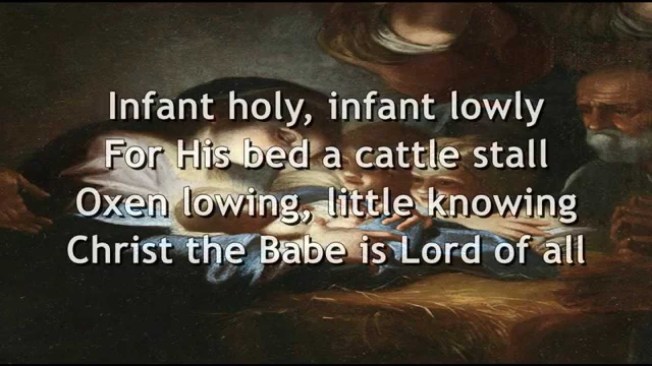
Infant Holy, Infant Lowly

“Infant Holy, Infant Lowly”

Infant Holy, words

Luke 1:39-45, 56 (1:45) – December 9, 2018

The meanings of names are a fascinating subject. The particular meanings of certain names are more well-known. Just think of Peter—Greek for “rock” and Irene—Greek for “peace.” Three names from Hebrew, Rachel (“lamb”), David (“beloved”) and Daniel (“God is my judge”). Then, there is my own name, Elizabeth, which comes from the Greek and means “God is my oath” or “God’s promise.”

My parents did not have any particular person on either side of the family who they were thinking of, or who they wanted to name me after. They just liked that name. I have always really liked my name, too.

I don’t know whether you have ever thought about the meaning of your name. Did your parents name you after a beloved aunt or uncle? Or perhaps a dear grandparent or godparent? Or did they just happen to like your name when you were born?

There is another Elizabeth in the New Testament. Our Gospel reading from Luke 1 talks about her. She was the mother of John the Baptist. She was the older cousin of Mary, living some distance away in the hill country of Judea.

In the verses just before this reading, we meet Mary, a teenaged girl who is visited by the angel Gabriel. Of course, the angel informs Mary that she will become the mother of the Messiah; Mary is to name the baby Jesus, Yeshua, or Joshua, which is Hebrew for “he saves.” As the angel says, “He will save His people from their sins.”

The angel Gabriel gave Mary some important information about her cousin Elizabeth. Elizabeth, as well. Apparently, Elizabeth and her husband the priest Zechariah had tried to have a baby for years, but could not. Finally, when Elizabeth had just about given up hope, she found she was indeed pregnant. This was called a miracle by everyone. Imagine—Elizabeth pregnant at an advanced age. God certainly works miracles, mighty acts and acts beyond the explanation of human eyes and ears.

What about Elizabeth, and about her younger cousin Mary? They are both women. Females, usually discounted and considered second-class by the cultures of their day. What do we find that is different about Elizabeth and Mary?

”All four gospels support the equality of women, but Luke is the one who is most obvious about it.  The male in the story, Zechariah, had been visited by an angel, but he did not trust [the angel’s word] (1:20) and was made mute.  His wife Elizabeth, however, who was an older woman, turns out to be the heroine of the family and she, in stark contrast to her mute husband, speaks under the influence of the Holy Spirit (1:41).” [1]

Elizabeth greets her young cousin, and says “God has blessed you more than any other woman! He has also blessed the child you will have. 43 Why should the mother of my Lord come to me? 44 As soon as I heard your greeting, my baby became happy and moved within me. 45 The Lord has blessed you because you believed that God will keep his promise.”

We could list several facts. Elizabeth spoke by the power of the Holy Spirit. She announced that Mary was richly blessed, as was Mary’s baby, Jesus. She also stated that John, the baby inside of her, had responded to the nearness of the very young infant Jesus. Finally, Elizabeth praises Mary for believing in God’s promise. And, we can be sure that God does keep God’s promises.

When I was in grade school, I was fascinated by the meanings of names. It was at around this time that I happened to start attending a Lutheran church in Chicago, brought there by my older sisters. They attended sometimes because of several friends from high school in the church youth group. They stopped attending when they left for college, but I kept going to that church.

I was a voracious reader. I would read just about anything, and as I mentioned, one of the books my parents had on their shelf had many lists of names and their meanings. I would pore over that book, and I sincerely wondered about my name. “God is my oath,” or “God’s promise.” It was at about this time that I started learning a great deal about the Bible and theology, and about the various promises of God. Especially the promises fulfilled at Christmas, in the birth of the Messiah.

What an earthshaking event, the birth of that Infant Holy. What a marvelous miracle, lifted up by Elizabeth in our Scripture reading today.

Here we have two strong women. Two women who know their own minds, and two women who are not going to be put in the background. These are two women—one younger, one older—who have been chosen by God to do great things. Not only to be the mothers of John and Jesus, but also to have the responsibility of raising them.

What stands out even more is that Mary has unshakeable faith in God’s promises. Can you imagine? I do not have complete faith and trust in God. A pretty good faith, but not one hundred percent, not doubt-free.

Rev. Bryan Findlayson has an intriguing comparison. He talks about seeing faith in Jesus as if it is a good bet. “If we are wrong, we lose nothing, but if we are right, we gain everything. Jesus is certainly a good bet, but the bet is not faith.” [2]

Mary’s faith is faith in God’s promises. She took God at God’s word. Sticking to God’s promises, firmly resting on them, this is what the Bible means by faith. Isn’t that what we lift up in these weeks of Advent? We have faith in God’s promises, and we rely on the Bible’s words, both in the Hebrew Scriptures as well as the New Testament.

Tonight is the anniversary of the first showing of the “Peanuts Christmas Carol” in 1965. We can watch this Christmas television special and laugh as we watch the Peanuts characters. We can also take the Christmas message to heart, as read by Linus, when Charlie Brown wanted to know what Christmas was truly all about.

God deeply wants to send abundant peace into the world. The birth of the Prince of Peace helps us to welcome Jesus for ourselves. He may have many different names, like Jesus, Joshua—”He saves,” Wonderful Counselor, Mighty God—but our Lord Jesus is the one and only Savior. As we prepare to celebrate “God with us,” Emmanuel, we also can lift our voices to praise the Prince of Peace.

Alleluia, amen!

[1] https://www.progressiveinvolvement.com/progressive_involvement/2012/12/lectionary-blogging-luke-1-39-55.html

Lectionary Blogging, Luke 1:39-56, John Petty, Progressive Involvement, 2012

[2] http://www.lectionarystudies.com/studyg/advent4cg.html

“Mary Visits Elizabeth,” Rev. Bryan Findlayson, Lectionary Bible Studies and Sermons, Pumpkin Cottage Ministry Resources.  

@chaplaineliza

(Suggestion: visit me at my regular blog for 2018: matterofprayer: A Year of Everyday Prayers. #PursuePEACE – and my other blog,  A Year of Being Kind . Thanks!
Unknown's avatar

O Come, Emmanuel

“O Come, Emmanuel”

O come Emmanuel

Luke 1:26-38 (1:31) – December 2, 2018

Have you noticed when you saw or heard your first Christmas commercial this year? On television, or on the radio? Or, perhaps it’s the first piped-in Christmas music at the store or at the coffee shop. Do you remember where you were? This expectation we go through every year; we pause, we watch the commercials, we hear in the music, we see in the displays of holiday lights and lighted figures outside of our neighbors’ houses.

These four weeks of Advent are weeks of preparation, of anticipation, of expectation. All these things are announcements of an impending arrival. Little reminders of the anticipation of the narrative from the first chapter in Luke. Ours is a fraction of the expectation that Mary had, beginning with the announcement from the angel. The teenage Mary had the angel Gabriel burst in on her, unannounced, giving her the very first Christmas commercial.

The anticipation we feel today is only a shadow of that we find in the Bible. I suspect, the teenage Mary was surprised out of her sandals by this unexpected visitor. Mary is told to expect the birth of the Son of the Most High.

If we go back several centuries, to the time of the prophet Isaiah, we notice the prophet writing about a young woman bearing a child, too.  In the Septuagint, the Greek translation of the Hebrew Scriptures, Isaiah 7:14 reads “a virgin will conceive and give birth to a son.” The Gospel of Luke shows this prophecy being fulfilled. But—not quite yet. Mary needs to go through a nine-month waiting period, a period of anticipation, expectation, and preparation.

As one commentator says, “Let’s be honest. Perplexity is exactly our response when the Lord shows up. To me? Why me? Why now? I think we underestimate the impact of what it means to know that God is actually around. Here. With us. Doesn’t God have better things to do? Bigger things to take care of? More major issues to maintain besides me?” [1]

Mary has a problem. She is not only a virgin (which the angel tells her not to worry about). However, she thinks she is merely a common, ordinary, every-day-type young woman. There is nothing special or extraordinary about her! It is “only after expressing her wonder and dismay, and then hearing again Gabriel’s affirmation and promise, does she manage to summon the courage to believe that God is indeed favoring Mary by working in her and through her for the health of the world.” [2]

This week is the first week of Advent, and we are going to focus on songs during these weeks. The Advent and Christmas seasons have marvelous carols, hymns and songs written during a number of centuries. This week, appropriately, we highlight the Advent carol “O Come, O Come, Emmanuel.” An excerpt from a fine article on this carol is found in your bulletin.

If you look at the article, notice several things. This is one of the oldest carols we have in our hymnals today. Christians have been singing it for over 1000 years. Originally written in Latin, it was translated into English by the scholar and priest John Mason Neale in the 1800’s. The translation of this hymn lets us know how much theology was written into the original lyrics. Each verse mentions a number of biblical and theological references.

You know what this ancient Latin hymn reminds me of? Young Mary. Eileen did not read Mary’s song from the first chapter of Luke, the Magnificat, but Mary does exactly that—after the angel leaves her, she breaks into song, and praises God. Not only that, she must have been biblically knowledgeable, because her song is chock full of biblical and theological references.

We know Mary was an introspective young woman, thoughtful and contemplative, since Dr. Luke tells us so in chapters 1 and 2. Does it surprise us that she knew a great deal about the Hebrew Scriptures, as we can tell from reading her song, her response to God?

Quoting from this wonderful song, the Magnificat:

“My soul glorifies the Lord  47 and my spirit rejoices in God my Savior,
48 for he has been mindful of the humble state of his servant.
From now on all generations will call me blessed,
49 for the Mighty One has done great things for me—holy is his name.
50 His mercy extends to those who fear him, from generation to generation.
51 He has performed mighty deeds with his arm; he has scattered those who are proud in their inmost thoughts. 52 He has brought down rulers from their thrones but has lifted up the humble.
53 He has filled the hungry with good things but has sent the rich away empty.
54 He has helped his servant Israel, remembering to be merciful
55 to Abraham and his descendants forever, just as he promised our ancestors.”

A modern setting of this song of Mary is the Canticle of the Turning, by Rory Cooney. I keep reminding myself not to get political in my weekly sermons—except when the words of the Scripture we read from the Lectionary are clearly lifting up some direct calling from God. Through Mary’s words, we are called to stand up in this neighborhood, this country, this world, and stand with the humble, the hungry, with those who fear God. We are called to stand against the proud, the rich, and the rulers.

In the Canticle of the Turning, this new retelling of Mary’s song is, indeed, about the birth of a baby. It also talks about how this birth turns a family upside down. Yet, this whole event—the birth of the Son of the Most High—is about God turning the world around. It is through God’s Son, Jesus, God welcomes us all. Not just welcoming the rich and privileged, but everyone, male, female, rich, poor, slave, free, whatever difference one person has from another. All means Jesus welcomes everyone. No matter what, no matter who.

Perhaps God did an extraordinary thing through Mary—just as the angel said—to show the world that through God all things are possible. Just as it was for the prophets, so it was with Mary, and so it is with us. May we all respond like Mary—“Here am I, the servant of the Lord; let it be with me according to Your word.”

[1] http://www.workingpreacher.org/craft.aspx?post=3462

Advent as a Way of Life, Karoline Lewis, Working Preacher, 2014

[2] http://www.workingpreacher.org/craft.aspx?post=1611

“Favored Ones,” David Lose, Dear Working Preacher, 2011.

@chaplaineliza

(Suggestion: visit me at my regular blog for 2018: matterofprayer: A Year of Everyday Prayers. #PursuePEACE – and my other blog,  A Year of Being Kind . Thanks!

Unknown's avatar

King: Alpha and Omega

“King: Alpha and Omega”

Alpha and Omega - Jesus

Revelation 1:4b-8 (1:8), John 18:33-37 – November 25, 2018

Royalty is very…regal. Kings, queens, princes, princesses—think of this past spring, when Prince Harry married Meghan Markle. Talk about a fairy-tale wedding! For those of us in the United States who watched the wedding, it was a grand gathering of royalty from across the world, plus some Very Important Persons, from any number of places.

Royalty was very much on the mind of people throughout the Middle Eastern and Mediterranean world, in the first century CE. Yes, small regional kings ruled over many tribes and areas. However, they were all subservient to the Roman Emperor, once his power reached into Africa, north into Europe, and east beyond the Fertile Crescent.

In our Gospel passage today, we have an interaction between Pilate the Roman governor of Palestine, and the prisoner Jesus. It’s just hours before Jesus is to be crucified. Yet, Pilate is all concerned about the Rabbi Jesus calling Himself a king. What’s the big deal with that?

We need to understand where the Jewish people are coming from. They want Royalty. Or, more properly speaking, a Messiah. Their nation has been subject under foreign countries for hundreds of years. They desperately yearned to be free! Free in not only a physical sense, but free in the prophetic sense, as well. In their writings there were prophecies of a Messiah, a Coming One, an Anointed One. That’s what many Jews were looking for! One who was a descendant of King David. A Messiah, a King.

Living in the United States today, we don’t have any concept of what that would be like. To be conquered, subservient to a huge foreign power. The closest thing I can think of in recent memory is the Eastern Bloc nations, the nations under Soviet rule for most of the second half of the 20th century. Poland, Romania, Bulgaria, Kazakhstan, Estonia, East Germany, and the other former Soviet satellite states.  All of these had local leaders and rulers. But—none of these local leaders got too big for their britches, unless they wanted to be deposed and imprisoned, and perhaps even killed.

That description is so similar to the position of the Rabbi Jesus, when He came before the Roman governor. Pilate was the Roman governor, the local voice of the Empire in Jerusalem. He had a prickly situation to handle. Yes, Pilate had to watch those stubborn, wayward Jews, and needed to manage their surly, ill-tempered leaders.

Pilate must have heard lots about Jesus! He was a miracle-worker! Healing the blind, the deaf, making food out of thin air for thousands, even raising people from the dead! Not to mention hearing about His wisdom and no-holds-barred interaction with the leaders of the Jews, priests and lawyers. What is more, the Roman governor must have heard whispers of this reactionary Rabbi possibly fulfilling the prophecies of the coming Messiah, or King.

Except, Pilate was considering kingship, power and authority from a Roman point of view. He was absolutely flabbergasted at this reactionary Rabbi. Not grasping the reins of force, power and control? What on earth is wrong with this guy?

Many people never consider the legal questions surrounding Jesus and His trials. Have you ever considered the royal power of Jesus before? If so, where was it active? Over whom did He rule? And, where was His jurisdiction?

As a typical, practical Roman, Pilate wanted to know all of those operational things, especially where Jesus had jurisdiction, power and control. Where exactly was His kingdom? Was He really King of the Jews? As if that was not enough, Pilate needed to know whether Jesus was committing treason. To set oneself up as an earthly King was plainly dangerous. As the Emperor’s representative, Pilate had to keep track of treasonous activities.

The Rabbi Jesus sidestepped Pilate’s questions.  Jesus is essentially saying that Pilate—by extension, the Roman government—does not have earthly jurisdiction in this matter.

True, Jesus said He was a king. But, Pilate is completely at a loss. Speaking from the point of view of a Roman, who considered worldly authority, control and power to be the be-all and end-all, this stuff about Jesus’s kingdom not being of this world does not compute.

This Sunday, the last Sunday in the Liturgical Year, is called Christ the King Sunday. Some call it Reign of Christ Sunday, because of negative connotations of the male image of “king.” But, Jesus turned the concept of “king” on its head. What Jesus meant by “king” is something so far away from the Roman concept of King and Emperor. Jesus’s concept is totally out of this world. A cosmic idea of King, of Ruler of the whole universe.

Our Gospel reading today tells us what Jesus is not. He is not an earthly King. He does not hold absolute, manipulative, soul-sucking power-over the other humans in the world. The reading from Revelation 1 lets us know exactly who Jesus is, and what He does.

Jesus did call Himself a king when talking to Pilate. He did mention His royal power is not of this world. He communicates the other-worldly nature of the reign of Christ, that cosmic King of Kings who is, and was, and is to come. A commentator mentioned that “The sovereign essence of God is amplified by such epithets as “the Alpha and the Omega,… who is and who was and who is to come, the Almighty (Revelation 1:8). These names and titles of God subvert claims of Roman Emperors. Contemporary readers of Revelation are also summoned to be aware of the dangers of imperial portraits seen in advertisements, political propaganda, and political party promises.” [1] Thus, the reign of Christ is subversive, in the eyes of this world. I rarely mention politics directly in my sermons, but these two bible passages today are specifically political. We can view the Rabbi Jesus as the reactionary leader of a downtrodden minority rabble, arrested at midnight and in handcuffs in front of a kangaroo court early one morning. Whether in the first century or the twenty-first, to proclaim Jesus Christ as King of Kings is a subversive act.

A seminary professor related, “One of my students is an Anglican priest from South Africa. Not long ago he shared a story about what it was like to believe Jesus was King during the days of apartheid. “Our whole congregation was arrested,” he said, “for refusing to obey the government.” I thought I misheard him, but he went on to say that all 240 members of the congregation were arrested and put in jail — from babies to a 90-year-old man. “At least babies and mothers were kept together,” he added. The pastor himself was imprisoned for a year. To claim that Jesus is King can be dangerous.” [2]

That is exactly what I proclaim here. Jesus Christ is King of Kings, Ruler of the universe, the Alpha and the Omega, the Beginning and the End. Who is, and who was, and who is to come.

“Jesus is a king who never rose so high that He couldn’t see those who were down low. Even today, we see Jesus in tent cities where people live together after losing their homes to foreclosure. We see Jesus in public housing where people are still waiting for the power to come on after the storm. We see Jesus in shelters where women have sought refuge from abusers.

If we would see Jesus, we will look in places kings seldom go.” [3]

It is not enough to see Jesus. He calls us to follow Him, too.

Be subversive! Tell people about Jesus, the reactionary Rabbi, King of Kings. Alpha and Omega, the Beginning and the End. Amen, alleluia.

[1] http://www.workingpreacher.org/preaching.aspx?commentary_id=2825

Commentary, Revelation 1:4b-8, Isarel Kamudzandu, Preaching This Week, WorkingPreacher.org, 2016.

[2] https://www.huffingtonpost.com/barbara-kay-lundblad/john-18-33-37-a-different-kind-of-king_b_2166819.html

“A Different Kind of King,” Barbara K. Lundblad, ON Scripture, Odyssey Networks, 2012.

[3] Ibid.

@chaplaineliza

(Suggestion: visit me at my regular blog for 2018: matterofprayer: A Year of Everyday Prayers. #PursuePEACE – and my other blog,  A Year of Being Kind . Thanks!

Unknown's avatar

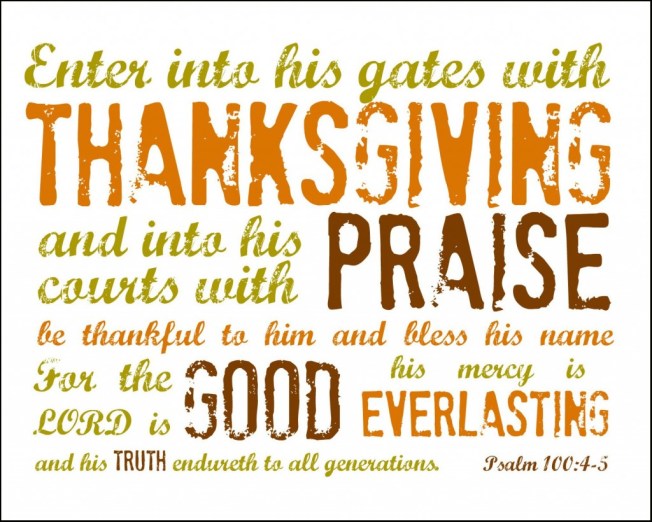
Give Praise! Give Thanks!

“Give Praise! Give Thanks!”

Psa 100 thanksgiving, praise

Psalm 100 – November 21, 2018

Who likes to be bossed around? Does anyone?

Listen to these examples: Do this! Come here! Watch out! Stop that! Go to your room!

It is not too pleasant to be bossed around, especially by someone mean or overbearing. But, what if someone who loves you is the one doing the bossing? What if that person has your best interests at heart? Imagine you are in a kitchen and someone cries, “Watch out! That stove it hot!” Or, when you are standing by an outdoor pool, and someone yells, “Be careful! You’re right by the edge!” That changes things a whole lot, to many people.

What about Psalm 100, our scripture reading for this evening?

As is the problem with written communication, we don’t have nuances and vocal inflection. There isn’t a certain way for us to tell whether the author of Psalm 100 was grumpy, joyful, or somewhere in between. However, I would like to think of our Psalm writer being joy-filled and excited. Doesn’t this Psalm sound like it’s written by an excited person?

I want to let you know: there are some commands, some imperatives in Psalm 100. Not suggestions, not “oh, by the way, could you possibly do this?” No. No, indeed.

A number of these verbs, or action words, are clear commands. In the first three verses, “Raise a shout!” “Serve!” “Come!” and “Know!” Verse four has “Enter!” “Be thankful!” and “Bless!” All of these verbs—and they are many of the chief action words in this Psalm—would be instantly recognizable as a command to anyone who spoke Hebrew!

I don’t know about you, but when some people try to twist my arm and bark commands at me, I don’t really like it. I may begrudgingly comply with such commands, rolling my eyes, but for sure not willingly. Not with my whole heart. Not freely, in worship and praise and thankfulness and gratitude, I can tell you that!

But, what if our psalm writer did not feel grumpy or mean at all? What if his situation was 180 degrees reversed? One commentary I read said “Surely the psalmist was imagining what it might sound like when all the earth is praising the LORD at the same time. What a joyful sound, indeed, that would be!” [1]

Let me tell you a few things about this psalm, in general. Psalm 100 is the last in a small collection of special psalms of praise and worship. Do these verses get you in the mood of worship? Of praise? Could we see ourselves marching to our particular house of worship looking forward to meeting with God? To serve and praise and bless and be thankful to God? That is exactly what this Psalm is encouraging—no, even more strongly—is commanding us to do.

I love the exuberance of children. They can be so uninhibited! So filled with joy and happiness and excitement that it just boils over. Sometimes, children just overflow with joy like fountains, bubbling up all over the place. This exuberance also reminds me of the worship styles and especially the musical expressions I have seen in African-American church services. I think this psalmist was expressing an intense feeling of worship very much like that contemporary praise. “One can almost hear the outbreak of jubilation described in this summons to praise in Psalm 100. This psalm calls the entire community to lift praises to God.” [2]

I’d like to tell you something about me. I love music. I studied music theory and composition as my undergraduate major some years ago, I love finding out interesting and historical things about music, too.

Around the middle of the 1500’s, John Calvin the Protestant reformer said that any music performed in the church had to be sung. No instruments, and no glorious sounds other than voices. That meant a number of the Reformed churches could not play any of the marvelous organ, instrumental, or choral music of composers like the Lutheran Johann Sebastian Bach, who came a little later.

John Calvin said only singing psalms set in verses, was right and proper for church worship. After all, the Psalms were the song book of the Bible. Very early after Calvin made that declaration, a clergyman named John Kethe turned this Psalm, Psalm 100, into verse. It was set to a hymn tune known—of course—as “Old Hundredth.” Let me read Psalm 100, in rhyme:

All people that on earth do dwell,

Sing to the Lord with cheerful voice,

Him serve with mirth, His praise forthtell;

Come ye before Him and rejoice.

Stanza 2:

The Lord, ye know, is God indeed;

Without our aid He did us make.

We are His flock, He doth us feed,

And for His sheep He doth us take.

Stanza 3:

Oh, enter, then, His gates with praise,

Approach with joy His courts unto;

Praise, laud, and bless His name always.

For it is seemly so to do.

Stanza 4:

For why? The Lord, our God, is good;

His mercy is forever sure.

His truth at all times firmly stood

And shall from age to age endure.

.

This psalm text was written in the late 1500’s, and immediately was a big hit. Psalm 100 soon appeared in a hymn book, or psalter, and was regularly sung in church services. What I did not know before a few days ago was that this setting of Psalm 100 was in the hymn book brought across the Atlantic Ocean a few years later.

The church music professor Dr. Hawn said, “This is probably the oldest continuously sung congregational song in North America. When the first British explorers arrived in Jamestown Island on May 14, 1607, to establish the Virginia colony on the banks of the James River near Chesapeake Bay, they undoubtedly brought with them a Psalter, a collection of metrical psalms.” [3]

Just imagine: the earliest English colonists sang this hymn, using the words of clergyman William Kethe, the same words that congregations sing today, four and a half centuries later.

Dr. Hawn reminds us, “the important thing to remember is that William Kethe’s text ties us with the earliest settlers in the American colonies over 400 years ago. It was not long before a Psalter was published in the American colonies: The Bay Psalm Book (1640) was the first book published in North America.” [4]

What a marvelous chain of events, and connections. We can follow the verses of this Psalm across the ocean, into hymn books, and ultimately read it tonight in this service.

That’s all well and good, you might say. History is nice, but we need to dust off the cobwebs and come back into the modern age. Enough of these historical words like “doth,”  “unto,” “forthtell” and “seemly.” All right. I’ll ask some questions. Modern-day questions. These can be thought-questions, and you don’t need to answer them right away, or even out loud.

What is your attitude towards worship of God? Or, is that just for other people? Do you willingly and joyfully come into God’s presence? Or, is going to your house of worship more of a chore, where you are just reluctantly going through the motions? Penetrating thought-questions, for us all.

I pray that the Holy One might speak to hearts as needed.

How do I see this Psalm? I’m glad you asked! I come from the Christian faith tradition, and God has called to me from that understanding. What is more, the way my mind best understands God is through the lens of Reformers like Martin Luther and John Calvin. Calvin’s Reformed tradition especially treasures Psalm 100.

This Psalm’s essence might well be contained in the first question and answer of a respected historical teaching tool for young people, the Westminster Shorter Confession.

Question: What is the chief end of humankind?

Answer: The chief end of humankind is to glorify God and enjoy God forever. [5]

This is a way of abbreviating this Psalm, in a nutshell. But it does not matter how we abbreviate it, or turn it into verse, or read and meditate on it, or sing it from the rooftops. God wants to know our attitude towards worship, and is hoping our attitude is excited! Joyful! Praise-filled! May we all come into God’s presence with a joyful noise, giving thanks from the bottom of our hearts every day of the year, not only on Thanksgiving Day.

Alleluia, amen.

[1] http://www.theafricanamericanlectionary.org/PopupLectionaryReading.asp?LRID=98

Commentary, Psalm 100, Alfie Wines, The African American Lectionary, 2009.

[2] Ibid.

[3] https://www.umcdiscipleship.org/resources/history-of-hymns-all-people-that-on-earth-do-dwell

http://www.umcdiscipleship.org/resources/history-of-hymns-all-people-that-on-earth-do-dwell

History of Hymns: “All People that on Earth Do Dwell”. by C. Michael Hawn

[4] Ibid.

[5] McCann, Jr., J. Clinton, The Book of Psalms, New Interpreters Bible Commentary, Vol. 4 (Nashville, TN: Abingdon Press, 1996), 1080.

@chaplaineliza

(Suggestion: visit me at my regular blog for 2018: matterofprayer: A Year of Everyday Prayers. #PursuePEACE – and my other blog,  A Year of Being Kind . Thanks!
Unknown's avatar

Thanksgiving for All

“Thanksgiving for All”

1 Tim 2-2 pray, words

1 Timothy 2:1-4 – November 18, 2018

Have you ever had a community leader in the local news—perhaps even someone you know—who annoyed you? Got you so mad, you wanted to hang them up by their toes? Something they said, or did, or some stand they were taking. How could they do such a thing? What cockamamie words to come out of their mouth! We mutter, “Good grief!” or “I cannot believe it!” and roll our eyes, again.

Why did Paul even write to Timothy? True, Paul and Timothy had a close relationship. Just think of someone older, who showed you how to do some work, or perhaps had some good advice for you. A mentor, someone who was wiser than you, back when you were first learning how to do things, or first were an apprentice. Or, perhaps you were a mentor for some young protégé, and had the joy and satisfaction of teaching them the ropes.

The Apostle Paul had some wise words for his young protégé Timothy about just such a situation. What does Paul say again? We are to pray. Listen: “I urge, then, above all, that petitions, prayers, intercession and thanksgiving be made for all people.”

Great advice! But, all of these describing words are kinds of prayer. Paul is being quite specific about prayer. Each of these four terms has a different meaning or nuance. The four Greek words used here have different applications, too. First, petitions, or deesis. This is an appeal for a particular need. Then, prayer, proseuche, a general word for prayer that often occurs in petitions. Third, intercession—exteuxis, which captures an urgent and bold request. Last, eucharistia, or thanksgiving, which means an expression of gratitude. [1]

Isn’t that what we celebrate today, on Thanksgiving Sunday? Isn’t that what we concentrate on at this time of the year? There is a problem. Paul mentions that we are supposed to pray for rulers and those in authority over us. Which brings me back to where I started.

I say again, have you ever had a community leader in the local news—perhaps even someone you know—who annoyed you? Got you so mad? Something they said, or did, or some stand they were taking. How could they do or say such a thing?

If ever there was a time that would test our willingness to pray for those in authority, now would be the time. Am I the only one who is aggravated by politicians? Not to mention the contentiousness of the recent election season! This bible passage could well be a real test of our willingness to follow God’s word.

Except, in Paul’s day, the local politicians—rulers—those in authority—had a lot more control over their constituents than those here in the United States. This is the second time Paul advises his readers to pray for those in authority. (He does so in Romans 13, too.) The emperor at this time was Nero, who was quite antagonistic towards the brand-new sect called Christians.

The commentator J. Vernon McGee says we are to pray even if we have a corrupt administration. If we transpose Paul’s words to today, McGee says the Democrats ought to pray for the Republicans, and the Republicans ought to pray for the Democrats. In a polarized nation and world this is a call to pray for people with whom we agree and for people with whom we disagree.  “We are to pray for whoever is in power. Remember that the man who was in power in Rome when Paul wrote was bloody Nero, yet he says we are to pray for kings and those in authority, whoever they are.” [2] Some of the leaders Timothy and his friends were to pray for were Romans who were trying to imprison and even kill as many Christians as possible.

God willing, we need to pray for all those in authority over us, no matter what, no matter who or where they may be. Paul’s words remind us that our leaders and those in authority depend on God’s guidance, grace and mercy.

Timothy is not only encouraged by his mentor Paul to pray for leaders—above all—but also to pray for all people. Not only to pray, but to intercede for, and give thanks for all people. That is every single person. All. All means all.

That is really difficult! Pray for ALL people? Pray for the funny looking guy at the drug store? Pray for the lady who talks to herself at the supermarket? Pray for that couple across the street with the weird looking clothes? What about the homeless person sitting on the sidewalk? Yes, yes, yes, and yes. We are to pray for, intercede for, and give thanks for ALL people. Especially these people who seem strange, or weird, or don’t speak like we do, or who walk funny, or a hundred other differences. All means all. Paul tells us to pray for everybody.

This is the thankful season of the year, when we express our gratitude to God for all the gifts we receive throughout the year. Gifts of family, friends, food, shelter, and many other blessings. Things that make us happy to be alive! But, where did this modern idea of Thanksgiving come from? Frances Woodruff has a brief history of the origin of our holiday.

“This week we celebrate Thanksgiving. On Thursday, everyone in our country will stop and give thanks for all their blessings. In the early days of our country, families picked their own day of thanksgiving. People celebrated on different days whenever it fit their schedule. Then 150 years ago, President Abraham Lincoln received a letter from Sarah Hale. Mrs. Hale suggested that there be a National holiday of Thanksgiving—that everyone in the country stop on the same day and give thanks. But at that time, our country was at war. The fighting made times sad, food scarce, and money tight. It was hard for people to feel thankful. People thought, We can’t have a holiday now! We don’t have time for a party! There are too many problems to be solved! But President Lincoln and the people soon realized that gathering together was just what they needed to do, especially in those tough times.” [3]

Whether the times are tough, or not-so-tough, whether fraught with danger or filled with peace, Paul tells us to be thankful. He tells us to have an expression of gratitude in our hearts, which will help us to stay positive and keep our eyes on God. Just as people through the years found that gathering together and being thankful together was a wonderful corporate celebration, so, too, with today. So it was in Paul’s day, as well.

Prayer, intercession, and being thankful are surely attitudes and practices that draw us together. Just as at the Interfaith Thanksgiving Eve service this coming Wednesday, where diverse friends from all over the Morton Grove, Niles, Skokie and Glenview neighborhoods come together, we all can be thankful. We all can praise God for another harvest safely gathered in. We all can praise God for warm families, good friends, and another year coming to a close.

All this thanksgiving is good, and it pleases God our Savior,” who wants all people to be saved and to come to a knowledge of the truth.” That is, all people, from all over the world.

God willing, amen. May it be so.

[1] http://www.workingpreacher.org/preaching.aspx?commentary_id=1769

Commentary, 1 Timothy 2:1-7, Christian A. Eberhart, Preaching This Week, WorkingPreacher.org, 2013.

[2] McGee, J. Vernon, Through the Bible, Vol. V., (Nashville: Thomas Nelson, 1983), 436.

[3] https://onthechancelsteps.wordpress.com/2012/11/05/gather/

“We Gather Together,” Frances Woodruff, On the Chancel Steps, 2012.

@chaplaineliza

(Suggestion: visit me at my regular blog for 2018: matterofprayer: A Year of Everyday Prayers. #PursuePEACE – and my other blog,  A Year of Being Kind . Thanks!

Unknown's avatar

The Poor Widow’s Gift

“The Poor Widow’s Gift”

Mark 12-42 widow, mite mosaic

Mark 12:38-44 – November 11, 2018

You know celebrities? Many of us follow their activities. Look at popular tabloids, magazines, television, and computer screens. It seems like the richer the celebrity, the better. So many celebrities give away a lot of money, or a lot of stuff, and they get a lot of applause. Look at Oprah Winfrey, Taylor Swift, Bono, and Angelina Jolie. All of them are very open in their giving, and they are to be commended, even applauded.

Many people watch celebrities, to see what they do, and even how they give. This is not a new activity. People have been doing it for centuries. In our Gospel reading today, people were watching, too. The offering box for the Temple was in the back, by the exit door. In the first century, apparently it was common for people to sit or stand near the offering box and watch as the faithful put in their offerings.

In the first century, all money clinked. All money was in coins. That means, no paper money. When anyone threw money in the offering box, the money made a metallic sound. I suspect there even were some who knew what kinds of noises different coins made. They possibly could keep “score,” regarding what kinds of coins were given by which people.

In the first part of our Gospel reading, our Lord Jesus calls out the temple leaders. Jesuse tells His disciples that the teachers of the Law of Moses are hypocrites. “They like to walk around in flowing robes and be greeted with respect in the marketplaces, 39 and have the most important seats in the synagogues and the places of honor at banquets. 40 They devour widows’ houses and for a show make lengthy prayers. These men will be punished most severely.”

Whoa! This is judging! And, judging pretty severely, too. Notice, please, where Jesus mentions “devouring widows’ houses.”

Does everyone here understand what happened to a widow, after her husband died? She had no way to earn money, and very quickly she would become poor, sometimes even losing the house she lived in. That’s a direct condemnation of the group Jesus was talking about in the first verses. He’s weighing one group of people against another.

These religious leaders had special clothing that actually was very different from the clothing of the other, “blue-collar” workers around them. The leaders had fancy long sleeves and elaborate cloaks that came down to the ground, which would just get in the way for the blue-collar workers. What is more, the synagogue leaders just loved to sit at the head table for public events or at synagogue functions.

“While those actions may have seemed spiritual, Jesus warns they’re signs that the religious leaders especially enjoy the attention they receive from people. However, Jesus also points out that the religious leaders of his day don’t just crave attention.  They’re also hungry for material things.  Jesus grieves, for example, how they “devour widow’s houses,” exploiting these defenseless people.” [1]

So, these religious leaders are two-faced and hypocrites. What else is new? The way the scribes/Pharisees treat the widows. That is, the poor, the indigent. Horrible example for others. They were throwing their pocket change (jingle, jingle) in the giving box in the back of the synagogue, so everyone could see AND hear how MUCH they gave, all the while neglecting and even robbing the widows of what the Temple offering would have given the poor.

This sermon is about so much more than the poor widow and her tiny gift. But, now that I’m referring to that, what about her gift, anyway?

If they were lucky, some widows had a small next egg saved up for a rainy day. And when that was gone, they had nothing. Zero. Talk about living on a fixed income! With no life insurance, Social Security or other government safety nets, these widows were often sunk, Out of luck, unless the synagogue chipped in or helped out, that is.

Jesus pointed out that ““Truly I tell you, this poor widow has put more into the treasury than all the others. 44 They all gave out of their wealth; but she, out of her poverty, put in everything—all she had to live on.”

What a contrast! On one hand, the show-off religious leaders, with their ostentatious gifts of money they can easily afford. On the other hand, we have people like this widow, giving her all.

But, what about the attitude of giving we see here?  One of the commentators says, “Some of the happiest, most fulfilled people on the face of this planet have the fewest resources and choice. These same people are also some of the most generous. They don’t seem convinced that hoarding their meager resources is the best use of them, and they appear to find more joy and possibility in sharing with others and in building relationship capital.” [2]

Another way of saying a similar thing? In the archives on a pastor’s chat-board, a Pastor JD from Washington DC gave the following example. “The widow gave from her “poverty” it says. Think about people who have given from their vulnerable experiences, from their “poverty” and, in so doing, have helped others beyond measure. An alcoholic revealing to a problem drinker his or her life’s story; A woman who has survived breast cancer shares her struggle with someone newly diagnosed; A Christian shares his faith doubts and journey revealing a realistic and growing faith.” [3]

Think about it. Those who knowingly share in their poverty are truly the most giving and trusting individuals of the world. God doesn’t want 10%, God wants 100%, regardless of whether we have less than others or more than others. God wants it all.

Each week we sing “We give thee but thine own, what-e’er the gift may be; All that we have is thine alone, a trust O Lord, from thee.” All we have is from God and we are to use all for the Glory of God. Giving our all, and trusting in God to take care of us.

May we all strive to follow this Godly example. So help us, God. Amen.

[1] http://cep.calvinseminary.edu/sermon-starters/proper-27b/?type=the_lectionary_gospel

The Center for Excellence in Preaching commentary and sermon illustrations, Scott Hoezee, 2015.

[2] http://www.stewardshipoflife.org/2015/11/the-abundant-life/

“The Abundant Life,” Sharron R. Blezard, Stewardship of Life, 2015.

[3] http://desperatepreacher.com//bodyii.htm 

@chaplaineliza

(Suggestion: visit me at my regular blog for 2018: matterofprayer: A Year of Everyday Prayers. #PursuePEACE – and my other blog,  A Year of Being Kind . Thanks!

Unknown's avatar

All Things New

“All Things New” – November 4, 2018

Revelation 21:1-6a

Rev 21 making new creation

  “ . . . and they all lived happily ever after.” The end.

Doesn’t that sound familiar? Isn’t that the way that fairy tales are supposed to end?

Thinking of the scripture reading we just read, the new heaven and new earth haven’t shown up yet. News flash! We are still living in the same old heaven, same old earth.

Life here on this earth is okay, I guess, but it is sure no fairy tale. Fairy tale endings are few and far between. Once in a while it happens that someone inherits a huge amount of money, or wins the lottery, or signs a big sports contract, but that isn’t the way it works for the vast majority of people here.

What happened? Doesn’t somewhere it say that “God saw everything that he had made, and indeed, it was very good?” As the book of Genesis, chapter one, tells us, in the beginning, God created the heavens and the earth, and God created everything good.

God gave humanity the world and everything in it for us to enjoy. It is all a gift, everything, for us to enjoy together with God. God wants to be in relationship with us. Can you imagine, daily strolls through beautiful gardens, in the cool of the evening? That’s just the picture that is painted for us by Genesis chapter 3.

You all know the plot line. God did have a close relationship with Adam. Then, one day, God came looking for Adam, but what happened? Sin happened. That relationship was fractured. Humanity was separated from God by sin. Now, today too, I am separated from God by my sin.

Another word for sin is separation. I know I sin. I displease God. And when I sin, I am separated from God. I feel it. I know I am alienated from God.

How many people here have seen a mime? I bet you are familiar with the wordless actors, who use gestures and movements to communicate. Can you see a mime coming up against a wall, trying to get through?   ((pantomime a wall))   Sin is like that wall. So high. So wide. Impenetrable. We are separated from God! That’s what sin does. Sin builds walls in our lives between us and God. And what’s more, sin builds walls between each of us, as well. Between me and you. Shutting us out, shutting us apart from each other.

The picture I’ve painted is pretty grim. If we were left in this horrible situation with no way out, the outlook would be pretty hopeless. I know that I am helpless to get myself out of this mess. I cannot overcome this separation from God, no matter how hard I try in my own strength.

I’m reminded of my children. When they were small, I can remember taking them to the playground, where I’d push them in the big swings. Then when they got a little older, they would always want to pump higher and higher themselves, so high that they would touch the sky. I remember my daughter Rachel (she’s in graduate school now, so this was some years ago) asked me if she could get as high as God. I laughed, and then told her that was a good question. But I said that she couldn’t reach God like that on a swing, no matter how hard she pumped.

But isn’t that just like us? To want to get to God on our own, on our own terms, in our own way? I want to do things my way! But, wait! I can’t get to God! There’s something in the way! ((pantomime a wall))  A wall, a barrier, a separation . . . I can’t get through!

But . . . thanks be to God. God has provided a way. God sent His Son, His only begotten Son, as a gift God sent His Son into this world, to reconcile this world to Himself, to bring us back into that relationship God wanted to have with us at the beginning. Remember God, walking in the garden? Giving humanity all of creation to enjoy? God has broken down the walls of separation and reconciled us to Himself. Praise God! We can now have that relationship with Him!

Let’s read again from Revelation 21, verses 3 and 4. “See, the home of God is among mortals. He will dwell with them; they will be His peoples, and God Himself will be with them; He will wipe away every tear from their eyes.”

Did you hear that? What did these verses say? The home of God will be with us!

The One Who is Faithful and True has written this. Sure, we’re living right now in an imperfect world. Sure, there are many problems here and now. Sure, we all can think of things that ought to be changed. And, we can strive to make it the very best world that we can. I’m wondering . . . how can you make a difference in this world, here and now? In big ways, little ways, any way you can? How can I make a difference, right where I am? This is not only a God-given challenge to us, to you, to me. This is a God-given opportunity!

But . . . there’s more! We can also look forward to the new heaven and the new earth. Right here in Revelation 21, the One seated on the Throne has promised to wipe away every tear from every eye. Death and mourning and crying and pain will be no more.

No matter what, we can look forward to a close relationship with God! No more separation, no more alienation. No more walls or barriers. Instead, the home of God will be with us! We will dwell with God forever and ever, no matter what.

What a great expectation to have. What a future. What a promise. What a celebration. Remember, the One seated on the Throne is trustworthy and true. The Alpha and the Omega, the Beginning and the End has promised these things. And our God is One Who keeps His promises.

Alleluia, amen.

@chaplaineliza

(Suggestion: visit me at my regular blog for 2018: matterofprayer: A Year of Everyday Prayers. #PursuePEACE – and my other blog,  A Year of Being Kind . Thanks!

Unknown's avatar

Saved by Grace through Faith

“Saved by Grace through Faith”


Rom 3-24 justified by grace

Romans 3:23-24 – October 28, 2018

I have been called for jury duty four times. Yes, one of those times I did serve on a jury, and I was one of that jury in a murder trial. I vividly remember the judge and his instructions to us as the jury. This particular judge had quite a presence. I could see everyone in that courtroom sitting up a little straighter, or paying more close attention when he spoke.

Is that your idea of a judge? Someone in black robes, sitting in judgment on a case with fairness and equity? A judge, someone evenhanded, listening to both sides of the legal question at hand before making a final decision on the case?

I am afraid that not all people think of judges in this way. In some parts of the world, judges can be less than fair, not exactly honest, and even mean or hurtful. I wanted to point out that this kind of flawed judge was certainly not what the Apostle Paul was thinking about here. Not here in Romans chapter 3.

We need to consider some background, if we are going to look at the book of Romans. This letter was written by Paul at a time when he was in prison. Paul had never been to Rome, even though he was born a Roman citizen. He knew a number of people who had over the years relocated to Rome. In fact, the small group of believers in Rome had probably written to Paul first, and they asked Paul to answer some theological and religious questions, and give them some of the Godly wisdom that comes from above.

The majority of Christ-followers at this time were Jewish, but not all of them. Paul started this section of the letter with a discussion of the Mosaic Law. I can just hear the responding comments by the Roman Christians who are also Gentiles: “Why are you talking about the Jewish Law Code?” In these beginning chapters of Romans, Paul is setting up an argument. He tells the Roman believers that ALL have sinned. Not just the Jews, under the Jewish or Mosaic Law Code. ALL have fallen short of God’s expectations.

Here in Romans 3 Paul highlighted the Law of Moses, and how difficult it is that anyone could be considered righteous. Another way of saying this is: The Law, in which the Jew boasted and the possession of which the Jew took for righteousness, is not able to make any one righteous but only to show them to be unrighteous. [1]

Sure, there is a whole lot of talk about unrighteousness in Romans. Paul comes right out and says, “For all have sinned and fall short of the glory of God.” Romans 3:23 is a verse countless Christians have used over the centuries to let people know what a rotten state we are all in. Notice that this verse does not say “For some have sinned,” or even “For most have sinned.” No. we ALL have sinned. We ALL have shown how unrighteous we are. We ALL fall short of the glory of God, that glory that goes so far beyond words.

Just between you and me, I am very glad we do not use the Mosaic Law to be our rulebook now for the believers’ faith. Paul even says so a couple of verses before, “Therefore no one will be declared righteous in God’s sight by the works of the law; rather, through the law we become conscious of our sin.” In other words, ALL have fallen short of God’s expectations.

If that were the case, I do not know how anyone could pass through such strong judgment and find reconciliation with God. That is, without Jesus. He is the whole point of Romans, and Paul returns to Him again and again. Thank God we do not need to stop at Romans 3:23! Paul does not stop there, either, but instead goes on: “ 24 and all are justified freely by his grace through the redemption that came by Christ Jesus.”

That is good news! I don’t know whether we fully understand it, but that’s good news!

Grace. That word is a simple enough word. However, I don’t want to put anyone on the spot and ask them what exactly “grace” means. I do remember an acrostic definition, from years ago. Grace is God’s Riches At Christ’s Expense.

Notice, please, that these two verses of Romans 3 tell us the whole Gospel. The whole Good News. The first, Romans 3:23, tells us why we are sunk, separated from God for eternity. The second, Romans 3:24, tells us we are justified by grace. We are drawn back into God’s presence, and are redeemed by Christ Jesus our Lord.

I’ve related this before, I am proud to say that I was raised as a Lutheran on the northwest side of Chicago. I was baptized and confirmed at that Lutheran church. I was fascinated by Martin Luther, the founder of the Lutheran denomination. When I was in high school, I learned as much as I could about Martin and his soul-wrenching journey to better understand this blessed fact—that he was saved by grace through faith.

Martin was a learned theologian, yes. But Martin felt sinful and unlovable, too. What’s more, even after lots and lots of good works and all these years of reading and study, he still felt so inadequate. Martin felt God could not possibly love or forgive him. He knew lots of things about Jesus intellectually, but he still did not grasp this central understanding.

Remember Romans 3:23? “For all have sinned and fall short of the glory of God.” Yes. Yes! That is true. But—that isn’t the whole story! Reading, starting from 3:21: “21 But now apart from the law the righteousness of God has been made known, to which the Law and the Prophets testify. 22 This righteousness is given through faith in Jesus Christ to all who believe. There is no difference between Jew and Gentile, 23 for all have sinned and fall short of the glory of God, 24 and all are justified freely by His grace through the redemption that came by Christ Jesus.”

I can almost see Martin falling off his chair, once he realizes how huge this is. Our sin is taken away through the redeeming that came through Jesus. We are made lovable through God’s grace. Our low self-worth and low self-esteem is now viewed by God through Jesus. God looks at all of us, each one of us, through Jesus-tinted lenses.

            We are all saved by grace, through faith. What tremendous Good News. No, it’s Great News! It’s the most marvelous News of all time!

We will not be tried in a court of law, with all of our sins playing out on a huge screen behind us as God the Judge bangs the gavel in some heavenly courtroom. Jesus took our sins upon Himself, so we do not have to carry them any longer.

That is the best of all possible Good News! Jesus died for our sins. Jesus showed us radical, God-sized grace, and radical, God-sized love.

As I proclaim each week after the Confession of Sin during the Assurance of Pardon, “Believe the Good News of the Gospel: in Jesus Christ, we are forgiven!”

Alleluia, amen!

[1] https://bible.org/seriespage/b-righteousness-it%E2%80%99s-not-what-you-know-or-who-you-are-romans-11-326

@chaplaineliza

(Suggestion: visit me at my regular blog for 2018: matterofprayer: A Year of Everyday Prayers. #PursuePEACE – and my other blog,  A Year of Being Kind . Thanks!


Unknown's avatar

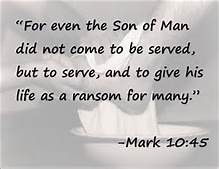
Servant? Leader? Both!

“Servant? Leader? Both!”

Mark 10-45 Son of Man came to serve

Mark 10:35-45 (10:43) – October 21, 2018

Almost everyone is familiar with slogans and jingles. I could say, “You deserve a break today, so get up and get away to…”  What about “I am stuck on Band Aids, ‘cause Band Aid’s stuck on me.” Or, “It’s the most original soft drink ever in the whole wide world—Dr Pepper.” When I mention these jingles, you can almost see the product right in front of you. That is how vivid the slogan or jingle from Madison Avenue is. This advertising hook is planted deeply in many people’s brains and memories.

I am not going to mention any political party in this sermon, but currently, one political party today uses a slogan that bring images to many people’s minds today. (Either strongly positive, or strongly negative.) It is “Make America Great Again.” Again, a lot of people have vivid, strong ideas or thoughts about this slogan. Similar to the advertising jingles I just mentioned, “Make America Great Again” strikes deep in people’s brains and memories.

Greatness. What is greatness? Who is the greatest? That’s the argument among the disciples in the Gospel reading for today. I suspect that argument resonated deeply in their hearts and minds, too. The disciples all had a basic idea in their heads of what “the greatest” was supposed to look like, act like, speak like, and be like.

Our reading is from Mark 10, just a few verses before the beginning of chapter 11, where Jesus enters Jerusalem on Palm Sunday for the final week of His life. This is the very end of Rabbi Jesus’s three-year ministry. His disciples had been with Him, and learned from Him for three whole years. And, still, after all this time, the disciples are still bickering over who is going to be “the greatest” among them. How clueless, how thick can they possibly be?

James and John, two of the disciples closest to Jesus, have the presumption to march right up to their Rabbi and ask Him something outrageous, straight out. In the Gospel of Matthew, same question, except Matthew softens it a little by having the mother of James and John ask.

The question? “We want You to do for us whatever we ask of You.” Talk about a self-centered and self-serving request! But, don’t we say almost the same thing to God, sometimes? Some of us might be looking in the mirror when we look closely at this reading.

In our modern world in this twenty-first century, we still repeat the identical demand to God: ‘Lord God, we want you to do for us whatever we ask.’ And then we ask God for our own way, what we want, e.g. healing for ourselves, our loved ones, a good job, a good spouse, a good house, a miracle of some sort, a special blessing, a way ‘out of a jam.’” [1] (In other words, some say prayers to a vending-machine-in-the-sky-God, or foxhole prayers said when things look really black, and there is no hope left.)

James and John wanted to be great! Whatever “great” meant to them. Oh, we know what “great” means to many people. Lots of power and control! Lots of people running, fetching, carrying for you! Being “great” meant lording it over everyone else, over all the little people. After all, James and John had a pretty good idea that their Rabbi was soon going to be proclaimed the Messiah. After all, hadn’t He told them so? Hadn’t Jesus been displaying the signs and miracles of His Messiahship for the past three years? Wasn’t that why Jesus was going to Jerusalem? As Messiah, they thought Jesus would become an earthly King. So, He would need right-hand guys to be His lieutenants. They figured they were those guys.

What is the matter? This picture does not jive with Jesus, that’s what.

Everyone else was pinning their hopes on Jesus, hoping that He would overthrow the Roman armies of occupation and restore the earthly kingdom of Israel. Then, everything would be hunky-dory, as far as the Jewish people were concerned. However, Jesus had no desire to become an earthly king, with an earthly kingdom, like King David.

People just did not understand. Not even when Jesus explained to the disciples that they needed to become completely of no account, like children, they still did not have any idea of what Jesus was talking about.

What is the overarching disconnect and problem here? “Power has been the perennial problem in human history. The reality of power is complex; its use and misuse in all human, social and political relations and interactions has been a question of utmost importance for all peoples.” [2]

Here, in this 10th chapter of Mark, Jesus clearly outlined His path and direction several times. Then, how did James and John get so mixed up, so close to the end of Jesus’s ministry? When people get focused on the wrong direction, they can end up in a very different place from where they started.

Listen again to Jesus’s words: “You know that those who are regarded as rulers of the Gentiles lord it over them, and their high officials exercise authority over them. 43 Not so with you. Instead, whoever wants to become great among you must be your servant, 44 and whoever wants to be first must be slave of all.”  I’d like everyone to notice: Jesus calls His friends to serve others. That is how they are to lead.

Jesus does not slam ambition and striving. Jesus does not call us to be Godly doormats, or worms under other people’s feet. He did not mean for us to be so heavenly-minded that we are of no earthly good or of no earthly use to others. In this passage, Jesus redirects our efforts of leadership. Our servant Savior teaches that true success requires a servant heart, and a servant practice.

Can you think of humble, thoughtful people who were chosen to lead, rather than those who proudly grasped for power?  Lording it over the people they lead? I can think of several who are particularly proud, high and mighty, looking down their noses at the “little people.”

Remember, Jesus said of His friends, “Can they drink the same “cup” of suffering and death he must drink, a cup that he himself will later ask be removed if possible? (14:36) Can they be baptized with the same baptism Jesus is to endure?” [3] Challenging words of Jesus, indeed.

Again, would we accuse Jesus of seeking for authority, status, honor, glory, or power? I think not. As followers of Christ, He modeled for us the style of leadership He wants us to use. We need to serve each other in love, not rule with a rod of iron or blunt force.

In Jesus’s day, all roads were dirt roads. People wore sandals. Whenever they went anywhere, people arrived with dirty feet. A household servant would show hospitality by washing guests’ feet. When Jesus and His friends were having dinner, there was no servant available to wash anyone’s feet. I leave us all with the vivid image of the Rabbi Jesus with a towel and basin. He’s a loving servant in the Upper Room at that Passover Seder, washing feet.

What kind of leader would Jesus want? Someone who is brash, proud, high and mighty, lording it over others? Or, someone who is humble, helpful, ready to pitch in, even available to wash other people’s feet? What kind of leader is Jesus? What kind of Christian are you?

Challenging words, indeed.

[1] http://www.sermonsfromseattle.com/series_b_having_the_hearts_and_hands_of_a_servant_GA.htm

“Having the Heart and Hands of a Servant,” Gospel Analysis, Sermons from Seattle, Pastor Edward F. Markquart, Grace Lutheran Church, Seattle, Washington.

[2] “Minjung and Power: A Biblical and Theological Perspective on Doularchy (Servanthood),” Kim Yong-Bock, at Religion OnLine.

[3] http://www.workingpreacher.org/preaching.aspx?commentary_id=2641

Commentary, Mark 10:35-45, Mark G. Vitalis Hoffman, Preaching This Week, WorkingPreacher.org, 2015.

@chaplaineliza

(Suggestion: visit me at my regular blog for 2018: matterofprayer: A Year of Everyday Prayers. #PursuePEACE – and my other blog,  A Year of Being Kind . Thanks!
Unknown's avatar

Jesus Loved Him

“Jesus Loved Him”

Jesus and The-Rich-Young-Man, Harold Copping

Mark 10:17-27 (10:21,24) – October 14, 2018

One of my favorite movie series made recently is “The Lord of the Rings.” Huge, sweeping fantasy epic, made for the wide-screen. I realize that fantasy is not everyone’s favorite kind of movie (or book), but I absolutely loved it. The ultimate battle of Good versus Evil, with the clash of armies fighting for supremacy in the world called Middle Earth.

One supporting character in this fantasy is an ancient, twisted creature named Gollum, who had the Ring in his keeping for many years, but lost it. The Ring was magic, you see, and the Ring exerted a magical pull or craving on anyone who came near to it. Gollum spent years and years trying to get close to the Ring, and perhaps possibly steal it back. Gollum not only craved the Ring, he thought about it almost all the time, and talked to it. Called it “my Precious.”

In our Gospel reading from Mark today, we have something similar to the situation with Gollum and the Ring. But, I’ll get to that in a few minutes.

What is the centerpiece in this picture from the Gospel of Mark? A rich young man? Is this about a wealthy young person, who had everything in life he could possibly want or desire? Some preachers make use of this bible reading to criticize wealthy people for being stingy. Even more preachers use this as an example of good stewardship, and how Christians are to be generous with the money they have. This sermon is not going to focus on either of those things. Let’s take a closer look at what is actually happening here.

A rich young man comes to Jesus, and asks how he might go to heaven—that is, inherit eternal life. This is not an odd question, for a rabbi. Not out of left field, at all. Rabbis got this and similar questions tossed to them on a regular basis.

Jesus took the young man directly back to his religious training in the synagogue. Jesus mentioned several of the Ten Commandments—all commandments that refer to a person’s relationship with others.19 You know the commandments: ‘You shall not murder, you shall not commit adultery, you shall not steal, you shall not give false testimony, you shall not defraud, honor your father and mother.’”

The young man seems to be very earnest and sincere.20 ‘Teacher,’ he declared, ’all these I have kept since I was a boy.’”

“We have this rich man (Matthew describes him also as young) coming to Jesus, actually, kneeling in front of him, asking “What must I do to inherit eternal life?” How often do you get rich people asking you that kind of question? Not much, I suspect. But here’s a live one.” [1]

All of these commands—all of these rules and prescriptions and social morés for behavior this young man has followed since he was a boy. Reading between the lines, I suspect this young man felt empty on the inside. He felt there was something missing in his relationship with God. Thus, prompting the question “What must I do to inherit eternal life?”

The response of Jesus? 21 “One thing you lack,” he said. “Go, sell everything you have and give to the poor, and you will have treasure in heaven. Then come, follow me.” 22 At this the man’s face fell. He went away sad, because he had great wealth.”

It is at this point some preachers say, “Aha!” This young man had too much wealth! Shaking their fingers at their congregations, some advise their congregations to divest themselves of their wealth, and a few preachers even mention how blessed it is to give it all away to others.

Well, yes. At first glance, we all can see that is kind of what Jesus is saying. But as with many things Jesus says in the Gospels, we can read deeper than the surface communication, and get so much more.

It may be that Jesus saw that this man was trapped in his riches, that it had become an idol that needed to be cast away. On top of that, as many have pointed out, what is the man supposed to do after he impoverishes himself?” [2]

Yes, riches and wealth can be a huge obstacle in anyone’s relationship with God. A rich person’s money might be on their mind too much. How are they investing the money? What kind of money manager do they have? How much are they paying in taxes? What if the stock market takes a big hit? And what about making more money? What then?

All of these persistent questions and random thoughts—and many more besides—can preoccupy someone’s mind. They can get in the way when you or I are thinking about having a close relationship with God. Why? Because, our skewed relationship with money or wealth is more important than a relationship with God.

To expand on what Dr. Vander Zee just said was that the relationship with riches had become an idol. It was getting in between the rich young man and God. Isn’t that what idols do? But, let’s go one step further. We are talking idols, what might be all-important to many people. Do you know people who have a real focus on their house? I mean, take care of their home impeccably, even are constantly boasting about it? Is their house an idol to them, maybe?

What about people who put their job first? Work extra-long hours, neglect their spouse and family, but are always available for work-related activities? We can say their job is their idol, even what they would sacrifice much of their life for.

Remember Gollum? I mentioned him a few minutes ago. A sad, twisted creature, so set on the magic Ring. He even called it “my Precious!” Is there anything extra-special in your life, so special you might be tempted to call it “my Precious?” Anything that consumes your mind and heart?

I believe that is something Jesus was so concerned about, with this rich young man. “We all have something ‘precious’ to which we cling. It’s the thing that separates us from God, from our full potential as faithful disciples. In order to see and experience the truth found in Jesus that leads to real life, the rich man has, to turn from his “precious” thing (money/possessions).” [3]

It does not matter what we lift up, what consumes almost every waking moment. Possessions, or physical fitness, or money, family, friends, or education. Any aspect of life can become too-important. Anything can become an idol, and get in between us and God.

What strikes me so much in this reading? Jesus loved this young man. He loved him. So earnest, such questions, really wanting to find out more about how to have a close, sincere relationship with God. Yet, the young man went away sorrowful, because he was not willing to set aside that idol or riches, of comfort. He was too comfortable, too complacent. Or, perhaps it was because the young man was too set in his ways, and that amount of change may be too disruptive. For whatever reason,

Jesus is calling. Jesus beckons to you, to me, to all of us. Leave behind whatever idol, whatever separates you from God. Embrace a loving, abundant relationship with Jesus, today. Jesus loved this young man, despite his faults and flaws. He loves each of us in exactly the same way, without strings, without conditions. Praise God! His arms are open to welcome each of us.

Alleluia, amen.

[1] http://cep.calvinseminary.edu/sermon-starters/proper-23b/?type=the_lectionary_gospel

The Center for Excellence in Preaching, resources from Calvin Theological Seminary: Comments & Observations, Textual Points, illustration ideas, 2015. Author: Leonard Vander Zee

[2] Ibid.

[3] http://www.stewardshipoflife.org/2015/10/who-can-be-saved/

“Who Can Be Saved?” Sharron R. Blezard, Stewardship of Life, 2015.

@chaplaineliza

(Suggestion: visit me at my regular blog for 2018: matterofprayer: A Year of Everyday Prayers. #PursuePEACE – and my other blog,  A Year of Being Kind . Thanks!