Unknown's avatar

Trinity Benediction

“Trinity Benediction”

2 Corinthians 13:11-14 – June 4, 2023

            This is one of my favorite Sundays in the whole church year. Trinity Sunday! Today is a different kind of Sunday, one where we focus on a theological concept and place it in the center of our service today.

Yes, we can talk about the Trinity, and have Bible readings about the Trinity. But, the most important thing is to center our worship, praise and prayer around the indescribable reality of that most holy of holies, the God who created heaven and earth. No matter how many intellectual arguments or theological books we read, all else falls woefully short.

We have two short Bible readings today, one from the beginning of all things, from Genesis 1, and one from the end of one of Paul’s letters. We span from the beginning to a benediction. As we approach the reading from Genesis, it is the very opening of the Bible. The very beginning of the world. I will examine these verses more in depth next week, as I start our Summer Sermon Series, a Biblical view of God as Nurturer, God from a Feminine viewpoint.

 I wanted to highlight something important. When God created all things, God was there as Trinity just as much as God is here today as Trinity. But – you might ask, and I would not blame you if you did – what on earth is the Trinity? Great question! We see Trinity as One God in Three Persons, as from the marvelous hymn, “Holy, Holy, Holy.” Yet, even this soaring hymn cannot give us much information about the definition or composition of the Trinity.  

We know about our Lord Jesus, our Savior, the Good Shepherd who cares for His sheep. We have some idea about the Holy Spirit, the Holy Comforter, the one who energizes God’s people (as we heard last week at Pentecost). And, we fall down before God the Father, the Almighty, the Holy One who created heaven and earth. We can say with the host of heaven, “Holy, holy, holy! Merciful and mighty! God in three persons, blessed Trinity.” Just as I said a few minutes ago – as I do every week, after the Scripture Reading – “Glory be to the Father, and to the Son, and to the Holy Spirit. As it was in the beginning, is now and ever shall be. World without end, amen, amen.”  

            The Bible does not give a clear definition of the Trinity; it mentions it in general, several times in both the Hebrew Scriptures and the New Testament. A mystery: One God, three Persons. We can compare the Trinity to a green, growing clover with three leaves in one plant (as St. Patrick did, centuries ago). We can think of it as St. Athanasius described it, as the three stages of water, as liquid, solid (ice) and gas (steam). All water, and yet in different forms.

            Some people, younger people and small children, find it easier to grasp this challenging theological concept if we use the different names of a person. Talking about different names of a person can be more relatable. Although my children were small, they could certainly understand how my mother could be “Mom” to me, “Grandma” to them and “Sister” to my Aunt Bernice. Three different names, three different aspects, yet one person.

            Most of us, if not all of us, can relate to being called by different names. Daughter, Mom, Grandpa, Brother, Teacher, Nurse, Chaplain, Pastor. Sometimes these names are more functional, some less so. Yet, still, no matter which name is used, you are still you. It’s the same way with God. God can be called any one of dozens of names, describing different aspects and functions. [1] And, these are all various ways of understanding our huge God, just a little bit more!  

            As I have been going over several commentaries and articles about the Trinity and about our Bible reading from 2 Corinthians, this idea of God as Trinity being too immense for us limited humans to understand is one aspect that I am certainly aware of. Yes, we can get a bit closer to the idea of God in Three Persons, but never fully understand it. God is too huge.

As Rev. Janet Hunt said, “Over these last days, I have simply found myself with my eyes and heart open, hopeful to simply see the face of God, even the many faces of God, which is and are represented by the concept of the Trinity.” [2] Is it the marvelous gift of God’s very good creation we hear about in Genesis 1? Is it the holy connection which is ours through Father, Son and Holy Spirit, as described in 2 Corinthians 13?

            Perhaps, we are simply to be blessed by this theological truth, this mystery, and not worry about fully comprehending it? Just as the Father, Son and Holy Spirit are in conversation one with the other, blessed One in Three, just as the Trinity is caught up in the eternal I AM, the constant and eternal present tense. How can we understand it, much less explain it, to come anywhere close to God’s reality or satisfaction?

            The apostle Paul shared these words with his readers at the end of this letter. Perhaps he did not understand it either! Yet, he spoke of the Trinity in his benediction with warm, loving words. “12 Greet one another with a holy kiss. 13 All God’s people here send their greetings. 14 May the grace of the Lord Jesus Christ, and the love of God, and the fellowship of the Holy Spirit be with you all.”

            Perhaps this prayer by my friend Rev. Jo Anne Lesco Taylor can add another view to the different understandings I have put forth today, to close this meditation on the Trinity. I hope and I pray these words may bless us all.

Holy One in Three and Three in One, Let me dance with you.

I may not understand how you can be three distinct persons living in unity,
how you can sing in unison and harmony at the same time,
But I do not need to understand in order to trust your Presence.

I need not Know in order to Love as you love, as you open the circle to me
and invite me into your dance, into your grace,
into your wholeness and holiness, into your love.

Let it be so. Let me dance with you, God. Amen. [3]

@chaplaineliza

(Suggestion: visit me at my other blogs: matterofprayer: A Year of Everyday Prayers. #PursuePEACE – and  A Year of Being Kind . Thanks!


[1] http://worshipingwithchildren.blogspot.com/2014/05/year-trinity-sunday-first-sunday-after.html

[2] https://dancingwiththeword.com/the-face-of-god/

[3] https://pastorsings.com/2023/06/03/a-prayer-for-the-eve-of-trinity-sunday/?fbclid=IwAR2DW8vuOxwd8OzkZnSS1gD9-w9R4AxHMb66tpWUycbaf2_Ou3G9ZAL-1ZM
Unknown's avatar

Hallowed Is Christ Jesus

“Hallowed Is Christ Jesus”

Philippians 3:4b-14 (3:8-9) – April 3, 2022

            Lots of words are old-fashioned. To say it another way, lots of words in the dictionary are words not much used today. Many people don’t know quite what they really mean. Have you ever thought about the word “hallowed?” I know, we say the word regularly when we pray the Lord’s Prayer. But, what does that word truly mean?

            In our Scripture reading today from Philippians chapter 3, Paul makes some audacious, over-the-top statements about himself. But more than that, Paul makes some extraordinary statements about Jesus. Paul’s total commitment is to Jesus Christ. Paul gives and lives as he does because he knows God (Jesus Christ) is hallowed. Sadly, many people do not have a clear idea about the word hallowed.  Before we can pray the Lord’s Prayer with understanding, we all need to learn that hallowed is another word for holy. Separated. Set apart[1]

            Think about it: “Our Father, who art in heaven, hallowed be Thy name.”

            Let’s back up, and take a closer look at this reading. Paul starts out by clearly boasting about himself. Writing to fellow believers in Philippi, Paul admits that his heritage and reputation could give him more reason than most people to place confidence in his spiritual pedigree. [2] This is one place where we can learn a great deal about the Apostle Paul! He goes over his resume, essentially, ticking off his wonderful credentials one by one. This is a surefire way to lift himself up, certainly. Talk about being a show-off!

            Do you recognize anyone you know in these words of Paul? I am reminded of people who are obsessed with important credentials, boastful and really full of themselves. This could be people trying awfully hard to get ahead, to claw their way to the top, by making sure their resume is top notch. Only having the best of the best listed on that piece of paper!

            Was this kind of activity putting God first? And, what about these boastful, obsessed people – do they have any sort of relationship with God? Do they consider God holy, or hallowed? Or do they ever think of God at all, except for paying God lip service on those occasional times when they recited the Lord’s Prayer?

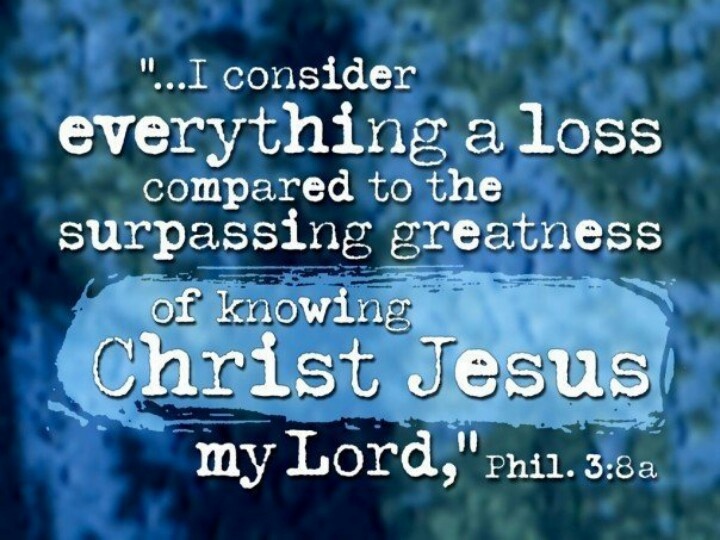
            But, those are only the first three verses of our reading. Paul does an abrupt about-face in verses 7 and 8. But whatever were gains to me I now consider loss for the sake of Christ. What is more, I consider everything a loss because of the surpassing worth of knowing Christ Jesus my Lord, for whose sake I have lost all things.” See how the Apostle Paul makes another extraordinary statement? The overwhelming grace of God – the surpassing worth of knowing Christ – calls Paul to a new, heavenly set of values.

            We will shortly be celebrating Communion, after this sermon. Here at this church, we do not usually say the Sanctus as a part of the Communion liturgy, since we use a shorter form of that section of the service. This part of the Communion liturgy is quite ancient. Here is the Sanctus: “Holy! Holy! Holy! Lord, God of Hosts! Heaven and earth are full of your glory!”  

            See how this statement fits into that Godly set of values from the Apostle Paul! “Our Father, who art in heaven, hallowed be Thy name.”

I invite you to consider the Sanctus when saying the beginning of the Lord’s Prayer. Imagine joining everyone who ever lived, lives now, and is already in heaven saying together that God’s name is hallowed. Because – God truly is holy!

What does Paul say next? “I consider [my worldly gains] garbage, that I may gain Christ and be found in him, not having a righteousness of my own that comes from the law, but that which is through faith inChrist—the righteousness that comes from God on the basis of faith.” Paul describes the value of all these worldly gains – all his marvelous resume – comparing it to the value system of the kingdom of Christ Jesus his Lord — complete rubbish! Absolute trash! That is where his outstanding resume belongs, compared to Christ Jesus our Lord!

               The Gospel reading for today comes from John 12, where Mary anoints Jesus’ feet while He is at dinner, in preparation for His death. “Like Mary pouring out her love by pouring expensive perfume, Paul shows his love and desire to know Christ by pouring out his credentials and achievements, his life, and considering them all rubbish (the Greek word also means “dung” and “excrement”) in comparison to the life to be gained in Christ.” [3]

            How much more can we consider our Lord to be holy? How much more meaningful can it be to say “Our Father, who are in Heaven, hallowed be Thy name,” compared to worldly credentials, or mere human achievements – compared to Christ Jesus our Lord.

            Paul’s goal, and our goal, is to know Christ! That holy, hallowed, set-apart Son of God, the one who reconciled us to God and bestowed upon all of us God’s gift of His righteousness. Praise God, Christ has redeemed us and we now walk in the newness of life.

            One last call to action, from the Apostle Paul: we are to straighten our priorities. Follow God’s priorities, God’s values, and follow Jesus. Make it your priority – my priority – our calling to know Christ intimately, and the power of His resurrection. Then, we surely can pray “Our Father, who art in heaven, hallowed be Thy name,” not only understand it, but mean it, too! Thanks be to God.

@chaplaineliza

(Suggestion: visit me at my other blogs: matterofprayer: A Year of Everyday Prayers. #PursuePEACE – and  A Year of Being Kind . Thanks!


[1] http://worshipingwithchildren.blogspot.com/2016/02/year-c-fifth-sunday-in-lent-march-13.html

[2] https://desperatepreacher.com//texts/phil3_4/phil3_4.htm

[3] https://desperatepreacher.com//texts/phil3_4/phil3_4.htm

Unknown's avatar

Choose Someone Else!

“Choose Someone Else!”

Isaiah 6:1-8 (6:8) – May 30, 2021

            Have you ever had a really vivid dream? Colorful, psychedelic, surreal, even? Sort of like what we just heard in the Scripture reading this morning. I suspect that people first hearing about Isaiah’s vision from chapter 6 may have thought the prophet was going way overboard with such vivid, descriptive language!  

Let’s take a few giant steps back, and gaze upon the big picture of this vision. We see the immense Holy One, and we see little, tiny Isaiah. “God’s presence is so large, the hem of the Lord’s robe alone fills the temple space. This is vastness. Strange but faithful creatures envelop the throne. Smoke obscures the whole scene. We are used to the images of fire and smoke, cloud and height being associated with God. It is all here.” [1]

            Some might think that Isaiah was exaggerating a lot when he described the Almighty God, seated on a throne in the heavenly temple. Yet, that vivid, glorious scene from the heavenly temple is the template of what goes on in many worship services today.

            The first hymn many people think of when they consider Trinity Sunday is “Holy, Holy, Holy, Lord God Almighty.” This hymn’s verses either refer to or directly quote this Scripture reading from Isaiah 6 – the first line, “Holy, holy, holy,” “Cherubim and seraphim falling down before Thee” and “all Thy works shall praise Thy name in earth and sky and sea.” This Scripture reading from Isaiah does not give us any information at all about the Christian doctrine of the Trinity, but has been used effectively as a backdrop and assist in helping Christians get some understanding of this mystical, almost ethereal doctrine that is so difficult to understand.

            What’s this about comparing Isaiah chapter 6 and worship services? Most worship services begin with a hymn of praise. Look at Isaiah 6:3 – “And [the seraphim] were calling to one another: ‘Holy, holy, holy is the Lord Almighty; the whole earth is full of his glory.’” If that isn’t a hymn of praise, I don’t know what is. What’s more, some contemporary churches have several hymns or an extended praise time at the beginning of their services.

Many worship services then move to a confession (or admission) of sin. Let’s check out Isaiah 6:5 – Isaiah cried, “Woe to me! I am ruined! For I am a man of unclean lips, and I live among a people of unclean lips, and my eyes have seen the King, the Lord Almighty.” We here at St. Luke’s Church have a confession of sin at the beginning of every worship service. I consider this vitally important! Just as Isaiah realized his sinfulness in the light of everything happening in that heavenly Temple, so we ought to confess our sins, too. We need to make ourselves clean on the insides before we can possibly come near to God.

After the confession and admission of sin comes an assurance or forgiveness of that sin, in Isaiah 6:6-7 – “Then one of the seraphim flew to me with a live coal in his hand, which he had taken with tongs from the altar. With it he touched my mouth and said, ‘See, this has touched your lips; your guilt is taken away and your sin atoned for.’” Just as we follow the prayer of confession in our worship with the assurance of pardon – Believe the Good News of the Gospel! In Jesus Christ, we are forgiven!

This template for the worship service from Isaiah does not have a reading of Scripture, but many other instances in the Hebrew Scriptures do, where the minister gives further instruction and exhortation using the Scripture. (This is exactly what I am doing right now! Exhorting the congregation, based on the Word of God.) What follows is all-important, the whole point and reason for it all! Isaiah 6:8 holds a call to service extended from the Lord God Almighty. This call is the focal point of the retelling of this vision. “I heard the voice of the Lord saying, “Whom shall I send? And who will go for us?” And I said, “Here am I. Send me!”

When I first felt that call from God, I was in my early 20’s, attending an evangelical Christian college as a music major. Women were definitely frowned upon as ordained clergy. I heard that call, and I even reflected upon it, turned it over in my head and heart, and talked about it with some other students at my school. However, not much came of it – then – yet.

As we take a look at another call narrative, the one from Exodus 3 involving Moses and the burning bush, we get a whole different response to the question “Whom shall I send? And who will go for us?” Moses certainly does not want to lead the people of Israel! “Choose somebody else!” is his response. And, even after God says God will empower Aaron as Moses’ right-hand man, Moses still drags his feet.

Isn’t that like us, sometimes? Don’t we often drag our feet when God calls? Aren’t we more likely to say, “Choose somebody else!” when God taps us on the shoulder?

When you and I hear the Word of God rightly divided and expounded, when we breathe in the Holy Spirit-inspired Word, that divine response and possibility is there, for all members of the congregation, for each believer in the Good News. The heavenly touch of the Holy Spirit may well come upon each of us, bursting forth into fiery life! That Trinity, that Triune God can empower you and me, and help us to do things, to say words, to dream dreams that go far beyond what we could even think or imagine – like Isaiah.   

Yes, worship is wonderful, and the Lord has great joy in the worship of God’s people! Yet, what is the focal point of worship? Responding to the call of God. When God calls, can you respond, “Here am I, send me!” That is what God truly wants, an open heart, and a willing spirit.

Say with me, with Isaiah, “Here am I, send me!”

(Thank you to John Holbert for his Patheos commentary from 2015. I took several extended ideas from that article. https://www.patheos.com/progressive-christian/choose-somebody-else-john-c-holbert-05-28-2015

 “Choose Somebody Else!” John C. Holbert, Opening the Old Testament, 2015. )

@chaplaineliza

(Suggestion: visit me at my other blogs: matterofprayer: A Year of Everyday Prayers. #PursuePEACE – and  A Year of Being Kind . Thanks!


[1] https://www.workingpreacher.org/commentaries/revised-common-lectionary/the-holy-trinity-2/commentary-on-isaiah-61-8-3

Commentary, Isaiah 6:1-8, Melinda Quivik, Preaching This Week, WorkingPreacher.org, 2012.

Unknown's avatar

Holy, Holy, Holy!

“Holy, Holy, Holy!”

Isa 6-3 sanctus-holy-holy-holy

Isaiah 6:1-8 (6:3) – May 27, 2018

Today is Trinity Sunday. In the children’s message, we talked about a straightforward way of understanding the Trinity. The theological concept of the Trinity is an idea that has been and still is misunderstood—for centuries. Christians and non-Christians alike just plain do not understand it. Even knowledgeable ministers and bible scholars have problems talking about it clearly. That is one reason the children’s message about the concept of the Trinity was stated the way it was.

The simple idea behind the children’s message is an idea that can work for us adults, too.

Jesus said to approach Him as little children. He was talking to adults at that particular time. He meant that piece of advice to go for His disciples, His followers, and anyone else who was thinking about following Him. This can work in terms of the theological idea of the Trinity, as well. What’s a good way to talk or think about the Trinity?

One of my favorite commentators, Carolyn Brown, observes Trinity Sunday as one of her favorite Sundays of the year. She says: “It is God Sunday. The call is not to explain God but to celebrate God’s mysterious, more-than-we-can-ever-explain presence.  What could be better!” [1]

As we consider God’s unsearchable mystery and God’s awe-inspiring power and might, we all can look at God from a child’s point of view. We might even think about “the unanswerable questions people of all ages ask about God, such as but definitely not limited to:

  • What was God doing before God created the world?
  • How can there never be a time before or after God?
  • How can God pay attention to each person in the world all the time?” [2]
  • Why did God create rattlesnakes and mosquitoes? Along with spiders, sharks, viruses, earthquakes, and volcanos?


Let’s look at the Hebrew Scriptures. There have been hints of the Trinity from the very beginning. Think of the first chapter of Genesis. “In the beginning, God created the heavens and the earth.” And, the beginning of the Gospel of John that starts “In the beginning was the Word, and the Word was God, and the Word was with God.”

Imagine a universe still and dark. Imagine a solar system just before it was going to spring into being, with nothing hung in space—yet. Imagine a place where the earth will orbit, but nothing there, yet. Except—the spirit of God—the Holy Spirit hovering, ready to hold the newly-born earth in loving embrace. Imagine the Word, the Logos, the creative force of God, speaking forth the whole of creation with astronomical power and might. Not only the earth, but also our solar system. Not only our solar system, but all other solar systems. And stars. And meteor showers. And quasars, and black holes, and everything else that is in the universe.

Traditionally speaking, God the Father, God the Son, and God the Holy Spirit had differently described roles in different expressions of the creation of the universe.   

As we look more closely at both of these passages, Genesis 1 and John 1, we see God created the universe in the beginning. Genesis tells us that God spoke, and the world came into being. The Word, the Logos, the pre-Incarnate Son was the powerful Word spoken at the beginning of all things. And then, the Holy Spirit—or the spirit of God—described as moving over the surface of the waters, holding the earth secure. Can you begin to understand what a mind-blowing image that was?

We continue to get glimpses of this Triune God in our sermon passage for this morning, where the prophet Isaiah has a sweeping, magnificent vision of the heavenly Temple of God.

“In the year that King Uzziah died, I saw the Lord, high and exalted, seated on a throne; and the train of his robe filled the temple. Above him were seraphim, each with six wings: with two wings they covered their faces, with two they covered their feet, and with two they were flying.

                    As Isaiah describes it with vivid word pictures, I think his vision sounds fearsome, and glorious, and terrifying. But, that’s not all! “And the angels were calling to one another:

‘Holy, holy, holy is the Lord Almighty; the whole earth is full of his glory.’ At the sound of their voices the doorposts and thresholds shook and the temple was filled with smoke.”

This passage from Isaiah 6 contains important liturgical language:. Did you recognize that language? “Holy, Holy, Holy!” This is called “the Sanctus. The song is an acclamation from the congregation honoring the presence of the Lord. The minister celebrating communion has just said, “The Lord be with you… lift up your hearts… let us give thanks…” and then prayed a prayer of acknowledgment (the Preface) for what God has done in language that calls up the time of the church year.”

We find out more—in another way—about how great and mighty and powerful this God is, by looking at the Psalm passage from today’s lectionary.

Psalm 29 deals with the mighty powers of God in nature and in the crashing sounds, stunning displays and fearsome descriptions Eileen read to us.  “For the psalmist, the storm is a symbol not of the power of nature, but rather of the power and sovereignty of Israel’s God. Seven, the number of completeness, is significant [in this psalm]. Israel’s God is completely powerful and ultimately sovereign. There can be no competing claims.” [3] Just in case anyone was wondering, that is. God is the ultimate in power, majesty and glory.

In the New Testament, God the Word, God the Logos becomes incarnate; He is born and grows to adulthood as the son of Mary, Jesus the Messiah. Jesus the Anointed One, the Lamb of God chosen before the foundations of the earth, the Prince of Peace revealed to us in the Gospels of the New Testament.

Remember last week, when we celebrated Pentecost, the birthday of the Church? That was the expected coming of the Holy Spirit in each believer’s life, in great power and might. The Holy Spirit blew powerfully into the lives of the assembled persons praying. The Holy Spirit ignited their hearts and minds to go forth and tell others about the might and power of God, in raising Jesus from the dead with resurrection power, and saving us from our sins.   

Is there any wonder that we are likely to fall on our knees as we sing the hymn “Holy, Holy, Holy?” As we consider the word holy the most special and important, set-apart, and awesome aspect of God. We reflect on the Trinity as we sing this hymn:

First, we praise God. Second, everyone in heaven praises God. Third, even though we do not fully understand God, we praise God anyway!.And last, everyone and everything on earth praises God. [4]

There are not enough superlatives to even begin to describe God. We do not have enough glorious, magnificent words fit to praise God. Our vocabulary falls far short.

Why don’t we consider the words of the heavenly beings in Isaiah 6, and close today with the words of the angels from Isaiah 6: “Holy, holy, holy is the Lord Almighty; the whole earth is full of God’s glory.”

Amen. Alleluia. Praise be to the Trinity, Eternal One in Three, Three in One.

[1] http://worshipingwithchildren.blogspot.com/2015/04/year-b-trinity-sunday-may-31-2015.html

Worshiping with Children, Trinity Sunday, Including children in the congregation’s worship, using the Revised Common Lectionary, Carolyn C. Brown, 2015.

[2] Ibid, Worshiping with Children.

[3] http://www.workingpreacher.org/preaching.aspx?commentary_id=2453   Commentary, Psalm 29, J. Clinton McCann, Trinity Sunday, WorkingPreacher.org, 2015.

[4] Ibid, Worshiping with Children.


@chaplaineliza

(Suggestion: visit me at my regular blog for 2018: matterofprayer: A Year of Everyday Prayers. #PursuePEACE – and my other blog,  A Year of Being Kind . Thanks!)