Unknown's avatar

We Are Convinced

“We Are Convinced” – July 26, 2020

Rom 8-37 conquerors, water

Romans 8:33-39 (8:37-39)

Shel Silverstein wrote some wonderful poetry for children. (His poetry is enjoyed by all ages, in fact!) You may be familiar with two of his books of poetry called “Where the Sidewalk Ends” and “A Light in the Attic.” This poem is called “Whatif.” I will read most of it:

Last night, while I lay thinking here,
some Whatifs crawled inside my ear
and pranced and partied all night long
and sang their same old Whatif song:
Whatif I’m dumb in school?
Whatif they’ve closed the swimming pool?
Whatif I get beat up?
Whatif there’s poison in my cup?
Whatif I start to cry?
Whatif I get sick and die?
Whatif nobody likes me?
Whatif a bolt of lightning strikes me?
Whatif I don’t grow taller?
Whatif my head starts getting smaller?
Whatif the bus is late?
Whatif my teeth don’t grow in straight?
Whatif I tear my pants?
Whatif I never learn to dance?
Everything seems well, and then
the nighttime Whatifs strike again!
[1]


Whatif? Many people are haunted by all kinds of fears that a school-age child might have. We can relate to some of them, perhaps even most of them! The commonality of these fears crosses borders, and connects us all in a powerful way. Does this remind you of our Scripture reading at all? Whatif? Whatif God is against us? Whatif God condemns us? Whatif the devil stands in front of us, telling God all the sins we have ever thought, said or done? And, then – Whatif God tells us we can’t get into heaven?

You need to understand something about the apostle Paul’s writing style. He wrote some really long sentences. Some of his sentences went on for a whole paragraph! Plus, it is typical of Paul to interrupt himself in the middle of a point he’s making, add some more details, and then pick up where he left off in the first place. What is more, every phrase in this 8th chapter of the letter to the Romans has marvelous information for our salvation!

We can watch as Paul assembles his argument. In verses 31 and 32, he asks, “who can be against us?” Paul’s answer: no one, not even God, who did not spare His own Son from death. In verse 33, who will bring a charge against us? Again, the answer is no one. God justifies – or makes it just-as-if we had not sinned. Then, in verse 34, Paul asks, “who will condemn?” The ringing answer is: no one! We are looking around for more accusers, but no one steps forward. Christ Jesus died for us, was raised for us, and intercedes for us. [2]

Did you hear? Jesus intercedes for us, too! Not just once or twice, but Jesus is continuing to intercede on our behalf! That is amazing. I almost cannot believe it, but Paul says so. In verse 35, Paul describes many physical hindrances that may separate us from the love of Jesus Christ. This rhetorical statement continues, piling up more and more bricks. You and I really need to listen to the apostle Paul when he tells us something so important, point blank.

I do need to remind us that Paul does describe here the kinds of sufferings that he and his fellow believers did go through. These were (and are today, too!) very real sufferings – danger, threat and struggle – of countless people throughout the world.

However, our salvation is NOT our doing. Bryan Findlayson tells us exactly what Paul is building here. Paul knows full well that “our standing before God is not dependent upon our love, obedience, perseverance or faithfulness, rather it rests on what Christ has done for us. At this moment we stand perfected before the throne of the Almighty God. We are eternally secure.” Do you hear that? Do we have any idea what fantastic news that is? You, I, all of us “are being daily renewed into the image we already possess in Christ. This is not our doing, but rather it is a gift of grace from a loving and merciful God.” [3]

As if all that is not enough, Paul adds the marvelous icing to the top of our salvation. It is almost as if he gets more and more outrageous with each pair of things he references. Sure, these strenuous pressures are powerful, sure to cause many people to stumble and fall. But – let us listen to them again: Paul says, “neither death nor life, neither angels nor demons, neither the present nor the future, nor any powers, 39 neither height nor depth, nor anything else in all creation.” He continues to mention all of these threats, elements, and all of space and time spread out before us – and yet, nothing – NOTHING can separate us from the love of God in Christ Jesus our Lord!

The love of God transcends all things. The love of God reaches into the depths of human despair, embraces those who live in the shadow of death, or the overbright light of present life. The love of God proclaims to the world that Jesus the Messiah is the world’s true Lord, and in Him and through Him, love has won the ultimate victory! [4]

Paul started out this chapter by telling us that “therefore there is no condemnation for those who are “in Christ” Jesus. He ends by telling us that therefore there can be no separation from the love of God for those who are “in Christ” Jesus.” [5] All this is Good News indeed.

Amen, alleluia!

[1] Silverstein, Shel, “Whatif,” from A Light in the Attic (Harper & Row: San Francisco, 1981), edited.

[2] Wright, N.T., “Romans,” The New Interpreter’s Bible Commentary, Vol. X (Abingdon: Nashville, TN, 2002), 613.

[3] http://www.lectionarystudies.com/sunday18aee.html  “The Love of God,” Rev. Bryan Findlayson, Lectionary Bible Studies and Sermons, Pumpkin Cottage Ministry Resources. Includes detailed textual notes.

[4] Wright, N.T., 619.

[5] Findlayson, “The Love of God,”

@chaplaineliza

(Suggestion: visit me at my regular blog for 2020: matterofprayer: A Year of Everyday Prayers. #PursuePEACE – and my other blog,  A Year of Being Kind . Thanks!

Unknown's avatar

God’s Children

“God’s Children” – July 19, 2020

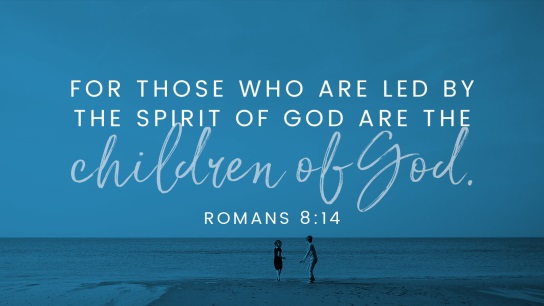
Rom 8-14 children of God

Romans 8:12-19 (8:17-19)

Many people know what it’s like to be part of a family. Parents, grandparents, aunts, uncles, cousins. For many, this is a warm and happy feeling! For others, not so much. What would it be like to have an unhappy childhood? Perhaps, to grow up as an orphan or in foster care? Or, with a parent or close family member who is an active addict or abuser? This is a sad reality for many, many people throughout the world, who do not experience the same warm, comfortable feelings about family that many of us here do.

We are in the middle of a short series about the Lectionary readings from Romans chapter 8 this month. Before I get into the wonders of salvation that Paul talks about in this chapter, we are going to take a short detour. Our Hebrew Scripture reading from this week concerns Jacob, from Genesis 28. Jacob was not a particularly honest guy. He was a sharp customer, who connived with his mother Rachel to steal the blessing of the firstborn from his older brother Esau. He also pulled the wool over the eyes of his dishonest father-in-law Laban, who did the same to him.

These are the things that are reported about Jacob, in the book of Genesis. I wonder what Jacob’s family life was really like? How were his relations with his father and mother, and his brother? We just don’t know for sure, but we can guess a good deal from his actions.

This was a very human, very fallible family we see from Genesis. Not at all like the Godly family the apostle Paul tells us about in Romans chapter 8.

Paul does not say that you and I are God’s employees, or servants of God. No, certainly not! The Lord could have said, “Oh, I’ll keep you around as long as you do things My way, as long as you behave and don’t put one toe out of line.” That is what many worldly people would have said! No, Paul tells us that those who are led by God’s Spirit are God’s children. Can you believe it? I can hardly understand why God would do such a thing for a such a sinner like me, but I do believe it. That is a blessed fact, and a promise from the Lord.

Now, wait a minute. Let’s think about Jacob again. He was not honest. He deceived people, was cowardly, and wasn’t a nice guy. But, what did God do to Jacob? Do you think the Lord kicked Jacob out of God’s family for doing all that sneaky, rotten stuff, for years? No!

“Instead, God promised to stick with him throughout his life and even told him that through him everyone in the world would be blessed. Jacob is a good person to remember when we feel like we should be kicked out of God’s family.[1]

Because we are part of God’s family, we can expect to enjoy the happy, easy days in the family.  But we must also be ready to stick with the family when the going gets hard.  The sufferings of Christ are very real. Paul says in verse 17 that we are going to have our share of suffering and suffer with Christ. Some suffer with cancer, or with diabetes, like my father and siblings. Some suffer with economic hardship, or a bad car accident, or paralysis. Perhaps we all are suffering right now, with the COVID-19 virus. I don’t know. That is one of the things we are going to need to ask God about when we meet God after we cross that River Jordan.

As David Lose, one of my favorite commentators, mentions, “Paul describes the difference it makes, being considered God’s children, adopted by God. Rather than being afraid – of the future, of what people may think of us, of our status, of our standing with God – Paul invites us instead to imagine a life of courage, the courage of those who have been adopted by God and invited into the full measure of God’s blessings and riches.[2]

Even if you or I or our friends had a less-than-perfect growing-up time, God calls us children. Even though some may not feel comfortable with the idea of an earthly parent or grandparent, or other members of the extended family, even though some may be orphans or foster children, abandoned by those who brought them into this world, God calls us heirs with Christ! Not employees, not servants, not someone who can be simply dismissed or ignored. We are God’s children! That is huge! Can I hear an amen? Isn’t that the best news you’ve heard all week? Even, all month? Perhaps, all year?

Paul tells us in verse 17 “Since we are God’s children, we will possess the blessings God keeps for his people, and we will also possess with Christ what God has kept for him; for if we share Christ’s suffering, we will also share his glory.” Praise God, we ARE God’s children, no matter what! And, God is going to shower us with blessing and glory! Amen! Alleluia!

Now, I have a challenge: what difference does it make NOW? What difference does being God’s child make to you? To know that you are unconditionally loved? That you have immeasurable value in God’s eyes? That no matter what to do – or is done to you – and no matter where you go, yet God always loves you and cares about you? [3]

I hope this blessed truth makes a huge difference to you – to you, to me, to all of us! Again, praise God for God’s declaration that we are God’s children! In this world, and in the next. Amen, alleluia.


(I would like to thank Carolyn C. Brown for her superb commentary in Worshiping with Children. This is a marvelous series, and I so appreciate her insights and wisdom. I have borrowed freely from this week’s Lectionary study on Year A – Proper 11, 16th Sunday in Ordinary Time, 6th Sunday after Pentecost.)

[1] http://worshipingwithchildren.blogspot.com/2014/06/year-proper-11-16th-sunday-in-ordinary.html

Worshiping with Children, Including children in the congregation’s worship, using the Revised Common Lectionary, Carolyn C. Brown, 2014.

[2] http://www.davidlose.net/2015/05/trinity-b-three-in-one-plus-one/

“Three-In-One Plus One!” David Lose, …in the Meantime, 2015.

[3] http://www.davidlose.net/2015/05/trinity-b-three-in-one-plus-one/

“Three-In-One Plus One!” David Lose, …in the Meantime, 2015.

@chaplaineliza

(Suggestion: visit me at my regular blog for 2020: matterofprayer: A Year of Everyday Prayers. #PursuePEACE – and my other blog,  A Year of Being Kind . Thanks!

Unknown's avatar

Life on God’s Terms

“Life on God’s Terms” – July 12, 2020

Rom 8_11 Spirit of God

Romans 8:1-11 (8:10)

Does anyone know what this is? [motioning towards the garbage can] You’re right. This is a garbage can. Good for being a container for all the garbage – refuse – junk – from our homes, workplaces, and communities. All kinds of worthless garbage that is not needed or wanted goes right in here. The apostle Paul talks about all kinds of garbage in our lives, on our insides, here in the letter to the church in Rome.

Imagine, if you will, all the internal junk in a person’s life, and mind, and heart. All of that meanness, and selfishness, gossip and swearing, bullying and arguing. And, what about the times people cheat? Or, blow off assignments or obligations? Or, stretch the truth just a little – or, perhaps a lot? Oh, it’s not much. But, do you think God keeps track of each and every time?

Just think of a person’s life. Perhaps, your life, or mine. If all the years and decades of those junky, selfish, stubborn, or mean thoughts, words or deeds were piled in this garbage can, I’d imagine it would be pretty full. Even, perhaps, full to overflowing.

Life on the inside, our internal selves without God can be pretty hopeless. Worthless. Just like garbage – refuse – junk that goes into this garbage can. Another word that Paul uses for all the stuff in these garbage cans is sin. I suspect many of us here can quote Romans 3:23, where Paul says “For all have sinned and fall short of the glory of God.” Paul does not say, “For some have sinned,” or even “For many have sinned.” No, we all have our internal selves filled up with meanness, selfishness, gossip, swearing, bullying, arguing. And, then some.

God does have laws. Many of these laws are common sense, and others are in keeping with moral codes that many civilizations have held for millenia. We know the big 10, the Ten Commandments, and many of the other laws of Moses that are found in the Hebrew Scriptures. Right before Paul writes these marvelous words in Romans 8, he talks about the huge problem with law and sin. We know about that. Sin and the law of God do not get along.

What do I do now? I know a lot of these laws of God, sure. But I still fall into sin, even though I know the rules. Another way of looking at sin is separation from God. When you—I—when all of us sin, we are separated from God. What’s more than that, sometimes people don’t even think of the Lord. God does not even enter their minds. Can you imagine? Ignoring God? Yet, so many people do just that.

So many people today are running on that treadmill of self will run riot, of selfish, mean, resentful living. I have seen a number of these kinds of persons, and they keep running, running, running on that treadmill of separation from God.

I have one particular person in mind. An acquaintance, from some years ago. To all outward appearances, she was very successful. She had designer clothes, a successful job, a luxury car, a fancy house. But, on the inside? All kinds of resentment, anger, greed, envy, gossiping and backbiting. She cut corners on her integrity and honesty, and just did not have a moral compass. Do you know someone like that? I have a feeling we all might have more in common with this unhappy lady than any of us might like to admit.

I’d like all of you to think of a sin in your life. I suspect you have thought of a sin that is really obvious to you, right now. the one thing you feel worst about. The one regret or misdeed or misfortune that you wear like a snail does its shell. The one part of your life that forever threatens sin and condemnation. Could you write it down? Or, if you don’t have a pen and paper, could you think really hard of that particular sin right now?

Paul does not leave us in that horrible place. Yes, all of Romans chapter 7 is talking about sin, and separation from God, and how much difficulty all of us have with these sinful thoughts, words and deeds. We might think that we are stuck at the bottom of one of these smelly, stinky, filthy garbage cans, with no way out. Who will rescue me from this body of sin and death? How can I – can we – get in a place where we can possibly have access to God?

Paul has good news for us. In fact, it’s great news! We do not have to stay in this garbage dump for the rest of our lives. No, Jesus reaches down from heaven and rescues us from sin and death. Jesus takes each of us out of that separated, filthy garbage can and brings us into the glorious presence of God!

Here is the best part of all. God’s Holy Spirit helps us to stay free from the power of sin and death. We no longer need to reflect on what we have done – or said – or thought that was wrong. No! Jesus Christ delivers us from sin and the Law.

I want to invite all of us to—virtually—toss that sin we wrote down into the garbage can right here. Jesus can clean us up from the inside, and help us to sin less and less. Amen!

One last thing. I invite each of you to take another piece of paper, and write what you are free to do now that you do not have that condemnation in your life and inside your very self. What challenge will God bring into your life, now that you know you are beloved by God and filled with God’s Spirit? What kindness or generosity will you attempt? What will you do with all the love and grace God can give you? [1]

God promises to be with us, yes! And, even more, God promises to use each of us for the sake of the people and the world God loves so much. Go out into the world for God, today.

[1] http://www.workingpreacher.org/craft.aspx?post=1571

“What Willl You Do…?” David Lose, Dear Working Preacher, 2011.

@chaplaineliza

(Suggestion: visit me at my regular blog for 2020: matterofprayer: A Year of Everyday Prayers. #PursuePEACE – and my other blog,  A Year of Being Kind . Thanks!
 

Unknown's avatar

Rest for the Weary

(I am on vacation this weekend. Thanks to the Rev. John Lewis of The Presbyterian Church of Hamilton, Ohio for preaching for me at St. Luke’s Church!

This is a sermon from 2008 on the Lectionary passage from Matthew 11:28-30.)

“Rest for the Weary” – July 6, 2008

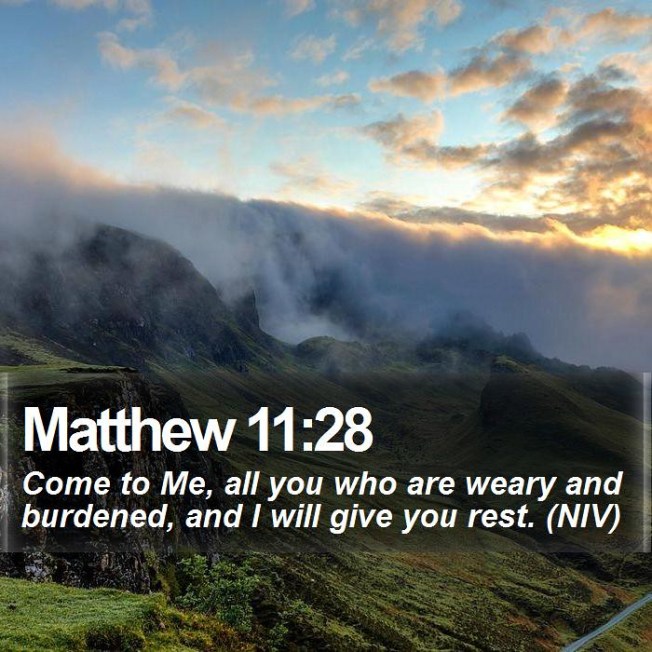
Matt 11-28 rest, bench

Matthew 11:28-30

I was born here in the city. My parents were born here, too, in Chicago. I have only a vague idea of what goes on in the country, on a farm. My information about farming activity comes chiefly from material I have read, and a bit from stories I have been told. By my father-in-law, for example, who grew up on a small farm in southeastern Iowa during the 1930’s.

So, when I read a scripture passage like the one we have before us today, I have to take a really close look at it, and work hard at fully understanding it, because I am not that familiar with oxen, or yokes. But burdens—I am familiar with burdens. And our Lord Jesus talks about burdens here in this reading from the Gospel of Matthew.

Burdens come in all assorted shapes and sizes. Burdens can be solitary things, with each of us, on our own, struggling with our separate burdens. It is difficult indeed for me to carry a burden on my own. And I am heavily laden. Let’s face it. We are all burdened with something. Perhaps several things. A few of us carry a lot of heavy difficulties, whether psychological, emotional, or physical. These all can be heavy burdens, to be sure.

If I thought I was having problems before, I did not even consider this next complication: I am naturally separated from other people here in this world. Just as much, if not more, I am also separated from God above. I not only have a wall of isolation separating me from other people, I also have that same isolating wall separating me from God.

The Bible has a name for this horrible wall of isolation, and this name is sin. As the Apostle Paul says in Romans 3:23, all have sinned and come short of the glory of God. The verse is not that a few have sinned. It does not say that some have sinned. The letter to the Romans says that all have sinned. So that wall of isolation has been erected between me and God, and me and other individuals. And that wall is there for you, too.

Think of different kinds of loads: burdens of pain and suffering, burdens of loneliness and isolation, burdens of other kinds of losses. If we think about it, on top of the other burdens that each of us is carrying is the burden of sin.

So, not only is each one of us separated from God and from our fellow human beings, but each of us is heavily burdened by countless other things. And I could imagine lots of people getting virtual hernias, because they are carrying their burdens all by themselves.

The truly good news is that we do not have to bear these burdens all alone, any more. Our Lord Jesus has reconciled us to God. Each of us is no longer separated, isolated. But Jesus brings us back into a proper, friendly relationship with God. Each of us has the opportunity to be called a child of God.

And Jesus not only reconciles each of us back to God, this is where He mentions the yoke. His yoke is easy, and His burden is light.

What is a yoke, anyway? How does it work? What does it do?

You all remember that I am a city girl. From my reading, I have found out that a yoke is used by a farmer to harness two animals—often oxen—to a piece of farm equipment, usually a plow. Yokes were made of wood. When the yoke was made, it was adjusted, so that it would not chafe. And the significant thing about this is that a yoke was custom-fitted to the particular ox that pulled with it.

Jesus mentions a yoke here. Remember, all of these people Jesus was talking to understood about farm life, and oxen, and especially about a good fit on a yoke. So when or Lord Jesus mentions “My yoke is easy,” He means that His yoke for each one of us fits us very well—it’s tailor-made, in other words. And even more important, one ox alone does not pull in a yoke. The load would be unbalanced if there were only one ox. Instead, each of us is in a team . . . in a yoked team with Jesus. If our Lord is right with us, pulling at our burden—whatever it is—at our side, then each of us is on a winning team.

Just imagine. I no longer need to pull at my burdens all by myself, isolated and alone. Jesus is right there next to me, helping me, pulling by my side. Praise God! Jesus comes alongside each one of us. Jesus is there to encourage us. And He will bring rest for our souls. Is there any better news than this best of all Good News?

Alleluia, amen.

@chaplaineliza

(Suggestion: visit me at my regular blog for 2020: matterofprayer: A Year of Everyday Prayers. #PursuePEACE – and my other blog,  A Year of Being Kind . Thanks!

Unknown's avatar

Cup of Cold Water

“Cup of Cold Water”

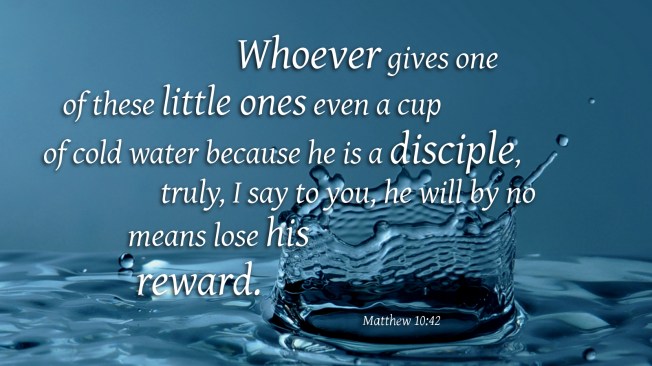
Matt 10-42 water, words

Matthew 10:40-42 (10:42) – June 28, 2020

I have several friends who are wonderful hosts and hostesses. They love to have friends and relatives come to their homes, and provide such excellent hospitality. In fact, I had the great good fortune to be the recipient of such fine hospitality a few months ago, at the home of my niece Josie’s uncles (on her mom’s side), in Washington state. Jeff was a marvelous host!

What does hospitality have to do with this bible reading from Matthew 10? At first glance, this reading talks about prophets, or God’s messengers. Jesus tells us how it’s important to accept, or to welcome the messengers of God.

Hospitality was huge in the Middle East. It still is, today. If someone comes to your home, you go all out for them, making them comfortable, feeding them, and otherwise supplying their needs. That hospitality has been a hallmark and a highlight of visiting this region of the world, for centuries.

When the Rabbi Jesus made this statement about receiving the prophets, God’s messengers, what do you immediately think of? What is the first thing that comes to mind? The first thing I thought of was an old-fashioned Sunday dinner after church, where one of the prominent families at the church invites the minister over for a fine meal following the morning services. Well, that cannot happen now, because of COVID-19. Not the socializing at each other’s houses, and not the in-person worship services.

But – can this reading mean more than that?

Somehow, I don’t think the Rabbi Jesus was thinking about the chief rabbi from the most prosperous synagogue in town. I don’t think Jesus had the hot-shot leading elders of the largest congregation in mind, either.

I suspect you can immediately think of someone—maybe a couple of someones—who is absolutely marvelous at hospitality. Putting on parties and get-togethers, gathering friends, relatives, acquaintances. I know, I have been at a few of these gatherings. They are almost always wonderful times to connect. Wonderful times for eating and drinking, too.

What about you? Are you grateful to friends or relatives who have the spiritual gift of hospitality? This absolutely is a spiritual gift, listed among the other more acknowledged or appreciated biblical gifts. Some have that gift of hospitality in abundance.

Except, the words of Jesus do not excuse some of us who are not so hospitality-gifted. No, Jesus’s words are intended for all of us. That means every believer has the responsibility to extend hospitality, whether they have that spiritual gift or not.

I could expound upon the gifts of the Holy Spirit that are given to each believer when they come to believe in Jesus Christ. The apostle Paul has written several lists where he runs down a good number of these gifts: in chapters Romans 12, 1 Corinthians 12, and Ephesians 4, among others. Gifts like teaching, discernment, helps, and administration.

I can hear some people say, “Oh, I just don’t have a hospitable bone in my body. I can’t welcome people into my tiny apartment. I’m all thumbs when it comes to spreading a wonderful table, and I don’t know the first thing about throwing a big party.” Well, guess what? Jesus did not say, “This command is just for the people among you who really like Martha Stewart.” Or, “This command only applies to the people who can throw the best parties.”

Jesus wants ALL of us to be hospitable. He wants ALL of us to extend a welcome. But, to whom? Who is it Jesus wants us to welcome in such a way? It’s just our friends and relatives, right? It’s just the people from my church, or from my side of town. It’s just the people who look like me. Isn’t that who You mean, Jesus?

Let’s read verse 10:42 again. ”And if you give even a cup of cold water to one of the least of my followers, you will surely be rewarded.” Acts of mercy and deeds of compassion, no matter how small. My goodness. Is Jesus talking about being kind to – anyone? Everyone? No matter what? No matter who? No matter what they look like? Or, where they were born?

Yes, mercy and compassion are two of those spiritual gifts the apostle Paul talks about. Except, Jesus commands all of us to show compassion and mercy, right here. By doing these compassionate things for anyone and to everyone, we give witness to the unconditional love of our Lord Jesus. Jesus does not make this expression of compassion and mercy something exclusive to “only our kind.” No, He specifically says that we are commanded to show mercy and compassion to “the least of these.” Some translations use the words “these little ones.”

Okay, Jesus. I guess I get the idea. You want me to show mercy and compassion to just about everyone who needs help. But, I need some ideas.

Dr. David Lose, one of my favorite commentators, gives us some excellent suggestions. He says: “at other times, Jesus seems to say, it’s nothing more than giving a cup of cold water to one in need. Or offering a hug to someone who is grieving. Or a listening ear to someone in need of a friend. Or offering a ride to someone without a car. Or volunteering at the local foodbank. Or making a donation to an agency like Luther World Relief. Or…you get the idea.” [1]

Jesus does not simply make a suggestion. This cup of cold water, this mercy and compassion is something He is really serious about. Let us take our Lord’s words to heart, and put them into action. Now. Go, do, in Jesus’ name. Amen.

[1] https://www.workingpreacher.org/craft.aspx?post=3265

“No Small Gestures,” David Lose, Dear Working Preacher, 2014.

@chaplaineliza

(Suggestion: visit me at my regular blog for 2020: matterofprayer: A Year of Everyday Prayers. #PursuePEACE – and my other blog,  A Year of Being Kind . Thanks!
Unknown's avatar

Live a New Life

“Live a New Life”

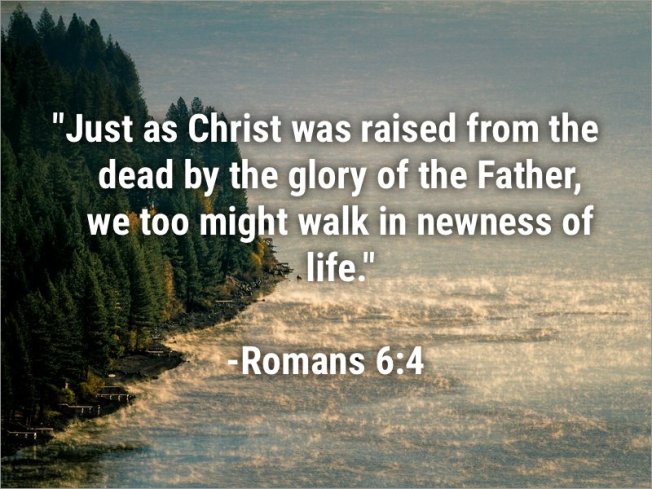
Rom 6-4 nwness of life

Romans 6:1-5 (6:4) – June 21, 2020

I have a friend who should have been on the debate team in high school. On occasion, he loves to discuss and debate points of history, or whether this or that point of politics has merit. He is quite good at expressing himself, and often enjoys a good, rousing discussion.

My friend reminds me of the apostle Paul. Paul talks at great length in his letters about such wonderful doctrines like sin, death, grace, baptism and salvation. He discussed several of them in chapter 5 of his letter to the Romans.

Paul argued and debated a lot with his fellow Christians. We are familiar with that, today, too. Theologians, church leaders and ministers debating back and forth, this way and that.

Different denominations have different “rules and regulations” about living the Christian life. One group tells believers that all true Christian people have to abstain from eating meat on Fridays. Another group tells all believing women that they have to wear skirts and are never permitted to wear pants. A third group says that musical instruments in worship services are evil, and only the human voice is fit to be used to praise the Lord.

Some of these rules and regulations might seem petty, or over the top, but they make sense to the people who follow them. The apostle Paul had to deal with some of these well-meaning but legalistic followers of Christ, too.

Paul used to be one of these super-legalistic followers of the Lord. He says it himself: he was a Hebrew of the Hebrews, as to the law, a Pharisee. A strict follower of God, blameless and righteous according to his observance of the Mosaic Law Code. (according to Philippians 3)

I am sure many believers are familiar with Romans 3:23, and can quote it word for word: “For all have sinned, and fall short of the glory of God.” Yes, that is in the middle of Paul’s discussion about sin. Then, Paul brings the theological concept of grace into the continuing argument, and adds additional layers to the ideas of sin, grace and forgiveness.

But, what does he say here in Romans, in the follow-up to his discussion of sin and grace in Chapter 5? I love the translation of Eugene Peterson, from the Message. This is his version of what Paul said: “So what do we do now? Keep on sinning so God can keep on forgiving us? I should hope not! If we’ve left the country where sin is sovereign, how can we still live in our old house there? Or didn’t you realize we packed up and left there for good?”

Oh, Pastor Peterson, you make these complex ideas of sin and grace from the apostle Paul so clear and plain.

Our old house on Transgression Avenue, in the Country of Sin, was a rattletrap of a building. Sin lurked in every part of that house—under the stairs, in the closets, and especially in the bedroom, basement and attic. That was before we met Jesus, and before He became the general contractor on that old sinful house. Jesus didn’t do just a cosmetic paint job. No, He started major work, inside and out. The work on some houses—some people—went more slowly, some more quickly, but sooner or later we moved out of the old neighborhood. That old, sin-filled neighborhood on Transgression Avenue.

Can you see how this analogy of an old house fits in to our new life in Jesus Christ? Sure, our old life—when we were still filled with sin—is like that old sin-filled house. But, after we met Jesus, He became the general contractor. Jesus started to tear down sagging walls, replace the plumbing and electrical systems. Jesus came alongside each of us. Jesus wants us to see that He can help us out with all kinds of components in our spiritual houses—in our lives.

How does Jesus go to work on our sinful selves? With His righteousness, that He freely gives us when we believe in Him. Jesus’ “righteousness, his faithfulness is ours as a gift of divine grace through faith, and this apart from obedience to the law. There is nothing that we can add to what Christ has done for us.[1]

Did you hear? Nothing. We add nothing. It’s all a gift, that Jesus freely gives to us. Some people still think they need to earn brownie-points with God for being good, before they can reach God’s heaven. Some people argued with Paul, saying they opposed his teaching about grace—God’s free gift of grace, because they still wanted to earn brownie-points.

Paul’s comeback? Yes, we have died to sin. Yes, we are buried with Jesus Christ in baptism. And, yes, we have been resurrected with Jesus to new life! Eternal life, through Jesus Christ our Lord. Plus, it’s all from Jesus, and nothing from us!

I repeat the wonderful translation of Eugene Peterson, of our Scripture today: If we’ve left the country where sin is sovereign, how can we still live in our old house there? Or didn’t you realize we packed up and left there for good? That is what happened in baptism. When we went under the water, we left the old country of sin behind; when we came up out of the water, we entered into the new country of grace—a new life in a new land!”

Praise God, we have a new life. We—each one of us—is a new creation in Christ Jesus. We no longer live in that tumbledown, sin-filled house on Transgression Avenue, in Sin Country. Even though we get pulled back sometimes, and turned around by temptation, we have moved into a new house for good. Jesus laid the sure foundation! A new life in a new, forgiven, redeemed country: Grace Country!

Remember who you are. Remember who you belong to; we have died to sin and now we live a new life in Jesus Christ. Remember! Alleluia, amen!

[1] http://www.lectionarystudies.com/sunday13ae.html   “Buried and Raised with Christ,” Rev. Bryan Findlayson, Lectionary Bible Studies and Sermons, Pumpkin Cottage Ministry Resources

@chaplaineliza

(Suggestion: visit me at my regular blog for 2020: matterofprayer: A Year of Everyday Prayers. #PursuePEACE – and my other blog,  A Year of Being Kind . Thanks!
Unknown's avatar

Lost Sheep

“Lost Sheep”

Matt 9-36 sheep, shepherd people

Matthew 9:35-10:1 (9:36) – June 14, 2020

In college, I can remember times when I heard fiery sermons about missionaries, and about how God provided the world as a harvest field for the followers of Jesus. I can remember how the preacher would thunder “the harvest is plentiful, but the workers are few! Pray that the Lord will send out many into God’s harvest fields!”

I attended a Christian college, and I did hear a number of sermons like that. Yes, that Bible reading is from Matthew 9:37. Perfectly appropriate for preachers to take this verse and highlight it in a sermon meant to urge people to go out to the mission field. The very next verse is where our Lord Jesus chooses the 12 disciples, and commissions them to go out into the villages and towns and heal, preach and do just what Jesus had been doing.

However, when I read these verses from Matthew to prepare a sermon for today, I was drawn to the previous verse, verse 36. When Jesus saw the crowds, he had compassion on them, because they were harassed and helpless, like sheep without a shepherd.”

I am NOT going to focus on the harvest being plentiful, and the workers being few – in that case, this would be a very mission-oriented sermon. I do preach mission-oriented sermons when I feel God leading me that way, but for this Scripture reading at this particular time, I see a different picture. Instead of God sending followers out into the world, I see Jesus full of compassion and caring. I see Jesus as a loving Shepherd, caring for His lost sheep who don’t even know they are without a shepherd.

Many, many people around the country have not been in physical contact with anyone else for a long, long time. In some cases, for months. People are still suffering from social isolation, from limited and limiting conversation from behind a mask, at a socially-acceptable distance of six feet—or more. Have you felt isolated and alone? Have any of your extended family, or loved ones, or friends been in that situation? Jesus would be able to give you a hug, for sure. As a Shepherd, Jesus would certainly lift up and carry little lambs in His arms.

Can you imagine how comforting that would feel, to be held in the arms of our Lord Jesus? What a wonderful feeling, to be protected and made secure by our Heavenly Shepherd.

For those who did not know, I am in the middle of a 4-part community video series involving the recent months, the pandemic and the shelter-in-place order in Illinois. This series is in collaboration with the Morton Grove Chamber of Commerce. I am the host and narrator for the project, and we are very grateful to the Village of Morton Grove and associated departments for all their help in making this series a reality.

As I think back a month, to the beginnings of this idea for a video series, it all started with a conversation. Or rather, two conversations, with Father Dennis and with Mark, the Director of the Chamber of Commerce. In both, we talked about how disconnected and discouraged many people felt. All three of us – Father Dennis, Mark, and I – had many people sharing with us how disheartened they were, for a number of reasons, all stemming from the pandemic, the shelter-in-place, and the social isolation that gripped so many across our nation.

Which leads me back again to this verse from Matthew 9:36, where the Rabbi Jesus spoke of compassion, and nurture, and how Jesus cares for each of us as His sheep. Jesus did not just preach from a pulpit, or up front on a raised platform, separated from all the other sheep—I mean, people. No, Jesus had compassion on these lost sheep.

Jesus felt such love and compassion towards these members of the house of Israel, He felt it deep down to his “splachna,” down to His guts, or bowels. According to the original Greek, in the first century, to be moved right down to one’s bowels was to be moved with compassion, or to have compassion inside. The bowels – or guts – were thought to be the seat of love and pity at that time. This expression denotes the very heart of Jesus’ understanding and personhood.

With Jesus, His compassion was not impersonal or disembodied. He did not simply see abstract problems that could be explained away. Instead, Jesus had compassion on real people. He saw each individual, the real self inside, and considered each one worthy of compassion and care. To know that someone has seen the real self, hidden underneath and still manages to love and accept us. What a profound difference that makes in our lives, in our hearts, in our self-image. Can we do less when we seek to engage the community around us?” [1]

What an earth-shattering thing, for Jesus to see us, to know us deeply, down to our hearts. We can praise God for this wonderful certainty, even as we are in the midst of such anxiety and fear. As a community, we can gather together to name our stresses and losses, and to grieve and mourn. Yet, Jesus shows us how to have compassion on ourselves and on others.

Morton Grove and the surrounding neighborhoods are finding resilience, togetherness, hope and even joy. Praise God for the example of our Lord Jesus. We can join (virtual) hands in community. Is there any better, more holy calling than to make friends with everyone we meet?

Remember, God loves everyone, no matter who. And, we might be surprised at who becomes our new friend in the Lord as we show compassion, too.

[1] https://www.umcdiscipleship.org/worship-planning/open-our-eyes/second-sunday-after-pentecost-year-a-lectionary-planning-notes/second-sunday-after-pentecost-year-a-preaching-notes

@chaplaineliza

(Suggestion: visit me at my regular blog for 2020: matterofprayer: A Year of Everyday Prayers. #PursuePEACE – and my other blog,  A Year of Being Kind . Thanks!
Unknown's avatar

Live in Peace

“Live in Peace”


2 Cor 13-11 God of love peace words

2 Corinthians 13:11-14 (13:11) – June 7, 2020

Did you ever try to grab the fog? I did, when I was a youngster. I’m sure all of us remember foggy mornings, when the fog was so thick you couldn’t even see fifty feet ahead of you. But—did you ever try to grab hold of that fog in your hands? Well, it can’t be done. For regular human beings trying to lay hold of that fog is almost the same as us trying to explain the doctrine of the Trinity. People may try. Yes, it is a difficult concept for Christians to grasp.

However, God’s comforting, welcoming presence is not difficult to hold on to, especially in complicated, troubled times like these. We turn to our Scripture passage for this morning. 2 Corinthians 13:11-14 is the close of a letter Paul wrote to a church very much conflicted, very much in pain. Yet, these final words are words of encouragement, comfort and blessing.

Did the multi-layered situation in First Church Corinth have any similarity to the tumultuous situation in the United States today? In a way and on a smaller scale, yes. The two situations do not have a one-to-one correspondence, true. But, can we find some insight, encouragement and comfort for today in Paul’s final words to his fellow believers in Corinth?

I have two sisters. Before they retired, both worked as managers for a number of years in two different corporations. Over the years, I heard from them both about difficult situations both had to deal with. I am sure everyone here knows of a complex situation that blew up in your face, or your friend’s face, or at your workplace. This kind of uproar can raise tensions, too.

Does this sound familiar? This complex group of situations was the uproar in First Church Corinth. Paul needed to address these situations in this second letter to the church.

I felt God nudging me to speak to this current great racial divide in our nation. It is bubbling over, even while many sit in our homes, sleep in our beds, and go about our daily business. Yes, this inequity has been present for a long, long time. The deaths of George Floyd, Breonna Taylor, and Ahmaud Arbery are simply the most visible among those horrific deaths that have been sad, desperate realities for countless numbers of families, for centuries.

We are not going to look through a magnifying glass at the complex situation in Corinth. It is enough to say that there was considerable strife among church members, including factions inside the church. I suspect this strife had spilled over into relations with others in the city. Perhaps, even, into relationships in the area of greater Corinth.

Paul did end up speaking sharply to the whole congregation, as well as to several specific people. Yet, in this second letter to the Corinthians, Paul also gives us tremendous understanding about the reconciliation we receive from Christ that we are also commanded to go out and share with others. What a command, after quite a rebuke and commentary!

Referring to factions in the church, Paul stated in verse 1:10 of his first letter, “that you be united (katertismenoi) in the same mind and the same purpose.” And Paul comes back to this concept in his closing words in 2 Corinthians 13:11: “’mend (katartizesthe) your ways,’ ‘agree with one another,’ and ‘live in peace.’” [1]

Paul expresses the wish, the desire that his fellow believers might live in unity, mending their ways, finding agreement even in disagreement, and above all living in peace.

This earnest desire of the apostle Paul’s heart seems more and more evasive ad elusive in this turbulent time, indeed. Like the fog I referred to, a few minutes ago, so difficult to grasp hold of. I see the demonstrations, the rallies, the protests and yes, the looting of these past days, the bubbling over of widespread racial inequities that have existed for a long, long time.

My friend, Presbyterian pastor Russell Smith wrote, “by our society’s actions, it’s clear that we as a culture treat Black lives as mattering less. This devaluing of life is a devaluing of the image of God that every human being carries. It is sinful and wrong.” [2] Friends, I agree with Russell. Every person created on earth is an image-bearer. All deserve to be lifted up. All deserve to live in peace. No matter who. Period.

How, then, can we as followers of Jesus live in peace? As Professor Works reminds us, “the appeal to peace is also a marker of the Spirit’s work. In short, the presence of joy and peace are the indicators of the Spirit’s transformative work to reveal God’s kingdom: Paul’s closing in 2 Corinthians is not simply an appeal for the church to get along, it is an exhortation for the Corinthians to be the new creation that the Spirit is equipping them to be.” [3]

What a wonderful follow-up to our Pentecost celebration last Sunday. Paul is indeed calling every believer to be all that God through the Holy Spirit is helping us to be. No matter what, no matter who. No matter whether we live in city, suburb, rural, or any other community. No matter what our skin color happens to be.

God willing, we can all strive to become more and more like Jesus. Who would Jesus love? Every one. Every single person in all creation. No matter who.

Paul ends this letter with a benediction. It is called a “Trinitarian benediction,” because it refers to God the Creator, Forgiver and Comforter. Receive these words of the apostle Paul:

May Jesus Christ who forgives us,

God who created us and loves us always,

and the Holy Spirit who is with us helping us and caring for the world through us

be with you all today and every day. [4]

[1] Commentary, 2 Corinthians 13: 11-13 (Trinity A), Carla Works, Preaching This Week, WorkingPreacher.org, 2014.

http://www.workingpreacher.org/preaching.aspx?commentary_id=2081

[2] https://russellbsmith.com/2020/06/05/black-lives-matter/

[3] Commentary, 2 Corinthians 13: 11-13 (Trinity A), Carla Works, Preaching This Week, WorkingPreacher.org, 2014.

http://www.workingpreacher.org/preaching.aspx?commentary_id=2081

[4] http://worshipingwithchildren.blogspot.com/2014/05/year-trinity-sunday-first-sunday-after.html

Worshiping with Children, Trinity Sunday, Including children in the congregation’s worship, using the Revised Common Lectionary, Carolyn C. Brown, 2014.

@chaplaineliza

(Suggestion: visit me at my regular blog for 2020: matterofprayer: A Year of Everyday Prayers. #PursuePEACE – and my other blog,  A Year of Being Kind . Thanks!

Unknown's avatar

Come, Holy Spirit!

“Come, Holy Spirit!”

Acts 2-3 pentecost

Acts 2:1-4 (2:4) – May 31, 2020

My parents grew up in the 1920’s and 1930’s. That was the golden age of radio. When I was young, my mother used to tell me about radio serials she used to follow. Serials like the Lone Ranger, Little Orphan Annie, Buck Rogers, and the Cinnamon Bear. I know many people all across the country followed these programs closely every week, and listened to even more.

I think of our friends, the followers of Jesus on that hilltop. Like in the radio serials, when last we left our intrepid heroes, we saw them with heads toward the sky. They watched the risen Lord Jesus ascend into heaven. Fast forward to this week. Thank you, Levi, for reading our Scripture from chapter 2 of Acts.

Only a few days have passed since that miraculous happening. Jesus disappeared into heaven. Yes, Jesus gave His followers their orders. Marching orders! But—where are the disciples now? What are they doing? Are they fearlessly marching out into Jerusalem, Judea, Samaria, and to the ends of the world? Come on, guys! What gives? What’s the matter? The followers of Jesus—both men and women—are waiting for something; something that Jesus foretold, something big that had not happened yet. Everyone was together in one place—waiting.

At least they all were in Jerusalem. After all, another religious festival was right around the corner. Fifty days after the Feast of Unleavened Bread (or Passover) the Festival of First Fruits, or First Harvest was celebrated. This festive day was also a glad ceremony in the Temple, and many Jews from hundreds of miles around were in Jerusalem to celebrate.

At least the Jews did not have a pandemic to worry about. No, Jerusalem and the surrounding area were packed with visitors ready to celebrate at the special worship services at the Temple, ex-pat Jews from all across the known world at that time.

And, where were the followers of Jesus? Up in that upper room, presumedly the same room where Jesus and the disciples had celebrated that Passover dinner the night before Jesus was crucified. They were there, but yes, they were shut away. Presumedly behind locked doors, for fear of what the authorities might do to them, even weeks after the crucifixion of their leader, the Rabbi Jesus. Or, is that the Messiah Jesus? Or, the risen, ascended Jesus?

The disciples of Jesus were all gathered together in one place. When, on that Harvest Festival morning, a noise like the rush of a mighty wind blew through that upper room. Apparently, it was loud enough—surprising enough—so that people on the street heard it, too!

The Holy Spirit came with full sound effects, with heavenly flames over each head and I suspect with some kind of noise, music or something that caught everyone’s attention for some distance. After the energizing of the Holy Spirit, the followers of Jesus couldn’t help themselves. They spilled out into the street, and started speaking other languages, as the Holy Spirit gave them knowledge and utterance. Surprising? Amazing? Miraculous? Yes to all three!

I think the Holy Spirit moved mightily upon the disciples, and the very breath of the risen Jesus was felt by many—on that day of Pentecost, through the centuries, and to the present day.

The disciples of Jesus were all gathered together in one place. I envy them.

Because of the pandemic and the shelter-in-place order I have not been able to gather together with a number of other believers for almost three months. And, neither have you.

Sure, we have had online worship, Zoom bible studies and prayer meetings, and telephone conversations. Perhaps individual Christians have met each other in the neighborhood, taking their dogs for a walk or running into each other at the grocery store. We remain socially-distant, to be safe and caring for others who are elderly or in fragile health—but it is not the same as in-person worship, IRL. Not the same, at all.

However—do we depend on a structure, a building, a tall steeple to witness to the Resurrection? Or, is the Church something more, something much bigger than this building?

The COVID-19 pandemic did not surprise God. I am not here to tell you this is a judgement of God upon the earth, or upon one group of people or another. I do not believe a good, gracious, loving God works that way. But—I want to suggest something else. Is it possible that we, as followers of Jesus, can also serve God by being separate, socially-distant, apart and still caring for one another? Can we follow the final instructions of our Lord that He gave just before He ascended, to go to Jerusalem, Judea and Samaria, and even to the ends of the earth?

The newly-energized disciples spread the Good News of Jesus and His Resurrection, and of God’s reconciliation. Boy, did the Good News travel! The authorities in and around Jerusalem got seriously worried, so upset that they eventually started to crack down on anyone who called themselves a follower of the risen Jesus. The disciples needed to move out from Jerusalem, and started taking the message of the Good News out to the ends of the earth.

God did a new thing at Pentecost, when the Holy Spirit came with power! I wonder if God is doing a new thing now, today? It’s possible that “God will use such a time as this to blow new life through and among and into and upon us. For our own sakes, yes. But even more so for the sake of those to whom we are sent.” [1]

We, the Church, are on assignment—out among the people God wants us to minister to. Feeding the hungry, comforting the afflicted, welcoming the stranger, taking care of the least of these. We can all tell people about the Good News—the wonderful news of God’s reconciliation and healing. Alleluia, amen!

[1] http://dancingwiththeword.com/all-together-in-one-place/

@chaplaineliza

(Suggestion: visit me at my regular blog for 2020: matterofprayer: A Year of Everyday Prayers. #PursuePEACE – and my other blog,  A Year of Being Kind . Thanks!

Unknown's avatar

Coming Attractions

“Coming Attractions”

Acts 1 ascension_of_jesus

Acts 1:6-11 (1:11) – May 24, 2020

When I used to go to the movie theater, I would be excited about the feature film. Of course! That is why many of us buy tickets and go to a theater, to see the big feature! What’s more, the feature film is usually billed as something special, indeed! Except – what about what happens before the feature film is shown? My children used to call them “commercials,” short teasers of movies coming soon. Another word for these? Coming attractions.

As we turn to the beginning of the book of the Acts of the Apostles, we find our resurrected Lord Jesus with a group of His disciples. He rose from the dead some weeks before, and I suspect this special time has been a time of intense learning. Similar to a condensed intensive course of study, if you will.

To be sure, the weeks after the Resurrection have been a time of training for the disciples. I am sure our Lord went over passages from the Hebrew Scriptures, pointing out how He fulfilled the promises given so long ago. I also suspect Jesus went over some practical things, too. What seminarians and professors refer to as practical theology – the every-day life and practice of being a follower of Jesus.

Now, Jesus is about to say good-bye. But, before He does, the disciples can’t wait to ask one more burning question. I get the feeling that this question just bursts out of them! “Lord, are you at this time going to restore the kingdom to Israel?”

I imagine our Lord stifling a big sign, and almost saying to His followers, “You’re asking Me this again? Haven’t I explained it thoroughly to you guys and girls before? I mean, many times before?” I can just see a meme of Jesus doing a facepalm, on social media. The disciples still haven’t gotten it. They still just don’t get the full picture.

Before we come down too hard on the disciples, we need to remember that they did understand a great deal of what was said in the Hebrew Scriptures. Yes, after the Resurrection, everyone certainly expects God to do something.

Some of Jesus’s disciples must have expected to be clothed with power, and deputized as Jesus’s right-hand men and women. They understood that their leader was in fact the Messiah! In large part, “their question to Jesus about the restoration of Israel is perfectly reasonable. The Messiah is expected to purify the land and rule over the nations. Is this finally the time?” [1]

“Listen, Rabbi, we know a huge miracle happened, and God raised You from the dead. But now, aren’t You going to become the greatest King of the whole world? That’s what we remember from our Torah study as kids, and from the preaching and teaching You did, too. So, when is that going to happen? Soon? Right now? When, Lord?

Jesus doesn’t go into a long discourse the way He did in the Gospels, to explain His position more thoroughly. No, instead, He gives the disciples an outline of what they are to do. A short how-to statement, after the weeks of intensive learning.

Isn’t that what practical theology is all about? I loved my practical theology classes in seminary. In those classes, I learned how to put the theological learning I got in my other studies to work. Classes like preaching, or what I’m doing right now; like pastoral care—what I use in talking with church members or as a chaplain in the hospital. And, I learned more practical things, picking up great tools for my pastoral tool belt in those practical classes. I learned the every-day life and practice of being a follower of Jesus—in the classroom.

The disciples must have learned things about the every-day life and practice of following their Lord Jesus, too. Except, there is a big difference between the classroom and real life.

As Jesus responds, “He said to them: “It is not for you to know the times or dates the Father has set by his own authority. But you will receive power when the Holy Spirit comes on you; and you will be my witnesses in Jerusalem, and in all Judea and Samaria, and to the ends of the earth.” This is the real thing, Jesus! No being just an apprentice. Not practice, not any more.

After these words come out of Jesus’s mouth, He ascends to heaven. Another miracle, accompanied by angels, even!

This to-do list from Jesus Himself ought to be a highlight for all of His followers. First, look at where we start. Jerusalem, or home. Where we stand, right here and now. Next, Judea—or our neighborhood. Is there anyone next door or down the block who needs to hear the Good News about Jesus? Maybe it’s kinda difficult. Maybe we hesitate. Really, Lord? Invite my neighbors to worship with me? Why not? Remember, Jesus said so. And then, to Samaria. What, Lord? That’s where those different people live—different from me, I mean. Sure, I know it’s nearby, but I’m just not comfortable!

Now, wait a second. The ends of the earth? Seriously? Some days I have enough problems getting out of bed in the morning, much less going to the ends of the earth. Yet, this is what our Lord Jesus commands all of us to do.

There is no “end of the earth.” “The world is my parish” John Wesley said.

The work of proclaiming that Good News, that salvation to all people is still going on today. The exciting thing to realize is that the ascension of our Lord meant that the promised Holy Spirit would come to the disciples, soon.

Coming attractions, indeed! Stay tuned for the next installment: Pentecost! The coming of the Holy Spirit. Get ready!


@chaplaineliza

(Suggestion: visit me at my regular blog for 2020: matterofprayer: A Year of Everyday Prayers. #PursuePEACE – and my other blog,  A Year of Being Kind . Thanks!

[1] http://www.workingpreacher.org/preaching.aspx?commentary_id=884

Commentary, Acts 1:6-14 (Easter 7A), Matt Skinner, Preaching This Week, WorkingPreacher.org, 2011.