Unknown's avatar

Happy Birthday, Jesus!

“Happy Birthday, Jesus!“


Shepherds adore the Christ child, Jan de Bisschop

Luke 2:4-15 – August 4, 2019

What events are particularly meaningful to children? Birthdays, of course. The birthday is not only a marking of the day the child was born, but is often (in this society, at least) a day for parties, presents and special things like ice cream and cake. And, children naturally love to go to birthday parties, too. No wonder many people celebrate birthdays as something really special.

Our two Scripture readings this morning both tell about the birthday of a really special Someone: the Baby born in Bethlehem, the baby Jesus. Except—I do not think it was common to celebrate birthdays with a birthday cake in those days.

When Isaiah wrote his prophecies six hundred years before the birth of Jesus, he was writing to a contemporary situation, it is true. But there is another situation, another prophetic announcement that people have marked from that point on. But, more about that birth announcement in a few minutes.

Yes, it is common for small children to concentrate on the baby Jesus and his birthday on Christmas Day. But, why did Jesus get born to a teenage girl in Bethlehem, anyhow? Why was this birth announcement made by the prophet six hundred years before the event?

For some of the answer to that question we need to go all the way back to the beginning, in the book of Genesis.

We know that God created the world, and God made plants and animals and humans. God created time and the seasons and great beauty and complexity in this marvelous world, and called it all good. In fact, very good. But, we know what happened. Sin happened, and entered into this world. Sin has caused tons of evil, heartache, misery, hatred, and disaster. We all know how much sadness and badness there are in this world.

Yesterday, in a shopping mall in the city of El Paso, Texas, we saw a horrific example of evil. The young, white shooter took the lives of twenty people, and did horrible harm to the lives of countless more. Is there a more visible example of corrosive sin and evil that can be shown to us? Sadly, violent situations such as this happen all too often, with tragic repercussions.

Yet, God the eternal Son, the second person of the Trinity, saw this horrible, pervasive evil of sin and nastiness and hatred that entered into the world, and knew its sweeping, widespread effects. God the eternal Son emptied Himself of all Godhood, and became a tiny, helpless baby human.

As the Apostles Creed tells us, We believe in Jesus Christ, God’s only Son, our Lord. He was conceived by the power of the Holy Spirit, and born of the Virgin Mary. Every time we say those words of that ancient—most ancient of creeds, we affirm those eternal truths. Are many Christians aware that in repeating this creed, we regularly proclaim the Good News of Christmas, the miracle of God the eternal Son breaking into human history and becoming a tiny baby?

As we examine that ancient birth announcement from Isaiah chapter 9, we reflect on those words that reverberate deep in the soul. “For to us a child is born, to us a son is given, and the government will be on his shoulders. And he will be called Wonderful Counselor, Mighty God, Everlasting Father, Prince of Peace.” The music that George Frederick Handel used in his oratorio “Messiah” for this chorus ring in my mind whenever this Scripture passage is read.

Yes, God the eternal Son was born as a baby, just as this verse from Isaiah says. But not just a human child, but much, much more! Wonderful Counselor, Mighty God, Everlasting Father, and Prince of Peace. This baby was sent into the world to change the world. This baby was sent into the world as the Prince of Peace, to bring peace to a troubled world and dispirited people. This baby was mighty to save.

It is sort of a challenge to communicate all of that difficult, mind-blowing stuff about sin and salvation to little children. I can well understand how the ease of having a birthday party for the Baby Jesus would appeal to them instead. Small children understand about birthdays and birthday parties. That is within their experience. And, we certainly tell them about the Baby Jesus being born in Bethlehem at Christmas.

As we move to the second chapter of Luke, this narrative of the Nativity is so familiar. Is there anything here we haven’t looked at before?

We see Mary and Joseph, check. Knocking on lots of doors in Bethlehem, check. Refusal at an inn, but welcomed to a stable, check. We examine this next important part of the story. “There were shepherds in the fields, keeping watch over their flocks by night. Suddenly, an angel appeared to them and said, ‘Don’t be afraid! I bring you good tidings of great joy, which shall be known to all people.”

While Mary and Joseph were busy with the birth of their firstborn Son, our scene shifts to the shepherds on the hills surrounding Bethlehem. We are familiar with this next part of the story: shepherds guarding their sheep at night, and the heavenly angel breaking onto the scene.

Does anyone remember what we just looked at from the book of Isaiah? The Lord God had a wonderful birth announcement, given a few hundred years beforehand. But, this is the time! This is when the prophet was talking about. The angel told the shepherds that a newborn Savior had arrived. He is not only a Savior, He is Messiah, too, with everything that that means to an oppressed, downtrodden people in an occupied country. Believe me, Rome was not exactly a gentle group of overlords. No, the Roman empire was an oppressive regime. I can just imagine how welcome this heavenly announcement was! God-sent, indeed.

Plus, the name given to this special Baby by the angel Gabriel had great meaning. Mary and Joseph did not go to a bookstore and pour over the selection of names in a baby book to help them name their son.  If we go back a chapter to Luke 1, the angel who tells the teenager Mary she is going to bear the Messiah also tells her what His name will be: “You will have a son, and you will call His name Jesus.” In Hebrew, the name Jesus means “the Lord saves.” That is just what the angel tells the shepherds—”Today in the town of David a Savior has been born to you; he is the Messiah, the Lord.

What a build-up for this heavenly event! Imagine, repeated birth announcements for this wondrous Child born in Bethlehem. Is it any wonder that this was the biggest, best birthday ever? If we go back to our first example, with the children having a party celebrating someone’s birthday, we could have a humdinger of a huge birthday bash, indeed.

Happy birthday, Jesus! We can celebrate, because Jesus came into the world on that Christmas Day. We can celebrate, because there is no other name given among people that can save us from our sins. Praise God, we have a Savior, indeed!

Alleluia, amen.

@chaplaineliza

(Suggestion: visit me at my regular blog for 2019: matterofprayer: A Year of Everyday Prayers. #PursuePEACE – and my other blog,  A Year of Being Kind . Thanks!

Unknown's avatar

The Coming King

“The Coming King”

Jesus Palm Sunday - Giotto di Bonde, Entry into Jerusalem 1304-06, Fresco, Cappella Scrovegni Arena Chapel, Padua

Luke 19:35-40 – April 14, 2019

The most powerful person in the world. Ever hear that expression? I suspect it is familiar to most of us from movies, from comic books, from historical fiction. With the release of super hero blockbusters every few months, we certainly have the opportunity to see the clash of titans on the big screen, and the super hero of the movie conquering the huge threat or the big bad guy—or big bad girl. The thing is…can we imagine Jesus as the most powerful person in the world?

Our Gospel reading today from Luke 19 tells us that a huge crowd of people thought the Rabbi Jesus was a really important person, a really powerful person. He was a Miracle Worker, He preached with authority, and just to be in His presence—wow! The crowd was hailing Him as the long-awaited King, the Anointed One of God, the Messiah.  

Jesus, Himself, had been telling His disciples that He had to go to Jerusalem for some time now. Even though His friends kept telling Him that the Jewish leaders and the Sanhedrin had it in for Him and wanted to kill Him, Jesus still “determined to go to Jerusalem,” as Luke tells us back in chapter 9.

Today’s story has all the makings of a great drama. (And, the narrative of the Passion Week has been recorded a number of times in motion pictures.) As commentator Alyce McKenzie tells us, “Good stories, screenwriters tell us, have a compelling protagonist, a believable supporting cast, a series of vivid scenes, and plenty of dramatic tension.” [1] Dr. Luke’s telling of the Palm Sunday story has all that, and more.

Here we are on Palm Sunday, and the weeks of Lent are almost over. That means that our series on the Lord’s Prayer is almost over, too. What sentence are we going to look at today, with our Scripture readings of Luke’s Triumphal Entry into Jerusalem, and the Apostle Paul’s hymn of Christ’s humility? We take a closer look at “for Thine is the kingdom, the power and the glory, forever and ever, amen.”  What more glorious Scripture readings to examine!

As we think of our great Divine drama, Jesus not only is a marvelous protagonist, but we can see He displays Divine foreknowledge. “Jesus knows ahead of time where the colt will be and what the response of the owner will be to being told, “The Lord needs it.” Luke shares with the other evangelists a portrait of Jesus as a true prophet whose prophecies are fulfilled and who has access to the secret knowledge of human hearts.” [2]

The second necessary feature of a great drama is a believable supporting cast. Look at the disciples—human, and distinctive. Listen again to Luke’s story: “Go to the village ahead of you, and as you enter it, you will find a colt tied there, which no one has ever ridden. Untie it and bring it here. 31 If anyone asks you, ‘Why are you untying it?’ say, ‘The Lord needs it.’” 32 Those who were sent ahead went and found it just as he had told them. 35 They brought it to Jesus, threw their cloaks on the colt and put Jesus on it “

We notice the rest of the supporting cast here, in the next verses. “As he went along, people spread their cloaks on the road. 37 When he came near the place where the road goes down the Mount of Olives, the whole crowd of disciples began joyfully to praise God in loud voices for all the miracles they had seen: 38 “Blessed is the king who comes in the name of the Lord!” “Peace in heaven and glory in the highest!”

From time to time we have talked about putting ourselves into a Scripture reading, and viewing it from the inside. Where would you be, in our Gospel reading from Luke? Are you an excited disciple or crowd member, waving your arms and picking up a palm to welcome the Messiah Jesus into the city of Jerusalem? Or, are you one of the skeptical ones on the road, holding back, with a wait-and-see attitude?

“The people were obviously weary of the Roman occupation. They had been hearing rumors of a great teacher from Nazareth who healed the sick, fed the hungry, and made the scriptures come alive. Some of them had seen miracles first hand and had heard parables straight from Jesus’ mouth. Now, they had a deliverer; their long-awaited Messiah and Savior, King Jesus, was with them.” [3]

The third necessary element in any great drama is dramatic tension. Boy, does the Triumphal Entry have that! Even down to the antagonistic Jewish leaders who come up against the Messiah Jesus, this has drama all over the place.

It is almost too difficult for me to put myself into the narrative, I know this story all too well. Yes, I am tempted to rush right through the Palm Sunday celebration, go once-over-lightly through the several events recorded in the other Gospels during Holy Week, and cry again because of the Crucifixion this Friday night. Or, was it two thousand years ago?

Switching to the New Testament reading from Philippians, the apostle Paul has a slightly different point of view. Paul is writing from the other side of the Crucifixion, the Resurrection and Jesus’ ascension into heaven—as we know from the Apostles Creed, Jesus has taken His seat at God’s right hand in heaven.

As we start this reading to the church in Philippi, Paul tells us of Jesus, before His incarnation and birth in Bethlehem. The eternal Christ humbled Himself, emptied Himself of all Godhood, all Godly prerogatives, and became a helpless human baby. Imagine the most powerful person in the whole world, in the whole universe, even. The eternal Christ put aside the kingdom of the universe, the ultimate power and the infinite glory, to become human.

Another way of looking at this is that Jesus put aside all of that kingdom, power and glory so He could communicate better with us, so He could come along side of us and be Emmanuel, God-with-us, as we have talked about at Christmas. But, that is not the end. Oh, no! Certainly not!

We see this progression: the preincarnate Christ, in all His kingdom, power and glory. Amen! “Christ emptied himself of inherent divinity, and for his supreme obedience unto crucified death, he was exalted by God for unending glory. Philippians 2:5-11 keeps the focus Christologically and theologically tight. On Passion Sunday [today, this Sunday], Paul keeps us grounded in what God, through Christ Jesus, is doing.” [4]

We do not look at the institution of Communion on Maundy Thursday and the Crucifixion of Good Friday. We are skipping the additional drama, trauma, anguish and grief today. Paul does mention those things briefly, but he looks to the amazing ending. “God exalted him to the highest place and gave him the name that is above every name, 10 that at the name of Jesus every knee should bow, in heaven and on earth and under the earth, 11 and every tongue acknowledge that Jesus Christ is Lord, to the glory of God the Father.”

If that is not a proclamation of the last line of the Lord’s Prayer, I don’t know what is. “For Thine is the kingdom, and the power, and the glory, forever and ever, amen.” Have you bowed the knee to our ascended and exalted Jesus the Messiah? Is your tongue acknowledging Him as Lord and Savior? Yes, Jesus was crucified on our account. It was for our sins He was crucified. His arms are open. His pierced hands are extended. Come to Jesus, today.

[1] https://www.patheos.com/Progressive-Christian/Palm-Sunday-Alyce-McKenzie-03-18-2013.html

Rewriting the Palm Sunday Story: Reflections on Luke 19:28-40, Alyce McKenzie, Edgy Exegesis, 2013.

[2] https://www.patheos.com/Progressive-Christian/Palm-Sunday-Alyce-McKenzie-03-18-2013.html

Rewriting the Palm Sunday Story: Reflections on Luke 19:28-40, Alyce McKenzie, Edgy Exegesis, 2013.

[3] http://www.theafricanamericanlectionary.org/PopupLectionaryReading.asp?LRID=15           

Commentary, Zechariah 9:9-13 / Luke 19:28-40, Rodney S. Sadler, Jr., The African American Lectionary, 2008.

[4] http://www.workingpreacher.org/preaching.aspx?commentary_id=284

Commentary, Philippians 2:5-11 (Passion Sunday), C. Clifton Black, Preaching This Week, WorkingPreacher.org, 2009.

@chaplaineliza

(Suggestion: visit me at my regular blog for 2019: matterofprayer: A Year of Everyday Prayers. #PursuePEACE – and my other blog,  A Year of Being Kind . Thanks!

Unknown's avatar

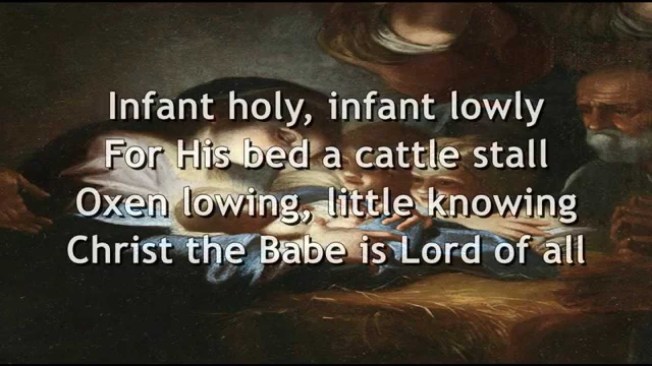
Infant Holy, Infant Lowly

“Infant Holy, Infant Lowly”

Infant Holy, words

Luke 1:39-45, 56 (1:45) – December 9, 2018

The meanings of names are a fascinating subject. The particular meanings of certain names are more well-known. Just think of Peter—Greek for “rock” and Irene—Greek for “peace.” Three names from Hebrew, Rachel (“lamb”), David (“beloved”) and Daniel (“God is my judge”). Then, there is my own name, Elizabeth, which comes from the Greek and means “God is my oath” or “God’s promise.”

My parents did not have any particular person on either side of the family who they were thinking of, or who they wanted to name me after. They just liked that name. I have always really liked my name, too.

I don’t know whether you have ever thought about the meaning of your name. Did your parents name you after a beloved aunt or uncle? Or perhaps a dear grandparent or godparent? Or did they just happen to like your name when you were born?

There is another Elizabeth in the New Testament. Our Gospel reading from Luke 1 talks about her. She was the mother of John the Baptist. She was the older cousin of Mary, living some distance away in the hill country of Judea.

In the verses just before this reading, we meet Mary, a teenaged girl who is visited by the angel Gabriel. Of course, the angel informs Mary that she will become the mother of the Messiah; Mary is to name the baby Jesus, Yeshua, or Joshua, which is Hebrew for “he saves.” As the angel says, “He will save His people from their sins.”

The angel Gabriel gave Mary some important information about her cousin Elizabeth. Elizabeth, as well. Apparently, Elizabeth and her husband the priest Zechariah had tried to have a baby for years, but could not. Finally, when Elizabeth had just about given up hope, she found she was indeed pregnant. This was called a miracle by everyone. Imagine—Elizabeth pregnant at an advanced age. God certainly works miracles, mighty acts and acts beyond the explanation of human eyes and ears.

What about Elizabeth, and about her younger cousin Mary? They are both women. Females, usually discounted and considered second-class by the cultures of their day. What do we find that is different about Elizabeth and Mary?

”All four gospels support the equality of women, but Luke is the one who is most obvious about it.  The male in the story, Zechariah, had been visited by an angel, but he did not trust [the angel’s word] (1:20) and was made mute.  His wife Elizabeth, however, who was an older woman, turns out to be the heroine of the family and she, in stark contrast to her mute husband, speaks under the influence of the Holy Spirit (1:41).” [1]

Elizabeth greets her young cousin, and says “God has blessed you more than any other woman! He has also blessed the child you will have. 43 Why should the mother of my Lord come to me? 44 As soon as I heard your greeting, my baby became happy and moved within me. 45 The Lord has blessed you because you believed that God will keep his promise.”

We could list several facts. Elizabeth spoke by the power of the Holy Spirit. She announced that Mary was richly blessed, as was Mary’s baby, Jesus. She also stated that John, the baby inside of her, had responded to the nearness of the very young infant Jesus. Finally, Elizabeth praises Mary for believing in God’s promise. And, we can be sure that God does keep God’s promises.

When I was in grade school, I was fascinated by the meanings of names. It was at around this time that I happened to start attending a Lutheran church in Chicago, brought there by my older sisters. They attended sometimes because of several friends from high school in the church youth group. They stopped attending when they left for college, but I kept going to that church.

I was a voracious reader. I would read just about anything, and as I mentioned, one of the books my parents had on their shelf had many lists of names and their meanings. I would pore over that book, and I sincerely wondered about my name. “God is my oath,” or “God’s promise.” It was at about this time that I started learning a great deal about the Bible and theology, and about the various promises of God. Especially the promises fulfilled at Christmas, in the birth of the Messiah.

What an earthshaking event, the birth of that Infant Holy. What a marvelous miracle, lifted up by Elizabeth in our Scripture reading today.

Here we have two strong women. Two women who know their own minds, and two women who are not going to be put in the background. These are two women—one younger, one older—who have been chosen by God to do great things. Not only to be the mothers of John and Jesus, but also to have the responsibility of raising them.

What stands out even more is that Mary has unshakeable faith in God’s promises. Can you imagine? I do not have complete faith and trust in God. A pretty good faith, but not one hundred percent, not doubt-free.

Rev. Bryan Findlayson has an intriguing comparison. He talks about seeing faith in Jesus as if it is a good bet. “If we are wrong, we lose nothing, but if we are right, we gain everything. Jesus is certainly a good bet, but the bet is not faith.” [2]

Mary’s faith is faith in God’s promises. She took God at God’s word. Sticking to God’s promises, firmly resting on them, this is what the Bible means by faith. Isn’t that what we lift up in these weeks of Advent? We have faith in God’s promises, and we rely on the Bible’s words, both in the Hebrew Scriptures as well as the New Testament.

Tonight is the anniversary of the first showing of the “Peanuts Christmas Carol” in 1965. We can watch this Christmas television special and laugh as we watch the Peanuts characters. We can also take the Christmas message to heart, as read by Linus, when Charlie Brown wanted to know what Christmas was truly all about.

God deeply wants to send abundant peace into the world. The birth of the Prince of Peace helps us to welcome Jesus for ourselves. He may have many different names, like Jesus, Joshua—”He saves,” Wonderful Counselor, Mighty God—but our Lord Jesus is the one and only Savior. As we prepare to celebrate “God with us,” Emmanuel, we also can lift our voices to praise the Prince of Peace.

Alleluia, amen!

[1] https://www.progressiveinvolvement.com/progressive_involvement/2012/12/lectionary-blogging-luke-1-39-55.html

Lectionary Blogging, Luke 1:39-56, John Petty, Progressive Involvement, 2012

[2] http://www.lectionarystudies.com/studyg/advent4cg.html

“Mary Visits Elizabeth,” Rev. Bryan Findlayson, Lectionary Bible Studies and Sermons, Pumpkin Cottage Ministry Resources.  

@chaplaineliza

(Suggestion: visit me at my regular blog for 2018: matterofprayer: A Year of Everyday Prayers. #PursuePEACE – and my other blog,  A Year of Being Kind . Thanks!

Unknown's avatar

King: Alpha and Omega

“King: Alpha and Omega”

Alpha and Omega - Jesus

Revelation 1:4b-8 (1:8), John 18:33-37 – November 25, 2018

Royalty is very…regal. Kings, queens, princes, princesses—think of this past spring, when Prince Harry married Meghan Markle. Talk about a fairy-tale wedding! For those of us in the United States who watched the wedding, it was a grand gathering of royalty from across the world, plus some Very Important Persons, from any number of places.

Royalty was very much on the mind of people throughout the Middle Eastern and Mediterranean world, in the first century CE. Yes, small regional kings ruled over many tribes and areas. However, they were all subservient to the Roman Emperor, once his power reached into Africa, north into Europe, and east beyond the Fertile Crescent.

In our Gospel passage today, we have an interaction between Pilate the Roman governor of Palestine, and the prisoner Jesus. It’s just hours before Jesus is to be crucified. Yet, Pilate is all concerned about the Rabbi Jesus calling Himself a king. What’s the big deal with that?

We need to understand where the Jewish people are coming from. They want Royalty. Or, more properly speaking, a Messiah. Their nation has been subject under foreign countries for hundreds of years. They desperately yearned to be free! Free in not only a physical sense, but free in the prophetic sense, as well. In their writings there were prophecies of a Messiah, a Coming One, an Anointed One. That’s what many Jews were looking for! One who was a descendant of King David. A Messiah, a King.

Living in the United States today, we don’t have any concept of what that would be like. To be conquered, subservient to a huge foreign power. The closest thing I can think of in recent memory is the Eastern Bloc nations, the nations under Soviet rule for most of the second half of the 20th century. Poland, Romania, Bulgaria, Kazakhstan, Estonia, East Germany, and the other former Soviet satellite states.  All of these had local leaders and rulers. But—none of these local leaders got too big for their britches, unless they wanted to be deposed and imprisoned, and perhaps even killed.

That description is so similar to the position of the Rabbi Jesus, when He came before the Roman governor. Pilate was the Roman governor, the local voice of the Empire in Jerusalem. He had a prickly situation to handle. Yes, Pilate had to watch those stubborn, wayward Jews, and needed to manage their surly, ill-tempered leaders.

Pilate must have heard lots about Jesus! He was a miracle-worker! Healing the blind, the deaf, making food out of thin air for thousands, even raising people from the dead! Not to mention hearing about His wisdom and no-holds-barred interaction with the leaders of the Jews, priests and lawyers. What is more, the Roman governor must have heard whispers of this reactionary Rabbi possibly fulfilling the prophecies of the coming Messiah, or King.

Except, Pilate was considering kingship, power and authority from a Roman point of view. He was absolutely flabbergasted at this reactionary Rabbi. Not grasping the reins of force, power and control? What on earth is wrong with this guy?

Many people never consider the legal questions surrounding Jesus and His trials. Have you ever considered the royal power of Jesus before? If so, where was it active? Over whom did He rule? And, where was His jurisdiction?

As a typical, practical Roman, Pilate wanted to know all of those operational things, especially where Jesus had jurisdiction, power and control. Where exactly was His kingdom? Was He really King of the Jews? As if that was not enough, Pilate needed to know whether Jesus was committing treason. To set oneself up as an earthly King was plainly dangerous. As the Emperor’s representative, Pilate had to keep track of treasonous activities.

The Rabbi Jesus sidestepped Pilate’s questions.  Jesus is essentially saying that Pilate—by extension, the Roman government—does not have earthly jurisdiction in this matter.

True, Jesus said He was a king. But, Pilate is completely at a loss. Speaking from the point of view of a Roman, who considered worldly authority, control and power to be the be-all and end-all, this stuff about Jesus’s kingdom not being of this world does not compute.

This Sunday, the last Sunday in the Liturgical Year, is called Christ the King Sunday. Some call it Reign of Christ Sunday, because of negative connotations of the male image of “king.” But, Jesus turned the concept of “king” on its head. What Jesus meant by “king” is something so far away from the Roman concept of King and Emperor. Jesus’s concept is totally out of this world. A cosmic idea of King, of Ruler of the whole universe.

Our Gospel reading today tells us what Jesus is not. He is not an earthly King. He does not hold absolute, manipulative, soul-sucking power-over the other humans in the world. The reading from Revelation 1 lets us know exactly who Jesus is, and what He does.

Jesus did call Himself a king when talking to Pilate. He did mention His royal power is not of this world. He communicates the other-worldly nature of the reign of Christ, that cosmic King of Kings who is, and was, and is to come. A commentator mentioned that “The sovereign essence of God is amplified by such epithets as “the Alpha and the Omega,… who is and who was and who is to come, the Almighty (Revelation 1:8). These names and titles of God subvert claims of Roman Emperors. Contemporary readers of Revelation are also summoned to be aware of the dangers of imperial portraits seen in advertisements, political propaganda, and political party promises.” [1] Thus, the reign of Christ is subversive, in the eyes of this world. I rarely mention politics directly in my sermons, but these two bible passages today are specifically political. We can view the Rabbi Jesus as the reactionary leader of a downtrodden minority rabble, arrested at midnight and in handcuffs in front of a kangaroo court early one morning. Whether in the first century or the twenty-first, to proclaim Jesus Christ as King of Kings is a subversive act.

A seminary professor related, “One of my students is an Anglican priest from South Africa. Not long ago he shared a story about what it was like to believe Jesus was King during the days of apartheid. “Our whole congregation was arrested,” he said, “for refusing to obey the government.” I thought I misheard him, but he went on to say that all 240 members of the congregation were arrested and put in jail — from babies to a 90-year-old man. “At least babies and mothers were kept together,” he added. The pastor himself was imprisoned for a year. To claim that Jesus is King can be dangerous.” [2]

That is exactly what I proclaim here. Jesus Christ is King of Kings, Ruler of the universe, the Alpha and the Omega, the Beginning and the End. Who is, and who was, and who is to come.

“Jesus is a king who never rose so high that He couldn’t see those who were down low. Even today, we see Jesus in tent cities where people live together after losing their homes to foreclosure. We see Jesus in public housing where people are still waiting for the power to come on after the storm. We see Jesus in shelters where women have sought refuge from abusers.

If we would see Jesus, we will look in places kings seldom go.” [3]

It is not enough to see Jesus. He calls us to follow Him, too.

Be subversive! Tell people about Jesus, the reactionary Rabbi, King of Kings. Alpha and Omega, the Beginning and the End. Amen, alleluia.

[1] http://www.workingpreacher.org/preaching.aspx?commentary_id=2825

Commentary, Revelation 1:4b-8, Isarel Kamudzandu, Preaching This Week, WorkingPreacher.org, 2016.

[2] https://www.huffingtonpost.com/barbara-kay-lundblad/john-18-33-37-a-different-kind-of-king_b_2166819.html

“A Different Kind of King,” Barbara K. Lundblad, ON Scripture, Odyssey Networks, 2012.

[3] Ibid.

@chaplaineliza

(Suggestion: visit me at my regular blog for 2018: matterofprayer: A Year of Everyday Prayers. #PursuePEACE – and my other blog,  A Year of Being Kind . Thanks!

Unknown's avatar

Peace Be with All of Us

“Peace Be with All of Us”

peace be with you, formal

Luke 24:36-49 (24:36) – April 15, 2018

Sometimes I just feel like pulling the covers over my head and not getting up in the morning. Wars, rumors of wars, bombings, fires, gas attacks, and these were just in the past week. Seriously, with all of the scary and shocking things going on in the world, the world can be a downright scary place.

No matter whether we live today in the United States or two thousand years ago in occupied Israel, there can be a lot of scary and confusing stuff going on.

In the case of our Gospel reading today, the scary and confusing stuff was going on right in Jerusalem. It was the time of the Passover, during what we today call the Passion Week. As we have been considering for the past few weeks, the occupying Roman forces in Jerusalem are watching the festival and worship situation very closely.

Sure, there are a great number of visitors from all over the known world, in Jerusalem for that great festival, Passover. But, the Roman forces must have doubled down on the populace in the city. And, even more, since the Rabbi Jesus had just entered the city only a few days before. He made a huge commotion, too, what with riding in on a donkey (like King David) on Palm Sunday, debating in the Temple during the week with the scribes, Pharisees and Sanhedrin, and getting arrested in the Garden of Gethsemane late on Thursday night and accused being Messiah. And, the crucifixion on Friday? Quite a week, for the occupying Roman forces.

Yes, we know some things in general about the disciples. They scattered, running away. Hiding, afraid that since their leader and Rabbi was just executed by the Romans on Friday, they might be arrested and executed next. In fact, Peter even denied knowing Jesus while in the high priest’s courtyard. He must have been scared to death, too.

The upper room, a larger room on the second floor of a building in Jerusalem, was one place where the disciples felt at least half-way safe. They were huddled up there, in hiding, trying to keep a low profile. Luke tells us the male disciples had already dismissed what the women disciples had told them about their Rabbi, early that morning. Something about an empty tomb, and their dead Rabbi gone. Even though Peter and John had run to the tomb and checked things out for themselves, they still did not have a clear idea what was going on.

This year, the lectionary does not have us look at the post-Resurrection appearance of Jesus when He walks with the two disciples from Jerusalem to the town of Emmaus. In brief, our commentator Dr. Mark Vitalis Hoffman summarizes this section of Luke 24: “Two from the group of followers of Jesus were going to Emmaus when they encounter, but do not recognize, Jesus. They express their disappointed hope that Jesus would be the one to redeem Israel, but Jesus explains how everything that happened was necessary according to Scripture. The two invite Jesus to spend the night with them. During the meal, when Jesus blessed and broke the bread, their eyes were opened, and they recognized Jesus, but he vanished from their sight. They rush back to Jerusalem and report to the gathered believers what had happened.” [1]

It is later that day that our Gospel reading picks up. Later in the evening, many disciples (I am assuming both male and female) are in hiding in the upper room. Luke specifically has the two disciples from Emmaus telling the rest about their encounter with Jesus.

Yet, the rest of the disciples are having difficulty believing, understanding. Even though several of these same disciples had angels and Jesus Himself telling them of the Resurrection, what gives? I suspect many of them are still paralyzed with fear. Scared to death. Afraid of the Roman soldiers coming around and knocking on the door at any moment, ready to carry off some of the disciples to be crucified, too.

How often have we been really afraid? Almost scared to death? Terror can paralyze a person. Fear can cause us to disbelieve, to run away, to get angry and fly off the handle. Don’t you think the disciples needed Jesus right then? When He appeared miraculously in their midst, many of them were still unbelieving. Still scared to death.

I think the first thing out of Jesus’s mouth was the most needed of all: “Peace be with you!” Do you hear? Jesus went straight to the heart of the disciples’ fear, their anxiety, their unbelief, and said “Peace be with you!”

Yes, we could talk about what happened after that, when some disciples thought Jesus was a ghost, so He ate a piece of fish to show His friends that He really, actually, had come back to life. Yes, we could talk about Jesus opening the disciples’ minds to the truth of the Scriptures, and how they were to be witnesses of the Good News and the forgiveness of sins.

I would like to go back to the first thing Jesus said: “Peace be with you!” During the Children’s Time, I talked about peace. There are many greetings in different languages that mean “Peace.” “Aloha in Hawaiian means affection, peace, compassion and mercy. Shalom (Hebrew) and Salaam (Arabic) mean peace, complete-ness, and prosperity. Aloha, Shalom, and Salaam can be used on meeting or departing.” [2]

Jesus wished the disciples His peace several times, recorded in the Gospels, including right here. This word is not only wishing a person peace, but “peace, shalom, and salaam” can also be wishing a person God’s presence. The disciples really needed that, too!

In the New Testament reading today from 1 John chapter 3, the aged disciple John tells us that we are the children of God. I remember when I was a mom of young children, sometimes then would get afraid. Sometimes I would comfort them, and hold them on my lap or give them hugs. Don’t you think it’s the same way with God? When we get afraid, even scared to death, we can run into God’s everlasting arms of care and concern. Our Lord Jesus can send us His peace.

The disciples really needed peace, first of all! Perhaps, they needed it most of all. God can send peace into the world today, too. Including peace into conflict in the Middle East, peace in warring regions in Africa and Asia, peace into difficult places in Central and South America. God can send peace to the streets of the cities of our country.

Jesus offers us comfort and peace, just the same way that parents (and grandparents) do. Jesus sends closeness, caring and loving, in addition to His peace.

Can you and I reach out in peace, in shalom, in wholeness and with God’s love? That is the message on my heart from the Gospel reading today. Reach out with God’s peace. Offer God’s peace to those around you today, and every day.

We can praise God for God’s peace and wholeness. God’s peace is a sure antidote to fear, today, and every day.

Alleluia, amen.

[1] http://www.workingpreacher.org/preaching.aspx?commentary_id=3627

Mark G. Vitalis Hoffman Associate Professor of Biblical Studies Lutheran Theological Seminary at Gettysburg

[2] http://worshipingwithchildren.blogspot.com/2015/03/year-b-third-sunday-of-easter-april-19.html

Worshiping with Children, Easter 3, Including children in the congregation’s worship, using the Revised Common Lectionary, Carolyn C. Brown, 2015

Unknown's avatar

Follow Jesus on Palm Sunday

“Follow Jesus on Palm Sunday”

Jesus Palm Sunday - Giotto di Bonde, Entry into Jerusalem 1304-06, Fresco, Cappella Scrovegni Arena Chapel, Padua

Mark 11:1-11 (11:9) – March 25, 2018

            Have you ever been at a really big celebration? I mean a public celebration—like a ticker-tape parade, a celebration of a world championship, or the visit of an A-list celebrity? Something really, really big?

            From all the descriptions of the Palm Sunday Triumphal Entry in all four Gospels, that’s kind of what we are looking at today in our scripture passage. The celebration is really big, the Rabbi Jesus was a big-name celebrity, and this special entry into Jerusalem was a first-century type of a ticker-tape parade. Except with palms!

            Let’s take a closer look. Here’s the situation: It’s almost Passover, the most important religious observance of the religious year. A great number of faithful Jews from near and far come to Jerusalem, in pilgrimage, in commemoration of the Exodus event.

Jesus comes, too. He publicly, intentionally enters Jerusalem, even though the religious leaders are not pleased with Him or what He has been doing for the past few years. Jesus’s disciples must have known about the prophecy of an entry into Jerusalem riding on a donkey. This was clearly a scene with “Messiah” written all over it.

And, Jesus does not sneak into the city, all hush-hush. No! He comes in with a parade! With crowds of people waving palms and shouting “Hosanna!” and “Blessed is the one who comes in the name of the Lord!”

Jesus had been planning this entry in to Jerusalem for some time. In the Gospel of Luke, chapter 9, we can already see that He intended to do this thing. But here in our reading today from Mark, we see a concise account, relating what happened. Little additional information. We can see that from the other Gospels. This way of telling the account reminds me that Mark did not waste much time. He wrote mostly for a Roman audience, who had little time or inclination to wade through genealogies (like Matthew) or background information (like Luke). I think of Mark as the journalist of the four Gospel writers: “just the facts, ma’am.” And, Mark’s use of “immediately!” carries us right along from one situation to the next.

Except, our Gospel reading today is a culmination. We follow Jesus right into Jerusalem at this most holy time of the year—either the Jewish Year or the Christian calendar. With the entry into Jerusalem riding on a donkey, Jesus was certainly reminding everyone of a prophecy from Psalm 118.

What is the meaning of those cries of “Hosanna” and “Blessed is the one who comes in the name of the Lord?” If we look at Psalm 118, we’ll find these words written by the psalmist. This was the usual Passover greeting one person would give another, except with the addition of the word “King.” And just to let you all know, the majority of the crowd in Jerusalem on that Palm Sunday morning understood what they were quoting—they were intentionally welcoming someone they hoped would be their Messiah, their King! Someone who would save them from the awful situation they were in.

            There was a disconnect between the people and their limited understanding, and what Jesus actually was going to do. But I’m getting ahead of myself by rushing on to later in Holy Week. We are still here on Palm Sunday. And everyone is still excited to welcome the Rabbi Jesus—their hoped-for Messiah—into the city. They are hoping He will save them from the Romans and maybe, possibly, become their King. Except they had an earthly King in mind.

In Mark’s Gospel, we hear no mention of children. As one of my commentators says, this was an adult-inspired and led event. She suspects children did get into the act, but they were joining the adults. [1]  Remember the palm processions featuring children, on Palm Sunday? Either at this church, or at other services you may have attended over the years? This is not strictly biblical. We ought to make the palm procession intergenerational! That is truly what the impromptu parade was like. And then, when children participate with their parents, grandparents, other adults and leaders of the church, children can understand that this is a very important parade. And, a very important thing in the life of Jesus.

When Jesus enters Jerusalem, the rambunctious crowd calls out for the coming kingdom of their ancestor David. Messiah was supposed to be related to David, and Messiah’s coming was a time of peace on earth. But, the coming of Jesus causes a division. It causes anything but peace on earth.

The theologian Tom Mullen makes this statement about his denomination (Society of Friends or Quakers): “They work for peace — and if you really want to cause conflict, you work for peace.” [2] So it was for the Rabbi Jesus—the Messiah Jesus riding into Jerusalem. Even though we want to follow Jesus in peaceful ways, Jesus and His message created division, tension, and crisis—as seen by the violent reaction of the religious leaders.

But thank God, Jesus is more powerful than any division, any tension, any crisis. Jesus entered the city not as an earthly King, not as a conqueror, not to set up a nationalistic empire, but as the True Redeemer of Israel. And not of just Israel, but also of the whole world. This Holy Week is where all of the prophecies focus to a fine point, and reveal the Rabbi Jesus as not only the Messiah and King, but also as the Suffering Servant. The Lamb of God, sent to take away the sins of the world.

As we remember this Passover time, this Holy Week, we can thank God that our Lord Jesus did enter Jerusalem. As a King, as a Messiah, yes! But also as our Redeemer and Savior. Praise God, Jesus is our Redeemer and Savior, just as much as He was Redeemer and Savior for that crowd in Jerusalem on that Palm Sunday. In the first century, Jesus came to save His people from their sins. Praise God, He came to save us, today, too! Amen! And amen!

[1] http://worshipingwithchildren.blogspot.com/2015/01/year-b-palm-passion-sunday-march-29-2015.html

Worshiping with Children, Palm/Passion Sunday, 2015. Including children in the congregation’s worship, using the Revised Common Lectionary, Carolyn C. Brown, 2012.

[2] Mullen, Thomas, Laughing Out Loud and Other Religious Experiences (Waco, TX: Word Publishers, 1983), 50.

Unknown's avatar

Transfigured? Frightened!

“Transfigured? Frightened!”

Mark 9:6 (9:6-7) – February 11, 2018

Jesus Transfiguration Georgian relief Luke 9

Transformations can be quite a surprise. For example, when a run-down house gets a top-to-bottom rehab job over weeks or months, the house can be really transformed. Or, when someone is diligent over time with diet and exercise, and loses a lot of weight, they can be really transformed, as well. People can be surprised and impressed when they see the stunning changes that happen, gradually. These kinds of transformative changes can take a while.

The type of stunning change that happened in our Gospel reading today did not take weeks or months. Instead, our Gospel writer Mark talks about the transformation happening suddenly. Or, to use one of Mark’s favorite words: immediately.

We need to set the scene. Just previous to this reading, in Mark chapter 8 Jesus asks His disciples who others say that He is, followed by who the disciples think He is. Peter makes the great statement “You are the Messiah.” It is then that Jesus predicts His death. He starts to tell His disciples that He will have to suffer, be rejected and die, and then rise after three days. All of which must have been difficult to understand for the disciples.

I can relate to the followers of Jesus. Jesus was a charismatic leader, and many people listened to Him, and even followed Him. However, some of the things Jesus said were clear out of their experience. Even with all of the biblical revelation, evidence and commentary that we have nowadays, some of the statements of Jesus are still a challenge for us to understand, today. I can relate to the disciples’ confusion and puzzlement!  

A few days after the confession of Peter and all this big stuff happening, Jesus decides to go for a day trip, up on the top of a mountain. He asks only three of His disciples to come with him: Peter, James and John. After they reach the mountaintop, Jesus suddenly is changed. Transformed. Or, as the Gospels tell us, Jesus is transfigured. This is a state of God’s heavenly glory, suddenly appearing all around Jesus, making His clothing whiter than anyone has ever seen. If that is not enough, the glorified Jesus is seen talking with Moses and Elijah.

Can you see the picture? Imagine a huge, bright spotlight shining on Jesus, Moses and Elijah. Plus, there are more small spotlights all around, and the background surrounding them is all backlit. Except—the people of Jesus’s time have never even heard of electricity. All of this super-white light and super-white clothing is supernatural. Of heavenly origin.

I am reminded of the heavenly glory that surrounded Moses on top of Mount Sinai. Moses was no stranger to heavenly whiteness and brightness. He was in the presence of the Lord God Almighty for many days. And, Elijah—going up to heaven in a fiery chariot pulled by fiery horses? That must have been a heavenly experience of light and glory, too. Much less being in heaven, in God’s presence for centuries at that point.

Moses and Elijah were the premier representatives of the Jewish people, of the Jewish law code and the voice of the prophets. Revered by millions of Jews since their time. And, on top of that, they were in the presence of the suddenly-glorified Lord Jesus Christ. Is it any wonder that mere humans Peter, James and John were all shaking in their shoes?

I discovered a fictionalized conversation between Jesus, Moses and Elijah, from that mountaintop that Mark tells us about. This conversation comes from Pastor Joyce, written in 2003, from a commentary website I visit on occasion. Listen to this conversation:

Elijah: Look at these stubborn and fearful people. How do you get these children to honor God?

“Moses: And how do you teach them to love each other? God knows I tried. I brought God’s law down from the mountain top. It is very clear. The simple commandments tell them how to love and honor God and how to live together in mutual love and respect.

But right after I told them how to live, they began complaining about God and began to worship false idols. The law told them not to betray or disrespect others. Yet, the powerful continued to grasp for more wealth and power. Foolish people they thought that would give them security. But for these things they have to oppress the weak. Then the fighting starts. It can lead to killing.

“Elijah: Well, I warned them. I told King Ahab and the people not to worship false idols. I challenged 450 prophets of Baal and they died on the mountain top. But today, people still worship the idols they create: power, material possessions, and the comfort they bring. But they do not receive satisfaction from them. NO! How do we teach people to find the real thing — joy in relationships with God and with each other?

“Jesus: God sent you, Moses, to give the law.  God sent you, Elijah, and other prophets to warn the people of how they are harming themselves. Now God has sent ME… I will live among these rebellious people for a while. I will love them and I will die for them. These men you see before you, and those who follow them, will carry on my work of reconciliation to God and humankind.

“Moses: These men? Look, they are dumbstruck. They are frail. They are confused.

“Elijah: Good joke, Jesus. Now… tell us your real plan.

“Jesus: I have no other plan.

“Elijah: But how will they find the wisdom and the strength?

“Jesus: Ahhh… I will be with them.” [1]

Did everyone hear? Jesus promised to be with the disciples, a number of times. Not only with the disciples, but with all of His friends and followers.

It’s true that Peter—good, old foot-in-mouth Peter—made some sort of confused and excited offer to build three little booths or mini-altars there, on top of the mountain. Yes, with our 20/20 retrospect, we can laugh at Peter’s fumbling and falling all over himself. But, wouldn’t we be in the same boat? What if there were a heavenly visitation right here, right now? Boom! Cue the bright lights! The glorified Jesus, here in our midst, here at St. Luke’s Church!

The thing is, Jesus could have stayed there, on that mountaintop, with Peter, James and John. Relatively safe, and the mountaintop could have become a pilgrimage site, renowned throughout the world. But, no. Jesus knew He had to walk the way of the Cross. He knew we, His followers and friends, had to come down from that mountaintop, too.

The disciples did not just slink away and hide. No, they went out after the Resurrection and Ascension and after Pentecost, and they turned the world upside down with the Good News of the risen Lord Jesus. It was not all sweetness and light for the disciples, or for the other followers of Jesus. No, many of them had a very difficult time. Yet, Jesus was with them.

Today, we don’t permanently live on the mountaintop, either. Yes, we often walk through the dark valleys. Yes, there is sorrow and pain in our lives. As David Lose says, the nitty-gritty details of misunderstanding, squabbling, disbelieving disciples. Religious and political quarrels of the day. Jealousies and rivalries both petty and gigantic. Into the poverty and pain that are part and parcel of all of our lives. [2] Yet—Jesus is right by our sides, too. Yes, in the good times, and yes, in the not-so-good, even sorrowful times, too.

Do you hear? Jesus will be with us, in good times and bad. We can take comfort in that. We can celebrate. Praise God. We are not left alone and friendless. What a friend we have in Jesus, indeed. Amen, alleluia.

[1] http://desperatepreacher.com//bodyii.htm

[2] http://www.workingpreacher.org/craft.aspx?post=1563

“He Came Down,” David Lose, Dear Working Preacher, 2012.

@chaplaineliza

(Suggestion: visit me at my regular blog for 2018: matterofprayer: A Year of Everyday Prayers. #PursuePEACE – and my other blog,  A Year of Being Kind . Thanks!)

Unknown's avatar

We See Your Salvation

“We See Your Salvation”

Luke 2-30 Simeon words

Luke 2:22-40 (2:30) – December 31, 2017

Many of us had a marvelous celebration last week for the Christmas holidays. Gatherings with extended family and friends, special parties and programs, holiday concerts and pageants, often ending with the caroling around the fireplace. And the stockings hung with care, and mounds of gaily wrapped presents around the Christmas tree.

But, too soon after the grand holiday, the main event, and the wonderful days of celebrations, everything is ended. The crumpled wrapping paper is in the trash, the many leftovers packed in the refrigerator. The unexpected visitors have gone home, and we have returned back to the plain old mundane, ordinary routine. What happens now? What next?

Mary and Joseph might have been wondering a similar thing. After the marvelous birth announcement given to the shepherds by the chorus of the heavenly hosts, and after the impromptu visit by the shepherds and others to the newborn Baby in Bethlehem, what happens now? What next? Great question! What does happen?

Reading from the second chapter of Luke: “22 When the time came for the purification rites required by the Law of Moses, Joseph and Mary took the child to Jerusalem to present him to the Lord 23 (as it is written in the Law of the Lord, “Every firstborn male is to be consecrated to the Lord”), 24 and to offer a sacrifice in keeping with what is said in the Law of the Lord: “a pair of doves or two young pigeons.”

We are told that Mary recuperates and takes the time prescribed for mothers of a first-born son from Leviticus chapter 12. Then, she and Joseph bring Jesus up to the Temple for the Child’s dedication. The Mosaic Law Code is very specific about what needs to be done for a first-born son: forty days after the birth, the parents of the newborn son take their Child to present Him before the Lord.

Now that the grand celebration of the birth is over, Mary and Joseph get down to the ordinary, everyday matter of living. The main way they do that is to follow the laws and rules prescribed for them in the Mosaic Law Code. The laws and rituals of the Jewish people were ancestral traditions. It’s pointed out that these “are a reminder to [the parents] that Jesus is born in the context of the covenant established between God and the people Israel.” [1]

The Jewish people were supposed to be sensitive to the Holy God, and this rite of purification in the Temple is a reminder of that relationship to God. “One way a woman encounters the holy is through the miracle of giving birth. It is a holiness which belongs to and describes the natural rhythm of life.” [2]

Our Gospel writer Luke breaks in right here with a new figure in his narrative. A cameo appearance by a guest star, if you think of things in terms of television or movies, in the birth narrative of Luke chapter 2. We meet the older man Simeon, and we find out about his backstory.

25 Now there was a man in Jerusalem called Simeon, who was righteous and devout. He was waiting for the consolation of Israel, and the Holy Spirit was on him. 26 It had been revealed to him by the Holy Spirit that he would not die before he had seen the Lord’s Messiah. 27 Moved by the Spirit, he went into the temple courts. When the parents brought in the child Jesus to do for Him what the custom of the Law required, 28 Simeon took Him in his arms and praised God.”

It is similar to what we covered in the weeks of Advent this year. In the midweek bible study during December, we studied the genealogy of Jesus from Matthew chapter 1. Pretty dry stuff, all of those names, and all of those “begats.” So-and-so the son of the other guy, the grandson of such-and-such. Genealogies were extremely important to the Jewish people, because keeping an orderly and exact account of who was related to whom helped cement the lines of ancestry and inheritance.

Except—the genealogy of Jesus had some surprises. Four women were mentioned in Matthew’s account. We studied the backstory of each of those four women, and found out exactly why each one was included in the genealogy of Jesus. In Luke’s birth narrative, he tells us some backstory, so we can find out exactly what the godly man Simeon is doing here.

Luke tells us that Simeon is called “just and devout,” and was waiting for the dawning of the kingdom of God – “the consolation of Israel”. The Holy Spirit had revealed to him that he would not die until he saw the Messiah. He now sees the fulfillment of this promise. In the power of the Spirit, he sings a song of praise and utters a prophecy concerning Jesus. [3]

What a marvelous expression of faith and trust in God comes from Simeon. He sings to God: “29 “Sovereign Lord, as You have promised, You may now dismiss Your servant in peace.
30 For my eyes have seen Your salvation, 31 which You have prepared in the sight of all nations:
32 a light for revelation to the Gentiles, and the glory of Your people Israel.” 33 The child’s father and mother marveled at what was said about Him.”

Sizeable words spoken about someone so small. Here we have the baby Jesus, and His mother and adoptive father did marvel at such weighty words!

However, Simeon is not finished yet. He prophecies after this wonderful expression of song. “34 Then Simeon blessed them and said to Mary, His mother: “This child is destined to cause the falling and rising of many in Israel, and to be a sign that will be spoken against, 35 so that the thoughts of many hearts will be revealed. And a sword will pierce your own soul too.”

Serious, solemn words, indeed. Simeon has waited for his whole life for this very moment. After years and decades of expectation and longing, the Messiah has finally arrived. What is more, Simeon spontaneously blesses Mary and Joseph, too, along with Jesus.

Simeon was right there, at the beginning, with Jesus as a baby. He gave witness that Jesus was as foretold, by many prophets throughout the Hebrew Scriptures. Jesus had the greatest future, here at the beginning of the Greatest Story Ever Told. “We are left in anticipation to watch as the Child grows strong, filled with wisdom and blessed with the favor of God.” [4]

Where are each of us in our understanding of Emmanuel, God being with us? Is this narrative from Luke just a fairy story, suitable only to be shared with children every December at the holidays? Or, is it more than that? Have we heard the Good News from the angels and are waiting for more assurance, more evidence that the Messiah has come to earth?

The faithful servant of God, Simeon, was waiting at the Temple for years.  He was waiting and hoping for the Messiah, the chosen One of Israel. When we come to church today, do we expect to have an encounter with the Messiah? We fall on our knees with those who came to worship. Jesus has his arms open wide to welcome all who would come to Him. Come to Jesus, today. Amen.

[1] http://www.workingpreacher.org/preaching.aspx?commentary_id=207

Commentary, Luke 2:22-40, Holly Hearon, Preaching This Week, WorkingPreacher.org, 2008. 

[2] Ibid.

[3] http://www.lectionarystudies.com/studyg/christmas1bg.html

“Jesus Grew in Wisdom and Stature,” Rev. Bryan Findlayson, Lectionary Bible Studies and Sermons, Pumpkin Cottage Ministry Resources.  

[4] http://www.workingpreacher.org/preaching.aspx?commentary_id=207

Commentary, Luke 2:22-40, Holly Hearon, Preaching This Week, WorkingPreacher.org, 2008

Unknown's avatar

My Soul Magnifies the Lord!

“My Soul Magnifies the Lord!”

Luke 1-46 Mary Magnificat, colors

Luke 1:46-55 (1:46) – December 24, 2017

People have been writing songs about the Virgin Mary for centuries. Songs of praise, songs of worship, songs honoring God, and lifting up Mary for saying “yes” to God. Christmas carols might be the first thing that come to mind—but I am also thinking of music from centuries past. From the familiar first part of Handel’s Messiah, to the various settings of the Magnificat, with lyrics from the first chapter of Luke—our Gospel reading for this morning.

Some Protestants might not be as familiar with the Virgin Mary as many Catholics and Orthodox Christians. Mary is held in extremely high esteem in many denominations and faith traditions throughout the world, and for excellent reasons. I honor her greatly.

Did you know that Mary—an unwed teenager from an oppressed people-group in an occupied country under crushing Roman rule—was also a radical? A subversive? Was plotting to overthrow the existing oppressive government and replace it with the rule of God?

What surprising, even shocking things to say about the sweet, innocent Virgin Mary! Everyone associates her with travel to Bethlehem while nine months pregnant, and needing to deliver the infant Jesus in a stable, because there was no room for them in the inn.

That Mary? Radical? Subversive? Yes.

Let’s back up. Go back to last week’s sermon, where the angel Gabriel surprises Mary and tells her God would like for her to be the mother of the Messiah.

But, what about Mary’s opinion? For a teenager, Mary must have been mature and sensible. She acknowledges the angel’s statement and God’s will. Mary says “Yes, I see it all now: I’m the Lord’s maid, ready to serve. Let it be with me just as you say.”

Sure, the wonderful classical settings of the Magnificat were often sung in a foreign language, like Latin. Or, in text from the King James version of the Bible, full of “thee’s” and “thou’s” and all manner of archaic words. Listen to the first part of her Magnificat, as translated in the modern version by Eugene Peterson, “The Message.”

“I’m bursting with God-news; I’m dancing the song of my Savior God. God took one good look at me, and look what happened—I’m the most fortunate woman on earth! What God has done for me will never be forgotten, the God whose very name is holy, set apart from all others. His mercy flows in wave after wave on those who are in awe before Him.”

One well-known depiction of the Virgin Mary is one that is meek, docile, sweet, and not raising a fuss at all. But, wait a moment. Do we realize what Mary is going to sing next? How revolutionary were many of the statements in her song?

“Even more importantly, Mary’s song is an overture to the Gospel of Luke as a whole. Mary’s lyrics set the tone for Jesus’s radical and controversial ministry that is to come:

You have shown strength with your arm;

You have scattered the proud in the thoughts of their hearts.

You have brought down the powerful from their thrones, and lifted up the lowly;

You have filled the hungry with good things, and sent the rich away empty.

“In contrast, the Christmas season leaves too many still hungry, and too many even further in debt.” [1]

Do you hear what radical things Mary is saying? If these lyrics of her song were more well-known, would our understanding of Mary be changed? Here Mary is advocating social change, rescuing victims—neglected women, forgotten elders and children, abused strangers and refugees—from being trodden underfoot, even ground under the heel of bragging, bluffing tyrants and braggarts. Turning all society as it was in her day—and ours—upside down.

What subversive idea is our revolutionary Mary advocating now? Feeding the starving? Giving the poor a banquet? Turning the unfeeling, callous rich people out into the cold? Yes, these radical words are the words found in Luke chapter 1, before we rush on to the narrative of the birth of the Baby in Bethlehem from Luke 2.

Mary was singing two thousand years ago. But, things haven’t changed much. Political leaders are still calling one another names while people starve. “Refugees struggle to find a home in a world with increasingly closed doors. The poor sleep under bridges while the rich build homes with rooms they will never need. And Abraham’s descendants—Jews, Christians, and Muslims—continue to fight over the lands where God’s messengers first spoke to all humanity.”[2]

As the Rev. Dr. Carl Gregg stated in his article on the radical nature of Mary’s Magnificat, “The Christmas story has, over time, too frequently come to have a sense of ‘preciousness,’ of saccharine sentimentality, of almost sickening sweetness as if you had eaten all the candy in your stocking all at once on Christmas morning. When this super-sweetening of the story happens, we can miss the radicality of the claim that God is found, not as the royal child of a queen in a palace, but as the son of an unwed teenager, born in a stable in a religiously-conservative small town.” [3]

Sure, we can see this saccharine sweetness of Luke chapter 2, once it is pointed out to us. But, in reality, life was not so pretty for teenaged Mary, pregnant without the benefit of marriage.

We are still in the season of Advent, the season of waiting. Today is the fourth Sunday of Advent. We still watch as Joseph and his greatly pregnant wife Mary walk one hundred miles to the town of Joseph’s ancestors (and Mary’s, too).

We still wait for the baby Jesus to be born in Bethlehem. We still hold our collective breath with all the rest of creation as we wait—and wait.

Luke, the writer of our Gospel, has a different take on things. Yes, he waits, too. But he waits with songs. Mary’s song—Mary’s Magnificat is a great example.

As Dr. David Lose says in his commentary, “Have you ever noticed how often Luke employs songs in the first several chapters of his story about Jesus? Mary sings when she is greeted by her cousin Elizabeth. Zechariah sings when his son John is born and his tongue is finally loosened. The angels sing of peace and goodwill when they share their “good news of great joy” with the shepherds. And Simeon sings his song of farewell once he has seen God’s promises to Israel kept in the Christ child.” [4]

These songs are deep expressions of the heart and soul to God and to the listeners—including us. These songs are hymns, psalms, songs of praise and exaltation, and even songs of resistance. Mary combined all of these into her song.

I’d like to close with a portion of a modern song written to Mary, asking her if she knew her infant son would truly be the Messiah, the Son of God. This song was written by Mark Lowry, and asks: “Mary, did you know that your baby boy is Lord of all creation? Mary, did you know that your baby boy would one day rule the nations?
Did you know that your baby boy is heaven’s perfect Lamb?
This sleeping child you’re holding is the great I am!

Mary, did you know? Mary, did you know?”  [5]

We are still waiting…


[1] http://www.patheos.com/blogs/carlgregg/2011/12/magnificat-learning-to-sing-mary%E2%80%99s-song-a-progressive-christian-lectionary-commentary-on-luke-146-55/

“Magnificat! Learning to Sing Mary’s Song,” Carl Gregg, Patheos, 2011.

[2] From An Advent Journey: Devotional Guide, Week Four. This curriculum comes from Illustrated Children’s Ministry.

[3] http://www.patheos.com/blogs/carlgregg/2011/12/magnificat-learning-to-sing-mary%E2%80%99s-song-a-progressive-christian-lectionary-commentary-on-luke-146-55/

“Magnificat! Learning to Sing Mary’s Song,” Carl Gregg, Patheos, 2011.

[4] http://www.davidlose.net/2015/12/advent-4-c-singing-as-an-act-of-resistance/

“Singing as an Act of Resistance,” David Lose, …in the Meantime, 2015.

[5] http://www.lyricsmode.com/lyrics/m/mark_lowry/mary_did_you_know.html

Mary Did You Know lyrics

(A heartfelt thank you to An Advent Journey: Devotional Guide. Some of these sermon ideas and thoughts came directly from this guide.  I appreciate this intergenerational curriculum, which is the basis for my Advent sermon series. This curriculum comes from Illustrated Children’s Ministry. Thanks so much for such great ideas!)

@chaplaineliza

(Suggestion: visit me at my regular blog for 2017: matterofprayer: A Year of Everyday Prayers. #PursuePEACE – and my other blog,  A Year of Being Kind . Thanks!)

Unknown's avatar

Keep Awake!

“Keep Awake!”

mark 13-26-artistic-christian-clouds-

Mark 13:24-27 (13:27) – December 3, 2017

How difficult it is to keep watch! Imagine how hard it is when you know the estimated time of arrival. There is even an acronym for this—ETA. We know about the estimated time of arrival of planes and trains and buses. People give relatives and friends their estimated time of arrival if they are traveling a long way. It is the polite thing to do, even courteous and helpful thing to do. Just so that the people on the receiving end know when visitors or relatives will be arriving.

We know when the Baby in Bethlehem arrived. Two thousand years ago, that’s when! God the Son, the baby Jesus, God made flesh, was born into this world as a helpless Baby a little more than two thousand years ago, as foretold in Bethlehem. He was born into an oppressed people group, in a land that was under occupation, under a conquering power; born to a young woman and her fiancé with very little money, power, or other prestige.

This is the first Sunday of Advent, the weeks the Church sets aside to wait quietly, expectantly, for the Baby in Bethlehem to be born. Yet, these first two weeks of Advent also give us a look at the future: predictions and promises for the second coming of Jesus Christ.

Here in our Gospel reading from Mark this morning, Jesus is asked about the timing of the second coming. When will this mysterious time come about?

Jesus—as is so often the case—does not give a direct answer. Instead, listen to His first example: “24 “In the days after that time of trouble the sun will grow dark, the moon will no longer shine, 25 the stars will fall from heaven, and the powers in space will be driven from their courses. 28 “Let the fig tree teach you a lesson. When its branches become green and tender and it starts putting out leaves, you know that summer is near. 29 In the same way, when you see these things happening, you will know that the time is near, ready to begin.”

Sure, the people of Jesus’s time were wondering when Messiah would return. When, Jesus? Please, just tell us when! How similar is that to our own time. Many, many people are dissecting both the Hebrew Scriptures and the New Testament writings. They, too, ask when Messiah is going to return the second time? When, Jesus? Please, just tell us when!

Next, Jesus gives His listeners a parable about a householder and his servants. As the Rabbi Jesus says in our Gospel reading today, “34 It will be like a man who goes away from home on a trip and leaves his servants in charge, after giving to each one his own work to do and after telling the doorkeeper to keep watch.”

We know that Jesus often tells His listeners stories about everyday things, with a twist. Somehow, Jesus uses these common, ordinary things to communicate powerful truths. In this parable, we see a bunch of servants working for a boss with a large household, a large piece of property. The boss goes away on a long journey, and his employees do not know when he will be back.

What would people at your workplace do in a situation like that, with the big boss gone for a really long time? Would your fellow employees continue working hard? Or, would some of them start fooling around? Maybe stop working altogether? How might you react, if this happened to you, or to someone you knew? Again, what would you do?

 Jesus totally skips over that part about exactly when the Messiah is coming back.

Instead, Jesus commands His listeners to “Keep watch!” Let’s look more closely at this story. We are not only supposed to wait expectantly, but we need to be alert. Not just to stand around and twiddle our thumbs like a bunch of do-nothings and know-nothings. Each servant—or employee has their own job to do. Each servant—or employee has an assigned task. The door-keeper has just about the most important job of all of them, which is to stay alert and to keep watch, no matter what. Keep an eye on things, and when the big boss unexpectedly returns, we are warned not to cut back or sleep or lie down on the job.

Let us consider today, in modern-day United States. When we think of Advent, what comes to our minds? Advent wreaths? Advent get-togethers after work or on the weekends? Maybe school holiday productions incorporating Advent?

Dr. David Lose, one of my favorite commentators, said “Each and all of it can be wonderful, and each and all of it can become rather overwhelming. So perhaps we might invite folks to make a short list – whether in their heads or on paper – of a few of the things that will occupy their Advent.[1]

What are you going to do for Advent? How are you going to get ready? How are you going to watch and keep awake?

I am not sure about anyone else here, but my December activities are threatening to become overwhelming. Can anyone else relate? Does anyone else have any idea about vulnerability and connecting with others?

The Church around the world is told to keep watch diligently. And then, “to think about how in each of those events and activities they might be more attentive to the vulnerability and need of those around them and more honest and open about their own need that they might receive the care of others.” [2]

Now, wait a minute, Jesus! I thought Advent was a time for us to wait and watch? A time for Advent calendars and Advent wreaths? I wanted to sit quietly in my corner and watch from the comfort of my easy chair. I did not want to step out of my comfort zone!

Guess what? The landlord—the big boss—has given all of us our jobs to do. In last week’s Gospel reading from Matthew, we are to welcome the stranger, feed the hungry, clothe the poor, and visit the people in hospitals and in prison. Yes, this may be a lot for us to take in. However, the commands of Jesus are pretty important! Don’t you think we ought to sit up and pay attention to His commands?

Jesus and His commands can lead us in new directions. Pastor Janet Hunt makes the following suggestion: “knowing that it will all one day end can also set us free, can’t it?

  • Free to speak words of truth and hope and love.
  • Free to reach out in generosity and kindness.
  • Free to forgive what before seemed unforgivable.
  • Free to let go of what we thought we would always need.” [3]

What an exciting opportunity to truly be what Jesus—the householder—the big boss—is calling each of us to be. “How do we “keep awake” in this kingdom time of already-not-yet? Simply by being faithful to the tasks God has given us to do – the tasks of kindness, mercy, justice, faithfulness, and love.” [4] When we are faithful in these things, we will become more and more like our Lord and Savior Jesus Christ.

Maranatha! Come, Lord Jesus!


[1] http://www.davidlose.net/2014/11/advent-1-b/  “Preaching a Participatory Advent,” David Lose, …in the meantime, 2014.

[2] Ibid.

[3] http://dancingwiththeword.com/raking-in-the-dark/  “Raking in the Dark,” Janet H. Hunt, Dancing with the Word, 2017.

[4] From An Advent Journey: Devotional Guide, Week One. This curriculum comes from Illustrated Children’s Ministry.

(A heartfelt thank you to An Advent Journey: Devotional Guide. Some of these sermon ideas and thoughts came directly from this guide.  I appreciate this intergenerational curriculum, which is the basis for my Advent sermon series. This curriculum comes from Illustrated Children’s Ministry. Thanks so much for such great ideas!)

@chaplaineliza

(Suggestion: visit me at my regular blog for 2017: matterofprayer: A Year of Everyday Prayers. #PursuePEACE – and my other blog,  A Year of Being Kind . Thanks!)