Unknown's avatar

On the Lookout

“On the Lookout”

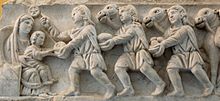
Matt 2-11 Adoration_magi_Pio_Christiano_4th cent. sarcophagus, Vatican museum

Matthew 2:1-12 (2:2) – January 7, 2018

Christmas Day has been over for two weeks. To modern-day Americans, this was a long time ago! But the full holiday isn’t really over on December 25th. There are the twelve days of Christmas (remember the song about the twelve days?), during which many would have parties and feasting and especially Twelfth Night celebrations.

As we think of Nativity scenes or paintings, how often do we see them with shepherds and sheep, as well as the three wise men? All of them at the same time visiting the baby Jesus in the manger?  That is not quite the way it was, as presented in the Gospels. We are all familiar with the Nativity narrative from Luke chapter 2, “In those days a decree went out from Emperor Augustus that all the world should be registered. All went to their own towns to be registered.”

For the visit of the wise men, we need to turn to Matthew’s gospel, chapter 2: “After Jesus was born in Bethlehem in Judea, during the time of King Herod, Magi [or, wise men] from the east came to Jerusalem and asked, “Where is the One who has been born king of the Jews? We saw His star when it rose and have come to worship Him.”

Here we have some wise men—probably noblemen who know a great deal about stars and constellations. They have been studying the heavens for years and years, as well as studying religious books and writings. Just as it says in the gospel record, a great sign (or star) rose in the sky, so these wise astrologers knew that something momentous was going to happen.

These wise men, or Magi, were not Jewish wise men, but instead were Gentiles. Non-Jews. “Could an unusual phenomenon in the night skies have caught the attention of some of them—interest in the stars was legendary in the region—and led them to set out to Jerusalem? That people of other lands and religions are drawn to Jesus, even as a child, is also significant: in Christ, God is speaking to the hearts and minds of all people.” [1] It is important to point out that they were on the lookout and knew which way to go—towards Jerusalem. And, eventually, they turned up at the palace, on King Herod’s doorstep.

What was King Herod’s response to the question of these noble Gentile wise men? “When Herod heard this, he was frightened and all Jerusalem with him.” “Why was Herod so frightened? Of a baby? What did he have to lose and how did he see this baby as a threat?” [2]

For the how and the what, we need to look at Herod’s psychological profile, which is not nice at all. He was bloodthirsty, cruel, narcissistic, and always on the lookout for trouble brewing that might affect him. Herod was installed as a puppet king of Israel by the Roman overlords. I suspect he did not feel very secure to begin with. When he heard about a newborn King of Israel, you can imagine how his anxiety level rose. Herod did not want any rival claim to the throne.

Herod is sneaky, and sly, and ruthless. Listen to his response to these wise men: “Then Herod called the Magi secretly and found out from them the exact time the star had appeared. He sent them to Bethlehem and said, “Go and search carefully for the child. As soon as you find him, report to me, so that I too may go and worship him.”

That leads me to ask some uncomfortable questions. We know Herod was threatened by the thought of a newborn King. Are we threatened by the thought of Jesus? Does the newborn King make us anxious? We know that cruel King Herod had horrible plans ahead for the boy babies and toddlers in the area of Bethlehem. But, are our motives clear when we think of our fear and anxiety concerning strangers and visitors coming into our hometown?

A telling observation comes from Dr. David Lose: “Perhaps it is because the one thing the powerful seek more than anything else is to remain in power. Gone from Herod and his court is any notion of the kind of servant leadership prescribed and required by Israel’s prophets. Gone is the memory that God placed them in their positions to serve rather than be served. Herod seeks his own ends and so is immediately threatened by even the mere mention of another – and therefore rival – king.” [3]

What about any self-interest we might have? We know King Herod was a prime hypocrite. But, is there any hypocrisy in our words and actions, when we think of how we treat strangers, visitors from far away? Serious questions, requiring serious thought.

We follow the wise men as they leave Jerusalem and go to Bethlehem. Remember what brought them on this journey in the first place? They had seen a star in the heavens, and by consulting their books of ancient wisdom, they knew that a King had been born. They followed that star, that Light.

We don’t know, and we cannot tell for sure, but perhaps one of the books the wise men consulted was the book of the Hebrew prophet Isaiah. Chapter 60 begins: “Arise, shine, for your light has come, and the glory of the Lord rises upon you. See, darkness covers the earth and thick darkness is over the peoples, but the Lord rises upon you, and His glory appears over you.” Maybe this was one of the ancient writings they poured over.

On Epiphany, or Three Kings Day, we sing about the wise men from the East. “We three kings, of Orient, are.” What is the chorus of that Christmas—actually, Epiphany—carol? “Star of wonder, star of night, star with royal beauty bright.” Although they were Gentiles, they still recognized that the one who was born the king of the Jews was worthy of worship. And, they came to the house where the Holy Family was staying, and offered Him gifts fit for a King.

Here in the United States in many Protestant denominations, Epiphany is not that big of a deal. Yes, the coming of the wise men is incorporated into many Christmas pageants, and is found in nativity scenes and Christmas cards. Except—I want to let everyone here know that this is a totally separate event. The coming of Light into the world—so beautifully mentioned at the beginning of the gospel of John—is the whole meaning behind our celebration of Epiphany.

One of the grand symbols of God is that of Light. Mentioned repeated throughout the Bible, when we picture Light we can think of a star, the sun, a candle, a lamp. We have the Advent wreath lit today, with the Christ candle in the middle letting us know that Jesus is with us right now. We lit those candles on the Advent wreath one by one, and on Christmas Eve lit the Christ candle to remind ourselves that God our Light is always with us. And, at the end of our service today the light from the candles behind the communion table will travel down the central aisle and out the back door to call worshipers to follow the Light of God out into the world. [4]

As the wise men followed the star—the Light—to worship the Child in Bethlehem, so we can follow Him, the True Light. The shining Star of our hearts is the risen Lord Jesus Christ. Do you know He is with us today? He opens His arms wide to all who would come. Come worship the True Light, the Child born in Bethlehem, today. Amen.

[1] http://www.taize.fr/en_article167.html?date=2012-01-01

“Jesus, Herod, the Magi and Us,” Commented Bible Passages from Taize, 2012.

[2] http://www.patheos.com/progressive-christian/gold-frankincense-myrrh-alyce-mckenzie-01-03-2013.html

“Gold, Frankincense and Myrhh,” Alyce McKenzie, Edgy Exegesis, 2013.

[3] http://www.workingpreacher.org/craft.aspx?post=1509  “An ‘Adults Only’ Nativity Story,” David Lose, WorkingPreacher, 2013.

[4] http://worshipingwithchildren.blogspot.com/2013/11/year-epiphany-monday-january-6-2014-or.html

Worshiping with Children, Epiphany, Including children in the congregation’s worship, using the Revised Common Lectionary, Carolyn C. Brown, 2014.

@chaplaineliza

(Suggestion: visit me at my regular blog for 2018: matterofprayer: A Year of Everyday Prayers. #PursuePEACE – and my other blog,  A Year of Being Kind . Thanks!)
Unknown's avatar

Thanksgiving to God

“Thanksgiving to God”

2 Cor 9-11 thanksgiving, words

2 Corinthians 9:6-11 (9:11) – November 19, 2017

Today, the Sunday before Thanksgiving, many people across the United States celebrate as Thanksgiving Sunday. “According to the Internet there are 12 nations – large and small – who celebrate in one form or another their nation’s Thanksgiving Day; whilst other forms and styles of celebration include local “Harvest Thanksgiving” services.” [1]

Both scripture readings this morning feature words of gratitude and thanks to God for giving us our many blessings, and specifically for the blessings of the harvest. First, our psalm for this morning lets us know God has provided so much for us to enjoy. Not only the bounty of the harvest, but more than that. Our Psalmist lets us know God has made the earth and water, and everything else, and provides everything for humanity’s benefit.

Let me read again from Psalm 65: “You, God, soften the earth with showers and bless its abundant crops. 11 You crown the year with a bountiful harvest; even the hard pathways overflow with abundance. 12 The grasslands of the wilderness become a lush pasture, and the hillsides blossom with joy. 13 The meadows are clothed with flocks of sheep, and the valleys are carpeted with grain. They all shout and sing for joy!”

All this bounty is considered to be given to humanity to enjoy. All the harvest and bounty that this psalm celebrates is what the apostle Paul talks about in his letter to the church in Corinth, too. Except, Paul goes one step further.

When we read Paul’s suggestions in this passage today, he urges the believers in Corinth to be generous. Sure, in Paul’s previous letter, in 1 Corinthians, the people from that church were collecting for the poor and persecuted Christians in Jerusalem. Now, with this updated message to Corinth, Paul praises the church for continuing with the collection for the saints in Jerusalem, and urges them to be generous. He broadens his suggestion and encourages them to give gifts freely. “Each of you should give what you have decided in your heart to give, not reluctantly or under compulsion, for God loves a cheerful giver.”

What about that last phrase, anyway? “God loves a cheerful giver.” Sure, Paul is urging his fellow Christians to be generous. However, this goes over and above mere giving of alms, or slipping a dollar in a panhandler’s cup, or even a five-dollar bill in the Salvation Army kettle in the holiday season. Paul lets us know we ought to give cheerfully (Gr. hilaron), or “hilariously,” in the sense of very joyfully. But, he doesn’t want us to throw our money around needlessly. And, not in the sense of thoughtlessly, either.

Money, charity, and giving are discussed in the Bible in several places. I will highlight one: “cheerful” givers always receive God’s loving approval (Prov. 22:8). So, God wants all of us to be cheerful, generous, and open-hearted.

There is a problem here, and Paul mentions it. “Remember this: Whoever sows sparingly will also reap sparingly, and whoever sows generously will also reap generously.”

One of my favorite bible commentators, Bob Deffinbaugh, writes “Some people simply do not enjoy being generous. It causes them great pain to give up more of what they possess in order to bestow it upon someone who needs it more than they do. Once I suggested to a friend who was dying that she give away some of her possessions while she was alive, so that she could enjoy the act of giving while she was still alive. I had seriously misjudged the situation. This woman did not want to give anything away before she died, because she found no pleasure in giving. Only after her death, when she could keep her possessions no longer, would she reluctantly will them to someone else. How sad.” [2]

This is a cautionary tale for all of us. Certainly, the idea of reluctantly giving away money or worldly goods is something most of us associate with Ebenezer Scrooge of Charles Dickens’s Christmas Carol fame. I know very well that there are great numbers of people who only give “grudgingly.”

So many people love their stuff, don’t they? Or, if not “stuff,” then they are awfully attached to their money, or even their time. Some might hate to part with anything of value, period.  And, especially, “We should not give because we feel there is no alternative, or because we think others will look down on us if we fail to give.” [3] It’s sort of tGod’swisted and perverted, and just like the Pharisees. That is the exact opposite of the reason Paul tells us to give.

As Bob Deffinbaugh relates, “To use an analogy our Lord employs, when we see a brother who has no coat, we don’t have to own a coat factory; all we need is two coats (see Luke 3:11). The reason we may not have the means to give to the poor is because we have not sown from that which we have in order to reap more to give. We, like the widow who cared for Elijah, may need to give first to those in need, and then look to God to supply our needs.” [4]

We can follow Paul’s words and suggestions, and ask—how would we celebrate God’s blessings to us? How could we give thanks? Like I suggested to the children earlier today, we can be generous. Give of what we have. If we have a little extra food or canned goods or pasta, give that. If we have an extra coat, give it to a coat drive. If we have some free time, volunteer or donate that. If God has been good to us and we have some extra money, be generous with whatever God has blessed us with.

When my husband and I were hiking through a state forest some years ago, we came across a stream. The path turned and followed the bubbling, flowing stream. As my husband and I continued walking, we came to a little waterfall, where the water bubbled and traveled downward from one level to another, and then went rushing along its merry way. I think of giving like this. Paul lets us know that generous giving flows out of God’s generosity to us. If we dam up that trickle of giving, we might end up with a backload of water that can’t flow, can’t run free and clear, and cannot transmit God’s blessings to others.

When we understand that everything—every single thing!—we have comes from God, it is much easier to share what we have with others. God supplies both the seed and the harvest. He is the one who makes us rich so that we might be generous on every occasion. Our giving is a demonstration of thanks to God. We thank God for what God has given us by giving it away!

And, what is the final point of Paul’s suggestion? What is the most wonderful thing God gives us? Praise the Lord for God’s unmatchable, unspeakable, unsurpassable Gift—Jesus Christ! Jesus and the grace He freely gives to us is the reason we give to others.

We give thanks that our generosity is rooted in the generosity of our God in the person of our Savior, Jesus Christ. We can say “Happy Thanksgiving,” indeed.

Amen, alleluia.

[1] http://www.thetimelesspsalms.net/w_resources/pentecost23[30]c_2016.htm

The Timeless Psalms: Psalm 65, Joan Stott, prayers and meditations based on lectionary Psalms, 2016.

[2] Religious Affections: A Study of Paul’s 2 Corinthian Correspondence 12. Keeping Your Commitments (2 Cor. 8:16-9:15) https://bible.org/seriespage/12-keeping-your-commitments-2-cor-816-915  Robert L. (Bob) Deffinbaugh, Th.M.

[3] http://soniclight.com/constable/notes/pdf/2corinthians.pdf

2 Corinthians, Expository Notes, Dr. Thomas L. Constable, Dallas Theological Seminary, 2005 edition.

[4] Religious Affections: A Study of Paul’s 2 Corinthian Correspondence 12. Keeping Your Commitments (2 Cor. 8:16-9:15) https://bible.org/seriespage/12-keeping-your-commitments-2-cor-816-915  Robert L. (Bob) Deffinbaugh, Th.M.

@chaplaineliza

(Suggestion: visit me at my regular blog for 2017: matterofprayer: A Year of Everyday Prayers. #PursuePEACE – and my other blog,  A Year of Being Kind . Thanks!)

Unknown's avatar

Keep Watch!

“Keep Watch!”

Matt 25-12 I know you not

Matthew 25:1-13 (25:13) – November 12, 2017

Just two weeks ago, St. Luke’s Church had its big fall Spaghetti Dinner fundraiser. This dinner took quite a bit of planning and preparation. Just ask anyone who worked on planning, preparing, serving, or cleaning up. And, another big thank you to all of those who planned, worked, or ate at the Spaghetti Dinner. It all was much appreciated!

I am a person who is not naturally a planner. Or, rather, I was not the person who would be so very prepared. You know that sort of person. They always plan way in advance. They always bring more supplies, buy plenty of food, and especially are always there in plenty of time, for any occasion. I admire these people. Over time, I have learned how to copy certain aspects of their planning and preparation. However, I am not naturally one of these super-prepared people.

To recap from our scripture from Matthew 25, there are a bunch of young women—strictly speaking, the text calls them “virgins.” They are to accompany the bridegroom and the rest of the bridal party as he travels to the bride’s home, picks her up, and they all go to a large banquet hall to celebrate the ceremony. This was a common feature of weddings in that part of the world, and still is in places around the world, today.

Jesus’s parable from Matthew 25 is all about being prepared. Doing some advance planning. And, at face value, it seems really unfair.      As Dr. David Lose (one of my favorite commentators) said, “All the bridesmaids brought oil, all waited, all fell asleep. And the decision about who gets in comes down to who anticipated the bridegroom would be this incredibly late and so brought more oil. Okay, so maybe it’s not unfair. Maybe it’s just that I’m pretty darn certain that I would have been among the foolish bridesmaids.” [1]

Oh, Dr. Lose, I relate so much! I fear I would have been among the foolish bridesmaids, too! I am afraid I may not be welcomed to the wedding banquet, either.

I have a confession to make. I have never preached a sermon on this parable before. I have always been leery of it. Or afraid of it. I wrestled with the idea of preaching on this parable, and felt convicted by God. So, I decided—with God’s help, when this reading came up as a lectionary Gospel reading that I would definitely preach on it.

Let’s pull back from this brief parable, and look at the larger situation where the Rabbi Jesus tells it. This is sometime midway through Holy Week, where Jesus is being asked when the end times will come. That’s a big reason why He gives this long discourse called the Olivet Discourse, several chapters long in Matthew’s Gospel. Similar to now, people all through the centuries have been aware that the Bible has certain mysterious, even unclear prophecies concerning the end times, just before when the Messiah will come.

Jesus “lets them know that there will be signs, terrible signs, that will give people clues that the end is coming, encouraging them not to listen to idle rumors, but to trust His words. The parable of the bridesmaids compares the listeners to [bridesmaids], entrusted with a role,” [2] while waiting for the bridegroom to come.

Preparation and planning are often mixed up with waiting. Sure, we can plan the menu for a big dinner, and purchase the food for the big event. We prepare everything for the festive table, and get the table centerpieces and flowers and everything else. But sometimes, waiting is somehow involved in this process. Waiting for God to show up. How long do we wait? That was just what the disciples were anxious and worried about. That was one big reason why Jesus told several parables in this particular discourse.

A story one commentator told happened several years ago. Dr. Karoline Lewis relates: “My father-in-law was a World War II veteran and he died a year ago this past April at the age of 96. In the twenty-three years I have known my husband, it was only in the last few that Sam [my father-in-law] ever talked about the war. The last time I saw him was at his bequest to have as many of his grandchildren present, not necessarily for a final goodbye, but as you know, people can sense that death is soon. Of course, that truth elicits its own sense of what waiting is like.

“That day, Sam talked about the war. He talked about the waiting. You see, he had been selected, singled out, not to be sent to the front, but to stay behind. Why? He was good in math. He showed us his notebook in which he had calculated multiple ballistic measurements. And as he worked on his equations, he waited for his fellow soldiers, his friends, to return. Some did. Some did not. He could not understand how he was spared. Yet in the waiting and the wondering he knew God was there, and there was nothing else he could do but trust that truth.” [3]

I wonder how many of us can trust God when we are waiting and wondering? I wonder how many of us continue to have faith in God when things just don’t seem to make any sense? Like in the case of difficult scripture passages like this one, this parable from Matthew where the bridegroom—Jesus—sends the five foolish, unprepared bridesmaids away, not allowing them in to the wedding banquet?

All these bridesmaids were waiting. (As do we. We wait for Jesus to return, and we—the church—have been waiting for centuries.) Five of these bridesmaids were prepared, and had enough oil. Five did not. We can compare that to having extra batteries for your flashlight, like I told the boys during the children’s time before the sermon. But today’s parable does not highlight a shortage of oil for the lamps. No, the oil is plentiful. There is more than enough oil. However, the five bridesmaids forget they are going to need the oil. [4] I sometimes forget I need oil—which God bountifully supplies. Do you sometimes forget, too?

I want to highlight verse 13, where Jesus says “Therefore, keep watch, because you do not know the day or the hour.”

Yes, there is pain, suffering, loss, grief, sickness, anxiety, and all manner of other difficult things in this world. We are not certain when God will show up. Yet, we can glean some words of advice from this parable: Be prepared. Plan. Watch. Keep awake. And, wait.

“If only we will remember that we have a steady supply of precious ‘oil’ to help light our way. For we have already have Jesus as we await the ‘bridegroom’s’ return.’ We already have Jesus. If only we will pause long enough to recognize and receive this precious gift, it is already ours. All we have to do is fill our lamps.” [5]

We all have been called to lift our lamps—our lights—and lift them high, shining as signs of promise and hope in a dark world with little hope or brightness or light in it. The oil is provided for us. Jesus encourages us to lift our lights in an often dark world.

Indeed, isn’t this what the world needs most of all?


(A big thank you to David Lose, Liz Milner, Karoline Lewis and Janet Hunt for their helpful writings as I wrestled with this challenging text from Matthew 25.)

[1] http://www.davidlose.net/2014/11/pentecost-22-a/  “Hope and Help for Foolish Bridesmaids,” David Lose, …in the meantime, 2014.

[2] https://www.journeywithjesus.net/essays/1534-my-bad-dream  “My Bad Dream,” Liz Milner, Journey with Jesus, 2017.

[3] http://www.workingpreacher.org/craft.aspx?post=3413  “How To Wait,” Karoline Lewis, Dear Working Preacher, 2014.

[4] http://dancingwiththeword.com/oil-for-our-lamps/  “Oil for Our Lamps,” Janet H. Hunt, Dancing with the Word, 2017.  November 5, 2017

[5] Ibid.

@chaplaineliza

(Suggestion: visit me at my regular blog for 2017: matterofprayer: A Year of Everyday Prayers. #PursuePEACE – and my other blog,  A Year of Being Kind . Thanks!)

Unknown's avatar

By Faith Alone

“By Faith Alone”

sola gratia, scriptura, fide - Lutheran

Romans 3:19-28 (3:28) – October 29, 2017

Today is a festive day in the church. Reformation Sunday, the last Sunday in October every year when we remember the bravery and determination of Father Martin Luther, Professor of Theology at the University of Wittenberg in Germany.

This year is not just an anniversary, it is a huge anniversary. October 31, 1517. This year, on All Hallow’s Eve, countless people throughout the world celebrate the 500th anniversary of Martin Luther and his posting of the 95 Theses, or grievances against the hierarchy of the Catholic Church, on the chapel door in Wittenberg.

As I have said during the past few weeks, I care very much about this celebration. I was baptized and confirmed a Lutheran and spent two full years studying Luther’s Small Catechism in confirmation preparation. I was a history and theology nerd throughout high school, learning as much as I could about the Reformation of the 1500’s, and Martin Luther in particular. I can tell you that Martin Luther had his ups and downs as he was traveling the religious road through life. He really, truly wanted to know exactly how to get right with God.

Our New Testament reading today comes from Romans 3, and it starts in a not-very-good place. The apostle Paul talks about the Law of Moses. All of its statutes and ordinances and restrictions would tie people up in knots as they tried to follow every single little rule. That’s the situation everyone finds themselves in, if we start with Romans 3:19-20. We are all in the same sinking boat. From Eugene Peterson’s wonderful translation The Message: “So where does that put us? Do we Jews get a better break than the other people? Not really. Basically, all of us, whether insiders or outsiders, start out in identical conditions, which is to say that we all start out as sinners. Scripture leaves no doubt about it:”

Martin started out as a monk, became a priest, and eventually earned his doctorate in theology. He was extremely intelligent, and knew lots of different kinds of stuff. Bible, theology, mathematics, rhetoric, Latin, Hebrew and Greek. However, he seemed to have an inferiority complex. Or, to say it in a different way, Martin was scared to death that he would never measure up to God’s standards and the way God wanted him to live.

Martin Luther tried really hard to get into God’s good graces, for years. He was quite earnest about it. He would try and try to pray and meditate, to do things that would get him on the plus side of God’s righteousness ledger. However, he never could measure up, not on his own. Not even because he was trying as hard as he could to get on God’s good side.

Does that sound familiar to anyone here, today? Is anyone here trying desperately to have God approve of them? Did we all hear the scripture reading from the book of Romans? We are all—all of us—in the same sinking boat. What is more, there is no one who can say they are living the right way, God’s way. Everyone falls short.

From time to time, I look at an online discussion board where ministers share their ideas and insights about scripture readings for sermons and bible studies. This was a few years ago, but Pastor Erik from Wisconsin shared the following comment in a discussion about these particular verses from Romans 3:

“This Sunday we celebrate confirmation. As a part of their confirmation requirements, students have to meet with me for a brief discussion/interview. I ask them about faith, life, God, etcetera – see if they learned anything during confirmation. One question I always ask is “How will you get into heaven? How are you saved?” Most often I get the answers – “Pray. Go to church. Do good deeds.[1]

Martin Luther went to the extreme, in this respect. That would have been his answer, for years and years. Martin spent hours every week on his knees, asking God for forgiveness and confessing his sins to God and to his own personal confessor and spiritual director. He fasted, depriving himself of food and drink, regularly. Martin even went on pilgrimages, to try to gain special favor with God and show himself to be extra specially deserving of coming into God’s presence.

And then, he would meticulously chalk up the good deeds he did. Not to be loving and giving, as our Lord had told us to do, but in order to be super-religious, and to show everyone just how religious Martin was being. Just in the same way that the Pharisees were super religious and meticulous in their rule-following in the first century, when our Lord Jesus walked the earth.

What does Romans 3:23 tell us? “For all have sinned and fall short of the glory of God.”

I don’t know whether anyone here has ever used a bow and arrow. Has anyone? (I would really like to know.) One of my daughters has, plus one of my close friends. The apostle Paul uses an expression here used for shooting arrows—falling short and missing the mark.  Not hitting the target. What’s more, we can never, ever hit the target that God has set for us to hit, no matter how hard we try, because of sin. All of us sin. That’s everyone. No exceptions.

One of my favorite commentators had this weighty insight about sin. Dr. David Lose tells us that “When we talk about sin, it’s almost always in the plural – sins – as in describing bad things we’ve done. But sin described in [Paul’s writings] is not so much a thing as it is a force – the power that seeks to rob the children of God of abundant life.” [2] How about that? We are all stopped from hitting the bull’s eye by this unstoppable force called sin.

But, wait! There’s more from Dr. Lose. Sin is also “a condition in which we are trapped. In this second sense, the condition of sin is very much a state of existential insecurity – being fearful or anxious that you are not safe, not sufficient, not worthy of love and respect.” [3]

Worse and worse! We not only are being stopped by a force that eternally keeps us from hitting this bull’s eye of living God’s way, but this same unstoppable force convinces us that we are not safe, not sufficient, not able even to use a Godly, heavenly bow and arrow—so to speak. It’s the ultimate feeling of insecurity, of feeling less-than, fearful and anxious that we will never get to heaven and never be in God’s presence.

But, who will save us from this wretched situation? From this unstoppable force and condition of sin? How can we come into God’s presence and live God’s way, the way our Lord meant us to live?

Martin Luther was also a diligent student of the Bible. He would pour over Scripture for hours each week. Finally, in 1513, he found this mind-blowing idea in Paul’s letter to the Roman believers.   Verse 3:28:” 28 For we maintain that a person is justified by faith apart from the works of the law.”   Thanks be to God.

“God also loves us, accepting and loving the insecure, wayward persons we are. Not the person we’ve tried to be or promised to but, but the person we really are. And so God not only forgives us those sins (plural) we commit, but also promises us God’s unconditional love, acceptance, and regard.” [4]

Again, thanks be to God for God’s unspeakable, marvelous, glorious gift!

This sermon is called “By Faith Alone:” Sola fide! Last Sunday’s sermon was “By Grace Alone:” Sola gratia! Last week we looked at Ephesians 2:8-9, which says “For it is by grace you have been saved, through faith—and this is not from yourselves, it is the gift of God— not by works, so that no one can boast.

We know from Paul’s straight account that all people have sinned and fall short of the glory of God, that no one can boast about their good works, “that none of us can brag that we earned some spiritual star a long time ago. If anyone will boast, we will not boast of our faith; we will not boast about our good works.  If anyone will boast, we will boast about God, the God who forgives us and loves us.  We will boast about Jesus Christ, who died on the cross for you and me. We will boast about the blood of Christ that cleanses us from all sin.” [5]

We are gathered here in this building because of Jesus Christ, because of what He did for us on the Cross, because He conquered death, and because we are now His followers. What more wonderful expression of our faith is there than to say Soli Deo Gloria! Or, to God alone be the glory. Praise God! Alleluia, amen.

[1] http://javacasa.ipower.com/resources/dps_form_results/roma3_19.htm

[2] http://www.davidlose.net/2014/10/ref-day-pen-20-original-insecurity/  “Original Insecurity and the Power of Love,” David Lose, …in the Meantime, 2014.

[3] Ibid.

[4] Ibid.

[5] Mother Teresa, Good Works and Faith  Romans 3:19-28 – ·  Reformation Sermons, Pastor Edward F. Markquart, Grace Lutheran Church, Seattle, Washington.

@chaplaineliza

(Suggestion: visit me at my regular blog for 2017: matterofprayer: A Year of Everyday Prayers. #PursuePEACE – and my other blog,  A Year of Being Kind . Thanks!)

Unknown's avatar

In Christ Alone

“In Christ Alone”

Acts 4-12 salvation, sun

Acts 4:1-17 (4:12) – October 15, 2017

“How many of you remember a time when you were so excited about something that you could barely wait to share that news with another person? Maybe it was getting accepted to the university you dreamed of attending? Or maybe it was that you are finally pregnant after years of waiting? Or maybe it was that you have now been confirmed to be cancer free after lengthy treatment? Or maybe it was when your special someone asked you to marry him? Or maybe you got the job you so desperately hoped for? This exciting news is changing your life, and you want to shout it from the mountaintop!” [1]

With exciting news of that magnitude of importance, who wouldn’t want to share something so earthshaking that is turning your life upside down?

That’s the case here in Acts chapters 3 and 4, where Peter and John are in Jerusalem, telling people about the Messiah Yeshua, the risen Jesus, risen from the dead. Do you know? Have you heard? This news is so exciting that it’s changing my life! Anyway, that is the story that Peter, John, and the rest of the disciples are sharing in downtown Jerusalem at the beginning of Acts 4.

But then, there’s a hitch. A problem, a complication.  Reading from Acts 4:1-2, “The priests and the captain of the temple guard and the Sadducees came up to Peter and John while they were speaking to the people. 2 They were greatly disturbed because the apostles were teaching the people, proclaiming in Jesus the resurrection of the dead.” In fact, these religious leaders are so upset, they toss Peter and John in prison.

Peter and John—and countless others throughout the centuries—were thrown into prison because of their beliefs, and because of their witness. It doesn’t matter whether it’s during the persecutions of the Roman emperors, the upheavals and persecutions of the religious wars of the 1500’s and 1600’s, or more modern persecutions and executions of the 20th and 21st centuries, people are still imprisoned for their beliefs. People are still persecuted for naming the name of Jesus Christ in a public forum.

This good news is an extremely important thing to proclaim. In many places in the world today and throughout history, this message of Jesus Christ crucified and risen from the dead is an extremely dangerous one to proclaim, too.

There must be something behind this God-sent boldness that energizes so many people!

“Solus Christus,” or “By Christ Alone” is another one of the foundational principles that sets Protestants apart. Another of the rallying cries of the Reformation, this important principle means Jesus Christ alone is the mediator between God and humanity. Not the priests as mediator between us and God, and not the sacrifices in the Temple as a necessary covering to allow us to come to God, but salvation comes through Jesus Christ alone.

Certain other faith traditions put extra emphasis on the saints, or the Virgin Mary, or on the church hierarchy. Yes, these ought to be honored. Absolutely we have the saints and Mary the mother of Jesus as our blessed examples and those we hold up as special before God. Plus, as the apostle Paul and Doctor Luke tell us repeatedly in the New Testament, we are all called saints of God, so we are all examples for one another.

Back to our passage from Acts 4. What happened to Peter and John? “The next day the rulers, the elders and the teachers of the law met in Jerusalem. They had Peter and John brought before them and began to question them: “By what power or what name did you do this?”

The religious leaders of Israel had thought they had gotten rid of their problem some weeks ago when they had a rabble-rousing rabbi called Jesus crucified. But, no! More and more problems kept cropping up, ever since they had “misplaced” this rabbi’s body, and then there were some scattered reports of Him being raised from the dead, being alive again.

The religious leaders brought Peter and John before them, and asked point blank: “By what power or what name did you do this?”
What is the foundational principle for Peter and John? Just as Acts 4:12 tells us, “Salvation is found in no one else, for there is no other name under heaven given to mankind by which we must be saved.”

What is another way of saying this great Good News? “The message of Jesus entails “salvation” (soteria) — a divine reality that generates wholeness, restoration, and reversal of societal norms (“healed” in Acts 4:9 is literally “saved,” sesotai)” [2]

We can say for sure that Peter, John and the other disciples would absolutely agree with the Reformers: “Solus Christus,” or “By Christ Alone” are we saved.

That was one principle that Protestants were willing to die for, and did.

What about you? What about me? Are we willing to proclaim Christ? Why does Peter say it so clearly? Because he has been with Jesus. So, too, we are with Jesus. “By Christ Alone” we are saved, we are restored, and we are walking by His side.

Praise God, alleluia, amen.

[1] https://www.umcdiscipleship.org/worship/lectionary-calendar/fourth-sunday-of-easter7#preaching

Preaching Helps and Worship Resources, Rev. Dawn Chesser, Prayers, Lectionary Hymns, United Methodist Church General Board of Discipleship, 2015.

[2] http://www.workingpreacher.org/preaching.aspx?commentary_id=2388  Commentary, Acts 4:5-12, Troy Troftgruben, Preaching This Week, WorkingPreacher.org, 2015.

@chaplaineliza

(Suggestion: visit me at my regular blog for 2017: matterofprayer: A Year of Everyday Prayers. #PursuePEACE – and my other blog,  A Year of Being Kind . Thanks!)


Unknown's avatar

Preach the Word!

“Preach the Word!”

2-tim-4-2-preach-the-word-water

2 Timothy 4:2 – October 16, 2016

For those who have had a mentor relationship—either as a mentor or a ment-ee—this kind of relationship can be so rewarding. This is the kind of relationship I had with Pastor Gordon, when we worked together years ago for almost a year at another UCC church. He was the mentor, I was the ment-ee. Paul and Timothy had this kind of relationship. Close, nurturing, and a blessing to both parties. In their case, this relationship was especially close. Paul even called Timothy “my true son in the faith.”

We get glimpses of the deep, nurturing relationship between Paul and Timothy in several of the New Testament letters. However, perhaps the deepest, most personal window into their relationship comes from this letter, the second letter to Timothy recorded in the New Testament.

Some backstory. Paul is in prison in Rome. This is nothing new for Paul. He had been imprisoned multiple times throughout his time as a follower of Jesus Christ. What is the most urgent thing on Paul’s mind? His direct command, his charge to his son in the faith: “Preach the Word! In season and out of season.” (In other words, all the time.)

Yes, Timothy was a pastor, and a preacher. We can take this command as something that Paul only meant for Timothy. Or, expand it a little further, and consider it a command for any pastor, for any preacher.

I would like to let everyone here know that I always—always—start with the Word of God. When I start preparing my sermons, I pray over the text. I ask God what the message is that God wants me to deliver to the congregation. I research the pertinent passage, and sometimes other, related passages from the Bible. Sometimes I take a closer look at the original languages, and at the nuances and the shades of meaning in the translations. Then, after all that, I write the sermon. And, I hope and pray I may faithfully proclaim God’s Word to the congregation. Always.

That is what I—personally—do as I bring the Word of God to you, each week. But, I believe Paul is talking to more than just his son in the faith. I believe Paul’s message can be taken to heart by all believers. Not only by me, or Pastor Gordon, or Pastor Kevin from Epiphany UCC, or Pastor Vertie Powers from the Chicago Metropolitan Association. But, Paul’s message is for all of us. Each of us, individually. At this church, and any every church.

As is so often the case with the Apostle Paul, he crammed a ton of ideas into a very small space. Let’s read his directions to Timothy, again, starting at 3:14: “But as for you, continue in what you have learned and have become convinced of, because you know those from whom you learned it.” Paul had already praised Timothy for his careful learning from his grandmother and mother, Lois and Eunice, at the beginning of this letter. Here, he expands this idea.

Here, Paul ”refers to the people from whom Timothy has learned. (And it is ’people,’ more than Paul alone, but a collection of people, since the ‘whom’ in 3:14 is plural.)” [1] We know that Timothy learned from his mother and grandmother, because Paul said so. Perhaps Timothy also went to Hebrew school, or Torah classes, or studied with some rabbinic scholar as a teen. But, Paul said Timothy learned from a number of people. Mentors. Teachers. Coaches. Elders in the faith, people who had thorough, lived-or-demonstrated faith. Their faithfulness, which made Timothy who he was as an adult.

Go back in your mind and memory. Can you remember one or two special people who instructed you in the faith? People who lived out their Christian faith each day, every day?

I can remember one dear woman when I was in elementary school on the northwest side of Chicago at the Lutheran church. I vividly remember a senior, Mrs. Pabst (who died many years ago). She was faithful. She was kind. She had the spiritual gifts of helps and mercy and service to others in abundance. She was unfailingly loving and giving to others. Each day. Every day. She lived out the Christian life in front of me. I learned practical theology from Mrs. Pabst: how to make theology part of everyday life and apply it to the nuts and bolts of everyday living. She demonstrated the Christian faith as part of who she was.

That’s what Paul is talking about here. He praises Timothy for having absorbed practical theology from mentors, teachers, coaches. The Christian faith was part of who Timothy was.

Who have we learned from? Who showed us how to make practical theology part of our everyday lives? Great question! I’ll let us all ponder that for today.

Let’s get back to talking about the Word. Yes, Paul commanded Timothy to preach the Word. What else does Paul say about the Word? About Scripture? These verses are rich with meaning. Paul says that Timothy learned Scripture from the time he was very small. From his infancy Timothy had been exposed to God’s Word, which was—which is able to make all of us wise for salvation through faith in Christ Jesus.

How about for us, today? Does that mean learning about Scripture in Sunday school? Memorizing verses in Confirmation classes? Sharing at bible study or at prayer time? Yes, yes, and yes. All of those, and so much more. What about decorating the sanctuary for Christmas? What about getting the fellowship hall ready for the Spaghetti Dinner or the Not-So-Lent Fish Fry? What about working at the Car Wash? Or praying for others with the email Prayer Chain?

Can those be times when we learn from each other how to be of service, and how to live Godly lives in a cheerful, faithful way? How to DO practical theology?

Just letting you all know: this final letter is bittersweet. More than sad. Paul is coming to the end of the road; he knows it. This time, he knew he had very little time left before he was executed. Beheaded. He has lost the final appeal, before the Emperor in Rome. Time is short—Paul desperately needs to give Timothy a final charge: “Preach the Word!”

We can all point to preachers on street corners or on television, or on the Internet. Preachers who give us lessons in how NOT to preach the Word. Preachers who use a boom box or a bullhorn, using guilt and shame as weapons to browbeat passersby into their “churches.” False preachers like these have no regard for those hearing the message. They do not deliver the Good News of forgiveness in Jesus Christ. God’s Word that transforms the life of every person who truly believes.

Communicating the transforming Word of God is the ministry of the Church. The main job of each and every believer. Just as Paul praised Timothy for having absorbed practical theology from mentors, teachers, coaches, just as Paul recognized that the Christian faith was part of who Timothy was, so each of us can live out the Christian faith each day. Every day. We can make theology part of our everyday lives, too.

We can have confidence and faith in Jesus Christ as our Lord, our Savior. We all can live lives that let everyone know we are Christians because we have love for one another. We can strive to be unfailingly loving and giving to others. Many others. Each day. Every day. And when we finally stand before Jesus Christ in glory, we will hear the words, “Well done, good and faithful servant.”

St. Francis of Assisi made theology part of his everyday life, making the Christian faith part of who he was. He reminded us, “Preach the Gospel at all times. And when necessary, use words.” Let those with ears to hear, let them hear. Amen.


[1] http://www.workingpreacher.org/preaching.aspx?commentary_id=1836 ; Commentary, 2 Timothy 3:14-4:5, Matt Skinner, Preaching This Week, WorkingPreacher.org, 2013.

@chaplaineliza

(Suggestion: visit me at my regular blog for 2016: matterofprayer: A Year of Everyday Prayers. #PursuePEACE – and my other blog,  A Year of Being Kind . Thanks!)

Unknown's avatar

Peaceful and Quiet Lives

“Peaceful and Quiet Lives”

1-tim-2-2-pray-message

1 Timothy 2:1-8 – September 18, 2016

It’s good to be in the habit of doing certain things. Say, going to the gym. Exercise is a beneficial thing, and if I go to the gym on a regular basis, like three times a week, I will be healthier for it. Same for other things—like practicing the piano, or practicing football or baseball—it’s beneficial to get into the habit of regular repetition, week in, and week out.

Worship and prayer are regular, comfortable things, things many churches do the same way, week in and week out. Here in our scripture passage today, Paul gives his younger friend Timothy some words of wisdom. Recommendations, if you will, of some things Timothy’s church can do in worship and prayer that will be beneficial to them all.

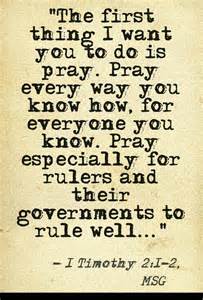
Reading again from 1 Timothy 2, “I urge, then, first of all, that petitions, prayers, intercession and thanksgiving be made for all people— for kings and all those in authority, that we may live peaceful and quiet lives in all godliness and holiness. This is good, and pleases God our Savior.”

I’ll stop right there. Not because the rest of the reading is unimportant. No! But, because Paul has so many ideas that are bursting out of him one on top of the other, I am afraid we might be overloaded if I read them all.

Paul begins the chapter by encouraging Timothy to offer prayers for all members of the human family during church services. He mentions prayer in the terms of: petitions (humble, general requests to God), intercessions (requests, pleading for those in need), supplications (requests for ourselves, especially when faced with a crisis) and thanksgivings (expressing gratitude for blessings we receive). [1] All people need to be held up to God in prayer. All. That is, everyone. Not just one particular neighborhood, not just one particular ethnicity, not just one particular denomination. Paul tells Timothy—Paul tells us—pray for all people.

Yes, this is a wonderful passage that gives us the basics of prayer and worship, and lets us know more about Paul’s ideas concerning this important aspect of our lives. However, I was drawn to one particular phrase in this passage that went beyond the basics of worship: that we may live peaceful and quiet lives in all godliness and holiness.” I pursued it all week.

I was fascinated to dig into this passage of scripture. I have not read the Pastoral Letters as often as the rest of the New Testament. So, this week was a good excuse for me to dust off those seldom-opened commentaries and brush up on what was going on in this highly charged situation. For, highly charged it certainly was!

There was a complication, in the case of these house churches. Let’s take a look at the historical context. In the first century, small house churches like the ones where Timothy and Paul worshipped were in a precarious situation. They were constantly involved in “the struggle to secure and maintain a foothold within a hostile environment, where political authorities would always tend to be suspicious of the little house groups whose legal status was at best ambiguous and be ready to act against them at short notice with little excuse.” [2] Many of these small groups of emerging Christians desperately wanted to gain basic respect. Not even respectability, but hoping for just a bit of respect from the authorities.

These groups, or house churches, are identical to house churches meeting all over the world today, in fear for their leaders, if not the group members’ very lives. House churches in parts of Vietnam and Thailand, China, Pakistan, Nepal, and large parts of the Middle East. These groups are—today, here and now—struggling to survive in precarious political situations.

Is it any wonder that these small house churches wanted to pray for those in authority over them, so that they might have some peace and quiet? Quiet and tranquil lives?

Good habits—beneficial, certainly! Habits like prayer and worship are something that Paul would tell Timothy that his house church ought to follow, each time they gather.

How does this prayer and worship counteract the complication of overbearing and even unjust authorities that hold sway over these little groups of believers?

Both Paul and Peter tell their friends that the Godly thing to do is to pray for the authorities. I read from Romans 13:1: “Let everyone be subject to the governing authorities, for there is no authority except that which God has established.” And 1 Peter 2:17: “Show proper respect to everyone, love the family of believers, fear God, honor the emperor.” The New Testament tells us so, in several places, including this letter from Paul to Timothy.

We can see Timothy and his church are prompted to pray for the government. As Rev. Findlayson comments, “We are encouraged to pray for the political process such that it provides an environment where ‘we may live peaceful and quiet lives in all godliness and holiness’ (verse 2:2). This verse actually contains a clue to the content of our prayer for government. We are to pray for “peace”, but what kind of peace? Is it peace in the sense of freedom from war, social and industrial strife and revolution?” [3]

Ah. We have arrived at the topic of the day. The theme of our service today. What kind of peace do we pray for, indeed?

I have been talking about peace ever since February, the beginning of Lent. Remember, I went to a number of different churches, church groups, and schools to ask individuals what their personal definition of peace was. What is peace to you?                I got many fascinating definitions and expressions. Everything ranging from “Peace is serenity” to “Peace is Jesus Christ in my heart” to “Peace is quiet and calm” and “Peace is no war and no fighting.” And, a whole lot of other things, besides.

This kind of peace Paul describes is not just personal peace, and individual peace. This kind of peace Paul talks about is peace in the larger sense. Peace among regions, between people groups, and even between countries. We can see the progression in Paul’s thought. The spread of truth and of the Good News of Jesus Christ is facilitated when peace exists among the nations. In Paul’s day, the Roman Empire, the Roman transportation system and the Pax Romana made the spread of the Gospel easier. Then as today, peaceful interaction between countries and regions opens doors for the Good News.

See what Paul says in verse 4. God “wants all people to be saved and to come to a knowledge of the truth.” So then, when we pray for government and for the authorities, we can confidently pray that there be peace for the maximizing of the spread of the Good News.

Paul gives us the basics of prayer and worship. Remember what I often say? Prayer time is one of my favorite times in the worship service. Paul tells us we are to pray for all people; and we are to follow Paul’s lead in supplications, prayers, intercessions and thanksgivings. The intention of such prayers is so that we Christians in society will be able to live tranquil and quiet lives. This isn’t me saying it. It’s the apostle Paul!

Regardless of whether there is peace in our church, peace in our neighborhood, or peace in our country, prayer is always a good idea. A close relationship with our Lord and Savior Jesus Christ is the reason we are here. Praise God! Thank You, Jesus. Alleluia, amen.

If anyone would like to know more about how to come to know God in a closer, more intimate way, I would be glad to tell you.

[1]  http://www.lectionarystudies.com/sunday25ce.html Rev. Bryan Findlayson, Lectionary Bible Studies and Sermons, Pumpkin Cottage Ministry Resources.

[2] New Interpreter’s Bible Commentary on 1 Timothy, James D.G. Dunn, (Nashville, TN: Abingdon Press, 1994)

[3] http://www.lectionarystudies.com/sunday25ce.html Rev. Bryan Findlayson, Lectionary Bible Studies and Sermons, Pumpkin Cottage Ministry Resources.

@chaplaineliza

(Suggestion: visit me at my regular blog for 2016: matterofprayer: A Year of Everyday Prayers. #PursuePEACE – and my other blog,  A Year of Being Kind . Thanks!)


Unknown's avatar

Unity of Christ’s Church

“Unity of Christ’s Church”

Gal 3-28 all one in Christ

Galatians 3:26-29 – August 28, 2016

One of my sisters lives in the New York City area, on Long Island. She has lived there for more than twenty-five years. She is a wonderful, generous hostess, and often takes her family and friends to various places around New York, site-seeing. We love to visit my sister. When my children were younger, we went with my sister to the top of the Statue of Liberty—on two different occasions!

The Statue of Liberty. A beacon of light for generations. When my grandfather was a boy in the early 1900’s, he and his family emigrated to the United States from a shtetl in western Ukraine. He remembered standing on the deck of a steam ship from Europe, coming into New York harbor.  He gazed over the rail at the welcoming sight, along with everyone else on that ship. The Statue of Liberty was etched vividly into his memory. I know, because he told me so.

This country has been called a melting pot, containing different nationalities, cultures, and ethnicities. Some call this country a mosaic or a kaleidoscope of people. Whatever you call it, the United States is truly an amazing nation made up of a multitude of individuals (or, their ancestors) who came from all over the world.

Unity. Unity amidst diversity. That is what this country is all about.

Let’s take a second look at our Scripture passage for today from Galatians 3. The Apostle Paul writes to the believers in the region (or area) called Galatia in Asia Minor. He makes an all-important point at the end of chapter 3: our text for today. “26 So in Christ Jesus you are all children of God through faith, 27 for all of you who were baptized into Christ have clothed yourselves with Christ. 28 There is neither Jew nor Gentile, neither slave nor free, nor is there male and female, for you are all one in Christ Jesus.”

I think you all might suspect what the theme for today’s service is. Unity!

Just as our nation incorporates strong unity amidst wonderful diversity, so does the Church. Not only this congregation, this fellowship of believers, but I am talking about the Church Universal. The Church around the world.

Taking a closer look at verse 3:28, at first glance, we might focus on the differences. Wow! There are some pretty big differences here. Paul mentions some significant separations and divisions. Different categories. What does this diversity look like?

First, “there is no longer Jew nor Gentile.” That is a serious thing for the Apostle Paul to say. Before his conversion on the road to Damascus, Paul was a Hebrew of the Hebrews; a member of the Sanhedrin (that is, the ruling religious council of Jerusalem). A top-notch Pharisee who probably prided himself on his meticulous keeping of the Mosaic Law code, down to the smallest detail. Good, law-keeping, observant Jews of that time would not allow themselves to associate with, or even talk to a Gentile. So—after he became a Christian, we can see how serious Paul was about this unity of everyone, in Christ Jesus.

The second difference? “There is neither slave nor free.” Jesus Christ takes away all distinctions of social class and standing!

Wait a minute! That is not strictly true. In this troubled world, there are lots of differences, lots of separations in social hierarchy. In Morton Grove, we see many people who are solidly middle class. Different from wealthy people living on the Gold Coast, just off Michigan Avenue near the Water Tower. Go just a few miles further south, to the Englewood area of Chicago. I saw some of areas of extreme poverty when I visited there, earlier this month.

However, when people come to believe in Jesus Christ, social class and power can be dissolved, and go away. The unity of all believers is emphasized in this verse, again.

The third difference we notice? Paul mentions “nor is there male and female.”

Subtle difference! Yes, God created people male and female. Yet, when people come to faith in Christ Jesus, there is a new creation. All things are become new, as Paul tells us in 2 Corinthians 5. Even gender is given a back seat. Each person’s belief in Christ is emphasized in this new creation, differences are dissolved, and the unity of all believers is lifted up. We are all one big family.

Earlier in this letter, Paul mentions circumcision. That’s something that is very Jewish. And, very male. In the time before the common era, women and girls could not be considered full children of Abraham because they could not be circumcised. (For obvious reasons.) That was fully half of all religious people who could not fully participate in religious functions. Yet now, in this new creation in Christ Jesus, the old differences and distinctions no longer separate male and female. All things have become new.

Let me remind everyone of how earthshaking this all must have been for the Apostle Paul. Talk about having his entire worldview and frame of reference turned upside down! A good, observant Jew who studied with one of the leading rabbis of that day, now associating and eating with Gentiles. Staying in their homes. What a huge change of Paul’s way of thinking.

One big theme of the letter to the Galatians is that of identity. Who are we? What are our identity markers? How do we tell who others are, in our group? Paul says so, right here. Those who are baptized in Christ are children of God. Everyone who is baptized is our brother, our sister. That’s a whole lot of people, when we consider all the people who are believers, not only in the United States, but in the whole world!

I don’t know how many of you remember your own baptism, as infants and children. However, Paul is talking to people who were baptized as adults. The weeks beforehand must have been significant, too, in which these new believers were fully instructed and immersed in the understanding of Christ as their Messiah, their Lord and Savior. Then, often on Easter Sunday, the new believers were baptized. When possible, they were fully immersed, or at least had water poured over them in a large tub. Sometimes, naked, because they often would remove their clothing before the ceremony. After the baptism, they put on a new, white garment, signifying their new life in Christ. They were truly “clothed in Christ,” just as Paul says here.

As diverse and different as we are, considering world-wide Christianity, we all have become one humongous family of God. We are all God’s children.

How many of us, today, can say that? Yes, when babies and children are baptized today, we make a big fuss. We buy them special outfits for the occasion. But, do we truly take the new reality—this new identity—to heart? We have all been transformed, through Christ.

What a transformation! What an identity shift. We here at St. Luke’s Church are just as much God’s children as the Catholics worshipping at St. Martha’s Catholic Church south of Dempster. And, both groups of believers are just as much God’s children as those baptized at St. Haralambos Greek Orthodox Church on Caldwell. And, what about our friends at Love Sharing Disciple Church here, who will be worshipping in this sanctuary later today? This is duplicated at churches and auditoriums all over the Chicago area, with diverse ethnic and cultural groups of believers. We can enlarge that to a wide variation of church practices, all over the world. Wow! Double wow!

What a mosaic of identity in Christ. What a kaleidoscope of difference, made one huge family of God. Remember our sentence for the week, from the United Church of Christ Statement of Mission? Empowered by the Holy Spirit, we are called to embrace the unity of Christ’s church.”

The unity of Christ’s church, in such beautiful, rich, worldwide diversity. This is truly something to celebrate! Alleluia, amen.

[Thanks to Dr. Richard B. Hays for concepts and ideas from his commentary on Galatians 3, from The New Interpreter’s Bible Commentary (Nashville, TN: Abingdon Press, 1996).]

@chaplaineliza

(Suggestion: visit me at my regular blog for 2016: matterofprayer: A Year of Everyday Prayers. #PursuePEACE – and my other blog,  A Year of Being Kind . Thanks!)

Unknown's avatar

We Are Called

“We Are Called”

call of God 1 Cor 1

I Corinthians 1:1-3 – June 12, 2016

Remember the baptism we celebrated here in this sanctuary a few weeks ago? What a wonderful opportunity to welcome a new child to God’s forever family! When we baptized baby Christine, we celebrated a sacrament of the church. And, baptism is a great expression of God calling people to God’s heart. Embracing all God’s children, no matter how young or how old they might be.

Our New Testament scripture reading comes from the beginning of the letter to the believers in the city of Corinth. The Apostle Paul wrote this letter to address some problems and answer some questions for the Christians in Corinth, a city not too far from Athens, Greece.

Paul only stayed in some towns and cities for a short time. A few towns—as we saw when we took our postcard trip through Acts last summer—he only was able to stay in for a very short time. But, the city of Corinth? When he was on his second missionary journey, Paul spent eighteen months there. That’s a good long time, in any century.

Imagine a town with loose morals. Think Las Vegas, pretty much any time of the year, and New Orleans, especially during Mardi Gras. Combine them into one city, and you have an idea of what the city of Corinth was like. Corinth was known throughout the Roman empire—and beyond—for being a loose-living, rough-and-tumble city. Lacking moral character. Yet, God tapped the prim and proper Apostle Paul on the shoulder and had him spend a year and a half here in this town. And, what a town it was!

We are taking a close look at the greeting in Paul’s letter. “Paul, called to be an apostle of Christ Jesus by the will of God, and our brother Sosthenes,” It’s like the address label or identifying mark, telling the recipients who is sending the letter.

Yes, this letter is from Paul and “our brother Sosthenes.” Except, I want us to look more closely at one particular phrase: “Paul, called to be an apostle of Christ Jesus by the will of God.”

This word “called?” A fascinating word. Paul is identifying himself as an apostle. Not just because he said so, or because he’s calling himself that, but because God said so! “Called” is the Greek verb kaleo, used dozens of times in the New Testament. It means “to call, invite or summon.” (Depending on who is doing the action. Friends invite, whereas kings summon!) This word can also be translated “to name.” (As in this case.) God has named Paul an Apostle. [1]

Paul is called as an Apostle, and given a specific job or task. We are probably familiar with the term “pulpit committee,” for filling the pulpit when a church is looking for a new pastor. When the church decides on a prospective pastor, they “call” that pastor. The church is choosing her or him to come and work for them. The church “invites” or “calls” the pastor. Kaleo.  A very biblical term!

The next verse of the greeting is in several parts. First, “To the church of God in Corinth, to those sanctified in Christ Jesus and called to be His holy people.”

There is that word again! “Called.” Kaleo. The believers in Corinth have been called to be God’s holy people! Wait, I thought Corinth was Sin City! I thought the city was a cross between Las Vegas and New Orleans in the middle of Mardi Gras! Well, yes. You would be correct. Except—this is God who is doing the calling!

God can call people out of all kinds of places. God can name individuals to be whatever God wants them to be. To do. To act. To love. To show mercy. To give. Whatever we are called to do, God summons us to fill that task, or calling. Even though many of us may never be a minister like Pastor Gordon, or a church musician like Angela, or a chaplain like I used to be, in the hospital, but God still calls.

All believers are still invited to follow God. And, that is not all. Let’s listen to this verse again. “To the church of God in Corinth, to those sanctified in Christ Jesus and called to be His holy people.”

The believers in Corinth were sanctified. There are other places in the New Testament where believers are described in just this way: “sanctified.” Which is a fancy word for “set apart,” or “separated.”

Believers are called as hagiois – saints, separated or set apart. Now, who wants to be “set apart” or “separated?” To the typical non-Christian Corinthian, that does not sound like very much fun. I do not think many of these non-Christian friends had much patience for that. However, Paul and his Christian friends did not withdraw from society and isolate. Instead, Paul and his friends lived together with the others in Corinth. They had a special quality that marked them and made them special. “Set apart” or “separated.” That is how Paul describes us as believers.

This is a difficult concept to some, but not in all contexts. Athletes set themselves apart often. They train hard, eat healthy, have particular foods and drink. A commentator mentions, “I wonder if that isn’t just another way of saying that [they’re] set apart or dedicated. That kind of language might work better for us. People are quite ready to talk in that way in our culture. Athletes set themselves aside. They dedicate themselves toward particular ends. There is a sense in which Paul is saying, ‘You are a dedicated people; you have been set apart.’” [2]

So, not only Paul is called—or named—as an Apostle of God. The believers at Corinth are called—or named—as a set apart, dedicated people of God. By extension, we—that is, all of us!—are named as a separated people of God. Not dedicated to loose living, or of low moral character; instead, set apart. Called, invited to be God’s people.

I am turning to the United Church of Christ Statement of Mission. You all have it as an insert in your bulletins. We are on the second part of the preamble today. Please read along: “we seek within the Church Universal to participate in God’s mission (John 20:21) and to follow the way of the crucified and risen Christ. Empowered by the Holy Spirit, we are called (1 Cor 1:1-3) and commit ourselves.”

This second part of the preamble, “Empowered by the Holy Spirit, we are called,” is an identification. We are not only finding out about the believers in the church at Corinth, we find out about us. About you and me, today.

We all are called! We have been invited by God, named as Christians by God. Just as baby Christine was loved by God and welcomed into God’s forever family through baptism, so God loves us and names us as part of God’s forever family, too.

This is important. The United Church of Christ is awfully particular about who receives this Statement of Mission. We all do! We all are called. We all are named as believers. And, we all are encouraged to follow this statement of mission, to carry it out.

Last, to return to our greeting from this letter, Paul has all believers everywhere calling on God. Another verb “kaleo,” another instance of us naming Jesus Christ as our Lord and Savior. Their Lord and ours. You can look at it as an identifying mark or label. We call Jesus Christ our Lord.

If we acknowledge Jesus Christ as our Lord, we are certainly ready for anything. In the weeks ahead, we will find out in more detail what the UCC Statement of Mission has for us to do. God willing, I will be ready. Will you?

[1] https://billmounce.com/greek-dictionary/kaleo. (Thank you, Dr. Mounce.)

[2] http://wordandworld.luthersem.edu/content/pdfs/15-4_Nations/15-4_Dinovo.pdf, Dinovo, Terrence L., “Jesus Christ and Him Crucified,” Word & World, Volume XV, Number 4, Fall 1995.

@chaplaineliza

(Suggestion: visit me at my regular blog for 2016: matterofprayer: A Year of Everyday Prayers. and my other blog,  A Year of Being Kind . Thanks!)

 

Unknown's avatar

Seeing is Believing!

Seeing is Believing!

“Seeing is Believing”

Jesus and Thomas illustration John 20-24

John 20:24-29 – April 12, 2015

Seeing is believing! Or . . . is it?

I wonder what things come to mind when I mention the phrase, “Seeing is believing”? Or even, “I won’t believe it until I see it!” Sometimes, people can be really doubtful about things. I can just imagine several people I know folding their arms across their chests and saying, “Unless you show me . . . “

In the gospel account we read today, from John 20, the disciple Thomas had just that reaction. After the resurrection, the first time Jesus came to the disciples, Thomas was not there. We’re not told why, simply that he wasn’t there. Maybe he was scared, maybe he was away, or out of town. Maybe he was sick. We just aren’t told why he wasn’t there.

The ‘why’ is not the important part. The fact that Thomas wasn’t present is. Thomas had doubts. Sincere doubts.

Truth to tell, the other disciples’ story was a little farfetched. I mean, how many people have you known who came back from the dead, and walked through walls into a locked room?

I wonder. I wonder if Thomas’ reaction strikes a chord with anyone here today. How many of us today are like Thomas? Doubting that Jesus has risen indeed from the dead? Or, completely missing Jesus, and doubting that Jesus is even here at all, today?

Let’s think some more about Thomas and his reaction. Thomas not only doubted, he also refused to believe! He not only doubted, he wanted concrete proof. Tangible proof, proof he could touch and feel and handle. Thomas wanted to put his hands in the nail marks on Jesus’ hands. That’s pretty concrete.

As I thought more about Thomas and his reaction and attitude toward Jesus and His first appearance to the disciples, I was reminded about my children. Generally, children have concrete thinking processes, especially smaller children. I have four children, and I’m accustomed to talking with them and communicating in more appropriate ways for their age groups. My children are just about grown up now. But when I used to explain something about God to my children, sometimes it was difficult for the younger ones to fully grasp the ideas I’m trying to explain. And they can ask some pretty hard questions. Gee, sometimes it’s difficult for me to know how to explain things about God to anyone who asks!

Maybe Thomas needed more concrete explanations, too. We just aren’t sure. The Gospel of John isn’t clear at this point. We as readers don’t know why Thomas had difficulty believing. But the gospel account says he did.

How many of us today are like Thomas? Not sure? Not believing? Closed up behind the locked doors of feeble faith? Not believing that Jesus can make a difference in our lives today? Could Jesus come and reveal Himself to Thomas? Can He come and reveal Himself to those today who are fearful, doubting, and unbelieving? . . . Can He reveal Himself to me?

Perhaps Thomas even had difficulty finding something to believe in, since he had so recently seen his Master and Teacher arrested and crucified. Grief, fear, anger, dashed hopes, shattered dreams. I strongly suspect several, if not all of these, were operating in Thomas’ life at this time.

These strong feelings and emotions inside are intense, and raw. From what is known today about the stages of grief, Thomas could very well have been feeling awful, angry, fearful and upset. Thomas could have felt like his life was falling apart. But Jesus can break through all of that. Jesus could enter Thomas’ life with new hope, standing right in front of him. In the same way, Jesus Christ can enter through the closed doors of our hearts, and meet us where we are, with open arms.

Just as Jesus did not leave Thomas high and dry, to figure things out on his own, so Jesus will not leave us. Our Lord came to Thomas in the upper room, despite his doubts and unbelief, and Jesus also comes to us in our doubts, and in our unbelief.

Now, Thomas didn’t actually see Jesus, at first. He had just heard from others who had seen Jesus. But then, a second time, the risen Lord appeared to the disciples. Again, in the locked room, and this time, Thomas was there.

What were Jesus’ words to Thomas? “Put your finger here and see my hands. Reach out your hand and put it in my side. Do not doubt, but believe.”

Thomas responded with that tremendous affirmation, “My Lord and my God!” Praise God for the sincere, heartfelt response of Thomas.

Jesus’ words to His doubting disciple serve as words of comfort and reassurance to me. I know I have doubts and fears, sometimes. And just as Jesus did not leave Thomas doubting, so too, Jesus will not leave me doubting, either. He will welcome me with open arms, coming through the locked doors of my fear, anger, doubt and unbelief.

Thomas saw Jesus. Seeing was believing, in Thomas’ case. Moreover, the risen Jesus continues with the statement, “Have you believed because you have seen me?” –here’s the best part of all. “Blessed are those who have not seen and yet have come to believe.”

What was that Jesus just said? Did I read that correctly? “Blessed are those who have not seen and yet have come to believe.” So–the Gospel of John says here that all who have not actually seen the risen Lord and yet have come to believe are indeed blessed.

That means Christians throughout the centuries are blessed, since they have come to believe in Jesus Christ and yet have not actually, physically seen Him as risen from the dead. That means you and I are blessed, since we have come to believe in Jesus Christ, too. How awesome is that? I am–you are–we all are blessed because the Lord Jesus says so!

Just as Jesus helped Thomas to believe, so the Gospel of John helps us to believe, too. This Gospel was not only written to bear witness so long ago, in the first century, some years after Jesus was raised from the dead. This Gospel was also written for the many generations which have come to believe throughout the centuries. And that includes us, too. Even though we may have doubts, and unbelief, and wonder whether, and why, or even why not, Jesus comes to us in our doubts and unbelief. Our Lord comes to us with reassurance and open arms and says “Do not doubt, but believe!”

Praise God that as we come to believe that Jesus is the Messiah, we can have life in His name. And Jesus can come to us, at any point in our walk with the Lord, no matter what the circumstance happens to be, no matter where we are in our lives. Thank God that Jesus will be there for us and with us, no matter what. May we all be able to affirm, with Thomas, that the risen Jesus is our Lord and our God.

Alleluia, amen.

@chaplaineliza

(Suggestion: visit me at my daily blog for 2015: matterofprayer: A Year of Everyday Prayers. and my other blog,  A Year of Being Kind .  Thanks!)