Unknown's avatar

Gift of the Holy Spirit

“Gift of the Holy Spirit” – May 15, 2016

Acts 2-38 repent, be baptized

Acts 2:38

What does it mean to know someone?  Can you know a sports star? Know all of his or her stats, his earned run average, how many sacks he got last season, how many assists she had to her credit in the last game?

We can know a lot about some really famous people, and yet not know them personally. I suspect you’re all familiar with the movie star Harrison Ford (Indiana Jones, Han Solo in the Star Wars movies, Jack Ryan in a couple of Tom Clancy movies). I know just a few things about him. He is a very private person, and a licensed helicopter pilot; he started in Hollywood years ago as a carpenter until he got his first movie role. I know things about Harrison Ford, But I have no illusions about being close to Harrison Ford.

What about Jesus? Do we know things about Jesus? Can we describe things about His life, His ministry, or the things He said? What about the last week He was alive? His passion?  His trials, crucifixion, and death on the cross? Do we know about all that?

Peter did. Peter knew all those things intimately. Peter was also one of the disciples who had a very close relationship with the Rabbi Jesus throughout the three years of His ministry. We know that, through the Gospel accounts. But now, now is the morning of the Pentecost festival. A whole host of Jews from all over the region have gathered together in Jerusalem for one of the important feasts, one of the celebrations on the Jewish calendar. Peter had quite a crowd for his impromptu sermon. For—that was what he delivered. A sermon.

But, a sermon on what? Why did he feel like he had to speak out?

For that, we need to go back to our Scripture passage for the morning. I am reading from Acts chapter 2: “When the day of Pentecost came, they [the disciples and followers of Jesus] were all together in one place. Suddenly a sound like the blowing of a violent wind came from heaven and filled the whole house where they were sitting. They saw what seemed to be tongues of fire that separated and came to rest on each of them. All of them were filled with the Holy Spirit and began to speak in other tongues[a] as the Spirit enabled them.”

What happened to the disciples? The Holy Spirit happened, that’s what! The Holy Spirit blew into that house, buffeting all inside with a violent wind. Then, on top of that, tongues of fire appeared over each one’s head. The Holy Spirit came and dwelt within each one of them—with each believer in the resurrection of Jesus Christ. These tangible and visible signs of the Holy Spirit were genuine proof that the Holy Spirit was real. This coming was huge. And, this arrival was life-changing.

After such a momentous event inside the house, the newly-filled, newly-energized believers spilled out into the street. Can you see their excited faces? Can you hear them as they share about this amazing experience that had just happened?

I can just imagine a roving reporter, reporting on the noisy crowd in the streets of Jerusalem that day. “Here on the streets of Jerusalem are God-fearing Jews from every nation under heaven. I understand that a strange sound was just heard. You all can see the crowd coming together in bewilderment. Each person is hearing their own language spoken. Everyone here is utterly amazed! “Aren’t all these who are speaking Galileans?—we hear them declaring the wonders of God in many different tongues! I keep hearing again and again from these eye-witnesses, “What does this mean?” The minority opinion is, however, less flattering. Some are making fun of theses Galileans and saying, “They have had too much wine.”

You can see how brash, outspoken Peter couldn’t help himself. Energized by the Holy Spirit, he began to tell people what happened. Why all of the disciples were so energized, so filled with the Holy Spirit. And—about Jesus Christ, Jesus the Jewish Messiah, crucified, died and resurrected from the dead.

Listen to the words of Peter: “But God raised Jesus from the dead, freeing Him from the agony of death, because it was impossible for death to keep its hold on Him. 32 God has raised this Jesus to life, and we are all witnesses of it. 33 Exalted to the right hand of God, He has received from the Father the promised Holy Spirit and has poured out what you now see and hear.”

Does everyone here understand? Peter finally gets it! So many times previously, Peter and the other disciples just didn’t understand the words of Jesus. They miss His message completely, and Jesus needed to patiently backtrack, go over the same information again and again. Except—not now. The disciples—and Peter—finally understand! The Holy Spirit is now indwelling them, and Peter lets everyone in the crowd know that this Jesus, this Messiah, has come for them, too.

This Jesus, this Messiah, is the long-promised Messiah, foretold by Moses and the prophets.

Many people in the crowd had heard something about the Rabbi Jesus, who had been put to death just a few short weeks ago. Yes, and some even knew a lot about this Jesus, this supposed Messiah, long-promised and foretold by the Hebrew Scriptures. But, the words of Peter, energized by the Holy Spirit, went straight to the hearts of those who listened that day.

Listen to the words of our scripture passage today: “When the people heard this, they were cut to the heart and said to Peter and the other apostles, “Brothers, what shall we do?” 38 Peter replied, “Repent and be baptized, every one of you, in the name of Jesus Christ for the forgiveness of your sins. And you will receive the gift of the Holy Spirit. 39 The promise is for you and your children and for all who are far off—for all whom the Lord our God will call.”

Wait a second. What is Peter talking about? Believing, and immediately getting baptized?

That is exactly what he means. Baptism was an established practice in the first century. Not done by everyone, but practiced by a number of people. To show cleansing, and repentance, and renewal of life. Jesus elevates this Jewish practice to what we call a sacrament.

As in the rest of believers’ lives, so also in the receiving of the sacraments, it is God who takes the initiative in approaching the believer. It is then the believers’ turn to respond joyfully to God, as a result of God’s sovereign gift of grace. Baptism is our response to God’s gracious gift of salvation, grace, and forgiveness of sins.

Let me explain in another way. Out on the cattle ranches of the West the unbranded calves that roam at large are known as “mavericks.” Theses calves are claimed by the rancher who is first to get his brand on them at the annual round up. A little girl from a Western state had been baptized one Sunday by the Methodist minister of the town. Her friends at school questioned her the next day as to the meaning of the ceremony. “Well,” she said, “I will just tell you. I was a little maverick out on the prairie. That pastor put the Jesus mark on my forehead so that when He sees me He will know that I am one of His children.”

That Jesus mark was what so many new believers received, that morning of Pentecost. That Holy Spirit gift was what we received when each of us was baptized. Before we knew the Lord, each of us was a maverick calf, wandering on the prairie. Whether we are baptized as adults, young people, or babies like Christine, baptism is a joyful, outward expression of God’s love toward us. And, we know that Jesus will know that each one is His child.

Do you know things intellectually about Jesus? Or, do you have a close relationship with Jesus? Like the other believers on that Pentecost morning, has the Holy Spirit blown through your life and heart? I invite you all into a close relationship with Jesus, today.

@chaplaineliza

(Suggestion: visit me at my regular blog for 2016: matterofprayer: A Year of Everyday Prayers. and my other blog,  A Year of Being Kind .  Thanks!)
Unknown's avatar

Well Pleased

“Well Pleased”

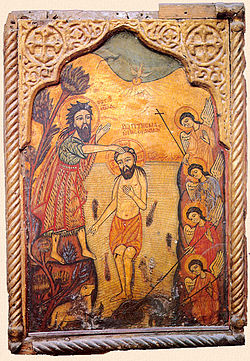
Baptism of Jesus Coptic icon

Baptism of Jesus
Coptic icon

Luke 3:22 – January 10, 2016

It’s a joyful day indeed when we celebrate a baptism in church.

We follow the command of our Lord and Savior Jesus Christ, showing to all an outward sign of an inward change. Here in this church, we often celebrate infant baptism, showing the sign of God’s grace to all who are present. The congregation has an important part, too. They promise to teach the little one the ways of God, and to help the family bring up the child in a manner pleasing to God. Truly, a joyful, grace-filled sign and sacrament!

Well, that’s today, here and now, a long time after the first century. That’s one common understanding we now have of baptism.

Our Gospel reading today features John the Baptist, baptizing people in the wilderness. John was a prophet of God. He was set apart for a special purpose, to give out a special message from God. Here John the Baptist preaches to the nation of Israel, before our Lord Jesus has even started His ministry.

This message ought to be familiar to most of us. We heard some of John’s prophetic message read as our Gospel lesson only a month ago. Doom and gloom! He identifies everyone in the crowd as part of the brood of vipers—as sinners! Exactly what John the Baptist has been saying to the people of Israel for some time.

Another way of looking at John’s message is: “You are dirty, inside and out! Come get clean, both symbolically and physically!” Through God’s grace, John offers the people the opportunity to be obedient and to clean up, to show God and to show others that they repent and turn from their sinful, wicked behavior, speech and thinking. Many people respond. It’s a mini-revival going on at the River Jordan. Amen! Hallelujah!

Let’s pull back for a moment, and consider the larger situation.

At that time, the nation of Israel was an occupied country. Under the boot of the Roman Empire, the people of Israel were oppressed and subjugated. Many people in Israel were looking for the promised Messiah, the Anointed One of God, who would be a Savior for Israel. We can see from our Gospel reading today. Verse 15: “The people were waiting expectantly and were all wondering in their hearts if John might possibly be the Messiah.”

John does not mince words. He does not pull punches. John identifies his listeners as a brood of vipers, as sinful and separated from God.

Just think about identity today. How do people identify themselves? In an excellent commentary on this Gospel passage, David Lose says many of the traditional elements of a person’s identity have been diminished. Think about it. The majority of people today change jobs and careers frequently. The majority of people live in multiple places and different residences rather than growing up and living for their whole lives in a single community. He comments, “fewer families remain intact – there is a craving to figure out just who we are.” [1]

John tells the people of Israel straight out, ““I baptize you with water. But one who is more powerful than I will come, the straps of whose sandals I am not worthy to untie. He will baptize you with the Holy Spirit and fire.” John the Baptist responds with a clear message: he offers the people baptism to remedy that flawed, sinful, separated identity. They can identify themselves with God, and be identified as God’s beloved children.

And then—and then—Jesus shows up. Jesus is about to begin His public ministry. But before that happens, He comes to the River Jordan to listen to His cousin John the Baptist. And, to get baptized.

Lo and behold, the companion Gospel accounts of Matthew and Mark tell us that John is surprised to see Jesus there. But Luke’s account makes Jesus’s appearance natural. The next right thing that happens. Verse 21 says, “When all the people were being baptized, Jesus was baptized too.” At first, John is the star actor, the one doing the main action of baptizing. Jesus is the next one baptized, along with many others. However, what happens next?

The spotlight shifts in the following sentence. Dr. Luke turns his focus on Jesus. “As [Jesus] was praying, heaven was opened 22 and the Holy Spirit descended on Him in bodily form like a dove.”

Can you see this on a movie screen? We open to a wide shot of the River Jordan. Large crowd of people on the river bank, and a number lined up in the water, waiting their turn. John the Baptist in a rough woven tunic with a leather belt around his waist. John is doing his thing—baptizing people who have repented of their sin. And—Jesus is one of them.

The camera pans in to a close-up shot on Jesus. Next in line. John slowly takes Jesus, baptizes Him. We are not sure whether John dunks Jesus in the water, or whether he pours water over Jesus’s head. (I prefer the idea and the image of pouring the water.) Regardless, everyone gets pretty wet. Next thing we all know, the heavens open wide.

Can you see it? The bright light from heaven? Perhaps sound effects, too? Heavenly music? Maybe even a low rumble of thunder? Dr. Luke paints a show-stopper of a scene. He tells us the Holy Spirit appears as a dove, descending on Jesus. The capper of the scene is the voice of God. Quoting from Luke’s account: “A voice came from heaven: ‘You are my Son, whom I love; with You I am well pleased.’”

Just in case anyone was not sure, God’s own voice tells us the identity of Jesus.

Jesus is God’s own beloved Son. Not only that, but God is well pleased with Him, too. Plus, the Holy Spirit as a dove is a visible and physical sign of the presence of God.

Here in this act of baptism, we find out about identity. As the commentator says, “The voice from heaven is addressed to Jesus in the first person: “You are my Son, the beloved; with you I am well pleased.” Baptism teaches us who we are – God’s beloved children – and confers upon us the promise of God’s unconditional regard.“ [2]

God not only proclaimed Jesus’s identity, on the banks of the Jordan River, God also proclaims our identity. We belong to God. It is not our doing, but God’s, instead.

Did you hear? Do you understand? No matter what happens, or how often we fall short, we cannot erase or eradicate God’s love. We love God because God first loved us. God has given us that sign, that seal of baptism, sealed by the Holy Spirit.

It does not matter whether we have been brought to baptism as a baby or a child, or have come as a young person or an adult. Perhaps there are people here who have not been baptized yet. God calls for all to be baptized. God calls for all of us to remember our baptism, as well.

God’s arms are open wide. God’s grace is abundant, for you and for me. God’s grace is poured out freely upon us in baptism. We are cleansed to do God’s gracious work in the world. Can you hear God’s voice talking to you? Telling others about you? “This is my beloved child. With you, child, I am well pleased.”

Alleluia, amen.

[1] Preaching a More Meaningful Baptism – David Lose, https://www.workingpreacher.org/craft.aspx?post=1624 .

[2] Ibid.

@chaplaineliza

Suggestion: visit me at my sometimes-blog: matterofprayer: A Year of Everyday Prayers. and my other blog,  A Year of Being Kind .  Thanks!

Unknown's avatar

Cleanse Your Hearts!

“Cleanse Your Hearts!”

Acts 15 Jerusalem council stained glass

Acts 15:8-9 – August 23, 2015

Conflict resolution is never an easy thing.

I hate to make sweeping statements, but I definitely think that that is one everyone can agree upon. Conflict resolution is never an easy thing.

We could be talking about the rough and tumble of sibling rivalry: “Mom! He started it!” “Did not!” “Yes, you did, too!” Or, a difficulty between neighbors that might get worse and worse, and escalate out of control until someone puts up a spite fence. Or, what about a problem between two employees in the workplace? You know the sort of thing. A disagreement starts between two people. Words are exchanged. Each side is sure they are right! Next thing you know, the whole office has chosen sides, and is squared off against each other.

We have a situation very much like this, in Acts 15. The whole group of believers—in all of the congregations scattered around the Mediterranean by this point—has escalated to the point that we heard about today, during the New Testament reading.

To recap, back in Acts 2, a number of days after our Lord Jesus ascended in to heaven, the few dozen believers have a Pentecost experience! The Holy Spirit comes upon them all, and Peter preaches his remarkable sermon. Not remarkable in and of itself, but remarkable because of the incredible response he got. Hundreds and hundreds of people came to belief in the risen Lord Jesus, in just one day! These were all Jewish believers. And, they continue spreading the Good News to any Jew they encounter. Many more believe, too.

Then, in Acts 8, Philip preaches in Samaria. The Holy Spirit comes upon these half-Jews, and even more people believe in the Good News! The circle of belief and faith continues to become wider and wider. In Acts 10, Peter preaches the Gospel to a Gentile—Roman centurion named Cornelius, and his whole Gentile household. They all believe, too! And, the Holy Spirit comes upon all of them, as well. Peter and the other apostles have the witness of their own eyes. They see that “God shows no partiality, but in every nation anyone who fears God and does what is right is acceptable to Him.” (Acts 10:34b-35)

The Holy Spirit continues to move. The believers continue to preach the Good News to anyone and everyone. It doesn’t matter whether they are Jew or Gentile, slave or free, high class or low born, or any other distinction. All are welcome to come to faith in the risen Lord Jesus.

Which brings us to the beginning of Acts chapter 15. A large number of believers has squared off, one side against the other, over keeping the Jewish laws. Should we, or shouldn’t we? What about Jewish people who never really kept kosher, before they started believing in the risen Jesus? Should they keep 600-plus rules in the Jewish law, now? And what about Gentiles who might have never had any idea about the Jewish laws, before? Should they turn themselves inside out and start keeping kosher, and wearing special clothes, and observing special holidays?

I went to one of the textbooks I had for one of my seminary classes, called Church Administration. (One of the best classes I ever had, in all my years of school!) This book is called Never Call Them Jerks: Healthy Responses to Difficult Behavior by Arthur Boers. Such helpful material on church conflict in this book!

Our situation at the beginning of Acts 15 seems black-and-white. We can see that from verse 5: Then some of the believers who belonged to the party of the Pharisees stood up and said, “The Gentiles must be circumcised and required to keep the law of Moses.”’ We have group A (or, Aleph) on this side, yelling ‘You’ve got to keep Jewish Law!” and group B (or, Bet) on the other side yelling back, “No, we don’t!” As they continue to bicker and snarl at each other, the argument gets worse and worse!

This argument is a classic case of polarizing! “Reducing issues to ‘black-and-white’ solutions and giving little time to discovering other options.” [1] What will they do now?

Yes, the controversy has busted wide open. Sometimes, people get stuck. They either don’t or can’t move. There they are, in that big, black-and-white argument, no way out. Or, so they think.

At the church council in Jerusalem, there was some discussion. I don’t know how long the discussion went on. There may have been some name-calling, or possibly even getting into fist fights. (I don’t know for sure—this was before the days of reality television.) Adversarial comments could have happened! “using ‘we/they’ language and ignoring or dismissing what is held in common.“ As the argument escalated, I can imagine threatening ultimatums being issued, back and forth. [2]

Here’s an illustration Boers uses: “One snowy morning I drove the high school car pool. I backed my fully loaded van onto a downwardly sloped street. On the slippery pavement, the van would not budge uphill in a forward gear. I could have pushed the accelerator, spun the wheels harder and faster, and gotten nowhere. Instead, I backed partway down the hill, tried the forward gear again, discovered my wheels had found a purchase, and was able to move forward.” [3]

Similarly, we find the apostle Peter taking a step back. Just like the van in this illustration, he backs up. And, he “seeks the common good over the interests of particular parties.” [4] He tries to find some common ground that all can agree on. Peter says, “God, who knows the heart, showed that He accepted the Gentiles by giving the Holy Spirit to them, just as God did to us. He did not discriminate between us and them, for God cleansed their hearts by faith.”

Did you hear? Peter makes the statement, again, that God wants to enter into a relationship with each and every person. That means, each person in his time, in the first century, just as much as today, in the twenty-first century. God does not discriminate! And, neither should we.

What’s more, God cleanses everyone’s heart! Praise God, we don’t need to meticulously follow the Jewish Law code. We don’t have to wear special clothes, or observe special holidays, or have restricted food choices. God has cleansed each of our hearts, through faith! Peter goes on to say, “Now then, why do you try to test God by putting on the necks of Gentiles a yoke that neither we nor our ancestors have been able to bear? 11 No! We believe it is through the grace of our Lord Jesus that we are saved, just as they are.”

Praise God! Alleluia! We are not saved by following each and every little rule in the Jewish Law code. We are not saved by following each and every little rule in recent rulebooks, like no dancing, and no card-playing, no movies, and no mixed bathing.

It was a little early in the formation of Christianity for the apostle Paul to formulate his theological statement in the letter to the Ephesians, some years down the road. But I can hear the beginnings of it being hammered out, right here. Paul’s triumphant words from Ephesians 2:8-9. “For by grace you have been saved through faith, and this is not your own doing; it is the gift of God—not the result of works, so that no one may boast.”

Praise God! Not just Jews, not just Greeks, not just people with brown hair, not just people who are right-handed. But everyone. God does not discriminate! What’s more, God cleanses everyone’s heart! We can all say Alleluia! Amen!

@chaplaineliza

Suggestion: visit me at my daily blog for 2015: matterofprayer: A Year of Everyday Prayers. and my other blog,  A Year of Being Kind .  Thanks!

[1] Boers, Arthur Paul, Never Call Them Jerks, (United States of America: the Alban Institute, 1999.), 72.

[2] Ibid.

[3] Ibid, 64.

[4] Ibid, 72.

Unknown's avatar

To the Ends of the Earth!

To the Ends of the Earth!

Acts 13-47 go into all the world

Acts 13:47 – August 16, 2015

Every month, St. Luke’s Church has a Church Council meeting to deal with the everyday business of running the church. We are going to have our August meeting this coming Friday. This being a congregational church, any member is more than welcome at our council meetings.

Let me ask: what would you think if someone from the Church Council were to get up in front of the congregation next Sunday morning, and say something like, “This past Friday at the Council meeting, the Holy Spirit told us to send two of our church leaders—two Council members—off to the mission field full time. We prayed over them, and we sent them off. They’re gone, and we’re not really sure where they’ll end up”? What would your reaction be to such a statement?

That’s just what happened. That’s just the situation, here at the beginning of Acts chapter 13. Except, I suspect the whole congregation gathered around Paul and Barnabas, as well as several others who intended to travel with them. Dr. Luke doesn’t specifically say, but I think the whole congregation prayed over them before they sent them out.

Paul and Barnabas were chosen by the Holy Spirit to go out. To tell others about the Good News of the risen Jesus. They, and several of their friends, left for parts unknown.

It’s a wonderful thing, to be noticed, recognized. Chosen as a messenger, a missionary for God. In the several churches I have attended over the years, I have seen dozens of people go on both short- and long-term mission trips, just like Paul and Barnabas. I’ve been involved with mission committees, and led prayer teams and prayer efforts in support of many of those same missionaries. However, I—myself—have never gone anywhere on a mission trip. Nope. Not even a short-term one.

How many of us, here, can say the same thing? I am not asking for anyone to raise hands or otherwise identify themselves. But, in your hearts, how many of us know that we have never gone to the mission field? Either overseas, or in this country?

Let’s define terms. What is a mission field, anyhow? What does it mean to be a missionary?

A simple definition? A mission field is somewhere on the other side of a boundary or barrier. I know seminary professors and people who study the history of missions might quibble with the specifics of this definition. However, I think most everyone would agree that a mission field involves crossing some sort of a boundary. That can be a boundary or barrier of race, nationality, language or culture. Those are the easiest to see and recognize! But a mission field can also be on the other side of an economic boundary, or a societal barrier.

Take my friends, Jim and Amy. Both trained as doctors, they both worked here in the Chicago area for a long time. But, they were mission-minded. They intentionally went to the South side of Chicago regularly, for years, to work at a Christian medical clinic. An inner city mission, right here in Chicago. They are now in sub-Saharan Africa, working as missionary doctors. Still with that mission mindset. But, it was only recently that they went to Africa.

For years, before that, they were using the training they had to work for God—as medical doctors. To communicate the Good News that God loves everyone. Here in Chicago, but in a radically different community, with a different culture. Were they missionaries then, in Chicago? Are they missionaries now, in Africa? I say, in both cases, yes!

Let’s consider our scripture passage for today. Pretty new idea, for these early believers to preach the Good News to a multi-cultural audience! Take a look at the list of prophets and teachers from the beginning of Acts chapter 13. “1-2 Now there were in the Church at Antioch both prophets and teachers—Barnabas, Simeon surnamed Niger, Lucius the Cyrenian, Manaen the foster-brother of the governor Herod, and Saul.”

Just looking at this list, off the top of my head, I might not notice anything particularly different. But, let’s dig a little deeper. My research tells me that this assembly of believers in Antioch was the first truly multi-ethnic local church. This church had Jews and Gentiles together in one local congregation, according to Acts 11:19–22.

            We have Barnabas, a Jewish man, a Levite from the priestly class, born in Cyprus. Next, Simeon—he’s also called Niger. That’s a black man, from Africa. Then, Lucius, the North African from a large town called Cyrene. Then, there is the upper-class Manaen, the foster-brother of Herod—raised in the palace of the ruler Herod Antipas. And finally, we have Saul (or Paul), one of the most pre-eminent Pharisees of his day, born a Roman citizen in Asia Minor, and educated in the equivalent of an Ivy League school.

            We have some heavy hitters. Men of spiritual substance, described by Dr. Luke as both prophets and teachers of the church in Antioch. And, they are VIP’s. Very Important People, from many different regions and cultural backgrounds! It was these church leaders—the Church Council of the church in Antioch—who commissioned Paul and Barnabas and their friends. These missionaries left a multi-cultural local congregation to go to the multi-cultural world.

            As we read further in the chapter, Paul, Barnabas and their friends traveled further. “13-15  They continued their journey through Perga to [another] town called Antioch. They went to the synagogue on the Sabbath day and took their seats. After the reading of the Law and Prophets, the leaders of the synagogue sent to them with a message, “Men and brothers, if you have any message of encouragement for the people, by all means speak.”

We can see Paul goes first to the congregation at a synagogue. Dressed as a Pharisee (because they did wear distinctive clothing), the synagogue leaders knew he was learned in the Law and the Prophets. Paul gets up to speak. He gives them the Gospel, in a way they could understand.

Using the Hebrew Scriptures, he spoke about the coming Messiah, and about the death and resurrection of the risen Jesus. He spoke in a clear way that Jewish people could easily relate to. And, many of them came to faith in the risen Jesus, the Messiah.

However, Paul did not stop there! He spoke of the risen Jesus to God-fearing people who were not Jewish! He spoke of the resurrection to Gentiles, to Romans, to people without regard of their ethnic origin, or of the color of their skin.

Listen as chapter 13 continues: “44-47 On the next Sabbath almost the entire population of the city assembled to hear the message of God, but when the Jews saw the crowds they were filled with jealousy and contradicted what Paul was saying, covering him with abuse. At this Paul and Barnabas did not mince their words but said, “We felt it our duty to speak the message of God to you first, but since you spurn it and evidently do not think yourselves fit for eternal life, watch us now as we turn to the Gentiles! Indeed the Lord has commanded us to do so with the words: ‘I have set you to be a light to the Gentiles, that you should be for salvation to the ends of the earth.’”

“48-50 When the Gentiles heard this they were delighted and thanked God for God’s message. All those who were destined for eternal life believed, and the Word of the Lord spread over the whole country.”

Did you hear? The Gentiles were delighted when they heard that they were welcomed by God, too! The Gentiles were—are as much God’s beloved children as are the Jews. All people are welcome to be saved. Salvation is for anyone, to the ends of the earth!

            What about the rest of the church, where Paul and Barnabas came from? Were they just sitting at home, twiddling their thumbs, or hiding their heads in the sand like ostriches?

I think the other believers in the church at Antioch had an important job to do, too. True, they may not have been sent out, called by the Holy Spirit to be missionaries. To go far away, like Paul and Barnabas, to suffer hardship and travel and preach the Good News in a different town every few weeks. However, God called these believers who stayed in Antioch to follow God, too. The Lord wanted each of them to share their story to the people around them, to share the Good News of the risen Jesus, too.

And, what about us, today? Do we have to be sent out as missionaries to Africa, like my friends, Jim and Amy? Or, can we share our stories, here? Can we show others the Good News of the risen Jesus? Tell them what Jesus has done for us, lately? Or, show them God’s love? Or what God has done in the lives of people we know?

What can you say about what God has done for you, or for a loved one? People almost always listen to stories. So, tell a true story. Tell how God has worked in your life.

How can you share about God, today?

I’d like for everyone to think of one person you might talk to. And, think of something that God has done in your life. And, prayerfully, go and tell! Here in multi-cultural Morton Grove—and Niles, and Des Plaines, and Skokie, and Chicago—most people we meet are from different ethnic groups or various cultural backgrounds. Just like the church in Antioch, the first truly multi-ethnic local church. So, go forth! Go and tell! That’s our challenge today.

Alleluia, amen!


(The scripture readings of Acts 13 were taken from the excellent translation by J.B.Phillips; ; J. B. Phillips, “The New Testament in Modern English”, 1962 edition by HarperCollins.”  And, thanks to the wonderful people who prepared the bible studies on Acts at http://www.intervarsity.org/bible-studies – The study on Acts 13 was quite helpful, and gave me some great jumping-off places from which to preach!)

@chaplaineliza

Suggestion: visit me at my daily blog for 2015: matterofprayer: A Year of Everyday Prayers. and my other blog,  A Year of Being Kind .  Thanks!

Unknown's avatar

“Who Are You, Lord?”

Who Are You, Lord?

Acts 9 conversionofsaintpaul - ethiopian icon

Acts 9:1-19 – August 2, 2015

Sometimes, asking good questions can be difficult.

In the 1400’s and 1500’s, the astronomers in Europe were discovering wonderful things about our solar system. It wasn’t until 1543 that astronomer Nicolaus Copernicus asked, “Could it be that the Earth orbits the Sun?” This was a dangerous question to ask, in his time. Common knowledge and expert opinion were in agreement, in the 1500’s: the Earth was the center of everything. But Copernicus had the courage to ask this simple—and profound—question, which turned the scientific community on its heads, and changed the world.

We turn to our Scripture passage for today. Acts chapter 9. Saul, a Pharisee of the Pharisees, was one of the chief persecutors of the early Church in the area of Jerusalem. He had been a witness to the stoning of Stephen, a short time before this reading today. Saul’s zeal in pursuing these “Jewish heretics,” these followers of “The Way” had become legendary. Let me read the Acts passage from an excellent translation by J.B. Phillips.

“1-2 But Saul, still breathing murderous threats against the disciples of the Lord, went to the High Priest and begged him for letters to the synagogues in Damascus, so that if he should find there any followers of the Way, whether men or women, he could bring them back to Jerusalem as prisoners.”

That was the situation. Saul was filled with religious zeal! It wasn’t enough that he had been instrumental in kicking out most of the believers and breaking up the Jerusalem church. He was going to round up these Jewish heretics in Damascus, more than one hundred miles away. Nab these false believers! And, extradite them. Bring them back to face the Chief Priest and the Sanhedrin in Jerusalem.

Who was Saul, anyway? Born a Roman citizen in Asia Minor, he was one of the graduates of the equivalent of an Ivy League school—the University of Tarsus, one of the finest universities of the first century. He had been a student of the Rabbi Gamaliel, one of the most prominent Jewish scholars of that day. As far as knowledge and book learning was concerned? Saul had it, in abundance! He was trained as a Pharisee, in every aspect of the Jewish religion. And, he was on fire to haul in every upstart Jewish heretic he could lay his hands on!

Just like the scientific establishment in the 1500’s in Europe, Saul had his mind set, for once and for all. He knew he was right, and nothing could make him swerve from his desire, his zeal to see justice done. Let’s go back to our reading from Acts. “3-4 But on his journey, as Saul neared Damascus, a light from Heaven suddenly blazed around him, and he fell to the ground. Then he heard a voice speaking to him, “Saul, Saul, why are you persecuting Me?””

Whoa! Wait a minute, here! Saul is one of the top religious law-followers in Jerusalem. As he said himself, a Pharisee of the Pharisees! But, BAM! Here is a clear, Heavenly event happening to Saul. You might have heard about “a Damascus road experience,” meaning a sudden, dramatic conversion experience? This is it. Right here, right now. Paul’s—I mean, Saul’s dramatic conversion experience.

Time after time in the Hebrew Scriptures, the prophets have encounters with the living God. We can see from descriptions in the books of Isaiah, Ezekiel and Daniel, just to name several. And the most significant—that of Moses, in Exodus, at the burning bush. Just as God called Moses twice: “Moses, Moses!” So the risen Lord Jesus also calls twice: “Saul, Saul!”

I have a suspicion that Saul immediately “got it.” The mental puzzle pieces started falling into place. Saul finally asked a really good question: “Who are you, Lord?

Isn’t that the way it is with you or with me, sometimes? Here we are, headed down Life Road, going about our business. When, boom! A sudden event happens. Maybe not as serious as Paul’s Damascus Road encounter, but all the same, earth-shaking. It could be something that happens to our health, or our jobs, an accident or some type of traumatic or sudden happening. Or, if it doesn’t happen to us, it happens to one of our loved ones. Our best friend. Or a next door neighbor.

Even if it’s something really fantastic, it can still be earth-shaking. Just as much of a shift or a change in life. Similar to the dramatic shift in the scientific world after Copernicus proved that the Earth really did orbit the Sun. He turned the whole world’s attitudes and ideas on their heads and paved the way for a whole new way of thinking. New frames for good questions.

As Saul was lying there in the dust of the road, I am sure a few new thoughts broke into his mind. “Who are you, Lord?” As one commentary says, Saul’s really good question was that “of a devout Jew who understands the significance of his experience from reading Scripture.”

Let’s continue with our reading: “6-7 “I am Jesus whom you are persecuting,” was the reply. “But now stand up and go into the city and there you will be told what you must do.”

His companions on the journey stood there speechless, for they had heard the voice but could see no one.”

Do you understand what’s going on here? The others in this vigilante posse can hear a voice, but have no idea Who is speaking. On top of that, Saul is suddenly struck blind. The companions don’t have a clue what is going on. They need to lead Saul by the hand into Damascus, blind and helpless. There he sits, and fasts, for three whole days.

I need to finish the narrative. It doesn’t end here! Not by a long shot!

10 Now in Damascus there was a disciple by the name of Ananias. The Lord spoke to this man in a dream. calling him by his name. “I am here, Lord,” he replied. 11-12 Then the Lord said to him, “Get up and go down to the street called Straight, and inquire at the house of Judas for a man named Saul from Tarsus. At this moment he is praying and he sees in his mind’s eye a man by the name of Ananias coming into the house, and placing his hands upon him to restore his sight.” 13-14 But Ananias replied, “Lord, I have heard on all hands about this man and how much harm he has done to Your holy people in Jerusalem! Why even now he holds papers from the chief priests to arrest all who call upon Your name.” 15-16 But the Lord said to him, “Go on your way, for this man is My chosen instrument to bear My name before the Gentiles and their kings, as well as to the sons of Israel. Indeed, I Myself will show him what he must suffer for the sake of My name.”

17 Then Ananias set out and went to the house, and there he laid his hands upon Saul, and said, “Saul, brother, the Lord has sent me—Jesus who appeared to you on your journey here—so that you may recover your sight and be filled with the Holy Spirit.” 18-19a Immediately something like scales fell from Saul’s eyes, and he could see again. He got to his feet and was baptised. Then he took some food and regained his strength.”

We see how a persecutor of Christians became the foremost preacher of Christ. By asking a really good question.

John Holbert mentions in his study on Acts 9, “Luke seals his portrait of the great apostle by reminding us that God is forever in the business of choosing the least likely of persons to do the great work of God.” Remember God’s “chosen instrument” mentioned in Acts 9:15? Paul refers to himself again as a cracked pot (in Greek, skeuos) for Jesus, in 2 Corinthians 4:7. We are all flawed, cracked pots. Each of us is a chosen instrument for God, yes! And a less-than-perfect cracked pot, too.

Do I have the amazing gifts of planning, leadership and public speaking that the Apostle Paul had? Not likely. However, I do what I can with what God has given me. You can, too! God calls each of us. Some to small tasks, others to larger ones. We are all flawed vessels—less-than-perfect cracked pots for Jesus.

Saul—shortly to become the Apostle Paul—was called by God to go to the Gentiles. To go to the nations, and not to just preach to Jews. I wonder. The Lord has called each one of us. God has welcomed each of us into a heavenly relationship. I wonder. The nations are coming to us—to Morton Grove, to Glenview, to Niles, to Des Plaines, and all over the Chicago area. Is God calling us to be God’s chosen instruments to our neighbors? To those we work with? To the person at the coffee shop or the clerk at the grocery store?

I offer you—I offer all of us the opportunity to hear God’s call! Chances are, it won’t be as dramatic as Saul’s conversion. But can you hear God’s call with gladness? God calls each of us. Some to small tasks, others to larger ones. Paul’s conversion narrative fires the imagination! May we find in its depths a call on every single one of us, for change and new possibility.

Alleluia! Amen.

@chaplaineliza

Suggestion: visit me at my daily blog for 2015: matterofprayer: A Year of Everyday Prayers. and my other blog,  A Year of Being Kind .  Thanks!


Unknown's avatar

Radical Stewardship!

“Radical Stewardship!“

Stephen stoning Acts 7

Acts 7:8-9, 57-59 – July 12, 2015

When you have a crisis or serious situation around the house, or personal matters that require some assistance, who is the first person you think of? Who is dependable, helpful, and downright handy to know? Who always seems to have the answers, provides service, and responds in a cheerful, friendly manner? Do you have someone in mind? That’s who, that’s what I think of when I think about Stephen, one of the first deacons of the Early Church.

Here we are, in the next installment of our summer sermon series from the Book of Acts, Postcards from the Early Church. I’ve mentioned this before, of how this sermon series reminds me a bit of a radio serial. “When last we left our intrepid heroes . . . “ Last week, we took a look at the first recorded church conflict, in Acts 6.

This tension and conflict revealed itself in a dispute over the care of widows. It escalated into a problem between two separate groups of believers in the early Church. Jews separated by language and by culture. One Greek-speaking group of Jews—a minority group—claimed they were being overlooked, and were being left out in the charity distribution to widows.

Remember, the twelve Apostles needed help, so they called upon the whole congregation to choose deacons, people of good standing, stature, and wisdom to serve the congregation. Among these Greek-speaking men was someone named Stephen. Like the others, he was appointed and ordained to take care of social welfare matters in the congregation.

Let’s take a closer look at Acts 6, and see what it has to say about Stephen and the other deacons. I’ll be reading from a modern translation, called The Message, translated by Eugene Peterson. “[The congregation] went ahead and chose [seven Greek-speaking men.] Praying, the apostles laid on hands and commissioned them for their task. The Word of God prospered. The number of disciples in Jerusalem increased dramatically. Not least, a great many priests submitted themselves to the faith.”

In these deacons, we have seven respected believers, people of wisdom, with Greek names. What’s more, one man was even a proselyte, a convert to Judaism. These Greek-speaking believers were good stewards of the gifts God had entrusted to them. They were also good stewards of what the congregation in Jerusalem had entrusted to them, too.

The book of Acts is not specific, but I can imagine them taking up their new duties. Going around the main part of Jerusalem and perhaps the suburbs, too. Checking up on the widows and those who could not come to services regularly. Making sure that the elderly, the young ones, and the infirm had enough to eat, and if need be, medical care. In this way, the deacons freed up the Apostles to continue in prayer, and preaching and teaching God’s Word.

Whatever they were doing must have done the job. We can see, as Dr. Luke said, the number of believers continued to grow—and grow!

What about us, here, today? Think about the things God has given you stewardship over. What gifts and talents do you have to offer the church? What can you offer to your neighbors? I’d like you to think about that, as we continue to look at Stephen.

Acts 6 lifts him up as a stand-out, as far as the new deacons are concerned. Stephen does an exceptional job. If there were Olympic-level competition in being a deacon, I suspect Stephen would be right up there, competing for a medal. He is a stellar deacon, serving the congregation! Listen to our passage from Acts: “Stephen, brimming with God’s grace and energy, was doing wonderful things among the people, unmistakable signs that God was among them.”

Remember how I opened this sermon? How I asked everyone here to think of someone who is dependable, helpful, and downright handy to know? Who always seems to have the answers, provides service, and responds in a cheerful, friendly manner? I just so happen to have someone like this in my extended family. My brother-in-law, married to my husband’s sister. Rick is one of the nicest guys you could meet. He was a volunteer fireman in his small town. Now he’s a fire inspector in his region of Michigan.

But that’s not what I wanted to highlight about Rick. Instead, he goes above and beyond when he’s asked to help. Now that my father-in-law is in his mid-eighties, my husband and I are sure glad that Rick lives only about a half hour’s drive away from Grandpa Jones. Rick is handy around the house, always keeps a cool head no matter what, and is just a swell guy to have around. Not only that, he’s an elder in his Presbyterian church, and a pillar of the community. Very much the kind of person I imagine Stephen to have been.

Back to Acts 6: “Then some men went up against Stephen trying to argue him down. But they were no match for his wisdom and spirit when he spoke.”  

It seems that Stephen is not only an outstanding deacon, excellent at serving others in the congregation, but I understand God has blessed him personally. Abundantly. He is an excellent steward of both his personal gifts, as well as God’s gifts of life and blessing for others. He must have been articulate, too. Fantastic at expressing himself, with wisdom and holy insight.

Remember, the Early Church was located in Jerusalem in these early days. Jerusalem was not friendly to the group of believers in the Risen Messiah Jesus. (I’m getting worried about what is going to happen.) Let’s read some more from Acts. “So in secret, the men bribed others to lie: ‘We heard him cursing Moses and God.’ That stirred up the people, the religious leaders, and religion scholars. They grabbed Stephen and took him before the High Council. ”

Ah. The High Council. In other words, the religiously powerful. I see them as those who block access to God. As a United Methodist commentary says, “those who use and interpret the Law in order to control access to God’s gifts. It seems that Stephen is so good at doling out ‘life abundant’ to anyone and everyone, that the religiously powerful go to unscrupulous lengths to stop him from doing what they perceive to be their job exclusively.”

Stephen continues to be a stand-out steward of the gifts God has given him. Even in his lengthy defense to the High Council—he takes almost all of Acts chapter 7 to go through the history of the nation of Israel, showing how ungrateful and stiff-necked the Jewish people are.

Just listen to the climax of Stephen’s defense: “And you continue, so bullheaded! Calluses on your hearts, flaps on your ears! Deliberately ignoring the Holy Spirit, you’re just like your ancestors. Was there ever a prophet who didn’t get the same treatment? Your ancestors killed anyone who dared talk about the coming of the Just One. And you’ve kept up the family tradition—traitors and murderers, all of you. You had God’s Law handed to you by angels—gift-wrapped!—and you squandered it!”

“At that point [the Council] went wild, a rioting mob of catcalls and whistles and invective. But Stephen, full of the Holy Spirit, hardly noticed—he only had eyes for God, whom he saw in all his glory with Jesus standing at his side. He said, ‘Oh! I see heaven open wide and the Son of Man standing at God’s side!’

57-58 “Yelling and hissing, the mob drowned him out. Now in full stampede, they dragged him out of town and pelted him with rocks. The ringleaders took off their coats and asked a young man named Saul to watch them. 59-60 As the rocks rained down, Stephen prayed, ‘Master Jesus, take my life.’ Then he knelt down, praying loud enough for everyone to hear, ‘Master, don’t blame them for this sin’—his last words. Then he died.”

As a commentator says, “Even as the council is extinguishing Stephen’s life – stone by hideous stone – he continues to dole out life and grace to them, his killers.”

Radical stewardship, indeed. He gave generously of God’s gifts of life and blessing for other believers. Such a stand-out, he was martyred for his stewardship of his gifts.

Stephen and his example of stewardship stand not only as an example for us, but for the Church Universal, and for the centuries. We can see that “The first Christian martyr comes not from those preaching the word, but from those feeding the hungry.”

This is what this church does. This church has a regular collection of food for the Maine Township Food Pantry. We feed the hungry and provide for God’s table of grace. This congregation shares food—and we share God’s gifts of life—with the hungry, with the vulnerable, with those in need. This is serving in the way that God wants us to serve.

I will adapt Paul Waddell’s words, as he writes for the Center for Christian Ethics: “Christian [stewardship] is a matter of welcoming, caring for, and befriending the stranger, the poor and needy, the homeless and destitute, the unloved and the unlikable, the weird and the strange, in gratitude to God and in imitation of Christ. For Christians, [stewardship] is not an occasional gesture but a whole way of being. It is not an interruption to our normal way of life but a habit, practice, or virtue that ought consistently to characterize our lives.”

Do you share God’s gifts of life, every day? Do we provide God’s table of grace for others, regularly? God calls each of us to be generous, each day. Be of service, one on one. Be excellent stewards—personally. God is calling, to you, and to me. Won’t you answer?

Alleluia, amen!

@chaplaineliza

(My thanks to “Radical Gratitude,” http://www.umfnw.org for several excellent ideas and quotes I used in this sermon. And, my thanks and deep appreciation for Eugene Peterson’s translation of selected verses from Acts 6 and 7;  “Scripture taken from The Message. Copyright © 1993, 1994, 1995, 1996, 2000, 2001, 2002. Used by permission of NavPress Publishing Group.”)

Suggestion: visit me at my daily blog for 2015: matterofprayer: A Year of Everyday Prayers. and my other blog,  A Year of Being Kind .  Thanks!

Unknown's avatar

New Life Reality

“New Life Reality”

Acts 2-42 teaching, fellowship, breaking of bread, prayers

Acts 2:42-47 – June 7, 2015

Have you ever looked through a photo album, or a scrap book? Showing memorable photos, distinctive times to remember. Hitting the high points of a person’s life, or of a family’s experiences. Or, if not the most wonderful times, at least the most significant times.

That’s what we are going to be looking at, in this summer sermon series. We are going to focus on the book of Acts, and see what vignettes Dr. Luke has for us, in this photo album of the Early Church. We’re starting with the Day of Pentecost, and its immediate aftermath. Right after Peter’s sermon, and the great big revival meeting there in the city of Jerusalem.

When last we left our intrepid heroes—I mean, the disciples—their revival meeting had a tremendous response! The report given here at the end of Acts 2 is that three thousand people came to belief in Jesus as their Messiah, who died on the cross, buried, and risen from the dead. Just as prophesied by the Hebrew Scriptures.

Now what? Sure, this extremely large group of people had their “come to Jesus” moment. The Holy Spirit blew through all of their lives. I do not at all wish to diminish this glorious experience. Dr. Luke records this marvelous “Kodak moment” in each of these individuals’ separate lives. Yes, God reached down, and touched each one.

But, in all seriousness, I repeat—now what? Where do they go from here? The group of believers in the Messiah Yeshua—or, Jesus Christ—went from a couple of dozen to 3000 people. All in one morning!

Wait just a moment: imagine a huge group of people, milling about. Think of a large location, like a high school auditorium, or a large gymnasium, or a festival at the lakefront. Now, imagine yourself plunked down in the middle of that huge crowd. We have a huge group of people who just came to a saving belief in Jesus as their Messiah. Now what? Is there any larger purpose? Any master plan?

Acts doesn’t tell us exactly who came up with this plan, but our passage today does tell us what they did. It’s a systematic listing. Four simple, straight-forward steps.

Verse 42 tells us the new believers “devoted themselves to the apostles’ teaching, and fellowship, to the breaking of bread, and the prayers.” Four simple steps are the spiritual glue that binds this miscellaneous group—diverse believers from all over creation—together as one cohesive whole.

First, the central activity: they “devoted themselves to the apostles’ teaching.” I suspect many of these 3000 people, these new believers, had only heard of Jesus of Nazareth. Some had never heard Jesus’ teachings directly, never mind about seeing His miracles! Why was this aspect so important? Because if these new believers started traipsing after their own ideas, they might go off into flights of fancy. The wild blue yonder. They needed to be grounded in solid teaching, directly from the men and women who learned from Jesus for three years. His disciples, and followers. Then they would know for sure what Jesus did—or did—not teach!

Has anyone here ever watched a plastic television preacher? Or listened to a sketchy evangelist on the radio or on a podcast? How about someone who was preaching the “health, wealth and happiness gospel?” Jesus wants us all to be healthy, wealthy and happy! Look at Job, after the Lord gave him everything back! Look at King David and King Solomon! Fabulously wealthy! All of them had favor with God, and you can, too! Just send the evangelist lots of money, and then you’ll be blessed! Just make sure you walk the straight and narrow, otherwise the Lord will smite you with sickness and poverty! Are you sick? Are your loved ones poor? Then, you’re not sending the preacher enough money! And, you don’t have enough faith!

Hold it! What I just said? False. Not true, at all.

Not the health, wealth and happiness gospel, not sending some huckster preacher or evangelist money in order to get health and prosperity. This is skillful twisting of Scripture passages, and is NOT GOOD AT ALL. This is exactly why it was so important that these new believers had ready access to the apostles, and paid such close attention to the disciples’ teaching. To prevent this kind of false teaching from getting started. It was true in the first century, and is just as true today, too!

Second on the Acts 2 list, fellowship. That means hanging out together! Eating meals together, visiting each others’ homes, going places together. This is closely followed by number three, breaking bread together. In other words, eating together! How many here just hang out together, occasionally? Visit, and be friends together?

Our friends from Love Sharing Congregation, do exactly that! If you come here early on a Sunday morning, before most people from St. Luke’s Church come into the building, you’ll find Love Sharing Congregation meeting together for early worship, and fellowship. They meet together, eat together, and hang out together. Then, again, every Sunday after 12 noon. They meet for worship service, and then eat a meal together. Be together, some more.

What a wonderful way to live out the activities the book of Acts recommends.

Fourth on the list we have “the prayers” mentioned. Not just general, private times of prayer, although the life of Jesus certainly models this for us, if anyone examines His life closely. “The prayers” probably refers to set times of prayer at the Temple. Gathering together regularly for prayer and worship was and is considered to be an important way to join together with others, horizontally, as well as joining with God, vertically.

These four things are activities that this group of brand new believers were involved in, from the get-go, from the very start. And, guess what? Their group continued to grow, and grow some more! Let’s take a special look at verses 46 and 47: “Day by day, as they spent much time together in the temple, they broke bread at home and ate their food with glad and generous hearts, 47 praising God and having the goodwill of all the people. And day by day the Lord added to their number those who were being saved.” This is what their new life together looked like! And, people noticed. They wanted to find out more.

I wonder whether the new believers might have been onto something?

On an online bulletin board, I read earlier this week about a church in Minnesota. This post was written a few years ago. I can’t tell you what the pastor’s name was, since he or she did not leave it. However, the pastor wrote about this awesome example of togetherness: communal living, spending time together, eating together, and hanging out together.

“The most profound example of communal living I see in our world is the work being done in homeless shelters. We often take our Sr. and Jr. High kids to a shelter and bring an evening meal for the shelter’s staff and residents. Individually, we cannot feed them because of the great need but, when we work together and plan together, we have more than enough to provide a good meal for the 70 or 80 residents of the shelter.

“In our church, it has become a badge of honor to insure that we can provided the best food for these folk and we now go to the shelter once a month. The point we make with our church members is that the residents of the shelter deserve our best, so we strive to provide it. Our youth like the work because it is a direct way to put their budding theology to work.”

You all see? Life together. Fellowship. Being friends. Eating and drinking together. Worshipping and praying together. Did I mention being comfortable together? This is “doing church,” at its best. Of course, we are all humans, and disagreements occur. Disappointments happen. But, this passage shows us a snapshot of what our life as a church can be!

Something to shoot for. Something to hope for. Something all of us can strive for. Wouldn’t it be marvelous if people in Morton Grove—Niles—Glenview—Park Ridge—Des Plaines—noticed what was going on here at St. Luke’s Church? The new church in Acts 2 reported “having the goodwill of all the people. And day by day the Lord added to their number those who were being saved.” This is what their new life together looked like! People noticed. They wanted to find out more.

Let’s celebrate the power of the Holy Spirit! We have that same power here. Nothing is impossible for the Spirit of God. This is a wonderful reminder of what church is all about.

Can I hear an “amen?” Alleluia, amen!

summer sermon series

@chaplaineliza

(Suggestion: visit me at my daily blog for 2015: matterofprayer: A Year of Everyday Prayers. and my other blog,  A Year of Being Kind .  Thanks!)

Unknown's avatar

Born of the Spirit

“Born of the Spirit” – May 31, 2015

Trinity - Holy Spirit

John 3:8

The wind can be really powerful. Has anyone here experienced a really strong wind? I remember the wind blowing so strong that I almost got blown off the highway while I was driving in Michigan. And when walking, I had to really lean into the wind to make any headway at all. We can watch the wind rush the clouds along and whip the trees and leaves. And what about devastating windstorms? Think of the tremendous power of hurricanes and tornados! We see the strong power of wind at work, regularly.

Wind is also a symbol from the Bible—a symbol of the Holy Spirit, in both the Hebrew Scriptures as well as the New Testament. The Holy Spirit is all over our Scripture passage today. We’ll hear our Lord Jesus mention the Holy Spirit in a few minutes, but first let’s set the stage.

Here it is, early in Jesus’ ministry. He had already made a name for Himself, with the marvelous teaching He had done and the wonderful miracles He had performed. A lot of people were talking about Jesus, this itinerant rabbi from Galilee. Even the most important leaders among the Jews, the Pharisees, were talking about Rabbi Jesus. One of the Jewish leaders, a man named Nicodemus, summoned up enough courage one night to sneak over to where Jesus was staying.

Nicodemus wanted to know more about Jesus.

Isn’t that just like some people? Some people know a little bit about Jesus, but they don’t know much. There is a veil across their understanding. This state is not godly; the Bible calls it the natural state of man, or of people. In their natural state, people often do not even consider God at all. They cannot come close to God. So, we often see people in their natural state feeling defeated and frustrated because they have a hole in their lives. There is something missing.

St. Augustine wrote a book centuries ago, an autobiography called The Confessions. He speaks of this emptiness, this void, this God-shaped hole inside of people. Augustine also talked about how it was impossible for anyone to fill up that hole with anything else but God.

People do try. They try to fill that hole with all kinds of things: work, money, education, status, alcohol, drugs, computers, family, exercise, shopping. All these things are ways to fill our lives, and to keep us busy. But—we cannot fill that God-shaped hole all by ourselves. No matter how hard we try.

Let’s go back to Nicodemus, coming to see this itinerant Rabbi Jesus in the middle of the night. Nicodemus is worried, or frightened, or a bit of both. But he does come to Jesus.

Did Nicodemus—a leader and prominent teacher among the Jews—come to have an intellectual, theological discussion with Jesus? Or, was it something else that convinced him to seek out this upstart Rabbi?

We discover he is drawn to Jesus by the wise words Jesus has said, as well as the witness of the mighty signs He has done. In other words, the word and the works of God draw Nicodemus to Jesus. Let me say that again: the word of God and the works of God draw Nicodemus to Jesus.

Early on in the interview—for that is what Nicodemus came to do, have an in depth interview with Rabbi Jesus—Jesus makes a surprising comment—surprising to Nicodemus, anyway. “Very truly I tell you, no one can see the kingdom of God without being born from above.” Nicodemus begins to stutter and stammer, and complains that he cannot crawl back inside of his mother to be reborn, can he?

Again and again, the prophets in the Old Testament mention the new birth and the new life from God. This was nothing surprising. As a teacher of the Jews, Nicodemus should have known this teaching. Jesus is patient and answers again in the same vein. He even jokes with Nicodemus—as one of the premier teachers and scholars in Israel, Nicodemus needed some itinerant rabbi to fill him in on the hope of Israel??

Here we are, almost two thousand years after this conversation. Are you and I any further along in belief? Do we understand everything about the Holy Spirit’s work in the typical believer’s life? Or, are we still trying to painstakingly piece together the activity of God? I know I am. I don’t have all the answers, and that’s okay by God.

Many deep, theological books have been written over the centuries to explain the theology of this third chapter of the Gospel of John. But—I don’t want to give you just a hodgepodge of theology. Instead, I want to tell you about Jesus and His response to Nicodemus’ questions. I want to lift up to you the One who was sent to earth by God, His Heavenly Father. I want to point to the One who gave testimony of the power of God through the Holy Spirit.

Just as no one can actually see electricity or the wind in operation, no one can tell us exactly how they work. But, we all can see their effects. In the same way, God works in our lives today in much the same way. God’s hand is not visible. The power of the Holy Spirit is very often invisible—it is sort of like the wind, similar to electricity. We can see the Holy Spirit’s effects. And we can definitely tell how God works in our lives and hearts. We can see people’s lives changed by the mighty power of God, the Father, Son and Holy Spirit.

Jesus here is mentioning powerHoly Spirit power. Do you believe it? Can you feel it? Like a gentle breeze, or even a strong wind, blowing through our lives?

Jesus forgives us our sins and wipes out the past. God cleanses us, and strengthens us. The Holy Spirit provides a way for us to be reborn, born from above. The Holy Spirit allows us to enter eternal life as children of God. Do you believe it? Can you feel it? What a wonderful opportunity! Praise God for His everlasting love.

“For God so loved the world that He gave His only begotten Son, that whoever believes in Him may not perish but may have eternal life.” Believe the good news of the Gospel!

Alleluia. Amen.

@chaplaineliza

(Suggestion: visit me at my daily blog for 2015: matterofprayer: A Year of Everyday Prayers. and my other blog,  A Year of Being Kind .  Thanks!)
Unknown's avatar

From Fearful to Fearless

“From Fearful to Fearless”

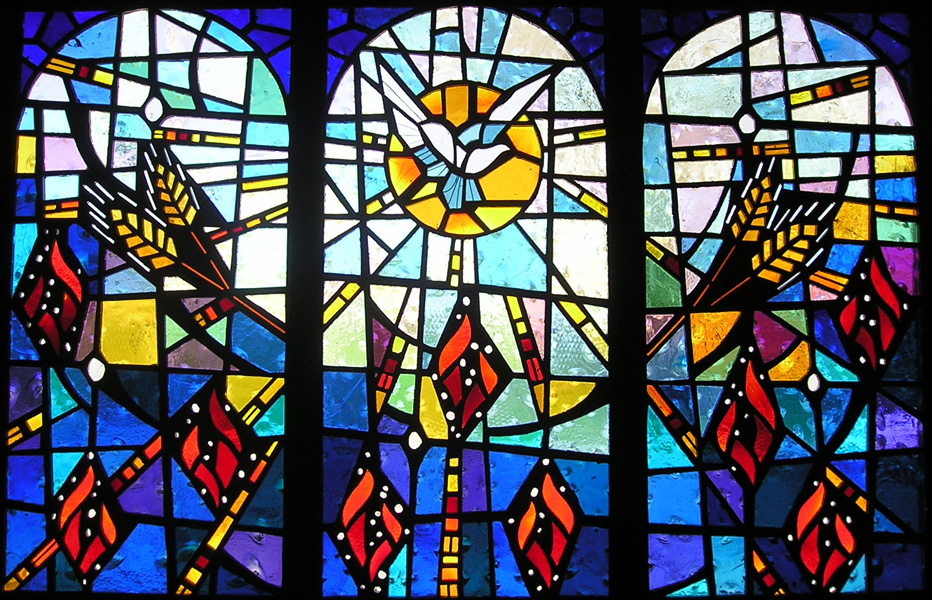
Pentecost stained glass - Boone Tabernacle Church of God in Christ

Pentecost stained glass – Boone Tabernacle Church of God in Christ

Acts 2:1-18 – May 24, 2015

Everyone feels afraid, some time. I know I usually do not make sweeping statements like that, but I feel safe in making that particular one: everyone is afraid, sometime. Being fearful; it goes with being human.

If we look at the disciples, gathered in that upper room—the same upper room where their leader and Rabbi Jesus had them gather together to eat the Passover dinner on Thursday in Holy Week—we can see several good, valid reasons for them to be afraid.

Confusing events happening in short succession. This was compounded by the followers of Jesus scattering, running away, frightened by the very real, very legal, very official things happening to Jesus just before His crucifixion.

     Let’s fast-forward past Easter Sunday, past the weeks when the risen Jesus was occasionally present with the disciples. Past the time of the Ascension. The disciples still must have been frightened to death of the authorities. But, I suspect they needed to talk about the happenings of the past few weeks, too. Debriefed. Tried to figure things out, as best as they could. We go to the day of Pentecost, another major feast day for the people of Israel. And where are the disciples? Back in Jerusalem, in the upper room, hidden away from the authorities.

Let’s begin to read our scripture passage for today, starting at Acts chapter 2, verse 1: “When the day of Pentecost came, they were all together in one place. Suddenly a sound like the blowing of a violent wind came from heaven and filled the whole house where they were sitting. They saw what seemed to be tongues of fire that separated and came to rest on each of them. All of them were filled with the Holy Spirit and began to speak in other tongues/languages as the Spirit enabled them.”

If we were watching this scene as it happened on television, or in a movie, the special effects would be awe-inspiring! Can you see it now? Except, this was long centuries before the time of anything approaching motion pictures, even electricity. Imagine what it was like for these few dozen people, gathered together to pray in the upper room.

The biblical record refers to the coming of the Holy Spirit as being similar to the blowing of a violent wind. I’m sure this was an eye witness report. That must have been what it really felt like! Buffeted about by the sheer power of a strong wind—except—they were all inside the house, with all the doors shut tight! Let’s continue with the next verses:

Now there were staying in Jerusalem God-fearing Jews from every nation under heaven. When they heard this sound, a crowd came together in bewilderment, because each one heard their own language being spoken. Utterly amazed, they asked: “Aren’t all these who are speaking Galileans? Then how is it that each of us hears them in our native language? Parthians, Medes and Elamites; residents of Mesopotamia, Judea and Cappadocia, Pontus and Asia, 10 Phrygia and Pamphylia, Egypt and the parts of Libya near Cyrene; visitors from Rome 11 (both Jews and converts to Judaism); Cretans and Arabs—we hear them declaring the wonders of God in our own tongues/languages!” 12 Amazed and perplexed, they asked one another, “What does this mean?”

Here in these verses, we take a tour of Asia Minor, and parts of Africa and some of Europe. That’s how far the Jewish people had dispersed, in the past few hundred years. Observant, practicing Jews had settled in these far-flung places many years before. Their present-day descendants were fully enculturated, and spoke the local languages and dialects as their own. However, some still came back to Jerusalem on a pilgrimage, to worship at the Temple. As I mentioned, Pentecost was a big festival in the Jewish religious calendar.

Moreover, these dispersed Jews from far-flung provinces were amazed that home-grown Jews from Galilee, the boondocks of Israel, were able to speak many regional languages and dialects so fluently! Wonder upon wonder!

These Galilean Jews had gone out on the street, rubbing shoulders with all and sundry outside. They all had gotten a big shot of courage from somewhere, and were communicating the good news—to everyone. To all of these visitors to Jerusalem, who in turn could take the good news of the Gospel with them, to all parts of the Roman Empire when they returned home.

True, I could preach about the erasing of the Tower of Babel’s barrier, the division of separate languages, and the ease of communication that took place here on Pentecost. I could talk about the birthday of the church, and how the church began its great mission of spreading the good news. But—I wanted to focus on the disciples. How they went from fearful to fearless.

Let’s turn back to our scripture passage: “13 Some, however, made fun of them and said, “They have had too much wine.” 14 Then Peter stood up with the Eleven, raised his voice and addressed the crowd: “Fellow Jews and all of you who live in Jerusalem, let me explain this to you; listen carefully to what I say. 15 These people are not drunk, as you suppose. It’s only nine in the morning! 16 No, this is what was spoken by the prophet Joel: 17 “‘In the last days, God says, I will pour out my Spirit on all people. Your sons and daughters will prophesy, your young men will see visions, your old men will dream dreams. 18 Even on my servants, both men and women, I will pour out my Spirit in those days, and they will prophesy.”

Did you hear what Peter said? It’s because of the Holy Spirit. Everything is because of the Holy Spirit! That is exactly why the disciples poured out into the street after their fiery experience in the upper room! After the wind of the Holy Spirit swept through that room, their hearts, and their very lives. It didn’t matter—men, women, whoever was there. Each one in that room had the Spirit energize their hearts and their minds. The Spirit came with fire!

What is more, we see from the prophet Joel that the Spirit was prophesied to be poured upon all people. Sons, daughters, young men, old men, even men and women servants. I think that is everyone. We are all going to get power from the Spirit of God. The ruach ha kodesh, the Holy Spirit. What’s more all of us have the possibility of going from fearful to fearless!

Here is the last of today’s reading from Acts: “20 The sun will be turned to darkness  and the moon to blood before the coming of the great and glorious day of the Lord. 21 And everyone who calls on the name of the Lord will be saved.’”

Pentecost was not just a one-time-only event. Sure, Dr. Luke put this account down on paper so we all could remember, so we all could see the power of God as it happened so long ago, in Jerusalem. But—we can see the power of the Spirit of God now, each and every day. We can tell others about what the Lord has done and is doing in our lives—how the Spirit of the Lord blows through our lives on a regular basis–today.

The important thing about the arrival of the Spirit of God was not the wind or the flames. That’s just the exterior way we all knew that the Holy Spirit had arrived! But the disciples knew, from experience, that God was now with them in power and in might. The same way the Spirit is with us, today. That knowledge changed the disciples from fearful to fearless, and that knowledge can do the same thing for each of us, today.

Is there a Pentecost in our lives today? Is the Holy Spirit living, breathing, active in our lives, today? Please God, yes. God can enable us to go forth from here in the Spirit’s power, to share what God has done for each of us. And the response? As Peter quoted from the prophet Joel, “everyone who calls on the name of the Lord shall be saved.” Amen, and amen!

@chaplaineliza

(Suggestion: visit me at my daily blog for 2015: matterofprayer: A Year of Everyday Prayers. and my other blog,  A Year of Being Kind .  Thanks!)