Unknown's avatar

How Majestic!

“How Majestic!”

Psalm 8:1-9 (8:1) – June 15, 2025

            Have you ever been far from the city lights, at night? Have you ever looked up into the sky, and seen countless stars spread out, twinkling high above? When I went to the Upper Peninsula of Michigan, and again in rural central Indiana, the starry skies were absolutely breathtaking. Amazing. Majestic, as the psalmist King David said in our Psalm reading today.

            Listen again: “Lord, our Lord, how majestic is your name in all the earth! You have set your glory in the heavens.” I can just imagine King David sitting far away from the lights of the city of Jerusalem, perhaps contemplating the stars as he saw them in his youth, when he looked after his father’s sheep, or as a younger adult, a leader of men in the wilderness of Judah, David certainly had many opportunities to gaze up into the night skies and see the breathtaking stars.

            As we gaze up into the night and see the amazing sight of all the stars laid out above us, we marvel. Marvel just as countless people have done throughout the millenia. As we think about the vastness and sheer beauty of the heavens, other vast, even unanswerable questions may come to mind. Just as countless people have done, and have reflected upon. Questions like: What was God doing before God created the world? And, how can there never be a time before or after God? And, how can God pay attention to each person in the world all the time? [1]

            These kinds of big questions have puzzled people for millenia, too. You and I could get hung up on these kinds of questions, and totally lose sight of the sheer, magnificent, bottomless awesomeness of God. Or, are we simply to return to the first verse of today’s reading, and be totally in awe at God’s glorious majesty? “Lord, our Lord, how majestic is your name in all the earth! You have set your glory in the heavens.”

            My husband tells me when I am thinking about big ideas, I am sometimes too focused on individual trees, rather than looking at a whole forest. That is what comes to mind when I get sidetracked by wondering what God was doing before God created the world. Or, maybe, why did God create rattlesnakes and mosquitoes? Perhaps – it is okay just to contemplate the vastness of the heavens and the sheer beauty of all the stars, comets, moons and other creations in the universe! Just as Psalm 8 invites us to do.

“How majestic is your name.” That’s the line that stands out, maybe because the psalm begins and ends with those same words. “How majestic is your name.” That sounds wonderful, indeed! Our opening hymn was written by Michael W. Smith, and we sang these exact words at the beginning of our service. And, the words sung by the angels, the seraphs flying around the heavenly temple in Isaiah 6 – they kept singing, kept repeating “Holy, holy, holy is the Lord of hosts, the whole earth is full of God’s glory.”

            Over and over, the seraphs sang those words. And, it is sometimes in the singing and in the repetition that the majesty and awesomeness of God begins to make sense. I mean, as much as it can, to our puny, limited, human comprehension.

            The concept of the Trinity, one God, Three in One, is a difficult concept to start to believe, much less fully comprehend. For a small comparison, we can look at water. Water is liquid, at room temperature. Yet, when we freeze water, it turns hard. It becomes ice. Is it still water? Yes. And, when we heat up water, it turns into steam – becomes gaseous. Is it still water? Yes.

            This example of the three states of water is an imperfect way to talk about the Trinity. Yet, we can marvel at the awesome complexity of the doctrine of the Trinity just as we marvel at the glory and magnificence of our God and God’s creation, just as Psalm 8 leads us to do. Whether we sing about our awesome God, talk about the glory of God, or contemplate God and God’s magnificent creation, it’s all good. And, all these activities are exactly what we are led to do throughout the Bible, and especially here in Psalm 8.

            Looking to the skies and contemplating the glory of God may be a sincere way for people to begin to try to understand how huge God is. And, if we are coming at the theological concept of the Trinity – which is also a huge thought – perhaps it’s best for you and me to think about this huge thought from God’s end of things, from God’s point of view. Whether you and I “can fully grasp the nuanced theological understanding of what Trinity means, we can acknowledge that, in part, it means that God wants to be known and experienced by those who claim the majestic name of God as sovereign. We give thanks for an accessible God.” [2]

            I return to one of my tried and true ways of looking at biblical things, from a theological perspective. You all know that sometimes I view the topics or ideas from my sermons in a way that children see them, or in a way that young people more readily understand. Psalm 8 tells us about the wonders of God. Even little children can (and do) accept this as the truth of God! However, little children are definitely not interested in explaining how or why, or about lengthy sermons droning on about different theologians and their competing view on God and the Trinity.

            Very often, deep down, children understand that God made them and God loves them. This is a foundational truth! You and I can have – along with the children – a “simple” and “trusting” faith. We don’t need to use the “right” words in our prayers and creeds. Remember – God wants to be known by us, above all! And, our Lord wants to be experienced by all who claim the name of the majestic God. By those who praise God’s name.

            Yes, the theological understanding of the Trinity is also a deep theological truth. Yet – I can tell you right now that we as fallible, frail humans fall short of understanding God’s ways. I can also tell you that in the midst of everything, we can know we are loved. God wants each of us to know our Lord intimately! As my commentator the Rev. Dr. Derek Weber says, “We are being made more like the Christ we follow. Our love is being shaped by God’s love that is poured into us. We are God’s act of creation. That’s a part of the message of Trinity Sunday. The Creator works within us, choosing us to be a sign of God’s presence in the world.” [3]

            Yes, God’s message is quite simple. We can know we are loved by God. God wants each of us to know our Lord intimately! And, our awesome God works within each of us, choosing each of us to be a sign of God’s presence in the world. This is the best Good News we can bring to the world. Alleluia, amen!

@chaplaineliza

(Suggestion: visit me at my other blogs: matterofprayer: A Year of Everyday Prayers. #PursuePEACE – and  A Year of Being Kind . Thanks!


[1] https://worshipingwithchildren.blogspot.com/2016/04/year-c-trinity-sunday-may-22-2016.html

[2] https://www.umcdiscipleship.org/worship-planning/trinity-sunday-year-c-lectionary-planning-notes

[3] https://www.umcdiscipleship.org/worship-planning/trinity-sunday-year-c-lectionary-planning-notes/trinity-sunday-year-c-preaching-notes
Unknown's avatar

Hallowed Is Christ Jesus

“Hallowed Is Christ Jesus”

Philippians 3:4b-14 (3:8-9) – April 3, 2022

            Lots of words are old-fashioned. To say it another way, lots of words in the dictionary are words not much used today. Many people don’t know quite what they really mean. Have you ever thought about the word “hallowed?” I know, we say the word regularly when we pray the Lord’s Prayer. But, what does that word truly mean?

            In our Scripture reading today from Philippians chapter 3, Paul makes some audacious, over-the-top statements about himself. But more than that, Paul makes some extraordinary statements about Jesus. Paul’s total commitment is to Jesus Christ. Paul gives and lives as he does because he knows God (Jesus Christ) is hallowed. Sadly, many people do not have a clear idea about the word hallowed.  Before we can pray the Lord’s Prayer with understanding, we all need to learn that hallowed is another word for holy. Separated. Set apart[1]

            Think about it: “Our Father, who art in heaven, hallowed be Thy name.”

            Let’s back up, and take a closer look at this reading. Paul starts out by clearly boasting about himself. Writing to fellow believers in Philippi, Paul admits that his heritage and reputation could give him more reason than most people to place confidence in his spiritual pedigree. [2] This is one place where we can learn a great deal about the Apostle Paul! He goes over his resume, essentially, ticking off his wonderful credentials one by one. This is a surefire way to lift himself up, certainly. Talk about being a show-off!

            Do you recognize anyone you know in these words of Paul? I am reminded of people who are obsessed with important credentials, boastful and really full of themselves. This could be people trying awfully hard to get ahead, to claw their way to the top, by making sure their resume is top notch. Only having the best of the best listed on that piece of paper!

            Was this kind of activity putting God first? And, what about these boastful, obsessed people – do they have any sort of relationship with God? Do they consider God holy, or hallowed? Or do they ever think of God at all, except for paying God lip service on those occasional times when they recited the Lord’s Prayer?

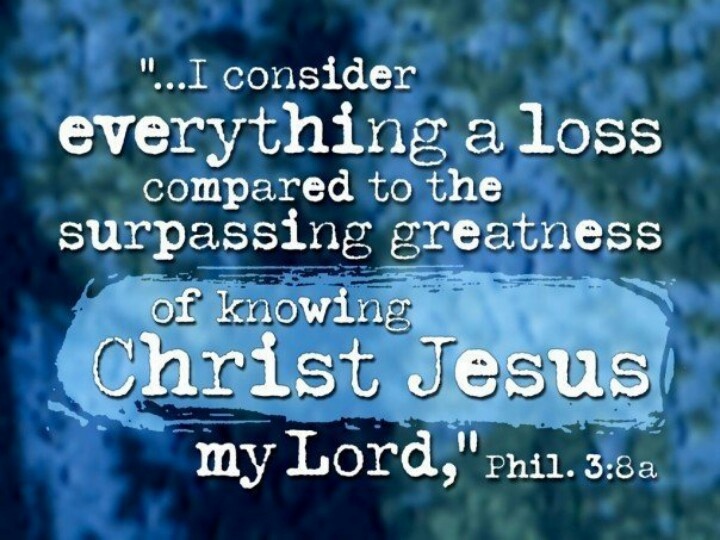
            But, those are only the first three verses of our reading. Paul does an abrupt about-face in verses 7 and 8. But whatever were gains to me I now consider loss for the sake of Christ. What is more, I consider everything a loss because of the surpassing worth of knowing Christ Jesus my Lord, for whose sake I have lost all things.” See how the Apostle Paul makes another extraordinary statement? The overwhelming grace of God – the surpassing worth of knowing Christ – calls Paul to a new, heavenly set of values.

            We will shortly be celebrating Communion, after this sermon. Here at this church, we do not usually say the Sanctus as a part of the Communion liturgy, since we use a shorter form of that section of the service. This part of the Communion liturgy is quite ancient. Here is the Sanctus: “Holy! Holy! Holy! Lord, God of Hosts! Heaven and earth are full of your glory!”  

            See how this statement fits into that Godly set of values from the Apostle Paul! “Our Father, who art in heaven, hallowed be Thy name.”

I invite you to consider the Sanctus when saying the beginning of the Lord’s Prayer. Imagine joining everyone who ever lived, lives now, and is already in heaven saying together that God’s name is hallowed. Because – God truly is holy!

What does Paul say next? “I consider [my worldly gains] garbage, that I may gain Christ and be found in him, not having a righteousness of my own that comes from the law, but that which is through faith inChrist—the righteousness that comes from God on the basis of faith.” Paul describes the value of all these worldly gains – all his marvelous resume – comparing it to the value system of the kingdom of Christ Jesus his Lord — complete rubbish! Absolute trash! That is where his outstanding resume belongs, compared to Christ Jesus our Lord!

               The Gospel reading for today comes from John 12, where Mary anoints Jesus’ feet while He is at dinner, in preparation for His death. “Like Mary pouring out her love by pouring expensive perfume, Paul shows his love and desire to know Christ by pouring out his credentials and achievements, his life, and considering them all rubbish (the Greek word also means “dung” and “excrement”) in comparison to the life to be gained in Christ.” [3]

            How much more can we consider our Lord to be holy? How much more meaningful can it be to say “Our Father, who are in Heaven, hallowed be Thy name,” compared to worldly credentials, or mere human achievements – compared to Christ Jesus our Lord.

            Paul’s goal, and our goal, is to know Christ! That holy, hallowed, set-apart Son of God, the one who reconciled us to God and bestowed upon all of us God’s gift of His righteousness. Praise God, Christ has redeemed us and we now walk in the newness of life.

            One last call to action, from the Apostle Paul: we are to straighten our priorities. Follow God’s priorities, God’s values, and follow Jesus. Make it your priority – my priority – our calling to know Christ intimately, and the power of His resurrection. Then, we surely can pray “Our Father, who art in heaven, hallowed be Thy name,” not only understand it, but mean it, too! Thanks be to God.

@chaplaineliza

(Suggestion: visit me at my other blogs: matterofprayer: A Year of Everyday Prayers. #PursuePEACE – and  A Year of Being Kind . Thanks!


[1] http://worshipingwithchildren.blogspot.com/2016/02/year-c-fifth-sunday-in-lent-march-13.html

[2] https://desperatepreacher.com//texts/phil3_4/phil3_4.htm

[3] https://desperatepreacher.com//texts/phil3_4/phil3_4.htm

Unknown's avatar

Hallowed is Christ Jesus

“Hallowed is Christ Jesus”

Phil 3-7 consider things loss, circle

Phil 3:4b-14 – April 7, 2019

            “Holy:  adjective, ho·li·er, ho·li·est. 1. specially recognized as or declared sacred by religious use or authority; consecrated. (holy ground)  2. dedicated or devoted to the service of God, the church, or religion. (a holy person)  3. saintly; godly; pious; devout. (a holy life)  [1]

            Holy, or “hallowed” is what we say about God and God’s name every time we pray the Lord’s Prayer.

Perhaps some people think of God as some huge guy with a long white beard, sitting in some glorious heavenly Temple, the Holy-of-Holies in the sky. “Holy is Your name!” Maybe some people think of God as a massive earthquake, and the whole countryside shakes, rumbles and crumbles. Then, perhaps some folks see God in the vast quiet of nature, the quiet rustle of a green meadow, or the gentle quiet of the waves lapping on an ocean beach.

We have two Bible readings today. Each of them gives a different perspective on Jesus and His magnificent, awesome holiness.

            Let’s look at them chronologically. First, Jesus is at a fancy dinner in Bethany, not long before His arrest, trial and crucifixion. His friend Martha made Him dinner, Mary and Martha’s brother (newly raised from the dead) Lazarus probably was hosting, and everyone is having a wonderful time. When—Mary takes an incredibly expensive jar of sweet-smelling ointment and pours it on Jesus’s feet. What is more, she unbinds her hair and starts wiping His feet with her hair. The whole house is filled with the marvelous scent of that ointment. I am sure that was a scent (and a sight) that everyone there remembered for the rest of their lives.

            The next Bible reading is from the letter to the church at Philippi. The apostle Paul (who often uses run-on sentences) goes on and on about himself, how much of a super Pharisee and righteous Jew he is, and even filled with great zeal for God. He is single-minded for the Lord! All God, all the time! But then—Paul comes to a complete stop. He says all of his marvelous resume is completely worthless, compared to the mega-awesome, super-special magnificence of knowing his Savior Christ Jesus his Lord.

             The commentator Carolyn Brown says “The petition “hallowed be thy name” in the Lord’s Prayer underlies both Mary’s lavish gift and Paul’s total commitment to Jesus.  Both give and live as they do because they know God/Jesus is hallowed.” [2] So, both Mary and Paul know that Jesus is the Holiest-of-Holies.

            In Mary’s case, this anointing of her Rabbi, teacher and friend with ointment was a coming attraction. In essence, a preview of the human Jesus’s death and resurrection. Mary gives her incredibly costly gift because she knows that Jesus is so holy and set apart. Not only pious, devoted and dedicated to God, but something even more special.

            Paul went about this in a slightly different way. Paul gave his readers a brief snapshot of his impressive resume, before Jesus Christ made such a difference in his life. Admittedly, this rundown of who and what Paul was makes him sound like one of the entries in the first-century’s version of Who’s Who, a mover-and-shaker of the Ancient Near East.

            In verses 4, 5 and 6, “His credentials, Paul tells us, were impeccable. Both through inheritance and attainment he has more reason than others to boast of his status. Paul’s loyalty to Israel’s God was unsurpassed. Paul’s very persecution of the followers of Jesus bore witness to his deep desire to please God.” [3] Yet—Paul makes a sudden shift in his bragging. Listen: “But whatever were gains to me I now consider loss for the sake of Christ. What is more, I consider everything a loss because of the surpassing worth of knowing Christ Jesus my Lord, for whose sake I have lost all things.”

            Remember, Paul writes from the perspective of one who has made a commitment to Jesus; and not just the human Jesus, either.  When our resurrected Lord and Savior appeared to Paul on the Damascus Road, that was a huge earthquake of an experience. The apostle Paul gives fascinating autobiographical details about himself, but then says all of that is worthless compared to the ultimate joy of knowing Christ Jesus his Lord.

Or, is that Christ Jesus our Lord?

            I think most of us—if not all of us—are familiar with well-meaning but worldly-driven parents, who seek out such stellar activities for their children’s resumes. We can see that Paul had it all, from a worldly point of view: until he had that divine, life-changing encounter on the road to Damascus.

            Sure, only a portion of Christians have a sudden, thunder clap of a Damascus Road encounter with the Lord Jesus Christ. Yet, we all name Him holy. Don’t we? We all pray the Lord’s Prayer, don’t we?

            In the original language of this letter, Greek, Paul uses what some might say is a nasty, word, even perhaps a swear word. This word is found in verse 8: from the Good News Translation: “For his sake I have thrown everything away; I consider it all as mere garbage, so that I may gain Christ.” Or, one of my favorite translations, the Message: “everything I once thought I had going for me is insignificant—dog dung. I’ve dumped it all in the trash so that I could embrace Christ and be embraced by him.”

            Comparing himself to Jesus, the ultimate Holy-of-Holies, is it any wonder that Paul considers everything that he thought he had going for himself as dog dung? Flushing his impeccable resume and outstanding pedigree down the toilet?

Beforehand, before he met Jesus on that road to Damascus, Paul’s total, single-minded commitment to his Lord, the Jewish understanding of God, puts us all to shame. But, afterwards? He transferred that single-minded commitment to his Lord and Savior. As Paul himself says in verses 12-14, “I’m not saying that I have this all together, that I have it made. But I am well on my way, reaching out for Christ, who has so wondrously reached out for me. Friends, don’t get me wrong: By no means do I count myself an expert in all of this, but I’ve got my eye on the goal, where God is beckoning us onward—to Jesus. I’m off and running, and I’m not turning back.”

            Carolyn Brown compared holy and hallowed to the words awesome, special and wonderful. This is the very, very, very best. When we say “hallowed be Thy name,” those are words that can be applied only to God. Every time we pray the Lord’s Prayer, just like the apostle Paul, just like Mary of Bethany, we are saying “God, You are holy, You are the very, very, very best there is in the whole universe.”

We are well on our way, reaching out for Christ, who so wondrously reached out for all of us. For each one of us. Thank You, God! In Jesus’ precious, redeeming name, amen!

[1] https://www.dictionary.com/browse/holy

Collins English Dictionary – Complete & Unabridged 2012 Digital Edition © William Collins Sons & Co. Ltd. 1979, 1986 © HarperCollins Publishers 1998, 2000, 2003, 2005, 2006, 2007, 2009, 2012

[2] http://worshipingwithchildren.blogspot.com/2016/02/year-c-fifth-sunday-in-lent-march-13.html

Worshiping with Children, Lent 5C. Including children in the congregation’s worship, using the Revised Common Lectionary, Carolyn C. Brown, 2016.

[3] http://www.churchofscotland.org.uk/__data/assets/pdf_file/0005/55769/7_April_Angus_Morrison_5_in_Lent.pdf

The Mission and Discipleship Council would like to thank the Very Rev Dr Angus Morrison, Minister of Orwell and Portmoak, for his thoughts on the fifth Sunday in Lent.

@chaplaineliza

(Suggestion: visit me at my regular blog for 2019: matterofprayer: A Year of Everyday Prayers. #PursuePEACE – and my other blog,  A Year of Being Kind . Thanks!