Unknown's avatar

Without Hesitation

“Without Hesitation”
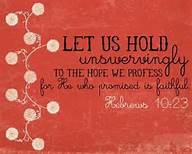
Heb 10-23 He who promised is faithful words

Hebrews 10:19 – November 15, 2015

Who here knows the words of the Apostles Creed? Who studied the Apostles Creed before they were confirmed? I know I did. I studied Martin Luther’s Small Catechism, and went over every part of the Lord’s Prayer as well as the Apostles Creed.

Today, we are going to take a closer look at the whys and wherefores of two phrases from the Apostles Creed: “He—Jesus—ascended into heaven, and sits on the right hand of God the Father Almighty.” You—I—all of us have been saying these words for years and years. It’s a part of our church culture. But, what do these words really mean? “Where is Jesus now?

We are departing from the Gospel of Mark. I’ve been preaching from Mark for the last two months. We have been following Jesus through His discussions with the Jewish leaders about all kinds of aspects of the proper religious life. Today, we make a big jump forward, to the New Testament passage from the letter to the Hebrews. This is after the Resurrection, after the book of Acts, and the Apostles have now been sent out into the world to tell all people about the risen Jesus, and about God’s love and forgiveness of their sins.

This letter to the Hebrews is a circulating letter. That means it and other circulating letters were sent from place to place in Asia Minor, so the small, struggling churches could receive encouragement and teaching in writing from the Apostles and other new church leaders. This particular letter was sent to Jews who lived a long way from Jerusalem. In essence, ex-pat Jews.

To give us some further background into this week’s reading, “This week’s text [from Hebrews] draws together the argument the author of this letter began six chapters ago, namely that Jesus is God’s final and ultimate High Priest. The author can point to the model of Israel’s priests to explain what Jesus does, but His priesthood differs in several fundamental respects. Beginning in verse 11 the author reiterates those differences once again.” [1]

What about those Old Testament priests in the Temple in Jerusalem, anyhow? They needed to keep on sacrificing animals over and over and over again. Why? The people of Israel had a Sin Problem. The priests had to keep sacrificing to cover the Sin Problem, to make it better. To atone for the sins of the whole people. And no matter how hard they worked, or how many animals they sacrificed, or how much they prayed to God, it was never enough. There was always more sin. The nation of Israel and all the individuals in Israel had a Sin Problem.

I know when my mother had a houseful of guests (usually several of her grown children all at once), she would try and try to keep the kitchen clean, the kitchen sink empty of dishes, and the bathroom ready and clean for anyone who needed to use it. Except—there were always so many people in the house. There was always more dirt. More mess. More dirty dishes. It seemed like it would never end! (Except, it periodically did when everyone went to their own homes, in the case of my mom’s house.)

How many people can relate to this example? Dirt, mess, dirty dishes and black marks in a crowded house never end. Just so, in the case of the priests and the sacrifices for sins that everyone commits, the Sin Problem never ends. For real! Never, ever! People are sinful. They keep doing and saying and thinking things that go against God’s laws, and sin never goes away. All the sacrifices ever brought before God could never make one dent in the Sin Problem.

When we look at our passage from Hebrews again, what do we read? Quoting from our scripture today, “As a priest, Christ made a single sacrifice for sins, and that was it!

What was that again?

Jesus Christ was the perfect High Priest. He was a better High Priest than any other of the priests throughout history who ever offered animal sacrifices to God at the Temple. What Jesus did for us on the cross (and I’m quoting again) “… was a perfect sacrifice by a perfect person to perfect some very imperfect people. By that single offering, He did everything that needed to be done for everyone who takes part in the purifying process.”

The whole repetitive process of endless animal sacrifice? Jesus came and broke that process. He ended it. He made that process obsolete, not necessary any more. Instead, Jesus and His death for us on the cross reaches way beyond animal sacrifice.

What’s more, Jesus our High Priest makes the perfect sacrifice once for all time. And then, He sits down. What about those other priests, the ones who continually stand and keep offering the imperfect animal sacrifices for all those centuries? From the Message, again: “As a priest, Christ made a single sacrifice for sins, and that was it! Then [Jesus] sat down right beside God and waited for His enemies to cave in.”

At first glance, some people might think that Jesus did not finish His work as High Priest. But, that is just the point! He did finish the work. The other priests had to continue to stand, because they had to continue to offer sacrifice after sacrifice on a daily basis. Because of the Sin Problem that just wouldn’t go away. Jesus did complete the perfect sacrifice. His sacrifice brought perfect, complete forgiveness of sins. Jesus was all done, and He sat down. The Sin Problem went away, once and for all.

But, wait! There’s more! Jesus doesn’t just sit down any old place. On any old bench, or in somebody’s creaky rocking chair. No. He takes a seat at the right hand of God. A place of great power and great authority. Jesus—the Son of God, the Second Person of the Trinity, incarnated by the Holy Spirit of the Virgin Mary—Jesus takes the number one seat in all of the universe, next to God the Father. The resurrected Lord Jesus is God the Father’s right hand man. It says so, right in our scripture text from Hebrews today.

To finish our passage from verses 19 and 20, “So, friends, we can now—without hesitation—walk right up to God, into “the Holy Place.” Jesus has cleared the way by the blood of His sacrifice, acting as our priest before God.”

I want everyone to notice that all the pronouns here are plural. That means we—all of us together—can have confidence. We—all of us—can walk right up to God. We can come into God’s presence and boldly bring our requests to God. As I say in our weekly pastoral prayers, we—all of us have free access to God. Not like the Jewish people before the time of Jesus, who were still dealing with the Sin Problem and still needed an intermediary between them and God. But because Jesus, our perfect High Priest, has cleared the way. Jesus has invited us to come. We are very welcome to enter into God’s presence!

Do you have a better understanding now of those two phrases from the Apostles Creed? “He—Jesus—ascended into heaven, and sits on the right hand of God the Father Almighty.”

This section from the letter to the Hebrews answers our questions about “where is Jesus now?”  The risen Jesus is with God and is Lord!

Do you have the confidence that your Sin Problem is taken care of? Do you dare accept the invitation that Jesus extends to us? Can we grasp that assurance that God welcomes us? This scripture passage clearly lets us know about that boldness. That “free confidence,” grounded on the consciousness that our sins have been forgiven.

As I say every week after the Confession of Sins and the Assurance of Pardon, believe the Good News of the Gospel. In Jesus Christ, our sins are forgiven.

Alleluia, amen!

[1] http://www.workingpreacher.org/preaching.aspx?commentary_id=142 Commentary on Hebrews 10:11-25 by Amy L. B. Peeler.

(Thanks to Amy for several ideas I wove into this sermon!)

@chaplaineliza

Suggestion: visit me at my daily blog for 2015: matterofprayer: A Year of Everyday Prayers. and my other blog,  A Year of Being Kind .  Thanks!


Unknown's avatar

By Grace through Faith

“By Grace through Faith”

grace = by grace through faith Lutheran

Romans 3:24 – October 25, 2015

I have a confession to make. I was raised a Lutheran. Baptized and confirmed in a Lutheran church on the northwest side of Chicago, I loved everything about that church. When I was in grammar school and high school, I learned all I could about my church, about being a Lutheran, and even about Martin Luther. I studied Luther’s Small Catechism during my two years of confirmation classes in seventh and eighth grades. So, you could say I know a thing or two about Martin Luther and about the church that to this day bears his name.

This Saturday, October 31st, is the 498th anniversary of the day Martin Luther tacked up the 95 Theses, his 95 points of disagreement he had with the Catholic Church. In 1517, the priest and doctor of theology Martin Luther posted his 95 Theses on the chapel door in Wittenberg, Germany, at the university where he served as professor. Thanks to the printing press, these 95 points of disagreement spread like wildfire. Not only in Germany, but throughout Europe. The Reformation began in earnest.

Why was Martin so upset? To understand that, we need to take a closer look at Martin’s beginnings. When he was a very young man, Martin Luther felt unworthy of God’s love. He felt lower than a worm sometimes, and tried his hardest to get into God’s good graces! He would go to confession several times a week, do penance after penance, and he made several pilgrimages. All of these things and more to stop feeling unworthy and sinful.

Taking a quick look at the letter the Apostle Paul wrote to the Roman church, you and I might get that same message, too. From chapter three, “There is no difference between Jew and Gentile, 23 for all have sinned and fall short of the glory of God.” Martin felt that so deeply! All have sinned! All fall short of God’s glory! All means everyone. All of us.

Romans 3:23 is not good news! This verse is pretty bad news. Rotten news. Really hopeless news, if you ask me. And, that is the news Martin Luther faced, the more and more he read and studied the Bible, meditated, and prayed.

Martin was right. According to the Law of Moses, given to the nation of Israel in the Old Testament, there is no one who can follow the Law one hundred percent. Not the Old Testament Jews, not Jews in Jesus’s day, not Martin Luther, five hundred years ago. And, not you and me, today, either. There is no way anyone can keep every single one of God’s commands! (Even though the Pharisees of Jesus’s day—and the Pharisees of today—try their very hardest.)

Martin Luther regularly reflected on his life and his thoughts, and how far short he fell, compared to where he knew that God wanted him to be. That was what I felt, when I was a teenager, too. I knew I couldn’t keep all of God’s rules, even if I tried really, really hard. Remember Romans 3:23? “For all have sinned and fall short of the glory of God.”

When I was a teenager, I was a particularly studious teen. I would read books on the Bible and on theology when I was in high school. I prayed regularly, and tried my hardest to get closer to God. I had low self-esteem. I felt sinful, unlovely and unlovable a good deal of the time.

Martin Luther tried even harder to get close to God! He did a ton of good works. He got a university degree in theology, and started teaching from the Old and New Testament at the university in Wittenberg. He studied even more about God, and preached regularly in a church in town. And yet—he still felt sinful and far from God! He still felt unlovable!

Can anyone relate to Martin? Are there times when you—when I—feel unlovable?
I remember hearing the story of a woman, horribly burned in a fire. Her husband came to see her in the hospital and was disgusted and horrified by what he saw. “You are not the woman I married,” he said, and promptly divorced her. Are we so unlovable? Is that what we are afraid God might do to us?

Martin felt sinful and unlovable, too. What’s more, even after lots and lots of good works and all these years of reading and study, he still felt so inadequate. He felt God could not possibly love or forgive him. That is—until he was reading the letter to the Romans, chapter 1, verse 17: “ For in the gospel the righteousness of God is revealed—a righteousness that is by faith from first to last, just as it is written: ‘The righteous will live by faith.’”

Do you hear? Do you understand? It wasn’t about Martin. It wasn’t about how sinful or unlovable he was. Or, how hard he tried to do good things, or tried to get on God’s good side, or tried to live by good works. God’s righteousness comes by faith. Faith alone! Faith in God!

Remember Romans 3:23? “For all have sinned and fall short of the glory of God.” Yes. Yes! That is true. But—that isn’t the whole story! Reading, starting from 3:21: “21 But now apart from the law the righteousness of God has been made known, to which the Law and the Prophets testify. 22 This righteousness is given through faith in Jesus Christ to all who believe. There is no difference between Jew and Gentile, 23 for all have sinned and fall short of the glory of God, 24 and all are justified freely by His grace through the redemption that came by Christ Jesus.”

I can almost see Martin falling off his chair, once he realizes how huge this is. Our sin is taken away through the redeeming that came through Jesus. We are made lovable through God’s grace. Our low self-worth and low self-esteem is now viewed by God through Jesus. God looks at all of us, each one of us, through Jesus-tinted lenses.

We are now brothers and sisters of Jesus, God’s beloved children! We are now redeemed freely. By His grace, through faith, through the redemption that came by and through Christ Jesus. The best part of this gift? It’s a free, undeserved gift, so that no one can pridefully boast about it.

Another way to look at this gift from God comes from a sermon study board online I follow. I recently read this, written a few years ago by a preacher named Erik in Wisconsin.

“This Sunday we celebrate confirmation. As a part of their confirmation requirements, students have to meet with me for a brief discussion/interview. I ask them about faith, life, God, etc. – see if they learned anything during confirmation. One question I always ask is “How will you get into heaven? How are you saved?” Most often I get the answers – “Pray. Go to church. Do good deeds.” And I shake my head and ask myself “Didn’t I emphasize grace enough?”

“Finally, I said to the class, “Listen, you are saved purely by God’s grace as a gift. I will ask you how you are saved in your confirmation interview. If you don’t remember anything else I’ve taught during these two years, remember this: “You are saved by God’s grace!” Why is it so hard to remember? Probably because we’ve been taught not to trust anything we might get for free, even if it is from God.”

Martin Luther found out that we are saved by faith alone, through grace alone. No good works! No trying and trying really, really hard, and not making it after all that! Salvation is all from God and God’s grace! Romans 3:24 says,” and all are justified freely by His grace through the redemption that came by Christ Jesus.”

As Martin Luther studied scripture, he finally discovered he was saved by grace, not because of anything he did or deserved. The Rev. David Hansen tells us, “He discovered a God who would send the only Son—not for the perfect people, but for the sinners. He discovered, above all else, a God and a Savior that will NEVER abandon us, that will stand by our side no matter how often we fail or how short we fall.”

Is that good news? Jesus died for our sins. Jesus showed us radical, God-sized grace, and radical, God-sized love.

As I proclaim each week after the Confession of Sin during the Assurance of Pardon, “Believe the Good News of the Gospel: in Jesus Christ, we are forgiven!”

Alleluia, amen!

Thanks to Rev. David L. Hansen and Pastor Erik from Wisconsin for their assistance in the formulation of this sermon!

@chaplaineliza

Suggestion: visit me at my daily blog for 2015: matterofprayer: A Year of Everyday Prayers. and my other blog,  A Year of Being Kind .  Thanks!
Unknown's avatar

Check and Double-Check!

“Check and Double-Check!”

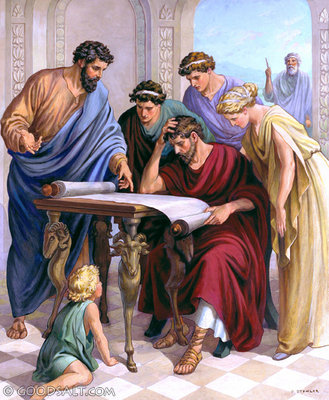
Acts 17 bereans

Acts 17:1-5a, 10-14 – September 13, 2015

When I attended seminary I had a handful of classes that were absolutely superb in every way. Interesting course material, fascinating professors, and assignments I could totally sink my teeth into. One of these courses was Reformed Tradition, taught at the Presbyterian seminary on the south side of Chicago. This course highlighted the Reformed Protestant church practices and theology since the 1500’s. And, I absolutely loved it.

One of the strong memories I have of this course is studying the practices of the Reformed missionaries of past centuries who were called to cross barriers (and in some cases, also cross continents and oceans). They took the message of the Gospel to those who had not yet heard the Good News of Jesus Christ.

That’s just what Paul and his friends are doing here in Acts 17. This week is the last of our Summer Sermon Series, Postcards from the Early Church. When last we met our intrepid heroes, (in Acts 16) they had crossed from Asia into Greece, into Europe. Here, in both towns of Thessalonica and Berea, they start preaching and speaking with the groups of Jews living in both areas, and they also preach to their Greek neighbors and friends.

To go back to the course I loved in seminary, Reformed Tradition, I discovered that many Protestant missionaries and mission agencies had a master plan. The missionaries would not just go and preach the Gospel. No! They almost always had an excellent method behind their outreach. They not only would start a small church or chapel, but would also often develop a health clinic, sometimes even a hospital. And—the missionaries almost always began a school. They wanted to teach people; not only how to read, but also teach math and other subjects; sometimes even beginning institutions of higher learning in far flung areas.

So, reading and literacy were of extremely high regard to the missionaries! This went along with the importance of each person being able to read the Scriptures for themselves. We can see that translating the Bible became a high priority, too.

What does this have to do with our Scripture passage for today, you might ask? After Paul and his friends were thrown out of the town of Thessalonica, they went down the road to the next town of Berea, fifty miles away. We don’t know very much about Berea, except—the Bereans eagerly searched the Hebrew Scriptures after they heard Paul’s message. Paul wasn’t just delivering a line, or trying to pull the wool over anyone’s eyes, no! The Bereans not only read, but diligently searched and sifted through the Scriptures to make sure that what Paul and his friends were telling them was true!

The literacy rate in Jewish communities has always been extremely high. For millennia it’s been this way. It’s marvelous to learn how to read, as well as do math and learn other subjects, too. Literacy has been a strong priority among large groups of Protestant missionaries, too. Reading the Scriptures is and has remained a primary goal, but just think about it. As we teach people how to read, we are also teaching them how to think, and how to reason. And, as more people in these far away mission areas learn more and more, the quality and standard of living rises in the whole community, as well! All very good things.

Dr. Luke doesn’t tell us too much about the Bereans. Except, the people in the town of Berea, in the foothills of the Olympian mountains, certainly seem like “people of more noble character” than the troublemakers in Thessalonica.

Using an excellent sermon illustration I discovered, “I want you to pretend for a moment that you are a first-century Berean Jew. Now suppose one Saturday a stranger comes into your synagogue and addresses the congregation. He says that his name is Paul, and he brings you the exciting news that the long-awaited Messiah has finally come! No, he didn’t actually restore the [physical] kingdom to Israel, as expected. In fact He was murdered a few years ago by the Romans. But, Paul says, that this is exactly what was supposed to happen to the Messiah, and he seems to prove it from Scripture. So now what do you do? If you are of noble character [as Dr. Luke says], you begin to search the Scriptures yourself to see if what Paul said is true.” [1]

Luke’s word used here in this passage is a legal term. Luke states that “Paul’s appeal to Israel’s Scriptures [was] a legal ‘witness’ to warrant his gospel’s claims about Jesus.”[2] Paul was not just making up imaginary tales, or fabricating fairy stories to put little children to sleep. No! Paul was using the Hebrew Scriptures as competent testimony to back up what he was telling them. And thus, many of the people who heard Paul out, believed what he said. Because they searched the Scriptures and made sure that what Paul was telling them matched with what they knew and already believed.

It’s like fact checking, today. How many people here have “heard something” about someone famous, or about some political candidate? How many people here are not sure where they first “heard it,” but “everyone is talking about it!” Like, for example, some Internet meme or email sob story passed around from person to person that is patently untrue.

My husband is an editor and journalist, working at a trade publication downtown. He takes special delight in exposing these sorts of gossip and misinformation that keep getting passed from one person to another via email, Facebook, and other kinds of social media. One of his favorite online tools is snopes dot com. “Snopes.com is the definitive Internet reference source for urban legends, folklore, myths, rumors, and misinformation.”[3]

I can just see some of these people in Berea, going to the library or to the synagogue where the scrolls and books were kept, checking out the sermons that Paul had just preached, as well as the discussion they had afterwards. Making sure—fact checking!—that Paul was the real deal. Dr. Luke tells us, “As a result, many of [the Berean Jews] believed, as did also a number of prominent Greek women and many Greek men.”
But, wait! This was not the end. Paul and his missionary friends did not have an easy time of it after starting the church in Berea. The people who stirred up things in the previous town heard about Paul and company and how they were having such an effect on the people in Berea. Some of those troublemakers from Thessalonica came over to Berea and made trouble in that town, too. Talk about nasty people! So, Paul’s new friends, the new believers in the Messiah, the Lord Jesus, shipped Paul out of town in a big hurry.

But the church Paul founded in Berea remained. Paul’s work here was done. We know they had a firm basis, since the Berean believers already had a solid foundation in the Hebrew Scriptures.

What about us? Do we have a similar solid foundation? Thank God, we have the Bible translated into English. It was translated for us centuries ago! We can look back to the great job that William Tyndale did in the 1500’s, paving the way for the King James Version, translated just after 1600. And now, today, we have many translations!

We can celebrate those translations, just as we celebrate our freedom to read the Bible, and our ability to study and learn about Scripture. There are still some places in the world today where it is a crime to read and study the Scriptures. I encourage all of you to pick up the Bible. Read a little every day. Become familiar with it. I know some of you do already. There are wonderful helps. Just ask me and I will hook you up with one!

God’s Word is truly a lamp to all of our feet, just as I told the Sunday school children before the sermon. The Bible sheds light on all of our paths. Just as it was with the Berean believers, just as it was with the Apostle Paul and his friends, so it is today. Praise God for God’s Word, freely available to all of us, today.

[1] “The Bereans,” Acts 17:10-14. Sermon delivered 10/25/2009 – Pastor David B. Curtis

[2] Wall, Robert W., Acts, from the New Interpreter’s Commentary series. (Nashville, Abingdon Press: 1994-2004) 239.

[3] http://snopes.com/

@chaplaineliza

Suggestion: visit me at my daily blog for 2015: matterofprayer: A Year of Everyday Prayers. and my other blog,  A Year of Being Kind .  Thanks!
Unknown's avatar

Spinning Out of Control!

“Spinning Out of Control!”

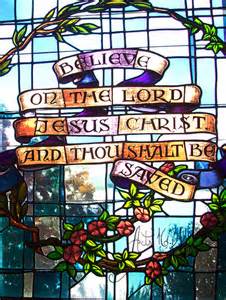
Acts 16-31 Believe in the Lord Jesus Christ stained glass

Acts 16:30-31 – September 6, 2015

Most people I know like things in order. Neat and tidy. Under control. I mean, most things. Steady income, check! Roof over our heads, check! Clothes to wear and food to eat? Check and double check. Sure, we can have little surprises now and then, but most people crave order. Everything’s hunky dory! Just the way it’s supposed it be.

Until, it isn’t. We experience things spinning out of control.

In our Scripture reading today, we have Paul, Silas, Dr. Luke and their missionary friends in the town of Philippi. This is another in our summer sermon series, Postcards from the Early Church. If you remember last week, we met Lydia, a Gentile woman. We are told she is from a city called Thyatira, and is a dealer in purple cloth, which for that time was a luxury item. What I suggested last week was that it’s similar today to a dealer in high-end designer clothing in our culture and context. She not only owns her own business, but she also has her own house.

The pertinent part for us in this week’s sermon is that after becoming a believer in the Lord Jesus Christ, Lydia invites Paul and his friends to stay at her large house in Philippi. Paul and friends start to carry out the challenging work of starting a church plant. That is, spreading the Good News of the risen Lord Jesus.

Paul is skilled at debate, and I suspect he and his friends went to gathering places all around town to talk with people. To tell them about the Good News about the Lord, how He died for our sins and was raised from the dead, conquered death, and has ascended to heaven.

Now we discover a slave girl starts to follow Paul and his friends around, as they travel about town. Listen to Acts 16: “We were met by a female slave who had a spirit by which she predicted the future. She earned a great deal of money for her owners by fortune-telling. 17 She followed Paul and the rest of us, shouting, “These men are servants of the Most High God, who are telling you the way to be saved.” 18 She kept this up for many days.”

Here Dr. Luke gives us a thumbnail sketch of this slave girl. Yes, she is telling the truth. Paul and his friends were telling people the way to be saved. But, the truth can be twisted. She refers to “the Most High God.” Meaning, a God among other Gods. And, in the polytheistic environment of Greece, the title “the Most High God” was also a common name for Zeus, ruler of the Greek pantheon of gods.

This slave girl was a factor completely out of the control of Paul and his friends. From what this looks like, she was a sort of a heckler. Walking after them, shouting and making a big fuss. And, the slave girl was a local. A known person to the inhabitants of the town. Paul and his friends were visitors, strangers in town. There was that dynamic, as well.

Not only is she starting to get irritating and annoying, following them around like a pesky little sister for many days, Paul realizes this slave girl is energized by a demon. The demon inside of her enabled her to tell fortunes, to tell people what would happen to them in the future. I suspect the demon knew with great certainty the exact identities of Paul, Silas, Dr. Luke, Lydia, and the rest of the believers in the risen Lord Jesus there in Philippi.

Let’s see what happened next! “Finally Paul became so annoyed that he turned around and said to the spirit, ‘In the name of Jesus Christ I command you to come out of her!’ At that moment the spirit left her.

What was that that happened? Paul got fed up with the persistent heckling the demon—I mean, the slave girl was doing. So, he cast the demon out of this slave girl. Next thing we know, the girl’s owners got really mad! That was a serious consequence, to be sure.

Let’s trace this back a bit. Why were her owners so angry and upset?

Apparently, the slave girl’s owners didn’t particularly care that she wandered around the city of Philippi shouting about Paul and his friends being servants of God and telling people how to be saved, as long as she pulled in the money. As long as she was a profitable cash cow, her owners were happy.

But in casting out the demon? Talk about things spinning out of control! The unexpected consequences of Paul’s action? It dried up all the profits the girl’s masters were making! Paul dried up the owners’ lucrative source of revenue! Talk about hitting them in the pocket book!

Continuing with Acts 16: “19 When her owners realized that their hope of making money was gone, they seized Paul and Silas and dragged them into the marketplace to face the authorities. 20 They brought them before the magistrates and said, “These men are Jews, and are throwing our city into an uproar 21 by advocating customs unlawful for us Romans to accept or practice.” 22 The crowd joined in the attack against Paul and Silas, and the magistrates ordered them to be stripped and beaten with rods.”

I owe thanks to John, a pastor on a sermon discussion board I follow, from time to time. His insight? The wallet. The billfold. “’Religion’ is all well and good, at least until it starts affecting my pocketbook. In this [passage], it’s only after the new religion affects the slave girl’s owners’ bank account that they have Paul and Silas arrested.”

With you and with me, today. What about us? Is “Religion” all well and good, until it hits us in the pocketbook, too? Is “Religion” affecting our bank accounts? Will following Jesus here in the United States affect us in a negative way? Affect our pocketbooks? Or, is that hitting too close to home for us? Hmm. I’ll let us think about that for a while. Let it sink in.

Let’s follow along with Paul and Silas. Dr. Luke tells us specifically about their time in the prison. “23 After they had been severely flogged, they were thrown into prison, and the jailer was commanded to guard them carefully. 24 When he received these orders, he put them in the inner cell and fastened their feet in the stocks.”

Things are spinning out of control again. Paul and Silas are thrown into the inner cell of a prison. I bet that was an especially secure place. But what do they end up doing? Instead of crying and desperately lifting their voices in prayer to God, they begin to sing. Imagine, singing hymns of praise to the Lord, at midnight. Securely locked, in a dark prison.

We continue with chapter 16: “26 Suddenly there was such a violent earthquake that the foundations of the prison were shaken. At once all the prison doors flew open, and everyone’s chains came loose. 27 The jailer woke up, and when he saw the prison doors open, he drew his sword and was about to kill himself because he thought the prisoners had escaped. 28 But Paul shouted, “Don’t harm yourself! We are all here!”’

We can see the economic effect this earthquake had on the jailer, for sure! Plus, the horrible sinking in his heart, seeing his jail destroyed, with the prisoners quite possibly running away, escaping in the middle of the night. No wonder he drew his sword, ready to kill himself.

The jailer is stopped by Paul, shouting out to him: “Don’t harm yourself! We are all here!”

29 The jailer called for lights, rushed in and fell trembling before Paul and Silas. 30 He then brought them out and asked, “Sirs, what must I do to be saved?” 31 They replied, “Believe in the Lord Jesus, and you will be saved—you and your household.”

Did you hear? What must we do to be saved? Believe on the Lord Jesus.

It doesn’t matter what is spinning out of control. It doesn’t matter what economic consequences are happening. It doesn’t matter what the authorities say or don’t say. Instead, we hear the Good News preached to us. Believe in the Lord Jesus, and we will be saved. All of us, and our households, too!

On this Labor Day weekend, we can see all levels of society hearing the Good News. We can see the slave girl—a slave, someone from the lower class, being freed and exposed to the saving grace of the Lord Jesus! And, we can see the jailer, a solid member of the middle class, receiving salvation with joy! And last week, we saw Lydia, a member of the upper class in Philippi, listening eagerly to the Good News. She came to faith in the Lord Jesus, too.

Our Lord Jesus is not only for the Gentile and the Jew, not only for male and female, but Jesus also transcends all class distinctions. All separations of caste, of nationality, of ethnicity, of background.

That’s how it was in the first century, and that’s how it is today, too. What about you? Do you believe in the Good News? Do you believe in the power of Jesus to forgive your sins, and help you to walk with Him day by day?

As I proclaim each week after our Confession of Sin at the beginning of the service, “Believe the Good News of the Gospel. In Jesus Christ we are forgiven!” Alleluia, amen!

@chaplaineliza

Suggestion: visit me at my daily blog for 2015: matterofprayer: A Year of Everyday Prayers. and my other blog,  A Year of Being Kind .  Thanks!

Unknown's avatar

Open Our Hearts!

“Open Our Hearts!”

Acts 16 St. Lydia

Acts 16:6-15 – August 30, 2015

Men, men, men! Here in the United States, men still take center place in many areas today. Look at most sports broadcasts. What you see is—men! Look at many industries and places of work, still, today. Firefighters? Mostly men. Police officers? Mostly men. Truckers? Construction workers? Mostly men here, too.

The sermon I have for you this morning is not the typical sermon. I would like us to consider the passage from Acts 16 that was read just now. This passage is interesting because of its highlight on women. Let’s take a closer look at the subject at hand.

We are looking at Acts, chapter 16, as part of our summer sermon series, Postcards from the Early Church. The events recorded in this book take place later in the first century after the birth of Christ, a long, long time ago. The concepts of welcoming and celebrating multi-culturalism—as we do today—were not even thought of.

The apostle Paul and his friends had a bit of a culture shock themselves. They had been itinerant preachers and missionaries throughout Asia Minor for the past several years. They were on the front lines, spreading the good news of Jesus Christ on the frontier, to people who had never heard that good news before. And now, at the beginning of Acts 16, they take the huge step of crossing into Europe. They are now in Philippi, in what is now northern Greece, in the region of Macedonia. So they are truly missionaries, bridging continents, crossing cultures, coming into a new situation with their good news.

Now, there was one structure Paul and his friends had to deal with, wherever they went: the Roman Empire. The Roman Empire embraced many different cultures, from western Europe to northern Africa, to the edges of what is Iraq today. But within that polyglot of cultures, one basic aspect remained constant: the pre-eminence of men, and the subordination of women.

We can still see this fact of life in certain societies and cultures today; in certain cultures, women are still subordinate, not allowed to do things or to be involved in activities that are normal and matter of course for both women and men today, in our culture and society here in the United States.

Let’s return to the scripture passage we are examining today. Dr. Luke is different from the other biblical authors, since he was a Gentile, and a doctor. He was used to dealing with women and children as a doctor, as a matter of course, and I believe they were important to him, professionally as well as personally. Thus, he mentions them more often in his writings. Here in Acts 16, almost the first thing that Dr. Luke tells us about Paul and his friends in Philippi is their encounter with a gathering of women outside of the city.

Let me say how unusual this is, for the Bible. In either the Hebrew Scriptures or the New Testament, the mention of a gathering of women, only, is almost unheard of. The mention of a woman, on her own, at all, is unusual.

Just think about it: women in the Bible are usually mentioned in reference to a man: Abraham’s wife, Sarah; Judah’s daughter-in-law, Tamar; Samuel’s mother, Hannah; Mordecai’s cousin, Esther; Aquila’s wife, Priscilla; Jesus’ mother, Mary.

Some women in the Bible are not even mentioned by name: the woman at the well from John 4, the woman with the flow of blood from Luke 8, and the faith of the Syro-Phoenician woman from Mark 7—anonymous women, known only to God. But wherever they appear in the Bible, the women of the Hebrew Scriptures and New Testament are clearly examples for anyone who reads the Bible today or has read the Bible, throughout the centuries.

Let’s look at this situation in Acts 16 from a different perspective, for a moment. Quite an odd occurrence, to be sure! Here we have a small group of men, strangers from out of town, coming and sitting down among a larger group of women. What is going on here?

I could mention the fascinating information I researched about Jewish synagogues among majority Gentile towns in the first centuries of this common era, or about the possibility that there was no synagogue in Philippi, which led the God-fearing people who wished to worship outside of the town. However, that is not where I wish to focus today. I would like to look at the rabbi Paul and his companions coming to pray and worship with this group of women. Rabbi Paul was probably the guest preacher for the morning, supported by his colleagues in ministry.

This prayer meeting was an open-air meeting outside the town, probably at a marginal location near the river. It was a meeting of God-fearing women, probably mostly Gentile in makeup. The amazing thing about this mention in Acts 16 is that Dr. Luke mentions the women.

Women are not mentioned often in the Bible, period. But without the active participation and support of women, and some of them of high standing, too, Paul and his companions would not have been able to accomplish half of what they did. Women, especially of high standing, were involved in local politics throughout the region, and economically involved, as well. Women were important to the ongoing life of the new church and to the spreading of the good news for several years before this occasion in Philippi. I believe Paul was acknowledging this through his willingness to talk with and preach for the women.

It is unusual for women to be mentioned on their own, self-sufficient, having their own accountability and standing in the city where they live. Yet here we have just that. Dr. Luke particularly mentions Lydia, and he gives us lots of personal information about her. We can tell by her name that she is a Gentile woman, and we are told she was born in a city called Thyatira, and is a dealer in purple cloth, which for that time was a luxury item, for sure. What we can compare this to is a dealer in high-end designer clothing in our culture and context, today. We can readily see that she not only owns her own business, but she also has her own house, and household servants and maybe even assistants and others in her entourage.

What did the Lord do? Here in verse 14, the passage says that the Lord opened Lydia’s heart to listen eagerly to the things Paul preached. And because of her attention to the message, she came to faith in the Lord Jesus Christ. And as an expression of that sincere faith in the Lord, she went the next step, and was baptized, thereby making a public declaration of her realization of coming to faith. And not only Lydia, but also her whole household was baptized.

Then, after she was baptized, she offers her own house as a hotel, as a place for Paul and his companions to stay, a base of operations while they were in Philippi. She is hospitable, showing good character and a definite spiritual gift. She had been a God-fearer, a worshiper of God, and now she was a Christian, a believer in the good news.

That’s Lydia’s story. But, how about you? Lydia was a God-fearer. Lydia was a proselyte, probably coming faithfully to prayer and worship Sabbath after Sabbath. It could even have been for years, faithful in her attendance, faithful in her giving to others. But it took the Lord to open Lydia’s heart to listen eagerly to the message of the good news. It took the Lord to lead Lydia to faith in the good news of Jesus Christ.

What about you? Have you come to that point in your life where you accept what Jesus Christ has done for you? Have you come to believe in that good news that Paul preached? Paul’s answer from Acts 16 still stands today. It is still valid. “Believe on the Lord Jesus, and you will be saved, you and your household.”

And if you are a believer in the Lord already, praise God! You can join Lydia and Dr. Luke and Paul and Silas and the rest of the saints, throughout the centuries.

And even if we do know the Lord, there may be some who have been far away from Him, and not as attentive to God’s will and God’s ways. I know I have sinned, often, and I think there may be others in the same circumstance. The Lord does not turn His back, and ignore us when we come to say we’re sorry, and we have sinned. No.

The Lord is ready to welcome us, to extend God’s mercy and grace to us. Each one of us.

Have you come to the Lord? Have you asked forgiveness for your sins, and thanked God for welcoming you to Him? See, today is the day of salvation. Let this day be the day when you open your heart to the Lord.

@chaplaineliza

Suggestion: visit me at my daily blog for 2015: matterofprayer: A Year of Everyday Prayers. and my other blog,  A Year of Being Kind .  Thanks!


Unknown's avatar

Cleanse Your Hearts!

“Cleanse Your Hearts!”

Acts 15 Jerusalem council stained glass

Acts 15:8-9 – August 23, 2015

Conflict resolution is never an easy thing.

I hate to make sweeping statements, but I definitely think that that is one everyone can agree upon. Conflict resolution is never an easy thing.

We could be talking about the rough and tumble of sibling rivalry: “Mom! He started it!” “Did not!” “Yes, you did, too!” Or, a difficulty between neighbors that might get worse and worse, and escalate out of control until someone puts up a spite fence. Or, what about a problem between two employees in the workplace? You know the sort of thing. A disagreement starts between two people. Words are exchanged. Each side is sure they are right! Next thing you know, the whole office has chosen sides, and is squared off against each other.

We have a situation very much like this, in Acts 15. The whole group of believers—in all of the congregations scattered around the Mediterranean by this point—has escalated to the point that we heard about today, during the New Testament reading.

To recap, back in Acts 2, a number of days after our Lord Jesus ascended in to heaven, the few dozen believers have a Pentecost experience! The Holy Spirit comes upon them all, and Peter preaches his remarkable sermon. Not remarkable in and of itself, but remarkable because of the incredible response he got. Hundreds and hundreds of people came to belief in the risen Lord Jesus, in just one day! These were all Jewish believers. And, they continue spreading the Good News to any Jew they encounter. Many more believe, too.

Then, in Acts 8, Philip preaches in Samaria. The Holy Spirit comes upon these half-Jews, and even more people believe in the Good News! The circle of belief and faith continues to become wider and wider. In Acts 10, Peter preaches the Gospel to a Gentile—Roman centurion named Cornelius, and his whole Gentile household. They all believe, too! And, the Holy Spirit comes upon all of them, as well. Peter and the other apostles have the witness of their own eyes. They see that “God shows no partiality, but in every nation anyone who fears God and does what is right is acceptable to Him.” (Acts 10:34b-35)

The Holy Spirit continues to move. The believers continue to preach the Good News to anyone and everyone. It doesn’t matter whether they are Jew or Gentile, slave or free, high class or low born, or any other distinction. All are welcome to come to faith in the risen Lord Jesus.

Which brings us to the beginning of Acts chapter 15. A large number of believers has squared off, one side against the other, over keeping the Jewish laws. Should we, or shouldn’t we? What about Jewish people who never really kept kosher, before they started believing in the risen Jesus? Should they keep 600-plus rules in the Jewish law, now? And what about Gentiles who might have never had any idea about the Jewish laws, before? Should they turn themselves inside out and start keeping kosher, and wearing special clothes, and observing special holidays?

I went to one of the textbooks I had for one of my seminary classes, called Church Administration. (One of the best classes I ever had, in all my years of school!) This book is called Never Call Them Jerks: Healthy Responses to Difficult Behavior by Arthur Boers. Such helpful material on church conflict in this book!

Our situation at the beginning of Acts 15 seems black-and-white. We can see that from verse 5: Then some of the believers who belonged to the party of the Pharisees stood up and said, “The Gentiles must be circumcised and required to keep the law of Moses.”’ We have group A (or, Aleph) on this side, yelling ‘You’ve got to keep Jewish Law!” and group B (or, Bet) on the other side yelling back, “No, we don’t!” As they continue to bicker and snarl at each other, the argument gets worse and worse!

This argument is a classic case of polarizing! “Reducing issues to ‘black-and-white’ solutions and giving little time to discovering other options.” [1] What will they do now?

Yes, the controversy has busted wide open. Sometimes, people get stuck. They either don’t or can’t move. There they are, in that big, black-and-white argument, no way out. Or, so they think.

At the church council in Jerusalem, there was some discussion. I don’t know how long the discussion went on. There may have been some name-calling, or possibly even getting into fist fights. (I don’t know for sure—this was before the days of reality television.) Adversarial comments could have happened! “using ‘we/they’ language and ignoring or dismissing what is held in common.“ As the argument escalated, I can imagine threatening ultimatums being issued, back and forth. [2]

Here’s an illustration Boers uses: “One snowy morning I drove the high school car pool. I backed my fully loaded van onto a downwardly sloped street. On the slippery pavement, the van would not budge uphill in a forward gear. I could have pushed the accelerator, spun the wheels harder and faster, and gotten nowhere. Instead, I backed partway down the hill, tried the forward gear again, discovered my wheels had found a purchase, and was able to move forward.” [3]

Similarly, we find the apostle Peter taking a step back. Just like the van in this illustration, he backs up. And, he “seeks the common good over the interests of particular parties.” [4] He tries to find some common ground that all can agree on. Peter says, “God, who knows the heart, showed that He accepted the Gentiles by giving the Holy Spirit to them, just as God did to us. He did not discriminate between us and them, for God cleansed their hearts by faith.”

Did you hear? Peter makes the statement, again, that God wants to enter into a relationship with each and every person. That means, each person in his time, in the first century, just as much as today, in the twenty-first century. God does not discriminate! And, neither should we.

What’s more, God cleanses everyone’s heart! Praise God, we don’t need to meticulously follow the Jewish Law code. We don’t have to wear special clothes, or observe special holidays, or have restricted food choices. God has cleansed each of our hearts, through faith! Peter goes on to say, “Now then, why do you try to test God by putting on the necks of Gentiles a yoke that neither we nor our ancestors have been able to bear? 11 No! We believe it is through the grace of our Lord Jesus that we are saved, just as they are.”

Praise God! Alleluia! We are not saved by following each and every little rule in the Jewish Law code. We are not saved by following each and every little rule in recent rulebooks, like no dancing, and no card-playing, no movies, and no mixed bathing.

It was a little early in the formation of Christianity for the apostle Paul to formulate his theological statement in the letter to the Ephesians, some years down the road. But I can hear the beginnings of it being hammered out, right here. Paul’s triumphant words from Ephesians 2:8-9. “For by grace you have been saved through faith, and this is not your own doing; it is the gift of God—not the result of works, so that no one may boast.”

Praise God! Not just Jews, not just Greeks, not just people with brown hair, not just people who are right-handed. But everyone. God does not discriminate! What’s more, God cleanses everyone’s heart! We can all say Alleluia! Amen!

@chaplaineliza

Suggestion: visit me at my daily blog for 2015: matterofprayer: A Year of Everyday Prayers. and my other blog,  A Year of Being Kind .  Thanks!
[1] Boers, Arthur Paul, Never Call Them Jerks, (United States of America: the Alban Institute, 1999.), 72.

[2] Ibid.

[3] Ibid, 64.

[4] Ibid, 72.

Unknown's avatar

To the Ends of the Earth!

To the Ends of the Earth!

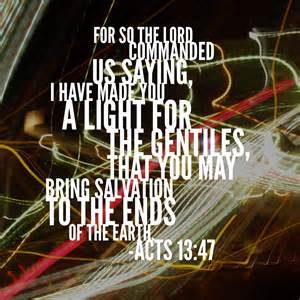
Acts 13-47 go into all the world

Acts 13:47 – August 16, 2015

Every month, St. Luke’s Church has a Church Council meeting to deal with the everyday business of running the church. We are going to have our August meeting this coming Friday. This being a congregational church, any member is more than welcome at our council meetings.

Let me ask: what would you think if someone from the Church Council were to get up in front of the congregation next Sunday morning, and say something like, “This past Friday at the Council meeting, the Holy Spirit told us to send two of our church leaders—two Council members—off to the mission field full time. We prayed over them, and we sent them off. They’re gone, and we’re not really sure where they’ll end up”? What would your reaction be to such a statement?

That’s just what happened. That’s just the situation, here at the beginning of Acts chapter 13. Except, I suspect the whole congregation gathered around Paul and Barnabas, as well as several others who intended to travel with them. Dr. Luke doesn’t specifically say, but I think the whole congregation prayed over them before they sent them out.

Paul and Barnabas were chosen by the Holy Spirit to go out. To tell others about the Good News of the risen Jesus. They, and several of their friends, left for parts unknown.

It’s a wonderful thing, to be noticed, recognized. Chosen as a messenger, a missionary for God. In the several churches I have attended over the years, I have seen dozens of people go on both short- and long-term mission trips, just like Paul and Barnabas. I’ve been involved with mission committees, and led prayer teams and prayer efforts in support of many of those same missionaries. However, I—myself—have never gone anywhere on a mission trip. Nope. Not even a short-term one.

How many of us, here, can say the same thing? I am not asking for anyone to raise hands or otherwise identify themselves. But, in your hearts, how many of us know that we have never gone to the mission field? Either overseas, or in this country?

Let’s define terms. What is a mission field, anyhow? What does it mean to be a missionary?

A simple definition? A mission field is somewhere on the other side of a boundary or barrier. I know seminary professors and people who study the history of missions might quibble with the specifics of this definition. However, I think most everyone would agree that a mission field involves crossing some sort of a boundary. That can be a boundary or barrier of race, nationality, language or culture. Those are the easiest to see and recognize! But a mission field can also be on the other side of an economic boundary, or a societal barrier.

Take my friends, Jim and Amy. Both trained as doctors, they both worked here in the Chicago area for a long time. But, they were mission-minded. They intentionally went to the South side of Chicago regularly, for years, to work at a Christian medical clinic. An inner city mission, right here in Chicago. They are now in sub-Saharan Africa, working as missionary doctors. Still with that mission mindset. But, it was only recently that they went to Africa.

For years, before that, they were using the training they had to work for God—as medical doctors. To communicate the Good News that God loves everyone. Here in Chicago, but in a radically different community, with a different culture. Were they missionaries then, in Chicago? Are they missionaries now, in Africa? I say, in both cases, yes!

Let’s consider our scripture passage for today. Pretty new idea, for these early believers to preach the Good News to a multi-cultural audience! Take a look at the list of prophets and teachers from the beginning of Acts chapter 13. “1-2 Now there were in the Church at Antioch both prophets and teachers—Barnabas, Simeon surnamed Niger, Lucius the Cyrenian, Manaen the foster-brother of the governor Herod, and Saul.”

Just looking at this list, off the top of my head, I might not notice anything particularly different. But, let’s dig a little deeper. My research tells me that this assembly of believers in Antioch was the first truly multi-ethnic local church. This church had Jews and Gentiles together in one local congregation, according to Acts 11:19–22.

            We have Barnabas, a Jewish man, a Levite from the priestly class, born in Cyprus. Next, Simeon—he’s also called Niger. That’s a black man, from Africa. Then, Lucius, the North African from a large town called Cyrene. Then, there is the upper-class Manaen, the foster-brother of Herod—raised in the palace of the ruler Herod Antipas. And finally, we have Saul (or Paul), one of the most pre-eminent Pharisees of his day, born a Roman citizen in Asia Minor, and educated in the equivalent of an Ivy League school.

            We have some heavy hitters. Men of spiritual substance, described by Dr. Luke as both prophets and teachers of the church in Antioch. And, they are VIP’s. Very Important People, from many different regions and cultural backgrounds! It was these church leaders—the Church Council of the church in Antioch—who commissioned Paul and Barnabas and their friends. These missionaries left a multi-cultural local congregation to go to the multi-cultural world.

            As we read further in the chapter, Paul, Barnabas and their friends traveled further. “13-15  They continued their journey through Perga to [another] town called Antioch. They went to the synagogue on the Sabbath day and took their seats. After the reading of the Law and Prophets, the leaders of the synagogue sent to them with a message, “Men and brothers, if you have any message of encouragement for the people, by all means speak.”

We can see Paul goes first to the congregation at a synagogue. Dressed as a Pharisee (because they did wear distinctive clothing), the synagogue leaders knew he was learned in the Law and the Prophets. Paul gets up to speak. He gives them the Gospel, in a way they could understand.

Using the Hebrew Scriptures, he spoke about the coming Messiah, and about the death and resurrection of the risen Jesus. He spoke in a clear way that Jewish people could easily relate to. And, many of them came to faith in the risen Jesus, the Messiah.

However, Paul did not stop there! He spoke of the risen Jesus to God-fearing people who were not Jewish! He spoke of the resurrection to Gentiles, to Romans, to people without regard of their ethnic origin, or of the color of their skin.

Listen as chapter 13 continues: “44-47 On the next Sabbath almost the entire population of the city assembled to hear the message of God, but when the Jews saw the crowds they were filled with jealousy and contradicted what Paul was saying, covering him with abuse. At this Paul and Barnabas did not mince their words but said, “We felt it our duty to speak the message of God to you first, but since you spurn it and evidently do not think yourselves fit for eternal life, watch us now as we turn to the Gentiles! Indeed the Lord has commanded us to do so with the words: ‘I have set you to be a light to the Gentiles, that you should be for salvation to the ends of the earth.’”

“48-50 When the Gentiles heard this they were delighted and thanked God for God’s message. All those who were destined for eternal life believed, and the Word of the Lord spread over the whole country.”

Did you hear? The Gentiles were delighted when they heard that they were welcomed by God, too! The Gentiles were—are as much God’s beloved children as are the Jews. All people are welcome to be saved. Salvation is for anyone, to the ends of the earth!

            What about the rest of the church, where Paul and Barnabas came from? Were they just sitting at home, twiddling their thumbs, or hiding their heads in the sand like ostriches?

I think the other believers in the church at Antioch had an important job to do, too. True, they may not have been sent out, called by the Holy Spirit to be missionaries. To go far away, like Paul and Barnabas, to suffer hardship and travel and preach the Good News in a different town every few weeks. However, God called these believers who stayed in Antioch to follow God, too. The Lord wanted each of them to share their story to the people around them, to share the Good News of the risen Jesus, too.

And, what about us, today? Do we have to be sent out as missionaries to Africa, like my friends, Jim and Amy? Or, can we share our stories, here? Can we show others the Good News of the risen Jesus? Tell them what Jesus has done for us, lately? Or, show them God’s love? Or what God has done in the lives of people we know?

What can you say about what God has done for you, or for a loved one? People almost always listen to stories. So, tell a true story. Tell how God has worked in your life.

How can you share about God, today?

I’d like for everyone to think of one person you might talk to. And, think of something that God has done in your life. And, prayerfully, go and tell! Here in multi-cultural Morton Grove—and Niles, and Des Plaines, and Skokie, and Chicago—most people we meet are from different ethnic groups or various cultural backgrounds. Just like the church in Antioch, the first truly multi-ethnic local church. So, go forth! Go and tell! That’s our challenge today.

Alleluia, amen!


(The scripture readings of Acts 13 were taken from the excellent translation by J.B.Phillips; ; J. B. Phillips, “The New Testament in Modern English”, 1962 edition by HarperCollins.”  And, thanks to the wonderful people who prepared the bible studies on Acts at http://www.intervarsity.org/bible-studies – The study on Acts 13 was quite helpful, and gave me some great jumping-off places from which to preach!)

@chaplaineliza

Suggestion: visit me at my daily blog for 2015: matterofprayer: A Year of Everyday Prayers. and my other blog,  A Year of Being Kind .  Thanks!
Unknown's avatar

God Sends Us Out!

“God Sends Us Out!”

Acts 8-5-8 Philip preaching in Samaria

July 26, 2015 – Acts 8:4-8, 12, 14-17

Did you ever have something unexpected happen? Let’s say, you’re going about your everyday business, everything perfectly normal. When, something out of the ordinary happens. Comes out of left field. Knocks your socks off! Could be called a miracle, even!

That’s what happened in our Scripture passage from Acts chapter 8 today. Something certainly out of the ordinary happened to the Samaritans!

I’m continuing with my Summer Sermon Series from the book of Acts, Postcards from the Early Church. But before I continue, I’d like to thank everyone for the opportunity to take a week to go to a church conference, the New Wilmington Mission Conference in western Pennsylvania. I hope everyone enjoyed Pastor Gordon as he preached and led the service last week in my absence. The mission conference was a marvelous opportunity to see what God is doing around the world in mission and outreach. Reaching out to people with the Good News of Jesus Christ. Surprise! It’s just what the apostle Philip was doing, in our Scripture reading today.

It’s only a number of months after that first Pentecost. The apostles have been preaching and teaching up a storm. The fellowship of new believers in the risen Messiah has been growing by leaps and bounds! When—we have the super-deacon Stephen get hauled up before the authorities. You remember, just like a radio serial. “When last we left our intrepid heroes . . . !” Only, things went from bad to worse for Stephen. Some things he said about God really got the authorities mad. They thought he was saying blasphemous words, so they stoned him to death. And, God rest his soul. Stephen was the first martyr of the Church.

You might have guessed that Jerusalem was no longer a safe place to stay for many early believers in the risen Jesus. The apostles and other church leaders left town in a hurry!

The early believers in the risen Messiah were ALL Jewish. Everyone in the first church in Jerusalem was Jewish! The first few months were like a greenhouse; this growing church was spreading like a wild fire! But the sudden death of Stephen brought the rapidly growing situation in Jerusalem to an abrupt end.

Which brings us to Philip, one of the apostles. His task is a continuation of sending. The Greek—the original language definition for apostle is ‘one sent on a mission.’ So, Philip is doing his job! Doing what Jesus told him to do.

One problem: Philip was not preaching to Jews. This is unheard of, at this point.

Preaching to Jews? Acts 8 says clearly that Philip—one of the Jewish apostles—went to Samaria, an area some ways north of Jerusalem. There’s a problem: no self-respecting, kosher-keeping Jew would willingly go to Samaria!

Let me tell you a little about the Samaritans, a tribe of people forcibly brought to Israel several centuries before. As John Petty says in his Lectionary blog, “Samaritans and Jews were all-but-enemies.  Centuries of insults and provocations had made each group so disgusted with the other that Jews travelling to Galilee or Judea would usually opt to take the longer route through the area across the Jordan River rather than set foot in Samaria.

“The Samaritans shared some aspects of faith with the Judeans.  Their sacred book was the Pentateuch, and, in their minds, they worshipped Yahweh.  They rejected, however, the focus on Jerusalem that was integral to the Judeans’ Jewish faith. As far as the [Jewish people] were concerned, the Samaritans were some form of ‘half-breed’ and their theology was heretical.”

I think you all can see where the problem lies. Jews hated Samaritans! Samaritans hated Jews! A racial issue! A huge barrier in relationship stood between them!

Just a minute. Let’s step back. Barriers between people? Misunderstood and marginalized people? Differences in religion, even heretical viewpoints? Sounds like a mission field to me!

This past week at the mission conference, I heard about mission outreaches that crossed all kinds of barriers. Differences in language, religion, culture, and viewpoint. Differences in urban people going to rural places, Christian worldview meeting Buddhist or Hindu or Moslem worldview. Wide differences in cultural views and assumptions. And—that’s just on the missionaries’ side.

So, when we consider the apostle Philip crossing a barrier of hatred and disdain and religious difference to reach the Samaritan people with the knowledge and understanding of the risen Messiah, we know for sure this was missionary activity. Listen to verses 5 and 6:

“5 Philip went down to a city in Samaria and proclaimed the Messiah there. When the crowds heard Philip and saw the signs he performed, they all paid close attention to what he said.” This verse mentions “signs.” I think I know what those signs were. In the very next verse, Dr. Luke explains: “For with shrieks, impure spirits came out of many, and many who were paralyzed or lame were healed.”

I don’t have time to go into the topic of evil, or impure, spirits at this time. I’ve been preaching a midweek bible study for the past few weeks on Angels: Elect and Evil. I’m going to do a “coming attractions spiel.” If you’re available this coming Wednesday at 11:00 am, step on down to this very room! If the weather is hot and toasty outside, come on in. We have air conditioning. This week will be the final session, on demons. Or as they are sometimes referred to, evil spirits.

Let’s move on—to Philip and his effective evangelism. He reached out with the Good News, to this despised and disdained group of people. Guess what? Many believed! Continuing with Acts 8: “12 When they believed Philip as he proclaimed the good news of the kingdom of God and the name of Jesus Christ, they were baptized, both men and women.”

But, wait! There’s more! Apostles Peter and John show up, wondering what is going on.

What did Peter and John think of the Samaritans? Dr. Luke doesn’t tell us, but I suspect they had similar feelings to their fellow countrymen.

I have another question for you: What do you think about crossing barriers today? What about outreach right here, right now? What about an Indian church, culturally different from St. Luke’s ? Oh, wait! The dancing classes St. Luke’s Church hosts during the week come from a Catholic Indian church. What about a language barrier, where a different group of people uses a completely different alphabet? Oh, wait! What about Love Sharing Disciple Church? Our Korean friends who worship in the sanctuary here at 12:30 pm.

Do you think Jesus included everyone in His invitation to come to Him? Or, did He say, “Oh, everyone is invited, except for people with physical problems.” That would put my friend and church elder Bob out of the picture, because he has a withered arm, withered from birth. Or, did Jesus say, “Everyone is invited, except for people with disabilities.” No! Remember my friend Pastor Joe, who was at my commissioning service? He’s blind.

Jesus loved Samaritans just as much as Jews. Remember the woman at the well from John 4? Yup, she was Samaritan. And a woman of loose morals. No self-respecting Jewish man would even talk to her. The Rabbi Jesus crossed lots of barriers to bring her to faith! What about the Good Samaritan? Jesus made a Samaritan the star of one of His best-loved parables! And, here’s the kicker. Jesus’ last words, just before He was taken up into heaven, Acts 1:8b. “and you will be my witnesses in Jerusalem, and in all Judea and Samaria, and to the ends of the earth.”

Did you all hear? It doesn’t matter whether the Jews despised the Samaritans. God would help the Jews to love the Samaritans. They still needed to introduce Samaritans to Jesus.

Did you all hear? The apostles needed to go to the ends of the earth. Praise God! That’s just what they did. Did you all hear? It doesn’t matter what kind of barrier you and I are need to cross, God is there to help. We can overcome language differences, culture or worldview problems, religious differences. Remember John 3:16? For God so loved the world that He gave His only-begotten Son.” For you, for me. For everyone.

God loves the whole world. What part of “whole world” do we not understand?

Peter and John were finally convinced. God does not divide or isolate persons one from another. Instead, Peter and John prayed and laid hands on the Samaritan believers. What happened? The Holy Spirit came upon the Samaritans. The Holy Spirit came with power to the Samaritan believers as well as the Jewish believers.

God is all about mission. Outreach. God is a sending God. It doesn’t matter if we are moved to reach out to our neighbor across the alley, to our community with the Maine Township Food Pantry, to the poor and marginalized of Chicago with Bundled Blessings diaper pantry, or to a mission outreach halfway around the world with Dana and Carolyn Belton, with SIM Ministries in Zambia.

In this way, we are following the command of Jesus—to go to our Jerusalem, our Judea, our Samaria, and to the uttermost parts of the earth. We have that opportunity, too. We can reach out, say ‘hello’ to someone who looks different—sounds different—worships differently. I have accepted this challenge! This opportunity. This challenge. God would like you to accept it, too!

Alleluia, amen!

@chaplaineliza

Suggestion: visit me at my daily blog for 2015: matterofprayer: A Year of Everyday Prayers. and my other blog,  A Year of Being Kind .  Thanks!

Unknown's avatar

Jesus Sends Us Forth!

John 17:11-19 – May 17, 2015

Sent into the world - John 17-18

“Jesus Sends Us Forth!”

Most everyone I know like to receive packages. Have you ever received something extremely fragile in the U.S. mail, or from Federal Express or UPS? Can you just visualize the package? Unpacking something like this is a multi-step process! Opening the box, taking out the protective foam pellets, unwrapping the layers of encasing bubble wrap, taking off the newspaper cushioning the fragile piece. And, then—there it is. Finally, unwrapped.

We didn’t want to allow the fragile piece of glassware—or pottery—to get chipped or broken. Heavens, no! So, we take extra-special care. We wrap it, protect it, and swathe it, even immobilize it, in order to make extra sure that it’s safe and won’t get hurt or broken.

Except—as we consider our gospel passage today, we aren’t talking about fragile glassware or delicate pottery. Here, our Lord Jesus is praying to His Heavenly Father about the disciples. Asking some things for them, specifically.

Let’s set the scene. It’s a familiar scene. The Upper Room, after the Passover dinner with His disciples. Jesus has just finished His last words to His friends, and now in John 17, He prays. It’s an intimate time, with Jesus addressing God His Father in the most intimate way.

God sent His Son into the world—special delivery. Into a battered, fallen, sinful, hate-filled world. Did you know that? Did you realize that? From time to time we may say that, in an Affirmation of Faith, or some such statement of belief. I try to make it a central point in my sermons, when the Scripture passage mentions it.

Yes! Jesus, the Son, was sent into the world in order to proclaim the gospel, as well as to give everyone a picture, an actual physical representation of God in heaven. Here, on earth. One of the names of Jesus is Emmanuel, God with us.

Question: when God sent Jesus into the world—special delivery, what was the situation?

Where was He sent, in the first place, according to the Christmas narrative in the Gospel of Luke, chapter 2? We remember! Jesus—the eternal Son, laid down all of His heavenly Godly-ness, all of His awesome power and might, and was born as a helpless infant to an unmarried girl. In an occupied state, from a marginalized people. Here on this earth in amongst fallen, messy, dirty people who often make mistakes. Lose their tempers. Are unkind and rude—and even worse—to others. Where sin and disease and unemployment and accidents happen, on a regular basis. Imagine that!

God the Heavenly Father could have wrapped the man Jesus securely in bubble wrap. Or, in case Jesus even moved, God could have made sure He was packed in protective foam pellets, so Jesus wouldn’t get injured or harmed. But—that sounds silly! Maybe that idea works for shipping fragile items or glasswear, but not for people!

Let’s take a closer look at verse 18 of this intimate prayer. Jesus says, “As you sent me into the world, I have sent them into the world.” So—Jesus is talking about sending the disciples out into the world. Do you get the picture? The past three years were a training program. An internship, if you will, to get the disciples prepared for ministry.

Being sent out. Getting down to the business of letting others know about God. The disciples are getting ready to be launched into the world. In order to proclaim the gospel, the Good News, as well as to give everyone a picture, a representation of God in heaven. Here, on earth.

Wait a second, Jesus. That’s scary!

The thought of the disciples going forth, being sent out. Who knows where they might end up? Here on this earth in amongst fallen, messy, dirty people who often make mistakes. Lose their tempers. Are unkind and rude—and even worse—to others. Where sin and disease and unemployment and accidents happen, on a regular basis. Imagine that!

These words in this intimate prayer to God are words that entrust the future to God. These words do not leave the disciples as orphans (as Jesus said), nor do they set the disciples adrift, completely on their own. These words do prepare the disciples for His departure, and for their work and lives in ministry after His death and resurrection.

In short, Jesus is asking God to take care of His friends, after He leaves. How caring! How considerate! How awesome! But, Jesus did not ask for God to pack the disciples in protective foam pellets or encase them in bubble wrap.

In preparing this message, one of the resources I used is one I occasionally turn to. An online website where clergy discuss the lectionary passages of the week. In one of the discussions on this gospel passage, a pastor from North Dakota gave the following reflection and then, illustration.

“The thing that strikes me this year about this text – this prayer – is that Jesus prays for protection. He doesn’t pray for removal – removal from the world – removal from evil. It seems to me that we are expected to be in the world (not of it) and with that comes dealing with sin and evil. And Jesus prays for protection. I also think there is a difference between protection and shielding.

“Here in North Dakota (not in May, mind you!) an image that works for me is that we dress our kids in snowsuits and hats and mittens and boots and then we send them out into the cold. We don’t just hide out in the house with the nice warm furnace and hot chocolate and we don’t shield our children from the weather. We protect them, yes, but, still, they are sent out into the wind and cold. I think God is like that with us as well. God doesn’t help us to hide from the world and all its ‘stuff.’ God gives us what we need as protection … the Word, faith, a conscience … you get the idea.”

You get the idea—God protected our Lord Jesus while Jesus was here on the earth, even though I’m sure Jesus and His friends had to put up with being itinerant and homeless all the time they were traveling around Israel, with all the accompanying discomforts and getting dirty and sometimes going hungry. God protected the disciples, the followers of Jesus—and they were still sent out into the wind and the cold. Into the world where sin and disease and unemployment and accidents happen, on a regular basis.

The part of this passage that hits home the most, for me, is that Jesus prays for His friends. Not only the disciples, but we can also see His prayer broadened to include all those who follow Him. That includes you and me! Us. All those who receive Jesus’ good news, His Gospel of the revelation of God.

Just as Jesus prays for us in this prayer in John 17, so we share in this mission. We, too, are being sent! We, too, have the awesome direction from our Lord Jesus to go forth, let others know about God. We are launched into the world. In order to proclaim the gospel, the Good News, as well as to give everyone a picture, a representation of God in heaven. Here, on earth.

The best part is that Jesus has prayed for us, already! He has covered us with prayer, with protection, so that we are suited up to go out into the world. Just as we don’t shield our children from the weather; we protect them, yes, but, still, they are sent out into the wind and the weather and cold. I think God is like that with us as well.

We are sent out into the world, to spread the Good News about Jesus. God is right by our sides, too. God gives us what we need, too. We can have that assurance. For sure, and certain. Alleluia, amen!

@chaplaineliza

(Suggestion: visit me at my daily blog for 2015: matterofprayer: A Year of Everyday Prayers. and my other blog,  A Year of Being Kind .  Thanks!)

Unknown's avatar

Good News about Jesus!

“Good News about Jesus!”

Ethiopian painting, unknown artist  Philip and the Ethiopian royal official

Ethiopian painting, unknown artist
Philip and the Ethiopian royal official

Acts 8:34-35 – May 3, 2015

Who enjoys hearing good news? Just about everyone! And what about those who share good news? A relative getting married, perhaps? A new baby in the family? What about a big graduation—from college, trade school, or nursing school? The purchase of a new condo or a new car? These are all things that cause a great deal of rejoicing!

We’re going to talk more about sharing good news, but first, we need to set the scene. Tell you a little about our Scripture text for today. We are going to take a closer look at Acts chapter 8.

The risen Lord Jesus has been with His disciples and followers for a number of weeks after Easter, after the Resurrection. He ascended into heaven in the first chapter of Acts, and the great events of Acts chapter 2—Pentecost, the birth of the church at the Temple in Jerusalem—have occurred. The number of believers in the risen Jesus has simply exploded!

Four thousand came to believe on Pentecost, in one day, alone. Thousands of Jewish people heard about the Messiah coming, dying on a cross, and being raised from the dead. And they believed!

As we view the new gathering of believers at this point, in the early chapters of Acts, it’s a Jewish gathering. It’s pretty monochromatic. All of the believers have similar skin tones. All of the believers come from the same religious background. Jewish. All of the believers heard the Good News in the city of Jerusalem. All of the Jewish believers originate from an oppressed people-group in an occupied territory in Asia Minor (Israel), even if they currently reside outside the territorial bounds as their current place of residence. They still made the pilgrimage to worship at the Temple in Jerusalem.

The disciples do not have a difficult time communicating the Good News of the risen Lord Jesus to their fellow Jews! No cross-cultural differences to be dealt with, here!

Not yet . . . anyway.

The disciples were greatly heartened by such a huge response to their spreading the Good News! They fanned out into the area around Jerusalem (just as Jesus told them to do), and continued preaching. Sharing their stories. Until—the beginning of Acts 8.

Here, we have Philip. Directed by the Holy Spirit, Philip travels in Samaria, sharing the Good News with the people he met there. People who were not fully Jewish! As if this wasn’t enough, we have the encounter just read to us. Where Philip meets a royal official from Ethiopia.

Let’s step away from the events of the reading to talk about the author of this book of Scripture.

Dr. Luke, who wrote the Acts of the Apostles along with the Gospel of Luke, had a special concern for certain parts of the general population. He highlights women, children, sick people, and—Gentiles. Non-Jews. Dr. Luke himself was a Gentile, a Greek doctor. He therefore lifts up these powerless, unprotected individuals.

He shows God’s concern and care for the least of God’s creation. Those who are often forgotten or overlooked by the preferred ones.

This royal official of the queen of Ethiopia was a powerful man, it’s true. He wielded considerable power in the palace, in his own arena. But outside of his country? He was an outsider, for sure. And for more reason than just the color of his skin. The royal official was a eunuch. That means probably when he was a young boy—probably as he started serving in the house of the queen—he was forcibly castrated in order to serve the queen. He didn’t allow that to deter him, though. He rose in the queen’s household, became well educated and literate, and eventually became an important official, in charge of her treasury.

This official also desired to know more about the God of the Jews.

We don’t know where he heard of that particular God, a foreign God, but he had an earnest desire to learn more about the God who made heaven and earth, the God of the Jewish people.

There was a problem. A big problem. Sure, the royal official could learn about the Jewish God. He could become a proselyte, even come to Jerusalem and visit the area outside of the Temple. But—he could not enter the Temple. There were strict rules regarding that, in the Mosaic Law Code. The official was a eunuch. He was castrated. He was not fully “a man,” like every other natural male.

According to Jewish law, that made this Ethiopian’s spiritual standing with God less than that of others. He was automatically excluded from a close relationship with the Jewish understanding of God, due to factors completely beyond his control.

Did that make any difference to Philip? Let Dr. Luke tell us more.

Let’s get back to the story. After going to Jerusalem and diligently, faithfully worshiping outside of the Temple, this Ethiopian official started back to Africa in his chariot. Philip, nudged by the Holy Spirit, came alongside the chariot. The Ethiopian was reading from the book of Isaiah—aloud. Very common practice of the time. Reading aloud. Coming alongside the chariot, Philip asked, “Do you understand what you are reading?”

Excellent question! I can just see the scene—the Ethiopian, poring over the open book in his hands, perhaps in Greek translation (the trade language of the time). Young, strong Philip, jogging alongside, engages the official. The Ethiopian, intrigued, invites Philip to sit beside him in the chariot and explain the passage further.

One thing leads to another, and next thing you know, Philip is telling the official his story. Telling the Good News of the risen Jesus. Sharing the Gospel from the book of Isaiah, as well as his own personal testimony. The official must have known a great deal about the Jewish Bible and have been able to connect the dots of the Good News in short order! Because, what do we see next?

They come to some water. I bet the Ethiopian was so excited when he asked Philip, “What is to prevent me from being baptized?”

Do you understand what happened here? Philip explained the Gospel—the Good News about Jesus—to this worthy man. And in very short order, he was ready—so ready to believe in the Resurrection, to accept the Gospel!

Now at the impromptu baptism, when the Ethiopian made a public declaration of his belief in the risen Lord Jesus, did Philip stop and ask whether this man was Jewish, or not? Did he notice whether this man was an eunuch, or not? Did he care about the color of this man’s skin, or not? The conversation in the passage is not specific, but Philip’s actions certainly are!

“Both Philip and the Ethiopian went down into the water, and Philip baptized him.” That’s what Dr. Luke tells us.

The early church records let us know that this royal official not only goes back to Ethiopia—rejoicing in his absolute acceptance by our Lord as a fully beloved child of God!—but he also carries the message of that Good News to others in his home country! He tells others his story, that God fully and lovingly accepted him. A non-Jew, a person of color, even a man who was castrated.

This official became a believer, part of those who spread the Good News, that God loves each individual, no matter what.

Can we be sure that God accepts us? What about the questionable things in our past? What about those things? God still loves us. What if we don’t have very high standing in the community? God still loves us. What about the bad feelings we have in our hearts? God still loves us. What if we come from the “wrong side of the tracks?” God still loves us.

Are you a child of God? If you are member of the human race, YES. Does God love you? If you are a member of the human race, YES. Can we celebrate in God’s love? YES. Can we share that Good News? YES.

God loves you so much that God sent Jesus to this earth to die on a cross and rise from the dead on the third day. Do you believe this Good News? This fantastic, phenomenal News?

Praise God, just as much as Philip, just as much as the Ethiopian official, just as much as any other disciple, we can rejoice in the Good News of the risen Christ and share our story.

I encourage you today.  Tell someone how much God loves you!

Philip did. The Ethiopian did. And we are encouraged to do so, too. Praise God! Alleluia! Amen.

@chaplaineliza

(Suggestion: visit me at my daily blog for 2015: matterofprayer: A Year of Everyday Prayers. and my other blog,  A Year of Being Kind .  Thanks!)