Unknown's avatar

Stand Firm in Benediction!

“Stand Firm in Benediction!”

2 Thessalonians 2:13-17 (2:16-17) – November 9, 2025

            It’s sometimes difficult to be persistent! To hold on, and continue working, continue trying, despite delays and disappointments and detours. Isn’t it? Continuing to work all alone, standing by and standing up when others fall away. Even just being faithful, and doing what you promised to do can be a real trudge up a long, winding road, up a steep and lonely hill.

            It’s a good thing that as we live the Christian life, so often we are in community with each other! Isn’t it easier and more companionable to be traveling together, or working on a project together, or carrying a load together, with a group of friends?

            That’s what the Apostle Paul was writing about, here in this second letter to the young church in Thessalonica. When Paul and his friends were on their second missionary journey, they had only spent a short time in that city before they needed to leave. This was a young church that Paul planted, and Paul had already sent one letter to the believers there. He sent this second one to correct some misunderstandings and to renew the Thessalonian believers’ hope in Christ.

            We are focusing on this small section right in the middle of Paul’s letter. He breaks away from giving further instruction on the confusing timing of our Lord Jesus Christ’s return to giving encouragement to his fellow believers. “But we ought always to thank God for you, brothers and sisters loved by the Lord, because God chose you as firstfruits to be saved through the sanctifying work of the Spirit and through belief in the truth. 14 He called you to this through our gospel, that you might share in the glory of our Lord Jesus Christ.”

            When I hear about churches and pastors today who really focus on the “end times,” and about the prophecies in both the Hebrew Scriptures as well as the few times in the New Testament that refer to the Second Coming, I often roll my eyes. If you have ever read or heard of the books on the End Times, the books are so much dominated by fear and anxiety, by persecution of Christians by cartoonish bad guys. Those same churches and pastors so often advise their congregations of strict rule-following, and black-and-white do’s and don’ts.

            Yes, I did read that first portion of the assigned reading from 2 Thessalonians 2 this past week, and I did not feel led to write a sermon on it. However, I continued reading in chapter 2, and found Paul encouraging his Thessalonian friends, and thanking God for them!

As commentator Mariam Kamell says, “Christians can be confident, encouraged people because we know that we are held as first fruits by God’s choice, preserved through the Spirit. In Paul’s paradigm there is neither room for pride in our efforts to improve the world, nor despair at the state of the world around us. For Paul, all of this talk about the end is to encourage us in our security in Christ and draw us ever further in the Spirit’s sanctifying work.” [1]

            So, we are not to despair over the End Times! We are not to be fearful and cower in the shadows, dominated by fear and anxiety! Instead, we are to rejoice, and be hopeful in our security and salvation in our Lord Jesus Christ.

            Paul then says, “so then,” which is very similar to his connecting word “therefore.” As one of my Bible instructors used to say when I was attending a Christian college for undergrad, “See what “therefore” is there, for! Why is Paul using this particular connecting word?  “15 So then, brothers and sisters, stand firm and hold fast to the teachingswe passed on to you, whether by word of mouth or by letter.”

            I know things and people and situations in this world today can be really scary, and even make us want to hide under the covers! Especially when we consider persecution and lawlessness – however, God has the final word. “Don’t worry about what will happen when you (or people you love) die and don’t worry about what will happen when you grow up or get to be a teenager or [grown-up].   Instead, think about today.  Live as God’s person today.  Do the best you can and know that God is with you.” [2]  

            Isn’t that wonderful encouragement for all of us? Instead of cowering in fear, or being a strict rule-follower or else! We are to know we are God’s people, followers of Jesus Christ, and led by the Spirit of God. Paul prays that the Thessalonian believers are to be encouraged – in their inner being.

“This is clearly a ministry of the indwelling Spirit of Christ. Against the wiles of this age, may we look in faith to the one who constantly surprises us with his love and inspires us with courage and confidence, enabling us to stand firm and not be overwhelmed by the vagaries of life. Our God will buttress us in our faith; this we can rightly ask in prayer, believing.” [3]

            The apostle Paul is truly being encouraging to his friends. Yes, they had some misunderstandings about what Paul preached to them, which Paul clarified. Yes, some of these believers were acting in ways displeasing or disappointing to our God, but at the end of the day and the end of this letter, Paul wanted to give encouragement and hope, not fear and dismay! We are to be cautious around churches and ministers who want to fix, manage and control every aspect of life! Paul leads with the grace of Christ, and the love of God. Period.

            And then, what should burst out of Paul but a benediction! Just as in the middle of the letter to the Ephesians, here at the end of the second chapter to the Thessalonians is a marvelous benediction. We will close with Carolyn Brown’s wonderful paraphrase of Paul’s words:

            “Remember that God loves you.  God chose you to hear about that love and to know the stories of Jesus.  Do not forget them.  Live by them every day.  And may God who created the whole universe, Jesus who showed us how much God loves us, and the Holy Spirit who guides us be with you giving you courage and strength to be God’s people every day.” [4]

@chaplaineliza

(Suggestion: visit me at my other blogs: matterofprayer: A Year of Everyday Prayers. #PursuePEACE – and  A Year of Being Kind . Thanks!


[1] https://www.workingpreacher.org/commentaries/revised-common-lectionary/ordinary-32-3/commentary-on-2-thessalonians-21-5-13-17-3

[2] https://worshipingwithchildren.blogspot.com/2016/09/year-c-proper-27-32nd-sunday-in.html

[3]  https://www.lectionarystudies.com/sunday32caiie.html

[4] https://worshipingwithchildren.blogspot.com/2016/09/year-c-proper-27-32nd-sunday-in.html

Unknown's avatar

God’s Law in Our Hearts

“God’s Law in Our Hearts”

Jeremiah 31:31-34 (31:33) – October 26, 2025

            Relationships are foundational to life. Positive, negative, distant, close.  Both of my parents are gone now, but I had a relationship with both of them. My sisters and brothers—again, I have relationships with them. Members of my extended family, too, are included in my list of relationships. Also my friends, acquaintances, colleagues, even my enemies. All of these people have relationships with me. Think about yourself. You have relationships with many, many people, too. Most of these people I just mentioned, if not all of them. Positive or negative, distant or close. We all have relationships—or friendships—with many people.

            But what about God? What kind of relationship do you and I have with God? Is that relationship good? Even wonderful? Is it close? Or distant? Bumpy at times?

            Our scripture reading for today talks about this relationship. Here. On this Reformation Sunday, we celebrate our clear relationship with God, the relationship that Martin Luther celebrated! But, the prophet is talking about it from God’s perspective. God’s view of the relationship, or the friendship, if you will.

            God wants to be friends. We’re not talking about a distant God, a God Who wound up the universe like a watch, put it on some shelf, and then walked away and promptly forgot all about it. No!! God wants to be in a relationship.

            If we look at this passage, we see that God had a relationship—a friendship, we could say—with the nation of Israel. God was the one Who started it. See what verse 32 says? God took the nation of Israel by the hand when God led them out of Egypt. God wanted the friendship. Israel did not start the relationship.

            We can compare that friendship to God’s friendship with us. God wants us as friends, too!  Just like the nation of Israel, God goes out of His way to make friends with us. You and me. Each and every one of us. God approaches us.

            But something happened. Something awful! The nation of Israel was not a faithful friend to God. The relationship was disrupted, broken. But God didn’t break it. No! Israel did. Remember the many, many times in the Hebrew Scriptures that Israel ran away from God? Or forgot about God? Or just plain ignored God? Time after time, we can read about how the nation stumbled, resisted, or was unfaithful to their friendship. Their relationship.

            A number of times in the various prophets’ writings, the relationship between God and Israel is pictured as a marriage. God is the husband, and Israel is the wife. God is always faithful, and Israel is not. Israel stumbles, falls, ignores her God, or just plain runs away in disobedience. Here in verse 32, the prophet tells us that Israel is unfaithful.

            What about us? What about you and me, in our on-again, off-again relationship with God? That is what Martin Luther talked about, so often. He had a real and abiding sense of his own sinfulness, his own unfaithfulness to God.

Isn’t it a lot the same with us? Don’t we stumble, or fall? Haven’t we forgotten about God a lot of the time, or even been unfaithful to our Lord? I’m thinking of sin. Putting other things in God’s place. Making other things or other people in our lives more important to us than God. 

            Our relationship with God is broken! Disrupted. Sometimes we grow so used to sinning, to being apart from God, that you and I cannot choose to do anything else.

            What a predicament! Our relationship with God—under the Old Covenant—is gone. Destroyed. We are sunk, there is not a chance for you and for me. But, wait! God does not leave us there! God still wants to be friends with us! With you, and with me.

God loves us so much that God is ready and willing to forgive our sin. Forgive us when we stumble and fall, when we put other things or other people in God’s place. God is ready to forgive absolutely. Unconditionally.

God’s nature is not punishing or arbitrary, but instead loving and forgiving. As Rev. Sharon Blezzard says, “as a Lutheran Christian I am called to re-formation on a continual basis. Even though I do die daily to sin, I also rise to newness of life; therefore, I am indeed always being made new. Thanks to the amazing gift of grace in Christ Jesus, I have options! I have a future, right here and right now.” [1]

            Just like Joseph, ruler of Egypt, freely forgave his brothers at the end of Genesis when they stood before him, God is more than willing to forgive us. Joseph’s brothers did some awful things to Joseph, but Joseph was ready and willing to forgive their treachery because of his love for them and for his father Jacob. How much more then is God able to forgive us for our falling short, for our running away, even for our disobedience! God loves us so much! . . .  God loves us this much! (spreads arms wide)

            This forgiveness is heart language, from God. The foundation of this forgiveness comes from our new knowledge of God, written on our hearts. And what is our response to God’s love? God’s forgiveness? God’s reconciling embrace? You and I have the opportunity to live changed lives, as changed people—from the inside out. God is not willing that anyone should be strangers, but instead that all would have the opportunity to be friends with God. Best friends.

God says it! Our Lord will be our God. We will be God’s people. And that’s a promise. That’s forgiveness. That’s the opportunity that each of us has to be with God, forever.

            Alleluia, amen.

@chaplaineliza

(Suggestion: visit me at my other blogs: matterofprayer: A Year of Everyday Prayers. #PursuePEACE – and  A Year of Being Kind . Thanks!


[1] https://www.stewardshipoflife.org/2015/10/oh-the-options/

Unknown's avatar

Who Then Can Be Saved?

“Who Then Can Be Saved?”

Mark 10:17-27 (10:26) – October 13, 2024

If we turn on the television, read a book, or listen to a podcast or talk radio, sometimes we might hear experts giving advice. These knowledgeable experts are often from well-known places. This week I am thinking about advice on how to live the “right” way. That’s sometimes thought to be a fruitful life, or a healthy life, or a spiritual life. Wouldn’t you be interested if you heard a radio program with a noted author or well-known expert in just this subject?

            That’s the case with Rabbi Jesus, today. In today’s scripture lesson, we get just a hint of what our Lord Jesus had to deal with much of the time. Can you see this situation? I love St. Ignatius and his prayer suggestion to put ourselves into the narrative. Let us imagine ourselves being there, right with our Lord Jesus the itinerant Rabbi, and His disciples.

The Rabbi Jesus was about to travel somewhere, and a number of His disciples are getting ready to accompany Him. It is significant to read what our commentator David Lose has to say about this journey. “In Mark, this is not merely “a journey” in general (per the NRSV), but rather represents the road to Jerusalem and the cross.” [1] And, repeatedly, our Gospel writer Mark tells us that Jesus has His face set to go to Jerusalem.

When, what happens? “17 As Jesus went out into the street, a man came running up, greeted him with great reverence, and asked, “Good Teacher, what must I do to get eternal life?” That is a pretty big question, isn’t it? Many people throughout the ages have wondered exactly that! The Rabbi Jesus was a widely acknowledged wise person, an expert in the interpretation of the Hebrew Scriptures, the Law of Moses and in lots of things associated with religious and spiritual life.

After all, you don’t get an expert in religion and spiritual life coming to your town just any old day.

The Rabbi Jesus is matter-of-fact, and responds (as many Rabbis would), “You know the commandments: Don’t murder, don’t commit adultery, don’t steal, don’t lie, don’t cheat, honor your father and mother.”

This is a shortened list of some of the Ten Commandments from the book of Exodus. These commands from God are revered as being the shorthand version of God’s rules for living. Now, while we have our imagining caps on, imagine we are watching this whole scene play out. Our teacher, the Rabbi Jesus, is involved in conversation with this earnest young man.

Except, something is different about this young man. He’s well-dressed, and looks to be really rich. Plus, he answers the Rabbi Jesus in all seriousness! “He said, “Teacher, I have—from my youth—kept them all!” 21 Jesus looked him hard in the eye—and loved him!”

 What do we see here? “Jesus looks at him with love (verse 21). He does not treat him as insincere or mock him as self-righteous, but rather loves him. Every interpretation we may offer must therefore take seriously Jesus’ absolute regard and unconditional love for this man.” [2]

I am still looking at this whole scene through my imagination, too. I am right there, watching everything go on. Watching the gathered crowd in the dusty afternoon in one of the towns of Palestine. And, we can see the love shining out of our Rabbi’s eyes!

But, let us get back to our rich young man who asked Rabbi Jesus this serious question. “’Jesus said, “There’s one thing left: Go sell whatever you own and give it to the poor. All your wealth will then be heavenly wealth. And come follow me.’ 22 The man’s face clouded over. This was the last thing he expected to hear, and he walked off with a heavy heart. He was holding on tight to a lot of things, and not about to let go.”

Dr. David Lose said about this point in the reading, “what Jesus really meant was that we needed to unburden ourselves of whatever might be keeping us from relying on God.” [3] Yes, the rich man had a great deal of difficulty hearing these words of Jesus.

            Let’s face it: these are difficult words for many people to hear. We love our stuff, don’t we? Or, if not most of our stuff, at least some of our stuff. I would really have difficulty giving up my computer and my car. I think I am not the only one in this room today for whom that is true. Others might have difficulty unburdening themselves of whatever might be keeping each one from God.

“Jesus knew that the only thing that could overcome the gravity of the riches of this life is a force stronger, a greater pull. Love redeems; love rescues; love wins. He knew that. He knows that. Jesus loved him even though it didn’t seem to work. The young man walked away, grieving. The burden on his heart increased, instead of lightened. He had the antidote; he had the prescription. But the medicine was too bitter for him to swallow.” [4]

Let me ask, as we still consider us being there, right next to Jesus. What would it be like to have Jesus look upon each of us with that same love? What is more, Jesus asks each of us the same question about our stuff, about following Jesus. And, what is our response to Jesus?

All of our stuff gets in the way between us and God’s kingdom. All of this clutter and distraction in our lives keeps us at a distance from God. We know what Jesus has asked us to do, just like this young man did. When you don’t do what God has asked you to do, how do you picture God responding to you? Do you imagine God looks at you—at us—with loving compassion like Jesus did in this story? What’s more, we all will see how all of our “small steps” in loving and giving combine to create a beautiful impact of compassion in God’s world.

            And, maybe, just maybe “God’s gift of salvation can actually free us to do something: to love each other, to care for God’s people and world, to share the good news…right here, right now, wherever it may be that God has placed us.” [5]  

            God willing, we can all show love, giving, and compassion, every day. Alleluia, amen.

@chaplaineliza

(Suggestion: visit me at my other blogs: matterofprayer: A Year of Everyday Prayers. #PursuePEACE – and  A Year of Being Kind . Thanks!


[1] https://www.workingpreacher.org/commentaries/revised-common-lectionary/ordinary-28-2/commentary-on-mark-1017-31-3

[2] Ibid.

[3] http://www.davidlose.net/2015/10/pentecost-20-b-curing-our-heartsickness/

[4] https://www.umcdiscipleship.org/worship-planning/walking-with-jesus/twenty-first-sunday-after-pentecost-year-b-lectionary-planning-notes/twenty-first-sunday-after-pentecost-year-b-preaching-notes

[5] http://www.davidlose.net/2015/10/pentecost-20-b-curing-our-heartsickness/

Unknown's avatar

Don’t Be Good . . . Be Wise!

“Don’t Be Good . . . Be Wise!”

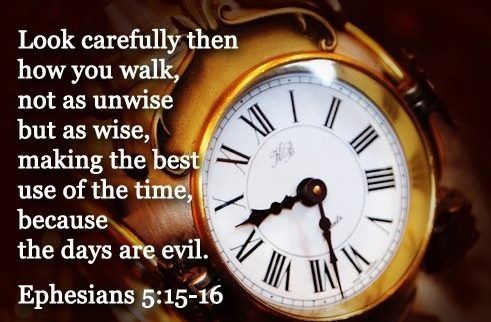
Ephesians 5:15-20 (5:15-16) – August 18, 2024

Can you picture this scenario? A tired mother, towing a whiny, unwilling child behind her in the grocery store, finally bursts out in an exasperated tone, “Will you please just be good?” How many times have you heard that cry? “Stop misbehaving!” or, “Please, be good, for once!” We may even have said it ourselves, to our children, grandchildren, nieces or nephews. Misbehavior is more than just a child’s issue. It’s bigger than that. It’s a larger issue . . . an issue of society in general, even a world issue.

The world situation today is not good. For confirmation, all anyone needs to do is look at a daily newspaper or listen to the nightly news. Misbehavior on a regional or national level. Wars and conflict overseas, violence in every large city in the United States, breakdown of society’s fabric in general, worldwide. I can quote the Apostle Paul from this passage in Ephesians 5 and say that these days are, indeed, evil.

This evil that Paul speaks of is not just generic, abstract evil. This evil is a specific kind of evil . . . in Greek, poneros—evil in active opposition to the good, pernicious. Insidious. Causing ruin. This is the situation that humanity is in without God. Left to our own devices, people will inevitably take the easier, softer way, cutting corners, with no moral compass.

If anyone here is familiar with the book The Lord of the Flies, this story is a prime example of how bad humanity can get. Briefly, the story concerns a group of British schoolboys who are wrecked on a tropical island without adult supervision, since the adults die in the plane wreck. It doesn’t take long before all kinds of evil behavior starts occurring as the boys engage in bullying, gang activity and before long, outright violence.

            Now, this book (later made into a movie) is a fictional account concerning schoolboys who do not have a moral compass. This kind of behavior is a worst case scenario, but it is happening more and more, as we see groups of people all over the world acting more and more amoral. Maybe we see it more and more because of better communications. And, with television and computers, news is beamed to the remotest corners of the world—news of these evil days.

“Though we cannot pretend that evil isn’t real (such a view would hardly be “wise”), this also cannot be the whole story of the world. We know that the world is God’s good creation, and that all days are God’s gifts” [1] – God’s gifts to God’s people!

            This is exactly the audience to whom Paul addresses this letter. The believers in Ephesus were Christians. They did believe in the claims of Jesus Christ. They were walking with God. One of the main themes of this letter is just that: keep walking with God. The Apostle Paul did not soften his words. He knew how difficult and challenging the Christian life can be.

            Paul’s strong words in Ephesians 5 are as much for us today as for believers centuries ago. “Take heed how you order your lives!” or, “Consider how you conduct yourselves!” The Christian life is not just a walk in the park, strewn with financial and material blessings, no matter what the tele-evangelists who promote a health, wealth and happiness gospel seem to say.

            Instead, and this is shown to us again and again in the Apostle Paul’s own life, the Christian life is not a spectator sport. No sitting in a comfy chair, eating bonbons. Life takes some doing. It takes rolling up our sleeves, and not being afraid to do something for God.

            Don’t get me wrong . . . I am NOT saying that we can work our way to heaven, because we CANNOT. No. We as human beings start off by our very nature separated from God, and cannot do anything about our own predicament. Yet, God’s wonderful grace sent God’s Son to redeem us from the evil things we have done, from the evil circumstances in which we find ourselves. And, when each of us believes in that gift of salvation and redemption, God helps us to be wise. God helps us to conduct ourselves in a manner pleasing to God!

            These days are evil, but with the Lord’s help, we can continue to walk in the way of God, not of evil. Yet, it is so easy to get off course. It’s like a ship on the ocean, steered by a rudder. Even if that rudder is off only a tiny amount, it doesn’t make a big difference at first. However, as the ship moves further and further across the ocean from New York City and continues on the wrong course uncorrected, instead of arriving in France, the ship might well end up in Africa! Aren’t we similar to that ship on the wrong course? Even though the course was only very slightly off in the beginning, as time went on and the journey continued, we might end up in a very different place from where we originally thought.

            This is one of the decision points of the letter to the Ephesians. We’re advised to live not as foolish people, but instead as wise people. I know very well how easy it is to become foolish. Sure enough, I do foolish things with great regularity. The Apostle Paul refers to this action as a continuing action.

Foolishness doesn’t just happen once or twice, and then stop. No, we need to keep close to God and keep coming to Him for help. God will help us understand how to be wise! God will help us to understand what God’s will is, too!

            This reminds me of my friend Mike, whose two children are about the ages of my two older daughters, in their late 30’s. Mike is a Presbyterian elder, a retired high school science teacher, and he gave me some words of wisdom some years ago regarding childrearing. He said because he wanted his children to exercise the excellent minds that God gave them, Mike would not tell his children to be good, but instead to be wise.

            Which is easier? Which is more difficult? Which takes more brain power? Being good, or being wise? Being wise takes some brain, some thoughtfulness, and some deliberation. Thank God that God loves us so much – God gave us excellent brains.

We can walk in a way pleasing to God, using the brains that God gave us to be God followers. “To be the awakened and wise people of God means that we can be good and honest stewards of time, so that opportunities to do justice, and to live boldly as God’s reconciled people during this time, are not missed.” [2]  And, the best part of all is that God will help us to be wise! God will give us wisdom, and will help us as we walk each day, one day at a time.

@chaplaineliza

(Suggestion: visit me at my other blogs: matterofprayer: A Year of Everyday Prayers. and  A Year of Being Kind . Thanks!


[1] https://www.workingpreacher.org/commentaries/revised-common-lectionary/ordinary-20-2/commentary-on-ephesians-515-20-4

[2] https://www.workingpreacher.org/commentaries/revised-common-lectionary/ordinary-20-2/commentary-on-ephesians-515-20-4

Unknown's avatar

Written on Our Hearts!

“Written on Our Hearts!”

Jeremiah 31:31-34 (31:33) – March 17, 2024

            Relationships are foundational to life. Positive, negative, distant, close.  Both of my parents are gone now, but I had a loving relationship with both of them. My sisters and brothers—again, I have relationships with them. Members of my extended family, too, are included in my list of relationships. Also my friends, acquaintances, colleagues, even my enemies. All of these people have relationships with me.

Think about yourself. You have relationships with many, many people, too. Most of your relatives and acquaintances I just mentioned, if not all of them. Positive or negative, distant or close. We all have relationships—or friendships—with many people.

            But what about God? What kind of relationship do you and I have with God? Is that relationship good? Even wonderful? Is it close? Or distant? Bumpy at times? Our Scripture reading for today talks about this relationship. The prophet is talking about it from God’s perspective. God’s view of the relationship, or the friendship, if you will.

            If we think about the nation of Israel in the time of Jeremiah, the nation was devastated, and destroyed by the conquering nation of Babylon. The nation of Israel was probably not thinking about keeping up their relationship with God at all – with so much chaos and destruction surrounding each individual, each family, across the whole country.

            Centuries before the time of Jeremiah, God gave the Ten Commandments to Moses, and the whole law code of Moses in the years after that. This law code or rule book was meant to be a structure for the nation of Israel to follow, to live their lives, on a daily basis. And, this structure was a way for them to have a relationship with their God, their helper and deliverer – if they chose to follow God and God’s ways.

            Isn’t that the main problem? The nation of Israel had continuing problems following God’s rule book, God’s law code. Isn’t it exactly the same thing today, that you and I have the same problems following God, too?

            We’re not talking about a distant God, a God Who wound up the universe like a watch, put it on some shelf, and then walked away and promptly forgot all about it. No! The Lord wants to be in a relationship – with us!

            If we look at this reading, we see that God did have a relationship—a friendship, we could say—with the nation of Israel. God was the one Who started it. See what verse 32 says? God took the nation of Israel by the hand when God led them out of Egypt. God wanted the friendship. Israel did not start the relationship.

            We can compare that friendship to God’s relationship with us. God wants us as friends, too!  Just as with the nation of Israel, God goes out of God’s way to make friends with us. You and me. Each and every one of us. God approaches us.

            But something happened. Something awful! The nation of Israel was not a faithful friend to God. The relationship was disrupted, broken. But, God didn’t break it. No! Israel did. Remember the many, many times  in the Hebrew Scriptures that Israel ran away from God? Or forgot about God? Or just plain ignored God? Time after time, we can read about how the nation stumbled, resisted, or was unfaithful to their friendship. Their relationship.

            We can see the number one reason the people of Israel were taken out of the land and sent into exile: because the people broke their Covenant and God’s rule book time after time after time again. That’s the big reason for the nation of Israel’s exile to Babylon.

            What about us? What about you and me, in our relationship with God? Isn’t it a lot the same? Don’t we stumble, or fall? Haven’t we forgotten about God, or even broken God’s rules? I’m thinking of sin. Putting other things in God’s place. Making other things or other people in our lives more important to us than God. 

            Our relationship with God is broken! Disrupted. Sometimes we grow so used to sinning, to being apart from God, that you and I cannot choose to do anything else. What a predicament! Our relationship with God—under the Old Covenant—is gone. Destroyed. We are sunk, there is not a chance for you and for me.

            What about the nation of Israel? What did God do for them? Rev. Sharon Blezzard said, “God does not abandon the people, even when their hearts have turned from God’s divine love and life-giving law. God is faithful and promises to be known – not just in word and in teaching, but in the very DNA of the people.” [1]

            The Lord does not leave us abandoned, either! God still wants to be in relationship with us! With you, and with me. God’s nature is not punishing or arbitrary, but instead loving and forgiving. This forgiveness is heart language, from God. And, God will write this new covenant, this new relationship upon our hearts.

            The foundation of this forgiveness comes from our new knowledge of God, written on our hearts. And what is our response to God’s love? God’s forgiveness? God’s reconciling embrace? You and I have the opportunity to live changed lives, as changed people—from the inside out. God is not willing that anyone should be strangers, but instead that all would have the opportunity to be friends with God. Best friends.

God will be our God. We will be God’s people. And that’s a promise. That’s forgiveness. That’s the opportunity that each of us has to be with God, forever. Amen, and amen.

@chaplaineliza

(Suggestion: visit me at my other blogs: matterofprayer: A Year of Everyday Prayers. and  A Year of Being Kind . Thanks!


[1] https://www.stewardshipoflife.org/2015/03/language-of-the-heart/

Unknown's avatar

“Held Close to God!

“Held Close to God!”

Hosea 11:1-4 – July 30, 2023

            Do you know a family who has a complicated relationship with each other? Some couples and some families have some problems that they deal with on a continuing basis. And how! I see all kinds of things in couples and families right now, in my job as hospice chaplain.

            The prophet Hosea had all kinds of problems in his relationship with his wife and family, too. I don’t know if you know much about the prophet Hosea, but he followed some specific directions from the Lord for his marriage and choice of wife. The Lord told him to marry a prostitute (who would later leave her husband). And, the Lord told Hosea to love her, cherish her and treat her really well (as all spouses ought to treat each other). This was even though – or perhaps because of – her past and future occupation.

Hosea tells a series of stories in this short book – true-life stories, from his own life. The tie-in or connection comes from a very similar story, about the nation of Israel. This true-life story “is that when God’s people were slaves in Egypt hundreds of years before this, God had freed them and led them through the wilderness to a new Promised Land.

“While they were in the wilderness God taught them what it meant to be God’s people. God gave them the 10 Commandments and taught them how to live together and how to love God. It was kind of like teaching a baby to walk. Unfortunately, when they got to the Promised Land the people forgot what God had taught them. They lied. They cheated. They stole from each other. They even worshiped other gods. God loved them too much to let it go on.” [1]

The prophet Hosea was a fascinating story-teller, and he had lots of people in the nation of Israel on the edge of their seats as he told his many-part story from God over a number of years. Hosea has moved on to relating several metaphors or parables. Like this one, here at the beginning of chapter 11.

Remember how I started this sermon? Talking about mixed-up, complicated relationships? That’s what Hosea relates at the beginning of chapter 11. Remember how the people of Israel were slaves in Egypt centuries before this time! Listen again to the words of Hosea: “When Israel was a child, I loved him, and I called my son out of Egypt. But as the saying goes, “The more they were called, the more they rebelled.”They never stopped offering incense and sacrifices to the idols of Baal.”

This child Hosea talks about? This child isn’t just one person. “The child is all God’s people – and they had been really, really rebellious for a very long time. God is about to let them be conquered and taken prisoners to Assyria. It is sort of like God was giving all the people a big “time out.” That’s the secret! “Child” is really all God’s people.” [2]

But first, before mentioning the punishment from the Lord, Hosea gets very tender. Listen to verses 3 and 4. “I took Israel by the arm and taught them to walk. But they would not admit that I was the one who had healed them. I led them with kindness and with love, not with ropes. I held them close to me;I bent down to feed them.”

In this summer sermon series, “Re-Imaging God,” we are looking at a number of Scripture readings which show the nurturing side of God. Or, a loving, mothering kind of God!

While it is much more common for Scripture to show our God as a heavenly Father, especially from the many descriptions our Lord Jesus gives to us while He was here on the earth, the imagery here is very feminine! Can you imagine a mother, teaching her little one how to walk, feeding them, and picking them up when they are hurt or injured? And, what about “leading them with kindness and love?” Our loving heavenly Parent cradling the small child Israel close. All such nurturing, caring activities. Here, Hosea gives his readers a warm, loving word-picture of our Lord. Such tender compassion shown!

Who remembers reading children’s picture books? I am thinking of several picture books I read to my small children many times. These books are about a parent who loves their child very, very much, no matter what! These books – “Runaway Bunny” by Margaret Wise Brown and “Mama, Do You Love Me” and “Papa Do You Love Me,” both by Barbara Joosse –  are wonderful expressions of the nurturing, embracing love we as human parents can show.

Hosea tells us a similar story! He insists that God loves all of the nation of Israel as much or even more than a human parent! Even when the people of Israel go their own way, stubbornly refuse to follow their God, and instead follow foreign idols, and other ungodly attractions.   Our God still loves the nation of Israel! And, our God still loves us, even when we go astray!

I can remember my small children not wanting to come home after a long playtime at the playground in the park. I would call them, and every once in a while, they would try to run away and hide, and refuse to come home. Did I walk away, and leave them there at the park? Of course not! I still loved them, even though they were disobedient. I still continued to love them, as they grew, no matter what.

We need to share a word of caution, however. In some families, relationships are definitely imperfect. Some parents feel the angry rebellion of their children. Some teachers face opposition from their students. And, some mentors want to give up on their charges. Plus, some children have parents who are distant, uncaring, or even hurtful. If that is your experience of your parents or grandparents, I am sad and sorry, and have great compassion for you. [3]

            But, there is Good News! In fact, the Greatest News of all!

Our God will never be distant, or uncaring, and especially not hurtful! Even if human relationships are like that sometimes, our relationship with our Heavenly Parent stands the test of time. The persevering love, caring and nurture of our Lord is rock solid and true. We can trust the faithfulness of God in this story that Hosea tells us. Remember, our God is always faithful, always loving, and always has arms outstretched to embrace us. No matter what.  

@chaplaineliza

(Suggestion: visit me at my other blogs: matterofprayer: A Year of Everyday Prayers. #PursuePEACE – and  A Year of Being Kind . Thanks!


[1] http://worshipingwithchildren.blogspot.com/2016/06/year-c-proper-13-18th-sunday-in.html

[2] Ibid.

[3] https://www.umcdiscipleship.org/worship-planning/prophet-margins/eighth-sunday-after-pentecost-year-c-lectionary-planning-notes

Unknown's avatar

This Light of Mine!

“This Light of Mine!”

Matthew 5:13-16 (5:14) – February 5, 2023

            When most people think of winter in Chicago, I suspect gloomy, cold, gray days come to mind for many people. I know I can see in my imagination dark, chilly, even depressing days with little sunlight and brightness. Sad, gray, gloomy days have an influence on my mood and general outlook, too. Can anyone else relate to this somber kind of attitude?

            As the atmosphere in these cold, frigid days of late January and early February seems to pull people down, down, down, I remember reading one chilly day in January that that particular month must be one hundred days long! Such gloomy, dull and dark days seem to stretch on forever. Thank goodness February is now here, with the coming promise of more sunshine, more light. Indeed, the sun is still shining – we know the sun is surely there, just behind the clouds.

            Right after our Lord Jesus gave His blessings or Beatitudes to the crowds, He talked about some very common, everyday things – like light. In our Scripture reading today, Jesus said to the crowds, “14 “You are the light of the world. A town built on a hill cannot be hidden. 15 Neither do people light a lamp and put it under a bowl. Instead they put it on its stand, and it gives light to everyone in the house.”

            The gray clouds, chilly darkness and sadness may be all around us, sometimes, but Jesus tells us about light. The light of a town, the light of the world. Lighting up the whole house. Jesus says that we – all of us – are the light.

            Lutheran Pastor Janet Hunt talks about a memory she had. “I remember still lying on the floor reading a book as the sun was growing dim. And older family member, an aunt, I believe, stepped into the room and chastised me. “How can you read without the light?” she wondered. Often now, when I turn on the light so as to see to read or to work in the kitchen or to do just about anything, I think of how much more I depend on ‘light’ for things I didn’t used to need illuminated.” [1]         

Carolyn Brown tells us, “Some lights are bright and help us see what needs to be seen, for example, a lighthouse, or a search light. Some lights are soft and make us see the beauty of the world, for example, candles [or gentle lamps].” [2] God’s people do whatever they can to make the world more loving, more caring, and more bright for everyone.

            As commentator David Lose states, “[Jesus] says both simply and directly, “You are the light of the world.” It is, as with the Beatitudes, sheer blessing, commendation, affirmation, and commissioning.” [3]

            Dr. Lose reminds us of the statistics about a child’s self-esteem compared to what kind of messages they hear. When elementary-aged children hear one single negative message about themselves—like, “you’re mean!” “how stupid!” “you can’t do anything right!”—psychologists suggest that the children need to hear ten positive messages to restore their sense of self-esteem to where it had been previously. [4] That is, to correct the internal emotional and psychological damage and balance of the children, and cause them to have a positive, healthy self-image, they need the hear ten positive messages to make up for just one negative, hurtful comment.

            When our Lord Jesus clearly states that we – all of us – are light, that is more than just a wish. That is more than a “I hope so!” or “maybe, it might happen.” No, the rabbi Jesus made a positive, declarative statement when He said “You are the light of the world.”  

What will we sing right after this sermon, as a sermon response? “This Little Light of Mine.” When we hold our fingers up as lights, do you know what that reminds me of? Remember back to Christmas Eve? Every year for the closing hymn of that service, we sing “Silent Night.” We all hold candles and sing. We hold those candles as a symbol or sign of God’s light within each of us, God’s light that shines among us.

            Jesus had a definitive point to His words from today’s Scripture reading. We are light. Right now.

            Children – or teens or adults, for that matter – so often become what they are named. “Call a child ‘bad’ long enough, and he or she will believe you and act bad. Call [them] worthless or unlovable or shameful, and eventually he or she – all of us! – will live into the name we’ve been assigned. In the same way call us good or useful, dependable, helpful, or worthwhile, and we will grow into that identity and behavior as well.” [5]

            That is exactly what Jesus is doing here! He is calling us—naming us—light. We are—all of us—light of the world. The light of a city on a hill, shedding light to the whole community. Yes, Jesus wants us to be that light. He is calling us to grow into that identity and behavior! That same light of God we held up on Christmas Eve? The light of God that came into the world as a Baby born in Bethlehem? This is the same light that Jesus is talking about here. It’s the light of a city on a hill, and the light for the nations, that the prophet Isaiah talks about.      

            We aren’t required to do ten impossible things before breakfast to just break even with God, and try to get in line for a chance to reach for the light. It isn’t hoping that someday, maybe, we might finally become that light. We aren’t hiding our lights under a bushel, either.

We are that light! Now! And, we are holding it high! Why? Because, Jesus says so!

            As Jesus says, “let your light shine before others, that they may see your good deeds and glorify your Father in heaven.” So, go. Be that light. Be that positive affirmation to your family, friends, workmates, and strangers. Let your light shine.

Now, more than ever, take Jesus at His word. Be the light. Amen.

@chaplaineliza

(Suggestion: visit me at my other blogs: matterofprayer: A Year of Everyday Prayers. #PursuePEACE – and  A Year of Being Kind . Thanks!


[1] https://dancingwiththeword.com/you-are-the-light-of-the-world-2/

[2] http://worshipingwithchildren.blogspot.com/2014/01/year-fifth-sunday-after-epiphany-fifth.html

[3]  https://www.workingpreacher.org/dear-working-preacher/salt-light

[4] Ibid.

[5] Ibid.

Unknown's avatar

In Remembrance

“In Remembrance”

1 Corinthians 11:23-26 (11:24) – April 14, 2022

          Many people wonder about Maundy Thursday. Some know it is a part of Holy Week, the final week when Jesus was on earth. It’s also called Holy Thursday, the day that Jesus washed His disciples’ feet. But, many people are not even sure about what “Maundy” means, anyway? “Maundy” comes from the Latin word mandatum (or commandment). It’s used for our Lord Jesus’ words “I give you a new commandment,” spoken at that Passover dinner on the night before the Crucifixion. In other words, commemorated tonight.            

This service tonight is not just for adults – by no means! One of my favorite biblical commentators is Carolyn Brown, a retired Presbyterian Children’s Ministry Director. She notes that, sadly, many congregations do not encourage children or even young people to attend these Holy Week services. “The fact that it is on a school night makes it easy to decide that children will not be able to come and therefore to neither plan for their presence nor encourage them and their families to come.  After a few years of such expectations it takes more than one or two “children are welcome” notes to reverse the trend.” [1]

We are going to celebrate the Lord’s Supper tonight, as is celebrated at many churches. Many congregations and churches do not include children in observing Communion! Why on earth did this happen? Paul reminded his readers that our Lord Jesus commanded His disciples – His followers – to partake or participate in the Lord’s Supper. And, whenever we partake, we do this in remembrance of Jesus! Meals and memory do get all tied up together, don’t they?

Paul wrote to his friends and former church members when he wrote the letters to the Corinthian church. This was a church that was fighting. The congregation members had some serious issues! Looking at Paul’s letter as a whole, people were bickering, arguing, and sometimes even bringing lawsuits against each other. And in the middle of all of Paul’s advice to the church members, he puts this marvelous assurance of the presence of the risen Lord Jesus! Paul also corrects some other practices, like eating in joint congregational meals.

“The supper of unity has become one of disunity. As Paul says, “When the time comes to eat, each of you goes ahead with your own supper, and one goes hungry and another becomes drunk . . . do you show contempt for the church of God and humiliate those who have nothing?” (11: 21-22) The major conflict is between the “haves” and “have-nots,” the rich and the poor, revealing the socioeconomic tension at the Corinthian table.” [2] 
          Talk about problems in the church today! Differences between the “haves” and “have-nots,” conflict between believers of different languages, leaving out the children and the young people, plus fighting between people who have differing (even conflicting) beliefs about the meaning of the Lord’s Supper! What sort of joining together, or unifying demonstration of followers of Jesus Christ is this?

Stories are important on this night. The key story we highlight is the bread and cup of the Last Supper.  But, the failure of the church in Corinth to gather as a loving community to celebrate communion is also important! And, we all need to remember the commemoration of the Passover dinner is also part of this special night. Meals and memory are important!

In the letter to the Corinthian church, “Paul is not talking about the Lord’s Supper as a liturgical rite in a church building. At this point in history, there were no separate buildings for Christian worship. The Lord’s Supper was a meal eaten by a community in private homes, pot-luck style. The Lord’s Supper happened as part of the common meal.” [3]

In fact, some churches do celebrate Communion on special occasions in this way – commonly called a Love Feast, congregations gather around a table for a meal. They break bread with one another, with the Lord’s Supper as a highlight of this meal.

Paul had a concern for the proper eating and drinking of the Eucharist at this first-century common meal: “For whenever you eat this bread and drink this cup, you proclaim the Lord’s death until He comes.” Equally important, Paul wants us to recognize the body of Christ in our brothers and sisters. “To properly discern the body at the table means that we cannot come while leaving others uninvited and unwelcomed, or without mourning their absence. We cannot leave the table and be content to leave anyone hungry. To discern the body in the Supper will send us into the world with new eyes and new hearts, to encounter Christ there.” [4]

We come to the Communion table for a whole host of reasons, then! We give a clear invitation to families to join all God’s people! Everyone hears the stories of the most important days of the year and celebrates this holy sacrament that was introduced on that night.  Remember, “the Eucharist has added power on Maundy Thursday.  Just to be there participating in the sacrament on this night says that I am one of God’s people.”  All of us are God’s people!  Because each of us are welcomed at this table, I belong. You belong. God extends a welcome to each one of us.

Who would Jesus welcome to His table? Each one. Every one. Even you, even me. Amen! 


[1] http://worshipingwithchildren.blogspot.com/2014/02/year-holy-or-maundy-thursday-april-17.html

[2] http://www.theafricanamericanlectionary.org/PopupLectionaryReading.asp?LRID=67

[3] Ibid.

[4] https://www.workingpreacher.org/commentaries/revised-common-lectionary/maundy-thursday/commentary-on-1-corinthians-1123-26-12

@chaplaineliza

(Suggestion: visit me at my other blogs: matterofprayer: A Year of Everyday Prayers. #PursuePEACE – and  A Year of Being Kind . Thanks!

Unknown's avatar

Dance Before the Lord!

“Dance Before the Lord!”

2 Samuel 6:1-5, 14-19 (6:14) – July 11, 2021

            Have you ever been to a worship service where people praised the Lord in all kinds of ways? More than singing hymns and worship songs. I mean, playing all kinds of instruments, dancing before God, and other kinds of artistic expressions. I know some churches regularly have multiple expressions of praise to God, in lots of different ways!

            This full reading from 2 Samuel chapter 6 is a long, extended one. I left out some of the material in the middle, not because it isn’t important. Following God’s explicit instructions and God’s subsequent punishment certainly is important! However, I wanted us to focus on the second part of today’s reading: King David and his joyous dancing before the Lord.

            Have you ever attended a church that had a dance ministry? Where members of that church performed sacred dance before the Lord? I have been a guest in such churches and worship services. This can be a beautiful and expressive way of praising God, and offering up the best of what creative people can give to God. Just as much as singing a worship song as solo or duet can be, or playing an instrument for special music in church.

            Let’s take a closer look at this narrative from 2 Samuel 6. The Ark of the Covenant – or, as our reading says, God’s Covenant Box – had been taken hostage by the Philistine army. That did not go well for them. If you happen to remember the movie made some years ago where the fictional archaeologist Indiana Jones found the Ark of the Covenant hidden away in Egypt, things did not go well for the Nazis who appropriated the Ark from Indy and his friends.  

Meanwhile, the Philistines decided God’s special Covenant Box was too much for them to hold hostage any longer. God convinced them to return the Ark by sending plagues on the Philistines. So, they shipped it back into the land of Israel on an ox-drawn cart with no driver.

King David was so excited to have the Ark of the Covenant back in Israel’s hands. He organized a big procession to bring it back into Jerusalem, his capitol city.

Sadly, I will not have time to take a close look at the sudden death of one of the men entrusted to walk beside the special Covenant Box. Following God’s specific instructions could be a sermon topic all on its own! We are going to continue on to look at the next episode of this narrative: where King David and a whole bunch of priests and Levites – the leaders in charge of all Israel! – dance and praise before the Lord as they march on the way to the Tabernacle.    

I remember several leaders of some churches where I belonged, years ago. I cannot imagine any of these leaders dancing and leaping before the Lord. Either because of embarrassment or pride, anxiety or impatience, or some other emotions altogether, these church leaders probably would never, ever dance in joy before the Lord. Never, ever.

But, our writer tells us that not only David and some priests and Levites dance, but says that eventually almost everyone in Israel joins in! They all join in worship and praise to the Lord. Celebrating God’s special Presence in the Ark of the Covenant, God’s special Box.

  Many people could see the Ark as it was brought into the city. They could sing and march and dance because it had returned from the Philistines. And, the people of Israel could be greatly blessed because now the Ark of the Covenant was back where it belonged, among God’s special people. And, God’s special Covenant Box signaled God’s Presence to all of Israel.

            Today, no one knows where the Ark of the Covenant is, if it even still exists. Nevertheless, God’s Presence is still very much in evidence among God’s people, right now. As one of my commentators mentions, “What symbols, objects or stories help us ‘have eyes to see and ears to hear’ God’s Presence among us? Stories from scripture, such as the exodus from Egypt, can make God present now.” [1]

            What special objects or stories mean a great deal to you? What special objects or stories are all-important to you, so important that you cannot imagine a worship service without them? Some imagine a large cross in the front of the church. Others think of the big Bible on the altar or lectern. Christian worship services often hold special things as quite valuable.

            “The danger, of course, is that the special objects or rituals will become idols in themselves, rather than signs pointing to God-with-us. So we must cultivate dynamic awareness that allows our rituals and objects to act as a sort of hyperlink, moving us beyond them to the larger Presence there.” [2] Just so, today we can connect to God’s Presence in ways that are significant and touch the heart and soul, that are meaningful to each of us – and celebrate others for connecting in ways that are meaningful and soulful to each of them! Whether dancing and leaping, praising in loud voices, praying quietly, singing hymns and songs, drawing and painting, making banners or wall hangings. We humans have a multitude of ways to praise our God!

            What ways are especially meaningful for you to connect to God’s presence?

            Just as David and the other leaders of Israel danced and praised God, we can dance and sing and march. Make some noise, too! Immanuel, God-with-us, the Lord’s Holy Presence is always with us – not just in church. Not just when we open the Bible. We can praise through spiritual practices, through the Lord’s Supper, through God’s beautiful creation, too.

We can all be attentive to God at any time, and at all times. And, the Lord is so pleased when God’s people bring a sacrifice of praise! Praise the Lord!

@chaplaineliza

(Suggestion: visit me at my other blogs: matterofprayer: A Year of Everyday Prayers. #PursuePEACE – and  A Year of Being Kind . Thanks!

(Thanks to Illustrated Ministries for their lesson for the 7th Sunday after Pentecost from 2 Samuel 6, from their 2020 Summer Children’s series.)


[1] https://www.workingpreacher.org/commentaries/revised-common-lectionary/ordinary-15-2/commentary-on-2-samuel-61-5-12b-19

[2] Ibid.

Unknown's avatar

Letter of the Law?

“Letter of the Law?”

Exodus 20:1-17 – March 7, 2021

            I enjoy driving very much. My husband is happy to let me be the primary driver in our house. I used to be a commercial driver some years ago, and I still hold a commercial driver’s license. So, I do know a good deal about the rules of the road.

            What would it be like if drivers did not obey these rules of the road? Just think of stop lights. We all know what happens when cars or trucks run a red light. Accidents happen, and sometimes, people get very badly hurt. All this happens because people just plain break the rules of the road.

            Our Scripture reading today comes from Exodus 20, and is a listing of God’s rules for living – the Ten Commandments. What would happen if people just plain broke God’s rules for living, any time they felt like it?

            One of my favorite Bible commentators is Carolyn Brown. She is now retired, but she was a longtime Children’s Ministry Director in the Presbyterian church. She wondered what would happen if we turned the Ten Commandments on their head, and made them the complete opposite of what God intended? Here are Ten Ways to Break God’s Rules.

1.    You are your own boss.  Do whatever you want to do whenever you feel like it. 

2.    Decide who and what is important to you.  Pay attention only to those people and things. Everyone else can drop dead.

3.    It does not matter when or how you say God’s name.  You can use it to swear or cuss or to get what you want (as in “God is on my side so you better do things my way, or else!”).

4.    It doesn’t matter if you never worship with God’s people on Sunday, or regularly.  If there are other things you’d rather do, go do them.

5.    Parents don’t get it.  Ignore them whenever you can.

6.    Kill whatever or whoever gets in your way.  The strongest live longest.

7.    Don’t worry about your family.  Think only about yourself and what you want.

8.    Finders keepers!  Toddler’s Rule of possession:  I see it, I want it, it’s mine! 
If you want it, figure out how to get it; cheat if you need to.

9.    Lie if you have to get out of trouble. Lie to get what you want.
Lie to make yourself look good – even if it makes someone else look bad.

10. The one who dies with most toys wins.  The world is full of awesome things.  Get your share, no matter what! [1]

            What was all that? Those Ways to Break God’s Rules sound totally selfish, absolutely self-centered, and completely against any kind of moral code or rulebook.

Why did God give God’s people the Ten Commandments, anyway?

“We suppose it is for our own good. Right? Well, you have to wonder. Is God one to bring the whole nation of Israel out into the wilderness for a time out? Is this conversation started with a wag of the divine finger and slow shake of the holy head, displaying disappointment and the prelude to punishment? Are these ten [commandments]given because the people of God have proved unworthy, have fallen short of who they were intended to be? Are they being grounded by these words” like a big bunch of misbehaving teenagers? [2]

            Let’s look at the beginning of the commandments. ”I am God.  I brought you out of slavery in Egypt.  I opened the sea for your escape.  I am the one and only God.  Don’t worship or pray to anything or anyone else.” The Lord tells the people of Israel exactly why God gave them these rules: to help them know how to live together as God’s free people. Not as slaves anymore! No, the Lord brought Israel out of slavery in Egypt: Exodus 20 tells us so!

            God is also warning the people of Israel about the different idols and gods of Egypt. People in Egypt worshiped many different gods. So, to ask the people of Israel who had just left Egypt to worship the Lord – and only the Lord – was a big stretch. A huge challenge! We might think we are only worshiping one God – but, are we? What are our modern-day idols? Do we worship money? Possessions? A job? What about how many “likes” we get on social media? What keeps us from making God the center of our lives? What distracts you and me? [3]

            These rules are not super-strict laws for people to follow reluctantly, or with their arms twisted behind their backs. Instead, as we read them, we can see descriptions of the kind of people God wants us to be. Not because God is a mean or nasty Heavenly Parent, but because we can strive to be that kind of people, the Lord’s relatives, in close relationship with our God.

            Remember, God will not say, “Jump through these hoops, or over these hurdles, and only then will I love you!” No! Instead, God says, “My love for you will shape you into these kinds of people, this kind of loving, beloved community.”    

            Let us strive to live together as a people of faith, as a community loved by God. Amen!


[1] http://worshipingwithchildren.blogspot.com/2015/02/year-b-third-sunday-in-lent-march-8-2015_7.html

Worshiping with Children, Lent 3B, Including children in the congregation’s worship, using the Revised Common Lectionary, Carolyn C. Brown, 2015

[2] https://www.umcdiscipleship.org/worship-planning/rend-your-hearts-claiming-the-promise/third-sunday-in-lent-year-b-lectionary-planning-notes/third-sunday-in-lent-year-b-preaching-notes

[3] https://www.churchofscotland.org.uk/__data/assets/pdf_file/0005/74507/7-March-3-Sunday-in-Lent.pdf

Third Sunday in Lent – 7 March 2021 The Faith Nurture Forum would like to thank Rev Jonathan Fleming, Minister of Cumbrae with Largs St John’s.

@chaplaineliza

(Suggestion: visit me at my other blogs: matterofprayer: A Year of Everyday Prayers. #PursuePEACE – and  A Year of Being Kind . Thanks!