Unknown's avatar

That You May Believe!

“That You May Believe!”

John 20:19-31 (20:31) – April 27, 2025

            Seeing is believing! Or . . . is it? I wonder what things come to mind when I mention the phrase, “Seeing is believing”? Or even, “I won’t believe it until I see it!” Sometimes, people can be really doubtful about things. I can just imagine several people I know folding their arms across their chests and saying, “Unless you show me . . . “

            In the gospel account we read today, from John 20, the disciple Thomas had just that reaction. After the resurrection, the first time Jesus came to the disciples, Thomas was not there. We’re not told why, simply that he wasn’t there. Maybe he was scared, maybe he was away, or out of town. Maybe he was sick. We just aren’t told why he wasn’t there.

            The ‘why’ is not the important part. The fact that Thomas wasn’t present is. Thomas had doubts. Sincere doubts. Truth to tell, the other disciples’ story was a little farfetched. I mean, how many people have you known who came back from the dead, and walked through walls into a locked room?

            I wonder. I wonder if Thomas’ reaction strikes a chord with anyone here today. How many of us today are like Thomas? Doubting that Jesus has risen indeed from the dead? Or, completely missing Jesus, and doubting that Jesus is even here at all, today?

            Let’s think some more about Thomas and his reaction. Thomas not only doubted, he wanted concrete proof. Tangible proof, proof he could touch and feel and handle. Thomas wanted to put his hands in the nail marks on Jesus’ hands. That’s pretty concrete.

            As I thought more about Thomas and his reaction and attitude toward Jesus and His first appearance to the disciples, the Gospel of John is not clear at this point. We as readers don’t know why Thomas had difficulty believing. But the gospel account says he did.

            How many of us today are like Thomas? Not sure? Not believing? Closed up behind the locked doors of feeble faith? Not believing that Jesus can make a difference in our lives today? Could Jesus come and reveal Himself to Thomas? Can He come and reveal Himself to those today who are fearful, doubting, and unbelieving? . . . Can He reveal Himself to me?

            Perhaps Thomas had difficulty finding something to believe in, since he had so recently seen his Master and Teacher arrested and crucified. Grief, fear, anger, dashed hopes, shattered dreams. I strongly suspect several, if not all of these, were operating in Thomas’ life at this time.

            These strong feelings and emotions inside are intense, and raw. From what is known today about the stages of grief, Thomas could have been feeling awful, and angry, and upset. Thomas could have felt his life was falling apart. But Jesus can break through all of that. Jesus could enter Thomas’ life with new hope, standing right in front of him. In the same way, Jesus Christ can enter through the closed doors of our hearts, meet us where we are, with open arms.

Just as Jesus did not leave Thomas high and dry, to figure things out on his own, so Jesus will not leave us. Our Lord came to Thomas in the upper room, despite his doubts and unbelief, and Jesus also comes to us in our doubts, and in our unbelief.  “The resurrection is among us, whether we see it or not. The resurrection is all around us, whether we recognize it or not. The resurrection is in the midst of us whether we are able to point to it or not.” [1]

            Now, Thomas didn’t actually see Jesus, at first. He had just heard from others who had seen Jesus. But then, a second time, the risen Lord appeared to the disciples. Again, in the locked room, and this time, Thomas was there. What were Jesus’ words to Thomas? “Put your finger here and see my hands. Reach out your hand and put it in my side. Do not doubt, but believe.”

            Thomas responded with that tremendous affirmation, “My Lord and my God!”  Praise God for the sincere, heartfelt response of Thomas.

            Jesus’ words to His doubting disciple serve as words of comfort and reassurance to me. I know I have doubts, sometimes. And just as Jesus did not leave Thomas doubting, so too, Jesus will not leave me doubting, either. He will welcome me with open arms, coming through the locked doors of my fear, anger, doubt and unbelief.

            Thomas saw Jesus. Seeing was believing, in Thomas’ case. And then, the risen Jesus continues with the statement, “Have you believed because you have seen me?” Here’s the best part of all. “Blessed are those who have not seen and yet have come to believe.”

            What was that Jesus just said? Did I read that correctly? “Blessed are those who have not seen and yet have come to believe.” So—the Gospel of John says here that all who have not actually seen the risen Lord and yet have come to believe are indeed blessed.

            That means Christians throughout the centuries are blessed, since they have come to believe in Jesus Christ and yet have not actually, physically seen Him as risen from the dead. That means you and I are blessed, since we have come to believe in Jesus Christ, too. How awesome is that? We are blessed because the Lord Jesus says so!

            Just in case we didn’t quite understand where the evangelist was coming from the first time, verses 30 and 31 of John 20 underline this concept. “Jesus did many other signs in the presence of His disciples, which are not written in this book. But these are written so that you may come to believe that Jesus is the Messiah, the Son of God, and that through believing you may have life in His name.”

            Just as Jesus helped Thomas to believe, so the Gospel of John helps us to believe, too. This Gospel was not only written to bear witness so long ago, in the first century, some years after Jesus was raised from the dead. This Gospel was also written for the many generations which have come to believe throughout the centuries. That includes us, too.

Plus, Jesus does not mean for us to hide this Good News and keep it for ourselves. We all are “to be involved and engaged with the communities around us, in which there are the lives of many who do not yet know the Gospel. We respond to them with loving service, walking alongside them and sharing Jesus with every step.” [2]

Even though we may have doubts, and unbelief, and wonder whether, and why, or even why not, Jesus comes to us in our doubts and unbelief. Our Lord comes to all of us with reassurance and open arms and says “Do not doubt, but believe!”

            Praise God that as we come to believe that Jesus is the Messiah, we can have life in His name. Jesus can come to us, at any point in our walk with the Lord, no matter what the circumstance happens to be, no matter where we are in our lives. Thank God that Jesus will be there for us and with us, no matter what. May we all be able to affirm, with Thomas, that the risen Jesus is our Lord and our God.

            Alleluia, amen.

@chaplaineliza

(Suggestion: visit me at my other blogs: matterofprayer: A Year of Everyday Prayers. #PursuePEACE – and  A Year of Being Kind . Thanks!


[1]  https://www.workingpreacher.org/dear-working-preacher/when-seeing-is-believing

[2] https://www.churchofscotland.org.uk/worship/weekly-worship/monthly/2025-april/sunday-27-april-2025-second-sunday-of-easter-year-c

Unknown's avatar

Who Has Seen the Lord?

“Who Has Seen the Lord?”

John 20:1-18 (20:18) – April 20, 2025

            Who doesn’t like to hear a good story? Storytellers are wonderful to listen to. Small children love to hear stories. Even grown-ups enjoy stories. Certain stories are told over and over again, in different ways. Cinderella. King Arthur. The Arabian Nights. Aesop’s fables. Even the Wizard of Oz.  What about The Greatest Story Ever Told? That’s another name for the narrative of the Passion Week, following Jesus step by step from Palm Sunday through Good Friday, finishing up with the happily ever after ending on Easter morning! 

            We left Jesus on the cross, on Friday afternoon, when last we saw Jesus on Good Friday. Jesus had walked through the days of Holy Week, debating with the Pharisees and other Jewish leaders in the Temple. He had eaten a Passover dinner with His disciples on Thursday evening. The special thing Jesus did on Thursday was instituting the Lord’s Supper with the bread and cup of the Passover meal. Do this in remembrance of Me, He said.

            After dinner, Jesus went to the Garden of Gethsemane to pray. He wanted His disciples to keep watch with Him, but they were too exhausted. After the events of a very busy week, just think. The disciples couldn’t keep their eyes open!

            Then the events follow in rapid succession. The arrest, torture, trials, and sentencing. The walk down the Via Dolorosa, the Way of Sorrow. Jesus dragging the cross outside the old city of Jerusalem. The disciples fled. (I won’t blame them—since their Rabbi was sentenced as a criminal and enemy of the state, I suspect the disciples were afraid they might be connected with their leader Jesus, too!) We see the women at the foot of the cross. The faithful women. And Jesus’ mother, Mary. Then—Jesus dies on the cross. The earth quakes, the sky darkened. All creation mourns as the Word made flesh, the creator of all the universe, dies on the cross.

            As we continued to follow the Greatest Story Ever Told, Jesus is taken down from the cross shortly before sunset. His body is turned over to one of the Pharisees, Joseph of Arimethea. Joseph hurriedly lays the dead body of Jesus in a tomb nearby. And, the faithful women are also there. What faith they must have had! What tenacity, and what love. The women disciples follow their leader, their rabbi, their Lord and master, even though He’s dead. To care for His body, in the absence of the disciples – the men disciples who are in hiding.

            The women are there. Not shunted aside, not put in second place. These faithful women disciples play an important role in caring for their Rabbi and their friend, hurriedly washing and preparing His dead body for the grave, before the Sabbath begins at sunset.

            As Friday night swiftly approaches, with it comes the Jewish holy observance. Especially this special Sabbath—which falls during Passover. No work is to be done at all on this holy day of rest, not even the compassionate work of caring for a dead body.

            After Sabbath day and Saturday night end, it is now Sunday morning. Faithful Mary Magdalene heads out for the tomb even before the sun has fully risen. Can you see her, eager in her haste to get to the tomb? With some oils to anoint the body? As she comes near the tomb, she discovers the stone has been rolled away. The tomb is now empty. What happened? Mary runs to get some assistance, someone to come with her and check things out more fully.

            Sure enough, Mary tells what she discovered. Two of the—men—disciples come back with her. Mary returns with the other two, back to the tomb. They see the tomb, and sure enough. It is empty. And then, these two men disciples turn right around. Go back to the rest. In hiding.

            But—what about Mary? What does she do? Again, I come back to the indisputable fact that the women disciples are faithful and true. What a roller coaster ride Mary has been on. Starting on Palm Sunday, their leader Jesus marches right into the lion’s den, right into Jerusalem itself. All through the Passion Week, Jesus appears in and around Jerusalem, in the Temple, doing anything but keeping a low profile. I am certain the men and the women accompanying them knew very well that the Jewish leaders were planning on doing bad things to Jesus.

The women disciples show compassion, love, and care for their Rabbi, their master and friend. Mary stays put near the tomb. Jesus had been her best friend and her teacher. After she met Jesus, her life was different – and lots better! But now, Jesus had been killed and buried. Not only that, it appeared that someone had stolen his body. [1]

            At this desperate point, early on Sunday morning, Mary weeps. She does not know where her Lord and Master’s body has gone! After many days and nights of worry, anxiety, strong emotion, and intense grief, I can well understand how Mary broke down in tears.

            What about us, today? Have you ever been through days of intense emotion, gut-wrenching anxiety, even intense grief? All of those feelings tumbling and roiling through you? Then you know a little of what Mary was going through.

            What Mary did not suspect at first was that she was in the Greatest Story Ever Told. She sees Someone through her tears. She suspects this Person is the gardener, of all things! She says, “Sir, if you have carried him away, tell me where you have put him, and I will get him.” 

            Then, Jesus—for it is He!—Jesus speaks to her. Jesus calls her by name. “Mary!”          Do you hear that? Jesus calls her by name. “Mary!” How sweet to have someone who loves you very much call you by name! Remember, I just said that Mary had been on an emotional roller coaster the whole week previous? Just think what this would do! Wow! Mary’s eyes are opened. Mary finally sees clearly, and responds, “Rabbi!” “Teacher!”

            There’s a word in the next verse that is sometimes misunderstood. In verse 17, Jesus tells Mary, “Do not hold on to me.” In the original language, Greek, the word ‘hold on’ or ‘touch’ is a present imperative verb. The verb in the sentence can be translated “Do not keep touching me!” Mary realizes that it was really and truly Jesus, in the flesh. I suspect she fell on her knees and grabbed onto His legs with every ounce of strength in her body. Clutching, crying, laughing. Can you just see her? Jesus, gently trying to get her to let go. “Mary, can you stop clutching at Me?”

            Can you see Mary now, as she understands in full. Jesus is alive! He is risen! She listens to Jesus, returns to the disciples, and declares the joyful truth to everyone!

            Mary is not only a faithful friend and follower of her Rabbi, she is also someone who carries the Good News! The news that Jesus is no longer dead, but He is risen! He is alive again. I want all of you to understand this all-important point. Jesus has entrusted Mary with the Gospel message. She is a preacher of the Good News!

Mary Magdalene is no longer just a supporting player, just a side note in the Gospel. Instead, she transitions to a lead actor in the Greatest Story Ever Told, here in John 20. And, one of the first and best preachers, sharing her experience, hope and joy.

            What a story! Except—this is not make-believe. This is for real. This is very much the truth. Yes, our risen Lord Jesus is alive. Yes, He is Lord. And, yes, He has conquered death once and for all. Do you hear? Listen again to the words of the disciple Mary. She told the disciples, “I have seen the Lord!”  

I pray we all can affirm together today: He is risen! Christ is risen, indeed!  

Alleluia! Amen!

@chaplaineliza

(Suggestion: visit me at my other blogs: matterofprayer: A Year of Everyday Prayers. #PursuePEACE – and  A Year of Being Kind . Thanks!


[1] https://worshipingwithchildren.blogspot.com/2016/02/year-c-easter-sunday-march-27-2016.html

Unknown's avatar

Hosanna to the Messiah!

“Hosanna to the Messiah!”

Luke 19:28-40 (19:37) – April 13, 2025

            Have you ever been at a really big celebration? I mean a public celebration—like a ticker-tape parade, a celebration of a world championship, or the visit of an A-list celebrity? Something really, really big?

            From all the descriptions of the Palm Sunday Triumphant Entry in all four Gospels, that’s kind of what we are looking at today in our scripture passage. The celebration is really big, the Rabbi Jesus was a big-name celebrity, and this entry into Jerusalem was a first-century type of a ticker-tape parade. Except with palms!

            Let’s take a closer look. Here’s the situation: It’s almost Passover, the most important religious observance of the year. A great number of faithful Jews from near and far come to Jerusalem, in pilgrimage, in commemoration of the Exodus event. 

Jesus comes, too. He publicly, intentionally enters Jerusalem, even though the religious leaders are not very pleased with Him or what He has been doing for the past few years. Even though Dr. Luke does not mention the prophecy in the book of Zechariah (which the other Gospels do), Jesus’s disciples must have known about the prophecy of an entry into Jerusalem riding on a donkey. This was clearly a scene with “Messiah” written all over it.   

And Jesus does not sneak into the city, all hush-hush. No! He comes in with a parade! With crowds of people waving palms and shouting “Hosanna!” and “Blessed is the one who comes in the name of the Lord!”

            What is the meaning of those cries of “Hosanna” and “Blessed is the King?” If we look at Psalm 118, we’ll find these words written by the psalmist. This was the usual Passover greeting one person would give another, except with the addition of the word “King.”  Just to let you all know, many of the crowd in Jerusalem on that Palm Sunday morning understood what they were quoting—they were intentionally welcoming someone they hoped would be their Messiah, their King! Someone who would save them from the awful situation they were in.

            There was a disconnect between the people and their limited understanding, and what Jesus actually was going to do. But I’m getting ahead of myself by rushing on to later in Holy Week. We are still here on Palm Sunday. And everyone is still excited to welcome the Rabbi Jesus—their hoped-for Messiah—into the city. They are hoping He will save them from the Romans and maybe, possibly, become their King. Except they had an earthly King in mind.

            But let’s read on in our scripture passage for today. Luke makes another striking statement. He starts to mention “peace.” “Peace in heaven, and glory in the highest!” What on earth is Luke mentioning “peace” for?

This sentence is an echo of the Gloria in excelsis Deo that the angels—the heavenly host—sang at the birth of the baby Jesus, several decades before. I know the heavenly host gave the shepherds good news of great joy, but wouldn’t that be good news for anybody? I know that was good news at the time Jesus was born, but isn’t that good news for today, as well? Peace? Glory in the highest? The difference is that at Jesus’s birth, it was peace on earth. Now, the crowd is saying “Peace in heaven.”

            So when Jesus enters Jerusalem, the crowd prays for peace in heaven. But the coming of Jesus causes a division. It causes anything but peace on earth.

            The theologian Tom Mullen makes this statement about his denomination (Society of Friends or Quakers): “They work for peace—and if you really want to cause conflict, you work for peace.” [1]  So it was for the Rabbi Jesus—the Messiah Jesus riding into Jerusalem. For all that Jesus wanted to bring peace, He and His message created division, tension, and crisis—as seen by the violent reaction of the religious leaders.

            I wonder about this tension, this violent reaction, this great desire for peace, yet a creation of division, tension and crisis. I know I have mentioned the Rev. Janet Hunt many time before in my sermons. She likewise ponders as we begin Holy Week, “If Jesus were to ride into my town today, what would be His means of transportation? What signs and symbols would speak today?” [2] The donkey was not the choice for a conquering King entering His capital city! The donkey was definitely a subversive choice for the Messiah, the Rabbi Jesus.

            I am not even going to explore what signs and symbols would display a Kingly entrance into a city today, except to say a royal entry usually entails a large police presence, a security detail, and lots of SUVs and a limousine for the royalty to ride in. Not so for the Rabbi Jesus!

Thank God, Jesus does not do that! He is more powerful than any division, any tension, any crisis. He entered the city not as an earthly King, not as a conqueror, not to set up a nationalistic empire, but as the True Redeemer of Israel. And not of just Israel, but also of the whole world. This Holy Week is where all of the prophecies focus to a fine point, and reveal the Rabbi Jesus as not only the Messiah and King, but also as the Suffering Servant. The Lamb of God, sent to take away the sins of the world.

            As we remember this Passover time, this Holy Week, we can thank God that our Lord Jesus did enter Jerusalem. As a King, as a Messiah, yes! But also as our Redeemer and Savior. Praise God, Jesus is our Redeemer and Savior, just as much as He was Redeemer and Savior for that crowd in Jerusalem on that Palm Sunday. In the first century, Jesus came to save His people from their sins. Praise God, He came to save us, too! Amen! And amen!

@chaplaineliza

(Suggestion: visit me at my other blogs: matterofprayer: A Year of Everyday Prayers. #PursuePEACE – and  A Year of Being Kind . Thanks!


[1] Mullen, Tom, Laughing Out Loud and Other Religious Experiences, (Friends United Press, Richmond IN: 1989) 50.

[2] http://words.dancingwiththeword.com/2016/03/the-donkey-subversive-choice.html

Unknown's avatar

Who is Hallowed?

“Who is Hallowed?”

Philippians 3:4-13 (3:8) – April 6, 2025

            When I was in grade school, I used to read the encyclopedia and the dictionary. My grandfather was kind enough to buy my family a multi-volume World Book encyclopedia, and we got the yearly supplements, too! My love of words and desire for information goes back a long ways, and when I was in school, I used to read these reference books regularly, curled up in the arm chair in my parents’ living room!

          We are going to highlight “Hallowed be Thy name” as our section of the Lord’s Prayer for this week. Holy, or “hallowed” is what we say about God and God’s name every time we pray the Lord’s Prayer. I would like us to consider the word “Hallowed.” It’s quite an old-fashioned word! But, before we get to that definition for “Hallowed,” let’s take a closer look at our Scripture reading for today.

The apostle Paul is writing a thank-you letter to the church in Philippi. That’s his primary reason for writing this letter. At the beginning of chapter 3, he is just winding up into one of his great declarations. Do you know someone who boasts and brags a lot? Of course you do! I do, too. We can roll our eyes, or be really impressed, or somewhere in the middle. Paul right here is really bragging – a lot! At the beginning of this reading, Paul ticks off all the things that make him a super special Jewish person. For real!

          The apostle Paul (who often uses run-on sentences) goes on and on about himself, how much of a super Pharisee and righteous Jew he is, and even filled with great zeal for God. He is single-minded for the Lord! All God, all the time! But then—Paul comes to a complete stop. He says all of his marvelous resume is completely worthless, compared to the mega-awesome, super-special magnificence of knowing his Savior Christ Jesus his Lord. 

Listen: “But whatever were gains to me I now consider loss for the sake of Christ. What is more, I consider everything a loss because of the surpassing worth of knowing Christ Jesus my Lord, for whose sake I have lost all things. I consider them garbage, that I may gain Christ and be found in him, not having a righteousness of my own that comes from the law, but that which is through faith inChrist.”  

Paul – Saul that was – found his own self-righteous actions and trying to make himself righteous enough for God just did not work. There was no way he could earn enough “brownie points” to be acceptable to God.

In other places in the New Testament, Paul describes what an awful mess he was in when he realized this! The Pharisee Saul had lived his whole life acting self-righteous, putting on a show. Here, in Philippians, Paul cuts straight to the chase. He tells us he no longer trusts in himself or his qualifications. Instead, he trusts in Christ! Absolutely, one hundred percent.

We could consider Paul a boastful, self-important guy! I mean, telling us all of those high and mighty things about himself. And yet – look where he comes down. Remember, Paul writes from the perspective of one who has made a commitment to Jesus; and not just the human Jesus, either.  When our Lord and Savior Jesus appeared to Paul on the Damascus Road, that was a huge earthquake of an experience. The apostle Paul gives fascinating autobiographical details about himself, but then says all of that is worthless – garbage! compared to the ultimate joy of knowing Christ Jesus his Lord. Or, is that Christ Jesus our Lord?

Paul actually uses a swear word here, in verse 8. “I consider everything a loss because of the surpassing worth of knowing Christ Jesus my Lord, for whose sake I have lost all things.” – meaning, putting aside all his training, and superior resume, and everything else – “I consider them garbage, that I may gain Christ.” We might think of a four-letter swear word to use here instead of “garbage,” and that is exactly what Paul uses in the original Greek. He wrote this letter from jail in Rome. Even still, Paul speaks of the ultimate joy he has, knowing Christ!

            Let’s come at this another way. As a believer, Paul regards “everything” – his impeccable resume, his high position in Jewish society, his self-righteous striving to make brownie points with the Lord – of absolutely no value, in comparison with the far greater worth of knowing Christ. Experiencing and understanding Jesus Christ comes first of all, and is of far greater value to him!

We circle around, back to the phrase we are highlighting today, from the Lord’s Prayer. In this church, we pray it every Sunday. We are lifting up “Hallowed be Thy name” today. That quaint, old-fashioned word “hallowed.” But, what does this word really mean?

The retired Director’ of Children’s Ministries and commentator Carolyn Brown compared hallowed to the words awesome, special and wonderful. This is the very, very, very best. When we say “hallowed be Thy name,” those are words that can be applied only to God. Every time we pray the Lord’s Prayer, just like the apostle Paul, just like Mary of Bethany from today’s Gospel reading, we are saying “God, You are holy, You are the very, very, very best there is in the whole universe.” [1]

            Sure, only a small portion of Christians have a sudden, thunder clap of a Damascus Road encounter with the Lord Jesus Christ, like Paul did. Yet, we all name Him holy – or, hallowed. Don’t we? We all pray the Lord’s Prayer, don’t we? 

Life was certainly no walk in the park for Paul, especially here. Yet, we can almost feel his joy right through the printed page. Even though, hardship – yet, there was joy! Even though, trials – yet, Paul felt joy! Even though, sickness – yet, Paul and his friends were joyful!

You and I are probably not in the happiest of places right now, with stress, uncertainty and anxiety all around us. Yet, Paul reminds us, we can experience joy in knowing Christ, the very, very, very best Person in the universe! If we place our trust and hope in Jesus Christ, His joy is available to us, any time! What a marvelous promise. Be joyful in Christ Jesus. Hallowed be His name. Amen.


[1] https://worshipingwithchildren.blogspot.com/2016/02/year-c-fifth-sunday-in-lent-march-13.html

@chaplaineliza

(Suggestion: visit me at my other blogs: matterofprayer: A Year of Everyday Prayers. #PursuePEACE – and  A Year of Being Kind . Thanks!

Unknown's avatar

How Different are God’s Thoughts?

“How Different are God’s Thoughts?”

Isaiah 55:1-3, 6-9 (55:2) – March 23, 2025

            Sometimes, I get really, really busy. Involved. Even distracted. Doing a lot of things, sometimes attempting even more than I could possibly ever finish in one day. Sometimes, when I get really involved in things or activities, I don’t even think about God for whole stretches of time–for hours, sometimes even days at a time. Sometimes, I discover I don’t even look for the Lord. I don’t even concern myself with finding God. And every once in a while, I don’t even want to go looking for the Lord.

            I certainly admit it. I have been less than a perfect Christian. There have been numerous times when I’ve forgotten to pray, neglected to study the Bible, sidestepped communication with God. I definitely haven’t hit a bull’s eye in my personal Christian walk 100 percent of the time. I do freely admit it. I have a sneaking feeling that I’m not alone. If we were to admit it to ourselves (and even admit it to a few other people, too!), I suspect we would find a number of honest, repentant people, confessing where they have fallen short in their Christian lives.

            That’s bad news! What can we do about that??

            Looking at our scripture reading for today, I can find several things that may help us out when we consider a big problem like falling short in our lives before God.

            Let’s take a closer look at verses 6 and 7. “Seek the LORD while he may be found, call upon God while he is near;” Whoa! The Lord is closer than I thought! God’s right here, johnny-on-the-spot! I have a sneaking suspicion the Lord is right next to me, whenever I look for Him. And I have a feeling God will be right there, immediately, whenever I call.

            While I was writing this sermon, I was reminded of the times I played hide-and-seek with the neighborhood kids when I was young. I bet most of you have played hide-and-seek at one time or another, too. When I was seeking the other players, I knew the object of the game. Look for the other players. I understood what I was supposed to do.

            But, there’s a problem here in the scripture passage, in Isaiah 55:7. The prophet mentions the wicked, who pursue their own wicked ways. They are not following after the Lord. They are not even close to doing what the Lord wants them to do. These wicked people don’t even know what they’re missing. They don’t care about the object of the game. “Let the wicked forsake their way, and the unrighteous their thoughts.” These wicked people, these unrighteous guys are even thinking bad thoughts, thoughts that are not pleasing to the Lord!

            Again, that’s bad news! What can we do about that??

            I’ve been talking about some pretty negative people, and some pretty negative actions, where some people actively go out of their way to be disobedient and disruptive. Some people are like that. The Bible often talks about those kinds of actions and that particular kind of people

            Now, I’ll go off in a slightly different direction—still away from the Lord, but just different. Sometimes, other people get the “busy-sickness.” You know the type. Running around like chickens with their heads cut off.. In a dad-blamed hurry, frantic, running, rushing and dashing around, sometimes even without any clear direction. Sometimes their thought-life (our thought-life?) can be the same way—scattered, rushed, not able to concentrate.

            What’s more, in this culture of consumer abundance, we can become preoccupied with our belongings, with our “stuff.” This sneaky kind of mind-set can sneak into our brains! What we possess and what we think we “need” can be a source of control.[1] Sometimes it can really be difficult for me – for you – for us to figure out what we truly need. Sadly, it’s often something that redirects our minds away from God, which is never good!   

            Again, that’s bad news! What can we do about that? What do you think the Lord might say to those people? What do think the Lord might say to us, to you and me?

            I see the answer right here, in verses 7 and 8. The prophet tells us straight out. “Let them return to the LORD, that he may have mercy on them, and to our God, for he will abundantly pardon.” Mercy! Pardon! To me, that sounds an awful lot like GRACE. The Lord wants us to return to Him! The Lord IS gracious! The Lord WILL abundantly pardon! I don’t know about you, but I think that is exciting news.

            I had a general idea of what “pardon” meant, but I wanted to find out the exact meaning. According to Webster’s dictionary, pardon means “to excuse or forgive an offense or penalty.” Wow!! That means even if I do something wrong, or think something I shouldn’t, in God’s eyes, God will abundantly pardon me–God will forgive me!! And God will abundantly forgive you, as well! That’s truly good news!

            Here in Isaiah 55, as we say thank you to God for that marvelous pardon and forgiveness, we also see God providing good gifts for us. The phrase we highlight from the Lord’s Prayer is “Thy kingdom come, Thy will be done.” With as often as we pray the Lord’s Prayer, I suspect God would be really pleased if we took this part of the prayer seriously.

We know what many of the things that please God look like. We can even make a list! As we consider God’s good gifts, and God’s kingdom, there will be food for everyone, everyone feels loved and loves others, people find ways of settling problems other than war and fighting, and when people hurt each other, people forgive each other.

            We can praise God that – just as in verse 5 where God pours out on God’s people the blessings God promised to King David – the Lord will pour out those blessings on earth! Just as these blessings are true every day now in heaven, they will one day soon be true upon earth. Especially if we all work to make these blessings and love and caring for each other happen! [2]   

            God will be there for us when we need it! God will forgive, and have abundant grace and mercy and pardon for us, and we can count on that! We can have the assurance that as we come near to the Lord, the Lord will draw near to us! What a promise. What a God. Amen.

@chaplaineliza

(Suggestion: visit me at my other blogs: matterofprayer: A Year of Everyday Prayers. #PursuePEACE – and  A Year of Being Kind . Thanks!


[1] http://www.word-sunday.com/Files/a/18-a/FR-18-a.html

[2] https://worshipingwithchildren.blogspot.com/2016/01/year-c-third-sunday-in-lent-february-28.html

Unknown's avatar

Under His Wings

“Under His Wings”

Luke 13:31-35 (13:34) – March 16, 2025

During this season of Lent, our focus is on love.

When we think of the animal kingdom—and let’s broaden that to all birds and beasts, all creatures great and small—how does love fit into the picture? Picture this. A mama cat or dog, licking and cleaning her little ones. A mama horse or elephant or dolphin, feeding her baby. A mother hen on her nest, spreading out her feathers, her wings, to keep her chicks warm and safe at night. All loving and caring pictures. All maternal. Motherly. 

When we think about God and God’s actions, maternal and motherly images are not necessarily the first things that pop into a person’s mind.  

This little, short Scripture reading from Dr. Luke today really packs a lot into it! Just four verses, and, my! We start with some Pharisees, coming to warn the Rabbi Jesus. Many Pharisees were part of the Jewish leadership, which generally did not look very kindly upon Jesus. However, these particular Pharisees warned the Rabbi Jesus that King Herod was out to get Him, and there is definitely trouble ahead!

This is one of the times that Jesus is reported calling someone a name, and probably (knowing what we know about Jesus) His words were ironic. Jesus says, “Go and tell that fox: ‘I am driving out demons and performing cures today and tomorrow, and on the third day I shall finish my work.’” The appellation “that fox” most probably meant “that wily, scheming person!” All of which was true, concerning King Herod!

Except, we are not going to focus primarily on foxes for our sermon today. No, we are going to continue on in our reading, and examine more closely what Jesus says and does next. But, just one mention first – Herod was someone who did a lot of evil things!

I said last week that we will look at a phrase (or petition) of the Lord’s Prayer each week in Lent. This week we think of “Deliver us from evil.” As we consider nasty King Herod and his evil clutches, being delivered from Herod certainly qualifies as being delivered from evil! But, that is this particular situation, with the Rabbi Jesus. There are plenty of other evil things and evil people in the world, more than enough to go around!

A clear, simple definition of evil is “bad stuff.” When we think of all the bad stuff we need to be saved from, we can come up with quite a list! Bullies, diseases, war, unemployment, natural disasters, anger and bitterness, being greedy. And that is hardly scratching the surface of all the evils that can happen! One of the best, straight forward translations of this part of the Lord’s Prayer is “Lord, save us from all the bad stuff that happens.” [1]

As our commentator on Psalm 27, Beth Tanner, says, “With all of the violence in our world, Christians are faced almost daily with a decision to live in fear, or despite their fear, to trust in God and God’s promises.“ [2]  “Deliver us from evil” is a powerful prayer! A prayer of trust and assurance in God’s provision, in God’s ability to keep us safe, whatever our situation.

Which brings us to the other image Jesus brings up in this short Gospel reading. Jesus says, “Jerusalem, Jerusalem! You kill the prophets, you stone the messengers God has sent you! How many times I wanted to put my arms around all your people, just as a hen gathers her chicks under her wings, but you would not let me!”

In my imagination, I can just see our Lord Jesus, on a hill looking down on a large portion of the city of Jerusalem. His heart is broken, and He says these very sad, very heart-breaking things about the city – and about the residents of the city. And by extension, about the Jewish people. Here is a very maternal, motherly image, “just as a hen gathers her chicks under her wings.” Jesus sees Himself as the loving, caring, nurturing mother hen!

When many people think of our Lord Jesus, often the images that come to mind are strong and mighty. The Lion of the tribe of Judah. The Messiah, the King. The Son of God, the Miracle Worker, the Lord Jesus Christ. All strong, powerful images!  

One of our commentators, Karoline Lewis, reflects that women are made in the image of God just as much as men are. She goes on to say, “if you rarely, if ever, hear about God’s femininity, female images for God, or female characteristics of God, then even that biblical truth will be hard to believe. And, if God is mostly assumed to be male, referred to with male pronouns, and described as male, then it will be more difficult and take more energy to imagine God in female categories — and to believe that you have a place in the kingdom of God.” [3]

I am reminded of the summer sermon series I preached in 2023, where I featured many of the maternal, motherly images of God in both the Hebrew Scriptures and the New Testament. This mothering image used by our Lord Jesus in Luke 13 reminded me of a newer hymn, found in several newer hymnals. The lyrics for hymns are often theological, moving and stirring, emotionally and intellectually. Here is the first verse of a hymn called “Mothering God.”\

Mothering God, you gave me birth / in the bright morning of this world.

Creator, source of ev’ry breath, / you are my rain, my wind, my sun. [4]

Of course God has male attributes and characteristics. God also has female attributes and characteristics, as we can see from this motherly word picture that Jesus uses!

            Jesus welcomes us into His embrace, into His community of love and caring. Just as a lost little chick who finally finds the way home into the nest, into his or her mother hen’s warm feathery embrace, so we can find our way into a community of caring, love, nourishing and belonging. I hope our church community extends that caring and loving welcome to everyone. Jesus wants us to know that we are welcome with Him, always.  

            Are you still searching for that community of belonging? That warm, caring place? I pray that we all may find it. Not only here, in this community, but especially in the embrace of Jesus.

            Amen, amen.

@chaplaineliza

(Suggestion: visit me at my other blogs: matterofprayer: A Year of Everyday Prayers. #PursuePEACE – and  A Year of Being Kind . Thanks!


[1] http://worshipingwithchildren.blogspot.com/2016/01/year-c-second-sunday-in-lent-february.html

[2]  https://www.workingpreacher.org/commentaries/revised-common-lectionary/second-sunday-in-lent-3/commentary-on-psalm-27-3

[3]  https://www.workingpreacher.org/dear-working-preacher/love-and-belonging

[4] “Mothering God, you gave me birth,” Evangelical Lutheran Worship, hymn #735,

Unknown's avatar

Tempted by the Devil!

“Tempted by the Devil!”

Luke 4:1-13 (4:2) – March 9, 2025

With the coming of March, our thoughts can turn to the coming of spring, of Easter, and of spring break. My son Peter will have spring break this coming week, and he has taken advantage of the opportunity to go on a trip. He flew to New York City for six days, to spend time with one of his good friends who is now living there. My son was very much looking forward to this journey, and I hope he has a wonderful time with his friend.  

My son has not made a journey like this for several years. The last trip he made two years ago was by train to New England. As I have been thinking about Lent, similarities with travel popped into my head. The Rabbi Jesus traveled a great deal through His life. He made stops at various places, staying at some for a longer time, some for a shorter time.  Jesus made a journey; a significant journey, a lifelong journey. Specifically, His journey through His public ministry is the subject matter for the four gospels in the New Testament.

Our scripture passage for today tells us about the beginning of that journey. This is one of the first major things recorded in the New Testament. The temptation of our Lord is a really significant event that happened to Jesus. Yes, it’s huge in His life experience. And, we can gather many spiritual principles and several excellent Scriptural examples for our hearts and lives.

We know about the temptations that the Devil used to try to get under Jesus’ guard. These words help to provide us with a big map, where we can more clearly see Jesus and the beginning of His journey. In the same way, each of us has started our individual journey through life. We are all on the way. We all have stops at various places, some big, life-changing events, and some small, little happenings that are hardly worth writing home about. But, all of us are on a journey, too, and we’re actively involved in our journey, at any point along the way.

This Scripture reading is – as I said – foundational for the life and experience of Jesus. Each of our Scripture readings during Lent will be telling us about one of the phrases (or, as they are referred to in “church-speak,” petitions) from the Lord’s Prayer. These clear connections are not necessarily in order, but all the phrases are there. We say the Lord’s Prayer each week; this pattern prayer is meaningful to untold millions of people. Today’s connection is to “lead us not into temptation, but deliver us from evil.” [1]

Except – what does temptation look like for each of us? If we are unsure about exactly what temptations are, we might not be able to avoid them. Or, we might not be able to answer the Devil back when he tempts us with these sneaky, shiny, sleek, or surprising temptations.  

If we consider some temptations for our children, or our grandchildren, recognizing them can be more straightforward. For example, we might list some familiar temptations such as a plate of cookies left on the counter, or a cool item (maybe a smart phone) left unattended in a very public place, or a set of test answers in such plain view that you can hardly help but see them on the desk of the student next to you. [2]

 However, it’s harder and more nuanced when we come to adult temptations. Sure, some are obvious! Like tempting to outright steal, or flat out lie, or hoodwink blatantly, or a “racy” conversation about sex, or drugs, or power dynamics. Can you and I resist when such tempting rewards are dangled in front of us?

We can read about the three temptations that Jesus faced in the wilderness. You remember, the Devil said, “If you are God’s Son…” Yes, and we see how absolutely effective Jesus was at confronting the Devil with direct quotes from the Word of God! Praise God, we can pattern our lives and behavior after our Lord Jesus.

What would Jesus do today, with our current temptations? Really, and seriously?

In today’s Gospel reading from Dr. Luke, we see Jesus going toe to toe with the Devil. Yes, the Devil is trying “to sow mistrust! You may go hungry; you do not have enough; how do you know God is trustworthy?” [3] We see that our Lord Jesus replies with Scripture. I consider knowing the Bible that well is certainly a help in time of trouble, a refuge and a strength, truly!

Following our Lord’s example, you and I can also get familiar with the Word of God. We can read it on a regular basis, and get so well acquainted with it that we will also be able to answer the little and not-so-little temptations that come up each and every day. To quote from Psalm 119:11, “Your Word I have hid in my heart, that I may not sin against You.” Plus, reading God’s Word, the Bible, is a wonderful way of building a relationship with our Heavenly Father. This is another tool that God gives to us, to help us along the journey through life.

Except – is our simple solution simply having a magic Bible verse for every situation?

As commentator Dr. David Lose says, he wonders “if it’s not so much that Jesus quotes Scripture to deflect temptation as it is that Jesus finds in Scripture the words to give voice to his trust. Because at the heart of each reply is Jesus’ absolute trust in – and dependence on – God for his identity and future.” [4]

I would like each of us today to consider the crucial link between trust and temptation. If we allow natural insecurity to twist our minds and hearts so that we mistrust God for our daily needs, our daily bread (to quote the Lord’s Prayer), where does that leave us? I think that natural insecurity, that lack of trust in our Heavenly Parent leaves each of us flailing and floundering in the wilderness, not on the journey with Jesus. This is the really important part: flailing and floundering is exactly where the Devil wants us to be!  

If that mistrust of God is the case, then we are open to the possibility, appeal, and temptation of the proposition that it is all up to us, that God is not able to provide and so we’d better take matters into our own hands. [5]

Certainly, we are each on the journey with Jesus. It is a day-by-day journey, one day at a time. The best part is that Jesus is traveling with us, by our side. That’s a promise, too. There is a lot to celebrate! God has promised never to leave us, or forsake us. Even though life happens, even though tough times come, Jesus travels with us. And that’s a promise we all can trust.

Amen, amen!

@chaplaineliza

(Suggestion: visit me at my other blogs: matterofprayer: A Year of Everyday Prayers. #PursuePEACE – and  A Year of Being Kind . Thanks!


[1] Http://worshipingwithchildren.blogspot.com/2016/01/year-c-first-sunday-in-lent-february-14.html

[2] Ibid.

[3] https://www.workingpreacher.org/dear-working-preacher/trust-and-temptation

[4]  Ibid,

[5] Ibid.

Unknown's avatar

We Should Love WHO?

“We Should Love WHO?”

Luke 6:27-38 (6:35) – February 23, 2025

Throughout history, we can trace many battles between enemies. I don’t mean outright war, like between armies with guns and tanks and bombs, but I mean enemies, nevertheless. Serious sports rivalries can turn ugly, causing fistfights and even rioting. Factions and strife in a town can even cause a cohesive neighborhood to break up. And in recent times, political differences can cause serious rifts between former friends. Deep tension even makes family members stop speaking to each other, sometimes for years.

What is this corrosive feeling between enemies? Some say envy, others say fear, others say hatred, plain and simple. Which brings us to the Gospel reading for today. What does Jesus say about enemies?

            First, we need to back up, and remind ourselves of what came just before. Or rather, what we heard last week. Just a reminder that Luke chapter 6 contains much of the same information that Jesus preached in Matthew, chapters 5, 6 and 7. Matthew’s Sermon on the Mount—leading off with the Beatitudes—is summarized in about one third of the space, right here. In Dr. Luke’s Sermon on the Plain.

            I do not want you to take my word for it! Let us listen to the words of our Lord Jesus, again, the words I am highlighting for us from the Sermon on the Plain. “27 “But I tell you who hear me: Love your enemies, do good to those who hate you, 28 bless those who curse you, and pray for those who mistreat you. 29 If anyone hits you on one cheek, let him hit the other one too; if someone takes your coat, let him have your shirt as well. 30 Give to everyone who asks you for something, and when someone takes what is yours, do not ask for it back. 31 Do for others just what you want them to do for you.”

            Loving our families? Yes, certainly. Loving our acquaintances? Well, that seems possible. But, loving our enemies? Those who are mean to us, or hurt us? Humanly impossible!

            How on earth does anyone expect us to love our enemies? “Are these words we really want to hear, to really listen to, and perhaps change our lives around? Well, no, let’s be honest. [Especially in today’s political climate] we live in a world that nurses grudges, that licks wounds, that lives to get even. Talk about swimming against the tide. These words of Jesus here in the Gospel of Luke sound like a discordant note out of tune in the symphony of our lives. Love your enemies? Come on!” [1]

            How does Jesus expect anyone to even come close to loving their enemies?

Jesus’ own country of Israel was under occupation. Just imagine occupied France or the Netherlands during World War II under Nazi occupation, and you are on the right track. The hated Romans were Israel’s overlords, and the whole country had to pay Roman taxes. Essentially, paying tribute to Caesar and his armies. The Roman soldiers threw their weight around, and it was backed up by the threat of force of arms. In other words, Roman garrisons were stationed in towns throughout Israel, keeping the populace in line and making certain there was order in Rome’s occupied territory. 

Somehow, I doubt whether the Rabbi Jesus scored many points with either the Jewish leaders or the Jewish people by preaching about loving their enemies.

Let’s take a closer look at what our Lord Jesus actually said. He repeats the same charge, the same command, four times. Jesus says, and I quote, “Love your enemies. do good to those who hate you, 28 bless those who curse you, and pray for those who mistreat you.” In other words, love those who hate you. Love those who curse you. Love those who abuse you.

In Scripture, where there is repetition, pay attention! The speaker is making a huge point! And, repeating it four times, with slight variations – Jesus underlines His point, right here!

Jesus actually provides more context. Love, do good, bless, pray for. In these four specific but related ways Jesus tells us how to put this command into practice! Jesus is NOT telling us just to roll over, or play dead, or sit and take whatever enemies deal out. No! Jesus “doesn’t tell us to be the doormat of anyone and everyone. What He tells us is, don’t become them. Don’t harbor the kind of corrosive hate that allows abuse and cursing to happen.” [2]

            I would like to remind everyone that this Gospel reading from Luke this morning features the Golden Rule: “Do unto others as you would have them do unto you.” In the United Nations Building in New York there is a large mosaic by Norman Rockwell that depicts people of all ages, of different genders, and many nationalities; embedded within the tiles are those same words, the words of the Golden Rule. Yes, they are the words of our Lord Jesus! We need to recognize that they are also words from other faiths, other traditions, and other cultures. [3] 

            We can see how we might begin to love our enemies, by treating them the way we want to be treated ourselves. Please, notice the variations in what Jesus says. “Do good” means encounter, to get close enough to impact our enemy’s life, in some way. As we encounter in love, we are treating our enemies as we ourselves wish to be treated.  

            When we “bless” our enemies, that can be at arm’s length. Perhaps it is not so safe to come nose to nose with our enemies. When enemies are cursing us, sometimes it might be very prudent to step back. However, we can still bless them, with all sincerity! Blessings can come from a distance, and be just as effective, too.

We can “pray” while our enemy or abuser is at work or some distance away. And, we always need to act with prudence and wisdom. It is so important that we “pray for God’s healing and God’s love to transform the abuser. Leave behind the inclination to return the hurt as you have been hurt. [That inclination] doesn’t help with healing. It doesn’t make right what has been a horrible wrong. Let it go and love. Love from a distance. Or better yet, pray that God’s love can do what your love is incapable of at the moment.” [4]

And if all else fails – if we just cannot, cannot love enemies by our frail, human selves – we can pray that God will step in and love our enemies with us, through us, and even – despite us.

Please God, help us all to love our enemies, as Jesus commands.  If you need help? Ask Jesus. He will help us to love everyone, and help us as we follow Him.

Alleluia, amen.

@chaplaineliza

(Suggestion: visit me at my other blogs: matterofprayer: A Year of Everyday Prayers. #PursuePEACE – and  A Year of Being Kind . Thanks!

(Many thanks to the website www.umcdiscipleship.org for their preaching notes for Epiphany 7! I am very grateful to this wonderful website for several significant ideas for this sermon.)


[1] https://www.umcdiscipleship.org/worship-planning/where-you-are-far-horizons/seventh-sunday-after-the-epiphany-year-c-lectionary-planning-notes/seventh-sunday-after-the-epiphany-year-c-preaching-notes

[2] Ibid.

[3] https://www.churchofscotland.org.uk/worship/weekly-worship/monthly/2025-february/sunday-23-february-2025-seventh-sunday-after-epiphany-year-c

[4] https://www.umcdiscipleship.org/worship-planning/where-you-are-far-horizons/seventh-sunday-after-the-epiphany-year-c-lectionary-planning-notes/seventh-sunday-after-the-epiphany-year-c-preaching-notes

Unknown's avatar

Let’s Go Deep!

“Let’s Go Deep!”

Luke 5:1-11 (5:4) – February 9, 2025

When did God become real to you? Were you sitting in Sunday school, when you felt deep within that God was real, and you felt wonder? Or, were you at a camp or retreat, around a campfire, when something let you know God was the real thing, and you felt nothing but awe? Or, perhaps, were you praying next to a loved one’s bed in the hospital, and you powerfully understood that God is real, and you felt deep comfort? Have you had a God-encounter?

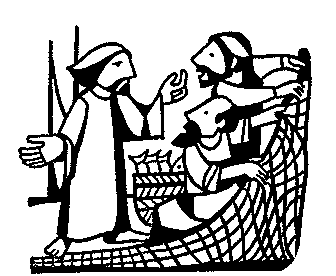
            The situation here today is where God becomes real for these people. Edward just read the Gospel lesson from Luke 5 to us, and we heard about Jesus calling the first disciples. But, we need to back up in this reading, before the Rabbi Jesus calls anyone to be a disciple.  

            We break into the action quite early in the public ministry of Jesus. So early, in fact, that He has not even called anyone to follow Him, to be His disciples. We see Rabbi Jesus, alone, teaching, preaching, healing, and beginning His ministry. Luke starts off with the phrase “One day as Jesus was standing on the shore of the Lake of Gennesaret.” I think Doctor Luke meant this to say that this was a typical day in the life of Jesus. Teaching, preaching, doing miracles. All in a day’s activities, for the Rabbi Jesus.

            But, Jesus is not the only one mentioned in this Gospel reading today. We are introduced to Simon. (or Simon Peter, but that name comes later on.) Simon did not have a good night fishing. In those days, people fished at night.

“The fishermen would spend the night in the shallows, tossing their nets and pulling in the catch. Then as dawn broke, they would bring the fish to shore and sell them at the market. Because of a lack of facilities for preserving fish, this was a daily event. Except this day.” [1]

            Have you ever had a bad day (or night) at work, too? Or how about at school? Has everything gone off the rails? Did you get off on the wrong foot? Or, was your supervisor, or teacher, or co-worker just downright grumpy, and their negative attitude threw a monkey wrench into the whole day?

            I suspect our friend – and future disciple – Simon could relate. He caught nothing the whole night long, so he had nothing to sell at the local market, and nothing to take to his folks at home to eat. No one knows for certain how Simon was feeling, but I know that many people in a similar situation would feel demoralized, defeated, or just plain empty inside. All because the nets had been empty all night long! But this Gospel reading does not only feature Jesus and Simon, No, there is a crowd, too!

The crowds who have gathered to hear the Rabbi Jesus teach and preach—and watch the miracles!—I suspect are filled with wonder, curiosity, and questions. Who is this rabbi with such clarity in teaching the word of God? Who is this rabbi with such power and authority? Yes, we see the people crowding around Jesus so much that He got in a boat by the seashore, put out a little way, and then preached to the crowd.

(Did you know—little known fact—that Jesus was using the natural amplification of the water to make His voice heard better? When someone is out in the water a little distance from shore, their voice can be heard as naturally amplified because of the sound waves bouncing off or echoing off of the surface of the water and traveling on towards the shore.)

            Doctor Luke tells us what happened next. When Jesus was done preaching, He asked Simon to cast off, take the boat out again, and lower his nets. Now, fishermen would customarily dock the boats, then wash their nets away from the boats. They had already cleaned up after a night and early morning’s work and were ready to go home. [2]

And yes, this non-fisherman Rabbi Jesus asked Simon to start all over again. To go out into the deep water and go fishing – again! In the daytime! Against his better judgment, Simon agrees to traipse out to the deep water to go fishing, even though they have worked hard all night, because Jesus requested that he and his co-workers go out and try fishing again.

We know what happened. Hardly had the nets gone into the water, but the fish came swimming into the nets. The nets were filled to bursting! It was a miracle. Simon Peter and his co-workers experienced it—they were eye witnesses.  

“Just think. A little invitation from Jesus, a small inconvenience, and before you know it, Simon was in over his head. Did Jesus show up that day looking for followers? Or was that a bonus? The catch of the day?” [3] Was this all because Jesus asked them to go deep, and to set sail for deep waters?

What was the surprising response? Continuing from Luke 5: “When Simon Peter saw this, he fell at Jesus’ knees and said, “Go away from me, Lord; I am a sinful man!”For he and all his companions were astonished at the catch of fish they had taken, 10 and so were James and John, the sons of Zebedee, Simon’s partners.”

What happened? Simon Peter had a God-encounter, there in the boat. God became real to him. Simon Peter deeply experienced God as very real to his life, but couldn’t handle it. What is Jesus’s unexpected response? Jesus tells Simon Peter and his co-workers, “Don’t be afraid; from now on you will fish for people.” Jesus calls them into a God-encounter.

For Simon Peter and his co-workers, his friends, this was decision-time. They decided to drop their nets on the shore, leave their boats where they were, and follow Jesus. There were many, many people in the crowd who also had the opportunity to follow Jesus, but they did not. The crowd only stayed for the good preaching and the miracles, not the following-Jesus-part.

Has Jesus struck you to the heart and soul, like Peter? Has God become real to you, through this Scripture reading? I encourage you to follow Him today. Thank Him for forgiving your shortcomings and sins. Thank Jesus for inviting you to come with Him for the journey.

What can we do with this newfound, exciting relationship with God? Become a disciple. Go out and talk about how God became real in your life. Talk about God’s Good News, today. God will be wonderfully praised by all who tell how God has become very real to them, and changed their hearts and lives.

How has God become real to you? Go deep. Become a disciple. Go and tell.

@chaplaineliza

(Suggestion: visit me at my other blogs: matterofprayer: A Year of Everyday Prayers. #PursuePEACE – and  A Year of Being Kind . Thanks!

[1] https://www.umcdiscipleship.org/worship-planning/where-you-are-far-horizons/fifth-sunday-after-the-epiphany-year-c-lectionary-planning-notes/fifth-sunday-after-the-epiphany-year-c-preaching-notes

[2] http://www.word-sunday.com/Files/c/5-c/A-5-c.html

[3] https://www.umcdiscipleship.org/worship-planning/where-you-are-far-horizons/fifth-sunday-after-the-epiphany-year-c-lectionary-planning-notes/fifth-sunday-after-the-epiphany-year-c-preaching-notes

Unknown's avatar

Love: God’s Better Way

“Love: God’s Better Way”

1 Corinthians 13:1-7 (13:4) – February 2, 2025

One of the most popular themes for songs is that of love. Songs that describe love of one person for another, or songs that tell about how awful it is to have unrequited love. Also, songs that tell about the emotions and feelings that come with being “in love.”

            One classic popular song written by Burt Bacharach and Hal David talks about love in a basic and simple way. Saying, “What the world needs now is love, sweet love.”

What is the state of the world, anyway? Judging from a quick view of the local news, the city of Chicago, the state of Illinois, the federal government, the uproar in Washington D.C., unemployment, not to mention abuse of different kinds—against women, children, and seniors. That is not even mentioning the various armed conflicts throughout the world—fights over territory, disputes over resources, differences between people of different religious beliefs.

            What can possibly bring harmony, hope and wholeness into the world today?

            This brings us to our scripture reading for the day, from 1 Corinthians 13. This chapter is called the Love Chapter. It is so often used as a scripture text for weddings! Perhaps you or a friend or relative had this chapter read at a wedding. But, did you know that the apostle Paul did not write this chapter to glorify romantic love?

One of my favorite commentators, Karoline Lewis, states “that this “Wedding Text” is not a passive, observable event that seeks our affirmation and support, but something that calls for our participation. This is not a text where we are asked to look on as guests, dressed for a party and seated dutifully in the church pews, but rather necessitates our involvement.” [1] Did you hear? Our participation! Our involvement!  

We are not supposed to sit quietly in a pew and let love happen to us. We are not supposed to sit in the bleachers while the professionals handle this love business. No! Let us take a closer look at exactly what Paul tells us to do, and how we are to get involved.

            Let us listen again to a portion of the words of 1 Corinthians 13, as brought up to date by Eugene Peterson in his modern translation “The Message.” “Love never gives up. Love cares more for others than for self. Love doesn’t want what it doesn’t have. Love doesn’t strut, Doesn’t have a swelled head, Doesn’t force itself on others, Isn’t always “me first,” Doesn’t fly off the handle, Doesn’t keep score of the sins of others, Doesn’t revel when others grovel.”

This is a penetrating way to teach people. Show them by example—examples of how not to love. Examples of jealousy or boasting, arrogance or rudeness. And especially, an example of a horrible injustice, where people are openly bigoted against females. (This can also be true of people who are bigoted about other differences, too, like about handicaps, or people of color, or of a different class of people, or of other nationalities or countries of origin.)

Those bad examples? Paul shows us clearly in this passage—don’t do those things! Don’t be that way! Sometimes, a bad example is the quickest way to our hearts and minds.

Paul was involved in a longer argument here in chapters 12 and 13 of his first letter to the Corinthian believers. Chapter 12 was all about the spiritual gifts that came from God, and meant for the strengthening of the body of Christ – the Church. Then in chapter 13, Paul zeros in on the most excellent of all of these God-given gifts. The gift of love. (or, charity, if we are speaking in a more flowery, King-James-version kind of a way).

            In this section I just read, Paul tells his friends and former church members what love is definitely not! Doesn’t strut, doesn’t have a swelled head, isn’t always “Me First!” Paul was making comparisons here! He had lived in the city of Corinth for many months, while he was pastor of this young church. He knew the rough and tumble, political attitude of the general population of the city of Corinth. Plus, he knew that this uncaring, callous attitude was rubbing off on the people inside of the church, too! That is why he wrote these words.

If we want to find out more about 1st century Corinth, “Charity [or, love] was not the activity of his opponents that spread their agenda. They promoted themselves, acted with arrogance, even engaged in shameful activities (backdoor politics?). As they sought personal gain, they provoked others, instilled animosities, and celebrated when others “lost face.” These were not the hallmarks of Christian community.” [2] In fact, all this crony-ism and inside politics sounds sadly familiar to me. But then, I grew up here in Chicago.

Instead, the apostle Paul gives us a marvelous example of what true love – and Godly caring, support, empathy – looks like. Listen again: “Love never gives up. Love cares more for others than for self. Takes pleasure in the flowering of truth, Puts up with anything, Trusts God always, Always looks for the best, Never looks back, But keeps going to the end.”

I don’t need to scramble and strive to love all by myself, trying really, really hard. It’s not all me, putting together my own faulty, human kind of caring. No! God freely gives gifts of love to all God’s children. That is what true love looks like. This is what true church looks like, too.

We can clearly see that Paul’s ministry of love, harmony and wholeness is for the whole world. Not just about taking care of those in our own families, although that’s important. It’s more than “taking care of our own,” although that is certainly laudable. It’s about showing love for everyone. For those affected by loneliness, or despair, disaster or disease wherever they are, without exclusion of those not like us or even of those we fear. Everyone.

Ending as I began, we look again at the Bacharach and David song, “What the World Needs Now.” The chorus of the song tells us the world needs love, sweet Godly love. Needs it badly. “No, not just for some, but for every, every, everyone.” Amen, Lord. Amen.

@chaplaineliza

(Suggestion: visit me at my other blogs: matterofprayer: A Year of Everyday Prayers. #PursuePEACE – and  A Year of Being Kind . Thanks!


[1] https://www.workingpreacher.org/commentaries/revised-common-lectionary/fourth-sunday-after-epiphany-3/commentary-on-1-corinthians-131-13-3

[2] http://www.word-sunday.com/Files/c/4-c/SR-4-c.html