Unknown's avatar

Bringing Gifts

“Bringing Gifts”

Magi bear gifts to an infant Jesus (one of the earliest-known depictions, 3rd century sarcophagus) Vatican Museums - Rome, Italy

Magi bear gifts to an infant Jesus (one of the earliest-known depictions, 3rd century sarcophagus)
Vatican Museums – Rome, Italy

Matthew 2:11 – January 3, 2016 (St. Luke’s Church, Epiphany Sunday)

I remember Christmases when I was very young. I was the youngest of six children, and we lived on the northwest side of Chicago. My father worked for the National Safety Council, which was a not-for-profit organization. He didn’t get paid a huge amount of money, so I remember Christmases when we children wouldn’t have a huge pile of presents under the Christmas tree, like the television commercials of today always seem to show. But I do remember the happiness and joy of those Christmas mornings. A number of gifts were exchanged, and we always had a big dinner later that day at one of my relatives’ houses. Those are warm memories, all of us gathered around the tree, exchanging presents.

Warm memories. I’m sure you all could bring to mind a similar warm memory or two, regarding Christmas. Many of my memories do involve gifts. The Scripture passage we just read mentions gifts, too. It’s from Matthew, Chapter 2, the traditional Epiphany story, when Wise Men from the East came to see the baby Jesus, bearing gifts.

Matthew calls them “Magi,” According to my research, they probably came from the East where the Jews had spent seventy years in the Babylonian captivity, centuries before the birth of Christ. During this period, the Babylonians and Persians probably learned of the promise of the “Messiah” from Daniel the prophet who had lived among them.

The Magi became important first among the Medes and later among the Persians by taking on the priestly functions of the mystery religion Zoroastrianism. By New Testament times, the term “Magi” was broadly used for persons adept in any number of sacred arts, including interpretation of dreams or other divine messages, astrology, magic and divination.

We can tell from the term “Magi” that here are three very important people, who are not Jewish. The consensus among biblical scholars is that Matthew was a Jewish apostle of Jesus who wrote his gospel for the Jewish people. Yet, here, front and center in the beginning of the Gospel of Matthew, we find three non-Jewish V.I.P.s, on their way to see the Child, born King of the Jews.

They know pretty much where they are headed, but not precisely. I suspect that is why the Magi went to see King Herod in Jerusalem. I mean, what better place to find a newborn King than in a palace, in the capital city?

I’ve got to give these Wise Men a lot of credit. Not only were they a little fuzzy as to their destination, and where they were going, but they were not afraid to ask questions and ask for directions. It’s too bad that they had to pick Herod to ask questions of.

“Where is the One having been born King of the Jews?”

The Wise Men saw the bright star announcing the birth of Jesus, and followed the star towards Jerusalem. Notice: they were not Jewish, yet they had heard of the Coming One, and even brought Him gifts. They even wanted to worship and adore Him. They had heard of the birth of Jesus through unconventional methods, by our standards. The Magi had foreseen the birth through signs in the stars, not necessarily through the Hebrew Scriptures, as the Jewish people had.

God understood that these Wise Men made a careful study of the stars, and He sovereignly decided to display signs and wonders in the heavenly places at the time of the birth of Jesus. God reached these Magi where they were at. And the wonderful thing is, God continues to reach out to people in ways they understand, no matter what is happening to them, no matter where they might happen to be.

But, let’s go back to these Wise Men. No one is exactly sure about the number of Magi who arrived in Jerusalem so long ago. Church tradition tells us that the number was three, and that these were not just Wise Men, but also Kings of the East. Assuming that they were at least minor royalty, these three non-Jewish V.I.P.s show up on King Herod’s doorstep, and he was not pleased to see them. He was even less pleased with their line of questioning. “What’da you mean, Child born to be King of the Jews? I’m the only king around here!”

Herod must have known something about the prophecies of a Coming One, of a Messiah, and I bet Herod was upset. The chief priests and scribes came to Herod and told him right away where the Messiah was to be born. The prophet Micah had foretold it several centuries before. In Bethlehem, in Judaea, only a little way down the road from Jerusalem.

From all accounts of Herod and his life and reign, he was a tyrant. Looking at writings from contemporary authors of that period, Herod was cruel and bloodthirsty. He was also two-faced, as we can see from his response to the Magi. He sent the Magi to Bethlehem, and requested that they come back after they find this “King of the Jews,” because Herod wished to “worship” this King as well. I have a pretty good idea of exactly what Herod wished to do to the baby Jesus.

The Gospel of Matthew tells us that Herod secretly found out the time the star had appeared in the sky, and typical of a bloodthirsty despot, he had all boy babies in the area of Bethlehem under the age of two killed. Just in case. This feature of the Christmas story usually isn’t mentioned, since it doesn’t fit into a nice, warm and fuzzy Christmas card. These verses are not included in our lectionary reading for today, either. Yet, this was the kind of world Jesus was born into. The world today hasn’t much changed.

Let’s pick up with these Wise Men. After they found out where the King of the Jews was born, they wasted no time in finding Him. Mary and Joseph must have decided to stay in Bethlehem for a time, since the Wise Men found the Holy Family inside a house. And, the original Greek of the Gospel of Matthew refers to Jesus as a boy, not as an infant, as the Gospel of Luke does. So Jesus may even have been a toddler at the time of the Wise Men’s visit.

Regardless of these minor, yet fascinating, details, the important part is that the Wise Men took the time to find the promised King of the Jews. When they found Jesus, the Wise Men were finally able to offer their gifts—gifts fit for a King, gold, frankincense and myrrh—expensive and costly gifts, to be sure. Then . . . the Wise Men worshiped Jesus, the Promised One, the coming Anointed One of God. And, they returned to their homes, rejoicing that God’s promise had been fulfilled.

What does this story from so long ago have to do with us, today, in the 21st century? God is indeed pleased when we give Him things we very much value, as the Wise Men did. But God doesn’t really want worldly things. What I see repeated in Scripture is that God really wants a relationship with us.

Christina Rossetti’s poem says it so well.

“What can I give Him, Poor as I am?/If I were a shepherd I would bring a lamb;

If I were a wise man, I would do my part;/Yet what can I give Him—give my heart.”


That’s what God wants most of all for Christmas. God wants our hearts. God wants us to come to Him, as small children come to a dear mother or father.

I can remember when my children were small, and they would come to me at night for a last cuddle before bedtime. I think that’s what God wants us to do. Only, better! God is a parent who will never be too busy to take time for us, and never be short-tempered with us. God’s everlasting arms are ready, wide open to receive any who come.

Yes, the Wise Men gave gifts to the baby Jesus, and yes, they stand as an example for us. We can celebrate their example, and remember it as we give our hearts to God, whether as a renewal gift of our lives, or as a sincere gift for the very first time. Give God the best gift you ever could. Yourself.

You are important, so important that Jesus came and gave Himself for you and for me. All He has ever wanted is to give us the chance to know Him as a personal Friend and Companion.

Won’t you give Him what He wants most for Christmas?

@chaplaineliza

Suggestion: visit me at my sometimes-blog: matterofprayer: A Year of Everyday Prayers. and my other blog,  A Year of Being Kind .  Thanks!

Unknown's avatar

Looking for Jesus

“Looking for Jesus”

William Holman Hunt, “Finding of the Saviour in the Temple,” 1854-60

William Holman Hunt, “Finding of the Saviour in the Temple,” 1854-60

Luke 2:48-49 – December 27, 2015

Christmas time is here! Called by some the most wonderful time of the year. Certainly, one of the busiest times, what with parties, social gatherings, visiting at relatives’ homes, and so many extra things on people’s to-do lists. Yes, Christmas is now over, but we are still right smack in the middle of the winter holidays.

Our Gospel reading from Luke today is right smack in the middle of the holidays, too. Except—right in the middle of the Passover holiday, in the spring. An extra special holiday, to be sure! This is one of the rare glimpses we receive of the young Jesus, before the beginning of His ministry. When we do get a glimpse of Jesus as a growing boy, Dr. Luke doesn’t say much more than Jesus was “increasing in wisdom and in years, and in favor with God and people.”

Most people know the Christmas story from Luke chapters 1 and 2 so well. You remember. Angel visitations, miraculous statements, heavenly choruses. And, capped by the birth of the Messiah, the Lord, who will save His people from their sins. And then—we have this sort of addendum. This conclusion of Luke chapter 2.

As Scott Hoezee says in his commentary, “we have a story as mundane, as utterly earthly and simple as they come: lost child. Panicked parents. A frantic search. The whole thing started with angels and it ends . . . paging for a lost child on the P.A. system at Walmart?” [1]

Let’s take a closer look at our passage from Luke chapter 2. This reading is from “The Message,” the excellent version translated by Eugene Peterson, starting at verse 41.

41-45 Every year Jesus’ parents traveled to Jerusalem for the Feast of Passover. When He was twelve years old, they went up as they always did for the Feast. When it was over and they left for home, the child Jesus stayed behind in Jerusalem, but His parents didn’t know it. Thinking He was somewhere in the company of pilgrims, they journeyed for a whole day and then began looking for Jesus among relatives and neighbors. When they didn’t find Him, they went back to Jerusalem looking for Him.”

Now, from Jesus’s point of view, His decision to stay behind in Jerusalem for several days made sense to Him. He may have wanted to get to know God a little better. And, Nazareth was only a small town away up north, far away from the capital city of Jerusalem. I suspect Jesus wanted to talk further with the knowledgeable rabbis and teachers in the Temple, too.

But, from His parents’ point of view? How many of us have served as parents or adults, responsible for young children in our care? Did any of us have a child turn up lost? What must Mary and Joseph have been feeling, during that time when they did not know where Jesus was?

This reminds me of my oldest daughter, when she was just a preschooler. I was at a department store in Chicago with my two children (at that time), my older daughter just turned three, and my second daughter a baby strapped in a stroller. I was looking at clothing on the round metal racks that are common to many department stores. As I looked at clothing and tried to keep track of my young daughter at the same time, she got lost. I could not find her, and she was much too small to see me over the clothing racks.

It only took me about five minutes of searching to discover where she had gone, but that time was desperately anxious for me and traumatic for my daughter—I suspect those five minutes seemed to go on forever. She was lost. She did not know where she was, or where I was. She was all alone, far from her home and familiar things, until I found her and reassured her that everything was all right.

Back to our Gospel text, from Luke 2.

46-48 The next day they found Jesus in the Temple seated among the teachers, listening to them and asking questions. The teachers were all quite taken with Him, impressed with the sharpness of His answers. But His parents were not impressed; they were upset and hurt. His mother said, ‘Young man, why have you done this to us? Your father and I have been half out of our minds looking for you.’”

As one commentary notes, “Mary and Joseph spend 48 hours before finally tumbling to the idea that just maybe they should check the Temple. ‘I can’t imagine he’d be there’ they must have said to each other, ‘but we we’re running out of likely places, so let’s check.’ For his part Jesus is merely confused. The Temple was the first place they should have looked, as it turns out. Jesus was ‘home’ at the Temple. His parents don’t understand, however. They are too flush with a combination of intense relief and a little abiding post-traumatic stress to be able to suss it all out just then.” [2]

Let’s take a closer look at Jesus’s response: “49-50 He said, ‘Why were you looking for me? Didn’t you know that I had to be here, dealing with the things of my Father?’ But they had no idea what he was talking about.”

Many learned biblical scholars have tried to puzzle out this divine mystery. The mystery of Jesus being at once human and divine, at the same time. Here, we have just a glimpse of what this may have been like for Jesus.

The twelve year old boy Jesus probably knew Himself as human. Just as His parents and other family were, and the other children in his town. I wonder whether Jesus was starting to understand by this time that He was fully divine, as well? Yes, some verses in the Gospels tell us He did have an awareness of being divine. Of having Godly attributes. However, I wonder whether He was starting to realize the special call on His life, even now?

We don’t know for sure; we aren’t told. But, do you think this could be why Jesus wanted to stay in the Temple? To talk with those knowledgeable about the Scriptures?

To finish the reading: “51-52 So Jesus went back to Nazareth with them, and lived obediently with them. His mother held these things dearly, deep within herself. And Jesus matured, growing up in both body and spirit, blessed by both God and people.”

Dr. Luke is a faithful reporter. He tells us the facts, as they were related to him. But we don’t know the back story, Jesus’s feelings, His reasoning. Did the Temple have a draw on His life, even at the age of twelve? Did it feel more like home than his family home in Nazareth? Luke doesn’t say.

We know that Mary was a reflective woman. She treasured up these many wonderful things, and also the things that perplexed and troubled her. And, we can ponder these things in our hearts, hold these thoughts dearly, deep within ourselves, just like Mary did.

We know today, from the testimony of all the Scriptures, that Jesus is at the same time fully God and fully man. Yes, that is why He came down from heaven to be born of Mary. This is the good news brought to us by the angel chorus. The Eternal Second Person of the Trinity, Creator of the whole universe, God the Son, emptied Himself of all God-ness. Took on humanity, and was born as a helpless Baby. Good news of great joy for all the people.

Jesus. Messiah. He will save His people from their sins. Fully God, fully human, at the same time. Yes, it’s a mystery. It’s a miracle. For a closing hymn, we will sing “Once in Royal David’s City,” one of my favorite Christmas carols. Please notice the words of verses 2 and 3. Talking about Jesus being human. And then, verse 4 tells us of the future, when we will be with Jesus forever, in heaven.

We can all say alleluia, amen, to that!

(The congregational response to this sermon will be the Nicene Creed.)

@chaplaineliza

Suggestion: visit me at my daily blog for 2015: matterofprayer: A Year of Everyday Prayers. and my other blog,  A Year of Being Kind .  Thanks!

[1] Sermon Starters for the Week, Scott Hoezee, textual notes, illustrations, commentary, Center for Excellence in Preaching, 2015.

[2] Ibid.

My thanks and deep appreciation for Eugene Peterson’s translation of selected verses from Luke 2;  “Scripture taken from The Message. Copyright © 1993, 1994, 1995, 1996, 2000, 2001, 2002. Used by permission of NavPress Publishing Group.”

Unknown's avatar

Invitation to Wonder

“Invitation to Wonder”

Virgin Mary and Child - Russian Orthodox

Luke 2:17-18 – December 24, 2015

Merry Christmas! What a wonderful expression. People greeting each other on the street, in the stores, here at church. I know not everyone celebrates Christmas, but still. What a joyous time of the year. Merry Christmas, many people say!

But I want you to go back, two thousand years. Go back to a time when “Merry Christmas” was not even a phrase, a wish, an idea in people’s heads. Go back to the time that Dr. Luke describes in the second chapter of his Gospel. Back to the time when Israel was an occupied country, and the Roman Empire was the strong man. Back to the time when all people in Israel needed to be enrolled. The Roman government decided to have a census, so that they would be able to tax the people of Israel more accurately.

In our Gospel reading tonight, we heard this census described. The Holy Family, Joseph and his fiancée Mary, went to Bethlehem to enroll, because Joseph was a direct descendant of King David. I suspect there were many people on the roads. Today, traveling can be stressful and nerve-wracking. However, I am certain travel in the first century was much more difficult. Poor roads, with many people walking to get from one place to another. We might imagine that Joseph and Mary had a donkey, but nowhere in the Gospel is that mentioned. Travel conditions were challenging, at best.

So, there they are, in Bethlehem. A long way from their home, in Nazareth. I suspect Joseph took care of the enrollment business first thing. But Mary felt the pains of labor begin. What a scary thing! To be far, far from home, in an unfamiliar place, and to have such a significant event happen. Significant, and potentially life-threatening, too.

I have had several children. I can remember all four of the deliveries. All of them happened in the hospital, with nurses and doctors standing by. Quite possibly most of the women here who have delivered babies can remember all their deliveries, too. Don’t you think Mary and Joseph remembered this experience for the rest of their lives? Yes, delivering a baby is a special day for anyone. But—even more so, for Mary and Joseph. Because of the angels. And the additional special visitors, too.

As Luke tells us, there were shepherds abiding in the fields, keeping watch over their flocks by night. Remember, there is no radio or telephone, no Internet or even telegraph. When messengers personally come to deliver a extra special announcement, it is a big deal. These angels coming to the shepherds, well, that was a super big deal, to be sure!

And the announcement? This isn’t the birth of a normal, ordinary baby. No! This baby is an extra special baby. The Messiah, who will save His people from their sins. Did you hear? This special baby, this Savior, Christ the Lord, is born to you—to me—to all of us, in the city of David, which is called Bethlehem.

Did you hear? The Savior, the Christ, the promised Messiah, came into this world as a Baby in Bethlehem. The Eternal Second Person of the Trinity, Creator of the whole universe, God the Son, emptied Himself of all God-ness. Took on humanity, and was born as a helpless Baby. That is not only good news, that is earth-shaking news. Good news of great joy for all the people. For you, for me, for all of us.

Yes, the promises of Christmas may sound familiar to us. The good news that the angels brought may be old news, to some. But those promises? They are so needed, today. What with uncertainty and fear, anxiety and hatred so common today. Peace and security seem way out of humanity’s reach. Don’t we need some good news right now?

This is good news, this Gospel the angels brought to the shepherds. And they, in turn, told everyone they could about the Child, which the Lord had made known to them. Just as Luke said, all who heard about the Child were amazed at what the shepherd told them.

After that special birth announcement from the angels, and the excited visits from the shepherds, we are left with Mary. Mary who was only a teenager. Mary, who had had nine months to consider this extraordinary pregnancy and upcoming birth.

I cannot imagine a teenager entrusted with such a serious task as bearing the Savior of the world. Yet, Mary must have been up to the task.

Mary must have been a reflective young woman.

We know from verse 18 that Mary treasured all these words and pondered them in her heart. All of these words, these unfolding events. Another translation has this verse as “Mary was keeping together (sunetare) all these words, bringing them together (sumballos) in her heart.” Keeping together, sunetare, has the sense of integration. Bringing these events together, or sumballos! She was fitting all the puzzle pieces together, bit by bit.

Can we do the same? Can we fit all the puzzle pieces together? Can we slow down, just a little, and wonder at the miracle of that night? I invite us all to listen to the good news of the shepherds.

Stop by that manger in Bethlehem, and be caught up in the wonder of what happened that night, so long ago. The eternal God, Creator of the universe, come to earth as the Babe in Bethlehem.

God gives each of us an opportunity, an invitation to wonder; an invitation to worship the newborn Savior.

O come, let us adore Him, Christ the Lord.

@chaplaineliza

Suggestion: visit me at my daily blog for 2015: matterofprayer: A Year of Everyday Prayers. and my other blog,  A Year of Being Kind .  Thanks!

Unknown's avatar

One Who Brings Peace

“One Who Brings Peace”

Micah 5-5 He will be our peace

Micah 5:5 – December 20, 2015

Peace. Peace is the subject today. Today we light the Advent candle of peace. Here, inside the church, it seems like peace is a realize-able actuality. But—not on the outside. Not out in the cold, cruel world. Peace, peace, is the cry! Here in the 21st century, we have wars and the rumors of war. Fighting, skirmishes, various attacks of various kinds. Will anyone hear our cry for peace? Will anyone—anywhere—heed our cry?

In biblical times, there was always some tribe or country beating up on another tribe or country. Always somebody marching off to war. To enlarge territory, or to gain political advantage, or to right some wrong. So seldom did the nation of Israel have true peace! Much of this book of the prophet Micah deals with war, conflict and fighting. Except for right here.

Our Gospel reading from Luke tells of the pregnant Virgin Mary going to visit her older cousin Elizabeth, who prophecies that Mary has within her the baby Jesus, the Son of God. Usually, the Scripture readings are chosen with great care. Chosen with an eye to common themes. So, what is in common, here? The prophecy of a strong leader to come, from our Old Testament text, and the prophecy of the birth of the Messiah, from our Gospel reading.

Here we are at the fourth Sunday of Advent. We have had Advent for a long time. Since the last week of November. I can just hear the children saying, “When is Christmas finally going to get here?” Some schools have already gotten out for the winter holidays. I know some local churches are featuring a Christmas cantata today, or a Christmas pageant in worship.

Yet here we all are. The last Sunday of Advent. Isn’t Christmas here yet? Isn’t it time for angels and shepherds, Mary and Joseph and the Baby in a manger? Can’t we hurry things along?

As we look at the prophecy in Micah, we can see that the prophet is certainly not thinking about warm and fuzzy Christmas carols. Not about the lion lying down with the lamb, about God reaching down and bringing peace on earth, good will towards all people. Or, is he? What is Micah saying in our reading today?

Yes, a strong leader will rise up. Who do you think Micah’s contemporaries thought the prophet was talking about? I was fascinated to read in one commentary that most people would connect this strong leader to King David. But, wait! David had been dead for two hundred years, by the time that Micah wrote his prophecy. How could the Jewish people think “David” when they heard prophetic words like this?

Because—because of the prophecy of David’s prophet Nathan from 2 Samuel 7. A direct descendant of David would be king. God had promised King David that exact thing. So, who else could this strong leader be but a direct descendant of the great King David?

All well and good! Except, it gets more complicated, fast. Micah mentions “out of you [Bethlehem] will come one who will be ruler over Israel, whose origins are from of old, from ancient times.”

Now, I can understand a strong leader. A ruler, a mighty King. A descendant of King David. I can even understand the prophecy of a baby, from Luke, chapter one. The descendant of David needs to be born. Elizabeth prophecying and praising God that the mother of the Messiah to come was coming to see her. Okay, I’ve got that.

I am so indebted to John C. Holbert’s article on this Scripture reading. [1] I was aware of some of this material from the book of Micah, but by no means all. And never in so much depth!

Micah’s prophecy foretells a strong leader, yes. A descendant of David is presumed. (Micah doesn’t specifically say so.) Adding two and two and two together, from the prophecies of the Hebrew Scriptures, people have ascertained that this prophecy also refers to the Messiah. And then—Micah adds the part about the ruler “whose origins are from of old, from ancient times.” This part definitely needs more explanation.

These phrases are a challenge to translate from Hebrew. The best that anyone can figure is that there are several meanings for these words. “Origins” can also be translated “coming forth” of old! Dr. Holbert says that God put this word ‘olam, or “ancient times,” “into human minds in such a way that they may know a bit of what has happened in the past, and a tiny portion of what may come, but just enough to teach them that they in fact know precious little about either past or future in the end. There the word appears to mean something like a very long time or deep in the past and far into the future, not quite eternity but as much as any puny human mind may conceive.”

Talk about not being able to understand Scripture. These couple of phrases blow me away. I feel small when I read this. Really young, like a preschooler. I realize I do not know very much about God or about the Bible, at all. Period. God surely can flatten me, humble me with a phrase from the prophet Micah.

But, wait! There is more! Let’s unpack this reading, further.

Holbert continues: “Who then does Micah have in mind? This is no simple heir of David; here is someone primordial, someone from the most ancient of times yet also uniquely prepared to act decisively in the present.” In other words, Micah is talking about Someone more than human. Looking forward to the future, talking about Someone who not only is the promised Messiah to come, the promised descendant of David, but also looking back to the far distant past. To the beginning of time, even beyond the beginning.

Then, in Micah 5:3, the prophet brings up the image of a woman in labor. What is our Gospel reading from Luke for today? It’s about two pregnant women. Elizabeth prophecying about the Child Mary is carrying. The Child is the Lord. The Son of God. The next verse, Micah 5:4 speaks of the promised one who will be a shepherd. Just like King David! A powerful and godly shepherd who keeps the flock safely; “and they will live securely, for then his greatness will reach to the ends of the earth.” Again, this is Messiah language, and more!

Who is this Messiah, anyway? Descendant of David, check. Born in Bethlehem, which is David’s ancestral home. Check. But, Micah says from ancient of days? Luke calls Him the Son of God? The Lord God Almighty?

This great Shepherd will not only be concerned with the flock of Israel, but also the flock of the entire world. And—this is the most important part to me, right now. This strong leader, this Shepherd will be our peace.

This Messiah will not just be peaceful for Israel’s sake. No! Our Messiah, our Christ, from ancient of days, will act peacefully for the safety and well-being of the whole world!

Do you hear the Good News from the prophet Micah today? This Messiah was not going to act in the way that so many other Middle Eastern potentates did. Or, for that matter, like any other earthly ruler ever has. Instead, we are told in our Scripture passage today that He will feed His flock. The Messiah’s flock will have the opportunity of living secure, safe, and peacefully under Messiah’s mighty protection. I thank God that I am one of the worldwide flock.

God extends that opportunity to everyone, so that we all can have the security and care of the Messiah, the Good Shepherd, the Babe of Bethlehem, the ruling King. Praise God for God’s wonderful gift of protection and care.

[1] http://www.patheos.com/Progressive-Christian/Who-Is-This-Peaceful-One-John-C-Holbert-12-11-2015

(Many thanks and much appreciation to Dr. Holbert! Wonderful article on Micah.)

@chaplaineliza

Suggestion: visit me at my daily blog for 2015: matterofprayer: A Year of Everyday Prayers. and my other blog,  A Year of Being Kind .  Thanks!

Unknown's avatar

Rejoice, Proclaim!

“Rejoice, Proclaim!”

Zeph 3-19 God will rejoice over you

Zephaniah 3:14 – December 13, 2015

Doom and gloom! “You brood of vipers!” and “Flee from the wrath to come!” Exactly what John the Baptist has been saying to the people of Israel for some time! And what about in this little, tiny book of the prophet Zephaniah? That is pretty much what he has been saying in the first two chapters, as well.

Why was Zephaniah so upset? In a commentary by Anne Stewart, she says “The oracles in the majority of the book announce cosmic destruction as divine judgment for the sins of [the nation of] Israel and, specifically, the priesthood. With vivid and at times disturbing language, the prophet envisions the arrival of the Day of the Lord, the time in which God will act to restore justice and to bring judgment on faithless, sinful nations.” [1]

But, what do we find in the third chapter of Zephaniah? A sudden turn-around. The people are told to rejoice! Not only rejoice, but rejoice with all of our hearts!

What gives here? What if God barged right into the middle of St. Luke’s Church, right here this Sunday morning? What if God came right into the middle of our daily lives with this message of rejoicing? What would happen then?

This is what Zephaniah says: “Be glad and rejoice with all your heart, Daughter Jerusalem! 15 The Lord has taken away your punishment, God has turned back your enemy. The Lord, the King of Israel, is with you; never again will you fear any harm.”

Before, life was bad. Awful! Doom and gloom! Horrible stuff! Yes, we were sinful. Yes, we were far away from God. Just as Zephaniah said—just as John the Baptist said—the people here on earth have fallen away from God and have been disobedient. God proclaimed judgment on everyone, for sure!

But, what now? Great question!

One of my commentaries tells us: “Imagine Zechariah and the people of God celebrating, with God there in their very midst. All are singing and dancing in the streets, and God is singing loudest of all. There is rejoicing because the people have been forgiven. They were imprisoned in sin, but all are forgiven and their sentence is commuted. God is their salvation and is coming into their midst to save them.”

This isn’t just a pause in the storm of judgment, but instead a get-out-of-jail-free card. We all—that is, you, me, everyone—are freed from sin, permanently. Did you hear? God is our salvation! That not only is Good News. That is absolutely Great News!

The prophet Zephaniah tells the people to rejoice. The third Sunday of Advent is traditionally “Rejoicing Sunday.” Our third Advent candle lets us know we can rejoice. Several of our Scripture lessons for today tell us to remember to give thanks for God’s great gifts to us.

Our commentary tells us that Zephaniah speaks in past, present, and future tenses. In terms of the present, the right now—Jesus Christ is in our midst. He is here with us, right now, of that we can be sure. What about the future? The prophet also lets us know about Christ’s coming again, in the second coming. There will be a time still to come when we will have our final homecoming with God, the greatest celebration of all.

What about the past? Zephaniah’s words are fulfilled in the coming of Christ as a baby in Bethlehem. That will be what we celebrate a week from Friday, on Christmas Day. We can see that Jesus “does not watch from a distance, but enters into the life of the world. This God enters even into human flesh, in the mystery and wonder of the Incarnation.” [2]

This third Sunday in Advent, we speak of joy. We look forward to joy coming into the world. We speak of the joy of a people redeemed and restored! And, God responds. As our reading from Zephaniah tells us, God sings. God shouts. God rejoices! Alleluia!

We will sing all four verses of “Joy to the World” in just a minute. That’s # 125 in our hymnals. But before we sing the carol, I would like everyone to follow along in the hymn books as I point out these opening lines as follows, verse by verse:

Why can we sing “Joy to the World” right now?

  1. No matter how bad things might be at the moment, “The Lord is come”, i.e. God is with us.
  2. The Savior, not any old king or mean dictator or nasty bully is in charge, is in charge of the world.   (Who is the savior?  Jesus is!)
  3. Given that, we don’t have to get upset or snowed under in our sorrows or caught up in all the bad stuff that happens.
  4. And, like all good last verses, this last verse is the summary.  We can rejoice and sing “Joy to the World!” because God rules the world with truth and grace. [3]


[1] http://www.workingpreacher.org/preaching.aspx?commentary_id=2700

[2] http://www.workingpreacher.org/preaching.aspx?commentary_id=468

[3] Worshiping with Children, Advent 3, 2015, Including children in the congregation’s worship, using the Revised Common Lectionary, Carolyn C. Brown

@chaplaineliza

Suggestion: visit me at my daily blog for 2015: matterofprayer: A Year of Everyday Prayers. and my other blog,  A Year of Being Kind .  Thanks!


Unknown's avatar

When He Appears

“When He Appears”

Malachi

Malachi 3:1-4 – December 6, 2015

Today is a challenging time in which to live. Wars, and rumors of wars. An increase in natural disasters. And, people around the world falling away from religion. Not going to their traditional place of worship, and not honoring God’s name. It doesn’t matter which nationality or which country we are talking about, in almost every country, area or region around the world we will see the faithlessness of people. Turning away from God.

This is exactly what our Old Testament prophet Malachi talks about, in our reading today! People in his time—400 years before the birth of Jesus in Bethlehem—did not follow the God of Israel. Their priests were disrespectful and made improper sacrifices. Many of the Jews turned toward foreign gods because they married foreigners who did not worship the God Jehovah. The people fell away from the Lord! They were faithless and disobedient to God.

As one online commentary [1] had to say, the situation in Malachi’s day echoes that in our own day, too. “The charges against the people [of Israel] pertain everywhere and in every century. We can say of ourselves, as well, that false prophets and priests among us do not uphold the righteousness of the temple, and that we fail to adhere to God’s commands, [fail] to fulfill our duty, and [fail] to build up our neighbors.”

Malachi does not pull any punches. He tells the people of Israel exactly what they are doing that is wrong, and bad, and displeasing to the Lord. “But who can endure the day of his coming? Who can stand when he appears? For he will be like a refiner’s fire or a launderer’s soap. He will sit as a refiner and purifier of silver; he will purify the Levites and refine them like gold and silver.”

Does anyone here remember doing laundry with particularly harsh soap? I’m talking about when people have stains that are really difficult to wash out. When I was a little girl, I can remember my mother using a special soap that came in a can, like a gel. She would scoop a little soap out, and put it on the clothing. I would see her rubbing the soap into the stain. Like on the grass stains in my older brother’s pants, I remember particularly. My mom would tell me to be very careful around that powerful soap.

There is some soap that is more powerful than that! It takes the color right out of cloth. Some people even need to wear rubber gloves when they use it, since the soap would blister or hurt their bare skin. For certain kinds of really deep stains or special kinds of material, that is the kind of soap that is needed to get things clean.

Malachi talks about when God comes. And when God does come, God is going to be very, very angry. God will not pull punches, either.

It’s like everyone has a horribly stained outfit. It’s laundry day, and God has a special, really harsh kind of soap that is guaranteed to get out the stains. Except, the soap is so strong that sometimes it takes the color out of our favorite shirt, or fades our new dark pants.

Laundry soap is the first comparison Malachi uses. Laundry soap! Not very glamorous, is it? Sinfulness is the awful condition everyone is in, and has been in for a very long time. And, God needs to put everyone through the laundry. Using a wringer washer, too. It gets the job done, even though it doesn’t have a ‘delicate cycle’ like an automatic washer.

I just heard that the retired pastor (who married me and my husband) is extremely ill. He has cancer in both his lungs and a brain tumor. He had the first of his radiation treatment and chemotherapy this past week. When people are seriously ill, they require serious medicine. Moreover, medicine like that often doesn’t taste very appealing or feel that good.

What about people who have broken several bones or gotten a severe muscle strain, and need physical rehabilitation? Has anyone here ever gone through rehab, or had a loved one that completed rehab? Not always an easy thing. Rehab hurts, sometimes, because of the really difficult, even awful situations people find themselves in.

This message, this reading is not very hopeful, is it? Yet, Malachi is telling the truth about the vast majority of the people in his country. He speaks the word of the Lord to a bunch of people who are not pleased with his message. Not pleased at all!

This reminds me a lot of our Gospel reading this morning. About the birth of John the Baptist, and the miraculous happenings that occurred just before and after his birth. Zachariah, John’s father, sang a song that was also a prophecy about his infant son John. Zachariah gives hints about what John’s purpose and message is ultimately going to be.

What is similar between Malachi’s message and John the Baptist’s message? “The Lord is not pleased with your lives! Or your intentions, either!” Sounds awfully familiar. God is trying to get across the message of repentance once more. And again. And again, after that.

God makes another comparison. The first was laundry soap. God is going to put us dirty, sinful people through the wash. And, a wringer washer, at that! The second is a refiner’s fire. Ouch! That hurts!

“What is important for us to know from Malachi is that the coming one is a refiner who is will purify and refine the people ‘like gold and silver.’” [2] This reminded me of an anecdote about this very verse from Malachi. “This verse puzzled the women having the bible study, and they wondered what this statement meant about the character and nature of God.

“One of the women offered to find out about the process of refining silver and get back to the group at their next Bible study. That week the woman called up a silversmith and made an appointment to watch him at work. She didn’t mention anything about the reason for her interest in silver beyond her curiosity about the process of refining silver. As she watched the silversmith, he held a piece of silver over the fire and let it heat up. He explained that, in refining silver, one needed to hold the silver in the middle of the fire where the flames were hottest so as to burn away all the impurities.

“The woman thought about God holding us in such a hot spot – then she thought again about the verse, that God sits as a refiner and purifier of silver. She asked the silversmith if it was true that he had to sit there in front of the fire the whole time the silver was being refined. The man answered that yes, he not only had to sit there holding the silver, but he had to keep his eyes on the silver the entire time it was in the fire.

“The woman was silent for a moment. Then she asked the silversmith, “How do you know when the silver is fully refined?”  He smiled at her and answered, “Oh, that’s the easy part — when I see my image reflected in it.”

As God refines each of us, when God purifies our hearts and minds, we reflect God’s image more and more. Just as the silver becomes more pure the longer it is held in the fire, so we reflect God’s image better and better. Sure, it hurts sometimes. Sure, it is unpleasant and awkward and sometimes downright painful. We can celebrate because we know our God loves us enough to refine and purify us.

Malachi’s message is that sometimes we must make hard changes and work hard with God’s help to be the people God made us to be.  Challenge? Yes! Opportunity? Yes!

“Only in the Coming One is there the power to refine us, to make clean what is unclean, and to ready us to offer what will be ‘pleasing to the Lord.’” Amen. Come, Lord Jesus.

[1] Commentary, Malachi 3:1-4, Melinda Quivik, Preaching This Week, WorkingPreacher.org, 2012.

[2] Ibid.

@chaplaineliza

Suggestion: visit me at my daily blog for 2015: matterofprayer: A Year of Everyday Prayers. and my other blog,  A Year of Being Kind .  Thanks!

Unknown's avatar

Hope of God’s Good Promises

“Hope of God’s Good Promises”

Jer 33-14 God fulfills the gracious promise

Jeremiah 33:14 – November 29, 2015

“It just isn’t fair!”

How many of us can remember children saying that? Either when we were in school, on the playground, or when our children or grandchildren were bickering or fighting together. “It just isn’t fair!”

Lots of things are unfair. One child gets a bigger helping of pie or ice cream at Thanksgiving dinner. One child gets more Christmas presents than another, under the Christmas tree. Let’s go one step further. One child gets a bigger treat than the others. Or even, one child gets punished more times than all the rest.

“It just isn’t fair!”

I will be preaching through the Old Testament scriptures this Advent. Yes, this is the first Sunday in Advent, the time of preparation, when we pray and get ready for Jesus to be born in Bethlehem. But—we are not there yet! We need to prepare for four Sundays.

Our Scripture passage today comes from the book of Jeremiah. The prophet Jeremiah lived about 350 to 400 years after King David and King Solomon. About 600 years before Jesus was born in Bethlehem. Just to give you some idea of the time line. The situation Jeremiah and the other people in the kingdom of Israel found themselves in was not good! Israel had been conquered. Again. (Yes, they had been disobedient to God, again. And, that was a large part of why they were in exile, far from their homes.)

I can see why the people of Israel might think they were being treated unfairly. “It’s just not fair!” Because, God had repeatedly said the nation of Israel is God’s special possession. God’s much beloved children. Just imagine a list of all the things that were not fair for Jeremiah’s listeners and their children – forced to live in a foreign land as servants, not enough food, no chance to go to school, soldiers who told you where to go and what to do, and then some! How on earth did the nation of Israel get into this mess?

Jeremiah was a prophet to the kingdom of Israel during the sixth century before the birth of Christ. The time in which he wrote, the place where he wrote, was conquered—again! Not very safe or very peaceful. There were wars and rumors of wars, as well as a lot of military oppression, from all sides.

Some context helps me out, when I read the Bible. This explanation comes from an Australian online commentary. “The context of Jeremiah 33 is important. In terms of the story in Jeremiah, the city of Jerusalem is under siege by the Babylonian king Nebuchadnezzar and the people will shortly go into exile (Jer 32:1-6). Jeremiah is in prison (Jer 32:2; 33:1). The people are about to lose everything that has given meaning to their lives – the temple, the city, king, priesthood, their homes, family, etcetera. God seems to be silent, absent, and preoccupied with judging the people for past wrongs.” [1]

Time jump! I can see how the people of the first century, when the Gospels were written, felt a lot the same way! The Jewish people were a conquered people. Again! The Roman empire kept very close watch on the Jews in Israel. They knew the Jews to be a stiff-necked, stubborn, rebellious lot, so the Roman government was quick to stamp out the least little sign of outbreak or rebellion among the Jewish people. And, the Roman occupation had gone on for decades.

Is this very different from today? Wars and rumors of wars, conflict, destruction, despair and darkness. Just turn on the evening news or check the morning newspaper, or read the news online, and these are common headlines. A sad commentary on our times. Or any time, when this is the situation.

Here we are, on the first Sunday of the new church year, the first Sunday in Advent. Our Scripture lessons from the Old Testament and from the Gospel of Luke serve two purposes: they are a combination peek ahead, and also a reality check. Jeremiah’s prophecies are often of doom and gloom. Real downers. But sometimes, God gives the prophet some positive message for the people in exile. This paragraph today is just one such message.

Jeremiah knows his people in exile feel worthless and useless, like an old stump. But he tells the Jews that God is not finished yet! God is going to raise up a Leader from the line of King David. Imagine a fair, just leader who was one of them, a Jew, rather than a foreigner. This righteous Leader will bring about justice and restoration! These are words of hope! Good news! Glad tidings for the future!

Then, we have the passage from Luke, where Jesus tells us exactly how bad it is going to get. We know! The world is truly in an awful state! Sometimes, it seems like nothing is going to bail us out of the awful mess we are in. Bad leaders, awful people, horrible plans happening all over the place. But—there is hope. God gives us good news! Glad tidings for the future!

God promises that in the end they will not win.  God will.

Jeremiah’s promise—God’s promise is that a righteous Leader will sprout. Will arise. Even though things look black and hope is almost gone, God gives us good news! In the reading from Jeremiah today, the last word is “Jerusalem will live in safety. This is the name by which it will be called: ‘The Lord Our Righteous Savior.’”

Yes, we have hope! Yes, hope for the present, and hope for the future! God’s own words and actions, and God’s challenge to present us with visions of what is to come.

We know Advent is not just about sitting, twiddling our thumbs, passively waiting for God to fulfill God’s promises. It is also about our being transformed through waiting. Expectant! Eagerly looking for God to show up!

Yes, God gives us good news! Glad tidings for the future! Yes, we have hope! Hope for the present, and hope for the future!

Yes. Hope of God’s Good Promises.

Alleluia, amen!

[1] http://hwallace.unitingchurch.org.au/WebOTcomments/AdventC/Advent1Jer33.html

@chaplaineliza

Suggestion: visit me at my daily blog for 2015: matterofprayer: A Year of Everyday Prayers. and my other blog,  A Year of Being Kind .  Thanks!


Unknown's avatar

Don’t Worry?

“Don’t Worry?”

Matt 6-34 do not worry about tomorrow

Matthew 6:25-34 – November 22, 2015

Worry. Fear. Anxiety. This 21st century urban culture we live in is an extremely anxious culture. People worry about all kinds of things. And, with the recent events in Paris, Beirut, and Baghdad, many people all over the world are even more anxious. For good reason!

Worry about my friends. One of my friends has an elderly parent who is in hospice. Yes, I’m concerned about the whole family! Worry about jobs. Some people worry about their bosses, or their co-workers. I have several friends who are in need of jobs, and wish they could have the luxury of worrying about the situation at work! So, there’s worry about finances in there, too.

Worry about health and about family. One of my sisters had a knee operation several months ago. She lives out of state, and I haven’t heard from her in a while. Worried? Concerned for her and her mobility? Yes, I am, at least a little.

All of these situations are troubles, concerns. Worries. The news on the radio, on the television, different media websites—all depend on worry and anxiety to pull in their viewers. And with recent events, many of the politicians worldwide are having a field day. And the media outlets? Trying to get the public on the edge of their seats, to keep tuning in, or buying their products. A never-ending fearful circus.

Here in our bible verses this morning, our Lord Jesus is telling us not to be filled with worry. Worry—anxiety—fear. When we come right down to it, this yucky predicament sounds familiar. We might not like it, we might be uncomfortable with it, but these various negative situations still happen to many of us, on a regular basis.

All the worry and anxiety just mentioned? That was mostly external. Looking outward. Yes, common to all of us. Let’s up that worry and anxiety one notch higher. Let’s sprinkle some self-centered fear on it. Add a few dashes of worry, and pile on concern about foreign people, faraway places, and strange-looking things? Does that sound familiar, too?

Fear of the interior. That’s the inside job. Your insides, my insides. Our feelings and emotions, everything all mixed together like with a blender or a kitchen mixer. I can imagine some people are so anxious and worried about what’s going on inside of them that they don’t even want to examine themselves, and do an inventory. They would far rather hide under a blanket. Or check out in other ways that involve various preoccupations or addictions. Sure, emotional insecurity is very real. Lots of people feel alone. All by themselves, and cut off from others. Bitterness and frustration can make things worse. Worry and anxiety can magnify those kind of feelings, way out of control.

The last few verses of Matthew 6 is the Gospel reading for Thanksgiving this year. Jesus preaches one of His signature sermons at the beginning of His ministry, the Sermon on the Mount. He deals with a whole bunch of topics here. The Beatitudes, the Law Code of Moses, prayer, judging others, and worry. Our reading for today. How on earth are we supposed to get thankfulness out of worry? Or not worrying? Seems like this is about gratitude’s opposite. Worry. Anxiety. Robbing our lives of peace, joy and serenity.

I have heard a good deal about worry and anxiety in the past few years. In my previous job, I worked as a hospital chaplain. Yes, I would pray with anyone who asked. But, I would also listen. As I listened, I heard about a whole lot of worry, anxiety and concern. And, rightfully so! Anxiety about upcoming treatment, worry about finances, awkward anticipation about losses of various kinds. But I would also hear about depression, anger, and self-pity. I’d hear about these painful emotions mixing and crashing around inside of people, and oftentimes, I would be helpless to do anything about it, except listen.

In personal life today, I have concerns. Sure, I have thoughts that sometimes preoccupy my mind. I can live in yesterday for too long of a time. I sometimes look forward to tomorrow—or next week or next month with some fear and anxiety. But what is the overarching message of this reading? What does Jesus tell us in this paragraph from the Gospel of Matthew?

He talks about the beauty and the vastness of God’s creation. He tells us to lift our heads and look around. Doesn’t God take care of the birds of the air and the beasts of the field? Yes, stuff happens. Life happens—and then some, at times. But if God takes care of the birds and the beasts, think about us. Think about you and me. Do you think for one minute that God would forget about you? Or, that God would forget about me?

In preparing this sermon, I found this wonderful article online. A Lutheran pastor, the Rev. Dr. Janet Hunt says this about this section of Matthew: “Somehow, sometimes, God does use the really terrible things that do happen to many of us to remind us of what is worth worrying about and what isn’t.  Only in Jesus’ words today?  Nothing is worth worrying about, not even the worst tragedies and struggles that are ours, for it is all in God’s hands.  The big things, absolutely. And the small ones, too.”

I think some of you might have heard these little sayings: “It’s hard by the yard, but it’s a cinch by the inch.” And, “How do you eat an elephant? One bite at a time.” Anything can seem overwhelming, if we look at the whole huge thing at once. Sure, life does have challenges. And then some! However, Jesus’ words are really wise: “34 So do not worry about tomorrow; it will have enough worries of its own.” In other words, one day at a time. “Don’t worry about tomorrow!” Those aren’t my words—they’re the words of Jesus!

Some of you might be saying, “That’s all very well, to say those words. Words are pretty, but do they have any action? Do they have any lasting effect on me, on you? How does it work? In real life?” What does worry and concern do to me? To you? In real life?

One way to deal with worry and concern is to practice a breath prayer. A breath prayer has two parts: first, a name of God that fits the prayer and the second a short request for help in dealing with the problem. For example, “God, help me feel okay at the dentist.” We can say God’s name while breathing in, and the request is said while breathing out. Breath prayers can work for little worries, and big concerns, too.

Jesus says these one-day-at-a-time words from Matthew 6 to each of us, today. We can take these words home with us, today. These words urge us to let go of our worry.

Jesus offers us an amazing gift. The possibility of God’s presence, through the challenges of life. God being with us, protecting us from that worry and anxiety. Shielding us from anything that would rob our lives of peace and joy.

Praise God! God continues to help us deal with worry and anxiety, no matter how big our concerns are, or how little. Whenever and wherever they might pop up.

It seems there is nothing greater for us to be thankful for. Gratitude? You bet! Grateful to God for God’s love, protection and tender care. Here, and hereafter.

We can all say amen to that. Alleluia, amen!

@chaplaineliza

Suggestion: visit me at my daily blog for 2015: matterofprayer: A Year of Everyday Prayers. and my other blog,  A Year of Being Kind .  Thanks!
Unknown's avatar

Without Hesitation

“Without Hesitation”

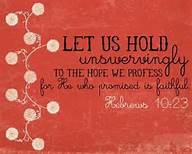
Heb 10-23 He who promised is faithful words

Hebrews 10:19 – November 15, 2015

Who here knows the words of the Apostles Creed? Who studied the Apostles Creed before they were confirmed? I know I did. I studied Martin Luther’s Small Catechism, and went over every part of the Lord’s Prayer as well as the Apostles Creed.

Today, we are going to take a closer look at the whys and wherefores of two phrases from the Apostles Creed: “He—Jesus—ascended into heaven, and sits on the right hand of God the Father Almighty.” You—I—all of us have been saying these words for years and years. It’s a part of our church culture. But, what do these words really mean? “Where is Jesus now?

We are departing from the Gospel of Mark. I’ve been preaching from Mark for the last two months. We have been following Jesus through His discussions with the Jewish leaders about all kinds of aspects of the proper religious life. Today, we make a big jump forward, to the New Testament passage from the letter to the Hebrews. This is after the Resurrection, after the book of Acts, and the Apostles have now been sent out into the world to tell all people about the risen Jesus, and about God’s love and forgiveness of their sins.

This letter to the Hebrews is a circulating letter. That means it and other circulating letters were sent from place to place in Asia Minor, so the small, struggling churches could receive encouragement and teaching in writing from the Apostles and other new church leaders. This particular letter was sent to Jews who lived a long way from Jerusalem. In essence, ex-pat Jews.

To give us some further background into this week’s reading, “This week’s text [from Hebrews] draws together the argument the author of this letter began six chapters ago, namely that Jesus is God’s final and ultimate High Priest. The author can point to the model of Israel’s priests to explain what Jesus does, but His priesthood differs in several fundamental respects. Beginning in verse 11 the author reiterates those differences once again.” [1]

What about those Old Testament priests in the Temple in Jerusalem, anyhow? They needed to keep on sacrificing animals over and over and over again. Why? The people of Israel had a Sin Problem. The priests had to keep sacrificing to cover the Sin Problem, to make it better. To atone for the sins of the whole people. And no matter how hard they worked, or how many animals they sacrificed, or how much they prayed to God, it was never enough. There was always more sin. The nation of Israel and all the individuals in Israel had a Sin Problem.

I know when my mother had a houseful of guests (usually several of her grown children all at once), she would try and try to keep the kitchen clean, the kitchen sink empty of dishes, and the bathroom ready and clean for anyone who needed to use it. Except—there were always so many people in the house. There was always more dirt. More mess. More dirty dishes. It seemed like it would never end! (Except, it periodically did when everyone went to their own homes, in the case of my mom’s house.)

How many people can relate to this example? Dirt, mess, dirty dishes and black marks in a crowded house never end. Just so, in the case of the priests and the sacrifices for sins that everyone commits, the Sin Problem never ends. For real! Never, ever! People are sinful. They keep doing and saying and thinking things that go against God’s laws, and sin never goes away. All the sacrifices ever brought before God could never make one dent in the Sin Problem.

When we look at our passage from Hebrews again, what do we read? Quoting from our scripture today, “As a priest, Christ made a single sacrifice for sins, and that was it!

What was that again?

Jesus Christ was the perfect High Priest. He was a better High Priest than any other of the priests throughout history who ever offered animal sacrifices to God at the Temple. What Jesus did for us on the cross (and I’m quoting again) “… was a perfect sacrifice by a perfect person to perfect some very imperfect people. By that single offering, He did everything that needed to be done for everyone who takes part in the purifying process.”

The whole repetitive process of endless animal sacrifice? Jesus came and broke that process. He ended it. He made that process obsolete, not necessary any more. Instead, Jesus and His death for us on the cross reaches way beyond animal sacrifice.

What’s more, Jesus our High Priest makes the perfect sacrifice once for all time. And then, He sits down. What about those other priests, the ones who continually stand and keep offering the imperfect animal sacrifices for all those centuries? From the Message, again: “As a priest, Christ made a single sacrifice for sins, and that was it! Then [Jesus] sat down right beside God and waited for His enemies to cave in.”

At first glance, some people might think that Jesus did not finish His work as High Priest. But, that is just the point! He did finish the work. The other priests had to continue to stand, because they had to continue to offer sacrifice after sacrifice on a daily basis. Because of the Sin Problem that just wouldn’t go away. Jesus did complete the perfect sacrifice. His sacrifice brought perfect, complete forgiveness of sins. Jesus was all done, and He sat down. The Sin Problem went away, once and for all.

But, wait! There’s more! Jesus doesn’t just sit down any old place. On any old bench, or in somebody’s creaky rocking chair. No. He takes a seat at the right hand of God. A place of great power and great authority. Jesus—the Son of God, the Second Person of the Trinity, incarnated by the Holy Spirit of the Virgin Mary—Jesus takes the number one seat in all of the universe, next to God the Father. The resurrected Lord Jesus is God the Father’s right hand man. It says so, right in our scripture text from Hebrews today.

To finish our passage from verses 19 and 20, “So, friends, we can now—without hesitation—walk right up to God, into “the Holy Place.” Jesus has cleared the way by the blood of His sacrifice, acting as our priest before God.”

I want everyone to notice that all the pronouns here are plural. That means we—all of us together—can have confidence. We—all of us—can walk right up to God. We can come into God’s presence and boldly bring our requests to God. As I say in our weekly pastoral prayers, we—all of us have free access to God. Not like the Jewish people before the time of Jesus, who were still dealing with the Sin Problem and still needed an intermediary between them and God. But because Jesus, our perfect High Priest, has cleared the way. Jesus has invited us to come. We are very welcome to enter into God’s presence!

Do you have a better understanding now of those two phrases from the Apostles Creed? “He—Jesus—ascended into heaven, and sits on the right hand of God the Father Almighty.”

This section from the letter to the Hebrews answers our questions about “where is Jesus now?”  The risen Jesus is with God and is Lord!

Do you have the confidence that your Sin Problem is taken care of? Do you dare accept the invitation that Jesus extends to us? Can we grasp that assurance that God welcomes us? This scripture passage clearly lets us know about that boldness. That “free confidence,” grounded on the consciousness that our sins have been forgiven.

As I say every week after the Confession of Sins and the Assurance of Pardon, believe the Good News of the Gospel. In Jesus Christ, our sins are forgiven.

Alleluia, amen!

[1] http://www.workingpreacher.org/preaching.aspx?commentary_id=142 Commentary on Hebrews 10:11-25 by Amy L. B. Peeler.

(Thanks to Amy for several ideas I wove into this sermon!)

@chaplaineliza

Suggestion: visit me at my daily blog for 2015: matterofprayer: A Year of Everyday Prayers. and my other blog,  A Year of Being Kind .  Thanks!


Unknown's avatar

The Widow’s Contribution

“The Widow’s Contribution”

Mark 12-42 widow, mite mosaic

Mark 12:43 – November 8, 2015

I have a friend who is recently retired. He goes around town, quietly, and does good. He was raised in the church, but that was a good many years ago. Yes, he does have a belief in God, and he expresses that faith by doing good for others and being faithful.

Sometimes that means driving people to a doctor’s appointment. Or volunteering at a local not-for-profit organization. Sometimes that means picking up the left-over baked goods from a business at the end of the day, at closing time. And then, delivering the baked goods to a homeless shelter. He does all of this without thanks, with little or no fanfare. He is faithful. He is dependable. He contributes, in any way he can. And, I am so glad he is my friend.

We turn to the Gospel reading for today, from Mark 12. Jesus and His disciples are in Jerusalem, and Jesus is having another in those continuing discussions with the chief leaders and teachers of the Jewish Law. They happen to be in the rear of the Temple. Large sanctuary, lots of coming and going, to and fro.

These are several verses from Eugene Peterson’s excellent translation, The Message. Mark sets the scene in verse 41: “Sitting across from the offering box, Jesus was observing how the crowd tossed money in for the collection.”

Wait, didn’t the congregation at the Temple in the first century pass an offering plate? How did they collect money to keep the doors of the Temple open? And, was there any outreach, any charitable giving being done?

For this, we turn to Matthew Henry’s commentary on this chapter from Mark. “There was a public fund for charity, into which contributions were brought, and out of which distributions were made; a poor’s-box, and this in the Temple; for works of charity and works of piety very fitly go together; where God is honoured by our worship, it is proper He should be honoured by the relief of His poor.”;

So, different cultures and different places of worship, not to mention different centuries. We are looking at a slightly different practice of collecting money. Just to make sure everyone is on the same page. The principles of giving and generosity are the same, and those principles span the cultures and the centuries.

Apparently, people used to hang out at the back of the Temple and talk, have discussions, and sometimes debate. Oh—and they would also check out how much other people were contributing to the Temple and to the charitable fund. (I’m quite serious.)

Remember how open, how blatantly obvious the religious leaders were, about their religious observance? Their ostentatious prayer practice, their ritual observance of washing and cleanliness, their attention to the least little bits of the Jewish Law Code, and their finger-wagging and complaining about other people who weren’t quite as observant? So, of course the prideful extra-observant people among the religious crowd would be extreme in their giving practices. Talk about being a show-off!

Jesus has dealt with this kind of prideful observant attitude before. Here in our reading, we see Him dealing with this kind of show-offy attitude again, only in the matter of giving to the needy. What is the next thing He notices? From Mark 12: “Many of the rich were making large contributions. One poor widow came up and put in two small coins—a measly two cents.”

What is this? Jesus does a compare/contrast sort of thing. He compares the large contributions of the rich people with the measly two small coins that the widow contributed. Large amount compared to a small amount.

We will take a short detour and look at our reading from the Old Testament for today. This passage from 1 Kings is a fascinating reading, about how God provided for the prophet Elijah in the time of an extended drought.

I could have preached my sermon to you from this reading! But pairing this passage with the reading from Mark makes a more powerful story.

Elijah was one of the most prominent prophets in the Old Testament. He was God’s spokesman in a time when the nation of Israel was not following God very well at all. King Ahab was married to a foreign Queen named Jezebel, who led Ahab and much of the rest of Israel into idolatry and worship of false idols. That is one of the reasons why God sent an extended drought onto the whole region of the Middle East.

Elijah listened to God, and God communicated to Elijah to head up north, near Damascus, to the home of a non-Jewish widow in the town of Zarephath. Ordinarily, widows were not very well off, with no husband and little means of support. This widow was really, really poor. By the time Elijah arrived at her house, she only had one bag of flour and one jar of oil left in her pantry, and that is all. Hard for us here in the Chicago suburbs to believe that she had so little. Remember, it was a time of extended drought,food prices must have been going through the roof.

Elijah worked a miracle. God provided for the widow, her son, and the prophet. The widow made food for her, her son, and for their tenant the prophet Elijah, every day. The bag of flour and the jar of oil did not run out for months, until the Lord allowed the rains to return and the crops to grow again. Did you hear? God provided for them, out of God’s abundance.

This is what I suspect Jesus was thinking of when He pointed out the widow who put the two coins into the collection box. What did Jesus say? “Jesus called His disciples over and said, “The truth is that this poor widow gave more to the collection than all the others put together. All the others gave what they’ll never miss; she gave extravagantly what she couldn’t afford—she gave her all.”

Did everyone hear what Jesus points out?

All of these show-off rich people gave a portion out of their abundance. But the poor widow? The widow gave extravagantly. She gave over and above. She gave, trusting in God’s abundance. She gave, hope-filled, looking to God to provide for her needs. Like the widow in Zarephath, centuries before, this widow in Jerusalem trusts God to provide. This widow decides that everything she is and has belongs to God.

But, the treasurer and trustees at the Temple might have had a problem with this kind of thinking, and this kind of giving. Guess what? Too bad! What is valued and lifted up by Jesus, what is important to the Kingdom of God is not what is valued in this world. God does not have a dollars-and-cents kind of perspective!

This vignette is just a slice of the widow’s life. But, I’d like to follow the widow home. See how she treats her neighbors. Does she bring over a pot of soup to a sick friend? Does she clean the apartment of someone who has fallen and broken their leg? And what about her listening skills? Is she someone people come to, to talk about their troubles? Giving to God is so much more than just dollars and cents. So much more than just the coins the show-offy rich people put into the collection box in the Temple.

What about us, today? How can we take this scripture lesson today, and apply it to our lives? Is it just a nice story about what happened to people in Jesus’s day? Or, is it much more?

Today, we all can be like the widow in Jerusalem. This widow gave extravagantly. She gave over and above. She gave, trusting in God’s abundance. And, this widow decides that everything she is and has belongs to God. Like my friend I told you about, who does lots of things without thanks, with little or no fanfare. We all can be faithful. We all can be dependable. We all can contribute, in any way we can, to God and to God’s kingdom.

God willing, I’ll contribute to God’s kingdom. Will you contribute, too? Alleluia, amen.

@chaplaineliza

Suggestion: visit me at my daily blog for 2015: matterofprayer: A Year of Everyday Prayers. and my other blog,  A Year of Being Kind .  Thanks!