Unknown's avatar

Spirit of Truth

“Spirit of Truth”

John 14:8-17 (14:16-17) – June 8, 2025

Have you ever been in a building during a power outage? A brown-out? Where something disrupted the electricity? Some years ago, I was at an evening meeting in a large building in Evanston, and that is exactly what happened. The electrical power was somehow shut off or interrupted, and everyone had to evacuate the building.

In situations like that, there can be a real feeling of helplessness. What happened? Where did the power go? When can we get it back? What do we do now? The disciples must have felt very much like this when the Rabbi Jesus made His statements about departure, at the dinner table on that Maundy Thursday night. Jesus told His disciples in no uncertain terms that He would leave them very soon. A distressing, disorienting situation, indeed! What is going on? Is our Rabbi really going to leave? What will we do? Where will we go now?

At dinner that night, our Lord Jesus reassures His disciples with the news that even if He does go away, the Heavenly Father will send another Helper or Advocate, the Holy Spirit. The Holy Spirit will help these new believers! As Jesus said, God our Father “will give you another Advocate, to be with you forever. 17 This is the Spirit of truth, whom the world cannot receive, because it neither sees him nor knows him. You know him, because he abides with you, and he will be in you.”

We can see how the disciples react to this news, given just before Jesus has His arrest, followed by the trials and then the crucifixion. Confusing events happening in short succession. This was compounded by the followers of Jesus scattering, running away, frightened by the very real, very legal, very official things happening to Jesus before and after His crucifixion.  Their leader and rabbi has gone. Several dozen disciples, huddled in an upper room, all together.  Wondering where their power is. Talk about a power disruption! Seems more like a power loss of epic proportions

And now what? As the disciples huddle in that Upper Room where Jesus and His disciples last met, The disciples still must have been frightened to death of the authorities, after the crucifixion. I suspect they needed to talk about the happenings of the past few weeks, too. Debriefed. Tried to figure things out, as best as they could.

We go forward several weeks to the day of Pentecost, another major feast day for the people of Israel. And where are the disciples? Back in Jerusalem, in the upper room, still hidden away from the authorities. Isn’t that a lot like today? No matter where people live in this world today, no matter what their situations are, no matter what they do for a living, a common desire among many people is that desire for reassurance, a wish for something to hope in, to believe in. A desire to know exactly where their power is coming from.

But that is where today’s story continues. You remember the scene? A little over one hundred followers of the risen Lord Jesus had gathered together in Jerusalem, in that very same second story of a building. The place that was the same Upper Room where the disciples had their Last Supper with their Rabbi. When, on that Harvest Festival morning, a noise like the rush of a mighty wind blew through that upper room. Apparently, it was loud enough—surprising enough—so that people on the street heard it, too!

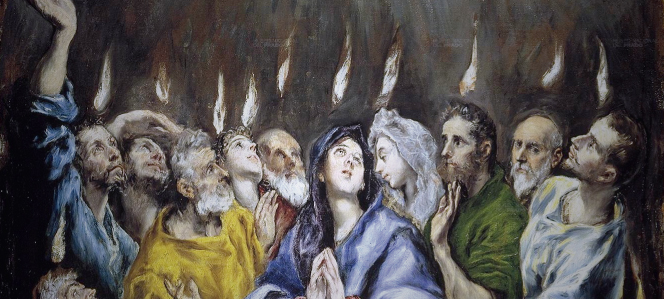
The Holy Spirit came with full power, with heavenly flames over each head and with some kind of noise, music or something that caught everyone’s attention for some distance. After the energizing of the Holy Spirit, the followers of Jesus couldn’t help themselves. They spilled out into the street, and started speaking other languages, as the Holy Spirit gave them knowledge and utterance. Surprising? Amazing? Miraculous? Yes to all three!

But, let’s back up. Just before the Holy Spirit came upon the disciples. Regardless of people’s Power-Source, something was definitely missing in the lives of these followers of Jesus, and something is definitely missing in the lives of many people today. Some people—for various reasons—give up on a belief in a God, in a Higher Power.  They fall back on the vacuum of nothingness, or hopelessness, the feeling of nihilism, the concept that life ends at the point of death, and there is nothing whatsoever afterwards—life on this earth is all there is. Others raise up the substitution of some man-made idol (like the golden calf at the foot of Mount Sinai).

All kinds of things can function in our lives like a golden calf—something else like money, prosperity, position, huge house, great success, or comfort and lifestyle. Other people cling to the Higher Power of self-sufficiency, the substitution of self for God, the crazy idea that I run the show, I’m all that matters, I can be that Power-Source in my personal life.

We all know what a false hope that can be. The Higher Power of self-sufficiency, the substitution of “me, me, me!” for the power of the Holy Spirit. What was so different and so life-changing was that the powerful Holy Spirit moved mightily upon the disciples, and the very breath of the risen Jesus was felt by many—on that day of Pentecost, through the centuries, and to the present day.

The newly-energized disciples spread the Good News of Jesus and His Resurrection, and of God’s reconciliation. Boy, did the Good News travel! The authorities in and around Jerusalem got seriously worried, so upset that they eventually started to crack down on anyone who called themselves a follower of the risen Jesus. The disciples needed to move out from Jerusalem, and started taking the message of the Good News out to the ends of the earth.

God did a new thing at Pentecost, when the Holy Spirit came with power! I wonder if God is doing a new thing now, today? It’s possible that “God will use such a time as this to blow new life through and among and into and upon us. For our own sakes, yes. But even more so for the sake of those to whom we are sent.” [1]

Have you not known? Have you not heard? The everlasting Lord, the God of all creation is sending the Holy Spirit into each of our lives. Yes, the Holy Spirit is active and powerful, and living around the world. Yes, Pentecost happened, almost 2000 years ago, and Pentecost can happen again, right here and right now. Is the Holy Spirit speaking to you? Have you had the Holy Spirit turn on the power in your life?

We, the Church, are on assignment—out among the people God wants us to minister to. Feeding the hungry, comforting the afflicted, welcoming the stranger, taking care of the least of these. We can all tell people about the Good News—the wonderful news of God’s reconciliation and healing. Alleluia, amen!

@chaplaineliza

(Suggestion: visit me at my other blogs: matterofprayer: A Year of Everyday Prayers. #PursuePEACE – and  A Year of Being Kind . Thanks!


[1] http://dancingwiththeword.com/all-together-in-one-place/ 

Unknown's avatar

How Shall We Love?

“How Shall We Love?”

John 17:6-19 – May 12, 2024 

Have you ever heard the saying that “Life is fragile: handle with prayer!” This is so true! Yet, some people might scoff, and say those words are too trite, or too simplistic, or, just don’t work. I feel really sad for people who think this way, because their lives or their circumstances might be sincerely sad or awkward or downright unpleasant.

If we look back at our Lord Jesus, and how He lived, and what His regular habits were, we can see that Jesus practiced regular prayer and meditation. Multiple times in several Gospels we can see our Lord Jesus slipping away to pray, or taking time in the early morning to go away by Himself to pray. He gathered others around Him when He prayed, too. I think Jesus would agree with this saying about prayer, trite though it may seem to be!

Our Gospel reading today comes from John chapter 17, at the end of that Upper Room Discourse, the section of John where Jesus and His disciples gather the night before He was crucified, to eat the Passover dinner. This chapter is an intimate look at prayer, where our Lord Jesus prays to His Heavenly Father. And most striking of all, Jesus prays for His followers. Not only the disciples, but also for us! 

            I love how straight forward commentator Karoline Lewis is. She says, “That upper room was filled with pain and abandonment. With betrayal and loss. With unsettled hearts and fearful souls. And Jesus ends it all with a prayer for his disciples. The section before this portion of the prayer is Jesus’ prayer for himself. But this segment is for his disciples.” [1]

            Jesus has several ideas in these verses, where He talked about trouble and difficulty for His followers. Sadly, this is not new information for us. Plus, these verses contain some of the most powerful concepts about God’s love that are to be found in the whole Bible. Amazingly, Jesus talks about how much God His Heavenly Father loves Jesus, and reminds His followers that they are to love each other in the same way.

            The words of Jesus to our God are written down in the whole of chapter 17. How intimate, how meaningful is that? I want to focus especially on verse 9. Jesus says, “I pray for them. I am not praying for the world, but for those you have given me, for they are yours.”

            Jesus prays for His followers. Not just any old prayer, but a significant prayer, at a profound time of Jesus’s life. The night before His crucifixion, when He must have had a thousand and one things on His mind, Jesus takes the time to think of and to pray for His followers; His friends and disciples. How selfless, how thoughtful this is. And, how much like the Jesus we know and love!

            One amazing thing about this prayer – this High Priestly Prayer of Jesus, is that Jesus not only prayed about the disciples He had at that time, those friends He loved so dearly. “Jesus is still loving and praying for us today – and so are our parents, grandparents, and church community. We are [all] covered in prayer just like a blanket.” [2]      

            When one of my children was still very small, he had a special blanket that meant a great deal to him. Being covered with that special blanket made him feel safe and secure. Does that sound comforting and heartening? Doesn’t it make you want to feel God’s love holding you (and me) securely, like a warm, fuzzy blanket? I’ve got great news for you! Jesus promises that to us, right here in John 17!   

            Today is Mother’s Day. Today is a day to take the time to think of beloved mothers (and, those who have acted as mothers).

In many, many cases throughout this country—and beyond, around the world—many caring, loving and nurturing women have mothered those under their care. In cases of religious nurture, caring mothers, grandmothers, aunties, sisters—and others who have stood in the place of these maternal figures—have prayed for their friends, relatives and loved ones, too.

Whether nearby or far away, prayer makes that intimate connection, that bond between friends, relatives, and loved ones. It does not matter whether the pray-er and the ones prayed for are next door, in the next town, or separated by miles, mountains or oceans. Jesus was making that intimate, loving connection too, through His prayer for us in John 17.

“This [prayer] is not the Lord’s Prayer. This is not Jesus teaching his disciples how to pray. This is not only a personal prayer or privatized piety. After betrayal and predicted denial, after concerned questions and foretold rejection, the disciples do not need another lesson, another miracle, another example. They need exactly what Jesus does, because Jesus knows — for Jesus to pray for them.” [3]

Just as a devout mother or grandma prays for her loved ones, just as Jesus seeks a intimate and loving connection with His friends and followers, so we can seek to have that deep connection with one another.

Dr. David Lose invites all of us to hear these words of Jesus addressed to each of us today. To imagine – really, to know – that Jesus was praying for us all those years ago and continues to care for us, support us, and love and connect with us today. Please take a moment to think about where we need to be more whole. Where do we need to have more peace in our lives? Where do we need more love? And then, imagine that Jesus is actively, intimately praying for each of you. And, indeed, for all of us. [4]

Jesus is caring for us, you know. Jesus loves each of us that much.

Plus, Jesus invites us to love one another that much, too, in this, His most intimate prayer. Take the words of Jesus seriously. Go and love others, just as Jesus loves us. Alleluia, amen. 

@chaplaineliza

(Suggestion: visit me at my other blogs: matterofprayer: A Year of Everyday Prayers. and  A Year of Being Kind . Thanks!


[1] https://www.workingpreacher.org/dear-working-preacher/prayers-needed

[2] https://www.stewardshipoflife.org/2018/05/the-power-of-prayer/

[3] https://www.workingpreacher.org/dear-working-preacher/prayers-needed

[4] http://www.workingpreacher.org/craft.aspx?post=2566  David Lose The Power of Being Prayed For

Unknown's avatar

We All Are Witnesses!

“We All Are Witnesses!”

Luke 24:48 – April 14, 2024 

Have you ever been confused by the number of hurried, jumbled nature of things happening at once? And the speed at which these things happen? This experience is more common than we might think. Just think of the passing of time, where it’s New Year’s, you and I turn around, and it’s already Easter! Or, before we know it, the school year is over!

However hurried and jumbled these past months have been, it pales in comparison with our Gospel reading today. The end of the Passion Week must have been momentous and confusing for the followers of the Rabbi Jesus. Some confusing and jumbled things were happening very quickly. From the big festival entrance on Palm Sunday to the Passover Dinner of Maundy Thursday evening, to the arrest, trial and Crucifixion on Good Friday.

Events happening in short succession from morning until night. Everything happening one thing after another. This was compounded by the followers of Jesus scattering, running away, frightened by the very real, very legal, very official things happening to Jesus on Thursday night and Friday during the day.

   Let’s fast-forward to that Sunday morning, the first day of the week. The disciples still must have been frightened to death of the Jewish and Roman authorities. I suspect they needed to talk about the happenings of the past few days, too. We can see that from our scripture passage.

We pick up the narrative right after the events of the Road to Emmaus. To fill everyone in, two followers of Jesus got on the road to Emmaus that Sunday. As they walked, they talked. Debriefed. Tried to figure things out, as best as they could. And what circumstances they needed to figure out! A Stranger began to walk with them on the way, and unbeknownst to them, it was the risen Jesus, incognito. He shared with them a summary of all that He had come to earth to do. Of His ministry, His message, and His purpose. And still, they did not know it was Jesus.

Not until dinner that evening in Emmaus, the risen Jesus was revealed when He blessed and broke the bread. And then—Jesus disappeared! The other two at the dinner table did not waste any time! They ran back to Jerusalem, to the Upper Room, to tell what they had seen. Yes, they were witnesses. Eye witnesses, verifying everything that had happened that day.

Our Gospel reading for today picks up the story at this point. All of the followers of Jesus are gathered together in the Upper Room, and are talking about the story of the road to Emmaus. Do they believe? Or, don’t they? Are a few skeptical? Or doubtful? Are some still frightened?

Let’s transition to today. Here and now. I can hear some people today, scoffing at the idea of some guy rising from the dead. And then, miraculously traveling alongside of two other guys? Good as new—in fact, even better? No way! Not a chance. The other two must have been hallucinating. Or dreaming. Or maybe, seeing a ghost. They can’t believe. Or, won’t believe.

As we start the Gospel reading, the risen Jesus suddenly appears to the group in the locked Upper Room. What does He say? “Peace be with you.” A common greeting of the time. He’s also calming their hearts, their spirits, their anxieties, their emotions. “Peace be with you.”

How does the risen Jesus immediately respond to the disciples?  “Don’t be frightened! It is I, myself.” He emphasizes His identification. “I, myself!” It’s not anyone else, but Jesus! He lets them know that He is solid and corporeal, not a ghost. Not a spirit. And, Jesus doesn’t criticize His followers for being afraid! For feeling uncertain, doubful and anxious!

I wonder whether you have ever had a kind and patient teacher, or instructor, or coach. When you were afraid, uncertain, or anxious, did this kind and patient person get angry with you? Or, upset? Or, did this person continue to be open and willing to help you? Generous with time and welcoming to your attempts? Well, that is Jesus, all over. To a T.

Jesus tells the disciples, first. They are to proclaim what they have seen and heard. They are to be witnesses to the power of the resurrection. They are to tell how the risen Jesus has made a difference in their lives! And boy, that was a big difference!

When we read the book of Acts, that is exactly what we see. The disciples being witnesses of what they have seen and heard, witnesses of the power of the resurrection. Time after time, no matter what, the disciples tell others about how Jesus lived, preached, did miracles, and rose from the dead. Then, how all that has made an earth-shaking difference in their lives.

This is the message that Jesus told the disciples to start to carry, when John was a very young man. Some decades later, we see the aged John still carrying the message Jesus told him to, the message of sacrifice, hope, and resurrection. John is still being a witness, all those decades later, at the close of the first century! Dear friends, our Lord Jesus gave specific instructions to His friends, to go and be witnesses. He gives those same instructions to us. We are to be witnesses of the power of the resurrection.

Can you think of someone who was a witness to the power of God, in your life? Someone who immediately comes to mind for me is Miss Rose. I met her more than thirty years ago, when my older two children were very small. She was a witness to the power of God, and to God’s love. She communicated God’s love to everyone she ever met, just about! A little lady, a dynamo for God, she would tell everyone about God and how much God loved them.

I met her again, some years ago when I was a chaplain intern at the Presbyterian Homes. She was a resident there. I was so happy to see her. Miss Rose and her joy in the Lord bubbled over and communicated to everyone she met there, too. Even though she was in severe, chronic pain, Miss Rose witnessed to the power of the resurrection, asking people she met, “Do you know Jesus? Can I tell you about Him, and what He’s done in my life? Can I tell you my story?”

Each of us has an opportunity to be a witness, to communicate the Good News about the risen Jesus and the power of the resurrection. We can communicate by words, by a smile, by being kind, through our actions, through our generosity.

Think about someone who impacted your life, who communicated the Good News to you. There’s a great example for you! Just like Miss Rose is a marvelous example for me, to be a witness despite pain and suffering, even through difficulty in my life. I can still communicate God’s love, just like the aged Apostle John did, too, decades after the Resurrection. He was even in prison when he wrote his letters, on a little island in the Mediterranean Sea. That didn’t make any difference. John still told his story, how the risen Jesus made a difference in his life.

What is important is that we get out there and start being a witness, telling people about the power of God, and about how much the risen Jesus has changed our lives. Can you be a witness? It’s as simple as telling your story. Can you tell the story of Jesus and His love? Jesus loves you. Jesus loves me. Jesus loves all of us.  Be witnesses. Alleluia, Amen.

@chaplaineliza

(Suggestion: visit me at my other blogs: matterofprayer: A Year of Everyday Prayers. and  A Year of Being Kind . Thanks!

Unknown's avatar

Promises Kept

 “Promises Kept”

John 14:8-17 (14:17) – June 5, 2022

When you think of our Lord Jesus when He was here on earth, what kinds of things come to your mind? Was the Rabbi Jesus an extraordinary preacher and teacher? I believe He was. How about a miracle worker? Certainly, by countless accounts! Did He always tell the truth? I think so. And, how about keeping the promises He made? Absolutely.  

Very often in the Bible, people predict what is going to happen in the future. The prophets of God were very good at this. Sometimes these predictions are warnings and negative things; sometimes the predictions are good things and events to be eagerly awaited!

After the Ascension, the group of disciples were all in Jerusalem, awaiting some really big predictions to come to pass. Predictions by angels, and by the Hebrew Scriptures, and some plain-spoken words by the risen Lord Jesus Himself. It was on Pentecost morning that a large number of predictions came to pass – in a huge way!

You remember the scene? A little over one hundred followers of the risen Lord Jesus had gathered together in Jerusalem, in that very same second story of a building. The place that was the same Upper Room where the disciples had their Last Supper with their Rabbi, the night before His crucifixion.

You remember the train of events? A big holiday and Jewish festival was celebrated: the festival of Shavuot, or First Fruits. Lo and behold, the group of disciples was having a prayer meeting, when suddenly “there was a sound from heaven like the roaring of a mighty windstorm, and it filled the house where they were sitting. Then, what looked like flames or tongues of fire appeared and settled on each of them. And everyone present was filled with the Holy Spirit and began speaking in other languages, as the Holy Spirit gave them this ability.”

The disciples were as surprised as anyone! Yet, Peter realized what was going on and as one of the spokesmen for the disciples, he stood up and proclaimed that this was indeed an earthshaking sign from God! He even quoted from the prophet Joel, about the descending of the Spirit of God.

You remember what happened? Peter said, ““People of Israel, listen! God publicly endorsed Jesus the Nazarene by doing powerful miracles, wonders, and signs through him, as you well know. 23 But God knew what would happen, and his prearranged plan was carried out when Jesus was betrayed.”

I am certain that as Peter spoke he remembered that last night in the Upper Room; their leader and Rabbi Jesus gave the disciples a firm promise, saying “And I will ask the Father, and he will give you another advocate to help you and be with you forever— 17 the Spirit of truth. The world cannot accept him, because it neither sees him nor knows him. But you know him, for he lives with you and will bein you.”

This cataclysmic happening on Pentecost morning was that exact thing! The pouring out of the Spirit of truth, God’s Holy Spirit! It was not a gentle, even passive pouring out, but instead a mighty rush of wind! Flames appearing over each believer’s head! And, the gift of tongues or speaking in languages that the disciples had never learned! God displayed awesome power and might on that Pentecost morning!

Let’s go back a few weeks, to that Upper Room, to that Passover dinner just before Jesus was betrayed. All during the past few weeks Jesus had been predicting His death. Fulfillment of prophecy often seems distant and impersonal…like it is not warm or intimate. By some standards, Jesus gave a prophecy, it’s true. But more than that, Jesus gave a firm promise. He promised that His Heavenly Father would send the Spirit of truth upon the disciples.

 “For he lives with you and will be in you.” Such a positive way of seeing this marvelous event! Jesus recognized that His promise would become a lifeline for the disciples, a promise made, and a promise He certainly kept! Isn’t keeping a promise warm, positive and genuine? That describes our Lord Jesus to a “T”

Throughout the Gospel of John, Jesus supplied deep needs. Wants and desires, too. He supplied a whole description on new life to Nicodemus. Jesus supplied living water, spiritual hydration to the woman at the well. He supplied healing to the man by the pool of Bethesda. Jesus supplied guidance into an unknown and frightening future to Thomas, and for knowledge that God’s promises are definitely true, in Philip’s case.

And here, in the Upper Room, to all of us here today and throughout the centuries, Jesus elaborated on the gift of the Holy Spirit. Our Gospel reading today points to “an intimate Pentecost, to the Holy Spirit at work in our inner lives and in our world drawing us into intimate relationship with God who delivers on all God’s promises.” [1]

The Pentecost event two thousand years ago was indeed a huge cataclysm of sound and wind and flame and excitement! Yes, and our individual Pentecosts today can also be quiet, introspective and just as full of the Holy Spirit. Have you not known? Have you not heard? The everlasting Lord, the God of all creation is sending the Holy Spirit into each of our lives.

This is not a mere prophecy, an impersonal declaration of the might and power of some distant Higher Power. Our risen and ascended Lord Jesus has given us a personal promise, a warm, genuine affirmation of God-With-Us, Emmanuel. A genuine promise given, and a promise bountifully kept – in your life and mine. Amen, alleluia!    

@chaplaineliza

(Suggestion: visit me at my other blogs: matterofprayer: A Year of Everyday Prayers. #PursuePEACE – and  A Year of Being Kind . Thanks!


[1] https://www.patheos.com/progressive-christian/intimate-pentecost-alyce-mckenzie-05-10-2013

Unknown's avatar

Peace of Mind and Heart

“Peace of Mind and Heart”

John 14:23-27 (14:27) – May 22, 2022

            The world is in powerful need of peace right now! Isn’t it? Just think of the many places in the world today, right now, where there is strife, conflict, fighting, and even outright warfare. The gift of Jesus that He speaks of here in today’s reading, peace of mind and heart, is something truly to wish for! Even, to clasp tightly to our minds and hearts!

            Here in John, chapters 14 through 17, is His Farewell Discourse. These are the last words that Jesus gave to His friends before His arrest and crucifixion. Important words, indeed!

            Even at this point, on the night before Jesus was betrayed, His disciples needed some further explanation of what Jesus was saying to them. First Peter (John 13:36), then Thomas (14:5), then Phillip (14:8), and then Judas (not Iscariot) (14:22) ask for clarification about exactly what Jesus is telling them. Jesus packs a whole lot into just a few short verses.

            I would like to highlight one particular verse: John 14:27. Jesus said, 27 “I am leaving you with a gift—peace of mind and heart. And the peace I give is a gift the world cannot give. So don’t be troubled or afraid.” There is so much conflict, fighting, mass shootings, and attacks of one kind or another happening in this world right now. We need peace badly!

            David Lose, one of my favorite commentators, wants us to think more deeply about this word “peace.” I hear Jesus say this word. But why? How do we understand peace? What do we imagine Jesus means? “Too often, I think, we think of peace as simply the cessation of conflict. And clearly an end to violence is a good thing. Many of us have prayed for peace in the Middle East, [peace in the Ukraine,] peace in our community, perhaps even peace in our homes. But I think the peace Jesus offers is more than the absence of something negative.” [1]

            But, wait a minute, some people say! I know the world needs peace in the Middle East, and peace in Ukraine, and peace in lots of other places worldwide. But, what about me? What about my house, my neighborhood? I am not experiencing much peace in my personal life!

            Rev. Janet Hunt agrees just this past week that peace is regularly shattered in her neighborhood in the town of Dekalb, in the community where she lives and serves. She mourns the fact that “peace of mind, heart and body are too hard to find; so many needs, physical and otherwise, go unmet. And even if all else seems to be going well, still we struggle through our personal, sometimes private heartaches which threaten our peace, our sense of wellbeing.” [2]

            Looking at Chicago, I was just on the spot of a mass shooting on Friday, just a few blocks west of the Water Tower, off of Michigan Avenue. The police activity was still very present as they investigated that evening shooting and the aftermath. I needed to be in the area for my job, to visit a patient for the hospice I work for. Yet, I saw firsthand the very real conflict and disruption in the city center, in one of the most affluent parts of the city.

When someone reports feeling calm and “at peace,” so often people scoff, or are jealous, or disbelieve. That is, at first. Why is this? Is peace so rare or so unusual?

            I want us to go back to the Upper Room, back to the Farewell Discourse. “Think, again, of the timing of Jesus’ promise: it is the night of his betrayal, the evening when he will be handed over to those who hate him and who will take him away to be executed. And yet in that moment, he not only senses peace but gives it to others.[3]

            Yes, Jesus knows He doesn’t live in a peaceful world, and Jesus knows very well that His personal life is going to be rocked to the core in just a few hours. Yet, Jesus tells His disciples that He gives them His peace. And, guess what? We can access that same peace! That peace which the world does not understand, that the world cannot give.

              When someone reports feeling “at peace,” that person “instead testifies to a sense of wholeness, even rightness, of and in one’s very being It’s a sense of harmony with those persons and things around us. Peace connotes a sense of contentment, but even more fulfillment, a sense that in this moment one is basking in God’s pleasure.” [4]

            Even when you and I are in the midst of hardship, struggle, even conflict or disruption, we can access Jesus and His peace! Countless believers have clung to this blessed promise, even through great difficulty, horrific tragedy, and deadly conflict. Through personal tragedies or nationwide devastation, it does not matter. Jesus still offers His peace, freely! That peace is not only to be embraced in some far distant future, but it is already ours!

            God’s promise of peace is not maybe, or perhaps, or just in case. God loves us with an everlasting love! God has already gifted us with that peace that passes all understanding. God has already laid claim to us! With that claim comes peace that is truly beyond our understanding, peace that is always ours for the receiving.

            With Rev. Janet, I can affirm that in the hardest of times, in the hugest of challenges, when my heart is most tender, God’s peace is right there for me, and for you, too. Both when faith runs deep, and when it’s hard to believe, too. And when it’s a challenge for you to have faith alone, that is what the church is for – to believe together, in community.

            Jesus said, “the peace I give is a gift the world cannot give. So don’t be troubled or afraid.” This gift of peace is truly for us all.  Alleluia, amen!

@chaplaineliza

(Suggestion: visit me at my other blogs: matterofprayer: A Year of Everyday Prayers. #PursuePEACE – and  A Year of Being Kind . Thanks!

(Thanks to Rev. Janet Hunt and her excellent commentary on this Gospel reading for the 6th week of Easter, https://dancingwiththeword.com/when-peace-like-a-river/. I have used several ideas and quotes from this post in this sermon. And, thanks to Rev. David Lose as well. I owe much to him, from http://www.davidlose.net/2016/04/easter-6-c-peace-the-world-cannot-give/)   


[1] http://www.davidlose.net/2016/04/easter-6-c-peace-the-world-cannot-give/

[2] https://dancingwiththeword.com/when-peace-like-a-river/

[3] http://www.davidlose.net/2016/04/easter-6-c-peace-the-world-cannot-give/

[4] http://www.davidlose.net/2016/04/easter-6-c-peace-the-world-cannot-give/

Unknown's avatar

Love As Transformation!

“Love As Transformation!”

John 15:9-17 (15:17) – May 9, 2021

            What do you think of when I mention the word “command?” Commands given in the military? Commands from a dog’s obedience training, a service dog or police dog? Or what about the commands given in the Law of Moses – most famously, the Ten Commandments?

            Here in the Gospel of John, our Lord Jesus gives us a big command. Perhaps, even the greatest command of all: love one another. That sounds awfully familiar! Last week’s sermon was also on last week’s lectionary passage, from the New Testament letter of 1 John chapter 4.

This week the sermon comes from the Gospel of John chapter 15. Both sections of Scripture talk about similar things: love, and loving one another. I showed last week that love is an action word. This week, I want to show that love is a transformational word.

It’s helpful for me to know where Scripture is coming from. Where in the Bible, and in the case of this reading, where in the life of Jesus it comes from. The passage Eileen just read for us is a short section from a long discourse – the Upper Room discourse, given by Jesus on the same night He celebrated the Passover remembrance with His disciples. The night He instituted Holy Communion, the Lord’s Supper. Also, the night before His arrest and crucifixion on that Good Friday.

As a Rabbi, Jesus knew the Hebrew Scriptures, and specifically the Law of Moses, in depth. In great detail. He was often called upon to discuss and debate specific Scriptures and points of the Mosaic Law. We see that again and again throughout the Gospels. Here, in His final discourse or sermon, our Lord Jesus comes back to the commands once more. Jesus gives His disciples one last command: love one another.

            How can we love one another? Is that another “do this” or “don’t do that” command?

            The Law of Moses, found in the Hebrew Scriptures, has over 600 specific commands. It’s quite detailed in how to live a life pleasing to God. For an individual, in a family, and in society. Instead of getting into the minutiae of exactly how to cook and wash, and how to dress and to behave, our Lord Jesus talks about transformation: He says, “Love one another.”

            Such a challenging concept! Yes, we are supposed to love one another. But, how? What does that kind of love look like?

            Jesus gives us an example, right here. “12 My commandment is this: love one another, just as I love you. 13 The greatest love you can have for your friends is to give your life for them.”  In case anyone has any questions about how they are to love, here’s an earth-shaking explanation. Be prepared to show your love at any time. In fact, be prepared for anyone and any time to require you – and me – to give our lives for one another. Jesus is not kidding. That is exactly the way that this command and commentary is phrased in John 15.

            What is another visible way for this kind of love to be shown? Our commentator, the Rev. Dr. Derek Weber says “What does a life of sacrificial love look like? That’s the image that you are casting this week. For many, it looks like a mother’s love. “ [1] A mother’s love – or, to some people, mothering love, coming from someone very close to you – can be amazing. Loving, yes. Caring, yes. Seemingly without bottom and without end.

            When many people think of mothers and Mother’s Day, what goes through their heads? What does Dr. Weber have to say? “For many. It is a time to say thank you to the one who often holds the family together and who often carries the heartache bound up in hope when no one else sees beyond their own personal pain. Today offers a chance to say thank you to the one who brings order out of chaos, who can find the missing sock and the lost homework, the one who remembers how much laundry detergent you need per load and the reason why some plastics won’t work in the microwave and some will. This is a chance to say thank you to the one who rarely gets thanked for all that she does day in and day out.” [2]

            But, for some in our world, mothers do not often act in a caring, loving way. Some memories of mothers are more painful than joyous. Mothers may be a difficult topic, challenging to even think about. Hurts, difficulties, losses, estrangement, even separation – any of these can make Mother’s Day a time of heartsore grief.

            However, most everyone can remember those certain people who stepped in, stepped up, and cared for us in the special way that a loving, caring parent is supposed to. Caring human beings can indeed be mothering influences and demonstrations.

            How do you and I consider others who love us the way Jesus told us to? “For others, [Mother’s Day] might need to be more personal, more individual. A part of our worship together might be a time of thankfulness for those who have loved us like that.” [3]

            This is sacrificial love, transforming a person right down to their inmost being. And, this kind of transforming love is exactly what our Lord Jesus is calling us to. Yes, we are here to thank all those who have given of themselves, lovingly, with great caring, even going to great lengths to sacrifice for their loved ones. And, we can all strive to be that person for others.

            Yes, love for our children, grandchildren, and other relatives. And yes, love for other loved ones, for those special people we meet in our journey through life. How can you best show that love for another person today? Be that person who shows amazing, wondrous love and care. Be kind. Be caring. Be loving. Be like Jesus.

            Alleluia, amen.


[1] https://www.umcdiscipleship.org/worship-planning/living-the-resurrection/sixth-sunday-of-easter-year-b-lectionary-planning-notes

[2] Ibid.

[3] Ibid.

@chaplaineliza

(Suggestion: visit me at my other blogs: matterofprayer: A Year of Everyday Prayers. #PursuePEACE – and  A Year of Being Kind . Thanks!

Unknown's avatar

Come, Holy Spirit!

“Come, Holy Spirit!”

Acts 2-3 pentecost

Acts 2:1-4 (2:4) – May 31, 2020

My parents grew up in the 1920’s and 1930’s. That was the golden age of radio. When I was young, my mother used to tell me about radio serials she used to follow. Serials like the Lone Ranger, Little Orphan Annie, Buck Rogers, and the Cinnamon Bear. I know many people all across the country followed these programs closely every week, and listened to even more.

I think of our friends, the followers of Jesus on that hilltop. Like in the radio serials, when last we left our intrepid heroes, we saw them with heads toward the sky. They watched the risen Lord Jesus ascend into heaven. Fast forward to this week. Thank you, Levi, for reading our Scripture from chapter 2 of Acts.

Only a few days have passed since that miraculous happening. Jesus disappeared into heaven. Yes, Jesus gave His followers their orders. Marching orders! But—where are the disciples now? What are they doing? Are they fearlessly marching out into Jerusalem, Judea, Samaria, and to the ends of the world? Come on, guys! What gives? What’s the matter? The followers of Jesus—both men and women—are waiting for something; something that Jesus foretold, something big that had not happened yet. Everyone was together in one place—waiting.

At least they all were in Jerusalem. After all, another religious festival was right around the corner. Fifty days after the Feast of Unleavened Bread (or Passover) the Festival of First Fruits, or First Harvest was celebrated. This festive day was also a glad ceremony in the Temple, and many Jews from hundreds of miles around were in Jerusalem to celebrate.

At least the Jews did not have a pandemic to worry about. No, Jerusalem and the surrounding area were packed with visitors ready to celebrate at the special worship services at the Temple, ex-pat Jews from all across the known world at that time.

And, where were the followers of Jesus? Up in that upper room, presumedly the same room where Jesus and the disciples had celebrated that Passover dinner the night before Jesus was crucified. They were there, but yes, they were shut away. Presumedly behind locked doors, for fear of what the authorities might do to them, even weeks after the crucifixion of their leader, the Rabbi Jesus. Or, is that the Messiah Jesus? Or, the risen, ascended Jesus?

The disciples of Jesus were all gathered together in one place. When, on that Harvest Festival morning, a noise like the rush of a mighty wind blew through that upper room. Apparently, it was loud enough—surprising enough—so that people on the street heard it, too!

The Holy Spirit came with full sound effects, with heavenly flames over each head and I suspect with some kind of noise, music or something that caught everyone’s attention for some distance. After the energizing of the Holy Spirit, the followers of Jesus couldn’t help themselves. They spilled out into the street, and started speaking other languages, as the Holy Spirit gave them knowledge and utterance. Surprising? Amazing? Miraculous? Yes to all three!

I think the Holy Spirit moved mightily upon the disciples, and the very breath of the risen Jesus was felt by many—on that day of Pentecost, through the centuries, and to the present day.

The disciples of Jesus were all gathered together in one place. I envy them.

Because of the pandemic and the shelter-in-place order I have not been able to gather together with a number of other believers for almost three months. And, neither have you.

Sure, we have had online worship, Zoom bible studies and prayer meetings, and telephone conversations. Perhaps individual Christians have met each other in the neighborhood, taking their dogs for a walk or running into each other at the grocery store. We remain socially-distant, to be safe and caring for others who are elderly or in fragile health—but it is not the same as in-person worship, IRL. Not the same, at all.

However—do we depend on a structure, a building, a tall steeple to witness to the Resurrection? Or, is the Church something more, something much bigger than this building?

The COVID-19 pandemic did not surprise God. I am not here to tell you this is a judgement of God upon the earth, or upon one group of people or another. I do not believe a good, gracious, loving God works that way. But—I want to suggest something else. Is it possible that we, as followers of Jesus, can also serve God by being separate, socially-distant, apart and still caring for one another? Can we follow the final instructions of our Lord that He gave just before He ascended, to go to Jerusalem, Judea and Samaria, and even to the ends of the earth?

The newly-energized disciples spread the Good News of Jesus and His Resurrection, and of God’s reconciliation. Boy, did the Good News travel! The authorities in and around Jerusalem got seriously worried, so upset that they eventually started to crack down on anyone who called themselves a follower of the risen Jesus. The disciples needed to move out from Jerusalem, and started taking the message of the Good News out to the ends of the earth.

God did a new thing at Pentecost, when the Holy Spirit came with power! I wonder if God is doing a new thing now, today? It’s possible that “God will use such a time as this to blow new life through and among and into and upon us. For our own sakes, yes. But even more so for the sake of those to whom we are sent.” [1]

We, the Church, are on assignment—out among the people God wants us to minister to. Feeding the hungry, comforting the afflicted, welcoming the stranger, taking care of the least of these. We can all tell people about the Good News—the wonderful news of God’s reconciliation and healing. Alleluia, amen!

[1] http://dancingwiththeword.com/all-together-in-one-place/

@chaplaineliza

(Suggestion: visit me at my regular blog for 2020: matterofprayer: A Year of Everyday Prayers. #PursuePEACE – and my other blog,  A Year of Being Kind . Thanks!

Unknown's avatar

Are We Fearful?

“Are We Fearful?”

John 20-28 st-thomas

John 20:19-29 (20:19, 26) – April 19, 2020

Have you ever been afraid? I mean, really scared? I am talking about so scared that you wanted to hide away from the people in charge, permanently? Maybe it was you, maybe it was some acquaintance or friend, but some people have really been scared so much that they stay holed up in some hiding place, some attic or some upper room—just like the disciples, after they watched their Rabbi Jesus get arrested, beaten and then crucified.

Two thousand years later, we all know the rest of the story. Jesus rose from the dead on the first day of the week, that first Easter morning. What was it like for the disciples? I mean, the men disciples? Sure, they had heard from the women disciples that the tomb was empty. Peter and John had even checked things out at the tomb for themselves. It was true! The tomb was empty! I am sure that news caused a great deal of excitement, discussion, and wonder!

But, what about other feelings? What kinds of other emotions were happening to the disciples? How did they feel on the insides? Were their stomachs doing flips? Were their hearts in their mouths? Were they filled with amazement? Fear? Doubt? Or all of these emotions, all at once, or in stages? Could the disciples be hiding out behind locked doors because they were afraid, embarrassed and ashamed? What were they doing as Jesus died? They certainly were not with Jesus at the cross—except for John. Were they afraid of what Jesus would say to them about all their desertions if He really were alive again? [1]

John’s Gospel tells us, plainly, that the disciples were afraid. Fear is a legitimate emotion and reaction to a dangerous, scary experience.  Sure, the disciples knew that the tomb was empty, but that did not stop them from being afraid. I also suspect that they feared that the Roman authorities might come after them, as known associates of the Rabbi Jesus. The disciples did have good reason to be afraid and anxious of the people in charge.

And right into the middle of all this fear and anxiety—even though the disciples knew about the empty tomb—Jesus walked through a locked door into the upper room, greeted the disciples, and they were suddenly overjoyed! As if a modern switch were flipped, the disciples’ emotional expression flipped, too.

Except—for some reason, the disciple Thomas was not present in the upper room on that occasion. We don’t know why. The Gospel of John does not say. The other disciples told him, excitedly, “We have seen the Lord Jesus!”  But, Thomas was skeptical. He responded, “I need proof for myself. Unless I see the nail marks and put my hand in the wound in His side, I will not believe.” I can just see Thomas crossing his arms across his chest and turning his back to his friends. “Nope. No way. That is too big a whopper for me to swallow.”

Do you know someone who needs concrete proof in order to believe something? Different people’s minds work in different ways. Certain types of people need concrete evidence in order to convince them of the truth, or of the facts, or of someone’s honesty. Thomas was that sort of a person: a “show me” sort of guy. He needed that kind of proof in order to truly believe.

Whether we are talking about two thousand years ago, or about today, people have not changed. One type—one size does not fit all. Some people hear about the Gospel and believe right away. Other people hear about heavenly coincidences, or “God-incidences,” and then come to believe. We can compare Thomas’s skepticism before belief to Paul’s Road to Damascus experience, where the apostle Paul had a sudden “come to Jesus” moment. (Literally.) The New Testament holds up both of these very different experiences as valid.

I have heard sermons about “doubting Thomas.” As if there is something shameful or wrong with being skeptical! I suspect Thomas didn’t know whether to believe or not to believe; there is no shame in being skeptical! We can see that different people come to their own sense of belief in their own individual way, because God has created each of us as unique individuals. Is it any wonder that each of us comes to God in our own personal way?

When you and I think about this Gospel narrative in light of today’s events, there is indeed a great deal of fear and anxiety. Just as there was with the disciples, so it is right now. All over the nation, all over the world the virus COVID-19 makes all of us afraid and anxious. This virus is even more dangerous than the Roman authorities, forcing vast groups of people all over the world to curtail their travel, their interaction, even to the point of quarantine.

Yet, just as our risen Lord Jesus spoke to the disciples and declared, “Peace be with you!” He says the same thing to us. “Peace be with you!” Jesus has declared His peace to fearful people and to dreadful situations over and over again, throughout history. In times of serious illness, in times of conflict and war, in times of natural disaster—Jesus has these hopeful, heartening words for us: “Peace be with you!”

Jesus can come alongside of each of us, through fear, through anger, through desperation, and through grief. And if Jesus is at our sides, walking next to us even though we walk through dark valleys, that is peace, indeed. Jesus gives us His peace, no matter what.

Amen, alleluia!

@chaplaineliza

(Suggestion: visit me at my regular blog for 2020: matterofprayer: A Year of Everyday Prayers. #PursuePEACE – and my other blog,  A Year of Being Kind . Thanks!

[1] http://worshipingwithchildren.blogspot.com/2014/03/year-the-second-sunday-of-easter-april_13.html

Worshiping with Children, Easter 2A, Including children in the congregation’s worship, using the Revised Common Lectionary, Carolyn C. Brown, 2014.

Unknown's avatar

Peace Be with All of Us

“Peace Be with All of Us”

peace be with you, formal

Luke 24:36-49 (24:36) – April 15, 2018

Sometimes I just feel like pulling the covers over my head and not getting up in the morning. Wars, rumors of wars, bombings, fires, gas attacks, and these were just in the past week. Seriously, with all of the scary and shocking things going on in the world, the world can be a downright scary place.

No matter whether we live today in the United States or two thousand years ago in occupied Israel, there can be a lot of scary and confusing stuff going on.

In the case of our Gospel reading today, the scary and confusing stuff was going on right in Jerusalem. It was the time of the Passover, during what we today call the Passion Week. As we have been considering for the past few weeks, the occupying Roman forces in Jerusalem are watching the festival and worship situation very closely.

Sure, there are a great number of visitors from all over the known world, in Jerusalem for that great festival, Passover. But, the Roman forces must have doubled down on the populace in the city. And, even more, since the Rabbi Jesus had just entered the city only a few days before. He made a huge commotion, too, what with riding in on a donkey (like King David) on Palm Sunday, debating in the Temple during the week with the scribes, Pharisees and Sanhedrin, and getting arrested in the Garden of Gethsemane late on Thursday night and accused being Messiah. And, the crucifixion on Friday? Quite a week, for the occupying Roman forces.

Yes, we know some things in general about the disciples. They scattered, running away. Hiding, afraid that since their leader and Rabbi was just executed by the Romans on Friday, they might be arrested and executed next. In fact, Peter even denied knowing Jesus while in the high priest’s courtyard. He must have been scared to death, too.

The upper room, a larger room on the second floor of a building in Jerusalem, was one place where the disciples felt at least half-way safe. They were huddled up there, in hiding, trying to keep a low profile. Luke tells us the male disciples had already dismissed what the women disciples had told them about their Rabbi, early that morning. Something about an empty tomb, and their dead Rabbi gone. Even though Peter and John had run to the tomb and checked things out for themselves, they still did not have a clear idea what was going on.

This year, the lectionary does not have us look at the post-Resurrection appearance of Jesus when He walks with the two disciples from Jerusalem to the town of Emmaus. In brief, our commentator Dr. Mark Vitalis Hoffman summarizes this section of Luke 24: “Two from the group of followers of Jesus were going to Emmaus when they encounter, but do not recognize, Jesus. They express their disappointed hope that Jesus would be the one to redeem Israel, but Jesus explains how everything that happened was necessary according to Scripture. The two invite Jesus to spend the night with them. During the meal, when Jesus blessed and broke the bread, their eyes were opened, and they recognized Jesus, but he vanished from their sight. They rush back to Jerusalem and report to the gathered believers what had happened.” [1]

It is later that day that our Gospel reading picks up. Later in the evening, many disciples (I am assuming both male and female) are in hiding in the upper room. Luke specifically has the two disciples from Emmaus telling the rest about their encounter with Jesus.

Yet, the rest of the disciples are having difficulty believing, understanding. Even though several of these same disciples had angels and Jesus Himself telling them of the Resurrection, what gives? I suspect many of them are still paralyzed with fear. Scared to death. Afraid of the Roman soldiers coming around and knocking on the door at any moment, ready to carry off some of the disciples to be crucified, too.

How often have we been really afraid? Almost scared to death? Terror can paralyze a person. Fear can cause us to disbelieve, to run away, to get angry and fly off the handle. Don’t you think the disciples needed Jesus right then? When He appeared miraculously in their midst, many of them were still unbelieving. Still scared to death.

I think the first thing out of Jesus’s mouth was the most needed of all: “Peace be with you!” Do you hear? Jesus went straight to the heart of the disciples’ fear, their anxiety, their unbelief, and said “Peace be with you!”

Yes, we could talk about what happened after that, when some disciples thought Jesus was a ghost, so He ate a piece of fish to show His friends that He really, actually, had come back to life. Yes, we could talk about Jesus opening the disciples’ minds to the truth of the Scriptures, and how they were to be witnesses of the Good News and the forgiveness of sins.

I would like to go back to the first thing Jesus said: “Peace be with you!” During the Children’s Time, I talked about peace. There are many greetings in different languages that mean “Peace.” “Aloha in Hawaiian means affection, peace, compassion and mercy. Shalom (Hebrew) and Salaam (Arabic) mean peace, complete-ness, and prosperity. Aloha, Shalom, and Salaam can be used on meeting or departing.” [2]

Jesus wished the disciples His peace several times, recorded in the Gospels, including right here. This word is not only wishing a person peace, but “peace, shalom, and salaam” can also be wishing a person God’s presence. The disciples really needed that, too!

In the New Testament reading today from 1 John chapter 3, the aged disciple John tells us that we are the children of God. I remember when I was a mom of young children, sometimes then would get afraid. Sometimes I would comfort them, and hold them on my lap or give them hugs. Don’t you think it’s the same way with God? When we get afraid, even scared to death, we can run into God’s everlasting arms of care and concern. Our Lord Jesus can send us His peace.

The disciples really needed peace, first of all! Perhaps, they needed it most of all. God can send peace into the world today, too. Including peace into conflict in the Middle East, peace in warring regions in Africa and Asia, peace into difficult places in Central and South America. God can send peace to the streets of the cities of our country.

Jesus offers us comfort and peace, just the same way that parents (and grandparents) do. Jesus sends closeness, caring and loving, in addition to His peace.

Can you and I reach out in peace, in shalom, in wholeness and with God’s love? That is the message on my heart from the Gospel reading today. Reach out with God’s peace. Offer God’s peace to those around you today, and every day.

We can praise God for God’s peace and wholeness. God’s peace is a sure antidote to fear, today, and every day.

Alleluia, amen.

[1] http://www.workingpreacher.org/preaching.aspx?commentary_id=3627

Mark G. Vitalis Hoffman Associate Professor of Biblical Studies Lutheran Theological Seminary at Gettysburg

[2] http://worshipingwithchildren.blogspot.com/2015/03/year-b-third-sunday-of-easter-april-19.html

Worshiping with Children, Easter 3, Including children in the congregation’s worship, using the Revised Common Lectionary, Carolyn C. Brown, 2015

Unknown's avatar

Unless…

“Unless…”

Jesus and Thomas illustration John 20-24

John 20:19-31 (20:25) – April 8, 2018

Imagine a city under martial law. Soldiers prowling the streets, night and day—and especially at night. The occupying army and the city authorities come down hard on the civilian population. Sure, the army of invaders polices the city efficiently, but the civilians have very little freedom of movement, very little freedom of expression. This kind of oppressive living would be very difficult. I am thinking of various cities and regions in Asia, Africa, Central and South America. Also within recent memory, we can add places in Europe that were under martial law and forces of occupation. Scary stuff.

We enter the scene in the Gospel of John right after the Crucifixion and Resurrection, late that Sunday evening. We find the disciples cowering behind locked doors, as John tells us.  They were very much afraid!

Jerusalem in the first century of the Common Era was not quite as bad as some places we can imagine from our modern day. Israel was not under strict martial law, but there were many rules and regulations concerning freedom of movement and about public gatherings. I suspect the capital city Jerusalem was a big headache to the Roman soldiers in charge of maintaining the peace, especially at the times of year of big festivals. Including Passover.

As we eavesdrop on the small group gathered there in the Upper Room, we can tell most of them (if not all of them) are scared to death. Perhaps, they thought of what had happened on that awful Good Friday. Perhaps, they considered where each of them had disappeared to. We are not told, and we can just imagine their sad and frightened conversation.

When, suddenly—suddenly—Jesus appears. The Gospel record tells us, “Then Jesus came and stood among them.”  He does not even come in through the door, but just walks right through the wall. Or, the closed door. Locks do not matter to Him. Can you imagine how shocked and scared the disciples were at this sudden appearance? Of someone they had seen die and get buried only three days before?

This must have been a terrifying, mystifying, and joy-filled experience for those disciples in that Upper Room. We can hardly imagine the deep outpouring of all kinds of emotions when they saw their Rabbi Jesus, risen from the dead. Alive once more.

Notice that Jesus did not say “What happened? Where were you? What do you mean, running away and leaving Me all alone? You screwed up! You guys are losers!” No, Jesus did not say anything angry or shaming like that. Instead, He said, “Peace.” Can you imagine? Jesus wished all of His friends “Peace.” In other words, “It is okay. I understand. I forgive you.” Can you imagine how the disciples felt when they heard this marvelous expression from Jesus? [1]

Except…not all of the disciples were there to witness this visit, this post-Resurrection appearance of our Lord. One disciple was missing. Thomas. We do not know why, or where he was, or what he was doing, only that he was indeed missing.

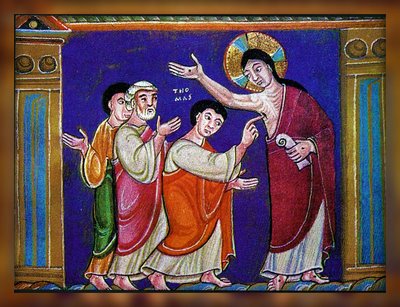
Let us turn to the account from John 20, and listen to what happened: “24 One of the twelve disciples, Thomas (called the Twin), was not with them when Jesus came. 25 So the other disciples told him, “We have seen the Lord!” Thomas said to them, “Unless I see the scars of the nails in his hands and put my finger on those scars and my hand in his side, I will not believe.”

He did not believe. Cut Thomas some slack. Perhaps some of us might have been in the same situation as Thomas, if we had not been there either, immediately following the Resurrection. Thomas is called “Doubting Thomas,” and sometimes he is even scoffed at. But, I prefer to think of him as “Skeptical Thomas.” He did not want to believe in mere hear-say, or in false reports, or in wishful or magical thinking. No, he wanted to have firm evidence of something so serious and earth-shaking as his Rabbi coming back to life. And, can we really blame him?

I love what one of my favorite commentators says about Thomas. Carolyn Brown says that “no amount of explaining can make ‘doubter’ into a positive adjective – especially in this story.” She wants to describe Thomas as a curious person who wanted to see for himself what his friends had already seen. [2]

Did something similar ever happen to you? Did you ever miss a big event (for whatever reason), and then had to listen to your friends and acquaintances excitedly go on and on about that big event? So much so, you wished they would just cut it out, and stop chattering about the big event that happened? Do you suspect Thomas might have felt that way?

At least Thomas is honest! If we look further at the Gospel of John, we see that Thomas was the disciples “who cared enough to interrupt Jesus when he did not understand what Jesus was saying (in John 14:5). He really wanted to understand Jesus.” [3]

How many of us today can say that same thing? Can you relate to Thomas? How many of us really are trying to understand what Jesus said, and what He meant? Thomas certainly is straight-forward. He is skeptical, but he also wants to find out exactly what happened. Put his hand in the spear wound in His side, and his fingers in the holes in Jesus’s wrists.

This sounds so much like many journalists today. They want to find out, first-hand, and get all the straight information. Get the whole story. Perhaps Thomas might have made a great reporter, if they had had newspapers in the first century.

We can ask questions, too. It takes courage to ask questions. We can be skeptical of God, too. God knows we all have questions. There is no honest question Jesus cannot handle.

Children have wonderful questions for Jesus. Carolyn Brown is now retired, but before she retired, she was a Director of Children’s Ministry at a Presbyterian church. Children ask God some serious, penetrating questions, like: “Why didn’t you make me taller or prettier or smarter or…..?“ “How can God pay attention to everyone in the world at every minute?” “Why can’t I see you or at least hear your actual voice like people in the Bible did?”  [4]

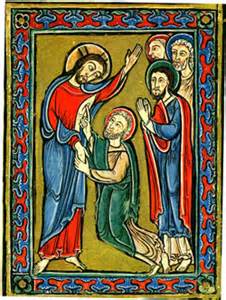
There were some confused disciples and puzzled followers of Jesus after His Resurrection, too. But, Jesus does not answer us in long, drawn-out explanations. Instead, He shows us Himself. He showed Himself to Thomas, and showed his fresh wounds. He said, “Stop doubting, and believe!”

What was Thomas’s response? “My Lord, and my God!”

Thomas saw Jesus’s wounds with his own eyes, A skeptic like Thomas could work his way through honest uncertainty and come to a ringing statement of faith.  What is more, Jesus then said ““Do you believe because you see me? How happy are those who believe without seeing me!” And that includes all of us, today.

Can you and I make a rock-solid statement of faith like Thomas, too? Please God, we can, and we will.

[1] http://worshipingwithchildren.blogspot.com/2015/02/year-b-second-sunday-of-easter-april-12.html

Worshiping with Children, Easter 2, Including children in the congregation’s worship, using the Revised Common Lectionary, Carolyn C. Brown, 2015. 

[2] Ibid.

[3] Ibid.

[4] Ibid.

@chaplaineliza

(Suggestion: visit me at my regular blog for 2018: matterofprayer: A Year of Everyday Prayers. #PursuePEACE – and my other blog,  A Year of Being Kind . Thanks!)