Unknown's avatar

Stand Firm in Benediction!

“Stand Firm in Benediction!”

2 Thessalonians 2:13-17 (2:16-17) – November 9, 2025

            It’s sometimes difficult to be persistent! To hold on, and continue working, continue trying, despite delays and disappointments and detours. Isn’t it? Continuing to work all alone, standing by and standing up when others fall away. Even just being faithful, and doing what you promised to do can be a real trudge up a long, winding road, up a steep and lonely hill.

            It’s a good thing that as we live the Christian life, so often we are in community with each other! Isn’t it easier and more companionable to be traveling together, or working on a project together, or carrying a load together, with a group of friends?

            That’s what the Apostle Paul was writing about, here in this second letter to the young church in Thessalonica. When Paul and his friends were on their second missionary journey, they had only spent a short time in that city before they needed to leave. This was a young church that Paul planted, and Paul had already sent one letter to the believers there. He sent this second one to correct some misunderstandings and to renew the Thessalonian believers’ hope in Christ.

            We are focusing on this small section right in the middle of Paul’s letter. He breaks away from giving further instruction on the confusing timing of our Lord Jesus Christ’s return to giving encouragement to his fellow believers. “But we ought always to thank God for you, brothers and sisters loved by the Lord, because God chose you as firstfruits to be saved through the sanctifying work of the Spirit and through belief in the truth. 14 He called you to this through our gospel, that you might share in the glory of our Lord Jesus Christ.”

            When I hear about churches and pastors today who really focus on the “end times,” and about the prophecies in both the Hebrew Scriptures as well as the few times in the New Testament that refer to the Second Coming, I often roll my eyes. If you have ever read or heard of the books on the End Times, the books are so much dominated by fear and anxiety, by persecution of Christians by cartoonish bad guys. Those same churches and pastors so often advise their congregations of strict rule-following, and black-and-white do’s and don’ts.

            Yes, I did read that first portion of the assigned reading from 2 Thessalonians 2 this past week, and I did not feel led to write a sermon on it. However, I continued reading in chapter 2, and found Paul encouraging his Thessalonian friends, and thanking God for them!

As commentator Mariam Kamell says, “Christians can be confident, encouraged people because we know that we are held as first fruits by God’s choice, preserved through the Spirit. In Paul’s paradigm there is neither room for pride in our efforts to improve the world, nor despair at the state of the world around us. For Paul, all of this talk about the end is to encourage us in our security in Christ and draw us ever further in the Spirit’s sanctifying work.” [1]

            So, we are not to despair over the End Times! We are not to be fearful and cower in the shadows, dominated by fear and anxiety! Instead, we are to rejoice, and be hopeful in our security and salvation in our Lord Jesus Christ.

            Paul then says, “so then,” which is very similar to his connecting word “therefore.” As one of my Bible instructors used to say when I was attending a Christian college for undergrad, “See what “therefore” is there, for! Why is Paul using this particular connecting word?  “15 So then, brothers and sisters, stand firm and hold fast to the teachingswe passed on to you, whether by word of mouth or by letter.”

            I know things and people and situations in this world today can be really scary, and even make us want to hide under the covers! Especially when we consider persecution and lawlessness – however, God has the final word. “Don’t worry about what will happen when you (or people you love) die and don’t worry about what will happen when you grow up or get to be a teenager or [grown-up].   Instead, think about today.  Live as God’s person today.  Do the best you can and know that God is with you.” [2]  

            Isn’t that wonderful encouragement for all of us? Instead of cowering in fear, or being a strict rule-follower or else! We are to know we are God’s people, followers of Jesus Christ, and led by the Spirit of God. Paul prays that the Thessalonian believers are to be encouraged – in their inner being.

“This is clearly a ministry of the indwelling Spirit of Christ. Against the wiles of this age, may we look in faith to the one who constantly surprises us with his love and inspires us with courage and confidence, enabling us to stand firm and not be overwhelmed by the vagaries of life. Our God will buttress us in our faith; this we can rightly ask in prayer, believing.” [3]

            The apostle Paul is truly being encouraging to his friends. Yes, they had some misunderstandings about what Paul preached to them, which Paul clarified. Yes, some of these believers were acting in ways displeasing or disappointing to our God, but at the end of the day and the end of this letter, Paul wanted to give encouragement and hope, not fear and dismay! We are to be cautious around churches and ministers who want to fix, manage and control every aspect of life! Paul leads with the grace of Christ, and the love of God. Period.

            And then, what should burst out of Paul but a benediction! Just as in the middle of the letter to the Ephesians, here at the end of the second chapter to the Thessalonians is a marvelous benediction. We will close with Carolyn Brown’s wonderful paraphrase of Paul’s words:

            “Remember that God loves you.  God chose you to hear about that love and to know the stories of Jesus.  Do not forget them.  Live by them every day.  And may God who created the whole universe, Jesus who showed us how much God loves us, and the Holy Spirit who guides us be with you giving you courage and strength to be God’s people every day.” [4]

@chaplaineliza

(Suggestion: visit me at my other blogs: matterofprayer: A Year of Everyday Prayers. #PursuePEACE – and  A Year of Being Kind . Thanks!


[1] https://www.workingpreacher.org/commentaries/revised-common-lectionary/ordinary-32-3/commentary-on-2-thessalonians-21-5-13-17-3

[2] https://worshipingwithchildren.blogspot.com/2016/09/year-c-proper-27-32nd-sunday-in.html

[3]  https://www.lectionarystudies.com/sunday32caiie.html

[4] https://worshipingwithchildren.blogspot.com/2016/09/year-c-proper-27-32nd-sunday-in.html

Unknown's avatar

Give Thanks Every Day!

“Give Thanks Every Day!”

John 6:5-23 (6:11) – November 26, 2023

            “We gather together to ask the Lord’s blessing!”

            Those words from a beloved, traditional Thanksgiving hymn are so familiar, and so appropriate for this thankful time of the year. Our family just had a Thanksgiving celebration a few days ago, and for many who are followers of faith traditions throughout the United States, Thanksgiving was indeed a day to ask the Lord’s blessing!

            Our Scripture reading is from the Gospel of John, chapter 6. Yet, we could also read about this same miracle from the other three Gospels. This miracle is the only miracle that appears in all four Gospel accounts of the life of Christ.

            This miracle from John 6 is about providing food to a large group of people, yes, and a whole lot more. Let us set the stage. The crowds gathered around the Rabbi Jesus more and more now, because Jesus was gaining a reputation for performing miracles!

            What do you think it would be like, to stand in the crowd and actually see a miracle performed by Jesus? How would you react, or your friends or family react? Would you believe that this Rabbi could actually perform miracles? Or, would you be more skeptical?   

            Each Gospel writer tells a similar narrative. For example, here we have a waiting crowd, eager to see what this unconventional Rabbi is going to do now, and perhaps even get up close to this miracle-worker!

“Here they come, down the road toward Jesus. Can you hear their voices getting louder as they approach and taste the dust that has risen from the tramping of their feet? They are coming closer and closer and they are hungry.” [1]

But, what makes the Gospel of John’s account of this miracle different?

            Think small and simple. Jesus is found in the ordinary and everyday stuff of life. John also called the “miracles” Jesus performed “signs.” This week’s Gospel reading reminds us of John pointing to Jesus in the simple sign of bread. In these verses Jesus uses a few loaves of bread to sustain and calm hungry and fearful folk. Yes, bread says a lot about Jesus’ identity and presence, not only in the sacrament of communion but in daily life. [2]

            Getting down to the specifics of the miracle, the disciples have much discussion about how all of this huge crowd is going to be fed. In the midst of this animated discussion, the disciple Andrew brings a little boy’s lunch to Jesus. But then, he says “How will this little amount go so far among so many?

            Perhaps you and I are like the disciples. Perhaps we get caught up in the limitations, in our fears, in the worry and concern about “how much?” and “what if?” and “what now?” How on earth are we ever going to have enough? And, how can you and I explain exactly how this miracle happened?    

            That is not the important part, which was about a “who,” not a “how.” Jesus is the focus of this sign, “the meeter of needs, the worker of miracles.” The second “who” is us, or them, “the 5,000 hungry ones on the side of the mountain. Who are us too, by the way, John says with an elbow to the ribs. Get it? We are hungry for something we can’t provide for ourselves.” [3]

            Sure, we can intellectualize this miracle, and talk about the exact number fed, and whether the 5,000 were just men, or whether there were additional women and children, and how many, and where they all came from, and who exactly distributed the food. Or, we can theologize this reading, and talk about the differences between the fine points of the translation of the different readings, or how this reading from John is another metaphor for the Eucharist, the bread or manna of heaven, the communion that Jesus provided for these people in the huge crowd without a thought for the exact theological terms used for this picnic lunch.

            Then, John puts in his occasional editorial comment at the end of this narrative. Perhaps John was the only disciple who actually got the point that our Lord Jesus was making! “We know that by how he describes the event. Did you see it? It’s there in the final verse of our text. The people were hanging out in the place where it happened. The miracle place. But John doesn’t call it a miracle place. [In verse 23] He says that it is the place where they had eaten the bread after the Lord had given thanks.[4]

The first thing Jesus did when he received the little boy’s lunch was to thank God for it. He gave thanks for having the food to offer the crowd of people. Jesus gave thanks for feeding the hungry people crowded around Him. Gratitude and generosity come from a way of seeing and being in the world. [5]

            Perhaps that is our grand takeaway for today. Perhaps that is exactly why there was a miracle, a sign from God, precisely because our Lord Jesus looked up to heaven and gave thanks before He broke the bread and shared out the pieces of fish.

Think about it. That’s what John wants us to remember: that this meal, this miracle happened after gratitude was expressed. Gratitude for the abundance that didn’t look like abundance. Gratitude for the satisfaction that came out of hunger. Gratitude becomes a way of seeing and a way of being in the world. We give thanks to God for what is about to happen. We give thanks for what we might not yet see, but what we trust God will provide.” [6]

            Jesus showed us – just as much as He showed His disciples and the crowd of people – that He is able, and He will provide for us our daily bread. We can truly have thanks, truly have gratitude for all that God has done, and is continuing to do in each of our lives. Alleluia, amen.

@chaplaineliza

(Suggestion: visit me at my other blogs: matterofprayer: A Year of Everyday Prayers. #PursuePEACE – and  A Year of Being Kind . Thanks!

(I would like to express my great appreciation for the observations and commentary from the web page www,umcdiscipleship.org for their brief series on gratitude. I used several quotes and ideas from their useful resources. Thanks so much!)


[1] https://www.patheos.com/progressive-christian/mind-the-gap-alyce-mckenzie-07-20-2012

[2] https://www.stewardshipoflife.org/2012/07/bread-water-and-signs-of-god/

[3] https://www.umcdiscipleship.org/worship-planning/our-hymn-of-grateful-praise/christ-the-king-reign-of-christ-sunday-year-a-lectionary-planning-notes/christ-the-king-reign-of-christ-sunday-year-a-preaching-notes

[4] https://www.umcdiscipleship.org/worship-planning/our-hymn-of-grateful-praise/christ-the-king-reign-of-christ-sunday-year-a-lectionary-planning-notes/christ-the-king-reign-of-christ-sunday-year-a-preaching-notes

[5] https://www.umcdiscipleship.org/worship-planning/our-hymn-of-grateful-praise/christ-the-king-reign-of-christ-sunday-year-a-lectionary-planning-notes/christ-the-king-reign-of-christ-sunday-year-a-childrens-message

[6] Ibid.

Unknown's avatar

Gratitude Is—!

“Gratitude Is—!”

Philippians 4:4-7 (4:6) – November 19, 2023

            It’s that thankful time of the year, and this service is one way we all gather to say “thank You” to God. We say thanks for all sorts of good things. Wonderful gifts. Exciting opportunities. We gladly come before God and mention how thankful each of us is—to God.

One of my favorite biblical websites (and, I fully consider her a bible commentator) is “Worshipping with Children,” written by Carolyn Brown. This is what she had to say about Thanksgiving: “One of my favourite times with the children was the year we learned how to say “Thank you” in many languages from our congregation, and ended by using those words for our prayer together.” [1]

I know I taught my children how to say “thank you” when they received gifts, and compliments, and lots of other things. It’s a common thing, for grown-ups, parents, and grandparents to instruct children in these considerate, valuable, and grateful words.

            But, gratitude? Yes, almost everyone knows they are supposed to be thankful at Thanksgiving-time. But, grateful? That is not quite thankful – or is it?  

            Our New Testament Scripture reading for this Sunday is directed toward a group of people – of believers in God. Similarly, the Psalm reading is meant for a group of people, as are our hymns today, too. Isn’t it easier for us to be thankful – jointly? And, to be grateful – together?

            Sometimes being a part of a special group of people is helpful for joining together and agreeing to be in one accord with one another. Especially in terms of encouragement and hope, any group of people makes it easier to show signs of gratitude and thankfulness. Like, in the example of the group of people the apostle Paul addresses through this thank-you note. 

            We all know that being grateful and thankful is not just a head thing, not just something we decide to do one fine day. No, being grateful and thankful is not just an intellectual belief we endorse to be true. Instead, our gratitude and thankfulness ought to be a well-worn habit, a way of living. Most important, our gratitude and thankfulness should be visible, shown in what we do and say, shown in the choices we make and the priorities we set.

            Who remembers thank-you notes? I know I just mentioned thank-you notes written for gifts received (especially written by our children), but this is on a much larger scale. If you like to think so, each of us can be saying “thank you” to God, each and every day. In the same way, each of us has many reasons to be grateful to God each and every day, too.

            We are in a worship service right now. Worship is supposed to be a grateful and thankful time, for sure! What kinds of prayers are grateful and thankful? What about the group that is us, our congregation? “What prayers can we offer that might tap into the sense of interconnectedness and belonging? How can we celebrate the community that we are and the community that we are becoming? Let there be space for saying thank you to one another and to God.” [2]

When Paul wrote this particular letter, he wrote it from prison in Rome. He had been sent to the emperor’s court on a capital charge. He was on trial for his life. And yet—the apostle Paul writes this joyful, thankful, gratitude-filled letter.

Let us count off difficulties and challenges that Paul faced: not only the upcoming trial—for his life, but on top of that, Paul considered himself to be responsible for the churches he had planted on his missionary trips in Asia Minor and throughout Greece. Such heavy burdens on Paul. Yet, here in chapter 4 we see him writing almost blithely to the Philippian believers. He not only writes a thank-you note for a financial gift the Philippian believers sent to him, but Paul also is full of praise, thanksgiving and gratitude to God!

When we look at the people who were on the receiving end of this correspondence, few of them were living comfortable lives. One of the commentaries I consulted said, “Many were poor, many were slaves and few of them would have known the meaning of security. In marked contrast, those of us who live in comparative wealth and luxury today are frequently those who are most worried and anxious.” [3] Isn’t that a true description of us, today?

Sometimes there IS stuff to worry about! A lot of times, people (yes, even Christians) worry about all kinds of stuff! Aren’t we tempted to be worried and anxious when finances are a challenge or the car is giving big problems? Or, how about when we or one of our loved ones is unemployed? Or, in the hospital or dealing with a chronic illness? What about in an accident, or even in jail? Some would say it is natural, even part of the human condition to be worried.

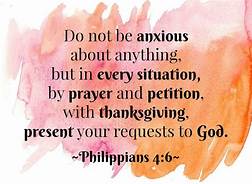
Here is camaraderie, teamwork, and togetherness at work. And, the togetherness, the sense of interconnectedness and belonging of the Christian life is what Paul recommends to us in verses 2 and 3. All of Paul’s commands dovetail into his urging to pray—with gratitude and thanksgiving. “Do not be anxious about anything, but in every situation, by prayer and petition, with thanksgiving, present your requests to God.”   

All too often, our prayers are just a ‘shopping list’ we bring to God, without thanksgiving and seasoned with anxiety and fear. We are urged to be grateful, to count our blessings.

            I encourage all of us – and I am preaching to myself as much as to anyone else – to strive to make it a habit. A way of living, to be thankful and grateful. Not just for this week, for Thanksgiving, but for the rest of the year, too. For always. Let us encourage each other to tap into this praiseworthy sense of interconnectedness and belonging! And celebrate the community that we are and the community that we are becoming!

Be like Paul. Don’t be filled with worry, but instead, be filled with gratitude and thanksgiving! Not just on Thanksgiving, but every day!

@chaplaineliza

(Suggestion: visit me at my other blogs: matterofprayer: A Year of Everyday Prayers. #PursuePEACE – and  A Year of Being Kind . Thanks!

(I would like to express my great appreciation for the observations and commentary from the web page www,umcdiscipleship.org for their brief series on gratitude. I used several quotes and ideas from their useful resources. Thanks so much!)


[1] http://worshipingwithchildren.blogspot.com/2013/09/year-c-thanksgiving-day-october-14-2013.html

[2] https://www.umcdiscipleship.org/worship-planning/our-hymn-of-grateful-praise/twenty-fifth-sunday-after-pentecost-year-a-lectionary-planning-notes

[3] Hooker, Morna D., The New Interpreter’s Bible Commentary (Vol. 12,The Letter to the Philippians), (Nashville, TN: Abingdon Press, 2000), 547-48.

Unknown's avatar

Turn Back in Thanksgiving

“Turn Back in Thanksgiving”

The Healing of the Ten Lepers – Luke 17:11-19

Luke 17:11-19 (17:15) – October 9, 2022

People in need of healing are often seen in the Gospels. Can you imagine a sudden, spontaneous healing happening right in front of you? How about ten people being healed, all at once? That is exactly what happens here, in today’s Scripture reading from Dr. Luke.

The Rabbi Jesus is on His way towards Jerusalem, traveling with His disciples along the way. He comes upon not only one or two people in need of healing, but instead ten people. What would you do when faced with a group of people your society says are “untouchables?” Who cannot even come close, or come into the town, near other “healthy” people? Who have strained relationships, even no relationships with larger society?

Since Luke was a doctor, he must have had some experience with people with various types of skin conditions. What we now know today as simple eczema, or hives, or allergy-related skin issues must have been sources of great dismay. Much less actual leprosy, known as Hansen’s disease, where extremities get diseased as a part of this disfiguring wasting illness. Imagine your fingers or toes or ears just getting diseased and falling off. Horrible.

Let’s look at the verses from Leviticus 13, giving instructions to the people of Israel. “The person with such an infectious disease must wear torn clothes, let his hair be unkempt, cover the lower part of his face and cry out, ‘Unclean! Unclean!’ As long as he has the infection he remains unclean. He must live alone; he must live outside the camp” This is what all people with serious skin conditions were required to do. Imagine yourself, a relative, or a good friend forced to put their hands out in a stay-away gesture. A very sad state of affairs, indeed!

We start to understand how very much alone these lepers are. Not being able to come near their families or friends? “It wasn’t uncommon for lepers to group together. They can’t have much social contact with the “clean” members of society, so they form their own society of the “unclean,” the “untouchables.” Being just outside a village would be common, since they probably obtain food from family members or those in the village who have pity on them. Since they have no land to till, no livestock to look after, they are dependent upon others.” [1]

These ten lepers asked Jesus “Have mercy upon us!” Notice, not the Greek verb for “heal us!” but instead the verb eleeo,“have mercy!” This Greek word means “to be greatly concerned about someone in need, have compassion/mercy/pity for someone.”

What was it Jesus said to the group of lepers? Not, “Go, be healed!” but instead, “‘Go, show yourselves to the priests.’ And as they went, they were cleansed.” (17:14)

As interested observers, we see that much that happens in this brief interaction is fairly typical, looking at all the healing miracles of Jesus from the Gospels. “Neither the pattern of healing — a plea followed by an eminently observable command [from Jesus] — nor the response of worship from the one who returns — to praise, prostrate, and thank — is unique. Both are reliable elements in healing stories. God acts in and through the ordinary.” [2]

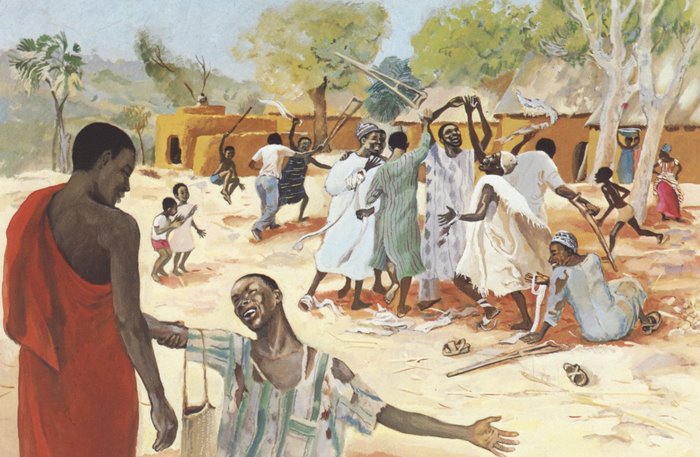
I used to attend church with a missionary who now is retired. I haven’t been in touch with Kathleen for a number of years, but she was in Africa for quite a while doing work for a Christian organization. As she did this relationship-building work with mostly moms and their children, and sometimes the elderly, Kathleen observed miraculous healings going on. These healings were sudden, and happened either with the help of fellow missionaries or pastors. Overwhelmingly, the healings took place in very ordinary, everyday circumstances. In people’s homes, in the marketplace, on the side of the road. God acted in and through ordinary things, and places, and actions. God miraculously built bridges, to draw many to God in relationship, in radical welcome.

It started out as an ordinary day. The ten lepers all were cleansed and healed as they went to show themselves to the priests. However, only one leper out of ten came back to say “thank You” to Jesus. What a bridge to build a relationship!

“By the end of the story, all ten are made well. But one has something more. He has seen Jesus, recognized his blessing and rejoiced in it, and changed his course of action and behavior. And because he sees what has happened, the leper is not just healed, but is made whole, restored, drawn back into relationship with God and humanity. In all these ways he has been, if we must choose a single word, saved.” [3]

Can you see God building relationship in your ordinary life? Helping you along your ordinary comings and goings? That is what God does. It was an ordinary day when these ten lepers suddenly met the Rabbi Jesus – at a distance. Nothing particularly unusual until they had their interaction with Jesus. Can God act in and through our ordinary life? Most important, can we say “thank You” to God for kindness, provision, even miracles that happen in our lives?

It does not matter whether we have any illness or infirmity: physical, mental, relational, psychological. We all have the possibility to be made whole, restored, drawn back into intimate relationship with God and with humanity. Even though we are all at a distance through sin and separation from God, thank God that our Lord Jesus is so willing to draw each one of us into an embrace, a radical welcome, and a close relationship. Thank God each of us can be made whole. Alleluia, amen!

@chaplaineliza

(Suggestion: visit me at my other blogs: matterofprayer: A Year of Everyday Prayers. #PursuePEACE – and  A Year of Being Kind . Thanks!


[1] http://www.jesuswalk.com/luke/074-thankful-leper.htm

[2] https://www.workingpreacher.org/commentaries/revised-common-lectionary/ordinary-28-3/commentary-on-luke-1711-19

[3] https://www.workingpreacher.org/commentaries/revised-common-lectionary/ordinary-28-3/commentary-on-luke-1711-19

Unknown's avatar

Love – No Matter What

“Love – No Matter What”

1 Corinthians 13:1-10 (13:7) – January 30, 2022

            With February right around the corner, many people start thinking about hearts and flowers. Thinking about chocolates and candy. Sweets for the sweet, as the old saying goes! Yes, Valentine’s Day is just two weeks away, and stores and card shops are full of red and pink displays and hearts and roses.

            As many hear this chapter on love from 1 Corinthians 13, some people wax sentimental. This chapter is a favorite to read at many wedding services in the church. “Everyone will nod along with a smile on their face. They’ll be remembering a wedding somewhere where these words were used to somehow capture the essence of this wild and crazy promise being made before the gathered overdressed assembly, this human enterprise that escapes human capabilities on a regular basis. [Or,] they’ll be remembering the Pinterest or Instagram post in fancy calligraphy, or the needlepoint in Grandma’s sitting room.” [1]

What if I were to tell you that love – the Bible’s definition of love – does not have anything to do with red and pink store displays, or hearts and flowers for Valentine’s Day?

            As we reflect on the biblical definition of love, let’s see what Paul says love does NOT do. I’m turning again to the wonderful modern translation of Eugene Peterson, The Message. “Love doesn’t want what it doesn’t have. Love doesn’t strut, Doesn’t have a swelled head, Doesn’t force itself on others.”

            That doesn’t sound much like lace and chocolates, hearts and big red bows, does it? No romanticized consumer version of love here! Do you recognize this honest, genuine kind of a feeling in the people you are close to, in the people you call family? Loved ones, and ones you cherish? This description is more of a love that is right down to earth, an honest, genuine feeling that is real and isn’t afraid to get its hands dirty.

            Let’s see a little more of what Paul says love does NOT do: “Isn’t always “me first,”
Doesn’t fly off the handle, Doesn’t keep score of the sins of others, Doesn’t revel when others grovel.” When I read all of these things love does NOT do, sometimes I get discouraged. It’s like I can’t measure up. I could never be that kind of person or be described that way; could you?

This enlarged, continued description of the biblical definition of love sounds too good to be true. For real people, I mean. To me, it sounds a lot like Mother Teresa, or Fred Rogers, two people who are considered to be the pinnacle of loving, caring people.

Wait a minute! Have we talked to God about this? Paul has been telling us for almost two chapters in 1 Corinthians that God freely gives believers spiritual gifts. What is more, Paul says that love is the absolute best of these different, diverse spiritual gifts. That means that God gives out love freely! With both hands! Right here, Paul is describing the gift of love that comes through people from the Lord. Isn’t that some of the best news ever?

I don’t need to scramble and strive to love, trying really, really hard. It’s not all me, putting together my own faulty kind of caring. No! God freely gives gifts of love to God’s children. God helps us to show love and caring, kindness and unselfishness. That is such a relief for me, and such a blessing to others!

We believers here on this earth may stumble on our way of walking the Christian journey, and that is okay. We do not need to fulfill each and every part of this long, involved definition that Paul given to us, either. And, it is not just up to our fallible striving or hard work to be the most loving and caring Christian believers possible. No! God will help!

When I think of God’s love, I think of certain people who modern society might not consider. Two individuals come to mind, who I knew years ago. Both are with the Lord now, and both had the diagnosis of Down syndrome. Both people were as loving and caring as anyone I have ever met. Both were selfless, totally concerned for others, and unfailingly kind, loving and giving. Isn’t this another example of love, according to the Bible? Isn’t it what love is all about?

Let’s take a final look at the last section of Paul’s definition of love, according to God. The previous entries or parts of the description were couched in the language of what love was NOT. At last, Paul describes what love IS. “Takes pleasure in the flowering of truth, Puts up with anything, Trusts God always, Always looks for the best, Never looks back, But keeps going to the end.” These are positive, affirming, uplifting traits, indeed.

We may not be able to walk the walk or talk the talk as perfectly as Paul describes here. “But we can stand in Paul’s certainty that there is a new way of being alive in the world, a new way of seeing the world and everyone in it. Must we simply accept everything going on in our messed-up world with a smile and nod? Of course not; evil exists. But we aren’t always the best at identifying where the real evil resides. Paul argues that it would better to lead with love.”[2] Again, you and I cannot generate this kind of spiritual gift in and of our own imperfect humanity, or of our own good works. We are welcome to ask the Lord for help and lead with God’s love.

This transformation is truly a gift – a gift of love! This gift comes from God, and is freely    offered to all believers! Let us thank God for this gift of love we all can display, and we all may give to others, just as freely. Alleluia, amen!


Thanks so much to Rev. Dr. Derek Weber, Director of Preaching Ministries for www.umcdiscipleship.com and his excellent preaching notes for this week’s worship service and sermon. I used several ideas from these notes for the sermon today

@chaplaineliza

(Suggestion: visit me at my other blogs: matterofprayer: A Year of Everyday Prayers. #PursuePEACE – and  A Year of Being Kind . Thanks!


[1] https://www.umcdiscipleship.org/worship-planning/love-never-ends-being-the-body-of-christ/fourth-sunday-after-the-epiphany-year-c-lectionary-planning-notes/fourth-sunday-after-the-epiphany-year-c-preaching-notes

[2] https://www.umcdiscipleship.org/worship-planning/love-never-ends-being-the-body-of-christ/fourth-sunday-after-the-epiphany-year-c-lectionary-planning-notes/fourth-sunday-after-the-epiphany-year-c-preaching-notes

Unknown's avatar

Faith in Action!

“Faith in Action!”

James 2:1-10, 14-17 (2:14) – September 5, 2021

            I watched a lot of movies and television series in the past – usually with my children, when they were children and teenagers. A lot of these shows were about young people on a high school campus, complete with all the groups and cliques, exclusion and favoritism. All the “popular” kids were beautiful people, and all the “nerds” and “dorks” were unpopular. Heaven help you if you were really poor and came from the wrong side of the tracks!

            Does this sound familiar? Is this favoritism similar to what James talks about here, in our reading today? James mentions one person coming to worship in fancy clothes, with expensive jewelry. He follows that up with a description of a poor person, in ragged, threadbare clothes, coming to that same worship service. You and I need to ask: who would James exclude from worship service? Who would James exclude from fellowship in the church?

            When we consider the typical high school campus and the typical high school kids, we may give them a pass. Some say they don’t fully understand how damaging and how hurtful their actions are, to many people. Others say that only weak, socially-awkward people get hurt from the rough-and-tumble world of high school…that is just something everyone has to put up with, and to live with. Suck it up, people! Get on with life!

            Except, this rough-and-tumble, catty, mean way of carrying on is not the way that Christians are supposed to be! Believers in the Lord Jesus Christ are supposed to be better than that! Believers are not supposed to play favorites! Aren’t they? James says so! Doesn’t he?

Who would James exclude? “If we’re honest, we have to squirm a little bit as he describes the scene. Of course, we’ve all done this; we’ve all shown partiality in this. We hope we’re overcoming it; we hope we’re countering it; we hope we’re better than that. But our society has drilled into us to value people on outward appearances more than essential being.”[1]

            This letter from James is so practical! Yes, he does refer to theological concepts now and then, but he wants to give us a manual of Christian living: living the way we as believers are called to live! The description in this reading today is a pertinent, hard-hitting example.  

            The Gospel reading from the Revised Common Lectionary today also has some difficult, hard-hitting points. Jesus and the disciples are in the racially-mixed area of the Decapolis, near the Sea of Galilee in the far north of Israel. A Gentile woman approaches the Rabbi Jesus while He is at dinner, and asks Him to please heal her daughter. Jesus says some challenging words to her about being a Gentile. She convinces Jesus to help her and heal her daughter, which He does.

            This Gospel reading deals with favoritism and being partial to one group while excluding another group. Who would Jesus exclude? Would He exclude me and my family? Would favoritism include you? How about your children, or grandchildren?  

            These are difficult issues raised by both the apostle James and the Gospel-writer Mark.

            Perhaps the world does things like this, almost all the time. Perhaps the common, sinful people in the world act and speak and think like this, almost all the time. But, we as believers are not to act like the world!

            As commentator Dr. Derek Weber says, “James points out the economic distinctions that we are all too likely to make in our hospitality ministry. But it wouldn’t be too big a leap to talk about racial and immigrant and gender and orientation distinctions at the same time. This is not, however, a recommendation to avoid the issues We are called to speak up, to follow the boldness of James and talk about the lines of respectability that we too often draw, consciously or unconsciously. It is better to enter into these delicate subjects knowingly than to be surprised.”[2]

            Today, we often use the word “believe” to mean intellectual assent, or understanding. The New Testament agrees – except the full understanding of the word “believe” is deeper and richer than simply the intellect. “When John 3:16 declares that “whosoever believes,” it is asking for a life that reflects that core belief. It isn’t really asking “do you believe” but “are you willing to put your life on it?”

“Does your life and your witness, do your actions and your words tell us that you believe that Jesus Christ is Lord of your life?” That’s what it means to believe in New Testament terms. For James, then, at the heart of believing is how we view and then treat others.” [3] Listen again to the hard-hitting words of James: “My friends, what good is it for one of you to say that you have faith if your actions do not prove it? Can that faith save you?”

            Who would you exclude? Who would I? Do we act like we prefer someone who wears fancy clothes and expensive jewelry to someone who wears ripped, patched blue jeans and shoes with holes? But, it’s more than that. No one deserves favoritism, or a fancier place to sit, or more attention, or more service. Does God choose favorites? What if you are one of those excluded high school kids, sitting at the heavenly loser lunch table, with no way to even get close to God? Shut out from God’s loving, caring, nurturing presence?

            Thank God we are always God’s beloved children! We are always the favorites – all of us! Here is a quote by Max Lucado. See if it resonates with you. “If God had a refrigerator, your picture would be on it. If God had a wallet, your photo would be in it. God sends you flowers every spring and a sunrise every morning Face it, friend – God is crazy about you!“

            Does God choose favorites? No! That is the way God feels about each one of us! Please, remember that as you go into the world. Treat every single person you meet as a very beloved child of God – because, they are! No matter what, no matter who!

@chaplaineliza

(Suggestion: visit me at my other blogs: matterofprayer: A Year of Everyday Prayers. #PursuePEACE – and  A Year of Being Kind . Thanks!


[1] https://www.umcdiscipleship.org/worship-planning/doers-of-the-word/fifteenth-sunday-after-pentecost-year-b-lectionary-planning-notes/fifteenth-sunday-after-pentecost-year-b-preaching-notes

[2] https://www.umcdiscipleship.org/worship-planning/doers-of-the-word/fifteenth-sunday-after-pentecost-year-b-lectionary-planning-notes

[3] https://www.umcdiscipleship.org/worship-planning/doers-of-the-word/fifteenth-sunday-after-pentecost-year-b-lectionary-planning-notes/fifteenth-sunday-after-pentecost-year-b-preaching-notes

Unknown's avatar

Rooted in God’s Love!

“Rooted in God’s Love!”

Ephesians 3:14-21 (3:17) – July 25, 2021

            Some summers are particularly dry. Thankfully, we here in Illinois are receiving a fair amount of rainfall this growing season. However, I can remember dry, hot summers where the whole landscape seemed to be turning brown and all parched for lack of water. Gardeners here around Chicago need to keep track of their garden plots, to make sure their flowers, fruits and vegetables are receiving all the water they need, even now, in a season of fair rainfall.

            Imagine, having the apostle Paul pray for you and the fellow members of your congregation! And not only that, imagine those words being recorded in the Bible, for countless numbers of people to read, centuries later!

            In our reading today, Paul focuses on love – the love of Christ! And, he does connect it to gardening and growing crops. The apostle Paul wrote the letter from our Bible to the Ephesian believers to answer some pressing questions they had about the Christian life. Paul also wanted to encourage the Ephesians in their continued walk with God.

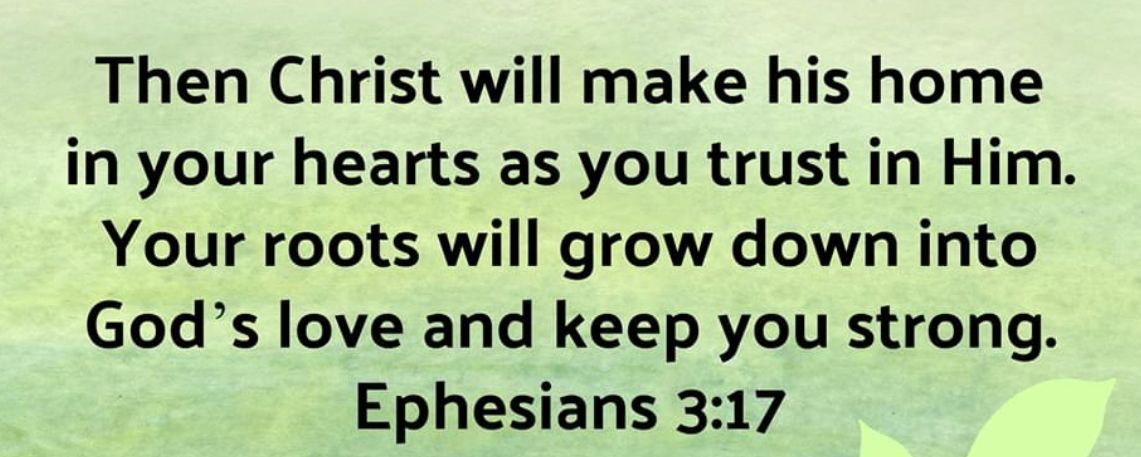
            Paul prays “that Christ will make his home in your hearts through faith. I pray that you may have your roots and foundation in love, 18 so that you, together with all God’s people, may have the power to understand how broad and long, how high and deep, is Christ’s love.”

            Just think: Paul’s recommendation to us as believers is to have our roots and foundation in Christ’s love! What comes to mind for you when you hear these words? What comes to mind for me is that Paul prays that I – and all other believers – have strong roots that go deep down, to support me and give me energy and nurture from the soil where I am planted. Imagine, we are reminded that we are all planted – grounded in the good soil of God’s love!

Some towns have tornados or hurricanes blow through, and blow havoc into many people’s lives. Remember the tornado that actually touched down last year within the Chicago city limits? In August 2020, a tornado blew through the Rogers Park neighborhood – not very far from my house! My husband and I went the next day to see some of the damage done. A large tree had been uprooted. We saw the tall tree lying on its side, all of its root system exposed. A wild sight!

            What happened to that tall tree can happen to us if you and I are not firmly grounded or planted in Christ’s love. We can be cut off from support and nurture from God and from God’s family of faith – and from our extended families, too.

            We know how important it is for our children (and grandchildren) to have the strong roots to give them the energy and the resources to grow big and strong. We can easily list them on our fingers: healthy food to eat, fresh water to drink, a good night’s sleep, on a regular basis. And, sadly, we can see what happens when children do not get these things. Food insecurity is a sad reality for many, many families across our country, as well as in the Chicago area. Schooling is particularly difficult if there is no fuel for the growing body in children’s stomachs.

            Another important aspect for our young people is when people surround and support them with love. Yes, God’s love is so important! Plus, the love and caring and support of people who love who you are and love the things you do is also an amazing thing. [1]

            Take, for example, the concept of “Gotcha Day.” This is where families who adopt celebrate the day when they became a family with the new adoptee. Oftentimes they celebrate the overflowing nature of the new love that happens in this new family. Perhaps you know a family who celebrates “Gotcha Day” themselves. This celebration is not only a day to celebrate the precious one who was adopted, but also the whole family – the new family that was made or transformed by the wonderful addition of this new family member.[2]     

            Listen to this memory of someone’s “Gotcha Day.” This is about a United Methodist minister and his wife, and their new son. He says, “It was on August 5, 1994 that my wife and I drove to Chicago O’Hare Airport to pick up an orphan named Kim Myung Hoon, a nine-month-old with bright eyes and a ready smile, and as if by magic turned him into our son Rhys, who is now a young adult and somewhat embarrassed to be the center of such attention. Gotcha Day. Every August 5, it’s Gotcha Day. It’s not a birthday, but then it sort of is; it’s a rebirth day, a day of becoming a family. That little life from halfway around the planet changed our lives in an instant. He filled a gap we didn’t even know we had. That moment turned us upside down or right side up with a simple smile and a reach from the hands that held him on that long flight from South Korea to our hands. To our hearts.” [3]

An absolutely amazing facet of love is how abundant and overflowing and bottomless it can be. God’s wondrous love for us amazes me every time I think of it. That is the marvelous nature of this love the apostle Paul talks about in our Scripture reading today. The apostle’s deepest desire is that we “together with all God’s people, may have the power to understand how broad and long, how high and deep, is Christ’s love.”

I know we cannot fully comprehend God’s love for each of us. I hope and pray we can get a little glimpse of it, though. “Gotcha Day!” What a tangible way of experiencing how we all are brought into the family of God. Can you express your thanks to God for Christ’s love for you? Please God, I want to. Please God, help me. Please God, God can help you, too.


[1] Illustrated Ministries; lesson for the 9th Sunday after Pentecost from Ephesians 3, from their 2020 Summer Children’s series.

[2]  https://www.umcdiscipleship.org/worship-planning/geared-up-for-life/ninth-sunday-after-pentecost-year-b-lectionary-planning-notes

[3] https://www.umcdiscipleship.org/worship-planning/geared-up-for-life/ninth-sunday-after-pentecost-year-b-lectionary-planning-notes/ninth-sunday-after-pentecost-year-b-preaching-notes

@chaplaineliza

(Suggestion: visit me at my other blogs: matterofprayer: A Year of Everyday Prayers. #PursuePEACE – and  A Year of Being Kind . Thanks!

(Thanks to Illustrated Ministries for their lesson for the 9th Sunday after Pentecost from Ephesians 3, from their 2020 Summer Children’s series.)

Unknown's avatar

Reminders from God

“Reminders from God”

Mark 8:31-39 (8:34) – February 28, 2021

When my teenage children reminded me about something, I certainly heard about it. They were never shy. They came right out and told me. This brings to my mind our scripture reading this morning. We hear Someone who reminded His disciples about something important, and wasn’t afraid to talk about it.

            Here is our Lord Jesus, acting as He often did in those years He traveled through Palestine, teaching His disciples, preaching, and healing. He was an itinerant Rabbi and teacher, traveling from place to place, setting up open-air classrooms, and doing theological seminars. Arguing scriptural points with other religious leaders. His followers tried to learn as much as they could from Jesus. They had an opportunity to observe Him closely, for three years.

            Just before today’s passage in the Gospel of Mark, our Lord Jesus asked the disciples “Who do people say that I am?” We can see from their responses that the disciples were starting to have some idea of their Rabbi’s purpose here on this earth.

            But now, our Lord Jesus began to systematically teach His followers that He was going to suffer, be rejected and killed, and then rise again. Moreover, Jesus did not just say this in private, but He said it openly, repeatedly.

            But, just a minute . . . the disciple Peter just made the declaration that Jesus was God’s Anointed. The Messiah. Then—immediately afterwards—Jesus reminds His followers of His passion and purpose here on earth.

            Whose priorities come first? What was Peter’s idea of the Messiah, God’s Anointed? Was Peter even ready to listen to Jesus? What is our idea of the Messiah, God’s Anointed? Do we listen to Jesus when He tells us who He is?

            A common, first-century idea of the Messiah, God’s Anointed, was that of a powerful, earthly Savior of His people, who leads them to worldly victory, and sets up a mighty earthly kingdom. Peter may very well have absorbed some of this idea of a worldly Messiah. The concept of Jesus being rejected and killed may have been completely out of the question for Peter. It was out of the question for many other people, too—in Jesus’s time, and our time today.

            Intellectually, we are familiar with the idea of Jesus being a suffering Savior. But how often, deep down, do we prefer a safe, comfortable idea of Jesus as a cheerful, safe, sensible fellow? A meek and mild Heavenly Friend? In other words, can you—can I—accept the idea of Jesus undergoing great suffering, being rejected, killed, and after three days rising again?

            I suspect Peter was unwilling to accept Jesus’s explanation of His passion and purpose. I think he refused to believe that Jesus was proclaiming Himself a meek, mild, Suffering Servant, ready to endure the Cross. From Mark’s description, Peter took Jesus aside and rebuked Him! I suspect Peter was putting his own priorities first!

            Do we put our own priorities first, as well? After all, in this modern day and age, the idea of dying on a cross is an extreme thing. Radical, in fact. It’s so much easier for us to believe in a moderate, neat, tidy, sensible religion.    

            Jesus does not mince words with Peter. Let’s read from Mark 8:33: “He rebuked Peter and said, “Get behind me, Satan? For you are setting your mind not on divine things but on human things.” Those are harsh words! Especially since Peter made such a marvelous declaration a short time before, that Jesus was God’s Anointed, the Messiah!

            But, isn’t it so typical of Peter, wanting things his own way, and not God’s way? Did he even listen to Jesus, and hear what his Lord was saying?

            Isn’t it so typical of us, to want things to be easy, cheerful, and sensible? Isn’t it simpler for us to shut out any concept of suffering and sacrifice? Or the pain of overcoming evil and temptation? We can see how Jesus reminds us, again, of God’s priorities. Jesus talks about how His followers need to think and act.

            Taking up His cross—for Jesus—was showing God’s love in the ultimate way. Jesus says that His followers are invited to take up their crosses, too. This isn’t shouldering a calamity, or enduring pain like a Stoic for your whole life. Taking up our cross is putting ourselves at the service of Christ, preparing a way for the Kingdom of God, whatever the cost.

            How can we follow Jesus’s example? The first thing I think of is putting God first. My insistent ego is a pesky thing, with its preoccupation with “me first!” and “I want some!” and “where’s mine?” A good suggestion is to think of God first, others second, and myself last. It’s a simple as wishing someone a good morning, and meaning it, or asking how someone is doing, and actually being interested in the answer. Thinking of others, and thinking of God – first.

            Being all focused on my own thoughts and activities can be one sure way to get my priorities messed up. Then, I lose sight of God’s priorities, and lose sight of Jesus and what He would encourage me to do, and to think.

            Thank God that Jesus gives us a clear idea of how we are to follow God’s priorities. Thank God for His reminders. We don’t need to forget the Cross, or avoid the Cross, but take up the Cross. We are encouraged to put ourselves at the service of our Lord Jesus. To think of others, and especially to think of God. That’s how to follow God’s priorities.

@chaplaineliza

(Suggestion: visit me at my other blogs: matterofprayer: A Year of Everyday Prayers. #PursuePEACE – and  A Year of Being Kind . Thanks!

Unknown's avatar

Encourage Like Paul!

“Encourage Like Paul!” – August 2, 2020

Phil 1-3 thank God words

Philippians 1:3-11 (1:3-6)

Do you remember a time when someone encouraged you? I mean, when you were feeling downhearted or down in the dumps, and a friend or relative gave you a real, sincere word of encouragement? I am afraid to say that my words of encouragement often do not measure up when compared to this encouraging letter Paul wrote to his Philippian friends. Paul really meant what he said in this letter to Philippi – every word!

We are starting a sermon series on the letter to the church in Philippi this week. This letter is one of the most heartwarming and personal letters written in the New Testament. Philippians is one of my favorite Bible books, too.

Just to remind us all, the apostle Paul traveled around for years. As an itinerant preacher and missionary, he was often on the move. Although, Paul did settle down from time to time, and stay in particular towns for a number of months. Like, right here, in Philippi.

`           I know today we might be encouraged by a family member over the telephone, or by a co-worker in a Zoom meeting, or by a friend through email or Instagram. But in the apostle Paul’s day, there were only two choices: either face to face, in a personal encounter, or in written form. Paul was far away from his friends and former parishioners, so he used a letter.  

Paul’s affection and care for his Philippian friends went much deeper than a nodding acquaintance, such as we might see in casual, continued encounters like in line at a grocery store, walking in the neighborhood, or in a polite exchange at the office.

Let’s look at exactly what Paul said here. This was a thank-you letter for a financial gift sent by the Philippian church. Since Paul was in prison, he was doubly thankful for the gift! I suspect it provided for his food, clothing and other needs while he was locked up. Let me remind people that if a prisoner’s friends or relatives did not supply these necessities, the prisoner was sadly out of luck. The prison did not supply anything. At least, not for free.

So, you and I might think this was a sad time and puzzling situation for Paul to have positive words to say about anything – much less to send such a positive, uplifting letter to his faraway friends in thanks for their financial gift.

Paul is fairly bubbling over with gratitude and thankfulness as he begins this letter. I wanted us to especially notice the 3rd verse. Paul thanks God every time he remembers his friends in Philippi. Do you have friends you can say that about? Do you or I have even one or two friends who are so special to us that we remember them to God with such warmth and excitement? What a marvelous thing to say about a friend. A good friend. Even, a best friend.

Verse 4 tells us that Paul always – always prays with joy when he prays for these special friends from Philippi. This is the first of many times Paul uses to word “joy” in this letter. He uses either the noun “joy” or the verb “rejoice” fourteen times! When I first took the course Bible Study Methods decades ago in bible college, we were told that if a passage or a book of the Bible repeated something, there was a really good reason for it. I believe, and commentators and Bible scholars agree, the apostle Paul means joy to be an overarching theme in this letter.

And, verse 5 tells what fills Paul with such joy: the Philippians not only were supporting Paul in prayer, but they also supported him in the partnership of the Gospel. They shared the Good News of Christ, too! That really filled the apostle Paul with joy.

How do you feel when you are especially encouraged and affirmed? What if that someone who encourages you is someone very special? Someone who means a whole lot to you? Doesn’t that make that encouragement and appreciation even more meaningful?

Let’s imagine. Close your eyes, if that helps you imagine. You and I are among this group of believers in Philippi, and we have just received this letter from our Pastor Paul in prison. Let’s listen again to these three verses: “I thank my God for you every time I think of you; and every time I pray for you all, I pray with joy because of the way in which you have helped me in the work of the gospel from the very first day until now.”

Paul is thankful for the money his friends sent. But, I hear these words saying how incredibly thankful and grateful Paul is for the caring and love of these people, friends from far away. Have you ever been encouraged and affirmed, with these amazing words?

I am reminded of when I taught piano lessons, some years ago, before I started seminary and several years into it. I taught for about ten years. I remember one student in particular. Her parents were going through a nasty divorce that lasted for many months. I taught this girl for a whole year. Her mother wanted her to continue with lessons until the end of the school year, as a stabilizing factor, because she saw how encouraging I was to her daughter in each lesson. And, I really tried to be a caring encourager for a troubled time in this girl’s life.

We all have had teachers, coaches or mentors in our past. Who has taught you about the Christian faith? Who has mentored you along the way, and encouraged you to become a more faithful believer? Do you have an apostle Paul in your life? Or, perhaps an encouraging and faithful Barnabas, one of Paul’s companions? Or, maybe an excited and eager John Mark, another companion of Paul? [1]

Whatever kind of teacher, coach or mentor in faith you have had, praise God for this beloved person. Thank the Lord for the impact this dear one has made on your life, and on mine. And, perhaps you can be that person who has a lasting impact on someone else. Please God, may it be today!

[1] http://www.word-sunday.com/Files/c/2Advent-c/SR-2Advent-c.html

“A Letter from a Mentor,” Larry Broding’s Word-Sunday.Com: A Catholic Resource for This Sunday’s Gospel. Adult Study, Children’s Story, Family Activity, Support Materials.

@chaplaineliza

(Suggestion: visit me at my regular blog for 2020: matterofprayer: A Year of Everyday Prayers. #PursuePEACE – and my other blog,  A Year of Being Kind . Thanks!


Unknown's avatar

Suit Yourselves!

“Suit Yourselves!”

2 Tim 4-3 itching ears

2 Timothy 4:1-5 – October 20, 2019

Have you seen the comics lately? I’m sure everyone here is familiar with the comics section of the newspapers—the daily comics in black and white, and the Sunday comics in full color—even if you don’t read them regularly. Can you picture this scene from the comics? A single panel, showing two business men by an office water cooler. One looks like a boss, and he says to the other, “If there’s one thing I hate, it’s a yes-man. Isn’t that right, Baxter?”

We chuckle, because we all are familiar with that kind of attitude. I’m sure we can recognize that tendency in other forms. Getting some yes-man to tell us what we want to hear . . . not what’s good for us to hear, not what we need to hear, but instead what we want to hear.

With all the worry and anxiety, trouble and danger in this modern world, people are actively searching for good news. Many are searching in all the wrong places. Commercialism and consumerism are rampant, with many people accumulating more and more stuff and always needing to get something else, something more, something new.

Sometimes, some people search for thrills, for that adrenaline rush, for some kind of excitement in life. It doesn’t matter if thrills come from drag racing, gambling, or risky behavior, like a wild bender at the local bar. Oftentimes, these people are trying to fill a hole deep inside.

Other people turn inward, searching for spiritual fulfilment. There are many ways of experiencing some kind of spirituality, like through the martial arts, or through meditative practices. Fung shui, the Chinese method of arranging furniture is an attempt to try to find balance and proper order in this life. Sure, doing an inside job, concentrating on the inside of ourselves is a great place to start, but . . . searching for inward, spiritual fulfillment on our own just won’t work. Anyway, not without God.

We have the assurance, from our scripture passage today, that Timothy had the opportunity to know God. Timothy was instructed, from the time he was very young, in the way of salvation through Jesus Christ. His mother and grandmother were both women of faith, and Timothy grew up in a believing household, a household that put God first.

As we read further in our passage today, we find there are people who will not put up with sound doctrine. They will not even want to listen to the truth! Even when the truth is as clear as day, and presented to them in a straight-forward manner, still, some will turn away.

You probably are all familiar with that modern phenomenon—tele-evangelists, some of whom are worthy people of God. However, there are those who are frauds. Charlatans. Fakes. Preachers not of sound doctrine or biblical teaching, but instead telling their listeners exactly what they—the listenerswant to hear.

Are you familiar with the health, wealth and happiness gospel, which focuses on only a few isolated passages from scripture? This false gospel tell the listeners that God wants us all to be healthy, wealthy and happy! All the time! And even shows us the example of Job—why, didn’t God give back to Job everything that was taken away? But . . . we must have faith! And if anything is wrong in our lives, or if our house burns down, or if we get sick, or if someone we love loses a job, or if our child gets in trouble, or . . . or . . . or . . . you get the picture. Well, we just didn’t have enough faith. Oh, and we didn’t send enough money to the tele-evangelist. So, God apparently must be withholding His blessing because of our lack of faith and our stinginess.

Not so!! This is a perverse, yet skillful, twisting of the truth! I bet you can see parts of the true Gospel here in what I’ve just described, but the rest is so skillfully bent and twisted, It sounds so similar to the Good News of God we have come to know and to understand and to love. Like, and yet unlike. The true Gospel tells us that God does indeed want to bless us abundantly! And, it is an inside job! God wants to change us, to help us change ourselves, to make us new creations from the inside out, through faith in Jesus Christ.

But, what about unsuspecting folks, who get turned away from the truth in God’s Word? What did our scripture passage today say about this sort of people? It mentions that they have “itching ears.” This is a Greek phrase that can be translated several ways—another way is “having their ears tickled.” In other words, having the preacher tell you exactly what you want to hear! These people with the itching ears, who wanted nice, warm, soft, fuzzy things said to them, nonthreatening, reassuring things preached to them from the pulpit, these people turned their backs on the truth of God’s Word and of sound doctrine.

These people with the itching ears had an agenda—and that was to hear only what they wanted to hear, at all times. None of the challenging words, none of the admonishing words, none of the emotional words of Scripture. This is another form of idolatry: putting themselves first, putting God aside as an afterthought. You know the attitude—me, me, me! I’m the most important person around here! Everything needs to go my way! Nobody else counts!

As I was thinking about this text over the past days, it came to me—what would Calvin say? John Calvin was one of the foremost theologians in the Reformed tradition, the tradition we in the UCC adhere to. What would Calvin say about these false teachers, preaching a “health, wealth and happiness” gospel, or any other sort of false gospel, for that matter?

How would he deal with these false teachers, leading people astray? Checking the Institutes, I find that Calvin spoke strong words against these false teachers, saying that they, in fact, pose the greatest danger to the church. They lead people away from true scripture and sound doctrine, and are responsible for bringing in destructive heresies. [1]

But . . . that’s not what we learned. That’s not what Timothy learned. We have the “sacred writings that are able to instruct us for salvation through faith in Christ Jesus.” We have the opportunity to come into a relationship with Jesus Christ. How wonderful, how awesome, and how sobering that Jesus entrusted us with the message of His Good News.

Now what? The different New Testament letters do indeed tell us definite things about doctrine, about theology . . . but then . . . what do we do with all of this information? How do we put it into practice? How do we live the Christian life? Now what, in other words?

I consider the commands in this passage to be good advice to anyone wanting to follow Christ more nearly. We are to proclaim the message. Communicate the Good News!

This command may give some people pause. How can I preach the Good News? Am I supposed to go to some cable television station and get on the air as yet another tele-evangelist? Or how about standing out on a street corner, preaching with a megaphone? Both of these are valid ways of preaching God’s Good News, but I don’t think most of us here in this church could ever see ourselves doing either of these things. But there are other ways to proclaim the message.

Preach the Good News. Another way of thinking about it is . . . telling what God has done in your life. What has God done for you? How has God made a difference in your life? How has God made a difference in mine? What new things have you and I learned from the Lord lately? What an opportunity to share these things with others, with our friends, with those who might not know God in a personal way.

Do we need advanced degrees in divinity or theology to do this? To share what God has done for us? No! Oftentimes, we are excited to tell people about other things, like who won the latest ball game, or about the neighbor next door spraining her ankle, or what exciting story we just heard on the news. Why can’t I tell people about Jesus, and what He’s done for me? Why can’t you?     I can tell about God’s faithfulness in my busy, hectic life. I can praise God for helping me to walk the Christian walk, one day at a time.

Thank God we have been given this Good News! What a opportunity! What a thing to celebrate! Praise God, we have been granted salvation through faith in Jesus Christ. That’s truly something to celebrate. That’s truly Good News to share.             Alleluia, Amen.

[1] Calvin, John, Institutes of the Christian Religion, edited by John T. McNeill (Westminster Press: Philadelphia, 1960), IV.9.4.

@chaplaineliza

(Suggestion: visit me at my regular blog for 2019: matterofprayer: A Year of Everyday Prayers. #PursuePEACE – and my other blog,  A Year of Being Kind . Thanks!