Unknown's avatar

Joy for Those Who Wander

“Joy for Those Who Wander”

Luke 2:1-7 (2:4-5) – December 14, 2025

            When some thing or some reading or some sermon is so familiar, so recognizable, are you tempted to tune it out? Turn it off?

I am preaching from an alternative lectionary, enlarging our Advent meditation on Dr. Luke’s so-familiar chapters. Today, I preach from the beginning of Luke chapter 2. Such a recognizable narrative! It has everything a story needs! Not only promise and heritage, not only memory and mystery. But, hearing an old story yet again brings its own kind of anticipation!

Although, the familiarity surrounding today’s reading is a particular problem for preachers. How do we make the reading fresh, bring it to life again, imbue it with that something extra special enough to cause people to tune in rather than tune out?

            Let us listen again to a portion of today’s reading: “And everyone went to their own town to register.So Joseph also went up from the town of Nazareth in Galilee to Judea, to Bethlehem the town of David, because he belonged to the house and line of David. He went there to register with Mary, who was pledged to be married to him and was expecting a child.”

            Joseph and Mary began to travel from Nazareth in the north of Galilee up to Bethlehem. A suburb of Jerusalem, really. A small town on the outskirts of the capital city, a good ways to the south of Galilee. We find Mary and Joseph (probably without a donkey – sorry to all of the lovers of traditional Christmas cards, everywhere) on the road, walking south to register for the census. And, they were not the only ones on the road.

            Can you see yourself – can I see myself – on the road? Are we all in transit, traveling along, not anywhere particularly fixed? Even those of us who have lived in the same place for a long time, is there something about your life, about our walk with God that makes you think that we all are on the road? Could it be that we all are wandering from one place to another, and not having a definite place to call home?

            The apostle Paul speaks of the temporary nature of this world, of this earthly tent we all inhabit. He says in 2 Corinthians 5, “For we know that if the earthly tent we live in is destroyed, we have a building from God, an eternal house in heaven, not built by human hands.” So, with that to look forward to, it gives us all a heavenly perspective to view our earthly tents, and the journey each of us is on, in this wide world today.

            Which brings us back to considering: the long trip for the census. And, since Bethlehem was the ancestral home of King David, that meant there were quite a lot of people who had to be counted who were descended from David. Including Joseph. Remember the genealogy written in the Gospel of Matthew?

            Speaking of descendants of David, I am sorry to prick the other balloons of belief in the traditional Christmas carols and traditions. “It would be unthinkable that Joseph, returning to his place of ancestral origins, would not have been received by family members, even if they were not close relatives.” Presbyterian missionary and pastor Dr. Kenneth Bailey, who is renowned for his studies of first-century Palestinian culture, comments:

“Even if he has never been there before he can appear suddenly at the home of a distant cousin, recite his genealogy, and he is among friends. Joseph had only to say, ‘I am Joseph, son of Jacob, son of Matthan, son of Eleazar, the son of Eliud,’ and the immediate response must have been, ‘You are welcome. What can we do for you?’” [1]

            I know this might be news to you – and it was to me. Jesus was not born in a cave or far on the outskirts of town, out adjacent to the field surrounding Bethlehem. However, this still does not let us off the hook for considering the larger question. Mary and Joseph were traveling, and were on the way, in between. According to Biblical record, they did not have very much money at all. (Although, because of the generous dictates of hospitality, they must have been put up in some cousin’s home while they were sojourning in Bethlehem.)

            I still would like to know! Our position as believers in the one true God makes us sojourners in this world; and this position is so similar to Mary and Joseph’s position as sojourners or travelers, too. Is there any solidarity for others today who are transient, who are traveling or sojourning, especially young families? Perhaps with mothers who are great with child at this time of the year, and are looking for even a temporary place to lay their heads?

             We can take this unexpected look at the Holy Family one step further. I remember a suburban church I attended a number of years ago. One of the smaller trees near the front door to the sanctuary was practically covered with blue ribbons. A sign was posted next to the tree, saying “While celebrating One homeless Family, these ribbons ask us to remember the homeless with us today.” I had never thought about the Holy Family in that way before. It’s God’s unexpected manner of opening our eyes, and displaying the new or different way we can look at Mary and Joseph and the baby Jesus.

            As we consider the birth of the baby Jesus in Bethlehem, as the Holy Family was traveling through, we can see this birth as so much more than simply a claim or confession of the church. As you and I are sojourners through this world, so we also are traveling through. Jesus, God’s eternal Son, the Second Person of the Trinity, emptied Himself. He willingly put Himself in this human flesh and became incarnate of the Virgin Mary. And, this is the most important part! This miraculous birth shows us the truth of our God. Our God loves us so much that the only way to really, truly show us how much was to become one of us. The Baby born in Bethlehem. [2]

            The baby Jesus, His parents Mary and Joseph – the Holy Family was on the way, traveling. Sojourning, and so are we. We are travelers, looking forward to that heavenly home, prepared for us in heaven. Are you on the road with us? On the way with Jesus?

            I close with two verses from a much beloved Christmas carol, collected in Appalachia by John Jacob Niles around 1900. Listen and hear the words of traveling, of being on the way.

 When Mary birthed Jesus, ’twas in a cow’s stall/with wise men and farmers and shepherd and all.
but high from God’s heaven a star’s light did fall, /and the promise of ages it did then recall.

I wonder as I wander, out under the sky, /how Jesus the Savior did come for to die
for poor ordinary people like you and like I; /I wonder as I wander, out under the sky.

            Alleluia, amen.

@chaplaineliza

(Suggestion: visit me at my other blogs: matterofprayer: A Year of Everyday Prayers. #PursuePEACE – and  A Year of Being Kind . Thanks!)


[1] https://www.psephizo.com/biblical-studies/once-more-jesus-was-not-born-in-a-stable/

[2] https://www.workingpreacher.org/dear-working-preacher/christmas-preaching

Unknown's avatar

Hosanna to the Messiah!

“Hosanna to the Messiah!”

Luke 19:28-40 (19:37) – April 13, 2025

            Have you ever been at a really big celebration? I mean a public celebration—like a ticker-tape parade, a celebration of a world championship, or the visit of an A-list celebrity? Something really, really big?

            From all the descriptions of the Palm Sunday Triumphant Entry in all four Gospels, that’s kind of what we are looking at today in our scripture passage. The celebration is really big, the Rabbi Jesus was a big-name celebrity, and this entry into Jerusalem was a first-century type of a ticker-tape parade. Except with palms!

            Let’s take a closer look. Here’s the situation: It’s almost Passover, the most important religious observance of the year. A great number of faithful Jews from near and far come to Jerusalem, in pilgrimage, in commemoration of the Exodus event. 

Jesus comes, too. He publicly, intentionally enters Jerusalem, even though the religious leaders are not very pleased with Him or what He has been doing for the past few years. Even though Dr. Luke does not mention the prophecy in the book of Zechariah (which the other Gospels do), Jesus’s disciples must have known about the prophecy of an entry into Jerusalem riding on a donkey. This was clearly a scene with “Messiah” written all over it.   

And Jesus does not sneak into the city, all hush-hush. No! He comes in with a parade! With crowds of people waving palms and shouting “Hosanna!” and “Blessed is the one who comes in the name of the Lord!”

            What is the meaning of those cries of “Hosanna” and “Blessed is the King?” If we look at Psalm 118, we’ll find these words written by the psalmist. This was the usual Passover greeting one person would give another, except with the addition of the word “King.”  Just to let you all know, many of the crowd in Jerusalem on that Palm Sunday morning understood what they were quoting—they were intentionally welcoming someone they hoped would be their Messiah, their King! Someone who would save them from the awful situation they were in.

            There was a disconnect between the people and their limited understanding, and what Jesus actually was going to do. But I’m getting ahead of myself by rushing on to later in Holy Week. We are still here on Palm Sunday. And everyone is still excited to welcome the Rabbi Jesus—their hoped-for Messiah—into the city. They are hoping He will save them from the Romans and maybe, possibly, become their King. Except they had an earthly King in mind.

            But let’s read on in our scripture passage for today. Luke makes another striking statement. He starts to mention “peace.” “Peace in heaven, and glory in the highest!” What on earth is Luke mentioning “peace” for?

This sentence is an echo of the Gloria in excelsis Deo that the angels—the heavenly host—sang at the birth of the baby Jesus, several decades before. I know the heavenly host gave the shepherds good news of great joy, but wouldn’t that be good news for anybody? I know that was good news at the time Jesus was born, but isn’t that good news for today, as well? Peace? Glory in the highest? The difference is that at Jesus’s birth, it was peace on earth. Now, the crowd is saying “Peace in heaven.”

            So when Jesus enters Jerusalem, the crowd prays for peace in heaven. But the coming of Jesus causes a division. It causes anything but peace on earth.

            The theologian Tom Mullen makes this statement about his denomination (Society of Friends or Quakers): “They work for peace—and if you really want to cause conflict, you work for peace.” [1]  So it was for the Rabbi Jesus—the Messiah Jesus riding into Jerusalem. For all that Jesus wanted to bring peace, He and His message created division, tension, and crisis—as seen by the violent reaction of the religious leaders.

            I wonder about this tension, this violent reaction, this great desire for peace, yet a creation of division, tension and crisis. I know I have mentioned the Rev. Janet Hunt many time before in my sermons. She likewise ponders as we begin Holy Week, “If Jesus were to ride into my town today, what would be His means of transportation? What signs and symbols would speak today?” [2] The donkey was not the choice for a conquering King entering His capital city! The donkey was definitely a subversive choice for the Messiah, the Rabbi Jesus.

            I am not even going to explore what signs and symbols would display a Kingly entrance into a city today, except to say a royal entry usually entails a large police presence, a security detail, and lots of SUVs and a limousine for the royalty to ride in. Not so for the Rabbi Jesus!

Thank God, Jesus does not do that! He is more powerful than any division, any tension, any crisis. He entered the city not as an earthly King, not as a conqueror, not to set up a nationalistic empire, but as the True Redeemer of Israel. And not of just Israel, but also of the whole world. This Holy Week is where all of the prophecies focus to a fine point, and reveal the Rabbi Jesus as not only the Messiah and King, but also as the Suffering Servant. The Lamb of God, sent to take away the sins of the world.

            As we remember this Passover time, this Holy Week, we can thank God that our Lord Jesus did enter Jerusalem. As a King, as a Messiah, yes! But also as our Redeemer and Savior. Praise God, Jesus is our Redeemer and Savior, just as much as He was Redeemer and Savior for that crowd in Jerusalem on that Palm Sunday. In the first century, Jesus came to save His people from their sins. Praise God, He came to save us, too! Amen! And amen!

@chaplaineliza

(Suggestion: visit me at my other blogs: matterofprayer: A Year of Everyday Prayers. #PursuePEACE – and  A Year of Being Kind . Thanks!


[1] Mullen, Tom, Laughing Out Loud and Other Religious Experiences, (Friends United Press, Richmond IN: 1989) 50.

[2] http://words.dancingwiththeword.com/2016/03/the-donkey-subversive-choice.html

Unknown's avatar

Who Comes in the Name of the Lord?

“Who Comes in the Name of the Lord?”

Mark 11:1-11 (11:9) – March 24, 2024

            Think of a time when you were expecting – anticipating – something really big. And, this really big thing was by no means 100 percent certain of ending well. Maybe you (or I) were facing a major interview at work, a huge exam at school, or even a really important speech. I can just imagine us being anxious, worried, with a knot at the pit of your – my stomach, or how jumpy we felt. The waiting time and expectation of that really big event was palpable! [1]

            This feeling is not exclusive to you and to me. No, many, many people have felt this way before! I wonder whether the disciples felt at all like this during the time that they were helping their Rabbi Jesus get everything ready for the entry into Jerusalem? As a subversive Rabbi and leader, Jesus knew His presence in the city was a grand challenge to the Jewish leaders. And yet, Jesus was going to walk right into Jerusalem with His eyes wide open.      

            Mark tells us in a straight forward way what happened that day. Verses 7 through 9: “When they brought the colt to Jesus and threw their cloaks over it, he sat on it. Many people spread their cloaks on the road, while others spread branches they had cut in the fields. Those who went ahead and those who followed shouted, “Hosanna!” “Blessed is he who comes in the name of the Lord!” 10 “Blessed is the coming kingdom of our father David!” “Hosanna in the highest heaven!” An impromptu grand entrance for the Rabbi Jesus; a parade, even!      

            Look at this entrance through the lens of anxiety and wonder! For, that certainly was what many people in the crowd were feeling. I suspect some of the disciples were feeling that way, too! As commentator Scott Hoezee says, “What Palm/Passion Sunday celebrates and observes is not simple, it is not neat, tidy, or straightforward.  The air fairly crackles with electricity as the characters in this grand drama sense that something big is up.” [2]

          Let’s look at this from a different direction. Here’s the situation: It’s almost Passover, the most important religious observance of the religious year. A great number of faithful Jews from near and far come to Jerusalem, in pilgrimage, in commemoration of the Exodus event. 

Jesus comes, too. He publicly, intentionally enters Jerusalem, even though the religious leaders are not pleased with Him or what He has been doing for the past few years. Jesus’s disciples must have known about the prophecy of an entry into Jerusalem riding on a donkey. This was clearly a scene with “Messiah” written all over it.  

Traditionally, when a conquering king comes home from war, he is seated on a horse, and the finest horse in the king’s stables, at that! But here, where Jesus proclaims Himself a king of peace, “he rides a donkey and enhances that statement of peace by choosing an unridden colt. The words that were spoken come from one of the enthronement psalms, used when a new king was coming into power. Hard to miss, really.” [3]

Just imagine if you and I were witnesses to our Lord Jesus and His triumphal entry to Jerusalem. I am sure that there were many people present in that crowd who only had a faint idea what was going on. What would you and I do if we were there? Would we be observers only, merely watching the parade? Would we be cheering the Rabbi Jesus as He entered Jerusalem? And, what about the reference to the psalm that people shouted? A psalm that was quoted when a new king took the throne? How many of the crowd really believed Jesus was a new King, a coming Messiah? Lots of questions we have, indeed!

There was a disconnect between the people and their limited understanding, and what Jesus actually was going to do. But I’m getting ahead of myself by rushing on to later in Holy Week. We are still here on Palm Sunday. And, many in the crowd are still excited to welcome the Rabbi Jesus—their hoped-for Messiah—into the city. They are hoping He will save them from the Romans and maybe, possibly, become their King. Except they had an earthly King in mind.

On second thought, I will go forward into Holy Week. This Triumphal Entry is the culmination of Jesus and His time on Earth, of all His time as a human, as God-become-Man in the Incarnation. Think about it: the world, the very cosmos itself, was on the brink of the most momentous event since the Big Bang, with the very Son of God about to be handed over to the authorities. Betrayed, abused, murdered. The very hosts of heaven – and maybe of hell for all we know – were quite literally holding their breath to see this all play out. [4]

            You and I have the luxury of 20/20 hindsight, of course, looking at an event so clearly reported in the historical and Biblical record. But, if a grand procession welcoming the Messiah happened today, would people still be waving palm branches? Would you and I?

This Holy Week is where all of the prophecies focus to a fine point, and reveal the Rabbi Jesus as not only the Messiah and King, but also as the Suffering Servant. The Lamb of God, sent to take away the sins of the world.

            As we remember this Passover time, this Holy Week, we can thank God that our Lord Jesus did enter Jerusalem. As a King, as a Messiah, yes! But also as Redeemer and Savior. In the first century, Jesus came to save His people from their sins. Just as much as He was Redeemer and Savior for that crowd in Jerusalem on that Palm Sunday, Jesus is our Redeemer and Savior, too. Praise God, He came to save us, today, too! Amen! And amen!

@chaplaineliza

(Suggestion: visit me at my other blogs: matterofprayer: A Year of Everyday Prayers. and  A Year of Being Kind . Thanks!


[1] https://cepreaching.org/commentary/2018-03-19/mark-111-11-2/

[2] Ibid.

[3] https://www.umcdiscipleship.org/worship-planning/depths-of-love/palm-passion-sunday-year-b-lectionary-planning-notes/palm-passion-sunday-year-b-preaching-notes

[4] https://cepreaching.org/commentary/2018-03-19/mark-111-11-2/

Unknown's avatar

Love Amazes!

“Love Amazes!”

Luke 2:15-20 (2:18) – December 24, 2023

            Merry Christmas! What a wonderful expression. People greeting each other on the street, in the stores, here at church. This is also the fourth Sunday in Advent, the Sunday where we focus on Love. What a joyous time of the year, and what a celebration of love-come-to-earth. 

            But I want you to go back, two thousand years. Go back to a time when “Merry Christmas” was not even a phrase, a wish, an idea in people’s heads. Go back to the time that Dr. Luke describes in the second chapter of his Gospel. Back to the time when Israel was an occupied country, and the Roman Empire was the strong man. Back to the time when all people in Israel needed to be enrolled. The Roman government decided to have a census, so that they would be able to tax the people of Israel more accurately.

We heard this census described in our Gospel reading. Joseph and his fiancée Mary went to Bethlehem to enroll, because Joseph was a direct descendant of King David. I suspect there were many people on the roads. Today, traveling can be stressful and nerve-wracking. However, travel in the first century was much more difficult. Poor roads, with many people walking to get from one place to another. We might imagine that Joseph and Mary had a donkey, but nowhere in the Gospel is that mentioned. Travel conditions were challenging, at best.

There they are, in Bethlehem. A long way from their home in Nazareth. I suspect Joseph took care of the enrollment business first thing. But Mary felt the pains of labor begin. What a scary thing! To be far, far from home, in an unfamiliar place, and to have such a significant event happen. Significant, and potentially life-threatening, too.

            Yes, delivering a baby is a special day for anyone. But—even more so, for Mary and Joseph. Extra special because of the love surrounding them, this amazing love from God.

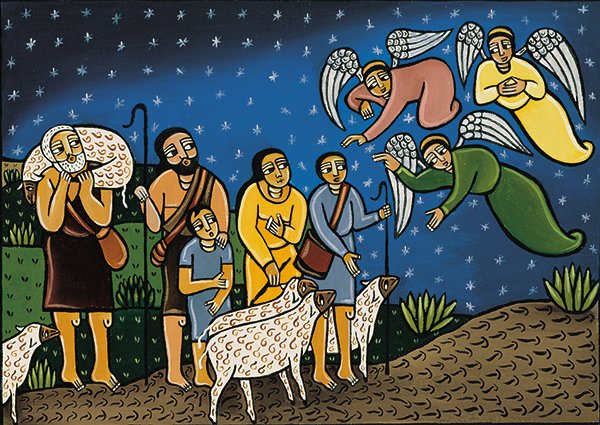
            As Dr. Luke tells us, there were shepherds abiding in the fields, keeping watch over their flocks by night. Remember, there is no radio or telephone, no Internet or telegraph. When messengers personally come to deliver a special announcement, it is a big deal. These angels coming to the shepherds, well, that was a super big deal, to be sure!

            And the announcement? This isn’t the birth of a normal, ordinary baby. No! This baby is an extra special baby. The Messiah, who will save His people from their sins. A special announcement of God’s love! This special baby, this Savior, Christ the Lord, is born to you—to me—to all of us, in the city of David, which is called Bethlehem.

            Did you hear? The Savior, the Christ, the promised Messiah, came into this world as a Baby in Bethlehem. The Eternal Second Person of the Trinity, Creator of the whole universe, God the Son, emptied Himself of all God-ness. Took on humanity, and was born as a helpless Baby. That is not only good news, that is earth-shaking news. Good news of great joy for all the people. For you, for me, for all of us.

            Yes, the promises of Christmas may sound familiar to us. The good news that the angels brought may be old news, to some. But those promises? They are so needed, today. What with uncertainty and fear, anxiety and hatred so common today. Peace and security seem way out of humanity’s reach. Don’t we need some good news right now? Don’t we need news of God’s amazing love for all of us, for each one of us?

This is good news, this Gospel the angels brought to the shepherds. And they, in turn, told everyone they could about the Child, which the Lord had made known to them. Just as Luke said, all who heard about the Child were amazed at what the shepherd told them.

When I take a step back from this narrative that is so familiar to all of us here in this church, I try to imagine this event brought up to date. “I do find myself wondering just where this might happen today. If Jesus were to come again in human form, would it be like the last time? Would it be in a country far away or would it be in our own back yard? Would it be in an unused room at a nursing home?  Or at a homeless shelter?  Or under a city bridge? I do wonder where Jesus would be born today, don’t you? I wonder how my wondering changes how I encounter those who are in those places now.” [1] It is very possible that those places are already made ‘holy’ – that babies born in unused rooms or homeless shelters or under bridges are holy, too. Even before the presence of the Christ Child makes them even more special.

After that special birth announcement from the angels, and the excited visits from the shepherds, we are left with Mary. Mary who was only a teenager, who had had nine months to consider this extraordinary pregnancy and upcoming birth. Mary must have been up to the task. Mary must have been an extraordinary, reflective young woman.

We know from verse 18 that Mary treasured all these words and pondered them in her heart. All of these words, these unfolding events. Another translation has this verse as “Mary was keeping together (the Greek verb sunetare) all these words, bringing them together (sumballos) in her heart.” Keeping together, sunetare, has the sense of integration. Bringing these events together, or sumballos! Mary was fitting all the puzzle pieces together, bit by bit.

Can we do the same? Can we fit all the pieces together? Can we slow down, just a little, and wonder at the miracle of that night? I invite us all to listen to the good news of the shepherds. The eternal God, Creator of the universe, come to earth as the Babe in Bethlehem.

God gives each of us an opportunity, an invitation to experience amazing love; an invitation to worship the newborn Savior. We, too, can stop by that manger in Bethlehem, and be caught up in the wonder of what happened that night, so long ago.  We, too, can say “O come, let us adore Him, Christ the Lord.” Alleluia, amen.

@chaplaineliza

(Suggestion: visit me at my other blogs: matterofprayer: A Year of Everyday Prayers. #PursuePEACE – and  A Year of Being Kind . Thanks!

(I would like to express my great appreciation for the observations and commentary from the Do Not Be Afraid Advent Devotional – © 2022 Illustrated Ministry, LLC.. I used several ideas from their useful resources. Thanks so much!)


[1] Dancing with the Word: Christmas in the Barn

Unknown's avatar

God’s Birth Announcement

(St. Luke’s Church had an electrical outage over the weekend. The radiator pipes burst, and there was no worship service on Sunday, December 25, 2022. This sermon comes from my archives, from December 24, 2003.)

“God’s Birth Announcement”

Luke 2:1-14 – December 24, 2003

            I have several friends who have recently had babies. Welcoming babies into the world is such a joyous occasion. One of the first things most people I know do is spread the news about the new baby, letting other friends and acquaintances know about this new little one who has joined the human race. When and where the baby was born, how big it was, whether it was a girl or a boy, and what the parents decided to name the baby are all details that are joyously spread, as soon as possible.

             I wonder . . . what would God’s birth announcement look like?

            In the fullness of time, God sent His Son. Prophesied in many passages from the Hebrew Scriptures, foretold for centuries before His coming. Looking at the Old Testament passage for today, Isaiah 9, the prophet tells his readers about the Wonderful Counselor, Mighty God, Everlasting Father, and Prince of Peace, who is the coming Messiah.

            Throughout the Advent season, we’ve been preparing for the coming of this Messiah. Well, I have news for you. He’s here. Today is Christmas Eve, and tomorrow we celebrate once again the earthly birthday of the Babe of Bethlehem, the Savior of the World, the only begotten Son of the Heavenly Father. Our Lord Jesus Christ, our savior and redeemer, from age to age the same, came into this fallen world as a baby. Imagine that. Emptying Himself of all His vast, eternal God-ness, and being born as a human baby.

            I wonder: what would God’s birth announcement look like?

            I think we have a pretty good idea, if we take a look at the second chapter of Luke. Doctor Luke gives a full accounting of what went on in those days. This account here is God’s version of a birth announcement, but what an unexpected sort of announcement!

            Let’s look at the parents of the Baby, first of all. The mother, Mary of Nazareth, is not even married yet. Sure, she’s engaged to this carpenter, Joseph, but they haven’t yet been fully joined in marriage. Marriage in those days, in the Jewish culture, was a several-step process. Mary and Joseph hadn’t quite finished the whole marriage thing.

            We read in chapter 1 of Luke that the Holy Spirit came upon Mary, and she conceived. Is Joseph the father of this Baby? No. Joseph could not believe this part of the account at first, until assisted by some heavenly help. An angel came and reassured Joseph that Mary was on the up and up, and that the baby inside of Mary was really the Messiah, the Savior of the world. In other words, the Son of God.

            So, the birth parents are not the usual kind of parents. The circumstances of the birth are not quite the typical birth scenario, either. Imagine the birth of a baby today, here in Evanston. Chances are that the baby would be born either in St. Francis or Evanston Hospitals, with the latest medical technology available, just in case. Not so for Mary, the mother of Jesus. Not only did she have the baby Jesus in less than optimum circumstances, in terms of hygiene and medical needs, but she was also far from her home as well.

            Mary and Joseph were both far away from familiar people, places and things. They were travelers, like many people in the town of Bethlehem at that time. Luke 2 tells us that there wasn’t any place for them to stay–anywhere. Because of the census ordered by Caesar Augustus, the town of Bethlehem was mobbed.

            Since Bethlehem was the ancestral home of King David (who had a lot of children!), that meant that there were quite a lot of people who had to be counted who were descended from David. And not all of them had money. We can see, from the offering that Mary and Joseph offered to the Lord shortly after the birth of the baby Jesus, that they did not have very much money.       

            Bethlehem must have been very crowded indeed, if a woman about to give birth couldn’t find even a room to have her baby in. She and Joseph had to room in a stable. It would be similar to today, where a young woman might have a baby in any common garage. We could even take it a step further, and draw some definite similarities between Mary and Joseph and some other young, homeless couple going to have a new baby, searching for a place to spend the night.

            I don’t know whether any of you have currently had the opportunity to see a sign in front of the First Presbyterian Church in Evanston, but one of the smaller trees near the front door to the sanctuary is practically covered with blue ribbons. There is a sign posted next to the tree, saying “While celebrating One homeless Family, these ribbons ask us to remember the homeless with us today.” I had never thought about the Holy Family in that way before. Again, it’s God’s unexpected way of announcing the birth of His Son.

            While we’re thinking about the stable where Mary had her baby, what about that stable, anyway? Jesus, after all, was a descendant of King David, through both His mother Mary and His adopted father, Joseph. A stable is an unexpected place to find a king. I don’t know about you, but I’d expect royalty to be born in a palace, or at least in a nice house. Not in a stable, anyway.

            And who are the people who first receive this birth announcement? Are they influential members of the community? Rich, movers and shakers? Leaders of the local synagogues and teachers of the Law of Moses? Those would be the kinds of people who I might expect to have a birth announcement sent to them. But God doesn’t work that way. Again, God does the unexpected, and chooses the most unlikely people to receive a hand-delivered message from the Lord of Hosts, the King of Kings.

            Some people in the 21st century probably are so accustomed to the Christmas story that their idea of shepherds keeping watch over their flocks by night is somehow associated with Christmas cards. But it was life as usual for these working people. An everyday way of life in Palestine. What’s more, being a shepherd was not a particularly high class job. The lowly vocation of shepherd was on the outskirts of society. A possible comparison today is to think of a person selling “Streetwise,” the paper sold for $1.00 outside of grocery stores and coffee shops here around the Chicago area.

            And suddenly, the angel of the Lord came to these shepherds–came to people in homeless shelters, people selling “Streetwise,” people down on their luck, people on the edge, on the outs of society. The angel of the Lord came to them with good news. Good news. With news of God’s birth announcement. We can see God again breaking through, in an unexpected way, to an unexpected group of people.

            God sends a birth announcement in unexpected ways to unexpected people, in many situations, all over the world. The angel was the first to tell of the newborn Baby, born in Bethlehem, but then the shepherds spread the news about the new Baby, letting other friends and acquaintances know about this new little One who has joined the human race. When and where the Baby was born, the news that it was a boy, and that the parents decided to name this Baby Jesus–for He would save people from their sins–are all details that the shepherds joyously spread, as soon as possible.

            Again, it’s God’s unexpected way of announcing the birth of His Son. Can you think of someone who hasn’t heard about this birth announcement? We today have the opportunity to spread the news about this Baby born in Bethlehem. And we can joyously praise God, for Jesus is the savior and redeemer of the world, as the angel of the Lord proclaimed so long ago.

Unknown's avatar

Joy at Arm’s Length

“Joy at Arm’s Length”

 Luke 2:1-14 (2:9-10) – December 12, 2021

            Have you felt recently like there are lots of feelings coming your way? It seems like 2021 is a year of deep feelings. Yes, the feelings of fear, anxiety, worry, and grief (over many different kinds of losses!). At the same time, there are occasions of happiness, comfort, and once in a while, excitement! Can you recognize joy in that bundle of feelings?

Let’s look at what Dr. Luke has to say about the shepherds. “And there were shepherds living out in the fields nearby, keeping watch over their flocks at night. An angel of the Lord appeared to them, and the glory of the Lord shone around them, and they were terrified.”

            As we read this familiar Christmas story, was there much in the shepherds’ daily life and experience to fill them with joy? I do not think they were particularly joy-filled, with their ordinary, workaday life and their low, social status.

Remember the difficult situation the shepherds were in. The shepherds’ position on the social ladder in Palestine was pretty near the bottom. Working as a shepherd was something that vagrants might pick up, or a job for ne’er-do-wells, or others who were very much down on their luck. Similar to the current day, where the angels might come and give a heavenly announcement to homeless people.

            Today, you and I do not need to be down and out like the shepherds to have difficulty finding joy. Goodness knows, there is a lot going on in the world today, much less in each individual life. Look at the extreme weather! Look at the political situation, both local and national! Look at finances all over! Look at health situations! Need I say more? Actually, I do.

            My friend Rev. April Fiet reflects about our focus on joy, too. She says, “I was already struggling with joy because I feel guilty delighting in things when others are suffering. It feels inappropriate. How can I rejoice when someone else is experiencing the pain of a loved one in the hospital and being unable to be with them? How can I feel delight when business owners are forced to close their doors? How can I justify smiling at the sound of the birds in the trees or the scent of fresh baked bread when neighbors are sick, families are separated, and such brokenness exists in the world?” [1]

Oh, my. I can relate to Pastor April’s reflections. Are you and I uncertain about joy? Is it difficult for us to feel joy, even a challenge to think about experiencing joy?

I know what it is like to work a hum-drum, workaday job. Yes, I have had some jobs like that, years ago. I wonder whether the shepherds felt like that, right before the angel chorus broke into this hum-drum, workaday world and appeared to them?

Dr. Luke says that the shepherds were doing their job in the fields by taking care of the sheep. It is what they did every day. “Maybe their job had become a routine. Perhaps they were used to living in the fields, and they had forgotten to notice the green grass or look up at the glittering stars. Suddenly, the angels came to the shepherds to share, “the good news of great joy for all the people.” They said, “Jesus has been born. It is a blessing for you. It is a blessing for everyone!”[2] Imagine, a bunch of extraterrestrial beings lighting up the whole night sky! Imagine, what would that have been like if you had been there?

Years back, many people remember cute Christmas pageants, with children dressed in bathrobes as shepherds, and angels with aluminum papered wings and tinsel halos singing “Gloria!” Yet, the real angels’ joyous announcement was contagious! They surrounded the shepherds with that great joy, for all people! The ultimate birth announcement for all time!

I am sure you remember getting filled with joy just because your friend or relative was so joy-filled. We just celebrated the birth of a grandbaby in this congregation a few days ago, and the grandparents were so joy-filled it surely was contagious for the rest of us! And how much more to have a glorious angel chorus filled with joy, singing their Glorias to God in the highest!

But, sometimes – it can be difficult to be filled with joy, even if angels are telling us to be. Sometimes, uncertain hearts can still lean away from joy, for all kinds of reasons. Some remember birth stories of sadness, either in their own lives, or in the life of someone close to them. And some people are just not feeling particularly holly-jolly, merry and bright at this time of the year. Again, for a whole host of reasons. And, that is okay. God understands and God is right here with us, through it all.

Even if we have the angel chorus turned down low, like on a car radio, we can still hear the good news of great joy. “Today in the town of David a Savior has been born to you; he is the Messiah, the Lord.” We can listen to the joyous chorus – softly: “Glory to God in the highest heaven, and on earth peace to those on whom God’s favor rests.”

Yes, the angels brought something extraordinary to the shepherds, and to all of us. Even when we are uncertain to receive it, the angels bring us good tidings of great joy, for all the people! And even when some of us do not have the strength or wherewithal to reach out for joy, a loving, gentle God continues to beckon to us. God’s gift of joy still remains.

I encourage us all – look for God’s joy in our lives today. And, God-with-us, Emmanuel, will stay at our sides in an uncertain Advent, through the Christmas season, and for the rest of our lives. Alleluia, amen!

@chaplaineliza

(Suggestion: visit me at my other blogs: matterofprayer: A Year of Everyday Prayers. #PursuePEACE – and  A Year of Being Kind . Thanks!


[1] https://aprilfiet.com/my-thoughts/advent-for-uncertain-hearts-week-3-joy-at-arms-length?fbclid=IwAR27woV9I-D9ZOu6-QnqwTF_Md7hE8MDmhpkjxdJ9JivtCJY-Nqmscm5aG8

[2] Illustrated Ministry – Week 3, Do Not Be Afraid, Advent 2021

Unknown's avatar

Happy Birthday, Jesus!

“Happy Birthday, Jesus!“


Shepherds adore the Christ child, Jan de Bisschop

Luke 2:4-15 – August 4, 2019

What events are particularly meaningful to children? Birthdays, of course. The birthday is not only a marking of the day the child was born, but is often (in this society, at least) a day for parties, presents and special things like ice cream and cake. And, children naturally love to go to birthday parties, too. No wonder many people celebrate birthdays as something really special.

Our two Scripture readings this morning both tell about the birthday of a really special Someone: the Baby born in Bethlehem, the baby Jesus. Except—I do not think it was common to celebrate birthdays with a birthday cake in those days.

When Isaiah wrote his prophecies six hundred years before the birth of Jesus, he was writing to a contemporary situation, it is true. But there is another situation, another prophetic announcement that people have marked from that point on. But, more about that birth announcement in a few minutes.

Yes, it is common for small children to concentrate on the baby Jesus and his birthday on Christmas Day. But, why did Jesus get born to a teenage girl in Bethlehem, anyhow? Why was this birth announcement made by the prophet six hundred years before the event?

For some of the answer to that question we need to go all the way back to the beginning, in the book of Genesis.

We know that God created the world, and God made plants and animals and humans. God created time and the seasons and great beauty and complexity in this marvelous world, and called it all good. In fact, very good. But, we know what happened. Sin happened, and entered into this world. Sin has caused tons of evil, heartache, misery, hatred, and disaster. We all know how much sadness and badness there are in this world.

Yesterday, in a shopping mall in the city of El Paso, Texas, we saw a horrific example of evil. The young, white shooter took the lives of twenty people, and did horrible harm to the lives of countless more. Is there a more visible example of corrosive sin and evil that can be shown to us? Sadly, violent situations such as this happen all too often, with tragic repercussions.

Yet, God the eternal Son, the second person of the Trinity, saw this horrible, pervasive evil of sin and nastiness and hatred that entered into the world, and knew its sweeping, widespread effects. God the eternal Son emptied Himself of all Godhood, and became a tiny, helpless baby human.

As the Apostles Creed tells us, We believe in Jesus Christ, God’s only Son, our Lord. He was conceived by the power of the Holy Spirit, and born of the Virgin Mary. Every time we say those words of that ancient—most ancient of creeds, we affirm those eternal truths. Are many Christians aware that in repeating this creed, we regularly proclaim the Good News of Christmas, the miracle of God the eternal Son breaking into human history and becoming a tiny baby?

As we examine that ancient birth announcement from Isaiah chapter 9, we reflect on those words that reverberate deep in the soul. “For to us a child is born, to us a son is given, and the government will be on his shoulders. And he will be called Wonderful Counselor, Mighty God, Everlasting Father, Prince of Peace.” The music that George Frederick Handel used in his oratorio “Messiah” for this chorus ring in my mind whenever this Scripture passage is read.

Yes, God the eternal Son was born as a baby, just as this verse from Isaiah says. But not just a human child, but much, much more! Wonderful Counselor, Mighty God, Everlasting Father, and Prince of Peace. This baby was sent into the world to change the world. This baby was sent into the world as the Prince of Peace, to bring peace to a troubled world and dispirited people. This baby was mighty to save.

It is sort of a challenge to communicate all of that difficult, mind-blowing stuff about sin and salvation to little children. I can well understand how the ease of having a birthday party for the Baby Jesus would appeal to them instead. Small children understand about birthdays and birthday parties. That is within their experience. And, we certainly tell them about the Baby Jesus being born in Bethlehem at Christmas.

As we move to the second chapter of Luke, this narrative of the Nativity is so familiar. Is there anything here we haven’t looked at before?

We see Mary and Joseph, check. Knocking on lots of doors in Bethlehem, check. Refusal at an inn, but welcomed to a stable, check. We examine this next important part of the story. “There were shepherds in the fields, keeping watch over their flocks by night. Suddenly, an angel appeared to them and said, ‘Don’t be afraid! I bring you good tidings of great joy, which shall be known to all people.”

While Mary and Joseph were busy with the birth of their firstborn Son, our scene shifts to the shepherds on the hills surrounding Bethlehem. We are familiar with this next part of the story: shepherds guarding their sheep at night, and the heavenly angel breaking onto the scene.

Does anyone remember what we just looked at from the book of Isaiah? The Lord God had a wonderful birth announcement, given a few hundred years beforehand. But, this is the time! This is when the prophet was talking about. The angel told the shepherds that a newborn Savior had arrived. He is not only a Savior, He is Messiah, too, with everything that that means to an oppressed, downtrodden people in an occupied country. Believe me, Rome was not exactly a gentle group of overlords. No, the Roman empire was an oppressive regime. I can just imagine how welcome this heavenly announcement was! God-sent, indeed.

Plus, the name given to this special Baby by the angel Gabriel had great meaning. Mary and Joseph did not go to a bookstore and pour over the selection of names in a baby book to help them name their son.  If we go back a chapter to Luke 1, the angel who tells the teenager Mary she is going to bear the Messiah also tells her what His name will be: “You will have a son, and you will call His name Jesus.” In Hebrew, the name Jesus means “the Lord saves.” That is just what the angel tells the shepherds—”Today in the town of David a Savior has been born to you; he is the Messiah, the Lord.

What a build-up for this heavenly event! Imagine, repeated birth announcements for this wondrous Child born in Bethlehem. Is it any wonder that this was the biggest, best birthday ever? If we go back to our first example, with the children having a party celebrating someone’s birthday, we could have a humdinger of a huge birthday bash, indeed.

Happy birthday, Jesus! We can celebrate, because Jesus came into the world on that Christmas Day. We can celebrate, because there is no other name given among people that can save us from our sins. Praise God, we have a Savior, indeed!

Alleluia, amen.

@chaplaineliza

(Suggestion: visit me at my regular blog for 2019: matterofprayer: A Year of Everyday Prayers. #PursuePEACE – and my other blog,  A Year of Being Kind . Thanks!

Unknown's avatar

Hallowed is Christ Jesus

“Hallowed is Christ Jesus”

Phil 3-7 consider things loss, circle

Phil 3:4b-14 – April 7, 2019

            “Holy:  adjective, ho·li·er, ho·li·est. 1. specially recognized as or declared sacred by religious use or authority; consecrated. (holy ground)  2. dedicated or devoted to the service of God, the church, or religion. (a holy person)  3. saintly; godly; pious; devout. (a holy life)  [1]

            Holy, or “hallowed” is what we say about God and God’s name every time we pray the Lord’s Prayer.

Perhaps some people think of God as some huge guy with a long white beard, sitting in some glorious heavenly Temple, the Holy-of-Holies in the sky. “Holy is Your name!” Maybe some people think of God as a massive earthquake, and the whole countryside shakes, rumbles and crumbles. Then, perhaps some folks see God in the vast quiet of nature, the quiet rustle of a green meadow, or the gentle quiet of the waves lapping on an ocean beach.

We have two Bible readings today. Each of them gives a different perspective on Jesus and His magnificent, awesome holiness.

            Let’s look at them chronologically. First, Jesus is at a fancy dinner in Bethany, not long before His arrest, trial and crucifixion. His friend Martha made Him dinner, Mary and Martha’s brother (newly raised from the dead) Lazarus probably was hosting, and everyone is having a wonderful time. When—Mary takes an incredibly expensive jar of sweet-smelling ointment and pours it on Jesus’s feet. What is more, she unbinds her hair and starts wiping His feet with her hair. The whole house is filled with the marvelous scent of that ointment. I am sure that was a scent (and a sight) that everyone there remembered for the rest of their lives.

            The next Bible reading is from the letter to the church at Philippi. The apostle Paul (who often uses run-on sentences) goes on and on about himself, how much of a super Pharisee and righteous Jew he is, and even filled with great zeal for God. He is single-minded for the Lord! All God, all the time! But then—Paul comes to a complete stop. He says all of his marvelous resume is completely worthless, compared to the mega-awesome, super-special magnificence of knowing his Savior Christ Jesus his Lord.

             The commentator Carolyn Brown says “The petition “hallowed be thy name” in the Lord’s Prayer underlies both Mary’s lavish gift and Paul’s total commitment to Jesus.  Both give and live as they do because they know God/Jesus is hallowed.” [2] So, both Mary and Paul know that Jesus is the Holiest-of-Holies.

            In Mary’s case, this anointing of her Rabbi, teacher and friend with ointment was a coming attraction. In essence, a preview of the human Jesus’s death and resurrection. Mary gives her incredibly costly gift because she knows that Jesus is so holy and set apart. Not only pious, devoted and dedicated to God, but something even more special.

            Paul went about this in a slightly different way. Paul gave his readers a brief snapshot of his impressive resume, before Jesus Christ made such a difference in his life. Admittedly, this rundown of who and what Paul was makes him sound like one of the entries in the first-century’s version of Who’s Who, a mover-and-shaker of the Ancient Near East.

            In verses 4, 5 and 6, “His credentials, Paul tells us, were impeccable. Both through inheritance and attainment he has more reason than others to boast of his status. Paul’s loyalty to Israel’s God was unsurpassed. Paul’s very persecution of the followers of Jesus bore witness to his deep desire to please God.” [3] Yet—Paul makes a sudden shift in his bragging. Listen: “But whatever were gains to me I now consider loss for the sake of Christ. What is more, I consider everything a loss because of the surpassing worth of knowing Christ Jesus my Lord, for whose sake I have lost all things.”

            Remember, Paul writes from the perspective of one who has made a commitment to Jesus; and not just the human Jesus, either.  When our resurrected Lord and Savior appeared to Paul on the Damascus Road, that was a huge earthquake of an experience. The apostle Paul gives fascinating autobiographical details about himself, but then says all of that is worthless compared to the ultimate joy of knowing Christ Jesus his Lord.

Or, is that Christ Jesus our Lord?

            I think most of us—if not all of us—are familiar with well-meaning but worldly-driven parents, who seek out such stellar activities for their children’s resumes. We can see that Paul had it all, from a worldly point of view: until he had that divine, life-changing encounter on the road to Damascus.

            Sure, only a portion of Christians have a sudden, thunder clap of a Damascus Road encounter with the Lord Jesus Christ. Yet, we all name Him holy. Don’t we? We all pray the Lord’s Prayer, don’t we?

            In the original language of this letter, Greek, Paul uses what some might say is a nasty, word, even perhaps a swear word. This word is found in verse 8: from the Good News Translation: “For his sake I have thrown everything away; I consider it all as mere garbage, so that I may gain Christ.” Or, one of my favorite translations, the Message: “everything I once thought I had going for me is insignificant—dog dung. I’ve dumped it all in the trash so that I could embrace Christ and be embraced by him.”

            Comparing himself to Jesus, the ultimate Holy-of-Holies, is it any wonder that Paul considers everything that he thought he had going for himself as dog dung? Flushing his impeccable resume and outstanding pedigree down the toilet?

Beforehand, before he met Jesus on that road to Damascus, Paul’s total, single-minded commitment to his Lord, the Jewish understanding of God, puts us all to shame. But, afterwards? He transferred that single-minded commitment to his Lord and Savior. As Paul himself says in verses 12-14, “I’m not saying that I have this all together, that I have it made. But I am well on my way, reaching out for Christ, who has so wondrously reached out for me. Friends, don’t get me wrong: By no means do I count myself an expert in all of this, but I’ve got my eye on the goal, where God is beckoning us onward—to Jesus. I’m off and running, and I’m not turning back.”

            Carolyn Brown compared holy and hallowed to the words awesome, special and wonderful. This is the very, very, very best. When we say “hallowed be Thy name,” those are words that can be applied only to God. Every time we pray the Lord’s Prayer, just like the apostle Paul, just like Mary of Bethany, we are saying “God, You are holy, You are the very, very, very best there is in the whole universe.”

We are well on our way, reaching out for Christ, who so wondrously reached out for all of us. For each one of us. Thank You, God! In Jesus’ precious, redeeming name, amen!

[1] https://www.dictionary.com/browse/holy

Collins English Dictionary – Complete & Unabridged 2012 Digital Edition © William Collins Sons & Co. Ltd. 1979, 1986 © HarperCollins Publishers 1998, 2000, 2003, 2005, 2006, 2007, 2009, 2012

[2] http://worshipingwithchildren.blogspot.com/2016/02/year-c-fifth-sunday-in-lent-march-13.html

Worshiping with Children, Lent 5C. Including children in the congregation’s worship, using the Revised Common Lectionary, Carolyn C. Brown, 2016.

[3] http://www.churchofscotland.org.uk/__data/assets/pdf_file/0005/55769/7_April_Angus_Morrison_5_in_Lent.pdf

The Mission and Discipleship Council would like to thank the Very Rev Dr Angus Morrison, Minister of Orwell and Portmoak, for his thoughts on the fifth Sunday in Lent.

@chaplaineliza

(Suggestion: visit me at my regular blog for 2019: matterofprayer: A Year of Everyday Prayers. #PursuePEACE – and my other blog,  A Year of Being Kind . Thanks!

Unknown's avatar

Mary and Joseph, Unafraid

“Mary and Joseph, Unafraid”

angel with trumpet

Luke 1:26-31, Matthew 1:19-21 – August 5, 2018 – from Dave Ivaska’s book Be Not Afraid

When a woman is pregnant and expecting a baby, it can be a marvelous experience. However, an unexpected pregnancy can be surprising, even worrisome. I know I have heard of several unplanned pregnancies over the years, and I suspect many of you have, too. An added complication can occur when the parents of the unexpected baby are not married.

That was exactly Mary and Joseph’s situation. Both were unmarried, only engaged. Both were very much involved with the birth of this unexpected baby. And, both had angels appear to them, telling them “Be not afraid!”

Just imagine: Mary and Joseph, considering the exact same unexpected situation, with two very different reactions and quite separate expectations. We are not told, but I cannot help but wonder whether Mary’s fear and Joseph’s fear of the unknown was compounded by fear for the other. How were their fears for the other encountered, and addressed? [1]

Both Mary and Joseph have angels suddenly come upon them. Both angels immediately say, “Be not afraid!” This occurrence is starting to become familiar to us by now, after two months of this summer sermon series. The sight of angels must be terrifying, since the first words out of their mouths is almost always, “Be not afraid!”

Mary must have been completely flabbergasted at the appearance of the angel. Even though she had heard about miraculous and angelic appearances in synagogue on the Sabbath for years, it’s a quite different thing to have it actually happen to her. Mary probably was interrupted while she went about her usual routine at home.

In Luke’s account, the angel Gabriel—God’s special messenger angel—comes to Mary and reassures her with the words “Be not afraid!” In this longer narrative of the birth of Jesus, the angels come to several people (and one group of people). What is more, according to commentator Shively Smith, “the simple phrase, “do not be afraid,” offers comfort and hope to those without hope, as in the case of Zechariah and Elizabeth (Luke 1:7, 24-25); miracles to those not looking for miracles, as in the case of Mary (Luke 1:26-27); and even disruption to those going about their daily routines, as in the case of the shepherds (Luke 2:8).” [2]

Matthew tells us that Joseph was interrupted by the angel of the Lord in a dream. From the short, spare account of Matthew—only a verse and a half!—we do find out that Joseph was called a righteous man. Joseph certainly was considering the unexpected news that Mary had brought to him. Both Joseph and Mary considering the same situation, but in different circumstances.

We all realize that today’s cultural references are different from those of first-century Palestine. The cultural marriage practices of the Jews of that time were patriarchal and highlighted the joining together of two families, not of two individuals, as marriage is seen today here in the United States. Nevertheless, we can see how God breaks apart first-century cultural practices and societal expectations through this miraculous birth narrative.

Joseph was, indeed, a righteous man. When his fiancée Mary first came to him with this unexpected news, he first thought she had been unfaithful. Wouldn’t you? Isn’t that the first thing anyone would think of? Either that, or that Mary had been raped, which is even more unpleasant and shocking. (But, the Gospel doesn’t go there.) Joseph does not want to expose Mary to public disgrace. So, how to deal with this unexpected situation?  

I suspect the situation was looking pretty desperate to Joseph. That is where the angel of the Lord steps in—or, flies in—to the situation.  The angel reassures Joseph that the baby within Mary’s uterus is indeed holy, conceived of the Holy Spirit. What is more, that the baby will be the Messiah! The words of the angel: “you are to give him the name Jesus, because he will save his people from their sins.”

This is quite similar to other appearances of supernatural wonder in the Gospel of Luke. Commentator Shively Smith tells us “each instance is accompanied by an awe-inspiring, even unusual moment that reasonably sparks wonder and even fear. Indeed, the practice of offering a word of assurance at moments of supernatural wonder and disruption to the norms of daily life is something Jesus takes up in his ministry later in the gospel (Luke 5:10; 8:50; 12:32).” [3]

Let us come back to Mary and Joseph, two individuals going through a difficult, even traumatic time, in terms of society’s expectations as well as cultural norms. This is a different way of thinking about the birth of Jesus than that we are used to, every Christmas. Commentator David Lose tells us “let’s not forget the distress, sense of betrayal, disappointment, and a host of other emotions that Joseph must have experienced, or the fear and hurt that Mary would likely have also felt as they sorted out their divinely complex relationship.” [4]

On one hand, Mary has this assurance of supernatural power and presence within her from the angel. On the other, Joseph gets a reassurance of supernatural power and presence concerning Mary from the angel. We might presume from all this that there is some far greater plan that neither Mary nor Joseph has any clear idea about. The injunction “Be not afraid!” is a part of this greater plan.

A supernatural plan, a plan that overarches all time and space, whereby the Savior of the world is going to enter in to our everyday lives, and blow apart every cultural norm and societal expectation. It blows our minds, just thinking about the birth of Jesus, two thousand years later. The encouragement “Be not afraid?” Don’t be afraid to step forward with TRUST, as part of a larger plan that comes from above.

You think the situations we find ourselves in today are complex? God understands the complexity and the ins and outs of every situation, every predicament, every sadness and trauma and difficulty each of us might find ourselves in. As we take a closer look at Mary and Joseph, we see that they are not just figures from some stained glass window, but instead flesh and blood people with the same emotions and fears and family difficulties we might have today.

“And the more we can imagine them as people like us — with ups and downs to their relationships, for instance — the more we might imagine ourselves to be people like them — that is, people who go through all kinds of things, some quite damaging, and yet whom God uses nevertheless to accomplish God’s purposes.” [5]

The angel’s words, “Be not afraid!” We can take them to heart, too, and be encouraged, reassured, that God is with us, today, just as much as God was with people in bible times, just as much as God was with Mary and Joseph, all the way through their wonderful and frightening and even shocking experiences. Even though we may go through all kinds of things, God will never leave us, nor forsake us. Be not afraid!

Alleluia, amen.

[1] Ivaska, David, Be Not Afraid (Downers Grove, Illinois: InterVarsity Press, 2000), 97.

[2] http://www.workingpreacher.org/preaching.aspx?commentary_id=3531

Luke 1:26-38 Shively Smith, Preaching This Week, WorkingPreacher.org, 2017.

[3] http://www.workingpreacher.org/preaching.aspx?commentary_id=3531

Luke 1:26-38 Shively Smith, Preaching This Week, WorkingPreacher.org, 2017.

[4] http://www.workingpreacher.org/craft.aspx?post=2961

“Matthew’s Version of the Incarnation,” David Lose, Dear Working Preacher, 2013.

[5] http://www.workingpreacher.org/craft.aspx?post=2961

“Matthew’s Version of the Incarnation,” David Lose, Dear Working Preacher, 2013.

@chaplaineliza

(Suggestion: visit me at my regular blog for 2018: matterofprayer: A Year of Everyday Prayers. #PursuePEACE – and my other blog,  A Year of Being Kind . Thanks!)

Unknown's avatar

Follow Jesus on Palm Sunday

“Follow Jesus on Palm Sunday”

Jesus Palm Sunday - Giotto di Bonde, Entry into Jerusalem 1304-06, Fresco, Cappella Scrovegni Arena Chapel, Padua

Mark 11:1-11 (11:9) – March 25, 2018

            Have you ever been at a really big celebration? I mean a public celebration—like a ticker-tape parade, a celebration of a world championship, or the visit of an A-list celebrity? Something really, really big?

            From all the descriptions of the Palm Sunday Triumphal Entry in all four Gospels, that’s kind of what we are looking at today in our scripture passage. The celebration is really big, the Rabbi Jesus was a big-name celebrity, and this special entry into Jerusalem was a first-century type of a ticker-tape parade. Except with palms!

            Let’s take a closer look. Here’s the situation: It’s almost Passover, the most important religious observance of the religious year. A great number of faithful Jews from near and far come to Jerusalem, in pilgrimage, in commemoration of the Exodus event.

Jesus comes, too. He publicly, intentionally enters Jerusalem, even though the religious leaders are not pleased with Him or what He has been doing for the past few years. Jesus’s disciples must have known about the prophecy of an entry into Jerusalem riding on a donkey. This was clearly a scene with “Messiah” written all over it.

And, Jesus does not sneak into the city, all hush-hush. No! He comes in with a parade! With crowds of people waving palms and shouting “Hosanna!” and “Blessed is the one who comes in the name of the Lord!”

Jesus had been planning this entry in to Jerusalem for some time. In the Gospel of Luke, chapter 9, we can already see that He intended to do this thing. But here in our reading today from Mark, we see a concise account, relating what happened. Little additional information. We can see that from the other Gospels. This way of telling the account reminds me that Mark did not waste much time. He wrote mostly for a Roman audience, who had little time or inclination to wade through genealogies (like Matthew) or background information (like Luke). I think of Mark as the journalist of the four Gospel writers: “just the facts, ma’am.” And, Mark’s use of “immediately!” carries us right along from one situation to the next.

Except, our Gospel reading today is a culmination. We follow Jesus right into Jerusalem at this most holy time of the year—either the Jewish Year or the Christian calendar. With the entry into Jerusalem riding on a donkey, Jesus was certainly reminding everyone of a prophecy from Psalm 118.

What is the meaning of those cries of “Hosanna” and “Blessed is the one who comes in the name of the Lord?” If we look at Psalm 118, we’ll find these words written by the psalmist. This was the usual Passover greeting one person would give another, except with the addition of the word “King.” And just to let you all know, the majority of the crowd in Jerusalem on that Palm Sunday morning understood what they were quoting—they were intentionally welcoming someone they hoped would be their Messiah, their King! Someone who would save them from the awful situation they were in.

            There was a disconnect between the people and their limited understanding, and what Jesus actually was going to do. But I’m getting ahead of myself by rushing on to later in Holy Week. We are still here on Palm Sunday. And everyone is still excited to welcome the Rabbi Jesus—their hoped-for Messiah—into the city. They are hoping He will save them from the Romans and maybe, possibly, become their King. Except they had an earthly King in mind.

In Mark’s Gospel, we hear no mention of children. As one of my commentators says, this was an adult-inspired and led event. She suspects children did get into the act, but they were joining the adults. [1]  Remember the palm processions featuring children, on Palm Sunday? Either at this church, or at other services you may have attended over the years? This is not strictly biblical. We ought to make the palm procession intergenerational! That is truly what the impromptu parade was like. And then, when children participate with their parents, grandparents, other adults and leaders of the church, children can understand that this is a very important parade. And, a very important thing in the life of Jesus.

When Jesus enters Jerusalem, the rambunctious crowd calls out for the coming kingdom of their ancestor David. Messiah was supposed to be related to David, and Messiah’s coming was a time of peace on earth. But, the coming of Jesus causes a division. It causes anything but peace on earth.

The theologian Tom Mullen makes this statement about his denomination (Society of Friends or Quakers): “They work for peace — and if you really want to cause conflict, you work for peace.” [2] So it was for the Rabbi Jesus—the Messiah Jesus riding into Jerusalem. Even though we want to follow Jesus in peaceful ways, Jesus and His message created division, tension, and crisis—as seen by the violent reaction of the religious leaders.

But thank God, Jesus is more powerful than any division, any tension, any crisis. Jesus entered the city not as an earthly King, not as a conqueror, not to set up a nationalistic empire, but as the True Redeemer of Israel. And not of just Israel, but also of the whole world. This Holy Week is where all of the prophecies focus to a fine point, and reveal the Rabbi Jesus as not only the Messiah and King, but also as the Suffering Servant. The Lamb of God, sent to take away the sins of the world.

As we remember this Passover time, this Holy Week, we can thank God that our Lord Jesus did enter Jerusalem. As a King, as a Messiah, yes! But also as our Redeemer and Savior. Praise God, Jesus is our Redeemer and Savior, just as much as He was Redeemer and Savior for that crowd in Jerusalem on that Palm Sunday. In the first century, Jesus came to save His people from their sins. Praise God, He came to save us, today, too! Amen! And amen!

[1] http://worshipingwithchildren.blogspot.com/2015/01/year-b-palm-passion-sunday-march-29-2015.html

Worshiping with Children, Palm/Passion Sunday, 2015. Including children in the congregation’s worship, using the Revised Common Lectionary, Carolyn C. Brown, 2012.

[2] Mullen, Thomas, Laughing Out Loud and Other Religious Experiences (Waco, TX: Word Publishers, 1983), 50.