Unknown's avatar

Wipe Away Every Tear

“Wipe Away Every Tear”

Revelation 7:9-17 (7:17) – November 5, 2023

            Memory is a precious thing. People remember lots of things: birthdays of loved ones, victories of sports teams, anniversaries of weddings or graduations or even the dates of those who have died. Many, many people remember Pearl Harbor, or the day John F. Kennedy was shot, or that terrible day of September 11, 2001.

            Our Scripture reading today comes from the book of Revelation, the last book of the Bible. Revelation has much that is foreshadowing, and much that is cloudy. This book also has passages that are incredibly scary and sad, and some that are hope-filled and even absolutely awe-inspiring.

            This reading today is certainly a joy-filled reading that gives hope and promise to even the saddest and most despondent follower of Christ. The Revelation was written late in the 1st century by the elderly apostle John, in exile. He wanted to give some comfort and encouragement to his fellow believers, it is true! This reading today does exactly that – in the midst of great sadness and tribulation.

            Let us pause, and think about this day. This is a special Sunday, when we remember. That is why I want us to think hard about memory and remembering today, of all days. All Saints Sunday is the day when we not only remember those our church has lost in this past year, but all of our loved ones who are no longer here on this side of the River Jordan. We also remember that great cloud of witnesses, all the saints who are in the presence of the Lord.

In the many-part vision that John saw, he wrote this: “After this I looked, and there before me was a great multitude that no one could count, from every nation, tribe, people and language, standing before the throne and before the Lamb.”

            Many churches practice the tradition of honoring the members of congregations and families who have died during the past year on All Saints Sunday, each year. Many churches also remember all of their loved ones who have passed on throughout many years, that great cloud of witnesses, and truly have a corporate memorial time in the service.

            As the United Methodist minister Rev. Dr. Derek Weber says, “This observance is worth taking the time in worship to give thanks and honor the saints of the church. The founder of the Methodist movement, John Wesley, loved All Saints Day. So, we suggest you take this day and let it stand alone as a celebration of the church that was, the church that is, and the church that will be.[1] In all its diversity, with different looks, languages, cultures, and customs.

            I know from my end-of-life work with families and their loved ones in the hospital, in skilled nursing facilities, and in homes throughout Chicago, that many people grieve even before their loved one has died. So many factors, so many features of life slip away while we are journeying with loved ones. We see a stopping of familiar activities, decrease in mobility, downsized living space, and any one of many other poignant, heart-tugging losses. The person or the family can grieve each loss as it comes, and sometimes several at once.

            At the same time, there can be quiet contentment, sharpening awareness, or gentle expectation wrapped up in this journey alongside, on the prayerful way through aging or end-of-life. You and I can see our families, our loved ones who have passed on as part of this heavenly congregation that the apostle John talks about in Revelation.

            “Yes, there is grief in the recognition of death, but there is also joy in the promise of eternity and the gratitude for the legacy that remains. On this day, we proclaim that we are who we are because of those who have gone before. But we also give thanks for the saints who are still with us.” [2] Today, All Saints Sunday, is not only a memorial time for those in the great cloud of witnesses surrounding us here, but also a celebration of the life and ministry of the church today, here and now. As the apostle Paul tells us, we are all saints! Each one of us is, for real.

            As we reflect on this Scripture reading set in the heavens, the apostle John tells us “he who sits on the throne will shelter [the saints] with his presence. 16 ‘Never again will they hunger; never again will they thirst.” Yes, we might see the “saints” as those dressed in white, in the heavens, gathered into the church triumphant. But since you and I are also called saints, couldn’t we also be considered present, before the Lamb who sits on the throne?

            To all of those who are struggling to find hope or healing, or to find the strength to continue being a caregiver, or to go to that difficult job for one more day: Jesus Christ’s promise to “wipe away every tear” is a word that all of us may appreciate hearing, today! [3]
            I encourage each of us to reflect on an everyday saint, someone you know or who you remember as being an everyday person, yet a special child of God. How was that person special? What did they do or say that makes you think of them as a saint? Today is not only a memorial and remembrance, but also a celebration. What is your favorite memory of that everyday saint? How can you best honor that person?  I encourage all of us to think of those everyday saints, our loved ones, family or friends. Think of how we can honor them best, and then do that.

Remember, the apostle John “is describing a vision: there are countless people from all over the world with different looks, languages, cultures, and customs. And they’re all worshiping God! These are the ones who have gone home to God.” [4]  We know that God was with those saints, every step of the way, just as God is with us – and we are God’s saints, too.  

@chaplaineliza

(Suggestion: visit me at my other blogs: matterofprayer: A Year of Everyday Prayers. #PursuePEACE – and  A Year of Being Kind . Thanks!


[1] https://www.umcdiscipleship.org/worship-planning/from-every-tribe/all-saints-sunday-year-a-lectionary-planning-notes

[2] Ibid.

[3] https://www.davidlose.net/2014/10/all-saints-a/

[4] https://www.umcdiscipleship.org/worship-planning/from-every-tribe/all-saints-sunday-year-a-lectionary-planning-notes/all-saints-sunday-year-a-youth-lessons

Unknown's avatar

In Remembrance

“In Remembrance”

1 Corinthians 11:23-26 (11:24) – April 14, 2022

          Many people wonder about Maundy Thursday. Some know it is a part of Holy Week, the final week when Jesus was on earth. It’s also called Holy Thursday, the day that Jesus washed His disciples’ feet. But, many people are not even sure about what “Maundy” means, anyway? “Maundy” comes from the Latin word mandatum (or commandment). It’s used for our Lord Jesus’ words “I give you a new commandment,” spoken at that Passover dinner on the night before the Crucifixion. In other words, commemorated tonight.            

This service tonight is not just for adults – by no means! One of my favorite biblical commentators is Carolyn Brown, a retired Presbyterian Children’s Ministry Director. She notes that, sadly, many congregations do not encourage children or even young people to attend these Holy Week services. “The fact that it is on a school night makes it easy to decide that children will not be able to come and therefore to neither plan for their presence nor encourage them and their families to come.  After a few years of such expectations it takes more than one or two “children are welcome” notes to reverse the trend.” [1]

We are going to celebrate the Lord’s Supper tonight, as is celebrated at many churches. Many congregations and churches do not include children in observing Communion! Why on earth did this happen? Paul reminded his readers that our Lord Jesus commanded His disciples – His followers – to partake or participate in the Lord’s Supper. And, whenever we partake, we do this in remembrance of Jesus! Meals and memory do get all tied up together, don’t they?

Paul wrote to his friends and former church members when he wrote the letters to the Corinthian church. This was a church that was fighting. The congregation members had some serious issues! Looking at Paul’s letter as a whole, people were bickering, arguing, and sometimes even bringing lawsuits against each other. And in the middle of all of Paul’s advice to the church members, he puts this marvelous assurance of the presence of the risen Lord Jesus! Paul also corrects some other practices, like eating in joint congregational meals.

“The supper of unity has become one of disunity. As Paul says, “When the time comes to eat, each of you goes ahead with your own supper, and one goes hungry and another becomes drunk . . . do you show contempt for the church of God and humiliate those who have nothing?” (11: 21-22) The major conflict is between the “haves” and “have-nots,” the rich and the poor, revealing the socioeconomic tension at the Corinthian table.” [2] 
          Talk about problems in the church today! Differences between the “haves” and “have-nots,” conflict between believers of different languages, leaving out the children and the young people, plus fighting between people who have differing (even conflicting) beliefs about the meaning of the Lord’s Supper! What sort of joining together, or unifying demonstration of followers of Jesus Christ is this?

Stories are important on this night. The key story we highlight is the bread and cup of the Last Supper.  But, the failure of the church in Corinth to gather as a loving community to celebrate communion is also important! And, we all need to remember the commemoration of the Passover dinner is also part of this special night. Meals and memory are important!

In the letter to the Corinthian church, “Paul is not talking about the Lord’s Supper as a liturgical rite in a church building. At this point in history, there were no separate buildings for Christian worship. The Lord’s Supper was a meal eaten by a community in private homes, pot-luck style. The Lord’s Supper happened as part of the common meal.” [3]

In fact, some churches do celebrate Communion on special occasions in this way – commonly called a Love Feast, congregations gather around a table for a meal. They break bread with one another, with the Lord’s Supper as a highlight of this meal.

Paul had a concern for the proper eating and drinking of the Eucharist at this first-century common meal: “For whenever you eat this bread and drink this cup, you proclaim the Lord’s death until He comes.” Equally important, Paul wants us to recognize the body of Christ in our brothers and sisters. “To properly discern the body at the table means that we cannot come while leaving others uninvited and unwelcomed, or without mourning their absence. We cannot leave the table and be content to leave anyone hungry. To discern the body in the Supper will send us into the world with new eyes and new hearts, to encounter Christ there.” [4]

We come to the Communion table for a whole host of reasons, then! We give a clear invitation to families to join all God’s people! Everyone hears the stories of the most important days of the year and celebrates this holy sacrament that was introduced on that night.  Remember, “the Eucharist has added power on Maundy Thursday.  Just to be there participating in the sacrament on this night says that I am one of God’s people.”  All of us are God’s people!  Because each of us are welcomed at this table, I belong. You belong. God extends a welcome to each one of us.

Who would Jesus welcome to His table? Each one. Every one. Even you, even me. Amen! 


[1] http://worshipingwithchildren.blogspot.com/2014/02/year-holy-or-maundy-thursday-april-17.html

[2] http://www.theafricanamericanlectionary.org/PopupLectionaryReading.asp?LRID=67

[3] Ibid.

[4] https://www.workingpreacher.org/commentaries/revised-common-lectionary/maundy-thursday/commentary-on-1-corinthians-1123-26-12

@chaplaineliza

(Suggestion: visit me at my other blogs: matterofprayer: A Year of Everyday Prayers. #PursuePEACE – and  A Year of Being Kind . Thanks!

Unknown's avatar

For God So Loved

“For God So Loved”

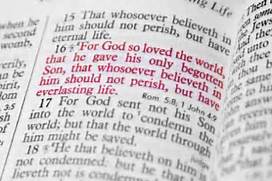
John 3-16 so loved, bible

John 3:16-17 – September 7, 2019

“For God so loved the world that He gave His one-and-only Son, that whoever believes in Him shall not perish but have everlasting life.”

That verse is from the Gospel of John, verse 3:16. It is also one of the most familiar and beloved Scripture verses of all time, and that is no exaggeration.

When I asked Gladys what verse or Bible passage was one of her father’s favorites, she immediately spoke up and said: John 3:16. What is more, Bart had his three daughters memorize this verse when they were young. What a beautiful and precious Bible verse, and also a beautiful and precious memory of their father.

This verse has been called the Gospel in a nutshell, or a simple way to view the Good News of God come to earth to save sinners. A vast number of people throughout the world love John 3:16 and can quote it word for word. Yes, it is a valid way to be introduced of the God of the Bible, and to be introduced to the Son, our Lord Jesus Christ. But, don’t stop there. Bart and Rosevelita did not stop with just that verse. They taught their children not to stop there, either.

What kinds of problems do people discover if they just stop with that one verse and ignore the rest of the Bible? They might have an incomplete understanding of salvation.

After centuries of the Christian church and church history, humanity has ended up with hundreds of different denominations, and even more different ways of understanding how to worship God and to give God honor and glory. This kind of diversity in thinking about God is a reflection of the awesome and magnificent diversity and difference in God’s creation. But, there is still—or should I say, even more—of a sharp disagreement and discord between believers and denominations that say they follow Christ.

What about Jesus Himself? What do you think Jesus would do? Or, WWJD, as the trendy bracelets and bumper stickers of some years back might say? But, I am serious, asking a serious question. What do you think Jesus would do—or say—about all the division in His church?

I suspect our Lord Jesus would cry, grieve, and be very downhearted about all the division, dissention and disharmony among people who say that they follow Christ.

But what if some don’t follow Jesus Christ, or aren’t sure about belief in God? What if some people are not in the same place as others on their journey of faith? We forget that statements like John 3:16 can portray a kind of God I suspect, if pushed, many people would rather not have. “We forget that our certainties about salvation lead to or come from claims about God that might not even reflect the God we know, the God we want.” [1]

If we say that God loves the world, this is not just a pie-in-the-sky theory for salvation. John 3:16 is not like doing advanced mathematics on a chalkboard or a biology experiment in a lab. It is specific and real-life. Particular. As particular as the God coming to earth and becoming human, just as human as you and me. But, can we measure God’s particular, tangible love, in a concrete way?

Sure, we can say “God so loved the world.” But, that means God loves a hated Samaritan woman—from John chapter 4. Does God love people who look and act and worship in a different way than we do? Do we love them, too? God loves a man paralyzed his entire life—from Mark chapter 2. Does God love handicapped and disabled people today? Do we love them, too?  God loves a man blind from birth. God loves Jesus’ friend Lazarus dead in the tomb for four days. God loves Peter who will deny his discipleship and deny being a friend of Jesus. [2]

Great calamities and difficult situations had happened to each of these people. God still loves them. God still loves you and me, and every other person, too. We may not be able to love all people, every person in the world. But, God does. John 3:16 tells us that God so loved the world. That means everyone. Every. Single. One.

Sometimes we use a measuring cup to measure things. When I made cookies a few days ago, I used a measuring cup and spoons to measure out the ingredients for cookies. Can we use a measuring cup to measure God’s love? If you or I were building something, we might use a measuring tape to measure the length and width of the wood properly. I wonder—could we use a tape measure to measure God’s love? Finally, we use a clock to measure the passage of time. Could we measure God’s love and find out how long it would last? Psalm 103 tells us that God’s love is from everlasting to everlasting, and that is pretty long, longer than we can humanly imagine. [3]

Do we have a better understanding of John 3:16 now?

We turn to another gracious promise from Scripture, from Romans 8, where the Apostle Paul tells us that he is convinced that neither death nor life, neither angels nor demons, neither the present nor the future, nor any powers, 39 neither height nor depth, nor anything else in all creation, will be able to separate us from the love of God that is in Christ Jesus our Lord.”

Bart knows the blessed truth of this verse. He is in heaven with the risen Christ right now, looking down on us. I pray that we all might think of Bart Garcia with blessing, honor his memory, and celebrate his new life in Christ Jesus our Lord..

Alleluia, amen.

[1] http://www.workingpreacher.org/craft.aspx?post=4835

“John 3:16,” Karoline Lewis, Dear Working Preacher, 2017.

[2] https://www.patheos.com/blogs/carlgregg/2012/03/lectionary-commentary-john-316-the-rest-of-the-story-for-sunday-march-18-2012/  “John 3:16 – The Rest of the Story,” Carl Gregg, Patheos, 2012.

[3] https://sermons4kids.com/measuring_gods_love.htm

“Measuring God’s Love,”  Charles Kirkpatrick, Sermons4kids.com.

@chaplaineliza

(Suggestion: visit me at my regular blog for 2019: matterofprayer: A Year of Everyday Prayers. #PursuePEACE – and my other blog,  A Year of Being Kind . Thanks!