Unknown's avatar

Love? Jesus Says So.

“Love? Jesus Says So.”

John 13:31-35 (13:34) – May 18, 2025

            May is Mental Health Awareness Month. This month is particularly meaningful to me, since I deal with people who have mental health challenges almost all the time. Both professionally, as a hospice chaplain, and personally, since I have a number of people in my extended family who have mental health challenges.

            I have highlighted May and mental health awareness for years, as a hospice chaplain working in the Chicago community. As a friend of mine, the Rev. Kathy MacNair said many times, everyone knows someone. Every single person knows someone who is struggling with mental health issues – and sometimes, they know several someones. Or, are related to several someones. Or, perhaps you are one of these people who have mental health challenges.

            Our Lord Jesus was very familiar with mental health challenges. As we can see from all four Gospels, the Rabbi Jesus traveled from place to place, preaching, teaching and healing. Sure, some of these healings were physical healings, but some of these healings were also spiritual, mental, and I believe psychological, too. Our Lord Jesus truly healed these dear folks. His compassionate action and treatment is always truly loving, and infinitely caring.  

John chapter 13 comes from the Upper Room Discourse, that last night the Rabbi Jesus was with His disciples. Remember, this was at the Passover meal they all shared together, just before Jesus was arrested later that evening, beaten, tried, appeared before Pontius Pilate, and later the next day crucified outside the city of Jerusalem.  

            Do you understand how important and poignant these words of Jesus are? Just think back to a particularly important conversation you had with someone very meaningful in your life. Perhaps it was one of the last conversations you remember having with that loved one. Just so, our Gospel writer is aware of how important these last hours with his Lord Jesus actually were! I am certain all the disciples remembered these memorable words of Jesus with particular care.

            Let us read again the words of Jesus, from John 13: “34 A new command I give you: Love one another. As I have loved you, so you must love one another. 35 By this everyone will know that you are my disciples, if you love one another.” Shallow people comment about what they call love, thinking about valentines, candy and chocolates, and champagne toasts of undying affection. Can’t you hear them already? “Oh, how wonderful of Jesus! I love everybody already. I’m a good Christian.” Let’s take a closer look at exactly what Jesus was commanding.

            Sure, the Gospel of John mentions the disciples loving one another. But – John’s Gospel also has passages about other kinds of people, too. Nicodemus was a respected member of the Jewish religious rulers, the Sanhedrin, the religious upper class. By and large, the Jewish rulers were no friends of the Rabbi Jesus. What about the half-Jew, the Samaritan woman of chapter 4? What is more, she was also an outcast in her own town.

Did Jesus show any hesitation in His interaction with either one? Wasn’t He caring, loving and honest with each of them, just as He was with everyone else?

            Jesus was the ultimate in being open, loving and honest to everyone. No matter who, no matter where, no matter what faith tradition, social strata, ethnicity, or any other designation.  Jesus is commanding us to love in the same way. Not only towards strangers, but towards friends, as well. That can be even more difficult sometimes.

            “Here in John chapter 13, Jesus demonstrates his love for the same disciples who will fail him miserably. Jesus washes and feeds Judas who will betray him, Peter who will deny him, and all the rest who will fail to stand by him in his hour of greatest distress. The love that Jesus demonstrates is certainly not based on the merit of the recipients, and Jesus commands his disciples to love others in the same way.” [1]

            I get set back a bit when I realize the full ramifications of that boundless, amazing love of Jesus. It’s a tall order! Whoa, Lord! You don’t really expect me to be that way with people who insult me, or are mean to me, or disrespect me, do You?  I kind of think that is exactly what Jesus means. Love them. No “but, what if…?” Love all of them unconditionally.

            Which brings us back to where we started. It’s easy to love lovable people, to love babies and small children. Easier to love those in our families, and friends. But what about those we don’t even know? What about people we actively dislike? And, what about people who are scary, who we don’t understand, who are in dementia or who throw tantrums, or have addictions?

            I have permission from our friend Irene to talk about her adult daughter, who does have mental health challenges, was living at Thresholds social services for years, and who currently lives in Wisconsin. Now that the daughter is regularly taking her prescribed medication, things are stable and under control.  This dear daughter is quite helpful to Irene when she comes to visit. Thank God, this story has a happy ending, and this mother and daughter are reunited and grateful to God for all the help and support from friends, doctors and from support groups.

            That is exactly what Jesus means. Love all people. Even the scary ones, even the ones we dislike. No “but, what if…?” Love all of them, unconditionally.

            This is not just a suggestion. Jesus makes it a command. If you and I want to follow Jesus, this is one of the requirements. Some well-meaning believers say that other people may not merit Jesus’ love, for whatever reason.  Gosh, I don’t merit Jesus’ love a lot of the time! But, that makes no difference. Jesus still loves each of us, unconditionally. No matter what. Plus, Jesus commands us to love others in the same way. The same ultimate, above-and-beyond, bottomless way.

            So, whether you and I succeed or fail in our attempts to love one another this week, yet God in Jesus loves us more than we can possibly imagine. And hearing of this deep Jesus-love we are set free and sent forth, once again, to “love one another.

That is good news for all of us! Alleluia, amen!

@chaplaineliza

(Suggestion: visit me at my other blogs: matterofprayer: A Year of Everyday Prayers. #PursuePEACE – and  A Year of Being Kind . Thanks!


[1] https://www.workingpreacher.org/commentaries/revised-common-lectionary/fifth-sunday-of-easter-3/commentary-on-john-1331-35

Commentary, John 13:31-35, Elisabeth Johnson, Preaching This Week, WorkingPreacher.org, 2016.

Unknown's avatar

In Search of…?

“In Search of…?”

Luke 6:17-26 (6:23) – February 16, 2025

Have you ever been looking forward to something, with all your heart? Perhaps, getting to a stadium early, and looking forward to a great ball game? Or, arriving at the church, looking forward to a wedding of two people who are dear to you? Maybe, finally going to a concert you’ve been waiting for, for many months. Looking forward to—what, exactly?

            Reading again from Luke 6: “Jesus went down with them and stood on a level place. A large crowd of His disciples was there and a great number of people who had come to hear Him and to be healed of their diseases. Those troubled by impure spirits were cured.”

            Yes, this was very early in the Rabbi Jesus’s ministry, but there already was talk about this promising young Rabbi. He not only teaches with authority, but this Jesus heals people’s diseases, too! And, He even casts demons out of people!

But, let us step back from this reading in Luke, for a moment. This reading is very similar to the Sermon on the Mount in Matthew. In fact, this larger reading in Luke is called the Sermon on the Plain. Our reading today echoes Matthew’s Beatitudes! However, there are significant differences between these two readings.

In Matthew, the Beatitudes are pretty straight-forward. It’s the Rabbi Jesus giving blessings to groups of people, who do specific things. The disciple Matthew was Jewish, writing primarily for Jews. But here in the Gospel of Luke, we have a slightly different perspective. Dr. Luke was Greek, and he wrote for a much more diverse audience. As we look at Luke’s version of blessings here in the Sermon on the Plain, we also find Jesus pronouncing woes! Such a difference from Matthew and the Beatitudes, for a diverse audience, this time!  

Who hasn’t turned to the Beatitudes for comfort, for reassurance, knowing that our Lord Jesus is on our side? Knowing that Jesus is supporting us, and in our corner? Certainly, we can still do all that, looking at Dr. Luke’s words from the Sermon on the Plain. “But there is more in these words, and some of it is a little hard to take. ‘Rejoice in that day,’ Jesus says, not about good things that happen, but about suffering, about being hated, about being rejected. This is not something we want to feel joy about.” [1]

When some people read Luke 6, some might nod their heads. Or, say nice things, like “wonderful words!” or “meaningful sentiments, surely!” But, are these opinions simply surface platitudes? Do people who praise this reading from Luke understand its full implications? 

But, this isn’t about us. We do not get to pick and choose what parts of the Gospels and which words of our Lord Jesus we like. No, we all are called to minister, to reach out to all people. As the Rev. Ernest Lyght mentions, “Perhaps there are some similarities between the crowd on the plain and the crowds that come to our churches. When you look out into your congregation, whom do you see? What are their needs? Who are the people who come to our churches? Do they reflect the neighborhoods around the church?

“Surely, they are folks who want to hear a Word from the Lord, and they want to be healed. They come with certain expectations.”[2]

In our society here in the United States, these precise words of Jesus are not particularly popular. In popular culture today – even in the church – do we often see wealth and success as signs of being favored or lucky? Who is often praised or lifted up as being wealthy and successful? Sports stars? Pop musicians and rappers? What about leaders in industry or CEOs of large corporations? How many of these supposedly “wealthy, successful” people follow these particular words of Jesus? These words of Jesus are not about following the crowd. These are challenging words from Jesus, difficult to hear, and even more difficult to put into action.  

            Which leads us to the next question: what are you looking forward to from the worship service, this morning? Were you expecting a warm, familiar service, with nice, familiar hymns, and a warm, comforting sermon?

Here is a poem written by a (then) ten-year-old boy, a few years back. The boy, now a teenager, is autistic, on the Aspergers spectrum. Listen to this view from someone our society would not consider “successful.”

I am odd, I am new / I wonder if you are too
I hear voices in the air / I see you don’t, and that’s not fair
I want to not feel blue / I am odd, I am new
I pretend that you are too / I feel like a boy in outerspace
I touch the stars and feel out of place / I worry what others might think
I cry when people laugh, it makes me shrink / I am odd, I am new
I understand now that so are you / I say I, “feel like a castaway”
I dream of a day that that’s okay / I try to fit in
I hope that someday I do / I am odd, I am new. [3]

Were you surprised and even taken aback when we listened to this lovely boy with autism who wrote that wonderful poem for his English assignment? (I had tears in my eyes when I finished reading that poem. God bless that boy, and God bless that teacher, too.)

            Look again at Luke’s version of the Beatitudes: “’Blessed are you who hunger now, for you will be satisfied. Blessed are you who weep now, for you will laugh. 22 Blessed are you when people hate you, when they exclude you and insult you and reject your name as evil, because of the Son of Man.’”

“We don’t rejoice because someone has hurt us, but we rejoice because we have a community that can help us heal from the hurt. We have relationships that can insulate us from the suffering that any of us might encounter living in the world. In worship, then, we can celebrate that community of support and encouragement. We give thanks for one another and the way we have been enfolded into a loving environment that helps shape our identity as an antidote to the identity we sometimes encounter in the world.” [4]

               Does Jesus challenge you in your daily walk with Him, or are you just looking for a nice, easy, quiet stroll with Jesus? Do we have open doors? Who are the people who do not come to our church, on this corner? Do we truly welcome all people?

These words of Jesus are not about following the crowd. What are you looking forward to? Check with our Lord Jesus, and see who He would welcome. Alleluia, amen.

@chaplaineliza

(Suggestion: visit me at my other blogs: matterofprayer: A Year of Everyday Prayers. #PursuePEACE – and  A Year of Being Kind . Thanks!


[1] https://www.umcdiscipleship.org/worship-planning/where-you-are-far-horizons/sixth-sunday-after-the-epiphany-year-c-lectionary-planning-notes

[2] https://www.umcdiscipleship.org/worship/season-after-epiphany-2019-part-2-worship-planning-series/february-17-sixth-sunday-after-the-epiphany-year-c/sixth-sunday-after-the-epiphany-2019-year-c-preaching-notes  

[3] https://en.stories.newsner.com/family/10-year-old-boy-with-autism-writes-poem-for-homework-his-teacher-is-at-a-loss-for-words/

[4] https://www.umcdiscipleship.org/worship-planning/where-you-are-far-horizons/sixth-sunday-after-the-epiphany-year-c-lectionary-planning-notes

Unknown's avatar

Wisdom from Above!

“Wisdom from Above!”

James 3:13-4:3 (3:17) – September 22, 2024

            I wonder if you can think of people who are called the best at something? The greatest athlete in a sport? The smartest student at your school? The best chef or best writer or best driver or best of anything? Just imagine how much bitter jealousy that comment can promote. Or, how much selfishness and blind ambition all this empty striving and competition leads to!

Worldly “wisdom” is anything but wise, according to our letter writer James. I am sure you recognize these jealous, covetous people. They regularly moan and kvetch and sometimes outright quarrel about what they have or about what they don’t have. James tells us about these dissatisfied, disgruntled people in our Scripture reading today.  

            Just listen to his description: “If in your heart you are jealous, bitter, and selfish, don’t sin against the truth by boasting of your wisdom. 15 Such wisdom does not come down from heaven; it belongs to the world, it is unspiritual and demonic. 16 Where there is jealousy and selfishness, there is also disorder and every kind of evil.”  

This kind of worldly striving, dog-eat-dog attitude is definitely not what James has in mind for us, as believers in Christ. He shines the spotlight on how believers ought to live. Listen! “13 Are there any of you who are wise and understanding? You are to prove it by your good life, by your good deeds performed with humility and wisdom.”

Can there be a sharper contrast between the dissatisfied, selfish, boastful worldly “wisdom” and the Godly, humble, beneficial wisdom and way of life that James talks about here? Not likely. Remember, in this practical letter, this how-to manual, James advises his friends on how to live in a way pleasing to God.

            It’s true that this fancy, flashy excitement can be attractive, even seductive, on the surface! But, all that is just for show, simply surface, an inch deep, and nothing more than worldly dissatisfaction, boastfulness and jealously. But, let’s be truthful – which of us is not tempted, sometimes, by the alluring or bright and shiny trappings of the way of worldly “wisdom?” Which of us doesn’t fall in step with others who might be jealous, or bitter, or selfish – sometimes? Most important, which of us leaves the simple, quiet, godly life of contentment for the flashy, glitzy (and shallow) excitement that so soon fades?

            Let’s consider the worldly, flawed way of thinking and being, for a moment. Carolyn Brown, retired Children’s Ministry Director, has written a prayer for this reading. Listen, if you would, and see whether these words from Ms. Brown do not resonate in our hearts.

Dear God, we want to look amazing.  

We want great clothes, cool shoes, a great haircut. We want our homes filled with our stuff.

We want all the best people to be our friends. We want to be the first, the best, the most, the greatest. So we grab and hold and demand. We even kick and punch to get what we want.

Forgive us.

Teach us to let go, to open our hands and hearts to others. Teach us to be content with what we have and to share it.

Teach us to think as much about what OTHERS want as what WE want. Teach us to be as loving as Jesus. Amen. [1]

            This prayer penetrates straight to the heart, let me tell you! I want to ask God for forgiveness, and to help me live in a loving way, like Jesus. I hope you do, too.

            This prayer makes me think of the Jewish High Holidays, which are quickly approaching. During the month before Rosh Hashanah and Yom Kippur, faithful Jews prepare for these holidays by examining their hearts. They meditate and pray, and ask forgiveness of God, of others, and of themselves for the sins and shortcomings of the past year.

            We also have a weekly time of confession and prayer at the beginning of each worship service. Thank God we receive the assurance of pardon each Sunday from our loving Lord! Yet, we keep on sinning. We still need to keep confessing our sins and shortcomings, and receive that assurance of pardon and forgiveness. Is it any wonder that we have this very practical how-to manual of how to live the Christian life by our letter-writer James, in the New Testament?  

            James assures his readers of Godly wisdom, because he describes its results. “Believers need to submit to the wise rule of God through the Spirit of God, a rule which purifies from within.” [2] The practical consequences of this wise rule of God are easy to observe. People who live God’s way are peaceable, considerate, gentle and non-combative! Does this sound very worldly to you? Certainly not selfish or jealous or bitter!

            What I wonder: how is the life of Jesus any mirror to our personal lives? Jesus is certainly recorded as merciful and loving. That is displayed over and over again in the Gospel record! When I think of our Lord Jesus during that three-year period of time in Palestine, I cannot think of anyone more sincere, honest or peaceable. More real and yet penetrating to the heart. I would love to have just a fraction of that Godly attitude and lifestyle as part of mine!

What – practically – can we take away from this reading today? Can we concentrate on living like Jesus? Living the Jesus way is peaceable, considerate, gentle and non-combative. Jesus is sincere, honest, and real. Can we make a commitment to live like Jesus?

This is the how-to of living a life pleasing to God, being filled with the presence of God. “[You and I] are works in process. This isn’t about completion and the satisfaction of a job well done; it is about a journey of discovery and transformation. But peace [gentleness, mercy, and lovingkindness] can be our companions in the journey to keep our feet on the path.” [3]

            Practical James would wholeheartedly agree! Keep on keeping on. Live in God’s way, in the wonderful, honest presence of Jesus. It’s a sure-fire way to have God draw near to each one of us. Alleluia, amen.

@chaplaineliza

(Suggestion: visit me at my other blogs: matterofprayer: A Year of Everyday Prayers. #PursuePEACE – and  A Year of Being Kind . Thanks!


[1] http://worshipingwithchildren.blogspot.com/2012/08/year-b-proper-20-25th-sunday-in_30.html

Worshiping with Children

[2] http://www.lectionarystudies.com/sunday25bee.html  

[3]  https://www.umcdiscipleship.org/worship-planning/doers-of-the-word/seventeenth-sunday-after-pentecost-year-b-lectionary-planning-notes

Unknown's avatar

Whose Calling? God’s Calling!

“Whose Calling? God’s Calling!”

Ephesians 4:1-6, 13-16 (4:1-3) – August 4, 2024

            I love the Olympics! Yes, the Winter Olympics are wonderful! No doubt about it. However, I have always had a warm place in my heart for the Summer Olympics. Watching such marvelous athletes can be excellent for both the head as well as the heart.

Watching the nations of the world come together in friendship and friendly competition is wonderful, too. Sports and friendly competition can transcend national rivalry, ethnic differences and even bring about an end to conflict and wars – as temporary as the peace and truce every four years at the time of the Olympics is.

            Sadly, in Paul’s time, regions and countries were in regular conflict and war, one with another. The apostle Paul is quite deliberate here at the beginning of Ephesians chapter 4. He does entreat, in all seriousness! Paul knows how difficult it is for individuals to get along with each other, much less countries. It sounds much like today!  

            The letter to the Ephesian church is divided into two parts. Paul ended the first section with Ephesians 3, with a prayer for an outpouring of Christ’s love. Paul wished the Lord might grant strength and power to the Ephesian believers, prayed they might experience the full-ness of God, and closed with a spontaneous doxology to the immeasurable praise and glory of God. Here at the beginning of the second section of his letter, Paul gets practical.

I would like to read again these words from the apostle Paul. “live a life that measures up to the standard God set when he called you. Be always humble, gentle, and patient. Show your love by being tolerant with one another. Do your best to preserve the unity which the Spirit gives by means of the peace that binds you together. There is one body and one Spirit, just as there is one hope to which God has called you.”  

            When you think of someone who is humble, gentle, and patient, who comes to mind? Let me tell you who comes to mind for me. Mister Rogers. Yes, Fred Rogers from Mister Rogers Neighborhood is for me a star at being humble, gentle, and patient. Yet, look at our culture here in the United States.  These three attributes are not seen to be highly regarded or sought after. Look at television commercials, which deliver a hard no to humble, gentle, and patient.

            Especially as – and I am going to venture into the political realm for a moment, which I usually do not do – we consider the general tenor and divisive attitude of the whole nation, with our national election only three months away. Who among our political leaders and those running for office wants to showcase themselves as humble, gentle and patient? Yet, that is exactly what the apostle Paul tells us to be, as believers in Christ.

            Paul moves to the idea of being worthy of “the calling you have received.” That is, each of us is called. God has chosen us, as the Bible says in multiple places, to be God’s beloved children. The Lord has chosen each of us to be a part of God’s Church Universal. And, each in our congregation is a part of our local church here. St. Luke’s Christian Community Church.

            In the Olympic competition every four years, we can watch many, many different teams playing a variety of sports, from all over the world. I was very much struck by the USA women’s rugby team, who actually medalled, winning bronze. The first time a USA team has won a medal in rugby, since 1924. I heard Illona Maher, the earnest, sincere captain of the team interviewed, and several of her teammates also commented. They are so grateful they had the opportunity to practice and to compete together. There is a special bond between these women that will last a lifetime. May the bonds between each of us as fellow Christians lead us to such togetherness.

            Now, WHY should there be such togetherness? As Paul is urging believers in Ephesus to live lives worthy of this Godly calling, he also urges each of us to do the same. “Nothing we do can ever make us truly worthy of the gift of God’s grace, but God’s grace should make us want to live lives that align with who God has called us to be.” [1] Isn’t grace the whole point of living our lives as believers in Christ? Talk about being counter-cultural! This is it, right here.

 God not only freely gives each of us grace – which none of us has done anything to earn! – but we, the church, have been given unity! I know it doesn’t seem like we are unified some of the time. Even, most of the time, depending on which groups of people you and I are looking at! Paul reminds us: “Do your best to preserve the unity which the Spirit gives by means of the peace that binds you together.”

As we look at the spirit and goal of the Olympics, we can see another expression of unity. Unity in sport, in friendly competition. This year, athletes from more than 200 countries are living together under one roof, and are unified as ambassadors of peace, for these two weeks at least. What a marvelous expression, and how similar is this unity that the apostle Paul talks about here in our reading today! What better way to express this unity, as Paul says, than by stewarding this unity through you and me striving to be humble, gentle, patient and loving.

            I know sometimes there are fierce rivalries between sports teams, and between their devoted fans. But, not here! Not in God’s gifting. Just as on a sports team there are different gifts displayed by the various team members, so there is in every local church different people performing different functions. Even equipped with different but equal talents! “It is notable that God, desiring unity, didn’t make us all the same, but instead has given us the opportunity to encounter people who differ from us. Our goal as a Church is to learn to love all peoples ‘until we all reach unity in the faith and in the knowledge of the Son of God.’” [2]

            So, God is again doing the unexpected: giving us grace! And, calling us with the rich calling that is even more amazing than we could possibly ask for. Plus, the hallmarks of our calling as believers come as we all strive to be humble, gentle, patient and loving – to everyone! All people, from everywhere. Just like the Olympics. Just like the Church, all over the world.

Listen to Paul – be peacemakers to all people, and be unified. As God has gifted us to be. Alleluia, amen!

@chaplaineliza

(Suggestion: visit me at my other blogs: matterofprayer: A Year of Everyday Prayers. and  A Year of Being Kind . Thanks!


[1] https://www.churchofscotland.org.uk/worship/weekly-worship/monthly/2024-august/sunday-4-august-2024-eleventh-sunday-after-pentecost-year-b

[2] Ibid.

Unknown's avatar

Have Compassion

“Have Compassion”

Matthew 9:35-9:38 – June 18, 2023

            Today is Father’s Day, the day people set aside in the United States to honor fathers, grandfathers, uncles, brothers – everyone who takes on a fatherly role in the lives of families and individuals across the country. Even, fathers across the world.

The Scripture reading today is the Gospel reading for this week, from the Revised Common Lectionary. I haven’t chosen an alternative reading for today, because the set reading from the Gospel of Matthew chapter 9 is so appropriate for our Summer Sermon series. We are re-imaging God. Seeing God from a different point of view.

Many, many people throughout the world look at the Holy, the Divine, and see something impersonal. This view of the Almighty can seem to be really far away. Distant and cold. Even forbidding and scary. Other times, some people see our God as a strong and mighty Deliverer. The Lord is described many times in the Hebrew Scriptures as a Rock, or a Fortress. That can be helpful, especially when we are in need of Someone strong to help us fight our battles, or when we need a safe, divine Shelter to hide inside – but quite impersonal.

But, what about when some of us (yes, I include all of us here!) need our God to be something other than distant, cold, and scary? Or Someone else than just a super-strong tough-guy? What then? It is really difficult for certain people to believe that their God could be that way! They cannot even conceive of God being warm, welcoming, caring and compassionate!

In Matthew 9:36, our Lord Jesus feels great compassion, and through the words chosen shows us just how deeply He cares. “When [Jesus] saw the crowds, he had compassion on them, because they were harassed and helpless, like sheep without a shepherd.”

            I wanted to see what a proper, in-depth word study on the word “compassion” had to say. According to one word study, “Com-passio literally means to “suffer with.”  In Latin, com means “with” and passio means “to suffer.”  “Passion” is suffering, which is why we talk about “the Passion of Christ” during Holy Week.” [1]    

            As He traveled throughout Palestine from place to place, the Rabbi Jesus had the opportunity to see a whole lot of people. Plus, many of the individuals who came to Him (or, were brought to Him) were not in good health. Many of these souls were distressed. Two other words for that state are “troubled” or the old-fashioned “vexed.” Have you seen troubled souls? Sometimes, these souls carry all their troubles inside, and the only way we know is by looking at their haunted eyes. Other times, some souls have physical aspects of their bodies that show us their distress and anxiety.

            Many of these hurting souls are dispirited. This word means “downcast” or “thrown down.” When people are inwardly helpless and forsaken, often we can see their souls as dispirited. “Philip Keller, in A Shepherd Looks at Psalm 23 [Zondervan], describes how sheep can get turned over on their backs and not be able to get up by themselves again. Such sheep are called “cast” or “cast down” sheep (p. 60). These sheep flail at the air with their legs, but they can’t get back on their feet without the aid of the shepherd. Left in this condition, helpless and vulnerable to their enemies, they will die after a few hours or days.” [2]

            We can easily see how Jesus as our Good Shepherd would be greatly concerned and compassionate for these dear souls! I would like to return to the word “compassion.” We looked at the Latin roots of that word, but the Gospel of Matthew was written in Greek.

If we take a closer look at what the Greek word “compassion” means, we see the word splagchna, which appears in the letter to the Philippians. The Apostle Paul’s words in the King James Version say: “I long after you all with the bowels of Jesus Christ.”  The word splagchna means “bowels” – literally, the innards in your belly.  It’s an earthy image that might offend some. “The people of the ancient world believed that all of the most intense feelings originated in the belly.  For them, “guts” did not mean “courage,” but depth of feeling.

It’s easy for us to understand why they would believe that, because when we feel anxious or afraid, our stomachs churn.  Our lower innards give away how much we are affected by our circumstances.  The Greek phrase Splagchna oiktirmou means something like “’the bowels of deep feeling.’” [3]

            Our Lord Jesus felt like this for the crowds surrounding Him. He had deep compassion, caring and love! As the classic hymn tells us, “O, the deep, deep love of Jesus, love of ev’ry love the best! ‘Tis an ocean vast of blessing, ‘tis a haven sweet of rest!”

            No matter how our popular culture makes fun of the “kinder, gentler” emotions like compassion, or labels them as “unmanly,” we can readily see from passages like these that our Lord Jesus felt them deeply. No matter how much some scoff at strong, mighty people also being caring and loving, we have a Divine example right here to hold up. To hold on to.

            Moreover, this does not only refer to the crowds Jesus saw in Palestine. Jesus has compassion on us, today, too. “He sees us in our lostness, in our emptiness, under attack by enemies within and without; and he loves us. Although we are harassed and helpless, he loves us. He doesn’t say, “Well, they should have known better.” He doesn’t say, “You’d think that by now they would have figured it out.” He doesn’t say, “What a bunch of losers.” [4]

Jesus has deep compassion for the sheep without a shepherd, centuries ago, and for us sheep, too! Jesus loves us all, cares for us all, down to the very depths of His being.

We can rejoice in the deep compassion, the deep caring, and yes, the “deep, deep love of Jesus.” This is for each of us today, and this is the Gospel truth. Alleluia, amen.

@chaplaineliza

(Suggestion: visit me at my other blogs: matterofprayer: A Year of Everyday Prayers. #PursuePEACE – and  A Year of Being Kind . Thanks!


[1] Compassion in the New Testament (Part 1) http://www.jmarklawson.com/traveling-in-place/2012/03/compassion-in-the-new-testament-part-1.html

[2] https://bible.org/seriespage/lesson-1-help-wanted-matthew-935-38

[3] Compassion in the New Testament (Part 1) http://www.jmarklawson.com/traveling-in-place/2012/03/compassion-in-the-new-testament-part-1.html

[4] https://www.umcdiscipleship.org/worship-planning/the-path-of-the-disciple-the-weight-of-the-call/third-sunday-after-pentecost-year-a-lectionary-planning-notes/third-sunday-after-pentecost-year-a-preaching-notes

Unknown's avatar

The Love Command

“The Love Command”

John 13:31-35 (13:34) – May 15, 2022

When I mention the word “love,” what do you think of? For me, it’s different things at different times. When I thought of the modern conception of love this time, what came to mind were the hearts and flowers of romantic love. You know the kinds of expressions I mean. Hearts, flowers, Valentine’s Day, frilly lace, and all the rest. This is not the kind of love our Lord had in mind.  Our modern ideas of love hardly scratch the surface of Jesus’ expression of love.

John shows us the extended conversation Jesus had with His friends on that last Thursday night, the night before He died on the Cross. Jesus said many poignant, important things to His disciples. Some of them were even commands! Like this one here, from John chapter 13.

            The disciples followed their Rabbi around Palestine for three years. Living together, rubbing shoulders and elbows together, those itinerant people got particularly close. That can happen when people travel and live in close quarters with one another! Now, at the culmination of all things, Jesus gives His disciples a new command. He even highlights it! “Love one another, as I have loved you.” Jesus made sure all of His friends knew it was a command!

            Shallow people comment, thinking about valentines, candy and chocolates, and champagne toasts of romantic love. Can’t you hear them already? “Oh, how wonderful of Jesus! I love everybody already. I’m a good Christian.”

Let’s take a closer look at what exactly Jesus was asking.

            Sure, the Gospel of John mentions the disciples loving one another. But – John’s Gospel also has passages about other kinds of people, too. Nicodemus was a respected member of the Jewish religious rulers, the Sanhedrin. By and large, the Jewish rulers were no friends of the Rabbi Jesus. What about the half-Jew, the Samaritan woman of chapter 4? She was also an outcast in her own town.  

Did Jesus show any hesitation in His interaction with either one? Wasn’t He caring, loving and honest with each of them, just as He was with everyone else?

            Jesus was the ultimate in being open, loving and honest to everyone. No matter who, no matter where, no matter what faith tradition, social strata, ethnicity, or any other designation.  Jesus is commanding us to love in the same way. Not only towards strangers, but towards friends, as well. That can be even more difficult sometimes.

            “Here in John chapter 13, Jesus demonstrates his love for the same disciples who will fail him miserably. Jesus washes and feeds Judas who will betray him, Peter who will deny him, and all the rest who will fail to stand by him in his hour of greatest distress. The love that Jesus demonstrates is certainly not based on the merit of the recipients, and Jesus commands his disciples to love others in the same way.” [1]

            I get set back quite a lot when I realize the full ramifications of that Jesus-kind-of-love. Whoa, Lord! You don’t really expect me to be that way with people who insult me, or are mean to me, or disrespect me, do You? Umm. I kind of think that is exactly what Jesus means. Love them. No “but, what if…?” Love them.

I post on social media regularly, both for my personal media accounts as well as for St. Luke’s Church. This was a post I made for yesterday, Saturday, exactly mirroring this command of our Lord’s. “Confused about the Christian response to social issues? Here’s a handy reference: Male? Love them. Female? Love them. Unsure? Love them. Gay? Love them. Straight? Love them. Unsure? Love them. Addict? Love them. Sober? Love them. Unsure? Love them. Believer? Love them. Unbeliever? Love them. Unsure? Love them.”

And, this is not just a suggestion. Jesus makes it a command. If you and I want to follow Jesus, this is one of the requirements. Some well-meaning believers say that other people may not merit Jesus’ love, for whatever reason. Gosh, I don’t merit Jesus’ love a lot of the time! But, that makes no difference. Jesus still loves us, Unconditionally. No matter what. Plus, Jesus commands us to love others in the same way. The same ultimate, above-and-beyond, bottomless way.

“Jesus goes to the cross to demonstrate that, in fact, “God so loved the world.” Jesus went to the cross to show in word and deed that God is love and that we, as God’s children, are loved. So whether we succeed or fail in our attempts to love one another this week, yet God in Jesus loves us more than we can possibly imagine. And hearing of this love we are set free and sent forth, once again, to love another.[2]

Alleluia, amen.

@chaplaineliza

(Suggestion: visit me at my other blogs: matterofprayer: A Year of Everyday Prayers. #PursuePEACE – and  A Year of Being Kind . Thanks!


[1] https://www.workingpreacher.org/commentaries/revised-common-lectionary/fifth-sunday-of-easter-3/commentary-on-john-1331-35

Commentary, John 13:31-35, Elisabeth Johnson, Preaching This Week, WorkingPreacher.org, 2016.
[2] https://www.workingpreacher.org/dear-working-preacher/on-loving-and-not-loving-one-another

“On Loving – and Not Loving – One Another,” David Lose, Dear Working Preacher, 2013.

Unknown's avatar

Concern For One Another

“Concern For One Another”

Hebrews 10:19-25 (10:24-25) – November 14, 2021

            Have you worshiped at another church – perhaps when you went out of town, or on a trip to see relatives – and found the worship at that other church was quite different from our worship here at St. Luke’s Church? I can relate! I have worshiped at churches in a number of different faith traditions, in all different kinds of church buildings, although they all proclaimed the same Lord, our Lord Jesus Christ. The same God receives all the glory! Some churches in a more rambunctious manner than we do here.

            Our writer to the Hebrew believers in the Messiah is writing to small groups of believers scattered all around the area of Asia Minor. Our Preacher writes to people very familiar with the Temple and Jewish sacrificial system.

            The scattered Hebrew believers worshiped in houses, sometimes synagogues. A far different place and space than the great, big Temple in Jerusalem. Think of that huge building! The High Priest was only able to go into the Most Holy Place of the Temple once a year, on Yom Kippur, with the most holy of sacrifices, to atone for the sins of the nation of Israel.

            This was at a time when there still was a Temple standing in Jerusalem. Yet, not for long. In just a few years, the Roman armies are going to totally destroy the Temple. But – what on earth are the faithful devout Jews going to do when that happens, to be certain sure that their God forgives them their sins? The Preacher to the Hebrew believers told them – yet again, in different ways – that there is a better way to God. That way is the Messiah Jesus.  

            I have worshiped in larger churches. A few times I’ve gone to cathedrals, like here in downtown Chicago. Not only to be surrounded by all of that beautiful stonework, artwork, and stained glass, but also to be surrounded by the glory of God. It is an amazing experience to worship in a place like one of those large, magnificent churches.  Some Christians have a problem, though. It doesn’t matter if they lived in the first century or the twenty-first century. Some believers try really hard to reach God on their own through doing good deeds. Going overboard helping people. Giving so much it seriously hurts.

.           “You’re never done because you can never do enough. After all, it’s not a way for God’s adopted children to establish a right relationship with God.  Of course, God’s people sometimes treat Christianity as a way to make God “happy.”  We sometimes assume you have to think, do or say just the right things to connect to God.” [1]

These beloved people, these God-followers just do not get it. God does not want people to be forced to do anything out of fear, with people scared to pieces, so afraid that they won’t worship God in the proper way. It happens throughout the centuries, not just long ago. It still goes on today – people think they have to worship the “correct” way to connect to God.

I’ve attended some African-American worship services. They are often quite different from the more quiet, sedate way we worship here at St. Luke’s Church. I had the privilege to preach in one service some years ago, at a Baptist church on the west side of Chicago. In a converted building, three storefronts put together. The building did not look like much from the outside. But, inside? A whole different thing. The spirit of God came down and transformed that worship space – and the worshipers. Marvelous to experience.

The worshipers truly encouraged one another, cared for one another, and helped one another show good to others. In their own context, familiar to them, on the west side of Chicago.

I know that we are supposed to encourage each other and care for each other, in our local assembly, in our congregation. But, some churches make it more difficult to do that. Some church buildings are large and impersonal. Like, for example, the church my husband’s sister attended years and years ago, in a nearby Chicago suburb. So cold and gloomy and impersonal! My husband did not want to go back there after he attended two or three times.

Other churches communicate an immediate feeling of warmth, welcome and fellowship. Is your church one of those? The Writer to the Hebrew believers instructs his scattered readers to not only encourage each other, in the assembly, but to be helpful to others outside of your congregation! Be kind! Reach out! And, that will honor God!

One great way to be an encouragement to our fellow congregation members AND to reach out to others out side of the church walls is by being faithful to our local assembly. As we are faithful in offering our time, talent and treasure to our local congregation, we can honor God.  Some might think that I am confused; I just got done with saying some believers try hard to reach God on their own through doing calculated “good deeds. Giving so much it hurts.

That is NOT the case. We don’t have to think, do or say just the right things to connect to God. It isn’t the good works we do. It isn’t the obligations we accomplish. Do you hear? It’s all about the relationship we have with our loving heavenly Parent! God wants relationship, not fear, not obligation. Not shoulds and arm-twisting and guilt, guilt, guilt!

God wants beloved children coming into the Heavenly Presence out of love, out of love and gratitude. That’s the vertical direction. Plus, God is so pleased when we extend that loving, caring relationship in a horizontal direction! To our fellow church member, yes! In reaching out to help others, outside the church walls, too.

We are encouraged to give – in response to God, in love and thankfulness – of our time, talents and treasure. (That means money.) God will be so pleased when we do! You and I will be amazed when we see how far our treasure goes, when we put it to work to help, strengthen, and encourage others. Let’s do this!

And, to God be the glory.  Alleluia, amen.

@chaplaineliza

(Suggestion: visit me at my other blogs: matterofprayer: A Year of Everyday Prayers. #PursuePEACE – and  A Year of Being Kind . Thanks!


[1] https://cepreaching.org/commentary/2018-11-12/hebrews-1011-14-15-18-19-25/

Unknown's avatar

Finding God’s Majestic Name!

“Finding God’s Majestic Name!”

Psalm 8:1-9 (8:1) – October 3, 2021

            Have you ever been far from the city lights, at night? Have you ever looked up into the sky, and seen countless stars spread out, twinkling high above? I have. When I went to the Upper Peninsula of Michigan, and again in rural central Indiana, the starry skies were absolutely breathtaking. Amazing. Majestic, as the psalmist King David said in our Psalm reading today.

            Listen again: “Lord, our Lord, how majestic is your name in all the earth! You have set your glory in the heavens.” I can just imagine King David sitting far away from the lights of the city of Jerusalem, perhaps contemplating the stars as he saw them in his youth, when he looked after his father’s sheep, or as a younger adult, a leader of men in the wilderness of Judah,. David certainly had many opportunities to gaze up into the night skies and see the breathtaking stars.

            I needed to take two science classes in college, for my undergraduate degree. I was happy to take a biology course, and I enjoyed it! But, I wanted to take something different for my second science course. A quirky but popular teacher also taught science – he taught astronomy! I don’t remember many facts from that class, but I remember him. I remember how excited he was about his subject, and how much he tried to make the course material interesting and accessible to his students. I have always had a warm spot inside for stars, for star-gazing and the moon and other planets, both before and ever since.

            When King David wrote this psalm, he used words like “majestic” and “awesome.” Can you remember when everything was “awesome?” “In the late 1980’s and early 1990’s, the word “awesome” was overused and abused. Everything was “awesome.” Events and people were awesome. God was awesome.” [1] Now, some years later, I am relieved to find this word is not so misused. However, God has not changed. God certainly is still truly awesome. Majestic, too.

            We can see King David had great awe and godly fear for the Lord his God. Just look at the language he uses! The opening verses of Psalm 8 has royal language all over the place. The very words “Lord” and “Sovereign” are used in conversation with a king in other places in Scripture, too. We can see that usage from both 1 and 2 Kings. These books of the Hebrew Scriptures use these expressions interchangeably for the king of Judah and the king of Israel.  

            When King David praises the majesty of God’s name, this also points to a royal understanding of God. The territory over which God reigns is not a small, limited region, but instead “all the earth.” [2] Yet, Dr. Elizabeth Webb makes a point of saying that even though David leads off this psalm with such huge, overarching thoughts, he then turns to humanity. Yes, God is Sovereign! Majestic! Awesome! The ultimate Godly authority! But, then, the earth is full of mere people. Frail humanity. Here one minute, and gone the next.

            “When I consider your heavens, the work of your fingers, the moon and the stars, which you have set in place, what is humankind that you are mindful of them, human beings that you care for them?” When we consider limited humans on a scale like that, with a cosmic Sovereign as vast as the heavens, how miniscule are we? How frail and short-lasting?

“Psalm 144:3-4, for example, begins with a similar question: “O Lord, what are human beings that you regard them, or mortals that you think of them?” In Psalm 144 it is human frailty that makes God’s interest in us almost incomprehensible: “They are like a breath; their days are like a passing shadow.” What concern could God possibly have with frail beings that are here one moment, gone the next?” [3] Truly something to wonder about. I have thought about it, from time to time. How can God concern Godself with me? With my trials or troubles, with God being so huge?

In Psalm 8, what the writer finds so wondrous is that the very God who established the order of the heavens actually cares for human beings, for us, for you and me. Listen to verse 4 again: “what is humankind that you are mindful of them, human beings that you care for them?”

If I did not believe that God was loving and caring, full of chesed, full of magnificent lovingkindness, I might really give up. Why should I even try to communicate with a faraway, distant, uncaring God, who would just as soon squash me like a bug? That’s even considering whether that cold and distant God even saw me crawling around on the earth?

Except, we know that God is not that way! Instead, our Lord is full of the attributes grace, mercy, love and chesed, shown in the death and resurrection of Jesus Christ.

We are here in church today to celebrate World Communion Sunday, a day when the Church worldwide celebrates the unity of the blessed Eucharist, that Lord’s Supper that believers all over the world celebrate in a variety of different languages, but proclaiming the same Lord. Thank God our Lord is a loving and caring God. Thank God our Lord is full of that magnificent, majestic attribute chesed, full of lovingkindness.

Here we are: frail, earthly human beings. Our God truly welcomes all of us as God’s children. Our God welcomes us at the Lord’s Table, especially on this World Communion Sunday. Can you praise the name of the Lord? Can you bless God for the profound, awesome gifts you have been given?   

“O LORD, our LORD, your majestic name fills the earth. Your glory is higher than
the heavens…!
We are blessed to be able to offer God our worship and praise!
In speechless and awed worship, we marvel at God’s holy presence with us,
as we contemplate all that God has given to us! We are all so very blessed! Amen. [4]

@chaplaineliza

(Suggestion: visit me at my other blogs: matterofprayer: A Year of Everyday Prayers. #PursuePEACE – and  A Year of Being Kind . Thanks!


[1] http://www.word-sunday.com/Files/Psalms/8.html

“Our God Is Awesome!” Larry Broding’s Word-Sunday.Com: A Lectionary Resource for Catholics.

[2] https://www.workingpreacher.org/commentaries/revised-common-lectionary/the-holy-trinity/commentary-on-psalm-8-10

[3] Ibid.

[4] http://www.thetimelesspsalms.net/w_resources/pentecost1a_2017.htm

The Timeless Psalms: Psalm 8, Joan Stott, prayers and meditations based on lectionary Psalms, 2017.

Unknown's avatar

Lost Sheep

“Lost Sheep”

Matt 9-36 sheep, shepherd people

Matthew 9:35-10:1 (9:36) – June 14, 2020

In college, I can remember times when I heard fiery sermons about missionaries, and about how God provided the world as a harvest field for the followers of Jesus. I can remember how the preacher would thunder “the harvest is plentiful, but the workers are few! Pray that the Lord will send out many into God’s harvest fields!”

I attended a Christian college, and I did hear a number of sermons like that. Yes, that Bible reading is from Matthew 9:37. Perfectly appropriate for preachers to take this verse and highlight it in a sermon meant to urge people to go out to the mission field. The very next verse is where our Lord Jesus chooses the 12 disciples, and commissions them to go out into the villages and towns and heal, preach and do just what Jesus had been doing.

However, when I read these verses from Matthew to prepare a sermon for today, I was drawn to the previous verse, verse 36. When Jesus saw the crowds, he had compassion on them, because they were harassed and helpless, like sheep without a shepherd.”

I am NOT going to focus on the harvest being plentiful, and the workers being few – in that case, this would be a very mission-oriented sermon. I do preach mission-oriented sermons when I feel God leading me that way, but for this Scripture reading at this particular time, I see a different picture. Instead of God sending followers out into the world, I see Jesus full of compassion and caring. I see Jesus as a loving Shepherd, caring for His lost sheep who don’t even know they are without a shepherd.

Many, many people around the country have not been in physical contact with anyone else for a long, long time. In some cases, for months. People are still suffering from social isolation, from limited and limiting conversation from behind a mask, at a socially-acceptable distance of six feet—or more. Have you felt isolated and alone? Have any of your extended family, or loved ones, or friends been in that situation? Jesus would be able to give you a hug, for sure. As a Shepherd, Jesus would certainly lift up and carry little lambs in His arms.

Can you imagine how comforting that would feel, to be held in the arms of our Lord Jesus? What a wonderful feeling, to be protected and made secure by our Heavenly Shepherd.

For those who did not know, I am in the middle of a 4-part community video series involving the recent months, the pandemic and the shelter-in-place order in Illinois. This series is in collaboration with the Morton Grove Chamber of Commerce. I am the host and narrator for the project, and we are very grateful to the Village of Morton Grove and associated departments for all their help in making this series a reality.

As I think back a month, to the beginnings of this idea for a video series, it all started with a conversation. Or rather, two conversations, with Father Dennis and with Mark, the Director of the Chamber of Commerce. In both, we talked about how disconnected and discouraged many people felt. All three of us – Father Dennis, Mark, and I – had many people sharing with us how disheartened they were, for a number of reasons, all stemming from the pandemic, the shelter-in-place, and the social isolation that gripped so many across our nation.

Which leads me back again to this verse from Matthew 9:36, where the Rabbi Jesus spoke of compassion, and nurture, and how Jesus cares for each of us as His sheep. Jesus did not just preach from a pulpit, or up front on a raised platform, separated from all the other sheep—I mean, people. No, Jesus had compassion on these lost sheep.

Jesus felt such love and compassion towards these members of the house of Israel, He felt it deep down to his “splachna,” down to His guts, or bowels. According to the original Greek, in the first century, to be moved right down to one’s bowels was to be moved with compassion, or to have compassion inside. The bowels – or guts – were thought to be the seat of love and pity at that time. This expression denotes the very heart of Jesus’ understanding and personhood.

With Jesus, His compassion was not impersonal or disembodied. He did not simply see abstract problems that could be explained away. Instead, Jesus had compassion on real people. He saw each individual, the real self inside, and considered each one worthy of compassion and care. To know that someone has seen the real self, hidden underneath and still manages to love and accept us. What a profound difference that makes in our lives, in our hearts, in our self-image. Can we do less when we seek to engage the community around us?” [1]

What an earth-shattering thing, for Jesus to see us, to know us deeply, down to our hearts. We can praise God for this wonderful certainty, even as we are in the midst of such anxiety and fear. As a community, we can gather together to name our stresses and losses, and to grieve and mourn. Yet, Jesus shows us how to have compassion on ourselves and on others.

Morton Grove and the surrounding neighborhoods are finding resilience, togetherness, hope and even joy. Praise God for the example of our Lord Jesus. We can join (virtual) hands in community. Is there any better, more holy calling than to make friends with everyone we meet?

Remember, God loves everyone, no matter who. And, we might be surprised at who becomes our new friend in the Lord as we show compassion, too.

[1] https://www.umcdiscipleship.org/worship-planning/open-our-eyes/second-sunday-after-pentecost-year-a-lectionary-planning-notes/second-sunday-after-pentecost-year-a-preaching-notes

@chaplaineliza

(Suggestion: visit me at my regular blog for 2020: matterofprayer: A Year of Everyday Prayers. #PursuePEACE – and my other blog,  A Year of Being Kind . Thanks!

Unknown's avatar

Jesus Seeks and Saves

Luke 19 zaccchaeus-the-publican

“Jesus Seeks and Saves”

Luke 19:1-10 – September 1, 2019

Do you know anyone who is really unpopular? I mean, so unpopular that people turn their backs and ignore them when they come around? That is just the sort of person we are going to talk about today: a particularly unpopular, even despised person.

The Gospel of Luke chapter 19 tells us of the tax collector Zacchaeus and the encounter he had with the Rabbi Jesus. Jesus had been in ministry for almost three years, and I suspect that He was a celebrity in the Jewish population. Perhaps even of rock-star-status, given Jesus had healed people, cast demons out of people, and performed all sorts of other miracles for the past three years. It’s no wonder Jesus attracted such a crowd wherever He went!

When you or I read about tax collectors during the first century, we might think they were simply unpleasant people tasked with an unfortunate job. Because, someone had to do it! The Roman Empire occupied a huge territory, including the region of what is now Israel and Palestine. The Roman army was the occupying force that policed the region. The conquered Jewish people were a subjugated people. But, that was not all.

No one likes to pay taxes. And, taxes are even worse when they are being collected by an occupying force, like the Romans. Except—the Romans were fiendishly clever. Some of the native population was used to collect taxes. Here’s what happened. The taxation system the Romans used was ripe for abuse. The Roman government farmed out the collection of taxes and sold off the right to do tax collection to the highest bidder. All that was necessary was that the Romans receive their assessed financial amount at the end of the year. Any money over that amount could be kept by the native-born tax collector. And, boy, did they collect the money! As I said before, this was a scheme sure to be abused. Talk about a shakedown racket!

Was it any wonder that these tax collectors were especially despised by their fellow Jews? These Jewish shakedown artists collaborated with the Roman overlords, besides being seen as extortionists for collecting double, and even triple the amount stipulated by the Roman tax assessment.

Some people think the United States tax code is punishing. They haven’t seen anything, compared to these tax collectors who were backed up by the force of the occupying Romans. In other words, just in case any Jewish person was even thinking of not paying taxes, the Roman army could come knocking at the door and drag them off to prison for tax dereliction. What is more, Zacchaeus was the chief tax collector, in charge of all the other tax collectors in the region. He must have been simply rolling in dough.

There is more, in terms of social consequences. Even though he was very wealthy, Zacchaeus had lost his place in the local synagogue, was not permitted to attend worship services, and was totally ostracized from all “decent society” in town. I mention all this to let everyone know what a scandal it was.

On top of everything else, Zacchaeus was extremely short, and probably felt even worse because of his little stature. New Testament scholar Anselm Grun theorizes that “Zacchaeus wanted to stand out to gain recognition, but the result was that he was isolated and rejected. He felt compelled to set himself above people because, alongside them, he felt too small. So perhaps there was a vicious cycle of insecurity, exploitation of others, loneliness, and rejection at work in Zacchaeus’s relationships in the community, or, more accurately, his lack of relationships.” [1]

But, no matter what, this guy really wanted to see the Rabbi Jesus!

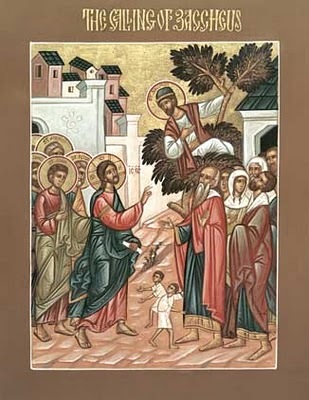
We know what happened. Reading from Luke 19, Zacchaeus “wanted desperately to see Jesus, but the crowd was in his way—he was a short man and couldn’t see over the crowd. So, he ran on ahead and climbed up in a sycamore tree so he could see Jesus when he came by.” Can you just see Zacchaeus, his head and shoulders poking out between the branches of a sycamore tree? What about the Rabbi Jesus? He called Zacchaeus by name! Can you imagine? Calling a hated tax collector by name, and even proclaiming that He would eat dinner at that tax collector’s house that evening?

What a scandal! What a horrible thing for a respectable Jewish Rabbi to do! Can you imagine what all the “decent folk” in Jericho had to say about that?

Yet, isn’t this just like Jesus?

Again and again in the Gospels, especially in Luke’s Gospel, we see Jesus side with those on the margins, those who are the least of these, those who are disrespected and dismissed. Jesus comes alongside of the down and out and those not accounted as much in the eyes of the world. “While Zacchaeus is rich, he is nevertheless despised by his neighbors, counted as nothing, even as worse than nothing. Yet Jesus singles him out.” [2]

I follow the social media account Invisible People on Twitter. This account regularly posts articles and photos of those people who are invisible to society at large: the homeless. The vignettes and stories are heartbreaking, on a daily basis. The followers who read Invisible People meet person after person who had a job and lost it, or had a spouse and lost them, or had an extended health reversal and lost their apartment, or any one of a dozen other sad scenarios. These people teetering on the poverty line, or even below it, pull at anyone’s heart strings.

Yet, to many people across our country, any mention of the homeless or those in shelters or camping in the woods because they do not have any other place to stay is certainly similar to mentioning “tax collectors” in first century Palestine. These “invisible” friends are despised by many “decent folk,” many who have money, education, experience, or moderately good health.

These “invisible people” of today are on the margins of society, similar to the tax collectors of the first century. Reading from Luke 19, we get some indication of what the onlookers said: “Everyone who saw the incident was indignant and grumped, “What business does Jesus have getting cozy with this crook?” 8 Zacchaeus just stood there, a little stunned. He stammered apologetically, “Master, I give away half my income to the poor—and if I’m caught cheating, I pay four times the damages.”

Jesus responds in typical, loving, caring Jesus-fashion: He lets everyone know that Zacchaeus is just as good as any of the “decent folk.” 9-10 Jesus said, “Today is salvation day in this home! Here he is: Zacchaeus, son of Abraham! For the Son of Man came to find and restore the lost.”

Who has a corner on perfect righteousness and standing before God? Which of us is not lost and wandering, at times? Don’t we all need to be found and restored to God’s loving embrace? Jesus has come to seek and save the lost, the wandering, the people on the margins and the outskirts of society, as well as “decent folk.” Jesus has His arms open wide to welcome each of us, no matter what.

Surely it is God who saves me—God has arms open to save all of us. Amen, alleluia.

[1] https://www.patheos.com/progressive-christian/power-persistence-alyce-mckenzie-10-28-2013.html

“The Power of Persistence, Part 3,” Alyce M. McKenzie, Edgy Exegesis, 2013.

[2] http://www.workingpreacher.org/preaching.aspx?commentary_id=2968  October 30, 2016

David Lose

@chaplaineliza

(Suggestion: visit me at my regular blog for 2019: matterofprayer: A Year of Everyday Prayers. #PursuePEACE – and my other blog,  A Year of Being Kind . Thanks!