Unknown's avatar

Have Mercy on Us!

“Have Mercy on Us!”

Luke 17:11-19 (17:13) – October 12, 2025

            Ever been to the dentist, or the doctor, with a health complaint? Of course, you have! You all—we all have, at one time or another. Thank goodness, we live here, in the suburbs of Chicago. It is fairly easy to get good—or even, excellent medical and dental care, as opposed to the rural spaces in the United States, where health care is not as accessible. And, can you imagine outside of this country?

            Imagine living in the first century of the Common Era. In Jesus’ day, doctors were rare even in mid- to large-sized towns. When people had health complaints, there were some homeopathic remedies, true. And local healers, people who were good with herbs, poultices, and ointments. But for continuing problems or chronic diseases? There weren’t many options for any other kind of health care.

            Let us set the scene. Dr. Luke tells us, “Now on his way to Jerusalem, Jesus traveled along the border between Samaria and Galilee. 12 As he was going into a village, ten men who had leprosy met him.”  We have a situation with some chronically ill people. These people had skin diseases. Commonly referred to as leprosy, these skin afflictions could be anything from severe eczema to Hansen’s disease, what we now know today as leprosy. And any disfiguring skin problem, in between.chronic

            In Jesus’ day, there were priests and Levites stationed all throughout the land of Israel. These official people were not only on duty for the Sabbath day, for religious observance, but they had several other important duties under the law of Moses. Did you know that the priests and Levites could make rulings on whether a person was too disfigured, too blemished to live in close quarters with the rest of the townspeople?  True facts!

            This was an early example of a health code. The priests and Levites were among the first health inspectors! Because some of these skin diseases were contagious, and so the people who had them would contaminate others, the priests and Levites would have to exile them. Kick these former upstanding people out of town. Out of society, and isolated. Marginalized. Exiled. Called ‘unclean.’ Living far away from everyone and everything they once held dear. Ringing bells to warn others not to come near them. That was the situation for these ten lepers we read about in Luke’s Gospel today. What a lonely existence for these poor people.

            The Rabbi Jesus was on His way to Jerusalem with His disciples when he met these ten men, on the border between Galilee and Samaria. This is yet another time that our Gospel writers tell us that “Jesus is again in a border region, again crossing boundaries and wandering where he probably shouldn’t go, and again healing people with whom he has no business interacting.” [1] Commentator Dr. Davis Lose reminds us that Jesus is again doing something out of the ordinary. In fact, extraordinary!  

            Let us consider that this unconventional Rabbi Jesus is not only crossing geographical boundaries and wandering – traveling where “good, rule-keeping Jews” just don’t go. But, Jesus is also interacting with these ten lepers! These men obviously kept at a distance from all other “normal” or “regular” people, except I am certain they had heard of this miracle-working Rabbi! Can’t you just hear the anguish and the hoping-against-hope in their voices as they cry out, “Jesus, Master, have mercy upon us!”  

            Jesus’ response is simple. Straight-forward. “Go, show yourselves to the priests. I can just imagine these ten men, told by Jesus to go and show themselves to the priests in town. Except, Jesus told them to go before He had done the act of visibly healing them from their skin disease. They needed to act, they needed to start to go before they saw what had happened.

            Have you ever needed to go on faith, and start an action, go on a trip, take a step without knowing for sure that God is right there with you? And, the whole idea of a borderland, an in-between place that is neither one place or the other. Doesn’t God meet us right there, before healing is completely complete?  [2]

That’s all Jesus says to them. The verb in Greek means ‘show, or point out something to someone.’ Remember, I said the priests were the health inspectors of that day? Can you understand these ten guys, isolated, banished, marginalized. And Jesus says, “Go, show yourselves to the priests.”

            Lo and behold, “as they went”—that is, in the going—“they were cleansed.” Do you understand? These poor, lonely people believed Jesus, had faith, and were healed as a result. We are not told exactly how they discovered it, but it probably didn’t take too long.

            One ex-leper, out of the original ten—one ex-leper comes back to thank Jesus. Glorifies God! Comes to Jesus and prostrates himself at His feet. Once the Samaritan realized he’d been healed, he couldn’t help but turn back and share his joy and thanksgiving with Jesus.

            Thanksgiving is like that. When it’s genuine, it’s spontaneous—you recognize you’ve been blessed and can’t help but share your joy through thanksgiving.

“Have you ever noticed just how powerful it is not only to receive blessing but also to name it and give thanks for it? Maybe you’re at dinner with family or friends, then you lean over to another, or maybe raise your glass in a toast, and say, “This is great. This time, this meal, you all. Thank you.” And in seeing and giving thanks, the original blessing is somehow multiplied. You’ve been blessed a second time.” [3]

The Samaritan knows he’s been given a gift and can’t help turning around to say something. In doing so, he’s given a second gift: He leaves his encounter with Jesus not only healed but also blessed in his own recognition of healing, blessed at being drawn into deeper relationship with the one he thanks, blessed at hearing himself commended for having great faith.

Imagine the huge difference that must have made in his life. That’s the way thanksgiving works—in giving thanks for gifts given to us, we are blessed again. We can all say alleluia, Thanks be to God!

@chaplaineliza

(Suggestion: visit me at my other blogs: matterofprayer: A Year of Everyday Prayers. #PursuePEACE – and  A Year of Being Kind . Thanks!


[1] https://www.workingpreacher.org/dear-working-preacher/second-blessing

[2] https://www.umcdiscipleship.org/worship-planning/choosing-faith/eighteenth-sunday-after-pentecost-year-c-lectionary-planning-notes/eighteenth-sunday-after-pentecost-year-c-small-groups

[3] https://www.workingpreacher.org/dear-working-preacher/second-blessing

Unknown's avatar

Losing and Finding!

“Losing and Finding!”

Luke 15:1-7 (15:7) – September 14, 2025

            Lost and found—this concept is very real and meaningful to many people, especially children. I have four children, and at various times, they have had to go looking for various possessions of theirs. You know, small items, things that were very precious to them somehow got lost. And oftentimes, they went looking everywhere for those precious things.

            I can remember when my son was younger, probably in first grade. He had a favorite stocking cap he wore almost every day in the winter. He wore it to school, out to play, on the weekends, almost everywhere. And then, one day it got lost. My son could not find it anywhere. He was heartbroken at the loss of this precious stocking cap—precious to my son, at least. We searched everywhere—and I mean everywhere—in the house, in the car, in his classroom, in his locker. He even looked in the lost and found at his school. Sadly, we never could find it.

Can you relate? Have you ever lost anything that was precious to you? Maybe not valuable in a monetary sense, but precious to you, your very favorite. And let’s go further. What about the things that are worth a great deal? Valuable in a very special way, in terms of both monetary and sentimental value. Losing something precious can be quite a blow.

            This is exactly what our Lord Jesus talked about in our scripture passage today. He tells the parables of the lost things. In fact, one nickname for this chapter, Luke 15, is the chapter of the lost things—the parables of the lost sheep, the lost coin, the lost son.

            Dr. Luke sets the scene for us. He says, “Now the tax collectors and sinners were all gathering around to hear Jesus. But the Pharisees and the teachers of the law muttered, “This man welcomes sinners and eats with them.” Tax collectors and “sinners” were two groups of people who were especially hated by the good, synagogue-going Jews! And, especially by the Jewish leaders, the Pharisees and teachers of the Jewish law, who had particularly high standing in their local community! How dare that upstart Rabbi Jesus waste His time with riff-raff, with no-good, low-class, dregs of society?  

            And, that’s not all the Rabbi Jesus is doing! “Eating — that is, sharing table fellowship — is a mark of camaraderie, acceptance, and friendship. And so in eating with tax collectors and sinners, Jesus is demonstrating a deep and abiding acceptance of those society has deemed beyond the moral pale.” [1] 

            In response to this complaining and carping from the Jewish leaders, Jesus has a response. Three responses, in fact. This week we look at His first parable, the parable of the Lost Sheep. As with many of the parables of Jesus, this one starts out in a straight-forward manner, but somehow doesn’t set quite right.

Jesus says, “Suppose one of you has a hundred sheep and loses one of them. Doesn’t he leave the ninety-nine in the open country and go after the lost sheep until he finds it?” In other words, if you are a shepherd, you put the other 99 sheep at risk! You leave them in the wilderness, with no protection or shelter while you go seeking the one that is lost! And, how about that lost sheep? How does that sheep feel? Lonely? Hungry? Injured? Scared?

From an accounting, balance-statement point of view, the loss of one percent of your stock or flock is an acceptable business loss. Why do we need to leave 99 sheep at dangerous risk? Just for one, single, measly little sheep? But, God does not take that point of view!

Sometimes, people – individuals – get lost. Can you and I relate? “Sometimes you can identify why you feel lost and other times you simply feel unmoored — unable to give a name or reason for a sense of confusion, disorientation, bewilderment, abandonment, loneliness — all of which can be manifestations of lostness.” [2]

            I work during the week as a full-time hospice chaplain. It is sometimes my heartbreaking job to go to see patients in dementia, and sometimes even severe dementia. I would like us to listen to this heartfelt vignette from Pastor Janet Hunt, about a longtime family friend.

“Norma became not only a family friend. She was our church secretary (back when we called them that) at my home congregation for forty years. What I especially remember most about that time was that she would listen and answer and go deeper with me about whatever it was we had learned in class that morning. There are a lot of people whose influence factors into one heeding the call to become a pastor. Norma was certainly one of those for me.

“I know that I am blessed to serve not so far from home for I have the chance sometimes, still, to connect with those I knew when I was young. I especially knew it this last Saturday morning for Norma’s son called me up to ask my thoughts about nursing home options here. Both of their parents’ health are failing and her Alzheimer’s Disease, in particular, is making this next move necessary. 

“Sunday afternoon I went to see Norma. I sat down next to her daughter and we visited a while. I don’t know for sure if she really remembered me or not, but her smile was as radiant as it ever was. Before I left, I asked if I could pray with her. She placed her hand palm down on the tray table in front of her. I put my hand on top of hers and her daughter put her hand on top of mine. I prayed simply and briefly – asking for God’s protection and strength and peace. When Norma took her hand back, she wiped her eyes for those words had somehow broken through. 

“She may only have pretended to remember me, but still she knows somehow that God remembers her. Slowly but surely the disease that is erasing her memory will not finally erase what matters most. In some ways, she may seem ‘lost’ to those who have loved her, but she is not lost to God. I expect, or at least I hope, that in that moment she knew God’s persistent love embracing her once more. ‘Found’ once more, I hope her comprehension of God’s tender love for her never leaves her.” [3]

No matter how we are lost, how we are wandering in the wilderness, in the hospital or care center, or when we concentrate so much on our physical or financial situation, or in the busy-ness of life, running from place to place – God never stops seeking us. We know who is loving and caring and seeking for each of us.

Which of you, Jesus asks, would go to such lengths to search and find and then welcome back and celebrate? Truth be told, none of us would. But God would. [4] Our Good Shepherd goes after me, and after you, too. He searches for us, and makes sure that we are back with Him, in the place of security and protection, and says, “Rejoice with me! For I have found my sheep that was lost!” To me, the news about our good Shepherd is the best news in the world. Alleluia, amen.

@chaplaineliza

(Suggestion: visit me at my other blogs: matterofprayer: A Year of Everyday Prayers. #PursuePEACE – and  A Year of Being Kind . Thanks!


[1] https://www.workingpreacher.org/dear-working-preacher/lost

[2]  https://www.workingpreacher.org/dear-working-preacher/lost-and-found

[3] http://words.dancingwiththeword.com/2013/09/lost-and-found.html

[4] https://www.workingpreacher.org/dear-working-preacher/lost

Unknown's avatar

Good News of Great Joy!

Stained Glass Nativity

“Good News of Great Joy!”

Luke 2:8-16 (2:10) – December 20, 2020

            Do you need Good News? So many are discouraged. Disconnected. Downhearted. This disconnected year of 2020 makes us all feel isolated and separated, even with the computer and social media. Especially at holiday time.

            The shepherds needed some Good News, too. On those hilltops around Bethlehem, they were not exactly welcome in the general society of the town, either. Focusing on today’s Scripture reading, Dr. Luke tells us about the shepherds, abiding in the fields, keeping watch over their flocks by night. But, he does not mention anything about the low position they held in society.

            Did you ever think you had something in common with those shepherds? This year of the pandemic, we certainly do. We all experience a real disconnect and isolation in society—and so did the shepherds.

            Throughout the centuries, in many situations, Christians have found themselves set at a distance from society at large. As you are feeling a similar kind of discombobulation, it may be that there is some solidarity in our worldwide disconnection.

            Differences in language can be a real barrier between people, too. It does not matter whether a family comes to a new land or a different area in times of conflict, or famine, or some other upheaval. If you are unfamiliar with the common language spoken in the area in which you are now living, that can be a huge disconnect, too. That is a large reason why ethnic groups of people gather together in towns and cities—for solidarity, social purposes, and for ease in communication.  

            I worked as a chaplain at Swedish Covenant Hospital for a number of years. I can remember how particularly touched an elderly woman was when I spoke to her with the few words of Polish I knew. This woman from Poland had dementia, and there was no one working in the hospital that evening who spoke Polish. I heard about this very sick woman when I went to the nurses’ station. I told them I just knew a very few Polish words. However, a few nurses encouraged me to come to her bedside and say those few words—which I did. It calmed the woman immediately, and the nurse and CNA were so grateful to me.

            Even a few words in a familiar language can bridge that disconnect and barrier, and make a stranger feel more at home, more connected.

            But, the disconnect for the shepherds was even more than that. “By the time of Jesus, shepherding had become a profession most likely to be filled from the bottom rung of the social ladder, by persons who could not find what was regarded as decent work. Society stereotyped shepherds as liars, degenerates, and thieves. The testimony of shepherds was not admissible in court, and many towns had ordinances barring shepherds from their city limits.” [1]

Imagine the difference in class between the shepherds and the bulk of the townspeople of Bethlehem. Certain people live “on the wrong side of the tracks,” or “on the other side of town.” Or, perhaps they come from the hill country, or down by the river.   

            For that matter, can you believe the disconnect between all people on earth and the angels? When the angels came to communicate their Good News to humanity, who were they sent to, first thing? Not the wealthy, in their expensive houses. Not the leaders of the community, or the rabbis or ministers of the houses of worship. No, the angels came to the lowly shepherds in the hill country, who did not even rate a home or a welcome among the “decent folk” in the middle of town.  

            I know this is not quite the same as the shepherds’ loneliness, but have you been feeling the isolation of COVID-19? Not being able to connect, or go out for coffee, or sit down with a friend or relative for a meal? Isn’t this similar to the shepherds’ isolation and loneliness?

            The angels did not observe the class consciousness of society, or the language barriers or color barriers of so much of our world. No! The angels sent from God brought glad tidings of great joy to ALL the people. Not just some select few, not even to most of the earth’s population. No! This Good News came to ALL the people. To all with a spiritual disconnect, too!          

            The angels came to the “fields of the isolated, the disenfranchised and the forgotten, or in our own painful places of spiritual wilderness, because God speaks the good news of Christ’s coming there. God brings great joy to those who need it most there.” [2]

            Whether we are isolated spiritually, or disconnected in real life, God wishes to draw ALL of us in to the Good News of the birth of God’s Son. Regardless of where we come from, or where we are right now, we are welcome.

            Do you hear? Each of us is special—each one of us has the angel of the Lord bringing Good News to us—personally. Glad tidings of great joy, no matter what!

            Wonderful news for Christmas, for sure. Wonderful news, any time we need it!

Alleluia, amen!


[1] http://www.workingpreacher.org/preaching.aspx?commentary_id=1522

[2] http://www.workingpreacher.org/preaching.aspx?commentary_id=1522

@chaplaineliza

(Suggestion: visit me at my regular blog for 2020: matterofprayer: A Year of Everyday Prayers. #PursuePEACE – and my other blog,  A Year of Being Kind . Thanks!

Unknown's avatar

Calling by Name

“Calling by Name”

John 10 parable-of-the-good-shepherd_lg

John 10:1-10 (10:3-4) – May 3, 2020

Have you ever felt lost? Lonely? Like everything was dark and stormy? I know I have, from time to time. Especially right now in this time of the coronavirus pandemic, that is the big difficulty with being separated from our friends and from one another: we run the risk of feeling lost and alone.

On a number of occasions, our Lord Jesus talked about being lost and alone—or rather, about being found, about living in community, in a group. Several times in the different Gospels, Jesus compares Himself to a Shepherd. Our Scripture reading today from John chapter 10 is one of those situations.

This is familiar territory, a common metaphor in the Bible. God is the Shepherd, and the nation of Israel is the flock of sheep. Though most of us today in suburban Chicago don’t know much about farm animals, this topic was an everyday subject to the people listening to Jesus. In villages and small towns, most families had a few sheep or goats. There were a few shepherds who would take all the animals from the different townspeople’s houses out of town to pasture.

As Jesus taught the people, He made sure to give a detailed account of the bad things that could threaten the sheep. Thieves and robbers sometimes waited to grab a lamb. They might even lie in wait to come over the wall of a sheepfold at night, and steal a couple of sheep away. That was one important reason for the shepherd to guard the sheep and sleep across the entrance to the sheep’s pen at night. In other words, to serve as the door for the sheep.

I know many today are fearful and anxious at such an uncertain time. Some people do not even want to hear another word about the topics of coronavirus and COVID-19. Radio, television and other social media have broadcast every variation of news about the pandemic for many weeks. Are coronavirus and COVID-19 robbers and thieves of our peace and security? Do these fearful and very real threats seek to heighten danger to all the people? All the sheep? These are things for all of us to think about and ponder in our hearts.

I attended a number of intensive summer seminars taught by the retired professor and Presbyterian pastor the Rev. Dr. Kenneth Bailey. Sadly, he died four years ago, but he greatly enriched the general understanding of Christianity and the Bible. He drew upon his many decades of familiarity with the culture and practices of the Middle East, and strongly encouraged his readers to view the Biblical texts through a Middle Eastern cultural lens.

In his book The Good Shepherd, John chapter 10 is one of the chapters in the Bible Ken Bailey tells us about. As he so often does, Dr. Bailey gives example after example of Middle Eastern accounts, described in the reading. A Syriac bishop from the 12th century discusses the thieves and robbers coming after his sheep—his parishioners—so realistically. [1] I almost was persuaded that he was describing evil and greedy fake ministers of today, out to “fleece” the unsuspecting sheep who were shepherded by the Syrian bishop Ibn-al-Salibi.

As this book describes the voice of the Shepherd, we come to see how the sheep quickly learn to recognize their own Shepherd’s voice. Even though there are other shepherds in the same area, the Good Shepherd’s sheep hear that distinctive voice and follow the one they know.

“But, wait!” you say. “Other voices might be just as loud,” or “Other noise can drown the Good Shepherd out.” Perhaps, even, the sheep get confused or anxious or downright lost, and wander away from their Shepherd. What then? What about a situation like right now, in a pandemic, where lots of fear, anxiety, emotional and economic uncertainty, worry, grieving and mourning distract us from the voice of our Good Shepherd? What about loss of jobs, loss of homes, loss of loved ones, loss of all kinds of things people hold dear?

Jesus, our Good Shepherd, knows about every situation. Nothing surprises Him. Jesus will stay by our sides and walk with us through each scary situation, each grief-filled event, and each dark valley we cross.

I know—from experience—the malicious, nagging murmur in my ear that says, “Why should the Shepherd want to call me? I’m not important. He probably does not even have a name for me, let alone know who I am.” The Syriac bishop has an answer for that. Reaching across the centuries to reach us today, Bishop Ibn-al-Salibi tells us “The shepherd expresses his true knowledge of [the sheep] by calling their names. For the one who calls another by name makes clear that he knows him.” [2]

Just think. Our Lord Jesus describes Himself as the Good Shepherd. Jesus knows the name of each of His sheep. It isn’t just a “Hey, you!” or “What’s your name?” No! Jesus calls each of us, His sheep, by personal name. Jesus knows each of us so well, He knows everything about us. And, what’s more, He still loves us!

Praise God, just as the risen Christ called Mary by name in the garden that Easter morning, so Jesus calls each of us by name. I rejoice in the knowledge that I am a much beloved sheep of our Good Shepherd. We all have a beloved relationship with Jesus! Each one of us is His dear sheep—we can trust Jesus’s word on it. Praise God! Alleluia, amen.


[1] Bailey, Kenneth E., The Good Shepherd (InterVarsity Academic: United States of America, 2014), 216-17.

[2] Bailey, Kenneth E., 218.

@chaplaineliza

(Suggestion: visit me at my regular blog for 2020: matterofprayer: A Year of Everyday Prayers. #PursuePEACE – and my other blog,  A Year of Being Kind . Thanks!

Unknown's avatar

Were Not Ten Made Clean?

“Were Not Ten Made Clean?”

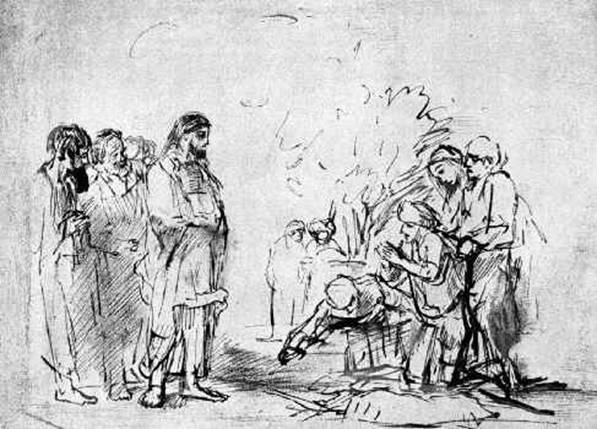
Luke 17-18 rembrandt

Luke 17:11-19 – October 13, 2019

Sometimes, I talk with people in recovery—alcoholics and addicts who are not drinking or using substances, one day at a time. I used to do this more often, when I was regularly facilitating a weekly spirituality group at an inpatient drug and alcohol rehab unit at a nearby hospital. One of the suggestions for staying clean and sober one day at a time is to keep a gratitude journal. You know, a running list of things we are grateful for.

A writer for the Hazelden/Betty Ford Clinic, Michael G., tells us “The Roman Emperor Marcus Aurelius famously said that our lives are what our thoughts make them. In other words, by simply changing the way we think and our focus, we can change our lives. Bearing this in mind, choosing gratitude can have a huge impact on your life.[1]

What on earth does a gratitude journal have to do with our Gospel reading today from Luke 17? To better understand that, we need to look at the background of the situation. Jesus and His disciples are on their way to Jerusalem. The time is growing nearer for Jesus to enter into Jerusalem on Palm Sunday—very near, now. While on the road on the border between Samaria and Galilee, Jesus is met by ten lepers—ten people with various sorts of skin deformity.

Can you see this scene? On the road at the outskirts of a town, Jesus and His disciples are walking. Perhaps, entering the town, hungry, thirsty, wanting a place to rest. When all of a sudden, ten lepers interrupt Jesus while He is on His journey. They stand some distance away, but they still make themselves heard—“Jesus, Master, have pity on us!”

Have you ever had the unexpected opportunity to meet someone special, someone important, perhaps interrupting them on their journey? That is exactly what happened.

These ten men, the men with serious skin conditions, were living a very lonely existence. They could not have any direct physical contact with any healthy or “clean” person, for fear of transmitting their skin condition or illness. Even touching a person who had leprosy or touching something they touched might be dangerous—might get someone infected.

Whenever someone developed a serious skin condition centuries ago, they had to be separated, and go live outside of their community. In the Law of Moses, the book of Leviticus devotes a whole chapter (chapter 13) to that situation, and is quite specific. ““Anyone with such a defiling disease must wear torn clothes, let their hair be unkempt, cover the lower part of their face and cry out, ‘Unclean! Unclean!’ 46 As long as they have the disease they remain unclean. They must live alone; they must live outside the camp.”

How horrible! Imagine never being able to hug your children, spouse, parents, or brothers and sisters again. Imagine never being able to enter the market or the house of worship you regularly attended, much less being banished from your home. This was life, in an ongoing and sad reality for these ten lepers. How incredibly lonely!

Especially to an observant Jew, the religious and spiritual separation must have been awful. As Dr. David Lose tells us, “That disease made them ritually unclean, which meant that they couldn’t participate in the Temple services and rituals at the center of their faith. And not able to practice their faith, these men stood on the outside of their community as well, likely feeling alone, abandoned, and desperate.” [2]             But, there is unexpected hope. I don’t know which of these lepers hears that the Rabbi Jesus is in town, but Jesus had been healing people throughout Israel and Galilee for about three years by this time. Wouldn’t you ask for healing, if you unexpected met the Rabbi Jesus?

As I considered this reading during the week, I wondered how addicts and alcoholics felt. Are they considered “Unclean!” and ostracized? Shunted aside? Ignored? Does their disease of alcoholism or addiction cause them increasingly to live alone and isolated, in poorer and poorer health?  These two situations from Luke 17 and the condition of addicts today do not line up completely, but there are some close parallels between our Gospel reading and the sad, lonely, debilitating condition of countless people who are afflicted by the disease of addiction.

I want us to begin to understand the hopeless, helpless sense of these ten lepers, ostracized and isolated, suddenly and unexpectedly getting hope for the first time in a very long time. “The Rabbi Jesus! Coming to our town? I’ve heard about Him! Isn’t He the Rabbi who heals the blind and lame? And, didn’t He raise that widow’s son from the dead? And—and—that Rabbi has healed some lepers. I know, I heard the stories. Maybe—He might heal me!”

Hoping against hope, you know what happens. Jesus does stop, and He does talk to them. He says, “Go, show yourselves to the priests.” That’s puzzling, at first hearing. But, not if you are someone living by the Law of Moses. When a person was healed from illness, they were routinely supposed to go to the Temple or to the priest and show themselves. In today’s terms, the priests were similar to physicians’ assistants in the role of certifying people’s return to good health. Jesus told the lepers to go even before they were healed. And as they were obedient and started on their way, a miracle happened. They were healed, cleansed, and their skin conditions were totally gone. Imagine how excited and delighted those former lepers were!

Here’s where the problem is: ten were healed, but how many came back with thanks to Jesus? How many were truly grateful? Yes, ten lepers left Jesus, and along the way to the priests became clean, healthy, and whole. Only one ex-leper truly recognized the incredible healing and gave thanks to the Rabbi Jesus. In giving thanks, he became what God had intended all along.

That is the answer. That is the secret to life: gratitude. “Noticing grace, seeing goodness, paying attention to healing, stopping to take in blessing, and then giving thanks for the ordinary and extraordinary graces of our life together. This is the secret to a good life and the heart of saving faith.” [3]

I started off this sermon quoting from an article on recovery. I’ll end it the same way. Michael G. says, “When I first came into recovery more than 30 years ago, my sponsor told me to buy a notebook and write down 10 things I was grateful for, and then add three things to that list every day. I stopped numbering my list when I got to 5,000 items.

Why did I write a gratitude list? Because I didn’t want to be miserable, and if being grateful was the solution, then that’s what I would do. And importantly, a grateful heart doesn’t drink. I learned very quickly that the struggle stops when gratitude begins.” [4]

I don’t often end with a challenge, but I am today. This is for me as well as for you. What practices ought we undertake, with what stories might we surround ourselves, with what rituals might we allow ourselves to be shaped, so that we might respond to God with gratitude and joy?

Dear Lord Jesus, help all of us to search for the answers to these sincere questions, and follow Your way in our daily lives, perhaps even writing a daily gratitude list.

Alleluia, amen.


[1] https://www.hazeldenbettyford.org/articles/sober-dad/gratitude-early-recovery

[2] http://www.davidlose.net/2019/10/pentecost-18-c-the-secret/

[3] Ibid.

[4] https://www.hazeldenbettyford.org/articles/sober-dad/gratitude-early-recovery

@chaplaineliza

(Suggestion: visit me at my regular blog for 2019: matterofprayer: A Year of Everyday Prayers. #PursuePEACE – and my other blog,  A Year of Being Kind . Thanks!