Unknown's avatar

Diverse Gifts and Abilities!

“Diverse Gifts and Abilities!”
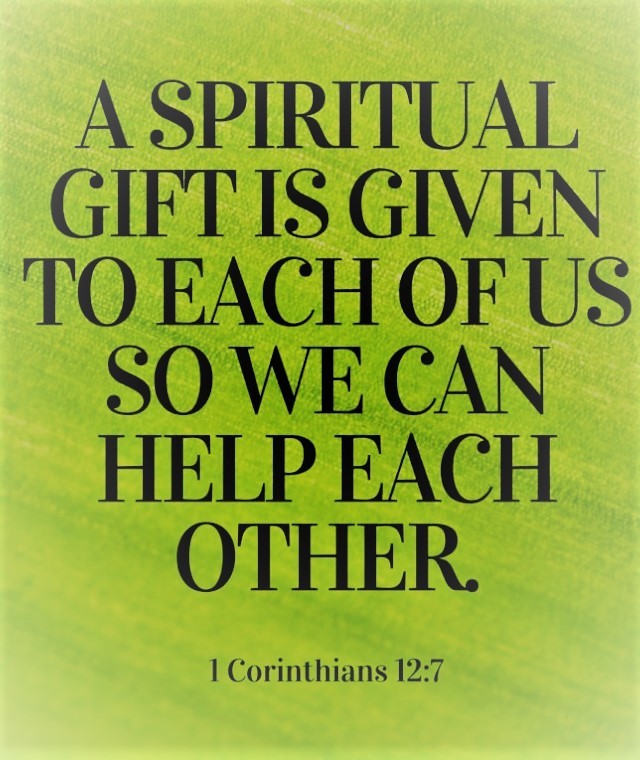
1 Corinthians 12:1-11 (12:10) – January 19, 2025

“In the beginning, God created the heavens and the earth.” God created everything on the face of the earth. Just think of the myriads of different kinds of plants, animals, climates, languages, cultures. God made it all, and God rejoices in the countless variations and differences. What a diversity in creation! We can be amazed over and over, at the ever-renewable wonders of God’s creation, whether we look at a flower in a vase, through a microscope at a microbe, or at the photographs sent from the landing craft now exploring on the planet Mars.

When we consider our reading for today, we can also see that God made different kinds of spiritual gifts, as well. God’s plan is for human beings to live together, with one another, in community. The main purpose for these diverse gifts is for the common good. God wants us to use our gifts for one another. What an awesome opportunity! Here, God freely and openly gives us gifts—spiritual gifts—to serve one another.

Now, let’s back up. The Apostle Paul cites Jesus Christ as a starting point at the beginning of Chapter 12. He states the authority of Jesus, and even makes the statement “Jesus is Lord” a sort of litmus test for being a follower of Jesus Christ. After all, no one who is a pagan can say “Jesus is Lord” and really mean it (at least in Paul’s day, that was true). But there is a problem. The problem is us human beings.

We are fallen people. We sin. In and of ourselves, we have no standing, and are not righteous before God. As Romans 3:23 reminds us, “There is none righteous, no, not one.” But the Holy Spirit gives us a big assist here! The Holy Spirit helps us to say the words “Jesus is Lord!” It is through the power of the Holy Spirit that we exercise these gifts that God so graciously gives to us!

Let’s look at what Paul says about these spiritual gifts. There are many kinds of gifts! Yet, there is one Lord. There are diverse abilities! Yet, one Spirit. I see a definite connection here. It’s all about God, and God’s immense creativity. Just as God created the world in all of its glory, beauty and diversity, so too the Lord created people in all their wonderful diversity, with diverse gifts and abilities for us to share with one another.

I started out quoting Genesis 1:1–”in the beginning, God created the heavens and the earth.” Looking back at Genesis, we can see that diversity is definitely in God’s plan for humanity from the very beginning. The sheer creativity of God in creation is so big and so varied. Musically speaking, there are countless variations on a countless number of themes. The only way I can figure this out is that God is pleased when we use our God-given creativity in any one of a myriad of ways—inventing, designing, doing, helping, making, thinking, crafting, composing, giving. And when we use our God-given gifts and abilities, it plain feels good inside.

When we look at this chapter in 1 Corinthians, Paul stresses that the church—the group of believers in Christ he was writing to–in all of its diversity, is a community. A great, big extended family, if that helps you think about it. I know that can remind us of the whole topic of the families each of us were born into–and some people don’t want to go there–with in-laws, out-laws, black sheep, and all the rest. But biblically speaking, this is God’s family.

This reminds me of my birth family, my family of origin. I am one of six sisters and brothers. The six of us are about as diverse as anyone would want to see. Across the political spectrum, in terms of talents, abilities, interests and activities, the six of us are so different from each other. Yet, we came from the same parents, and grew up in the same household. Even within my own family, there is such a rich diversity.

With God as our Heavenly Parent, we as believers in Jesus Christ are all sisters and brothers of one another. Why? Because God’s Word says so. Paul says, several verses down in this same chapter, “For in the one Spirit we were all baptized into one body—Jews or Greek, slaves or free—and we were all made to drink of one Spirit.”

There are different services, and different activities, yet there is one Holy Spirit over all, energizing all. And this is a corollary benefit: whatever happens, whenever people use their God-given gifts and abilities, God receives praise and honor!

Tomorrow, we observe a federal holiday, where we remember and give thanks for Martin Luther King Jr. His stirring words helped to move this nation toward justice, empathy and equity. His witness called forth the best of all of us.

Sadly, in recent years, we have seen the increasing rise of hatred, separation one from another, and white supremacy. We need to go forward towards those loving, caring and equitable ideas that Martin spoke of. We have been given these gifts to show the whole world that God means for all of us to serve one another, no matter who they are, no matter where they may be.

God can break through insular, tribal loyalties! God can and does knit all of us together as one humanity, one great big extended family. Plus, tomorrow as a Day of Service is not simply a day on the calendar, but it is a day on which all of us can serve and work, pray and hope, struggle and strive to – as Martin said – bend the arc of history closer to justice, and be shaped into the people of God that God’s prophets call all of us to be. Each day. Every day.

So, we can praise God that we have been graciously given these gifts and abilities to use, for each person we meet.  What an awesome opportunity! Here, God freely and openly gives us gifts—spiritual gifts—to serve one another, for the common good. How can you take that opportunity, and use these gifts for one another’s benefit, and continue to build the Beloved Community we are told of repeatedly in the Bible? Not just tomorrow, on the MLK Day of Service, but every day? How can you best serve God’s worldwide family? How can I?

God willing, we can and we will. Alleluia, amen.

@chaplaineliza

(Suggestion: visit me at my other blogs: matterofprayer: A Year of Everyday Prayers. #PursuePEACE – and  A Year of Being Kind . Thanks!

Unknown's avatar

Joy, For the Nations

Joy, For the Nations

Isaiah 42:1-9 (42:6) – December 11, 2022            

God has an amazing way of bringing about justice! You and I can think of countless situations where God is walking with faithful believers through all kinds of difficult situations! Yet our God cares for each and every situation, and our God accompanies all these in patient and long-suffering ways.          

  Today’s reading from the prophet Isaiah highlights God’s servant bringing justice, lighting the way to joy, and bringing release to the captives. God usually does not smite the “bad guys,” and we know God doesn’t throw thunderbolts at the people who make life so difficult for everyone else.             

How on earth are we supposed to deal with rotten situations like chronic illness, unemployment, or natural disasters, then? What could you and I do when we are being mistreated or oppressed or trampled, like the people of Israel were by the Babylonians? Because, that was who was beating up on the armies of Israel at the time Isaiah wrote. And, the Babylonians finally conquered the Israelites and took many of them away to the country of Babylon as hostages, and enforced labor.         

    This rotten situation was very real for Isaiah and the country of Israel, in other words! What are the people to do? How should they deal with evil, unfeeling oppressors?            

The prophet writes, speaking for God: “Here is my servant, whom I uphold, my chosen one in whom I delight; I will put my Spirit on him, and he will bring justice to the nations.” “But, Lord,” I can just hear many of the people of Israel say, “When will this be? How long do we need to wait? Why are You taking so long?”           

Waiting is just what we’re doing now. Right now, we are in the season of Advent; we are waiting for the coming of the Messiah, of the Servant of the Lord. The Baby in Bethlehem. Today is the third Sunday of Advent, the Sunday of Joy. The week of continuing expectation, and the week of the Virgin Mary.           

  Several themes of this reading from Isaiah are so similar to the themes of the song of the Virgin Mary – the Magnificat from Luke chapter 1. The angel Gabriel has just told the teenage Mary she will bear the Messiah, the Servant of the Lord. The next thing we know, Mary starts singing this amazing song! Hearkening back to Hannah’s song from 1 Samuel and to this song we read today from chapter 42. Similar to God taking delight in the servant of the Lord, Mary begins her song taking joy in the Lord. As she says, “From now on all generations will call me blessed, for the Mighty One has done great things for me—holy is his name. 50 His mercy extends to those who fear him, from generation to generation.” As God proclaims the promise to “to open eyes that are blind, to free captives from prison and to release from the dungeon those who sit in darkness,” so Mary takes heart in God’s promise that the Lord considers, cares for, and acts on behalf of the lowly.           

  Both of these songs proclaim radical actions! Both of these songs are from a subversive point of view. Both of these songs – the Magnificat of Mary and this servant song from Isaiah – talk of toppling existing unrighteous power structures and erecting a topsy-turvy power structure with the have-nots receiving more than enough from God. Mary goes even further, stating that “it is not for kings or the mighty and powerful that the Lord has regard, rather it is for all the rest that God does great things.” [1]           

Both songs raise the question of justice. Both time periods had the people of Israel under the boot of conquering, oppressive nations: Babylon in the time of Isaiah, and Rome in the time of the Gospel of Luke. I can just hear the people of Israel say, “Has God abandoned us? Are we still God’s people? Is God still God?”  Because of exile and oppression, the people of Israel could only conclude that God had withdrawn favor and allowed the conquerors to punish them for their sins and disobedience. [2]            Yet, into all of this upset and darkness and uncertainty, both songs praise God for being God. Can we do that too, and praise God, today? Both songs address the theme of justice for all people, not just for a few. Can we believe in God’s statement of justice for all, even though every day we see the poor and the downtrodden getting pushed around, and the humble and lowly being overlooked and even discarded?            

“Isaiah reminds this exiled people that God has not abandoned them but is indeed at work among them, restoring them to be a blessing. This is good news! God is still God.” [3]This loving, caring attitude of God is amazing, in God’s approach to bringing justice to all people. Both Isaiah and Mary have strong feelings about justice—especially radical, subversive Mary! Our patient God is working with all of us, gently, gradually, to bring change and justice into this fallen world.

Both Isaiah and Mary sing a song that can be, should be, our song in this Advent season. As we have prepared for the coming of the Christ Child, now we too can sing in thanksgiving, in celebration, in remembrance, and in proclamation of the promise made to our ancestors. And, the promise made to us, too. What can we say but, alleluia!  Come, Lord Jesus!

@chaplaineliza

(Suggestion: visit me at my other blogs: matterofprayer: A Year of Everyday Prayers. #PursuePEACE – and  A Year of Being Kind . Thanks!
Unknown's avatar

Hungry and Thirsty Blessings

“Hungry and Thirsty Blessings”

Matthew 5:1-7 (5:6) – July 31, 2022

Have you ever been really hungry? I mean, have you ever gone without food for more than a day? Longer than that? Hunger can be an ache inside, an actual pain inside your abdomen. Being physically hungry and thirsty can be dangerous for people’s health. Yet, food is not all that people hunger for.

Our Lord Jesus wanted to specifically mention those who were hungry and thirsty. “Blessed are those who hunger and thirst for righteousness, for they will be filled.” Yes, we can think of people who are actually, physically hungry and thirsty. That is a real need, and it’s a need for individuals and families all over the world.

Let us take a step back, and consider actual, physical hunger. What is that like? I have had the blessing of steady employment at a decent rate of income for several decades now. I do not recently have the first-hand experience of going to bed hungry, with nothing to eat in my kitchen. Not a can of vegetables in the cupboard, not a package of food in the pantry.  

My friend Rev. Dr. Marilyn Pagán-Banks is the director of A Just Harvest, located right next to the Howard Street El station, in that congested and now gentrifying area on the far north side of Chicago. A Just Harvest is a nonprofit organization. Their summary statement is “Breaking bread, restoring community – every day. One meal at a time. One job at a time. One change towards wellness, peace, and justice at a time.”

After the Covid shut-down in March 2020, St. Luke’s Church was still receiving baked goods on Saturdays from Meier’s Bakery. Except, the men’s residence at the McGaw YMCA in Evanston – where I donated the baked goods – shut down, too. That meant NO more deliveries or donations, for many months. I had to quickly pivot, and so I gave a quick call to my friend’s organization, A Just Harvest. Part of their outreach is a food pantry; an industrial-service kitchen that provides a complete hot meal for free, between noon and 2 pm, 365 days a year. That is every day, even on bank holidays and major holidays, when other service centers are closed.

The Community Kitchen was overjoyed to hear about all the baked goods! So, for each weekend for over a year, I would take the baked goods from Meier’s on Waukegan to the Community Kitchen after church on Sundays. Until, Meier’s sadly closed for good in April 2021.

It is a marvelous thing to share our resources with others who do not have enough. That is part of what our Lord Jesus was getting at!

Yet, Jesus also mentioned “hunger and thirst for righteousness.” That adds a whole deeper layer to being hungry and thirsty. (as if regular “hunger and thirst” were not significant enough!) Yes, many people who followed Jesus were very hungry. They needed a secure food source. But, many people in Jesus’ day were also hungry for justice.

“One understanding of “righteousness” is justice. God’s justice means we make sure everyone has what they need. When we partner with God to bring justice to the earth, we are working toward a world where living things live in right and healthy relationships.” [1]

I know that sometimes, people get really caught up in their own lives, their family challenges, their health problems, and yes, financial difficulties. It’s really hard to focus on other people and their deep needs when you or I have some very deep needs of our own.

The same was very true in Jesus’s day, as well as all the times in between the first century and the 21st. We have talked about this before, how a huge crowd gathered around the Rabbi Jesus, and He saw their hurts and pains and cared for them in all kinds of ways. Yes, Jesus physically healed many! And yes, Jesus also saw each and every individual as worthwhile, as blessed, and as created by God.  That is a big reason why He preached about God’s kingdom, where there is abundance for all. More than enough honor, food, money, love, power and resources for everyone to thrive.

“A lot of things were not right for the people listening to Jesus. In that time, some people had a lot of money and power. They used what they had to dominate other people. Some people were poor and felt powerless. Jesus speaks here to the people who feel that ache for a better world—God’s kind of world. Jesus knows their hearts are hungering more and more for relationships and systems to be fair and right. Just like we need food to live, we need love, hope, and healthy connections with others. Jesus understands and cares about all these needs.” [2]

Bringing in God’s kingdom is not just a task for our Lord Jesus. No! He has given that task to each of us, to each of His followers. That is what the Beatitudes are all about. It’s a commission, a charge for all of us, to go out into our own communities and put these tasks to work. Each idea from our Lord Jesus, each and every day.

We can even call the Beatitudes directives from God. Yes, each Beatitude holds a personal blessing, and each Beatitude holds a direct charge or task for each of us to complete. When we look at this list of blessings from God in this way, it can be incredibly daunting! Yet, with God’s help, all things are possible.

We all have the opportunity to fight for justice in many different ways. Are there particular issues that you and your family engage in? Do you hunger for environmental righteousness? Racial and gender equality righteousness? Food security righteousness? Senior care righteousness? Employment righteousness?

If every person in this world knew what it was to truly “hunger and thirst for righteousness,” there would be no danger of fighting or war, no need to fear bombs or muggings or name-calling or any other destructive behavior. Herein lies the way to true peace and justice on a horizontal plane, with our fellow humans, and true fellowship with God, on a vertical plane.  

I ask again: what would Jesus do? How would Jesus bring about justice in a tangible way? Go. Do that. And, be blessed, for yours is indeed the kingdom of heaven.

@chaplaineliza

(Suggestion: visit me at my other blogs: matterofprayer: A Year of Everyday Prayers. #PursuePEACE – and  A Year of Being Kind . Thanks!
(Thanks to illustratedministries.com for their excellent Summer 2022 family Sunday school curriculum on the Beatitudes. I will be using this curriculum all summer as source material for a summer sermon series on the Topsy-Turvy Teachings of Jesus!)


[1] Illustrated Ministries, Curriculum for Summer Sunday school family series, “The Beatitudes.” Summer 2022.

[2] Ibid.

Unknown's avatar

Justice, Healing, Wholeness

“Justice, Healing, Wholeness”

Eph 2-14 word cloud

Ephesians 2:14-17 – August 21, 2016

The Summer Olympics in Rio de Janeiro have been going on for two weeks. The Olympics has been a marvelous time of both competition and camaraderie, crossing international borders. I have not spent as much time as in years past watching the different competitions, but there have been some exciting and nail-biting times in these past weeks. Swimming and diving, gymnastics, track and field: the United States has won medals in these and many more. And yes, there have also been some scandalous things that happened, both on and off the field of play.

Scandals, quarreling, fighting, bombing. Attacks, sniping, terrorism, and even warfare. So often those are common events in the world today. Sadly, common, and sadly, robbing countries of their best and brightest young people.

From the time that I was little, I was drawn to the Olympic competitions not only for the sake of sport, but also for the sake of the Olympic values and traditions. The Olympic values strive to counteract those negative traits and actions I just mentioned. Pierre de Coubertin, the founder of the modern Olympic Games, wanted the Olympics to lift up the ideals of respect, fair balance, pursuit of excellence, joy in effort, and balance between mind, body and will. He held up these as the essential Olympic values. What wonderful ideals to reach for!

However, as faulty, error-filled people in this mixed-up world, we have a big problem. Sin gets in the way of these lofty ideals. Negative feelings like hatred, xenophobia, classism, separation of all kinds get in the way. Sin also includes the haves versus the have-nots, all over again, in a myriad of ways.

I would like us to switch gears and look at the Scripture passage for this morning from Ephesians 2. The Apostle Paul is in the middle of a very long paragraph about Jesus Christ and why He came to earth: “But now in Christ Jesus you who once were far away have been brought near by the blood of Christ. 14 For He Himself is our peace, who … has destroyed the barrier, the dividing wall of hostility; His purpose was to create in Himself one new humanity out of the two, thus making peace, 16 and in one body to reconcile both of them to God through the cross..”

As is typical with the Apostle Paul, he makes a complex argument and brings a whole bunch of ideas into play. But I want to highlight this central fact from Ephesians chapter 2. Humanity was once far away from God, made far away by our separation and sin. There was—and is still—a dividing wall of hostility. Hostility between us and God, and hostility between human beings. Hostility between individuals, neighborhoods, groups, nations, races, classes, and a whole host of other separations.

The Olympic ideals, values and tradition help in counteracting this hostility and separation between humanity. The United Church of Christ’s Statement of Mission helps to counteract this, too. I have been preaching through the Statement of Mission this summer. The sentence for this week states: Empowered by the Holy Spirit, we are called: to work for justice, healing, and wholeness of life.” Wonderful things to strive for! And, worthy ideals to shoot for, from the point of view of the Olympic ideals, or from a Christian framework.

Jesus Christ came to earth to reconcile us to God, to destroy that dividing wall of hostility, so that each of us could have healing and wholeness of life. Praise God! Alleluia! That involves our relationship with God. Our vertical relationship, which is so important. Jesus has done that for us. No longer separated and far away, we now have a relationship with God.

But, that is not the end of the story. No! God wants us to take the next step. God calls us to work for justice, healing and wholeness of life, not only for us individually, but for others as well. That is our mission, from the UCC Statement of Mission.

I spoke about this several weeks ago, when several moms from Morton Grove went to the south side of Chicago, into the Englewood neighborhood. Two of us went again this past Wednesday, to help serve at a dinner outreach to that community. We took this opportunity to reconnect with the good people in the Englewood neighborhood and show them that friends outside of their community care, and are concerned. Friends want to help them strengthen relationships, and bring peace into their streets. Their neighborhood. Their community.

By several of us going to the Englewood neighborhood, this was a concrete way of showing our love and caring for others. As a follower of Christ, it was and is my responsibility to work for justice, healing and wholeness of life. Not because I am a pastor, not because I am a leader of this congregation, but because I follow Christ and strive to do the things He did and to say the words He said. And most especially, I strive to love the way Jesus loves.

All of us are called to do that same thing. To follow Christ to the best of our ability.

Let me switch gears and talk about the Olympics again. I did have the opportunity to watch a bunch of races last week. My son and daughter got really excited about the men’s and women’s swimming. We were awestruck to watch Michael Phelps add to his haul of Olympic medals, plus all of the other American swimmers doing an outstanding job in the pool.

I also made note of Simone Manuel, who won two gold medals, one for the 100 meter freestyle and the other as a member of the 4 by 400 relay team. Ms. Manuel is one of the fastest swimmers on the planet today. She also happens to be African-American, the first black woman to medal for the United States in swimming. Ever.

Articles and news stories immediately proliferated on the Internet, television, newspaper and other forms of media. Yes, they all praised Ms. Manuel for her grand achievement. Yet, some of the longer articles told a different story. About how the history of swimming pools and racism are closely tied together in this country. About how “according to the Centers for Disease Control and prevention, in the United States, a black 11-year-old is 10 times as likely to drown in a swimming pool as a white 11-year-old. And as of 2010, around 70 percent of African-Americans said they couldn’t swim, compared with some 40 percent of white folks.” [1]

I quote from an article in Rolling Stone, “the fraught dynamics of segregation were fought within swimming pools as well. Often whites would shut down or avoid pools rather than have to intermingle with black people. There were legal battles fought throughout the 1950s over the access black people had to swimming pools and beaches that continued even after Brown v. the Board of Education and the idea that “separate but equal” facilities were deemed unconstitutional.” [2] A large percentage of American children having a likelihood of drowning. It doesn’t matter who, or what, or where. They are our country’s children. All of our children. And, this is a matter of justice—or, injustice.

This racist attitude is changing. Praise God! Plus, I am so happy for Simone Manuel and her two gold medals in swimming! This aspect of justice is something we all can do something about. And healing, and wholeness. Can you hear God calling? Calling to each of us? As the book of Isaiah says, “God will teach us His ways, so that we may walk in God’s paths.”

We can all look forward to God’s shalom, healing, peace, and wholeness, and verdant life. God wants us to try to communicate this Good News, work for justice, and do our best to spread healing and wholeness. To our friends, our neighbors, those we work with. Let us strive to live healing-filled lives, with God’s help. Alleluia, amen!

[1] http://www.npr.org/sections/codeswitch/2016/08/12/484841513/simone-manuel-wins-olympic-gold-thats-a-really-big-deal

[2] http://www.rollingstone.com/sports/simone-biles-and-simone-manuel-wins-impact-on-race-w434453

@chaplaineliza

(Suggestion: visit me at my regular blog for 2016: matterofprayer: A Year of Everyday Prayers. #PursuePEACE – and my other blog,  A Year of Being Kind . Thanks!)

Unknown's avatar

Hope of God’s Good Promises

“Hope of God’s Good Promises”

Jer 33-14 God fulfills the gracious promise

Jeremiah 33:14 – November 29, 2015

“It just isn’t fair!”

How many of us can remember children saying that? Either when we were in school, on the playground, or when our children or grandchildren were bickering or fighting together. “It just isn’t fair!”

Lots of things are unfair. One child gets a bigger helping of pie or ice cream at Thanksgiving dinner. One child gets more Christmas presents than another, under the Christmas tree. Let’s go one step further. One child gets a bigger treat than the others. Or even, one child gets punished more times than all the rest.

“It just isn’t fair!”

I will be preaching through the Old Testament scriptures this Advent. Yes, this is the first Sunday in Advent, the time of preparation, when we pray and get ready for Jesus to be born in Bethlehem. But—we are not there yet! We need to prepare for four Sundays.

Our Scripture passage today comes from the book of Jeremiah. The prophet Jeremiah lived about 350 to 400 years after King David and King Solomon. About 600 years before Jesus was born in Bethlehem. Just to give you some idea of the time line. The situation Jeremiah and the other people in the kingdom of Israel found themselves in was not good! Israel had been conquered. Again. (Yes, they had been disobedient to God, again. And, that was a large part of why they were in exile, far from their homes.)

I can see why the people of Israel might think they were being treated unfairly. “It’s just not fair!” Because, God had repeatedly said the nation of Israel is God’s special possession. God’s much beloved children. Just imagine a list of all the things that were not fair for Jeremiah’s listeners and their children – forced to live in a foreign land as servants, not enough food, no chance to go to school, soldiers who told you where to go and what to do, and then some! How on earth did the nation of Israel get into this mess?

Jeremiah was a prophet to the kingdom of Israel during the sixth century before the birth of Christ. The time in which he wrote, the place where he wrote, was conquered—again! Not very safe or very peaceful. There were wars and rumors of wars, as well as a lot of military oppression, from all sides.

Some context helps me out, when I read the Bible. This explanation comes from an Australian online commentary. “The context of Jeremiah 33 is important. In terms of the story in Jeremiah, the city of Jerusalem is under siege by the Babylonian king Nebuchadnezzar and the people will shortly go into exile (Jer 32:1-6). Jeremiah is in prison (Jer 32:2; 33:1). The people are about to lose everything that has given meaning to their lives – the temple, the city, king, priesthood, their homes, family, etcetera. God seems to be silent, absent, and preoccupied with judging the people for past wrongs.” [1]

Time jump! I can see how the people of the first century, when the Gospels were written, felt a lot the same way! The Jewish people were a conquered people. Again! The Roman empire kept very close watch on the Jews in Israel. They knew the Jews to be a stiff-necked, stubborn, rebellious lot, so the Roman government was quick to stamp out the least little sign of outbreak or rebellion among the Jewish people. And, the Roman occupation had gone on for decades.

Is this very different from today? Wars and rumors of wars, conflict, destruction, despair and darkness. Just turn on the evening news or check the morning newspaper, or read the news online, and these are common headlines. A sad commentary on our times. Or any time, when this is the situation.

Here we are, on the first Sunday of the new church year, the first Sunday in Advent. Our Scripture lessons from the Old Testament and from the Gospel of Luke serve two purposes: they are a combination peek ahead, and also a reality check. Jeremiah’s prophecies are often of doom and gloom. Real downers. But sometimes, God gives the prophet some positive message for the people in exile. This paragraph today is just one such message.

Jeremiah knows his people in exile feel worthless and useless, like an old stump. But he tells the Jews that God is not finished yet! God is going to raise up a Leader from the line of King David. Imagine a fair, just leader who was one of them, a Jew, rather than a foreigner. This righteous Leader will bring about justice and restoration! These are words of hope! Good news! Glad tidings for the future!

Then, we have the passage from Luke, where Jesus tells us exactly how bad it is going to get. We know! The world is truly in an awful state! Sometimes, it seems like nothing is going to bail us out of the awful mess we are in. Bad leaders, awful people, horrible plans happening all over the place. But—there is hope. God gives us good news! Glad tidings for the future!

God promises that in the end they will not win.  God will.

Jeremiah’s promise—God’s promise is that a righteous Leader will sprout. Will arise. Even though things look black and hope is almost gone, God gives us good news! In the reading from Jeremiah today, the last word is “Jerusalem will live in safety. This is the name by which it will be called: ‘The Lord Our Righteous Savior.’”

Yes, we have hope! Yes, hope for the present, and hope for the future! God’s own words and actions, and God’s challenge to present us with visions of what is to come.

We know Advent is not just about sitting, twiddling our thumbs, passively waiting for God to fulfill God’s promises. It is also about our being transformed through waiting. Expectant! Eagerly looking for God to show up!

Yes, God gives us good news! Glad tidings for the future! Yes, we have hope! Hope for the present, and hope for the future!

Yes. Hope of God’s Good Promises.

Alleluia, amen!

[1] http://hwallace.unitingchurch.org.au/WebOTcomments/AdventC/Advent1Jer33.html

@chaplaineliza

Suggestion: visit me at my daily blog for 2015: matterofprayer: A Year of Everyday Prayers. and my other blog,  A Year of Being Kind .  Thanks!