Unknown's avatar

Shepherds Watched Their Flocks

“Shepherds Watched Their Flocks”

Shepherds, Annunciation, Oxford Bodlean Library

Luke 2:8-20 (2:8) – December 23, 2018

Birth announcements are often greeted with great excitement and joy. In the United States, they can be detailed and specific, with details like the time of delivery, the sex and the weight of the baby, and of course, the name of the new child. The new parents are so proud of their new bundle of joy, and the new grandparents often show everyone the latest photos of their new grandchild, sometimes before the baby is one hour old.

Nothing is new about babies being born. As long as humans have been on earth, babies have been born. As the old saying goes, “A baby is God’s opinion that the world should continue.” One particular, super-special birth announcement happened one night, two thousand years ago. Not with fancy paper, balloons, or glitter, but with something a lot more special.

We need to back up a bit. We all are familiar with the basic details of the Christmas story. Since the Roman Empire wanted to discover exactly how many people they had living in all the provinces and regions of their vast empire, a law was passed that said every adult male needed to go to their ancestral town to register, or report. So, Joseph, descendent of King David, needed to go to David’s home town, Bethlehem, to report in.

Except, Joseph and Mary find themselves on the road at an awkward time. Not only were there lots of other people traveling to their ancestral towns, but added to that, Mary was greatly pregnant. So pregnant, in fact, that soon after she arrived in Bethlehem she went into labor. Mary delivered a newborn boy, as Dr. Luke tells us in the verses previous to our reading.

There was something quite different about this birth. Several somethings, in fact.

In most birth announcements, one of the main things people want to know is the baby’s name. This newborn baby had a great name: Jesus, Yeshua, or Joshua, meaning “he saves.” We know—because one of the prophecies from the book of Isaiah told us so—that this Baby, this Child is also known as the Prince of Peace. Plus, the newborn baby is also of the house and lineage of King David. Added to which, the birth of this particular Baby was prophesied in the Hebrew Scriptures. Impressive bloodline and backstory, indeed.

After all this build-up, many people would expect a grand birth announcement, sent to the very best people. People like nobility, royalty, other V.I.P.s. But who is it who receives this birth announcement? Shepherds. Common, ordinary, lowly shepherds. As Dr. Luke records in his Gospel, “shepherds living out in the fields nearby, keeping watch over their flocks at night.” For the shepherds, it was an ordinary night. Nothing special, they were just minding their own business. And, if you have worked on a farm or with farm animals, you might know what herding animals smells like. Not very appealing, to modern minds—or noses.

Shepherds were not considered well-to-do, upright citizens. Quite the opposite! Dr. David Lose tells us “And the shepherds? These were the undesirables of the first century, the folks on the lowest of the low rungs of the socio-economic ladder.” [1] Today, we might look on people like these shepherds as street sweepers, or rag-pickers, people who emptied latrines, menial workers of the lowest variety. One step above indigent, homeless people.

Yet, these demeaned shepherds were the super-special chosen ones, the ones God favored with a super-special, divine birth announcement. Complete with a light display that lit up the whole sky, an angelic spokesperson, and angel chorus, God wanted the shepherds to know first of all. Not the rich people in town, or the president of the synagogue, or the elders on the ruling board. Not the King of Judah in his palace in Jerusalem, or the nobility who lived in fine houses with fancy clothes, or the Pharisees or members of the Sanhedrin. No, God wanted the lowest of the low to find out, first.

Isn’t it strange—or odd—or funny that God wanted these shepherds to be the first to know? Actually, no. Since God could choose absolutely anyone on earth to hear about the divine birth first, God must have had a really good reason for choosing these despised shepherds. And, God wants all people to know of the birth of the newborn King, the Prince of Peace.

“In spite of their poor reputation as a class of people, these shepherds seem to have been godly men, men who were looking for the coming of Israel’s Messiah. All the others of those who were directly informed of the birth of Messiah in Matthew and Luke were described as godly people, and so it would seem to be true of the shepherds as well.” [2]

Believe it or not, these despised shepherds were sometimes compared to God, in the Bible. God being the shepherd, and the people of Israel the sheep. As uncomplimentary as it may be, people are often compared to sheep in both the Hebrew and Christian scriptures.

As I have noticed before, the behavior of sheep and the behavior of human beings do have some similarities. Yet despite all of these negative attributes, the Jewish and Christian holy writings repeatedly talk about people being compared to sheep.

I found this lovely poem by William Blake (1757-1827). A poet and visionary, he was a committed Christian. He also was a creative writer and some called him even mystical.

As long as we are considering the shepherds coming to see the baby Jesus, I also wanted us to reflect upon the sheep—the flocks, shepherded by the workers on those cold, windswept hills around Bethlehem.


Meditation on the Lamb


Little Lamb, who made thee?

Dost thou know who made thee,

gave thee life, and bid thee feed

by the stream and o’er the mead;

gave thee clothing of delight,

softest clothing, woolly, bright;

gave thee such a tender voice,

making all the vales rejoice?


Little Lamb, who made thee?

Dost thou know who made thee?

Little Lamb, I’ll tell thee,

Little Lamb, I’ll tell thee:

He is called by thy name,

for he calls himself a Lamb.

He is meek, and he is mild;

He became a little child.

I a child, and thou a lamb,

we are called by his name.

Little Lamb, God bless thee!

Little Lamb, God bless thee!


Jesus is called a Lamb. We are called sheep. Not very flattering, is it?  The lowest of the low, the shepherds, heard of the birth of the Prince of Peace, the Lamb of God. However, it matters nothing to God about our position, or honor, or wealth, or influence.

God does care about our hearts, and how we receive God’s Son.

“In Christ we have the promise that God will not stop until each and all of us have been embraced and caught up in God’s tremendous love and have heard the good news [as proclaimed to the shepherds] that “unto you this day is born a savior, Christ the Lord.” [3]

Let us joyfully follow the shepherds’ example, “glorifying and praising God for all the things they had heard and seen.” Amen, alleluia.

[1] http://www.workingpreacher.org/craft.aspx?post=1612

“Something More,” David Lose, Dear Working Preacher, 2011.

[2] https://bible.org/seriespage/4-birth-messiah-luke-21-20

Robert L. (Bob)Deffinbaugh graduated from Dallas Theological Seminary with his Th.M. in 1971. Bob is a pastor/teacher and elder at Community Bible Chapel in Richardson, Texas.

[3] http://www.workingpreacher.org/craft.aspx?post=1612

“Something More,” David Lose, Dear Working Preacher, 2011.

@chaplaineliza

(Suggestion: visit me at my regular blog for 2018: matterofprayer: A Year of Everyday Prayers. #PursuePEACE – and my other blog,  A Year of Being Kind . Thanks!

Unknown's avatar

Welcoming Children

“Welcoming Children”

jesus and child

Mark 9:30-37 (9:37) – September 23, 2018

Can you remember back to elementary school? Remember the bickering and fighting on the playground and in the hallways—“who is the best?” Who is the best speller? Who is the best at math? Who is the best kicker at kickball? Which one is the greatest? It doesn’t matter whether you remember your own school days, or the bickering of your children or grandchildren, or nieces and nephews. Isn’t that a common conversation among children? They are encouraged to compete, to win ribbons or trophies—who’s the greatest? Who’s the best?

Just before the Gospel reading for today, Jesus and the disciples are walking on the road to Capernaum. The disciples have an argument: they are bickering over which one of them is the greatest—the “best” disciple. One problem: they tried their hardest to have this argument privately, without their Rabbi Jesus hearing about it.

Of course, we all know what really happened. Jesus knew about the argument anyhow. Except, He acted like He didn’t, and asked a leading question: “When Jesus was in the house, He asked them, ‘What were you arguing about on the road?’”

I suspect you are all familiar with the reaction of a small child when he or she has been found out, and is guilty of something. Perhaps breaking a glass, or spilling some milk, or something even a little more serious. The guilty look, the sidelong glance, the trembling lips, ducking the head. Even a few tears. There is embarrassment, even feeling ashamed. We all know the signs. We’ve all been there. The response from the disciples? “34 But they kept quiet because on the way they had argued about who was the greatest.”

Who is the greatest, anyway? Jesus tells us, in His usual puzzling, even roundabout way. With a seeming paradox, no less.

Jesus sits down. That’s important! Did you know that teachers and scholars in the first century would always sit when teaching? Our Gospel writer Mark wanted to make that clear, so that’s why he mentioned Jesus sitting down—going into teaching mode.

We already know the disciples were confused about a lot of things. This was another of those things. Just before this reading, Jesus reminds them about His death and how important it would be. Immediately after that, almost as if Jesus had never mentioned such a serious thing at all, the disciples start to bicker about which one of them is the greatest. Imagine! We always knew the disciples were pretty clueless. As if we needed another reminder.

Next, Jesus did something quite unorthodox. (As was His habit, after all.) Jesus brings a little child front and center, right into the middle of His teaching session.

Sometimes, when children are brought to the front of some churches, it’s because “they’re so cute!” With pretty little outfits, and darling, chubby cheeks. Often, children act silly or say the darnedest things!

As one commentator says, “However, during the rest of the sermon, are the children central? Are they models of faith? Or are they there just for the giggle and cute factor?

Jesus very distinctly does not say, ‘I love these cute little guys. Isn’t this kid so adorable?’” [1] That is not the purpose at all.

Just to make sure we all understand just how unorthodox this was, we need to know the position of children in the first century. Children were not considered persons, yet. They were considered helpless and marginalized in that society. Isn’t that what Jesus always did? Didn’t He go straight for the helpless, the marginalized, the outcasts, the least of these? That is what He did, in this situation.

Bound up in this spotlight on a small child is Jesus’s statement about who is truly “the greatest” in God’s eyes. Remember, Jesus is still in teaching mode. He states that “the kingdom of God was based on a completely different set of principles. God’s kingdom ushers in a new world order…. [This] radically reverses normative standards and declares a different definition of discipleship—service to others. The one who is willing to be last of all and servant of all is, in fact, great in God’s kingdom.[2]

Talk about turning the world in its head! Jesus was, indeed, turning the world the disciples knew on its head. I suspect the words coming from Jesus did not compute in the disciples’ brains. Not right away, anyhow.

What does this definition of greatness mean to you and me? Jesus’s definition is completely counter-cultural, whether we are talking about the culture of the first century or of the twenty-first. This does not mesh at all with any modern idea of “the best” or “the greatest” or ribbons or trophies or Olympic medals. However, Jesus does not concern Himself with adjusting or accommodating to other people’s standards. Instead, He “calls us to imagine that true greatness lies in service by taking care of those who are most vulnerable – those with little influence or power, those the culture is most likely to ignore.[3]

Isn’t that Jesus, all over? Isn’t that what Jesus would do? He wouldn’t hang out with the cool kids on the playground, or with the rich folks on the right side of the tracks. Instead, Jesus would seek out the lepers, the tax collectors, the Samaritan woman by the well, the blind and the lame and the demonized ones. Those most vulnerable, those with little influence or power.

What would Jesus do? Who would Jesus hang out with?

As we consider our church, St. Luke’s Church, and our children, we can follow the excellent example of many African American congregations. Overwhelmingly, they have “reached out to children in love. This spirit has deep roots within African American history and culture. Now, more than ever, vulnerable children need to be embraced by the church just as Jesus embraced children.[4]

That’s what Jesus did. Listen to our reading: “Taking the child in His arms, Jesus said to them, 37 ‘Whoever welcomes one of these little children in My name welcomes Me; and whoever welcomes Me does not welcome Me but the one who sent Me.’”

Jesus reached out to the margins of His society and drew a small child into the center of His community. What is more, He welcomed the child. He welcomed the least of these and integrated them into our fellowship. Can we do any less?

It’s not only the children, but also the other people on the margins, on the outskirts of society today. The outcasts, the lonely, those who are stigmatized or separated. We need to welcome all of these, the least of these. No matter what. Just as Jesus welcomes the children fully into our fellowship today.

Who would Jesus welcome? He welcomes you. He welcomes me. Praise God, Jesus has His arms open wide to welcome everyone.

Alleluia, amen.

[1] http://thq.wearesparkhouse.org/featured/ordinary25bgospel/

Children in the Center of the Assembly, Clint Schnekloth, The Hardest Question, 2012.

[2] http://www.theafricanamericanlectionary.org/PopupLectionaryReading.asp?LRID=74

Commentary, Mark 9:33-37, Imani Jones, The African American Lectionary, 2009.

[3] http://www.davidlose.net/2018/09/pentecost-18-b-a-different-kind-of-greatness/

“A Different Kind of Greatness,” David Lose, …in the meantime, 2018.

[4] http://www.theafricanamericanlectionary.org/PopupLectionaryReading.asp?LRID=74

Commentary, Mark 9:33-37, Imani Jones, The African American Lectionary, 2009.

@chaplaineliza

(Suggestion: visit me at my regular blog for 2018: matterofprayer: A Year of Everyday Prayers. #PursuePEACE – and my other blog,  A Year of Being Kind . Thanks!)

Unknown's avatar

Courage, Not Fear

“Courage, Not Fear

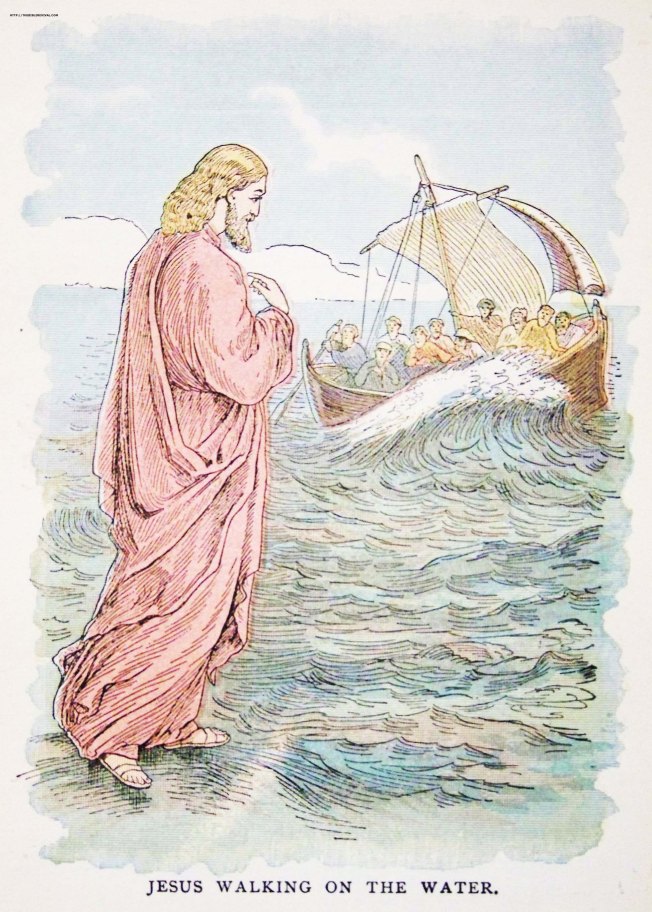
Mark 6-50 jesuswalkingonthewater

Mark 6:46-52 (6:50) – August 12, 2018 – from Dave Ivaska’s book Be Not Afraid

“O God, thy sea is so great, and my boat is so small.” So says the Breton’s fisherman’s prayer on a small brass-inscribed plaque. The plaque was given to John F. Kennedy by Admiral Rickover, and President Kennedy kept this plaque on his desk in the Oval Office.

When I started to think about this Scripture passage from Mark, the narrative where Jesus walks on the Sea of Galilee by night, this plaque came to mind. I suspect the disciples did feel afraid on that small boat as they faced the choppy waves, strong currents, gusty winds, and other weather conditions. Similar to that Breton fisherman.

I have never been to Israel, but I have read that the weather around the Sea of Galilee is particularly changeable. There are hills and even small mountains surrounding a portion of the inland sea. Sometimes, the weather patterns can cause rough weather to flare up with next to no warning. According to the Gospel of Mark, chapter 6, the weather that night on the Sea of Galilee was windswept and the water was churning and choppy. The disciples were out on the water after dark. Some of them were fishermen, but not all. So, some of them were used to being out in an open boat in the middle of open water. Others of the disciples were not fisherman at all, and were probably extremely uncomfortable.

What was the general morale of the disciples? Jesus was notably absent—not with them in the boat. I suspect some of the disciples were fearful and anxious. Maybe even complaining about their sorry situation, out in the middle of the lake and with no Jesus. Just think about their desperate situation, and compare it to your own. From time to time, I am sure all of us have felt like we are adrift in choppy water, all alone, someplace like the Sea of Galilee. Heavy weather is on the horizon. Who can help us deal with our fear and uncertainty?

We need Jesus, that’s who. Just as much as the disciples did.

This scary situation on the Sea of Galilee did not just happen all by itself. This nighttime situation followed after a very busy day for Jesus. This was the day that Jesus miraculously fed several thousand people with a few loaves and fishes. When this all happened, they all were in a lonely place far away from any village or town, near the Sea of Galilee.

I want to be sure all of us understand. This feeding was not just a little miracle. Instead, Jesus did a huge miracle! Feeding well over five thousand people with just a boy’s sack lunch of a few little loaves and fishes? How astounding is that? The disciples were right there with Jesus, serving and distributing all the loaves and fish to all the crowds who attended Jesus’s after-lecture luncheon. Except, Jesus provided all of the food! Miraculously.

Listen again to the beginning of today’s Scripture reading from Mark, which follows the paragraph on the feeding miracle: “ 45 Immediately Jesus made his disciples get into the boat and go on ahead of him to Bethsaida, while he dismissed the crowd. 46 After leaving them, he went up on a mountainside to pray.”

At the end of a really busy day with a lot of public ministry, I can see why Jesus wanted to be all by Himself, not only to pray and rest and recoup, but also to spend some down time rejuvenating with His loving, caring Heavenly Parent. Wouldn’t you, if you were in a similar position? Resting and recouping after a long, challenging day of ministry, just about anyone would want to be reassured by the loving embrace of their Heavenly Parent. I know I would!

After Jesus withdraws to be with His Heavenly Father for some hours, it’s time for Him to rejoin the disciples. Let’s continue with the reading from Mark: “ 47 Later that night, the boat was in the middle of the lake, and he was alone on land. 48 He saw the disciples straining at the oars, because the wind was against them. Shortly before dawn he went out to them, walking on the lake.”  I would have loved to be with the disciples in that boat!

Just imagine all the exciting information we would hear about leadership and discipleship, serving and helping others, and getting closer to God!

Or, even more, I would love to have a film camera and crew on their boat that night! What a bunch of reaction shots! Shots showing fear, anger, uncertainty, anxiety—the whole range of emotions and reactions to the unexpected and miraculous appearance of Jesus, supernaturally walking on the Sea. Considering what huge miracle had just happened only a few hours ago, “what confidence did the disciples would have had to believe that Jesus would now help them in this terrifying situation?“ [1]

We’ve talked about this before, how the disciples sometimes had a problem believing what Jesus plainly said. Or, a problem seeing what Jesus had just clearly shown them. Or, a problem understanding an illustration or object lesson Jesus had just brought to them. This was one of those situations.

The disciples were a bit thick-headed. They just did not get the full ramifications of the huge miracle of the loaves and fishes. They just did not understand how Jesus—who was God’s son, fully God, and creator of the heavens and the earth—could possibly walk on water.

Jonah had this problem, too. He was a prophet of God, he heard the word of God regularly, but he just didn’t get the message clearly. It took getting swallowed by a fish in the middle of the ocean to get the cotton out of Jonah’s ears.

Listen to a part of Jonah’s prayer from the belly of the huge fish, from the 2nd chapter of Jonah: “In my distress I called to the Lord, and God answered me. From deep in the realm of the dead I called for help, and you listened to my cry. You hurled me into the depths, into the very heart of the seas, and the currents swirled about me; all your waves and breakers swept over me. But you, Lord my God, brought my life up from the pit. “When my life was ebbing away, I remembered you, Lord, and my prayer rose to you, to your holy temple.”

It took a miracle of a huge fish to get Jonah to see clearly. It takes a miracle of Jesus walking on the water, on top of the feeding-and-provision-of-food miracle, to get the disciples to see clearly. Yet, God is with them all, even through the darkness and the storm, even through being swallowed by the big fish or being buffeted by choppy seas.

“What does this story reveal about Christ’s involvement in our own trials? He is both aware of and concerned about our struggles and acts on our behalf. In addition to helping us in our plight, His deliverance reveals to us His supernatural power.” [2] another way of says it is that Jesus is God’s son. Fully God, and fully man. Of course, Jesus can walk on water! And, of course, Jesus can be with us, in and through and beyond our trials and problems. Having God incarnate as my—as our personal Friend and Savior is very reassuring, believe me.

Sometimes we do go through the storm, and even repeated storms. Sometimes we do have serious illness happen to us or to a loved one. Sometimes we travel through the valley of the shadow, and we need that reassurance that God is with us. Jesus can say to us just as much as He said to the disciples, “Take courage! It is I. Don’t be afraid.”

These are the words of Jesus. We can take them to heart. These reassuring words are for the disciples, and for us, too. Alleluia, amen.

[1] Ivaska, David, Be Not Afraid (Downers Grove, Illinois: InterVarsity Press, 2000), 101.

[2] https://intervarsity.org/bible-studies/mark-6c

Mark 6:45-56: Confounded by Christ | InterVarsity

@chaplaineliza

(Suggestion: visit me at my regular blog for 2018: matterofprayer: A Year of Everyday Prayers. #PursuePEACE – and my other blog,  A Year of Being Kind . Thanks!)

Unknown's avatar

His Followers—Including Us, Too

“His Followers—Including Us, Too”

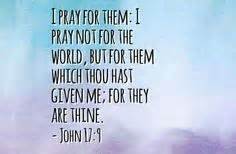
John 17-9 Jesus prays for us

John 17:6-19 (17:9) – May 13, 2018

Throughout the centuries since Jesus’s death and resurrection, believers have followed their Lord Jesus and prayed for others. I suspect we all can picture Jesus and His friends during that last week before His crucifixion. And, Jesus was a person of deep prayer. This profound image is quite precious to me, and I suspect for you, too.

In our Gospel reading today, Jesus prays for His followers. Not just any old prayer, but a significant prayer, at a profound time of Jesus’s life. The night before His crucifixion, when He must have had a thousand and one things on His mind, Jesus takes the time to think of and to pray for His followers; His friends and disciples.

Today is Mother’s Day. Today is a day to take the time to think of beloved mothers (and, those who have acted as mothers). Some more devout people even pray for their mothers. And grandmothers, and daughters and sisters. All those who act as mothers, too.

In many, many cases throughout this country—and beyond, around the world—many caring, loving and nurturing women have mothered those under their care. In cases of religious nurture, caring mothers, grandmothers, aunties, sisters—and others who have stood in the place of these maternal figures—have prayed for their friends, relatives and loved ones, too.

Whether nearby or far away, prayer makes that intimate connection, that bond between friends, relatives, and loved ones. It does not matter whether the pray-er and the ones prayed for are next door, in the next town, or separated by miles, mountains or oceans.

Jesus was making that connection, too, through His prayer.

As we have noted before in weeks past, the disciples were anxious, worried, even scared to death. And, Jesus knew that very well. Remember His words of comfort from just a short while before this? In John 14:27, where Jesus says “Peace I leave with you, My peace I give to you; not as the world gives do I give to you.”

Of course, Jesus knew how serious this all was! He knew He was going to be beaten, jeered at, crucified, and die. He knew it was all going to happen in less than twenty-four hours. Yet, Jesus still had the amazing love, nurture and caring for His friends and disciples that He would say such things as these. Jesus did not allow the horror and anguish of what was to come take away from the love, caring and connection He had with His friends.

In today’s passage from John 17, Jesus expresses His deepest yearning for His closest followers. But, there is much more. Commentator Janet Hunt says “[Jesus] speaks to them all together at length ‘one last time’ as he sits with his disciples at table that Thursday night. … For instance, we get a sense of Jesus’ profound connection to the one to Whom he prays. And we are told that those who followed Jesus had learned of the truth of this as well.” [1]

How often do we hear of a faithful, devout mother or grandmother or auntie or dear friend praying for her loved one, asking God to take care of this dear one, whether nearby or far away? And, even when things become depressingly sad, or that diagnosis turns into a hospice admit, or the divorce finally happens, God is still able to be there and be present with the one prayed for. And their family.

As we can see from today’s scripture reading, Jesus prayed for His closest followers and friends. I love the way Dr. David Lose puts it: Jesus “senses their anxiety, confusion, and fear, and so he prays for them. He knows they can bear no more, and so he prays for them. He knows he will soon leave them, and so he prays for them. And as he does, and whether or not they understand everything he says, he tells them that they do not have to do everything or even understand everything.” [2]

Jesus was a master at making connections, just as relatives do in a close family, just as dear friends make intimate connections with each other. Sure, this climactic point in the Passion Week, this night in which Jesus was betrayed, had all the disciples’ emotions and feelings at a breaking point. Sadness, anxiety, fear, anger, horror. And, we know Jesus was there with His friends in the middle of all of those tumultuous feelings.

What about those in countless congregations today, and those who did not go to a house of worship this weekend, who had (or are still having) difficulty with the relationship with their mom? What about those whose mothers are somehow unwilling or unable to care for their children? What about those who have given children up for adoption? Mother’s Day is certainly difficult for these hurting people.

What about the mothers who have had miscarriages, or stillbirths, or abortions? What about those mothers who have lost a young—or not-so-young child? What about those who have never been mothers—for a whole host of different reasons? Yet, these women often care for and nurture others, whether theirs by natural means, or through choice. And even more important, Jesus is certainly able to love, nurture and care for all of these loved caregivers, all of these called children of God.

As we look at John 17, we can be sure that Jesus used His masterful way of connecting to show love, care and nurture. Pastor Tim Yee had the following illustration: “Jedd Medefind and Erik Lokkesmoe’s book, The Revolutionary Communicator, stresses seeking connection as an important communication tool that Jesus modeled, as he engaged people… This story [the authors] share of a little boy visiting a grieving elderly widower illustrates the power of seeking connection: The mother noticed the little boy crossing into the neighbor’s yard and climbing up into the old man’s lap. He remained there for some time, sitting quietly. When the boy returned home, his mother met him with her hands on her hips. “I told you not to bother him!” she scolded. “What were you doing?” “I wasn’t doing anything,” the little fellow answered. “I was just helping him cry.” (p. 23) [3]

Yes, Jesus prayed for the disciples, and “not only on behalf of these, but also on behalf of those who will believe in me through their word…” That includes us! Just as a devout mother or grandma prays for her loved ones, just as Jesus seeks a intimate and loving connection with His friends and followers, so we can seek to have that deep connection with one another.

Dr. David Lose invites all of us to hear these words of Jesus addressed to each of us today. To imagine – really, to know – that Jesus was praying for us all those years ago and continues to care for us, support us, and love and connect with us today. Please take a moment to think about where we need to be more whole, to have more peace in our lives. And then, imagine that Jesus is actively, intimately praying for each of you. And, indeed, for all of us. [4]

Jesus is caring for us, you know. Jesus loves each of us that much.

Alleluia, amen.

[1] http://dancingwiththeword.com/last-words/  “Last Words,” Janet H Hunt, Dancing with the Word, 2018.

[2] http://www.workingpreacher.org/craft.aspx?post=2566  David Lose The Power of Being Prayed For

[3] Revolutionary Communicator: Seeking Connection

https://lifeforleaders.depree.org/revolutionary-communicator-seeking-connection/?utm_source=Life%20for%20Leaders&utm_campaign=6da0a06843-EMAIL_CAMPAIGN_2018_05_12&utm_medium=email&utm_term=0_daeb77a376-6da0a06843-85700765&mc_cid=6da0a06843&mc_eid=6effffadbb

[4] http://www.workingpreacher.org/craft.aspx?post=2566  David Lose The Power of Being Prayed For

@chaplaineliza

(Suggestion: visit me at my regular blog for 2018: matterofprayer: A Year of Everyday Prayers. #PursuePEACE – and my other blog,  A Year of Being Kind . Thanks!)

Unknown's avatar

Love as Jesus Loves

“Love as Jesus Loves”

John 15-12 love one another, words

John 15:9-17 (15:12) – May 6, 2018

Love, love, love. When you think of love, what comes to mind? Valentine’s Day hearts and heart-shaped boxes of candy? Bouquets of roses? What about popular love songs from musicals or the radio? Or, do you think about loving your family—your parents or children, or grandchildren? Loving your spouse, or your pets? Or, how about dear friends?

At first glance, this seems like something natural, common sense. Of course, I love my children. Of course, I love my husband. Of course—when they were alive, years ago—I loved my two dogs. Of course, I go out of my way for my loved ones. I bet we all do those things.

But, is that the kind of love Jesus is talking about here? Jesus gives His friends the command to love: what does that look like?

Some people say they love one another. They talk really big. You know the kind I mean. They might speak of loving all different kinds of people, and put on a great show. How much they talk the talk of love! Telling everyone how big their heart is. But, when it comes to doing anything related to love, and caring, serving, and helping others, where are these people? Do they walk the walk of love? Do they practice loving like Jesus loved?

When I was in kindergarten, my parents started me in piano lessons. As the youngest of six children, I followed all of my older brothers and sisters in having at least a few years of playing the piano. And, practice I did. As I practiced over the years, I became better and better at playing the piano. I had a teacher to show me how to play an instrument, and I practiced.

The same could be said for anything people want to become skilled at. Practice! Whether it’s playing baseball, football, hockey or tennis, when we practice an activity, we can’t help but become better at doing it. Whether it is sewing, dancing, painting or whatever else we are striving to get better at, practice doesn’t necessarily “make perfect,” but it does help us to improve. A teacher or coach helps us to become more comfortable and accustomed to doing whatever thing we are trying to do.

Let’s go back to the blowhard, the one who says they love everyone. Can you hear them bragging and boasting? Look at them! They are so tremendous at loving. In fact, no one loves half as well as these super-special lovers.

Question: is their talk of  “love” only self-serving and selfish? Or, do they walk the walk of love? Can we see the genuine effects of their loving, in their families, among their friends and acquaintances, and out in the community?

Let’s take a closer look at the Gospel reading for today, from John 15. Jesus starts His command with a few words of preparation: “10 If you keep my commands, you will remain in my love, just as I have kept my Father’s commands and remain in his love. 11 I have told you this so that my joy may be in you and that your joy may be complete.”

The big thing I get from this introduction to our Lord’s command? Jesus tells us to keep His commands. This ought to be a no-brainer. We all need to keep, or follow, Jesus’s commands. Piece of cake, right? Walk in the park! No problem, Jesus.

Well, not so much. Jesus must have known how much of a problem we all would have with this command. He said, “IF you keep my commands.” I am assuming we are not braggarts and blowhards like some people. No, we really mean to try to love others. So help us, God! But, it is not so easy. That thing called sin gets in the way, snarling and tangling us all up.

But, why does Jesus say this? He wants us to be filled with His joy. It says so, right here in this reading. We all have the possibility for the joy of Jesus of be in each one of us. Not only the joy of Jesus, but the complete joy of Jesus. Chock full to the brim! Filled with His joy!

I don’t know about you, but I think that being filled with the complete joy of Jesus sounds amazing. Beyond awesome.

However, I keep coming across this problem. I know very well that my heart is sinful. I have sinful thoughts, and sometimes I say sinful words, and do sinful deeds. Self-serving things, selfish, bragging, and boasting. I wonder whether you might do or say selfish things, too?

I suspect Jesus knew that this was the case, which was why He phrased His command in this way. But, wait! There’s more. The next thing out of Jesus’s mouth: “12 My command is this: Love each other as I have loved you. 13 Greater love has no one than this: to lay down one’s life for one’s friends.”

Now, wait a minute, Jesus! What do You mean? Sure, “love one another,” that I get. But, “love each other as I have loved you?” Didn’t Jesus sacrifice a lot? Didn’t Jesus love people with an unconditional love? Jesus finishes the command by not only telling us about unconditional love, but He shows us what it can mean.

I consider these words of loving command serious words, indeed. Show one another unconditional love, just like Jesus. Let me tell you how one commentator’s mother followed Jesus’s words of command to love as He loved.

“My mom started a backpack program 8 years ago with an elementary school down the road from my parents’ church that has morphed into a partnership. Among many other ways that they support the school’s students and teachers, congregation members pack food every week for more than 100 children who may not otherwise have anything to eat during the weekend.

This story was relayed by the mother of a child who receives a weekly backpack.

“This mom watched from her window as her child and his friend got off of the school bus one Friday afternoon. Her son took his food bag out of his backpack and started unpacking some food at the bus stop. This little one shared half of what he had with his friend. When his mom asked him about what she saw, he told her that his friend needed some extra food, too.

“Word got back to the school counselor. We sent extra food in this little one’s bag, until we could get the new child enrolled in the program. We added a note telling him how proud we were of him and that we would send extra food for him to share with his buddy until he could get his own bag of food on Fridays.” [1]

That weekly commitment – shopping, packing, delivering – is a way to put action to the words of love, a way to show others we care. We have the opportunity to stop being selfish. That makes possible other acts of self-giving and generosity. It’s a way to love with actions, the way that Jesus would love.

What self-sacrificing love! This kind of love is not self-centered. It does not brag or boast, it does not get all puffed up and just blather on about how loving they are. No, this kind of love is love with workboots on. Love that rolls up its sleeves and goes to work, for anyone. Loving one another, no matter what. Loving people the way Jesus would love them.

I ask periodically, “what would Jesus do?” Would Jesus roll up His sleeves, get in there and pack backpacks for kids who did not have enough to eat? I think so. What can we do for Jesus? How can we roll up our sleeves and show others that Jesus loves them?

We all have the opportunity to follow the commands of Jesus. Love one another. Go and do. Go and love, in Jesus’s name.

[1] http://www.ekklesiaproject.org/blog/2015/05/what-is-love/

“What Is Love?” Anna Macdonald Dobbs, Ekklesia Project, 2015.

@chaplaineliza

(Suggestion: visit me at my regular blog for 2018: matterofprayer: A Year of Everyday Prayers. #PursuePEACE – and my other blog,  A Year of Being Kind . Thanks!)

Unknown's avatar

For the Sheep

“For the Sheep”

John 10:11-18 (10:11) – April 22, 2018

Jesus Good Shepherd_BnF_Ethiopien_389_fol_1v

The Bible often talks about sheep. Sheep in a sheep fold. All we like sheep. The sheep and the shepherd. The nation Israel is like sheep. The followers of our Lord Jesus are like sheep. We can follow the repeated illustrations of sheep and a shepherd in many places in the Bible, in both the Hebrew Scriptures and the New Testament. Just like in today’s scripture readings.

The words of Jesus can be a bit puzzling to both children and adults. We as adults can figure out what Jesus is saying here in chapter 10 of the Gospel of John. We have more developed brains and we can figure out what Jesus means by the metaphor “I am the Good Shepherd.“ Jesus is like a Good Shepherd, and we are like sheep.

But, what makes a shepherd “good?”

Jesus gives us further information in His description about what a Good Shepherd is not. A good shepherd is not a hired hand, since a hired hand doesn’t own the sheep. And so, he does not truly care about the sheep. If the hired hand is watching the sheep, a wolf might come and attack and scatter the flock. A hired hand will probably run away and leave the flock unprotected. So, the hired hand is most definitely not a Good Shepherd.

I go back to my initial question: what makes a shepherd “good?” For a more complete answer to that question, we need to take a close look at Psalm 23, our psalm reading for today. Remember, we are still trying to figure out what makes a shepherd “good.”

Our description from King David lets us know more about what makes a shepherd “good.” As sheep, we might be unsure about where we will find grass to eat, especially in a semi-arid region like most of the country of Israel. Yet, our Good Shepherd knows where there are places with grass to eat; we as sheep will feel safe enough to lie down in green pastures.

What else makes a shepherd “good?” When flocks of sheep are wandering around the fields and foothills of many dry places in Israel, sometimes it is difficult finding places to get water. A quickly rushing stream is not a place where sheep like to drink, since they can get hurt or swept away by the swiftly moving water. Yet, the Good Shepherd can lead His sheep to pools of still water, where they can safely drink.

Even today, we can ask similar questions. What makes a Shepherd “Good?” Dangers and problems can crop up today, at any time, among Jesus’s sheep, too. Will I have enough to eat or drink? What about a quiet place to live? Will the place where I live be safe? Or, will there be wolves and other nasty creatures wandering in my general area?

One of the earliest known depictions of Jesus in early church art is found in the Roman catacombs, under the ancient city. One of my favorite commentators, Carolyn Brown, tells us that “The catacombs are narrow, twisting underground tunnels.  The walls are filled floor to ceiling with graves that have been dug out of them.  They are dark and spooky.” [1]

Carolyn Brown suggests that we imagine we are walking quietly through the catacombs with a small oil lamp to find Christian friends who are gathering to worship by a designated grave. Can you hear the clank or crunch of Roman soldiers’ armor or boots? Christianity was an illegal religion. Christians were often hiding or on the run from the authorities. Since this was the case, it is easy to imagine why someone painted on the catacomb ceiling a picture of Jesus as a strong young shepherd who would take care of them.

What does a Good Shepherd look like, to you?

Jesus expands on this illustration of the Good Shepherd. The people of His time lived mostly in villages or small towns. Even if they worked doing other things, I suspect almost all of them were familiar with sheep, lambs and shepherds. I bet they had some ideas about what made a “good shepherd,” and what a “bad shepherd” looked like, too.

Even though today we might not be very familiar with the job of a shepherd, we still know how safe we feel when someone truly cares for us and looks out for our best interests. We still understand when someone protective stands guard and watches out for enemies so we can feel secure. We still appreciate when someone loving goes out of his or her way to search for a lost sheep when we wander away or get hurt or are in distress.

Jesus wanted to get across the idea of how much He cared for His sheep—that’s all of us. Jesus not only compares us to sheep (a biblical illustration repeated several times in the Hebrew Scriptures), but He tells us just what a hired hand does with the sheep. Or rather, Jesus tells us that the hired hand just runs away. The sheep would then be deserted and alone, liable to be attacked and perhaps eaten by wild animals.

Except, our Lord Jesus will not run away. Instead, He will care for the sheep, feed and water them, and lead them in good places. Jesus will not allow them to stray, but instead will lovingly protect and guard the flock.

As commentator Lucy Lind Hogan says, “To be [Jesus’s] followers was to enter into his sheepfold. He came to be the one who cared for and fed them.  It was a dangerous job; protecting the sheep from wolves and bandits. As the good shepherd Jesus had not only to be willing to, he did, lay down his life for the sheep that God had given him.” [2]

What does our Good Shepherd look like? How do we know when we have found Him?

And, is it possible that Jesus loves us so much that He gave His life for us? That He laid down His life for the sheep God had given Him? Jesus goes further in this reading from John 10, even further than King David in Psalm 23. Jesus not only cares for the sheep, and loves them, but He even dies for them. Gives up His life for the sheep.

Similarly, we lay down our lives every time we set aside what we want to take care of the needs of others.  We all need to hear Jesus’ insistence that if He lays down his life He can take it up again.  Giving up what you want once does not mean you will never get it or that you will always be called on to give up what you want.  Adults have learned that, but it takes a while for children to learn it, too. [3]

I said earlier that some people, young children especially, have a problem understanding metaphors. When Jesus said “I am the Good Shepherd,” that can be one of those hard sayings.

When Dr. Maria Montessori was working in a children’s hospital “she found that when she told sick children stories about the Good Shepherd using small wooden figures, they almost all grabbed the figure [of the Good Shepherd] and held onto it “for keeps.”  So the Good Shepherd made sense to them in some way.” [4] Jesus our Good Shepherd is able to come alongside of all of us, too. We are able to take hold of His hand, “for keeps.”

We know today Jesus loves us so much He gave His life for us. How much did Jesus love us? He loves us this much. [spreads arms wide]

Alleluia, amen.

[1] http://worshipingwithchildren.blogspot.com/2015/03/year-b-fourth-sunday-of-easter-april-26.html

Worshiping with Children, Easter 4, Including children in the congregation’s worship, using the Revised Common Lectionary, Carolyn C. Brown, 2015.

[2] http://www.workingpreacher.org/preaching.aspx?commentary_id=1239

Commentary, John 10:11-18, Lucy Lind Hogan, Preaching This Week, WorkingPreacher.org, 2012.

[3] http://worshipingwithchildren.blogspot.com/2015/03/year-b-fourth-sunday-of-easter-april-26.html

Worshiping with Children, Easter 4, Including children in the congregation’s worship, using the Revised Common Lectionary, Carolyn C. Brown, 2015.

[4] Ibid.

@chaplaineliza

(Suggestion: visit me at my regular blog for 2018: matterofprayer: A Year of Everyday Prayers. #PursuePEACE – and my other blog,  A Year of Being Kind . Thanks!)


Unknown's avatar

Remember Jesus

“Remember Jesus”

communion line drawing

1 Corinthians 11:23-27 – March 30, 2018

One Sunday in another church, one of the bible reading was from the second chapter of Ruth. In the middle of the reading were the words, “The Lord be with you” (Ruth 2:4). The congregation, trained as they were in liturgical language, immediately interrupted the reading with the unison, “And also with you.” The congregation had only ever heard the words, “The Lord be with you,” as a liturgical call that demanded a response, which they provided. [1]

This leads me to ask, how often can “church” get in the way of worship? Here we are at Good Friday, one of the most holy and most devastating days of the church year. And, we can hide in our “churchiness.” Have you pulled the bedcovers of church tradition and church practice over your head, and hidden away from the sadness, shock and devastation of Good Friday?

The words of our New Testament reading for this evening include the words of institution for the Communion service. These are the words I will say later in this service as we remember our Lord at dinner with His friends. The apostle Paul “had learned these words from Christians before him (who had received them ultimately from the Lord) and was in turn passing them on to the Corinthian believers.” [2] These words which our Lord Jesus spoke at that Passover seder were already well known in the Christian community, just a few years afterwards.

Amazing, how significant and meaningful certain meals can be. I suspect you all can remember a particular meal you shared with someone. Was it grandparents? Children? Good friends? We remember meals, and deep conversations, and meaningful interactions. We remember the weather, the situation, where we were. All of this we remember.

All bound up in our Communion service is the recollection of where Communion came from. Whether we call it Holy Communion, or the Eucharist, or the Lord’s Supper, we remember this night when it all started. We remember what our Lord Jesus said and did; we remember what happened after that dinner, on that night two thousand years ago.  

A problem showed up by the time Jesus’s followers were familiar with this remembrance meal,. Paul highlighted this problem in his letter to the believers in Corinth. People of higher or lower social status commonly received different amounts and better or worse qualities of food and drink at their church potlucks in Corinth. That was just the way it was: widespread, almost universal social custom and it could not be changed.

Paul wanted the Corinthian believers—and us, too—to know that “the Lord’s Supper was intended to demonstrate the unity of the church in the mutual dependence on the grace of God shown in the death and resurrection of Jesus.” [3]

Do we hear? Do we understand? Jesus wanted us to know that God’s grace is poured out on all of us, whether we live on the right side or the wrong side of the tracks, whether we are born into wealth or into poverty. No matter our country of origin, or place of citizenship, we all have citizenship in heaven if we believe in the death and resurrection of Jesus.

Remember, Jesus set aside all pretensions and false importance. He did not puff Himself up, or claim undue privilege. As the Gospel of John tells us, our Lord Jesus took the place of a servant and washed His disciples’ feet when they were arguing among themselves, when each considered himself too important to wash the others’ feet. Can our “churchiness” get in the way of our worship? Our reverence? Our remembering?

Rev. Janet Hunt reflects on special times in her family, from her cousin, She remembers, ““I don’t really want a Shamrock Shake. I just want the feeling I had: 7 years old and my mom bought me one after the parade.”

“My cousin Greg posted this on Facebook a few weeks back.  His status update touched me so that first I found myself laughing and then tearing up remembering his mother, my Aunt Jane.  We exchanged a few private messages after that where he recalled with me that this was common practice for his mom, one passed on, evidently, by our grandmother — that of special treats communicating something about love.  That shamrock shake, in fact, was his mother’s way of saying, “I love you and you’re special to me.”

“Meals and memory do get all tied up together, don’t they?” [4]

Whether it’s a memory of our own meals, or a remembering of a meal shared in the Bible—like the meal of Abraham and his three heavenly Guests by the oaks of Mamre, or our Lord Jesus sharing loaves and fishes with a huge crowd, or the great welcome party when the Prodigal came home—we remember certain meals. We share together this special meal, this sharing of bread and passing the cup. We remember deep emotion and feelings, and sometimes we are struck to the heart.

We remember that Our Lord Jesus wanted us to know His message: “I love you, and you’re special to me.” As often as we eat this bread and share this cup, we remember. On this very special night, we remember. Amen.

[1] http://www.workingpreacher.org/preaching.aspx?commentary_id=279  Commentary, 1 Corinthians 11:23-26, Dwight Peterson, Preaching This Week, WorkingPreacher.org, 2009.

[2] Ibid.

[3] Ibid.

[4] http://words.dancingwiththeword.com/2012/03/on-meals-and-memories-some-thoughts-for.html

“On Meals and Memories,” Janet H. Hunt, Dancing with the Word, 2012.

Unknown's avatar

Transfigured? Frightened!

“Transfigured? Frightened!”

Mark 9:6 (9:6-7) – February 11, 2018

Jesus Transfiguration Georgian relief Luke 9

Transformations can be quite a surprise. For example, when a run-down house gets a top-to-bottom rehab job over weeks or months, the house can be really transformed. Or, when someone is diligent over time with diet and exercise, and loses a lot of weight, they can be really transformed, as well. People can be surprised and impressed when they see the stunning changes that happen, gradually. These kinds of transformative changes can take a while.

The type of stunning change that happened in our Gospel reading today did not take weeks or months. Instead, our Gospel writer Mark talks about the transformation happening suddenly. Or, to use one of Mark’s favorite words: immediately.

We need to set the scene. Just previous to this reading, in Mark chapter 8 Jesus asks His disciples who others say that He is, followed by who the disciples think He is. Peter makes the great statement “You are the Messiah.” It is then that Jesus predicts His death. He starts to tell His disciples that He will have to suffer, be rejected and die, and then rise after three days. All of which must have been difficult to understand for the disciples.

I can relate to the followers of Jesus. Jesus was a charismatic leader, and many people listened to Him, and even followed Him. However, some of the things Jesus said were clear out of their experience. Even with all of the biblical revelation, evidence and commentary that we have nowadays, some of the statements of Jesus are still a challenge for us to understand, today. I can relate to the disciples’ confusion and puzzlement!  

A few days after the confession of Peter and all this big stuff happening, Jesus decides to go for a day trip, up on the top of a mountain. He asks only three of His disciples to come with him: Peter, James and John. After they reach the mountaintop, Jesus suddenly is changed. Transformed. Or, as the Gospels tell us, Jesus is transfigured. This is a state of God’s heavenly glory, suddenly appearing all around Jesus, making His clothing whiter than anyone has ever seen. If that is not enough, the glorified Jesus is seen talking with Moses and Elijah.

Can you see the picture? Imagine a huge, bright spotlight shining on Jesus, Moses and Elijah. Plus, there are more small spotlights all around, and the background surrounding them is all backlit. Except—the people of Jesus’s time have never even heard of electricity. All of this super-white light and super-white clothing is supernatural. Of heavenly origin.

I am reminded of the heavenly glory that surrounded Moses on top of Mount Sinai. Moses was no stranger to heavenly whiteness and brightness. He was in the presence of the Lord God Almighty for many days. And, Elijah—going up to heaven in a fiery chariot pulled by fiery horses? That must have been a heavenly experience of light and glory, too. Much less being in heaven, in God’s presence for centuries at that point.

Moses and Elijah were the premier representatives of the Jewish people, of the Jewish law code and the voice of the prophets. Revered by millions of Jews since their time. And, on top of that, they were in the presence of the suddenly-glorified Lord Jesus Christ. Is it any wonder that mere humans Peter, James and John were all shaking in their shoes?

I discovered a fictionalized conversation between Jesus, Moses and Elijah, from that mountaintop that Mark tells us about. This conversation comes from Pastor Joyce, written in 2003, from a commentary website I visit on occasion. Listen to this conversation:

Elijah: Look at these stubborn and fearful people. How do you get these children to honor God?

“Moses: And how do you teach them to love each other? God knows I tried. I brought God’s law down from the mountain top. It is very clear. The simple commandments tell them how to love and honor God and how to live together in mutual love and respect.

But right after I told them how to live, they began complaining about God and began to worship false idols. The law told them not to betray or disrespect others. Yet, the powerful continued to grasp for more wealth and power. Foolish people they thought that would give them security. But for these things they have to oppress the weak. Then the fighting starts. It can lead to killing.

“Elijah: Well, I warned them. I told King Ahab and the people not to worship false idols. I challenged 450 prophets of Baal and they died on the mountain top. But today, people still worship the idols they create: power, material possessions, and the comfort they bring. But they do not receive satisfaction from them. NO! How do we teach people to find the real thing — joy in relationships with God and with each other?

“Jesus: God sent you, Moses, to give the law.  God sent you, Elijah, and other prophets to warn the people of how they are harming themselves. Now God has sent ME… I will live among these rebellious people for a while. I will love them and I will die for them. These men you see before you, and those who follow them, will carry on my work of reconciliation to God and humankind.

“Moses: These men? Look, they are dumbstruck. They are frail. They are confused.

“Elijah: Good joke, Jesus. Now… tell us your real plan.

“Jesus: I have no other plan.

“Elijah: But how will they find the wisdom and the strength?

“Jesus: Ahhh… I will be with them.” [1]

Did everyone hear? Jesus promised to be with the disciples, a number of times. Not only with the disciples, but with all of His friends and followers.

It’s true that Peter—good, old foot-in-mouth Peter—made some sort of confused and excited offer to build three little booths or mini-altars there, on top of the mountain. Yes, with our 20/20 retrospect, we can laugh at Peter’s fumbling and falling all over himself. But, wouldn’t we be in the same boat? What if there were a heavenly visitation right here, right now? Boom! Cue the bright lights! The glorified Jesus, here in our midst, here at St. Luke’s Church!

The thing is, Jesus could have stayed there, on that mountaintop, with Peter, James and John. Relatively safe, and the mountaintop could have become a pilgrimage site, renowned throughout the world. But, no. Jesus knew He had to walk the way of the Cross. He knew we, His followers and friends, had to come down from that mountaintop, too.

The disciples did not just slink away and hide. No, they went out after the Resurrection and Ascension and after Pentecost, and they turned the world upside down with the Good News of the risen Lord Jesus. It was not all sweetness and light for the disciples, or for the other followers of Jesus. No, many of them had a very difficult time. Yet, Jesus was with them.

Today, we don’t permanently live on the mountaintop, either. Yes, we often walk through the dark valleys. Yes, there is sorrow and pain in our lives. As David Lose says, the nitty-gritty details of misunderstanding, squabbling, disbelieving disciples. Religious and political quarrels of the day. Jealousies and rivalries both petty and gigantic. Into the poverty and pain that are part and parcel of all of our lives. [2] Yet—Jesus is right by our sides, too. Yes, in the good times, and yes, in the not-so-good, even sorrowful times, too.

Do you hear? Jesus will be with us, in good times and bad. We can take comfort in that. We can celebrate. Praise God. We are not left alone and friendless. What a friend we have in Jesus, indeed. Amen, alleluia.

[1] http://desperatepreacher.com//bodyii.htm

[2] http://www.workingpreacher.org/craft.aspx?post=1563

“He Came Down,” David Lose, Dear Working Preacher, 2012.

@chaplaineliza

(Suggestion: visit me at my regular blog for 2018: matterofprayer: A Year of Everyday Prayers. #PursuePEACE – and my other blog,  A Year of Being Kind . Thanks!)

Unknown's avatar

We See Your Salvation

“We See Your Salvation”

Luke 2-30 Simeon words

Luke 2:22-40 (2:30) – December 31, 2017

Many of us had a marvelous celebration last week for the Christmas holidays. Gatherings with extended family and friends, special parties and programs, holiday concerts and pageants, often ending with the caroling around the fireplace. And the stockings hung with care, and mounds of gaily wrapped presents around the Christmas tree.

But, too soon after the grand holiday, the main event, and the wonderful days of celebrations, everything is ended. The crumpled wrapping paper is in the trash, the many leftovers packed in the refrigerator. The unexpected visitors have gone home, and we have returned back to the plain old mundane, ordinary routine. What happens now? What next?

Mary and Joseph might have been wondering a similar thing. After the marvelous birth announcement given to the shepherds by the chorus of the heavenly hosts, and after the impromptu visit by the shepherds and others to the newborn Baby in Bethlehem, what happens now? What next? Great question! What does happen?

Reading from the second chapter of Luke: “22 When the time came for the purification rites required by the Law of Moses, Joseph and Mary took the child to Jerusalem to present him to the Lord 23 (as it is written in the Law of the Lord, “Every firstborn male is to be consecrated to the Lord”), 24 and to offer a sacrifice in keeping with what is said in the Law of the Lord: “a pair of doves or two young pigeons.”

We are told that Mary recuperates and takes the time prescribed for mothers of a first-born son from Leviticus chapter 12. Then, she and Joseph bring Jesus up to the Temple for the Child’s dedication. The Mosaic Law Code is very specific about what needs to be done for a first-born son: forty days after the birth, the parents of the newborn son take their Child to present Him before the Lord.

Now that the grand celebration of the birth is over, Mary and Joseph get down to the ordinary, everyday matter of living. The main way they do that is to follow the laws and rules prescribed for them in the Mosaic Law Code. The laws and rituals of the Jewish people were ancestral traditions. It’s pointed out that these “are a reminder to [the parents] that Jesus is born in the context of the covenant established between God and the people Israel.” [1]

The Jewish people were supposed to be sensitive to the Holy God, and this rite of purification in the Temple is a reminder of that relationship to God. “One way a woman encounters the holy is through the miracle of giving birth. It is a holiness which belongs to and describes the natural rhythm of life.” [2]

Our Gospel writer Luke breaks in right here with a new figure in his narrative. A cameo appearance by a guest star, if you think of things in terms of television or movies, in the birth narrative of Luke chapter 2. We meet the older man Simeon, and we find out about his backstory.

25 Now there was a man in Jerusalem called Simeon, who was righteous and devout. He was waiting for the consolation of Israel, and the Holy Spirit was on him. 26 It had been revealed to him by the Holy Spirit that he would not die before he had seen the Lord’s Messiah. 27 Moved by the Spirit, he went into the temple courts. When the parents brought in the child Jesus to do for Him what the custom of the Law required, 28 Simeon took Him in his arms and praised God.”

It is similar to what we covered in the weeks of Advent this year. In the midweek bible study during December, we studied the genealogy of Jesus from Matthew chapter 1. Pretty dry stuff, all of those names, and all of those “begats.” So-and-so the son of the other guy, the grandson of such-and-such. Genealogies were extremely important to the Jewish people, because keeping an orderly and exact account of who was related to whom helped cement the lines of ancestry and inheritance.

Except—the genealogy of Jesus had some surprises. Four women were mentioned in Matthew’s account. We studied the backstory of each of those four women, and found out exactly why each one was included in the genealogy of Jesus. In Luke’s birth narrative, he tells us some backstory, so we can find out exactly what the godly man Simeon is doing here.

Luke tells us that Simeon is called “just and devout,” and was waiting for the dawning of the kingdom of God – “the consolation of Israel”. The Holy Spirit had revealed to him that he would not die until he saw the Messiah. He now sees the fulfillment of this promise. In the power of the Spirit, he sings a song of praise and utters a prophecy concerning Jesus. [3]

What a marvelous expression of faith and trust in God comes from Simeon. He sings to God: “29 “Sovereign Lord, as You have promised, You may now dismiss Your servant in peace.
30 For my eyes have seen Your salvation, 31 which You have prepared in the sight of all nations:
32 a light for revelation to the Gentiles, and the glory of Your people Israel.” 33 The child’s father and mother marveled at what was said about Him.”

Sizeable words spoken about someone so small. Here we have the baby Jesus, and His mother and adoptive father did marvel at such weighty words!

However, Simeon is not finished yet. He prophecies after this wonderful expression of song. “34 Then Simeon blessed them and said to Mary, His mother: “This child is destined to cause the falling and rising of many in Israel, and to be a sign that will be spoken against, 35 so that the thoughts of many hearts will be revealed. And a sword will pierce your own soul too.”

Serious, solemn words, indeed. Simeon has waited for his whole life for this very moment. After years and decades of expectation and longing, the Messiah has finally arrived. What is more, Simeon spontaneously blesses Mary and Joseph, too, along with Jesus.

Simeon was right there, at the beginning, with Jesus as a baby. He gave witness that Jesus was as foretold, by many prophets throughout the Hebrew Scriptures. Jesus had the greatest future, here at the beginning of the Greatest Story Ever Told. “We are left in anticipation to watch as the Child grows strong, filled with wisdom and blessed with the favor of God.” [4]

Where are each of us in our understanding of Emmanuel, God being with us? Is this narrative from Luke just a fairy story, suitable only to be shared with children every December at the holidays? Or, is it more than that? Have we heard the Good News from the angels and are waiting for more assurance, more evidence that the Messiah has come to earth?

The faithful servant of God, Simeon, was waiting at the Temple for years.  He was waiting and hoping for the Messiah, the chosen One of Israel. When we come to church today, do we expect to have an encounter with the Messiah? We fall on our knees with those who came to worship. Jesus has his arms open wide to welcome all who would come to Him. Come to Jesus, today. Amen.

[1] http://www.workingpreacher.org/preaching.aspx?commentary_id=207

Commentary, Luke 2:22-40, Holly Hearon, Preaching This Week, WorkingPreacher.org, 2008. 

[2] Ibid.

[3] http://www.lectionarystudies.com/studyg/christmas1bg.html

“Jesus Grew in Wisdom and Stature,” Rev. Bryan Findlayson, Lectionary Bible Studies and Sermons, Pumpkin Cottage Ministry Resources.  

[4] http://www.workingpreacher.org/preaching.aspx?commentary_id=207

Commentary, Luke 2:22-40, Holly Hearon, Preaching This Week, WorkingPreacher.org, 2008

Unknown's avatar

Keep Awake!

“Keep Awake!”

mark 13-26-artistic-christian-clouds-

Mark 13:24-27 (13:27) – December 3, 2017

How difficult it is to keep watch! Imagine how hard it is when you know the estimated time of arrival. There is even an acronym for this—ETA. We know about the estimated time of arrival of planes and trains and buses. People give relatives and friends their estimated time of arrival if they are traveling a long way. It is the polite thing to do, even courteous and helpful thing to do. Just so that the people on the receiving end know when visitors or relatives will be arriving.

We know when the Baby in Bethlehem arrived. Two thousand years ago, that’s when! God the Son, the baby Jesus, God made flesh, was born into this world as a helpless Baby a little more than two thousand years ago, as foretold in Bethlehem. He was born into an oppressed people group, in a land that was under occupation, under a conquering power; born to a young woman and her fiancé with very little money, power, or other prestige.

This is the first Sunday of Advent, the weeks the Church sets aside to wait quietly, expectantly, for the Baby in Bethlehem to be born. Yet, these first two weeks of Advent also give us a look at the future: predictions and promises for the second coming of Jesus Christ.

Here in our Gospel reading from Mark this morning, Jesus is asked about the timing of the second coming. When will this mysterious time come about?

Jesus—as is so often the case—does not give a direct answer. Instead, listen to His first example: “24 “In the days after that time of trouble the sun will grow dark, the moon will no longer shine, 25 the stars will fall from heaven, and the powers in space will be driven from their courses. 28 “Let the fig tree teach you a lesson. When its branches become green and tender and it starts putting out leaves, you know that summer is near. 29 In the same way, when you see these things happening, you will know that the time is near, ready to begin.”

Sure, the people of Jesus’s time were wondering when Messiah would return. When, Jesus? Please, just tell us when! How similar is that to our own time. Many, many people are dissecting both the Hebrew Scriptures and the New Testament writings. They, too, ask when Messiah is going to return the second time? When, Jesus? Please, just tell us when!

Next, Jesus gives His listeners a parable about a householder and his servants. As the Rabbi Jesus says in our Gospel reading today, “34 It will be like a man who goes away from home on a trip and leaves his servants in charge, after giving to each one his own work to do and after telling the doorkeeper to keep watch.”

We know that Jesus often tells His listeners stories about everyday things, with a twist. Somehow, Jesus uses these common, ordinary things to communicate powerful truths. In this parable, we see a bunch of servants working for a boss with a large household, a large piece of property. The boss goes away on a long journey, and his employees do not know when he will be back.

What would people at your workplace do in a situation like that, with the big boss gone for a really long time? Would your fellow employees continue working hard? Or, would some of them start fooling around? Maybe stop working altogether? How might you react, if this happened to you, or to someone you knew? Again, what would you do?

 Jesus totally skips over that part about exactly when the Messiah is coming back.

Instead, Jesus commands His listeners to “Keep watch!” Let’s look more closely at this story. We are not only supposed to wait expectantly, but we need to be alert. Not just to stand around and twiddle our thumbs like a bunch of do-nothings and know-nothings. Each servant—or employee has their own job to do. Each servant—or employee has an assigned task. The door-keeper has just about the most important job of all of them, which is to stay alert and to keep watch, no matter what. Keep an eye on things, and when the big boss unexpectedly returns, we are warned not to cut back or sleep or lie down on the job.

Let us consider today, in modern-day United States. When we think of Advent, what comes to our minds? Advent wreaths? Advent get-togethers after work or on the weekends? Maybe school holiday productions incorporating Advent?

Dr. David Lose, one of my favorite commentators, said “Each and all of it can be wonderful, and each and all of it can become rather overwhelming. So perhaps we might invite folks to make a short list – whether in their heads or on paper – of a few of the things that will occupy their Advent.[1]

What are you going to do for Advent? How are you going to get ready? How are you going to watch and keep awake?

I am not sure about anyone else here, but my December activities are threatening to become overwhelming. Can anyone else relate? Does anyone else have any idea about vulnerability and connecting with others?

The Church around the world is told to keep watch diligently. And then, “to think about how in each of those events and activities they might be more attentive to the vulnerability and need of those around them and more honest and open about their own need that they might receive the care of others.” [2]

Now, wait a minute, Jesus! I thought Advent was a time for us to wait and watch? A time for Advent calendars and Advent wreaths? I wanted to sit quietly in my corner and watch from the comfort of my easy chair. I did not want to step out of my comfort zone!

Guess what? The landlord—the big boss—has given all of us our jobs to do. In last week’s Gospel reading from Matthew, we are to welcome the stranger, feed the hungry, clothe the poor, and visit the people in hospitals and in prison. Yes, this may be a lot for us to take in. However, the commands of Jesus are pretty important! Don’t you think we ought to sit up and pay attention to His commands?

Jesus and His commands can lead us in new directions. Pastor Janet Hunt makes the following suggestion: “knowing that it will all one day end can also set us free, can’t it?

  • Free to speak words of truth and hope and love.
  • Free to reach out in generosity and kindness.
  • Free to forgive what before seemed unforgivable.
  • Free to let go of what we thought we would always need.” [3]

What an exciting opportunity to truly be what Jesus—the householder—the big boss—is calling each of us to be. “How do we “keep awake” in this kingdom time of already-not-yet? Simply by being faithful to the tasks God has given us to do – the tasks of kindness, mercy, justice, faithfulness, and love.” [4] When we are faithful in these things, we will become more and more like our Lord and Savior Jesus Christ.

Maranatha! Come, Lord Jesus!


[1] http://www.davidlose.net/2014/11/advent-1-b/  “Preaching a Participatory Advent,” David Lose, …in the meantime, 2014.

[2] Ibid.

[3] http://dancingwiththeword.com/raking-in-the-dark/  “Raking in the Dark,” Janet H. Hunt, Dancing with the Word, 2017.

[4] From An Advent Journey: Devotional Guide, Week One. This curriculum comes from Illustrated Children’s Ministry.

(A heartfelt thank you to An Advent Journey: Devotional Guide. Some of these sermon ideas and thoughts came directly from this guide.  I appreciate this intergenerational curriculum, which is the basis for my Advent sermon series. This curriculum comes from Illustrated Children’s Ministry. Thanks so much for such great ideas!)

@chaplaineliza

(Suggestion: visit me at my regular blog for 2017: matterofprayer: A Year of Everyday Prayers. #PursuePEACE – and my other blog,  A Year of Being Kind . Thanks!)