Unknown's avatar

Prescription for Prayer

“Prescription for Prayer”
1 Timothy 2:1-8 (2:1-3) – September 21, 2025

It’s good to be in the habit of doing certain things. Say, going to the gym. Exercise is a beneficial thing, and if I go to the gym on a regular basis, like three times a week, I will be healthier for it. Same for other things—like practicing the piano, practicing swimming or square dancing—it’s beneficial to get into the habit of regular repetition, week in, and week out.   

Worship and prayer are regular, comfortable things, things many churches do the same way, week in and week out. Here in our scripture reading today, Paul gives his younger friend Timothy some words of wisdom. Recommendations, if you will, of some things Timothy’s church can do in worship and prayer that will be beneficial to them all.

Reading again from 1 Timothy 2, “I urge, then, first of all, that petitions, prayers, intercession and thanksgiving be made for all people— for kings and all those in authority, that we may live peaceful and quiet lives in all godliness and holiness. This is good, and pleases God our Savior.”

I’ll stop right there. Not because the rest of the reading is unimportant. No! But, because Paul has so many ideas that are bursting out of him one on top of the other, I am afraid we might be overloaded if I read them all.

I am on social media, daily. I feature some things regularly, including my Daily Prayer posts. I have posted Daily Prayers on my public Facebook page for five years now. I see it as something I can contribute for my Facebook friends, and for friends of friends, too. I post a prayer each evening that I find meaningful, and I hope they can be helpful to others, too.

Other people have regular habits or practices of prayer and meditation. That is what the Apostle Paul talks about here! I am in a doctoral program for Spiritual Direction, which some people refer to as spiritual companionship. That’s coming alongside of another person, or a small group of people, being a long-term companion. Walking with them, sitting with them through their joys and through their difficulties and sorrows. I have a heart for listening to people’s stories, challenges, and difficulties in their lives. Plus, I pray with people through these things.

You recognize that is what we do in church, don’t you? In our Intercessory Prayers each week, we – as a congregation – come alongside of individuals and families and pray with them through their joys, challenges, and various difficulties. That is exactly what Paul tells Timothy to do here! This reading is a prescription for intercessory prayer in a worship service!

I know that believers and followers of Christ, Paul and Timothy were very much in the minority in their communities. The majority opinion and the overwhelming cultural context for both of them was one of a worldly avarice, where people were concerned about “me, first!” and “where’s mine?” This call to intercessory prayer was very counter-cultural!

Let’s look again at what Paul recommends. Paul begins the chapter by encouraging Timothy to offer prayers for all members of the human family during church services.He wants petitions, prayers, intercession and thanksgiving – all integral parts of praying – to be made for all people. That is not just for a few, or a family, or “only for our little, insular group of people.” No! Paul is recommending to Timothy that we pray for ALL people.

He mentions prayer in the terms of: petitions (humble, general requests to God), intercessions (requests, pleading for those in need), supplications (requests for ourselves, especially when faced with a crisis) and thanksgivings (expressing gratitude for blessings we receive). [1] All people need to be held up to God in prayer.

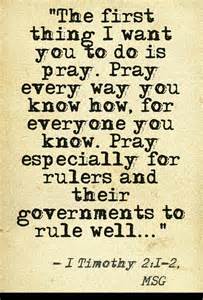
That means for everyone. Period. Even for mean people. Even for people we disagree with. Even for people who don’t look like us. As the modern translation from “The Message” of this reading begins, “Pray every way you know how for everyone you can.” Period.

Especially in the past few years in this country, division, discord, and dissension of large portions of the American population has only speeded up in the last few years, fueled by increasingly divisive rhetoric, shrill podcasts, and fraught news reports, as well as the regional and national conversations.

As Rev. Sharon Blezzard said, “Good news doesn’t usually sell publications or improve ratings. It takes bombast, divisiveness, and catty, snarky repartee to make headlines, not prayerful peacemakers standing in the breach attempting to reknit brokenness in quiet relationship building and listening. But we are called to a different way of being, to a stewardship of self and other that places value on people, on relationships, and on the building up of community.[2]

God has not called us to be snarky or mean, nasty or divisive. God does not want big bullies on God’s team. I have never heard of God approving of or cheering on hateful, spiteful Christians, either.

Instead, when we “Pray every way you know how for everyone you can.,” Paul reminds Timothy that “This is good, and pleases God our Savior, who wants all people to be saved and to come to a knowledge of the truth.”

Remember what the situation was for Paul and Timothy, and for all other believers in that first-century time and place. It is the same for us, today!  “We are called to be counter-cultural witnesses to God’s love, mercy, and saving grace. We cannot be a witness if our hearts are filled with hate. We cannot love our neighbors if we aren’t willing to get to know them, and certainly not if we aren’t willing to stop working violence against one another.” [3]

      Paul tells us we are to pray for all people; and we are to follow Paul’s lead in supplications, prayers, intercessions and thanksgivings. The intention of such prayers is so that we Christians in society will be able to live tranquil and quiet lives. This isn’t me saying it. It’s the apostle Paul! 

Regardless of whether there is peace in our church, peace in our neighborhood, or peace in our country, prayer is always a good idea. Having a close relationship with our Lord and Savior Jesus Christ is the reason we are here. Praise God! Thank You, Jesus. Alleluia, amen.

@chaplaineliza

(Suggestion: visit me at my other blogs: matterofprayer: A Year of Everyday Prayers. #PursuePEACE – and  A Year of Being Kind . Thanks!


[1] http://www.lectionarystudies.com/sunday25ce.html Rev. Bryan Findlayson, Lectionary Bible Studies and Sermons, Pumpkin Cottage Ministry Resources.

[2] https://www.stewardshipoflife.org/2016/09/calling-all-prayerful-peacemakers/

[3] Ibid.

Unknown's avatar

How to Worship?

“How to Worship?”

1 Tim 2-2 pray, message

1 Timothy 2:1-4 – September 22, 2019

Have you ever been to a different kind of worship service? A service where people prayed differently, sang different kinds of songs, played different instruments, and even spoke in different languages? I have attended a number of different kinds. Worship of God can be diverse and different, depending on where we live, what each of us grows up with, and what kind of faith tradition we come from.

In today’s reading from the first letter to Timothy, we hear about instructions for prayer and worship. This letter to Timothy is one of the pastoral letters from the New Testament. In other words, this letter contains instructions for a church leader on how to be a better pastor and leader of a congregation. Including—recommendations for corporate worship and prayer.

This is not like the instructions from the Sermon on the Mount in Matthew or the Sermon on the Plain from Luke, where our Lord Jesus gives specific instructions for personal, private prayer. No, this letter is from several decades later, when there were established groups of believers, and they needed structure and direction on corporate worship and prayer.

From 1 Timothy 2: “I urge, then, first of all, that petitions, prayers, intercession and thanksgiving be made for all people—” This sounds wonderful! I have experienced this aspect of prayer in practically every worship service I have ever attended. I suspect you have, too.

Whether prayer happens from the pulpit or lectern, or from the floor of the church, whether the prayer is offered by members of the congregation from the pews or seated in a circle, extemporaneously or written out, Paul’s recommendation of unified prayer is definitely one that has gone on as long as believers in Christ have gathered together.

However, the prayers we offer are not just generic prayers. I want to remind everyone (and I am reminding myself, too!), that we are encouraged to “offer prayers for all members of the human family during church services; prayer in the terms of: petitions (general requests to God), Intercessions (requests for those in need), supplications (requests for ourselves), and thanksgivings.” [1]  The apostle Paul is quite specific here! All of these different kinds of prayer!

I wonder: are your prayers—are my prayers—as far-ranging and thorough as these? Are these recommendations something we all can get on board with? Something we all follow?

Let’s continue with this reading from chapter 2. Who should we pray for? “for kings and all those in authority, that we may live peaceful and quiet lives in all godliness and holiness.”

We are not talking about good-tempered rulers. No, the kings, rulers and those in authority in the later half of the first century were not nice guys. What happens when we have mean rulers and cruel leaders, those in authority who do such wicked things as throw people out of their homes, put them in jail, even force them into exile, or even death?

Let’s take a look at the Roman emperors Tiberias, Caligula and Nero. None of them were particularly “good or nice,” several showed signs of mental instability, and these men were at the pinnacle of power in the Roman Empire for over 25 years. Yet, the apostle Paul recommended that his fellow believers pray for them, for other rulers, and “for those in authority, that we may live peaceful and quiet lives in all godliness and holiness.”

This was an instruction Timothy received for his regular worship services! What was the apostle thinking of? The Rev. Bryan Findlayson suggests “Such prayer seeks to restrain the powers of evil and so encourage peace and security. When society is in a state of peace, believers can freely serve both God and mankind.” [2]

Again, what about rulers and those in authority who persecute Christians? What about governments that destroy churches, jail church leaders and ministers, and make it impossible for Christians to live and raise families? What about those governments? Do we still need to pray for those wicked people? We are to pray for peace, but what kind of peace?

I would say, yes, especially for those wicked people in government who persecute Christians. “Most often our prayers for peace concern our own personal well-being. When society is at peace, life can go well for us and we can build that extra barn. Yet, the peace Paul has in mind is a positive environment for the proclamation and hearing of the gospel.” [3]

September 21st is the International Day of Peace. The website specifically for this day states: “Established in 1981 by unanimous United Nations resolution, Peace Day provides a globally shared date for all humanity to commit to Peace above all differences and to contribute to building a Culture of Peace.” [4] What a wonderful thing to contribute to building: peace.

Moreover, as the apostle Paul reminds us, peace in the world involves a positive environment for proclaiming and hearing the Good News of our Lord Jesus Christ. Is our government corrupt? We need to pray for the members of a wicked and corrupt administration, then. What matters even more is that we are safe to proclaim the Good News of the Lord, and to provide for a way to let everyone know the Good News of salvation through His name.

Division and divisiveness is not conducive to spreading the Good News. This current-day division and animosity between people who call themselves believers must make God very sad. Christians of all communities and all ethnicities ought to have their wonderful belief in Christ to unite them. But, no. Sadly, believers all over the world allow politics to divide them.

The Rev. J. Vernon McGee had this to say: “We need to pray for our country, and we need to pray for those who have authority over us. If you are a Republican and a Democrat is in office, pray for him. If you are a Democrat and a Republican is in office, pray for him.” [5]

We have been thinking about the unity of believers from all parts of the world for several weeks now. In our bible study, we are studying the book of Philippians, and talking about how the apostle Paul and his friends preached the Good News to a diverse and different population in the regional capital of Macedonia, Philippi. Diverse and different individuals came together to worship the Lord Jesus Christ, and God made it possible for them all to join in worship.

What a wonderful example to lift up! Can we do the same, here, now? We here at St. Luke’s Church can strive for the same unity and friendship, despite differences in our families, the languages we spoke as children, or the towns where we were born. We can also come together in worship, despite differences in worship styles, or singing, or prayer.

I pray at the beginning of most services here for God to bless our time in worship, and especially to aid us in lifting our vices in words, prayer and song. This is truly what God calls us all to do. Moreover, God looks upon every voice raised in prayer, praise, or song as legitimate worship, no matter what, no matter where, no matter how. We are all encouraged to do the same. We have God’s word on it!

Alleluia, amen!

@chaplaineliza

(Suggestion: visit me at my regular blog for 2019: matterofprayer: A Year of Everyday Prayers. #PursuePEACE – and my other blog,  A Year of Being Kind . Thanks!


[1] http://www.lectionarystudies.com/sunday25ce.html    “Worship in the Church,” Rev. Bryan Findlayson, Lectionary Bible Studies and Sermons, Pumpkin Cottage Ministry Resources.

[2] Ibid.

[3] Ibid.

[4] https://internationaldayofpeace.org/

[5] McGee, J. Vernon, Thru the Bible: 1 Corinthians through Revelation, Vol 5, (Nashville TN: Thomas Nelson Publishing, 1983) 436.