Unknown's avatar

Peaceful and Quiet Lives

“Peaceful and Quiet Lives”
1-tim-2-2-pray-message

1 Timothy 2:1-8 – September 18, 2016

It’s good to be in the habit of doing certain things. Say, going to the gym. Exercise is a beneficial thing, and if I go to the gym on a regular basis, like three times a week, I will be healthier for it. Same for other things—like practicing the piano, or practicing football or baseball—it’s beneficial to get into the habit of regular repetition, week in, and week out.

Worship and prayer are regular, comfortable things, things many churches do the same way, week in and week out. Here in our scripture passage today, Paul gives his younger friend Timothy some words of wisdom. Recommendations, if you will, of some things Timothy’s church can do in worship and prayer that will be beneficial to them all.

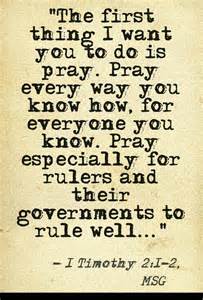
Reading again from 1 Timothy 2, “I urge, then, first of all, that petitions, prayers, intercession and thanksgiving be made for all people— for kings and all those in authority, that we may live peaceful and quiet lives in all godliness and holiness. This is good, and pleases God our Savior.”

I’ll stop right there. Not because the rest of the reading is unimportant. No! But, because Paul has so many ideas that are bursting out of him one on top of the other, I am afraid we might be overloaded if I read them all.

Paul begins the chapter by encouraging Timothy to offer prayers for all members of the human family during church services. He mentions prayer in the terms of: petitions (humble, general requests to God), intercessions (requests, pleading for those in need), supplications (requests for ourselves, especially when faced with a crisis) and thanksgivings (expressing gratitude for blessings we receive). [1] All people need to be held up to God in prayer. All. That is, everyone. Not just one particular neighborhood, not just one particular ethnicity, not just one particular denomination. Paul tells Timothy—Paul tells us—pray for all people.

Yes, this is a wonderful passage that gives us the basics of prayer and worship, and lets us know more about Paul’s ideas concerning this important aspect of our lives. However, I was drawn to one particular phrase in this passage that went beyond the basics of worship: that we may live peaceful and quiet lives in all godliness and holiness.” I pursued it all week.

I was fascinated to dig into this passage of scripture. I have not read the Pastoral Letters as often as the rest of the New Testament. So, this week was a good excuse for me to dust off those seldom-opened commentaries and brush up on what was going on in this highly charged situation. For, highly charged it certainly was!

There was a complication, in the case of these house churches. Let’s take a look at the historical context. In the first century, small house churches like the ones where Timothy and Paul worshipped were in a precarious situation. They were constantly involved in “the struggle to secure and maintain a foothold within a hostile environment, where political authorities would always tend to be suspicious of the little house groups whose legal status was at best ambiguous and be ready to act against them at short notice with little excuse.” [2] Many of these small groups of emerging Christians desperately wanted to gain basic respect. Not even respectability, but hoping for just a bit of respect from the authorities.

These groups, or house churches, are identical to house churches meeting all over the world today, in fear for their leaders, if not the group members’ very lives. House churches in parts of Vietnam and Thailand, China, Pakistan, Nepal, and large parts of the Middle East. These groups are—today, here and now—struggling to survive in precarious political situations.

Is it any wonder that these small house churches wanted to pray for those in authority over them, so that they might have some peace and quiet? Quiet and tranquil lives?

Good habits—beneficial, certainly! Habits like prayer and worship are something that Paul would tell Timothy that his house church ought to follow, each time they gather.

How does this prayer and worship counteract the complication of overbearing and even unjust authorities that hold sway over these little groups of believers?

Both Paul and Peter tell their friends that the Godly thing to do is to pray for the authorities. I read from Romans 13:1: “Let everyone be subject to the governing authorities, for there is no authority except that which God has established.” And 1 Peter 2:17: “Show proper respect to everyone, love the family of believers, fear God, honor the emperor.” The New Testament tells us so, in several places, including this letter from Paul to Timothy.

We can see Timothy and his church are prompted to pray for the government. As Rev. Findlayson comments, “We are encouraged to pray for the political process such that it provides an environment where ‘we may live peaceful and quiet lives in all godliness and holiness’ (verse 2:2). This verse actually contains a clue to the content of our prayer for government. We are to pray for “peace”, but what kind of peace? Is it peace in the sense of freedom from war, social and industrial strife and revolution?” [3]

Ah. We have arrived at the topic of the day. The theme of our service today. What kind of peace do we pray for, indeed?

I have been talking about peace ever since February, the beginning of Lent. Remember, I went to a number of different churches, church groups, and schools to ask individuals what their personal definition of peace was. What is peace to you?                I got many fascinating definitions and expressions. Everything ranging from “Peace is serenity” to “Peace is Jesus Christ in my heart” to “Peace is quiet and calm” and “Peace is no war and no fighting.” And, a whole lot of other things, besides.

This kind of peace Paul describes is not just personal peace, and individual peace. This kind of peace Paul talks about is peace in the larger sense. Peace among regions, between people groups, and even between countries. We can see the progression in Paul’s thought. The spread of truth and of the Good News of Jesus Christ is facilitated when peace exists among the nations. In Paul’s day, the Roman Empire, the Roman transportation system and the Pax Romana made the spread of the Gospel easier. Then as today, peaceful interaction between countries and regions opens doors for the Good News.

See what Paul says in verse 4. God “wants all people to be saved and to come to a knowledge of the truth.” So then, when we pray for government and for the authorities, we can confidently pray that there be peace for the maximizing of the spread of the Good News.

Paul gives us the basics of prayer and worship. Remember what I often say? Prayer time is one of my favorite times in the worship service. Paul tells us we are to pray for all people; and we are to follow Paul’s lead in supplications, prayers, intercessions and thanksgivings. The intention of such prayers is so that we Christians in society will be able to live tranquil and quiet lives. This isn’t me saying it. It’s the apostle Paul!

Regardless of whether there is peace in our church, peace in our neighborhood, or peace in our country, prayer is always a good idea. A close relationship with our Lord and Savior Jesus Christ is the reason we are here. Praise God! Thank You, Jesus. Alleluia, amen.

If anyone would like to know more about how to come to know God in a closer, more intimate way, I would be glad to tell you.

[1]  http://www.lectionarystudies.com/sunday25ce.html Rev. Bryan Findlayson, Lectionary Bible Studies and Sermons, Pumpkin Cottage Ministry Resources.

[2] New Interpreter’s Bible Commentary on 1 Timothy, James D.G. Dunn, (Nashville, TN: Abingdon Press, 1994)

[3] http://www.lectionarystudies.com/sunday25ce.html Rev. Bryan Findlayson, Lectionary Bible Studies and Sermons, Pumpkin Cottage Ministry Resources.

@chaplaineliza

(Suggestion: visit me at my regular blog for 2016: matterofprayer: A Year of Everyday Prayers. #PursuePEACE – and my other blog,  A Year of Being Kind . Thanks!)


Unknown's avatar

Justice, Healing, Wholeness

“Justice, Healing, Wholeness”

Eph 2-14 word cloud

Ephesians 2:14-17 – August 21, 2016

The Summer Olympics in Rio de Janeiro have been going on for two weeks. The Olympics has been a marvelous time of both competition and camaraderie, crossing international borders. I have not spent as much time as in years past watching the different competitions, but there have been some exciting and nail-biting times in these past weeks. Swimming and diving, gymnastics, track and field: the United States has won medals in these and many more. And yes, there have also been some scandalous things that happened, both on and off the field of play.

Scandals, quarreling, fighting, bombing. Attacks, sniping, terrorism, and even warfare. So often those are common events in the world today. Sadly, common, and sadly, robbing countries of their best and brightest young people.

From the time that I was little, I was drawn to the Olympic competitions not only for the sake of sport, but also for the sake of the Olympic values and traditions. The Olympic values strive to counteract those negative traits and actions I just mentioned. Pierre de Coubertin, the founder of the modern Olympic Games, wanted the Olympics to lift up the ideals of respect, fair balance, pursuit of excellence, joy in effort, and balance between mind, body and will. He held up these as the essential Olympic values. What wonderful ideals to reach for!

However, as faulty, error-filled people in this mixed-up world, we have a big problem. Sin gets in the way of these lofty ideals. Negative feelings like hatred, xenophobia, classism, separation of all kinds get in the way. Sin also includes the haves versus the have-nots, all over again, in a myriad of ways.

I would like us to switch gears and look at the Scripture passage for this morning from Ephesians 2. The Apostle Paul is in the middle of a very long paragraph about Jesus Christ and why He came to earth: “But now in Christ Jesus you who once were far away have been brought near by the blood of Christ. 14 For He Himself is our peace, who … has destroyed the barrier, the dividing wall of hostility; His purpose was to create in Himself one new humanity out of the two, thus making peace, 16 and in one body to reconcile both of them to God through the cross..”

As is typical with the Apostle Paul, he makes a complex argument and brings a whole bunch of ideas into play. But I want to highlight this central fact from Ephesians chapter 2. Humanity was once far away from God, made far away by our separation and sin. There was—and is still—a dividing wall of hostility. Hostility between us and God, and hostility between human beings. Hostility between individuals, neighborhoods, groups, nations, races, classes, and a whole host of other separations.

The Olympic ideals, values and tradition help in counteracting this hostility and separation between humanity. The United Church of Christ’s Statement of Mission helps to counteract this, too. I have been preaching through the Statement of Mission this summer. The sentence for this week states: Empowered by the Holy Spirit, we are called: to work for justice, healing, and wholeness of life.” Wonderful things to strive for! And, worthy ideals to shoot for, from the point of view of the Olympic ideals, or from a Christian framework.

Jesus Christ came to earth to reconcile us to God, to destroy that dividing wall of hostility, so that each of us could have healing and wholeness of life. Praise God! Alleluia! That involves our relationship with God. Our vertical relationship, which is so important. Jesus has done that for us. No longer separated and far away, we now have a relationship with God.

But, that is not the end of the story. No! God wants us to take the next step. God calls us to work for justice, healing and wholeness of life, not only for us individually, but for others as well. That is our mission, from the UCC Statement of Mission.

I spoke about this several weeks ago, when several moms from Morton Grove went to the south side of Chicago, into the Englewood neighborhood. Two of us went again this past Wednesday, to help serve at a dinner outreach to that community. We took this opportunity to reconnect with the good people in the Englewood neighborhood and show them that friends outside of their community care, and are concerned. Friends want to help them strengthen relationships, and bring peace into their streets. Their neighborhood. Their community.

By several of us going to the Englewood neighborhood, this was a concrete way of showing our love and caring for others. As a follower of Christ, it was and is my responsibility to work for justice, healing and wholeness of life. Not because I am a pastor, not because I am a leader of this congregation, but because I follow Christ and strive to do the things He did and to say the words He said. And most especially, I strive to love the way Jesus loves.

All of us are called to do that same thing. To follow Christ to the best of our ability.

Let me switch gears and talk about the Olympics again. I did have the opportunity to watch a bunch of races last week. My son and daughter got really excited about the men’s and women’s swimming. We were awestruck to watch Michael Phelps add to his haul of Olympic medals, plus all of the other American swimmers doing an outstanding job in the pool.

I also made note of Simone Manuel, who won two gold medals, one for the 100 meter freestyle and the other as a member of the 4 by 400 relay team. Ms. Manuel is one of the fastest swimmers on the planet today. She also happens to be African-American, the first black woman to medal for the United States in swimming. Ever.

Articles and news stories immediately proliferated on the Internet, television, newspaper and other forms of media. Yes, they all praised Ms. Manuel for her grand achievement. Yet, some of the longer articles told a different story. About how the history of swimming pools and racism are closely tied together in this country. About how “according to the Centers for Disease Control and prevention, in the United States, a black 11-year-old is 10 times as likely to drown in a swimming pool as a white 11-year-old. And as of 2010, around 70 percent of African-Americans said they couldn’t swim, compared with some 40 percent of white folks.” [1]

I quote from an article in Rolling Stone, “the fraught dynamics of segregation were fought within swimming pools as well. Often whites would shut down or avoid pools rather than have to intermingle with black people. There were legal battles fought throughout the 1950s over the access black people had to swimming pools and beaches that continued even after Brown v. the Board of Education and the idea that “separate but equal” facilities were deemed unconstitutional.” [2] A large percentage of American children having a likelihood of drowning. It doesn’t matter who, or what, or where. They are our country’s children. All of our children. And, this is a matter of justice—or, injustice.

This racist attitude is changing. Praise God! Plus, I am so happy for Simone Manuel and her two gold medals in swimming! This aspect of justice is something we all can do something about. And healing, and wholeness. Can you hear God calling? Calling to each of us? As the book of Isaiah says, “God will teach us His ways, so that we may walk in God’s paths.”

We can all look forward to God’s shalom, healing, peace, and wholeness, and verdant life. God wants us to try to communicate this Good News, work for justice, and do our best to spread healing and wholeness. To our friends, our neighbors, those we work with. Let us strive to live healing-filled lives, with God’s help. Alleluia, amen!

[1] http://www.npr.org/sections/codeswitch/2016/08/12/484841513/simone-manuel-wins-olympic-gold-thats-a-really-big-deal

[2] http://www.rollingstone.com/sports/simone-biles-and-simone-manuel-wins-impact-on-race-w434453

@chaplaineliza

(Suggestion: visit me at my regular blog for 2016: matterofprayer: A Year of Everyday Prayers. #PursuePEACE – and my other blog,  A Year of Being Kind . Thanks!)

Unknown's avatar

Struggle for Liberation

“Struggle for Liberation”

Isa 61-1 freedom, liberty word cloud

Isaiah 61:1-3 – August 14, 2016

Has anyone listened to the news? Or, read the newspaper lately? Or, checked out the headlines on their computer news sites? Other than the Olympics—which is some positive, uplifting news, indeed, and a much needed boost in this mixed-up world—there is very little positive going on in the world right now.

Bombings in Thailand, and wide-spread flooding in the Gulf Coast. Not to mention the violence in Milwaukee, poor economic forecast and drought-stricken areas covering large sections worldwide. Add to that, the rise in the prison population in the United States, complicated by the surge in unemployment in many urban areas across the country. Problem upon problem. What can we do about all of this? It makes me feel helpless, and hopeless.

Our Scripture passage from the Hebrew Bible comes from the book of Isaiah, chapter 61. As we read through the first two verses, we might just as well be reading the headlines from the daily paper or from a news site online, or listening to the news on the radio or television. Chapter 61 talks about the poor, those who are captive, brokenhearted, and those in prison. With one huge exception: the prophet has been chosen and anointed by the Lord to bring help and hope to those very people.

Reading from Isaiah 61 again: “The Spirit of the Sovereign Lord is on me, because the Lord has anointed me to proclaim good news to the poor. God has sent me to bind up the brokenhearted, to proclaim freedom for the captives and release from darkness for the prisoners, margto proclaim the year of the Lord’s favor.” Praise God! The Lord is listening to the poor, the brokenhearted, the captives and the prisoners!

The prophet knows very well he has been sent and deputized to go to these people who are down and out. On the outskirts, on the margins of society. In this world today, so many people are poor, and captive, and prisoners. Outside of this country, certainly. But, even within this country. I am certain there are many people on the outskirts and margins of society very near this church, in a two mile-radius all the way around St. Luke’s Church.

I am preaching through the United Church of Christ’s Statement of Mission for my summer sermon series. This week, our sentence from the mission statement says: “Empowered by the Holy Spirit, we are called: to join oppressed and troubled people in the struggle for liberation.”

This call from the statement of mission certainly echoes Isaiah 61. The prophet is clearly joining oppressed and troubled people. On the outskirts, on the margins of society.

Our Lord Jesus read this very passage from the prophet Isaiah when He started His ministry. Right after Jesus was baptized, He went to Nazareth. While in the synagogue, He was given the opportunity to read from Scripture. This was the passage Jesus read. After reading these verses, “20 Then He rolled up the scroll, gave it back to the attendant and sat down. The eyes of everyone in the synagogue were fastened on Him. 21 He began by saying to them, ‘Today this scripture is fulfilled in your hearing.’”

We have the prophet in the time of Isaiah sent to the poor, the oppressed, and the marginalized. We have our Lord Jesus saying—at the beginning of His ministry—that He has been sent to the poor, the oppressed, and the marginalized. And, we have the United Church of Christ’s Mission Statement saying that we—all of us—have been sent to the poor, the oppressed, and the marginalized.

Jesus chose to hang out with these “down and out” type people, deliberately.

In fact, Jesus was soundly criticized. In the Gospel of Mark, the religious leaders get all righteous on Jesus for hanging out and eating with tax collectors and other “sinners.” The super-righteous Pharisees would not even allow themselves to come near these second-class citizens! That’s how much better they considered themselves. But, our Lord Jesus willingly associated with these “sinners,” these people who according to religious law were ritually unclean.

Jesus came to earth to reach out to all people, to bring the good news of the Gospel to everyone. Jesus came to the tax collectors just as much as the Pharisees, to free all people from their spiritual bondage. To liberate all people, so that we could be free, indeed!

Isn’t that just what God has been doing, all along? All throughout biblical history, and throughout the history of the church? We can follow that thread of liberation through the Hebrew Scriptures, highlighted by the Exodus, where the Jewish people were freed from slavery in Egypt. A huge liberation, to be sure!

We can follow the additional freedoms from oppression and liberations from captivity stated in the Bible. The book of Judges has one after another. The books of the Kings of Judah and Israel, more periodic liberation. The return from captivity of both Judah and Israel. Then, the ultimate liberation from captivity—humanity’s freedom from the bondage to sin and death, paid for us by Jesus Christ and His death on the cross.

Praise God! We have been set free from this bondage of sin and death. The physical, mental, emotional and psychological shackles that kept us all bound as prisoners have been loosened. Thank You, Jesus! I am so very, very happy and grateful and thankful.

Jesus encourages us—each of us—to reach out in the same way. We are to reach out to the poor, the brokenhearted, the oppressed. That is our part, to offer this freedom from bondage to those we meet.

I know what some people might say. “I am just one person. The task is much, much too big. Plus, I haven’t been trained in mission, or evangelism, or chaplaincy, or how to preach.”

Let me tell you a story. A young girl was walking along a beach upon which thousands of starfish had been washed up during a terrible storm. When she came to each starfish, she would pick it up, and throw it back into the ocean. People watched her with amusement. She had been doing this for some time when a man approached her and said, “Little girl, why are you doing this? Look at this beach! You can’t save all these starfish. You can’t begin to make a difference!”

The girl seemed crushed, suddenly deflated. But after a few moments, she bent down, picked up another starfish, and hurled it as far as she could into the ocean. Then she looked up at the man and replied, “Well, I made a difference to that one!” [1]

Remember, our sentence from the mission statement says: “Empowered by the Holy Spirit, we are called: to join oppressed and troubled people in the struggle for liberation.” Exactly so. You and I can do what we are able. No matter how small or how big it might be.

What can I do? This task of freeing the starfish—I mean, people from the penalty of bondage and death? What can we do to join oppressed and troubled people, and sit with them in their time of need? Walk with them through their difficulties?

I know it seems like a small thing, but I go regularly to play for a hymn sing at a nursing home in Chicago. I know the seniors appreciate my playing. What about donating to the Maine Township food pantry? I know it seems small, but there are hungry people throughout the community who will thank us.

Let us follow the prophet, and follow our Lord Jesus in this worthy effort. Engage with others. Find something to do, or say, and do it!

Please God, help us all in this endeavor. Amen!

[1] Adapted from The Star Thrower by Loren C. Eiseley

@chaplaineliza

(Suggestion: visit me at my regular blog for 2016: matterofprayer: A Year of Everyday Prayers. #PursuePEACE – and my other blog,  A Year of Being Kind . Thanks!)
 

Unknown's avatar

Proclaim the Gospel!

“Proclaim the Gospel!”

Luke 4-18 word cloud

Luke 4:14-21 – June 26, 2016

The primary season is over. You all know what that means. The presidential primaries have been going on for months, and they are finally over. Some people in the United States have followed the debates, listened to the various candidates, and discussed the various political positions, pro and con. What’s more, we are also going to elect congressional representatives, and state and local officials, too. Campaigning will begin in earnest this fall.

All of this campaigning has a purpose. The various candidates all try to have their position distilled down to a simple message. What they stand for. What they will strive to do.

I want us to look at the Gospel passage for today, from Luke. This is the very beginning of the public ministry of Rabbi Jesus. We can draw some parallels between this passage and the political campaign going on in our country, right now.

Sure, this was the very beginning. Jesus was just starting to make a name for Himself as an itinerant rabbi. And, He came to His hometown, the place where He grew up. Maybe where the butcher and baker down the street were good friends with His parents from way back. Maybe the real estate agent across the square sold His parents their house some years before, the house where His mother Mary still lives. In other words—I suspect everyone in that village was there in the synagogue that day to hear what the Rabbi Jesus—their hometown boy!—had to say.

Jesus already had generated some buzz in the greater Nazareth area. “Have you heard the latest about that Jesus? The one who says He is a Rabbi? The one who was baptized in the River Jordan by that Baptizer fellow? And, there was something about the heavens cracking open, a dove flying out of a clear blue sky—and a voice from heaven! I’m not saying all this was for real or not, but that is what people are saying about this Jesus. You know, the guy from our town.”

Jesus had hardly started to do His public ministry, and people were already talking about Him and what had happened in His life. Even in Nazareth, the town where He had grown up.

I am fascinated by this particular reading, where Jesus preaches His first sermon. It is quite a bit like political campaigns. The various candidates all try to have their position distilled down to a simple message. What they stand for. What they will strive to do. Just so, with Jesus.

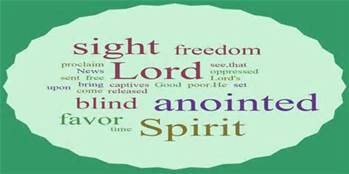
Let’s read from our passage from the Gospel of Luke, again. “Jesus stood up to read, 17 and the scroll of the prophet Isaiah was handed to him. Unrolling it, He found the place where it is written: 18 ‘The Spirit of the Lord is on me, because he has anointed me to proclaim good news to the poor. He has sent me to proclaim freedom for the prisoners and recovery of sight for the blind, to set the oppressed free, 19 to proclaim the year of the Lord’s favor.’”

There we have it. Jesus distilled His message down. His position, what He stands for, and what He will strive to do. Jesus is here to proclaim good news. Or, in the word from middle English, God-spell. What we today know as Gospel. Proclaim the good news, indeed!

This is what we are told in the sentence for this week from the United Church of Christ’s Statement of Mission. Empowered by the Holy Spirit, we are called and commit ourselves: To proclaim the Gospel of Jesus Christ in our suffering world.”
If we say this passage from Luke is Jesus’s basic position statement for His overall ministry, how does that work for us? Jesus said He would proclaim: 1) good news to the poor, 2) freedom for the prisoners, 3) recovery of sight for the blind, and 4) to set the oppressed free.

My first thought is, I’m not poor! Or, a prisoner, or blind, or oppressed, either. I am not any of those things. What kind of stuff is Jesus saying here?

I live a fairly comfortable life in a small condo in Evanston. Seriously, what is Jesus bringing up? Does He have some kind of secret message? If these are the types of people Jesus says He is going to preach and minister to, I am not sure I would be comfortable with it. All that talk about the poor and blind, grief-stricken and oppressed, that is giving me some hesitation about following this new Rabbi Jesus.

But, let’s take a closer, deeper look. Here Jesus is addressing the poor. Could that be the poor in spirit, as well as poor, materially speaking? Next up, He addresses the prisoners. Perhaps, prisoners of sin? Then, speaking to the blind; blind to the love and gifts of God in their lives? And, Jesus came for the oppressed. Oppressed by anxiety, doubt, fear, anger, self-loathing, self-pity, self-righteousness. (I could go on, but I think you all have the idea.)

That is why Jesus has come to earth. That is His message, His purpose statement, distilled down to the pure essence. He has come to preach the Good News. The Gospel. The year of the Lord’s favor.

One of the commentators I consulted said it another way: “This Spirit inspired message is one of justice and mercy, of righteousness and freedom. This is a prophetic ministry, and when Jesus finishes reading the passage He sat down, and with every eye in the congregation focused on Him, He told them: ‘Today this scripture has been fulfilled in your hearing.’ In other words: I’m the one Isaiah spoke of. I’m going to do these very things.” [1]

Jesus is correct. He does do these things. That is why He came. That is the Good News, the distilled message of hope, love and promise from God. Moreover, He has come to bring that message to us—to each and every one of us, no matter what.

Jesus’s message is Good News! However, for us to really hear it, we need to become aware of our poverty, our captivity, our blindness, and what we are oppressed by. This is news “that we are not who we want to be, can be, and should be…and we never will be. Jesus comes bringing good news to those in need, and those who don’t see and admit their need want nothing to do with him.” [2]

What is more, Jesus tells us to do these things, too. We are to proclaim the Good News just as much as He proclaims it. We are sent in the same way that He is sent.

I would like everyone to turn to the back page of the bulletin. Look at the listing of the church staff. Who heads the list? We do. We all do! We are ALL ministers, every one of us sitting here today. Yes, and those in other places right now, too. Ministering, carrying the Good News of the Gospel wherever they are, too.

I loved the way the commentator David Lose put it: “This, in a sense, is what the Body of Christ and community of faith is – God’s hands delivering the promise of good news to all who come in need. Afraid? We may ask those around us. Come here to find courage. Lonely? Come join our community. Ill? Come here – or better, let us come to you – to care for you. Isolated? We will visit you. Discouraged? Let us gather together and encourage one another.”

Good News for all people, just as the angels said at Christ’s birth. Remember the Christmas narrative from Luke chapter 2? This is why Jesus was born to us. This is why He came into the world. How much better news could there possibly be?

What about you? Are you going to accept Jesus Christ’s offer of Good News today? Remember the words of the angel to the shepherds: “I bring you good news that will cause great joy for all the people.”  Ministering, carrying the Good News of the Gospel to each of us, to all the people, today.

[1] http://www.bobcornwall.com/2016/01/the-charismatic-messiah-lectionary.html

[2]  “Jesus’ Inaugural Address,” David Lose, Dear Working Preacher, 2013.  http://www.workingpreacher.org/craft.aspx?post=1771

@chaplaineliza

(Suggestion: visit me at my regular blog for 2016: matterofprayer: A Year of Everyday Prayers. and my other blog,  A Year of Being Kind . Thanks!)

Unknown's avatar

Confess Sins, Accept Forgiveness

“Confess Sins, Accept Forgiveness”

1 John 1-9 if we confess our sins

1 John 1:8-9 – June 19, 2016

Have you ever seen a small child when he or she knows or realizes they have done something wrong? Sometimes, they gasp. Their lower lip may tremble. Sometimes they might start crying. The realization that they have made a big mistake sometimes overwhelms them.

Does this picture sound at all familiar? I do not care whether it’s children, grandchildren, nieces or nephews. When a small child realizes they have done something wrong—well, that can be the saddest time in the world for that young person.

Sound familiar? I suspect it ought to. This awful feeling affects not only small children, but it can trouble grown-ups. It can happen to you or to me, too. The realization that nothing is the way it ought to be? Affecting, heart-rending, deeply sad. Sometimes feeling like the bottom dropped out of the world!  And, get this: it’s all my fault.

If we look at our Scripture lesson for today, we will find exactly that. The older Apostle John tried to get his readers to see this, in the first verse of our reading today. I will read both of these stirring verses from 1 John, chapter 1. “If we claim to be without sin, we deceive ourselves and the truth is not in us. If we confess our sins, God is faithful and just and will forgive us our sins and purify us from all unrighteousness.”

And, we are on the next line of the United Church of Christ Statement of Mission. “Empowered by the Holy Spirit . . . To praise God, confess our sin, and joyfully accept God’s forgiveness.”

I am going to depart a little from my usual sermon format, and ask: what do we do every week in our worship service, right after the opening hymn? After our prayer of invocation, where we ask God to be with us in our worship service, we move into the prayer of confession.

Why on earth do we need to confess our sins before God?

Ah! That is where John’s reminder of our sinfulness is helpful. Remember, the Bible came first. Scripture was written to be helpful to believers, and to offer praise, and to admonish and correct our behavior—when we needed that. Afterwards, people started to set down a formal worship service. Especially in our Protestant tradition several hundred years ago, they always had a formal confession of sins—just like the Apostle John mentions here.

Each of us—every worshiper here today—sins. Every day. It doesn’t matter who we are, or how good we are trying to be. Each of us makes mistakes. It is like someone using a pencil. That is what erasers are for. To erase wrong or messy writing, and to correct mistakes, like in arithmetic at school.  We all have sins, or mistakes, or errors in our lives. And what’s more, we admit them to God. We tell God all about them.

Let’s look at the first sentence in our prayer of confession today. “Merciful God, who has compassion on Your sinful children.” Right here, this has several deep theological ideas! We are saying that God is merciful! God is not unforgiving, or uncaring. Instead, merciful. Full of mercy toward each of us. The Lord has compassion on each of us, too! God feels with each of us.

The next part of the prayer: “You sent Your son Jesus Christ to be the Savior of the world.” Ah! Here is the Gospel, the Good News. This is why God sent Jesus! God knew the terrible mess humanity was in, and God had a solution: to send God the Son—in the flesh, made as a human—to become one of us. To be our Savior, and save us from our sins.

Some years ago, I knew a practically perfect person. He was a stickler for perfection, for writing precisely, for trying to act appropriately at all times. He used to joke that he thought he made a mistake once—but he was mistaken. (He understood his tendency as a perfectionist, and gently laughed at himself.)

This is where our Scripture reading is helpful. 1 John 1:8 says, “If we claim to be without sin, we deceive ourselves and the truth is not in us.” Except—the New Testament says that we all have sinned and fall short of the glory of God. (In the letter to the Romans 3:23.)

We continue with the prayer of confession: “Grant us grace to lament our sins; help us by prayer and meditation to repent and turn to You.”

If you recall, I often repeat this verse from 1 John as the weekly assurance of pardon: “If we confess our sins, God is faithful and just and will forgive us our sins.”

Sometimes in our confession of sins, we have a time of silence for personal confession. In addition to the prayers written in the bulletin each week, from time to time I provide space in our service for each of us to come to God silently in prayer, a quiet time to come with personal things that are particularly burdensome. And, did you hear what John said in this verse? “God IS faithful and just, and WILL forgive us our sins.”

The next sentence in our prayer of confession today: “Give us a true longing to be free from sin. Thank You for Your abundant love and forgiveness.”

Praise the Lord! Did you hear? “God will forgive us our sins, and cleanse us from all unrighteousness!” Those are the words of John, written in the first century. Moreover, they are still true today!

Just like dirty clothes are cleaned in the washing machine, especially when we add some laundry detergent, so we are cleansed from our sin. My mother had a wringer washer in the basement. I used to go downstairs and wash the clothes for the family. I put water in the washer, added the detergent, and turned on the agitator. Scrubbed the clothes, and then wrung them out into each of the double sinks, rinsing, and then rinsing again. I saw firsthand how this business of washing clothes worked. How the soapy water got so dirty. How the clothes got rinsed clean.

That’s us! When we come to God to confess our sins, correct the mistakes we have done and said, it’s like God has cleaned us in a washing machine. Sure, sometimes I feel like I have been in a washer from time to time. Been agitated by the machine, and then put through the wringer. I bet you can relate, too. Some people go through the wringer more often than others—and how!

 However, we come out the other side as clean people. We receive God’s abundant love and forgiveness!

The final words of the prayer of confession: “We pray these words for the sake of Jesus Christ, our only Redeemer, amen.” Jesus is the only Redeemer. Not ourselves. Not saints, or good works, or some television minister, or prayer book, or other holy practice. Our Lord Jesus is our blessed Redeemer. We are indeed redeemed by the blood of the Lamb, as our closing hymn tells us.

The assurance of pardon is what follows this confession of sins. This is not a half-hearted assurance. This is not “maybe,” or “I hope so,” or “fingers crossed!” This assurance is complete. As Jesus said as He died on the cross, “It is finished.” The work of redemption is completed. Praise God! Just as what John said in this verse: “God IS faithful and just, and will forgive us our sins and cleanse us from ALL unrighteousness.”

Shortly, we will sing a hymn all about forgiveness and redemption. I close this sermon with a verse of this wonderful old hymn, written by Fanny Crosby:

“Redeemed, how I love to proclaim it!
Redeemed by the blood of the Lamb;
Redeemed through His infinite mercy,
His child and forever I am.” —Alleluia, amen!

@chaplaineliza

(Suggestion: visit me at my regular blog for 2016: matterofprayer: A Year of Everyday Prayers. and my other blog,  A Year of Being Kind . Thanks!)

Unknown's avatar

Mother Love, Parent Love

“Mother Love, Parent Love” – May 8, 2016

LOVE hear word cloud

John 17:20-26 (17:23)

This is a weekend to celebrate mothers. Yes, and mothers-in-law, daughters, grandmothers, aunts, sisters and nieces and other relatives and friends who are mothers. It is a special weekend, with special meals, gifts, flowers, and cards. Significant trips to the cemetery perhaps.  Happy Mother’s Day. What a wonderful sentiment. Hallmark card holiday, some might say. Particularly meaningful day to many. A day of pain and grief, of sorrow and longing, to others. An emotional day, for sure, with a whole range of emotions.

Reminds me of the particularly emotional night that we have in our Gospel reading for today. It comes from the last night our Lord spent on earth. From John 17:20-26, when Jesus prays for His friends after the Passover dinner.

Here is the beginning of that passage, the words of Jesus to His Heavenly Parent, in prayer. 20 “My prayer is not for them [the disciples] alone. I pray also for those who will believe in Me through their message, 21 that all of them may be one, Father, just as You are in Me and I am in You.”

I wanted to highlight this section, as a prelude to the topic of this sermon. This sermon goes straight to the heart of why Jesus was here on earth. He was communicating that message to His friends and followers. This prayer lets us know Jesus is not just praying for His disciples. He is also praying for all those who come to believe as a result of the disciples’ spreading the Good News. That means, Jesus is praying for all Christians, throughout all time. He is praying here for us, too! Did you realize that? Jesus prays for us.

What does He pray, some might wonder? I’m glad you asked!

I continue reading from John 17: “22 I have given them [all believers] the glory that You gave me, that they may be one as We are one.” Here Jesus is talking about the unity of all believers. The family of God.

Did you know we are in God’s family? Children of God, that’s what we are. Knowing that living together, living in community is not easy, Jesus prays for His disciples and for us.  That prayer is for household families, the church family, and God’s world-wide family. [1]

All of us—no matter who—are included in Jesus’s description of family. All of us—no matter who—are included in the unity of believers.

But, I did not want to preach on the unity—fellowship—of the family of God today. I know that is a huge concept, and I’ve touched on it in recent sermons. No, today I wanted to describe God’s love.

Let’s let Jesus tell us more. From John’s Gospel reading, verse 23. “Then the world will know that You sent Me and have loved them [all believers] even as You have loved Me.”

I love what the commentator Barbara Lundblad said about this section of Jesus’s prayer. She talks about the surprising twists and turns of the Gospel of John. About the protective nature of this talk Jesus gave in the Upper Room, where Jesus proclaims God’s love. God’s love for—the world. God’s beloved children! [2]

But, Jesus does not just describe us all as children. He speaks of Himself as the Good Shepherd. We as children—as sheep—hear His voice. But, wait! There’s more! Just as we are ready to shut the gate, Jesus mentions other sheep. Different sheep, not of our sheepfold.

The disciples must have been really confused by this time. Not only have these past few days been really emotional, but the band of disciples know they are in a tough spot. A dangerous situation. They all know that their Rabbi Jesus is high on the Enemies of the Jewish Leaders list. Who knows if there will be an official knock at the door, summoning some if not all of them to meet with the Jewish authorities? Jesus had some daring, walking right into Jerusalem on that Passover week.

Yet, what does Jesus do? He prays for His disciples, and for all of those who will believe. He prays a prayer of protection. He prays that these beloved ones of God will be protected from the world. That sounds like a prayer from a mother’s heart. We see a word picture of our Lord Jesus, seeming very much like a mother.

That’s the thing about mothers. (Most mothers, I mean.) It doesn’t matter whether their children are small, or whether they’re grown. It doesn’t matter whether the child is near or far, employed or out of work, healthy or sick. A mother still thinks of her son, her daughter. A mother still prays for her child, no matter where, no matter what.

We are all children of God. God is our Heavenly Father, our Heavenly Parent. We are much beloved by God, and chosen and precious to God. That’s all of us, right here. It doesn’t matter what we’ve done, or what we’ve left undone. It doesn’t matter what we look like, or whether we are in poor health, or whether we’re right- or left-handed. God loves us.

But—what about people who haven’t had an ideal relationship with their mothers? I know these things are difficult to think about, and difficult to talk about. However, sometimes they do need to be voiced. These words and experiences are truths for many. Maybe not many here, but for many across the country, and throughout the world. For some children, and for some adults, that is a real and painful reality in their lives.

Every Mother’s Day card or gift, every reminder of Mother’s Day, whether on commercials, in shop windows, or from friends or relatives, is accompanied by a sinking heart, feeling of regret or grief, or perhaps a flash of anger. For all those for whom this is your reality, I grieve with you today. I have several friends for whom this is true. I do feel great compassion and sorrow in my heart, for them and for those who still suffer.

I turn back to Barbara Lundblad. She says, “we hear Jesus praying as a mother worried for her children. “I will not leave you orphaned,” Jesus said. You are my own and I will be with you forever.” Jesus, who will not let us down, who will walk right by our sides.

I hear echoes of the most comforting of Psalms here. Psalm 23, which Jesus must certainly have been familiar with. True, this was King David talking to God, but David’s words have transcended the centuries. His words have been true for oh, so many. “Yea, though I walk through the shadow of the valley of death, I will fear no evil.” Why? Because God is walking right at our sides.

Finally, David says, “Surely, goodness and mercy shall follow me all the days of my life, and I will dwell in the house of the Lord forever.” Do you hear? That is what Jesus wants for us. God’s transformative love for us will shine through. We, as God’s beloved children, are going to dwell in the house of the Lord, forever.
That’s the long view. Now, how can we use these words in our lives, today?

This is the wondrous mystery revealed to theologian Julian of Norwich in the 14th century. This well-educated Christian woman devoted her life to God through study and contemplation of scripture. She wrote a theological treatise in a day when not many people were well-educated, much less women. Her words have now become a hymn that we could sing today: “Mothering God, you gave me birth. Mothering Christ, you took my form. Mothering Spirit, nurturing One.” [3] God is so much more than we ever could imagine.

Alleluia to God, heavenly Parent of us all. Amen.

[1] http://worshipingwithchildren.blogspot.com/2016/04/year-c-seventh-sunday-of-easter-may-8.html

[2] http://www.workingpreacher.org/preaching.aspx?commentary_id=2851

[3] http://www.workingpreacher.org/preaching.aspx?commentary_id=2851

(Thanks to Barbara Lundblad and Carolyn Brown for their words and ideas!)

@chaplaineliza

(Suggestion: visit me at my regular blog for 2016: matterofprayer: A Year of Everyday Prayers. and my other blog,  A Year of Being Kind .  Thanks!)

Unknown's avatar

Words of Wondrous Love

“Words of Wondrous Love”

resurrection Jesus - medieval manuscript

Luke 24:1-12 – March 27, 2016

Have you ever had a very full week? Where a month of experiences have been packed into seven hectic days? At such a busy, sometimes tumultuous time, it’s hard to focus. Difficult to pick up the thread of conversations. Challenging to decide what important thing to do when, especially when there are so many urgent matters waiting for you. Calling for you. Nudging your elbow, clamoring for your attention. Add to all that tumult the trauma of a sudden death.

That is the situation for these faithful women. These women have gone through some gut-wrenching things, these past few days. After the Triumphal Entry into Jerusalem just a short seven days ago, these companions of the Rabbi Jesus had seen their leader in debate with some of the most learned religious teachers and leaders of Israel. Jesus had delivered one of His most stirring sermons—the Olivet Discourse from Matthew’s Gospel, as well as one of the most poignant—the Discourse from the Upper Room, from John’s Gospel.

As if all of that heavy theology from Rabbi Jesus wasn’t enough, their leader Jesus showed Himself to be everyone’s servant. Since there was no servant present at that Passover dinner on Thursday night to wash the guests’ feet, Jesus did it Himself. He took the position of a servant and washed His disciples’ feet. Talk about a mind-blowing experience. Your Rabbi, your teacher, whom you have been following for several years, hanging on His every word and action. This Rabbi, this Jesus becomes a lowly servant and washes everyone’s feet.

But, wait. We’re only getting started. Their Teacher, Rabbi Jesus did something completely unprecedented at supper that night. He took one of the loaves of bread, tore it apart, and said, “This bread? It’s my body. It’s going to be broken for all of you. Take it, and eat it.” Shortly after that, Jesus took one of the cups of wine and said, “This cup? This is the new covenant in my blood, given for you. Take it, and drink.” Jesus took the familiar Passover supper and instituted a new thing—the Lord’s Supper. What we call communion, the Eucharist.

Things really started to follow in rapid succession. The time of intense prayer in the Garden of Gethsemane. The betrayal of Judas, and the arrest of Rabbi Jesus. Repeated trials before Pilate, Herod, the Sanhedrin, the whipping and the scourging. I am certain all of this was reported to the disciples in great detail.

Pilate bringing Jesus before the crowd that Friday morning. The crowd yelling, “Crucify Him! Crucify Him!” So, Pilate sentenced this Rabbi Jesus to death. The Roman death of a criminal, death on a cross. Crucifixion.

Some of Jesus’s followers were there as He bore His cross out of the city of Jerusalem. They saw that agonized walk down the Via Dolorosa, the way of sorrows. Finally, as the cross was raised on Golgotha, Jesus suffered that most painful death, death on a cross.

All of that heartbreaking trauma, horror, and extreme grief were packed into just a few days. Plus, for all good Jews, Saturday was the Sabbath. Not only a regular Sabbath, but the special Sabbath during Passover. The women—the rest of the disciples hardly had a chance to begin to process all of those tumultuous events. They did their best to rest, to hide, to grieve on that seventh day of the week, on that Saturday.

I include the women as disciples of Jesus. As commentator Dennis Bratcher says, “Luke tells us that these women followed Jesus from Galilee and watched Him die on the cross (23:49). The Greek word for “follow” is the usual word used for a disciple …. It seems that Luke wants the readers to understand these women to be disciples of Jesus.” [1]

After all this, the women—trying so hard to be faithful in their friendship and following of their leader and teacher Jesus—take spices to anoint the body. They go to the tomb where Jesus had been hurriedly laid late on Friday, before sundown. As the Gospel tells us, they found the stone rolled away. And, the tomb was—empty!

Can you imagine how confused they were? Distracted? Astonished? Yes, it was early in the morning. The women had difficulty comprehending what was before their eyes. After all the horror and trauma of the last few days, while the women were talking amongst themselves, things got even weirder. As Luke says, “suddenly two men in clothes that gleamed like lightning stood beside them. In their fright the women bowed down with their faces to the ground.”

What would you do if two guys in gleaming white clothes showed up, suddenly appeared right here, in St. Luke’s Church? Pretty scary! Talk about being amazed. Astonished.

The men (we can call them angels, because that’s what they were) said, “Why do you look for the living among the dead? He is not here; He has risen!”

What did I say, a few minutes ago? How at such a busy, sometimes tumultuous time, it’s hard to focus. Difficult to pick up the thread of conversations, to pay attention. What on earth is going on here? We hear the angels say, “Remember how He told you, while He was still with you in Galilee: ‘The Son of Man must be delivered over to the hands of sinners, be crucified and on the third day be raised again.’”

Then—finally!—the women remember the words of their Teacher Jesus. They run back to their friends, the other disciples, telling them what happened. They are witnesses! They say, “The tomb is empty! Jesus is gone! And, we saw angels!”

I suspect we all can predict the reaction of the other disciples. “What? You saw … what? Are you crazy? What is the matter with you?” Luke tells us, “They did not believe the women, because their words seemed to them like nonsense.”

What must it have been like for the disciples to hear the Good News the angels brought? A little far-fetched. Maybe a whole lot far-fetched. They couldn’t take it all in. They didn’t believe it! They thought what the women were saying was crazy talk!

What is it like for us, today, to hear the Good News the angels brought?

Who do you identify with? Do you identify with the women? Do you believe in those words the angels brought, and run and tell your friends? Are you witnesses to the Resurrection? Or, are you like the other disciples? Doubting. Skeptical. Thinking those words seem like nonsense! Crazy talk! Perhaps the disciples didn’t remember the words of Jesus. No, not yet.

Ah, that first Easter morning. As Luke says, the angels remind us that our Lord Jesus told us what was going to happen beforehand. Our Lord Jesus predicted that He must be delivered over to the hands of sinners, be crucified and on the third day be raised again. Those were the words that the women remembered. And just like the women, we, too, can witness to the Resurrection. We can proclaim that powerful, loving, transforming experience that has happened!

What does that message, that Good News the angels brought, mean to you and me? Do we know the wondrous love of Jesus? The wondrous love that led Him to the cross, the wondrous love that pierced Him for our transgressions. And, by His wounds we—all of us are healed. Thank God Jesus died in our place, so we don’t have to be separated from God for eternity. Thank God Jesus conquered death. We have been reconciled to God. That is the Good News of wondrous love the angels brought.

Believe the Good News of the Gospel—Christ is risen! He is risen, indeed!       


(I appreciate Readings, Analysis of Texts and Preaching Paths, Dennis Bratcher, Christian Resource Institute. Thanks for the assistance in understanding the text from Luke.)

[1] http://www.crivoice.org/lectionary/YearC/Ceaster1nt.html#text2

@chaplaineliza

Suggestion: visit me at my daily blog: matterofprayer: A Year of Everyday Prayers– where I am doing a Lenten journey.  #PursuePEACE – And my other blog,  A Year of Being Kind -Thanks!

Unknown's avatar

Whiter Than Snow

“Whiter Than Snow”

Psa 51-7 whiter than snow

Psalm 51:1-3, 7 – February 10, 2016

Have you ever made a mistake? I mean, not just like an ordinary mistake, like in addition or subtraction. I know we all made those while we were in grade school. That’s what erasers on pencils are for! I mean, a whopper! A mistake that is so bad, so huge, you wanted the earth to open up and swallow you? The kind that when you remember and look back on it, you want it to be permanently erased off the face of the planet? A mistake that big. That horrible.

Maybe you and I have never made that huge of a mistake. Maybe we have. But, I suspect all of us can relate to that kind of negative feeling. That horrible, gut-wrenching, sinking feeling. That “I wish I had never, ever been born!” feeling.

The psalm we consider tonight is all about this kind of negative, sinking, yucky feeling. This psalm is written by King David after his affair with an attractive married woman, Bathsheba, and his subsequent murder of Bathsheba’s husband (David’s general), Uriah.

Adultery! Attempted cover-up! Plotting and murder! And, another cover-up! Sounds like it’s right out of a soap opera script. Except, it really happened. And, it happened to a man after God’s own heart. A man with a close, personal, even intimate relationship with God. This all happened to King David, some years into his reign over Israel.

So, David has sinned. I mean, really sinned! I can see people shaking their heads, even now. David had a close relationship with God. God called him “a man after God’s own heart.” And some people might say, “David should’ve known better!”

Looking at us, today, we sin, too. We are often in a similar situation. We say we have a close relationship with God. We know the commandments, God’s rules, we have Jesus Christ and His example for us. Some people might say of us, “they should’ve known better!”

And what is David’s response? Verse 3, “For I know my transgressions, and my sin is always before me.” He does not pull punches. David comes right out and says it. He sinned. He knows it. He knows very well that God knows it, too.

We know we make mistakes, too. We know we mess up. We say mean things. We don’t tell the truth. We cut off people in traffic. We slam doors in anger. Who hasn’t bitten their tongue the second after saying something unfeeling? Or nasty? Or stupid? And, there are larger mistakes, too. Mistakes like, breaking the law. Theft. Embezzlement. Various felonies. Or like King David, with adultery, cover-ups and murder.

The psalm writer freely acknowledges his sins. Not even using euphemistic phrases like “wrong was done,” or “mistakes were made.” David is amazingly clear in stating “my transgressions,” “all my iniquity” and “my sin.”

Listen again to the verbs David uses – “wash me thoroughly from my iniquity,” “cleanse me from my sin,” purge me with hyssop.” To “wash” in verses 2 and 7 could better be translated “scrub,” as one scrubs dirty clothes. (I wonder whether David was remembering his mother, scrubbing the family’s dirty clothes when he wrote that verse?) “Cleanse” in verse 2 and “be clean” in verse 7 is the same word used for washing clothes in a river (Leviticus 13:6, 34, 58). (Perhaps when David was a shepherd for his family’s sheep, he would go by the river and watch the women from his village washing—cleaning or cleansing—their families’ clothes.)

One commentary I read mentions “sin as a kind of figurative stain on her life and conscience that she needs God to scrub away. After all, [we] beg God to ‘blot out,’ ‘wash away’ and ‘cleanse me.’ It’s the image of ancient people washing dishes or clothing and modern people using various detergents and stain removers on stubborn stains.”[1]

In other words, my sins are washed away, and though I may still be in the (figurative) spin cycle, yet shall I dry. I can freely confess my sins, too. Here, tonight, we all can acknowledge the wrongs we do.

At the beginning of each regular service, we gather together and have a corporate time of confession. This Ash Wednesday service is a special time to gather together, confess our sins to each other, and to understand we are sinners. This understanding of our sin—of the mistakes we have made and are continuing to make—prepares us to receive the forgiveness that comes through Jesus Christ. And the cross of ashes on each forehead is a reminder of that forgiveness in each one of our lives.

Yes, there IS good news! We can ask God to take away our iniquity. God’s abundant mercy will forgive. We can be sure of God’s unfailing love towards all of us.

Believe the Good News of the Gospel. In Jesus Christ, through His death on the cross, our sins are forgiven. Thanks be to God. Amen.

[1] http://cep.calvinseminary.edu/sermon-starters/lent-5b-2/?type=the_lectionary_psalms

@chaplaineliza

Suggestion: visit me at my sometimes-blog: matterofprayer: A Year of Everyday Prayers– where I am doing a Lenten journey. Pursuing PEACE. And my other blog,  A Year of Being Kind -Thanks!

Unknown's avatar

Invitation to Wonder

“Invitation to Wonder”

Virgin Mary and Child - Russian Orthodox

Luke 2:17-18 – December 24, 2015

Merry Christmas! What a wonderful expression. People greeting each other on the street, in the stores, here at church. I know not everyone celebrates Christmas, but still. What a joyous time of the year. Merry Christmas, many people say!

But I want you to go back, two thousand years. Go back to a time when “Merry Christmas” was not even a phrase, a wish, an idea in people’s heads. Go back to the time that Dr. Luke describes in the second chapter of his Gospel. Back to the time when Israel was an occupied country, and the Roman Empire was the strong man. Back to the time when all people in Israel needed to be enrolled. The Roman government decided to have a census, so that they would be able to tax the people of Israel more accurately.

In our Gospel reading tonight, we heard this census described. The Holy Family, Joseph and his fiancée Mary, went to Bethlehem to enroll, because Joseph was a direct descendant of King David. I suspect there were many people on the roads. Today, traveling can be stressful and nerve-wracking. However, I am certain travel in the first century was much more difficult. Poor roads, with many people walking to get from one place to another. We might imagine that Joseph and Mary had a donkey, but nowhere in the Gospel is that mentioned. Travel conditions were challenging, at best.

So, there they are, in Bethlehem. A long way from their home, in Nazareth. I suspect Joseph took care of the enrollment business first thing. But Mary felt the pains of labor begin. What a scary thing! To be far, far from home, in an unfamiliar place, and to have such a significant event happen. Significant, and potentially life-threatening, too.

I have had several children. I can remember all four of the deliveries. All of them happened in the hospital, with nurses and doctors standing by. Quite possibly most of the women here who have delivered babies can remember all their deliveries, too. Don’t you think Mary and Joseph remembered this experience for the rest of their lives? Yes, delivering a baby is a special day for anyone. But—even more so, for Mary and Joseph. Because of the angels. And the additional special visitors, too.

As Luke tells us, there were shepherds abiding in the fields, keeping watch over their flocks by night. Remember, there is no radio or telephone, no Internet or even telegraph. When messengers personally come to deliver a extra special announcement, it is a big deal. These angels coming to the shepherds, well, that was a super big deal, to be sure!

And the announcement? This isn’t the birth of a normal, ordinary baby. No! This baby is an extra special baby. The Messiah, who will save His people from their sins. Did you hear? This special baby, this Savior, Christ the Lord, is born to you—to me—to all of us, in the city of David, which is called Bethlehem.

Did you hear? The Savior, the Christ, the promised Messiah, came into this world as a Baby in Bethlehem. The Eternal Second Person of the Trinity, Creator of the whole universe, God the Son, emptied Himself of all God-ness. Took on humanity, and was born as a helpless Baby. That is not only good news, that is earth-shaking news. Good news of great joy for all the people. For you, for me, for all of us.

Yes, the promises of Christmas may sound familiar to us. The good news that the angels brought may be old news, to some. But those promises? They are so needed, today. What with uncertainty and fear, anxiety and hatred so common today. Peace and security seem way out of humanity’s reach. Don’t we need some good news right now?

This is good news, this Gospel the angels brought to the shepherds. And they, in turn, told everyone they could about the Child, which the Lord had made known to them. Just as Luke said, all who heard about the Child were amazed at what the shepherd told them.

After that special birth announcement from the angels, and the excited visits from the shepherds, we are left with Mary. Mary who was only a teenager. Mary, who had had nine months to consider this extraordinary pregnancy and upcoming birth.

I cannot imagine a teenager entrusted with such a serious task as bearing the Savior of the world. Yet, Mary must have been up to the task.

Mary must have been a reflective young woman.

We know from verse 18 that Mary treasured all these words and pondered them in her heart. All of these words, these unfolding events. Another translation has this verse as “Mary was keeping together (sunetare) all these words, bringing them together (sumballos) in her heart.” Keeping together, sunetare, has the sense of integration. Bringing these events together, or sumballos! She was fitting all the puzzle pieces together, bit by bit.

Can we do the same? Can we fit all the puzzle pieces together? Can we slow down, just a little, and wonder at the miracle of that night? I invite us all to listen to the good news of the shepherds.

Stop by that manger in Bethlehem, and be caught up in the wonder of what happened that night, so long ago. The eternal God, Creator of the universe, come to earth as the Babe in Bethlehem.

God gives each of us an opportunity, an invitation to wonder; an invitation to worship the newborn Savior.

O come, let us adore Him, Christ the Lord.

@chaplaineliza

Suggestion: visit me at my daily blog for 2015: matterofprayer: A Year of Everyday Prayers. and my other blog,  A Year of Being Kind .  Thanks!

Unknown's avatar

Hope of God’s Good Promises

“Hope of God’s Good Promises”

Jer 33-14 God fulfills the gracious promise

Jeremiah 33:14 – November 29, 2015

“It just isn’t fair!”

How many of us can remember children saying that? Either when we were in school, on the playground, or when our children or grandchildren were bickering or fighting together. “It just isn’t fair!”

Lots of things are unfair. One child gets a bigger helping of pie or ice cream at Thanksgiving dinner. One child gets more Christmas presents than another, under the Christmas tree. Let’s go one step further. One child gets a bigger treat than the others. Or even, one child gets punished more times than all the rest.

“It just isn’t fair!”

I will be preaching through the Old Testament scriptures this Advent. Yes, this is the first Sunday in Advent, the time of preparation, when we pray and get ready for Jesus to be born in Bethlehem. But—we are not there yet! We need to prepare for four Sundays.

Our Scripture passage today comes from the book of Jeremiah. The prophet Jeremiah lived about 350 to 400 years after King David and King Solomon. About 600 years before Jesus was born in Bethlehem. Just to give you some idea of the time line. The situation Jeremiah and the other people in the kingdom of Israel found themselves in was not good! Israel had been conquered. Again. (Yes, they had been disobedient to God, again. And, that was a large part of why they were in exile, far from their homes.)

I can see why the people of Israel might think they were being treated unfairly. “It’s just not fair!” Because, God had repeatedly said the nation of Israel is God’s special possession. God’s much beloved children. Just imagine a list of all the things that were not fair for Jeremiah’s listeners and their children – forced to live in a foreign land as servants, not enough food, no chance to go to school, soldiers who told you where to go and what to do, and then some! How on earth did the nation of Israel get into this mess?

Jeremiah was a prophet to the kingdom of Israel during the sixth century before the birth of Christ. The time in which he wrote, the place where he wrote, was conquered—again! Not very safe or very peaceful. There were wars and rumors of wars, as well as a lot of military oppression, from all sides.

Some context helps me out, when I read the Bible. This explanation comes from an Australian online commentary. “The context of Jeremiah 33 is important. In terms of the story in Jeremiah, the city of Jerusalem is under siege by the Babylonian king Nebuchadnezzar and the people will shortly go into exile (Jer 32:1-6). Jeremiah is in prison (Jer 32:2; 33:1). The people are about to lose everything that has given meaning to their lives – the temple, the city, king, priesthood, their homes, family, etcetera. God seems to be silent, absent, and preoccupied with judging the people for past wrongs.” [1]

Time jump! I can see how the people of the first century, when the Gospels were written, felt a lot the same way! The Jewish people were a conquered people. Again! The Roman empire kept very close watch on the Jews in Israel. They knew the Jews to be a stiff-necked, stubborn, rebellious lot, so the Roman government was quick to stamp out the least little sign of outbreak or rebellion among the Jewish people. And, the Roman occupation had gone on for decades.

Is this very different from today? Wars and rumors of wars, conflict, destruction, despair and darkness. Just turn on the evening news or check the morning newspaper, or read the news online, and these are common headlines. A sad commentary on our times. Or any time, when this is the situation.

Here we are, on the first Sunday of the new church year, the first Sunday in Advent. Our Scripture lessons from the Old Testament and from the Gospel of Luke serve two purposes: they are a combination peek ahead, and also a reality check. Jeremiah’s prophecies are often of doom and gloom. Real downers. But sometimes, God gives the prophet some positive message for the people in exile. This paragraph today is just one such message.

Jeremiah knows his people in exile feel worthless and useless, like an old stump. But he tells the Jews that God is not finished yet! God is going to raise up a Leader from the line of King David. Imagine a fair, just leader who was one of them, a Jew, rather than a foreigner. This righteous Leader will bring about justice and restoration! These are words of hope! Good news! Glad tidings for the future!

Then, we have the passage from Luke, where Jesus tells us exactly how bad it is going to get. We know! The world is truly in an awful state! Sometimes, it seems like nothing is going to bail us out of the awful mess we are in. Bad leaders, awful people, horrible plans happening all over the place. But—there is hope. God gives us good news! Glad tidings for the future!

God promises that in the end they will not win.  God will.

Jeremiah’s promise—God’s promise is that a righteous Leader will sprout. Will arise. Even though things look black and hope is almost gone, God gives us good news! In the reading from Jeremiah today, the last word is “Jerusalem will live in safety. This is the name by which it will be called: ‘The Lord Our Righteous Savior.’”

Yes, we have hope! Yes, hope for the present, and hope for the future! God’s own words and actions, and God’s challenge to present us with visions of what is to come.

We know Advent is not just about sitting, twiddling our thumbs, passively waiting for God to fulfill God’s promises. It is also about our being transformed through waiting. Expectant! Eagerly looking for God to show up!

Yes, God gives us good news! Glad tidings for the future! Yes, we have hope! Hope for the present, and hope for the future!

Yes. Hope of God’s Good Promises.

Alleluia, amen!

[1] http://hwallace.unitingchurch.org.au/WebOTcomments/AdventC/Advent1Jer33.html

@chaplaineliza

Suggestion: visit me at my daily blog for 2015: matterofprayer: A Year of Everyday Prayers. and my other blog,  A Year of Being Kind .  Thanks!