(I was privileged to celebrate the wedding of two of my friends last weekend! Here is the meditation I gave at the wedding.)
1 John 4:13-17 (4:17) – November 15, 2025
Weddings are wonderful events. Brides and grooms try their best to make them meaningful, personalized, and one-of-a-kind! This is especially true about the music chosen.
I have strong feelings about certain songs that are featured at weddings. I won’t name any specific song, but I think you can recognize them when you hear them. I’m thinking of hearts and flowers, sappy songs that highlight love as a warm and fuzzy, surface-kind-of feeling. What happens when that warm and fuzzy feeling called “love” goes away?
We are here today to celebrate the wedding of our two friends. How wonderful, how fitting that we also talk about celebrating how much we love one another! Not a sappy, fuzzy kind of love, but a kind of love that goes the distance. A deep-down love that endures.
Many people, indeed, many ministers lift up the Bible reading from 1 Corinthians 13, where the Apostle Paul talks all about love. The “Love Chapter” from the New Testament is a wonderful statement about love.
I am a chaplain, and it’s part of my job description to talk about the Bible. How does the Bible describe love? I prefer the Apostle John and his marvelous description, his plain words on the subject of love – God’s love. Our Bible reading from the first letter of John written to his scattered church members describes love – the way God sees love. St. John writes: “Dear friends, since God so loved us, we also ought to love one another. 12 No one has ever seen God; but if we love one another, God lives in us and God’s love is made complete in us.”
Here in this description, St. John tells his friends all about love – God’s love. And, John raises love to the next level. Or, perhaps another way of describing it: John raises the bar for measuring love. “Since God so loved us, we also ought to love one another.”
When I think of the number one example of love, I think of our Lord Jesus, while He was here on this earth. I think of how Jesus lived, how He acted, and how He carried out His ministry. Jesus showed us how to love, by displaying love in action. Jesus truly showed His friends (as well as all the world) a life of love – and caring and compassion for all people.
What better thing to do than to think of our Lord Jesus, when He was here on this earth, and ask ourselves “What would Jesus do?” How would Jesus act? Who would Jesus love?”
In recovery circles, a common saying is “do the next right thing.” I had a friend in recovery, of blessed memory, who is now with the Lord. He always tried his very best to be loving, caring and giving. He knew that common recovery saying very well, except he would change one word. He would often say “do the next loving thing.” That’s how to fulfill John’s definition of love from 1 John chapter 4.
So – what would Jesus do? Do the next loving thing. Go. Do that.
Can you think of an excellent host or hostess you know? Perhaps one or your friends or family? Celebrating or hosting is a big part of coming together as friends, as family, for all kinds of festive occasions. Some people are especially blessed with the skills, gifts and graces that are part and parcel of being a wonderful host or hostess. Today is World Communion Sunday, and our Lord Jesus is our heavenly Host today at this service.
But first, we need to take a closer look at our Scripture reading for today. The letter to the scattered Hebrews (Jews who believe in Jesus as their Messiah) was a circulating letter, traveling from place to place, copied and sent from one small group of believers, one congregation to the next. In order to understand this letter more deeply, we need to look at it as directed to people with a Jewish understanding, and a Jewish viewpoint.
“God spoke to our ancestors in many times/ways through the prophets, but now God speaks through the Son” – in the same way, we can view the older Hebrew Scriptures as God speaking through the prophets (and writers of narrative and poetry), but now (as in the New Testament), God speaks through the Son, our Lord Jesus Christ – especially in the Gospels.
Jesus – before He came to the earth and emptied Himself of all God-hood to become a little baby born in Bethlehem – created the universe at the beginning of time, and Jesus is the one who will possess all things at the end of time. So, before the beginning and after the end – there was the Son long before His incarnation, the second person of the Trinity. Before the universe, before the Big Bang and all things were created, there was the pre-incarnate Son.
Plus – Jesus sustains/continues/upholds the universe with His powerful Word. The Word that had the creative force in the beginning of time!
Let’s think about that creative force for a moment. In chapters 8 and 9 in The Magician’s Nephew, one of the Chronicles of Narnia, C.S. Lewis has the Great Lion Aslan walking around on a brand new world. The Lion is singing, and the sheer creative force is magnificent, as shown by the reaction of all creation, land, water and sky to the sounds and the notes of Aslan’s powerful, creative voice. [1]
Yet, that is not all! We can see the writer of the letter to the Hebrews goes on to tell us more about what Jesus did. After Jesus finished His work on earth and achieved forgiveness for all sins for all human beings (for all time), the resurrected, ascended Jesus SAT DOWN in heaven. This goes along with what Paul says in the first chapter of the letter to the Ephesians, 1:20-22, which sounds quite a lot like Hebrews 1:3 from our reading today.
In the worship in the Temple before the first century CE, even at the time that the Rabbi Jesus was walking around Palestine for three years before His death, resurrection and ascension into heaven, Jewish priests continually stood up when they did their work in the Temple. That was the way of it. That was how priests went about their priestly duties, continually standing before the Lord, continuing to offer sacrifices for sins, making atonement for the sins of everyone who came to them.
Except – our Lord Jesus was not like the earthly priests. The apostle Paul said Jesus sat down in heaven, and no longer had to continually stand and continue to offer sacrifices to the Lord. Here in our reading today, the writer of the letter to the scattered Hebrews (or, Jews) tells them that Jesus “sat down in heaven at the right side/hand of God, the Supreme Power.”
As our commentator Carolyn Brown retells these three verses from Hebrews chapter 1, she says “Jesus was one with God at the beginning of everything and will be one with God after everything ends. Jesus worked with God on creating the whole world and keeps taking care of it. In Jesus of Nazareth God lived among us as a person and allowed himself to be crucified. Jesus is God in human skin. Everything we know about Jesus tells us what God is like. Jesus Christ forgives us.” [2]
Do you understand how powerful that declaration is? As one of what I consider one of the most meaningful gospel songs says, “Jesus paid it all! All to Him I owe, Sin had left a crimson stain, He washed it white as snow.” This is one of the reasons we celebrate Communion, or the Lord’s Supper, because we are so grateful to Jesus for being the Lamb of God, who as our reading today tells us, “achieved the forgiveness of sins for all human beings.”
The first Sunday of October is World Communion Sunday in most congregations. Not only set apart for children and young people, but for everyone. “That means raising awareness that Christians all around the world are one big family. We may have skin of different colors, wear different clothes, speak different languages, and do all sorts of different things, but we are all baptized and we all share communion.” [3]
Do you hear? All believers, worldwide, are all one big family. That means that we all come together around the communion table, from north and south, from east and west, from every tribe and people-group and nationality. Across national borders, regardless of languages spoken, paying no attention to differences of politics, or of allegiances, of national dress, or of regional separations.
All of these earthly differences do not matter to eternity. Jesus tells us so. All are welcome at the Lord’s table. And, it is His table. As I have said many times before, on many Communion Sundays in the past 11 and a half years, this is not St. Luke’s table. It is not the United Church of Christ’s table. It is not the Protestant Church’s table. Instead, this is the Lord’s table, and our Lord Jesus says all are welcome.
We can see how great God’s love is for humanity through the incarnation. Yes, God sent God’s son to earth to become human, live among us, and die for us. And, on this World Communion Sunday, we remember how our Lord Jesus provided communion for us, as a sacrament, a means of grace, and to remember Him.
Through the centuries, all believing Christians have celebrated this meal, this Lord’s Supper, in remembrance of Him. “Today, through World Communion, we also celebrate that though each church does things differently, we each and all of us need God and God’s grace. By participating together around the world in Holy Communion, we celebrate our common need for God, and together we celebrate receiving His love and grace.” [4]
This weekend is a jam-packed weekend, indeed. Not only is today World Communion Sunday, but yesterday was the feast day of St. Francis of Assisi. Many faith traditions celebrate with a Blessing of the Animals this weekend. St. Francis is not only a patron saint of animals, he is also the patron of all creation, or the natural world.
As we reflect on our Lord Jesus, God’s Son before the beginning of time and after the end of time, I want to end our sermon today with a benediction; the final verse from the hymn that is attributed to Francis, “All Creatures of Our God and King.”
Let all things their Creator bless, and worship Him in humbleness, O praise Him! Alleluia! Praise, praise the Father, praise the Son, and praise the Spirit, Three in One! O, let us praise God, indeed! Alleluia, amen.
It’s good to be in the habit of doing certain things. Say, going to the gym. Exercise is a beneficial thing, and if I go to the gym on a regular basis, like three times a week, I will be healthier for it. Same for other things—like practicing the piano, practicing swimming or square dancing—it’s beneficial to get into the habit of regular repetition, week in, and week out.
Worship and prayer are regular, comfortable things, things many churches do the same way, week in and week out. Here in our scripture reading today, Paul gives his younger friend Timothy some words of wisdom. Recommendations, if you will, of some things Timothy’s church can do in worship and prayer that will be beneficial to them all.
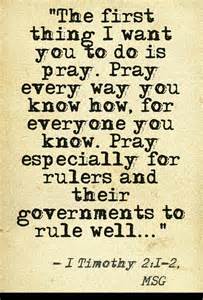
Reading again from 1 Timothy 2, “I urge, then, first of all, that petitions, prayers, intercession and thanksgiving be made for all people— 2 for kings and all those in authority, that we may live peaceful and quiet lives in all godliness and holiness. 3 This is good, and pleases God our Savior.”
I’ll stop right there. Not because the rest of the reading is unimportant. No! But, because Paul has so many ideas that are bursting out of him one on top of the other, I am afraid we might be overloaded if I read them all.
I am on social media, daily. I feature some things regularly, including my Daily Prayer posts. I have posted Daily Prayers on my public Facebook page for five years now. I see it as something I can contribute for my Facebook friends, and for friends of friends, too. I post a prayer each evening that I find meaningful, and I hope they can be helpful to others, too. ‘
Other people have regular habits or practices of prayer and meditation. That is what the Apostle Paul talks about here! I am in a doctoral program for Spiritual Direction, which some people refer to as spiritual companionship. That’s coming alongside of another person, or a small group of people, being a long-term companion. Walking with them, sitting with them through their joys and through their difficulties and sorrows. I have a heart for listening to people’s stories, challenges, and difficulties in their lives. Plus, I pray with people through these things.
You recognize that is what we do in church, don’t you? In our Intercessory Prayers each week, we – as a congregation – come alongside of individuals and families and pray with them through their joys, challenges, and various difficulties. That is exactly what Paul tells Timothy to do here! This reading is a prescription for intercessory prayer in a worship service!
I know that believers and followers of Christ, Paul and Timothy were very much in the minority in their communities. The majority opinion and the overwhelming cultural context for both of them was one of a worldly avarice, where people were concerned about “me, first!” and “where’s mine?” This call to intercessory prayer was very counter-cultural!
Let’s look again at what Paul recommends. Paul begins the chapter by encouraging Timothy to offer prayers for all members of the human family during church services.He wants petitions, prayers, intercession and thanksgiving – all integral parts of praying – to be made for all people. That is not just for a few, or a family, or “only for our little, insular group of people.” No! Paul is recommending to Timothy that we pray for ALL people.
He mentions prayer in the terms of: petitions (humble, general requests to God), intercessions (requests, pleading for those in need), supplications (requests for ourselves, especially when faced with a crisis) and thanksgivings (expressing gratitude for blessings we receive). [1] All people need to be held up to God in prayer.
That means for everyone. Period. Even for mean people. Even for people we disagree with. Even for people who don’t look like us. As the modern translation from “The Message” of this reading begins, “Pray every way you know how for everyone you can.” Period.
Especially in the past few years in this country, division, discord, and dissension of large portions of the American population has only speeded up in the last few years, fueled by increasingly divisive rhetoric, shrill podcasts, and fraught news reports, as well as the regional and national conversations.
As Rev. Sharon Blezzard said, “Good news doesn’t usually sell publications or improve ratings. It takes bombast, divisiveness, and catty, snarky repartee to make headlines, not prayerful peacemakers standing in the breach attempting to reknit brokenness in quiet relationship building and listening. But we are called to a different way of being, to a stewardship of self and other that places value on people, on relationships, and on the building up of community.” [2]
God has not called us to be snarky or mean, nasty or divisive. God does not want big bullies on God’s team. I have never heard of God approving of or cheering on hateful, spiteful Christians, either.
Instead, when we “Pray every way you know how for everyone you can.,” Paul reminds Timothy that “3 This is good, and pleases God our Savior, 4 who wants all people to be saved and to come to a knowledge of the truth.”
Remember what the situation was for Paul and Timothy, and for all other believers in that first-century time and place. It is the same for us, today! “We are called to be counter-cultural witnesses to God’s love, mercy, and saving grace. We cannot be a witness if our hearts are filled with hate. We cannot love our neighbors if we aren’t willing to get to know them, and certainly not if we aren’t willing to stop working violence against one another.” [3]
Paul tells us we are to pray for all people; and we are to follow Paul’s lead in supplications, prayers, intercessions and thanksgivings. The intention of such prayers is so that we Christians in society will be able to live tranquil and quiet lives. This isn’t me saying it. It’s the apostle Paul!
Regardless of whether there is peace in our church, peace in our neighborhood, or peace in our country, prayer is always a good idea. Having a close relationship with our Lord and Savior Jesus Christ is the reason we are here. Praise God! Thank You, Jesus. Alleluia, amen.
Lost and found—this concept is very real and meaningful to many people, especially children. I have four children, and at various times, they have had to go looking for various possessions of theirs. You know, small items, things that were very precious to them somehow got lost. And oftentimes, they went looking everywhere for those precious things.
I can remember when my son was younger, probably in first grade. He had a favorite stocking cap he wore almost every day in the winter. He wore it to school, out to play, on the weekends, almost everywhere. And then, one day it got lost. My son could not find it anywhere. He was heartbroken at the loss of this precious stocking cap—precious to my son, at least. We searched everywhere—and I mean everywhere—in the house, in the car, in his classroom, in his locker. He even looked in the lost and found at his school. Sadly, we never could find it.
Can you relate? Have you ever lost anything that was precious to you? Maybe not valuable in a monetary sense, but precious to you, your very favorite. And let’s go further. What about the things that are worth a great deal? Valuable in a very special way, in terms of both monetary and sentimental value. Losing something precious can be quite a blow.
This is exactly what our Lord Jesus talked about in our scripture passage today. He tells the parables of the lost things. In fact, one nickname for this chapter, Luke 15, is the chapter of the lost things—the parables of the lost sheep, the lost coin, the lost son.
Dr. Luke sets the scene for us. He says, “Now the tax collectors and sinners were all gathering around to hear Jesus. 2 But the Pharisees and the teachers of the law muttered, “This man welcomes sinners and eats with them.” Tax collectors and “sinners” were two groups of people who were especially hated by the good, synagogue-going Jews! And, especially by the Jewish leaders, the Pharisees and teachers of the Jewish law, who had particularly high standing in their local community! How dare that upstart Rabbi Jesus waste His time with riff-raff, with no-good, low-class, dregs of society?
And, that’s not all the Rabbi Jesus is doing! “Eating — that is, sharing table fellowship — is a mark of camaraderie, acceptance, and friendship. And so in eating with tax collectors and sinners, Jesus is demonstrating a deep and abiding acceptance of those society has deemed beyond the moral pale.” [1]
In response to this complaining and carping from the Jewish leaders, Jesus has a response. Three responses, in fact. This week we look at His first parable, the parable of the Lost Sheep. As with many of the parables of Jesus, this one starts out in a straight-forward manner, but somehow doesn’t set quite right.
Jesus says, “Suppose one of you has a hundred sheep and loses one of them. Doesn’t he leave the ninety-nine in the open country and go after the lost sheep until he finds it?” In other words, if you are a shepherd, you put the other 99 sheep at risk! You leave them in the wilderness, with no protection or shelter while you go seeking the one that is lost! And, how about that lost sheep? How does that sheep feel? Lonely? Hungry? Injured? Scared?
From an accounting, balance-statement point of view, the loss of one percent of your stock or flock is an acceptable business loss. Why do we need to leave 99 sheep at dangerous risk? Just for one, single, measly little sheep? But, God does not take that point of view!
Sometimes, people – individuals – get lost. Can you and I relate? “Sometimes you can identify why you feel lost and other times you simply feel unmoored — unable to give a name or reason for a sense of confusion, disorientation, bewilderment, abandonment, loneliness — all of which can be manifestations of lostness.” [2]
I work during the week as a full-time hospice chaplain. It is sometimes my heartbreaking job to go to see patients in dementia, and sometimes even severe dementia. I would like us to listen to this heartfelt vignette from Pastor Janet Hunt, about a longtime family friend.
“Norma became not only a family friend. She was our church secretary (back when we called them that) at my home congregation for forty years. What I especially remember most about that time was that she would listen and answer and go deeper with me about whatever it was we had learned in class that morning. There are a lot of people whose influence factors into one heeding the call to become a pastor. Norma was certainly one of those for me.
“I know that I am blessed to serve not so far from home for I have the chance sometimes, still, to connect with those I knew when I was young. I especially knew it this last Saturday morning for Norma’s son called me up to ask my thoughts about nursing home options here. Both of their parents’ health are failing and her Alzheimer’s Disease, in particular, is making this next move necessary.
“Sunday afternoon I went to see Norma. I sat down next to her daughter and we visited a while. I don’t know for sure if she really remembered me or not, but her smile was as radiant as it ever was. Before I left, I asked if I could pray with her. She placed her hand palm down on the tray table in front of her. I put my hand on top of hers and her daughter put her hand on top of mine. I prayed simply and briefly – asking for God’s protection and strength and peace. When Norma took her hand back, she wiped her eyes for those words had somehow broken through.
“She may only have pretended to remember me, but still she knows somehow that God remembers her. Slowly but surely the disease that is erasing her memory will not finally erase what matters most. In some ways, she may seem ‘lost’ to those who have loved her, but she is not lost to God. I expect, or at least I hope, that in that moment she knew God’s persistent love embracing her once more. ‘Found’ once more, I hope her comprehension of God’s tender love for her never leaves her.” [3]
No matter how we are lost, how we are wandering in the wilderness, in the hospital or care center, or when we concentrate so much on our physical or financial situation, or in the busy-ness of life, running from place to place – God never stops seeking us. We know who is loving and caring and seeking for each of us.
Which of you, Jesus asks, would go to such lengths to search and find and then welcome back and celebrate? Truth be told, none of us would. But God would. [4] Our Good Shepherd goes after me, and after you, too. He searches for us, and makes sure that we are back with Him, in the place of security and protection, and says, “Rejoice with me! For I have found my sheep that was lost!” To me, the news about our good Shepherd is the best news in the world. Alleluia, amen.
(I am on vacation this week, or rather, a stay-cation. Enjoying stepping away from pastoral and preaching responsibilities. Here is a sermon from the beginning of July 2007, when I was co-interim pastor of a (sadly) now-closed little church, St. John’s United Church of Christ in Evanston, Illinois.)
Acts 2:42 July 1, 2007
“Approaching God in Community”
Life here in America, even here in the Chicago area, in the 21st century can be lonely. People often live alone, drive alone, shop alone, even work alone. Many people do not talk about their lives, are never asked how their day is going, rarely experience a caring touch. Loneliness and a sense of isolation are part and parcel of many people’s daily lives. Unless people intentionally make an effort to interact with others today, whole days—even weeks can go by without meaningful encounters.
There are lots of reasons for this. The rapid communication trend with ever increasing speed has distancing, impersonal effects on many. The nuclear family is fragmented, now more than ever. Technology will continue to develop, and businesses downsize, fragmenting society and driving people further apart. And then, of course, we need to consider the speed with which everything is going now, so much faster than fifteen or twenty years ago.
A retired pastor friend of mine told me a while ago about some elderly people at a church he pastored, a number of years ago. Some of them lived alone, either in houses or apartments. My friend told me about the loneliness that drove several of them out to the grocery store every day, because if they did not have that interaction with the checker checking out their food, they would not have a personal encounter in the entire day. A few were so hungry for personal contact, they desperately wanted the physical touch that comes from an exchange of money at the cash register; so simple, so fleeting.
Similarly, some people today are searching for an interaction with God. George Barna, the guru of surveys, statistics and demographics, found that 49 percent of people who do not attend church, in the 1990’s—less than ten years ago—wanted a close relationship with God. These are people who do not even darken a church door. The percentage is even larger when we consider the people who do attend church. There is a common desire among many to have an encounter with God. Saint Augustine referred to it as a God-shaped hole in our hearts.
This longing for God, this desire for an encounter with God, I see as similar to longing for human contact. Both longings stem from a deep loneliness, a need for something internally, a kind of relationship. Many people are yearning for some kind of deep relationship in their lives, both horizontally—with other human beings, as well as vertically—with God.
However, there is a problem. This longing cannot be filled. The encounter—both vertically as well as horizontally—that many people want to have cannot happen. Something gets in humanity’s way. Something is in our lives and hearts, and acts as a block, a separation. You know it as well as I do, and this something is sin. Sin is a separation; it comes between us and other people. Sin comes between us and God.
I won’t dwell on sin much, other than to say that it is a prideful, selfish, sometimes downright rebellious attitude. The “me, first!” attitude that comes between us and other people, and especially comes between us and God. And that deep-down attitude separates us, builds walls, and keeps humanity from developing relationships, from having meaningful, honest encounters.
But there is good news. God wants to break down that separation, and allow us to encounter Him. The Bible tells us that Jesus had willingly taken our sins on Himself to pay the “wages of sin” in our place! And God the Father made it clear to everyone that He was completely satisfied with this payment by the fact that He raised Jesus His Son up from the dead! And so, the way is now clear for us to have the relationship with God that we were meant to have! At last, the “hole in our souls” can be filled to our satisfaction, this deep-down longing for God can be filled.
So this is good news! This is very good news! But I haven’t even started to examine our scripture passage for this morning. I wanted to take a brief look at the second chapter of Acts.
Peter—you all remember Peter, don’t you? Peter was just finishing his sermon in Jerusalem, on the day of Pentecost. The book of Acts records one of the biggest altar calls ever. About three thousand people welcomed the gospel message of Peter into their hearts, and joined the brand new group of believers that day. Talk about a soul-winning campaign! God touched the hearts of thousands of people that day, and drew all these people to Himself. God had a close encounter with each one of these people that day.
One of the most amazing things we can learn from this passage is that God not only repaired the way for Him to have a relationship with each person, vertically-speaking, but this lifting of the sin-separation repairs the way for us as individuals to have a relationship, to have an encounter with each other. God causes the separation to disappear, both horizontally, as well as vertically.
Listen again to the passage, starting at Acts 2:41-42. “So those who welcomed his message were baptized, and that day about three thousand persons were added. They devoted themselves to the apostles’ teaching and fellowship, to the breaking of bread and the prayers.”
Welcoming the message of the good news is the first part I want to consider. God repaired the separation. About three thousand people came to faith in the message Peter preached. God drew these people to Himself, reached their hearts, and caused the separation of sin to disappear.
Do you hear? Do you understand? God wants to approach us just as much as we want to approach Him—more, even, since God’s love is higher than the highest heaven and deeper than the deepest sea. And God has made this possible by the death of His Son on the cross, reconciling us to Himself, breaking the separation that divides us from God.
But wait—that’s not all. Not by a long shot.
God not only wants to bring us into a close relationship with Him, God wants each of us to come into a relationship with each other. And what an awesome opportunity to do both at the same time. In worship, we have the opportunity to experience a close encounter with God and with other people worshiping with us.
We here at St. John’s Church call this congregation a church family. Well, that’s exactly what Dr. Luke had in mind as he wrote the book of Acts. He wanted to emphasize that separate, lonely, desperate individuals not only developed a relationship with God, but through their heartfelt belief, they developed a relationship with each other. And that relationship, that fellowship has the opportunity to be realized in worship, together.
In centuries past, congregations took the opportunity to worship actively together. Congregational singing, reciting creeds, celebrating communion, reading liturgy, passing the peace—all of these are expressions, activities that congregations used to do together. But, there’s more. Much, much more. God is pleased when we are creative, and what better way to be creative than in worship and praise of our God.
Now, especially in some churches, worship is becoming increasingly a passive activity. Just sit back, and watch the show up front. But this isn’t a way to have a relationship with God, or with our fellow church family! People cannot interact with God and with others if they don’t have anything to do on a Sunday morning in a worship service.
God wants a relationship with us. God wants to get in touch with us. And part of that interaction comes from our getting in touch with each other. As someone here in the congregation mentioned a couple of weeks ago, it is especially at times of deep emotion that a congregation can pull together and show love and concern for each other.
It would be silly to think that a relationship could be built simply on loving thoughts and nothing else. No, a relationship is built on regular interactions, close encounters on a regular basis. The book written to the Hebrews advises these believers not to neglect the assembling of themselves together. They were to assemble regularly for worship. I’d like to go even further, and suggest that we not neglect worship that is interactive—not only between the congregation and God, but between the members of the congregation.
God is offering you, offering me, the opportunity for a relationship with Him, as well as a relationship with our church family. The options are there in front of us—loneliness and separation, both vertically as well as horizontally, or relationship and fellowship, with God and with our church family.
What does this look like? I don’t know, exactly. It’s different for different congregations. God is a God of infinite variation, and I suspect He accepts worship of all different kinds, just as God accepts people of all different cultures and people-groups.
I invite you to start praying about worship, and talking about it with each other, too. Some here may feel rather skittish, or downright silly, entertaining different and new ideas about worship. Some may even feel like they’re “breaking the rules,” but that’s okay. This interactive worship, both in a horizontal way as well as a vertical way, is truly biblical worship. It is truly a way for us to approach God, as well as each other. And in this day and age, that’s what humanity needs—a close encounter with God, as well as with each other.
Have you ever been far from the city lights, at night? Have you ever looked up into the sky, and seen countless stars spread out, twinkling high above? When I went to the Upper Peninsula of Michigan, and again in rural central Indiana, the starry skies were absolutely breathtaking. Amazing. Majestic, as the psalmist King David said in our Psalm reading today.
Listen again: “Lord, our Lord, how majestic is your name in all the earth! You have set your glory in the heavens.” I can just imagine King David sitting far away from the lights of the city of Jerusalem, perhaps contemplating the stars as he saw them in his youth, when he looked after his father’s sheep, or as a younger adult, a leader of men in the wilderness of Judah, David certainly had many opportunities to gaze up into the night skies and see the breathtaking stars.
As we gaze up into the night and see the amazing sight of all the stars laid out above us, we marvel. Marvel just as countless people have done throughout the millenia. As we think about the vastness and sheer beauty of the heavens, other vast, even unanswerable questions may come to mind. Just as countless people have done, and have reflected upon. Questions like: What was God doing before God created the world? And, how can there never be a time before or after God? And, how can God pay attention to each person in the world all the time? [1]
These kinds of big questions have puzzled people for millenia, too.You and I could get hung up on these kinds of questions, and totally lose sight of the sheer, magnificent, bottomless awesomeness of God. Or, are we simply to return to the first verse of today’s reading, and be totally in awe at God’s glorious majesty? “Lord, our Lord, how majestic is your name in all the earth! You have set your glory in the heavens.”
My husband tells me when I am thinking about big ideas, I am sometimes too focused on individual trees, rather than looking at a whole forest. That is what comes to mind when I get sidetracked by wondering what God was doing before God created the world. Or, maybe, why did God create rattlesnakes and mosquitoes? Perhaps – it is okay just to contemplate the vastness of the heavens and the sheer beauty of all the stars, comets, moons and other creations in the universe! Just as Psalm 8 invites us to do.
“How majestic is your name.” That’s the line that stands out, maybe because the psalm begins and ends with those same words. “How majestic is your name.” That sounds wonderful, indeed! Our opening hymn was written by Michael W. Smith, and we sang these exact words at the beginning of our service. And, the words sung by the angels, the seraphs flying around the heavenly temple in Isaiah 6 – they kept singing, kept repeating “Holy, holy, holy is the Lord of hosts, the whole earth is full of God’s glory.”
Over and over, the seraphs sang those words. And, it is sometimes in the singing and in the repetition that the majesty and awesomeness of God begins to make sense. I mean, as much as it can, to our puny, limited, human comprehension.
The concept of the Trinity, one God, Three in One, is a difficult concept to start to believe, much less fully comprehend. For a small comparison, we can look at water. Water is liquid, at room temperature. Yet, when we freeze water, it turns hard. It becomes ice. Is it still water? Yes. And, when we heat up water, it turns into steam – becomes gaseous. Is it still water? Yes.
This example of the three states of water is an imperfect way to talk about the Trinity. Yet, we can marvel at the awesome complexity of the doctrine of the Trinity just as we marvel at the glory and magnificence of our God and God’s creation, just as Psalm 8 leads us to do. Whether we sing about our awesome God, talk about the glory of God, or contemplate God and God’s magnificent creation, it’s all good. And, all these activities are exactly what we are led to do throughout the Bible, and especially here in Psalm 8.
Looking to the skies and contemplating the glory of God may be a sincere way for people to begin to try to understand how huge God is. And, if we are coming at the theological concept of the Trinity – which is also a huge thought – perhaps it’s best for you and me to think about this huge thought from God’s end of things, from God’s point of view. Whether you and I “can fully grasp the nuanced theological understanding of what Trinity means, we can acknowledge that, in part, it means that God wants to be known and experienced by those who claim the majestic name of God as sovereign. We give thanks for an accessible God.” [2]
I return to one of my tried and true ways of looking at biblical things, from a theological perspective. You all know that sometimes I view the topics or ideas from my sermons in a way that children see them, or in a way that young people more readily understand. Psalm 8 tells us about the wonders of God. Even little children can (and do) accept this as the truth of God! However, little children are definitely not interested in explaining how or why, or about lengthy sermons droning on about different theologians and their competing view on God and the Trinity.
Very often, deep down, children understand that God made them and God loves them. This is a foundational truth! You and I can have – along with the children – a “simple” and “trusting” faith. We don’t need to use the “right” words in our prayers and creeds. Remember – God wants to be known by us, above all! And, our Lord wants to be experienced by all who claim the name of the majestic God. By those who praise God’s name.
Yes, the theological understanding of the Trinity is also a deep theological truth. Yet – I can tell you right now that we as fallible, frail humans fall short of understanding God’s ways. I can also tell you that in the midst of everything, we can know we are loved. God wants each of us to know our Lord intimately! As my commentator the Rev. Dr. Derek Weber says, “We are being made more like the Christ we follow. Our love is being shaped by God’s love that is poured into us. We are God’s act of creation. That’s a part of the message of Trinity Sunday. The Creator works within us, choosing us to be a sign of God’s presence in the world.” [3]
Yes, God’s message is quite simple. We can know we are loved by God. God wants each of us to know our Lord intimately! And, our awesome God works within each of us, choosing each of us to be a sign of God’s presence in the world. This is the best Good News we can bring to the world. Alleluia, amen!
Throughout history, we can trace many battles between enemies. I don’t mean outright war, like between armies with guns and tanks and bombs, but I mean enemies, nevertheless. Serious sports rivalries can turn ugly, causing fistfights and even rioting. Factions and strife in a town can even cause a cohesive neighborhood to break up. And in recent times, political differences can cause serious rifts between former friends. Deep tension even makes family members stop speaking to each other, sometimes for years.
What is this corrosive feeling between enemies? Some say envy, others say fear, others say hatred, plain and simple. Which brings us to the Gospel reading for today. What does Jesus say about enemies?
First, we need to back up, and remind ourselves of what came just before. Or rather, what we heard last week. Just a reminder that Luke chapter 6 contains much of the same information that Jesus preached in Matthew, chapters 5, 6 and 7. Matthew’s Sermon on the Mount—leading off with the Beatitudes—is summarized in about one third of the space, right here. In Dr. Luke’s Sermon on the Plain.
I do not want you to take my word for it! Let us listen to the words of our Lord Jesus, again, the words I am highlighting for us from the Sermon on the Plain. “27 “But I tell you who hear me: Love your enemies, do good to those who hate you, 28 bless those who curse you, and pray for those who mistreat you. 29 If anyone hits you on one cheek, let him hit the other one too; if someone takes your coat, let him have your shirt as well. 30 Give to everyone who asks you for something, and when someone takes what is yours, do not ask for it back. 31 Do for others just what you want them to do for you.”
Loving our families? Yes, certainly. Loving our acquaintances? Well, that seems possible. But, loving our enemies? Those who are mean to us, or hurt us? Humanly impossible!
How on earth does anyone expect us to love our enemies? “Are these words we really want to hear, to really listen to, and perhaps change our lives around? Well, no, let’s be honest. [Especially in today’s political climate] we live in a world that nurses grudges, that licks wounds, that lives to get even. Talk about swimming against the tide. These words of Jesus here in the Gospel of Luke sound like a discordant note out of tune in the symphony of our lives. Love your enemies? Come on!” [1]
How does Jesus expect anyone to even come close to loving their enemies?
Jesus’ own country of Israel was under occupation. Just imagine occupied France or the Netherlands during World War II under Nazi occupation, and you are on the right track. The hated Romans were Israel’s overlords, and the whole country had to pay Roman taxes. Essentially, paying tribute to Caesar and his armies. The Roman soldiers threw their weight around, and it was backed up by the threat of force of arms. In other words, Roman garrisons were stationed in towns throughout Israel, keeping the populace in line and making certain there was order in Rome’s occupied territory.
Somehow, I doubt whether the Rabbi Jesus scored many points with either the Jewish leaders or the Jewish people by preaching about loving their enemies.
Let’s take a closer look at what our Lord Jesus actually said. He repeats the same charge, the same command, four times. Jesus says, and I quote, “Love your enemies. do good to those who hate you, 28 bless those who curse you, and pray for those who mistreat you.” In other words, love those who hate you. Love those who curse you. Love those who abuse you.
In Scripture, where there is repetition, pay attention! The speaker is making a huge point! And, repeating it four times, with slight variations – Jesus underlines His point, right here!
Jesus actually provides more context. Love, do good, bless, pray for. In these four specific but related ways Jesus tells us how to put this command into practice! Jesus is NOT telling us just to roll over, or play dead, or sit and take whatever enemies deal out. No! Jesus “doesn’t tell us to be the doormat of anyone and everyone. What He tells us is, don’t become them. Don’t harbor the kind of corrosive hate that allows abuse and cursing to happen.” [2]
I would like to remind everyone that this Gospel reading from Luke this morning features the Golden Rule: “Do unto others as you would have them do unto you.” In the United Nations Building in New York there is a large mosaic by Norman Rockwell that depicts people of all ages, of different genders, and many nationalities; embedded within the tiles are those same words, the words of the Golden Rule.Yes, they are the words of our Lord Jesus! We need to recognize that they are also words from other faiths, other traditions, and other cultures. [3]
We can see how we might begin to love our enemies, by treating them the way we want to be treated ourselves. Please, notice the variations in what Jesus says. “Do good” means encounter, to get close enough to impact our enemy’s life, in some way. As we encounter in love, we are treating our enemies as we ourselves wish to be treated.
When we “bless” our enemies, that can be at arm’s length. Perhaps it is not so safe to come nose to nose with our enemies. When enemies are cursing us, sometimes it might be very prudent to step back. However, we can still bless them, with all sincerity! Blessings can come from a distance, and be just as effective, too.
We can “pray” while our enemy or abuser is at work or some distance away. And, we always need to act with prudence and wisdom. It is so important that we “pray for God’s healing and God’s love to transform the abuser. Leave behind the inclination to return the hurt as you have been hurt. [That inclination] doesn’t help with healing. It doesn’t make right what has been a horrible wrong. Let it go and love. Love from a distance. Or better yet, pray that God’s love can do what your love is incapable of at the moment.” [4]
And if all else fails – if we just cannot, cannot love enemies by our frail, human selves – we can pray that God will step in and love our enemies with us, through us, and even – despite us.
Please God, help us all to love our enemies, as Jesus commands. If you need help? Ask Jesus. He will help us to love everyone, and help us as we follow Him.
(Many thanks to the website www.umcdiscipleship.org for their preaching notes for Epiphany 7! I am very grateful to this wonderful website for several significant ideas for this sermon.)
One of the most popular themes for songs is that of love. Songs that describe love of one person for another, or songs that tell about how awful it is to have unrequited love. Also, songs that tell about the emotions and feelings that come with being “in love.”
One classic popular song written by Burt Bacharach and Hal David talks about love in a basic and simple way. Saying, “What the world needs now is love, sweet love.”
What is the state of the world, anyway? Judging from a quick view of the local news, the city of Chicago, the state of Illinois, the federal government, the uproar in Washington D.C., unemployment, not to mention abuse of different kinds—against women, children, and seniors. That is not even mentioning the various armed conflicts throughout the world—fights over territory, disputes over resources, differences between people of different religious beliefs.
What can possibly bring harmony, hope and wholeness into the world today?
This brings us to our scripture reading for the day, from 1 Corinthians 13. This chapter is called the Love Chapter. It is so often used as a scripture text for weddings! Perhaps you or a friend or relative had this chapter read at a wedding. But, did you know that the apostle Paul did not write this chapter to glorify romantic love?
One of my favorite commentators, Karoline Lewis, states “that this “Wedding Text” is not a passive, observable event that seeks our affirmation and support, but something that calls for our participation. This is not a text where we are asked to look on as guests, dressed for a party and seated dutifully in the church pews, but rather necessitates our involvement.”[1]Did you hear? Our participation! Our involvement!
We are not supposed to sit quietly in a pew and let love happen to us. We are not supposed to sit in the bleachers while the professionals handle this love business. No! Let us take a closer look at exactly what Paul tells us to do, and how we are to get involved.
Let us listen again to a portion of the words of 1 Corinthians 13, as brought up to date by Eugene Peterson in his modern translation “The Message.” “Love never gives up. Love cares more for others than for self. Love doesn’t want what it doesn’t have. Love doesn’t strut, Doesn’t have a swelled head, Doesn’t force itself on others, Isn’t always “me first,” Doesn’t fly off the handle, Doesn’t keep score of the sins of others, Doesn’t revel when others grovel.”
This is a penetrating way to teach people. Show them by example—examples ofhow not to love. Examples of jealousy or boasting, arrogance or rudeness. And especially, an example of a horrible injustice, where people are openly bigoted against females. (This can also be true of people who are bigoted about other differences, too, like about handicaps, or people of color, or of a different class of people, or of other nationalities or countries of origin.)
Those bad examples? Paul shows us clearly in this passage—don’t do those things! Don’t be that way! Sometimes, a bad example is the quickest way to our hearts and minds.
Paul was involved in a longer argument here in chapters 12 and 13 of his first letter to the Corinthian believers. Chapter 12 was all about the spiritual gifts that came from God, and meant for the strengthening of the body of Christ – the Church. Then in chapter 13, Paul zeros in on the most excellent of all of these God-given gifts. The gift of love. (or, charity, if we are speaking in a more flowery, King-James-version kind of a way).
In this section I just read, Paul tells his friends and former church members what love is definitely not! Doesn’t strut, doesn’t have a swelled head, isn’t always “Me First!” Paul was making comparisons here! He had lived in the city of Corinth for many months, while he was pastor of this young church. He knew the rough and tumble, political attitude of the general population of the city of Corinth. Plus, he knew that this uncaring, callous attitude was rubbing off on the people inside of the church, too! That is why he wrote these words.
If we want to find out more about 1st century Corinth, “Charity [or, love] was not the activity of his opponents that spread their agenda. They promoted themselves, acted with arrogance, even engaged in shameful activities (backdoor politics?). As they sought personal gain, they provoked others, instilled animosities, and celebrated when others “lost face.” These were not the hallmarks of Christian community.” [2] In fact, all this crony-ism and inside politics sounds sadly familiar to me. But then, I grew up here in Chicago.
Instead, the apostle Paul gives us a marvelous example of what true love – and Godly caring, support, empathy – looks like. Listen again: “Love never gives up. Love cares more for others than for self. Takes pleasure in the flowering of truth, Puts up with anything, Trusts God always, Always looks for the best, Never looks back, But keeps going to the end.”
I don’t need to scramble and strive to love all by myself, trying really, really hard. It’s not all me, putting together my own faulty, human kind of caring. No! God freely gives gifts of love to all God’s children. That is what true love looks like. This is what true church looks like, too.
We can clearly see that Paul’s ministry of love, harmony and wholeness is for the whole world. Not just about taking care of those in our own families, although that’s important. It’s more than “taking care of our own,” although that is certainly laudable. It’s about showing love for everyone. For those affected by loneliness, or despair, disaster or disease wherever they are, without exclusion of those not like us or even of those we fear. Everyone.
Ending as I began, we look again at the Bacharach and David song, “What the World Needs Now.” The chorus of the song tellsus the world needs love, sweet Godly love. Needs it badly. “No, not just for some, but for every, every, everyone.” Amen, Lord. Amen.
Photos are marvelous at capturing memories. Now, of course, almost everyone snaps photos with their cell phones. But, can you remember looking at old photos? Especially when we are together with good friends or relatives, and several of us look at the photos together, pointing out special features, memories can come to life!
Memories are special things. Perhaps you have a memory of an exciting event, or of a special friend or relative, and the photo perfectly captures your memory. And, when you are with others now who were there for that special event in the past – something wonderful can happen.
I wonder how many of us can remember our baptisms? In this particular church’s tradition, I know the pastors almost always baptize babies and small children. That is a particular theological view of baptism, and one where we affirm that God extends heavenly blessing and grace to all, regardless of when they come before God in baptism.
How often have you have seen someone get baptized? What do you think of when you remember? The darling little child, getting baptized? The proud parents and sponsors, bringing their child forward to be welcomed into God’s forever family? The congregation, promising to teach this little one the ways of God, and to help the parents bring up this child in a manner pleasing to God?
Well, that’s today. That’s one common understanding we now have of baptism.
What about our scripture passage today? This section of Luke’s gospel tells about John the Baptist, baptizing people in the wilderness. John was a prophet of God. He was set apart for a special purpose, to give out a special message from God. The companion Gospel of Mark even tells us a little about John—about the rough clothes he wore, and the food he was able to scrounge from subsistence living where he was in the wilderness, some distance from Jerusalem.
Two thousand years ago, John the Baptist wanted adults to confess their own sinfulness, to realize that each one had sinned and fallen short before God. As a result of that confession, John would then baptize each one. This is a slightly different view of baptism, and one that was (and is) just as valid. And, we come back to Jesus, waiting patiently. Jesus wanted John to baptize Him, too – even though Jesus never sinned.
The Rev. Jeff Campbell relates, “A loving God is constantly reaching out, wanting to be at the center of our lives. And although we might still have questions, we are directed to Jesus, just as John directed those gathered who were seeking a Messiah.” [1]
As we consider this baptism of Jesus focus of our service today, some may wonder about who John was. As we see in these Gospel accounts of Jesus’ baptism, some wondered there, too. In Mark’s Gospel, he tells us they were questioning in their hearts whether John the Baptist might possibly be the Messiah. John redirected their questioning and their gaze by pointing to one who would come after him. John pointed to Jesus.
Jesus was an extra-special case, since He already had an intimate relationship with His Heavenly Father. Looking at today’s reading, we can see what happened, from Luke’s account: “And as [Jesus] was praying, heaven was opened 22 and the Holy Spirit descended on him in bodily form like a dove. And a voice came from heaven: “You are my Son, whom I love; with you I am well pleased.”
As we consider these loving words of the Lord, there are several things that are abundantly clear. God says this about Jesus before he has taught anybody, healed anyone, or died on the cross. As we remember this remarkable event at the beginning of a new year, God’s statement especially reminds us that God loved Jesus and loves us not because of anything we do but just because God loves us. Period.[2]
Some people have the idea that baptism is needed and necessary for salvation. Other people see the baptism of infants and young children as a sort of rite of passage, something that needs to be done, and so they want their minister to “do the baptism.” Some faith traditions encourage this way of thinking and this kind of theology. [3]
John baptizes Jesus. In centuries to come, many differing views arise about John’s simple, straight-forward act of baptism. We don’t know if Jesus was immersed or sprinkled. We don’t know which liturgy John prefers, or if the vows that Jesus made were the same as the ones we make or not.
However, baptism is a sign of this marvelous, free gift of God’s love. God’s rich and abundant love and grace are poured out. As we can see from our reading today in Luke, all the people present received this marvelous gift, this love and grace from God. And, each of us is encouraged to follow the example of our Lord Jesus, and be baptized, too.
Just a short time ago we celebrated the birth of the Baby born in Bethlehem. We remember in the fullness of time, Jesus was nurtured in the water of Mary’s uterus. We remember Jesus was baptized by John in the water of the Jordan. We remember that Jesus became living water to a woman at a Samaritan well. We remember Jesus washed the feet of the disciples. And, we remember Jesus sent His friends forth to baptize all peoples, all nations, by water and the Holy Spirit.
Yes, Jesus was baptized, and received this affirmation of God’s love at the beginning of His ministry! As we remember our baptism, we also remember that each of us received this same love and grace from God through water and the Word.
Praise God. What wondrous love towards our Lord Jesus. What wondrous love toward each of us. God calls each of us beloved. With each one of us God is pleased.
Merry Christmas! What a wonderful expression. People greeting each other on the street, in the stores, here at church. I know not everyone celebrates Christmas, but still. What a joyous time of the year. Today, we are here at the 4th Sunday of Advent! Many, many people can hardly wait for the arrival of Christmas Day! Especially for children, I bet some people are so excited that they hardly sleep a wink for the next few nights. (But that’s mostly for reasons of Santa and presents under the tree, not for the religious reasons I’m talking about this morning.)
Merry Christmas, many people say! But I want you to go back, two thousand years. Go back to a time when “Merry Christmas” was not even a phrase, a wish, not even an idea in people’s heads. Go back to the time Dr. Luke describes in his Gospel. Back to the time when Israel was an occupied country, and the Roman Empire was the occupying force. Back to the time when all people in Israel needed to be enrolled. The Roman government decided to have a census, so that they would be able to tax the people of Israel more accurately.
We remember this census. The Holy Family, Joseph and his fiancée Mary, went to Bethlehem to enroll, because Joseph was a direct descendent of King David. I suspect there were many people on the roads. Today, traveling can be stressful and nerve-wracking. I am certain travel in the first century was much more difficult. Poor roads, with many people walking to get from one place to another. We might imagine that Joseph and Mary had a donkey, but nowhere in the Gospel is that mentioned. Travel conditions were challenging, at best.
Wait a minute. Do we really concentrate on the difficulties and trials of travel to Bethlehem, of the labor and birth of a baby without medication, or of any of the rest of this real-life narrative from Luke chapter 2? Or, do we imagine a nice, tidy, picture-perfect Christmas card? With Mary in a rich, bright blue robe, gazing lovingly at her radiant newborn baby, Joseph looking adoringly at both mother and child. Not to mention the cleaned-up shepherds gazing in wonder, their tidy, well-groomed sheep lying quietly in adoration, too.
That picture-perfect Christmas card was not what actually happened, not by a long shot. Mary felt the pains of labor begin. What a scary thing! To be far, far from home, in an unfamiliar place, and to have such a significant event happen. Significant, and potentially life-threatening, too. Plus, anyone who has worked with large animals (even many smaller animals) knows what a group of them smell like. That’s where Jesus was laid, in a manger among the animals. And, is anyone familiar with the hustle, bustle and smells associated with the labor and delivery room of a hospital? This refocused picture of the birth is not all gentle, meek and mild, to be sure.
As Luke tells us, there were shepherds abiding in the fields, keeping watch over their flocks by night. When messengers personally come to deliver a special announcement, it is a big deal. These angels coming to the shepherds, well, that was a super big deal, to be sure!
And the announcement? This isn’t the birth of a normal, ordinary baby. No! This baby is an extra special baby. The Messiah, who will save His people from their sins. Did you hear? This special baby, this Savior, Christ the Lord, is born to you—to me—to all of us, in the city of David, which is called Bethlehem.
Did you hear? The Savior, the Christ, the promised Messiah, came into this world as a Baby. The Eternal Second Person of the Trinity, Creator of the whole universe, God the Son, emptied Himself of all God-ness. Took on humanity, and was born as a helpless Baby. That is not only good news, that is earth-shaking news. Good news of great joy for all the people. For you, for me, for all of us. How better to communicate to earth than to become one of the frail human beings God intended to reach?
The Almighty God who made all of heaven and earth, the powerful God who can hold the incomprehensibly vast universe in the span of God’s fingers? Yes, that same God wanted to reach to earth—reach to each of us, to all of us, in love. With love. Through love.
That loving outreach is from God’s point of view. Yes, the Almighty God sent the Baby in Bethlehem to earth, in love. But, what if frightened, nervous humans did not in the least expect that? What if short-sighted humans closed their eyes and their hearts to the possibilities of God’s love breaking into the world in such a tender way?
Mary could have been frightened half to death of the angel and closed her heart to the Divine possibilities that blessedly came about. But, Mary chose love. She chose openness and possibilities that transformed her heart and her life.
When Mary’s baby was born, Jesus spoke quietly through the blood, sweat and tears of the labor pains of that young woman. Jesus cried softly as an infant, and allowed us all to see the unimaginable caring, the oh-so-tender love that Almighty God expressed, to each one of us. And, each of us is embraced in God’s everlasting arms of lovely love.
One of my favorite Christmas carols talks about this very thing. This Christmas poem—before it was set to music—was written by Christina Rosetti in 1885. Here is the first verse:
Love came down at Christmas, Love all lovely, Love Divine, Love was born at Christmas, Star and Angels gave the sign.
Love Divine was born at Christmas. Born for you, born for me. Praise God, our Lord and Savior Jesus was born as a Baby in Bethlehem. Yes, He would preach and heal and suffer and die. And, yes, He would rise again on that Easter morning years later.
Yet—right now, we rejoice in the blessed fact that Jesus was born.
Praise God, we, too, can stop by that manger in Bethlehem, and be caught up in the wonder of what happened that night, so long ago. We, too can welcome this lovely, Godly Love that has come into this broken, weary world, today.







 Pastor, Preacher, Pray-er