Unknown's avatar

“Held Close to God!

“Held Close to God!”

Hosea 11:1-4 – July 30, 2023

            Do you know a family who has a complicated relationship with each other? Some couples and some families have some problems that they deal with on a continuing basis. And how! I see all kinds of things in couples and families right now, in my job as hospice chaplain.

            The prophet Hosea had all kinds of problems in his relationship with his wife and family, too. I don’t know if you know much about the prophet Hosea, but he followed some specific directions from the Lord for his marriage and choice of wife. The Lord told him to marry a prostitute (who would later leave her husband). And, the Lord told Hosea to love her, cherish her and treat her really well (as all spouses ought to treat each other). This was even though – or perhaps because of – her past and future occupation.

Hosea tells a series of stories in this short book – true-life stories, from his own life. The tie-in or connection comes from a very similar story, about the nation of Israel. This true-life story “is that when God’s people were slaves in Egypt hundreds of years before this, God had freed them and led them through the wilderness to a new Promised Land.

“While they were in the wilderness God taught them what it meant to be God’s people. God gave them the 10 Commandments and taught them how to live together and how to love God. It was kind of like teaching a baby to walk. Unfortunately, when they got to the Promised Land the people forgot what God had taught them. They lied. They cheated. They stole from each other. They even worshiped other gods. God loved them too much to let it go on.” [1]

The prophet Hosea was a fascinating story-teller, and he had lots of people in the nation of Israel on the edge of their seats as he told his many-part story from God over a number of years. Hosea has moved on to relating several metaphors or parables. Like this one, here at the beginning of chapter 11.

Remember how I started this sermon? Talking about mixed-up, complicated relationships? That’s what Hosea relates at the beginning of chapter 11. Remember how the people of Israel were slaves in Egypt centuries before this time! Listen again to the words of Hosea: “When Israel was a child, I loved him, and I called my son out of Egypt. But as the saying goes, “The more they were called, the more they rebelled.”They never stopped offering incense and sacrifices to the idols of Baal.”

This child Hosea talks about? This child isn’t just one person. “The child is all God’s people – and they had been really, really rebellious for a very long time. God is about to let them be conquered and taken prisoners to Assyria. It is sort of like God was giving all the people a big “time out.” That’s the secret! “Child” is really all God’s people.” [2]

But first, before mentioning the punishment from the Lord, Hosea gets very tender. Listen to verses 3 and 4. “I took Israel by the arm and taught them to walk. But they would not admit that I was the one who had healed them. I led them with kindness and with love, not with ropes. I held them close to me;I bent down to feed them.”

In this summer sermon series, “Re-Imaging God,” we are looking at a number of Scripture readings which show the nurturing side of God. Or, a loving, mothering kind of God!

While it is much more common for Scripture to show our God as a heavenly Father, especially from the many descriptions our Lord Jesus gives to us while He was here on the earth, the imagery here is very feminine! Can you imagine a mother, teaching her little one how to walk, feeding them, and picking them up when they are hurt or injured? And, what about “leading them with kindness and love?” Our loving heavenly Parent cradling the small child Israel close. All such nurturing, caring activities. Here, Hosea gives his readers a warm, loving word-picture of our Lord. Such tender compassion shown!

Who remembers reading children’s picture books? I am thinking of several picture books I read to my small children many times. These books are about a parent who loves their child very, very much, no matter what! These books – “Runaway Bunny” by Margaret Wise Brown and “Mama, Do You Love Me” and “Papa Do You Love Me,” both by Barbara Joosse –  are wonderful expressions of the nurturing, embracing love we as human parents can show.

Hosea tells us a similar story! He insists that God loves all of the nation of Israel as much or even more than a human parent! Even when the people of Israel go their own way, stubbornly refuse to follow their God, and instead follow foreign idols, and other ungodly attractions.   Our God still loves the nation of Israel! And, our God still loves us, even when we go astray!

I can remember my small children not wanting to come home after a long playtime at the playground in the park. I would call them, and every once in a while, they would try to run away and hide, and refuse to come home. Did I walk away, and leave them there at the park? Of course not! I still loved them, even though they were disobedient. I still continued to love them, as they grew, no matter what.

We need to share a word of caution, however. In some families, relationships are definitely imperfect. Some parents feel the angry rebellion of their children. Some teachers face opposition from their students. And, some mentors want to give up on their charges. Plus, some children have parents who are distant, uncaring, or even hurtful. If that is your experience of your parents or grandparents, I am sad and sorry, and have great compassion for you. [3]

            But, there is Good News! In fact, the Greatest News of all!

Our God will never be distant, or uncaring, and especially not hurtful! Even if human relationships are like that sometimes, our relationship with our Heavenly Parent stands the test of time. The persevering love, caring and nurture of our Lord is rock solid and true. We can trust the faithfulness of God in this story that Hosea tells us. Remember, our God is always faithful, always loving, and always has arms outstretched to embrace us. No matter what.  

@chaplaineliza

(Suggestion: visit me at my other blogs: matterofprayer: A Year of Everyday Prayers. #PursuePEACE – and  A Year of Being Kind . Thanks!


[1] http://worshipingwithchildren.blogspot.com/2016/06/year-c-proper-13-18th-sunday-in.html

[2] Ibid.

[3] https://www.umcdiscipleship.org/worship-planning/prophet-margins/eighth-sunday-after-pentecost-year-c-lectionary-planning-notes

Unknown's avatar

Lost Sheep

“Lost Sheep”

Matt 9-36 sheep, shepherd people

Matthew 9:35-10:1 (9:36) – June 14, 2020

In college, I can remember times when I heard fiery sermons about missionaries, and about how God provided the world as a harvest field for the followers of Jesus. I can remember how the preacher would thunder “the harvest is plentiful, but the workers are few! Pray that the Lord will send out many into God’s harvest fields!”

I attended a Christian college, and I did hear a number of sermons like that. Yes, that Bible reading is from Matthew 9:37. Perfectly appropriate for preachers to take this verse and highlight it in a sermon meant to urge people to go out to the mission field. The very next verse is where our Lord Jesus chooses the 12 disciples, and commissions them to go out into the villages and towns and heal, preach and do just what Jesus had been doing.

However, when I read these verses from Matthew to prepare a sermon for today, I was drawn to the previous verse, verse 36. When Jesus saw the crowds, he had compassion on them, because they were harassed and helpless, like sheep without a shepherd.”

I am NOT going to focus on the harvest being plentiful, and the workers being few – in that case, this would be a very mission-oriented sermon. I do preach mission-oriented sermons when I feel God leading me that way, but for this Scripture reading at this particular time, I see a different picture. Instead of God sending followers out into the world, I see Jesus full of compassion and caring. I see Jesus as a loving Shepherd, caring for His lost sheep who don’t even know they are without a shepherd.

Many, many people around the country have not been in physical contact with anyone else for a long, long time. In some cases, for months. People are still suffering from social isolation, from limited and limiting conversation from behind a mask, at a socially-acceptable distance of six feet—or more. Have you felt isolated and alone? Have any of your extended family, or loved ones, or friends been in that situation? Jesus would be able to give you a hug, for sure. As a Shepherd, Jesus would certainly lift up and carry little lambs in His arms.

Can you imagine how comforting that would feel, to be held in the arms of our Lord Jesus? What a wonderful feeling, to be protected and made secure by our Heavenly Shepherd.

For those who did not know, I am in the middle of a 4-part community video series involving the recent months, the pandemic and the shelter-in-place order in Illinois. This series is in collaboration with the Morton Grove Chamber of Commerce. I am the host and narrator for the project, and we are very grateful to the Village of Morton Grove and associated departments for all their help in making this series a reality.

As I think back a month, to the beginnings of this idea for a video series, it all started with a conversation. Or rather, two conversations, with Father Dennis and with Mark, the Director of the Chamber of Commerce. In both, we talked about how disconnected and discouraged many people felt. All three of us – Father Dennis, Mark, and I – had many people sharing with us how disheartened they were, for a number of reasons, all stemming from the pandemic, the shelter-in-place, and the social isolation that gripped so many across our nation.

Which leads me back again to this verse from Matthew 9:36, where the Rabbi Jesus spoke of compassion, and nurture, and how Jesus cares for each of us as His sheep. Jesus did not just preach from a pulpit, or up front on a raised platform, separated from all the other sheep—I mean, people. No, Jesus had compassion on these lost sheep.

Jesus felt such love and compassion towards these members of the house of Israel, He felt it deep down to his “splachna,” down to His guts, or bowels. According to the original Greek, in the first century, to be moved right down to one’s bowels was to be moved with compassion, or to have compassion inside. The bowels – or guts – were thought to be the seat of love and pity at that time. This expression denotes the very heart of Jesus’ understanding and personhood.

With Jesus, His compassion was not impersonal or disembodied. He did not simply see abstract problems that could be explained away. Instead, Jesus had compassion on real people. He saw each individual, the real self inside, and considered each one worthy of compassion and care. To know that someone has seen the real self, hidden underneath and still manages to love and accept us. What a profound difference that makes in our lives, in our hearts, in our self-image. Can we do less when we seek to engage the community around us?” [1]

What an earth-shattering thing, for Jesus to see us, to know us deeply, down to our hearts. We can praise God for this wonderful certainty, even as we are in the midst of such anxiety and fear. As a community, we can gather together to name our stresses and losses, and to grieve and mourn. Yet, Jesus shows us how to have compassion on ourselves and on others.

Morton Grove and the surrounding neighborhoods are finding resilience, togetherness, hope and even joy. Praise God for the example of our Lord Jesus. We can join (virtual) hands in community. Is there any better, more holy calling than to make friends with everyone we meet?

Remember, God loves everyone, no matter who. And, we might be surprised at who becomes our new friend in the Lord as we show compassion, too.

[1] https://www.umcdiscipleship.org/worship-planning/open-our-eyes/second-sunday-after-pentecost-year-a-lectionary-planning-notes/second-sunday-after-pentecost-year-a-preaching-notes

@chaplaineliza

(Suggestion: visit me at my regular blog for 2020: matterofprayer: A Year of Everyday Prayers. #PursuePEACE – and my other blog,  A Year of Being Kind . Thanks!

Unknown's avatar

A Great Multitude

“A Great Multitude”

Rev 7 multitude white-robes

Revelation 7:9-17 – April 17, 2016

This past Friday, April 15, 2016, I convened a Peace Breakfast at Kappy’s Restaurant, here in Morton Grove. We had a diverse group assembled! Not quite as diverse as this great multitude that John talked about in Revelation 7, but still, diverse. Culturally, ethnically, and religiously different from one another.

Let’s step back, and think about the book of Revelation. This is not your typical bible passage to read on a Sunday morning. Not your usual sermon text, either. The book of Revelation is a series of interconnected visions alerting believers to the last days of the church.

Chapter 7 comes towards the beginning of John’s visions.

I’d like everyone to think of an old-fashioned radio or television serial, in multiple parts, or episodes. Here we have yet another fantastic episode of this amazing book.

For centuries, many preachers, teachers, and bible interpreters have read Revelation, and completely pick it apart. Find all types of supposed references to actual people, places and things. Use it as a guidebook for the End Times. It sounds like the political hype we lament but can’t quite seem to escape. (Let me say—bible interpreters have been “identifying” people, places and things in Revelation for centuries. Different anti-Christs, different identifications for the Four Horsemen of the Apocalypse, and all the rest—every century, every era, every place.)

If John wrote this book to bring hope to his readers, how in the world can this passage of Revelation provide a different, more life-giving vision to us, today?

Our bible passage today opens with a great multitude. It’s like John has a huge video screen in front of him. He’s watching this fantastic vision play out in front of him.

I encourage you all to get into the spirit of this passage. Shut your eyes, and imagine yourself seated in a heavenly theater (an iMax theater, if that helps you). John is seated right next to you, and suddenly, you see a great multitude on this massive screen in front of you. Every racial group, every ethnicity, every language spoken. All of them! All the things, as the young people say today.

Yes, in the larger picture, all of these people in the great multitude are going to go through a time of great trial. However—I would like to focus on this multi-racial, multi-ethnic, multi-lingual multitude of people.

We are all aware of other separations and designations for groups of people. Upper class, working class. City folk, country folk, North side, South side. With all of this fantastic stuff going on in the book of Revelation, on that huge theater screen in front of us, who has time to think about these divisions? Who would be concerned—in heaven? Standing before the throne of God Almighty, in the full sight of God.

Yet—here in this world, here in the United States, in the Chicago area, those things do matter. As a pastor, I talk to a number of people many times in a week. Some of these people share about their fears and hopes for the future. More and more, I notice a shift in the mindsets of people—a shift towards deeper feelings of uncertainty and general anxiety.

I am distressed and dismayed at the overt anger, undisguised racism, and blatant xenophobia that is increasingly happening in this country. The shouting, yelling, name-calling, and general mud-slinging in this political primary process, just for an example. Note: I am not taking sides, but I am truly dismayed by the marked increase in such attitudes due to people’s ethnicity, culture, or religion. That is what I see as a big problem today.

Perhaps I am an idealist, but I would like to believe that we as a nation are truly a melting pot. This country is one of the most like this image, this part of the vision that John saw. That is such a strength of the United States! Yay! Go, us!!

We are going to switch gears. Let us look at the beginnings of the church.

In Acts, shortly after the day of Pentecost, a disagreement came up in the church. As Rev. Findlayson mentions, “The Jewish world was divided between Aramaic-speaking Jews from Palestine [Hebrews—home grown], and Greek-speaking Jews from the dispersion [or Hellenists—who had grown up outside Palestine]. Racial tension, often focused on religious purity, existed in the wider Jewish community and found its way into the New Testament church. [The tension] revealed itself in a dispute over the care of widows. The [Greek-speaking Jews] claimed that their widows were not getting a fair share of the church’s welfare budget.”

Do you hear the problem? Two separate groups of people in the early Church—all Jews, and one group—a minority group, no less—claimed they were being overlooked. Discriminated against. Now, multiply that 100 times. No, 1000 times. And, you begin to see the problems we all have today with rampant, widespread hatred, racism, fear, and xenophobia.

I guess I was one of those people who wanted to believe that we as a country and maybe even as a human race were becoming more open, integrated, and generous. I wanted to believe that humans were moving past this kind of hatred, fear, and violence. I thought we were on the way towards making it as difficult as possible for anyone to intimidate or harm others simply because they are of a certain religion, or racial background, or culture.

What can conquer such deep set feelings?

John 3:16 is a wonderful verse. So much promise, so much love, so much grace. And—so much power!

Let us consider John 3:16. I suspect many of you can say it with me. We are just going to quote the beginning of the verse: “For God so loved the world that He gave His only begotten Son.” I wondered: let’s unpack this verse. God loves? With a God-sized love. We all agree. God gave His Son—God’s ultimate Gift. Again, we all agree.  

The last phrase of this sentence? God so loved—the world.

Who is not part of the world that God loved? Let us consider racist feelings. Does God love the racist person? Yes. How about the person who is racially profiled? Yes.

Let’s consider xenophobic fears. Does God love the person who is so afraid of people who look different from them, or speak another language, or come from another part of the world? Yes, God does. God loves everyone. No matter what.

That is the hope we can gather from this passage in Revelation 7 today. God loves you. God loves me. Even though we may be flawed, and make mistakes, and do or say bad things. God still loves us.

The Peace Breakfast was a beginning, a chance to continue the conversation. We all live and work together, in community. Let’s promote positivity and friendship, not distrust and alienation. Here, in Niles and Morton Grove—and in Des Plaines, Glenview, Skokie—all over the Chicago area—we have such a multitude of diverse people! And it’s an opportunity to shine forth as a light of the Gospel, right here on this corner of Shermer and Harlem.

Finally, we can all praise God along with the great multitude from Revelation, and say, “Amen! Praise and glory and wisdom and thanks and honor and power and strength be to our God for ever and ever. Amen!”

@chaplaineliza

(Suggestion: visit me at my daily blog for 2015: matterofprayer: A Year of Everyday Prayers. and my other blog,  A Year of Being Kind .  Thanks!)

Unknown's avatar

To the Ends of the Earth!

To the Ends of the Earth!

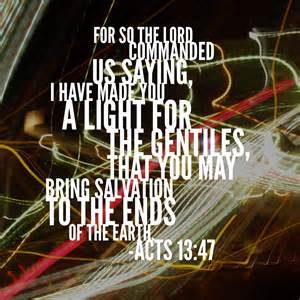
Acts 13-47 go into all the world

Acts 13:47 – August 16, 2015

Every month, St. Luke’s Church has a Church Council meeting to deal with the everyday business of running the church. We are going to have our August meeting this coming Friday. This being a congregational church, any member is more than welcome at our council meetings.

Let me ask: what would you think if someone from the Church Council were to get up in front of the congregation next Sunday morning, and say something like, “This past Friday at the Council meeting, the Holy Spirit told us to send two of our church leaders—two Council members—off to the mission field full time. We prayed over them, and we sent them off. They’re gone, and we’re not really sure where they’ll end up”? What would your reaction be to such a statement?

That’s just what happened. That’s just the situation, here at the beginning of Acts chapter 13. Except, I suspect the whole congregation gathered around Paul and Barnabas, as well as several others who intended to travel with them. Dr. Luke doesn’t specifically say, but I think the whole congregation prayed over them before they sent them out.

Paul and Barnabas were chosen by the Holy Spirit to go out. To tell others about the Good News of the risen Jesus. They, and several of their friends, left for parts unknown.

It’s a wonderful thing, to be noticed, recognized. Chosen as a messenger, a missionary for God. In the several churches I have attended over the years, I have seen dozens of people go on both short- and long-term mission trips, just like Paul and Barnabas. I’ve been involved with mission committees, and led prayer teams and prayer efforts in support of many of those same missionaries. However, I—myself—have never gone anywhere on a mission trip. Nope. Not even a short-term one.

How many of us, here, can say the same thing? I am not asking for anyone to raise hands or otherwise identify themselves. But, in your hearts, how many of us know that we have never gone to the mission field? Either overseas, or in this country?

Let’s define terms. What is a mission field, anyhow? What does it mean to be a missionary?

A simple definition? A mission field is somewhere on the other side of a boundary or barrier. I know seminary professors and people who study the history of missions might quibble with the specifics of this definition. However, I think most everyone would agree that a mission field involves crossing some sort of a boundary. That can be a boundary or barrier of race, nationality, language or culture. Those are the easiest to see and recognize! But a mission field can also be on the other side of an economic boundary, or a societal barrier.

Take my friends, Jim and Amy. Both trained as doctors, they both worked here in the Chicago area for a long time. But, they were mission-minded. They intentionally went to the South side of Chicago regularly, for years, to work at a Christian medical clinic. An inner city mission, right here in Chicago. They are now in sub-Saharan Africa, working as missionary doctors. Still with that mission mindset. But, it was only recently that they went to Africa.

For years, before that, they were using the training they had to work for God—as medical doctors. To communicate the Good News that God loves everyone. Here in Chicago, but in a radically different community, with a different culture. Were they missionaries then, in Chicago? Are they missionaries now, in Africa? I say, in both cases, yes!

Let’s consider our scripture passage for today. Pretty new idea, for these early believers to preach the Good News to a multi-cultural audience! Take a look at the list of prophets and teachers from the beginning of Acts chapter 13. “1-2 Now there were in the Church at Antioch both prophets and teachers—Barnabas, Simeon surnamed Niger, Lucius the Cyrenian, Manaen the foster-brother of the governor Herod, and Saul.”

Just looking at this list, off the top of my head, I might not notice anything particularly different. But, let’s dig a little deeper. My research tells me that this assembly of believers in Antioch was the first truly multi-ethnic local church. This church had Jews and Gentiles together in one local congregation, according to Acts 11:19–22.

            We have Barnabas, a Jewish man, a Levite from the priestly class, born in Cyprus. Next, Simeon—he’s also called Niger. That’s a black man, from Africa. Then, Lucius, the North African from a large town called Cyrene. Then, there is the upper-class Manaen, the foster-brother of Herod—raised in the palace of the ruler Herod Antipas. And finally, we have Saul (or Paul), one of the most pre-eminent Pharisees of his day, born a Roman citizen in Asia Minor, and educated in the equivalent of an Ivy League school.

            We have some heavy hitters. Men of spiritual substance, described by Dr. Luke as both prophets and teachers of the church in Antioch. And, they are VIP’s. Very Important People, from many different regions and cultural backgrounds! It was these church leaders—the Church Council of the church in Antioch—who commissioned Paul and Barnabas and their friends. These missionaries left a multi-cultural local congregation to go to the multi-cultural world.

            As we read further in the chapter, Paul, Barnabas and their friends traveled further. “13-15  They continued their journey through Perga to [another] town called Antioch. They went to the synagogue on the Sabbath day and took their seats. After the reading of the Law and Prophets, the leaders of the synagogue sent to them with a message, “Men and brothers, if you have any message of encouragement for the people, by all means speak.”

We can see Paul goes first to the congregation at a synagogue. Dressed as a Pharisee (because they did wear distinctive clothing), the synagogue leaders knew he was learned in the Law and the Prophets. Paul gets up to speak. He gives them the Gospel, in a way they could understand.

Using the Hebrew Scriptures, he spoke about the coming Messiah, and about the death and resurrection of the risen Jesus. He spoke in a clear way that Jewish people could easily relate to. And, many of them came to faith in the risen Jesus, the Messiah.

However, Paul did not stop there! He spoke of the risen Jesus to God-fearing people who were not Jewish! He spoke of the resurrection to Gentiles, to Romans, to people without regard of their ethnic origin, or of the color of their skin.

Listen as chapter 13 continues: “44-47 On the next Sabbath almost the entire population of the city assembled to hear the message of God, but when the Jews saw the crowds they were filled with jealousy and contradicted what Paul was saying, covering him with abuse. At this Paul and Barnabas did not mince their words but said, “We felt it our duty to speak the message of God to you first, but since you spurn it and evidently do not think yourselves fit for eternal life, watch us now as we turn to the Gentiles! Indeed the Lord has commanded us to do so with the words: ‘I have set you to be a light to the Gentiles, that you should be for salvation to the ends of the earth.’”

“48-50 When the Gentiles heard this they were delighted and thanked God for God’s message. All those who were destined for eternal life believed, and the Word of the Lord spread over the whole country.”

Did you hear? The Gentiles were delighted when they heard that they were welcomed by God, too! The Gentiles were—are as much God’s beloved children as are the Jews. All people are welcome to be saved. Salvation is for anyone, to the ends of the earth!

            What about the rest of the church, where Paul and Barnabas came from? Were they just sitting at home, twiddling their thumbs, or hiding their heads in the sand like ostriches?

I think the other believers in the church at Antioch had an important job to do, too. True, they may not have been sent out, called by the Holy Spirit to be missionaries. To go far away, like Paul and Barnabas, to suffer hardship and travel and preach the Good News in a different town every few weeks. However, God called these believers who stayed in Antioch to follow God, too. The Lord wanted each of them to share their story to the people around them, to share the Good News of the risen Jesus, too.

And, what about us, today? Do we have to be sent out as missionaries to Africa, like my friends, Jim and Amy? Or, can we share our stories, here? Can we show others the Good News of the risen Jesus? Tell them what Jesus has done for us, lately? Or, show them God’s love? Or what God has done in the lives of people we know?

What can you say about what God has done for you, or for a loved one? People almost always listen to stories. So, tell a true story. Tell how God has worked in your life.

How can you share about God, today?

I’d like for everyone to think of one person you might talk to. And, think of something that God has done in your life. And, prayerfully, go and tell! Here in multi-cultural Morton Grove—and Niles, and Des Plaines, and Skokie, and Chicago—most people we meet are from different ethnic groups or various cultural backgrounds. Just like the church in Antioch, the first truly multi-ethnic local church. So, go forth! Go and tell! That’s our challenge today.

Alleluia, amen!


(The scripture readings of Acts 13 were taken from the excellent translation by J.B.Phillips; ; J. B. Phillips, “The New Testament in Modern English”, 1962 edition by HarperCollins.”  And, thanks to the wonderful people who prepared the bible studies on Acts at http://www.intervarsity.org/bible-studies – The study on Acts 13 was quite helpful, and gave me some great jumping-off places from which to preach!)

@chaplaineliza

Suggestion: visit me at my daily blog for 2015: matterofprayer: A Year of Everyday Prayers. and my other blog,  A Year of Being Kind .  Thanks!