Unknown's avatar

Are We Fearful?

“Are We Fearful?”

John 20-28 st-thomas

John 20:19-29 (20:19, 26) – April 19, 2020

Have you ever been afraid? I mean, really scared? I am talking about so scared that you wanted to hide away from the people in charge, permanently? Maybe it was you, maybe it was some acquaintance or friend, but some people have really been scared so much that they stay holed up in some hiding place, some attic or some upper room—just like the disciples, after they watched their Rabbi Jesus get arrested, beaten and then crucified.

Two thousand years later, we all know the rest of the story. Jesus rose from the dead on the first day of the week, that first Easter morning. What was it like for the disciples? I mean, the men disciples? Sure, they had heard from the women disciples that the tomb was empty. Peter and John had even checked things out at the tomb for themselves. It was true! The tomb was empty! I am sure that news caused a great deal of excitement, discussion, and wonder!

But, what about other feelings? What kinds of other emotions were happening to the disciples? How did they feel on the insides? Were their stomachs doing flips? Were their hearts in their mouths? Were they filled with amazement? Fear? Doubt? Or all of these emotions, all at once, or in stages? Could the disciples be hiding out behind locked doors because they were afraid, embarrassed and ashamed? What were they doing as Jesus died? They certainly were not with Jesus at the cross—except for John. Were they afraid of what Jesus would say to them about all their desertions if He really were alive again? [1]

John’s Gospel tells us, plainly, that the disciples were afraid. Fear is a legitimate emotion and reaction to a dangerous, scary experience.  Sure, the disciples knew that the tomb was empty, but that did not stop them from being afraid. I also suspect that they feared that the Roman authorities might come after them, as known associates of the Rabbi Jesus. The disciples did have good reason to be afraid and anxious of the people in charge.

And right into the middle of all this fear and anxiety—even though the disciples knew about the empty tomb—Jesus walked through a locked door into the upper room, greeted the disciples, and they were suddenly overjoyed! As if a modern switch were flipped, the disciples’ emotional expression flipped, too.

Except—for some reason, the disciple Thomas was not present in the upper room on that occasion. We don’t know why. The Gospel of John does not say. The other disciples told him, excitedly, “We have seen the Lord Jesus!”  But, Thomas was skeptical. He responded, “I need proof for myself. Unless I see the nail marks and put my hand in the wound in His side, I will not believe.” I can just see Thomas crossing his arms across his chest and turning his back to his friends. “Nope. No way. That is too big a whopper for me to swallow.”

Do you know someone who needs concrete proof in order to believe something? Different people’s minds work in different ways. Certain types of people need concrete evidence in order to convince them of the truth, or of the facts, or of someone’s honesty. Thomas was that sort of a person: a “show me” sort of guy. He needed that kind of proof in order to truly believe.

Whether we are talking about two thousand years ago, or about today, people have not changed. One type—one size does not fit all. Some people hear about the Gospel and believe right away. Other people hear about heavenly coincidences, or “God-incidences,” and then come to believe. We can compare Thomas’s skepticism before belief to Paul’s Road to Damascus experience, where the apostle Paul had a sudden “come to Jesus” moment. (Literally.) The New Testament holds up both of these very different experiences as valid.

I have heard sermons about “doubting Thomas.” As if there is something shameful or wrong with being skeptical! I suspect Thomas didn’t know whether to believe or not to believe; there is no shame in being skeptical! We can see that different people come to their own sense of belief in their own individual way, because God has created each of us as unique individuals. Is it any wonder that each of us comes to God in our own personal way?

When you and I think about this Gospel narrative in light of today’s events, there is indeed a great deal of fear and anxiety. Just as there was with the disciples, so it is right now. All over the nation, all over the world the virus COVID-19 makes all of us afraid and anxious. This virus is even more dangerous than the Roman authorities, forcing vast groups of people all over the world to curtail their travel, their interaction, even to the point of quarantine.

Yet, just as our risen Lord Jesus spoke to the disciples and declared, “Peace be with you!” He says the same thing to us. “Peace be with you!” Jesus has declared His peace to fearful people and to dreadful situations over and over again, throughout history. In times of serious illness, in times of conflict and war, in times of natural disaster—Jesus has these hopeful, heartening words for us: “Peace be with you!”

Jesus can come alongside of each of us, through fear, through anger, through desperation, and through grief. And if Jesus is at our sides, walking next to us even though we walk through dark valleys, that is peace, indeed. Jesus gives us His peace, no matter what.

Amen, alleluia!

@chaplaineliza

(Suggestion: visit me at my regular blog for 2020: matterofprayer: A Year of Everyday Prayers. #PursuePEACE – and my other blog,  A Year of Being Kind . Thanks!

[1] http://worshipingwithchildren.blogspot.com/2014/03/year-the-second-sunday-of-easter-april_13.html

Worshiping with Children, Easter 2A, Including children in the congregation’s worship, using the Revised Common Lectionary, Carolyn C. Brown, 2014.


Unknown's avatar

Jesus is Back! Just Ask Thomas.

“Jesus is Back! Just Ask Thomas.”

John 20-28 st-thomas

John 20:19-29 – April 28, 2019

Who remembers reading storybooks to their children or grandchildren? I do! I love to read stories, and I read books to the preschoolers here every Tuesday morning. One of my favorite stories is about Curious George. Curious George is a monkey who is very curious and mischievous, and always gets into big trouble because of his curiosity. But, by the end of the books, everything always comes out all right. Except—George remains curious.

Traditionally, many people have thought of “doubting Thomas” as really negative, a person we might point our fingers at, and perhaps view as “the Disciple least likely to believe in Jesus.” But what if we viewed Thomas as curious, as the kind of person who needed evidence? Sincere questioning is positive. Being curious is positive. Some people need first-hand evidence. Curious Thomas was just such a person.

What would the monkey Curious George have thought of not being there for something exciting, a super exciting event he missed out on? That was what happened to Curious Thomas. For some reason—we are not told why—Thomas was not with the other Disciples when the risen Lord Jesus came to be with them on that first day of the week. Afterwards, I suspect when the others told Thomas about it, Curious Thomas was beside himself with curiosity! He had to see for himself what had happened!

Do you know someone who is like that, who really needs evidence to fully believe? How many of us need evidence before we stop being skeptical? “Well, I’m not sure. It seems like a real long shot. I wonder—but we will have to see.” Curious, yes! And skeptical, yes!

We know God welcomes questions! How many times was Jesus asked honest questions during the Gospels? And how many times was Thomas one of those asking the questions? I suspect Thomas was one of the Disciples who just had to know “why,” who was both skeptical and curious. Curious Thomas.

Dr. David Lose, one of my favorite commentators, put it this way: “But that’s not the way it works with Thomas. He doubts. He questions. He disbelieves. He’s not satisfied with second-hand reports and wants to see for himself. And again I would say, who can blame him? He was, after all, one of those who saw his Lord and friend mistreated, beaten, and then crucified and has probably spent the last few days pulling the broken pieces of his life back together and trying to figure out what to do next.” [1]

Listen again to our Gospel reading from John: “24 Now Thomas (also known as Didymus[a]), one of the Twelve, was not with the disciples when Jesus came. 25 So the other disciples told him, “We have seen the Lord!” But he said to them, “Unless I see the nail marks in his hands and put my finger where the nails were, and put my hand into his side, I will not believe.”

In this modern day and age, scientific evidence is held up as the gold standard for many things: for medical testing, for chemistry experiments, for biological research. Commentator Dr. Martin Marty says, “The counsel is clear: do not accept something just because people traditionally have done so. Science is creatively disrespectful of such traditions. Scientists reason that if they are to heal, they must probe, criticize, evaluate, and seek to discover.” [2]

Sometimes, our honest questions show we are particularly curious, and extremely interested in what we are questioning. Sometimes, we need evidence, just like Thomas.

Except—Jesus does something remarkable the next time He returns to the Upper Room. He obviously knows that Thomas has honest questions, and He will certainly respond to them! However, listen to what Jesus does first: “26 A week later his disciples were in the house again, and Thomas was with them. Though the doors were locked, Jesus came and stood among them and said, “Peace be with you!”

Did you hear? Before Jesus does anything else, He wishes His disciples peace. “Peace be with you.” That is what we did after the reading of Scripture today. Many churches make the Passing of the Peace a weekly part of their worship service, and I wanted to highlight it. Peace, or shalom, is a traditional Jewish greeting, it is true, but for Jesus to wish His friends peace? For the risen Lord Jesus to bless His disciples with peace, and commend peace to them? This is so significant, and so moving.

It is only then that our Lord Jesus turns to curious, skeptical Thomas: “Then Jesus focused his attention on Thomas. “Take your finger and examine my hands. Take your hand and stick it in my side. Don’t be unbelieving. Believe.”

The Italian Baroque painter Caravaggio created a famous painting called “The Incredulity of Saint Thomas.” In this painting, the risen Jesus shows the wound in His side, and Thomas is actually sticking his finger into the wound. We know from John’s Gospel account that Jesus was quite willing to go to any length to give Thomas the evidence he needed to satisfy his questions, to allay his curiosity and skepticism.

How far are we willing to go with Jesus? Do we have honest questions? Do we have questions regarding some miracle, or are we curious about a parable Jesus told? Or, perhaps are we just plain skeptical about the Resurrection story itself? Do we wonder how on earth the story of Jesus rising from the dead 2000 years ago will make any difference in our lives today?

What is it to be a Christian? Do we need faith? Do we need evidence? Do we need to see God at work in people’s lives?

How serious are we about this thing we call Christianity? Is it a religion, a creed, a set of beliefs we believe in, and if other people don’t believe exactly the way we do, are they wrong? Do we banish them to outer darkness, and not allow those people to come into our churches or our lives? Or, do we have a living, vital relationship with the risen Lord Jesus Christ? Is He our Best Friend? Does He come alongside of each one of us, in the happy times as well as the sad times, and walk by our sides all the way? No matter what?

Thomas made the first-person testimony after he was convinced that Jesus was alive. He said, “My Lord and my God!” Can you and I say that, and mean it?

Jesus is waiting. He has His arms open wide. Come with your honest questions: God can handle them. Come with your skepticism and fear, your anger, or hesitancy and doubt. Jesus does understand. He really does.

Come to Jesus, today. Alleluia, amen.

[1] http://www.davidlose.net/2016/03/easter-2-c-blessed-doubt/

“Blessed Doubt,” David Lose, …in the meantime, 2016.

[2] Marty, Martin E., Theological Perspective on John 20:19-31, 2nd Sunday of Easter, Feasting on the Word: Preaching the Revised Common Lectionary, Year C, Vol. 2 (Louisville KY: Westminster John Knox, 2009), 396.

@chaplaineliza

(Suggestion: visit me at my regular blog for 2019: matterofprayer: A Year of Everyday Prayers. #PursuePEACE – and my other blog,  A Year of Being Kind . Thanks!

Unknown's avatar

Too Good to Be True?

“Too Good to Be True?”

Easter He is risen

Luke 24:1-12 – April 21, 2019

Advertisements often promise us marvelous things. If we wash our clothes with this special detergent, our clothes will be whiter than white, cleaner than clean. The brand new car we see advertised is so shiny and the ride is amazingly smooth. If we buy this fancy shampoo, our hair will become unbelievably sleek and silky. The reality never lives up to the hype. We even have an expression for this: “Too good to be true.”

I wonder whether the disciples felt like this on that Easter morning, so long ago?

We need to go back to Friday, to get a better idea of what was happening. The women did not have time to take proper care of the body of Jesus when it was quickly buried late Friday afternoon, just before sunset. And then after Friday night came, it was the Sabbath. All observant Jews rested on the Sabbath day, as prescribed in the Jewish Law. More than that, it was the time of the Passover, an especially sacred time.

This Sabbath observance must have been especially sad and sorrowful for the followers of the Rabbi Jesus, dispersed as they were. I can imagine some huddling together in the upper room where so short a time before Jesus had led them in that Passover dinner on Thursday evening. Perhaps, a couple more hiding in the home of Mary, Martha and Lazarus, a few miles down the road in Bethany. What must have been going through their minds?

The Easter morning story was read for us by Eileen: about the women going to the tomb, shocked to find Jesus’s body gone, and angels there instead. The angels tell the women the Good News, the Gospel message that Jesus is alive again. When they run back to tell the disciples, the men do not believe the women. Here again is what Dr. Luke says: “10 It was Mary Magdalene, Joanna, Mary the mother of James, and the others with them who told this to the apostles. 11 But they did not believe the women, because their words seemed to them like nonsense.” As we said before, the disciples thought, “Too good to be true.”

The New Revised Standard Version translates verse 11 like this: “11 But these words seemed to them an idle tale, and they did not believe them.” Rev. Rick Morley, one of the commentators on our Scripture reading from Luke said, “And the disciples thought it was an “idle tale?” How condescending, right? There go those excitable women again…<eye-roll> <knowing-glance to another disciple> <raise of the eyebrows> [1]

Let’s consider historical context: women in Palestine were second class citizens. They had very prescribed roles in life and in the family, had no standing in court, and could not even be witnesses in a court of law.

However—when Jesus called His disciples, He called both men and women. Both men and women followed Him. The Gospels say Mary sat and learned from Jesus’s teaching just as much as any of the male disciples, and when Martha complained to Jesus about how Mary was not “doing her woman’s job” in serving and doing kitchen duty, Jesus corrected Martha. Not to mention His courteous, egalitarian treatment of women throughout the Gospels—the woman at the well, the woman with the flow of blood, the widow of Nain, just to mention a few. Extremely significant to treat women as equals, especially in that time and place.

So, when the women followers—or, disciples—of Jesus ran back to the others with this witness to the Good News, the Gospel that Jesus is alive!—are we surprised to have the women’s witness dismissed as an “idle tale?” “Too good to be true!”

There is another, sadder side to this “idle tale” business. Rick Morley reflects further: “It’s a popular position in the world and an increasingly popular position in the church. I mean how many people—how many self-professed Christians—take Easter as a nice little hopey-springy cute-bunny-loving pastel-wardrobe-opportunity? How many people who almost never come to church, will come on Easter either because their spouse or mother forced them to—and while they’ll play the game and sing the hymns, they see the Resurrection of Jesus as a metaphor at best, or at worst a cute little myth?” [2]

Yet—this Gospel, this Good News was the women’s real experience! Dr. Luke reports “When they came back from the tomb, they told all these things to the Eleven and to all the others.” When they ran back to their friends, they did not spout deep theology. They did not expound profound sermons. No, they reported the facts. They told what had happened to them.

Some of these women were at the foot of the Cross on Friday. They had seen Jesus in agony. They witnessed Him suffering for hours, and saw Him die. Some of these same women were now swearing that Jesus was alive again. The angels said so, too!

Rev. Janet Hunt, a Lutheran pastor who has a church in De Kalb, a few dozen miles to the west of us, reflects on this Easter Good News, this Easter promise. She looks at it from a sorrowful perspective. “How will the Resurrection Promise resound in the ears of one whose winter has been long and death has seemed to have had the last say too many times?

“What will it sound like in the ears of one whose week-end is spent in a hospital bed waiting for a risky surgery first thing Monday morning, to the one who has just been arrested for his third DUI and who is waiting his court date, hoping the whole town did not read the police blotter last week, to the one who is afraid to hope that finally this pregnancy will hold?

“What would the gift of life where death has seemed to hold sway mean to those whose fleeing for their lives has left them at our southern border with futures still uncertain? To those whose livelihoods have been destroyed by flooding across our nation’s midsection? To already desperately poor people whose meager existence has been wiped out by natural disaster or disease?

“What does it mean to any and all of these and also to you and me to know that the story does not end with the closing of the tomb on Friday afternoon? Indeed, what if having heard it and believed it, we actually began to live like it was so?[3]

You and I do not need to preach a sermon, or give deep theological reasons why Jesus is alive. People today need to hear that Jesus IS alive. His life makes a difference. Jesus changes lives—he turns them upside down, and your life—my life—will never be the same again.

Is this first-person testimony too good to be true?

“‘I have seen the Lord’ insists that the ways of love will win over the ways of hate. ‘I have seen the Lord’ confirms that the truth of kindness can be heard over the din of ruthless, callous, and vindictive rhetoric. ‘I have seen the Lord’ gives witness to the fact that there is another way of being in the world — a way of being that is shaped by resurrection, that embodies anything and everything that is life-giving, a way of being that is so counter-cultural, so demonstrative of mercy, so exemplary of the truth of Easter that others will listen to you, watch you, wonder about you and say, ‘Wait a minute. Did I just see the Lord?’[4]

This—this right here—is where the Gospel begins, with this first-person testimony—the great Good News that Jesus is alive! This great Good News changes everything, for each of us, and for the whole world.

[1] http://www.rickmorley.com/archives/2546

“Idle Talk,” Rick Morley, 2013.

[2] http://www.rickmorley.com/archives/2546

“Idle Talk,” Rick Morley, 2013.

[3] http://dancingwiththeword.com/needing-the-easter-promise-now/

Janet Hunt has served as a Lutheran pastor in a variety of contexts in Northern Illinois. Currently she serves as pastor at First Lutheran, DeKalb, IL.

[4] http://www.workingpreacher.org/craft.aspx?post=4571

“True Resurrection,” Karoline Lewis, Dear Working Preacher, 2016.

@chaplaineliza

(Suggestion: visit me at my regular blog for 2019: matterofprayer: A Year of Everyday Prayers. #PursuePEACE – and my other blog,  A Year of Being Kind . Thanks!


Unknown's avatar

What Are You Expecting?

“What Are You Expecting?”

Jesus teaching

Luke 6:17-23 (6:18-19) – February 17, 2019

Have you ever been expecting something, with all your heart? Perhaps, getting to a stadium early, and expecting a great ball game? Or, arriving at the church, expecting a wedding of two people who are dear to you? Maybe, finally going to a concert you’ve been waiting for, for many months. You are there with many other people. And, all of you have such expectations!

Expectations—of what?

We see something so similar with the scripture reading Eileen just read to us, from Luke chapter 6. Yes, this was early in the Rabbi Jesus’s ministry, but there already was talk about this promising young Rabbi. He not only teaches with authority, but this Jesus heals people’s diseases, too! And, He even casts demons out of people!

Wouldn’t that be something to travel a long distance for? Just imagine—a Rabbi, a high-profile teacher who spoke with authority. On top of that, He’s a healer and miracle-worker, too! That is something to see, indeed!

We need to step back a bit, and look at the bigger picture. Did you know that Luke chapter 6 contains much of the same information that Jesus preached in Matthew, chapters 5, 6 and 7? Matthew’s Sermon on the Mount—leading off with the Beatitudes—is summarized in about one third of the space, right here. In Luke’s Sermon on the Plain.

Both sermons contain much of the same information, except sometimes in different phrases and from a slightly differing point of view. Matthew was one of Jesus’s disciples, he was Jewish, and an eye witness. Dr. Luke was a Greek, he was writing his Gospel some years later, and relied on the testimony of a number of first-person accounts. Just so you can see these two sermons side by side.

Instead of diving into the sermon right away, I want us to look at the people who were hearing it. Dr. Luke is quite particular in his wording: he wants us to know that people from all over are listening, from down south in Judea and Jerusalem (good, God-fearing Jews), as well as people from the coast in the north, from the cities Tyre and Sidon. This second group of people was more mixed, some Jews, but secular, pagan Gentiles as well.

Luke mentioned the disciples, specifically. These were the twelve disciples, recently hand-chosen by Jesus. Moreover, “there are the larger crowds of disciples who are followers of Jesus, who have responded to His ministry, but who have not received a special call from Jesus.”[1] Quite a diverse group, indeed. And, Jesus preached to them all.

Have you ever been in a crowd of all different kinds of people? At a ball game, or, in a crowd at a concert, perhaps. I’ve been there, and I have felt the camaraderie, the fellowship and general good nature of certain kinds of crowds.

Reading again from Luke 6: “Jesus went down with them and stood on a level place. A large crowd of His disciples was there and a great number of people who had come to hear Him and to be healed of their diseases. Those troubled by impure spirits were cured.”

Expectant? I suspect that is exactly how this crowd was feeling. Even before Jesus can start preaching, people surged around Him. Listen, again from Luke: “and the people all tried to touch him, because power was coming from him and healing them all.”

People not only wanted to see Jesus, they wanted a word of comfort or encouragement from Jesus. And, people wanted to be healed by Jesus most of all! Did you notice that Jesus did not just heal people from their physical problems, but also their spiritual and psychological difficulties, too? Such miracle-working activity must have brought people many miles to see the Rabbi Jesus.

As the Rev. Ernest Lyght mentions, “Perhaps there are some similarities between the crowd on the plain and the crowds that come to our churches. When you look out into your congregation, whom do you see? What are their needs? Who are the people who come to our churches? Do they reflect the neighborhoods around the church? Surely, they are folks who want to hear a Word from the Lord, and they want to be healed. They come with certain expectations.”[2]

Which leads to the next question: what are your expectations for the worship service, this morning? Were you expecting a warm, familiar service, with nice, familiar hymns, and a warm, comforting sermon? Or, were you surprised and even taken aback when we heard the testimony about a lovely ten-year-old boy with autism who wrote that wonderful poem for his English assignment? (I had tears in my eyes when I first finished reading that poem. God bless that boy, and God bless that teacher, too.)

Does Jesus challenge you – challenge me – in our daily walk with Him, or are you just looking for a nice, easy, quiet stroll with Jesus? What are your expectations?

Let’s look at some of Luke’s version of the Beatitudes: “’Blessed are you who are poor, for yours is the kingdom of God. 21 Blessed are you who hunger now, for you will be satisfied. Blessed are you who weep now, for you will laugh. 22 Blessed are you when people hate you, when they exclude you and insult you and reject your name as evil, because of the Son of Man.’”

Whoa, wait a minute, Jesus! I thought You were warm and cuddly, like a teddy bear. At least, that’s what I heard. From Sunday school, or somewhere. Where did Jesus come up with all this about hungering, and weeping, with people hating me, excluding me, insulting me, even rejecting me. What gives, Jesus? What happened to that warm, fuzzy Christianity I thought I knew?

Christianity is not a religion, being a Christian is a relationship. It’s a series of relationships. Jesus and me, vertically. Sure! But, it’s Jesus and all of us too. Plus, it’s the horizontal relationship between you, and me, and you, and you—and all of us, with each other. That is what Jesus came to offer all of us. A radical change in relationships between God and humanity. And, in how we all relate to each other. No matter who.

Have you told anyone about this radical, out-of-this-world friendship between you and God? Have you been changed in how you relate to everyone you meet?

Bishop Lyght is now retired from the United Methodist Church. The UMC has for its advertising catch phrase “open hearts, open minds, and open doors.” Great images! Wonderful things to strive for, too. We can take that phrase to heart, and ask ourselves: do we have open hearts? Are our hearts open to everyone who may walk in to our church? Do we have open minds? Are our minds open and accepting of everyone, no matter what ethnicity, mental challenge, sexual orientation, or other kind of differences they might have?

Finally, do we have open doors? Who are the people who do not come to our church, on this corner? Do we truly welcome all people? In our church? On the street or at work or at line in the grocery store? In our neighborhoods?

What are your expectations? Check with Jesus, and see who He would welcome.


(Many thanks to the Rev. Ernest Lyght and http://www.umcdiscipleship.org for ideas and assistance for this series on discipleship.)

[1] http://www.crivoice.org/lectionary/YearC/Cepiphany6nt.html

Lectionary Commentary and Preaching Paths (Epiphany C6), by Dennis Bratcher, at The Christian Resource Institute.

[2] https://www.umcdiscipleship.org/worship/season-after-epiphany-2019-part-2-worship-planning-series/february-17-sixth-sunday-after-the-epiphany-year-c/sixth-sunday-after-the-epiphany-2019-year-c-preaching-notes  

Unknown's avatar

Who Is a Disciple?

“Who Is a Disciple?”

Jesus fish

Luke 5:1-11 (5:10) – February 10, 2019

When did God become real to you? Were you sitting in Sunday school, when you felt deep within that God was real, and you felt wonder? Or, were you at a camp or retreat, around a campfire, when something let you know God was the real thing, and you felt nothing but awe? Or, perhaps, were you praying next to a loved one’s bed in the hospital, and you powerfully understood that God is real, and you felt deep comfort? Have you had a God-encounter?

The situation here today is where God becomes real for these people. Eileen just read the Gospel lesson from Luke 5 to us, and we heard about Jesus calling the first disciples. But, we need to back up in this reading, before the Rabbi Jesus calls anyone to be a disciple.

We break into the action quite early in the public ministry of Jesus. So early, in fact, that He has not even called anyone to follow Him, to be His disciples. We see Jesus, alone, teaching, preaching, healing, and beginning His ministry. Luke starts off with the phrase “One day as Jesus was standing by the Lake of Gennesaret.” I think Luke meant this to say that this was a typical day in the life of Jesus. Teaching, preaching, doing miracles. All in a day’s activities, for Jesus.

But, this is early on. The crowds who have gathered to hear Jesus teach and preach—and watch the miracles!—I suspect are filled with wonder, curiosity, and questions. Who is this rabbi with such clarity in teaching the word of God? Who is this rabbi with such power and authority? Yes, we see the people crowding around Jesus so much that He got in a boat by the seashore, put out a little way, and then preached to the crowd.

(Did you know—little known fact—that Jesus was using the natural amplification of the water to make His voice heard better? When someone is out in the water a little distance from shore, their voice can be heard as naturally amplified because of the sound waves bouncing off or echoing off of the surface of the water and traveling on towards the shore.)

Back to Jesus. The boat Jesus used to preach was Simon Peter’s boat. He and Simon Peter must have been acquainted a little, as we can see from their interaction. “When he had finished speaking, he said to Simon, “Put out into deep water, and let down the nets for a catch.” Simon answered, “Master, we’ve worked hard all night and haven’t caught anything.”

Have you ever worked hard all night, with nothing to show for it? How about all week, or all month? Or, even, all year, with nothing concrete to show for it? Like, in the fisherman Simon Peter’s case, no fish at all?

There are some professions where there are fewer concrete markers to show how much a worker has done. At least Simon Peter had a definite marker to show “success” in his profession: the number of fish caught. However, he also must have had periods of time when he caught no fish, or very little fish.

Do you think Simon Peter got depressed, or frustrated, or anxious, or just plain angry? How did he deal with failure? He was a professional fisherman, after all. He had fished in those waters for many years, so I suspect he knew the territory, was familiar with the places the fish liked to hang out, and understood when was the best time of day to go fishing. Which leads us to the next comment by Simon Peter, made to the Rabbi Jesus: “Master, we’ve worked hard all night and haven’t caught anything. But because you say so, I will let down the nets.”

Remember, “Peter, a fisherman, might have known that Jesus was a carpenter. He might have thought that a carpenter did not know anything about fishing.  But he surrendered his prejudice and let down the nets. Peter was the one who sat on the boat with Jesus while he was preaching and heard the good news of Jesus.” [1] “But because you say so.” Against his better judgment, Simon Peter agrees to traipse out to the deep water to go fishing, even though they have worked hard all night, because Jesus requested that he and his co-workers go out and try fishing again.

We know what happened. Hardly had the nets gone into the water, but the fish came swimming into the nets. The nets were filled to bursting! It was a miracle. Simon Peter and his co-workers experienced it—were eye witnesses.

What was the surprising response? Continuing from Luke 5: “When Simon Peter saw this, he fell at Jesus’ knees and said, “Go away from me, Lord; I am a sinful man!” For he and all his companions were astonished at the catch of fish they had taken, 10 and so were James and John, the sons of Zebedee, Simon’s partners.”

Yes, we can see that Simon Peter confessed he was a sinful person. But, I want to lift up another deep feeling within Simon Peter. God became tangibly real to him, at that moment. Too real, because he was filled with feelings of sin and inadequacy,

We already know some feelings going through Peter’s head. He felt ashamed and guilty of falling short of God’s mark. He came to Jesus in sorrow—probably with frustration, fear and sadness. He suspected that Jesus would indeed be able to forgive him his sins.

What happened? Simon Peter had a God-encounter, there in the boat. God became real to him. Simon Peter deeply experienced God as very real to his life, but couldn’t handle it.

What is Jesus’s unexpected response? Jesus tells Simon Peter and his co-workers, “Don’t be afraid; from now on you will fish for people.” Jesus calls them into a God-encounter.

I ask again: do you remember when God became real to you? When did you encounter God? This is just the first of many occasions that God became real to Simon Peter. Can you remember a situation where God showed up in power, or in encouragement, or comfort? For you, or for a loved one?

For Simon Peter and his co-workers, his friends, this was decision-time. They decided to drop their nets on the shore, leave their boats where they were, and follow Jesus. There were many, many people in the crowd who also had the opportunity to follow Jesus, but they did not. At least, not at this time. They only stayed for the good preaching and the miracles, not the following-Jesus-part.

How about you? Has Jesus struck you to the heart and soul, like Peter? Has God become real to you, through this Scripture reading today? If you have never taken the step of following Jesus, I encourage you to follow Him today. Thank Him for forgiving your shortcomings and sins. Thank Jesus for inviting you to come with Him for the journey.

What can we do with this newfound, exciting relationship with God? Become a disciple. Go out and talk about how God became real in your life. Talk about God’s Good News, today, to anyone you meet. God will be wonderfully praised by all who tell how God has become very real to them, and changed their hearts and lives.

How has God become real to you? Become a disciple. Go and tell.

[1] https://www.umcdiscipleship.org/worship/season-after-epiphany-2019-part-2-worship-planning-series/february-10-fifth-sunday-after-the-epiphany-year-c/fifth-sunday-after-the-epiphany-2019-year-c-preaching-notes

(Many thanks to the Rev. Dr. Kwangki David Kim and http://www.umcdiscipleship.org for ideas and assistance for this series on discipleship.)

@chaplaineliza

(Suggestion: visit me at my regular blog for 2019: matterofprayer: A Year of Everyday Prayers. #PursuePEACE – and my other blog,  A Year of Being Kind . Thanks!

Unknown's avatar

Courage, Not Fear

“Courage, Not Fear

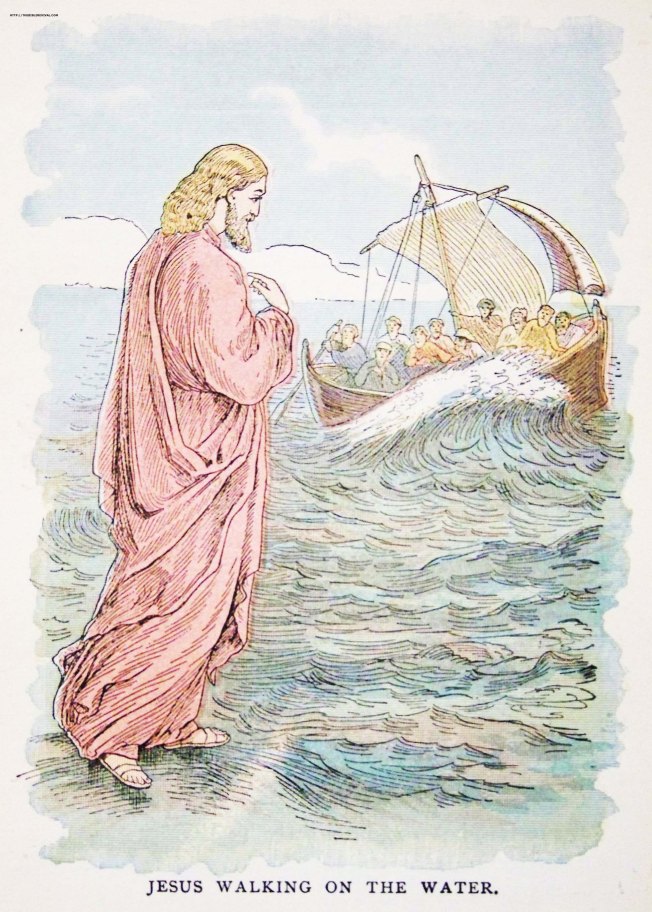
Mark 6-50 jesuswalkingonthewater

Mark 6:46-52 (6:50) – August 12, 2018 – from Dave Ivaska’s book Be Not Afraid

“O God, thy sea is so great, and my boat is so small.” So says the Breton’s fisherman’s prayer on a small brass-inscribed plaque. The plaque was given to John F. Kennedy by Admiral Rickover, and President Kennedy kept this plaque on his desk in the Oval Office.

When I started to think about this Scripture passage from Mark, the narrative where Jesus walks on the Sea of Galilee by night, this plaque came to mind. I suspect the disciples did feel afraid on that small boat as they faced the choppy waves, strong currents, gusty winds, and other weather conditions. Similar to that Breton fisherman.

I have never been to Israel, but I have read that the weather around the Sea of Galilee is particularly changeable. There are hills and even small mountains surrounding a portion of the inland sea. Sometimes, the weather patterns can cause rough weather to flare up with next to no warning. According to the Gospel of Mark, chapter 6, the weather that night on the Sea of Galilee was windswept and the water was churning and choppy. The disciples were out on the water after dark. Some of them were fishermen, but not all. So, some of them were used to being out in an open boat in the middle of open water. Others of the disciples were not fisherman at all, and were probably extremely uncomfortable.

What was the general morale of the disciples? Jesus was notably absent—not with them in the boat. I suspect some of the disciples were fearful and anxious. Maybe even complaining about their sorry situation, out in the middle of the lake and with no Jesus. Just think about their desperate situation, and compare it to your own. From time to time, I am sure all of us have felt like we are adrift in choppy water, all alone, someplace like the Sea of Galilee. Heavy weather is on the horizon. Who can help us deal with our fear and uncertainty?

We need Jesus, that’s who. Just as much as the disciples did.

This scary situation on the Sea of Galilee did not just happen all by itself. This nighttime situation followed after a very busy day for Jesus. This was the day that Jesus miraculously fed several thousand people with a few loaves and fishes. When this all happened, they all were in a lonely place far away from any village or town, near the Sea of Galilee.

I want to be sure all of us understand. This feeding was not just a little miracle. Instead, Jesus did a huge miracle! Feeding well over five thousand people with just a boy’s sack lunch of a few little loaves and fishes? How astounding is that? The disciples were right there with Jesus, serving and distributing all the loaves and fish to all the crowds who attended Jesus’s after-lecture luncheon. Except, Jesus provided all of the food! Miraculously.

Listen again to the beginning of today’s Scripture reading from Mark, which follows the paragraph on the feeding miracle: “ 45 Immediately Jesus made his disciples get into the boat and go on ahead of him to Bethsaida, while he dismissed the crowd. 46 After leaving them, he went up on a mountainside to pray.”

At the end of a really busy day with a lot of public ministry, I can see why Jesus wanted to be all by Himself, not only to pray and rest and recoup, but also to spend some down time rejuvenating with His loving, caring Heavenly Parent. Wouldn’t you, if you were in a similar position? Resting and recouping after a long, challenging day of ministry, just about anyone would want to be reassured by the loving embrace of their Heavenly Parent. I know I would!

After Jesus withdraws to be with His Heavenly Father for some hours, it’s time for Him to rejoin the disciples. Let’s continue with the reading from Mark: “ 47 Later that night, the boat was in the middle of the lake, and he was alone on land. 48 He saw the disciples straining at the oars, because the wind was against them. Shortly before dawn he went out to them, walking on the lake.”  I would have loved to be with the disciples in that boat!

Just imagine all the exciting information we would hear about leadership and discipleship, serving and helping others, and getting closer to God!

Or, even more, I would love to have a film camera and crew on their boat that night! What a bunch of reaction shots! Shots showing fear, anger, uncertainty, anxiety—the whole range of emotions and reactions to the unexpected and miraculous appearance of Jesus, supernaturally walking on the Sea. Considering what huge miracle had just happened only a few hours ago, “what confidence did the disciples would have had to believe that Jesus would now help them in this terrifying situation?“ [1]

We’ve talked about this before, how the disciples sometimes had a problem believing what Jesus plainly said. Or, a problem seeing what Jesus had just clearly shown them. Or, a problem understanding an illustration or object lesson Jesus had just brought to them. This was one of those situations.

The disciples were a bit thick-headed. They just did not get the full ramifications of the huge miracle of the loaves and fishes. They just did not understand how Jesus—who was God’s son, fully God, and creator of the heavens and the earth—could possibly walk on water.

Jonah had this problem, too. He was a prophet of God, he heard the word of God regularly, but he just didn’t get the message clearly. It took getting swallowed by a fish in the middle of the ocean to get the cotton out of Jonah’s ears.

Listen to a part of Jonah’s prayer from the belly of the huge fish, from the 2nd chapter of Jonah: “In my distress I called to the Lord, and God answered me. From deep in the realm of the dead I called for help, and you listened to my cry. You hurled me into the depths, into the very heart of the seas, and the currents swirled about me; all your waves and breakers swept over me. But you, Lord my God, brought my life up from the pit. “When my life was ebbing away, I remembered you, Lord, and my prayer rose to you, to your holy temple.”

It took a miracle of a huge fish to get Jonah to see clearly. It takes a miracle of Jesus walking on the water, on top of the feeding-and-provision-of-food miracle, to get the disciples to see clearly. Yet, God is with them all, even through the darkness and the storm, even through being swallowed by the big fish or being buffeted by choppy seas.

“What does this story reveal about Christ’s involvement in our own trials? He is both aware of and concerned about our struggles and acts on our behalf. In addition to helping us in our plight, His deliverance reveals to us His supernatural power.” [2] another way of says it is that Jesus is God’s son. Fully God, and fully man. Of course, Jesus can walk on water! And, of course, Jesus can be with us, in and through and beyond our trials and problems. Having God incarnate as my—as our personal Friend and Savior is very reassuring, believe me.

Sometimes we do go through the storm, and even repeated storms. Sometimes we do have serious illness happen to us or to a loved one. Sometimes we travel through the valley of the shadow, and we need that reassurance that God is with us. Jesus can say to us just as much as He said to the disciples, “Take courage! It is I. Don’t be afraid.”

These are the words of Jesus. We can take them to heart. These reassuring words are for the disciples, and for us, too. Alleluia, amen.

[1] Ivaska, David, Be Not Afraid (Downers Grove, Illinois: InterVarsity Press, 2000), 101.

[2] https://intervarsity.org/bible-studies/mark-6c

Mark 6:45-56: Confounded by Christ | InterVarsity

@chaplaineliza

(Suggestion: visit me at my regular blog for 2018: matterofprayer: A Year of Everyday Prayers. #PursuePEACE – and my other blog,  A Year of Being Kind . Thanks!)

Unknown's avatar

Peace Be with All of Us

“Peace Be with All of Us”

peace be with you, formal

Luke 24:36-49 (24:36) – April 15, 2018

Sometimes I just feel like pulling the covers over my head and not getting up in the morning. Wars, rumors of wars, bombings, fires, gas attacks, and these were just in the past week. Seriously, with all of the scary and shocking things going on in the world, the world can be a downright scary place.

No matter whether we live today in the United States or two thousand years ago in occupied Israel, there can be a lot of scary and confusing stuff going on.

In the case of our Gospel reading today, the scary and confusing stuff was going on right in Jerusalem. It was the time of the Passover, during what we today call the Passion Week. As we have been considering for the past few weeks, the occupying Roman forces in Jerusalem are watching the festival and worship situation very closely.

Sure, there are a great number of visitors from all over the known world, in Jerusalem for that great festival, Passover. But, the Roman forces must have doubled down on the populace in the city. And, even more, since the Rabbi Jesus had just entered the city only a few days before. He made a huge commotion, too, what with riding in on a donkey (like King David) on Palm Sunday, debating in the Temple during the week with the scribes, Pharisees and Sanhedrin, and getting arrested in the Garden of Gethsemane late on Thursday night and accused being Messiah. And, the crucifixion on Friday? Quite a week, for the occupying Roman forces.

Yes, we know some things in general about the disciples. They scattered, running away. Hiding, afraid that since their leader and Rabbi was just executed by the Romans on Friday, they might be arrested and executed next. In fact, Peter even denied knowing Jesus while in the high priest’s courtyard. He must have been scared to death, too.

The upper room, a larger room on the second floor of a building in Jerusalem, was one place where the disciples felt at least half-way safe. They were huddled up there, in hiding, trying to keep a low profile. Luke tells us the male disciples had already dismissed what the women disciples had told them about their Rabbi, early that morning. Something about an empty tomb, and their dead Rabbi gone. Even though Peter and John had run to the tomb and checked things out for themselves, they still did not have a clear idea what was going on.

This year, the lectionary does not have us look at the post-Resurrection appearance of Jesus when He walks with the two disciples from Jerusalem to the town of Emmaus. In brief, our commentator Dr. Mark Vitalis Hoffman summarizes this section of Luke 24: “Two from the group of followers of Jesus were going to Emmaus when they encounter, but do not recognize, Jesus. They express their disappointed hope that Jesus would be the one to redeem Israel, but Jesus explains how everything that happened was necessary according to Scripture. The two invite Jesus to spend the night with them. During the meal, when Jesus blessed and broke the bread, their eyes were opened, and they recognized Jesus, but he vanished from their sight. They rush back to Jerusalem and report to the gathered believers what had happened.” [1]

It is later that day that our Gospel reading picks up. Later in the evening, many disciples (I am assuming both male and female) are in hiding in the upper room. Luke specifically has the two disciples from Emmaus telling the rest about their encounter with Jesus.

Yet, the rest of the disciples are having difficulty believing, understanding. Even though several of these same disciples had angels and Jesus Himself telling them of the Resurrection, what gives? I suspect many of them are still paralyzed with fear. Scared to death. Afraid of the Roman soldiers coming around and knocking on the door at any moment, ready to carry off some of the disciples to be crucified, too.

How often have we been really afraid? Almost scared to death? Terror can paralyze a person. Fear can cause us to disbelieve, to run away, to get angry and fly off the handle. Don’t you think the disciples needed Jesus right then? When He appeared miraculously in their midst, many of them were still unbelieving. Still scared to death.

I think the first thing out of Jesus’s mouth was the most needed of all: “Peace be with you!” Do you hear? Jesus went straight to the heart of the disciples’ fear, their anxiety, their unbelief, and said “Peace be with you!”

Yes, we could talk about what happened after that, when some disciples thought Jesus was a ghost, so He ate a piece of fish to show His friends that He really, actually, had come back to life. Yes, we could talk about Jesus opening the disciples’ minds to the truth of the Scriptures, and how they were to be witnesses of the Good News and the forgiveness of sins.

I would like to go back to the first thing Jesus said: “Peace be with you!” During the Children’s Time, I talked about peace. There are many greetings in different languages that mean “Peace.” “Aloha in Hawaiian means affection, peace, compassion and mercy. Shalom (Hebrew) and Salaam (Arabic) mean peace, complete-ness, and prosperity. Aloha, Shalom, and Salaam can be used on meeting or departing.” [2]

Jesus wished the disciples His peace several times, recorded in the Gospels, including right here. This word is not only wishing a person peace, but “peace, shalom, and salaam” can also be wishing a person God’s presence. The disciples really needed that, too!

In the New Testament reading today from 1 John chapter 3, the aged disciple John tells us that we are the children of God. I remember when I was a mom of young children, sometimes then would get afraid. Sometimes I would comfort them, and hold them on my lap or give them hugs. Don’t you think it’s the same way with God? When we get afraid, even scared to death, we can run into God’s everlasting arms of care and concern. Our Lord Jesus can send us His peace.

The disciples really needed peace, first of all! Perhaps, they needed it most of all. God can send peace into the world today, too. Including peace into conflict in the Middle East, peace in warring regions in Africa and Asia, peace into difficult places in Central and South America. God can send peace to the streets of the cities of our country.

Jesus offers us comfort and peace, just the same way that parents (and grandparents) do. Jesus sends closeness, caring and loving, in addition to His peace.

Can you and I reach out in peace, in shalom, in wholeness and with God’s love? That is the message on my heart from the Gospel reading today. Reach out with God’s peace. Offer God’s peace to those around you today, and every day.

We can praise God for God’s peace and wholeness. God’s peace is a sure antidote to fear, today, and every day.

Alleluia, amen.

[1] http://www.workingpreacher.org/preaching.aspx?commentary_id=3627

Mark G. Vitalis Hoffman Associate Professor of Biblical Studies Lutheran Theological Seminary at Gettysburg

[2] http://worshipingwithchildren.blogspot.com/2015/03/year-b-third-sunday-of-easter-april-19.html

Worshiping with Children, Easter 3, Including children in the congregation’s worship, using the Revised Common Lectionary, Carolyn C. Brown, 2015

Unknown's avatar

Follow, Carry the Cross

“Follow, Carry the Cross”

Mark 8-34 take up your cross, print

Mark 8:31-38 (8:34) – February 25, 2018

When you imagine children at play, what do you think of? Children in a schoolyard, out at recess or out at lunch break? I am not sure what children play now, but when I was in school, school children played all kinds of games. Besides hopscotch and jumping rope, there were games of Red Rover Red Rover, Mother May I?, Duck Duck Goose, and Simon Says. And, Follow the Leader in the playground among the play equipment.

When we compare children’s games today with the words of Jesus from Mark’s Gospel reading, we are looking at two very different things. When Jesus said, “Follow Me!” He was not talking about a fun thing like a children’s game. He spoke about something quite serious.

The background of these words is critically important for us to understand exactly what Jesus was getting at. What was the history, the backstory? Here we are at the center of the Gospel of Mark. Jesus had healed, taught, cast out demons, and performed other signs of power, but often in secret. And, people had questioned who this upstart Rabbi was, but with little answer.  Up until this time, Mark had only mentioned the term “the Christ” once, in the opening verse at the very beginning of the book, until here in today’s reading, in Chapter 8.

Just before this scripture reading today, the Rabbi Jesus asks His disciples, “Who do other people say I am?” Great question! We are familiar with the responses. Some say John the Baptist, others say Elijah or another prophet, but you and I know better. We know different. We know the end of the story. The thing is, these disciples do not.

Jesus has been asking the disciples to follow Him ever since the first chapter of Mark. When He called James and John, Simon and Andrew, Levi and all the rest, Jesus said simply, “Follow Me!” And, they did! They left everything, in fact. Commentator Matt Skinner said “Jesus isn’t so much about gathering pupils or making sure everyone understands him. He calls followers. Want to see who he really is? Join him.” [1] Which is exactly what many people did.

Today, we are following Jesus step by step on His journey to Jerusalem and the Cross during the next weeks, throughout Lent. Similar to these early followers of the Rabbi Jesus, we are taking this following thing one step at a time. We focus on one facet of the journey each Sunday. This Sunday we look at what Jesus said about taking up the cross when we follow Him. What on earth does that mean?

Here we can see that Jesus knew where He was going, and what He was going to do. Others probably did not, and even would call Jesus crazy or somehow deluded. “What do You mean, Jesus? How can You say that?”

Didn’t Peter just say that Jesus was the Messiah, the Christ, the chosen One of God? I suspect the disciples were thinking, what kind of mixed messages are coming from Jesus now?

Jesus not only mentioned that the disciples ought to follow Him, but He also wanted them to take up their cross. Jesus even made some mention of a person being willing to give up their life. The only comparison I can figure is that of police officers and firefighters. They “make the decision to put themselves in danger, risking their lives to save another person.  They measure their lives not by length, but by depth and quality.” [2] That sounds very similar to the sort of thing Jesus said in our reading today.

There is a problem. I can hear some people today saying, “Wait a minute, Jesus! I didn’t know that following You meant the possibility of giving up my life! I didn’t know that there was such danger and risk involved in being a Christian.”

Except, giving up one’s life was what the apostle Paul talked about over and over again in his letters to the churches in the New Testament. And, that’s what Jesus starts telling His disciples quite plainly, starting in today’s Gospel reading. Listen to Jesus: “If any of you want to come with Me,” He told them, “you must forget yourself, carry your cross, and follow Me. 35 For if you want to save your own life, you will lose it; but if you lose your life for Me and for the gospel, you will save it. 36 Do you gain anything if you win the whole world but lose your life? Of course not!”

What is more, Jesus rebuked Peter for telling Him He—Jesus—was wrong, and for trying to keep Jesus from walking the journey to Jerusalem and the Cross. Preventing Jesus from facing the Passion and sure death. At this point, Peter did not understand the full meaning of Jesus being the Messiah, the Christ. Plus, I suspect Peter and the other disciples were not clear on what taking up their own cross and following Jesus meant, either. But, they would find out, in the months and years to come.

Yes, sometimes it is difficult to follow Jesus. And, who in their right mind would want to shoulder the difficult burden of carrying a cross?

When we consider police officers or firefighters and what challenges they face on a regular basis, sometimes we call them heroes. Yet, Jesus calls all of His followers to face any number of difficulties and challenges, too. Except, not quite like running into a burning building or running down perpetrators, but still just as challenging.

Imagine someone you know, or someone you’re related to, bearing different crosses during their life. Crosses can be burdens we carry, difficulties we face. Some crosses involve physical pain and suffering. Other crosses can be financial, relational, or mental. What are the problems you or your family are dealing with today? Last month? Next year?

This might be the cross Jesus calls for us to bear, whether dealing with a devastating disease, accident, handicap, or disability. (Seen or unseen.) On the positive side, taking up our cross might assist us as we journey with Jesus toward Jerusalem. Lutheran pastor Edward Markquart reminds us:

-To take up our cross daily means to be open and flexible to God’s plan.

-To take up our cross daily means to focus on God daily.

-To take up our cross daily means that we can fail. That is, we do not do it.

-To take up our cross daily means to try to be loving every day.

-To take up our cross daily means to go the extra mile to do our jobs in life well.

-To take up our cross daily means to work on my relationship with my relatives and with people I do not like. [3]

Like I told the children earlier, we need to live like Jesus. We have to love God every day and love the people around us even when it gets hard. Yes, Jesus tells us clearly what it is like to follow Him. It is simple, yes. But easy, not necessarily so. May we pray for the grace, strength and perseverance to continue to follow Jesus, and to take up our own crosses.

And at the end of our lives, when we stand before Christ, what does the apostle Paul say? In Romans 8, “If God is for us, who can be against us? 32 Certainly not God, who did not even keep back his own Son, but offered him for us all! He gave us his Son—will he not also freely give us all things?” Praise God, we are indeed accepted by the Messiah Jesus. We are loved by our Beloved, Jesus Christ. Amen, and amen!

[1] http://www.workingpreacher.org/preaching.aspx?commentary_id=1383  Matt Skinner

[2] https://sacredstory.org/2012/02/29/jesus-faces-death-taking-up-the-cross/

“Jesus Faces Death: Taking Up the Cross,” Mother Anne Emry, Sacred Story, 2012.

[3] http://www.sermonsfromseattle.com/series_a_peter_the_stumbling_blockGA.htm

“Peter: The Stumbling Block and the Way of the Cross,” Gospel Analysis, Sermons from Seattle, Pastor Edward F. Markquart, Grace Lutheran Church, Seattle, Washington.

@chaplaineliza

(Suggestion: visit me at my regular blog for 2018: matterofprayer: A Year of Everyday Prayers. #PursuePEACE – and my other blog,  A Year of Being Kind . Thanks!)

Unknown's avatar

Compassion and a Rich Man

Mark 10:17-27 (10:21) – July 16, 2017

Mark 10-21 Jesus-Christ and-the-rich-man

“Compassion and a Rich Man”

If we turn on the television, read a book, or listen to a podcast or talk radio, sometimes we might hear experts giving advice. These knowledgeable experts are often from well-known places.  This week I am thinking about advice on how to live the “right” way. That’s sometimes thought to be a fruitful life, or a healthy life, or a spiritual life. Wouldn’t you be interested if you heard a radio program with a noted author or well-known expert in just this subject?

That’s the case with Rabbi Jesus, today. In today’s scripture lesson, we get just a hint of what our Lord Jesus had to deal with much of the time. Can you see this situation? I love St. Ignatius and his suggestion to put ourselves into the narrative. Let us imagine ourselves being there, right with our Lord Jesus the itinerant Rabbi, and His disciples.

Mark tells us that Rabbi Jesus (and some others) are about to leave on a journey. Can you see the hustle and the bustle as they get ready to leave? Maybe several of Jesus’s friends are concerned about last-minute details. Perhaps they have already contacted someone in the town they plan to go to, to find some kind of lodging, some kind of food and board.

I would imagine Jesus being calm and self-possessed, amidst all of this rushing around. Just like our scripture reading today says, someone runs up to the Rabbi and asks Him a parting question. After all, you don’t get an expert in religion and spiritual life coming to your town just any old day. The Rabbi Jesus was a widely acknowledged wise person, an expert in the interpretation of the Hebrew Scriptures, the Law of Moses and in lots of things associated with religious and spiritual life.

Looking at it from that angle, of course this young man would rush up and try to get the ear of the wise Rabbi just before He and His followers left their town.

The Gospel writer tells us: Jesus was beginning a journey when a man ran up and knelt in front of Him and asked, ‘Good Teacher, what must I do to get eternal life?’”

Do we hear what this man says? He wants to know how he can get God’s approval. What is more, we can watch this man kneel humbly before the wise Teacher and Rabbi when he asks.

Let’s continue with St. Ignatius and his suggestion to imagine ourselves there with Jesus. Perhaps as one of the disciples, maybe as one of the crowd, watching and waiting to hear what the Rabbi was going to say. And, we are packed into a small area. A good amount of people usually gather around when Jesus is talking in public.

The Rabbi Jesus makes an unexpected response to the young man: “Jesus asked him, “You’re calling me good? Only God is good. You know the commandments: Don’t kill, don’t betray, don’t steal, don’t lie, don’t cheat, honor your father and mother.”

This is a straightforward, traditionally Jewish response that many Rabbis would give, in answer to such a question. This is the way you gain favor with God: keep the commandments. In fact, Jesus even gives a little recap of them, a “highlights” list, just in case anyone forgot.

We look to the young man, who says. “‘Teacher, I’ve always obeyed all of these, ever since I was a kid.’”

I am sure we all know someone like this. Some goody-two-shoes who always follows the rules, straight as an arrow. Pious and earnest. Always trying his hardest to win God’s approval, as well as the approval of his parents and other grown-ups.

We return to our Lord Jesus, and listen to what He said. “Jesus looked at the man and loved him. Then Jesus said to the man, ‘There’s one more thing: Go sell all your stuff. Whatever money you make, give it to the poor. Then you’ll be rich in the things of heaven. And then, come follow me.’ The man was really surprised by what Jesus said, and really sad. He had a lot of stuff, and he really loved some of it. He walked away, still upset by what he’d heard.”

Now, we are learning additional information. This is not just any young man. No, this is a rich young man. I wonder whether the rich young man was aware that all of his stuff could act as a barrier between him and God? That’s why Jesus tells him to sell all of his stuff.

Dr. David Lose said about this point in the reading, “what Jesus really meant was that we needed to unburden ourselves of whatever might be keeping us from relying on God.” [1] Yes, the rich man had a great deal of difficulty hearing these words of Jesus.

Let’s face it: these are difficult words for many people to hear. We love our stuff, don’t we? Or, if not most of our stuff, at least some of our stuff. I would really have difficulty giving up my computer and my car. I think I am not the only one in this room today for whom that is true. Others might have difficulty unburdening themselves of whatever might be keeping each one from God.

This is a huge lesson for all of us from this Scripture reading today. And yet, it is not the only lesson. Remember our sermon series? Our sermon series on compassion is continuing with Jesus having compassion on this rich young man. What does our Gospel writer say? “Jesus looked at the man and loved him.” Jesus loved this young man—this rich young man.

Dr. Lose wonders: “whatever [the young man’s] appearance on the outside, whatever his faithful and pious life, he’s still missing something, something important, something that matters, something that’s a matter of life and death.”[2]

What about us? What is our reaction to Jesus and the rich young man?

Turn it around. Imagine we are friends of the rich young man, standing right next to him, meeting Jesus. We have a lot of stuff, too. Jesus is asking us to give it all away. We may want so badly to follow Jesus! We want to travel around with Him everywhere He goes. But, since we have so much clutter, so many things, we just can’t uproot ourselves and follow Jesus.

Can you relate? “The man was really surprised by what Jesus said, and really sad. He had a lot of stuff, and he really loved some of it. He walked away, still upset by what he’d heard.”

Just as much as Jesus loved this young man, that’s how much He loves each of us. Jesus loves you, me, and every person on the face of this earth. Even when we don’t do what God has asked us to do, God still loves us. Does everyone feel God’s love for us? And, not only us as a group, everyone in this sanctuary, but also for each one, for every individual.

And, the capper for this interaction between Jesus and the young man? “The disciples were amazed at his words. Looking at his disciples, Jesus said, ‘It is so hard—can you even imagine how hard?—for someone who has so much to come to God’s kingdom.

It’d be easier for a camel to go through the eye of a needle.’”

In other words, really, really hard. All of our stuff gets in the way between us and God’s kingdom. All of this clutter and distraction in our lives keeps us at a distance from God. We know what Jesus has asked us to do, just like this young man did. When you don’t do what God has asked you to do, how do you picture God responding to you? Do you imagine God looks at you—at us—with loving compassion like Jesus did in this story?

We might not be able to follow Jesus completely, all at once, but we can make steps in that direction. We can make small steps toward doing what pleases God. I encourage all of us to choose someone or something and be kind. Be compassionate towards them What’s more, we all will see how all of our “small steps” in loving and giving combine to create a beautiful impact of compassion in God’s world.

And, maybe, just maybe “God’s gift of salvation can actually free us to do something: to love each other, to care for God’s people and world, to share the good news…right here, right now, wherever it may be that God has placed us.” [3]

God willing, we can all show love and compassion, every day. Amen.

[1] http://www.davidlose.net/2015/10/pentecost-20-b-curing-our-heartsickness/

[2] Ibid.

[3] Ibid.

(A heartfelt thank you to An Illustrated Compassion: Learning to Love Like God. Many of these sermon ideas and thoughts came directly from this series.  I appreciate this intergenerational curriculum, which is the basis for my summer sermon series on compassion. This curriculum comes from Illustrated Children’s Ministry. Thanks so much for such great ideas!)

@chaplaineliza

(Suggestion: visit me at my regular blog for 2017: matterofprayer: A Year of Everyday Prayers. #PursuePEACE – and my other blog,  A Year of Being Kind . Thanks!)

Unknown's avatar

They Recognized Jesus!

Luke 24:19-35 (24:31) – April 30, 2017

Luke 24 Supper at Emmaus, Rembrandt

“They Recognized Jesus!”

In centuries past, people did not have many options when it came to traveling places over land. Sometimes, when they had a little more money, they would ride horses, or donkeys—or, use wagons or carriages. However, most people did not have that luxury. So, people would walk.

We are going to consider our Gospel lesson this morning. It is a lengthy reading, most of Luke 24. Luke talks about two disciples who are walking to a nearby village called Emmaus, which was seven miles from Jerusalem. Does anyone here know how far seven miles is? I wanted to give you all a real-life example. If you left St. Luke’s Church here in Morton Grove and walked seven miles east down Dempster, you would end up in Evanston. Right about at Dempster and Ridge, at the Jewish synagogue Beth Emet. It would take me between two and a half to three hours to walk that far, at a moderate pace. (Just so we all know how far the two disciples walked.)

From Luke 24, this is a reading about two people on the road. (start walking from the front of the church)  “13-16 That same day two of them were walking to the village Emmaus, about seven miles out of Jerusalem. They were deep in conversation, going over all these things that had happened. In the middle of their talk and questions, Jesus came up and walked along with them. But they were not able to recognize who He was.

17-18 He asked, “What’s this you’re discussing so intently as you walk along?’ (full stop)

Ah. We can see that they were busy talking, pouring over the information, and trying to understand what had happened.  These disciples were people who both knew the need for and had hope for the coming of a Messiah who could redeem God’s people. [1]

“They just stood there, long-faced, like they had lost their best friend.”

How often have we been hoping against hope for something wonderful? Something dynamic, that will knock everyone back on their backsides? And then—and then—hope fizzles. Hope is gone. The Messiah, their leader is put to death on Good Friday (what a misnomer!), and nothing more is possible.

“Then one of them, his name was Cleopas, said, ‘Are you the only one in Jerusalem who hasn’t heard what’s happened during the last few days?’

Cleopas is not mentioned in any other biblical reference. He and his unnamed companion had been followers of Jesus. There must have been a number of these lesser-known people, disciples who knew Jesus as a prophet mighty in deed and word. A Miracle Worker whom they had hoped would be the Messiah, the one to redeem Israel. [2]

(Then, Jesus asked a leading question.) ”19-24 Jesus said, “What has happened?”

(Continue walking and reading.) “They said, “The things that happened to Jesus the Nazarene. He was a man of God, a prophet, dynamic in work and word, blessed by both God and all the people. Then our high priests and leaders betrayed Him, got Him sentenced to death, and crucified Him. We had our hopes up that He was the One, the One about to deliver Israel. And it is now the third day since it happened. But now some of our women have completely confused us. Early this morning they were at the tomb and couldn’t find His body. They came back with the story that they had seen a vision of angels who said He was alive. Some of our friends went off to the tomb to check and found it empty just as the women said, but they didn’t see Jesus.”

(Be at the back of the church by now.) Did everyone hear? Jesus chose to appear to some women, first thing. And now, Jesus appears to two unimportant, minor followers. Not even the big three disciples, Peter, James, and John. How Jesus cares for and is concerned for those who are unimportant, and sometimes shunted aside. The risen Jesus comes to them, especially! (Continue walking.) The seeming unimportant, the ones behind the scenes, the forgotten ones.

25-27 Then He said to them, “So thick-headed! So slow-hearted! Why can’t you simply believe all that the prophets said? Don’t you see that these things had to happen, that the Messiah had to suffer and only then enter into His glory?” Then Jesus started at the beginning, with the Books of Moses, and went on through all the Prophets, pointing out everything in the Scriptures that referred to Him.”

Wouldn’t you like to be on that trip, with Jesus and the two lesser-known disciples? Imagine, Jesus Himself, explaining how the scarlet thread of salvation is found throughout the Hebrew Scriptures. What insights! What glory! (Walk up to the front.)

Now, we arrive at the village of Emmaus: “28-31 They came to the edge of the village where they were headed. He acted as if He were going on but they pressed Him: “Stay and have supper with us. It’s nearly evening; the day is done.”

These two caring disciples were people who were concerned for others—or at least for this traveling companion of theirs who thought He’d continue on in the evening.  “Cleopas and his friend knew how unsafe the roads were.  Surely the man who had spent so much time with them talking about Scripture would be better served by a simple meal and safe accommodations for the night.” [3]

“So Jesus went in with them. And here is what happened: He sat down at the table with them. Taking the bread, He blessed and broke and gave it to them. At that moment, open-eyed, wide-eyed, they recognized Him. And then—He disappeared.”

What was that all about? Were these two men dreaming? All the talking, all the pondering of what-ifs, suppositions, different theological opinions, pro and con. There is a kind of resignation in all this, both in Luke’s story and often in our own lives.  Can’t you hear the cynical, long-suffering comments? “Get real.”  “Grow up.”  “Back to work.”  We can only imagine how the families and friends of Cleopas would offer snippy, unsolicited advice and opinions when the two got home to long untended work and family obligations. [4]

And then—and then—Jesus makes Himself known to them. Something nebulous, some intellectual and theoretical story changes in the twinkling of an eye to something real, wonderful, and concrete. Something these two men are eyewitnesses of, and can testify to.

32 Back and forth they talked. “Didn’t we feel on fire as He conversed with us on the road, as He opened up the Scriptures for us?” 33-34 They didn’t waste a minute. They were up and on their way back to Jerusalem. They found the Eleven and their friends gathered together, talking away: “It’s really happened! The Master has been raised up—Simon Peter saw him!” 35 Then the two went over everything that happened on the road and how they recognized Him when He broke the bread.”

As we look back on the movement of this narrative from Luke: 1) the two travelers are met on the road, 2) have the Scriptures opened, 3) and share in a meal that reveals the identity and presence of Christ. Then, 4) the travelers are sent out to share and live the Good News. [5] Isn’t that what happens as the two lesser-known disciples waste no time in going back to Jerusalem to share their story?

Remember, these two disciples had been on the road. Aren’t we all traveling? All on the road through life? Doesn’t Jesus come alongside of each of us, as He opens the Scriptures and explains how He has come into the world to reconcile us to God? And then, Jesus enters the house (or, church) with us, and we recognize Him when He breaks the bread of life, for us, too?

The last, and most important part, is sharing the Good News. We can tell others how Jesus has risen from the dead. We can tell others how He has changed our lives through His Word, the Bible. We can tell others how He comes to be with us each time we break bread, too. Just like Cleopas and his friend, just like Peter and the other disciples, we can turn the world upside down, too.

I close with the words of a special prayer—the Collect for today, the third Sunday of Easter, from the Episcopal Church’s Book of Common Prayer. “O God, whose blessed Son made himself known to His disciples in the breaking of bread: Open the eyes of our faith, that we may behold Him in all His redeeming work; who lives and reigns with You, in the unity of the Holy Spirit, one God, now and for ever. Amen.”


(The Gospel reading is from the modern translation The Message, by Eugene Peterson. With gratitude, I appreciate Rev. Peterson’s translation and use his words in my sermon today.)

(I thank Carolyn Brown for her wonderful idea of traveling, of walking around the congregation in my sermon today. From Worshiping with Children, Easter 3, Including children in the congregation’s worship, using the Revised Common Lectionary, Carolyn C. Brown, http://worshipingwithchildren.blogspot.com/2014/03/year-the-third-sunday-of-easter-may-4.html )

[1]  http://www.workingpreacher.org/preaching.aspx?commentary_id=933  Commentary, Luke 24:13-35, (Easter3A), Sarah Henrich, Preaching This Week, WorkingPreacher.org, 2011.

[2] Ibid, Sarah Henrich, Preaching This Week, WorkingPreacher.org, 2011.

[3] Ibid, Sarah Henrich, Preaching This Week, WorkingPreacher.org, 2011.

[4] Ibid, Sarah Henrich, Preaching This Week, WorkingPreacher.org, 2011.

[5] https://www.workingpreacher.org/craft.aspx?post=3188 David Lose President, Lutheran Theological Seminary at Philadelphia