Unknown's avatar

Open Hearts to Joy!

“Open Hearts to Joy!”
Luke 2:8-20 (2:15) – December 15, 2024

So many houses and apartments are decorated for the season at this time of year. Colorful lights and holiday decorations indoors and out, shining Christmas trees, special dishes and fancy tablecloths. Plus, some families have a Nativity scene in a special place, whether under the Christmas tree or placed in an extra special location, even outside, all lit up at night.

As we consider our Scripture reading for this morning, we think about the familiar words from Luke chapter 2. We think of the very pregnant Mary and her husband Joseph, coming into the town of Bethlehem late one day, but they could not find any place to stay. So familiar it is today, but I suspect you all can think of the Nativity scene figures: a kneeling Mary, Joseph hovering over his wife, and the baby Jesus lying in a manger.

Where did this tradition of decorating with a Nativity scene come from? Yes, the Nativity scene is a familiar way of retelling this story of the birth of Jesus. But—how did Nativity scenes begin? It was in 1223. “According to St. Bonaventure’s biography, St. Francis of Assisi got permission from Pope Honorious III to set up a manger with hay and two live animals—an ox and an ass—in a cave in the Italian village of Greccio. He then invited the villagers to come gaze upon the scene while he preached about ‘the babe of Bethlehem.’ (Francis was supposedly so overcome by emotion that he couldn’t say ‘Jesus.’)” [1]

            That first Nativity was located in Italy, during the 1200’s. The practice of Nativity scenes, pictures and photos has certainly spread from there, all over the world. Do you remember acting in Christmas Nativity scenes, or perhaps Christmas pageants with a Nativity scene in them? You, or your children? Or grandchildren?

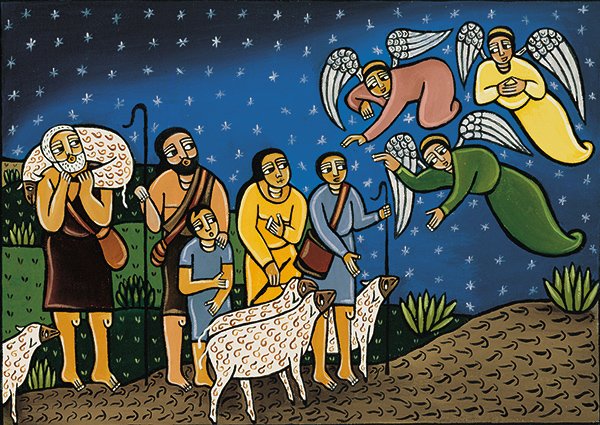
            The Nativity scenes I remember always had at least one shepherd visiting the baby Jesus, along with a sheep or two. Perhaps you remember when you or your children or grandchildren were in a Christmas pageant. Were there shepherds abiding in the fields, keeping watch over their flocks by night? And, sheep! I remember several Nativity scenes in Christmas pageants years ago, where the small children were dressed up as sheep.

            Let’s hear again from Dr. Luke the words the angel said to the shepherds, that Christmas night: “the angel said to them, ‘Do not be afraid; for see—I am bringing you good news of great joy for all the people.” Not just the people in Italy, where St. Francis was. Not just the people in Europe, or North America. Good news of great joy for all the people, all over the world.

This week in Advent, here at this church we are concentrating on the shepherds. As we read this familiar Christmas story, was there much in the shepherds’ daily life and experience to fill them with joy? I do not think they were particularly joy-filled, with their ordinary, workaday life and their low, social status. I wonder whether the shepherds felt like that, right before the angel chorus broke into this hum-drum, workaday world and appeared to them?

Remember the difficult situation the shepherds were in. The shepherds’ position on the social ladder in Palestine was pretty much the bottom rung. The Jewish religious leaders even considered shepherds ritually unclean, since their duties and their work of looking after sheep made it impossible for them to observe the Sabbath. Working as a shepherd was something that vagrants might pick up, or a job for ne’er-do-wells, or others who were very much down on their luck. Their society stereotyped shepherds as liars, degenerates, and thieves.

 Just imagine the reaction of these lowly shepherds as they heard this news from the angels! Good news of great joy, especially, particularly for them! And centuries later, imagine the reaction of these same shepherds to think that they are now an integral part of a Nativity scene, a central part of the Christmas story played out time and time again, year after year.  

When my children were small, one of the first Christmas decorations I’d take out of the box would be our little Nativity scene. The little figures were all children, and it was intended specifically for the young. I would tell and re-tell the Christmas story again and again. When they were small, all four of my children would love to play with the figures, spending a good long time with those inexpensive yet meaningful little figures.  

Different churches do different things to communicate this narrative of the birth of Jesus. I read that the Rev. Janet Hunt has a yearly practice she does in her Lutheran church in De Kalb. But, I will let her tell you herself. “It has been my practice for many years to ‘build the creche’ with the children during the children’s sermon during Advent.  One week we add the animals. The next week the angels join them. Pretty soon Mary and Joseph arrive and not long after the baby Jesus and shepherds and the three sages from the East arrive last of all. The order is not perfect, of course, but it is one way of bringing the story home.” [2]

My personal Nativity scene, the one my children played with, has white children, every one. I had not thought about this when I bought the set of figures, more than thirty years ago. Even though my children were part of a multi-ethnic, multi-cultural school system, we still had an all-white Nativity set. Were the people in that first Nativity people of color? Yes, they were.

            Let us return to these shepherds of the first century, on the hills surrounding Bethlehem. They were downhearted outsiders, all right! People of color, non-white, on the bottom rung of their society, for sure. “But God does not give up on us. God sends angels to people who have given up on God. How would you respond to God sending angels to you when you’d given up on God? Like the shepherds, I’d be terrified.” [3]     

Remember the words of the angel of the Lord: “Do not be afraid; for see—I am bringing you good news of great joy for all the people.” We can praise God! God did not send good news of great joy to just a few people in the world, or even some of the world’s people. Or, only people of a certain position in society. No, our God sent good news of great joy to all the people of the world.

The angel has come to all cultures, all ethnicities, all people, wherever their position on the social ladder. All people, everywhere. Even us. You and I can truly come to the manger in Bethlehem side by side with the lowly shepherds.

            That is not only GOOD news, that is GREAT news. Good news of great joy, for all the people of the world! Alleluia, amen.

@chaplaineliza

(Suggestion: visit me at my other blogs: matterofprayer: A Year of Everyday Prayers. #PursuePEACE – and  A Year of Being Kind . Thanks!


[1] http://www.smithsonianmag.com/smart-news/the-first-nativity-scene-was-created-in-1223-161485505/ 

[2] https://dancingwiththeword.com/re-telling-the-story/

[3] http://www.workingpreacher.org/preaching.aspx?commentary_id=1522

Unknown's avatar

God’s Faithful Promises

“God’s Faithful Promises”

Hebrews 10:15-25 (10:24-25) – Sunday, November 17, 2024

            Have you ever thought of all the different kinds of churches? Big churches, small churches, fancy places with lots of stained glass and stone carvings, or plain buildings with wooden pews and earnest prayers, plus house churches, all over the world!

            My friend Tiffany used to attend church at the National Cathedral in Washington. She grew up there. She remembers running around in that gorgeous building along with the other children in their renowned youth choir. Up and down the corridors, and even playing hide and seek in the building. Imagine having that glorious cathedral as a familiar, home church!

            I would like for us to focus on one particular idea in this Scripture reading from the letter to the Hebrews, today. “And let us consider how we may spur one another on toward love and good deeds, 25 not giving up meeting together, as some are in the habit of doing, but encouraging one another—and all the more as you see the Day approaching.”

I have worshiped at churches in a number of different faith traditions, in all different kinds of church buildings, and they all proclaimed the same Lord, Jesus Christ. The same God receives all the glory! Some churches pray in a more rambunctious manner than we do here. Yet, in every church, believers come together to worship God, and to encourage each other.

This letter to the Hebrews is a circulating letter. That means it and other circulating letters were sent from place to place in Asia Minor, so the small, struggling groups of believers could receive encouragement and teaching in writing from the Apostles and other newer church leaders. This particular letter was sent to Jews who lived a long way from Jerusalem, and possibly had rarely been to Palestine. Right here in chapter 10, this letter to the Hebrews gives the command to keep up meeting together.

Remember, the Christian community was extremely small at this point! In these towns and cities in Asia Minor and all over the Roman Empire, the Jewish community was decidedly small, too. Except, the Jewish religion at this time was known and accepted by the Roman government. Since Christianity was such a brand new religion, the Roman government did not recognize it, and in fact in some places, wanted to persecute followers of Christ!

I want everyone here to understand: in these early days, followers of Christ were not going to worship in large building dedicated to the Lord, set apart to the worship of our God. Not at all! This gathering together we read about in Hebrews 10 is in very early days of the church. We are talking about small house churches! Gathering together took place in each others’ homes, and maybe, perhaps, in a large spare room belonging to one of their number.

I’ve attended some African-American worship services. They are often quite different from the more quiet, sedate way we worship here at St. Luke’s Church. I had the privilege to preach in one service some years ago, at a Baptist church on the west side of Chicago. In a converted building, three storefronts put together. The building did not look like much from the outside. But, inside? A whole different thing.

The spirit of God came down and transformed that worship space – and the worshipers. Marvelous to experience. They truly encouraged one another, cared for one another, and helped one another show good to others. In their own context, familiar to them, on the west side of Chicago.

“After all, God has graciously adopted us into God’s family. God has transformed you and me from God’s enemies into God’s children, and from strangers into siblings. So when Christians meet together, we come to a kind of family reunion.” [1] When we meet together, whether it’s in a soaring cathedral or just where two or three are gathered together, God is present with us. And, God can draw us close. Closer to God, and closer to each other.

Now, this is only the first part of what happens when we gather together. What else can happen? What is another command from Hebrews chaplain 10? “And let us consider how we may spur one another on toward love and good deeds.”

So often, we as believers are told to be nice and gentle, meek and mild. And, that is one side of our Lord Jesus, certainly. But, the Rabbi Jesus when He was here on this earth was not just a meek, mild, retiring kind of guy. He often stepped out, and stepped up. Jesus actively worked on behalf of the poor, the forgotten, those left behind, in both love and good deeds!

How often are we called to be bold in the Scripture? To spur one another on to expressions of love and caring, to strike out and be bold and courageous? Yes, we are also called to be bold, and outspoken, and hard-working – like our Lord Jesus! This connects to the gospel call to face dangerous or difficult times bravely knowing that God is in charge. [2]

There is one important factor here, though. It’s very difficult to be brave, bold and courageous all alone. But – it helps if we do it together.

I would like to point out that all of these pronouns in these verses are plural. In the original Greek, the writer to the Hebrews is talking to “you all” when he mentions “you,” and especially when mentioning “we.” In all of these instances, all of these commands, these verses are talking to us Christians as a group. That is, all of us followers of Christ. Eugene Peterson’s excellent translation The Message interprets this as a summons to “be inventive … in encouraging love and helping out.”

As we come to the end of the church year, we consider a number of Scripture readings that talk about the end of our time here on Earth, when we look forward to our Lord Jesus returning. This Scripture reading from Hebrews is no exception. Listen again: “encouraging one another—and all the more as you see the Day approaching.”

Just as Boy Scouts are required to do a community service project to earn their Eagle Scout award, they need to organize others to help them do their special project. In the process of completing the project, they learn how to spur one another on to accomplish that goal, to join in together on good works that benefit their community. [3]

In the same way, we Christians are called to be faithful, to encourage each other, and to spur one another on! And, as each of us is drawn closer together to other believers, we are drawn closer to our God.

We followers of Christ are all called to actively work on behalf of the poor, the forgotten, those left behind, in both love and good deeds! And, all the more, as we all look forward to that Day when our Lord returns in glory.  We practice, we love each other, and we work together, looking forward to that Day when “every knee shall bow and every tongue confess that Jesus Christ is Lord.” What marvelous blessings for ourselves, for each other, for our communities, and for the world.  Alleluia, amen!

@chaplaineliza

(Suggestion: visit me at my other blogs: matterofprayer: A Year of Everyday Prayers. #PursuePEACE – and  A Year of Being Kind . Thanks!


[1] https://cepreaching.org/commentary/2018-11-12/hebrews-1011-14-15-18-19-25/

[2] http://worshipingwithchildren.blogspot.com/2015/10/year-b-proper-28-33rd-sunday-in.html

[3] Ibid.

Unknown's avatar

Out of Their Abundance?

“Out of Their Abundance?”

Mark 12:38-44 (12:44) – November 10, 2024

Just think, for a moment, about the sound two coins make as they clink into each other. I have two coins here. I’m going to take them both in my hand and shake them. Can you hear that? What does that sound bring to mind? Do you feel satisfied, or scary? Is that the sound of abundance, or scarcity? What do you think of that sound? [1]

We turn to the Gospel reading for today, from Mark 12. The Rabbi Jesus and His disciples are in Jerusalem, and Jesus is having another in those continuing discussions with the chief leaders and teachers of the Jewish Law. They happen to be in the rear of the Temple. Large sanctuary, many people walked and talked, and went to and fro. Business being transacted, multiple conversations and commotion going on. Except – the sound of two coins shaken together would be easily drowned out.

Listen again to a portion of today’s Gospel reading: “a poor widow came and put two very small copper coins into the temple treasury, worth only a few cents. 43 Calling his disciples to him, Jesus said, “Truly I tell you, this poor widow has put more into the treasury than all the others. 44 They all gave out of their abundance; but she, out of her poverty, put in everything—all she had to live on.”

Yes, I realize that our Lord Jesus was talking primarily about giving money. But, I have always thought of giving and being generous to count just as much for giving our time, and our talents, and our generosity in many other kinds of ways. Not simply in terms of money. I have a friend who has been retired for almost ten years now. He goes around town, quietly, and does good. He was raised in the church, but that was many years ago. Yes, he does have a belief in God, and he expresses that faith by doing good for others and being faithful.

Sometimes that means driving a friend to a doctor’s appointment. Or volunteering at a local not-for-profit organization. Sometimes that means picking up the left-over baked goods from a business at the end of the day, at closing time. And then, delivering those baked goods to a homeless shelter. He does all of this without thanks, with little or no fanfare. He is faithful. He is dependable. He contributes, in any way he can. And, I am so glad he is my friend.

Except, this is not the way that many religious people operate. Many religious folks – good, church-going folks – have been taught is that God works through deals. You do this, and I’ll do that. We do our bit, and then God will follow through with God’s part. “Pay a little extra and get a better seat at God’s table. Put in some overtime, split hairs on the detail of the law and you’ll get a nice long robe and watch everyone in the marketplace bow to you as you pass. Sure, maybe they had to foreclose on a widow or two, but business is business after all. And to make up for it look how much they gave, how much went into the offering box. Isn’t that what we want, more in the [offering] plate?” [2]

I know there are multiple ways to give, to be generous, including online giving – which is a wonderful thing. Here in the United States and in many other places around the world, we can give at the touch of a computer key or by pressing a cell phone button.

A number of years ago, at another church, I remember walking by the room next to the sanctuary where two trustees would be counting the offering after the worship service. But today, we don’t hear the offering. “The clink of coins is lost. Perhaps the value we place in pennies, nickels, and dimes has been lost, too. We no longer hear, see, or feel the weight of what happens when our small offerings come together in praise and honor of the God of abundant life.” [3]

But, back to our widow, the woman our Lord Jesus specifically points out. She had next to nothing to live on. God sees this woman, and many, many just like her. God cares about her, and about the countless others around the world. Along with commentator David Lose, I doubt anyone else, including the religious elite parading around the Temple that day and dropping in their token offerings and spare change, noticed this woman.

            Don’t you think that God also sees our struggles today, recognizes our challenges, cares about where we are hard pressed to make ends meet? And, isn’t God inviting each of us? This congregation knows I do not bring divisive politics into this pulpit. I preach what the Gospel teaches, what our Lord Jesus tells each of us to do.

I’m exhorting each of us to have open ears to what God is saying. God invites us to look around and see each other, those in our community we know and those we don’t.  I mean really see each other – the pain of those who are discriminated against because of their ethnicity, the desolation of those who cannot find work and have been abandoned to fend for themselves, the despair of those who have given up on finding work and have lost hope, the anguish of those who have been exploited by unfair employers, abusive landlords, or even detestable sex traffickers. God is inviting us to see them, to care for them, and to advocate for a system that does not leave anyone behind.[4]

This vignette from the Gospel of Mark is just a slice of the widow’s life. But, I’d like to follow the widow home. See how she treats her neighbors. Does she bring over a pot of soup to a sick friend? Does she clean the apartment of someone who has fallen and broken their leg? And what about her listening skills? Is she someone people come to, to talk about their troubles? Giving to God is so much more than just dollars and cents. So much more than just the coins the show-offy rich people put into the collection box in the Temple.

What about us, today? How can we take this scripture lesson today, and apply it to our lives? Is it just a nice story about what happened to people in Jesus’s day? Or, is it much more?

Today, we all can be like the widow in Jerusalem. This widow gave extravagantly. She gave over and above. She gave, trusting in God’s abundance. And, this widow decides that everything she is and has belongs to God. Like my friend I told you about, who does lots of things without thanks, with little or no fanfare. We all can be faithful. We all can be dependable. We all can contribute, in any way we can, to God and to God’s kingdom.

God willing, I’ll contribute to God’s kingdom. Will you contribute, too? Alleluia, amen.

@chaplaineliza

(Suggestion: visit me at my other blogs: matterofprayer: A Year of Everyday Prayers. #PursuePEACE – and  A Year of Being Kind . Thanks!


[1] https://www.umcdiscipleship.org/worship-planning/truth-telling/twenty-fifth-sunday-after-pentecost-year-b-lectionary-planning-notes

[2] https://www.umcdiscipleship.org/worship-planning/truth-telling/twenty-fifth-sunday-after-pentecost-year-b-lectionary-planning-notes/twenty-fifth-sunday-after-pentecost-year-b-preaching-notes

[3] https://www.umcdiscipleship.org/worship-planning/truth-telling/twenty-fifth-sunday-after-pentecost-year-b-lectionary-planning-notes

[4] https://www.davidlose.net/2015/11/pentecost-24-b-surprisingly-good-news/

Unknown's avatar

God’s Free Gift!

“God’s Free Gift!”

Romans 3:19-31 (3:24) – October 27, 2024

I have a confession to make. I was raised a Lutheran. Baptized and confirmed in a Lutheran church on the northwest side of Chicago, I loved everything about that church. learned all I could about being a Lutheran, and about Martin Luther. I studied Luther’s Small Catechism during my two years of confirmation classes in seventh and eighth grades. I know a thing or two about Martin Luther and about the church that to this day bears his name.

            This Thursday, October 31st, is the 507th anniversary of the day Martin Luther tacked up the 95 Theses, his 95 points of disagreement he had with the Catholic Church. In 1517, the priest and doctor of theology Martin Luther posted his 95 Theses on the chapel door in Wittenberg, Germany, at the university where he served as professor. Thanks to the printing press, these 95 points of disagreement spread like wildfire. Not only in Germany, but throughout Europe. The Reformation began in earnest. 

            Why was Martin so upset? When he was a very young man, Martin Luther felt unworthy of God’s love. He felt lower than a worm sometimes, and tried his hardest to get into God’s good graces! He would go to confession several times a week, do penance after penance, and he made several pilgrimages. All of these things and more to stop feeling unworthy and sinful.  

            Taking a quick look at the letter the Apostle Paul wrote to the Roman church, you and I might get that same message, too. From chapter three, “There is no difference between Jew and Gentile, 23 for all have sinned and fall short of the glory of God.” All have sinned! Martin felt that so deeply! All fall short of God’s glory! All means everyone. All of us.

            Romans 3:23 is pretty bad news. Rotten news. Really hopeless news. That is the news Martin Luther faced, the more and more he read and studied the Bible, meditated, and prayed.

            Martin was right. According to the Law of Moses, given to the nation of Israel in the Hebrew Scriptures, no one can follow the Law one hundred percent. Not the Jews in the time of Moses, not Jews in Jesus’s day, not Martin Luther, five hundred years ago. And, not you and me, today, either. There is no way anyone can keep every single one of God’s commands!

            That was what I felt, when I was a teenager. I knew I couldn’t keep all of God’s rules, even if I tried really, really hard. Remember Romans 3:23? “For all have sinned and fall short of the glory of God.”  When I was a teenager, I was a particularly studious teen. I would read books on the Bible and on theology when I was in high school. I prayed regularly, and tried my hardest to get closer to God. I felt sinful, unlovely and unlovable a good deal of the time. 

Martin Luther tried even harder to get close to God! He did a ton of good works. He got a university degree in theology, and started teaching from the Old and New Testament at the university in Wittenberg. He studied even more about God, and preached regularly in a church in town. And yet—Martin still felt sinful and far from God! He still felt unlovable!

            Can anyone relate to Martin? Are there times when you—when I—feel unlovable?
            I remember hearing the story of a woman, horribly burned in a fire. Her husband came to see her in the hospital and was disgusted and horrified. “You are not the woman I married,” he said, and divorced her. Are we so unlovable? Is that what we are afraid God might do to us?

            What’s more, even after lots and lots of good works and all these years of reading and study, Martin still felt so inadequate. He felt God could not possibly love or forgive him. That is—until he was reading the letter to the Romans, chapter 1, verse 17: “ For in the gospel the righteousness of God is revealed—a righteousness that is by faith from first to last, just as it is written: ‘The righteous will live by faith.’” 

            Do you hear? Do you understand? It wasn’t about how sinful or unlovable Martin was. Or, how hard he tried to do good things, or tried to get on God’s good side, or tried to live by good works. God’s righteousness comes by faith. Faith alone! Faith in God!

            Remember Romans 3:23? “For all have sinned and fall short of the glory of God.” That is true. But—that isn’t the whole story! From verse 3:21: “21 But now apart from the law the righteousness of God has been made known, to which the Law and the Prophets testify. 22 This righteousness is given through faith in Jesus Christ to all who believe. There is no difference between Jew and Gentile, 23 for all have sinned and fall short of the glory of God, 24 and all are justified freely by His grace through the redemption that came by Christ Jesus.”

“From Paul’s declaration that we have all been justified by grace to Luther’s hammering his theses against the Wittenburg Church door to remind us that grace reigns supreme, the whole darn Reformation-thing was intended to tell us that, in the end, we don’t need to do anything, earn anything, say anything, accomplish anything, or buy anything to earn God’s love. That we already have it, and that most of the Church’s problems – and, indeed, the world’s problems – start when we forget we already have love and worth and dignity as a gift from God and try to earn it or take it from someone else.” [1]

I can almost see Martin falling off his chair, once he realizes how huge this is. Our sin is taken away through the redeeming that came through Jesus. We are made lovable through God’s grace. Our low self-worth and low self-esteem is now viewed by God through Jesus.

God looks at all of us, each one of us, through Jesus-tinted lenses.  We are brothers and sisters of Jesus, God’s beloved children! We are redeemed freely. By His grace, through faith, through the redemption that came by and through Christ Jesus.

The best part of this gift? It’s a free, undeserved gift, so that no one can pridefully boast about it. Another way to look at this gift from God comes from a sermon study board online I follow. I recently read this, written a few years ago by a pastor named Erik in Wisconsin.       

“This Sunday we celebrate confirmation. As a part of their confirmation requirements, students have to meet with me for a brief discussion/interview. I ask them about faith, life, God, etc. – see if they learned anything during confirmation. One question I always ask is “How will you get into heaven? How are you saved?” Most often I get the answers – “Pray. Go to church. Do good deeds.” And I shake my head and ask myself “Didn’t I emphasize grace enough?”

            “Finally, I said to the class, “Listen, you are saved purely by God’s grace as a gift. I will ask you how you are saved in your confirmation interview. If you don’t remember anything else I’ve taught during these two years, remember this: “You are saved by God’s grace!” Why is it so hard to remember? Probably because we’ve been taught not to trust anything we might get for free, even if it is from God.”

            As Martin Luther studied scripture, he finally discovered he was saved by grace, not because of anything he did or deserved. The Rev. David Hansen tells us, “He discovered a God who would send the only Son—not for the perfect people, but for the sinners. He discovered, above all else, a God and a Savior that will NEVER abandon us, that will stand by our side no matter how often we fail or how short we fall.” [2] Isn’t that good news? Jesus died for our sins. Jesus showed us radical, God-sized grace, and radical, God-sized love.

As I proclaim each week after the Confession of Sin during the Assurance of Pardon, “Believe the Good News of the Gospel: in Jesus Christ, we are forgiven!”

Alleluia, amen!


Thanks to Rev. David L. Hansen and Pastor Erik from Wisconsin for their assistance in the formulation of this sermon!

@chaplaineliza

(Suggestion: visit me at my other blogs: matterofprayer: A Year of Everyday Prayers. #PursuePEACE – and  A Year of Being Kind . Thanks!


[1] https://www.davidlose.net/2015/10/reformationpen-22-freedom/

[2] from http://www.gmi.org/services/missiographics/library/world-refugee-day

Unknown's avatar

Who Then Can Be Saved?

“Who Then Can Be Saved?”

Mark 10:17-27 (10:26) – October 13, 2024

If we turn on the television, read a book, or listen to a podcast or talk radio, sometimes we might hear experts giving advice. These knowledgeable experts are often from well-known places. This week I am thinking about advice on how to live the “right” way. That’s sometimes thought to be a fruitful life, or a healthy life, or a spiritual life. Wouldn’t you be interested if you heard a radio program with a noted author or well-known expert in just this subject?

            That’s the case with Rabbi Jesus, today. In today’s scripture lesson, we get just a hint of what our Lord Jesus had to deal with much of the time. Can you see this situation? I love St. Ignatius and his prayer suggestion to put ourselves into the narrative. Let us imagine ourselves being there, right with our Lord Jesus the itinerant Rabbi, and His disciples.

The Rabbi Jesus was about to travel somewhere, and a number of His disciples are getting ready to accompany Him. It is significant to read what our commentator David Lose has to say about this journey. “In Mark, this is not merely “a journey” in general (per the NRSV), but rather represents the road to Jerusalem and the cross.” [1] And, repeatedly, our Gospel writer Mark tells us that Jesus has His face set to go to Jerusalem.

When, what happens? “17 As Jesus went out into the street, a man came running up, greeted him with great reverence, and asked, “Good Teacher, what must I do to get eternal life?” That is a pretty big question, isn’t it? Many people throughout the ages have wondered exactly that! The Rabbi Jesus was a widely acknowledged wise person, an expert in the interpretation of the Hebrew Scriptures, the Law of Moses and in lots of things associated with religious and spiritual life.

After all, you don’t get an expert in religion and spiritual life coming to your town just any old day.

The Rabbi Jesus is matter-of-fact, and responds (as many Rabbis would), “You know the commandments: Don’t murder, don’t commit adultery, don’t steal, don’t lie, don’t cheat, honor your father and mother.”

This is a shortened list of some of the Ten Commandments from the book of Exodus. These commands from God are revered as being the shorthand version of God’s rules for living. Now, while we have our imagining caps on, imagine we are watching this whole scene play out. Our teacher, the Rabbi Jesus, is involved in conversation with this earnest young man.

Except, something is different about this young man. He’s well-dressed, and looks to be really rich. Plus, he answers the Rabbi Jesus in all seriousness! “He said, “Teacher, I have—from my youth—kept them all!” 21 Jesus looked him hard in the eye—and loved him!”

 What do we see here? “Jesus looks at him with love (verse 21). He does not treat him as insincere or mock him as self-righteous, but rather loves him. Every interpretation we may offer must therefore take seriously Jesus’ absolute regard and unconditional love for this man.” [2]

I am still looking at this whole scene through my imagination, too. I am right there, watching everything go on. Watching the gathered crowd in the dusty afternoon in one of the towns of Palestine. And, we can see the love shining out of our Rabbi’s eyes!

But, let us get back to our rich young man who asked Rabbi Jesus this serious question. “’Jesus said, “There’s one thing left: Go sell whatever you own and give it to the poor. All your wealth will then be heavenly wealth. And come follow me.’ 22 The man’s face clouded over. This was the last thing he expected to hear, and he walked off with a heavy heart. He was holding on tight to a lot of things, and not about to let go.”

Dr. David Lose said about this point in the reading, “what Jesus really meant was that we needed to unburden ourselves of whatever might be keeping us from relying on God.” [3] Yes, the rich man had a great deal of difficulty hearing these words of Jesus.

            Let’s face it: these are difficult words for many people to hear. We love our stuff, don’t we? Or, if not most of our stuff, at least some of our stuff. I would really have difficulty giving up my computer and my car. I think I am not the only one in this room today for whom that is true. Others might have difficulty unburdening themselves of whatever might be keeping each one from God.

“Jesus knew that the only thing that could overcome the gravity of the riches of this life is a force stronger, a greater pull. Love redeems; love rescues; love wins. He knew that. He knows that. Jesus loved him even though it didn’t seem to work. The young man walked away, grieving. The burden on his heart increased, instead of lightened. He had the antidote; he had the prescription. But the medicine was too bitter for him to swallow.” [4]

Let me ask, as we still consider us being there, right next to Jesus. What would it be like to have Jesus look upon each of us with that same love? What is more, Jesus asks each of us the same question about our stuff, about following Jesus. And, what is our response to Jesus?

All of our stuff gets in the way between us and God’s kingdom. All of this clutter and distraction in our lives keeps us at a distance from God. We know what Jesus has asked us to do, just like this young man did. When you don’t do what God has asked you to do, how do you picture God responding to you? Do you imagine God looks at you—at us—with loving compassion like Jesus did in this story? What’s more, we all will see how all of our “small steps” in loving and giving combine to create a beautiful impact of compassion in God’s world.

            And, maybe, just maybe “God’s gift of salvation can actually free us to do something: to love each other, to care for God’s people and world, to share the good news…right here, right now, wherever it may be that God has placed us.” [5]  

            God willing, we can all show love, giving, and compassion, every day. Alleluia, amen.

@chaplaineliza

(Suggestion: visit me at my other blogs: matterofprayer: A Year of Everyday Prayers. #PursuePEACE – and  A Year of Being Kind . Thanks!


[1] https://www.workingpreacher.org/commentaries/revised-common-lectionary/ordinary-28-2/commentary-on-mark-1017-31-3

[2] Ibid.

[3] http://www.davidlose.net/2015/10/pentecost-20-b-curing-our-heartsickness/

[4] https://www.umcdiscipleship.org/worship-planning/walking-with-jesus/twenty-first-sunday-after-pentecost-year-b-lectionary-planning-notes/twenty-first-sunday-after-pentecost-year-b-preaching-notes

[5] http://www.davidlose.net/2015/10/pentecost-20-b-curing-our-heartsickness/

Unknown's avatar

Heavenly Prescription for Prayer

“Heavenly Prescription for Prayer”

James 5:13-20 (5:13) – September 29, 2024

How many of you remember being really sick? So sick that you had to stay in bed for days, or perhaps even had to go to the hospital? Thank goodness here in the Chicago area we have many devoted doctors and excellent hospitals to choose from, and to figure out exactly what is ailing us. And, thank goodness we are able to have effective medicine prescribed for us when we are sick, too!

Except – what do we do when our hearts and spirits are feeling sick? Anxious, or disturbed? Where do you and I go when our faith in God seems shaky? We could perhaps go to the doctor or the hospital, but they probably will not have the right tools or equipment to help when you or I have spiritual afflictions. [1]

This is our fifth week looking into the letter of James, and we have seen over the past few weeks that James is a very practical man. He displays a great deal of common sense, and does not pull punches when it comes to talking straight to his friends scattered around Asia Minor. (The area to the north and east of present-day Palestine.)

Let’s hear from James about this very problem: “Are any among you in trouble? They should pray. Are any among you happy? They should sing praises. 14 Are any among you sick? They should send for the church elders, who will pray for them and rub olive oil on them in the name of the Lord. 15 This prayer made in faith will heal the sick; the Lord will restore them to health, and the sins they have committed will be forgiven.”

What I have seen in these past weeks and months are the overwhelming number of people with heightened emotions and reactions to anxious, even fearful situations. As someone involved in pastoral care and trained as a chaplain, I notice these things. In our scripture reading today, we find the apostle James talking straight about how to pray, and thus deal with things similar to these things he mentions: heightened, negative emotions and reactions to anxious situations, not to mention physical needs, too.

The apostle James was a practical kind of guy. We can see that from this short letter, the only letter he wrote, included in the New Testament. He gives some practical advice to his readers on how to live a faithful and effective Christian life: how to live faithfully with others in society, how to control the tongue, how to turn away from evil and towards God. Here, in the fifth chapter of James, he turns to prayer. As we look at this passage, James tells his friends how to pray, in very practical terms, almost the same way as a doctor with a prescription pad might write it out.

What are the beginnings of this spiritual prescription? You and I need a special place and a special way to access God; we need to be open and willing, in this place! You and I need God – especially through the Holy Spirit – to help our hearts and spirits feel renewed, and we need the body of Christ–all of us–to help us strengthen our faith. In fact, we all need each other. [2]

When I was a hospital chaplain, working in critical care units like the Emergency Department, Intensive Care, and trauma support all over the hospital, my primary job would be that of compassionate listener—even before prayer, and also as a heartfelt part of prayer.

Now that I am a hospice chaplain, compassionate listening becomes an even more important part of what I do, not only for my patients, but for their loved ones. I suggest for all of us to consider a heart of compassion and a gentle hand of mercy. It’s time to put our defenses down and instead experience the vulnerability of listening to one another.

“If someone has a story to tell, the greatest gift you can offer is simply to listen. You don’t need to have answers or wisdom. You probably don’t need to say anything except, ‘I hear you. I believe you. I’m sorry you experienced that.’ In the compassionate version of the world I yearn for, we offer one another solidarity, a listening ear, and a tender heart.[3]

Another way of defining this spiritual prescription is through prayer – corporate prayer. James says, “16 So then, confess your sins to one another and pray for one another, so that you will be healed. The prayer of a good person has a powerful effect.“

Again, I am reminding us all, this exercise of prayer is not meant to be only for persons in isolation. It’s true, as a hospice chaplain, I see many people isolated in hospitals, in care centers, all alone in their rooms with no one to hold their hands or offer them a kind word of compassion or comfort. James would give us – fellow Christians – the practical advice to come alongside the sick persons in prayer and fellowship, even solidarity.

My commentator Dr. James Boyce echoes this very call from our letter-writer: “James knows a wisdom that is communal, especially in its faithful exercise of prayer. Twice he charges that confession should be “to one another,” and that we should pray “for one another,” if we have any expectation that the promised healing is to take place (James 5.16). Such prayer exercised within and on behalf of the community has power — James says it is “effective.” [4]

I think all of us can agree that as God’s people, we all need regular repentance and soul-searching, no matter what. We are also all in need of healing, personally, and certainly communally. Isn’t that what James tells us here?

At the end of this 5th chapter, this practical how-to manual on the Christian life, we can follow the heavenly prescription James sets forth. We can pray. We can worship. “We learn about how to be God’s people by reading the Bible. We find ways to serve – to do spiritual exercises that both help the world and strengthen us. We develop relationships within our faith community [or church] that are healing and helpful. And we learn to be generous – to share the many good things God has given us with others.” [5]

Whether it is the healing touch of the laying on of hands, or a simple hug from a sister or brother in Christ, or the potent power of prayer or the relief of corporate confession, active participation in the Body of Christ is preventative medicine at its best. What are you waiting for? There’s no co-pay, third-party billing, or lifetime limits on God’s grace and love. Prayer is our heavenly prescription from God.

Alleluia, amen!

@chaplaineliza

(Suggestion: visit me at my other blogs: matterofprayer: A Year of Everyday Prayers. #PursuePEACE – and  A Year of Being Kind . Thanks!


[1] https://www.stewardshipoflife.org/2012/09/rx-for-broken-lives-and-faltering-faith/

[2] https://www.stewardshipoflife.org/2012/09/rx-for-broken-lives-and-faltering-faith/

[3] https://fosteringyourfaith.com/2018/09/30/time-for-compassion/

[4] https://www.workingpreacher.org/commentaries/revised-common-lectionary/ordinary-26-2/commentary-on-james-513-20-4

[5] https://www.stewardshipoflife.org/2012/09/rx-for-broken-lives-and-faltering-faith/

Unknown's avatar

Wisdom from Above!

“Wisdom from Above!”

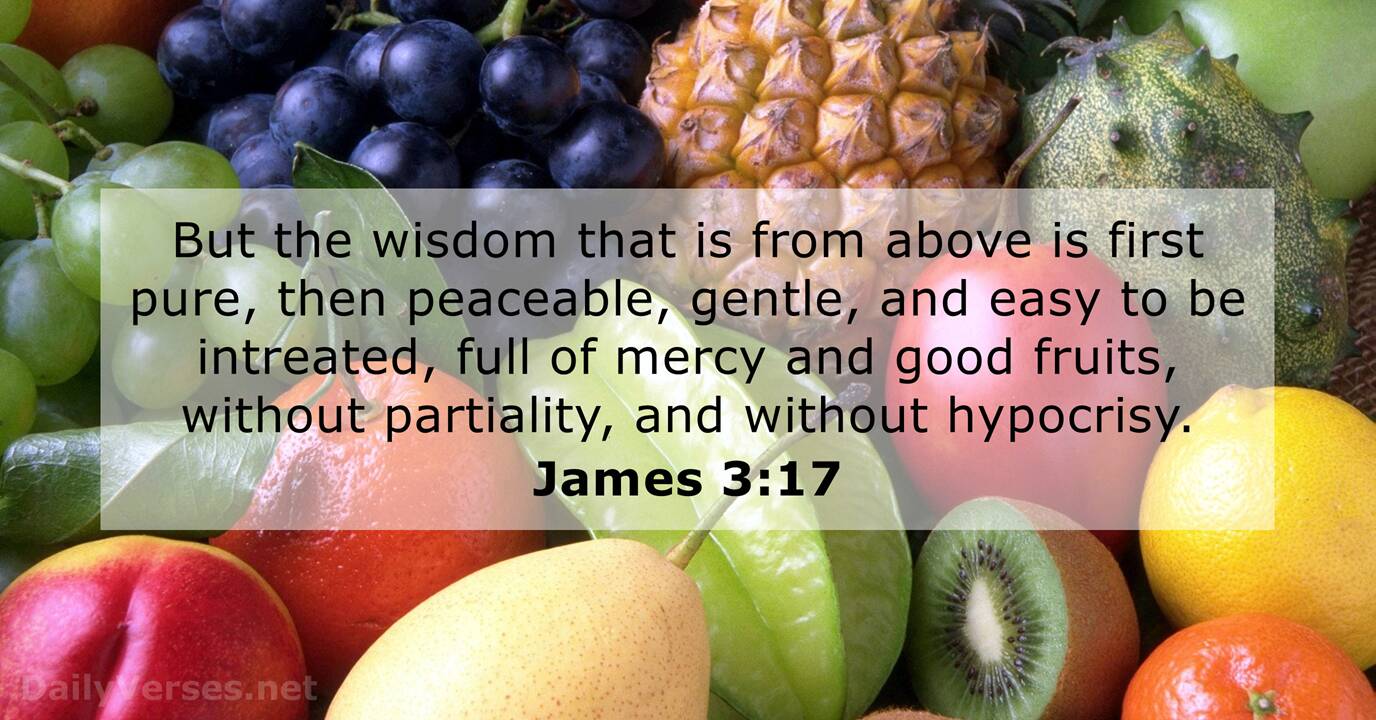
James 3:13-4:3 (3:17) – September 22, 2024

            I wonder if you can think of people who are called the best at something? The greatest athlete in a sport? The smartest student at your school? The best chef or best writer or best driver or best of anything? Just imagine how much bitter jealousy that comment can promote. Or, how much selfishness and blind ambition all this empty striving and competition leads to!

Worldly “wisdom” is anything but wise, according to our letter writer James. I am sure you recognize these jealous, covetous people. They regularly moan and kvetch and sometimes outright quarrel about what they have or about what they don’t have. James tells us about these dissatisfied, disgruntled people in our Scripture reading today.  

            Just listen to his description: “If in your heart you are jealous, bitter, and selfish, don’t sin against the truth by boasting of your wisdom. 15 Such wisdom does not come down from heaven; it belongs to the world, it is unspiritual and demonic. 16 Where there is jealousy and selfishness, there is also disorder and every kind of evil.”  

This kind of worldly striving, dog-eat-dog attitude is definitely not what James has in mind for us, as believers in Christ. He shines the spotlight on how believers ought to live. Listen! “13 Are there any of you who are wise and understanding? You are to prove it by your good life, by your good deeds performed with humility and wisdom.”

Can there be a sharper contrast between the dissatisfied, selfish, boastful worldly “wisdom” and the Godly, humble, beneficial wisdom and way of life that James talks about here? Not likely. Remember, in this practical letter, this how-to manual, James advises his friends on how to live in a way pleasing to God.

            It’s true that this fancy, flashy excitement can be attractive, even seductive, on the surface! But, all that is just for show, simply surface, an inch deep, and nothing more than worldly dissatisfaction, boastfulness and jealously. But, let’s be truthful – which of us is not tempted, sometimes, by the alluring or bright and shiny trappings of the way of worldly “wisdom?” Which of us doesn’t fall in step with others who might be jealous, or bitter, or selfish – sometimes? Most important, which of us leaves the simple, quiet, godly life of contentment for the flashy, glitzy (and shallow) excitement that so soon fades?

            Let’s consider the worldly, flawed way of thinking and being, for a moment. Carolyn Brown, retired Children’s Ministry Director, has written a prayer for this reading. Listen, if you would, and see whether these words from Ms. Brown do not resonate in our hearts.

Dear God, we want to look amazing.  

We want great clothes, cool shoes, a great haircut. We want our homes filled with our stuff.

We want all the best people to be our friends. We want to be the first, the best, the most, the greatest. So we grab and hold and demand. We even kick and punch to get what we want.

Forgive us.

Teach us to let go, to open our hands and hearts to others. Teach us to be content with what we have and to share it.

Teach us to think as much about what OTHERS want as what WE want. Teach us to be as loving as Jesus. Amen. [1]

            This prayer penetrates straight to the heart, let me tell you! I want to ask God for forgiveness, and to help me live in a loving way, like Jesus. I hope you do, too.

            This prayer makes me think of the Jewish High Holidays, which are quickly approaching. During the month before Rosh Hashanah and Yom Kippur, faithful Jews prepare for these holidays by examining their hearts. They meditate and pray, and ask forgiveness of God, of others, and of themselves for the sins and shortcomings of the past year.

            We also have a weekly time of confession and prayer at the beginning of each worship service. Thank God we receive the assurance of pardon each Sunday from our loving Lord! Yet, we keep on sinning. We still need to keep confessing our sins and shortcomings, and receive that assurance of pardon and forgiveness. Is it any wonder that we have this very practical how-to manual of how to live the Christian life by our letter-writer James, in the New Testament?  

            James assures his readers of Godly wisdom, because he describes its results. “Believers need to submit to the wise rule of God through the Spirit of God, a rule which purifies from within.” [2] The practical consequences of this wise rule of God are easy to observe. People who live God’s way are peaceable, considerate, gentle and non-combative! Does this sound very worldly to you? Certainly not selfish or jealous or bitter!

            What I wonder: how is the life of Jesus any mirror to our personal lives? Jesus is certainly recorded as merciful and loving. That is displayed over and over again in the Gospel record! When I think of our Lord Jesus during that three-year period of time in Palestine, I cannot think of anyone more sincere, honest or peaceable. More real and yet penetrating to the heart. I would love to have just a fraction of that Godly attitude and lifestyle as part of mine!

What – practically – can we take away from this reading today? Can we concentrate on living like Jesus? Living the Jesus way is peaceable, considerate, gentle and non-combative. Jesus is sincere, honest, and real. Can we make a commitment to live like Jesus?

This is the how-to of living a life pleasing to God, being filled with the presence of God. “[You and I] are works in process. This isn’t about completion and the satisfaction of a job well done; it is about a journey of discovery and transformation. But peace [gentleness, mercy, and lovingkindness] can be our companions in the journey to keep our feet on the path.” [3]

            Practical James would wholeheartedly agree! Keep on keeping on. Live in God’s way, in the wonderful, honest presence of Jesus. It’s a sure-fire way to have God draw near to each one of us. Alleluia, amen.

@chaplaineliza

(Suggestion: visit me at my other blogs: matterofprayer: A Year of Everyday Prayers. #PursuePEACE – and  A Year of Being Kind . Thanks!


[1] http://worshipingwithchildren.blogspot.com/2012/08/year-b-proper-20-25th-sunday-in_30.html

Worshiping with Children

[2] http://www.lectionarystudies.com/sunday25bee.html  

[3]  https://www.umcdiscipleship.org/worship-planning/doers-of-the-word/seventeenth-sunday-after-pentecost-year-b-lectionary-planning-notes

Unknown's avatar

Today!

(I attended a denominational national assembly this weekend, and was not leading worship. Here is a sermon from my archives! I hope it touches your heart and spirit.)

“Today” – 2 Corinthians 5:20-6:2

June 28, 2006

            Once upon a time, there was a loving Father with abundant wealth, property and resources. He loved His many children dearly and did everything in His power to provide abundantly for them.

            Does this story line sound familiar? It should. That loving Father is God, our Heavenly Father. He created the world in the beginning, including humanity. Our loving God gave humans abundant resources, and provided many good and gracious gifts for them, doing everything possible to provide a rich and rewarding life for them.

I’d especially like to focus on the love. God’s love for humanity, for the world, for us. I dare say that many of us here today could quote John 3:16—“For God so loved the world that He gave His only begotten Son, that whoever believes in Him should not perish, but have everlasting life.”

From this verse, can we tell how much God loves the world? How much does God love us? This much?     (spread arms and pause)  

There was a problem, way back when, when God lavished such good and loving care on humans, on His children. That problem was and is SIN.

Face it, humanity—and that includes you and me—is fallen. I usually hesitate when I make sweeping statements, but not in this area. We are sinful. As Romans 3:23 says, “For all have sinned and fall short of the glory of God.” That is ALL. Not a few, not even most, but ALL. Everyone. All humanity. We don’t sin all the time, or in every situation. There are plenty of times when members of the human race act in kind ways, and think loving thoughts, but that troublesome sin nature is alive and kicking in each one of us.

Can you see a toddler or preschooler, stamping her feet, crossing her arms across her chest, and shouting, “No!!” Can you see a teenager, disrespectful and angry, slouching away from the dinner table without a word? Can you see the prodigal mentioned in the Gospel of Luke, wishing that his father would kick the bucket already, so he could get his inheritance? Do these selfish, proud, disrespectful, ungrateful actions (and thoughts, I might add) have anything in common? I would say, yes, they do. The sin nature that is part and parcel of all humanity is readily evident, in all of these situations. We are human, therefore we sin—by thought, word, or deed—by omission or by commission.

It would be really bad news if the story ended there, wouldn’t it? Humanity would be both hopeless and helpless, stuck in the miry clay of our own sinfulness. BUT, that is not the end of the story. God still loves us. Remember John 3:16? “For God so loved the world?” That love still comes to us, regardless of our sinfulness, regardless of our selfishness, regardless of how much we have disregarded the abundant love and the lavish care that God showers upon us each and every day.

As our passage from 2 Corinthians says, we humans trespass. We sin. We mess up. We make mistakes. But God loves us anyhow! God doesn’t keep a tally sheet, a ledger of all our good deeds and bad deeds. God does not count these mistakes against us. In fact, God goes above and beyond our mistakes, reconciling the world to Himself.

It’s not that God is estranged from the world, from humanity. It’s the other way round. It is humanity—it is you and me—that is estranged from God. God created humans, and He loves humans. He created each of us with our foibles and quirks and personality flaws as well as our individual strengths. He created each one of us as individuals to give glory to His name in our own individual ways. God knows us so much better than we know ourselves, and He still loves us just the same! God reconciled the world—that’s you and me—to Himself, out of love.

Like I said, that is wonderful news! Amen! Praise God! Thank You, Jesus!

Jesus was sinless, but He was made to be sin for us. Jesus took all of our collective sin upon Himself on the cross so that in Him we might become righteous before God. Can we tell how much God loves the world? How much does God love us? Is it this much?     (spread arms and pause)  

So, now that we know about God’s abundant love that He lavishes upon each of us, what are we going to do about it? Listen to the words of our passage again. “’At an acceptable time I have listened to you, and on a day of salvation I have helped you.’ See, now is the acceptable time; see, now is the day of salvation!”

D.L. Moody, noted evangelist during the 1800’s and founder of Moody Bible Institute, did much of his evangelistic work around Chicago. One Sunday evening in September 1871, Mr. Moody closed his sermon with the injunction for the congregation to evaluate their relationship with God over the next week and to return the following Sunday. When Mr. Moody was on his way home after the evening service, he heard the fire alarms all over and saw the flames against the sky, turning the night sky red and orange. That meeting hall where the service was held burnt to the ground, along with most of the city of Chicago. The Great Chicago Fire happened that night.

Mr. Moody was horrified, knowing that he had not told his listeners the full message of the love of God, for each one of them. He vowed from that day on to tell the whole story, to always let people know the good news of salvation in every sermon he preached.

What about you? Are you still thinking about God’s offer of salvation? You may have been a church member all your life, faithful and hard at work for many years. But you may have never realized that God’s joyful message of reconciliation was especially for you. You may have been born into a loving Christian family, maybe even a pastor’s kid or missionary’s kid, and been surrounded by God’s abundant love all your life. But just because I may be born in the room behind a bakery doesn’t make me a biscuit . . . and just because I may be born into a Christian family doesn’t make me a Christian by birthright or by osmosis. God has no grandchildren. There are only children of God.

God has been loving us—you and me—all of our lives, even when we turned our backs on Him. If this is that day for you, that acceptable time, that day of salvation, praise God! Enter into the joy of a loving relationship with God, a close friendship with God.

If God had a refrigerator, your picture would be on it. If God had a wallet, your photo would be in it. God can live anywhere in the universe, and He wants to live in your heart. If you have never, truly experienced God’s love for you, individually, there is no time like the present. We can indeed enter into the joy of our Father’s loving embrace and experience His abundant love for each one of us. Today is the day of salvation! God is ready. Are you?
@chaplaineliza

(Suggestion: visit me at my other blogs: matterofprayer: A Year of Everyday Prayers. and  A Year of Being Kind . Thanks!

Unknown's avatar

A Hometown Reaction?

“A Hometown Reaction?”

Mark 6:1-7 (6:5) – July 7, 2024

            I have not rubbed shoulders with many VIPs – Very Important People – in my life. All of those VIPs grew up somewhere. All of those high-profile people started out as kids, and teenagers, and some grew up in small towns before they hit it big. When they went back to the old neighborhood where they grew up, how were they received? Were the older people from the neighborhood filled with awe or pride? Or, did these VIPs get disrespected?

            From what our reading tells us, the people from the old neighborhood in Nazareth did not think very much of the newly-minted Rabbi Jesus. Starting at verse 2, “On the Sabbath Jesus began to teach in the synagogue. Many people were there; and when they heard him, they were all amazed. “Where did he get all this?” they asked. “What wisdom is this that has been given him? How does he perform miracles? Isn’t he the carpenter, the son of Mary, and the brother of James, Joseph, Judas, and Simon? Aren’t his sisters living here?” And so they rejected him.”

            The folks from the old neighborhood – from where Jesus grew up – would not see Jesus as He had become. They insisted on seeing Him as the young boy who had grown up down the block, where His extended family still lived. Nothing more. Talk about disrespect! “There is an undertone of ‘who does he think he is’ in this passage. Not the warm welcome you might expect your home crowd to give you. And yet is it not often the case that when people know you, really know you, that they can be quick to believe the gossipmongers?” [1]

            When our Lord Jesus went home, things did not go well for Him, as we see here. How many of us wish to “go home,” wherever “home” is for you?

            Of course, a great deal depends on our family of origin and the situation of our growing up, the neighborhood where we were born, even how long we lived there. Did our family move from place to place several times during the time we were children? What about the place were we were born – was it in a large town, or a little village, or on the wrong side of the tracks?

            And, what about where you were in the birth order in your family? Some families have definite birth orders, while other family structures are more lackadaisical and some even haphazard. How many of us do not get respect from brothers or sisters or family elders simply because of place in our family “pecking order?” Certainly, Jesus got this kind of attitude when he went home and preached in Nazareth. [2]

Mark’s Gospel clearly says that a number of townsfolk took offense at Jesus. Some commentaries particularly mention this word. In Greek, it is “skandalon,” from which we get the word “scandal.” Can you imagine being scandalized by a young man from your hometown or neighborhood actually preaching, teaching, and even doing miracles? I cannot imagine it. It’s a little beyond me, but Mark says it’s so, right here in chapter 6.           

            Jesus said to them, “Prophets are respected everywhere except in their own hometown and by their relatives and their family.” He was not able to perform any miracles there, except that he placed his hands on a few sick people and healed them. Jesus was greatly surprised, because the people did not have faith.

            Jesus realizes that His teaching, preaching and miracles would not always be well-received. But, this is still the beginning of His ministry. Jesus is still building His team and training them for the work He knows they will have to do. Jesus knows that it will not be easy and the teaching and preaching of the disciples will not always be well-received or even welcome – although even Jesus is amazed at how hostile the crowd in Nazareth are. [3]

But, what if we took the sad situation in Nazareth – or wherever our small town or old neighborhood is – and flipped it upside down? What kinds of things might happen? Instead of some hometown boy or girl coming back and being disrespected, what might happen?

            What if you and I are more alert and more attuned to what God can do in our world than Jesus’s neighbors in Nazareth were? Can we watch for God at work in our world? How about on our block or down the street? Does God work here, today, and not just in Bible times? A pastor friend of mine (another Pastor Joe) calls these “God sightings.”

What about an older brother or sister leaving friends to take care of a younger sibling? What about some young people working on and repairing an elderly church member’s house? What about a son or daughter (or grandson or granddaughter) getting a first job at a local mission agency or food pantry, like A Great Harvest hear the Howard Street El station? I used to take the baked goods from Maier’s Bakery there for a number of months. What about a church member bringing a dinner or some take-out to a shut-in or someone recently returned from the hospital? Aren’t these all “God sightings?”  God working through ordinary people – like us?

            We can see from our Gospel reading today that the Rabbi Jesus came home, but He wasn’t “at home.” How were His friends and disciples His new “found family,” or “family of choice?” Are you – am I more comfortable with a “family of choice?” And, does God support us when we find family in unexpected places? Each of us – all of us can find family and can find “God sightings” each and every day!

            I encourage all of us to open our eyes and look for these everyday ways that God works in our lives, our homes, and our neighborhoods each day. We all have the opportunity to support “God sightings!” Plus, we all have regular opportunities to find places where you and I can get active and perform one of these “God sightings” ourselves!

Today, this week, whenever we can.

            Don’t be like the people in Nazareth, hostile and scandalized at Jesus and His ways of doing God’s work. Instead, celebrate – support – and get involved in any of the places where God is at work in our neighborhoods, today! Alleluia, amen!

@chaplaineliza

(Suggestion: visit me at my other blogs: matterofprayer: A Year of Everyday Prayers. and  A Year of Being Kind . Thanks!


[1] https://www.churchofscotland.org.uk/worship/weekly-worship/monthly/2024-july/sunday-7-july-2024-seventh-sunday-after-pentecost-year-b

[2] http://www.word-sunday.com/Files/b/14-b/A-14-b.html

“Going Home,” Ordinary 14B, Larry Broding’s Word-Sunday.Com: A Catholic Resource for This Sunday’s Gospel

[3] https://www.churchofscotland.org.uk/worship/weekly-worship/monthly/2024-july/sunday-7-july-2024-seventh-sunday-after-pentecost-year-b

Unknown's avatar

Fearfully and Wonderfully Made!

“Fearfully and Wonderfully Made!”

Psalm 139:13-18 (Psalm 139:14) – June 2, 2024

            As some of you know, I am a new grandma. My lovely twin grandchildren were born recently, much-awaited, and very welcome to their family and their parents. I was praying for the twins each day while my daughter was pregnant, and now that they are here, growing and maturing, and being their own wonderful selves, of course I continue to pray for them.

            I have always felt a real connection with Psalm 139, but never more so than when I – with their parents – was awaiting the birth of my lovely grandchildren. This psalm was written by King David, and shows his trust and confidence that God is indeed with him, all the time. And, indeed, with all of us.

            As Dr. Streaty-Wimberly says in her commentary on this psalm, the 139th Psalm reveals an account of what may be called “an encounter of the closest kind” with God. What a statement! And, what a word-picture David paints here.

“The psalm details an intimate conversation with God in which the psalmist is speaker and God is listener. The psalmist focuses quickly in verses1-2 on the word, “know(n).” This key reference points to the psalmist’s relating to God the experience of not simply being recognized and acknowledged by God, but of belonging inseparably to God.[1]

Along with the rest of my family, I eagerly awaited the arrival of my grandchildren! And, I find my wonder and amazement echoed by so many friends and acquaintances as they welcome newborns into their larger families, too.

One of the commentators I read has an extended example of her joy and wonder at welcoming her nephew. “My nephew was born on the day I started working on this commentary [about Psalm 139]. When the picture of Mason James arrived, my initial thoughts were, “There you are. What were you doing in there all of these months?” And then I read: For it was you who formed my inward parts;you knit me together in my mother’s womb (vs. 13).

“How did you go from a hoped-for dream of your parents to flesh and blood, bones, muscles and those long, skinny fingers and those cute ears?” I wondered. Then I read: My frame was not hidden from you, when I was being made in secret, intricately woven in the depths of the earth. Your eyes beheld my unformed substance (vs. 15).

“I wanted to shout, “Mason, you are perfect.” Yet this acclamation paled in comparison to his parents’ “You are perfect!” which pales in comparison to God’s “You are PERFECT!”

My hope for this little guy on his first day, his birth day, was that one day he would realize and pray with the psalmist, I praise you, for I am fearfully and wonderfully made (vs. 14). [2]

            What a marvelous addition to this commentary on such a rich, praise-worthy psalm! Dr. Hannan usually writes in a more academic style, but enriched and awed by the birth of her nephew, this particular commentary is unusually personal. And, her prayer is heartfelt.

            Sure, if we go to biology and look at the growth of a bunch of cells inside a female mammal, we can still be intellectually amazed by the intricacy of the growing being inside of the uterus. However, when we take into consideration the reference to “being ‘knit together’ in the mother’s womb, the psalmist seems to describe God as a weaver who engages on the highly intricate, and artistic, endeavor of creating a unique and wonderfully made living being.” [3]

            How marvelous that each of us – whether parents, grandparents, siblings, great-aunts and -uncles, or dear friends of the parents – can stand by and observe these miracles that come into the world each day. What a privilege to welcome one of these little ones, and nurture and help it grow!

            Now, we need to turn from beloved babies, entering life as very much wanted members of the family (and of God’s family), and consider another sad possibility. Sadly, there are many, many babies and children who have unhappy childhoods, are not valued members of a family, and even know that they are not welcome in their homes – from a young age. This is heart-breaking, and happens much more often in this world, for any number of sad reasons.

            Rabbi Sharon Brous talks about a commentary written in the ninth century that “declares that every person is accompanied, at all times, by a procession of angels crying out, “Make way, for an image of the Holy One is approaching!” Every person, like royalty… How do we keep missing all those angels, with their trumpets and proclamations, desperate to rouse us to the dignity of every human being?” [4]

            What an earth-shaking concept! This is true not only for cute, adorable newborn babies, but also for all children. For tweens and teenagers (even if we are irked or frustrated with them). This is true for each adult, whoever and wherever they may be on their journey through life. And, this is true as well for each sick person and each senior I may encounter as a chaplain in my day-to-day travels to skilled nursing facilities and extended care centers.

            Rabbi Brous continues to reflect that this attitude “heightens the amazing and magnificent artistry of God’s creation. Indeed, this recognition becomes reason for praising God and affirming the self’s ultimate worth in the sight of God (v. 14).” [5]

            Indeed, we are all – each of us, every person in the world – fearfully and wonderfully made! Each person is accompanied, at all times, by a procession of angels crying out, “Make way, for an image of the Holy One is approaching!” That means every single person, in beautiful diversity, regardless of color, creed, cultural difference, language or nation of origin.

            We are celebrating our graduates today! Let us celebrate each other, too. In the words of the lovely children’s hymn “All things bright and beautiful, all creatures great and small, All things wise and wonderful, the Lord God made them all.” [6] God made you, me, and every single person in the world – all fearfully and wonderfully made. Alleluia, amen!


[1] http://www.theafricanamericanlectionary.org/PopupLectionaryReading.asp?LRID=27

[2] https://www.workingpreacher.org/commentaries/revised-common-lectionary/second-sunday-after-epiphany-2/commentary-on-psalm-1391-6-13-18-3

[3] http://www.theafricanamericanlectionary.org/PopupLectionaryReading.asp?LRID=27

[4] Brous, Sharon, The Amen Effect: Ancient Wisdom to Mend Our Broken Hearts and World (New York: Avery, 2024), 53–54,

[5] Ibid.

[6] https://hymnary.org/text/each_little_flower_that_opens

@chaplaineliza

(Suggestion: visit me at my other blogs: matterofprayer: A Year of Everyday Prayers. and  A Year of Being Kind . Thanks!