Unknown's avatar

Under His Wings

“Under His Wings”

Luke 13:31-35 (13:34) – March 16, 2025

During this season of Lent, our focus is on love.

When we think of the animal kingdom—and let’s broaden that to all birds and beasts, all creatures great and small—how does love fit into the picture? Picture this. A mama cat or dog, licking and cleaning her little ones. A mama horse or elephant or dolphin, feeding her baby. A mother hen on her nest, spreading out her feathers, her wings, to keep her chicks warm and safe at night. All loving and caring pictures. All maternal. Motherly. 

When we think about God and God’s actions, maternal and motherly images are not necessarily the first things that pop into a person’s mind.  

This little, short Scripture reading from Dr. Luke today really packs a lot into it! Just four verses, and, my! We start with some Pharisees, coming to warn the Rabbi Jesus. Many Pharisees were part of the Jewish leadership, which generally did not look very kindly upon Jesus. However, these particular Pharisees warned the Rabbi Jesus that King Herod was out to get Him, and there is definitely trouble ahead!

This is one of the times that Jesus is reported calling someone a name, and probably (knowing what we know about Jesus) His words were ironic. Jesus says, “Go and tell that fox: ‘I am driving out demons and performing cures today and tomorrow, and on the third day I shall finish my work.’” The appellation “that fox” most probably meant “that wily, scheming person!” All of which was true, concerning King Herod!

Except, we are not going to focus primarily on foxes for our sermon today. No, we are going to continue on in our reading, and examine more closely what Jesus says and does next. But, just one mention first – Herod was someone who did a lot of evil things!

I said last week that we will look at a phrase (or petition) of the Lord’s Prayer each week in Lent. This week we think of “Deliver us from evil.” As we consider nasty King Herod and his evil clutches, being delivered from Herod certainly qualifies as being delivered from evil! But, that is this particular situation, with the Rabbi Jesus. There are plenty of other evil things and evil people in the world, more than enough to go around!

A clear, simple definition of evil is “bad stuff.” When we think of all the bad stuff we need to be saved from, we can come up with quite a list! Bullies, diseases, war, unemployment, natural disasters, anger and bitterness, being greedy. And that is hardly scratching the surface of all the evils that can happen! One of the best, straight forward translations of this part of the Lord’s Prayer is “Lord, save us from all the bad stuff that happens.” [1]

As our commentator on Psalm 27, Beth Tanner, says, “With all of the violence in our world, Christians are faced almost daily with a decision to live in fear, or despite their fear, to trust in God and God’s promises.“ [2]  “Deliver us from evil” is a powerful prayer! A prayer of trust and assurance in God’s provision, in God’s ability to keep us safe, whatever our situation.

Which brings us to the other image Jesus brings up in this short Gospel reading. Jesus says, “Jerusalem, Jerusalem! You kill the prophets, you stone the messengers God has sent you! How many times I wanted to put my arms around all your people, just as a hen gathers her chicks under her wings, but you would not let me!”

In my imagination, I can just see our Lord Jesus, on a hill looking down on a large portion of the city of Jerusalem. His heart is broken, and He says these very sad, very heart-breaking things about the city – and about the residents of the city. And by extension, about the Jewish people. Here is a very maternal, motherly image, “just as a hen gathers her chicks under her wings.” Jesus sees Himself as the loving, caring, nurturing mother hen!

When many people think of our Lord Jesus, often the images that come to mind are strong and mighty. The Lion of the tribe of Judah. The Messiah, the King. The Son of God, the Miracle Worker, the Lord Jesus Christ. All strong, powerful images!  

One of our commentators, Karoline Lewis, reflects that women are made in the image of God just as much as men are. She goes on to say, “if you rarely, if ever, hear about God’s femininity, female images for God, or female characteristics of God, then even that biblical truth will be hard to believe. And, if God is mostly assumed to be male, referred to with male pronouns, and described as male, then it will be more difficult and take more energy to imagine God in female categories — and to believe that you have a place in the kingdom of God.” [3]

I am reminded of the summer sermon series I preached in 2023, where I featured many of the maternal, motherly images of God in both the Hebrew Scriptures and the New Testament. This mothering image used by our Lord Jesus in Luke 13 reminded me of a newer hymn, found in several newer hymnals. The lyrics for hymns are often theological, moving and stirring, emotionally and intellectually. Here is the first verse of a hymn called “Mothering God.”\

Mothering God, you gave me birth / in the bright morning of this world.

Creator, source of ev’ry breath, / you are my rain, my wind, my sun. [4]

Of course God has male attributes and characteristics. God also has female attributes and characteristics, as we can see from this motherly word picture that Jesus uses!

            Jesus welcomes us into His embrace, into His community of love and caring. Just as a lost little chick who finally finds the way home into the nest, into his or her mother hen’s warm feathery embrace, so we can find our way into a community of caring, love, nourishing and belonging. I hope our church community extends that caring and loving welcome to everyone. Jesus wants us to know that we are welcome with Him, always.  

            Are you still searching for that community of belonging? That warm, caring place? I pray that we all may find it. Not only here, in this community, but especially in the embrace of Jesus.

            Amen, amen.

@chaplaineliza

(Suggestion: visit me at my other blogs: matterofprayer: A Year of Everyday Prayers. #PursuePEACE – and  A Year of Being Kind . Thanks!


[1] http://worshipingwithchildren.blogspot.com/2016/01/year-c-second-sunday-in-lent-february.html

[2]  https://www.workingpreacher.org/commentaries/revised-common-lectionary/second-sunday-in-lent-3/commentary-on-psalm-27-3

[3]  https://www.workingpreacher.org/dear-working-preacher/love-and-belonging

[4] “Mothering God, you gave me birth,” Evangelical Lutheran Worship, hymn #735,

Unknown's avatar

Dazzling White!

“Dazzling White!”

Luke 9:28-36 (9:35) – March 2, 2025

Have you ever seen a caterpillar? I know that crawly caterpillars are not particularly exciting to look at. Walking around on multiple little feet, eating big hunks of leaves and generally being crawly – some might say a bit creepy. As caterpillars begin to go through the process of changing from a rather ugly crawly thing into a breathtaking, lovely butterfly, that multiple-day process is called metamorphosis. How remarkable to see a new butterfly coming out of a chrysalis! As it has turned from a crawly caterpillar into a beautiful butterfly!  

I know, this natural process takes a great number of days, and we cannot closely compare the caterpillar-to-butterfly to our Bible reading today. Except – in a marvelous, unexpected way, we can. As we stop, look and see our Lord Jesus transforming His appearance on top of the mountain, I am reminded of the beautiful butterfly we see coming out of the chrysalis.

Christian tradition tells us Luke was a doctor—and a Gentile, a Greek. The only non-Jewish writer of two books of the Bible. Three of the Gospel accounts show us the Transfiguration. But, Dr. Luke is the only one who adds the description of Jesus leading the other three disciples up on the mountain. Let’s take those three disciples, Peter, James, and John, his brother. Jesus asks them to climb with Him to the top of a mountain to pray. This was a regular thing that Jesus did—not the mountain part, but going away by Himself—or with a couple of other people—to pray and meditate in depth.

And, what is the reaction of the three disciples? Where do we find our faithful friends, Peter, James and John? Fast asleep. Again. We do not know why or how they wake up, but they did. They wake to the sight of Jesus looking dazzling bright, whiter than snow, brighter than anything they had ever seen.  

Dr. Luke says,The appearance of his face changed” (Luke 9:29). “The appearance. He didn’t look like what they were used to looking at. He looked different. He looked … more. Transfigured is the word that we are used to reading here. That sounds more holy somehow, more theological than to say simply that he changed. But the Greek word here is metamorphothe, from which we get metamorphosis. Or change.” [1]

This event is truly a situation where I can say: Oh. My. God!!

I do think our friends the disciples have a bit of a problem. Here they have their Rabbi Jesus, the best example of Godly living the world has ever seen. The best example of living with a close and deep relationship with God, with prayer and meditation front and center in His life. And where are they at this significant time in the life of Jesus? Asleep at the switch. Not paying attention, not getting involved or participating.

Remember, even though the disciples followed Jesus, the disciples were not exactly sure who the Rabbi Jesus really and truly was, before the Transfiguration. True, they understood the Rabbi Jesus was especially anointed by God, and was a definite prophet and miracle-worker, and anointed preacher. They had been traveling with Jesus. They ate with Him and even bunked down by Him at night. You get to know a person very well if you do that for long enough. The disciples knew that Jesus was something special.  However, these earnest disciples may have been confused about the exact identity of who they were following.   

Our Lord Jesus did not need the Transfiguration, certainly. He was rock solid in His identity, and knew He was God’s Son. He understood His mission here on earth. Who needed the Transfiguration, then? God did this special showing or metamorphosis in particular for the disciples, for Peter, James and John. And for those who would later read about it – all of us.

Yes, our Lord Jesus appeared all dazzling white, and was deep in conversation on top of the mountain with a transfigured Moses and Elijah. These disciples had been eye-witnesses to some really big miracles, even before this mountaintop experience! Except … these three certainly were puzzled and amazed here. And, I get the feeling that these three and the other disciples at the bottom of the mountain looked that way most of the time!

 “They knew Jesus was special, but they were never quite sure what that meant.  By wrapping Jesus in a shiny cloud and incredible clothes, God was telling the disciples, ‘Jesus is more than a special person.  Jesus is God with you.’” [2]

What happened on top of that mountain was much more than just a spectacular laser, fog and lights show, with fancy costumes. As Jesus – and Moses and Elijah – appeared in dazzling white, glorious robes, the essence of Jesus became more visible, more obvious. Our Lord Jesus was the same Person who climbed the mountain, the same Person who went down again. He displayed even more of Himself on that mountaintop. He is always who He is, just as Jesus is always present in the fullness of His being.[3]  

And, if that picture is not mind-blowing, I do not know what is!

How can we open our ears and take this narrative into our hearts and lives today? Remember, Jesus took the disciples away to pray with them, there on the mountain top. What happened, again? They didn’t pay attention. They fell asleep. How often do we do the same thing? How often do we just go through the motions? How often do we want the same old experiences and are hesitant to accept any change in life or church or a new part of the service? How often are we more concerned with what our fellow believers are wearing than the condition of their hearts?  Their souls? Their emotional lives? Their physical well-being? Wouldn’t Jesus concern Himself with real people’s lives, with prayer and word and praise? Or would Jesus get sidetracked like the disciples? Going through the motions?

Hard to imagine our Lord Jesus doing anything of the kind.

As we gather in this place for communion today, we remember. Jesus said, “Do this to remember Me.” Do what? Pray together. Participate together. More specifically, all of us are to participate in the communion meal, where Jesus is revealed in the breaking of the bread.

And afterwards, we are sent forth to bring Jesus into the world. Jesus, God’s Chosen One! Jesus, the hope of the nations! Jesus, the Prince of peace.  Alleluia! Amen.

@chaplaineliza

(Suggestion: visit me at my other blogs: matterofprayer: A Year of Everyday Prayers. #PursuePEACE – and  A Year of Being Kind . Thanks!

(Many thanks to the website www.umcdiscipleship.org for their preaching notes for Transfiguration Sunday! I am very grateful to this wonderful website for several significant ideas for this sermon.)


[1] https://www.umcdiscipleship.org/worship-planning/where-you-are-far-horizons/transfiguration-sunday-year-c-lectionary-planning-notes/transfiguration-sunday-year-c-preaching-notes

[2] http://worshipingwithchildren.blogspot.com/2013/01/year-c-transfiguration-of-lord-february.html

[3] https://www.umcdiscipleship.org/worship-planning/where-you-are-far-horizons/transfiguration-sunday-year-c-lectionary-planning-notes/transfiguration-sunday-year-c-preaching-notes

Unknown's avatar

We Should Love WHO?

“We Should Love WHO?”

Luke 6:27-38 (6:35) – February 23, 2025

Throughout history, we can trace many battles between enemies. I don’t mean outright war, like between armies with guns and tanks and bombs, but I mean enemies, nevertheless. Serious sports rivalries can turn ugly, causing fistfights and even rioting. Factions and strife in a town can even cause a cohesive neighborhood to break up. And in recent times, political differences can cause serious rifts between former friends. Deep tension even makes family members stop speaking to each other, sometimes for years.

What is this corrosive feeling between enemies? Some say envy, others say fear, others say hatred, plain and simple. Which brings us to the Gospel reading for today. What does Jesus say about enemies?

            First, we need to back up, and remind ourselves of what came just before. Or rather, what we heard last week. Just a reminder that Luke chapter 6 contains much of the same information that Jesus preached in Matthew, chapters 5, 6 and 7. Matthew’s Sermon on the Mount—leading off with the Beatitudes—is summarized in about one third of the space, right here. In Dr. Luke’s Sermon on the Plain.

            I do not want you to take my word for it! Let us listen to the words of our Lord Jesus, again, the words I am highlighting for us from the Sermon on the Plain. “27 “But I tell you who hear me: Love your enemies, do good to those who hate you, 28 bless those who curse you, and pray for those who mistreat you. 29 If anyone hits you on one cheek, let him hit the other one too; if someone takes your coat, let him have your shirt as well. 30 Give to everyone who asks you for something, and when someone takes what is yours, do not ask for it back. 31 Do for others just what you want them to do for you.”

            Loving our families? Yes, certainly. Loving our acquaintances? Well, that seems possible. But, loving our enemies? Those who are mean to us, or hurt us? Humanly impossible!

            How on earth does anyone expect us to love our enemies? “Are these words we really want to hear, to really listen to, and perhaps change our lives around? Well, no, let’s be honest. [Especially in today’s political climate] we live in a world that nurses grudges, that licks wounds, that lives to get even. Talk about swimming against the tide. These words of Jesus here in the Gospel of Luke sound like a discordant note out of tune in the symphony of our lives. Love your enemies? Come on!” [1]

            How does Jesus expect anyone to even come close to loving their enemies?

Jesus’ own country of Israel was under occupation. Just imagine occupied France or the Netherlands during World War II under Nazi occupation, and you are on the right track. The hated Romans were Israel’s overlords, and the whole country had to pay Roman taxes. Essentially, paying tribute to Caesar and his armies. The Roman soldiers threw their weight around, and it was backed up by the threat of force of arms. In other words, Roman garrisons were stationed in towns throughout Israel, keeping the populace in line and making certain there was order in Rome’s occupied territory. 

Somehow, I doubt whether the Rabbi Jesus scored many points with either the Jewish leaders or the Jewish people by preaching about loving their enemies.

Let’s take a closer look at what our Lord Jesus actually said. He repeats the same charge, the same command, four times. Jesus says, and I quote, “Love your enemies. do good to those who hate you, 28 bless those who curse you, and pray for those who mistreat you.” In other words, love those who hate you. Love those who curse you. Love those who abuse you.

In Scripture, where there is repetition, pay attention! The speaker is making a huge point! And, repeating it four times, with slight variations – Jesus underlines His point, right here!

Jesus actually provides more context. Love, do good, bless, pray for. In these four specific but related ways Jesus tells us how to put this command into practice! Jesus is NOT telling us just to roll over, or play dead, or sit and take whatever enemies deal out. No! Jesus “doesn’t tell us to be the doormat of anyone and everyone. What He tells us is, don’t become them. Don’t harbor the kind of corrosive hate that allows abuse and cursing to happen.” [2]

            I would like to remind everyone that this Gospel reading from Luke this morning features the Golden Rule: “Do unto others as you would have them do unto you.” In the United Nations Building in New York there is a large mosaic by Norman Rockwell that depicts people of all ages, of different genders, and many nationalities; embedded within the tiles are those same words, the words of the Golden Rule. Yes, they are the words of our Lord Jesus! We need to recognize that they are also words from other faiths, other traditions, and other cultures. [3] 

            We can see how we might begin to love our enemies, by treating them the way we want to be treated ourselves. Please, notice the variations in what Jesus says. “Do good” means encounter, to get close enough to impact our enemy’s life, in some way. As we encounter in love, we are treating our enemies as we ourselves wish to be treated.  

            When we “bless” our enemies, that can be at arm’s length. Perhaps it is not so safe to come nose to nose with our enemies. When enemies are cursing us, sometimes it might be very prudent to step back. However, we can still bless them, with all sincerity! Blessings can come from a distance, and be just as effective, too.

We can “pray” while our enemy or abuser is at work or some distance away. And, we always need to act with prudence and wisdom. It is so important that we “pray for God’s healing and God’s love to transform the abuser. Leave behind the inclination to return the hurt as you have been hurt. [That inclination] doesn’t help with healing. It doesn’t make right what has been a horrible wrong. Let it go and love. Love from a distance. Or better yet, pray that God’s love can do what your love is incapable of at the moment.” [4]

And if all else fails – if we just cannot, cannot love enemies by our frail, human selves – we can pray that God will step in and love our enemies with us, through us, and even – despite us.

Please God, help us all to love our enemies, as Jesus commands.  If you need help? Ask Jesus. He will help us to love everyone, and help us as we follow Him.

Alleluia, amen.

@chaplaineliza

(Suggestion: visit me at my other blogs: matterofprayer: A Year of Everyday Prayers. #PursuePEACE – and  A Year of Being Kind . Thanks!

(Many thanks to the website www.umcdiscipleship.org for their preaching notes for Epiphany 7! I am very grateful to this wonderful website for several significant ideas for this sermon.)


[1] https://www.umcdiscipleship.org/worship-planning/where-you-are-far-horizons/seventh-sunday-after-the-epiphany-year-c-lectionary-planning-notes/seventh-sunday-after-the-epiphany-year-c-preaching-notes

[2] Ibid.

[3] https://www.churchofscotland.org.uk/worship/weekly-worship/monthly/2025-february/sunday-23-february-2025-seventh-sunday-after-epiphany-year-c

[4] https://www.umcdiscipleship.org/worship-planning/where-you-are-far-horizons/seventh-sunday-after-the-epiphany-year-c-lectionary-planning-notes/seventh-sunday-after-the-epiphany-year-c-preaching-notes

Unknown's avatar

Let’s Go Deep!

“Let’s Go Deep!”

Luke 5:1-11 (5:4) – February 9, 2025

When did God become real to you? Were you sitting in Sunday school, when you felt deep within that God was real, and you felt wonder? Or, were you at a camp or retreat, around a campfire, when something let you know God was the real thing, and you felt nothing but awe? Or, perhaps, were you praying next to a loved one’s bed in the hospital, and you powerfully understood that God is real, and you felt deep comfort? Have you had a God-encounter?

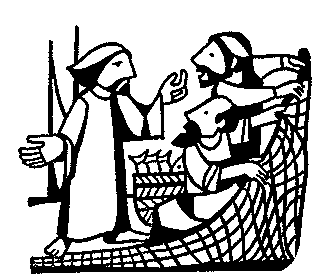
            The situation here today is where God becomes real for these people. Edward just read the Gospel lesson from Luke 5 to us, and we heard about Jesus calling the first disciples. But, we need to back up in this reading, before the Rabbi Jesus calls anyone to be a disciple.  

            We break into the action quite early in the public ministry of Jesus. So early, in fact, that He has not even called anyone to follow Him, to be His disciples. We see Rabbi Jesus, alone, teaching, preaching, healing, and beginning His ministry. Luke starts off with the phrase “One day as Jesus was standing on the shore of the Lake of Gennesaret.” I think Doctor Luke meant this to say that this was a typical day in the life of Jesus. Teaching, preaching, doing miracles. All in a day’s activities, for the Rabbi Jesus.

            But, Jesus is not the only one mentioned in this Gospel reading today. We are introduced to Simon. (or Simon Peter, but that name comes later on.) Simon did not have a good night fishing. In those days, people fished at night.

“The fishermen would spend the night in the shallows, tossing their nets and pulling in the catch. Then as dawn broke, they would bring the fish to shore and sell them at the market. Because of a lack of facilities for preserving fish, this was a daily event. Except this day.” [1]

            Have you ever had a bad day (or night) at work, too? Or how about at school? Has everything gone off the rails? Did you get off on the wrong foot? Or, was your supervisor, or teacher, or co-worker just downright grumpy, and their negative attitude threw a monkey wrench into the whole day?

            I suspect our friend – and future disciple – Simon could relate. He caught nothing the whole night long, so he had nothing to sell at the local market, and nothing to take to his folks at home to eat. No one knows for certain how Simon was feeling, but I know that many people in a similar situation would feel demoralized, defeated, or just plain empty inside. All because the nets had been empty all night long! But this Gospel reading does not only feature Jesus and Simon, No, there is a crowd, too!

The crowds who have gathered to hear the Rabbi Jesus teach and preach—and watch the miracles!—I suspect are filled with wonder, curiosity, and questions. Who is this rabbi with such clarity in teaching the word of God? Who is this rabbi with such power and authority? Yes, we see the people crowding around Jesus so much that He got in a boat by the seashore, put out a little way, and then preached to the crowd.

(Did you know—little known fact—that Jesus was using the natural amplification of the water to make His voice heard better? When someone is out in the water a little distance from shore, their voice can be heard as naturally amplified because of the sound waves bouncing off or echoing off of the surface of the water and traveling on towards the shore.)

            Doctor Luke tells us what happened next. When Jesus was done preaching, He asked Simon to cast off, take the boat out again, and lower his nets. Now, fishermen would customarily dock the boats, then wash their nets away from the boats. They had already cleaned up after a night and early morning’s work and were ready to go home. [2]

And yes, this non-fisherman Rabbi Jesus asked Simon to start all over again. To go out into the deep water and go fishing – again! In the daytime! Against his better judgment, Simon agrees to traipse out to the deep water to go fishing, even though they have worked hard all night, because Jesus requested that he and his co-workers go out and try fishing again.

We know what happened. Hardly had the nets gone into the water, but the fish came swimming into the nets. The nets were filled to bursting! It was a miracle. Simon Peter and his co-workers experienced it—they were eye witnesses.  

“Just think. A little invitation from Jesus, a small inconvenience, and before you know it, Simon was in over his head. Did Jesus show up that day looking for followers? Or was that a bonus? The catch of the day?” [3] Was this all because Jesus asked them to go deep, and to set sail for deep waters?

What was the surprising response? Continuing from Luke 5: “When Simon Peter saw this, he fell at Jesus’ knees and said, “Go away from me, Lord; I am a sinful man!”For he and all his companions were astonished at the catch of fish they had taken, 10 and so were James and John, the sons of Zebedee, Simon’s partners.”

What happened? Simon Peter had a God-encounter, there in the boat. God became real to him. Simon Peter deeply experienced God as very real to his life, but couldn’t handle it. What is Jesus’s unexpected response? Jesus tells Simon Peter and his co-workers, “Don’t be afraid; from now on you will fish for people.” Jesus calls them into a God-encounter.

For Simon Peter and his co-workers, his friends, this was decision-time. They decided to drop their nets on the shore, leave their boats where they were, and follow Jesus. There were many, many people in the crowd who also had the opportunity to follow Jesus, but they did not. The crowd only stayed for the good preaching and the miracles, not the following-Jesus-part.

Has Jesus struck you to the heart and soul, like Peter? Has God become real to you, through this Scripture reading? I encourage you to follow Him today. Thank Him for forgiving your shortcomings and sins. Thank Jesus for inviting you to come with Him for the journey.

What can we do with this newfound, exciting relationship with God? Become a disciple. Go out and talk about how God became real in your life. Talk about God’s Good News, today. God will be wonderfully praised by all who tell how God has become very real to them, and changed their hearts and lives.

How has God become real to you? Go deep. Become a disciple. Go and tell.

@chaplaineliza

(Suggestion: visit me at my other blogs: matterofprayer: A Year of Everyday Prayers. #PursuePEACE – and  A Year of Being Kind . Thanks!


[1] https://www.umcdiscipleship.org/worship-planning/where-you-are-far-horizons/fifth-sunday-after-the-epiphany-year-c-lectionary-planning-notes/fifth-sunday-after-the-epiphany-year-c-preaching-notes

[2] http://www.word-sunday.com/Files/c/5-c/A-5-c.html

[3] https://www.umcdiscipleship.org/worship-planning/where-you-are-far-horizons/fifth-sunday-after-the-epiphany-year-c-lectionary-planning-notes/fifth-sunday-after-the-epiphany-year-c-preaching-notes

Unknown's avatar

Love: God’s Better Way

“Love: God’s Better Way”

1 Corinthians 13:1-7 (13:4) – February 2, 2025

One of the most popular themes for songs is that of love. Songs that describe love of one person for another, or songs that tell about how awful it is to have unrequited love. Also, songs that tell about the emotions and feelings that come with being “in love.”

            One classic popular song written by Burt Bacharach and Hal David talks about love in a basic and simple way. Saying, “What the world needs now is love, sweet love.”

What is the state of the world, anyway? Judging from a quick view of the local news, the city of Chicago, the state of Illinois, the federal government, the uproar in Washington D.C., unemployment, not to mention abuse of different kinds—against women, children, and seniors. That is not even mentioning the various armed conflicts throughout the world—fights over territory, disputes over resources, differences between people of different religious beliefs.

            What can possibly bring harmony, hope and wholeness into the world today?

            This brings us to our scripture reading for the day, from 1 Corinthians 13. This chapter is called the Love Chapter. It is so often used as a scripture text for weddings! Perhaps you or a friend or relative had this chapter read at a wedding. But, did you know that the apostle Paul did not write this chapter to glorify romantic love?

One of my favorite commentators, Karoline Lewis, states “that this “Wedding Text” is not a passive, observable event that seeks our affirmation and support, but something that calls for our participation. This is not a text where we are asked to look on as guests, dressed for a party and seated dutifully in the church pews, but rather necessitates our involvement.” [1] Did you hear? Our participation! Our involvement!  

We are not supposed to sit quietly in a pew and let love happen to us. We are not supposed to sit in the bleachers while the professionals handle this love business. No! Let us take a closer look at exactly what Paul tells us to do, and how we are to get involved.

            Let us listen again to a portion of the words of 1 Corinthians 13, as brought up to date by Eugene Peterson in his modern translation “The Message.” “Love never gives up. Love cares more for others than for self. Love doesn’t want what it doesn’t have. Love doesn’t strut, Doesn’t have a swelled head, Doesn’t force itself on others, Isn’t always “me first,” Doesn’t fly off the handle, Doesn’t keep score of the sins of others, Doesn’t revel when others grovel.”

This is a penetrating way to teach people. Show them by example—examples of how not to love. Examples of jealousy or boasting, arrogance or rudeness. And especially, an example of a horrible injustice, where people are openly bigoted against females. (This can also be true of people who are bigoted about other differences, too, like about handicaps, or people of color, or of a different class of people, or of other nationalities or countries of origin.)

Those bad examples? Paul shows us clearly in this passage—don’t do those things! Don’t be that way! Sometimes, a bad example is the quickest way to our hearts and minds.

Paul was involved in a longer argument here in chapters 12 and 13 of his first letter to the Corinthian believers. Chapter 12 was all about the spiritual gifts that came from God, and meant for the strengthening of the body of Christ – the Church. Then in chapter 13, Paul zeros in on the most excellent of all of these God-given gifts. The gift of love. (or, charity, if we are speaking in a more flowery, King-James-version kind of a way).

            In this section I just read, Paul tells his friends and former church members what love is definitely not! Doesn’t strut, doesn’t have a swelled head, isn’t always “Me First!” Paul was making comparisons here! He had lived in the city of Corinth for many months, while he was pastor of this young church. He knew the rough and tumble, political attitude of the general population of the city of Corinth. Plus, he knew that this uncaring, callous attitude was rubbing off on the people inside of the church, too! That is why he wrote these words.

If we want to find out more about 1st century Corinth, “Charity [or, love] was not the activity of his opponents that spread their agenda. They promoted themselves, acted with arrogance, even engaged in shameful activities (backdoor politics?). As they sought personal gain, they provoked others, instilled animosities, and celebrated when others “lost face.” These were not the hallmarks of Christian community.” [2] In fact, all this crony-ism and inside politics sounds sadly familiar to me. But then, I grew up here in Chicago.

Instead, the apostle Paul gives us a marvelous example of what true love – and Godly caring, support, empathy – looks like. Listen again: “Love never gives up. Love cares more for others than for self. Takes pleasure in the flowering of truth, Puts up with anything, Trusts God always, Always looks for the best, Never looks back, But keeps going to the end.”

I don’t need to scramble and strive to love all by myself, trying really, really hard. It’s not all me, putting together my own faulty, human kind of caring. No! God freely gives gifts of love to all God’s children. That is what true love looks like. This is what true church looks like, too.

We can clearly see that Paul’s ministry of love, harmony and wholeness is for the whole world. Not just about taking care of those in our own families, although that’s important. It’s more than “taking care of our own,” although that is certainly laudable. It’s about showing love for everyone. For those affected by loneliness, or despair, disaster or disease wherever they are, without exclusion of those not like us or even of those we fear. Everyone.

Ending as I began, we look again at the Bacharach and David song, “What the World Needs Now.” The chorus of the song tells us the world needs love, sweet Godly love. Needs it badly. “No, not just for some, but for every, every, everyone.” Amen, Lord. Amen.

@chaplaineliza

(Suggestion: visit me at my other blogs: matterofprayer: A Year of Everyday Prayers. #PursuePEACE – and  A Year of Being Kind . Thanks!


[1] https://www.workingpreacher.org/commentaries/revised-common-lectionary/fourth-sunday-after-epiphany-3/commentary-on-1-corinthians-131-13-3

[2] http://www.word-sunday.com/Files/c/4-c/SR-4-c.html

Unknown's avatar

God-Given Gifts!

“God-Given Gifts!”

1 Corinthians 12:12-27 (12:12) – January 26, 2025

At this time of the year, many people get all excited about sports. Hockey, basketball, and especially football. The end of the football season is upon us! There are many different types of positions on a football team. I was wondering: how good would a team be if all of the players were big and bulky, like offensive linemen? Or, how about if all the players wiry and nimble, like wide receivers? How successful would a team like that be? 

The Apostle Paul told the church in Corinth about another group, or team. Except, he called it a body—God’s Body. God put together all the different believers into a team, or body called the church. God’s team. When we consider our Bible reading for today, we can also see that God made different kinds of gifts. God’s plan is for human beings to live together in one body. That is, with one another, in a great big community, in all its colorful diversity.

What on earth is Paul talking about? A body? Why is he mentioning a metaphor like that? He was responding to a letter from the church in the city of Corinth. He had spent a number of months in the city, teaching and preaching. Then, he went on his way to spread the Good News of Jesus Christ to other cities. He was an itinerant preacher and missionary, after all.  I suspect Paul had a great number of people sending him letters, asking him questions, wanting his advice about continuing problems in the various churches he had founded. A number of big things were the matter with the church in Corinth. In his letter, Paul tried to correct several issues, including this important issue about spiritual gifts, and unity in the church.

What is the background of today’s reading? One chapter before, in chapter 11, Paul offers instruction on public worship. He deals with the believers in church acting inappropriately, and lets them know they ought to straighten up, and be unified – together! Then, in chapter 12, Paul continues the theme of unity – except he brings in the wonderful concept of spiritual gifts in the Church. Diversity of spiritual gifts, given to each member of the Church, of the Body of Christ.

That is not just a few members, or only some members of the Church. It is not even most members of the Church. God gives gifts to ALL members of the Church, of the Body of Christ. Each person in the Church, no matter who, no matter where they are from, is a beloved member of the Body of Christ. That is the Church Universal, and God gives gifts to all.

Not just the church on this side of Morton Grove, not just the church that holds their worship services in English, not just the church that has people who “look like us.” No, each individual person is beloved, and is given a share in the diverse gifts of the worldwide Body of Christ. Can you, can I possibly imagine the diversity in that worldwide body? And, can you, can I possibly begin to understand that God is so pleased when we all, worldwide, agree together and act and worship and live together in unity as a loving Body of Christ?

We all are probably familiar with a popular children’s toy. Put out by Hasbro, small children have played with it for decades. Made even more famous by an appearance in Toy Story movies from Pixar. Mr. Potato Head, accompanied by his partner, Mrs. Potato Head, of course. You remember how Mr. Potato Head works. A large potato. And, the separate parts of the body: eyes, ears, nose, mouth. Hands, feet.

Reminds me of the Apostle Paul’s metaphor of the Church, the body of Christ, doesn’t it? But what if our Potato Head had all eyes, and no hands? Or, all ears and no feet? What then? Lopsided? Wouldn’t work properly? Just imagine if our local church, St. Luke’s Church, was all lopsided like this? Wouldn’t work properly? Not only is the Church meant to have unity, and work well together, it is also made up of diverse or different parts, on purpose!

            Looking back at Genesis, we can see that diversity is definitely in God’s plan for humanity from the very beginning. The sheer creativity of God in creation is so big and so varied. A countless variety of individuals made in every size, shape, color, ethnicity. Having endless variations of gifts and abilities that God gave to each of us.

This is a recurring problem in Corinth – the people were convinced that some people and some gifts were better than others. They completely missed Paul’s repeated statements that God gives a multitude of diverse gifts and abilities to all of God’s beloved, diverse church members! Not that some church members were better, or more popular, or had a greater gift than everyone else. No! Paul states plainly that every person counts! Every gift counts, and every single person in each of their lovely, multi-colored, multicultural diversity is beloved of God. What is more, has received God’s spiritual gifts for free use in the multi-colored, multicultural Body of Christ!

Yes, tension and division and racism and enmity exist – all within the Body of Christ. I cannot even imagine how that breaks God’s heart, knowing that churches on one side of town are arguing with churches on the other side of town. Or, that some churches are ignoring the plain words of the prophet Micah to do justice, to love mercy, and to walk humbly with our God. Or, ignoring the plain words of Jesus to be merciful to the powerless and the least of these.

Yes, in today’s uncertain times, the Church has “tensions from within and without which are bringing doubt and confusion to the Body as we face the challenges of the near and distant future.” [1] Thank God we have a firm foundation on which we all stand. Thank God we have the words of Paul here in 1 Corinthians calling us to unity under God, rejoicing in our diversity with all the multi-colored, multicultural people of God, worldwide.

Yes, each of us is different from each other. And, yes, we are all one in Christ Jesus. We can celebrate that blessed both/and reality today! Just imagine what a marvelous job each Church could do, if each member used what God has freely given to each one, to the best of their ability! What an opportunity for ministry and outreach!

What possibilities lie before us as a church, as the Body of Christ in this place? May each of us prayerfully ask today what God would have us to do with the gifts and abilities God has given each of us.  Amen, alleluia!

@chaplaineliza

(Suggestion: visit me at my other blogs: matterofprayer: A Year of Everyday Prayers. #PursuePEACE – and  A Year of Being Kind . Thanks!


[1] https://www.churchofscotland.org.uk/worship/weekly-worship/monthly/2025-january/sunday-26-january-2025-third-sunday-after-epiphany-year-c

Unknown's avatar

Diverse Gifts and Abilities!

“Diverse Gifts and Abilities!”

1 Corinthians 12:1-11 (12:10) – January 19, 2025

“In the beginning, God created the heavens and the earth.” God created everything on the face of the earth. Just think of the myriads of different kinds of plants, animals, climates, languages, cultures. God made it all, and God rejoices in the countless variations and differences. What a diversity in creation! We can be amazed over and over, at the ever-renewable wonders of God’s creation, whether we look at a flower in a vase, through a microscope at a microbe, or at the photographs sent from the landing craft now exploring on the planet Mars.

When we consider our reading for today, we can also see that God made different kinds of spiritual gifts, as well. God’s plan is for human beings to live together, with one another, in community. The main purpose for these diverse gifts is for the common good. God wants us to use our gifts for one another. What an awesome opportunity! Here, God freely and openly gives us gifts—spiritual gifts—to serve one another.

Now, let’s back up. The Apostle Paul cites Jesus Christ as a starting point at the beginning of Chapter 12. He states the authority of Jesus, and even makes the statement “Jesus is Lord” a sort of litmus test for being a follower of Jesus Christ. After all, no one who is a pagan can say “Jesus is Lord” and really mean it (at least in Paul’s day, that was true). But there is a problem. The problem is us human beings.

We are fallen people. We sin. In and of ourselves, we have no standing, and are not righteous before God. As Romans 3:23 reminds us, “There is none righteous, no, not one.” But the Holy Spirit gives us a big assist here! The Holy Spirit helps us to say the words “Jesus is Lord!” It is through the power of the Holy Spirit that we exercise these gifts that God so graciously gives to us!

Let’s look at what Paul says about these spiritual gifts. There are many kinds of gifts! Yet, there is one Lord. There are diverse abilities! Yet, one Spirit. I see a definite connection here. It’s all about God, and God’s immense creativity. Just as God created the world in all of its glory, beauty and diversity, so too the Lord created people in all their wonderful diversity, with diverse gifts and abilities for us to share with one another.

I started out quoting Genesis 1:1–”in the beginning, God created the heavens and the earth.” Looking back at Genesis, we can see that diversity is definitely in God’s plan for humanity from the very beginning. The sheer creativity of God in creation is so big and so varied. Musically speaking, there are countless variations on a countless number of themes. The only way I can figure this out is that God is pleased when we use our God-given creativity in any one of a myriad of ways—inventing, designing, doing, helping, making, thinking, crafting, composing, giving. And when we use our God-given gifts and abilities, it plain feels good inside.

When we look at this chapter in 1 Corinthians, Paul stresses that the church—the group of believers in Christ he was writing to–in all of its diversity, is a community. A great, big extended family, if that helps you think about it. I know that can remind us of the whole topic of the families each of us were born into–and some people don’t want to go there–with in-laws, out-laws, black sheep, and all the rest. But biblically speaking, this is God’s family.

This reminds me of my birth family, my family of origin. I am one of six sisters and brothers. The six of us are about as diverse as anyone would want to see. Across the political spectrum, in terms of talents, abilities, interests and activities, the six of us are so different from each other. Yet, we came from the same parents, and grew up in the same household. Even within my own family, there is such a rich diversity.

With God as our Heavenly Parent, we as believers in Jesus Christ are all sisters and brothers of one another. Why? Because God’s Word says so. Paul says, several verses down in this same chapter, “For in the one Spirit we were all baptized into one body—Jews or Greek, slaves or free—and we were all made to drink of one Spirit.”

There are different services, and different activities, yet there is one Holy Spirit over all, energizing all. And this is a corollary benefit: whatever happens, whenever people use their God-given gifts and abilities, God receives praise and honor!

Tomorrow, we observe a federal holiday, where we remember and give thanks for Martin Luther King Jr. His stirring words helped to move this nation toward justice, empathy and equity. His witness called forth the best of all of us.

Sadly, in recent years, we have seen the increasing rise of hatred, separation one from another, and white supremacy. We need to go forward towards those loving, caring and equitable ideas that Martin spoke of. We have been given these gifts to show the whole world that God means for all of us to serve one another, no matter who they are, no matter where they may be.

God can break through insular, tribal loyalties! God can and does knit all of us together as one humanity, one great big extended family. Plus, tomorrow as a Day of Service is not simply a day on the calendar, but it is a day on which all of us can serve and work, pray and hope, struggle and strive to – as Martin said – bend the arc of history closer to justice, and be shaped into the people of God that God’s prophets call all of us to be. Each day. Every day.

So, we can praise God that we have been graciously given these gifts and abilities to use, for each person we meet.  What an awesome opportunity! Here, God freely and openly gives us gifts—spiritual gifts—to serve one another, for the common good. How can you take that opportunity, and use these gifts for one another’s benefit, and continue to build the Beloved Community we are told of repeatedly in the Bible? Not just tomorrow, on the MLK Day of Service, but every day? How can you best serve God’s worldwide family? How can I?

God willing, we can and we will. Alleluia, amen.

@chaplaineliza

(Suggestion: visit me at my other blogs: matterofprayer: A Year of Everyday Prayers. #PursuePEACE – and  A Year of Being Kind . Thanks!

Unknown's avatar

A Star and a Gift from God!

“A Star and a Gift from God!”

Matthew 2:1-12 (2:10) – January 5, 2025

I remember Christmases when I was very young. I was the youngest of six children, and we lived on the northwest side of Chicago. My father worked for the National Safety Council, which was a not-for-profit organization. He didn’t get paid a huge amount of money, so I remember Christmases when we children would not have a huge pile of presents under the Christmas tree, like the television commercials of today always seem to show. But, I do remember the happiness and joy of those Christmas mornings. Those are warm memories, all of us gathered around the tree, exchanging presents.

I’m sure we all could bring to mind a similar warm memory or two, regarding Christmas. Many of my memories do involve gifts. The Scripture passage just read mentions gifts, too. It’s from Matthew, Chapter 2, the traditional Epiphany narrative, when Magi from the East came to see the young child Jesus, bearing gifts.

Here we have some wise people—probably nobles who know a great deal about stars and constellations. They have been studying the heavens for years and years, as well as studying religious books and writings. Just as it says in the gospel record, a great sign (or star) rose in the sky, so these wise astrologers knew that something momentous was going to happen.

These wise people, or Magi, were not Jewish wise people, but instead were Gentiles. Non-Jews. “Could an unusual phenomenon in the night skies have caught the attention of some of them—interest in the stars was legendary in the region—and led them to set out to Jerusalem? That people of other lands and religions are drawn to Jesus, even as a child, is also significant: in Christ, God is speaking to the hearts and minds of all people.” [1]

The old saying is true, “If you want to go fast, go alone; but if you want to go far, go together.” These Magi traveled together, and supported one another. These wise people encouraged each other and (I suspect) spurred each other on to continue following that star. It is important to point out that they were on the lookout and knew which way to go—towards Jerusalem. And, eventually, they turned up at the palace, on King Herod’s doorstep.

God understood that these Magi made a careful study of the stars, and God sovereignly decided to display signs and wonders in the heavenly places at the time of the birth of Jesus. God reached these Magi where they were at. The wonderful thing is: God continues to reach out to people, no matter what is happening to them, no matter where they might happen to be.

But, let’s go back to these Wise people. No one is exactly sure about the number of Magi who arrived in Jerusalem so long ago. Church tradition tells us that the number was three. These were not just Magi, but also royalty of the East. Assuming they were at least minor royalty, these non-Jewish V.I.P.s show up at King Herod’s palace, and he was not pleased to see them.

Turning back to our Scripture reading, “After the Magi had heard the king, they went on their way, and the star they had seen when it rose went ahead of them until it stopped over the place where the child was. 10 When they saw the star, they were overjoyed. 11 On coming to the house, they saw the child with his mother Mary, and they bowed down and worshiped him. Then they opened their treasures and presented him with gifts of gold, frankincense and myrrh.”

            The Non-Jewish wise people who followed that star found what they were searching for. And, they were overjoyed, they worshipped, and then gave precious gifts.

What about that special star? Is it easy for us to get so distracted that we cannot even see the majesty and wonder of God’s creation? Do we get turned around and separated, all alone?

For that matter, do we get comments of direction from an unlikely source? Because, that is exactly what King Herod was: an unlikely source of direction. Do we get lost as we try to follow Jesus? Or, have you even found Him in the first place?

Matthew’s birth story centers around the Star. We have come to see this as the Star of Epiphany, the Light that has come into the world! We use Light to symbolize God. The Star of Wonder represents the Light of God! Just think of the Star at the top of many Christmas trees. This signifies the Star that the Magi followed – that same star we talk about today.

I have mentioned God’s Gift, and I have mentioned God’s Light. The Gift given to the world, and the Light that has come into the world. Epiphany is all about celebrating the light that has come into the world as the Baby Jesus, and at the same time Christ the Lord. “But it is also a celebration of the community that gathers to see and follow that light. Worship this day needs to be corporate. It needs to move away from “I” language toward “us” language. We need to be reminded that this is a walk we take together.” [2]

We are reminded that the Magi came together to the Baby Jesus with a need to worship, to come to Him and bow down, and give rich gifts. “That is what brought these Magi so far – however far it was. That was why they went to Herod and anyone who might help them find their way. They longed to worship, as do we all.” [3]

Today, we celebrate Epiphany, Twelfth Night, Three Kings Day, January 6th. We mark this celebration a day early, since the 6th falls on Monday this year. Today is also our celebration of Communion, the Lord’s Supper. Epiphany commemorates the visit of the Magi as told to us by Matthew. As we consider the Star the Magi followed, we fix our eyes on Jesus, the Light of the World, the Bright Morning Star. And as we consider the precious gifts the Magi gave to the Baby in Bethlehem, we also consider that best Christmas Gift of all, for all the world – and we worship Jesus. As the Christmas carol tells us, O come, let us adore Him, Christ the Lord.

We, too, can bring our gifts. We all can give our talents, and our hearts to our Lord Jesus this Epiphany. May we continue to place ourselves, our hearts and lives in Christ’s keeping. May God bless us all as we walk with Jesus in this new year. Alleluia, amen.

@chaplaineliza

(Suggestion: visit me at my other blogs: matterofprayer: A Year of Everyday Prayers. #PursuePEACE – and  A Year of Being Kind . Thanks!


[1] http://www.taize.fr/en_article167.html?date=2012-01-01

“Jesus, Herod, the Magi and Us,” Commented Bible Passages from Taize, 2012.

[2] https://www.umcdiscipleship.org/worship-planning/re-membering-the-body/second-sunday-after-christmas-day-epiphany-year-c-lectionary-planning-notes

[3] https://www.umcdiscipleship.org/worship-planning/re-membering-the-body/second-sunday-after-christmas-day-epiphany-year-c-lectionary-planning-notes/second-sunday-after-christmas-day-epiphany-year-c-preaching-notes

Unknown's avatar

Amazed by Love!

“Amazed by Love!”

Luke 2:15-20 (2:18) – December 22, 2024

Merry Christmas! What a wonderful expression. People greeting each other on the street, in the stores, here at church. I know not everyone celebrates Christmas, but still. What a joyous time of the year. Today, we are here at the 4th Sunday of Advent! Many, many people can hardly wait for the arrival of Christmas Day! Especially for children, I bet some people are so excited that they hardly sleep a wink for the next few nights. (But that’s mostly for reasons of Santa and presents under the tree, not for the religious reasons I’m talking about this morning.)

Merry Christmas, many people say! But I want you to go back, two thousand years. Go back to a time when “Merry Christmas” was not even a phrase, a wish, not even an idea in people’s heads. Go back to the time Dr. Luke describes in his Gospel. Back to the time when Israel was an occupied country, and the Roman Empire was the occupying force. Back to the time when all people in Israel needed to be enrolled. The Roman government decided to have a census, so that they would be able to tax the people of Israel more accurately.

            We remember this census. The Holy Family, Joseph and his fiancée Mary, went to Bethlehem to enroll, because Joseph was a direct descendent of King David. I suspect there were many people on the roads. Today, traveling can be stressful and nerve-wracking. I am certain travel in the first century was much more difficult. Poor roads, with many people walking to get from one place to another. We might imagine that Joseph and Mary had a donkey, but nowhere in the Gospel is that mentioned. Travel conditions were challenging, at best.

Wait a minute. Do we really concentrate on the difficulties and trials of travel to Bethlehem, of the labor and birth of a baby without medication, or of any of the rest of this real-life narrative from Luke chapter 2? Or, do we imagine a nice, tidy, picture-perfect Christmas card? With Mary in a rich, bright blue robe, gazing lovingly at her radiant newborn baby, Joseph looking adoringly at both mother and child. Not to mention the cleaned-up shepherds gazing in wonder, their tidy, well-groomed sheep lying quietly in adoration, too.

That picture-perfect Christmas card was not what actually happened, not by a long shot. Mary felt the pains of labor begin. What a scary thing! To be far, far from home, in an unfamiliar place, and to have such a significant event happen. Significant, and potentially life-threatening, too. Plus, anyone who has worked with large animals (even many smaller animals) knows what a group of them smell like. That’s where Jesus was laid, in a manger among the animals. And, is anyone familiar with the hustle, bustle and smells associated with the labor and delivery room of a hospital? This refocused picture of the birth is not all gentle, meek and mild, to be sure.

As Luke tells us, there were shepherds abiding in the fields, keeping watch over their flocks by night. When messengers personally come to deliver a special announcement, it is a big deal. These angels coming to the shepherds, well, that was a super big deal, to be sure!

            And the announcement? This isn’t the birth of a normal, ordinary baby. No! This baby is an extra special baby. The Messiah, who will save His people from their sins. Did you hear? This special baby, this Savior, Christ the Lord, is born to you—to me—to all of us, in the city of David, which is called Bethlehem.

            Did you hear? The Savior, the Christ, the promised Messiah, came into this world as a Baby. The Eternal Second Person of the Trinity, Creator of the whole universe, God the Son, emptied Himself of all God-ness. Took on humanity, and was born as a helpless Baby. That is not only good news, that is earth-shaking news. Good news of great joy for all the people. For you, for me, for all of us. How better to communicate to earth than to become one of the frail human beings God intended to reach?

            The Almighty God who made all of heaven and earth, the powerful God who can hold the incomprehensibly vast universe in the span of God’s fingers? Yes, that same God wanted to reach to earth—reach to each of us, to all of us, in love. With love. Through love. 

            That loving outreach is from God’s point of view. Yes, the Almighty God sent the Baby in Bethlehem to earth, in love. But, what if frightened, nervous humans did not in the least expect that? What if short-sighted humans closed their eyes and their hearts to the possibilities of God’s love breaking into the world in such a tender way?

            Mary could have been frightened half to death of the angel and closed her heart to the Divine possibilities that blessedly came about. But, Mary chose love. She chose openness and possibilities that transformed her heart and her life.

            When Mary’s baby was born, Jesus spoke quietly through the blood, sweat and tears of the labor pains of that young woman. Jesus cried softly as an infant, and allowed us all to see the unimaginable caring, the oh-so-tender love that Almighty God expressed, to each one of us. And, each of us is embraced in God’s everlasting arms of lovely love.

            One of my favorite Christmas carols talks about this very thing. This Christmas poem—before it was set to music—was written by Christina Rosetti in 1885. Here is the first verse:

Love came down at Christmas, Love all lovely, Love Divine,
Love was born at Christmas, Star and Angels gave the sign.

Love Divine was born at Christmas. Born for you, born for me. Praise God, our Lord and Savior Jesus was born as a Baby in Bethlehem. Yes, He would preach and heal and suffer and die. And, yes, He would rise again on that Easter morning years later.

Yet—right now, we rejoice in the blessed fact that Jesus was born.

Praise God, we, too, can stop by that manger in Bethlehem, and be caught up in the wonder of what happened that night, so long ago. We, too can welcome this lovely, Godly Love that has come into this broken, weary world, today.

Alleluia, amen.

@chaplaineliza

(Suggestion: visit me at my other blogs: matterofprayer: A Year of Everyday Prayers. #PursuePEACE – and  A Year of Being Kind . Thanks!

Unknown's avatar

Open Hearts to Joy!

“Open Hearts to Joy!”

Luke 2:8-20 (2:15) – December 15, 2024

So many houses and apartments are decorated for the season at this time of year. Colorful lights and holiday decorations indoors and out, shining Christmas trees, special dishes and fancy tablecloths. Plus, some families have a Nativity scene in a special place, whether under the Christmas tree or placed in an extra special location, even outside, all lit up at night.

As we consider our Scripture reading for this morning, we think about the familiar words from Luke chapter 2. We think of the very pregnant Mary and her husband Joseph, coming into the town of Bethlehem late one day, but they could not find any place to stay. So familiar it is today, but I suspect you all can think of the Nativity scene figures: a kneeling Mary, Joseph hovering over his wife, and the baby Jesus lying in a manger.

Where did this tradition of decorating with a Nativity scene come from? Yes, the Nativity scene is a familiar way of retelling this story of the birth of Jesus. But—how did Nativity scenes begin? It was in 1223. “According to St. Bonaventure’s biography, St. Francis of Assisi got permission from Pope Honorious III to set up a manger with hay and two live animals—an ox and an ass—in a cave in the Italian village of Greccio. He then invited the villagers to come gaze upon the scene while he preached about ‘the babe of Bethlehem.’ (Francis was supposedly so overcome by emotion that he couldn’t say ‘Jesus.’)” [1]

            That first Nativity was located in Italy, during the 1200’s. The practice of Nativity scenes, pictures and photos has certainly spread from there, all over the world. Do you remember acting in Christmas Nativity scenes, or perhaps Christmas pageants with a Nativity scene in them? You, or your children? Or grandchildren?

            The Nativity scenes I remember always had at least one shepherd visiting the baby Jesus, along with a sheep or two. Perhaps you remember when you or your children or grandchildren were in a Christmas pageant. Were there shepherds abiding in the fields, keeping watch over their flocks by night? And, sheep! I remember several Nativity scenes in Christmas pageants years ago, where the small children were dressed up as sheep.

            Let’s hear again from Dr. Luke the words the angel said to the shepherds, that Christmas night: “the angel said to them, ‘Do not be afraid; for see—I am bringing you good news of great joy for all the people.” Not just the people in Italy, where St. Francis was. Not just the people in Europe, or North America. Good news of great joy for all the people, all over the world.

This week in Advent, here at this church we are concentrating on the shepherds. As we read this familiar Christmas story, was there much in the shepherds’ daily life and experience to fill them with joy? I do not think they were particularly joy-filled, with their ordinary, workaday life and their low, social status. I wonder whether the shepherds felt like that, right before the angel chorus broke into this hum-drum, workaday world and appeared to them?

Remember the difficult situation the shepherds were in. The shepherds’ position on the social ladder in Palestine was pretty much the bottom rung. The Jewish religious leaders even considered shepherds ritually unclean, since their duties and their work of looking after sheep made it impossible for them to observe the Sabbath. Working as a shepherd was something that vagrants might pick up, or a job for ne’er-do-wells, or others who were very much down on their luck. Their society stereotyped shepherds as liars, degenerates, and thieves.

 Just imagine the reaction of these lowly shepherds as they heard this news from the angels! Good news of great joy, especially, particularly for them! And centuries later, imagine the reaction of these same shepherds to think that they are now an integral part of a Nativity scene, a central part of the Christmas story played out time and time again, year after year.  

When my children were small, one of the first Christmas decorations I’d take out of the box would be our little Nativity scene. The little figures were all children, and it was intended specifically for the young. I would tell and re-tell the Christmas story again and again. When they were small, all four of my children would love to play with the figures, spending a good long time with those inexpensive yet meaningful little figures.  

Different churches do different things to communicate this narrative of the birth of Jesus. I read that the Rev. Janet Hunt has a yearly practice she does in her Lutheran church in De Kalb. But, I will let her tell you herself. “It has been my practice for many years to ‘build the creche’ with the children during the children’s sermon during Advent.  One week we add the animals. The next week the angels join them. Pretty soon Mary and Joseph arrive and not long after the baby Jesus and shepherds and the three sages from the East arrive last of all. The order is not perfect, of course, but it is one way of bringing the story home.” [2]

My personal Nativity scene, the one my children played with, has white children, every one. I had not thought about this when I bought the set of figures, more than thirty years ago. Even though my children were part of a multi-ethnic, multi-cultural school system, we still had an all-white Nativity set. Were the people in that first Nativity people of color? Yes, they were.

            Let us return to these shepherds of the first century, on the hills surrounding Bethlehem. They were downhearted outsiders, all right! People of color, non-white, on the bottom rung of their society, for sure. “But God does not give up on us. God sends angels to people who have given up on God. How would you respond to God sending angels to you when you’d given up on God? Like the shepherds, I’d be terrified.” [3]     

Remember the words of the angel of the Lord: “Do not be afraid; for see—I am bringing you good news of great joy for all the people.” We can praise God! God did not send good news of great joy to just a few people in the world, or even some of the world’s people. Or, only people of a certain position in society. No, our God sent good news of great joy to all the people of the world.

The angel has come to all cultures, all ethnicities, all people, wherever their position on the social ladder. All people, everywhere. Even us. You and I can truly come to the manger in Bethlehem side by side with the lowly shepherds.

            That is not only GOOD news, that is GREAT news. Good news of great joy, for all the people of the world! Alleluia, amen.

@chaplaineliza

(Suggestion: visit me at my other blogs: matterofprayer: A Year of Everyday Prayers. #PursuePEACE – and  A Year of Being Kind . Thanks!


[1] http://www.smithsonianmag.com/smart-news/the-first-nativity-scene-was-created-in-1223-161485505/ 

[2] https://dancingwiththeword.com/re-telling-the-story/

[3] http://www.workingpreacher.org/preaching.aspx?commentary_id=1522