Unknown's avatar

God Says, “Don’t Be Afraid!”

God Says, “Don’t Be Afraid!”

Jeremiah 1:4-10 (1:5) – August 24, 2025

Babies can be wonderful. The coming of a baby into the world is certainly a big event, with all the attendant hustle and bustle, all of the excitement and exhaustion. With all the babies that have been born into this world over the millenia, we’re going to look at one baby in particular … the prophet Jeremiah.

Here in the first chapter of Jeremiah, we can take a peek at God’s perspective on the birth of a baby. When we look at verse 1:4, the LORD is saying to Jeremiah, “Before I formed you in the womb, I knew you.” Wow. God knew Jeremiah before Jeremiah was just a tiny group of cells, growing inside of his mother’s uterus. Double wow. The same thing could be said about countless other people, too. God knew me before I was born. The Lord knew everyone in this room, too. It is truly awesome to think about how intimately God knows each one of us.

King David talks about this in Psalm 139. We get another glimpse at how intimately God is acquainted with each one of us. Starting at verse 13, “For it was You who formed my inward parts, You knit me together in my mother’s womb. My frame was not hidden from You, when I was being made in secret, intricately woven in the depths of the earth. Your eyes beheld my unformed substance.” We can see that God surely knows us, far better than we know ourselves.

We are celebrating going back to school this Sunday. God knows each and every student who is returning to school, and I believe the Lord is watching over every school, every training program, and all internships, all over the world. When I prayed the Blessing of the Backpacks, I was thinking of not only the students associated with this church, but all students, across this country and in the whole wide world. Bless each one!

Which brings me back to the young Jeremiah. This is the beginning, the first chapter of his very challenging prophetic book. Our Scripture reading today is Jeremiah’s call story, when he was just a young teenager. He was not even a grown-up! And, God called out Jeremiah for a special purpose, as we can see: “But the Lord said to me, “Do not say, ‘I am too young.’ You must go to everyone I send you to and say whatever I command you. Do not be afraid of them, for I am with you and will rescue you,” declares the Lord.”

 We can all remember times at school when certain kids were picked on. Perhaps even you or a friend or brother or sister of yours was called names! Usually, to establish some sort of pecking order in the classroom. “Still, most name calling makes people look ‘less’ in the eyes of people around them.” [1]  What were – what are – some of those names? Sadly, I can identify some of the names, like wimp, bully, jock, geek, baby, sissy, cry-baby, bird brain, smarty pants, etc. that are hurled at others.

Just think of how differently people look and feel when we say instead “child of God.” Because, that is exactly what each of us is! Each one of us is a unique creation of God, and each one of us is fearfully and wonderfully made! And, God knows each of us, intimately!

God mentions all this to Jeremiah, because God was watching Jeremiah from the very beginning. And, God saw Jeremiah even before he was born, and God appointed him a prophet, “This, of course, came as startling news to Jeremiah who, apparently, had not had any previous inkling that this could be his life’s work. Maybe it did not even sound that good to him, either. In any event, he starts to do what any number of divinely appointed figures in the Bible have done: he resists the call. He makes up an excuse.” [2]

We can see that Jeremiah did not feel ready to do what God wanted.  “I’m too young. I’m not a public speaker. What could a child like me have to say anyway, and who’d listen even if I tried? No, no, Sovereign God, you’ve got the wrong guy. I’m no one special!”

Be sure that God sometimes calls each of us to do things we feel we are not ready to do or that we are not brave enough to try. That happens in offices, on the factory or hospital floor, in all kinds of classes and just hanging out at school. “When it does, our challenge is to remember what God told Jeremiah: God had given him everything he needed and God would be with him helping him know what to do and say.” [3]

We can see from this Scripture reading that God touched Jeremiah. God put His hand on the teenager. Wow. What an awesome thing, having the God of the universe call on Jeremiah … and to think that God can put His hand on you and on me, too. But—funny thing—God doesn’t always call us in the way that we expect, or in the way that we want God to, but God is always there for us. God is always available to each of us. God calls each one of us, in God’s timing.

Here is an example of an everyday person who was called by God, saw a need, and stepped up to the plate. One of my commentators tells the story:

“Most people I have ever heard speaking of their start in vocations similar to those of Moses and Jeremiah begin not with a burning bush or an audible voice, but with a deep conviction that whatever else they may do, and no matter how they might or might not establish their bona fides, it is the task itself that draws them in. Eula Hall, who describes herself as a ‘hillbilly activist,’ an Appalachian woman with an eighth-grade education and a burning sense of purpose, told me many years ago how she came to found the Mud Creek Health Clinic in southeastern Kentucky to provide health care for the poor: “I looked, and I said to myself, ‘taint right like this, no medical service here, taint right. Somebody needs to act.’ I guess that somebody was me.” [4]

Often now in such a time as this which is like no other many of us have known, we would do well to hear Jeremiah’s call as our own. For God extends not only the call, but also promises to accompany us as we seek to follow. [5] It doesn’t matter our age, young, elderly, or in the middle. It doesn’t matter where we are, at home, school, work, or on the street.

Yes, God called Jeremiah. Yes, God touched Jeremiah. And God calls to each of us today. God was with Jeremiah through the difficult times of his life and ministry, and the Lord promises to be with us, too, through thick and thin, through the difficult times as well as the wonderful times. We can forever be thankful that God is always there with us.  Alleluia, amen!

@chaplaineliza

(Suggestion: visit me at my other blogs: matterofprayer: A Year of Everyday Prayers. #PursuePEACE – and  A Year of Being Kind . Thanks!


[1] https://worshipingwithchildren.blogspot.com/2016/07/year-c-proper-16-21st-sunday-in.html

[2] https://cepreaching.org/commentary/2016-01-25/jeremiah-14-10/

[3] https://worshipingwithchildren.blogspot.com/2016/07/year-c-proper-16-21st-sunday-in.html

[4] https://www.workingpreacher.org/commentaries/revised-common-lectionary/fourth-sunday-after-epiphany-3/commentary-on-jeremiah-14-10

[5] https://dancingwiththeword.com/the-call-of-jeremiah-still-speaks/

Unknown's avatar

Playing Favorites!

“Playing Favorites!”

James 2:1-10, 14-17 (2:17) – September 8, 2024

            Sometimes, my husband and I step back and observe our fellow human beings. For example, when we are at a coffee shop, or walking through a park. My husband calls it “people watching.” And sometimes, we catch snatches of conversation, too. Some of these bits of conversations are quite revealing! Sometimes, we can even hear about relationships between these people, and their family or friends. These relationships are not always the most healthy.

            Who has all really healthy, happy relationships in their family? Or, friend groups, and acquaintances? Do you – do I – have friends or family members who are mean sometimes? Or who gossip? What about family who have bad habits, like rooting for the wrong sports teams? Or to be more serious, what about friends or family members who play favorites? Who prefer certain people because of their fancy clothes, or their popularity, or how much money they have?

            That is exactly what James is talking about here in chapter 2. This letter from James is so practical! Yes, he does refer to theological concepts now and then, but James wants to give us a manual of Christian living: living the way we as believers are called to live! The description in this reading today is a pertinent, hard-hitting example. 

            James says, “Suppose a rich man wearing a gold ring and fine clothes comes to your meeting, and a poor man in ragged clothes also comes. If you show more respect to the well-dressed man and say to him, “Have this best seat here,” but say to the poor man, “Stand over there, or sit here on the floor by my feet,” then you are guilty of creating distinctions among yourselves and of making judgments based on evil motives.”

            One of my biblical commentators says, “The problem is ‘status serving’ – favoritism. Playing favorites! We are easily attracted toward the successful, wealthy and beautiful people. Yet for James, such partiality is something quite evil.” [1] Playing favorites is definitely not a way for anyone to please God, or to live the way we as believers are called to live. 

            The Gospel reading from the Revised Common Lectionary today also has some difficult, hard-hitting points. Jesus and the disciples are in the racially-mixed area of the Decapolis, near the Sea of Galilee in the far north of Israel. A Gentile woman approaches the Rabbi Jesus while He is at dinner, and asks Him to please heal her daughter. Jesus says some challenging words to her about being a Gentile. She convinces Jesus to help her and heal her daughter, which He does.

            This Gospel reading deals with favoritism and being partial to one group while excluding another group. Who would Jesus exclude? Would He exclude me and my family? Would favoritism include you? How about your children, or grandchildren? 

            These are difficult issues raised by both the apostle James and the Gospel writer Mark.

            Favoritism is all over the place! At work, in the school room, on sports teams, at home. Even – perhaps, especially, as James says – in our local churches. “To seek out the ‘beautiful’ people in our congregation and give them honour because of wealth, status in society, looks, youthfulness, race, education, breeding, success….. is a most ugly way to develop a Christian fellowship. Favoritism is rife in society, let it not exist in our church.” [2]

            Preferring one person over another or one group of people over another is a very worldly way of approaching life. James tells us point blank that we are not to behave this way. Period.  If we take the bare bones approach and look at what the apostle Paul tells us, that we are all one in Christ, and that we are to all love one another, as both Paul and John remind us, some might say we can all simply join hands in a big circle around a campfire and sing “Kum-by-yah” feel all warm and fuzzy inside, and that would be more than enough for the Christian life.

            If that simplistic attitude and short-sighted way of behavior was the only thing we had to do to live the Christian life, then the Christian life would be an insular, warm-and-fuzzy thing indeed. But, as James tells us throughout this letter, there is much more to the Christian life. In this letter, he gives us a how-to manual. A manual for living the way believers are called to live.   

            If we take the example that James gives us, one quick solution would be to simply buy the poor person a new outfit. See? Now the two people coming into church look the same! But, that is only a shallow, simplistic quick-fix for the situation. Instead, James “is asking them to treat the [poor] man with the same respect they would offer a well-dressed man.  Learning to do that in a culture that separates and creates fear between the richer and the poorer requires practice.” [3] This problem goes deep down in people’s attitudes, and is much more serious – even insidious. James says plainly, “Don’t be snobs! Don’t play favorites!”

            I can remember a church I attended some years ago was part of a group of houses of worship that hosted midday meals for the homeless once a week, as well as hosting a warming center during the winter months for five hours in the afternoon and early evening, allowing the homeless to gather inside in a safe space that was warm and welcoming. My husband volunteered at the warming center, and some of those friends who attended regularly mentioned how grateful they were for the church opening their doors freely.

            Yes, make sure our internal attitudes line up with the way that is pleasing to God. Remember, practical, matter-of-fact James shows us a manual for Christian living. Does God choose favorites? What if you are one of those excluded homeless people, or left-out high school kids, sitting at the loser lunch table, with no way to even get close to God? Shut out from God’s loving, caring, nurturing presence?

            Thank God we are always God’s beloved children! We are always the favorites – all of us! Here is a quote by Max Lucado. See if it resonates with you. “If God had a refrigerator, your picture would be on it. If God had a wallet, your photo would be in it. God sends you flowers every spring and a sunrise every morning Face it, friend – God is crazy about you!“

            Does God choose favorites? No! That is the way God feels about each one of us! Please, remember that as you go into the world. Treat every single person you meet as a very beloved child of God – because, they are! No matter what, no matter who!

@chaplaineliza

(Suggestion: visit me at my other blogs: matterofprayer: A Year of Everyday Prayers. #PursuePEACE – and  A Year of Being Kind . Thanks!


[1] http://www.lectionarystudies.com/sunday23be.html

[2] Ibid.

[3] http://worshipingwithchildren.blogspot.com/2012/08/year-b-proper-18-23rd-sunday-in.html

Unknown's avatar

Attitude of Gratitude!

“Attitude of Gratitude!”

Psalm 100 – November 12, 2023

            Gratitude! Be grateful! Have an attitude of gratitude! But, how on earth do we do that? Great question!

With November, all of us here in the United States enter a time of thanksgiving, a season of gratitude. We can think of the Thanksgiving story, that thankful meal shared several centuries ago in New England. This was a means of showing gratitude for the harvest gathered in, and for the blessings of the bounty of nature God bestows upon those who farm the land.

I’ve lived in the Chicago area all my life. I’ve never lived in a small town, or a farming community, or had anything to do with gathering in crops. The most I’ve ever done is go to an apple orchard in the fall to pick apples – and that was just twice in my life. I know that whole communities rely on the harvest! Except – I have never been a direct part of that process.   

            What we all share, both city folks and country folks, is gratitude. Yes, we all can be thankful and grateful. Yes, we all can lift our hearts to the Holy One to say “thank you” for the bounty of nature, and we can come to God in praise for the interconnectedness of life.  

Autumn is, indeed, a thankful time of the year. But, how can each of us generate an attitude of gratitude? What does a life of gratitude look like? Or perhaps more importantly, what does a life of gratitude feel like?

            I want us to focus on our Scripture reading for today, and take special note of verse 4: “Enter God’s gates with thanksgiving and his courts with praise; give thanks to him and praise his name.” Psalm 100 is a praise psalm or song, the last in a small collection of special psalms of praise and worship. Do these verses get you in the mood of worship? Of praise? Could we see ourselves marching to our particular house of worship looking forward to meeting with God? To serve and praise and bless and be thankful to God? That is exactly what this Psalm is encouraging—no, even more strongly—is commanding us to do.

            The ancient superscription – or introduction – to this psalm simply says “a psalm of thanksgiving.” “On the one hand, there is the idea that thankfulness covers all of life; it is our way of approaching the world and the attitudes with which we choose to live. On the other hand, there is a clear indication that we are making a commitment to God in our choice to live a grateful life.” [1]

A number of verbs, or action words in this short psalm, are clear commands. In the first three verses, “Raise a shout!” “Serve!” “Come!” and “Know!” Verse four has “Enter!” “Be thankful!” and “Bless!” All of these verbs—and they are many of the chief action words in this Psalm—are instantly recognizable as an imperative, a command to anyone who spoke Hebrew!

This grateful commitment to God is quite serious if we follow these commands found in this psalm of praise. The grateful, thankful life shown to each of us in this short psalm is more than just a possibility. It becomes a blessed reality, if we follow through on the commands and promises highlighted by these few verses!

            We look to verse 4 again. We are commanded to “Enter the gates with thanksgiving!” “But what does that mean? Do we come to church with grateful hearts? Well, of course, we do. But more than that, we pass through every door with gratitude in our minds and hearts.” [2] Except, it’s more than that. Yes, we enter every door with thanksgiving and gratitude! And – plus – moreover – we can take the opportunity to incorporate this gratitude into each interaction we have throughout our day. When we enter our homes, we can be grateful for the family of which we are a part. When we go out and about, into the neighborhood or the community, we can be grateful for the abundance we all take for granted far too often. [3]

            And, what about those we encounter in our daily lives? Perhaps we haven’t even thought that far. Could it be that God would be pleased if we are grateful for each person we meet? Each one is a precious child of God, too – even the ones we sometimes struggle to get along with. Perhaps that attitude of gratitude is helpful for bridging the gap, for helping each of us be thankful for every interaction we have, every single day.

            I was so amazed to read about a senior’s daily practice in the preaching notes for this Sunday’s Scripture reading. Listen to this description: “Every morning, Amy Kawahara, ninety-four years old, opens her eyes and thanks God for another day to live. She knows she belongs to God. She reads devotion, prays, and seeks ways to share joy. She sings in the choir to make a joyful noise to the Lord. She leads a prayer group and senior exercise ministry. In every way, she worships the Lord with gladness.” [4]

            Isn’t the attitude of this senior Amy Kawahara a model attitude of gratitude to God?

            What are you thankful for, at this thankful time of year? What is each of us grateful for? There is something behind all this gratitude and thankfulness! We belong! We not only belong to God, but we belong to our church, to our fellowship of believers. “We are a part of something that is infinitely bigger than we can see. Of course, gratitude is the only proper response.” [5]

            This psalm ends with a powerful description: we have a the good God who loves each of us – all of us! Praise-filled, and thankful! May we all come into God’s loving, faithful presence with a joyful noise, giving thanks from the bottom of our hearts. Let us have an attitude of gratitude every day of the year, not only on Thanksgiving Day.    Alleluia, amen.

@chaplaineliza

(Suggestion: visit me at my other blogs: matterofprayer: A Year of Everyday Prayers. #PursuePEACE – and  A Year of Being Kind . Thanks!

(I would like to express my great appreciation for the observations and commentary from the web page www,umcdiscipleship.org for their brief series on gratitude. I used a number of quotes and ideas from their useful resources. Thanks so much!)


[1] https://www.umcdiscipleship.org/worship-planning/our-hymn-of-grateful-praise/twenty-fourth-sunday-after-pentecost-year-a-lectionary-planning-notes/twenty-fourth-sunday-after-pentecost-year-a-preaching-notes

[2] Ibid. 

[3] Ibid.

[4] https://www.umcdiscipleship.org/worship-planning/our-hymn-of-grateful-praise/twenty-fourth-sunday-after-pentecost-year-a-lectionary-planning-notes/twenty-fourth-sunday-after-pentecost-year-a-small-groups

[5] https://www.umcdiscipleship.org/worship-planning/our-hymn-of-grateful-praise/twenty-fourth-sunday-after-pentecost-year-a-lectionary-planning-notes/twenty-fourth-sunday-after-pentecost-year-a-preaching-notes

Unknown's avatar

Everyone Is Called!

“Everyone Is Called!!”

Matthew 4:17-23 (4:17) – January 22, 2023

            I have had a calling from God since I was is undergraduate school. For forty years, if not more! I have felt the Holy Spirit nudging me all those years, and for many of those years I followed the Spirit’s nudging. Sometimes, over those forty years, God would directly point me towards something I knew I ought to do or get involved in. Ministry as a layperson in music, art, Sunday school and youth, mission, bible study. Yes, I was a layperson for thirty of those years, and God called me for all that time.  (And, I was not officially ordained until 2015, almost eight years ago, right here in this sanctuary.)

            Let’s take a closer look at this reading from the beginning of Jesus’ ministry. “17 From that time on Jesus began to preach, ‘Repent, for the kingdom of heaven has come near.’”

            Our Lord Jesus makes a statement at the very beginning of His public life. A summary statement. A headline, to encapsulate why He was there, why He came into the world. All of history is on a continuum, and the earthly Jesus was a part of that. All earthly events “move in tune with God’s redemptive activity. And, indeed, Jesus proclaims the coming kingdom of God and invites those listening to turn around (repent) to receive this kingdom.[1]

            Jesus’s words are compelling. For years, even still now, I wanted to hear and understand! I dearly desired to hearken to Jesus’ own call to the crowds, to perceive and become a part of God’s in-breaking kingdom.

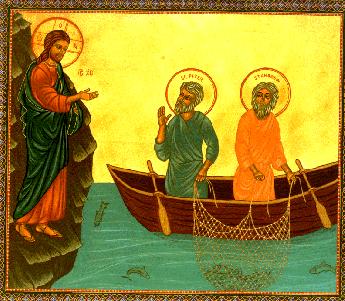
Let us see what Jesus did next, the absolute next thing, after He made this proclamation. “18 As Jesus was walking beside the Sea of Galilee, he saw two brothers, Simon called Peter and his brother Andrew. They were casting a net into the lake, for they were fishermen. 19 “Come, follow me,” Jesus said, “and I will send you out to fish for people.” 20 At once they left their nets and followed him. 21 Going on from there, he saw two other brothers, James son of Zebedee and his brother John. They were in a boat with their father Zebedee, preparing their nets. Jesus called them, 22 and immediately they left the boat and their father and followed him.”

Jesus calls each of us! He calls the clergy among believers, and Jesus calls lay people as well. In other words, Jesus calls everyone – each and every one of us – to follow Him. Do you feel called? Has Jesus picked you out from the crowd, given you a purpose, and given you a new name? (like Peter?) Some churchgoers do feel called by Jesus! However, some do not.

One bible commentator I respect, Dr. David Lose, has this to say: “Some years ago, as part of a Lilly Endowment sponsored grant on vocation, the research team I worked with discovered that while most of the graduates of our seminaries identified “vocation” and “calling” as important theological concepts that were at the center of their preaching and teaching, very few of their parishioners actually felt called. Very few of them, that is, believed that what they did with most of their time mattered to God and the church or made a particular difference in the world.” [2]

            I wonder why? God calls everyone! Taps everyone on the shoulder! Each believer!

Dear Lord, why is this? There are people who attend churches all over the country, even all over the world. Where are all of the people who believe in Jesus, and who claim the name of Jesus, and call themselves believers, even Christians?  Yet, I do not see many church folk who consider themselves called of God in this particular way.

            Let us consider Peter, Andrew, James and John. The first four disciples. What did the new Rabbi Jesus do? He called these four people to follow Him, the first ones to take part in the kingdom of God that starts our Scripture reading today!

            What were Peter, Andrew, James and John doing when Jesus called them to follow Him? They were fishing. Actual fishermen. You remember: “Come, follow me,” Jesus said, “and I will send you out to fish for people.” 20 At once they left their nets and followed him.” These people had nets, boats, and all other equipment used for fishing. They walked away from all that.

We can see how Jesus made His proclamation that “the kingdom of God is near!” And He called helpers, people to come alongside and do the work of fishing for people. Maybe we are coming at this sideways? What if – what if Jesus calling of the disciples was something unexpected? What if – what if the disciples’ calling and our calling is exactly the same?

            What kinds of equipment might we use for “fishing for people?” What kinds of equipment might Jesus have had in mind? The world today is a bit different from the first century, but some equipment people might use today include a Meals On Wheels cooler (to reach people by bringing them food), or extra clothes, coats or shoes (to give out to people in need), or even musical instruments or art supplies (to reach people with the arts). Plus, it’s always appropriate to reach out to others with friendly visits, caring cards, or phone calls or texts. Plus, as our Pastoral Prayer said today, we can also be readers to little children, bandagers of bruised hears, lovers of the forsaken, and pilgrims who show the way to others – with God’s help.

            What if – what if God’s calling is actually plain and simple? “Think about it for a moment: God’s call isn’t simply to do something, but rather to be something, a child of God…. if we can first focus on being – just being – God’s beloved children, and let that grace-filled identify seep into the deepest parts of ourselves.” [3]

            Yes, our call is to follow Jesus!  Our call is to offer God’s words of mercy, grace, hope and love, because we are God’s beloved children. I know I often say “Go and do that. Follow God” at the end of my sermons. I’ll add today, “Go and be that. Be that beloved child of God.” Alleluia, amen.

@chaplaineliza

(Suggestion: visit me at my other blogs: matterofprayer: A Year of Everyday Prayers. #PursuePEACE – and  A Year of Being Kind . Thanks!


[1]  https://www.davidlose.net/2017/01/epiphany-3-a-being-before-doing/

[2]  https://www.davidlose.net/2017/01/epiphany-3-a-being-before-doing/

[3]  https://www.davidlose.net/2017/01/epiphany-3-a-being-before-doing/   

Unknown's avatar

Good News about Jesus!

“Good News about Jesus!”

Ethiopian painting, unknown artist  Philip and the Ethiopian royal official

Ethiopian painting, unknown artist
Philip and the Ethiopian royal official

Acts 8:34-35 – May 3, 2015

Who enjoys hearing good news? Just about everyone! And what about those who share good news? A relative getting married, perhaps? A new baby in the family? What about a big graduation—from college, trade school, or nursing school? The purchase of a new condo or a new car? These are all things that cause a great deal of rejoicing!

We’re going to talk more about sharing good news, but first, we need to set the scene. Tell you a little about our Scripture text for today. We are going to take a closer look at Acts chapter 8.

The risen Lord Jesus has been with His disciples and followers for a number of weeks after Easter, after the Resurrection. He ascended into heaven in the first chapter of Acts, and the great events of Acts chapter 2—Pentecost, the birth of the church at the Temple in Jerusalem—have occurred. The number of believers in the risen Jesus has simply exploded!

Four thousand came to believe on Pentecost, in one day, alone. Thousands of Jewish people heard about the Messiah coming, dying on a cross, and being raised from the dead. And they believed!

As we view the new gathering of believers at this point, in the early chapters of Acts, it’s a Jewish gathering. It’s pretty monochromatic. All of the believers have similar skin tones. All of the believers come from the same religious background. Jewish. All of the believers heard the Good News in the city of Jerusalem. All of the Jewish believers originate from an oppressed people-group in an occupied territory in Asia Minor (Israel), even if they currently reside outside the territorial bounds as their current place of residence. They still made the pilgrimage to worship at the Temple in Jerusalem.

The disciples do not have a difficult time communicating the Good News of the risen Lord Jesus to their fellow Jews! No cross-cultural differences to be dealt with, here!

Not yet . . . anyway.

The disciples were greatly heartened by such a huge response to their spreading the Good News! They fanned out into the area around Jerusalem (just as Jesus told them to do), and continued preaching. Sharing their stories. Until—the beginning of Acts 8.

Here, we have Philip. Directed by the Holy Spirit, Philip travels in Samaria, sharing the Good News with the people he met there. People who were not fully Jewish! As if this wasn’t enough, we have the encounter just read to us. Where Philip meets a royal official from Ethiopia.

Let’s step away from the events of the reading to talk about the author of this book of Scripture.

Dr. Luke, who wrote the Acts of the Apostles along with the Gospel of Luke, had a special concern for certain parts of the general population. He highlights women, children, sick people, and—Gentiles. Non-Jews. Dr. Luke himself was a Gentile, a Greek doctor. He therefore lifts up these powerless, unprotected individuals.

He shows God’s concern and care for the least of God’s creation. Those who are often forgotten or overlooked by the preferred ones.

This royal official of the queen of Ethiopia was a powerful man, it’s true. He wielded considerable power in the palace, in his own arena. But outside of his country? He was an outsider, for sure. And for more reason than just the color of his skin. The royal official was a eunuch. That means probably when he was a young boy—probably as he started serving in the house of the queen—he was forcibly castrated in order to serve the queen. He didn’t allow that to deter him, though. He rose in the queen’s household, became well educated and literate, and eventually became an important official, in charge of her treasury.

This official also desired to know more about the God of the Jews.

We don’t know where he heard of that particular God, a foreign God, but he had an earnest desire to learn more about the God who made heaven and earth, the God of the Jewish people.

There was a problem. A big problem. Sure, the royal official could learn about the Jewish God. He could become a proselyte, even come to Jerusalem and visit the area outside of the Temple. But—he could not enter the Temple. There were strict rules regarding that, in the Mosaic Law Code. The official was a eunuch. He was castrated. He was not fully “a man,” like every other natural male.

According to Jewish law, that made this Ethiopian’s spiritual standing with God less than that of others. He was automatically excluded from a close relationship with the Jewish understanding of God, due to factors completely beyond his control.

Did that make any difference to Philip? Let Dr. Luke tell us more.

Let’s get back to the story. After going to Jerusalem and diligently, faithfully worshiping outside of the Temple, this Ethiopian official started back to Africa in his chariot. Philip, nudged by the Holy Spirit, came alongside the chariot. The Ethiopian was reading from the book of Isaiah—aloud. Very common practice of the time. Reading aloud. Coming alongside the chariot, Philip asked, “Do you understand what you are reading?”

Excellent question! I can just see the scene—the Ethiopian, poring over the open book in his hands, perhaps in Greek translation (the trade language of the time). Young, strong Philip, jogging alongside, engages the official. The Ethiopian, intrigued, invites Philip to sit beside him in the chariot and explain the passage further.

One thing leads to another, and next thing you know, Philip is telling the official his story. Telling the Good News of the risen Jesus. Sharing the Gospel from the book of Isaiah, as well as his own personal testimony. The official must have known a great deal about the Jewish Bible and have been able to connect the dots of the Good News in short order! Because, what do we see next?

They come to some water. I bet the Ethiopian was so excited when he asked Philip, “What is to prevent me from being baptized?”

Do you understand what happened here? Philip explained the Gospel—the Good News about Jesus—to this worthy man. And in very short order, he was ready—so ready to believe in the Resurrection, to accept the Gospel!

Now at the impromptu baptism, when the Ethiopian made a public declaration of his belief in the risen Lord Jesus, did Philip stop and ask whether this man was Jewish, or not? Did he notice whether this man was an eunuch, or not? Did he care about the color of this man’s skin, or not? The conversation in the passage is not specific, but Philip’s actions certainly are!

“Both Philip and the Ethiopian went down into the water, and Philip baptized him.” That’s what Dr. Luke tells us.

The early church records let us know that this royal official not only goes back to Ethiopia—rejoicing in his absolute acceptance by our Lord as a fully beloved child of God!—but he also carries the message of that Good News to others in his home country! He tells others his story, that God fully and lovingly accepted him. A non-Jew, a person of color, even a man who was castrated.

This official became a believer, part of those who spread the Good News, that God loves each individual, no matter what.

Can we be sure that God accepts us? What about the questionable things in our past? What about those things? God still loves us. What if we don’t have very high standing in the community? God still loves us. What about the bad feelings we have in our hearts? God still loves us. What if we come from the “wrong side of the tracks?” God still loves us.

Are you a child of God? If you are member of the human race, YES. Does God love you? If you are a member of the human race, YES. Can we celebrate in God’s love? YES. Can we share that Good News? YES.

God loves you so much that God sent Jesus to this earth to die on a cross and rise from the dead on the third day. Do you believe this Good News? This fantastic, phenomenal News?

Praise God, just as much as Philip, just as much as the Ethiopian official, just as much as any other disciple, we can rejoice in the Good News of the risen Christ and share our story.

I encourage you today.  Tell someone how much God loves you!

Philip did. The Ethiopian did. And we are encouraged to do so, too. Praise God! Alleluia! Amen.

@chaplaineliza

(Suggestion: visit me at my daily blog for 2015: matterofprayer: A Year of Everyday Prayers. and my other blog,  A Year of Being Kind .  Thanks!)