

“Open Hearts to Joy!”
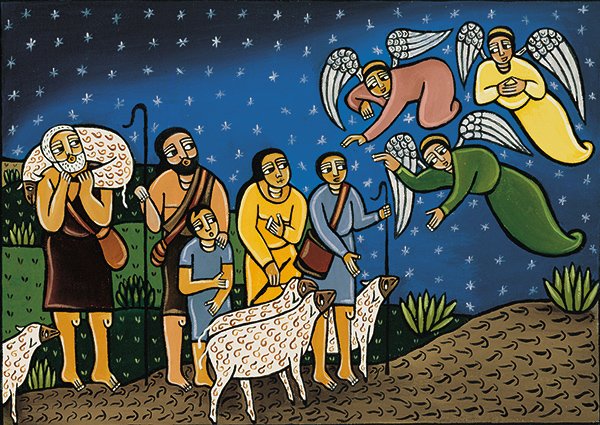
Luke 2:8-20 (2:15) – December 15, 2024
So many houses and apartments are decorated for the season at this time of year. Colorful lights and holiday decorations indoors and out, shining Christmas trees, special dishes and fancy tablecloths. Plus, some families have a Nativity scene in a special place, whether under the Christmas tree or placed in an extra special location, even outside, all lit up at night.
As we consider our Scripture reading for this morning, we think about the familiar words from Luke chapter 2. We think of the very pregnant Mary and her husband Joseph, coming into the town of Bethlehem late one day, but they could not find any place to stay. So familiar it is today, but I suspect you all can think of the Nativity scene figures: a kneeling Mary, Joseph hovering over his wife, and the baby Jesus lying in a manger.
Where did this tradition of decorating with a Nativity scene come from? Yes, the Nativity scene is a familiar way of retelling this story of the birth of Jesus. But—how did Nativity scenes begin? It was in 1223. “According to St. Bonaventure’s biography, St. Francis of Assisi got permission from Pope Honorious III to set up a manger with hay and two live animals—an ox and an ass—in a cave in the Italian village of Greccio. He then invited the villagers to come gaze upon the scene while he preached about ‘the babe of Bethlehem.’ (Francis was supposedly so overcome by emotion that he couldn’t say ‘Jesus.’)” [1]
That first Nativity was located in Italy, during the 1200’s. The practice of Nativity scenes, pictures and photos has certainly spread from there, all over the world. Do you remember acting in Christmas Nativity scenes, or perhaps Christmas pageants with a Nativity scene in them? You, or your children? Or grandchildren?
The Nativity scenes I remember always had at least one shepherd visiting the baby Jesus, along with a sheep or two. Perhaps you remember when you or your children or grandchildren were in a Christmas pageant. Were there shepherds abiding in the fields, keeping watch over their flocks by night? And, sheep! I remember several Nativity scenes in Christmas pageants years ago, where the small children were dressed up as sheep.
Let’s hear again from Dr. Luke the words the angel said to the shepherds, that Christmas night: “the angel said to them, ‘Do not be afraid; for see—I am bringing you good news of great joy for all the people.” Not just the people in Italy, where St. Francis was. Not just the people in Europe, or North America. Good news of great joy for all the people, all over the world.
This week in Advent, here at this church we are concentrating on the shepherds. As we read this familiar Christmas story, was there much in the shepherds’ daily life and experience to fill them with joy? I do not think they were particularly joy-filled, with their ordinary, workaday life and their low, social status. I wonder whether the shepherds felt like that, right before the angel chorus broke into this hum-drum, workaday world and appeared to them?
Remember the difficult situation the shepherds were in. The shepherds’ position on the social ladder in Palestine was pretty much the bottom rung. The Jewish religious leaders even considered shepherds ritually unclean, since their duties and their work of looking after sheep made it impossible for them to observe the Sabbath. Working as a shepherd was something that vagrants might pick up, or a job for ne’er-do-wells, or others who were very much down on their luck. Their society stereotyped shepherds as liars, degenerates, and thieves.
Just imagine the reaction of these lowly shepherds as they heard this news from the angels! Good news of great joy, especially, particularly for them! And centuries later, imagine the reaction of these same shepherds to think that they are now an integral part of a Nativity scene, a central part of the Christmas story played out time and time again, year after year.
When my children were small, one of the first Christmas decorations I’d take out of the box would be our little Nativity scene. The little figures were all children, and it was intended specifically for the young. I would tell and re-tell the Christmas story again and again. When they were small, all four of my children would love to play with the figures, spending a good long time with those inexpensive yet meaningful little figures.
Different churches do different things to communicate this narrative of the birth of Jesus. I read that the Rev. Janet Hunt has a yearly practice she does in her Lutheran church in De Kalb. But, I will let her tell you herself. “It has been my practice for many years to ‘build the creche’ with the children during the children’s sermon during Advent. One week we add the animals. The next week the angels join them. Pretty soon Mary and Joseph arrive and not long after the baby Jesus and shepherds and the three sages from the East arrive last of all. The order is not perfect, of course, but it is one way of bringing the story home.” [2]
My personal Nativity scene, the one my children played with, has white children, every one. I had not thought about this when I bought the set of figures, more than thirty years ago. Even though my children were part of a multi-ethnic, multi-cultural school system, we still had an all-white Nativity set. Were the people in that first Nativity people of color? Yes, they were.
Let us return to these shepherds of the first century, on the hills surrounding Bethlehem. They were downhearted outsiders, all right! People of color, non-white, on the bottom rung of their society, for sure. “But God does not give up on us. God sends angels to people who have given up on God. How would you respond to God sending angels to you when you’d given up on God? Like the shepherds, I’d be terrified.” [3]
Remember the words of the angel of the Lord: “Do not be afraid; for see—I am bringing you good news of great joy for all the people.” We can praise God! God did not send good news of great joy to just a few people in the world, or even some of the world’s people. Or, only people of a certain position in society. No, our God sent good news of great joy to all the people of the world.
The angel has come to all cultures, all ethnicities, all people, wherever their position on the social ladder. All people, everywhere. Even us. You and I can truly come to the manger in Bethlehem side by side with the lowly shepherds.
That is not only GOOD news, that is GREAT news. Good news of great joy, for all the people of the world! Alleluia, amen.
(Suggestion: visit me at my other blogs: matterofprayer: A Year of Everyday Prayers. #PursuePEACE – and A Year of Being Kind . Thanks!
[1] http://www.smithsonianmag.com/smart-news/the-first-nativity-scene-was-created-in-1223-161485505/
[2] https://dancingwiththeword.com/re-telling-the-story/
[3] http://www.workingpreacher.org/preaching.aspx?commentary_id=1522


 Pastor, Preacher, Pray-er