Unknown's avatar

Peace for Those Who Wait

“Peace for Those Who Wait”

            Waiting. I can remember waiting while being pregnant. Waiting for the weeks to pass. Waiting for another prenatal visit. Especially waiting during that last month. And, waiting for the labor pains finally to kick in and to get going, for the baby to finally be born. (Each of my pregnancies involved long labors.)

            I can relate to our Gospel reading from Luke chapter 1 today! Waiting! Waiting for something huge to happen. Waiting for babies to be born.

Except, Mary found herself in the early months of pregnancy without the protection of a husband or partner. I have a feeling she and Joseph were having continuing dialogue about her being pregnant, and not by Joseph. That must have been awkward, to say the least! We find that Mary traveled and went to her older cousin Elizabeth’s house, some distance away, for several months. Elizabeth’s home must have been a sanctuary in an unpeaceful time for Mary, while she was in a time of waiting.

Let us look at the current day, and focus on the United States. Things today, situations here and now are certainly not peaceful. We are looking at the second Sunday in Advent, and the second candle on the Advent wreath signifies the candle of Peace. Can you and I possibly find peace in an unpeaceful world?

Is there a way to look for God’s peace in a turbulent and tumultuous time?

As I said last week, we are well used to seeing Mary as a sweet, calm, quiet, almost docile follower of God’s will for her life. Last week, I brought up the fact that Mary, our Mary that Dr. Luke tells us about, was also a prophet! As a prophet, she brought hope to the world. Was it possible that Mary also brought peace to an unpeaceful world?  

This prophetic role, this insight is a new way of looking at Mary for me. New for me, and I hope enlightening to you, too. As we consider the call of the prophets in the Hebrew Scriptures, and consider the call of Mary by the angel Gabriel, we see all the familiar, classic steps: we see God’s initial call to Mary, God’s task, Mary the prophet’s objection, God’s reassurance, and Mary the prophet’s acceptance of call. [1]

All of these are found in Mary’s conversation with the angel Gabriel in the account of the Annunciation, found in Luke chapter 1. I was struck by – you might say, gobsmacked by – the clarity of all those classic steps of the prophet’s call displayed, and I had never seen it before. Sure, I had approached this insight in years past, even preaching about how Mary was a radical by singing about such radical ideas.

Even though I have been well acquainted with the first chapter of Luke for decades, the further concept of Mary as God’s chosen prophet never fully clicked with me. Until now.

As we go on to look at the Canticle that Mary sings, I want to bring before us the earth-shattering idea that “Luke portrays her in a startling role: one that shakes up the way we’ve been brought up to think of her and invites us to stop observing her and start imitating her.” [2]

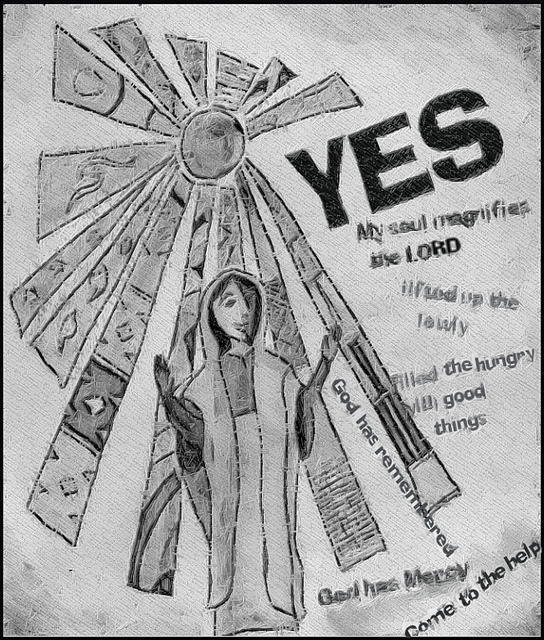
Can you listen with open ears to Mary sing of God who “has brought down rulers from their thrones but has lifted up the humble,” and “has filled the hungry with good things but has sent the rich away empty.” This is a classic story (or song) about the “haves” and the “have-nots,” and we can guess who Mary associates herself with! The Jewish people are definitely downtrodden; the Roman empire certainly has them under their collective boot heel. Nevertheless, Mary’s prophetic notes of joy ring out for all to hear in the Magnificat!

Remember, Mary’s song, giving glory, magnifying God, is also clearly a radical protest song. As she sings about the injustice not only in her hometown, but within the whole occupied Jewish nation, any peace but a forced “peace” was the furthest thing from the minds of the Roman occupiers. Yet, “the new world Mary sings about here isn’t elusive or unquantifiable at all. The hope she holds onto is one passed on to her from her ancestors: from Hannah, who sang this hymn of reversal and revolution in the Hebrew scriptures, to the Psalmist, who echoed praise to God for raising the poor from the dust and lifting the needy out of their desperation.” [3]

One of my favorite interpretations of the Canticle Mary sings, the Magnificat, is a newer song written by artist Rory Cooney, set to a traditional Irish tune called “Star of the County Down.” It is presented as a story-song with refrain: “Though the nations rage from age to age, we remember who holds us fast: God’s mercy must deliver us from the conqueror’s crushing grasp. This saving word that our forebears heard is the promise which holds us bound, ‘til the spear and rod can be crushed by God, who is turning the world around.” [4]

Can you believe how radical, how revolutionary an idea this was (and is)? Especially to a large group of people who have been poor, downtrodden, and left on the outskirts for generations, perhaps for centuries? What good news – even marvelous news – this would be to such a group of people, to know that God not only loves them, but God cares about each of them, and is actively coming to their defense, to fill their stomachs and right their wrongs!

Here in the United States, right now, we have a large segment of the population becoming fearful and anxious. Not only about the economic situation for individuals and families, but also the current political situation. The roaming of ICE agents and Department of Homeland Security walking freely, touchy and eager to display their confounding and overwhelming strength, their power over.

How striking and similar is this to the occupying Roman army in first century Palestine? Some striking and sadly similar parallels between the first and twenty-first centuries. In both cases, God’s love was and is displayed, overcoming worldly power.

As the Canticle of the Turning says in the last verse, “Though the nations rage from age to age, we remember who holds us fast: God’s mercy must deliver us from the conqueror’s crushing grasp. This saving word that our forbears heard is the promise that holds us bound, ‘Til the spear and rod be crushed by God, who is turning the world around.” [5]

  Let those with ears to hear, hear the words of the prophet Mary. Alleluia, amen.

@chaplaineliza

(Suggestion: visit me at my other blogs: matterofprayer: A Year of Everyday Prayers. #PursuePEACE – and  A Year of Being Kind . Thanks!)


[1] http://www.patheos.com/progressive-christian/mary-reluctant-prophet-alyce-mckenzie-12-17-2012.html

[2] Ibid.

[3] The Do Not Be Afraid Advent Devotional – © 2022 Illustrated Ministry, LLC

[4] Cooney, Rory, “Canticle of the Turning,” (GIA Pulications, Inc. Chicago, IL: 1990)

[5] Ibid.

Unknown's avatar

Hope, for Mary and for Us

“Hope, for Mary and for Us”

Luke 1:26-45 (1:38) – November 30, 2025

            I have a secret confession to make. I am greatly thankful that I have never had to take a job in retail. As I said to my husband this past weekend, I would have quit after the first day, simply because of the constant, cheesy, sometimes saccharin-sweet Christmas music that is piped in over the PA system at every retail store I go into. This is done for about two months before Christmas. And, that’s a long, long time to hear Christmas carols and songs, non-stop.

            And yet – and yet, as we consider this alternative Advent Bible reading from Luke chapter 1 today, I invite you to come with me back in time, to a time before there even was a Christmas. We are not only going to time-travel, but we are going to ocean-hop, too. Let us go to the modest home of a teenager named Mary, living with her parents in Palestine, around the beginning of the first century of the Common (or, Christian) Era.

            This teenaged girl – really, young woman, as she was in that time and place – had an angel visitation. We even find out the Angel’s name, Gabriel. The few times that the angel Gabriel appears in the Bible (that we know of), are times of great importance. Especially this appearance, when Gabriel heralds the birth of the coming Messiah! But, we haven’t gotten there yet. Mary is in her parents’ home when the angel suddenly arrives, about to upend everything concerning Mary and her life as she knows it.  

            Another very important fact: the country where Mary is living, and her people, the Jews, are under Roman rule. Palestine is an occupied country, like so many other regions and nations under the boot of Rome and the powerful Roman army. Palestine doesn’t sound much like a “Silent Night, Holy Night,” where “all is calm, all is bright.” Does it?

            Our mighty God does not wait until everything is perfect, or everything is calm and placid, to work wonders and miracles. God sent the angel Gabriel to a teenager in a modest house, in a country under military occupation. Not to the ruling classes, not to the king’s family in his luxurious palace, but to an unlikely young woman in a backwater town.

            Let us shift gears and move our focus to the modern day. Here in the United States, we have a great deal of internal struggle! Things today are certainly not perfect, or calm or placid. As we mark the first Sunday in Advent, the first candle on the Advent wreath is called the candle of Hope. Can you and I possibly find hope in an atmosphere of anxiety? Of uncertainty? Overwhelmed by pervasive negativity, with the American people’s attitudes filled with division, derision and defensiveness?

            Let’s return to Mary and the angel. How does Gabriel lead off in this conversation from Luke chapter 1? 28 The angel went to her and said, “Greetings, you who are highly favored! The Lord is with you.” Admittedly, Mary wonders what on earth is going on! Dr. Luke tells us, Mary “was greatly troubled at his words and wondered what kind of greeting this might be.” I dare say you and I would be greatly troubled, too, if we were to encounter an angel!

            Sure enough, Gabriel announces to Mary that she is highly favored, and that “you will conceive and give birth to a son, and you are to call him Jesus. 32 He will be great and will be called the Son of the Most High. The Lord God will give him the throne of his father David, 33 and he will reign over Jacob’s descendants forever; his kingdom will never end.”

Mary probably knew her place in society of her time, as a female, as a second-class citizen. Mary “is common, ordinary, of little account in her world and definitely not the stuff of legends…and she knows it. Only after expressing her wonder and dismay, and then hearing again Gabriel’s affirmation and promise, does she manage to summon the courage to believe that God has indeed favoring her by working in her and through her for the health of the world.” [1] What was Mary’s response to the angel? 38 “I am the Lord’s servant,” Mary answered. “May your word to me be fulfilled.”

We all know very well that our teenaged Mary became pregnant by the Holy Spirit, and gave birth to the baby Jesus in Bethlehem. We are well used to seeing Mary as a sweet, calm, quiet, almost docile follower of God’s will for her life. However, I would like to suggest that Mary was also a prophet! As a prophet, she would also be a bringer of hope to the world!

This prophetic role, this insight is a new way of looking at Mary for me. New for me, and I hope enlightening to you, too. As we consider the call of the prophets in the Hebrew Scriptures, and consider the call of Mary by the angel Gabriel, we see all the familiar, classic steps: we see God’s initial call, God’s task, the prophet’s objection, God’s reassurance, and the prophet’s acceptance of call. [2]

 I will say more about this next week, when we take a look at the Canticle that Mary sings, but I want to bring before us the earth-shattering idea that “Luke portrays her in a startling role: one that shakes up the way we’ve been brought up to think of her and invites us to stop observing her and start imitating her.” [3]

 I know that the Christmas carol “Once in Royal David’s City” calls mother Mary “mild,” and the typical portrayal of her on Christmas cards is calm, placid and docile. But, how can this mild depiction of Mary cause our hearts to be hopeful, today? Especially when it seems that the whole world is uncertain, the current political situation is contentious, and our society in the United States is fractured and broken?

            While Mary’s specific task is specific to her, the prophetic call remains open to everyone. God can call each one of us to a prophetic role, especially at this time of Advent, at this grateful and expectant time of year when people are looking up, looking outward, looking for hope. We can all be like Mary, the prophet, bearing good news to everyone.

            Alleluia, amen.

@chaplaineliza

(Suggestion: visit me at my other blogs: matterofprayer: A Year of Everyday Prayers. #PursuePEACE – and  A Year of Being Kind . Thanks!


[1] https://www.workingpreacher.org/dear-working-preacher/favored-ones

[2] http://www.patheos.com/progressive-christian/mary-reluctant-prophet-alyce-mckenzie-12-17-2012.html

[3] Ibid.

Unknown's avatar

Amazed by Love!

“Amazed by Love!”

Luke 2:15-20 (2:18) – December 22, 2024

Merry Christmas! What a wonderful expression. People greeting each other on the street, in the stores, here at church. I know not everyone celebrates Christmas, but still. What a joyous time of the year. Today, we are here at the 4th Sunday of Advent! Many, many people can hardly wait for the arrival of Christmas Day! Especially for children, I bet some people are so excited that they hardly sleep a wink for the next few nights. (But that’s mostly for reasons of Santa and presents under the tree, not for the religious reasons I’m talking about this morning.)

Merry Christmas, many people say! But I want you to go back, two thousand years. Go back to a time when “Merry Christmas” was not even a phrase, a wish, not even an idea in people’s heads. Go back to the time Dr. Luke describes in his Gospel. Back to the time when Israel was an occupied country, and the Roman Empire was the occupying force. Back to the time when all people in Israel needed to be enrolled. The Roman government decided to have a census, so that they would be able to tax the people of Israel more accurately.

            We remember this census. The Holy Family, Joseph and his fiancée Mary, went to Bethlehem to enroll, because Joseph was a direct descendent of King David. I suspect there were many people on the roads. Today, traveling can be stressful and nerve-wracking. I am certain travel in the first century was much more difficult. Poor roads, with many people walking to get from one place to another. We might imagine that Joseph and Mary had a donkey, but nowhere in the Gospel is that mentioned. Travel conditions were challenging, at best.

Wait a minute. Do we really concentrate on the difficulties and trials of travel to Bethlehem, of the labor and birth of a baby without medication, or of any of the rest of this real-life narrative from Luke chapter 2? Or, do we imagine a nice, tidy, picture-perfect Christmas card? With Mary in a rich, bright blue robe, gazing lovingly at her radiant newborn baby, Joseph looking adoringly at both mother and child. Not to mention the cleaned-up shepherds gazing in wonder, their tidy, well-groomed sheep lying quietly in adoration, too.

That picture-perfect Christmas card was not what actually happened, not by a long shot. Mary felt the pains of labor begin. What a scary thing! To be far, far from home, in an unfamiliar place, and to have such a significant event happen. Significant, and potentially life-threatening, too. Plus, anyone who has worked with large animals (even many smaller animals) knows what a group of them smell like. That’s where Jesus was laid, in a manger among the animals. And, is anyone familiar with the hustle, bustle and smells associated with the labor and delivery room of a hospital? This refocused picture of the birth is not all gentle, meek and mild, to be sure.

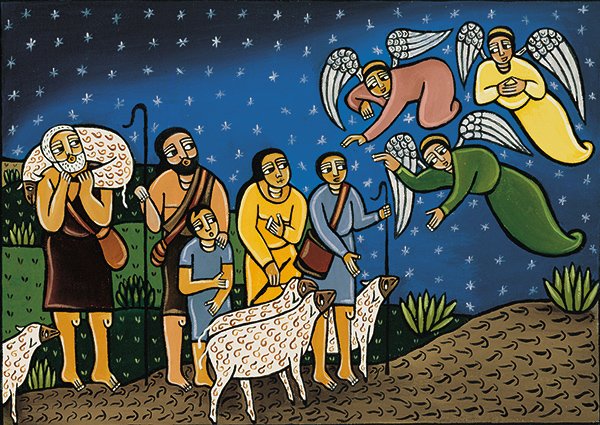
As Luke tells us, there were shepherds abiding in the fields, keeping watch over their flocks by night. When messengers personally come to deliver a special announcement, it is a big deal. These angels coming to the shepherds, well, that was a super big deal, to be sure!

            And the announcement? This isn’t the birth of a normal, ordinary baby. No! This baby is an extra special baby. The Messiah, who will save His people from their sins. Did you hear? This special baby, this Savior, Christ the Lord, is born to you—to me—to all of us, in the city of David, which is called Bethlehem.

            Did you hear? The Savior, the Christ, the promised Messiah, came into this world as a Baby. The Eternal Second Person of the Trinity, Creator of the whole universe, God the Son, emptied Himself of all God-ness. Took on humanity, and was born as a helpless Baby. That is not only good news, that is earth-shaking news. Good news of great joy for all the people. For you, for me, for all of us. How better to communicate to earth than to become one of the frail human beings God intended to reach?

            The Almighty God who made all of heaven and earth, the powerful God who can hold the incomprehensibly vast universe in the span of God’s fingers? Yes, that same God wanted to reach to earth—reach to each of us, to all of us, in love. With love. Through love. 

            That loving outreach is from God’s point of view. Yes, the Almighty God sent the Baby in Bethlehem to earth, in love. But, what if frightened, nervous humans did not in the least expect that? What if short-sighted humans closed their eyes and their hearts to the possibilities of God’s love breaking into the world in such a tender way?

            Mary could have been frightened half to death of the angel and closed her heart to the Divine possibilities that blessedly came about. But, Mary chose love. She chose openness and possibilities that transformed her heart and her life.

            When Mary’s baby was born, Jesus spoke quietly through the blood, sweat and tears of the labor pains of that young woman. Jesus cried softly as an infant, and allowed us all to see the unimaginable caring, the oh-so-tender love that Almighty God expressed, to each one of us. And, each of us is embraced in God’s everlasting arms of lovely love.

            One of my favorite Christmas carols talks about this very thing. This Christmas poem—before it was set to music—was written by Christina Rosetti in 1885. Here is the first verse:

Love came down at Christmas, Love all lovely, Love Divine,
Love was born at Christmas, Star and Angels gave the sign.

Love Divine was born at Christmas. Born for you, born for me. Praise God, our Lord and Savior Jesus was born as a Baby in Bethlehem. Yes, He would preach and heal and suffer and die. And, yes, He would rise again on that Easter morning years later.

Yet—right now, we rejoice in the blessed fact that Jesus was born.

Praise God, we, too, can stop by that manger in Bethlehem, and be caught up in the wonder of what happened that night, so long ago. We, too can welcome this lovely, Godly Love that has come into this broken, weary world, today.

Alleluia, amen.

@chaplaineliza

(Suggestion: visit me at my other blogs: matterofprayer: A Year of Everyday Prayers. #PursuePEACE – and  A Year of Being Kind . Thanks!

Unknown's avatar

Open Hearts to Joy!

“Open Hearts to Joy!”

Luke 2:8-20 (2:15) – December 15, 2024

So many houses and apartments are decorated for the season at this time of year. Colorful lights and holiday decorations indoors and out, shining Christmas trees, special dishes and fancy tablecloths. Plus, some families have a Nativity scene in a special place, whether under the Christmas tree or placed in an extra special location, even outside, all lit up at night.

As we consider our Scripture reading for this morning, we think about the familiar words from Luke chapter 2. We think of the very pregnant Mary and her husband Joseph, coming into the town of Bethlehem late one day, but they could not find any place to stay. So familiar it is today, but I suspect you all can think of the Nativity scene figures: a kneeling Mary, Joseph hovering over his wife, and the baby Jesus lying in a manger.

Where did this tradition of decorating with a Nativity scene come from? Yes, the Nativity scene is a familiar way of retelling this story of the birth of Jesus. But—how did Nativity scenes begin? It was in 1223. “According to St. Bonaventure’s biography, St. Francis of Assisi got permission from Pope Honorious III to set up a manger with hay and two live animals—an ox and an ass—in a cave in the Italian village of Greccio. He then invited the villagers to come gaze upon the scene while he preached about ‘the babe of Bethlehem.’ (Francis was supposedly so overcome by emotion that he couldn’t say ‘Jesus.’)” [1]

            That first Nativity was located in Italy, during the 1200’s. The practice of Nativity scenes, pictures and photos has certainly spread from there, all over the world. Do you remember acting in Christmas Nativity scenes, or perhaps Christmas pageants with a Nativity scene in them? You, or your children? Or grandchildren?

            The Nativity scenes I remember always had at least one shepherd visiting the baby Jesus, along with a sheep or two. Perhaps you remember when you or your children or grandchildren were in a Christmas pageant. Were there shepherds abiding in the fields, keeping watch over their flocks by night? And, sheep! I remember several Nativity scenes in Christmas pageants years ago, where the small children were dressed up as sheep.

            Let’s hear again from Dr. Luke the words the angel said to the shepherds, that Christmas night: “the angel said to them, ‘Do not be afraid; for see—I am bringing you good news of great joy for all the people.” Not just the people in Italy, where St. Francis was. Not just the people in Europe, or North America. Good news of great joy for all the people, all over the world.

This week in Advent, here at this church we are concentrating on the shepherds. As we read this familiar Christmas story, was there much in the shepherds’ daily life and experience to fill them with joy? I do not think they were particularly joy-filled, with their ordinary, workaday life and their low, social status. I wonder whether the shepherds felt like that, right before the angel chorus broke into this hum-drum, workaday world and appeared to them?

Remember the difficult situation the shepherds were in. The shepherds’ position on the social ladder in Palestine was pretty much the bottom rung. The Jewish religious leaders even considered shepherds ritually unclean, since their duties and their work of looking after sheep made it impossible for them to observe the Sabbath. Working as a shepherd was something that vagrants might pick up, or a job for ne’er-do-wells, or others who were very much down on their luck. Their society stereotyped shepherds as liars, degenerates, and thieves.

 Just imagine the reaction of these lowly shepherds as they heard this news from the angels! Good news of great joy, especially, particularly for them! And centuries later, imagine the reaction of these same shepherds to think that they are now an integral part of a Nativity scene, a central part of the Christmas story played out time and time again, year after year.  

When my children were small, one of the first Christmas decorations I’d take out of the box would be our little Nativity scene. The little figures were all children, and it was intended specifically for the young. I would tell and re-tell the Christmas story again and again. When they were small, all four of my children would love to play with the figures, spending a good long time with those inexpensive yet meaningful little figures.  

Different churches do different things to communicate this narrative of the birth of Jesus. I read that the Rev. Janet Hunt has a yearly practice she does in her Lutheran church in De Kalb. But, I will let her tell you herself. “It has been my practice for many years to ‘build the creche’ with the children during the children’s sermon during Advent.  One week we add the animals. The next week the angels join them. Pretty soon Mary and Joseph arrive and not long after the baby Jesus and shepherds and the three sages from the East arrive last of all. The order is not perfect, of course, but it is one way of bringing the story home.” [2]

My personal Nativity scene, the one my children played with, has white children, every one. I had not thought about this when I bought the set of figures, more than thirty years ago. Even though my children were part of a multi-ethnic, multi-cultural school system, we still had an all-white Nativity set. Were the people in that first Nativity people of color? Yes, they were.

            Let us return to these shepherds of the first century, on the hills surrounding Bethlehem. They were downhearted outsiders, all right! People of color, non-white, on the bottom rung of their society, for sure. “But God does not give up on us. God sends angels to people who have given up on God. How would you respond to God sending angels to you when you’d given up on God? Like the shepherds, I’d be terrified.” [3]     

Remember the words of the angel of the Lord: “Do not be afraid; for see—I am bringing you good news of great joy for all the people.” We can praise God! God did not send good news of great joy to just a few people in the world, or even some of the world’s people. Or, only people of a certain position in society. No, our God sent good news of great joy to all the people of the world.

The angel has come to all cultures, all ethnicities, all people, wherever their position on the social ladder. All people, everywhere. Even us. You and I can truly come to the manger in Bethlehem side by side with the lowly shepherds.

            That is not only GOOD news, that is GREAT news. Good news of great joy, for all the people of the world! Alleluia, amen.

@chaplaineliza

(Suggestion: visit me at my other blogs: matterofprayer: A Year of Everyday Prayers. #PursuePEACE – and  A Year of Being Kind . Thanks!


[1] http://www.smithsonianmag.com/smart-news/the-first-nativity-scene-was-created-in-1223-161485505/ 

[2] https://dancingwiththeword.com/re-telling-the-story/

[3] http://www.workingpreacher.org/preaching.aspx?commentary_id=1522

Unknown's avatar

Peace, from Generation to Generation

“Peace, from Generation to Generation”

Luke 1:44-56 (1:50) – December 8, 2024

People have been writing songs about the Virgin Mary for centuries. Songs of praise, songs of worship, songs honoring God, and lifting up Mary for saying “yes” to God. Christmas carols might be the first thing that come to mind—but I am also thinking of music from centuries past. From the familiar first part of Handel’s Messiah, to the various settings of the Magnificat, with lyrics from the first chapter of Luke—our Gospel reading for this morning.

            Some Protestants might not be as familiar with the Virgin Mary as many Catholics and Orthodox Christians are. Mary is held in extremely high esteem in many denominations and faith traditions throughout the world, and for excellent reasons. I honor her greatly.

If we look at our modern world today, the situation here in our country, we have a great deal of uncertainty, and very little peace. Does our world today have some strong similarities to the world that Mary inhabited? I wonder, and I would say yes.

Mary sings about the mighty work of God. Yes, personally, in her life. But also in the lives of all the people in the world. “What will this work of God look like?  Something revolutionary is about to happen. God will turn the world upside down. The rich and the powerful will be brought low, and those living on the margins will be raised up. This isn’t a vision that fits very well with a Christian world that values success and power.[1]

For, that is definitely what a large portion of the so-called “Christian world” values today. At least, here in this country, and among a large number of people who claim to follow Christian values and practices religiously. Even if certain Christian denominations do not say it outright, the “Health, Wealth and Happiness Gospel” is a high priority in many people’s lives today.

Let us take a look at what Mary’s situation consisted of. Did you know that Mary—an unwed teenager from an oppressed people-group in an occupied country under crushing Roman rule—was also a radical? A subversive? Was plotting to overthrow the existing oppressive government and replace it with the rule of God?

            What surprising, even shocking things to say about the sweet, innocent Virgin Mary! Everyone associates her with travel to Bethlehem while nine months pregnant, and needing to deliver the infant Jesus in a stable, because there was no room for them in the inn.

That Mary? Radical? Subversive? Absolutely, yes.

Think about the modern Christmas season from another direction. Contrast Mary’s situation with today. Is there any place we can go where we are not bombarded with commercial messages shouting for us to “Buy, buy, buy!” and reminding us of big sales, and markdowns, and half-price! Not to mention all the pressure to be “merry and bright” all the time. Even when going to yet another event or concert or dinner or celebration is the last thing you want to do!

Let us reflect on the first chapter of Luke, on Mary’s song. The last thing on Mary’s mind was commercialism. “Mary’s song, often called the Magnificat, is a welcome contrast to the hyped-up speed of the commercialism that is too often the dominant theme in our culture during the Advent season. Her lyrics are an invitation to approach Christmas with a slower, more contemplative pace.” [2] Is it possible to slow down the frenetic pace of the holidays, to get off the commercial merry-go-round, and instead sit still and worship the coming Messiah?

Sure, the wonderful classical settings of the Magnificat were often sung in a foreign language, like Latin. Or, in text from the King James version of the Bible, full of “thee’s” and “thou’s” and all manner of archaic words. Listen to the first part of her Magnificat, as translated in the modern version by Eugene Peterson, “The Message.” 

“I’m bursting with God-news; I’m dancing the song of my Savior God. God took one good look at me, and look what happened—I’m the most fortunate woman on earth! What God has done for me will never be forgotten, the God whose very name is holy, set apart from all others. His mercy flows in wave after wave on those who are in awe before Him.”

 One well-known depiction of the Virgin Mary is one that is meek, docile, sweet, and not raising a fuss at all. But, wait a moment. Do we realize what Mary is going to sing next? How revolutionary were many of the statements in her song?

             “Even more importantly, Mary’s song is an overture to the Gospel of Luke as a whole. Mary’s lyrics set the tone for Jesus’s radical and controversial ministry that is to come:

You have shown strength with your arm;

You have scattered the proud in the thoughts of their hearts.

You have brought down the powerful from their thrones, and lifted up the lowly;

You have filled the hungry with good things, and sent the rich away empty.

“In contrast, the Christmas season leaves too many still hungry, and too many even further in debt.” [3]

            Do you hear what radical things Mary is saying? If these lyrics of her song were more well-known, would our understanding of Mary be changed? Here Mary is advocating social change, rescuing victims—neglected women, forgotten elders and children, abused strangers and refugees—from being trodden underfoot, even ground under the heel of bragging, bluffing tyrants and braggarts. Turning all society as it was in her day—and ours—upside down.

            What subversive idea is our revolutionary Mary advocating now? Feeding the starving? Giving the poor a banquet? Turning the unfeeling, callous rich people out into the cold? Yes, these radical words are the words found in Luke chapter 1, before we rush on to the narrative of the birth of the Baby in Bethlehem from Luke 2. 

Just looking at this Magnificat, we can see how subversive it was for the infant Messiah to be born to the Virgin Mary. And, we can begin to realize how radical it is for us to say, “O come, let us adore Him, Christ the Lord!” For Jesus truly will bring peace on earth, and He will truly turn the world upside down, just as Mary sang two thousand years ago.

But, this is still only the second Sunday of Advent. We still wait for the baby Jesus to be born in Bethlehem. We still hold our collective breath with all the rest of creation as we wait—and wait. And with Mary, we can rejoice in the promise of the coming Messiah.

Are we overwhelmed with the superficial, commercial glitz and bling of the holidays? Or, are we focused on what really matters – on the coming of our Messiah, our Lord, in God’s peace and wholeness? Let us focus on Jesus, today. Alleluia, amen.

@chaplaineliza

(Suggestion: visit me at my other blogs: matterofprayer: A Year of Everyday Prayers. #PursuePEACE – and  A Year of Being Kind . Thanks!


[1] http://www.bobcornwall.com/2015/12/blessed-are-you-among-women-lectionary.html

[2] http://www.patheos.com/blogs/carlgregg/2011/12/magnificat-learning-to-sing-mary%E2%80%99s-song-a-progressive-christian-lectionary-commentary-on-luke-146-55/

[3] http://www.patheos.com/blogs/carlgregg/2011/12/magnificat-learning-to-sing-mary%E2%80%99s-song-a-progressive-christian-lectionary-commentary-on-luke-146-55/

“Magnificat! Learning to Sing Mary’s Song,” Carl Gregg, Patheos, 2011.

Unknown's avatar

Favor with God!

“Favor with God!”

Luke 1:26-45 (1:30) – December 3, 2023

            Stories are so important! Do you have family stories that you have told around the dining room table, or that your parents told you, about your family history? I have told my children stories about one grandfather who owned a pharmacy and drug store in Chicago through the Depression and afterwards. And, my other grandfather who emigrated from a shtetl in Eastern Europe early in the 1900’s, seeing the Statue of Liberty from the deck of the steamer.

            I imagine teenaged Mary, and the stories she was told in her family. Not only family stories about her parents and grandparents, but also stories of the Hebrew people – stories of Abraham and Sarah, of Jacob and his sons, of Moses, Miriam, King David, and especially of Hannah and Samuel. I’d imagine Mary thinking hard about Hannah, pregnant with her child of promise Samuel, and it would be difficult not to compare herself to Hannah!  

            I am wondering which such stories have shaped you and me, giving us direction and hope, understanding and wisdom in the midst of uncertain times. [1] Which stories – either our family stories or Bible stories – have helped us along, given us positivity and perseverance when we get discouraged or upset?

            Mary must have been a thoughtful teenager, possibly even mature beyond her years, when the angel Gabriel suddenly appeared to her! The angel greeted Mary with the typical words most recorded in Scripture when an angel makes a visitation: “Don’t be afraid!” Lo and behold, Mary enters into conversation with this heavenly visitor.

            Would you and I have been as thoughtful, or as quick on our feet if we were suddenly confronted with an angel? Even if the angel immediately said, “Don’t be afraid!?”

            Mary must have had some idea of what she was up against, both in her culture and in her traditional society structure. Here she was, a young, unmarried teenager – yes, of marriageable age, but not married yet. And, she willingly took on the task of bearing a child, the Son of God as the angel said. “You have found favor with God. 31 You will conceive and give birth to a son, and you are to call him Jesus.”

            I wonder perhaps if this is why Mary goes to her older cousin Elizabeth in the hill country, because of the societal pressure that was on her in her hometown. I wonder whether Mary was thinking she might receive social judgement from Elizabeth once she gets there? Yet, I also know that cousin Elizabeth had her own experience of being shamed and excluded. “In her culture a woman’s primary purpose in life was to bear children, so as an elderly infertile wife she had endured a lifetime of being treated as a failure. Her response to her miraculous pregnancy emphasizes that God’s grace has reversed her social status.” [2]   

            Just think about it! Both Mary and Elizabeth were in a position of social stigma and even dishonor. Yet, Elizabeth said “This is what the Lord has done for me when he looked favorably on me and took away the disgrace I have endured among my people” (Luke 1:25). Further, by greeting Mary with joy and with honor, the pregnant Elizabeth firmly overturns society’s frowns and shames and clucking of tongues.

            There’s a whole lot in front of Mary and Elizabeth that they do not know. “They do not know why they have been chosen for these roles. They don’t know who their babies will become, though they have some hints. They don’t know how their children will change the world or how the world will change their children.” [3]

            What about today, with migrants, immigrants, or people displaced from war-torn areas or as a result of natural disasters? People are outside of their society’s rules or their cultural expectations, and are regularly in precarious situations. Old people, seniors far from families who need assistance – even a wheelchair – and nothing is available. Children who go hungry because their displaced parents are unable to work because of their host country’s rules.

Pregnant women sometimes are stigmatized by their society, shame, and cultural dishonor. So like Mary and Elizabeth. Do any of these stories resonate inside of you? Which of these ancient stories passed on – even as they were to Mary – do you hold especially close to your heart, especially in December, in this season of Advent? Do one or two of these Biblical stories carry you in dark or uncertain times, and give you encouragement and comfort? [4] Either the story of Hannah and Samuel, or of Mary and Elizabeth? Or another Biblical story?

Sometimes, there are competing stories of hopelessness, or discouragement, or dishonor that come to people’s minds. I would like to tell you that those competing, pessimistic stories are not helpful to our hearts or minds! These stories are not positive or uplifting, and please, please do not let yourselves get bogged down listening to them, internalizing them!

This story of Mary and Elizabeth shows us the positive, nurturing attitude of God reaching down to the least and the lowly. We can be open to the ways that God chooses to act in our world, both two thousand years ago, and today, too! “What is God doing through unexpected people in our society today? Where is God at work through people whom our neighbors and fellow church members often exclude or treat as shameful? Will we listen to the Spirit’s prompting when the bearers of God’s new reality show up on our doorstep?” [5]

I invite us all to consider these positive, miraculous stories and invite the Lord to come alongside of us as we travel through Advent. And perhaps, these stories will help us all to make the world a different place, a more Godly place, where God overrules society’s structure, shame and cultural disapproval! A place where God has arms open wide to all children, all people.

Maranatha, come, Lord Jesus!  

@chaplaineliza

(Suggestion: visit me at my other blogs: matterofprayer: A Year of Everyday Prayers. #PursuePEACE – and  A Year of Being Kind . Thanks!

(I would like to express my great appreciation for the observations and commentary from the Do Not Be Afraid Advent Devotional – © 2022 Illustrated Ministry, LLC.. I used several quotes and ideas from their useful resources. Thanks so much!)


[1] https://dancingwiththeword.com/mary-and-hannah-and-a-woman-in-the-county-jail/

[2] https://www.workingpreacher.org/commentaries/revised-common-lectionary/fourth-sunday-of-advent-3/commentary-on-luke-139-45-46-55-3

[3] Do Not Be Afraid Advent Devotional – © 2022 Illustrated Ministry, LLC.

[4] https://dancingwiththeword.com/mary-and-hannah-and-a-woman-in-the-county-jail/

[5] https://www.workingpreacher.org/commentaries/revised-common-lectionary/fourth-sunday-of-advent-3/commentary-on-luke-139-45-46-55-3

Unknown's avatar

Joy, For the Nations

Joy, For the Nations

Isaiah 42:1-9 (42:6) – December 11, 2022            

God has an amazing way of bringing about justice! You and I can think of countless situations where God is walking with faithful believers through all kinds of difficult situations! Yet our God cares for each and every situation, and our God accompanies all these in patient and long-suffering ways.          

  Today’s reading from the prophet Isaiah highlights God’s servant bringing justice, lighting the way to joy, and bringing release to the captives. God usually does not smite the “bad guys,” and we know God doesn’t throw thunderbolts at the people who make life so difficult for everyone else.             

How on earth are we supposed to deal with rotten situations like chronic illness, unemployment, or natural disasters, then? What could you and I do when we are being mistreated or oppressed or trampled, like the people of Israel were by the Babylonians? Because, that was who was beating up on the armies of Israel at the time Isaiah wrote. And, the Babylonians finally conquered the Israelites and took many of them away to the country of Babylon as hostages, and enforced labor.         

    This rotten situation was very real for Isaiah and the country of Israel, in other words! What are the people to do? How should they deal with evil, unfeeling oppressors?            

The prophet writes, speaking for God: “Here is my servant, whom I uphold, my chosen one in whom I delight; I will put my Spirit on him, and he will bring justice to the nations.” “But, Lord,” I can just hear many of the people of Israel say, “When will this be? How long do we need to wait? Why are You taking so long?”           

Waiting is just what we’re doing now. Right now, we are in the season of Advent; we are waiting for the coming of the Messiah, of the Servant of the Lord. The Baby in Bethlehem. Today is the third Sunday of Advent, the Sunday of Joy. The week of continuing expectation, and the week of the Virgin Mary.           

  Several themes of this reading from Isaiah are so similar to the themes of the song of the Virgin Mary – the Magnificat from Luke chapter 1. The angel Gabriel has just told the teenage Mary she will bear the Messiah, the Servant of the Lord. The next thing we know, Mary starts singing this amazing song! Hearkening back to Hannah’s song from 1 Samuel and to this song we read today from chapter 42. Similar to God taking delight in the servant of the Lord, Mary begins her song taking joy in the Lord. As she says, “From now on all generations will call me blessed, for the Mighty One has done great things for me—holy is his name. 50 His mercy extends to those who fear him, from generation to generation.” As God proclaims the promise to “to open eyes that are blind, to free captives from prison and to release from the dungeon those who sit in darkness,” so Mary takes heart in God’s promise that the Lord considers, cares for, and acts on behalf of the lowly.           

  Both of these songs proclaim radical actions! Both of these songs are from a subversive point of view. Both of these songs – the Magnificat of Mary and this servant song from Isaiah – talk of toppling existing unrighteous power structures and erecting a topsy-turvy power structure with the have-nots receiving more than enough from God. Mary goes even further, stating that “it is not for kings or the mighty and powerful that the Lord has regard, rather it is for all the rest that God does great things.” [1]           

Both songs raise the question of justice. Both time periods had the people of Israel under the boot of conquering, oppressive nations: Babylon in the time of Isaiah, and Rome in the time of the Gospel of Luke. I can just hear the people of Israel say, “Has God abandoned us? Are we still God’s people? Is God still God?”  Because of exile and oppression, the people of Israel could only conclude that God had withdrawn favor and allowed the conquerors to punish them for their sins and disobedience. [2]            Yet, into all of this upset and darkness and uncertainty, both songs praise God for being God. Can we do that too, and praise God, today? Both songs address the theme of justice for all people, not just for a few. Can we believe in God’s statement of justice for all, even though every day we see the poor and the downtrodden getting pushed around, and the humble and lowly being overlooked and even discarded?            

“Isaiah reminds this exiled people that God has not abandoned them but is indeed at work among them, restoring them to be a blessing. This is good news! God is still God.” [3]This loving, caring attitude of God is amazing, in God’s approach to bringing justice to all people. Both Isaiah and Mary have strong feelings about justice—especially radical, subversive Mary! Our patient God is working with all of us, gently, gradually, to bring change and justice into this fallen world.

Both Isaiah and Mary sing a song that can be, should be, our song in this Advent season. As we have prepared for the coming of the Christ Child, now we too can sing in thanksgiving, in celebration, in remembrance, and in proclamation of the promise made to our ancestors. And, the promise made to us, too. What can we say but, alleluia!  Come, Lord Jesus!

@chaplaineliza

(Suggestion: visit me at my other blogs: matterofprayer: A Year of Everyday Prayers. #PursuePEACE – and  A Year of Being Kind . Thanks!

Unknown's avatar

Joy at Arm’s Length

“Joy at Arm’s Length”

 Luke 2:1-14 (2:9-10) – December 12, 2021

            Have you felt recently like there are lots of feelings coming your way? It seems like 2021 is a year of deep feelings. Yes, the feelings of fear, anxiety, worry, and grief (over many different kinds of losses!). At the same time, there are occasions of happiness, comfort, and once in a while, excitement! Can you recognize joy in that bundle of feelings?

Let’s look at what Dr. Luke has to say about the shepherds. “And there were shepherds living out in the fields nearby, keeping watch over their flocks at night. An angel of the Lord appeared to them, and the glory of the Lord shone around them, and they were terrified.”

            As we read this familiar Christmas story, was there much in the shepherds’ daily life and experience to fill them with joy? I do not think they were particularly joy-filled, with their ordinary, workaday life and their low, social status.

Remember the difficult situation the shepherds were in. The shepherds’ position on the social ladder in Palestine was pretty near the bottom. Working as a shepherd was something that vagrants might pick up, or a job for ne’er-do-wells, or others who were very much down on their luck. Similar to the current day, where the angels might come and give a heavenly announcement to homeless people.

            Today, you and I do not need to be down and out like the shepherds to have difficulty finding joy. Goodness knows, there is a lot going on in the world today, much less in each individual life. Look at the extreme weather! Look at the political situation, both local and national! Look at finances all over! Look at health situations! Need I say more? Actually, I do.

            My friend Rev. April Fiet reflects about our focus on joy, too. She says, “I was already struggling with joy because I feel guilty delighting in things when others are suffering. It feels inappropriate. How can I rejoice when someone else is experiencing the pain of a loved one in the hospital and being unable to be with them? How can I feel delight when business owners are forced to close their doors? How can I justify smiling at the sound of the birds in the trees or the scent of fresh baked bread when neighbors are sick, families are separated, and such brokenness exists in the world?” [1]

Oh, my. I can relate to Pastor April’s reflections. Are you and I uncertain about joy? Is it difficult for us to feel joy, even a challenge to think about experiencing joy?

I know what it is like to work a hum-drum, workaday job. Yes, I have had some jobs like that, years ago. I wonder whether the shepherds felt like that, right before the angel chorus broke into this hum-drum, workaday world and appeared to them?

Dr. Luke says that the shepherds were doing their job in the fields by taking care of the sheep. It is what they did every day. “Maybe their job had become a routine. Perhaps they were used to living in the fields, and they had forgotten to notice the green grass or look up at the glittering stars. Suddenly, the angels came to the shepherds to share, “the good news of great joy for all the people.” They said, “Jesus has been born. It is a blessing for you. It is a blessing for everyone!”[2] Imagine, a bunch of extraterrestrial beings lighting up the whole night sky! Imagine, what would that have been like if you had been there?

Years back, many people remember cute Christmas pageants, with children dressed in bathrobes as shepherds, and angels with aluminum papered wings and tinsel halos singing “Gloria!” Yet, the real angels’ joyous announcement was contagious! They surrounded the shepherds with that great joy, for all people! The ultimate birth announcement for all time!

I am sure you remember getting filled with joy just because your friend or relative was so joy-filled. We just celebrated the birth of a grandbaby in this congregation a few days ago, and the grandparents were so joy-filled it surely was contagious for the rest of us! And how much more to have a glorious angel chorus filled with joy, singing their Glorias to God in the highest!

But, sometimes – it can be difficult to be filled with joy, even if angels are telling us to be. Sometimes, uncertain hearts can still lean away from joy, for all kinds of reasons. Some remember birth stories of sadness, either in their own lives, or in the life of someone close to them. And some people are just not feeling particularly holly-jolly, merry and bright at this time of the year. Again, for a whole host of reasons. And, that is okay. God understands and God is right here with us, through it all.

Even if we have the angel chorus turned down low, like on a car radio, we can still hear the good news of great joy. “Today in the town of David a Savior has been born to you; he is the Messiah, the Lord.” We can listen to the joyous chorus – softly: “Glory to God in the highest heaven, and on earth peace to those on whom God’s favor rests.”

Yes, the angels brought something extraordinary to the shepherds, and to all of us. Even when we are uncertain to receive it, the angels bring us good tidings of great joy, for all the people! And even when some of us do not have the strength or wherewithal to reach out for joy, a loving, gentle God continues to beckon to us. God’s gift of joy still remains.

I encourage us all – look for God’s joy in our lives today. And, God-with-us, Emmanuel, will stay at our sides in an uncertain Advent, through the Christmas season, and for the rest of our lives. Alleluia, amen!

@chaplaineliza

(Suggestion: visit me at my other blogs: matterofprayer: A Year of Everyday Prayers. #PursuePEACE – and  A Year of Being Kind . Thanks!


[1] https://aprilfiet.com/my-thoughts/advent-for-uncertain-hearts-week-3-joy-at-arms-length?fbclid=IwAR27woV9I-D9ZOu6-QnqwTF_Md7hE8MDmhpkjxdJ9JivtCJY-Nqmscm5aG8

[2] Illustrated Ministry – Week 3, Do Not Be Afraid, Advent 2021

Unknown's avatar

Hope for Uncertain Hearts

“Hope for Uncertain Hearts”

Luke 1:26-45 (1:30) – November 28, 2021

            I want to ask a simple question. Do you believe God is active in the world today? I know we can read about Bible times, thousands of years ago. The Bible says that God was active, mighty and powerful, back then. God did amazing things in people’s lives – long, long ago. But, what about today? Is God active in your life – in my life – today?

            “Few of our people imagine God to be an active character in the story of their lives.” And I suspect commentator Walter Brueggemann is right. It’s not that people today don’t believe in God. It’s more that, day in and day out, God seems to most of them (and perhaps to us, too) as fairly passive. If God is doing anything, it’s pretty much hanging out in the background, watching, waiting, merely being supportive. Not vital, and not active. [1]

Here we are, on the first Sunday in Advent. God may seem far away right now. Merely watching and waiting. Not playing a vital, active role in the story of our lives today. Perhaps it is difficult to think of the Lord as a mighty, powerful actor in our lives right now. But, wasn’t that exactly what God was, in our Scripture reading today?  

            I suspect Mary was shocked down to her sandals when the angel came to her that day, two thousand years ago. The angel said, “Greetings, you who are highly favored! The Lord is with you.” We can read that “29 Mary was greatly troubled at his words and wondered what kind of greeting this might be. 30 But the angel said to her, “Do not be afraid, Mary; you have found favor with God.” If that isn’t God taking an active role in Mary’s life, I don’t know what is.

            Is it possible that you and I might have that same kind of expectation today, that hopeful looking-forward-to God acting in our lives, too?

            I am afraid that I am not very hopeful right now. Neither is my friend, Rev. April Fiet. The fear, the anxiety, the uncertainty of the past eighteen months of pandemic have taken their toll on many, many people across our country. Across our world. Is it even possible to hope? Or, is that feeling a big uncertainty, too?

            Pastor April says “I have tried to hope even when better days seemed impossible. I tried to take things one day at a time, not get too far ahead of myself, and look at the good things I had rather than the things I was losing out on.” [2] I can relate to this honesty. Like Pastor April, I became afraid to hope, too. Every time I got a little bit of hope in my heart, some positivity inside, something would happen. COVID cases would spike, or hospitals and morgues would be overwhelmed, or more recently, the supply chain would have severe interruptions. Not to mention interruptions or disasters in my work life here, or my personal life at home.

            Yet, as we mark the first Sunday in Advent, the first candle on the Advent wreath is called the candle of Hope. Can you and I possibly find hope in such an atmosphere of anxiety? Of uncertainty? Overwhelmed by pervasive negativity?

            Pastor April’s words ring so true in my heart. She says, “I’m uncertain about Advent. I’m uncertain I can hope. I’m uncertain about what’s possible for me. The only thing I’m certain about is that I don’t want to go through Advent with this heaviness on my heart. I want to find a way to release [this feeling] so that healing can begin to happen. I want to exchange uncertainty for hope.” [3] Oh, that would be such a blessing to my heart, to even begin to hope!

            I suspect if you and I had an encounter with a heavenly messenger, like Mary did in our Scripture reading, things might be very different for us. I’m asking, again: what about today? Is God active in your life – in my life – today? Can God actively encourage our hearts to hope?

            Sometime after Mary and the angel had their encounter and Mary became pregnant with the infant Jesus, Mary went to her older cousin Elizabeth’s house. Elizabeth had had a wonderful intervention happen in her life, too. Mary and Elizabeth both had a most joyous reason to hope. Yes, I suspect both women were anxious and fearful sometimes, especially as this was the first pregnancy for both women.

I’m wondering: isn’t it possible to feel afraid and to hope at the same time? The Holy Spirit helped Mary and Elizabeth to hold great hope in their hearts. They held on to hope even in all the uncertainty and caution of their lives.

Sometimes, we may feel overwhelmed, even afraid to hold on to hope. But, we do not need to face challenges all alone. God has promised to be with us. Plus, you and I can join together. We can come alongside of each other, too, if someone is feeling especially down and hopeless. [4] We can thank God for each other! Thank God for God’s mighty power, too.

So, what do you think? We know about Bible times long ago, and what the biblical record has to say. What about today? Is God active in your life – in my life – today? Can God actively encourage our hearts to hope? We can trust that God is still active, and is still doing all kinds of things in the world today – even in each of our lives! Look around at the people around you, in your family, in your congregation. God actively encourages each one of them, and each of us, too. [5]

God can do marvelous things through all our lives, too. Think how many marvelous things God wants to accomplish through each of us, today. On our insides and on our outsides. God IS mighty, active, and inspiring hope for sure, even through these uncertain times.

Alleluia, amen.

@chaplaineliza

(Suggestion: visit me at my other blogs: matterofprayer: A Year of Everyday Prayers. #PursuePEACE – and  A Year of Being Kind . Thanks!

And, thanks to Rev. April Fiet for her excellent series “An Advent for Uncertain Hearts.” I appreciate Illustrated Ministry’s Do Not Be Afraid selections for Advent, too.


[1] https://www.workingpreacher.org/dear-working-preacher/favored-ones

[2] https://aprilfiet.com/my-thoughts/advent-for-uncertain-hearts-week-1-when-it-is-hard-to-hope

[3] Ibid.

[4] Illustrated Ministry – Do Not Be Afraid, Advent 2021

[5] https://www.workingpreacher.org/dear-working-preacher/favored-ones

Unknown's avatar

While by My Sheep

“While by My Sheep”


Luke 2-10 angels, shepherds, Rembrandt 1635

Luke 2:15-20 – December 22, 2019

Christmas is a wonderful time of the year, with all of its opportunities to acquaint ourselves with our Lord Jesus once more. Whether in church on an Advent Sunday, or experiencing the wonder of preparation with an Advent calendar, we have many opportunities to prepare our hearts for the arrival of Christmas during the Advent season.

But, now is two thousand years after the first Christmas. We have developed a great many rituals and observances surrounding the birth of a Baby in Bethlehem. The liturgical year has been instituted, with the season of Advent celebrated for four weeks before Christmas even happens; Advent being the time of preparation and waiting before the birthday of the King.

The shepherds around the village of Bethlehem did not even know anything special was happening, that first Christmas night. They were simply going about their normal nightly activities with the sheep. When—suddenly, as Luke tells us, the whole night sky was lit up, as bright as noonday.

Do we remember what the social situation of the shepherds was, at the time Jesus was born? I mentioned it last week, in my sermon. I mentioned that shepherds were among the lowest of the low, as far as social class was concerned. Shepherds were on the outskirts of society, the same way they usually lived on the outskirts of a town or village. A shepherd was not highly regarded by common, decent Jews at that time, at all.

This narrative from Luke chapter 2 becomes all that much more valuable, that much more unusual, with the shepherds among the first to hear about the birthday of a newborn King.

We looked at the arrival of the angel of the Lord last week, delivering a heavenly birth announcement to these most unlikely recipients, the lowly shepherds. The shepherds were so astounded by the Good News of the angelic chorus that after the angels left they talked among themselves. After discussing the news, they determined to go check things out. Or, as Luke said, “When the angels had left them and gone into heaven, the shepherds said to one another, ‘Let’s go to Bethlehem and see this thing that has happened, which the Lord has told us about.’”

That is one thing our observance of Advent is supposed to heighten: just like small children, Christians are supposed to get more and more excited about the approach of Christmas. a whole month of Advent is supposed to make us look forward to the birth of the Baby in Bethlehem so much more.

Since we live in the northern hemisphere, the coming of Christmas means winter—cooler temperatures, shorter days and longer nights. This time of year is also known as the Winter Solstice; that is, the time of the shortest day and the longest night of the year. Do you think people were (and are) looking forward to the approach of more sunlight, of longer days and shorter nights? This is also an integral part of the Christmas celebration, a celebration of the return of sunlight and warmth, a harbinger of growth and green and all the things that light and life bring back into the world.

And, here we have the shepherds, stuck in the middle of all of this celebration, all this foretelling and forth-telling of God’s Good News. Isn’t that the message the angels brought to the shepherds? “Today in the town of David a Savior has been born to you; he is the Messiah, the Lord. 12 This will be a sign to you: You will find a baby wrapped in cloths and lying in a manger.” Good news, indeed!

Although the shepherds were not aware of the deeper meaning at the time, God’s angelic witness was first delivered to those of low station. These who were outcast, the lowest of the low by society’s standards formed for us a view of God’s redeeming love.

In the same way of His ancestor, the shepherd king David, our shepherd king Jesus would shepherd His people through the lineage of His earthly father Joseph and the Oneness with His heavenly Father. The lowly shepherds who were shunned by society, yet responsible for keeping the safety of temple’s sacrificial sheep in the area surrounding Jerusalem, were thus caused to be the first to see and hear God’s great Good News. [1]

As the shepherds excitedly discussed this angelic birth announcement, they did decide to go into Bethlehem and see this newborn Baby. And, as Luke tells us, “When they had seen him, they spread the word concerning what had been told them about this child, 18 and all who heard it were amazed at what the shepherds said to them.”

Tell me, does anyone here want to get on a street corner and tell others about God’s Good News? That was exactly what the shepherds wanted to do! The people on the outside, on the outskirts of the town of Bethlehem, the outcasts of society were so very excited by the Good News and by the miraculous sights they had seen.

Does that make you want to go and tell? Getting so excited about the miraculous, and yet every-day?  At once, wanting to bow in worship at the manger, and at the same time wanting to jump up and go and tell the blessed truth about Jesus?

Yes, our dear Lord Jesus is creator of al that is dark and all that is light. He is the Light of the world and the Lord of the day, and all that is green and growing. He is the Lord of darkness, too. Lord of all that is scary and fear-filled, yet also Lord of the night and nocturnal creatures, and the warm, welcoming darkness of nurture and strength.

Let us go and tell others about the blessed truth of Christmas, about how Jesus is so much more than just a Baby wrapped in swaddling clothes, laid in a manger. Our Lord Jesus is also Emmanuel, God with us.

Glory to God in the highest! Christ is born in Bethlehem. Our response? Go and tell!

Alleluia, amen.


(I would like to thank illustratedministry.com for their Advent devotional “An Illustrated Advent for Families: In Light & Darkness.” For this sermon, I have borrowed several ideas and quotes from Week 4 of this devotional. Thanks so much!)

For further information, see info@illustratedministries.com

@chaplaineliza

(Suggestion: visit me at my regular blog for 2019: matterofprayer: A Year of Everyday Prayers. #PursuePEACE – and my other blog,  A Year of Being Kind . Thanks!

[1] http://beambiblebounty.blogspot.com/2015/12/shepherds-joy.html

“Shepherds Joy!” Thomas Beam, 2015.