Unknown's avatar

Sought by God

“Sought by God”

luke-15-lost-word-cloud

Luke 15:1-10 – September 11, 2016

Many people have expectations of leaders and important people. I am not sure whether these expectations are realistic or not, but regardless—many people do have them. Think of teachers or professors. Executive directors, or CEOs. Partners in executive firms, or coaches of athletic teams. And—what about pastors and ministers? Leaders of houses of faith? Do people have expectations of them? Sometimes, unrealistic or disapproving expectations? Of course they do.

Here in Luke 15 we have a crowd of tax collectors and “sinners” gathered around the Rabbi Jesus. But, the Pharisees and teachers of the Mosaic Law Code—the righteous religious people—were disapproving. These self-righteous folk had misconceptions. They had the wrong kind of expectations about how the Rabbi Jesus was “supposed to” minister. Imagine that!

Let’s take a step back, and look at the setting of this passage for today. Luke 15:1-2 tells us that the Rabbi Jesus ”welcomes sinners and eats with them.” It seems to be the case that Jesus was the host at dinner—at least, part of the time. But that isn’t the main thing, for the self-righteous folks. What about those tax collectors and “sinners?” What was the matter with them?

Yes, it was all about those evil, disreputable “sinners.” The people who did not keep the Mosaic Law Code were considered “sinners,” by the orthodox, observant Jews. A Pharisee and any of his family were forbidden to have anything to do with “those people.” No business dealings, and certainly no meals together.  According to the Pharisees and teachers of the law, Jesus was mixing in really bad company, especially for a decent, self-respecting Rabbi. At least—that was an unrealistic expectation a lot of people had about Him.

Luke chapter 15 is all about Jesus telling three stories. The first two stories—the two parables we had read to us in our Gospel passage today—could be about anyone, anyone at all. Not necessarily about Pharisees, observant people who were extremely strict about keeping the Mosaic Law, but about anyone. Anyone at all.

Do you remember high school groups and cliques? The popular kids, the cool kids. The math nerds, the science geeks. The jocks, the honors students. The Pharisees and teachers of the Mosaic Law considered themselves to be the ultra-cool kids. The kids who wouldn’t hang out with anyone else. They were the only kids who were going to make it into the presence of God. Everyone else? Tough luck. No way. Maybe—just maybe if the other people followed the Mosaic Law especially closely, dotting every “I” and crossing every “t”. Maybe, just maybe, God would allow the other groups and cliques into heaven, too.

What does Jesus say to these ultra-cool kids, these Pharisees and teachers of the Law, He tells some stories. The first story is about a shepherd and his hundred sheep. It was hard work being a shepherd. There was not a lot of arable pasture land in Palestine. Being a shepherd took a great deal of grit, persistence, and self-sacrifice. In this story, the shepherd lost one of his sheep—one out of one hundred.

To today’s loss prevention and quality assurance mindset, one sheep lost out of one hundred was an acceptable loss. Think of the rough and rocky terrain. Expecting a shepherd to keep track of all hundred sheep? To some people, that could be an unrealistic expectation. Shrinkage happens. It isn’t a huge deal. Except—to that one little lost sheep. What’s more, shepherds were excellent at tracking. They were personally responsible for each sheep under their care.

Let’s take a look at the second story. The Rabbi Jesus tells a parable about a woman. (Unusual for the Bible! Out of the ordinary for Jesus, too.) Reading from Luke 15:8-9, “Or suppose a woman has ten silver coins and loses one. Doesn’t she light a lamp, sweep the house and search carefully until she finds it? And when she finds it, she calls her friends and neighbors together and says, ‘Rejoice with me; I have found my lost coin.’ “

This second parable is a similar story about a lost thing. The typical Palestinian home was not huge. One room, two at most. Can you imagine this woman, losing a precious silver coin? The interior of the house probably did not have many windows. So even in the daytime the interior was dark, necessitating the lighting of a lamp. Can you see her sweeping carefully, methodically, listening for the clink of a metal coin?

The woman’s coin was lost. It didn’t grow legs and run away. All the same, the coin was lost. The sheep may have strayed away, but it still got lost. Both parables have lost things. What is to be done?        

Let’s go back to the ultra-cool kids, the Pharisees and teachers of the Law. If you can imagine such a thing, they avoided all contact with anyone—anyone at all—who did not keep the Mosaic Law Code to the absolute maximum degree. If you can go a further step in your imagination, these ultra-cool, ultra-strict Jews looked forward to the destruction of the “sinners.” Not, as Jesus said in 15:7, ”I tell you that in the same way there will be more rejoicing in heaven over one sinner who repents than over ninety-nine righteous persons who do not need to repent.” And in 15:10,  10 ”In the same way, I tell you, there is rejoicing in the presence of the angels of God over one sinner who repents.”

This is something radically different. Jesus sends a message of lost and found. Jesus sends the welcoming message to everyone, to anyone, a message of radical welcome. At least, as far as the Pharisees and teachers of the law are concerned.

Both of these parables are about God seeking the lost. How dare God forgive sinners! This is about false expectations about God, just as much as Pharisees had false expectations about Jesus.

Do we have false expectations about God? Is there someone who we don’t think God should look for? The woman in the parable was diligent in finding that lost coin. The shepherd was determined to seek out that lost sheep.

As one of the commentators on this passage said, “Many of the flocks were communal flocks, belonging, not to individuals, but to villages. There would be two or three shepherds in charge. Those whose [sheep] were safe would arrive home on time and bring news that one shepherd was still out on the mountain side searching for a sheep which was lost. The whole village would be upon the watch. When, in the distance, they saw the shepherd striding home with the lost sheep across his shoulders, there would rise from the whole community a shout of joy and of thanksgiving.” [1]

Do we have faulty expectations about God? Or, is the woman from the parable diligent to search and search, turn her whole house topsy turvy until she finds that lost coin? Is the Great Shepherd of the sheep concerned about absolutely every sheep that wanders away—no matter what? That is the picture Jesus paints for us in these two parables. God knows the joy of finding someone who was lost. No Pharisee ever dreamed of a God like that, a God with extravagant welcome, a God who would seek and save the lost, no matter what.

And both parables? They end with a grand celebration. “Then the shepherd calls his friends and neighbors together and says, ‘Rejoice with me; I have found my lost sheep.’ I tell you that in the same way there will be more rejoicing in heaven over one sinner who repents than over ninety-nine righteous persons who do not need to repent.” God does not want sinners—or anyone else—to be lost. These stories from Jesus illustrate that the goodness and mercy of God is for everyone, especially the most neglected and despised. Truly, good news for us all. Alleluia, amen!


[1] Barclay, William, The Gospel of Luke (The Daily Study Bible Series), (Westminster Press: Philadelphia, 1975).

@chaplaineliza

(Suggestion: visit me at my regular blog for 2016: matterofprayer: A Year of Everyday Prayers. #PursuePEACE – and my other blog,  A Year of Being Kind . Thanks!)
Unknown's avatar

Thy Kingdom Come

“Thy Kingdom Come”

matt-6-10-thy-kingdom-come-illustrated

September 4, 2016 – Matthew 6:10

Here in the United States, most advertisers on Madison Avenue tell us every little girl wants to be a princess. We can see this in many cartoon movies made by Walt Disney. Princes, princesses, kings, queens. Living in a kingdom, with happily ever after figuring significantly in the ending of the stories.

When you mention “kingdom” to people, that is often the first thing they think of. But—what did Jesus mean when He talked about the term “kingdom?”

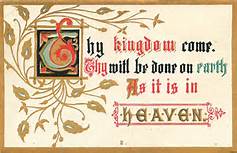
We have for our Scripture passage this morning a portion of the Lord’s Prayer from the Sermon on the Mount, Matthew 6.  This is one of the most familiar portions of the Bible. A huge multitude of Christians of a vast number of denominations and faith traditions know these words by heart. I ask again: what did our Lord Jesus mean when He said these words, “Thy kingdom come, thy will be done, on earth as it is in heaven.”

To be frank, this subject of the kingdom of God is something I have struggled with for decades. Yes, I now have some understanding of what Jesus meant here in the Gospel of Matthew. And yes, I will try to help us all to understand better what it was that Jesus was saying. And, why He wanted us to say—or pray—these words.

Jesus was considered a Rabbi, a teacher, by all who knew Him. He was learned in the Hebrew Scriptures, and must have been quite skilled in rabbinic discussion and debate. That’s why I think He knew all aspects of the Old Testament understandings of the Kingdom of God.

There are several aspects of the Kingdom of God. But, important: God created the world, and everything in it. (I think God took great joy in creation, too!) By default, everything and everyone is under God’s authority and power. So, yes. Everything is part of God’s kingdom.

However, something happened after God created everything. Sin happened. A cosmic rejection, rebellion and separation from God happened. As the Apostle Paul mentions in Romans 8, the whole creation has been groaning in agony ever since.

Let’s return to Madison Avenue, and advertising. Television commercials. I can see several young, smiling people, outside. Having fun. Maybe skiing, or hiking, or sailing. “Go for all the gusto you can!” says the voiceover, on a beer commercial. These young people are on the top of their game, not a care in the world. They are not even thinking of sin, rejection, rebellion and separation from God.

I want to tell you a secret. Well, not really a secret. The fallen world and the fallen people in this world do not want to acknowledge God at all. They are separated from any idea of following God’s life, light and love. From being a part of God’s kingdom.

This is a sad reality. Jesus knows it is. That is why Jesus tells us to pray this way. “Thy kingdom come.”  Yes, the whole world is separated from God. When we pray this prayer, Jesus wants us to commit to opening ourselves to God’s kingdom. We can help fulfill God’s kingdom in this world.

I found a fascinating bible study on the Lord’s Prayer online, released by the Salvation Army in Great Britain. When I examined this part of the study, it concentrated on another scripture passage from Luke 4. This section of Luke does not mention the Kingdom of God, but it might as well. This passage is where Jesus tells the people in the synagogue in His home town of Nazareth what His message is, in chapter 4. Jesus “found the place where it is written: 18 ‘The Spirit of the Lord is on me, because he has anointed me to proclaim good news to the poor. He has sent me to proclaim freedom for the prisoners and recovery of sight for the blind, to set the oppressed free, 19 to proclaim the year of the Lord’s favor.’”

This is Jesus’s Kingdom announcement! Remember, a few weeks ago, I spoke of where Jesus preaches His first sermon. It is quite a bit like political campaigns. The various candidates all try to have their position distilled down to a simple message. What they stand for. What they will strive to do. And, in both the Gospels of Matthew and of Luke, Jesus talks a lot about the Kingdom of God. What it means, and how Jesus expects to bring it. How Jesus wants His followers to bring the Kingdom themselves. Proclaim the Gospel. Share the Good News.

There are many, many commentaries, theological books, and bible studies written on this portion of Matthew, the Lord’s Prayer. The phrase we are looking at this week, “Thy kingdom come,” is considered to be a central phrase in this prayer. Some say the most important phrase. That would mean “the Kingdom announcement … is the focal point of Jesus’ entire ministry. This prayer, then, can only be understood in the light of how Jesus ‘lived the Kingdom’ while He was here on earth. Bringing the Kingdom of God to earth was Jesus’ great task.” [1]

Here is this message, this announcement of the Kingdom, again. Jesus teaches His followers to pray with a model prayer. The Lord’s Prayer. Just like Jesus does repeatedly in the Gospels when He preaches, Jesus proclaims the Kingdom in this model prayer—except He wants us to proclaim it, too! And, to do it. To bring the Kingdom in.

One thing I love about the Salvation Army: their emphasis on service, on proclaiming the Kingdom of God through concrete, hands-on means. Following their lead, we can “look at how Jesus lived His life, get involved in the things that He thought were important, and understand what Jesus meant by the term ‘Kingdom of God.’” [2] Bring relief to the poor. Visit those in jail. Heal those who are sick. Alleviate the suffering of those who are oppressed. That is what Jesus was saying in Luke 4.

With this week, we come to the end of our Summer Sermon Series from the United Church of Christ’s Statement of Mission. The last sentence of the statement: “Empowered by the Holy Spirit, we are called to discern and celebrate the present and coming reign of God.” (Or, the present and coming kingdom of God.)

God’s kingdom is here and now, and God’s kingdom is future tense. Like Jesus preached, God’s kingdom is among us, within us. We can share that kingdom with others, today. Plus, God’s kingdom is a future thing. At the end of all time, the fullness of God’s kingdom and glory will burst upon the whole world, the whole creation, in awesome majesty and glory.

What a series it has been! Each week, we have delved more deeply into each sentence of this mission statement. St. Luke’s Church was founded by this vital, missionary association of churches almost 70 years ago. Each week this summer, I hope we have discovered more about this wonderful denomination. It is my hope that we now see many connections where we can fit, and serve, and grow—as a local congregation, a fellowship of believers, and as a sister church in association with the great variety of churches in the Chicago Metropolitan Association.

God’s kingdom is here and now, and God’s kingdom is future tense, too. This is something to celebrate, like the Statement of Mission says! God is building God’s kingdom within each one of us now. It is our joy and privilege to share the Good News, to tell other people about Jesus and His love for each of us.

But, that is not all. By no means! The future part of God’s Kingdom is even better. I think most people here are familiar with George Frederick Handel and his oratorio Messiah.

The text for this chorus comes from our second reading today, from Revelation chapter 11. The Hallelujah Chorus from the end of the second part of the Handel’s oratorio Messiah says, “and He shall reign forever and ever. King of Kings, and Lord of Lords.” This is a joyous proclamation of the coming kingdom of our Lord.

Hallelujah! Hallelujah! Hallelujah!

[1]http://www.usc.salvationarmy.org/usc/prayer/24-7/24-7_UK_Bible_Studies..pdf

[2] Ibid.

@chaplaineliza

(Suggestion: visit me at my regular blog for 2016: matterofprayer: A Year of Everyday Prayers. #PursuePEACE – and my other blog,  A Year of Being Kind . Thanks!)

Unknown's avatar

Unity of Christ’s Church

“Unity of Christ’s Church”

Gal 3-28 all one in Christ

Galatians 3:26-29 – August 28, 2016

One of my sisters lives in the New York City area, on Long Island. She has lived there for more than twenty-five years. She is a wonderful, generous hostess, and often takes her family and friends to various places around New York, site-seeing. We love to visit my sister. When my children were younger, we went with my sister to the top of the Statue of Liberty—on two different occasions!

The Statue of Liberty. A beacon of light for generations. When my grandfather was a boy in the early 1900’s, he and his family emigrated to the United States from a shtetl in western Ukraine. He remembered standing on the deck of a steam ship from Europe, coming into New York harbor.  He gazed over the rail at the welcoming sight, along with everyone else on that ship. The Statue of Liberty was etched vividly into his memory. I know, because he told me so.

This country has been called a melting pot, containing different nationalities, cultures, and ethnicities. Some call this country a mosaic or a kaleidoscope of people. Whatever you call it, the United States is truly an amazing nation made up of a multitude of individuals (or, their ancestors) who came from all over the world.

Unity. Unity amidst diversity. That is what this country is all about.

Let’s take a second look at our Scripture passage for today from Galatians 3. The Apostle Paul writes to the believers in the region (or area) called Galatia in Asia Minor. He makes an all-important point at the end of chapter 3: our text for today. “26 So in Christ Jesus you are all children of God through faith, 27 for all of you who were baptized into Christ have clothed yourselves with Christ. 28 There is neither Jew nor Gentile, neither slave nor free, nor is there male and female, for you are all one in Christ Jesus.”

I think you all might suspect what the theme for today’s service is. Unity!

Just as our nation incorporates strong unity amidst wonderful diversity, so does the Church. Not only this congregation, this fellowship of believers, but I am talking about the Church Universal. The Church around the world.

Taking a closer look at verse 3:28, at first glance, we might focus on the differences. Wow! There are some pretty big differences here. Paul mentions some significant separations and divisions. Different categories. What does this diversity look like?

First, “there is no longer Jew nor Gentile.” That is a serious thing for the Apostle Paul to say. Before his conversion on the road to Damascus, Paul was a Hebrew of the Hebrews; a member of the Sanhedrin (that is, the ruling religious council of Jerusalem). A top-notch Pharisee who probably prided himself on his meticulous keeping of the Mosaic Law code, down to the smallest detail. Good, law-keeping, observant Jews of that time would not allow themselves to associate with, or even talk to a Gentile. So—after he became a Christian, we can see how serious Paul was about this unity of everyone, in Christ Jesus.

The second difference? “There is neither slave nor free.” Jesus Christ takes away all distinctions of social class and standing!

Wait a minute! That is not strictly true. In this troubled world, there are lots of differences, lots of separations in social hierarchy. In Morton Grove, we see many people who are solidly middle class. Different from wealthy people living on the Gold Coast, just off Michigan Avenue near the Water Tower. Go just a few miles further south, to the Englewood area of Chicago. I saw some of areas of extreme poverty when I visited there, earlier this month.

However, when people come to believe in Jesus Christ, social class and power can be dissolved, and go away. The unity of all believers is emphasized in this verse, again.

The third difference we notice? Paul mentions “nor is there male and female.”

Subtle difference! Yes, God created people male and female. Yet, when people come to faith in Christ Jesus, there is a new creation. All things are become new, as Paul tells us in 2 Corinthians 5. Even gender is given a back seat. Each person’s belief in Christ is emphasized in this new creation, differences are dissolved, and the unity of all believers is lifted up. We are all one big family.

Earlier in this letter, Paul mentions circumcision. That’s something that is very Jewish. And, very male. In the time before the common era, women and girls could not be considered full children of Abraham because they could not be circumcised. (For obvious reasons.) That was fully half of all religious people who could not fully participate in religious functions. Yet now, in this new creation in Christ Jesus, the old differences and distinctions no longer separate male and female. All things have become new.

Let me remind everyone of how earthshaking this all must have been for the Apostle Paul. Talk about having his entire worldview and frame of reference turned upside down! A good, observant Jew who studied with one of the leading rabbis of that day, now associating and eating with Gentiles. Staying in their homes. What a huge change of Paul’s way of thinking.

One big theme of the letter to the Galatians is that of identity. Who are we? What are our identity markers? How do we tell who others are, in our group? Paul says so, right here. Those who are baptized in Christ are children of God. Everyone who is baptized is our brother, our sister. That’s a whole lot of people, when we consider all the people who are believers, not only in the United States, but in the whole world!

I don’t know how many of you remember your own baptism, as infants and children. However, Paul is talking to people who were baptized as adults. The weeks beforehand must have been significant, too, in which these new believers were fully instructed and immersed in the understanding of Christ as their Messiah, their Lord and Savior. Then, often on Easter Sunday, the new believers were baptized. When possible, they were fully immersed, or at least had water poured over them in a large tub. Sometimes, naked, because they often would remove their clothing before the ceremony. After the baptism, they put on a new, white garment, signifying their new life in Christ. They were truly “clothed in Christ,” just as Paul says here.

As diverse and different as we are, considering world-wide Christianity, we all have become one humongous family of God. We are all God’s children.

How many of us, today, can say that? Yes, when babies and children are baptized today, we make a big fuss. We buy them special outfits for the occasion. But, do we truly take the new reality—this new identity—to heart? We have all been transformed, through Christ.

What a transformation! What an identity shift. We here at St. Luke’s Church are just as much God’s children as the Catholics worshipping at St. Martha’s Catholic Church south of Dempster. And, both groups of believers are just as much God’s children as those baptized at St. Haralambos Greek Orthodox Church on Caldwell. And, what about our friends at Love Sharing Disciple Church here, who will be worshipping in this sanctuary later today? This is duplicated at churches and auditoriums all over the Chicago area, with diverse ethnic and cultural groups of believers. We can enlarge that to a wide variation of church practices, all over the world. Wow! Double wow!

What a mosaic of identity in Christ. What a kaleidoscope of difference, made one huge family of God. Remember our sentence for the week, from the United Church of Christ Statement of Mission? Empowered by the Holy Spirit, we are called to embrace the unity of Christ’s church.”

The unity of Christ’s church, in such beautiful, rich, worldwide diversity. This is truly something to celebrate! Alleluia, amen.

[Thanks to Dr. Richard B. Hays for concepts and ideas from his commentary on Galatians 3, from The New Interpreter’s Bible Commentary (Nashville, TN: Abingdon Press, 1996).]

@chaplaineliza

(Suggestion: visit me at my regular blog for 2016: matterofprayer: A Year of Everyday Prayers. #PursuePEACE – and my other blog,  A Year of Being Kind . Thanks!)

Unknown's avatar

Justice, Healing, Wholeness

“Justice, Healing, Wholeness”

Eph 2-14 word cloud

Ephesians 2:14-17 – August 21, 2016

The Summer Olympics in Rio de Janeiro have been going on for two weeks. The Olympics has been a marvelous time of both competition and camaraderie, crossing international borders. I have not spent as much time as in years past watching the different competitions, but there have been some exciting and nail-biting times in these past weeks. Swimming and diving, gymnastics, track and field: the United States has won medals in these and many more. And yes, there have also been some scandalous things that happened, both on and off the field of play.

Scandals, quarreling, fighting, bombing. Attacks, sniping, terrorism, and even warfare. So often those are common events in the world today. Sadly, common, and sadly, robbing countries of their best and brightest young people.

From the time that I was little, I was drawn to the Olympic competitions not only for the sake of sport, but also for the sake of the Olympic values and traditions. The Olympic values strive to counteract those negative traits and actions I just mentioned. Pierre de Coubertin, the founder of the modern Olympic Games, wanted the Olympics to lift up the ideals of respect, fair balance, pursuit of excellence, joy in effort, and balance between mind, body and will. He held up these as the essential Olympic values. What wonderful ideals to reach for!

However, as faulty, error-filled people in this mixed-up world, we have a big problem. Sin gets in the way of these lofty ideals. Negative feelings like hatred, xenophobia, classism, separation of all kinds get in the way. Sin also includes the haves versus the have-nots, all over again, in a myriad of ways.

I would like us to switch gears and look at the Scripture passage for this morning from Ephesians 2. The Apostle Paul is in the middle of a very long paragraph about Jesus Christ and why He came to earth: “But now in Christ Jesus you who once were far away have been brought near by the blood of Christ. 14 For He Himself is our peace, who … has destroyed the barrier, the dividing wall of hostility; His purpose was to create in Himself one new humanity out of the two, thus making peace, 16 and in one body to reconcile both of them to God through the cross..”

As is typical with the Apostle Paul, he makes a complex argument and brings a whole bunch of ideas into play. But I want to highlight this central fact from Ephesians chapter 2. Humanity was once far away from God, made far away by our separation and sin. There was—and is still—a dividing wall of hostility. Hostility between us and God, and hostility between human beings. Hostility between individuals, neighborhoods, groups, nations, races, classes, and a whole host of other separations.

The Olympic ideals, values and tradition help in counteracting this hostility and separation between humanity. The United Church of Christ’s Statement of Mission helps to counteract this, too. I have been preaching through the Statement of Mission this summer. The sentence for this week states: Empowered by the Holy Spirit, we are called: to work for justice, healing, and wholeness of life.” Wonderful things to strive for! And, worthy ideals to shoot for, from the point of view of the Olympic ideals, or from a Christian framework.

Jesus Christ came to earth to reconcile us to God, to destroy that dividing wall of hostility, so that each of us could have healing and wholeness of life. Praise God! Alleluia! That involves our relationship with God. Our vertical relationship, which is so important. Jesus has done that for us. No longer separated and far away, we now have a relationship with God.

But, that is not the end of the story. No! God wants us to take the next step. God calls us to work for justice, healing and wholeness of life, not only for us individually, but for others as well. That is our mission, from the UCC Statement of Mission.

I spoke about this several weeks ago, when several moms from Morton Grove went to the south side of Chicago, into the Englewood neighborhood. Two of us went again this past Wednesday, to help serve at a dinner outreach to that community. We took this opportunity to reconnect with the good people in the Englewood neighborhood and show them that friends outside of their community care, and are concerned. Friends want to help them strengthen relationships, and bring peace into their streets. Their neighborhood. Their community.

By several of us going to the Englewood neighborhood, this was a concrete way of showing our love and caring for others. As a follower of Christ, it was and is my responsibility to work for justice, healing and wholeness of life. Not because I am a pastor, not because I am a leader of this congregation, but because I follow Christ and strive to do the things He did and to say the words He said. And most especially, I strive to love the way Jesus loves.

All of us are called to do that same thing. To follow Christ to the best of our ability.

Let me switch gears and talk about the Olympics again. I did have the opportunity to watch a bunch of races last week. My son and daughter got really excited about the men’s and women’s swimming. We were awestruck to watch Michael Phelps add to his haul of Olympic medals, plus all of the other American swimmers doing an outstanding job in the pool.

I also made note of Simone Manuel, who won two gold medals, one for the 100 meter freestyle and the other as a member of the 4 by 400 relay team. Ms. Manuel is one of the fastest swimmers on the planet today. She also happens to be African-American, the first black woman to medal for the United States in swimming. Ever.

Articles and news stories immediately proliferated on the Internet, television, newspaper and other forms of media. Yes, they all praised Ms. Manuel for her grand achievement. Yet, some of the longer articles told a different story. About how the history of swimming pools and racism are closely tied together in this country. About how “according to the Centers for Disease Control and prevention, in the United States, a black 11-year-old is 10 times as likely to drown in a swimming pool as a white 11-year-old. And as of 2010, around 70 percent of African-Americans said they couldn’t swim, compared with some 40 percent of white folks.” [1]

I quote from an article in Rolling Stone, “the fraught dynamics of segregation were fought within swimming pools as well. Often whites would shut down or avoid pools rather than have to intermingle with black people. There were legal battles fought throughout the 1950s over the access black people had to swimming pools and beaches that continued even after Brown v. the Board of Education and the idea that “separate but equal” facilities were deemed unconstitutional.” [2] A large percentage of American children having a likelihood of drowning. It doesn’t matter who, or what, or where. They are our country’s children. All of our children. And, this is a matter of justice—or, injustice.

This racist attitude is changing. Praise God! Plus, I am so happy for Simone Manuel and her two gold medals in swimming! This aspect of justice is something we all can do something about. And healing, and wholeness. Can you hear God calling? Calling to each of us? As the book of Isaiah says, “God will teach us His ways, so that we may walk in God’s paths.”

We can all look forward to God’s shalom, healing, peace, and wholeness, and verdant life. God wants us to try to communicate this Good News, work for justice, and do our best to spread healing and wholeness. To our friends, our neighbors, those we work with. Let us strive to live healing-filled lives, with God’s help. Alleluia, amen!

[1] http://www.npr.org/sections/codeswitch/2016/08/12/484841513/simone-manuel-wins-olympic-gold-thats-a-really-big-deal

[2] http://www.rollingstone.com/sports/simone-biles-and-simone-manuel-wins-impact-on-race-w434453

@chaplaineliza

(Suggestion: visit me at my regular blog for 2016: matterofprayer: A Year of Everyday Prayers. #PursuePEACE – and my other blog,  A Year of Being Kind . Thanks!)

Unknown's avatar

Struggle for Liberation

“Struggle for Liberation”

Isa 61-1 freedom, liberty word cloud

Isaiah 61:1-3 – August 14, 2016

Has anyone listened to the news? Or, read the newspaper lately? Or, checked out the headlines on their computer news sites? Other than the Olympics—which is some positive, uplifting news, indeed, and a much needed boost in this mixed-up world—there is very little positive going on in the world right now.

Bombings in Thailand, and wide-spread flooding in the Gulf Coast. Not to mention the violence in Milwaukee, poor economic forecast and drought-stricken areas covering large sections worldwide. Add to that, the rise in the prison population in the United States, complicated by the surge in unemployment in many urban areas across the country. Problem upon problem. What can we do about all of this? It makes me feel helpless, and hopeless.

Our Scripture passage from the Hebrew Bible comes from the book of Isaiah, chapter 61. As we read through the first two verses, we might just as well be reading the headlines from the daily paper or from a news site online, or listening to the news on the radio or television. Chapter 61 talks about the poor, those who are captive, brokenhearted, and those in prison. With one huge exception: the prophet has been chosen and anointed by the Lord to bring help and hope to those very people.

Reading from Isaiah 61 again: “The Spirit of the Sovereign Lord is on me, because the Lord has anointed me to proclaim good news to the poor. God has sent me to bind up the brokenhearted, to proclaim freedom for the captives and release from darkness for the prisoners, margto proclaim the year of the Lord’s favor.” Praise God! The Lord is listening to the poor, the brokenhearted, the captives and the prisoners!

The prophet knows very well he has been sent and deputized to go to these people who are down and out. On the outskirts, on the margins of society. In this world today, so many people are poor, and captive, and prisoners. Outside of this country, certainly. But, even within this country. I am certain there are many people on the outskirts and margins of society very near this church, in a two mile-radius all the way around St. Luke’s Church.

I am preaching through the United Church of Christ’s Statement of Mission for my summer sermon series. This week, our sentence from the mission statement says: “Empowered by the Holy Spirit, we are called: to join oppressed and troubled people in the struggle for liberation.”

This call from the statement of mission certainly echoes Isaiah 61. The prophet is clearly joining oppressed and troubled people. On the outskirts, on the margins of society.

Our Lord Jesus read this very passage from the prophet Isaiah when He started His ministry. Right after Jesus was baptized, He went to Nazareth. While in the synagogue, He was given the opportunity to read from Scripture. This was the passage Jesus read. After reading these verses, “20 Then He rolled up the scroll, gave it back to the attendant and sat down. The eyes of everyone in the synagogue were fastened on Him. 21 He began by saying to them, ‘Today this scripture is fulfilled in your hearing.’”

We have the prophet in the time of Isaiah sent to the poor, the oppressed, and the marginalized. We have our Lord Jesus saying—at the beginning of His ministry—that He has been sent to the poor, the oppressed, and the marginalized. And, we have the United Church of Christ’s Mission Statement saying that we—all of us—have been sent to the poor, the oppressed, and the marginalized.

Jesus chose to hang out with these “down and out” type people, deliberately.

In fact, Jesus was soundly criticized. In the Gospel of Mark, the religious leaders get all righteous on Jesus for hanging out and eating with tax collectors and other “sinners.” The super-righteous Pharisees would not even allow themselves to come near these second-class citizens! That’s how much better they considered themselves. But, our Lord Jesus willingly associated with these “sinners,” these people who according to religious law were ritually unclean.

Jesus came to earth to reach out to all people, to bring the good news of the Gospel to everyone. Jesus came to the tax collectors just as much as the Pharisees, to free all people from their spiritual bondage. To liberate all people, so that we could be free, indeed!

Isn’t that just what God has been doing, all along? All throughout biblical history, and throughout the history of the church? We can follow that thread of liberation through the Hebrew Scriptures, highlighted by the Exodus, where the Jewish people were freed from slavery in Egypt. A huge liberation, to be sure!

We can follow the additional freedoms from oppression and liberations from captivity stated in the Bible. The book of Judges has one after another. The books of the Kings of Judah and Israel, more periodic liberation. The return from captivity of both Judah and Israel. Then, the ultimate liberation from captivity—humanity’s freedom from the bondage to sin and death, paid for us by Jesus Christ and His death on the cross.

Praise God! We have been set free from this bondage of sin and death. The physical, mental, emotional and psychological shackles that kept us all bound as prisoners have been loosened. Thank You, Jesus! I am so very, very happy and grateful and thankful.

Jesus encourages us—each of us—to reach out in the same way. We are to reach out to the poor, the brokenhearted, the oppressed. That is our part, to offer this freedom from bondage to those we meet.

I know what some people might say. “I am just one person. The task is much, much too big. Plus, I haven’t been trained in mission, or evangelism, or chaplaincy, or how to preach.”

Let me tell you a story. A young girl was walking along a beach upon which thousands of starfish had been washed up during a terrible storm. When she came to each starfish, she would pick it up, and throw it back into the ocean. People watched her with amusement. She had been doing this for some time when a man approached her and said, “Little girl, why are you doing this? Look at this beach! You can’t save all these starfish. You can’t begin to make a difference!”

The girl seemed crushed, suddenly deflated. But after a few moments, she bent down, picked up another starfish, and hurled it as far as she could into the ocean. Then she looked up at the man and replied, “Well, I made a difference to that one!” [1]

Remember, our sentence from the mission statement says: “Empowered by the Holy Spirit, we are called: to join oppressed and troubled people in the struggle for liberation.” Exactly so. You and I can do what we are able. No matter how small or how big it might be.

What can I do? This task of freeing the starfish—I mean, people from the penalty of bondage and death? What can we do to join oppressed and troubled people, and sit with them in their time of need? Walk with them through their difficulties?

I know it seems like a small thing, but I go regularly to play for a hymn sing at a nursing home in Chicago. I know the seniors appreciate my playing. What about donating to the Maine Township food pantry? I know it seems small, but there are hungry people throughout the community who will thank us.

Let us follow the prophet, and follow our Lord Jesus in this worthy effort. Engage with others. Find something to do, or say, and do it!

Please God, help us all in this endeavor. Amen!

[1] Adapted from The Star Thrower by Loren C. Eiseley

@chaplaineliza

(Suggestion: visit me at my regular blog for 2016: matterofprayer: A Year of Everyday Prayers. #PursuePEACE – and my other blog,  A Year of Being Kind . Thanks!)


Unknown's avatar

Powerful, Living Word

“Powerful, Living Word”

Heb 4-12 alive and active

Hebrews 4:12-13 – August 7, 2016

Words have power. Well-written words paint pictures in our brains, lift our spirits, or tug at our heartstrings.

Think of the vivid quote from Shakespeare’s play The Tempest: “We are such stuff/As dreams are made on; and our little life/Is rounded with a sleep.” And, the stirring words of Abraham Lincoln’s Gettysburg Address: “Four score and seven years ago our fathers brought forth on this continent, a new nation, conceived in Liberty, and dedicated to the proposition that all men are created equal.” Or, the heartstring tugs from A.A. Milne’s book Winnie the Pooh: “How do you spell ‘love’?” – Piglet “You don’t spell it…you feel it.” – Pooh”

This service today is all about words. Some very special words. Powerful words. God’s words. The Word of God, the Bible.

Our passage for this morning comes from the letter to the Hebrews, chapter 4. Reading verse 4:12 again: “For the word of God is alive and active. Sharper than any double-edged sword, it penetrates even to dividing soul and spirit, joints and marrow; it judges the thoughts and attitudes of the heart.”

Those words are pretty powerful! Sharp, penetrating, dividing, judging. The Word of God has great penetrating power, piercing incisively. This is an everyday picture: imagine a butcher with a very large, very sharp knife, cutting down to the bone.

“The word of God is not just sharp, but sharper than the sharpest doubled edged sword. In that sense the word of God can cut either way—in judgement or blessing.” [1] Plus, God’s Word, the Bible, is filled with God’s Spirit. That is important, too!

We are taking a closer look at the United Church of Christ’s Statement of Mission. Today’s sentence is: Empowered by the Holy Spirit, we are called to preach and teach with the power of the living Word.

God’s words have been powerful since the beginning of time. And, even before. Think of the preincarnate Jesus, the eternal God the Son. The first chapter of the Gospel of John tells us “In the beginning was the Word, and the Word was with God, and the Word was God. He was with God in the beginning.” Jesus, the Logos, which is a Greek expression meaning “the Word.” He spoke, and the entire universe came into being. Jesus is equated with this powerful, living and active Word of God!

As a minister of the Gospel, it is my responsibility and joy to preach and teach the Word of God. To preach and teach the amazing, mighty, powerful, living Word. Yet, the Statement of Mission tells us plainly that we all—that is, everyone here—have that same responsibility.

Last Wednesday afternoon, I went with several people from Morton Grove to the south side of Chicago. My friend had been in touch with a mothers’ group called Mothers Against Senseless Killing (MASK). This group has a free meal outreach called Give Them a Meal.

The four of us went to the Englewood neighborhood of Chicago. What a wonderful opportunity for people to come together, to share, to have fellowship and make community. We set up everything so the free meal could be offered to anyone who came up to the street corner.

We were there for several hours. Yes, it was a marvelous afternoon. We were of service to that community. However, I wanted to let you know that just before I left, I had a wonderful conversation with the senior pastor of a Missionary Baptist church that set up an outdoor worship service on that same street corner.

Complete with sound system and moveable pulpit, that church has a regular outreach to their community each Wednesday evening. Pastor Matthew told me of the burden on his heart to disciple the members of his church. He strives to teach them to share their faith. Just as the UCC Statement of Mission says, “be ready to teach and preach with the power of the living Word.”

That’s what Pastor Matthew and his congregation strive to do, week in and week out! I am not particularly skilled in evangelism. That is one area where I fall short. I can learn lots from him and the members of his church. Plus, this sentence from our Statement of Mission tells us that teaching and preaching with the power of the living Word is something that every believer in Christ ought to be doing, on a regular basis.

There is a problem, though. We humans have shortcomings. We miss the mark in so many ways. As I was preaching last week, natural humans have deceitful hearts. We hide and run away. Our thoughts, words and actions are cloaked in darkness and sin.

Does this word picture sound sadly familiar? Throughout the Hebrew Scriptures, and then repeatedly in the New Testament, we see over and over again how natural humans keep tripping up. How we sin “in thought, word, and deed,” The second part of Hebrews 4:12 lets us know that God’s word “judges the thoughts and attitudes of the heart.” I think that all of us here today acknowledge that we humans do sin. Miss the mark. Make mistakes. Say stupid things.

There is a famous picture, or icon, of Jesus.  Jesus the Judge. We are all familiar with pictures of Jesus as the Good Shepherd, or Jesus with the little children. But here in these verses, we have a serious word-picture of the risen, exalted Jesus, Jesus the Judge. Yes, this is a very real part of our Lord Jesus, whom we know and love.

The other half of this pair of verses lets us know that “Nothing in all creation is hidden from God’s sight. Everything is uncovered and laid bare before the eyes of him to whom we must give account.” Words of caution! Words telling us to take care. As one commentator mentions, “the Word of God can probe the innermost motives of the real self and bring them out into the open, and then, with the self exposed to the light, prompt repentance and forgiveness.” [2]

Serious stuff, the Word of God! The Bible.

Still, we need to look at the words of the statement from the UCC Statement of Mission. “be ready to teach and preach with the power of the living Word.”

When it comes to everyone—all of us being ready to preach and teach, God offers us help. Isn’t that wonderful? God lets us know that we have God coming alongside of us. Helping, coaching, cheering us on as we tell others about the tremendous God we serve.

I have mentioned Miss Rose before. Miss Rose was a loving, caring senior from a church I attended some thirty years ago. Imagine my surprise and pleasure to find her one of the residents at the senior citizen home I worked at while I attended seminary! Miss Rose had the gift of evangelism. She would ask practically everyone, “Do you know the Lord?” Then, she would tell about the wonderful things God was doing in her life.

Miss Rose did not have an easy time at the retirement home. She was in constant pain, among other health issues. However, she did not let that stop her. Practically every person knew that God was Miss Rose’s Helper, Refuge, Strength. Shepherd. Healer.

Just in case anyone is wondering how to be “ready to teach and preach with the power of the living Word,” We can follow Miss Rose’s excellent example. Tell others what God is doing for you, right now. Tell others about the Holy Spirit’s power in your life. And, tell others about the amazing Word of God, the Logos, God the Son, Jesus!

What an opportunity! Tell others, like Miss Rose. Tell others about God’s power in your life, today. Alleluia, amen.

[1] http://www.lectionarystudies.com/sunday28be.html “The Word of God,”  Rev. Bryan Findlayson, Lectionary Bible Studies and Sermons, Pumpkin Cottage Ministry Resources.  

[2] http://www.lectionarystudies.com/sunday28be.html “The Word of God,”  Rev. Bryan Findlayson, Lectionary Bible Studies and Sermons, Pumpkin Cottage Ministry Resources.  

@chaplaineliza

(Suggestion: visit me at my regular blog for 2016: matterofprayer: A Year of Everyday Prayers. #PursuePEACE – and my other blog,  A Year of Being Kind . Thanks!)

Unknown's avatar

Repenting Hearts

“Repenting Hearts”

Jer 17-9 heart deceitful, script

Jeremiah 17:5-10 – July 31, 2016

I just came back from my study leave at the New Wilmington Mission Conference. Wonderful conference, again. (It always is!) I sat in bible class, and mission hour, and morning and evening meetings all week, learning about the marvelous ways believers are reaching out, locally and all over the world.

However, I also learned about many, many places in the world where believers are persecuted and in danger. Where the government has tight control, or where different groups are fighting. Where believers, especially church leaders, have been imprisoned, even killed. Countries like Syria, Egypt, South Sudan, Iraq; parts of Nepal, Pakistan, Indonesia, Thailand, and Vietnam. One of our bible passages for the morning is from Jeremiah 17. It tells us: “The heart is deceitful above all things and beyond cure. Who can understand it?”

Humans can be particularly inhuman, sometimes. Human hearts can be deceitful above all things, sometimes.

We are continuing with our summer sermon series from the United Church of Christ’s Statement of Mission. I am sad to say that the sentence of the week is: “Empowered by the Holy Spirit, we are called and commit ourselves: To repent our silence and complicity with the forces of chaos and death.”

Natural humans without God can be inhuman. They can treat each other abominably. Not only through evil deeds like fighting, destruction and war, but also through general chaos and death—just as our sentence of the week from the Statement of Mission says. Many people want power and control. Many people strive to maintain power and control at all costs. They trust in humans’ own strength, and Jeremiah says their hearts turn away from the Lord.

What an awful thing! To have people in control—police, mayor, other government officials—whose hearts are completely separated from God. These people are controlled by the forces of evil, of chaos and death, according to the prophet.

Yes, these verses contain poetic language about humanity. As one commentator says, “To ancient peoples, the heart was not only the center of emotions, feelings, moods and passions, but also of will and motive power for the limbs. The heart discerned good from evil; it was also the center of decision-making. Conversion to God’s ways took place in the heart. In verse 9, it is said to be where evil begins.” [1]

At the mission conference this week, we had a chance to put our words into action.  Interested people had the opportunity to sign a petition to request Secretary of State John Kerry to intercede on behalf of the people of South Sudan, and to allow humanitarian aid to come in to the regions of the country under conflict and war. That is a concrete way to come up against the forces of evil, of chaos and death, and to show the love of God in a tangible way.

Evil. Chaos. Death. Just what the sentence from the Statement of Mission for today says. Natural humans—humans without God—have deceitful hearts, hearts that turn from the Lord. Our scripture passage for today tells us: “That person will be like a bush in the wastelands; they will not see prosperity when it comes. They will dwell in the parched places of the desert, in a salt land where no one lives.”

Well, I am not a deceitful person, an evil person. I know God. In fact, God lives in my heart! Where can I go wrong?

One problem there: according to our Statement of Mission, we are to “repent our silence and complicity with the forces of chaos and death.”

You mean, being silent can be a problem? Maybe, even a sin? The statement tells all of us to repent. That certainly sounds like sin language. What is more, the statement mentions “all of us.” Not “some,” not “most,” but “all.”

            Albert Einstein said, ““If I were to remain silent, I’d be guilty of complicity.” Can anyone relate? Horrible things happen every day. People who live next door, or down the street, or other places nearby find themselves in a difficult situation. They can be seen as vulnerable. Observers can turn out to be ostriches, hiding their heads in the sand. Hoping against hope that the problems of domestic abuse and its connected trauma might just go away.  Or, when there is racial tension in your side of town, to do nothing. In fact, to say nothing, to look the other way, and to stand on the sidelines with your mouth shut.

            What is wrong with that picture? That kind of behavior telling us what the sentence from the Statement of Mission tells us. The deceitful people who actively do terrible things to others? Are they at all like the quiet people who shut their eyes to injustice, or pretend that violence, bitterness and inequity never happen…at least, not in my world. Not on my block. Not in my part of town. Something to think about.

            This past week, I had the joy of learning about mission aspects of the Lord’s Prayer from a coworker for the World Mission Initiative at Pittsburgh Theological Seminary, Rev. Jen Haddox. Yes, the Lord’s Prayer is prayed all over the world. In a multitude of languages, and numerous settings. This prayer can cross boundaries—just like believers. Believers can, with God’s help, cross the boundaries of unbelief and of chaos. Believers can bring the love of God into an evil and traumatic situation.

            Jen Haddox spoke about areas of Vietnam, where the government has tight control over everything—both everyday life in the villages and towns, and over the house churches and Christian leaders. And, some believers live in fear of government oppression and even prison. Yet, as Jen said, believers in Vietnam have a joy and a freedom that overcomes the forces of chaos and death.

            In both bible passages this morning, both passages give us the good news from God. Both passages have a compare and contrast section: natural humans, without God, and humans who strive to follow God. We can see what can happen when God intervenes.

Yes, we are empowered by the Holy Spirit, just as the Statement of Mission says. And, yes, we can pray for believers throughout the world, as well as in our backyard. We can pray for South Sudan, for Vietnam, for other areas of war and conflict. Remember, conflict and trauma can be anywhere. Not only physical conflict, but psychological and emotional, too. Here in the Morton Grove area, and in Chicago, as well as far away in large parts of Africa and Asia.

The prophet says: “But blessed is the one who trusts in the Lord, whose confidence is in Him.” We can bring that blessing to those under the forces of chaos and death. Yes, we need to repent our silence in the face of evil. We can tell God we are sorry for our silence, and strive to bring words of blessing and peace into situations of trauma and chaos.

What an opportunity to strive to become believers who transcend boundaries! Praise God for the chance to spread the love of God into lives of people near and far. Through prayer for faraway places, and through tangible means like food from the Maine Township food pantry for those who are nearby.

Won’t you join in the mission of God? Let’s all strive to pray, go, and do, in the name above all names, the name of Jesus. Alleluia, amen!

[1] Chris Haslam, Anglican Diocese of Montreal. http://montreal.anglican.org/comments/archive/cpr06m.shtml

Unknown's avatar

Confront Evil, Love Enemies

“Confront Evil, Love Enemies”

Luke 6-27 love your enemies

Luke 6:27-28 – July 17, 2016

This week in the news has been difficult, to say the least. Thinking of two situations: the truck rampage in Nice after the Bastille Day celebrations, and the attempted coup in Turkey. Horrific situations. The loss of life, the horror, grief and trauma. Localized in the case of Nice, France. Widespread, in several regions of the country in Turkey.

I know, as sure as I am standing before you today, that many people are traumatized. The deaths, hospitalizations, shootings. Not only affected and grieving people in localized areas, but people throughout the region. Maybe even the world.

I chose this particular passage a week ago to discuss our sentence of the week from the United Church of Christ Statement of Mission. This week’s sentence: “Empowered by the Holy Spirit, we are called to name and confront the powers of evil within and among us.”

I searched the Bible to find verses and passages which dealt with evil and confronting the powers of evil. Yes, I could have chosen verses by the Apostle Paul that dealt with powers and principalities, institutional evil and great wickedness. Or, I could have gone with generalities, and centered on sin. I can think of several passages from both the Old and New Testaments that deal with sin, both individual and corporate sin.

However, a week ago, I chose chapter 6 of the Gospel of Luke, where Jesus talks about enemies and how His followers ought to treat their enemies. This was before the attack in Nice, before the attempted coup in Turkey, and before the Black Lives Matter protests here in this country. Jesus had some pointed things to say about enemies. Some surprising things, too.

Karen read this passage to us, a few minutes ago. I will read verses 27 and 28 one more time, to let us hear the words of our Lord, again. 27 “But to you who are listening I say: Love your enemies, do good to those who hate you, 28 bless those who curse you, pray for those who mistreat you.” Another way of saying this comes in verse 31:  “Do to others as you would have them do to you.”

Wait a minute. Maybe, more than a minute. Enemies do bad things to us. They speak in mean and calculating ways, and sometimes act viciously, even heartlessly. Enemies are sometimes evil, through and through. That is exactly what our sentence of the week from the Statement of Mission talks about, too.

When I think of evil, sometimes I think about something that slithers or sneaks. Something that hides in the shadows, creeping along in the darkness. Occasionally, evil acts blatantly, coming right out in the open, swaggering around all over the place, like someone who curses and cusses a blue streak. But, I would like to concentrate on evil that sneaks around secretly, even unnoticed. Spreading its poison, insidious in its grasp.

What can we do in the face of this kind of evil? When these kinds of enemies continue to rise against us?  

These words of Jesus are challenging words. Some might say hard words. Even, impossible words. But, think about it. The whole focus of evil and of enemies is to get us to retaliate. To be just as evil in return, if not more so. “An eye for an eye only makes the whole world blind,” Gandhi said. What good is that to anyone?

Not only individuals, but groups also can be sucked right in. Groups—often with the tribal mentality—can be drawn into a cycle of evil, even violence. Is that what Jesus advocates here? What about when He says “Do to others as you would have them do to you?” What do you think He meant here? Did Jesus want us to retaliate and do evil acts? Say nasty and mean things? Or, did Jesus want us to try something radically different? Unusual? Counter-cultural?

I would like to tell you about a town in Denmark. Middle-sized town, generally peaceful and harmonious. Except, in 2012, the police received calls from a number of concerned people, including some parents. Several guys in their late teens or early twenties left their homes, their town, and all that was familiar, to go to Syria. To work for Muslim terrorists.

The two police officers, Aarslev and Link, are police specialists with a role in crime prevention. This article featuring them and their idea appeared Friday on the National Public Radio website. “They usually deal with locals who are drawn to right-wing extremism, or gangs. The landscape of global terrorism was completely new to them. But they decided to take it on. And once they did, they wound up creating an unusual — and unusually successful — approach to combating radicalization.”

“The rest of Europe came down hard on citizens who had traveled to Syria. France shut down mosques it suspected of harboring radicals. The U.K. declared citizens who had gone to help ISIS enemies of the state. Several countries threatened to take away their passports — a move formerly reserved for convicted traitors.”

“But the Danish police officers took a different approach: They made it clear to citizens of Denmark who had traveled to Syria that they were welcome to come home, and that when they did, they would receive help with going back to school, finding an apartment, meeting with a psychiatrist or a mentor, or whatever they needed to fully integrate back into society.”

“Their program came to be known as the ‘Aarhus model.’” [1]

This program, this way of treating enemies reminds me a lot of Jesus. Let us listen to our Lord’s words from Luke 6, again. “27 “But to you who are listening I say: Love your enemies, do good to those who hate you, 28 bless those who curse you, pray for those who mistreat you.”

Isn’t this knowingly being kind to those who wish to do us harm? Who hate us, curse us, and wish to mistreat us? Correct me if I am off base, but I think these police officers are very much following the commands of Jesus.

These are challenging words which we find in Luke 6:27-36. I suggest re-reading this passage with an open mind and open spirit, and then ask yourselves (and myself, too—I always preach to myself, as well!), “What would Jesus do?”

As Father John Dear says, “Jesus wants us to break the downward cycle of violence by refusing to practice further violence. Violence in response to violence will only lead to further violence, he teaches, so do not retaliate with further violence. Break the chain of violence.”

Father Dear goes on to say, “Does that mean sitting back and do nothing in the face of violence? No, quite the contrary. Jesus also forbids passive resignation or indifference to evil. Instead, he demands an active, creative nonviolent response that will disarm our violent opponent without using their violent means… Through our nonviolent resistance, we insist on the truth of our common humanity, until… he repents of his violence and agrees to treat us with respect as human beings.” [2] As the Hutu and Tutsi tribes reconciled in Rwanda, as whole groups of people of all colors, classes and races reconciled in South Africa.

Is it difficult to follow the commands of Jesus? YES. Yet, I strive to do this very thing. Imperfectly, yet I strive on. I remember the words of Abraham Lincoln: “Do I not destroy my enemies when I make them my friends?”

I invite us all to seek the ways of Jesus, and search out an active, creative nonviolent response to evil, to enemies, and to violence. Will you join with me in striving to follow Jesus, today?

@chaplaineliza

(Suggestion: visit me at my regular blog for 2016: matterofprayer: A Year of Everyday Prayers. and my other blog,  A Year of Being Kind . Thanks!)

[1] http://www.npr.org/sections/health-shots/2016/07/15/485900076/how-a-danish-town-helped-young-muslims-turn-away-from-isis

[2] http://www.huffingtonpost.com/john-dear/an-eye-for-an-eye-makes-t_b_8647348.html

Unknown's avatar

Hear Creation’s Cry

“Hear Creation’s Cry”

Psalm 24-1 creation picture

Psalm 24:1-2 – July 10, 2016

Have you ever had a family member, or a friend, go out of town? Or how about go on vacation? Your friend, your family member, asks you to take care of something of theirs. It may be a dog or cat, sometimes houseplants indoors or a garden outside. Asking you to be a good steward for them. Taking good care, being responsible for your friend’s property. That includes all the stuff in your friend’s house or apartment, all their valuables and beloved possessions.

Let’s go on a tour of Scripture today. Think about the earth God created. Creation is the handiwork of a loving God who saw all that was made and in Genesis pronounced it “very good.” Scripture tells us that God delights in creation and creation delights in praising the creator.  A great example is Psalm 150:6. “Let everything that breathes praise the Lord!”

One of the oldest forms of expression of Christianity today is Celtic Christianity. Coming from the British Isles, it carries within it the deeply Celtic understanding that nature itself is a testament to God. One of the Celtic holy men, Saint Columbanus once said, “If you want to know God, first get to know his creation.” [1]

That is exactly the case with the earth, the world, today. The earth belongs to the Lord. God created it—all of it. The dogs, the cats, the other animals, things that swim in the water and fly in the air. All the plants, and trees, and other growing things. All the valuable things on the earth and underground.

God wants us, expects us human beings to be good stewards of the earth, to take excellent care of it, nurturing it, loving it. Exactly how you’d expect someone to take care of your dog or cat while you were away on an extended vacation.

Let’s look at the UCC Statement of Mission. Which sentence are we on this week?

“Empowered by the Holy Spirit … To hear and give voice to creation’s cry for justice and peace.” We are to listen and respond to this wonderful gift God has given to all of us.

Our next stops on our tour of Scripture are the books of Genesis and Numbers.  We have seen that God has given humankind a special responsibility to care for creation. Genesis 2:15 says the Lord God took humanity and put them in the garden of Eden to till it and to keep it. A form of the Hebrew verb “shamar,” meaning “to keep,” is also used in Aaron’s blessing from Numbers 6:24. Lacey closes our services playing Lutkin’s arrangement of that blessing each week as Al extinguishes the candles. “The Lord bless you and keep you.”

We are not only to nurture, sustain and care for creation, but we are to follow God’s example. We can see how God nurtures, sustains and cares for us—each one of us. This interconnected aspect of creation helps all of us remain aware of the joys and concerns encountered in the world around us, and of their impact on all of our lives each day.

However, there is a problem. A huge problem.

Our relationship with God, with each other and with creation are all part of the same multi-colored fabric. Pull any one thread and the whole piece begins to unravel. Human selfishness, ignorance, fear and mistrust have ecological consequences. Add some territorial urges, and feelings of animosity and xenophobia. A basic name for all of this is sin.

The Bible is not hesitant to make connections between human sinfulness and the degradation of creation. Two telling examples come to us from the prophets Isaiah and Hosea.  “The Earth lies polluted under its inhabitants; for they have transgressed laws, violated the statutes, broken the everlasting covenant” (Isaiah 24: 5). “There is no faithfulness or loyalty, and no knowledge of God in the land. . . . Therefore the land mourns . . . even the fish of the sea are perishing” (Hosea 4: 1-3).

What is to be done? People will not stop being selfish, or territorial, or fearful, or displaying hatred. But it’s also much bigger than that. Going clear back to the fall, to Adam and Eve’s disobedience in the garden, we learn that broken relationships are costly.  Lord, who will deliver us from this horrible state of sin?

We could throw up our hands, and say that saving the world is a lost cause. The earth is too far gone. The scales have been tipped, and it’s all downhill from here. But—it is not true!

When all else seems totally dark, God steps in.

I have talked about this before. Remember? God the Son became incarnate in Jesus Christ. He was born as a baby in Bethlehem. Jesus became part of the “stuff” of creation to heal and restore the relationships broken by human sinfulness.

The apostle Paul tells us “God was in Christ reconciling the world” (2 Corinthians 5:19). An early hymn praises Jesus Christ, the firstborn of creation, the firstborn from the dead, through whom God was pleased to reconcile all things, whether on Earth or in heaven (Colossians 1:15-20). The resurrection of Jesus Christ, God’s great victory over sin and death, is a pledge and sign not only of our resurrection, but also of God’s promised redemption of all creation.

Can I hear an “Amen” for that? Jesus and His resurrection means that we will be redeemed, just like creation. Just like the world will be. We all have had experience with God and how incredibly stunning this creation is, right now.

However, let me remind you. Andy Wade tells us something so important: “God’s creation is not somehow separate from God’s plan of redemption. When we forget that God’s very good creation also gives testimony to God, we can begin to think that it’s ours to trample on, ours to exploit, and ours to use for our own selfish purposes.” [2]

This selfish, self-centered kind of attitude and way of dealing with the wonders of creation and the great gift God has blessed us with? Thank God that God has made a way for creation to be made new, just as much as God has made a way for us to be made new!

The next question is simple: what is the next step? Where do we go after realizing God has plans to make all of creation new?

We as followers of Christ are called to witness to the resurrection of Jesus Christ. In our words and actions we are called to reflect the love of the one whose victory over sin and death was a victory for the whole of creation.

It is all very well to simply talk about being a witness. But, how can we do that, right here and right now? I’m glad you asked.

Some years ago, Solana Beach Presbyterian Church, near San Diego, received one of six “2000 Energy Star for Congregations Awards” from the US EPA. Following an energy audit, the congregation invested in energy-saving measures, including new lighting fixtures and energy-efficient light bulbs. The Solana Beach Church witnesses to Christ’s redeeming power every time they turn on the lights!

Just like this church! We can praise God that Kids Academy got all of the light bulbs in St. Luke’s Church building changed to energy efficient light bulbs. This is a wonderful start! Every time anyone here turns on the lights, we, too, can witness to Christ’s redeeming power.

Let’s not stop here. Let’s continue to keep looking for ways to hear creation’s cry, and to respond in loving ways. Ways to witness to the world around us that we are striving to be good stewards. Ways to celebrate God’s goodness, too. Alleluia, amen!

@chaplaineliza

(Suggestion: visit me at my regular blog for 2016: matterofprayer: A Year of Everyday Prayers. and my other blog,  A Year of Being Kind . Thanks!)

My sincere thanks goes to the National Council of Churches’ great resources. I borrowed liberally from the Earth Day 2001 Sermon Notes and Worship Resources.

http://web.archive.org/web/20110706140053/http://www.nccecojustice.org/earthday/PastEarthDayResources.php


[1] http://godspace-msa.com/2016/07/07/creations-sacrifice-gives-testimony-to-god/

[2] http://godspace-msa.com/2016/07/07/creations-sacrifice-gives-testimony-to-god/

Unknown's avatar

Embody God’s Love

“Embody God’s Love”

John 13-34 love one another, swirls

John 13:34-35 – July 3, 2016

Have you ever seen the following scenario playing out? In a friend’s life, in a relative’s life, or perhaps on television or the movies? Two teens or young people bicker or argue, sometimes even coming to blows. A teacher or a supervisor or a coach steps in, and urges the two people to face each other, say they are sorry, and then shake hands. Then, sometimes, the relationship is repaired, even better than it was before. (At least, that is the hope.)

How often do we see the disciples of Jesus bickering? Arguing? I would not be surprised if—every once in a while—one or two of them even came to blows. Then, Jesus would have to take that adult or parental role. Encouraging His disciples to come together in relationship, in friendship, in His gentle yet firm way.

Here’s the situation. Here we are again in that Passion Week, the last week our Lord Jesus spent here on earth as a human. Jesus entered Jerusalem on Palm Sunday, and went to a number of places with His friends that were particularly public. Out in the open. Jesus made no secret of being in Jerusalem for the Passover holiday.

Our scripture reading for today is set on this last evening. The last supper, that Passover dinner Jesus shared with His disciples. And here, in the Gospel of John, Jesus gives them some final instructions, as we can tell from this reading today. I’ll start in John 13:33. “My children, I will be with you only a little longer. You will look for me, and just as I told the Jews, so I tell you now: Where I am going, you cannot come.”

Jesus is preparing the disciples—as best as He can—for the horrors and agony of the next twenty-four hours, and beyond. It’s true. There is a lot going on in this Passion Week, and Jesus and His disciples are still in the Upper Room. (The events of later that Thursday night and on Friday still have not happened yet.) Our Lord has some extremely important information to communicate in John 13:34. “A new command I give you: Love one another. As I have loved you, so you must love one another.”

This is that Passover dinner where Jesus just got done washing His disciples’ feet. “As I have loved you—served you—wholeheartedly—so you must love one another.”

Problem: Jesus’s disciples must have been distracted. Fearful, anxious, forgetful. Perhaps their nerves were frayed. Tempers flared. Some might not have been able to concentrate fully on Jesus and His words, with all the tumultuous events swirling around. It’s true, many factors contributed to a fearful, anxious time. The possibility of hostile soldiers knocking at the door at any time of the day or night must have been only one of these fear-producing factors.

Jesus had a huge amount of things to contend with, too. However, here in John 13, we see Jesus once again demonstrating His never-ending love.

He shows huge love to these same guys who will fail Him, and fail miserably! Commentator Elisabeth Johnson said, “Jesus washes and feeds Judas who will betray him, Peter who will deny him, and all the rest who will fail to stand by him in his hour of greatest distress. The love that Jesus demonstrates is certainly not based on the merit of the recipients, and Jesus commands his disciples to love others in the same way.” [1]

Jesus is not referring to showing love to strangers outside of the church here. (Jesus talks about that in several other places.) He’s meaning our fellow church members! Brothers and sisters in the faith. Showing love, friendship, fellowship to those we worship with.

I am certain we all can tell horror stories about a church torn apart by arguments, or jealousy, or friction, or hurt feelings.

What about disagreements about church meetings or the color of the church carpet or Sunday service or the new pastor or the old pastor or the church music? Pro or con, big or little, one way or the other. Such disagreements and arguments are not the way to carry out this important command of Jesus.

Let’s change gears and take a look at the topic for our Summer Sermon Series, the UCC Statement of Mission. What is the section for this week? As I turn to it, I find: “Empowered by the Holy Spirit, we are called and commit ourselves: To embody God’s Love for all people.” I will repeat that last part: “To embody God’s Love for all people.”

I chose these verses from the Gospel of John to illustrate this important part of the Statement of Mission. We are not only to show God’s Love to others, but we are to strive to embody God’s Love. Go above and beyond.

My first thought was, What on earth does “embody” mean? A great place to start is close to home, and this—St. Luke’s Church, our local church—is our church family. Our church home. We are able to show others God’s Love through genuine, earnest, wholehearted, servant-love towards each other in the church.

Now is a good time to look at verse 13:35: “By this everyone will know that you are My disciples, if you love one another.” Did everyone hear? Jesus is telling us to love one another. That means to get along with one another, not bicker and argue and fuss with each other. What better way to let everyone outside of the church know that we love one another—to be genuine and pleasant to each other, to care for each other, to go out of our way for each other.

This is for real. Not pretending, not putting on a false face. For real.

How many of us know someone who gossips about other people in their church? I am not talking about anyone in this church, mind you. But I know we all know people in other churches. What about someone who is mean to other people in their church? Or, someone who ignores others, or is openly disrespectful, or even goes around trying to stir up trouble for others in their church? I know these awful things go on at churches all across the country, every day.

Would it be different if we tried things the way Jesus wanted us to do? What if we loved others? Could we strive to embody the love of Jesus? Show His love to everyone we meet, and especially in the church? What kind of witness would that be to people outside of our church? Wouldn’t they be curious about St. Luke’s Church?

“I wonder what is happening at that church? What gives? What kind of preaching is going on there? Those people really show each other that they love and care for each other. I’d like to find out more about that church!”
One of the commentators I respect has an article on just this subject. I quote from John Pavlovitz: “As a Christian, Love is the only acceptable legacy I care to leave the world; not Love covered in doctrine, not Love couched in religion, not Love loaded down with caveats and conditions; just the beautifully potent thing itself, distilled down to its essence and delivered directly to people as honestly and purely as I can.

“And let’s not kid ourselves, most people know when they’re really being loved and when they been handed a lousy imitation with the same name—especially when it comes to religious people. I’ve come to believe that if someone’s color, gender, religion, ethnicity, or sexual orientation keeps you from fully loving them, you’re probably doing Love wrong.” [2]

Thank you, John. Loving others in Jesus’s way is what we are commanded to do, what we have been called to do. Yes, we can celebrate Jesus and His love for us! And, we can take the next step—the step He commands.

Love one another. No fooling. For real.

Alleluia! Amen.

[1] Commentary, John 13:31-35, Elisabeth Johnson, Preaching This Week, WorkingPreacher.org, 2016. http://www.workingpreacher.org/preaching.aspx?commentary_id=2830

[2] http://johnpavlovitz.com/2015/09/18/i-want-to-do-love-right/?utm_campaign=coschedule&utm_source=twitter&utm_medium=johnpavlovitz

@chaplaineliza

(Suggestion: visit me at my regular blog for 2016: matterofprayer: A Year of Everyday Prayers. and my other blog,  A Year of Being Kind . Thanks!)