Unknown's avatar

With Thanksgiving

“With Thanksgiving”

phil-4-6-dont-be-anxious-pray-instead

Philippians 4:4-7 (4:6) – November 20, 2016

It’s that thankful time of the year, and this service is where we all gather to say “thank You” to God. We say thanks for all sorts of good things. Wonderful gifts. Exciting opportunities. We gladly come before God and mention how thankful each of us is—to God.

One of my favorite biblical websites (and, I fully consider her a bible commentator) is “Worshiping with Children,” written by Carolyn C. Brown. This is what she had to say about Thanksgiving: “One of my favourite times with the children was the year we learned how to say “Thank you” in many languages from our congregation, and ended by using those words for our prayer together.” [1]

Saying “thank you.” I know I taught my children how to say “thank you” when they received gifts, and compliments, and lots of other things. It’s a common thing, for grown-ups, parents, and grandparents to instruct children in these considerate, valuable, and grateful words.

Our scripture passage for the morning comes from the letter of the Apostle Paul to the church in Philippi, in the last chapter. Paul previously said what he wanted to say in the body of the letter, and this is the final few paragraphs. What we have here are closing remarks. And, what remarks! Reading verse 4:6 again: “Do not worry about anything, but in everything by prayer and supplication with thanksgiving let your requests be made known to God.”

This letter Paul wrote to the Philippian church was, in part, a thank you letter. We can see how Paul weaves thankfulness and gratitude in several parts of this letter, including right here. Except—he throws in a number of last-minute recommendations and commands, too. Paul mentions worry, right up front. “Do not worry about anything.”

How can worry affect us? True, it can be so difficult to follow Paul’s advice! Everyone has something to worry about. Some people have lots of things to worry about, it seems. Let’s take a closer look, and see what the background to this advice is.

When Paul wrote this letter, he wrote it from prison in Rome. He had been sent to the emperor’s court on a capital charge. He was on trial for his life. And yet—the apostle Paul writes this joyful, thankful, gratitude-filled letter.

Let us count off difficulties and challenges that Paul faced: not only the upcoming trial—for his life, but on top of that, Paul considered himself to be responsible for many of the churches he had planted on his missionary trips in Asia Minor and throughout Greece. Such heavy burdens on Paul. Yet, here in chapter 4 we see him writing almost blithely to the Philippian believers.

When we look at the people who were on the receiving end of this correspondence, few of them were living comfortable lives. One of the commentaries I consulted said, “Many were poor, many were slaves and few of them would have known the meaning of security. In marked contrast, those of us who live in comparative wealth and luxury today are frequently those who are most worried and anxious.” [2]

Isn’t that a true description of us, today?

Sometimes there IS stuff to worry about! A lot of times, people (yes, even Christians) worry about all kinds of stuff! Aren’t we tempted to be worried and anxious when finances are a challenge or the car is giving big problems? Or, how about when we or one of our loved ones is unemployed? Or, in the hospital or dealing with a chronic illness? What about in an accident, or even in jail? Some would say it is natural, even part of the human condition to be worried.

Something to think about, certainly. Especially at this grateful, thankful time of the year when we are encouraged to count our blessings.

Let’s look at the next part of this verse, the part that comes after Paul tells us not to worry: “but in everything by prayer and supplication with thanksgiving let your requests be made known to God.”

Sometimes it can be extremely difficult to pray and request with thanksgiving. Sometimes exterior circumstances can make things such a challenge for us to be thankful. There are even worse things: sometimes people can be absolutely at the end of themselves, spiritually and emotionally. Look at people like Paul, when we consider him in prison, on trial for his life.

From a commentator comes this challenging illustration about Corrie ten Boom, a devout Christian who hid and saved dozens of Jews from the Nazis: “Imagine how difficult it was to pray and worship with thanksgiving in a concentration camp in Germany. ‘Corrie ten Boon’s memory of leading forbidden worship in a World War II concentration camp might shed some light for us. Almost crushed by the effort of offering praise amidst wretched, flea-infested, frigid surroundings, they worshiped God.  Always fearful of discovery and punishment, they lifted whispered prayers of thanksgiving not only for the beloved community in that unholy place but also for the hardships they helped each other bear.

‘Months passed as their cherished worship continued uninterrupted by the usually brutal guards, offering encouragement to their battered spirits. Decades later, Corrie encountered a former prison guard who admitted he had never ventured into her barrack because he feared the overwhelming flea infestation. God was indeed in that place, utilizing every means to bless those worshipers.’” [3]

If we “don’t worry,” and do the “requesting with thanksgiving” part, what happens then?

God’s peace will then guard our hearts and minds.

Yes, it can be a challenge to make our requests, and to pray with thanksgiving. Especially when we give thanks “while staring down hatred, injustice, poverty or sadness. It may strain our faithfulness. Discerning God’s love while receiving cancer treatments, caring for a critically ill loved one or agonizing over a wayward child may challenge our belief.” [4]

Yet, we have Paul’s testimony that—even though he was locked away in prison for a capital offence—he could still write this joy-filled, thankful letter to the Philippian believers. And, Paul reminds his listeners that there is a wonderful result of laying out our cares to God. “God’s peace, which is more wonderful than anyone can imagine, will stand guard over our hearts and minds. While we are still vulnerable, we are also assured of God’s concern and protection.” [5]

What a promise. God personally grants us peace. God has promised to stand like a sentinel over our hearts and minds. Yes, things can be difficult, and challenging, even heart-wrenching,  yet Paul reminds us: be thankful.

These thankful words came from Paul, and they are for believers all over the world. It does not matter who we are; we all are encouraged to say “thank you.” It doesn’t matter where on earth people are from, or what language they speak. We all can use these words for our prayer together: Dear God, thank you for Your good gifts. Merci. Danke. Sheh-sheh. Molte grazie! In Jesus’ precious, powerful name we give thanks, amen.

[1] http://worshipingwithchildren.blogspot.com/2013/09/year-c-thanksgiving-day-october-14-2013.html

[2] Hooker, Morna D., The New Interpreter’s Bible Commentary (Vol. 12,The Letter to the Philippians), (Nashville, TN: Abingdon Press, 2000), 547-48.

[3] https://fosteringyourfaith.wordpress.com/author/econgregtnl/

[4] https://fosteringyourfaith.wordpress.com/author/econgregtnl/

[5] http://www.workingpreacher.org/preaching.aspx?commentary_id=470  Commentary, Philippians 4:4-7, Michael Joseph Brown, Preaching This Week, WorkingPreacher.org, 2009.

@chaplaineliza

(Suggestion: visit me at my regular blog for 2016: matterofprayer: A Year of Everyday Prayers. #PursuePEACE – and my other blog,  A Year of Being Kind . Thanks!)

Unknown's avatar

Every Blessing in Abundance

“Every Blessing in Abundance”

2-cor-9-7-thanksgiving-word-cloud

2 Corinthians 9:7-12 (9:8) – November 13, 2016

At this thanksgiving time of the year, people are more liberal with their donations. Soon the Salvation Army kettles will be out in front of stores and supermarkets, and we will hear the ding dong of bell ringers asking for gifts. The food pantries and clothes closets appreciate extra donations, and all manner of other charities will receive additional gifts, too. The holidays are a time to give liberally to all kinds of organizations and charitable institutions.

This brings me to our Scripture passage for today. This giving time of the year reminds us of what Paul wrote to the church in Corinth. In the paragraphs before today’s reading in chapter 9, Paul asks for a collection to be gathered together. This collection of money is to be given to the persecuted, needy church in Jerusalem.

It’s then Paul tells more about giving, in general. How to give, and why. How not to give, too. People have all kinds of reasons to give: giving to provide for others, in a righteous kind of way. Giving to help others, in a loving way. Or, giving out of obligation, in a grudging way. There are many different kinds of ways to give, and attitudes to have while we contribute. The Apostle Paul talks about a few of them in this reading today.

God loves a cheerful giver. Paul says so! In the verses just before today’s passage, Paul praises the believers in Corinth for such a bountiful gift for the persecuted church in Jerusalem. So generous! They understood why the money was needed, certainly.

We have a proverb of Paul’s day included here, in our first verse: “the one who sows sparingly will also reap sparingly, and the one who sows bountifully will also reap bountifully.” Here Paul is including a common saying of the day to illustrate his point. Talking about bounty, about being generous, and about grudging giving—being stingy.

What is all this about sowing and reaping? To us, in a 21st century, urban context, most of us are not very familiar with planting and harvest, sowing and reaping illustrations. Some are—those of us who have green thumbs, plant lovely gardens, and reap a bountiful harvest. You will more easily understand what Paul is saying here.

We have it in a little different fashion, a verse later. Each of you must give as you have made up your mind, not reluctantly or under compulsion.”

Let me give an illustration. Better than that, let me show you what Paul is talking about here. I have some bookmarks with 2 Corinthians 9:7 printed on them. I will take the liberty of passing them out.

(I pass out the bookmarks, first, reluctantly. With a somber face, not looking people in the eye, sighing, rolling my eyes, and not very pleased to be giving out bookmarks at all. Halfway through, I change my demeanor. I pass out bookmarks with a cheerful smile, with a happy attitude, and wishing people the best as I give them bookmarks.)

Did anyone notice a difference? What was that difference?

Was I a reluctant giver of the bookmarks, at first? “I can’t believe I have to do this.” And “I wonder whether I can leave soon?” Rolling my eyes, and sighing. I did not show a very good attitude, at all!

How about the second half of the bookmarks? The second half of my giving? How was that? Was I a cheerful giver? Was I kind and welcoming?

How did you feel receiving the bookmark from a reluctant giver? How about the cheerful giver? Which kind of giver would you prefer? Which kind of giver do you think God prefers?

We will read this verse once more: “Each of you must give as you have made up your mind, not reluctantly or under compulsion, for God loves a cheerful giver.” These are wise words from the Apostle Paul. This giving cannot be done reluctantly, or under compulsion, because then it isn’t for real. The reluctant giving is grudging. Out of obligation, and a heavy, unpleasant responsibility.

Paul would tell us, “No! That isn’t that way God wants you to give!” Instead, we are to give in cheerfulness, with joy in our hearts. We are to give freely and positively. God will love us for that positive, cheerful attitude. What is more, the whole action and the whole feeling of the heart will then be framed by love. God’s love! God will express love toward us, and each of us will express love toward our fellow people in need. And, whomever else we need to give to.

But, wait! There is more! Paul goes on to talk about what more God will do. If we have this generous attitude towards giving, being open-handed, positive and cheerful, then God will bless us abundantly with every blessing.

You can kind of see this from the way the sentence is translated into English, but Paul is making sure his readers know that God will absolutely, abundantly provide. God will certainly multiply all with great abundance. If we have generous attitudes, God will provide every increase, so that we will abound in every good work.

Let me caution everyone here. God is not talking about purchasing salvation. That is not even being discussed. We are saved already.

We have been justified by God, and we are now and always God’s children, beloved and cherished. However—as we know from our own children, beloved children are not always cheerful and generous. That is just Paul’s point here!

God wants us to live abundant lives. God wants us to be kind and cheerful and generous. God wants us to be abundantly blessed, and have heavenly gifts rain on our heads. What is the hinge, here? Giving. If we have a kind, cheerful and generous attitude towards giving, God is essentially giving us a high five!

We will live abundant lives, blessed and enriched in every way.

What a marvelous promise. What wonderful words. And, this is not “maybe,” or “I hope so,” but it is a blessed promise from God! This is not only for our gifts of treasure, for our gifts of money. But, this blessing is for our gifts of time and of talents, as well.

For the person who comes and volunteers on Sunday mornings to start the coffee, stuff the bulletins in the hymnals, or turns on the lights in the sanctuary and lights the candles—thank you, so much. For the person who bakes a cake or makes a table decoration or repairs the church building—thank you. Those are the gifts of time and of talent, and God is so pleased with that. All of those things, and many, many more.

Paul’s final words from this reading today: “11 You will be enriched in every way for your great generosity, which will produce thanksgiving to God through us; 12 for the rendering of this ministry not only supplies the needs of the saints but also overflows with many thanksgivings to God.” See? Our cheerful, generous giving supplies the needs of the saints. The needs of the local church.

We end as we begin, with thanksgiving. Thanksgiving to our fellow church members, to our friends and neighbors, and ultimately, to God. Thanks be to God for God’s abundant blessings. And, thanks be to God for the indescribable gift of salvation.

Alleluia, amen!

(Thanks to Pam Auble and http://www.ucc.org/oghs_resources_2013-resources_activities for the excellent suggestion of a reluctant giver and a cheerful giver.)

Unknown's avatar

Riches of God’s Inheritance

“Riches of God’s Inheritance”

eph-1-18-riches-of-heart-paul

Ephesians 1:1-2, 15-19 (1:18) – November 6, 2016

It’s All Saints’ Sunday! The day set apart to commemorate all the saints. Not only the living saints of today, but all the saints, all those who have ever believed in God, for all time.

Who is a saint, anyhow? We have the Apostle Paul. He is called a saint by many streams of Christian faith and tradition, and has been known as one for hundreds and hundreds of years. A powerhouse of a believer, that’s to be sure! What about St. Luke, who our church is named after? The only Gentile to author books in our Bible, and a learned man. A doctor. He certainly is lifted up as a prime example of faith in our Lord.

But that was centuries ago. Who do we lift up as saints today? Mother Theresa was just declared a saint by Pope Francis several months ago. Her example as the founder of the order the Missionaries of Charity, and her piety and good works are definitely something for all of us to emulate. What about on the Protestant side of the aisle? Some would say people like Martin Luther King Jr. ought to be lifted up, who did so much to promote the worth and position of people of color, of women and of downtrodden individuals all over the world. What about Dietrich Bonhoeffer, who steadfastly stood against the rise of the Nazi party in Germany in the 1930’s and into the 1940’s, and trained pastors secretly in a forbidden seminary. He wrote extensively about not only the Christian faith, but the fearsome menace of the Fascists in Germany against not only Christians, but against all people of conscience, all over the world.

Yes, we commemorate all of these, and many more. The Apostle Paul surely would nod his head in agreement. But, what does our scripture lesson for today have to do with all of these big names, all of these rock stars of the Christian faith? Good question! For the answer, let’s turn to the passage from Ephesians, the beginning of Paul’s letter.

Starting at verse one, chapter one: “Paul, an apostle of Christ Jesus by the will of God, To the saints who are in Ephesus and are faithful in Christ Jesus: Grace to you and peace from God our Father and the Lord Jesus Christ.”

Do you hear? Saints! Paul calls everyone who belongs to the church in Ephesus a saint. A believer, one who is faithful to Jesus.

One of the commentators I consulted says “In Paul’s understanding the title “saint” belongs to those who have been united with Christ. He routinely calls the members of his churches “saints” (Ephesians 1:1 and 1:15) because of who they are in Christ and not because of what they have accomplished. [1] (italics mine)

We take these writings in the New Testament to heart. We believe the biblical writers not only to have addressed these letters to the stated churches and people, but we consider these writings to be addressed to us, too. So—Paul is calling us saints. In Greek, it is hagioi, or holy ones, set-apart-ones. That is us, too!

Our scripture lesson today lifts up Paul’s prayer for the Ephesian believers, or saints. These are Paul’s friends. He had been pastor in Ephesus in the past for many months, and he had developed some deep, intimate relationships with some of the people there. Now far away, he writes this letter to his friends, his former congregation.

When you have deep, intimate relationships with people, and then move far away, how do you keep in touch? Today, of course, with the telephone, computer and social media, there are many ways to stay connected. But, in Paul’s day? Not so much. Besides returning to see the friend for a visit, the options were personal letters, and visits from emissaries, who might deliver a personal message to a friend or relative.

Paul really wanted to communicate some specific things. He does this in a prayer; the prayer in the passage we read today. Paul prays for the Ephesians…but, how does he pray? For what? He mentions faith! Love! Hope! Riches!

Let’s break that down. He leads off with the two most significant, and in a compliment to his friends, too! Verse 15: “I have heard of your faith in the Lord Jesus and your love toward all the saints;” that is, for all of their fellow believers in Christ. And, I think Paul is talking about the Ephesians’ love for all saints, everywhere!. That’s huge! Could someone say that about us? About this group of believers, right here at St. Luke’s Church?

I want us to pay particular attention. That compliment of Paul’s is a great example for us. To love not only believers nearby, who look like us and worship like we do on Sunday morning, but also have love for believers far away, who look and act and speak in very different ways, and may not worship in ways that are familiar, or even comfortable to our way of thinking. Certainly, something to think about.

Let’s get to the heart of this prayer (and the heart of this sermon); look at Paul’s mention of hope and riches. This is his earnest request of God: “that the God of our Lord Jesus Christ…may give you a spirit of wisdom and revelation…so that, you may know what is the hope to which God has called you, what are the riches of his glorious inheritance among the saints.”

Here is Paul’s earnest prayer for his friends in Ephesus, and by extension, earnest prayer for all of us, too! That we may be fully aware of 1) the hope of our Calling by God, and 2) the riches of God’s glorious inheritance.

Let me double check. Then, if we understand Paul correctly, we can tell that we are saints—holy people—set apart—solely because of who we are in Christ, not because of anything we have done, or how good we have been, or any other striving or good works on our part. And that is consistent with exactly what we have heard last week, in our Reformation Day sermon. We are set free—we are made holy people, hagioi, saints of God—by Jesus Christ. Not because of anything we have done, or by our puny striving, or our paltry good works. (What a marvelous tie-in to last week’s sermon!)

You may be wondering why I asked everyone to bring in photos of their loved one who have died. I wanted a visible reminder of these beloved saints, these loved ones who have gone before us, into God’s blessed presence. Paul prays that the Ephesian saints may know the riches of our glorious inheritance—which is salvation! Redemption! Adoption as God’s beloved children. Our loved ones who are now in God’s presence know those glorious riches firsthand.

In a few minutes, we will celebrate the Lord’s Supper. It is not only us gathered here who celebrate, but it is that great cloud of witnesses we spoke of, at the beginning of the service. We have our own cloud of witnesses, too, who are gathered here around the altar. Who we remember and miss and think of with fondness, and who are with us each time we gather together as a congregation in worship.

Each time we gather together at this table, we join the communion of saints—and our own cloud of witnesses to God’s glory and unbounded love. Just as they are feasting in heaven right now, around God’s own banquet table, so we feast here today. A foretaste of that banquet in heaven, and the blessed hope of the reunion to come.

Let us not forget: as the Apostle Paul reminds us, we can also celebrate the riches of our inheritance! That is, our forgiveness by Jesus Christ, our salvation and redemption in His name, and our adoption as children of God. Saints of God! That title of “saints” isn’t just for the superstars of faith, but it’s for you and me, too. To all who believe. Praise God! Amen!


[1] http://www.workingpreacher.org/preaching.aspx?commentary_id=1634  Ephesians 1:11-23, Mark Tranvik, All Saints C, Preaching This Week, WorkingPreacher.org, 2013.

Unknown's avatar

All in the Family!

john-8-36-freedom-in-christ

“All in the Family!”


John 8:36 – October 30, 2016

Happy Reformation Day! Today is Reformation Sunday. When I say Reformation Sunday, what do you think of? “A Mighty Fortress Is Our God!” Or, Martin Luther, beginning the separation from the Catholic faith on October 31, 1517. What about a day to remember and lift up the Protestant Reformation? Or even all the faithful man and women of integrity through the centuries, who suffered and died for being true to their faith?

The Gospel reading for our sermon has a fascinating connection to Reformation Sunday. Jesus is teaching. And as often happens, His listeners do not understand what Jesus says.

All of this chapter of John—the eighth chapter—takes place in Jerusalem during the Festival of Booths. That is a yearly harvest-time celebration where the Jewish people commemorate God’s protection and accompaniment of the Jews on their wilderness wanderings; when they flee from bondage in Egypt to the freedom of the Promised Land.

I think Jesus said it clearly enough, but I wasn’t there. I didn’t hear His words, with first-century ears. And we all know about hindsight. Looking back on things past, hindsight is so often 20/20. Rewinding the tape, living life forwards, the Jewish audience in the Temple in Jerusalem wrangle over what Jesus means by His words. Some agree, some disagree, with contention back and forth.

What are the exact words Jesus says, again? “31 To the Jews who had believed him, Jesus said, “If you hold to My teaching, you are really My disciples. 32 Then you will know the truth, and the truth will set you free.” The listening Jews—who include the disciples—do misunderstand. Therein lies the source of a great deal of bickering back and forth.

The Jews listening to the Rabbi Jesus are—for the most part—really sincere. They really want to live righteous lives, pleasing to God. But—HOW to do this? That is the problem. And, competing teachers or rabbis had different plans, or step-by-step procedures to help people get closer to God. (It sounds pretty similar to today, doesn’t it?)

Let’s dig deeper, and look at the first phrase Jesus said: “If you hold to My teaching.” This is a phrase that can be translated in several different ways. A more literal way of translating it is “If you abide-dwell in My word.” Remember, we are talking about people who sincerely, legitimately want to get closer to God; see God more clearly, and follow God more nearly.

I suspect people have had difficulty in this area for centuries. Not connecting with God, I mean. Merely “teaching” sounds like it might be possible to get away with just having a nodding acquaintance with God. A kind of distant relationship where we might once in a while attend services, and think about God just a bit, and maybe drop a little money in the basket. But, not much more. Not get really involved.

What about the more literal translation? What was that Jesus said? “If you abide-dwell in My word—” Abide, or dwell. That sounds permanent. Moving in, and putting down roots! And, “in My word.” That is, digging deep! Learning more, and exploring the riches of God’s word. No surface stuff here. Not a nodding acquaintance only, as far as Jesus is concerned. He wants us to move in, lock, stock and barrel. Get to know God, really well, and get to know God’s word. That’s how to show we are really Jesus’s disciples!

Now, the second part of this if-then statement. Because, that’s just what it is. If we abide-dwell in Jesus’s words, then we are really Jesus’s disciples. If we know the truth, then the truth will make us free.

What on earth? Who is free? Who is a slave? What is Jesus saying here?

Can you see the scene in the Temple, here? The Rabbi Jesus makes an incredible statement, “Then you will know the truth, and the truth will set you free.” Let’s quote the exact words, the comeback these people gave to Jesus: “They answered him, “We are Abraham’s descendants and have never been slaves of anyone. How can you say that we shall be set free?”

A Reformation Day paraphrase could be: “We are the theological descendants of Martin Luther, and have never been slaves to anyone!”

In other words, “What gives? Who are you calling slaves? Slaves to what? We are free-born people, not slaves!”  Jesus has a ready answer. Verse 34: “ Jesus replied, “Very truly I tell you, everyone who sins is a slave to sin.”

Did everyone here listen? Did you all hear what Jesus said? Sounds a lot like Romans 3. Paul quotes from Psalms: “As it is written: ‘There is no one righteous, not even one; … there is no one who does good, not even one.’” And further on in chapter 3: “There is no difference between Jew and Gentile, 23 for all have sinned and fall short of the glory of God.”

That does not sound like good news. But—does the Apostle Paul tell us that we are permanently worthless, and there is absolutely no way to reconcile to God? Does Jesus stop right there, and leave us enmeshed in sin? Certainly not!

Jesus “is not talking about physical slavery but a spiritual, even existential state of being enslaved to sin.” [1] The Jewish listeners in the audience around the Rabbi Jesus just did not understand. They could not wrap their heads around the concept of “slaves to sin.”

Quoting again from a commentator: “Further, one is not delivered from such slavery by either history or birth right, but rather by a present and ongoing relationship — relationship to the Son, the one who is in the bosom of the Father and makes the Father known (1:18). Only those who abide with, dwell in, and are in intimate relationship with the Son, the living Word, the logos of God, are free indeed.” [2]

This is exactly what Martin Luther was preaching, from the moment he posted those 95 Theses on the chapel door at the University of Wittenberg. We are not hopeless slaves to sin. We are not people with merely a nodding acquaintance with God. Instead, we have an intimate relationship with the Son, with Jesus. Moreover, we are freed through our belief in Jesus Christ and His death on the cross for our sins. That’s yours and mine. All done! All gone. Our every sin is covered, taken away, is no longer separating us from God.

That is not only good news, that is great news! Tremendous news! And the best news of all? If we abide in His word, Jesus says we are now in God’s family. Listen to what He says in our Scripture passage today: “35 Now a slave has no permanent place in the family, but a son belongs to it forever. 36 So if the Son sets you free, you will be free indeed.”

Jesus lets us know that a relationship with God is not only a possibility, but a reality. And, the closest relationship of all! All in the family. We can call ourselves the children of God; sons and daughters of the Almighty. We can enter into intimacy with God. We have the right, the privilege to crawl up into our Heavenly Parent’s lap, and call out, “Abba!”

That freedom was what Martin Luther got excited about. That intimacy is the foundation of the Protestant Reformation. That relationship is what we are heirs to today.

Alleluia, amen!

[1] http://www.workingpreacher.org/preaching.aspx?commentary_id=827 , Commentary on John 8:31-36, October 31, 2010, David Lose.

[2] Ibid.

@chaplaineliza

(Suggestion: visit me at my regular blog for 2016: matterofprayer: A Year of Everyday Prayers. #PursuePEACE – and my other blog,  A Year of Being Kind . Thanks!)

Unknown's avatar

Have You Met a Pharisee?

“Have You Met a Pharisee?”

luke-18-pharisee-and-tax-collector

Luke 18:13 – October 23, 2016

I’d like to start with a question: has anyone here ever met a Pharisee?

The Pharisees were professional “religious folks.” They were the moral bookkeepers of Jesus’ day, keeping track of right activity and wrong activity. The Pharisees kept an exact mental ledger, and were meticulous about having as little in the “wrong activity” column as possible. They were not only meticulous about their own activity, and went over their own business with a fine-tooth comb, but they gave recommendations to the rest of Israel on how to live, as well.

As this passage mentions in verse 9, righteousness was VERY important to the Pharisees; so much so that “certain ones” even went so far as to trust in themselves that they were righteous, and looked at others with contempt.

I ask again—has anyone here ever met a Pharisee?

Jesus mentions one Pharisee in particular in this parable. From my study and reflection on this text, I see this particular Pharisee being acutely concerned with external activity—wrong activity that was obvious to anyone. Let’s look at verse 11: ”God, I thank Thee that I am not like other people—swindlers, unjust, adulterers, or even like this tax collector .” What can we see? EXTERNAL activity, where this Pharisee looks judgmentally with his lip curled at other people’s external actions. May I suggest that this Pharisee had his eyes focused on the external, visible part, on the wrong-activity part of people’s lives?

If we take a look at the Bible, at both the Old and New Testaments, we can see wrong-headed, external actions being committed time and time again. Over and over and over again. People at the time of the Bible just did not learn. I have a feeling that people today are in a similar situation, making mistakes and wrong decisions on a regular basis.

Certainly, our actions are important to God. Wrong-activity goes against everything we have ever been taught in Sunday school, from the pulpit, in seminary, about sanctified living, and how to present our bodies as a living and holy sacrifice, acceptable to God. But, a subtext I see here in this passage concerns INTERNAL attitudes and activities: the inside job.

When we talk about the inside job, the internal attitudes and activities, it does not matter whether we consider Bible times or today. People mess up. They have messed up for thousands of years. People not only do bad things, they say and think bad things. They miss the mark.

The Pharisee from this passage in Luke 18 looks at externals, and says to himself, “Gee, I’m not so bad. Matter of fact, I’m pretty good. Come to think of it, I’m doing all right!” See what his thought-process is here? He’s making himself out to be better, superior to other people. Verse 9: “Trusting in himself that he was righteous!”

This “super-righteous guy” was—in reality—anything but. So busy looking at other people’s outsides that he never did a reality check of his own life. Such a self-serving, prideful prayer! He was blind to his own shortcomings, and his own not-so-wonderful position before God. As long as he considered himself to be pretty good, more-righteous-than-thou, that was good enough for him. So much better than the sneer of contempt he expressed for all of the “sinful people.”

What about the contempt and scorn that Pharisees today express for others? Let’s take a similar situation: the one of a high-and-mighty bully on the playground. “You’re not as (good, fast, smart, pretty….)  as me!” Or, “You’re just a (jerk, baby, loser, …) And what about names that belittle – “shorty, four eyes, tubby, pipsqueak, etcetera.” [1]

You get the idea. Let your mind wander to add labels used in your workplace, school, community center, or neighborhood.

We all can feel what is hurtful about these names and labels, even if we cannot rationally identify it. And, these are not the only kinds of phrases Pharisees—those snide, blustering bullies—use. Just reminding us: we need to think ahead about how to handle similar belittling terms, and even worse terms with racial or sexual connotations.

I ask again, has anyone here ever met a Pharisee?

I am not sure whether you all know this, but at seminary, almost everyone who attends classes for a Master of Divinity degree takes at least one preaching class. We learn how to preach, how to bring a sermon to a congregation.

While I was in the Preaching class at seminary, I ran into one of my professors in the cafeteria. He and I periodically talked about my theological background and where I came from, theologically speaking. As we put our trays on the conveyor belt, I mentioned to him that I was working on a sermon for Preaching class. He asked me which text I was working on. I told him, “The Pharisee and the Tax Collector, from Luke 18.” His question—”which are you?” My response—”Oh, the tax collector, of course . . . I’m a reformed theologian.” The professor roared with laughter; he really appreciated that. (That’s theological humor for you.)

But it’s true. I do identify with the tax collector. The tax collector here KNEW he was a sinner. He didn’t have any illusions about himself! He knew what the Hebrew Bible had to say about external activity, and how to approach God. He KNEW that he missed the mark. He was conscious—oh, so conscious–of his sin. As Paul says in Romans 3:23, we ALL have sinned, and fall short of the glory of God. We have turned, EVERY ONE, to his, or her, own way.

But, the tax collector does not stop at just wallowing in sin. Neither should we!!! No–he falls at the feet of God and claims God’s mercy. As Jesus says in this parable, “I tell you, this man went to his house justified.” The Pharisee in this parable couldn’t even see where he had missed the mark. The tax collector recognized his sin, and he knew where to go. He knew he was powerless over sin. He knew his life was unmanageable. He knew where to flee for help and mercy!

Could the contrast between the two men possibly be more clear? Could the difference between the two prayers possibly be more extreme? What about you and me? Are there places where we have not done what God wants us to do? Are there impatient or unkind words that we have said? What about nasty, mean thoughts that have gone through our minds?

The Pharisee trusted in his own flawed and erroneous righteousness; we can certainly learn from his mistakes. The tax collector knew his own sinfulness very well! He threw himself on God’s mercy and forgiveness, wholeheartedly.

“Mercy there was great, and grace was free, Pardon there was multiplied to me. There my burdened soul found liberty—at Calvary!” We can thank God that God does not use a balance sheet for our accounts.

As I say each Sunday, we are forgiven! If we confess our sins, God is faithful and just, and will forgive us our sins and cleanse us from ALL unrighteousness. We can go to our houses justified, through the mercy and grace of our Lord Jesus Christ. What better news can we possibly receive than that? Alleluia, amen!

[1] http://worshipingwithchildren.blogspot.com/2013/09/year-c-proper-25-30th-sunday-of.html ; Worshiping with Children, Proper 25, Including children in the congregation’s worship, using the Revised Common Lectionary, Carolyn C. Brown, 2013.

@chaplaineliza

(Suggestion: visit me at my regular blog for 2016: matterofprayer: A Year of Everyday Prayers. #PursuePEACE – and my other blog,  A Year of Being Kind . Thanks!)

Unknown's avatar

Preach the Word!

“Preach the Word!”

2-tim-4-2-preach-the-word-water

2 Timothy 4:2 – October 16, 2016

For those who have had a mentor relationship—either as a mentor or a ment-ee—this kind of relationship can be so rewarding. This is the kind of relationship I had with Pastor Gordon, when we worked together years ago for almost a year at another UCC church. He was the mentor, I was the ment-ee. Paul and Timothy had this kind of relationship. Close, nurturing, and a blessing to both parties. In their case, this relationship was especially close. Paul even called Timothy “my true son in the faith.”

We get glimpses of the deep, nurturing relationship between Paul and Timothy in several of the New Testament letters. However, perhaps the deepest, most personal window into their relationship comes from this letter, the second letter to Timothy recorded in the New Testament.

Some backstory. Paul is in prison in Rome. This is nothing new for Paul. He had been imprisoned multiple times throughout his time as a follower of Jesus Christ. What is the most urgent thing on Paul’s mind? His direct command, his charge to his son in the faith: “Preach the Word! In season and out of season.” (In other words, all the time.)

Yes, Timothy was a pastor, and a preacher. We can take this command as something that Paul only meant for Timothy. Or, expand it a little further, and consider it a command for any pastor, for any preacher.

I would like to let everyone here know that I always—always—start with the Word of God. When I start preparing my sermons, I pray over the text. I ask God what the message is that God wants me to deliver to the congregation. I research the pertinent passage, and sometimes other, related passages from the Bible. Sometimes I take a closer look at the original languages, and at the nuances and the shades of meaning in the translations. Then, after all that, I write the sermon. And, I hope and pray I may faithfully proclaim God’s Word to the congregation. Always.

That is what I—personally—do as I bring the Word of God to you, each week. But, I believe Paul is talking to more than just his son in the faith. I believe Paul’s message can be taken to heart by all believers. Not only by me, or Pastor Gordon, or Pastor Kevin from Epiphany UCC, or Pastor Vertie Powers from the Chicago Metropolitan Association. But, Paul’s message is for all of us. Each of us, individually. At this church, and any every church.

As is so often the case with the Apostle Paul, he crammed a ton of ideas into a very small space. Let’s read his directions to Timothy, again, starting at 3:14: “But as for you, continue in what you have learned and have become convinced of, because you know those from whom you learned it.” Paul had already praised Timothy for his careful learning from his grandmother and mother, Lois and Eunice, at the beginning of this letter. Here, he expands this idea.

Here, Paul ”refers to the people from whom Timothy has learned. (And it is ’people,’ more than Paul alone, but a collection of people, since the ‘whom’ in 3:14 is plural.)” [1] We know that Timothy learned from his mother and grandmother, because Paul said so. Perhaps Timothy also went to Hebrew school, or Torah classes, or studied with some rabbinic scholar as a teen. But, Paul said Timothy learned from a number of people. Mentors. Teachers. Coaches. Elders in the faith, people who had thorough, lived-or-demonstrated faith. Their faithfulness, which made Timothy who he was as an adult.

Go back in your mind and memory. Can you remember one or two special people who instructed you in the faith? People who lived out their Christian faith each day, every day?

I can remember one dear woman when I was in elementary school on the northwest side of Chicago at the Lutheran church. I vividly remember a senior, Mrs. Pabst (who died many years ago). She was faithful. She was kind. She had the spiritual gifts of helps and mercy and service to others in abundance. She was unfailingly loving and giving to others. Each day. Every day. She lived out the Christian life in front of me. I learned practical theology from Mrs. Pabst: how to make theology part of everyday life and apply it to the nuts and bolts of everyday living. She demonstrated the Christian faith as part of who she was.

That’s what Paul is talking about here. He praises Timothy for having absorbed practical theology from mentors, teachers, coaches. The Christian faith was part of who Timothy was.

Who have we learned from? Who showed us how to make practical theology part of our everyday lives? Great question! I’ll let us all ponder that for today.

Let’s get back to talking about the Word. Yes, Paul commanded Timothy to preach the Word. What else does Paul say about the Word? About Scripture? These verses are rich with meaning. Paul says that Timothy learned Scripture from the time he was very small. From his infancy Timothy had been exposed to God’s Word, which was—which is able to make all of us wise for salvation through faith in Christ Jesus.

How about for us, today? Does that mean learning about Scripture in Sunday school? Memorizing verses in Confirmation classes? Sharing at bible study or at prayer time? Yes, yes, and yes. All of those, and so much more. What about decorating the sanctuary for Christmas? What about getting the fellowship hall ready for the Spaghetti Dinner or the Not-So-Lent Fish Fry? What about working at the Car Wash? Or praying for others with the email Prayer Chain?

Can those be times when we learn from each other how to be of service, and how to live Godly lives in a cheerful, faithful way? How to DO practical theology?

Just letting you all know: this final letter is bittersweet. More than sad. Paul is coming to the end of the road; he knows it. This time, he knew he had very little time left before he was executed. Beheaded. He has lost the final appeal, before the Emperor in Rome. Time is short—Paul desperately needs to give Timothy a final charge: “Preach the Word!”

We can all point to preachers on street corners or on television, or on the Internet. Preachers who give us lessons in how NOT to preach the Word. Preachers who use a boom box or a bullhorn, using guilt and shame as weapons to browbeat passersby into their “churches.” False preachers like these have no regard for those hearing the message. They do not deliver the Good News of forgiveness in Jesus Christ. God’s Word that transforms the life of every person who truly believes.

Communicating the transforming Word of God is the ministry of the Church. The main job of each and every believer. Just as Paul praised Timothy for having absorbed practical theology from mentors, teachers, coaches, just as Paul recognized that the Christian faith was part of who Timothy was, so each of us can live out the Christian faith each day. Every day. We can make theology part of our everyday lives, too.

We can have confidence and faith in Jesus Christ as our Lord, our Savior. We all can live lives that let everyone know we are Christians because we have love for one another. We can strive to be unfailingly loving and giving to others. Many others. Each day. Every day. And when we finally stand before Jesus Christ in glory, we will hear the words, “Well done, good and faithful servant.”

St. Francis of Assisi made theology part of his everyday life, making the Christian faith part of who he was. He reminded us, “Preach the Gospel at all times. And when necessary, use words.” Let those with ears to hear, let them hear. Amen.


[1] http://www.workingpreacher.org/preaching.aspx?commentary_id=1836 ; Commentary, 2 Timothy 3:14-4:5, Matt Skinner, Preaching This Week, WorkingPreacher.org, 2013.

@chaplaineliza

(Suggestion: visit me at my regular blog for 2016: matterofprayer: A Year of Everyday Prayers. #PursuePEACE – and my other blog,  A Year of Being Kind . Thanks!)

Unknown's avatar

Mental Illness, Mental Wholeness

“Mental Illness, Mental Wholeness”

luke-8-35-jesus-and-demoniac

Luke 8:35 – October 9, 2016

The focus of our service today is mental illness. The National Alliance for Mental Illness has designated this past week—the first week of October—as Mental Illness Awareness Week. On the back table in the narthex is a handout with some facts about mental illness and how to be understanding, how to be an advocate for those who suffer, and to their families and loved ones.

The Gospel reading for today is an extended one. We are going to look at it piece by piece during the sermon time today. Reading from the Gospel of Luke chapter 8, starting at verse 26: “Then [Jesus and the disciples] arrived at the country of the Gerasenes, which is opposite Galilee. 27 As[Jesus] stepped out on land, a man of the city who had demons met Him. For a long time he had worn no clothes, and he did not live in a house but in the tombs.”

Let’s talk about the setting for this encounter—for it is a significant encounter in the life and ministry of Rabbi Jesus. Jesus and the disciples have crossed the sea of Galilee to the other side: the Gentile side. This is a non-Jewish town, in a non-Jewish area, the territory of the Decapolis. On top of that, the first person Jesus meets when He steps on land is a man with demons, unclean spirits, who lived in one of the most unclean places—among the tombs.

Continuing reading from Luke: “28 When he saw Jesus, he fell down before Him and shouted at the top of his voice, “What have you to do with me, Jesus, Son of the Most High God? I beg you, do not torment me”—“ Abrupt, confrontational, in your face.

Can you see it, in your mind’s eye? Or on a screen inside your head? The man, with wild eyes, disheveled hair, tattered beard. No clothes, falling on his face in front of Jesus. He doesn’t go to anyone else, but he singles out Jesus—whom he names “Son of the Most High God.” Isn’t it interesting, amazing, that the demonized people can always recognize Jesus—the Son of the Most High God—and infallibly identify the Messiah for who and what He is, long before the other people surrounding Jesus can.

These encounters where Jesus deals with demons have been discussed for centuries. Many modern day interpreters and commentators think that these people who were “demonized” (a direct transliteration of the Greek term) suffered from mental illness. Regardless of what we think about these narratives, we know that these demons are often “forces that take hold of us and prevent us from becoming what God intends us to be.” [1] And yes, demons can be represented by self-loathing and self-destructive words, actions, habits and thoughts.

The Reverend Jean Hite had some fascinating insights into this Gospel reading. She notes that “All the demons that Jesus confronts in the Gospel stories have three things in common:

  • First:  Demons cause self-destructive behavior in their victim.
  • Second:  The victim feels like he’s trapped – trapped in his life situation.
  • And third:  The demons keep the victim from living a normal, happy life in his family or community – the demons separate the victim from family and community.” [2]

Dr. Luke gives us some back story. “Jesus had commanded the unclean spirit to come out of the man. (For many times it had seized him; he was kept under guard and bound with chains and shackles, but he would break the bonds and be driven by the demon into the wilds.)” Superhuman strength this man displayed! A demon, or mental illness—whatever it was in the first century, whatever it is today, Jesus faces down the situation and the affliction fearlessly.

Dr. Luke continues with the encounter: “30 Jesus then asked him, “What is your name?” He said, “Legion”; for many demons had entered him. 31 They begged [Jesus] not to order them to go back into the abyss.” A Roman legion had anywhere from 3000 to 6000 soldiers in it. Even if this was a great exaggeration, we are still talking about a whole lot of demons.

I want to interrupt to say that there could well be demons inhabiting this man. I am not denying the existence of demons and other spiritual forces. Not at all! However—I want to highlight the fact that throughout the centuries, people with any sort of mental challenge or mental illness have been incredibly misunderstood. Shunned. Excluded. Banished.

But, Jesus would not shun, would not exclude, would not banish anyone.

There is so much misinformation about mental illness, even today. It is amazing how many affected people are excluded. Astonishing how many live with the daily stigma of shunning, being ignored, or viciously teased.  Population studies tell us that people who are affected by mental illness are between 20 and 25 percent of the population. Not only schizophrenia and paranoia, but chronic depression, the autism spectrum, anxiety disorders, and obsessive compulsive disorders. One in four or one in five of the people in line with you at the grocery store, or at the bank, or filling the tank at the gas station. Everyone knows someone.

Back to Luke chapter 8: “32 Now there on the hillside a large herd of swine was feeding; and the demons begged Jesus to let them enter these. So He gave them permission. 33 Then the demons came out of the man and entered the swine, and the herd rushed down the steep bank into the lake and was drowned.”

Remember, this was a non-Jewish area, so herds of pigs were common. Whatever expression or definition we give to the demons, they ask Jesus whether they can enter the pigs. He agrees, and immediately the whole herd drowns in the lake. This scares the living daylights out of the pig herders! “34 When the swineherds saw what had happened, they ran off and told it in the city and in the country. 35 Then people came out to see what had happened, and when they came to Jesus, they found the man from whom the demons had gone sitting at the feet of Jesus, clothed and in his right mind. And they were afraid.”

I suspect that people had written off this scary, unbalanced man as a totally lost cause. Today, we know that many, many people with mental illness can be helped a great deal. It is a physical challenge, just like diabetes and the imbalance involving the pancreas.

Moreover, illnesses and challenges do not need to be visible. For example, I am very nearsighted. I correct that with contact lenses. There are any number of different therapies, as well as medication that can control mental illness and outbreaks. But, such a drastic healing in the first century? No wonder everyone was scared to death of Jesus!

36 Those who had seen it told them how the one who had been possessed by demons had been healed. 37 Then all the people of the surrounding country of the Gerasenes asked Jesus to leave them; for they were seized with great fear. So [Jesus] got into the boat and returned. 38 The man from whom the demons had gone begged that he might be with him; but Jesus sent him away, saying, 39 “Return to your home, and declare how much God has done for you.” So he went away, proclaiming throughout the city how much Jesus had done for him.”

Notice that Jesus wanted this healed man to stay where he was and tell his fellow townspeople about the marvelous things God has done! He was to tell his story. Be an evangelist.

Whether we are talking the first or the twenty-first century, we can all praise God—Jesus has come to heal our diseases, to free us from our bondage. Whether from sin, from demons, from mental illnesses. Jesus knows our sorrows and carries our griefs. Jesus comes alongside of us—all of us—and helps us to bear our heavy loads.

Whether the load is physical or mental, psychological or spiritual, Jesus gives a helping hand. Jesus shows up. All of which tells us that God is willing to go absolutely anywhere to come alongside, to free, sustain and heal those who are broken and despairing.

Alleluia, amen!

[1] https://jeanhite.wordpress.com/2013/06/23/a-power-greater-than-ourselves/

[2] Ibid.

@chaplaineliza

(Suggestion: visit me at my regular blog for 2016: matterofprayer: A Year of Everyday Prayers. #PursuePEACE – and my other blog,  A Year of Being Kind . Thanks!)

Unknown's avatar

Faith Begins at Home

“Faith Begins at Home”

2-timothy-opening-page

2 Timothy 1:1-5 – October 2, 2016

Today is the day we celebrate our children’s first communion. What a happy day! We all join together in praise for Claire, Edward and Noah. They learned more about the why of it, the beginnings of Communion yesterday, in the choir room.

We went through the events of that Passion Week two thousand years ago, and concentrated on that Maundy Thursday evening, that Passover seder our Lord Jesus and His friends celebrated. We talked about the crucifixion, and the resurrection of Jesus. Then, we talked about how Jesus ascended into heaven and is in heaven right now. And, that Jesus gave us the practice of communion—of the Lord’s Supper—for us to remember Him and to join together as a congregation of believers in Jesus and what He did for us on the cross.

Another really important thing we talked about was how Jesus forgives us for the bad and angry words we say, and the bad and wrong things we do. That is another important part of communion, too. We need to confess our sins before we come to the Lord’s Table. Then, just as I remind us all in the Assurance of Pardon each week, God will forgive us our sins and cleanse us from all unrighteousness. Believe the good news! In Jesus Christ we are forgiven.

These are central foundations of our faith. The Christian faith. That’s the same faith the Apostle Paul talked about in our Scripture lesson today, from 2 Timothy. Paul says to his protégé Timothy, “I am reminded of your sincere faith, which first lived in your grandmother Lois and in your mother Eunice and, I am persuaded, now lives in you also.”

This same faith, in these same things. Except, everything was very recent. There were still a number of people living who had actually seen Jesus and the events in Israel. (Can you imagine that?) So much more immediate.

Timothy was one of the first Christians brought up in a believing family; he received sound teaching about God from his mother and grandmother, Eunice and Lois. Yes, Paul was very close to Timothy, a young man whom he took under his wing. But we see here that Paul gave credit where credit was due: Paul raised up Timothy’s careful teaching from a believing family, and the sincere faith of both his grandmother and mother.

Eunice, Lois and Timothy were Jewish. As in any careful Jewish home, the mother and grandmother had a good deal to do with teaching the children. The Hebrew Scriptures are careful to tell faithful people to share about the ways of God within the home. Deuteronomy 4:9 reminds us, “Make them known to your children and your children’s children.” Worship services in the Temple were not sectioned off, with a separate place for babies and toddlers, and a junior Temple, and then Temple for adults. No, there were multiple generations present at all worship services. What a great way to celebrate the family of faith, the larger faith community.

Praise God for families that strive to live for God, and to raise children in the nurture and fear of the Lord. Wonderful opportunities to learn more and more about God in a familiar setting, and how to walk in God’s ways and will.

But—what if a person does not grow up in a believing family? What then? Can someone be raised in a secular family, or a non-Christian family, and still come to know God?

I did. I grew up in a home where there was no mention of God at all. When I was a preschooler and into my primary grades, I don’t believe I ever when to church at all. Maybe, once. (A vague memory.)

I’m the youngest of six children, and I grew up on the northwest side of Chicago. My parents were both raised in Catholic parishes in Chicago, but they stopped attending the Catholic church while they were in college. And, they never renewed their acquaintance with the church.

It was a combination of things that started me attending Christ Lutheran Church in Chicago when I was in elementary school. My older sisters sometimes went to the youth group of that church because their friends attended there. The church also had a volleyball team, and one of my sisters loved to play. They would occasionally go to church, and my mother pushed me out the door to go to Sunday school with my sisters. I found I liked it. I really liked it, more than anyone ever expected.

That congregation became my family of faith. I not only attended Sunday school and youth group, but I learned all about the Christian faith while at that church. The pastor, Pastor Wold, was a faithful and conscientious teacher in confirmation classes. I remember attending confirmation every Wednesday afternoon for almost two years after school, and we carefully went through Luther’s Small Catechism.

Just like Timothy, with a sincere faith living in him passed down from his blood family, so I had a sincere faith living in me. It was passed down to me through faithful Sunday school teachers and youth leaders. I remember with gratitude people like Pastor Wold, Mrs. Pabst and Mrs. Smallman. People who carefully taught me how much God loved me.

Here, at St. Luke’s Church, we have the opportunity to teach our children about the Christian faith. Not only Miss Karen teaches our young people, in Sunday School, but all of us do as we gather together in worship, sing, pray, repeat the stories of our faith. Even sit together in silence. All of these are ways we come together as a family of faith, before God. We all have the opportunity to learn from each other on a regular basis, when we gather for worship.

Today is a special day. Yes, it is the first communion of Claire, Edward and Noah. Praise God! We do rejoice with them! But, it is more than that. Much, much more.

Please take out your bulletins. Look at the front page. What does it say on the bulletin? World Communion Sunday. “World Communion Sunday (originally called World Wide Communion Sunday) is a gift of the Presbyterian Church to the larger ecumenical church.  The first celebration occurred at Shadyside Presbyterian Church in Pittsburgh, PA, in 1933 where Dr. Hugh Thompson Kerr served as pastor.”

“World Communion Sunday grew out of the Division of Stewardship at Shadyside. It was their attempt to bring churches together in a service of Christian unity—in which everyone might receive both inspiration and information, and above all, to know how important the Church of Jesus Christ is, and how each congregation is interconnected one with another.” [1]

So, not only are families interconnected by blood ties. Not only are congregations connected as families of faith. But, a multitude of congregations, of churches, are interconnected with each other. All over the world.

This celebration of the Lord’s Supper—called in different places Communion—or the Eucharist—is as different as are the many varied cultures where the Lord’s Supper is commemorated today. Some people today will meet out of doors, under a tree. Others will meet in a plain structure with only a roof over their heads. Some will meet in a fancy, ornate sanctuary, while still others will creep away by ones or twos to a hidden place for fear of being arrested, or worse. All of these are remembering our Lord Jesus as He instituted this holy meal, this sacrament.

We meet each Sunday as a family of faith. And, we meet today as fellow members of the family of Jesus Christ. Praise God for friendship, for fellowship, and praise God for the marvelous diversity of the families of faith throughout the world, in cities, small towns, rural churches, across denominations, transcending barriers and dividing lines, all through the power of the love of Christ. Truly, our sisters and brothers, all around the world.


[1] http://www.presbyterianmission.org/ministries/worship/special-days-and-emphases/world-communion-sunday/  John A. Dalles, a PCUSA pastor who has researched the history of World Communion Sunday notes this in his blog entry, reprinted from the October 7, 2002 Presbyterian Outlook.

@chaplaineliza

(Suggestion: visit me at my regular blog for 2016: matterofprayer: A Year of Everyday Prayers. #PursuePEACE – and my other blog,  A Year of Being Kind . Thanks!)

Unknown's avatar

Cup of Cold Water

(I preached this sermon last September at St. Luke’s Christian Community Church. I delivered it again yesterday, as part of the Big Soul series on Jesus in the Gospels at Epiphany UCC.)

“Cup of Cold Water”

mark-9-41-cup-of-cold-water-word-cloud

Mark 9:39-41 – (from a sermon of September 27, 2015) September 25, 2016, preached to Epiphany UCC, Chicago

This weekend is the first weekend of autumn, here in the Northern Hemisphere. The baseball playoffs are around the corner. Football season is with us again. And who isn’t interested in team rankings? The Chicago Cubs have made it to the playoffs! And whether you enjoy college football or pro ball, rankings are certainly something much discussed, in news columns, on television, and in personal conversation.

What if you do not care for sports? Have you or one of your relatives looked at Yelp lately, to check out that new restaurant down the street, and see how many stars the restaurant gets? What about U.S. News and World Report’s rankings of the top colleges in the country?

Face it, this mentality has transferred to the church, too. Who’s the top ranked preacher in the country? Does the church down the road make it on to the list of best churches in Illinois? Or what about the top ten children’s ministries in the Chicago area?

In our Gospel reading today, we see that the disciples were not immune to this kind of thinking. Even though they didn’t have the Internet, or Yelp, football, or even the printing press, we can still tell that the disciples were jockeying for position. Arguing and trying to figure out which one of them was the “best.” Who was the “greatest,” anyway?

I think Jesus made them sad, even ashamed of themselves. We can see they got very quiet when He asked them what they were arguing about on the road, just before they reached their destination for the evening. They didn’t want to admit they were arguing over superficial or unimportant things like rankings! Who was the “best,” or the “greatest.” Striving for superficial, unimportant things.  I suspect they already knew what Jesus would say about that kind of thinking and striving.

To make His point with the disciples, Jesus brought a small child into the middle of their group. Mark tells us that Jesus took the child into His arms. And then said, “Whoever welcomes one of these little children in My name welcomes me; and whoever welcomes Me does not welcome Me but the One who sent Me.”

Wow! Pretty pointed remarks, let me tell you! In other words, Jesus said that being kind to the least of society (for that was what children were, in the first century) was far better than seeking status or striving to be the “best” or the “greatest.” The disciples were right to quiet down in embarrassment when Jesus asked them why they were arguing on the road.

But, all of that is preamble. Setting the stage for what I really wanted to talk about today. And yet, this sermon topic is a continuation of Jesus speaking about being kind, thinking about, and being of service to the least of society.

The disciples just didn’t get it. Jesus makes His point clearly, repeatedly. Being kind to those who are overlooked or ignored? Helping out those who have little or nothing, with no thought for a “return on your investment?” The disciples misunderstand or get confused, over and over and over again. Like right here.

A year ago, the people of the United States had a rare opportunity to see the head of the worldwide Roman Catholic Church, in the flesh. For real. Pope Francis was here, in this country. He arrived in Washington D.C. The President, Vice President, their families, and many other members of Congress and other people in Washington were among those who had the opportunity to hear his Holiness speak to a joint session of Congress. Oh, and the Pope ate lunch with the homeless, instead of with the bigwigs at the White House.

Pope Francis then went to New York City, celebrated Mass at Madison Square Garden, drove along Central Park, and visited a Catholic grammar school in a poor, Latino and Black area of the Bronx. Then, he flew to Philadelphia. And, he celebrated a huge open-air Mass in the middle of downtown Philly. Plus, he visited a prison, as well.

I don’t know how much anyone here follows news of Pope Francis, but he is a very unusual man for someone holding one of the highest religious positions in the world. A man of humility, who does not care for the spotlight. Who loves and engages with children and goes out of his way to take “selfies” with young people. He makes a special effort to visit disabled people wherever he goes. Pope Francis is fervent about being pro-life—that’s for all life, including ending abortion as well as capital punishment. He is fervent about protecting the environment—worldwide. He does not wish to be elevated or made much of. So, of course people recognize his humility, good humor, engaging behavior, and respond to him all the more!

(I am not advocating for or against his deeply felt convictions. I’m trying to give a snapshot of Pope Francis, so that we might see how real, genuine and compassionate he is.)

I think Pope Francis would understand immediately what Jesus was saying here. Jesus wanted His disciples to think about others, first and foremost. Not jockey for position, seek high status, or try to be the “best” or “greatest.” Not to go out of our way for standing or high rank.

Jesus goes on to say, “41 Truly I tell you, anyone who gives you a cup of water in my name because you belong to the Messiah will certainly not lose their reward.” Wait a minute. What’s this? First he’s talking about considering those on the bottom rung in society as fully human, too. Not second-class citizens! Children certainly qualify for that, as do women, the elderly, the disabled, and handicapped. As do immigrants, migrants and refugees.

Let me tell you about a college student bible fellowship in Europe, to give an example of what Jesus was telling His disciples. This comes from the prayer email sent out last September from the International Fellowship of Evangelical Students, IFES Global Communications.
            “Students with SXEF Greece are mobilising to help throughout the country. Grigoris, a staff worker in Thessaloniki, writes: ‘Greece has been one of the places on the global map where a lot of quite painful changes have taken place. Little did we realize that, in our own “neighborhood”, there was place for more suffering, until we saw the caravans of refugees and migrants crossing the borders holding their babies in their arms.

We saw this situation as an opportunity to show that the Christianity we preach is practical. So we went to the northern borders where migrants are gathering, to help in any way we can.’

Sophia, a student, helping there, agreed with Grigoris. ‘Our daily missions gave us the opportunity not to just speak for God but to do something for him. Many times I felt that our actions had the biggest impact, whether with the migrants, the local authorities or humanitarian organizations.’

‘Just with a smile, a bottle of water or some food, I realized better why God wants to serve him with our actions. I think it is because that is also [God’s] own heart for us, to take away our fears and minister to our needs.’
Quite literally, we are sometimes called to give a cup of cold water to people in need. Like these college students did, in northern Greece. Giving a smile, and an encouraging touch. A handshake. Holding a cranky baby or a fretful toddler, so a tired mother can have a short break.

Are these big actions, or expensive things? Often times, no. But, they are human things. We can each do the small things we are able to do. And with a little help from everyone, we can do a whole lot!

I think of what Pope Francis said to the joint session of Congress last September: “Our world is facing a refugee crisis of a magnitude not seen since the Second World War. . . . On this continent, too, thousands of persons are led to travel north in search of a better life for themselves and for their loved ones, in search of greater opportunities. Is this not what we want for our own children? We must not be taken aback by their numbers, but rather view them as persons, seeing their faces and listening to their stories, trying to respond as best we can to their situation.”

Isn’t this exactly the same thing that Jesus said to His disciples, in our Gospel reading today? Isn’t this what the college student bible fellowship found when they ministered to the hungry, thirsty and tired refugees crossing through their country? Giving a cup of cold water in Jesus’ name has a huge impact. The action is not a huge deed. But the smile and handshake that accompany the water, or the food, or the supplies? Priceless. And welcoming.

Showing the least of these that someone cares. Someone is concerned. They are not all alone. Each of them is made in the image of God. Just like me. Just like you.

Remember, for God so loved the world. That is, the whole world. Not just part of it. Not two thirds of it. Not just people in the Northern Hemisphere, or people who are right handed. Not just people born to married parents, or the people who are sighted and can hear. But, everyone.

What’s more, Jesus is calling for each of us, all of us, to look at each other and see God’s image in each person’s heart. For God so loved you. For God so loved me. For God so loved . . . each person. In Chicago. In Illinois. In the United States. Yes, even the whole world.

@chaplaineliza

(Suggestion: visit me at my regular blog for 2016: matterofprayer: A Year of Everyday Prayers. #PursuePEACE – and my other blog,  A Year of Being Kind . Thanks!)


Unknown's avatar

Peaceful and Quiet Lives

“Peaceful and Quiet Lives”

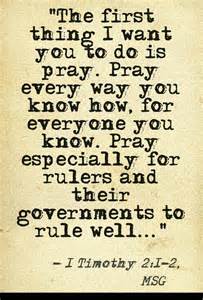
1-tim-2-2-pray-message

1 Timothy 2:1-8 – September 18, 2016

It’s good to be in the habit of doing certain things. Say, going to the gym. Exercise is a beneficial thing, and if I go to the gym on a regular basis, like three times a week, I will be healthier for it. Same for other things—like practicing the piano, or practicing football or baseball—it’s beneficial to get into the habit of regular repetition, week in, and week out.

Worship and prayer are regular, comfortable things, things many churches do the same way, week in and week out. Here in our scripture passage today, Paul gives his younger friend Timothy some words of wisdom. Recommendations, if you will, of some things Timothy’s church can do in worship and prayer that will be beneficial to them all.

Reading again from 1 Timothy 2, “I urge, then, first of all, that petitions, prayers, intercession and thanksgiving be made for all people— for kings and all those in authority, that we may live peaceful and quiet lives in all godliness and holiness. This is good, and pleases God our Savior.”

I’ll stop right there. Not because the rest of the reading is unimportant. No! But, because Paul has so many ideas that are bursting out of him one on top of the other, I am afraid we might be overloaded if I read them all.

Paul begins the chapter by encouraging Timothy to offer prayers for all members of the human family during church services. He mentions prayer in the terms of: petitions (humble, general requests to God), intercessions (requests, pleading for those in need), supplications (requests for ourselves, especially when faced with a crisis) and thanksgivings (expressing gratitude for blessings we receive). [1] All people need to be held up to God in prayer. All. That is, everyone. Not just one particular neighborhood, not just one particular ethnicity, not just one particular denomination. Paul tells Timothy—Paul tells us—pray for all people.

Yes, this is a wonderful passage that gives us the basics of prayer and worship, and lets us know more about Paul’s ideas concerning this important aspect of our lives. However, I was drawn to one particular phrase in this passage that went beyond the basics of worship: that we may live peaceful and quiet lives in all godliness and holiness.” I pursued it all week.

I was fascinated to dig into this passage of scripture. I have not read the Pastoral Letters as often as the rest of the New Testament. So, this week was a good excuse for me to dust off those seldom-opened commentaries and brush up on what was going on in this highly charged situation. For, highly charged it certainly was!

There was a complication, in the case of these house churches. Let’s take a look at the historical context. In the first century, small house churches like the ones where Timothy and Paul worshipped were in a precarious situation. They were constantly involved in “the struggle to secure and maintain a foothold within a hostile environment, where political authorities would always tend to be suspicious of the little house groups whose legal status was at best ambiguous and be ready to act against them at short notice with little excuse.” [2] Many of these small groups of emerging Christians desperately wanted to gain basic respect. Not even respectability, but hoping for just a bit of respect from the authorities.

These groups, or house churches, are identical to house churches meeting all over the world today, in fear for their leaders, if not the group members’ very lives. House churches in parts of Vietnam and Thailand, China, Pakistan, Nepal, and large parts of the Middle East. These groups are—today, here and now—struggling to survive in precarious political situations.

Is it any wonder that these small house churches wanted to pray for those in authority over them, so that they might have some peace and quiet? Quiet and tranquil lives?

Good habits—beneficial, certainly! Habits like prayer and worship are something that Paul would tell Timothy that his house church ought to follow, each time they gather.

How does this prayer and worship counteract the complication of overbearing and even unjust authorities that hold sway over these little groups of believers?

Both Paul and Peter tell their friends that the Godly thing to do is to pray for the authorities. I read from Romans 13:1: “Let everyone be subject to the governing authorities, for there is no authority except that which God has established.” And 1 Peter 2:17: “Show proper respect to everyone, love the family of believers, fear God, honor the emperor.” The New Testament tells us so, in several places, including this letter from Paul to Timothy.

We can see Timothy and his church are prompted to pray for the government. As Rev. Findlayson comments, “We are encouraged to pray for the political process such that it provides an environment where ‘we may live peaceful and quiet lives in all godliness and holiness’ (verse 2:2). This verse actually contains a clue to the content of our prayer for government. We are to pray for “peace”, but what kind of peace? Is it peace in the sense of freedom from war, social and industrial strife and revolution?” [3]

Ah. We have arrived at the topic of the day. The theme of our service today. What kind of peace do we pray for, indeed?

I have been talking about peace ever since February, the beginning of Lent. Remember, I went to a number of different churches, church groups, and schools to ask individuals what their personal definition of peace was. What is peace to you?                I got many fascinating definitions and expressions. Everything ranging from “Peace is serenity” to “Peace is Jesus Christ in my heart” to “Peace is quiet and calm” and “Peace is no war and no fighting.” And, a whole lot of other things, besides.

This kind of peace Paul describes is not just personal peace, and individual peace. This kind of peace Paul talks about is peace in the larger sense. Peace among regions, between people groups, and even between countries. We can see the progression in Paul’s thought. The spread of truth and of the Good News of Jesus Christ is facilitated when peace exists among the nations. In Paul’s day, the Roman Empire, the Roman transportation system and the Pax Romana made the spread of the Gospel easier. Then as today, peaceful interaction between countries and regions opens doors for the Good News.

See what Paul says in verse 4. God “wants all people to be saved and to come to a knowledge of the truth.” So then, when we pray for government and for the authorities, we can confidently pray that there be peace for the maximizing of the spread of the Good News.

Paul gives us the basics of prayer and worship. Remember what I often say? Prayer time is one of my favorite times in the worship service. Paul tells us we are to pray for all people; and we are to follow Paul’s lead in supplications, prayers, intercessions and thanksgivings. The intention of such prayers is so that we Christians in society will be able to live tranquil and quiet lives. This isn’t me saying it. It’s the apostle Paul!

Regardless of whether there is peace in our church, peace in our neighborhood, or peace in our country, prayer is always a good idea. A close relationship with our Lord and Savior Jesus Christ is the reason we are here. Praise God! Thank You, Jesus. Alleluia, amen.

If anyone would like to know more about how to come to know God in a closer, more intimate way, I would be glad to tell you.

[1]  http://www.lectionarystudies.com/sunday25ce.html Rev. Bryan Findlayson, Lectionary Bible Studies and Sermons, Pumpkin Cottage Ministry Resources.

[2] New Interpreter’s Bible Commentary on 1 Timothy, James D.G. Dunn, (Nashville, TN: Abingdon Press, 1994)

[3] http://www.lectionarystudies.com/sunday25ce.html Rev. Bryan Findlayson, Lectionary Bible Studies and Sermons, Pumpkin Cottage Ministry Resources.

@chaplaineliza

(Suggestion: visit me at my regular blog for 2016: matterofprayer: A Year of Everyday Prayers. #PursuePEACE – and my other blog,  A Year of Being Kind . Thanks!)