Unknown's avatar

Fishers of People

Matthew 4:18-23 – January 22, 2017

matt-4-19-fishers

“Fishers of People”

Is everyone here familiar with regular, ordinary work? Some people might call it common or mundane. The ordinary, everyday kinds of things that ordinary, everyday people do on a regular basis. That is what countless numbers of people do, every day, at work and at home.

That is what Peter, Andrew, James and John were doing, as fishermen. As the Gospel lesson today mentions, these men and their co-workers worked on their boat, doing hard work. Doing what they were used to doing every day. Probably, for some among them, doing the same ordinary, everyday things they had done on their boats for decades.

I suspect this day started out for Peter, Andrew, James and John like so many others. But, this day turned out differently, because Jesus showed up. Let’s see what happened from Matthew’s account: “As Jesus walked by the Sea of Galilee, he saw two brothers, Simon, who is called Peter, and Andrew his brother, casting a net into the sea—for they were fishermen.”

As one of the commentaries said, “Fishing was a popular trade on the Sea of Galilee. Fishing was the most common occupation for people residing in the small villages located on the lakeshore. Living on the shores of Lake Galilee with its abundant supply of fish, people understood fishing perhaps more than they did farming. Living on the shores of a fishing lake, the whole town was ‘into fishing.’” [1]

Typical for many people in the town of Capernaum, Peter and his brother Andrew were regular, ordinary working men, doing their regular, ordinary job, with others in their family’s boat. Casting their nets into the sea.

That troublemaking rabbi Jesus walks by the shore and calls out to them. He says, “19 Follow me, and I will make you fish for people.” What on earth does Jesus mean by that?

Some people consider their work to be simply that: work. But, a portion of workers think work is something more than just a way to earn a paycheck. They consider their work to be much more: something from which they receive significant satisfaction, purpose, and meaning.

One of the writers I consulted, Dr. David Lose, helped to formulate a survey describing “work,” “vocation,” and “calling.” The survey asked respondents various questions about their work, how they viewed it, and how important work was in their lives.

“Where do [these] people find the greatest sense of fulfillment, meaning, and purpose (terms to which these survey respondents resonated far more strongly than “vocation” or “calling,” by the way)? Relationships. Even those who identified their work as a source of meaning and fulfillment usually cited their relationships at work as the places of particular significance.” [2]

Peter and Andrew were interrupted in the middle of their regular, ordinary day by Jesus. When Jesus called out to Peter and Andrew and said He would make them fish for people, He called to them, to build relationship with Him, first and foremost. Then, to build relationships with others.  

These two guys in the boat? It’s their response that is really extraordinary. Our Gospel reading says: ” 20 Immediately they left their nets and followed Him.” Immediately! They don’t pause and think about it. Immediately, they go!

So now we have the rabbi Jesus, and Peter, and Andrew, walking along the shore. What happens next? “21 As Jesus went from there, He saw two other brothers, James son of Zebedee and his brother John, in the boat with their father Zebedee, mending their nets, and He called them. 22 Immediately they left the boat and their father, and followed him.”

The same thing. These two are sitting in their father’s fishing boat, and the rabbi Jesus calls to them. They get up in the middle of things, leaving the nets half-mended, and they leave.

What on earth is going on here? This reading is difficult to believe. It’s really a stretch of the imagination to think of getting up and leaving everyone and everything these guys know to follow Jesus. I don’t know whether I could do it! Don’t most people figure the disciples were extraordinary, first-century super heroes of the faith? You know. People that we can admire from afar but certainly not identify with.

Dr. Lose refers to some biblical scholars who suggest that “Jesus had been living in Capernaum for a while and had known Peter, Andrew, James, and John for some time, and so this call was neither sudden nor abrupt but was the natural outcome of their friendship. Maybe that was the case (huge emphasis on “maybe”), but given that Matthew reports that when Jesus comes and calls they immediately follow, I think we are meant to take notice.” [3]

Whether Jesus knew these four guys for a long time or for just a little while, Matthew tells us—he stresses they followed Jesus immediately. They didn’t think about it, they didn’t dither, or pause, or tell Him to come back tomorrow. No! They immediately followed and entered into a relationship with Jesus.

And, Jesus? He didn’t call them to come and work for Him. He didn’t just want to be their supervisor or manager. No! He called them into a close, genuine relationship with Him: the best kind of relationship there is! Jesus continues to encourage His disciples, His friends, to bring others into a close, genuine relationship with Him, too. BFFs, best friends forever.

What were some things the New Testament tells us about this relationship with God? To bear each other’s burdens, care for each other (especially the vulnerable), and hold onto each other, through thick and thin. Striving to do this, we will always be upheld by God’s grace. [4]

Some people still don’t think they are worthwhile, or good enough to be real disciples. After all, I suspect we don’t have any super duper saints here in this church. No super heroes of the faith! Can God use me? Can God use you?  I know I am imperfect. I’m just a regular, ordinary person, going about my business, doing regular, ordinary things. I suspect that describes everyone here.

I have good news for us all, however. Jesus is still looking for people to come, to answer His call. He is calling to regular, ordinary people in regular, ordinary situations to rise up and become extraordinary.

Jesus is calling to you and to me, holding out His hand to each of us. Jesus wants us to be in a close, genuine relationship with Him, too. Jesus wants us to go the next step and have concern and love for others: to be in a close, genuine relationship with them, too. Not in a mission, or a ministry, or a movement, but in genuine love and caring for one another.

Here’s an action step for you: find one person with whom you are in significant relationship. Perhaps it’s a relationship that brings you particular joy, or sorrow, or frustration, or hope. It doesn’t really matter, just so long as it’s significant. Once you have that person in mind, please take a moment to pray for that person every day for a week … and to believe that God is using you to make a difference in the life of the person for whom you are praying. [5]

Come back next week and let me know what happened. Did you feel closer to God? Did anything change for that person? We all can rejoice, for all of us strive to be faithful. Alleluia! Amen!


(A great big thanks to Dr. David Lose for his excellent words and thoughts on Matthew 4 and his bible study “Fishers of People.”)

@chaplaineliza

(Suggestion: visit me at my regular blog for 2017: matterofprayer: A Year of Everyday Prayers. #PursuePEACE – and my other blog,  A Year of Being Kind . Thanks!)

[1] http://www.sermonsfromseattle.com/series_b_fishing_for_christGA.htm “Fishing for Christ,” Gospel Analysis, Sermons from Seattle, Pastor Edward F. Markquart, Grace Lutheran Church, Seattle, Washington.

[2] https://www.workingpreacher.org/craft.aspx?post=3018  “Fishers of People,” David Lose, Dear Working Preacher, 2014.

[3] Ibid. (emphasis mine)

[4] https://www.workingpreacher.org/craft.aspx?post=3018  “Fishers of People,” David Lose, Dear Working Preacher, 2014.

[5] Ibid.
Unknown's avatar

Christ is All!

Colossians 3:9-15 – January 15, 2017

col-3-11-christ-is-all-words

“Christ is All!”

Did you ever get a brand-new suit? A lovely new dress? Were you dressed in new clothes from head to toe? What about when one or your children or grandchildren was dressed in a wonderful new outfit? That can cause a person to feel brand new, all over.

That’s what the Apostle Paul is talking about, here in Colossians 3, verses 9 and 10: seeing that you have stripped off the old self with its practices 10 and have clothed yourselves with the new self.” That is exactly the word picture Paul is using, about taking off an old shirt or coat, and putting on a new, clean garment.

Paul not only is talking about our new selves and our new identity. He is also alluding to what happened at baptism. He makes mention of it in the letter to the Galatian church, and he mentions it here, too.

In the early Church, people often got baptized as adults. They would go through a several-week period of preparation, teaching and study, and finally be pronounced ready to be baptized. After the time of baptism, which often took place on Easter, the newly-baptized person would put on a new, clean white garment. This would show everyone that they were washed clean and ready to claim their new identity in Christ.

Some people might be wondering what I am doing up here, with no robe. I wanted to show everyone what Paul was describing here. See, I am just plain old me. Nothing special, nothing to write home about. But, now, I am going to take off the old self. Take off my old jacket. What is it that Paul said, again? I put on—we put on the new self. Like, right now, when I put on my robe. I am clothing myself in Christ. We all have done this, already! It has already happened, and is a blessed reality!

However, there is a problem. Paul reminds us about that. Did you know we can fool ourselves into thinking that this has not happened? Paul says exactly that, in verse 9: “Do not lie to one another, seeing that you have stripped off the old self with its practices.”

Paul knows how easy it is to lie. Maybe not tell big whoppers, but certainly bend the truth. Some people lie a little, and others lie a lot. Whether it’s a lot or a little, whether it’s lying to other people or lying to ourselves, some people can act like they still have their dingy old clothes on, and haven’t put on their brand new Jesus garment yet. Some people can talk like they haven’t had much of an acquaintance with Jesus, either. Jesus is not affecting them much at all. Not in the way they talk, or act, or think.

We all know how easy it is to stretch the truth to other people. It’s just human, after all! This might be a challenge for us to hear, but, let’s think about lying to ourselves. Yes, not acting or talking like we have put on Christ. What about when we fool ourselves a lot, or beat ourselves up? When we say, “no one will ever know!” or “I guess nobody ever expected much,” or even, “what’s the use? I never can measure up.” Settling for cut-rate, lying to ourselves that whatever we are doing is okay, or giving up, not even trying at all. It’s a really difficult habit to break.

That is a big, big problem! What are we going to do about such a state of affairs?

Sometimes, people do end up stuck in the middle. Right before the scripture passage we read today, in the letter to the church at Colossae, Paul mentions a laundry list of practices and other things that can get in the way. Things that come between us and God.

We believers may think we have gotten rid of the malice, impurity, even blasphemy that Paul describes in verse 8. Yes, Paul matter-of-factly ticks off bad habits and sinfulness from the list, but spiritually, these people haven’t put on their brand-new Jesus garment. Do you know people like that? I’m afraid some people are too focused on themselves, either in a puffed-up self-centered manner, or in a negative, self-defeating way.

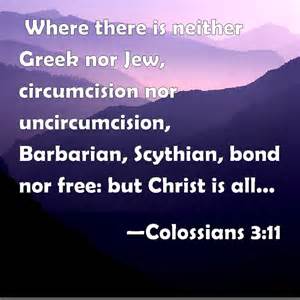
I discovered verse 11 of this chapter a long time ago. Paul says, “you have clothed yourselves with the new self…. In that renewal, there is no longer Greek nor Jew, circumcised nor uncircumcised, barbarian, Scythian, slave and free; but Christ is all and in all!”

One commentary I consulted was particular about the translation of this verse from Greek: “There is no such thing as Greek and Jew (the difference of privilege between those born of the natural seed of Abraham and those not, is abolished), [no such thing as] circumcision and uncircumcision (the difference of legal standing between the circumcised and uncircumcised is done away with)—and [no such thing as the difference between] bondman, freeman.” [1]

So many people just skim over this verse, not even considering the inclusiveness and social justice that the text implies. Instead, they are—we are—still focused on ourselves, as if we all are wearing blinders. They—we celebrate the day they were “saved”, but fail to do the work of God’s realm, including the removal of barriers. Those who are stuck halfway between their old, sinful clothes and their new, clean Jesus garment may even be creating new barriers.

Today is Martin Luther King Jr.’s birthday. In August 1963, he made his “I have a dream” speech from the steps of the Lincoln Memorial, on the Mall in Washington, D.C. He said, “I have a dream that my four little children will one day live in a nation where they will not be judged by the color of their skin but by the content of their character.”

That sentence resounds with the quality and the content of this verse from Colossians, as well as the similar verse from Galatians 3:28, which talks about neither male nor female, neither Jew nor Gentile, and neither slave nor free. All of us—that is, everyone—are one in Christ Jesus our Lord. Or, as Colossians 3 states: “Christ is all, and in all!”

Martin Luther King was highlighting people’s insides, not their outsides, and looking at the quality of their character, not the color of their skin. Or how nice their clothes look. Or how expensive their shoes are. Or whether they have been to college or not. Or which side of the train tracks they are from. Or what ethnicity or culture they grew up in.

“There’s a great line from a movie where two African Americans are walking past a whites-only church, and one of them says, ‘I’ve been trying to get into that church since I was a kid.’ His friend responds by saying, ‘That’s nothing, Jesus has been trying to get in there for a lot longer and he hasn’t gotten in yet.’” [2]

The larger church is hurting. Most believers have witnessed divisions and separation both inside and outside the church. Hurt, grief, anger, dashed expectations, frustration, fear…. a mass of emotions. Hurting people, hurting each other.

Jesus will help us. He will not leave us alone, hurting and separated from others. He will not leave us wearing old, dirty, sinful clothes, but will help us to put on a brand-new, clean Jesus garment. Jesus will come alongside of each one of us. He wants all of His children to come together, to love each other, no matter what.

I close with the words of Jesus from the Gospel of John, chapter 15: “This is my commandment, that you love one another as I have loved you.” No matter what. How much did Jesus love us? He loved us this much. (spread out arms) Alleluia. Amen!

[1] http://www.ccel.org/ccel/jamieson/jfb.xi.xii.iv.html  Commentary on the Whole Bible (Jamieson, Fausset and Brown, 1871). When

[2] http://www.lectionarystudies.com/sunday18ce.html “Real Life in Christ,” Rev. Bryan Findlayson, Lectionary Bible Studies and Sermons, Pumpkin Cottage Ministry Resources.

@chaplaineliza

(Suggestion: visit me at my regular blog for 2017: matterofprayer: A Year of Everyday Prayers. #PursuePEACE – and my other blog,  A Year of Being Kind . Thanks!)


Unknown's avatar

Baptized, Beloved

“Baptized, Beloved”

luke-3-21-baptismchrist2

Matthew 3:13-17 (3:16) – January 8, 2017

Water. Water is used for a great many things. For washing and cleaning, certainly! Washing clothes and dishes, washing hands before dinner, washing cars in the summertime. Cleaning things, too, like brushing teeth before bed, and cleaning instruments and tools. Water is used for a special, cleansing purpose in the Christian church, too. Water is for cleansing of people, and washing of souls, of body and spirit.

The Gospel of Matthew begins our Scripture passage today with Jesus at the very beginning of His ministry. He comes to the River Jordan, to see His cousin John the Baptist. And what is John doing at the Jordan? Baptizing people, cleansing them while they confess their sins, washing their souls, inside and out.

Let’s back up a bit, and take a look at the passage from Isaiah, from the Hebrew scriptures. Here we have a prophetic suggestion of what is to come; the prophet tells us here in the book of Isaiah about the Sent One of God.

Did you know that God deeply cares about the Sent One? The prophet says so! Listen again to verse 42:6—“I am the Lord, I have called you in righteousness, I have taken you by the hand and kept you;” We see that God is faithful to God’s promises, and will care for those whom God loves. In fact, God is within the Servant the prophet speaks of, And, God means for this Servant to transform and cleanse the mess the world has been in. [1]

This is awesome news! The mixed-up world will finally be washed and cleansed. Except, Jesus does something completely unexpected. Jesus does not come to cleanse the world, at first. No, Jesus comes to John to be obedient and go through the waters of baptism Himself.

We can see from the Gospel passage that John is really hesitant to baptize Jesus. He says, “No way, Jesus! I oughta be baptized by You! And here You are, coming to me to be baptized?”

I want to remind everyone that Jesus had no sin. He was both God and man at the same time. Yet, Jesus came to be baptized by John. Jesus wanted to identify with sinful humanity in every way. Plus, Jesus wanted to fix the mess the world was in.

Look at verses 6 and 7 of the passage from Isaiah: “I have given you as a covenant to the people, a light to the nations, to open the eyes that are blind, to bring out the prisoners from the dungeon, from the prison those who sit in darkness.” That sounds like washing and cleansing this fallen, mixed-up world. That sounds like the mission Jesus had in His ministry here on earth.

But, Jesus is not there yet, at the beginning of Matthew 3. Jesus needs to be baptized, to fulfill all righteousness. And, what is righteousness? “Compassionate justice and care for those who are poor and/or marginalized, humility and faithfulness that always point to God as the One who is at work in this transformation, and the hope—the promise—of new things that will dazzle us and rattle the foundations of our safe little worlds. When read, and heard, together, the texts from Isaiah and Matthew dramatically illustrate God’s own deep faithfulness and care.” [2]

We can see from the Gospel of Matthew how God has deep faithfulness and care for Jesus, God’s Son. After Jesus convinces John to baptize Him, the heavens open, the Spirit of God as a heavenly dove descends, and God the Father says, “This is my Beloved!”

Let us imagine ourselves in that crowd on the banks of the river, watching the baptisms, as people are cleansed from sin. John is washing their souls, inside and out. Hear the sound of the rushing water. You and I, all of us are crowded together, jostling each other. We watch John the Baptizer, with that new rabbi Jesus, in the water. Suddenly, the heavens break apart! Everyone, all of us in the crowd know the Spirit of God is present, in the likeness of a dove coming down from the sky.

What do you think of when you hear the voice of God saying, “This is my Beloved!” What goes through your head? What kinds of feelings are going through you? Are you scared? Excited? Puzzled? Confused? Or, all of the above?

Think of baptisms we have seen, even participated in. Do you think baptisms are just an excuse for gifts and a party? Or, does baptism mean much more? Consider your own baptism in light of this Gospel reading. Now, think of the others in this congregation, too. Close your eyes. Think of God saying to you—yes, to you in particular—“You are my Beloved!”

            God is saying that to each one of you. Really and truly.

I found this story on a pastor’s sermon board, online. It was written a number of years ago by a Pastor Del in Iowa. He tells the story of his grandmother’s death, and his subsequent desire to find out more about his grandparents’ families.

“I began to ask questions about my genealogy… about my great grandfather (whose last name was Fahling) whom I remember well from my childhood.

“As I questioned my mother about the family history on my father’s side, she indicated to me that my great grandfather’s real last name is unknown. It seems that he left the old country and came to the New World as a boy, his journey paid for by a farmer with the name of Fahling. Upon crossing the waters of the Atlantic, my great grandfather took up residency with this farmer, labored on his land and took upon himself his sponsor’s name and identity and became part of the Fahling family. He even receiving a share in the inheritance of the family farm.

“At first I was disappointed with the loss of a history, but then I realized that in many respects this is the meaning of our baptisms. Crossing the waters, we take on different residency, ordained labors, and new identities and begin a new history. We become an integral part of the family of God through sharing in the baptism of Christ who sponsors and pays for our journey.”[3]

We have several different ways to come to an understanding of baptism. Yes, we have been washed and cleansed from our sins. We have crossed the water. Yes, each of us has been adopted by God. Yes, each of us has a new identity. And, yes, each of us is Beloved, much loved by God, our heavenly Parent.

Consider this last understanding of baptism, about each person, child or adult, in our congregation. And then about each baptized person you know. God considers each one God’s Beloved. Do we consider each one Beloved? Do we treat each person as God’s Beloved? How would that understanding change the way we treat each other?

Not that baptism magically changes us and—presto, change-o—causes us to become Beloved in some magical way. No! We are Beloved because God says we are. Just as God called Jesus Beloved, God refers to each of us in the very same way.

Praise God! I know I am God’s Beloved, the same way you are, too. What a marvelous name. What a fantastic feeling. What a wonderful God we serve.


(Thanks to Kathryn Matthews and the United Church of Christ’s Worship Ways for several ideas used in this sermon.)

[1] http://www.ucc.org/worship_samuel_sermon_seeds_january_8_2017   by Kathryn Matthews

[2] http://www.ucc.org/worship_samuel_sermon_seeds_january_8_2017   by Kathryn Matthews

[3] http://desperatepreacher.com//bodyii.htm

@chaplaineliza

(Suggestion: visit me at my regular blog for 2017: matterofprayer: A Year of Everyday Prayers. #PursuePEACE – and my other blog,  A Year of Being Kind . Thanks!)

Unknown's avatar

A Time for Everything

“A Time for Everything”

eccl-3-1-everything-cursive

Ecclesiastes 3:1-13 – January 1, 2017

Expectations. Excitement! A fresh, new start. With eyes wide open, we all have the opportunity to make a new beginning, this New Year’s Day of 2017. New brooms sweep clean. New, fresh, sparkling clean, not a spot or speck to be seen. At least, not yet.

 As our scripture lesson from Ecclesiastes 3 says today, there is a time for everything. God has given each one of us a sense of the passage of time. God has implanted that within us, and we are placed in this construct of time, of past, present and future.

What are we to do with this concept of time? And, the idea that time is a never-ending stream? That, somehow, each of us is intricately bound up in this bubble called history, and together or separately, each of us has specific things to do. Or, not do. To look behind at 2016 with longing or regret, missing opportunities lost, or gazing ahead with expectancy, looking forward to what 2017 has to bring into each life?

What new, fresh excitement, and expectations!

Let’s take a common example. A door. We can either be on one side or the other of a doorway. One side—inside—and the other—outside. One side—in the past—and the other—in the future. It’s difficult to straddle both parts of a world, and at the same time to strive to do both of these either/or activities stated in our passage from Ecclesiastes, today.

Thinking further, Doors are good images for New Year’s Day. We have closed the door on last year, on 2016. We’ve opened the door to a new, sparkling clean year.

When each of us walks through a door, things can change—either a lot or just a little. As one bible commentator says, “When you go from outside to inside, you use a quieter voice, you wipe off (sometimes even take off) your shoes, you expect to do different things.  Walking through doors tells us where we are and who we are. “ [1]

Janus is the Roman god of endings and beginnings. A two-headed god, with one head looking backwards into the past, and the other looking forward, into the future. This god presided over gates and doors, and was sometimes shown with a gatekeeper’s keys and staff. There can be a great deal of change and transition from one place to another, as one year changes into the next.

Some people have a great deal of baggage left over from last year. Lots of stuff to carry with them into the new year. What does our scripture passage say? “For everything there is a season, and a time for every matter under heaven.” There are several ways to view this poetic look at life and death, and everything that comes in between, but one way is to acknowledge this overarching structure as a foundational basis for understanding the cosmos, life itself.

Sure, some can go too far, and have a totally fatalistic point of view, saying that everything is absolutely fated and predetermined. Nothing is worth doing, no innovation, no creativity; no one can change anything ever. What a hopeless, helpless point of view. This view takes away free will, human decision, and the possibility of change. Why do anything, ever again?

However, we can leave our baggage and stuff, old and tattered, tired and worn, just drop it, even brand-new stuff with price tags still attached. We can look forward to a new year, a new chance to walk into the future with head held high, and eyes open to new possibilities.

I have an opportunity to realize and remember the many blessings that God provides in each of our lives, on a regular basis. Do you remember each of those blessings that God provided in your life, in 2016? Can you name each one, and thank God for it? Nope, me, neither. But, here is a concrete way to help you remember each one in 2017. Here is a real action step to take.

It’s called The Jar Project, and features jars with the following label attached: “The Jar Project. Starting New Year’s Day, I will fill this empty jar with notes about good things that happen. On next New Year’s Eve, I will empty it and remember that awesome things did happen this year.”

There are various other ways people think of this activity. Some people call it a Gratitude Jar, or a Blessing Jar. Put in strips of paper with things or people you are grateful for, or that you have been blessed by, in 2017. Then at the end of the year, each of us will have a whole year of wonderful, awesome blessings to truly thank God for.

Come with me, back to the doors of our sanctuary. We can offer prayer, asking that these doors welcome many visitors during the coming year and that all who come through the doorway be blessed.  I am going to write on our church doors with prayers for all who will come through the doors this year (worshipers, visitors, brides and grooms, parents bringing babies to be baptized, families and friends coming to bury their dead, members of community groups which will use the facilities).

Please, I encourage each of you, each household, to repeat this in your own homes. God’s richest blessings on you and your family in 2017.


God of doors and homes, bless this home this year and every year.

Bless all who come and go through this door, both those who live here and those who visit.

May all who enter through this door come in peace and bring joy.

May all who come to this door find welcome and love.

May the love and joy in this home overflow and spread into the community and the world. [2]

[1] http://worshipingwithchildren.blogspot.com/2013/11/new-years-day-years-b-c.html New Year’s Day, Including children in the congregation’s worship, using the Revised Common Lectionary, Carolyn C. Brown, 2013

[2] http://worshipingwithchildren.blogspot.com/2013/11/new-years-day-years-b-c.html New Year’s Day, adapted from Including children in the congregation’s worship, using the Revised Common Lectionary, Carolyn C. Brown, 2013

Unknown's avatar

The Word Became Flesh

“The Word Became Flesh”

john-1-14-word-made-flesh-stained-glass

John 1:14 – December 25, 2016

Words, words, words, words!! Words of every kind, of every description. Words that tell, words that show, words that praise, words that criticize. Words separate and draw together. Words fill people with joy and peace as well as with suspicion and animosity. Words have power. Whether insightful words or divisive words, encouraging words or cajoling words, stirring words or capitulating words, words have the ability to shake emotions and to inflame passions for good or for evil.

How do people use words and language, anyway? People speaking a common language need to agree upon the sense of what they say. It helps to be bound together by social convention as well as language rules of practice and use. In fact, language provides the structure of our common experience, understanding and perspectives. But I don’t want to get all high-falutin’ and theoretical. I want to bring this home to where we live.

We all use language. Every day. In conversation at home, or on the telephone, or at work. Reading a newspaper or writing e-mail. Watching television or giving a sermon. All of these uses of language use words. Words communicate meaning, ideas, stories. Each one of us has a personal story, of what it was like, what happened, and what it’s like now. Each story is individual and unique. Our stories are communicated using words and language, and each individual has a creative, unique way to tell his or her story.

The story of an individual’s own personal life makes sense because it is part of a larger story, the Story that has the story of Jesus Christ at its center. The Story of the Baby in Bethlehem that is so familiar to so many. It is a story of God’s initiative which calls for my gratitude and response, a Story some theologians have called ‘the history of salvation.’ It is the Story set forth in the Word of God that attracts, crossing boundaries and transcending lines of race, class, culture and age.

Our gospel text for today, the first verses of the Gospel of John, is a restatement of an old theme. Remember Genesis 1:1? “In the beginning, God created the heavens and the earth.” Most scholars today believe the apostle John was thinking of that introduction to the Greatest Story ever told when he wrote his own portion of it. John 1:1: “In the beginning was the Word.” John reframed that Story, and gave it a new look from a different perspective.

In John, Chapter 1, we have God, the creative God who made heaven and earth. The almighty God wanted to communicate with us puny, limited human beings. But how was God supposed to communicate His Story?

I can remember when my children were younger, in first and second grades. Sometimes they would need help with their homework at night. Years before, I had taken several courses of math in college . . . college algebra, trigonometry, analytical geometry. But, after considering more advanced mathematical ideas, how was I supposed to explain simple addition and subtraction to my young children in language they would understand?

That’s the way I look at God’s problem sometimes. It’s sort of like God, able to do the most advanced mathematics possible—in God’s head!!—and God needed to be able to explain the simplest addition and subtraction problems to us ordinary, simple-minded human beings.

There was another problem, as if the simple-mindedness of humanity wasn’t enough. That problem was (and is!)  sin. Funny thing, how sin keeps cropping up in our lives and getting in the way. Sin divides people from one another as well as from God. Sin isolates and forces apart. Sin happens on a horizontal plane with other people as well as on a vertical plane with God. And sin causes humanity to walk in darkness and to run from God’s presence.

So here we have a loving God, a God of light, a God who wants so much to communicate with us sinful human beings. But how was God supposed to communicate God’s Story?

            The Gospel of John tells us how. In the beginning was the Word. The Word was God. The Word is God. Jesus is the Word. John 1:14 says that the Word, Jesus, became fleshand . . . the Word dwelt among us.

Let’s look at this verse more closely. The Word became flesh. The Greek word for “flesh” is sarx, the same word that the apostle Paul uses when he talks about the flesh. Except that Paul meant sinful flesh, and Jesus as God incarnate had sin-less flesh.

Think about it: the whole idea of God becoming a helpless baby, a human being, able to feel cold and heat, able to be hungry and thirsty, with blood and bones and a nervous system and a digestive system. So staggering was this idea that some of the people in John’s day could not believe it. God? the creative God who made heaven and earth? Coming to earth as a helpless, human baby? No way!!

And, that’s not all!! Not only did this Creator God make Himself appear in creation so that our eyes could see Him, this almighty God, after making Himself flesh and blood, has the crazy idea of dwelling among people. Becoming one of us limited human beings, sharing our food and living in our midst. Jesus became fully man. He didn’t just seem to be a man, and pretend to be human. He really and truly became man, living with us as one of us.

What a way for the almighty, eternal, creative God to communicate to us in a way that we limited human beings might possibly understand. God wanted humanity to understand His Story of good news, the Bible, but God also wanted humanity to understand His Word made flesh, the one called Jesus of Nazareth.

Jesus (the Word incarnate) is the central principle of Scripture as well as the central character of the Greatest Story ever told. Reformed believers have throughout the centuries been finding new ways to confess their faith, using the fallible, limited resources of language that have been handed down to humanity throughout the generations. God helps us understand the Greatest Story ever told, and there is nothing God wants more than for us to want to understand His Story better and better.

A good many years ago, a bible translator went to a remote, mountainous region in the interior of Africa. He worked hard at turning an obscure oral language into a written language, which involved decoding the language, writing a grammar, learning extensive vocabulary, and finally translating a portion of the Bible into the heart language of that particular people-group.

After several years of intense work and language preparation, when he felt he was ready, the missionary made his first presentation of the Story of Jesus to a group of headmen from the tribe. He was surprised at their response, which was unlike any he had ever had before in all his years of being a missionary and telling people the Story of Jesus. The group of men just sat agthere in silence, and then the chief came forward.

The chief grasped the missionary’s hands and, with tears in his eyes, thanked him for coming to tell them the Story of Jesus. “This Story of good news is the one my people have waited for, all their lives long!!” And then came the clincher: the chief asked, “Your tribe has had this Story for many, many years. What took you so long to tell us?”

Communicating the Story of Jesus has power! Awesome power! This is a Story that can change people’s lives for eternity. Telling the Story in someone’s heart language is one of the best ways to communicate how much God loves us.

When Jesus came to this earth, He spoke the language of the people of His region, and He communicated ideas in ways people could understand. Yes, He was the Word become flesh, and yes, He showed us how to live this life that we have to live. Jesus, in the words of the Barmen Declaration, “the one Word of God which we have to hear and which we have to trust and obey in life and in death.” [1]

Praise God that God sent the Son Jesus into this world, the Word incarnate, the Word that became a helpless baby in Bethlehem. Praise God that God has given us the right to repair that broken relationship with us, and to be called the children of God. And praise God that God loved us so much that—as John 3:16 says—God gave His only begotten Son on our behalf, to reconcile us to God for eternity.

Gloria in excelsis Deo.


[1] 8.11, The Barmen Declaration, The Book of Confessions, (Louisville, KY: Office of the General Assembly, Presbyterian Distribution Services, 2014) 283.

@chaplaineliza

(Suggestion: visit me at my regular blog for 2016: matterofprayer: A Year of Everyday Prayers. #PursuePEACE – and my other blog,  A Year of Being Kind . Thanks!)

Unknown's avatar

Some Children See Him

“Some Children See Him”

peru-nativity

Luke 2:8-15 – December 24, 2016

So many houses and apartments are decorated for the season at this time of year. Colorful lights and decorations indoors and out, shining Christmas trees, special dishes and fancy tablecloths. Plus, some families have a Nativity scene in a special place, whether under the Christmas tree or placed in an extra special location. Here at St. Luke’s Church, we have the Nativity scene with some other lovely Christmas decorations, in the narthex of our church.

The Christmas narrative from the Gospel of Luke is so familiar. Mary and Joseph enrolling for a census in Joseph’s ancestral town. Since it was the time of the census, the town was crowded to bursting. Mary was greatly pregnant, and while she was in Bethlehem, labor pains started. She and Joseph found shelter in a stable, and put her newborn baby in a feeding trough, a manger.

This evening, we are going to focus on the shepherds abiding in their fields, and the angel alerting them about the birth of this super-special Baby. Starting at verse 10 of Luke 2: “10 But the angel said to them, ‘Do not be afraid; for see—I am bringing you good news of great joy for all the people: 11 to you is born this day in the city of David a Savior, who is the Messiah,[a] the Lord.’” The shepherds quickly go into town and find the Baby, and worship and adore Him.

Yes, the Nativity scene is a familiar way of retelling this story. But—how did Nativity scenes begin? It was in 1223. “According to St. Bonaventure’s biography, St. Francis of Assisi got permission from Pope Honorious III to set up a manger with hay and two live animals—an ox and an ass—in a cave in the Italian village of Grecio. He then invited the villagers to come gaze upon the scene while he preached about ‘the babe of Bethlehem.’ (Francis was supposedly so overcome by emotion that he couldn’t say ‘Jesus.’)” [1]

However, that first Nativity was located in Italy, during the 1200’s. The practice of Nativity scenes, pictures and photos has certainly spread from there, all over the world. Do you remember acting in Christmas Nativity scenes? You, or your children? Or grandchildren?

When my children were small, one of the first Christmas decorations I’d take out of the box would be our little Nativity scene. The little statues were all children, and it was intended specifically for the young. I would tell and re-tell the Christmas story again and again. My younger two children would love to play with the figures, spending a good long time with those inexpensive yet meaningful little figures.

My personal Nativity scene, the one my children played with, has white children, every one. I had not thought about this when I bought the set of figures, more than twenty years ago. Even though my children were part of a multi-ethnic, multi-cultural school system, we still had an all-white Nativity set.

Let’s hear again the words of the angel to the shepherds, that Christmas night: “the angel said to them, ‘Do not be afraid; for see—I am bringing you good news of great joy for all the people.” Not just the people in Italy, where St. Francis was. Not just the people in Europe, or North America. Good news of great joy for all the people.

Think about Edith, our church’s pen pal from Kampala, Uganda. Almost everyone she sees on a regular day happens to be African, and dark-skinned. She has seen lighter-skinned people before, but most everyone she sees and interacts with is darker-skinned. What would a Nativity scene at Edith’s church in Kampala look like? (I don’t know. I can ask her!)

I love to go to a fair trade store in Evanston, a not-for-profit shop that sells goods from all over the world, called 10,000 Villages. This store has lots of different kinds of Christmas decorations, especially different kinds of Nativity scenes. Nativities from Mexico, South America, all over Africa, India, southeast Asia, and the Middle East.

I bought this Ethiopian Nativity puzzle several years ago from a fair trade shop. I love the way the figures almost come alive, with their bright colors. Is this vibrant Nativity a welcome sight for you, or is it a bit distracting? Perhaps we might be encouraged to meditate on something a little different? Perhaps we can use an alternative, ethnic kind of manger scene, or different- culture picture of the Mother and Child, this year? Certainly something to think about.

Remember the words of the angel of the Lord: “Do not be afraid; for see—I am bringing you good news of great joy for all the people.” We can praise God! God did not send good news of great joy to just a few people in the world, or even some of the world’s people. God sent good news of great joy to all the people of the world.

The angel has come to all cultures, all ethnicities, all people, everywhere.

That is not only GOOD news, that is GREAT news. Good news of great joy! We can truly praise God with the angel hosts, saying, “Glory to God in the highest heaven,
and on earth peace among those whom God favors!” Alleluia, amen!

[1] http://www.smithsonianmag.com/smart-news/the-first-nativity-scene-was-created-in-1223-161485505/

@chaplaineliza

(Suggestion: visit me at my regular blog for 2016: matterofprayer: A Year of Everyday Prayers. #PursuePEACE – and my other blog,  A Year of Being Kind . Thanks!)

Unknown's avatar

His Name: Emmanuel

“His Name: Emmanuel”

emmanuel-plainsong

Isaiah 7:10-14  – December 18, 2016

So many people love babies. Look at just about any gathering of people. Church congregation, senior center, exercise group, book club. When anyone mentions that someone has just had a baby, what happens? Lots of comments like, “What did she have? Boy or girl?” How big is the baby?” And, especially, “Oh, I hope mom and baby are happy and healthy!”

Common, everyday occurrences, like young women getting pregnant and babies being born. That is exactly what the prophet spoke of in our passage today. The prophet gave a lot of background, but he finished this passage by talking about the clear promise from God. Let’s go back to the beginning of the passage from the prophet: “Again the Lord spoke to King Ahaz, saying, Ask a sign of the Lord your God; let it be deep as Sheol or high as heaven.” It sounds like the Lord God wants to give King Ahaz a really big message. But, wait. Why is this stuff happening?

A little backstory. The kings of Syria and Israel (Northern Kingdom) join together to go to war with the Assyrians. They ask King Ahaz of Judah (Southern Kingdom) to join with them, but Ahaz refuses. Both countries send armies to march on Jerusalem to dethrone Ahaz and put a puppet king on the throne.

We have big political intrigue going on in Jerusalem at this time! Remember, it’s about seven centuries before the birth of Jesus in Bethlehem. The Lord sends Isaiah to Ahaz a second time, this time offering to give Ahaz a sign so that he will believe God. From Isaiah 7: “12 But Ahaz said, I will not ask, and I will not put the Lord to the test,” and once again Ahaz refuses.

One of the commentators I consulted said, “King Ahaz received an oracle from Yahweh, directing him to ask for a sign as deep as Sheol or as high as heaven. This may refer to a sign announced by an earthquake or in lightning. With seeming piety, Ahaz refuses to ask for a sign lest it put Yahweh to a test. Isaiah, however, treats his answer as a refusal to trust God and announces that God will give him a sign anyway.” [1]

What is this sign? A common, everyday sign. There may have likely been just a young woman who was at Ahaz’s court, to whom Isaiah could literally point a finger and say, “Look, she’s pregnant. She’s going to have a son. That birth is the sign that God is with us.” We can see this as a sign that God is in the common, everyday things, the simple, ordinary passages of life.

Do the simple, small things that come into our lives change our course? These verses give us an interesting image. God would save the people of Israel through the sign of something so common and ordinary as a pregnant woman. Isaiah began by offering the opportunity for a great big, splashy sign, but instead gave the king a common image of everyday, ordinary happenings.

The sign was certainly not for the mighty and powerful. Rejected by those in power, God would work wonders among the humble and lowly. In other words, the simple common folk. The original reference for Isaiah was to a child born in his time, and in the near future. For the prophet, the message is that in a few years, both the kingdoms threatening Judah will be no longer a problem. This indeed is historically what happened.

Some centuries pass. The Book of Isaiah was originally written in Hebrew, which was the common language of Israel during the 700’s BCE. By the time we arrive at 300 BCE, there has been a huge turnover in the world. Now, the Greeks under Alexander the Great have conquered most of the known world, and they have spread the Greek language far and wide. Plus, the Jewish people had been scattered all over the Middle East and into Asia Minor.

Many of the scattered Jewish people could hardly read and understand their own Scriptures any more! So, a large group of Jewish scholars translated the whole of the Hebrew Scriptures into Greek. It is that translation that Matthew uses when he says, “22 All this took place to fulfill what had been spoken by the Lord through the prophet: 23 “Look, the virgin shall conceive and bear a son, and they shall name him Emmanuel,” which means, “God is with us.”

Believers from the time of Matthew’s gospel have pointed to these verses as Messianic prophecies. Yes, there is a technical difference between “young woman” and “virgin.” This tension is evident if we closely examine the difference between the Hebrew words and the Greek translation. Yet—what is the same? It is a message of God’s caring and love that sees pregnancy and birth—simple, everyday happenings—as signs of God’s care and concern for God’s people.

Emmanuel. God with us. Was that true in Isaiah’s day, with the Assyrian armies breathing down the necks of the people of Israel? Of course! Isaiah gave the king a special oracle to let him know so. Emmanuel. God with us. Was that true in the time of Jesus’s birth, with the occupying Roman armies breathing down the necks of the people of Israel? Of course it was!

God has always had concern and love for God’s people, no matter where and no matter when. No matter if the persecuted Christians were running from the Romans, or being chased and persecuted by any one of the occupying forces in the centuries in between.

Jesus came from humble origins. Yet, He changed the world. Likewise, the birth of this child, was a sign that even in the midst of the chaos and destruction surrounding Jerusalem in the uncertain time of Isaiah and the uncertain time of the baby Jesus, God was still with them. Life still did go on. In a very real sense, that was (and is!) a miracle.

What is the simple message we receive from these words of the prophet? God will be with us, no matter what. That is the message to King Ahaz and the people of Israel, that is the message to occupied Israel in the newborn Jesus’s day. And, it’s the message we can take home with us this day.

“Look, she’s pregnant. She’s going to have a son. That birth is the sign that God is with us.” We can see this as a joyful sign that God is in the common, everyday things, like the simple, ordinary passages of life. Like a baby being born, displayed to all of us as a wonderful sign from the Lord God. Praise God! God is concerned about the smallest and every day and ordinary, like babies and new moms and children, like you and like me.

Alleluia, amen!

[1] http://fontes.lstc.edu/~rklein/Documents/adventa.htm#Advent4, Studies on Old Testament texts from Series A, Ralph W. Klein, Lutheran School of Theology at Chicago.

@chaplaineliza

(Suggestion: visit me at my regular blog for 2016: matterofprayer: A Year of Everyday Prayers. #PursuePEACE – and my other blog,  A Year of Being Kind . Thanks!)

Unknown's avatar

Transforming Creation

“Transforming Creation”

isa-35-word-cloud

Isaiah 35:1-6, 10 – December 11, 2016

Expectation. Anticipation. Sitting on the edge of one’s seat in excitement. That sounds like we just hardly can wait another minute for a long-expected, awaited event! Can you think of events which were so exciting for you? A long-awaited trip to a far-away place, a well-deserved promotion at work, or finally celebrating a wonderful wedding or a significant anniversary. Can you remember being so excited about these things that you were sitting on the edge of your seat in preparation and anticipation?

“O come, O come, Emmanuel.” This is a familiar hymn we sing in the month of December, in the weeks leading up to Christmas. It is an Advent hymn, full of hope, preparation, and expectation about the Messiah’s coming. Are you sitting on the edge of your seat, waiting for the arrival of Christmas, of the Baby born in Bethlehem? Or, is this just another ho-hum, not-so-exciting occurrence for you?

We all know the Messiah is long-expected. Time and again in the Hebrew scriptures, we hear the prophets declaring their marvelous news, that the Savior and Redeemer of Israel is coming. The heir to King David’s throne is coming to reign over Israel. But, this week, this passage from the prophet is a little different. We turn to the prophecy from Isaiah 35, starting at verse 1: “The wilderness and the dry land shall be glad, the desert shall rejoice and blossom; like the crocus it shall blossom abundantly, and rejoice with joy and singing.” Here, the prophet is talking about what will happen in the future.

Here, the prophet talks about all creation: the wilderness, the dry land, and the desert. Large parts of the land of Israel was parched, inhospitable to both humans and animals. Here, in these verses, we hear about what is going to happen to the land, to creation itself.

As Dr. Michael Chan, one of my commentators, said, “The general theme is that desolate, dry places will be transformed into paradise. Those who live in desert environs can appreciate the transformative power of water on the desert. Overnight, even a small amount of rain can change a dry desert into a vibrant landscape. But Isaiah’s poem moves far beyond the natural consequences of water on the desert. Creation itself will “be glad,” “rejoice,” and sing (verses 1-2). Creation’s praise joins human praise, in recognition of God’s marvelous work.” [1]

Death Valley, a large desert area in southern California, has wildflower blooms every year. Once every ten (or so) years, Death Valley receives an unusual amount of rain from storms that are way out of the ordinary. This causes what is known as a “super bloom,” as happened in spring of 2016. For a number of days, the valley was covered in an unusually huge amount of wildflowers. [2] Talk about anticipation for the coming of the Messiah! Thinking of the super-bloom in Death Valley gives us a foretaste of what we read here in Isaiah, certainly.

Looking at verses 3 and 4: “Strengthen the weak hands, and make firm the feeble knees.
Say to those who are of a fearful heart, “Be strong, do not fear! Here is your God.” The prophecy not only refers to creation, it also is talking to the people of this world, the people of our God. According to commentator Dr. Chan, “Like so many other texts in Isaiah, Isaiah 35 confronts fear with promise: “Here is your God … He will come with vengeance … He will come and save you.” In switching to the second person, the prophet leaves nothing to chance, making sure that his audience knows that this message is ‘for you.’[3]

But, what was the situation of these people of Israel? A huge group of them were in exile. Israel was occupied territory, and the occupying forces had been the strong, conquering forces. They took a large number of the people as prisoners back with them to Babylon, to force the good behavior of the whole nation of Israel.

So, the prophet encourages his listeners “to be strong and not be afraid no matter how bad things look at the moment because God will come to their rescue.” [4]  Just think of how so many of them felt, being prisoners of war in a foreign country.  As you can imagine, life for them was lousy. The prophet urged the Israelites to be strong because God will always have the last word. It does not matter, not for the people of Israel, not for us, either. God is in the process of overcoming, and the end result will be a wonderful thing.

May I point out that though we are not prisoners of war like the people of Israel, we face lots of really hard situations in our lives. Personally, in my extended family, we are facing a difficult and sad situation right now. Especially hard on my husband and his sisters. Their elderly father is gradually dying; slipping away. Yes, it is particularly tough for me and my whole family right now. And yes, God is a refuge and strength for our family, a very present help in times of our trouble and difficulty.

This is a challenging time of the year for many people. Carolyn Brown so helpfully reminds us that “many congregations have become sensitive to people for whom it is hard to rejoice at this time of year.” [5] Since her ministry focus is on children, she mentions that this group includes children as well as adults. Imagine how difficult, how confusing, even overwhelming the holidays can be for children, sometimes. (And for adults, too.)

“Children face the same problems that daunt the adults, but do so with different twists.  For one thing, they lack the experience of many Christmases that the adults can draw on to keep a sense of balance.  For another, they feel that as a child they should be totally into the season.  It feels even more unfair to them than to the adults that they are not going to have special gifts or fun family gatherings or decorations.” [6]

I am going to our sister church, Epiphany United Church of Christ, to assist for their Blue Christmas service this coming Wednesday. And, Pastor Kevin will assist me here at St. Luke’s Church for our Blue Christmas service a week from tomorrow, on Monday, Dec. 19th. Often- times, people get overwhelmed by the holidays. Perhaps they have lost a loved one during the past year, and this is the first Christmas with that empty chair. Perhaps there has been some other significant change or major move in their lives. No matter what the event or grief or situation, sometimes people need a refuge, they need a quiet gathering for support in this very busy time.

May I say that Isaiah’s promise is for us—all of us. No matter how hard things seem at the moment, we know that God will eventually win and God’s peace will come to the whole world. God will send joy to us all, despite the difficulties we all go through, on a daily basis. Knowing that, we can be strong and patient.

We can praise God for the witness of the prophet: “Then the eyes of the blind shall be opened, and the ears of the deaf unstopped; then the lame shall leap like a deer, and the tongue of the speechless sing for joy. For waters shall break forth in the wilderness, and streams in the desert;” Do you hear? Creation will be transformed, both the world and the people therein.

We can look forward to that, when Christ comes again in His glory. Soon and very soon, we will see Him face to face. We can sit on the edge of our seats as we await this wonderful, marvelous event. Praise God! The Messiah, the King is coming. We all can sing, “O come, O come, Emmanuel,” and really mean it, truly wait with anticipation and excitement.

Alleluia, amen.

[1] Michael J. Chan, http://www.workingpreacher.org/preaching.aspx?commentary_id=3118 

[2] http://news.nationalgeographic.com/2016/03/160302-death-valley-super-bloom-wildflowers-weather/

[3] hael J. Chan, http://www.workingpreacher.org/preaching.aspx?commentary_id=3118 

[4] http://worshipingwithchildren.blogspot.com/2013/08/year-third-sunday-of-advent-december-15.html

[5] http://worshipingwithchildren.blogspot.com/2013/08/year-third-sunday-of-advent-december-15.html

[6] http://worshipingwithchildren.blogspot.com/2013/08/year-third-sunday-o

f-advent-december-15.html 

@chaplaineliza

(Suggestion: visit me at my regular blog for 2016: matterofprayer: A Year of Everyday Prayers. #PursuePEACE – and my other blog,  A Year of Being Kind . Thanks!)


Unknown's avatar

Until He Comes

“Until He Comes”


1-cor-11-26-until-he-comes

(My friend Pastor Gordon preached at St. Luke’s Church this morning. Here is a shorter meditation I preached, from the first week of December 2012.)

1 Corinthians 11:26 – December 7, 2012

“It’s the most wonderful time of the year!” This popular Christmas song blares from PA systems at malls, restaurants and grocery stores across the United States at this time of year. This song talks about caroling, mistletoe, snowmen, good cheer. These Christmas-themed songs blare for more than a month before Christmas, long before the Thanksgiving turkey is on the table.

But what about what comes before Christmas? What about Advent? Who remembers Advent, in our popular culture? Advent is a time of preparation. A time of waiting. A time of anticipation. But Advent is not honored or valued much here, especially in this country’s culture. Not in this society of flash and noise, of macho and posturing, of glitz and glamour. Let’s face it. The quiet, reflective season of Advent is just not as exciting as Christmas.

Seriously, from one point of view, Christmas has it all. Angel choir, big miracle, special effects, even some VIPs—the Magi. It even has some aspects that certain segments of society today would consider inclusive—featuring a marginalized people-group, starring a young, single mother, even society’s downtrodden outcasts in the shepherds. And the music! Just think of Christmas carols and music from your childhood, from concerts you’ve attended. Yup. Christmas has it all.

But what of Advent? Not so much. Advent is a waiting time. A time of anticipation. We wait for the coming of Christ, the birth of the baby Jesus in Bethlehem. For four weeks we wait, and watch, and pray. During the reflective Advent season, we hear many prophecies foretelling the coming of Christ. Both the first coming—in Bethlehem—as well as the second coming.

Often we consider the Old Testament prophecies as foretelling, as promises, as forerunners to Good News of great joy, which shall be to all people. But what about our Scripture text for today? Our text comes from 1 Corinthians, from the writing of the Apostle Paul. At first glance, one might think it has little to do with Advent. But let’s look at verse 26 of chapter 11 one more time. “For whenever you eat this bread and drink this cup, you proclaim the Lord’s death until He comes.” That sounds like Advent to me!

Each time we celebrate the Lord’s Supper, we remember the second coming. We are anticipating the coming of our Lord. Yes, we remember the story of Jesus and His love, that happened two thousand years ago. But we also look forward to the time when our Lord comes in the clouds, with all of the angel chorus. Talk about special effects! Hollywood won’t be able to hold a candle to this one!

We are told to be ready. Like the Boy Scout motto, Be Prepared! And part of our preparation is to remember—to look backwards. And also, at the same time, to look ahead! We anticipate, we get ready, we remember. Both backwards and forwards, at the same time.

And if that is not enough—we celebrate. Praise God, we are invited to the table of our Lord. Let us thank God for these gifts we are about to receive.

Alleluia, amen.


1 Corinthians 11:23-26

23 For I received from the Lord what I also passed on to you: The Lord Jesus, on the night he was betrayed, took bread, 24 and when he had given thanks, he broke it and said, “This is my body, which is for you; do this in remembrance of me.” 25 In the same way, after supper he took the cup, saying, “This cup is the new covenant in my blood; do this, whenever you drink it, in remembrance of me.” 26 For whenever you eat this bread and drink this cup, you proclaim the Lord’s death until he comes.

@chaplaineliza

(Suggestion: visit me at my regular blog for 2016: matterofprayer: A Year of Everyday Prayers. #PursuePEACE – and my other blog,  A Year of Being Kind . Thanks!)

Unknown's avatar

The Light of the Lord

“The Light of the Lord”

isa-2-5-teach-me-to-walk-in-the-light

Isaiah 2:1-5 (2:5) – November 27, 2016

At this holiday and homecoming time of the year, some people’s thoughts turn to those who are traveling. Those who will be coming to a gathering, a party, a meal. Have you been waiting for someone to arrive at a gathering? A meal, perhaps? At this time of year, the sun sets early. People often put the porch light on to welcome the traveler, in hope and expectation. That is the situation we have here, in our scripture passage from the prophet Isaiah.

And, what a grand porch light it is! Let’s read from Isaiah 2, verse 2: “In days to come the mountain of the Lord’s house shall be established as the highest of the mountains, and shall be raised above the hills; all the nations shall stream to it.”
But, what of Isaiah’s audience? What about them? Times in the nation of Judah were uncertain, to say the least. Spirits were low. The Israelites were in fear for their lives. The Assyrian armies were closing in. The nation of Assyria was a major world power in that time, conquering nations, kings, and vast areas of land right and left. (This was several centuries before Jesus Christ was even born in Bethlehem.) What about today? We can look at our times, too. A great deal of uncertainty, everywhere we look. Uncertain times here, locally, in the immediate community. On a nation-wide scale, as well. What about internationally? However—Isaiah brings a word of hope to people of his day, and hope to people of ours, too.

The prophet gives a prophetic announcement in these verses. It isn’t a hymn of praise, but instead words to let people know that God is not absent or unable to help, but instead a very present help. A hope, in times of uncertainty and need. The very promise of salvation, to not only the people of Israel, but to anyone who hears these words. We can see that from the mention of “all nations” streaming to the mountain of the Lord.

Many people in Isaiah’s time frankly doubted God’s power and faithfulness, with the Assyrians breathing down their necks. These were uncertain times, indeed. Can you imagine, a huge army right on our border, and not very much in between? Imagine the fear, anxiety, and conflict for those people of Judah! Even though, today, we here in the United States are not in such dire straits as little, puny Israel, we face uncertainty and times of conflict, too.

What does the prophet have to say about that fear, that anxiety? He brings words of hope and expectation to his listeners. Listen to verse 3: “Many peoples shall come and say, “Come, let us go up to the mountain of the Lord, to the house of the God of Jacob; that God may teach us His ways and that we may walk in God’s paths.” So, God will begin a time of learning, a time of pilgrimage! “A purposeful journey to a holy place.” [1]

Again, we see that the prophet tells us many, many people will come to God’s house! Remember, this proclamation refers to all nations, all peoples, and addresses all who have open ears to hear.

All this will occur “in days to come.” Sure, the prophet is not specific; this is an indefinite time, but there also will be a radical transformation! Listen to verse 4: “[God] shall judge between the nations, and shall arbitrate for many peoples; they shall beat their swords into plowshares, and their spears into pruning hooks; nation shall not lift up sword against nation, neither shall they learn war any more.”

Can anyone read these verses and not long for peace? And not have keen hope and expectation for this coming time of peace and concord? The Lord God will sit as a judge or arbiter for many, many people. And—this is fascinating—the nations, themselves, shall willingly lay down their weapons. Many nations shall cause their weapons—their swords—to be turned into something radically different. To rephrase, “God promises that there will be a time when everyone gets along.  It will be so peaceful that people won’t need swords and other weapons anymore.  So, they will turn them into garden tools.” [2]

It does not take a brilliant student of current events to tell us that this prophecy is not here, yet. We regularly hear about wars and rumors of war today. We see for ourselves that nations are at each others’ throats, bickering, sometimes fighting, and even committing acts of mass destruction and death. What is to be done?

The prophet brings these words of hope and expectation to a fearful and anxious people, at an uncertain time centuries ago. Is the situation much different, today? Our time is filled with conflict. Fearful, anxious, and uncertain, too.

The prophet’s message holds out hope and expectation, true. But hope would be empty if we did not have a situation where we needed God’s help. We have to see our desperate need first, in order for us to realize that we are sunk without God. This whole mindset of conflict, fighting and resistance to any kind of peace certainly registers as a time of great need. The prophet was calling to the nation of Israelites just as much as he is calling to us.

“God is taking us somewhere we cannot go on our own, not because of our righteousness, but because of God’s goodness. The coming peace is God’s, but it is promised to us. And thus, like Israel, Isaiah calls us to act in the meantime as though the promise is ours.” [3]

Today is the first Sunday in Advent. We have the reminder of our hope set before us, in this Advent wreath. Today, Carl and Irene lit our first candle, the candle of hope. Yes, both scripture readings this morning spoke of expectation in the Lord’s working, in different ways. Yet, how does this work show itself?

Practically everyone here is familiar with the need for light. If we have a dark closet or a dark basement corner, bright light is so useful and needful to shine in and reveal our needs.  What about dark news? Dark times need light, too. The prophet talks about hope and expectation of nations turning tools of destruction and war into tools that will help us to grow food, and to provide nurture and healthfulness. Isn’t this a promise of light? And wonderful things to come?

Can we “compare lighting the Advent candles to putting a candle in the window?  [This is a way] of saying we are ready, you are welcome, come in. Often we turn these lights on while we are setting the table, sweeping the floor, and cooking dinner.” [4] Isn’t this a way to use common, everyday things to work with God to bring God’s light into the world?

In Christ’s kingdom, we have the opportunity to tend with everyday garden tools to cultivate and grow the peaceful, loving ways of God rather than using swords and spears—and bombs, tanks and guns—to cultivate wayward humanity’s own ways of conflict, fighting and war. Truly, may we all be faithful, anticipate God’s light and expect it in God’s peaceful ways, and not our own. Come, Lord Jesus!


[Thanks for several ideas to Gene M. Tucker and the The New Interpreter’s Bible Commentary (Vol. 6, The Book of Isaiah, Chapters 1-39), (Nashville, TN: Abingdon Press, 2000)]

[1] Gene M. Tucker and the The New Interpreter’s Bible Commentary (Vol. 6, The Book of Isaiah, Chapters 1-39), (Nashville, TN: Abingdon Press, 2000).

[2] http://worshipingwithchildren.blogspot.com/2013/08/year-first-sunday-of-advent-also-sunday.html ; Carolyn C. Brown, Year A – First Sunday of Advent, Also the Sunday after Thanksgiving in the USA.

[3]  http://www.workingpreacher.org/preaching.aspx?commentary_id=7

[4] http://worshipingwithchildren.blogspot.com/2013/08/year-first-sunday-of-advent-also-sunday.html ; Carolyn C. Brown, Year A – First Sunday of Advent, Also the Sunday after Thanksgiving in the USA.