Unknown's avatar

But Now I See

John 9:1-41 (9:25) – March 26, 2017

John 9 word cloud

“But Now I See”

In the first century, when Jesus walked the earth, people commonly believed a number of things that have since been proven mistaken, including something mentioned here in our Gospel passage today. When babies were born with a handicap or impediment—like born with a club foot, born with a cleft palate, or born blind—many, many people thought this was a punishment from God.

The parents were at fault. Sin was the reason the child was born that way!

In the encounter we have today in our Gospel lesson from John, Jesus deals with that kind of thinking. Let’s set the scene. “9 As Jesus was walking along, he saw a man who had been born blind. His disciples asked him, “Teacher, whose sin caused him to be born blind? Was it his own or his parents’ sin?”

In certain parts of the world today, people still think like that. Sad state of events, but that is the way it is. Some people mistakenly assign the “blame” for a “disability” or “illness.” Let’s see how Jesus responds.

Jesus answered, “His blindness has nothing to do with his sins or his parents’ sins. He is blind so that God’s power might be seen at work in him. As long as it is day, we must do the work of him who sent me; night is coming when no one can work. While I am in the world, I am the light for the world.”

Jesus rejects this blaming kind of talk! He “suggests that this man’s blindness offers the opportunity for God’s power to be revealed…. There is, in this case, physical blindness, but it’s not the only kind of blindness.  There are those who can see just fine, but live in spiritual darkness.” [1] More on that, later.

Plus, Jesus goes from talking about blindness, to God’s power, to Jesus being the light for the world. Can you follow Him in the progression of His thought? Actual, physical blindness, leading to God’s power made manifest by our Lord Jesus, who is God’s Light for the world, enlightening everyone. Back to the story.

After he said this, Jesus spat on the ground and made some mud with the spittle; he rubbed the mud on the man’s eyes and told him, “Go and wash your face in the Pool of Siloam.” (This name means “Sent.”) So the man went, washed his face, and came back seeing.

A man, born blind, made to see? This is a miracle, by anyone’s estimation! But, this is not quite a happily-ever-after story. By no means the end of our story.

13 Then they took to the Pharisees the man who had been blind. 14 The day that Jesus made the mud and cured him of his blindness was a Sabbath. 15 The Pharisees, then, asked the man again how he had received his sight. He told them, “He put some mud on my eyes; I washed my face, and now I can see.” Here is a clear statement of facts, as reported by the man who formerly was born blind.

We can tell the Pharisees believed the commonly held theological position of the day: illness and disability were God’s punishment for sin. What is more, people disagreed about whose sin was responsible for this former baby’s (now grown man’s) blindness. Most thought it was the parents. However, some thought that the newborn baby had somehow sinned! (Hard to believe, but true.)

On top of that, the Pharisees had some unkind words for this upstart Rabbi Jesus. Imagine, healing on a Sabbath! Who does He think He is?

16 Some of the Pharisees said, “The man who did this cannot be from God, for he does not obey the Sabbath law.” Others, however, said, “How could a man who is a sinner perform such miracles as these?” And there was a division among them. 17 So the Pharisees asked the man once more, “You say he cured you of your blindness—well, what do you say about him?” “He is a prophet,” the man answered. 18 The Jewish authorities, however, were not willing to believe that he had been blind and could now see, until they called his parents 19 and asked them, “Is this your son? You say that he was born blind; how is it, then, that he can now see?”

The Pharisees could not see past the noses on their faces. All they could see was healing, or work being done on the Sabbath, which was forbidden in their strict interpretation of the Law of Moses. That was huge, in their eyes. Hugely wrong!

Looking for additional people to cast blame on, the Pharisees just did not believe this guy who was formerly blind—so they called his parents!

20 His parents answered, “We know that he is our son, and we know that he was born blind. 21 But we do not know how it is that he is now able to see, nor do we know who cured him of his blindness. Ask him; he is old enough, and he can answer for himself!” 22 His parents said this because they were afraid of the Jewish authorities, who had already agreed that anyone who said he believed that Jesus was the Messiah would be expelled from the synagogue. 23 That is why his parents said, “He is old enough; ask him!”

24 A second time they called back the man who had been born blind, and said to him, “Promise before God that you will tell the truth! We know that this man who cured you is a sinner.” 25 “I do not know if he is a sinner or not,” the man replied. “One thing I do know: I was blind, and now I see.”

One of the most familiar and beloved traditional hymns is “Amazing Grace.” This hymn talks about several important things, including salvation. The hymn also talks about blindness, and the change that comes into a person’s life when they receive sight—spiritual sight. “Was blind, but now I see.” What a theological truth. What a profound insight. Jesus wasn’t blinded at all to seeing this man born blind.

It is the Pharisees who have been blind—spiritually blind—and they don’t even know it. “The religious leaders remain spiritually blind, still contending that the work of Jesus is demonic.  In their resistance to [Jesus,] their blindness – their sin – is revealed.” [2]

Is this just some nice bible story, or could it apply to us, today? Similar to the Pharisees, are we so preoccupied with our own holiness and righteousness that we are blinded? I mean, spiritually blinded to seeing signs of God’s work right here in our midst? [3]

“How does Jesus open our eyes to the things of God?  How does he reveal our blind spots so that we can let go of them and give glory to God? The good news is that there is amazing grace available to us.” [4] We can testify, along with this formerly blind man, “One thing I do know: I was blind, and now I see.”

This is something to celebrate! Jesus can open our eyes to those around us. We can be healed of our spiritual blindness and come into the light of God’s presence, and be able to testify to others of God’s light-giving and grace-giving. Praise God! Amen.

[1] http://www.bobcornwall.com/2014/03/who-is-really-blind-lectionary.html

[2] http://www.bobcornwall.com/2014/03/who-is-really-blind-lectionary.html

[3] https://www.umcdiscipleship.org/worship/lectionary-calendar/fourth-sunday-in-lent-one-great-hour-of-sharing#preaching

[4] http://www.bobcornwall.com/2014/03/who-is-really-blind-lectionary.html

@chaplaineliza

(Suggestion: visit me at my regular blog for 2017: matterofprayer: A Year of Everyday Prayers. #PursuePEACE – and my other blog,  A Year of Being Kind . Thanks!)

Unknown's avatar

The First Missionary

John 4:5-42 (4:29) – March 19, 2017

Jesus and woman at well icon

“The First Missionary”

When I say these words: “rotten half-breeds!” what comes to mind? Arguments, animosity, maybe even blood feuds. Fighting going on for years, decades, perhaps even centuries. Certainly, nothing good or positive.

That’s the situation we have here in John chapter 4, with the Jews and their hated half-brothers, the Samaritans. The Samaritans were, indeed, half-breeds who had been settled in the middle of modern-day Israel by the Assyrian occupation, about 700 BCE. The fighting and the hatred between these two closely-related tribes of people had been going on for several centuries.

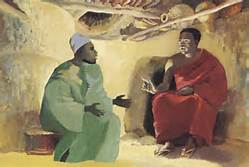
That’s the backdrop we have as we consider this extended conversation between the Rabbi Jesus and an unnamed Samaritan woman, right smack in the middle of the Samaritan region of the country. Typical Jews would not often cross through Samaria to get from the south part of the country—around Jerusalem, to the north part of the country—around Nazareth and the Sea of Galilee. For the Jews, this encounter was in the middle of enemy territory.

Let’s listen in on Jesus and this woman.

In Samaria Jesus came to a town named Sychar. Jacob’s well was there, and Jesus, tired out by the trip, sat down by the well. It was about noon. A Samaritan woman came to draw some water, and Jesus said to her, “Give me a drink of water.” (His disciples had gone into town to buy food.)

Here is the situation. Jesus has been walking all morning, wants water, and asks for a drink. I am not going to give a long explanation concerning why this woman came to the well when everyone else had gotten their water for the day. No, and I am not going to ask what kinds of behavior might be scaring the other Samaritan townspeople away. I will let you all imagine what kinds of things they might be.

Continuing with John 4: “The woman answered, “You are a Jew, and I am a Samaritan—so how can you ask me for a drink?” 10 Jesus answered, “If you only knew what God gives and who it is that is asking you for a drink, you would ask him, and he would give you life-giving water.” 11 “Sir,” the woman said, “you don’t have a bucket, and the well is deep. Where would you get that life-giving water? 12 It was our ancestor Jacob who gave us this well; he and his children and his flocks all drank from it. You don’t claim to be greater than Jacob, do you?”

According to common Jewish thought at that time, this was a “rotten, half-breed Samaritan woman.” Yet, she goes right to the heart of it, and unerringly puts her finger on the complication in this extended conversation. “Life-giving water:” what kind of water is that? Where does it come from?

Stagnant water sits in a cistern or barrel and harbors deadly bacteria. “Life-giving water” or “living water” means running water, like in a stream or river. “Living water, rushing over rocks, cleans us more thoroughly and is much safer to drink. We build settlements where living water flows at the surface, or where wells can be dug reaching to underground streams or springs of water.” [1]

The woman’s rhetorical question, “You’re not greater than Jacob, are you?” can also imply she is rather skeptical of this Jewish guy sitting by the well. 13 Jesus answered, “Those who drink this water will get thirsty again, 14 but those who drink the water that I will give them will never be thirsty again. The water that I will give them will become in them a spring with life-giving water and give them eternal life.”

15 “Sir,” the woman said, “give me that water! Then I will never be thirsty again, nor will I have to come here to draw water.” Ah. Jesus is upping the stakes, offering this woman living water, and even life-giving water that becomes a spring inside of each person. See how eagerly the woman responds?

16 “Go and call your husband,” Jesus told her, “and come back.” 17 “I don’t have a husband,” she answered. Jesus goes to the heart of the woman (and, the heart of the interaction) by broaching the highly personal subject of the woman’s husband. Some might say it was a sore spot. However, Jesus is revealing Himself further to this woman through this statement. Back to the story.

“Jesus replied, “You are right when you say you don’t have a husband. 18 You have been married to five men, and the man you live with now is not really your husband. You have told me the truth.” 19 “I see you are a prophet, sir,” the woman said.

20 “My Samaritan ancestors worshiped God on this mountain, but you Jews say that Jerusalem is the place where we should worship God.” 21 Jesus said to her, “Believe me, woman, the time will come when people will not worship the Father either on this mountain or in Jerusalem. 22 You Samaritans do not really know whom you worship; but we Jews know whom we worship, because it is from the Jews that salvation comes.

25 The woman said to him, “I know that the Messiah will come, and when he comes, he will tell us everything.” 26 Jesus answered, “I am he, I who am talking with you.”

Do you see the natural steps of interaction Jesus took with this woman? Her surprise at his asking for a drink of water changed to curiosity at the offer of living water. This further changed to wonder and amazement at Jesus knowing all about her past, and her several marriages. Finally, they reach the topic of religion, and Jesus tells her—in plain words—that He is, indeed, the Messiah. All in a short interchange.

In fact, when Jesus reveals Himself to this woman, He speaks the words “I am.” These words make explicit connections with the divine name in Exodus 3:14, which also confirm the words of the first chapter of the Gospel of John: “the Word was God.” In this way, Jesus fulfills this woman’s expectations of the Messiah and transcends them, at the same time. [2]

27 At that moment Jesus’ disciples returned, and they were greatly surprised to find him talking with a woman.” (Jesus, as a Jewish religious leader, was not supposed to talk with a woman in public, much less a Samaritan woman.) “But none of them said to her, “What do you want?” or asked him, “Why are you talking with her?”

28 Then the woman left her water jar, went back to the town, and said to the people there, 29 “Come and see the man who told me everything I have ever done. Could he be the Messiah?” 30 So they left the town and went to Jesus.

Here we have an evangelist. The first Christian missionary! She was so struck by what Jesus had just said to her that she had to go and tell others about it. What is more, she invited all her fellow townspeople to come and see! Come and see this man who told her everything she had done in her life.

Because of this woman’s witness, the number of people who believed in Jesus grows—and not just Jews! The “hated, rotten, half-breed” Samaritans believe, too! Jesus and His words challenge each of us, today.

How do you and I come to believe in Jesus Christ as our Lord, our Savior, our Messiah? Was there some life-changing moment in your life that softened your heart and changed your mind? What was it—what is it that causes us to want to go and tell everyone the Good News? Are we eager to tell others to “Come and see?” [3]

Are we so excited that we forget our water jars—or smart phones—or briefcases—or tool belts? It is important to share our witness and to tell our own story. Jesus encourages us to tell others to “come and see!” Come on, come closer. Come, see the One who knows everything about me, and loves me anyway!

Come and see!  

[1] https://www.umcdiscipleship.org/resources/planning-for-worship-during-lent-year-a-living-our-baptismal-calling

[2] Gail R. O’Day and The New Interpreter’s Bible Commentary (Vol. 10, The Gospel of John), (Nashville, TN: Abingdon Press, 2000), 568.

[3] https://www.umcdiscipleship.org/resources/planning-for-worship-during-lent-year-a-living-our-baptismal-calling

@chaplaineliza

(Suggestion: visit me at my regular blog for 2017: matterofprayer: A Year of Everyday Prayers. #PursuePEACE – and my other blog,  A Year of Being Kind . Thanks!)
Unknown's avatar

Faith, Birth from Above

John 3:1-17 – March 12, 2017

Jesus and Nicodemus, JesusMAFA

“Faith, Birth from Above”

Got faith? Really, do you have faith in anything? Perhaps, faith in electricity, to keep the lights and appliances working in our houses. What about faith in our doctors, or in the medical profession in general? Some people would say “yes” and others “not so much.” How about faith in the Chicago sports teams? That kind of faith is getting more and more difficult to keep up.

What about in our Scripture readings today? We have already heard about Abraham, and how he had faith in his God. In each reading, we have a person in our list of faith recipients. A person who tried to have faith and trust in someone or something outside of themselves.

Let’s take a closer look at Abraham’s situation. Reading from Genesis 12: “Now the LORD said to Abram, “Go from your country and your kindred and your father’s house to the land that I will show you.” Everything the Lord was saying sounded strange and unfamiliar. God did not even name the country where Abram was supposed to go.

Turning to John 3, Eileen and I acted out the encounter Nicodemus had with the Rabbi Jesus; let’s remind ourselves of that situation. “Now there was a Pharisee named Nicodemus, a leader of the Jews. He came to Jesus by night and said to him, “Rabbi, we know that you are a teacher who has come from God; for no one can do these signs that you do apart from the presence of God.”

Nicodemus was trying to have faith in someone or something, but faltering. That sounds a lot like us. Don’t we hesitate and falter sometimes, when trying to have faith?

“Jesus answered Nicodemus, “Very truly, I tell you, no one can see the kingdom of God without being born from above. Nicodemus said to him, “How can anyone be born after having grown old? Can one enter a second time into the mother’s womb and be born?”

This is a real puzzle for Nicodemus.  Added to that, Nicodemus had heard Jesus a number of times, thought He was right about a lot of things, but still was cautious.  Put yourself in Nicodemus’s situation. How would you like to be a big-shot teacher of Israel, well known not only among the common people, but also with his colleagues among the Pharisees? He brought his questions to Jesus at night when no one would see him and maybe make fun of him. [1]

Perhaps we are in a similar position, too, where some of us here are cautious or hesitant about finding out more about Jesus. For sure we are in the same boat as Abram: we don’t know quite where we are going, or where this new land really is.

This whole trusting-Jesus-business requires some faith.

Another way of looking at this is that we need to find a new perspective, too, like the Apostle Paul said about Abram in Romans, our New Testament reading today.

Leaving everything familiar to begin a new life? Going to an unknown land, you don’t even know where it is, or how far away? Look, Abram is not coming back. This is certainly no there-and-back-again journey. This is no pilgrimage, either.

I was fascinated to learn some things from one of the commentators. “On a pilgrimage, one sets out to a new place or a holy place to learn something and return where one came from with some new insight for living back home. Abram’s is to be a permanent relocation, something far more like the experience of the millions since Abram who have immigrated to other countries, including the vast majority of the population of the current United States or at least their ancestors.” [2]

I know some of you here are familiar with computers. You might even know how to “reset” or “restart” your computer with a CTRL-ALT-DEL move on a Microsoft Windows®-based computer. Maybe that was what Nicodemus really wanted to do. (It does get frustrating, being uncertain and unsure, not knowing where on earth we are going!) Let’s look at the situation from Jesus’s point of view. Jesus wanted to bring Nicodemus into a whole new world. He started talking about a new birth, or birth from above.

A sermon website I go to from time to time had a superb illustration. (I’m sorry, but I don’t know the name of the anonymous pastor.) “When I was a country pastor trying to get directions to a farm that I had never been to before, if the directions were complicated, the directions sometimes began with “you can’t get there from here.” It was their way of saying that starting from a different place would make the trip easier. Sometimes the best spiritual advice is like that — in order to get to life in the kingdom/reign of God, we have to start from a new place, a reborn place in our lives; and that we can’t get there (to the kingdom) from here (our life of sin apart from God). Nicodemus has trouble thinking that you can start from a new place, that you can’t take along all the history and baggage of the past — “how can these things be?” (vs. 9)” [3]

In computer terms, it is almost as if Jesus tells Nicodemus that he has to “reboot” — that he can’t run his program any more because there are too many error messages flashing in his life. We need, and God is ready to supply, an entirely different operating system.

Too true! Jesus offered the cautious Nicodemus more than a new perspective. It’s a new birth, and whole new world. And, how is he able to reach it? By faith, that’s how.

When God called Abraham, Abraham left everything he knew to move to a place that had not been named.  That is brave and bold.  That takes faith.

All that faith business is centuries in the past. Nicodemus lived when Jesus lived, and Abram lived a lot of centuries before that. What does all that have to do with today? With modern life, and with us here at St. Luke’s Church? Don’t we hesitate and falter sometimes, when trying to have faith? Today, Jesus would tell us the exact same thing.

Some people treat our relationship with God as something we earn by what we do, by “being good” or at least “not being bad” on the basis of some checklist of good or bad behavior. Have we reduced a life of discipleship to Jesus to morality and status instead of actual faithfulness to trust Him and follow where he leads every day? [4]

When we gather together our courage and go to see Jesus under the cover of darkness—like Nicodemus—He welcomes us. He enters into a relationship with us. We are in the same boat as Abram: we don’t know quite where we are going, or where this new land really is.

What about when we get to the end of that lifelong journey, and cross the River Jordan? There will be a welcoming party when we arrive in the Promised Land, for sure!

My original question at the beginning of the sermon: got faith? This whole trusting-Jesus-business requires some faith. The best part is that Jesus will help us. He understands our difficulties. He is patient, and will walk with us as we journey towards that new land. He’ll be right by our side in the valley of the shadow. Step by step, we strive to have faith in God.

What a Savior. What a Friend we have in Jesus. Amen.

[1] http://worshipingwithchildren.blogspot.com/2014/02/year-second-sunday-in-lent-march-16-2014.html 

[2] https://www.umcdiscipleship.org/worship/lectionary-calendar/second-sunday-in-lent4#bow

[3] http://desperatepreacher.com//bodyii.htmhttp://javacasa.com/resources/dps_form_results/jon3_1.htm

[4] https://www.umcdiscipleship.org/worship/lectionary-calendar/second-sunday-in-lent4#bow

@chaplaineliza

(Suggestion: visit me at my regular blog for 2017: matterofprayer: A Year of Everyday Prayers. #PursuePEACE – and my other blog,  A Year of Being Kind . Thanks!)

(Thanks so much to the good folks at UMC Discipleship.org! I am following their Lenten series. Their online Lenten sermon notes and worship helps are invaluable.)

Unknown's avatar

Into the Wilderness

Matthew 4:1-11 – March 5, 2017

jesus-temptation-wilderness

“Into the Wilderness”

Have you ever overheard a conversation at a restaurant where someone was absolutely raving about the food served? About how delicious it was, how well seasoned, or well prepared? The magnificent desserts, or the fantastic dishes? “Out of this world!” or, “It’s to die for!” I’ve even heard a few people say, “That was positively sinful!”

Enjoying our creature comforts so much, we are not able to focus on anything else. Not able to focus on each other, and reaching out to the needy, sick and hungry. Not able to focus on God, either, much less worship God’s name regularly.

Let’s go back to the beginning. Yes, back to the very beginning, the book of Genesis. Eileen just read for us several verses from chapters 2 and 3 of Genesis, where Adam and Eve are tempted by the Devil.

We find out that the garden from Genesis has everything a person could want—except for one thing. There is one prohibition: a tree in the middle of the garden. Adam and Eve already have been told never to eat from that tree. Never, ever, ever eat from that specific tree. (Or they—we—shall surely die.)

We all know the story. The Tempter comes to Eve in the form of a snake, plants doubt in her mind, and convinces her to eat the fruit of the tree. What’s more, she gives some to Adam and he eats. And because of this sin, this disobedience, Adam and Eve have to leave the Garden of Eden.

What got in the way between Adam and Eve, and God? Adam and Eve said “Yes” to the serpent. In saying “Yes” to the snake, they found themselves saying “No” to God. They renounced the God who created them, who loved them, and who gave them all things. And, they were sent into the wilderness.

In our Gospel reading this morning, we find Jesus led out into the wilderness to be tempted by the devil. For forty days Jesus fasts and prays, away by Himself, in the wilderness. Jesus was preparing Himself for His time of ministry ahead, as well. At the end of this time, the tempter comes to a weakened, depleted Jesus, and tempts Him. The devil tempts Jesus with food, with control, and with power. The devil very much wanted to get Jesus to say “Yes” to him, to say “Yes” to at least one of the temptations he brought to Jesus.

At the beginning of each Lenten season, each year, the lectionary readings begin with the Gospel reading of Jesus and the temptation. The devil tries very hard to get Jesus to say “Yes” to him and the phony, flashy, fake things he offers. And by saying “Yes” to the devil, Jesus would end up saying “No” to God. The devil wanted to get Jesus to renounce His heavenly Father.

The period of Lent as a time of fasting, penitence and self-examination was followed early on, in the church’s history. The Church Council of Nicaea in 325 discussed a 40-day period of Lent, but did not get that period codified at that point.

What was a common practice by that time was an extended period for people intending to prepare themselves for baptism on Easter Day. Yes, this did include fasting, penitence and self-examination, along with learning the catechism of the Church.

The rest of the congregation did not take it easy during this 40-day period. They had to fast, be penitent, and examine themselves, too. We still do this today, remembering Jesus and His time of fasting and penitence in the wilderness just before He began His ministry. A time when He renounced the devil and all his works and all his ways.

Renounce. Renounce what? This is a confusing term, for some. But—what gets in the way between us and God? What tempts us to turn from God and the good things God wants for each of us?  What does it mean for us to follow after Jesus, and to renounce the devil?

The first temptation was that of hunger. The devil tempted Jesus with bread. (And, not just physical hunger.) “It is about all of those things that we use in an attempt to fill ourselves up, to satisfy our many hungers. We have a problem with excess.  We eat too much.  We drink too much.  We buy too much.  We spend too much.  We have too much.” [1]

Augustine, that great saint of the Church, said there was a God-shaped hole inside of each of us. We try to fill that empty hole, that void, with all kinds of things. Both physical as well as spiritual.  “And the food and clothes and jewels, all the drugs and alcohol and sex and movies and vacations and entertainment and money and toys in the world, aren’t going to be enough to fill up that empty space inside us.” [2]

The second and third temptations are all about control and power. And, putting God to the test. Do we try to take control of our own lives? Or, how about micro-managing everyone around us? Do you know anyone who willfully, stubbornly goes off on their own, whose theme song is “My Way” by Frank Sinatra? Not following God, not putting themselves into God’s caring, loving hands. Perhaps making bargains with God?

The commentator says this week, “Do we worship our lifestyle? The (fill in your nationality) way? Military power? Economic domination? The rich and the famous? Football or [baseball or hockey or] other sports? The almighty dollar?” [3] What do we need to renounce in order to come back into a close, loving relationship with God?

We can take for our example how Jesus responded to the devil. Three different temptations, and three times Jesus responded with the Word of God.  

Do we remember baptism? Not necessarily our own baptisms, but the more recent baptisms that have happened here. Several months ago, I baptized Claire. Part of the liturgy for that service includes several questions. The pastor says the words “Will you encourage this child to renounce the powers of the devil, his works and ways, and to receive the power of new life in Christ?” The parents and the sponsors respond, “We will, with the help of God.”

It doesn’t matter where we are, we have promised, on our behalf or on our children’s, to encourage ourselves or our loved ones to renounce the devil. With the help of God, we will say “No” to the devil. It says so, right here in the service of baptism. That is exactly what Jesus did, at His temptation, and we’re encouraged to say “No,” too!

It can be as simple and straightforward as saying “No” to the tempter, to his works and ways, and saying “Yes” to God. Turning our backs on the tempting things that beckon to us, lure us in, and instead, following after Jesus.

Whether having to do with our bodies, desires, excess, addiction, power, control; in deserts, gardens, the country, cities, mountains—wherever we find ourselves, we need to consider renouncing the devil. Refusing to follow after the devil’s pied piper flute.  Lent is not just giving up chocolate or sweets, or meat on Fridays, but this is a special time to follow Jesus, to examine ourselves, and to learn and practice the works and ways of God.

Whether we are in the wilderness or not, I encourage all of us to follow after Jesus. Say “Yes” to God, and “No” to the devil and the seductive power of evil. And, God will be with us, in the wilderness, on the mountain, in the cities, wherever we are. Thank God! Amen.
[1] https://www.umcdiscipleship.org/worship/lectionary-calendar/first-sunday-in-lent7#preaching

[2] Ibid.

[3] Ibid.

@chaplaineliza

(Suggestion: visit me at my regular blog for 2017: matterofprayer: A Year of Everyday Prayers. #PursuePEACE – and my other blog,  A Year of Being Kind . Thanks!)
(Thanks so much to the good folks at UMC Discipleship.org! I am following their Lenten series. Their online Lenten sermon notes and worship helps are invaluable.)

Unknown's avatar

Be Reconciled to God

2 Corinthians 5:20b – March 1, 2017

2-cor-5-20-reconciled-words

“Be Reconciled to God”

Saying “I’m sorry.” People can say “I’m sorry” for all kinds of things, from stepping on the back of your shoe on accident, to crashing into your car and totally destroying it. Sometimes, people think it is okay to accept an apology, and other times, it isn’t.

Did you ever think what God’s thoughts are? On us, saying “I’m sorry” so often, for almost everything, it seems? How does God feel when people ignore God’s rules for days, weeks, even years—and then, once one of God’s big rules—the Ten Commandments—get broken, people sometimes say, “I’m sorry.” And then, expect everything to be all right with God!

It was kind of that way with King David. He was a powerful king later on in his reign, commanding great armies that conquered large areas surrounding Israel. As with many really powerful people, David felt more and more like he was an absolute ruler, and nobody could give him counsel, or tell him “No, you can’t do that,” or “That’s a bad idea.”

Remember how King David saw the young, beautiful Bathsheba, wife of one of his generals, Uriah? Uriah and the rest of the army were away fighting a war, and King David had Bathsheba brought to him. King David slept with the beautiful Bathsheba, she became pregnant, and David ultimately had his general Uriah killed because he wanted to cover up his sin.

But, God knew what happened. Eventually, God told the prophet Nathan, and then everyone in Israel found out what happened, too. And, the baby died shortly after he was born.

King David was devastated. As a result of his grief and shame and guilt, he wrote Psalm 51. This is most of that psalm. I want everyone to listen for the grief David feels, as well as his guilt, and sadness at disappointing God, and how he says “I’m sorry” to God.

51 Be merciful to me, O God, because of your constant love.
Because of your great mercy wipe away my sins!
Wash away all my evil and make me clean from my sin!

I recognize my faults; I am always conscious of my sins.
I have sinned against you—only against you—and done what you consider evil.
So you are right in judging me; you are justified in condemning me.
I have been evil from the day I was born; from the time I was conceived, I have been sinful.

Sincerity and truth are what you require; fill my mind with your wisdom.
Remove my sin, and I will be clean; wash me, and I will be whiter than snow.
Let me hear the sounds of joy and gladness;
and though you have crushed me and broken me, I will be happy once again.
Close your eyes to my sins and wipe out all my evil.

10 Create a pure heart in me, O God, and put a new and loyal spirit in me.
11 Do not banish me from your presence; do not take your holy spirit away from me.
12 Give me again the joy that comes from your salvation, and make me willing to obey you.
13 Then I will teach sinners your commands, and they will turn back to you.

For millennia, the Hebrew Scriptures and the New Testament traditions have highlighted  this penitential attitude. King David’s eloquent request for God to hear him and forgive him stands as one of the most moving expressions of “I’m sorry” ever penned.

But, what if people can’t quite relate to rich and powerful King David? What then? What if David seems too high and mighty, or a bit too distant, too removed? I was just a mom and a housewife for years, before I went to graduate school in my forties. I didn’t think I had much at all in common with David.

Or, did I? You and I all know that people have a tendency of being self-sufficient, self-involved, going their own way, pushing others away, and often not particularly caring about others. God has a name for this kind of attitude, and it is sin. I bet you can recognize it.

“I don’t need any help! I can do it on my own! I’ll do it my way! I don’t need God. I don’t need anybody else meddling in my business, either.”

You and I—we may not have openly been involved in adultery, or murder, or a cover-up on the scale of a congressional investigation, like King David. But, that does not matter to God. Sin is sin. We have been talking about sin for the past few weeks, in our services centered around Jesus and His messages from the Sermon on the Mount. Jesus always wanted us to focus on our inside attitude and reception to God.

It is that sinful, selfish attitude that separates people from God. And what’s more, it separates people from one another. It is a barrier that separates each individual from every other individual. However, let’s look at this verse from 2 Corinthians 5. “God is making His appeal through us; we entreat you on behalf of Christ, be reconciled to God.”

Did you hear? God wants to overcome that barrier of our sin, of self-involvement and self-sufficiency. Paul says that God took all our sin and put it on Christ, so that we could be clothed with His sinless righteousness.

“In Christ, God was reconciling the world to Himself, not counting their trespasses against them.” So, God is not counting trespasses! God is merciful and forgiving! God wants to be reconciled to us! God’s arms are indeed open wide! Our Lord wants us to come close.

Paul says, “Now is the acceptable time. Today is the day of salvation.”

God is waiting with open arms. We can’t receive God’s forgiveness if we aren’t familiar with God ourselves. Do you know Jesus? Are you close to Him?

Now is the acceptable time. Now is a good time. God is waiting.

@chaplaineliza

(Suggestion: visit me at my regular blog for 2017: matterofprayer: A Year of Everyday Prayers. #PursuePEACE – and my other blog,  A Year of Being Kind . Thanks!)
 

Unknown's avatar

Terrified!

Matthew 17:1-9 – February 26, 2017

imandoa001p4

“Terrified!”

When my children were young, I would always read them a bedtime story, every night. That was part of our process of going to bed. Sometimes I’d read chapters from books like Winnie the Pooh or the Wizard of Oz, and sometimes storybooks or fairy tales from the library. Some of the stories would have some really scary things in them! A little like the Gospel reading from Matthew, today, where the three disciples were terrified on top of the mountain! There are certain things that scare us almost to death. But, I am getting ahead of myself.

In many of the stories we know, some people often like to find a character they can relate to. A sympathetic character, or one who displays some qualities each of us might have. Who hasn’t been frightened, like Piglet, or puzzled, like Pooh Bear, or excited, like Tigger? In today’s Gospel reading, we have several characters. Is it possible to find some similarity in one of these characters, some characteristic that each of us might share, or be able to relate to?

In today’s Gospel reading, we have Jesus, and we have Peter, James, and his brother John. Jesus takes them up a trail on a mountain, up to the top. There, they have a stunning, supernatural encounter.

That day does not start that way. That day was probably like many other days among Jesus and His group of followers. Hectic, a bit crowded, perhaps even some people already waiting in line to see the Rabbi, have some prayer, even hoping for a healing. Unknown to everyone else, Jesus slips away with the three disciples.

Remember how we often choose a character from a story and try to relate to them, or find some similarity with a characteristic of theirs? I thought one of the commentators on this Gospel passage had some excellent points. Alyce McKenzie said: “If you know what it is like to be tired, to have people seeking you out for what you can do for them, and other people criticizing you and working against you, if you have ever been filled with dread at what lies ahead, you have a little something in common with Jesus. If you know what it’s like to feel those things as a direct result of serving God, then you have even more in common with Jesus.” [1]

While this little group is climbing the mountain, I suspect these three disciples are a bit proud that their Rabbi Jesus has singled them out, amidst all of the other disciples and followers. Wouldn’t you be proud? Perhaps, even congratulating yourself that you are a confidant of Jesus?

After the four people reach the mountaintop, something happens. Now, remember, Peter, James and John are not used to watching television or movies. They do not know anything about fancy costumes that look like they come from outer space, or special effects with light and fireworks, or super sound systems like we have in the United States, today.

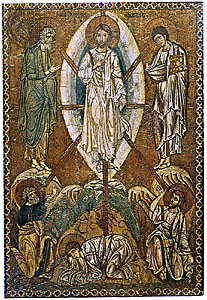
Just imagine people like Peter, James and John, having no concept of any of these modern things. Next, I invite you to close your eyes. Try to put yourself in the company of the three disciples, on top of the mountain, in your mind. Are you there? “There was Jesus, transfigured before them. His face shone like the sun, and his clothes became as white as the light. Just then there appeared before them Moses and Elijah, talking with Jesus.”

I can think of at least a dozen supernatural encounters—right off the top of my head—in both the Old and the New Testaments. You know, where people come face to face with angels, or hear the voice of God, or see the burning bush. Here on top of the mountain, these three disciples already knew that Jesus was a man from God. Only a few days before, Peter had even testified to that fact that Jesus was the Messiah, the promised One of God.

In all of these supernatural encounters throughout the Bible, angels always say “Don’t be afraid!” to whomever they meet. I bet when the angels break in to the everyday, ordinary world, that must be the scariest thing those people have ever seen! Even though Peter, James and John had walked with Jesus, learned from Jesus, and lived with Jesus for many months, by this time, I suspect they are scared at the events that are happening!

We have Jesus—transfigured, or literally translated from Greek, metamorphoomai, the verb “to undergo a metamorphosis.” We are not quite sure exactly how Jesus looked, except that we are told He glowed with a glory reserved for angels, for things from heaven. It’s as if a switch were flipped, and Jesus was lit from the inside with bright, white super-sunshine.

Is it any wonder that Peter started babbling, and said the first thing that came into his head? “Um, Lord, it is good that we are here. Look, look, I’ll put up three booths, or tents, so we can worship You and Moses and Elijah right here!” Good old foot-in-mouth Peter. Sure to speak before he thinks, letting his mouth run away with him. (Does that sound like anyone you know? Is that a situation in this story that you especially relate to?)

The bright and shining Jesus was talking to Elijah and Moses. Remember Moses, and how he had led the people of Israel for forty years around the wilderness? Yes, “Moses, who had seen God face to face on Mt. Sinai, the Mount of Revelation, and whose face had shone.” Dr. Alyce McKenzie tells us “that Moses hadn’t wanted to be a prophet in the first place and had made excuses to God to get out of it. (If you know what it’s like to make excuses to God, you have a little something in common with Moses.)“ [2]

But, wait! There’s even more! “While Peter was still speaking, a bright cloud covered them, and a voice from the cloud said, “This is my Son, whom I love; with Him I am well pleased. Listen to Him!” If you thought the appearance of Jesus in radiant form wasn’t enough, imagine the stentorian voice of God booming all around! This is it. Right here.

Can you imagine Peter, James and John even more afraid than they were before? Absolutely terrified? They fall on their faces at this heavenly voice. It isn’t even a sound system, with squawking speakers all around, but instead the resounding voice of God from heaven.

And then—everything supernatural goes away. It’s all over. Only Jesus remains, in His normal, everyday clothes.

I can tell you how Peter remembered this awesome, terrifying experience, several decades later. He writes to his fellow believers in a letter, “18 We ourselves heard this voice that came from heaven when we were with him on the sacred mountain.” But then, Peter couldn’t stay on the mountaintop forever, worshiping the Lord. Peter—and James, and John—needed to come down into the real world, into the mundane, every day. And, do the real, sometimes difficult, work of God’s kingdom.

Remember what I said about characters in a story, and about us finding some similarity in one of these characters, some characteristic that each of us might share, or be able to relate to?

Whether we are up on the mountain today, with the bright shining, heavenly Jesus, or down on the earth in a sad or difficult place, the love of Jesus shines in our hearts. Jesus remains.

He is with us, just as He promised. Not “maybe,” not “I wish so, or “I hope so.” But, Jesus promises to be right by our sides, always, through thick and thin, through good times and bad. “In Him we behold what we want to become. In us Jesus lives as a presence that empowers us to become what God would have us become.” [3]

And for that, we can surely say “alleluia, amen!”

[1] http://www.patheos.com/Resources/Additional-Resources/Finding-Ourselves-in-the-Story-Alyce-McKenzie-02-25-2011

[2] http://www.patheos.com/Resources/Additional-Resources/Finding-Ourselves-in-the-Story-Alyce-McKenzie-02-25-2011

[3] http://www.patheos.com/Resources/Additional-Resources/Finding-Ourselves-in-the-Story-Alyce-McKenzie-02-25-2011

@chaplaineliza

(Suggestion: visit me at my regular blog for 2017: matterofprayer: A Year of Everyday Prayers. #PursuePEACE – and my other blog,  A Year of Being Kind . Thanks!)

Unknown's avatar

Love Your Enemies

Matthew 5:43-48 – February 19, 2017

matt-5-44-love-enemies-pray

“Love Your Enemies”

Rules are good things. Rules help us to know what are good things to do, or prudent actions to avoid. Rules—or laws—or commands give us guidelines for how to behave, and what is or is not acceptable. You all know the rules of the road, and traffic laws we need to follow. We have codes of conduct and ethical guidelines for different professions. All of these are rules, laws, codes. Commands.

Moses talked about commands, too. The Ten Commandments, and an elaboration of the big ten, too. That’s what we have for our Old Testament reading today. We used a modern translation, Eugene Peterson’s The Message, to give us a fresh understanding of this important part of God’s rule book, or God’s guidelines for living.

There are 613 laws—or rules—or commands—in the Law of Moses, in the Hebrew Scriptures. In the last few weeks, our Gospel readings have Jesus starting with a big law from Moses’s Law Code, and then elaborating on it. Not reciting the law by rote, like some child at school, but much more than that. Jesus transcends the Law of Moses, every time.

Like last week. Remember what Jesus said in Matthew 5:21? “You have heard that it was said to those of ancient times, ‘You shall not murder’; and ‘whoever murders shall be liable to judgment.’” He quickly followed with Matthew 5:22—”But I say to you that if you are angry with a brother or sister, you will be liable to judgment; and if you insult a brother or sister, you will be liable to the council; and if you say, ‘You fool,’ you will be liable to the hell of fire.”

Transcending the Law of Moses, with additional information. Jesus was talking about the inside job, about how people’s feelings translated to their outward actions. Today’s reading from Matthew 5 goes even further. How does Jesus begin? In verse 43: “You’re familiar with the old written law, ‘Love your friend,’ and its unwritten companion, ‘Hate your enemy.’ I’m challenging that.”

We all know how children scuffle and argue together. Imagine a playground or the park in your mind, with a group of kids. Two of them start arguing. The argument escalates. Soon they are name-calling, first one, then the other. Then, they start pushing one another. They push harder, and more vigorously. Before you know it, punches start flying. Maybe the friends on both sides get involved, and we have an outright brawl on our hands.

What did Jesus say, again? “You’re familiar with the old written law, ‘Love your friend,’ and its unwritten companion, ‘Hate your enemy.’ I’m challenging that.” And then, Jesus goes a step—or three—further. He adds: “I’m telling you to love your enemies. Let them bring out the best in you, not the worst. When someone gives you a hard time, respond with the energies of prayer.” This may well be the hardest thing that Jesus ever told us to do.

We can tell, from specific examples in the surrounding verses, that Jesus was thinking about the occupying Roman forces. He gave several examples of how His listeners ought to act when confronted by Roman soldiers, and made some recommendations on how to respond. Positively, courteously, and not in a retaliatory way! Turn the other cheek; don’t hit back. Give the soldier your cloak, and the shirt off your back, too.

Jesus said—in extremely plain language—we are not to retaliate. Not to escalate things, or make things bigger, or worse, or to blow things out of proportion. Jesus said “Love your enemies.”

Here is the parallel passage from Luke 6:32-33, where Jesus is also preaching. “27 “But to you who are listening I say: Love your enemies, do good to those who hate you, 28 bless those who curse you, pray for those who mistreat you.32 “If you love those who love you, what credit is that to you? Even sinners love those who love them. 33 And if you do good to those who are good to you, what credit is that to you? Even sinners do that.”

I know this may be difficult for us. But—what part of this rule do we not understand? Or, is it just really, really challenging for us to live up to this particular command of Jesus? This is part of God’s rule book. This is the ultimate. The pinnacle. This is the last of the laws from the Law Book of Moses that Jesus quotes here, and then goes even further in His interpretation.

We sit, in our safe, warm church, looking back at the first century. We consider Jesus, talking about the occupying Roman forces. They had the whole nation of Israel under their collective thumb. But, we aren’t under occupation, being crushed by enemy forces or living under martial law. However, the nation of Israel was. What’s more, Jesus knew it, very well. Even more than that—Jesus gave these commands, or rules, for believers to follow, with full knowledge of the land of Israel being under occupation.

One of the commentators I consult regularly had this example listed for the Gospel reading today. Carolyn Brown describes a children’s book called The Christmas Menorahs: How A Town Fought Hate, by Janice Cohn. She tells us, “A hate group threw a rock through the bedroom window of a Jewish boy in Billings, Montana.  There was a menorah lit in the window.  In response, the children of the town drew menorahs to put in their own windows.  The local newspaper printed a full page menorah for other families to color in.  It was the community’s way of standing up to a bunch of bullies.” [1]

Thus, a loving, non-violent, empowering way of standing up for someone being bullied. Of loving one’s enemies, just like Jesus said.

“The book includes the legend about the King of Denmark wearing a yellow star when the occupying Nazis decreed that all Jews must wear a yellow star.” [2]

I remember what a dear senior friend of mine told me, who grew up in the hilly region of France not far from Switzerland. She was a child during World War Two. A number of unaccompanied Jewish refugee children were being housed in their small town. A very devout, Christian town, let me add. The occupying Nazi forces demanded that the Jewish children wear the yellow stars of David, indicating they were Jewish. My friend’s mother sewed yellow stars for every child and young person in that town. They all wore the yellow stars, every day, whether Jewish or Christian. That is how they combatted the Nazi occupying forces, using peaceful, non-violent means. (And, they saved the lives of every Jewish child in that small town.)

Remember what Jesus said in response to the question: “But, who is my neighbor?” Jesus told the parable of the Good Samaritan, and the Jewish people could not stand the Samaritans! Jesus knew that! Yet, that was just His point.

Is it difficult to show love to our enemies? To those who hate us? Yet, this is exactly what Jesus calls us to do. This is right up at the top of God’s rule book, right next to “Love God with all your heart, mind, and strength, and love your neighbor as yourself.”  Including our enemies. Including whomever is a Samaritan to each of us.

Yes, loving our enemies is difficult, and challenging. It’s difficult for me, and I suspect it’s a challenge to a number of others here, too. But, God will help us. All we need to do is ask God for help with loving others who are difficult for us to love.

Listen to the words of Jesus, finishing this Gospel passage: “48 “In a word, what I’m saying is, Grow up. You’re kingdom subjects. Now live like it. Live out your God-created identity.” We already know what to do and how to live. Let’s go out, and live like it.

Alleluia! Amen!

[1] http://worshipingwithchildren.blogspot.com/2014/01/year-seventh-sunday-after-epiphany.html Worshiping with Children, Epiphany 7, Including children in the congregation’s worship, using the Revised Common Lectionary, Carolyn C. Brown, 2014. 2011.

[2] http://worshipingwithchildren.blogspot.com/2014/01/year-seventh-sunday-after-epiphany.html Worshiping with Children, Epiphany 7, Including children in the congregation’s worship, using the Revised Common Lectionary, Carolyn C. Brown, 2014. 2011.

@chaplaineliza

(Suggestion: visit me at my regular blog for 2017: matterofprayer: A Year of Everyday Prayers. #PursuePEACE – and my other blog,  A Year of Being Kind . Thanks!)
Unknown's avatar

Anger and Insults

Matthew 5:21-26 – February 12, 2017

matt-5-22-words

“Anger and Insults”

Have you ever met someone who flew off the handle about the least little thing? I mean, got angry at the drop of a hat? People get angry about all kinds of things. Big things, little things, serious things, even funny things. Like, getting cut off in traffic, or getting passed over for that promotion. Or what about when your shoelace snaps as you’re late for an appointment? What about other people, like when they spill juice all over the kitchen floor? Or when someone does something stupid and thoughtless at work? Doesn’t that just make your blood boil? Sometimes?

Anger happens to all of us, to all different kinds of people. Adults, teenagers, and children, not just once, or twice, but many more times than that. In our Gospel reading today, Jesus has some pointed words for anger and insults. Serious, too.

Let’s start where Jesus starts: the Law of Moses, and specifically, the big ten, or the Ten Commandments found in Exodus 20. That is one place Jesus refers to here in Matthew 5:21. “You have heard that it was said to those of ancient times, ‘You shall not murder’; and ‘whoever murders shall be liable to judgment.’”

I am certain the people Jesus was talking to knew what the Law of Moses had to say about murder. Except—the Law of Moses did not say anything about getting angry. (Not in any of the 613 laws found in the Hebrew Scriptures.) What does Jesus say about getting angry?

Matthew 5:22—”But I say to you that if you are angry with a brother or sister, you will be liable to judgment; and if you insult a brother or sister, you will be liable to the council; and if you say, ‘You fool,’ you will be liable to the hell of fire.”

Whoa! Those words are extremely serious! Jesus takes murder, on one hand, and compares it with anger. What is more, He says they are just as bad as each other!

If we take Jesus’s words as Gospel truth, we are in a sorry state. Everyone gets angry, sometimes. What are we to do?

Dr. Scott Hoezee has a paraphrase that packs a punch: “You haven’t stabbed anyone through the chest or shoved someone to his death off a cliff?  Good for you, but when in your anger you told Harold last week to go take a flying leap, in God’s eyes the ‘Do not murder’ command snapped quite cleanly in two in your life.” [1]

Jesus took the Law of Moses, from the Ten Commandments, and went beyond it. Far beyond it! He did not merely repeat the Law, like any of the scribes and teachers of that day did. Jesus transcended the Law of Moses.

How radical is that? I’ve said it before, and will say it again. Jesus was indeed a radical. He was subversive, never saying or doing what the established religious folks expected. Here, in this passage, Jesus was talking about the inside job, about how people felt on the inside—and how that translated to their outward actions.  

How did we start our service today? After the opening hymn, we had our children’s time, and I started talking about anger. Then—we had a prayer of confession. We confessed our anger, and asked God to forgive us when we get angry.

Let’s go one step further, and turn to another of the commentators, Karen Georgia Thompson: “The comparison is clear. Murder is serious and so is anger. There is a need in this first-century church to look at relationships and how individuals treat each other. There is a value to life and how we value the lives of others.” [2] Over and over again, Jesus talks about relationships, and how we are to act and speak in relationships. Here, Jesus goes one step further and even tells us how we are to think, in a way that will be pleasing to God.

Remember, relationships are more than one-dimensional. Sure, there are relationships on a horizontal level, between individuals, and even between groups of people. But Jesus is talking about the vertical relationship, too. The relationship between me and God, each individual and God. And, our joint relationship between all of us as a congregation and God. It’s quite a sobering thing, when we consider Jesus’s words in this light.

Eugene Peterson translates verse 22 as “Carelessly call a brother ‘idiot!’ and you just might find yourself hauled into court. Thoughtlessly yell ‘stupid!’ at a sister and you are on the brink of hellfire.” So, our angry words and thoughts towards others do great harm to our insides.

Jesus is serious when He refers to calling someone “stupid.” “He uses a term that calls into question the other person’s morality–it might be the equivalent of calling someone “a dirty rat,” someone you don’t trust for a second.” Another way of looking at it? Jesus is decrying our belittling of people’s mental powers and our belittling of their moral status. “Let your anger get the best of you in simmering grudge-bearing,” Jesus says, “and sooner or later you’ll start to denounce the people around you as stupid and immoral–as not worthy of your time.” [3]

That is not the kind of relationship Jesus wants us to have! Not with our neighbors, not with those in the church. Not with those in our community, and not with those on the other side of the state line, or the country’s border, or the ocean. What did Jesus say? Quoting from the Message again: “If you enter your place of worship and, about to make an offering, you suddenly remember a grudge a friend has against you, abandon your offering, leave immediately, go to this friend and make things right. Then and only then, come back and work things out with God.”

We have been shocked, and warned. We are all scared down to our shoes by the words of Jesus. What is our next step? What does Jesus say? Jesus gives us some really valuable advice. Action steps, if you will. Jesus does say not to wait too long to do this! We can name the problem that makes us angry and figure out something to do about it.  The Gospel of Matthew says, “be reconciled” with the person who made you angry. That means work it out with them. Figure out how to solve the problem, or the quarrel, or the bad feelings between you. That is not easy. Frequently it helps to get advice or help from other people. [4]

I have known people who hold grudges for years, even decades. On the block where I grew up, two neighbors had a huge fight with each other. One of the neighbors was a sour old man who lived alone. He built a grudge fence, eight feet high, so he would not have to see his neighbor’s yard—less than six feet from his house. The grudge fence stood until he died.

This Gospel reading reaches right out of the Bible and shakes us up. We can even be interrupted in church. If we remember a grudge in the middle of a worship service, Jesus tells us to go, and make it right. Apologize, if we need to. (And, Jesus will help us.)

Right relationships come from the heart. Jesus doesn’t say this until later in the Gospel, but now is a great time to remember: Love God, and love your neighbor as yourself. Which neighbor? The neighbor we are angry at. The family member we called “idiot.” Say we are sorry. Apologize. Then, God will truly be pleased with us, and with our worship.

Alleluia, amen!

[1] http://cep.calvinseminary.edu/sermon-starters/epiphany-6a/?type=the_lectionary_gospel February 06, 2017 The Lectionary Gospel —  Matthew 5:21-37, Author: Scott Hoezee


[2] http://www.ucc.org/worship_samuel_sermon_seeds_february_12_2017  “Heartfelt,” Karen Georgia Thompson, Sermon Seeds, 2017.


[3] http://cep.calvinseminary.edu/sermon-starters/epiphany-6a/?type=the_lectionary_gospel February 06, 2017 The Lectionary Gospel —  Matthew 5:21-37, Author: Scott Hoezee

[4] http://worshipingwithchildren.blogspot.com/2014/01/year-sixth-sunday-after-epiphany-sixth.html Worshiping with Children, Epiphany 6, Including children in the congregation’s worship, using the Revised Common Lectionary, Carolyn C. Brown, 2014. 2011.

@chaplaineliza

(Suggestion: visit me at my regular blog for 2017: matterofprayer: A Year of Everyday Prayers. #PursuePEACE – and my other blog,  A Year of Being Kind . Thanks!)


Unknown's avatar

The Light on This Corner

Matthew 5:14-16 – February 5, 2017

matt-5-14-light-city-at-night

“The Light on This Corner”

Remember the holiday we celebrated here in this church, just a few weeks ago? The birth of the baby in Bethlehem. Foretold by prophets, welcomed by angels. I mean Christmas, the coming of God’s light into a dark world.

Just think about light, for a moment. When you walk into a dark house late at night, what is first thing you do? Turn on the lights. When the electricity shuts off during a power outage one dark and stormy night, what is the first thing you do? Find a flashlight or a candle and light it. Light is not only comforting, but useful. Light helps us in any number of ways. Helps us to see, allows us to work and read and go about our activities in what would otherwise be a dark and scary situation.

Jesus talked about light here in today’s Gospel reading, too. But before we get into His words about light, where does this reading coming from? These words are from the beginning of the Sermon on the Mount at the beginning of His public ministry. Another way of looking at this long address is a long lecture on God’s view of a lot of things. Important things, with a lot of real-life illustrations.

Our bible study on Wednesday mornings has just started a study on the first verses of Matthew 5, the Beatitudes, what comes just before these verses today. I won’t talk about the Beatitudes, since each sentence, each blessing of those deserves a whole sermon all by itself. We go on to these verses about salt and light, which the Rabbi Jesus places here, after the Beatitudes.       We could say more about salt (which is important, and tells us a lot about what Jesus thinks about the part we take in our world). However, I wanted to focus on Jesus’s words about Light. He says, You are the light of the world. A city built on a hill cannot be hid.

What did we sing right before the sermon started? “This Little Light of Mine.” When we held our lights up, do you know what that reminded me of? Remember back to Christmas Eve? For the closing hymn of that service, we sang “Silent Night.” We all held candles and sang. We held those candles as a symbol or sign of God’s light within each of us, God’s light that shines among us.

Jesus had a definite point to His words. We are light. Right now.

However, there is a definite temptation for many followers of Jesus. Some are tempted to make these words of Jesus a rigid requirement, as if Jesus were a stern, mean drill sergeant. Communicating with sarcasm, shaming. Shaking His finger at us and shouting, “You’d better be light!” Or a little less severe: “If you want to be light, do this!” Or even, “Before I call you light, I’ll need to see this from you.” [1]

Does that sound like Jesus? Truly? Would He ever use shame, guilt, and sarcasm?

That is most certainly not the way Jesus communicates here. As commentator David Lose says, “Rather, He says both simply and directly, “You are the light of the world.” It is, as with last week’s Beatitudes, sheer blessing, commendation, affirmation, and commissioning.” [2]

Dr. Lose reminds us of the statistics about a child’s self-esteem compared to what kind of messages they hear. When elementary-aged children hear one single negative message about themselves—like, “you’re mean!” “how stupid!” “you can’t do anything right!”—psychologists suggest that the children need to hear ten positive messages to restore their sense of self-esteem to where it had been previously. [3] That is, to correct the internal emotional and psychological balance of the children, and cause them to have a positive, healthy self-image.

“Children, to put it another way, become what they are named. Call a child bad long enough, and he or she will believe you and act bad. Call a child (or teen or adult for that matter) worthless or unlovable or shameful, and eventually he or she — all of us! — will live into the name we’ve been assigned. In the same way, call us good or useful, dependable, helpful, or worthwhile, and we will grow into that identity and behavior as well.” [4]

That is exactly what Jesus is doing here! He is calling us—naming us—light. We are—all of us—light of the world. The light of a city on a hill, shedding light to the whole community. Yes, Jesus wants us to be that light. He is calling us to grow into that identity and behavior! That same light of God we held up on Christmas Eve? The light of God that came into the world as a Baby born in Bethlehem? This is the same light that Jesus is talking about here. It’s the light of a city on a hill, and the light for the nations, that the prophet Isaiah talks about.

We aren’t required to do ten impossible things before breakfast to just break even with God, and try to get in line for a chance to reach for the light. It isn’t hoping that someday, maybe, we might finally become that light. We aren’t hiding our lights under a bushel, either.

We are that light! Now! And, we are holding it high! Why? Because, Jesus says so!

Janet Hunt, a Lutheran pastor from DeKalb, about an hour west of here in Morton Grove, has this real-life illustration about letting the light of God shine.

About two weeks ago, she met with the director of Hope Haven, the homeless shelter in DeKalb. The director told Pastor Hunt that the homeless shelter is the second largest housing facility in the county for the mentally ill (after the county jail for DeKalb County). Pastor Hunt was cut to the heart when the director told her the homeless shelter had to ration toilet paper, because of severe funding cuts. (Imagine, rationing even toilet paper.)

This is what Pastor Janet Hunt’s Lutheran congregation is going to do for the month of February. She said, “we will be collecting toilet paper and giving it to some of the most vulnerable among us. And maybe this will give us a way to begin a conversation about why it is so that the jail and the homeless shelter appear to be the only options in our neighborhood for people who are so fragile. Maybe we can start to shine light on this and them even in a time when too much of the world seems to care so little for such as these. And maybe that shining light will serve as both beacon and promise to our neighbors — both those who are so vulnerable and those who have extra toilet paper to share.” [5]

This might just be a little thing her church can do. Little to them, but huge to the people at the homeless shelter. This is surely a way to let the residents and the employees at Hope Haven know that someone cares. Someone is listening, and caring, and doing something.

Dr. Hunt’s illustration is a tremendous tie-in with Micah 6:8 from last week’s sermon! Do justice and love mercy/kindness/chesed for these homeless people in DeKalb, and shine the light of God. In the same way, we can let our lights (or, the Light of God) shine here in Morton Grove so that others will see it and rejoice. A city build on a hill shines its light for all to see. This church on this corner shines its light for all to see in this community, as well.

Where have you seen the light of God, lately? How can you let your light shine, today? How can you make a difference in someone’s life, even if it is small? I have a list of some kind, loving things you and I can do, each and every day. We can BE what Jesus calls us: light to the world. Light to our community. We can all live into God’s affirmation, trust, and love and BE God’s light to everyone we meet. Alleluia, amen.

[1] http://www.workingpreacher.org/craft.aspx?m=4377&rp=blog53&post=1543 “Salt and Light,” David Lose, Dear Working Preacher, 2011. (Italics mine.)

[2] Ibid.

[3] Ibid.

[4] http://www.workingpreacher.org/craft.aspx?m=4377&rp=blog53&post=1543 “Salt and Light,” David Lose, Dear Working Preacher, 2011

[5] http://dancingwiththeword.com/you-are-the-light-of-the-world/  “You Are the Light of the World,” Janet H Hunt, Dancing with the Word, 2017.

@chaplaineliza

(Suggestion: visit me at my regular blog for 2017: matterofprayer: A Year of Everyday Prayers. #PursuePEACE – and my other blog,  A Year of Being Kind . Thanks!)

Unknown's avatar

What the Lord Requires

Micah 6:6-8 – January 29, 2017

micah-6-8-word-cloud

“What the Lord Requires”

Many people have very particular ideas about how to do things. Ask the editors at Vogue or GQ, or other high fashion magazines, and they will tell you precisely how a well-dressed person ought to look. What about Emily Post, Miss Manners, and Ann Landers? Don’t they let everyone know how to act and how to behave in polite society, in just about any situation?

What about the police and lawyers, and what is legal or not? Aren’t there basic rules and requirements for behavior and actions in this community? You and I have a right to wave our arms as much as we like. Except—my right ends where your nose begins. And what about public intoxication? Drunk and disorderly? There are many examples I could mention about recommended behavior.

Welcome to our mainline American culture, here in the 21st century. I’m not even going to go into the multitude of different cultures and the differences of practice and of culture, world-wide. Yet, many people have quite particular ideas about how to do things, and what types of activity are recommended, even required.

One of our Scripture passages today gives us a short list of what the Lord recommends for each of us. A summary statement, if you will. Let’s read Micah 6:8: “God has told you, O mortal, what is good; and what does the Lord require of you but to do justice, and to love kindness, and to walk humbly with your God?”

Let’s unpack that summary statement, and take a look at the two verses that come before. Verse 6: “With what shall I come before the Lord, and bow myself before God on high?” This is a sincere question, I believe. It’s sincere for the prophet, and sincere for all of us here today. What is the best way to come before God? How can we come to the sanctuary, to the holy place? Who may approach God? What kinds of things do we all need to do (and say, and think) to be acceptable and worthy in the sight of the Most High God?

These verses do not concentrate on what we ought to wear. Different people wear different things, depending on their culture, their context, and their preferences. At some churches, the minister wears super-fancy robes (like at my priest friends’ Episcopal churches in Maryland and Virginia). I have several friends who attend church in Chicago at a very youth-oriented congregation. Their minister wears blue jeans and an open-collared shirt for a Sunday morning service. Clothing choice is NOT what this sermon is about. The choices of what we do with our lives, how we treat each other and live together—this IS what the prophet is talking about here.

What does the Lord require of us, anyway?

Some people and some churches think God wants a showy service, and spectacular offerings. As one of the commentators said, “Perhaps our worship is wrong; perhaps we have not been serious enough in our acts of praise? “What do you want, Lord? Burnt offerings, year-old calves, thousands of rams, tens of thousands of rivers of oil?” (6:6b-7a) [1]

In the time the prophet Micah wrote, a small portion of people did not stop there. They went even further. Listen: “Shall I give my firstborn for my transgression, the fruit of my body for the sin of my soul?”

Yes, sometimes, in the Old Testament times, when people from other tribes and nations thought they had sinned so severely—so grievously that their god could never, ever forgive them, they would actually turn over their firstborn to the temple. In some cases, their firstborn would even be killed by the priests. (This was NOT in Israel. The Lord considered this practice an abomination!) However, in certain places, at certain kinds of temples with horrible blood sacrifices (for example, at the temples of the horrible, bloodthirsty god Moloch), this was true.

Again, NOT the case in Israel. And, NOT the case here, today, either.

The people were too preoccupied about what they could do to please God through their religious ceremonies, only on what happened in the sanctuary. They did not care about the rest of their lives, and how they behaved the other six days a week. How could these people live their lives during the week any old way they wanted to, but just wanted God to put a stamp of approval on their foreheads when they came to Temple (or church) on the weekend? Because, that was what they were trying to get away with.

Which leads us to the general summary in Micah 6:8. What is it that God requires of us? First, to do justice. Justice is dynamic! Not just written down in some dusty book. Justice means that we “work for fairness and equality for all, particularly the weak and the powerless who are exploited by others.” [2]

Who speaks out for those who have little or no power or influence? Throughout history, Christians have felt strongly that they ought to speak for those who have no voice. Like, children, the elderly, and the mentally disabled. People in asylums, prisons, and orphanages. All of these need fairness, equality, and help against exploitation.

Second, the Lord requires us to love kindness. Yes, one meaning of the Hebrew word chesed is kindness, but the full meaning can hardly be conveyed by one single English word. It means a whole lot more than simple kindness! Chesed “has to do with love, loyalty, and faithfulness. It can be used to describe the key element in relationships, whether in marriage or between human friends or between God and humanity.” [3]

This is more than just “being nice” to each other. Much, much more! It all comes down to relationships.

Third, the prophet says to walk humbly with our God. The key word here is “walk.” Not to do things pleasing to God every once in a while, but be “careful to put God first and to live in conformity with God’s will.” [4] Our life’s journey—our continued walk with God—is a journey with our loving, giving, embracing God as our constant companion.

Again, this verse, Micah 6:8—is NOT about worship practices on Sunday mornings, and that’s all there is. This verse is NOT about how to dress for church, or other kinds of exterior behavior, just for show. This verse is about our inside attitude.

This is one verse where the expression “What Would Jesus Do?” has pertinent meaning. What would Jesus do, with that homeless veteran on the street, begging for money? What would Jesus do, with the elderly woman in subsidized housing, trying to make ends meet on only her Social Security check each month? What would Jesus do, with the pregnant teenager kicked out of her home because of an unwise choice?

Is this requirement from God easy? No. Not easy. Is it simple and straightforward? Yes. In plain language, the prophet tells us what God expects of all followers of God.

Let’s close with Micah 6:8, again: “God has told you, O mortal, what is good; and what does the Lord require of you but to do justice, and to love kindness, and to walk humbly with your God?”

Let those with ears to hear, let them hear. And do, and love, and walk with God.

[1] http://www.patheos.com/Resources/Additional-Resources/Justice-Not-Worship-John-C-Holbert-1-20-2011 Justice, Not Worship, Reflections on Micah 6:1-8, John C. Holbert, Patheos, 2011.

[2]  Daniel J. Simundson and the The New Interpreter’s Bible Commentary (Vol. 7, The Book of Micah), (Nashville, TN: Abingdon Press, 1994).

[3] Ibid.

[4] Ibid.

@chaplaineliza

(Suggestion: visit me at my regular blog for 2017: matterofprayer: A Year of Everyday Prayers. #PursuePEACE – and my other blog,  A Year of Being Kind . Thanks!)