Unknown's avatar

By Faith Alone

“By Faith Alone”

sola gratia, scriptura, fide - Lutheran

Romans 3:19-28 (3:28) – October 29, 2017

Today is a festive day in the church. Reformation Sunday, the last Sunday in October every year when we remember the bravery and determination of Father Martin Luther, Professor of Theology at the University of Wittenberg in Germany.

This year is not just an anniversary, it is a huge anniversary. October 31, 1517. This year, on All Hallow’s Eve, countless people throughout the world celebrate the 500th anniversary of Martin Luther and his posting of the 95 Theses, or grievances against the hierarchy of the Catholic Church, on the chapel door in Wittenberg.

As I have said during the past few weeks, I care very much about this celebration. I was baptized and confirmed a Lutheran and spent two full years studying Luther’s Small Catechism in confirmation preparation. I was a history and theology nerd throughout high school, learning as much as I could about the Reformation of the 1500’s, and Martin Luther in particular. I can tell you that Martin Luther had his ups and downs as he was traveling the religious road through life. He really, truly wanted to know exactly how to get right with God.

Our New Testament reading today comes from Romans 3, and it starts in a not-very-good place. The apostle Paul talks about the Law of Moses. All of its statutes and ordinances and restrictions would tie people up in knots as they tried to follow every single little rule. That’s the situation everyone finds themselves in, if we start with Romans 3:19-20. We are all in the same sinking boat. From Eugene Peterson’s wonderful translation The Message: “So where does that put us? Do we Jews get a better break than the other people? Not really. Basically, all of us, whether insiders or outsiders, start out in identical conditions, which is to say that we all start out as sinners. Scripture leaves no doubt about it:”

Martin started out as a monk, became a priest, and eventually earned his doctorate in theology. He was extremely intelligent, and knew lots of different kinds of stuff. Bible, theology, mathematics, rhetoric, Latin, Hebrew and Greek. However, he seemed to have an inferiority complex. Or, to say it in a different way, Martin was scared to death that he would never measure up to God’s standards and the way God wanted him to live.

Martin Luther tried really hard to get into God’s good graces, for years. He was quite earnest about it. He would try and try to pray and meditate, to do things that would get him on the plus side of God’s righteousness ledger. However, he never could measure up, not on his own. Not even because he was trying as hard as he could to get on God’s good side.

Does that sound familiar to anyone here, today? Is anyone here trying desperately to have God approve of them? Did we all hear the scripture reading from the book of Romans? We are all—all of us—in the same sinking boat. What is more, there is no one who can say they are living the right way, God’s way. Everyone falls short.

From time to time, I look at an online discussion board where ministers share their ideas and insights about scripture readings for sermons and bible studies. This was a few years ago, but Pastor Erik from Wisconsin shared the following comment in a discussion about these particular verses from Romans 3:

“This Sunday we celebrate confirmation. As a part of their confirmation requirements, students have to meet with me for a brief discussion/interview. I ask them about faith, life, God, etcetera – see if they learned anything during confirmation. One question I always ask is “How will you get into heaven? How are you saved?” Most often I get the answers – “Pray. Go to church. Do good deeds.[1]

Martin Luther went to the extreme, in this respect. That would have been his answer, for years and years. Martin spent hours every week on his knees, asking God for forgiveness and confessing his sins to God and to his own personal confessor and spiritual director. He fasted, depriving himself of food and drink, regularly. Martin even went on pilgrimages, to try to gain special favor with God and show himself to be extra specially deserving of coming into God’s presence.

And then, he would meticulously chalk up the good deeds he did. Not to be loving and giving, as our Lord had told us to do, but in order to be super-religious, and to show everyone just how religious Martin was being. Just in the same way that the Pharisees were super religious and meticulous in their rule-following in the first century, when our Lord Jesus walked the earth.

What does Romans 3:23 tell us? “For all have sinned and fall short of the glory of God.”

I don’t know whether anyone here has ever used a bow and arrow. Has anyone? (I would really like to know.) One of my daughters has, plus one of my close friends. The apostle Paul uses an expression here used for shooting arrows—falling short and missing the mark.  Not hitting the target. What’s more, we can never, ever hit the target that God has set for us to hit, no matter how hard we try, because of sin. All of us sin. That’s everyone. No exceptions.

One of my favorite commentators had this weighty insight about sin. Dr. David Lose tells us that “When we talk about sin, it’s almost always in the plural – sins – as in describing bad things we’ve done. But sin described in [Paul’s writings] is not so much a thing as it is a force – the power that seeks to rob the children of God of abundant life.” [2] How about that? We are all stopped from hitting the bull’s eye by this unstoppable force called sin.

But, wait! There’s more from Dr. Lose. Sin is also “a condition in which we are trapped. In this second sense, the condition of sin is very much a state of existential insecurity – being fearful or anxious that you are not safe, not sufficient, not worthy of love and respect.” [3]

Worse and worse! We not only are being stopped by a force that eternally keeps us from hitting this bull’s eye of living God’s way, but this same unstoppable force convinces us that we are not safe, not sufficient, not able even to use a Godly, heavenly bow and arrow—so to speak. It’s the ultimate feeling of insecurity, of feeling less-than, fearful and anxious that we will never get to heaven and never be in God’s presence.

But, who will save us from this wretched situation? From this unstoppable force and condition of sin? How can we come into God’s presence and live God’s way, the way our Lord meant us to live?

Martin Luther was also a diligent student of the Bible. He would pour over Scripture for hours each week. Finally, in 1513, he found this mind-blowing idea in Paul’s letter to the Roman believers.   Verse 3:28:” 28 For we maintain that a person is justified by faith apart from the works of the law.”   Thanks be to God.

“God also loves us, accepting and loving the insecure, wayward persons we are. Not the person we’ve tried to be or promised to but, but the person we really are. And so God not only forgives us those sins (plural) we commit, but also promises us God’s unconditional love, acceptance, and regard.” [4]

Again, thanks be to God for God’s unspeakable, marvelous, glorious gift!

This sermon is called “By Faith Alone:” Sola fide! Last Sunday’s sermon was “By Grace Alone:” Sola gratia! Last week we looked at Ephesians 2:8-9, which says “For it is by grace you have been saved, through faith—and this is not from yourselves, it is the gift of God— not by works, so that no one can boast.

We know from Paul’s straight account that all people have sinned and fall short of the glory of God, that no one can boast about their good works, “that none of us can brag that we earned some spiritual star a long time ago. If anyone will boast, we will not boast of our faith; we will not boast about our good works.  If anyone will boast, we will boast about God, the God who forgives us and loves us.  We will boast about Jesus Christ, who died on the cross for you and me. We will boast about the blood of Christ that cleanses us from all sin.” [5]

We are gathered here in this building because of Jesus Christ, because of what He did for us on the Cross, because He conquered death, and because we are now His followers. What more wonderful expression of our faith is there than to say Soli Deo Gloria! Or, to God alone be the glory. Praise God! Alleluia, amen.

[1] http://javacasa.ipower.com/resources/dps_form_results/roma3_19.htm

[2] http://www.davidlose.net/2014/10/ref-day-pen-20-original-insecurity/  “Original Insecurity and the Power of Love,” David Lose, …in the Meantime, 2014.

[3] Ibid.

[4] Ibid.

[5] Mother Teresa, Good Works and Faith  Romans 3:19-28 – ·  Reformation Sermons, Pastor Edward F. Markquart, Grace Lutheran Church, Seattle, Washington.

@chaplaineliza

(Suggestion: visit me at my regular blog for 2017: matterofprayer: A Year of Everyday Prayers. #PursuePEACE – and my other blog,  A Year of Being Kind . Thanks!)

Unknown's avatar

By Grace Alone

“By Grace Alone”


sola gratia, sola scriptura, sola fide

Ephesians 2:4-10 (2:8) – October 22, 2017

How many people catch their breath or look troubled when they see an ambulance whiz by, sirens blaring, and lights flaring? I think that is a common reaction. I feel that way from time to time, too. Sometimes, I feel helpless, even useless, just watching from the sidelines. Or, in some cases, the sidewalk. Working as a chaplain, I met ambulances in the Emergency Department where they would unload their critically ill patients.

This is so like the situation that the apostle Paul talks about in our scripture reading for this morning. Let’s read Ephesians 2:4-5. “But because of His great love for us, God, who is rich in mercy, made us alive with Christ even when we were dead in transgressions.”

I know how difficult this discussion is for some people. Some of you or some of your friends or relatives might have traveled to the hospital, following that ambulance. I know, because I met with many families and loved ones in the Emergency Department. I’ve sat next to beds in the intensive care unit or other critical care units and prayed with seriously ill patients. I’ve comforted both patients and their loved ones. Sadly, I have been with a large number of people who died in the hospital. That is what Paul is talking about here. This is the situation. Paul says we—all of us—are dead in transgressions.

This is looking at things from a really dismal point of view. Absolutely! Sure, we might be walking around, physically breathing, hearts pumping. But as Paul tells us, we are dead because of our trespasses. Our transgressions. Our sins. Our thoughts, words and deeds that are not what God wants from us, and not who God wants us to be.

If you think of it in contemporary, even humorous terms, think of the whole human race like zombies—spiritual zombies. Sure, our bodies are walking and breathing, but we are all spiritually dead.

The apostle Paul is really clear about this. We—all of us—are spiritually dead in our trespasses and transgressions. Because of sin. What can we possibly do to heal ourselves from this spiritual death?

Some people might think they are not too bad off, not as bad as other people. I can hear them now: “I haven’t murdered or cheated anybody. I can’t be that sinful.” Or, “Look at that gal. She did all that illegal, nasty stuff. I’m not half as bad as she is.” Well, I have news for you. Really bad news. Everyone has sinned and fallen short of the glory of God. (Same apostle, different New Testament letter.)

For some, it might help if you can picture this. It’s as if each of us is in a spiritual boxing ring, boxing with the Devil. The tricky Devil flattens us with the one-two punch of temptation and sin. On our own, we are permanently knocked out, down for the count, forever.

Sin hits different people in different ways. Sometimes it’s sin like anger or envy or jealousy. Other times it’s the sin of pride or gossip or nasty words. Sometimes it’s the sin of mean, unkind thoughts—like Jesus told us, wishing you had something that belonged to somebody else—that is called coveting. Or, getting so angry at a friend or relative you call them, “You idiotic fool!” And, really mean worse than that. Jesus called all of that sin, too.

Let’s read from Ephesians 2:4-5 again: “But because of his great love for us, God, who is rich in mercy, made us alive with Christ even when we were dead in transgressions—it is by grace you have been saved.”

Wait a minute. I’ve heard some people with another take on this sin thing. They try to work their way onto God’s good side. “There must be something I can do! Maybe, pray a bunch of times a day—really earnest prayers, too!” Or, “Maybe bringing some extra special offerings will make God happy. Maybe that will take away some of the black marks against me.” Or, “Maybe doing lots of good deeds. Maybe God will look at that and be satisfied.”

Paul says there is a problem with that. We cannot work our way to heaven by ourselves. What does Ephesians 2:8-9 say “For it is by grace you have been saved, through faith—and this is not from yourselves, it is the gift of God— not by works, so that no one can boast.” In other words, the only way we can be accepted by God is only God’s doing. It is all God’s mercy, love, kindness and grace. Especially grace. Grace alone. Sola gratia. Not grace plus good works, no!

“Scripture is clear that we are saved by grace apart from works. If we were saved based on our works we would all be going to hell because our greatest works are filthy rags before God.[1] All we need to do to check that out is to read Isaiah 64:6 – “All of us have become like one who is unclean, and all our righteous deeds are like filthy rags.”

Stan Mast from Calvin Theological Seminary had this to say: “I love the old story about C.S. Lewis wandering into an august gathering of theologians in Britain in the last century. They were debating how Christianity differed from other religions. Was it the doctrine of the Incarnation? No, some argued, they found stories of gods appearing in human form in other religions, though not in the precise form as the Gospel. So, was it the Resurrection? No, argued others, there are stories of people rising from the dead in other religions, though not in the precise form as the Gospel. Eventually, Lewis, the great Oxford scholar, wandered into the room and asked what the rumpus was about. When told that they were discussing Christianity’s unique contribution to the world’s religions, he said, “That’s easy. It’s grace.” [2]

God’s grace. Amazing grace. Marvelous grace of our loving Lord.

As I said to the children at the beginning of the service today, grace is undeserved. We do not deserve it. A newborn baby cannot do anything to make his or her parents or grandparents love him or her. We don’t expect them to! Can the newborn baby say “I love you?” Can the newborn baby give people hugs? Yet, the baby’s family loves that tiny human very much.

Remember the definition of grace (actually, Carolyn Brown’s definition): “grace is loving someone even when they don’t deserve it and God’s grace is the fact that God continues to love us, care for us, and forgive us even when we really do not deserve it.” [3]

I used to enjoy taking my children to the park, to the playground with all of the play equipment. I would often bring a book and read while the children played for a good long time. Sooner or later, it would be time to go home. Occasionally, when I would call my children, one or the other of them wouldn’t be ready to leave. Every once in a while, they would take off running in the opposite direction. I would have to go running after them.

Sure, I’d get upset. Sometimes, I’d be afraid and even angry, because they might wander off the playground and run near a busy street. But, I wouldn’t stop loving them. I’m a human, fallible parent. How much more does God love my children? And, how much more does God love me? And, you?

I am okay with God speaking of me—of us—as a small child (which the Bible does, on several occasions). When you or I disobey or run away from God, does God keep loving us? Remember Carolyn Brown’s definition of grace? “God’s grace is the fact that God continues to love us, care for us, and forgive us even when we really do not deserve it.”

From the beginning, in the middle, and to the end, we all are saved, justified by God’s grace alone. By God’s grace, “we become the creatures God had intended from the beginning, God’s magnificent workmanship, God’s masterpiece.” [4]

God’s grace. Marvelous grace of our loving Lord. Amazing grace. Alleluia, amen.


[1] God’s Grace…… Earned or Freely Given?  http://www.reformedgnome.com/  Posted on February 9, 2016

[2] The Center for Excellence in Preaching, Stan Mast, resources from Calvin Theological Seminary: Comments & Observations, Textual Points, illustration ideas, 2015. http://cep.calvinseminary.edu/sermon-starters/lent-4b-2/?type=lectionary_epistle

[3] Worshiping with Children, Lent 4B, Including children in the congregation’s worship, using the Revised Common Lectionary, Carolyn C. Brown, 2015. 2012http://worshipingwithchildren.blogspot.com/2015/02/year-b-fourth-sunday-in-lent-march-15.html

[4] The Center for Excellence in Preaching, Stan Mast, resources from Calvin Theological Seminary: Comments & Observations, Textual Points, illustration ideas, 2015. http://cep.calvinseminary.edu/sermon-starters/lent-4b-2/?type=lectionary_epistle

@chaplaineliza

(Suggestion: visit me at my regular blog for 2017: matterofprayer: A Year of Everyday Prayers. #PursuePEACE – and my other blog,  A Year of Being Kind . Thanks!)

Unknown's avatar

In Christ Alone

“In Christ Alone”

Acts 4-12 salvation, sun

Acts 4:1-17 (4:12) – October 15, 2017

“How many of you remember a time when you were so excited about something that you could barely wait to share that news with another person? Maybe it was getting accepted to the university you dreamed of attending? Or maybe it was that you are finally pregnant after years of waiting? Or maybe it was that you have now been confirmed to be cancer free after lengthy treatment? Or maybe it was when your special someone asked you to marry him? Or maybe you got the job you so desperately hoped for? This exciting news is changing your life, and you want to shout it from the mountaintop!” [1]

With exciting news of that magnitude of importance, who wouldn’t want to share something so earthshaking that is turning your life upside down?

That’s the case here in Acts chapters 3 and 4, where Peter and John are in Jerusalem, telling people about the Messiah Yeshua, the risen Jesus, risen from the dead. Do you know? Have you heard? This news is so exciting that it’s changing my life! Anyway, that is the story that Peter, John, and the rest of the disciples are sharing in downtown Jerusalem at the beginning of Acts 4.

But then, there’s a hitch. A problem, a complication.  Reading from Acts 4:1-2, “The priests and the captain of the temple guard and the Sadducees came up to Peter and John while they were speaking to the people. 2 They were greatly disturbed because the apostles were teaching the people, proclaiming in Jesus the resurrection of the dead.” In fact, these religious leaders are so upset, they toss Peter and John in prison.

Peter and John—and countless others throughout the centuries—were thrown into prison because of their beliefs, and because of their witness. It doesn’t matter whether it’s during the persecutions of the Roman emperors, the upheavals and persecutions of the religious wars of the 1500’s and 1600’s, or more modern persecutions and executions of the 20th and 21st centuries, people are still imprisoned for their beliefs. People are still persecuted for naming the name of Jesus Christ in a public forum.

This good news is an extremely important thing to proclaim. In many places in the world today and throughout history, this message of Jesus Christ crucified and risen from the dead is an extremely dangerous one to proclaim, too.

There must be something behind this God-sent boldness that energizes so many people!

“Solus Christus,” or “By Christ Alone” is another one of the foundational principles that sets Protestants apart. Another of the rallying cries of the Reformation, this important principle means Jesus Christ alone is the mediator between God and humanity. Not the priests as mediator between us and God, and not the sacrifices in the Temple as a necessary covering to allow us to come to God, but salvation comes through Jesus Christ alone.

Certain other faith traditions put extra emphasis on the saints, or the Virgin Mary, or on the church hierarchy. Yes, these ought to be honored. Absolutely we have the saints and Mary the mother of Jesus as our blessed examples and those we hold up as special before God. Plus, as the apostle Paul and Doctor Luke tell us repeatedly in the New Testament, we are all called saints of God, so we are all examples for one another.

Back to our passage from Acts 4. What happened to Peter and John? “The next day the rulers, the elders and the teachers of the law met in Jerusalem. They had Peter and John brought before them and began to question them: “By what power or what name did you do this?”

The religious leaders of Israel had thought they had gotten rid of their problem some weeks ago when they had a rabble-rousing rabbi called Jesus crucified. But, no! More and more problems kept cropping up, ever since they had “misplaced” this rabbi’s body, and then there were some scattered reports of Him being raised from the dead, being alive again.

The religious leaders brought Peter and John before them, and asked point blank: “By what power or what name did you do this?”
What is the foundational principle for Peter and John? Just as Acts 4:12 tells us, “Salvation is found in no one else, for there is no other name under heaven given to mankind by which we must be saved.”

What is another way of saying this great Good News? “The message of Jesus entails “salvation” (soteria) — a divine reality that generates wholeness, restoration, and reversal of societal norms (“healed” in Acts 4:9 is literally “saved,” sesotai)” [2]

We can say for sure that Peter, John and the other disciples would absolutely agree with the Reformers: “Solus Christus,” or “By Christ Alone” are we saved.

That was one principle that Protestants were willing to die for, and did.

What about you? What about me? Are we willing to proclaim Christ? Why does Peter say it so clearly? Because he has been with Jesus. So, too, we are with Jesus. “By Christ Alone” we are saved, we are restored, and we are walking by His side.

Praise God, alleluia, amen.

[1] https://www.umcdiscipleship.org/worship/lectionary-calendar/fourth-sunday-of-easter7#preaching

Preaching Helps and Worship Resources, Rev. Dawn Chesser, Prayers, Lectionary Hymns, United Methodist Church General Board of Discipleship, 2015.

[2] http://www.workingpreacher.org/preaching.aspx?commentary_id=2388  Commentary, Acts 4:5-12, Troy Troftgruben, Preaching This Week, WorkingPreacher.org, 2015.

@chaplaineliza

(Suggestion: visit me at my regular blog for 2017: matterofprayer: A Year of Everyday Prayers. #PursuePEACE – and my other blog,  A Year of Being Kind . Thanks!)


Unknown's avatar

To God Alone Be Glory

“To God Alone Be Glory”

1 Tim 1-17 immortal, invisible, words

1 Timothy 1:12-17 (1:17) – October 8, 2017

When I was young, I was a member of a Lutheran church on the northwest side of Chicago, baptized and confirmed Lutheran, and well trained in liturgical practice and classic hymnody. Later in high school and into my twenties, I spent a number of years in Evangelical churches. I memorized dozens of bible verses, learned pietistic practices, and completed an undergraduate degree in church music from a local bible college. I sang many beloved old hymns and gospel songs, including “Rock of Ages,” “Amazing Grace,” “Blessed Assurance,” and “To God Be the Glory.”

It’s this last gospel song I would like to quote: “To God be the glory—great things He hath done! So loved He the world that He gave us His Son, Who yielded His life an atonement for sin, And opened the Life-gate that all may go in.”

“To God be the glory!” Exactly the topic of my sermon today. Pastor Kevin asked me to preach on one of the “solas,” the foundations or main principles of the Protestant faith. Soli Deo Gloria is one of the “solas” or “onlies” of the Reformation. As we remember Martin Luther and his posting of the 95 Theses, or grievances against the Catholic Church on that chapel door in the town of Wittenberg in October 1517, this October 31, 2017 is the 500th anniversary of his brave act that sparked the Protestant Reformation.

“Soli Deo Gloria,” or, to God alone be glory, is one of the foundational principles that sets Protestants apart. One of the rallying cries of the Reformation, this principle meant that all glory (and honor and worship) is due to God, alone. Not God plus the saints, not God plus the Virgin Mary, not God plus the church hierarchy. God alone is worthy of our glory—and only God is to be worshipped. That was one principle that Protestants were willing to die for, and did.

Our Scripture reading today comes from 1 Timothy 1, starting at verse 12. Paul states: “I thank Christ Jesus our Lord, who has given me strength, that He considered me trustworthy, appointing me to His service.” Paul is just overflowing with thankfulness here. He is absolutely grateful to the Lord Jesus for extending His grace to Paul and designating Paul a worker for God, in the service of Jesus Christ.

Just to refresh everyone’s memories, the Apostle Paul was not always a follower of Christ. Before he had that sudden, come-to-Jesus experience on the Damascus Road, Paul was called Saul. He was a Pharisee of the Pharisees, and an up-and-coming member of the Sanhedrin—the ruling council of the Jews in Jerusalem. Saul/Paul had studied at the equivalent of the University of Tarsus, a cosmopolitan city where he grew up, in modern-day Turkey. He saw this breakaway sect of Jews following some “false Messiah” as a clear danger to the worship of the one God who made heaven and earth.

Paul tells us himself what his personal situation was—in brief—in the next verse of 1 Timothy 1: “13 Even though I was once a blasphemer and a persecutor and a violent man, I was shown mercy because I acted in ignorance and unbelief.” Sure, Saul/Paul was a fire-breathing zealot, ready to grab these “Christians” off the street and throw them in prison. As he himself states, Paul was formerly “a blasphemer and a persecutor and a violent man.”

How on earth could God use someone awful like this? A self-admitted bad guy, too! But, wait. This isn’t the end of the story. Not by a long shot. Jesus steps into the picture.

What does Paul say in the next verse? “14 The grace of our Lord was poured out on me abundantly, along with the faith and love that are in Christ Jesus.” What happened? Jesus Christ happened. God’s grace was poured out on Paul, and he had a true conversion experience. He once was blind but suddenly was given the gift of sight—spiritual sight.

Here in this letter to Timothy, the Apostle Paul gives his testimony. He tells everyone what a rotten guy he was, and how God reached down and saved him, and what’s more, put Paul into his service. In many Baptist and Evangelical churches, “the sharing of testimony was [and is] a vital practice of faith. Such sharing of stories, such narrating of God’s faithfulness in our lives was not a moment to extol the speaker’s virtues as a follower of Jesus so much as a way to name God’s acting.” [1]

Paul certainly had a different kind of past life, before coming to Christ, and he definitely remembered aspects of that life. We can see that from these two verses: “15 Here is a trustworthy saying that deserves full acceptance: Christ Jesus came into the world to save sinners—of whom I am the worst. 16 But for that very reason I was shown mercy so that in me, the worst of sinners, Christ Jesus might display His immense patience as an example for those who would believe in Him and receive eternal life.”

We can hear rumblings of several other “solas” from our Reformation in these verses, can’t we? Sola Fide—faith alone, and Sola Gratia—grace alone, and certainly Solus Christus—by Christ alone. It is at this earthshaking, deep emotional point that Paul can’t stand it any more and breaks into a glorious doxology: “17 Now to the King eternal, immortal, invisible, the only God, be honor and glory for ever and ever. Amen.”

If we are paying close attention to what he just said, it is at this point that we—all of us—ought to join Paul on our knees and lift our arms to God in praise and awe and honor and glory. Here, in brief, is the tremendous order of events that Paul wrote about at the beginning of his letter to Timothy. Saul/Paul was “the chief of sinners,” came face to face with Jesus, went into God’s service, had his life amazingly changed, and wrote a glorious doxology about it.

Look at this Protestant principle from the point of view of the 1500’s. Was it God—plus the saints, or the Virgin Mary—that caused such a life-changing experience for Paul? I think not. Was it God—plus the church hierarchy—that made Paul do a complete 180 degree turn? No, not that either. It was God alone who brought Paul to his knees. God alone, God’s grace and mercy in Paul’s life, heart and soul had a life-changing effect on Paul. Heart-changing and soul-changing, too!

Sadly, in Martin Luther’s day, many people had (in effect) contingency plans for their salvation. Or, add-ons to get to heaven. For example, they would believe in Jesus Christ and His atonement—plus prayers to the saints; or Jesus Christ and His blood shed on the cross—plus the petitions of the Virgin Mary. All of these additional things were and are blessings, and were and are embraced by people all over the world. Just not to be elevated to the point of worship.

However, Martin Luther and John Calvin and the other Reformers said that it is God alone who was to receive our worship, honor and glory. That is what bursts out of Paul here in 1 Timothy 1. “Immortal, invisible, God only wise, In light inaccessible, hid from our eyes. Most blessed, most glorious, the Ancient of Days, Almighty, victorious—Thy great name we praise.”

Which leads us to our response. Yes, we can celebrate! Yes, such a marvelous God is truly to be given all praise. Blessing and honor, glory and power be unto God and to the Lamb.

But, some of us do not readily burst into speech that might be mistaken as quotes from the King James version of the Bible. I was moved by several paragraphs of a recent book by the noted Christian author Anne Lamott. It comes from the third section of the book “Help Thanks Wow,” which is an exploration of three essential prayers that we all pray at one time or another.

“The third great prayer, Wow, is often offered with a gasp, a sharp intake of breath, when we can’t think of another way to capture the sight of shocking beauty or destruction, of a sudden unbidden insight or an unexpected flash of grace. “Wow” means we are not dulled to wonder.” [2]

Isn’t this another way of expressing Paul’s glorious doxology? It might not be as elegant, but if the Holy Spirit can take the deep, wordless groanings of our hearts and make them understood in prayer, why not the heartfelt, or exuberant, or awestruck simple “Wow!”

As the Reformers tell us, all of us are sinners, saved by God’s grace. So, all of us can say with Paul that God alone is to be worshiped—to God alone be the glory.

We can see from the life of the apostle Paul as well as from the lives of countless followers of Christ throughout the centuries, God can use anyone whom God wishes to use. Paul’s heart-stirring testimony can move us to pray, to serve, to live for God. Our Lord Jesus can take us, wherever and whomever we are, and use us. Here I am, God. Here are we. Send me. Send us.

[1] http://www.workingpreacher.org/preaching.aspx?commentary_id=3034 , September 11, 2016, Eric Barreto

[2] Help Thanks Wow, Anne Lamott, (United States of America: Riverhead Books, published by the Penguin Group, 2012) 71.

@chaplaineliza

(Suggestion: visit me at my regular blog for 2017: matterofprayer: A Year of Everyday Prayers. #PursuePEACE – and my other blog,  A Year of Being Kind . Thanks!)

Unknown's avatar

By Scripture Alone

“By Scripture Alone”

2 Tim 3-16 Scripture God-breathed, script

2 Timothy 3:14-17 (3:16) – October 1, 2017

Who remembers going to Sunday school? Remember the bible lessons, and learning about God’s faithfulness? How God was faithful to people over and over in both the Old and New Testaments, and how God is faithful to us, today? Who remembers going to confirmation classes, and learning about God’s grace? How God extends abundant grace to us, today? Who remembers learning about Jesus, and how He came into the world to save sinners, including us?

The young Timothy learned lots of that kind of bible stuff, too. He grew up reading the Hebrew Scriptures, and was carefully taught about God and the ways of salvation and faith. Except, timid Timothy needed a knowledgeable mentor, an older brother in the faith, and he found one in the Apostle Paul. Paul zeroed in on the fact that Timothy grew up with the Scriptures. He praised Timothy for learning the Bible; “how from infancy you have known the Holy Scriptures, which are able to make you wise for salvation through faith in Christ Jesus.”

I mentioned last week that I will be preaching this month on the five “Solas,” the five foundations or main principles of the Protestant faith. As we remember Martin Luther and his posting of the 95 Theses, or grievances against the Catholic Church on that chapel door in the town of Wittenberg on October 31, 1517, this October 2017 is the 500th anniversary of his brave act that sparked the Protestant Reformation.

This week, I am preaching on Sola Scriptura, or by Scripture alone. This foundational principle sets Protestants apart. This was a big deal in Martin Luther’s day. One of the rallying cries of the Reformation, by Scripture alone was not the case in the minds of many, many people in Martin’s day. Not only clergy but also lay people in the 1500’s thought that they needed more stuff to add to the Bible, for salvation—to get them to heaven.

“I need the Scriptures plus the Pope to save me.” That was what some people thought. They considered the Pope’s pronouncements to be equal in weight to the Scriptures. That was one thing that Martin Luther publicly denounced in his 95 Theses, in several pointed statements.

Don’t get me wrong; I have highly praised both Pope Francis and Pope John Paul II from this pulpit, on several occasions. Francis is a spiritual, kind, caring and devout man, a marvelous representative for the Catholic Church worldwide. I could say similar things about John Paul II, may he rest in peace. Great leaders, and wonderful examples. Just not elevating their pronouncements to the level of the Holy Scriptures.

“I need the Scriptures plus church tradition to save me.” That was what some people thought. Yes, Holy Scripture was important. But many, many people for centuries thought that the doctrines and traditions of the Church Universal were of equal importance. The creeds and confessions and catechisms of the church were considered of equal importance, too.

Guess what? Doctrines, traditions, and creeds are all human creations. That means that humans made them. In most cases, very carefully. They checked and double-checked to make certain they agreed with Scripture. However, sometimes these faulty humans made mistakes. Sometimes these fallible, sinful humans goofed and put down their goofs on paper, for posterity to see. Sometimes sincere people of good conscience passed rules stating that certain things were good or positive or “the way things should be” or “it’s always been that way.”

“Over the centuries, doctrines have been developed with the interests of the Church in mind.  These doctrines have come to us from human hands and minds.  They are imperfect.” [1]

One vivid example? In 2017, we now understand that slavery is immoral. 150 years ago at the beginning of the American Civil War, sincere people of good conscience in certain denominations split ways over the biblical condition of slavery, described numerous times in the Scriptures. They did not reconcile for many decades. Similar to people at the time of Martin Luther, many were bound to tradition and following the church leaders of past centuries.

What about today? Is this still true? I think, yes. Today, “men use the Bible to enforce patriarchy.  Bigots use the Bible to justify discrimination.  The calling to serve the poor falls on deaf ears.  ‘Healing the sick’ is not a community responsibility, lest we have to pay more in taxes.  [Many] Christians use the Bible to satisfy their desires, promote their own interests, and express their own fears and bigotry.” [2]

How can people so blindly follow tradition, we might ask? To illustrate , here is a short story. “The new bride is making her first big dinner for her husband and tries her hand at her mother’s brisket recipe, cutting off the ends of the roast the way her mother always did. Her husband thinks the meat is delicious, but says, “Why do you cut off the ends — that’s the best part!” She answers, “That’s the way my mother always made it.”

Bothered by this, the young bride calls her mother and asks, “You know the roast brisket recipe? Why do you cut off the ends of the roast before you put it in the pan?” Her mother answers, “That’s the way your grandmother always made it.”

“The next week, they go to the grandmother’s house, and she prepares the famous roast brisket recipe, again cutting off the ends. The young bride is sure she must be missing some vital information, so she asks her grandma why she cut off the ends. Grandma says, “My dear, that’s the only way it will fit in the pan!” [3]

What does Paul tell Timothy? “How from infancy you have known the Holy Scriptures, which are able to make you wise for salvation through faith in Christ Jesus. We, too, have learned Scripture in Sunday school, in confirmation classes, in bible studies and sermons over the years. “The one tradition, the one Scripture we are to continue is the one that has been nurtured in us, which points to only one thing: salvation through faith in Jesus Christ.” That is a foundation stone of our faith. By Scripture alone.

Returning to the words of the Apostle Paul, “All Scripture is God-breathed and is useful for teaching, rebuking, correcting and training in righteousness.” So, Scripture is God-breathed. Divinely inspired. Breathed out by the Ruach ha Kodesh, the Holy Spirit.

The important part? “The descriptive words here are important: teaching, correcting, training. The Scripture invites us into a pattern of gospel living. It does not provide “yes” and “no” answers to every situation, every question, every dilemma.” [4] What the Bible does offer us—these blessed, holy Scriptures invite us into a pattern or example of gospel living. In other words, live like Jesus.

Is this an easy example to follow? No, but it is straight-forward. What would Jesus do?

As John 1 tell us, in the beginning was the Word, and the Word was with God, and the Word was God. Do you hear? Holy Scripture equals the Word. The Word equals Jesus, the Word made flesh, come down from heaven.

We look to Scripture for our nurture, our faith, and our salvation. We look to our Lord Jesus to save us from our sins. We look to the Word made flesh, the Word we celebrate and remember in Communion, today. Praise God for salvation. Praise God for Scripture.

[1] https://modernlectionaries.blogspot.com/2013/10/making-sense-of-god-sound-doctrine-and_20.html

“Making Sense of God: ‘Sound Doctrine’ and Divine Inspiration,” Richard Mario Procida, Modern Lectionaries, 2013.

[2] Ibid.

[3] http://www.snopes.com/weddings/newlywed/secret.asp , adapted.

[4] http://www.workingpreacher.org/preaching.aspx?commentary_id=725

Commentary, 2 Timothy 3:14-4:5, Dirk G. Lange, Preaching This Week, WorkingPreacher.org, 2010.  

@chaplaineliza

(Suggestion: visit me at my regular blog for 2017: matterofprayer: A Year of Everyday Prayers. #PursuePEACE – and my other blog,  A Year of Being Kind . Thanks!)

Unknown's avatar

Our Debt? Love One Another

“Our Debt? Love One Another”

Rom 13-8 love one another, script

Romans 13:8-11 (13:8) – September 24, 2017

I am very pleased to announce that a big anniversary is coming up at the end of October. It is not just a big anniversary, it is a huge anniversary. October 31, 1517. This year, on All Hallow’s Eve, we celebrate the 500th anniversary of Martin Luther and his posting of the 95 Theses, or grievances against the hierarchy of the Catholic Church, on the chapel door at Wittenberg University, in Germany.

Many people do not even know anything about this event. Some people really could not care less. However, I care very much. I was baptized and confirmed a Lutheran and spent two years studying Luther’s Small Catechism in confirmation preparation. I was a history and theology nerd throughout high school, learning as much as I could about the Reformation of the 1500’s, and Martin Luther in particular. I was not your typical teenager.

Today, I want to finish up our short series on the book of Romans, our Epistle readings from the Revised Common Lectionary that we have focused on for the past weeks. The Apostle Paul was also one of Martin Luther’s favorite biblical authors.

The Apostle Paul gets a bad rap from some people. True, he was a Pharisee of the Pharisees. He came from impeccable bloodlines, from the tribe of Benjamin, trained at the secular college in the city of Tarsus in Asia Minor, and mentored by the renowned rabbi Gamaliel. He was puffed up about his ancestry and about his superior schooling.

Can you imagine the high-and-mighty Pharisee Saul-that-was, suddenly transformed into lowly Paul, a follower of the Messiah Jesus? Losing all that prestige, losing his position on the Sanhedrin, and also his position as an up-and-coming leader of the religious Jews. After all that, after such a come-down, Paul is not only following Jesus, but he is using his substantial rhetorical skills at persuading anyone who comes by that they ought to follow Jesus, too! That’s the situation right here, in the letter to the Roman church. We are in the middle of the practical section of the letter, where Paul gives advice and commands for his readers to listen to, and heed.

When it comes to the Hebrew Scriptures and the commands listed there, we recall the Big Ten, the Commandments given by God on Mount Sinai to Moses. The Ten Commandments were the ultimate in the commands given to the people of Israel. Even though there were more than six hundred various laws in the Law Code of Moses as written down by various biblical scholars and religious lawyers in centuries following, the Big Ten commands led the list.

Here, in our reading today, Paul lists four of these commandments, the chief commands that refer to our relationships with each other. Do not commit adultery, do not murder, do not steal, and do not covet. As a former Pharisee, I suspect Paul had learned them when very young. Repeating them was something the devout followers of the Law of Moses did on a regular basis.

Paul could have given us a repetition of the Commandments and left it at that.

But, no. Paul wanted to go beyond just a rote repetition of the Law of Moses, of the Commandments—even the Ten Commandments that the Lord God gave on Mount Sinai. What he says in this reading today is nothing short of amazing, especially coming from a former Pharisee. Listen again to verse 8: “Let no debt remain outstanding, except the continuing debt to love one another, for whoever loves others has fulfilled the law.” Full stop. Period.

And, again in verse 10, just in case anyone was not clear about what Paul was saying: “Love does no harm to a neighbor. Therefore, love is the fulfillment of the law.”

Going back to our discussion about the Reformation of the 1500’s, one of the great confessions of the Protestant Church is the Heidelberg Catechism, completed in 1562. Perhaps some of you are familiar with the first question at the beginning: “What is your only comfort, in life and in death?” The response: “That I belong—body and soul, in life and in death—not to myself but to my faithful Savior, Jesus Christ, who at the cost of His own blood has fully paid for all my sins and has completely freed me from the dominion of the devil; that He protects me so well that without the will of my Father in heaven not a hair can fall from my head.”

This Catechism was written in uncertain times, when religious wars were causing upheaval over large parts of Europe. Yet, the writers of this document have the sure certainty that Jesus Christ is, indeed, our faithful Savior, protecting us from ultimate, eternal separation from God our Heavenly Father.

Look more closely at this Catechism, which talks of human redemption, God the Father, Son and Spirit, the sacraments, prayer, and the Ten Commandments.

The section on the eighth commandment, “You shall not steal,” went right to my heart. Question 111 says: “What does God require of you in this commandment?” The response: “That I work for the good of my neighbor wherever I can and may, deal with him/her as I would have others deal with me, and do my work well so that I may be able to help the poor in their need.” What was it that Paul just said in Romans 13:10? ““Love does no harm to a neighbor. Therefore, love is the fulfillment of the law.”

Okay, love one another. But, what does that look like? How do we go about loving each other? The Rev. Dr. Alan Brehm preached on this reading from Romans, several years ago. He said, “loving your neighbor means, “if your neighbor is hungry, feed him.” It means “if your neighbor is thirsty, give her something to drink.” If there are people who are sick or hurting or suffering or alone in the world, visit them. It’s not rocket science! But it’s not easy.” [1]

The problem is, with us fallible people who sin from time to time, we forget. We fall back into old patterns, familiar but not-so-good habits. It’s all very well for Paul and the other Apostles to tell us, “love one another.” Martin Luther would be the first to tell us of his struggles with this very thing! How do we go against the grain and “love one another?” I mean, love all others? No matter who they are? I think we just heard from Dr. Brehm.

As Dr. Brehm tells us, our sinful, fallible selves are “always in the mode of “what’s in it for me?” But that’s not the kind of love the Bible teaches us. The kind of love that Jesus modeled for us and that the Apostles taught us to practice is a kind of love that simply gives to another person—without any wish to get anything in return.” [2]

The Apostle Paul gives us a big challenge today, and also a big blessing. God wants us to love one another! The Lord is so pleased when we try to love each other. As we try to love more and more, we draw closer and closer to God, and to each other. No matter who they are.

I know—from experience!—how difficult this can be. Some of us are stubborn. Some of us are afraid. Loving one another can be a really, really hard challenge. I want all of us to help each other. We can all think of one or two people we encounter on a regular basis who are difficult for us to love. I invite you all to write their names on a piece of paper. We will collect the names and the ushers will bring them forward for us all to pray over. We can ask God’s forgiveness for not loving them, and ask Jesus for His help to love one another as He loved us.

The last question in the Heidelberg Catechism is, “What is the meaning of the little word ‘Amen?’” The answer: “Amen means: this shall truly and certainly be. For my prayer is much more certainly heard by God than I am persuaded in my heart that I desire such things from Him.” We can all say, “Alleluia, amen” to that earnest, heartfelt prayer to God.

[1] http://thewakingdreamer.blogspot.com/2011/09/charity-never-fails-rom.html

A sermon preached by Rev. Dr. Alan Brehm on 9/4/11 at First Presbyterian Church, Dickinson, TX and at A Community of the Servant-Savior Presbyterian Church, Houston, TX.

[2]  Ibid.

@chaplaineliza

(Suggestion: visit me at my regular blog for 2017: matterofprayer: A Year of Everyday Prayers. #PursuePEACE – and my other blog,  A Year of Being Kind . Thanks!)

Unknown's avatar

Live at Peace with Everyone

“Live at Peace with Everyone”

Rom 12-18 if possible, peace - words

Romans 12:9-21 (12:18) – September 17, 2017

One of the most heartwarming books I have read in the past few decades is a book by Robert Fulghum, All I Really Need to Know I Learned in Kindergarten. I would like to read a few sentences from this book.

“These are the things I learned (in Kindergarten): 1. Share everything. 2. Play fair. 3. Don’t hit people. 4. Put things back where you found them. 5. CLEAN UP YOUR OWN MESS. 6. Don’t take things that aren’t yours. 7. Say you’re SORRY when you HURT somebody. 8. Wash your hands before you eat. 9. Flush. 10. Warm cookies and cold milk are good for you. 11. Live a balanced life – learn some and drink some and draw some and paint some and sing and dance and play and work every day some. 12. Take a nap every afternoon. 13. When you go out into the world, watch out for traffic, hold hands, and stick together.” [1]

As we listen to this list of things Robert Fulghum brings to our attention, what goes through our heads? Are we charmed by the memories of little ones that come to mind? Or, do we think of the significant truths that come from our kindergarten friends?

As I was considering our Scripture reading this week from Romans, I immediately thought of Robert Fulghum’s book, and specifically this quote. If we set these two lists side by side, each list sounds like it is full of important things. Full of important tasks to accomplish on a regular, if not daily basis.

One thing that people who are very interested in bible translation do when they are looking at specific sentences or paragraphs is the look at the kinds of words that are used, and whether the writer had something special he was trying to get across. In the case of Romans 12, the Apostle Paul is using a lot of verbs, and most of these are imperative verbs. These are all commands to his fellow believers in Rome! Not just suggestions, or recommendations.

“Rather, [Paul’s] exhortations speak to any community patterning its life after that of the crucified and risen Christ. The words are a window on what life in Christ looks like in community.” [2]

Yes, in this American culture, the rugged individual pulling themselves up by their bootstraps, living their life all alone, on the edge, is so important to so many. BUT, the Apostle Paul reminds us that life is to be lived in a community. There are no Lone Ranger Christians. “One is tempted to imagine Paul saying with his syntax, “Don’t try this alone.” His advice is addressed to a bunch of people, and much of it concerns their shared life.” [3]

This piece of advice holds true whether for a group of secular people as well as for a church congregation. A short negative summary of these commands is “Do not do any evil to anyone:” If we turn that around (as Robert Fulghum does) and speak positively, we find that it sounds suspiciously like his list from All I Really Wanted to Know, I Learned in Kindergarten.

There is a problem with these lists, no matter whether the Apostle Paul wrote about these commands or whether Robert Fulghum urges us to follow his positive suggestions  A big problem. No matter how much we may be trying to follow Jesus in our daily lives, hypocrisy and insincerity sneak up on all of us and clobber us over the head.

Sadly, we have many, many people with extreme black-and-white thinking, from all areas, from all cultures. These modern-day Pharisees talk about either totally sinning, or totally following God without reservation, and there is nothing at all in between. They bash others over the head with these commands in this list from Romans 12 (and from other lists that Paul writes in other places in the New Testament).

The preacher Kwasi Kena brings us an illustration. “Any bank teller knows that spotting counterfeit money first requires that one knows what is genuine. After repeated exposure to what is genuine, the bank teller can easily spot the counterfeit item. It is the same with genuine Christian love. Constant exposure to genuine Christian love builds a growing desire for more. That yearning for the genuine also produces repulsion toward the counterfeit.” [4]

Yes, we might be able to see blatant insincerity and hypocrisy and counter it, gently, in Christian love. What does Paul tell us, first thing? He says love above all is the way to go. When we are dissatisfied with our own lives or the lives of others, this can be an indication that something is not right. When some Pharisees start judging and self-righteously shaking their fingers at us, and get in our faces with extreme black-and-white thinking, and extreme shaming, what then? Sorrow for them might happen in our hearts. We can point them out immediately.

As Kwasi Kena tells us, the seasoned bank teller—or, the committed Christian who is loving, caring, generous and kind in his or her dealings with others can spot hypocrisy and insincerity from a mile away. The Apostle Paul’s message urges us to embrace genuine love through Jesus Christ, whether individually or in community. And, even embrace these self-righteous, judgmental ones.

“Mutual love and honour or respect is fundamental to good community (12:10). There is no room for exploitation of any kind. Nor is there room for shaming behaviour. We are to be free from having to win (by making others into losers). Paul urges a positive attitude in 12:11. For Paul this is less about rules of behaviour and more about choosing to believe in hope.” [5]

Over the past several decades Robert Fulghum wrote six books, all New York Times bestsellers, and still popular today. He has a master’s degree in theology and has also been a minister in the Unitarian Church for several decades. I consider his words about kindergarteners (and the rest of us human beings) to be so incredibly important for our search for genuine love, caring, kindness and reaching out to others, in the name of God.

From Rev.Fulghum again: “Take any one of those items and extrapolate it into sophisticated adult terms and apply it to your family life or your work or your government or your world and it holds true and clear and firm. Think what a better world it would be if we all—the whole world—had cookies and milk about three o’clock every afternoon and then lay down with our blankies for a nap. Or if all governments had as a basic policy to always put things back where they found them and to clean up their own mess.” [6]

I think the Apostle Paul would approve of Rev. Fulghum’s words. What was one of the summary statements of Paul’s words of wisdom from Romans 12? “17 Do not repay anyone evil for evil. Be careful to do what is right in the eyes of everyone. 18 If it is possible, as far as it depends on you, live at peace with everyone.

It does not matter whether we look at Robert Fulghum’s wise words or at the words of wisdom from Romans 12: care about each other. Love one another. No matter what, no matter where, no matter who. Individually, and in a community.

Let us allow Rev. Fulghum to have the last word for today: “And it is still true, no matter how old you are—when you go out into the world, it is best to hold hands and to stick together.”[7]

Alleluia, amen.


[1] Fulghum, Robert, All I Really Wanted to Know I Learned in Kindergarten, (New York: Ballantine Books, 1986),

[2] Commentary on Romans 12:9-21, http://www.workingpreacher.org/preaching.aspx?commentary_id=1060   Mary Hinkle Shore

[3] Ibid.

[4] https://www.umcdiscipleship.org/resources/book-of-romans-sermon-starters-week-14

Book of Romans, Sermon Starters—Week 14 , Evangelistic Preaching Helps for the Thirteenth Sunday After Pentecost, Year A– September 3, 2017 by Kwasi Kena

[5] http://wwwstaff.murdoch.edu.au/~loader/AEpPentecost12.htm “First Thoughts on Year A Epistle Passages in the Lectionary,” Pentecost 12, William Loader, Murdoch University, Uniting Church in Australia

[6] Fulghum, Robert, All I Really Wanted to Know I Learned in Kindergarten, (New York: Ballantine Books, 1986),

[7] Ibid.

Unknown's avatar

God Wants Me to Change?

“God Wants Me to Change?”

Rom 12-2 be transformed, words

Romans 12:1-2 (12:2) – September 10, 2017

The date of September 11th is a significant date to remember. Just as many people remember where they were on November 22, 1963, the date John F. Kennedy was assassinated, so, too, many people remember where they were on September 11, 2001, when planes flew into buildings, and horror upon horror was seen on televisions and video monitors around the world..

When we think of the inhumanity that people display—people who assassinate a national leader, or who cold-bloodedly kill dozens, or even hundreds of their fellow human beings—man’s inhumanity to man can leave our jaws hanging open, shaking our heads in disbelief.

We are horrified when we think about such things. I am sorry to bring this up, but Romans, the book of the New Testament from which our Scripture reading comes, has some very bad news in it. All of us fall short of what God wants for us. All of us miss the mark, as far as God is concerned. As Romans 3:11 tells us, “There is no one righteous, not even one; there is no one who understands, no one seeks after God.” We are all self-centered, not God-centered.

However, the book of Romans also has some very good news! The Apostle Paul says we are not deserted in such a hopeless situation. No! “The message of [the book of] Romans is that sin’s mastery over humankind has been broken in the death and resurrection of Jesus Christ.” [1] We all know that the wages of sin is death—death, meaning separation from God forever. But the free gift of God is eternal life through our Lord Jesus Christ! Those are the blessed words of Romans 6:23!

I wanted to remind everyone about this difference, this separation that the Apostle Paul tells us about, us and the Roman believers. Here, on this side, is the BEFORE side. Life without God. Life is really bad news! Eternal darkness, and separation from God, forever. Here, on the other side, is the AFTER side. Life with Christ, and life eternally in God’s presence and light.

Just in case anyone is wondering exactly how we develop a relationship with Christ, we tell our Lord Jesus that we have sinned. We are truly sorry, we confess our sins to Him, and ask Him to forgive us. The best part? He will forgive us, freely! No strings attached. And then, we will enter into the best relationship we will ever have in our lives—true friendship with God.

Thanks be to God that we are accepted through our Lord Jesus Christ, and as Romans 8 tells us, nothing—in the whole universe—can separate us from the love of God!

That, in a nutshell, is the message of the first half of the letter to the Romans. But, now that we are in Christ, now what? What do we do now? How shall we then live? These first two verses of Romans chapter 12 hit home. Paul gives us several strong commands.

Let’s read Romans 12:1 again from that wonderful modern translation by Eugene Peterson, “The Message.” “So here’s what I want you to do, God helping you: Take your everyday, ordinary life—your sleeping, eating, going-to-work, and walking-around life—and place it before God as an offering.”

We were just asking, now that I—you—all of us believe in Jesus, confess our sins, and are welcomed by God into the family of God, what next? Right here, Paul tells us. Paul wants us to place our whole lives before God as our offering.

Did you know the Jewish people in Israel (before Jesus was born in Bethlehem, that is) sacrificed all kinds of things at the Temple, often? That was a requirement for being obedient to God, for being a fine, upstanding Jew. There were thank offerings, and guilt offerings, offerings for forgiveness and for harvest time, wave offerings, drink offerings, and animal offerings. Offerings on special occasions, and everyday offerings. There were enough animal, grain, wine, and other offerings to keep the many priests at the Temple in Jerusalem very busy, indeed! I’m not talking about only the Pharisees, but all of Israel. God expected offerings from everyone.

That was then—during the time of Jesus, and before. But, what about now? What kinds of offerings is Paul talking about? How do we bring offerings to God? I’ll say it again. Or rather, Paul will tell us, from Romans 12:1: “Take your everyday, ordinary life—your sleeping, eating, going-to-work, and walking-around life—and place it before God as an offering.”

A number of years ago, my children, my husband and I went to Michigan to see my in-laws. They decided we all should go to a really nice public garden, some distance away from their home. The public garden included a butterfly house. I don’t know whether anyone here has ever been to a butterfly house, but all different kinds and colors of butterflies fly around. Plus, there is a special section where the caterpillars make their cocoons and become a chrysalis. It takes some time, but finally they transform into a butterfly. My children just loved watching the butterflies flit around from flower to flower. I decided to sit still, and several butterflies came and landed on my arms. One even landed on my head.

Is there a difference between a caterpillar and a butterfly? I think we all would say, yes! Certainly! Is there a difference between the sinful us, and the forgiven us? I think so. That is what the Apostle Paul is getting at.

God is so pleased when we bring our whole selves to God. Before, our old selves were sinful, self-centered, and not doing or thinking or saying the things that pleased God. That sinful self is what the Apostle Paul talks about in the first half of this letter to the Romans! But now we have a relationship with God, we are being changed from the inside out. A complete change of our inner, spiritual selves, from being self-centered to God-centered!

A caterpillar changes or transforms into a butterfly. In the same way, “Paul speaks of radical inward change. The mind is key in the renewal process. The renewed mind is able to think, discern, and test what will please God instead of being deceived by sin.” [2]

Now, I need to let everyone know: this change is still happening. We are not completely sin-less. With God’s help, we sin less and less.

Sadly, the world we inhabit is still very much affected by sin. We can see that from natural disasters, like hurricanes, wild fires and earthquakes (to mention some catastrophic things happening in our world right now). Our fellow human beings are also very much affected by sin and self-involvement, self-centered fear and self-important egotism, focusing on their own issues to the neglect of any one or any thing else.

Which brings us full circle to what we started this sermon with: man’s inhumanity to man. It is not difficult to tick off on both hands the horrible things people do to other people. We can feel sadness for the sin we still have in our own lives, too. We can shake our heads, in sorrow and grief. And, yes, we can praise God that God is not finished with us yet!

As the Apostle Paul reminds us in our Scripture reading in Romans 12:2, “fix your attention on God. You’ll be changed from the inside out. Readily recognize what God wants from you, and quickly respond to it.”

Does God want all of us to change? You bet! Each day we are becoming more and more changed into the likeness of our Lord Jesus. We can all say “amen!” to that.

[1] http://www.workingpreacher.org/preaching.aspx?commentary_id=1038

Commentary, Romans 12:1-8, Mary Hinkle Shore,, Preaching This Week, WorkingPreacher.org, 2011.

[2] Chesser, Dawn  – Director of Preaching Ministries, https://www.umcdiscipleship.org/resources/book-of-romans-sermon-starters-week-13

@chaplaineliza

(Suggestion: visit me at my regular blog for 2017: matterofprayer: A Year of Everyday Prayers. #PursuePEACE – and my other blog,  A Year of Being Kind . Thanks!)

Unknown's avatar

Compassion? Go and Do Likewise

“Compassion? Go and Do Likewise”

Luke 10-37 good-samaritan, line drawing

Luke 10:25-37 (10:37) – September 3, 2017

A good number of years ago, my husband and I attended a large church. This church had a great number of activities, classes and ministries. One of the classes that I enjoyed attending was one particular adult Sunday school class. In this class, there were a number of middle-aged and older adults, some of whom really enjoyed discussing and arguing together about the finer points of the Bible. Some of these people were really knowledgeable about Scripture, about archeology and about ancient culture, and they could argue their points to beat the band. Did I mention that a number of them were lawyers?  People who were well trained to argue and press their points firmly. Even pouncing upon and verbally trapping their adversaries.

While I enjoyed this verbal sparring on occasion, this got a bit tiresome. Instead of huddling together, talking among ourselves inside a church classroom, I wanted to go out into the community and talk with others about the love of God. I wanted to show people how much God loves them.

That’s the situation in the Gospel of Luke. The Rabbi Jesus was having another one of His religious conversations, about the finer points of the Mosaic Law Code. Yes, Jesus knew the Law of Moses backwards and forwards. He knew the Hebrew Scriptures intimately. Yet, so did many of the religious leaders who asked Jesus question after question. Especially this religious lawyer who asked Jesus several questions. I believe this lawyer was well trained to argue and press his points firmly. Even pouncing upon and verbally trapping his adversaries.

I love this compassion series that I have been using for our summer sermon series. The Illustrated Children’s Ministry has done a tremendous job of translating the weekly Bible passages into an understandable story that anyone can understand. I bet we all know passages from the Bible that are so difficult. Not these Scripture passages! These Bible translations are straightforward so that anyone from 5 to 95 can easily understand them.

Let’s listen to the beginning of Luke 10, starting at verse 25: “A man who knew a whole lot about religious laws came to Jesus with a question. He said, “Teacher, how do I really, truly, live with God?”

“Jesus asked him, “Well, what does God’s law say? How do you understand it?” The man answered him, “It says to love God, completely—with heart and soul and strength and mind—and to love your neighbor like your own self.” And Jesus said to him, “That’s it! Do that, and you’ll have the life you’re asking about.”

That’s the initial question the lawyer asks. How does he—how do we—really, truly, live with God? Jesus responds with the question, “What does God’s law say?”

I recently preached a sermon about this all-important two-part law: we love God completely, the vertical part of love, and we love our neighbor like our own selves, the horizontal part of love. That is distilling all of God’s many commands in the Bible down to the foundation, the very core of what God expects from us. That two-part command is enough for another sermon. Indeed, many sermons have been preached on this bible verse!

But, wait, there’s more. The religious lawyer wasn’t done with the Rabbi Jesus yet. He goes a step further, and asks another question. I am not certain whether he wanted to trick Jesus, and make Him trip up verbally, or whether the lawyer felt really convicted, and wanted to justify himself.

What does our Scripture passage say? “Still wondering, the man asked, “But who exactly is my neighbor?” And in response, Jesus told this story.”

We all know the story of the Good Samaritan. A certain man—an anonymous, undefined man, so we are not sure where he fit in the social order—this man was beaten up and left for dead while he was traveling. He is identified only by what happened to him.

Two fellow travelers came upon him, on the side of the road. One was a priest, an important religious man. He looked at the hurt guy from a distance, and then turned and went on his way. The second was a Levite, another important lay leader at a synagogue. He also looked at the hurt guy from a distance. He, too, crossed to the other side of the road and passed by the guy who was lying in a ditch.

Both of these men were upstanding leaders in their communities. Both of them had significant stature. Both of them neglected this poor guy who was obviously in need of help. We are not told why, just that both of these very important people stopped, noticed the guy who was beaten up, and passed by on the other side of the road.

Now, the third man to pass by was a Samaritan. I don’t know whether you are aware of the fear and even hatred the Jewish people had for Samaritans. Think back a number of decades. Can anyone remember the fear and animosity parts of this country had for black people? How Jim Crow laws were firmly in place in large parts of the South? Let’s go back to World War II, and the perceptions of Germans, Italians, and Japanese in the United States. There was a great fear and animosity for these groups of people.

Now you might better understand the fear and hatred the Jewish people had for these half-breed Samaritans, supposed traitors to the people of Israel.

The third person to come upon the hurt man in Jesus’s story? He was indeed a Samaritan, and he did something none of Jesus’s listeners would expect. The Samaritan was kind to the hurt man.  As commentator David Lose tells us, “the Samaritan instead goes to him, and becomes vulnerable in that closeness. How often are we frightened to come close to others simply because we do not want to bear their pain, to be open to their need?” [1]

Most of the people listening to this story would have been enemies to the Samaritans, since Jews and Samaritans did not get along. How do you imagine the people Jesus was talking to felt when they heard this story of a Samaritan reaching out to help a Jew? Can we take this shocking story and move it to the present day? Are we shocked when we see a newspaper article or television news story about an observant Muslim man helping an elderly Orthodox Jew who has fallen and hurt himself on a busy sidewalk?

Again, are we frightened to come close to others simply because we are afraid of being open to their need? To their pain?

The Samaritan showed compassion by binding up the hurt man’s wounds, taking him to an inn and paying for the hurt man to stay there and recuperate. Compassion, indeed, is sympathy put into action. As I have been preaching each week this summer, God wants each of us to show compassion to others. Be kind, show mercy, be sympathetic. Just like the Samaritan.

We need to look at the end of the story from Luke 10. Then Jesus asked, “Who became a neighbor to the man who was attacked?” And the man with the questions said, “The one who had compassion for him.” Jesus said, “Go. Do that.”

I can just see the religious lawyer, shocked that the hated Samaritan is the good guy in this story of the Rabbi Jesus. His answer in response to “who became the neighbor?” The lawyer couldn’t even say “the Samaritan,” so he said “the one who had compassion.” Jesus speaks to us, just as strongly as He spoke to that lawyer so long ago. We are to have compassion, in exactly the same way.

“No one is beyond the reach of God’s love. No one. And so Jesus brings this home by choosing the most unlikely of characters to serve as the instrument of God’s mercy and grace and exemplify Christ-like behavior. That’s what God does: God chooses people no one expects and does amazing things through them. Even a Samaritan. Even our people. Even me. Even you.” [2]

What does Jesus say to the lawyer? What does Jesus say to us, today? “Go. Do that.” “Go, and do likewise.”


[1] http://www.davidlose.net/2016/07/pentecost-8-c-the-god-we-didnt-expect/  “The God We Didn’t Expect,” David Lose, in the Meantime, 2016.

[2] http://www.davidlose.net/2016/07/pentecost-8-c-the-god-we-didnt-expect/  “The God We Didn’t Expect,” David Lose, in the Meantime, 2016.

(A heartfelt thank you to An Illustrated Compassion: Learning to Love Like God. Many of these sermon ideas and thoughts came directly from this series.  I appreciate this intergenerational curriculum, which is the basis for my summer sermon series on compassion. This curriculum comes from Illustrated Children’s Ministry. Thanks so much for such great ideas!)

@chaplaineliza

(Suggestion: visit me at my regular blog for 2017: matterofprayer: A Year of Everyday Prayers. #PursuePEACE – and my other blog,  A Year of Being Kind . Thanks!)

Unknown's avatar

Compassion = Just, Kind, Humble

“Compassion = Just, Kind, Humble”

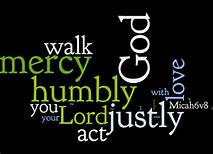
Micah 6-8 word cloud

Micah 6:6-8 – August 27, 2017

Familiar things, familiar words. Even familiar bible verses. When we see or hear familiar things—like a familiar family member, a familiar couch or chair, a familiar saying or expression our best friend says—what goes through our minds? Do we take it in? Do we pay attention? Do we understand that what we are seeing or hearing is important? Or, do we just dismiss it?

Do we dismiss a loved one who just happens to live with us because she or he is always underfoot? Do we even hear an expression from a friend because he or she says it all the time? Or, does familiarity encourage us to ignore the loved one, the sayings, or expressions?

Can this happen to familiar bible verses, too? I am thinking now of John 3:16. Can that beloved verse become so familiar, so same-old, same-old, that it has absolutely no power in our lives or hearts? What about some other super-familiar Scripture verses, too? What about them? What happens to our sensibilities now, now that I have highlighted this important point?

Let’s take a closer look. When we hear the same old thing (even in a bible verse) repeated over and over, week after week, our ears can stop hearing it. It might make some people sick and tired, or bored to tears. We can say, “yeah, yeah,” and ignore it. Go on our merry way. As bible commentator Tyler Mayfield said, “There is a danger to familiarity. The familiar can be overlooked or neglected.” [1]

We have for our Scripture passage today one of the most familiar commands from the Lord, ever. Micah 6:6-8. I will read it in the straight-forward modern translation for all ages provided for us by the Illustrated Children’s Ministry. Starting at verse 6: “How can I even begin to approach God? How can I honor who God is? What gift could I bring, what sacrifice could I make? Would God like it if I made offerings like those made in the past—rams, oil, or whatever is most precious? Does God want me to give up what means the world to me?”

That translation puts a new, different twist on things, doesn’t it?

In this chapter of Micah, the people of Israel pose several questions, and this one is a biggie. How can we even begin to approach the awesome God who made heaven and earth? Isn’t God huger than huge, more righteous and holy than anything else in the entire universe? How can you or I possibly bring anything to God that would please this Holy One?

As Dr. Mayfield says, the central issue with all of these questions concerns the gift, the sacrifice. “What is it, O God, that you want from us? What do you require? Just tell us your favorite offering, and we will surely sacrifice it—even if it is a rather extreme request.” [2]

This is a rhetorical question, of sorts. Micah follows it up with God’s response, in this very familiar verse, Micah 6:8. Is it “same old, same old,” or do you think we ought to sit up and pay attention? After all, this is a verse that lets us know God’s own requirements of how to come to God, this Holy One who made heaven and earth. Listen to this very familiar verse.

The prophet says: “No, listen, people, we already know the answer to this one.  God has told us, this is what counts; this is the compassionate life God wants for us: that we would do justice, and love kindness, and walk humbly, together with God.

Let’s turn to the playground and the schoolroom. What do you think children value? What are ways they like to be treated when they are together? Do you think children want things to be fair and equal in the classroom? Do they want people to be kind to them when they are in line at the store, or at the restaurant, or at home? And what about showing respect to other people? Do children want others to show them respect and courtesy on the playground, school, in the mall, or on the sidewalk? What about at home, too? These are important questions, since they not only apply to children, these questions apply to each of us. Every day.

“That’s not fair! He got more! She cut in line! They shoved me! That’s not fair!” Sound familiar? Does it sound like children bickering at home? This is exactly what the prophet Micah mentions, right off the bat. He tells us that God wants us—all of us—to act justly. And, to remind all of us, justice means fairness. Making things right. Got integrity? Do you act in an upright manner? That is exactly what God wants us—all of us—to do.

But, wait a moment! I know we have been through this before, but I thought the people of Israel were eager to know what kinds of stuff they could offer to God.

I can hear the conversations now: “Just tell me, I’m ready to bring the special animal offerings! I’ll bring really expensive stuff, Lord. Just tell me what it is that You want me to bring!” The problem is, the Lord may not give the answer the people expect. In fact, it is not the answer they seek. They have focused on expensive animals and special oils and fine wine offerings—small and large. The people of Israel have over-emphasized super-special sacrifices, and showy gifts in worship; they have ignored justice and kindness to others. [3]

Do you think children want other people to be kind to them? What about us? Do we want others to show care and consideration toward us? Let’s go even further. Being humble is a difficult concept for children to understand. (Gee, sometimes it’s difficult for me to understand!) However, being respectful is simpler to understand. Do I want others to be respectful to me? Just as important, am I—are you—respectful and courteous to others, no matter what? No matter who they are, and no matter where they come from, which side of the tracks they live on, or what they smell like, or who they vote for?

As we can see, Micah “turns the questions asked in verses 6-7 away from their focus on the types of offerings and toward a focus on the type of person. God does not want a specific type of offering. God wants a specific type of person.” [4]

Are you that type of person, the type God wants? Someone who regularly does just things with integrity? Someone who loves kindness and mercy and does kind and merciful things for others, regularly? What about someone who walks humbly, and is respectful and courteous to others, no matter what?

I think the prophet Micah would say that this is a truly compassionate life.

I wonder what this kind of life looks like, in our setting, here in the Chicago suburbs? How do you imagine this kind of life looks in our world today?

The prophet says our life is a journey, and we walk with the Lord, each day. We walk with integrity, in kindness, and we walk humbly. Imagine God is asking you to do one thing this week that would bring more compassion to those around you.

What would our lives look like if we lived like this? Would other people stop short in their tracks and say, “That person definitely is kind!” “That person goes out of her way to help people!” “That person certainly values the newcomer.” “That person displays genuine integrity, for sure!” I challenge all of us: choose one (or more) of these attributes each day for a week, and live it out.

Act justly—with integrity. Do kindness and mercy. Walk humbly with our God, showing compassion to all we meet. And, guess what? This is the way to truly please God.

Let those with ears to hear, let them hear. Amen.

[1] http://www.workingpreacher.org/preaching.aspx?commentary_id=3152 ; Dr. Tyler Mayfield, Assistant Professor of Hebrew Bible/Old Testament, Louisville Presbyterian Theological Seminary, Louisville, Ky.

[2] http://www.workingpreacher.org/preaching.aspx?commentary_id=3152

[3] http://www.workingpreacher.org/preaching.aspx?commentary_id=3152

[4] http://www.workingpreacher.org/preaching.aspx?commentary_id=3152

(A heartfelt thank you to An Illustrated Compassion: Learning to Love Like God. Many of these sermon ideas and thoughts came directly from this series.  I appreciate this intergenerational curriculum, which is the basis for my summer sermon series on compassion. This curriculum comes from Illustrated Children’s Ministry. Thanks so much for such great ideas!)

@chaplaineliza

(Suggestion: visit me at my regular blog for 2017: matterofprayer: A Year of Everyday Prayers. #PursuePEACE – and my other blog,  A Year of Being Kind . Thanks!)