Unknown's avatar

God’s Birth Announcement

Luke 2:1-7 – December 13, 2020

Welcoming babies into the world is such a joyous occasion. One of the first things most people do is spread the news about the new baby. When and where the baby was born, how big it was, whether it was a girl or a boy, and what the parents decided to name the baby are all details that are joyously spread, as soon as possible.

             I wonder . . . what would God’s birth announcement look like?

            In the fullness of time, God’s Son came into the world. Prophesied in many passages from the Hebrew Scriptures, foretold for centuries before His coming. Looking at the Hebrew Scripture passage for today, Isaiah 9, the prophet tells his readers about the Wonderful Counselor, Mighty God, Everlasting Father, and Prince of Peace, who is the coming Messiah.

            Throughout the Advent season, we prepare for the coming of this Messiah. Soon we will celebrate the earthly birthday of the Babe of Bethlehem, the Savior of the World, the only begotten Son. Our Lord Jesus Christ, our savior and redeemer came into this fallen world as a baby. Emptying Himself of all His vast, eternal God-ness, and being born as a human baby.

            I wonder: what would God’s birth announcement look like?

            I think we have a pretty good idea, if we take a look at the second chapter of Luke. Doctor Luke gives a full accounting of what went on in those days. What an unexpected sort of announcement!

            Let’s look at the parents of the Baby, first of all. The mother, Mary of Nazareth, is not even married yet. Sure, she’s engaged to this carpenter, Joseph, but they haven’t yet been fully joined in marriage. Marriage in those days, in the Jewish culture, was a several-step process.

            We read in chapter 1 of Luke that the Holy Spirit came upon Mary, and she conceived. Is Joseph the father of this Baby? No. Joseph could not believe this part, until assisted by some heavenly help. An angel came and reassured Joseph that Mary was on the up and up, and that the baby inside of Mary was really the Messiah, the Savior of the world.

            The circumstances of the birth are not quite the typical birth scenario, either. Imagine the birth of a baby today. Chances are that the baby would be born in a hospital, with the latest medical technology available, just in case. Not so for Mary, the mother of Jesus. Not only did she have the baby Jesus in less than optimum circumstances, in terms of hygiene and medical needs, but she was also far from her home as well.

            Mary and Joseph were both far away from familiar people, places and things. They were travelers, like many people in the town of Bethlehem at that time. Luke 2 tells us that there wasn’t any place for them to stay—anywhere. Because of the census ordered by Caesar Augustus, the town of Bethlehem was mobbed.

            Since Bethlehem was the ancestral home of King David, that meant there were quite a lot of people who had to be counted who were descended from David. We can see, from the offering that Mary and Joseph offered to the Lord shortly after the birth of the baby Jesus, that they did not have very much money.            

            Bethlehem must have been very crowded indeed, if a woman about to give birth couldn’t find even a room to have her baby in. We could even take it a step further, and draw some definite similarities between Mary and Joseph and some other young, homeless couple going to have a new baby, searching for a place to spend the night.

            I remember a suburban church I attended a number of years ago. One of the smaller trees near the front door to the sanctuary was practically covered with blue ribbons. A sign was posted next to the tree, saying “While celebrating One homeless Family, these ribbons ask us to remember the homeless with us today.” I had never thought about the Holy Family in that way before. Again, it’s God’s unexpected way of announcing the birth of God’s Son.

            While we’re thinking about where Mary had her baby, what about that manger, anyway? Jesus was a descendant of King David, through both His mother Mary and His adopted father, Joseph. A manger is an unexpected place to find a king. I don’t know about you, but I’d expect royalty to be born in a palace, or at least in a nice house.

            And who are the people who first receive this birth announcement? Are they influential members of the community? Leaders of the local synagogues and teachers of the Law of Moses? Those would be the kinds of people who I might expect to have a birth announcement sent to them. But God doesn’t work that way. God does the unexpected, and chooses the most unlikely people to receive a hand-delivered message from the Lord of Hosts.

            God sends a birth announcement in unexpected ways to unexpected people, in many situations, all over the world. When and where the Baby was born, the news that it was a boy, and that the parents decided to name this Baby Jesus—for He would save people from their sins—are all details that the shepherds joyously spread, as soon as possible.

            Again, it’s God’s unexpected way of announcing the birth of His Son. Can you think of someone who hasn’t heard about this birth announcement? We today have the opportunity to spread the news about this Baby born in Bethlehem. And, we can joyously praise God, for Jesus is the savior and redeemer of the world, as was proclaimed so long ago.

@chaplaineliza

(Suggestion: visit me at my regular blog for 2020: matterofprayer: A Year of Everyday Prayers. #PursuePEACE – and my other blog,  A Year of Being Kind . Thanks!

Unknown's avatar

Magnify the Lord with Me!

“Magnify the Lord with Me!”

Luke 1:38-56 (1:46) – December 6, 2020

            Do you know any teenage girls? Any girls with the maturity and balance that teenaged Mary shows to us here? This kind of maturity and balance in one so young is not very plentiful among teens, believe me.

            Socially and culturally, Mary was in an awkward situation. Even, a tight spot. A young woman (for, that was what Mary was considered, in the culture of her day), pledged to be married, who turns up pregnant. Scandalous! I am sure the old biddies in Nazareth were clucking about Mary’s situation—and character—and a whole lot more.

            While we, today, may read this narrative and think, “what a nice bible story!” this reading today is much more than that. Mary decides to go and visit her older cousin Elizabeth, in the hills of Judah. Elizabeth has miraculously gotten pregnant several months earlier. (The angel Gabriel told Mary so!) Two miraculous pregnancies, two women blessed by God. Plus, Elizabeth was an older, wiser woman, able to be a companion and mentor to the teenage Mary.  

            Yes, Mary’s extended visit to Elizabeth probably was comforting and encouraging to Mary. However, my attention is drawn to Mary’s song. The Magnificat is a tremendous counter-cultural song, turning everything in the political and cultural order upside down and topsy-turvy.

            Do you have any experience with an extended situation turning our world today upside down and topsy-turvy? Any disease or pandemic that is causing nationwide—even worldwide disruption and confusion? These two instances do not have a direct one-to-one correspondence, but there are many similarities here! The political and cultural upheaval Mary sings about in the Magnificat will greatly upend the established order of things. And, in many ways today, so will the COVID pandemic and its surrounding upheaval.

            I am reminded of a fellow professor friend of one of my Bible commentators. She grew up as a missionary kid in a poverty-stricken area in the Philippines. “Growing up among that nation’s poor, Professor Malcolm has reported that when they heard Mary’s Psalm, it was the first time that anyone had told them the good news that God cares about them — the poor, the oppressed.” [1] Some people in poverty have never heard this Good News! “Christ has come to challenge the structures of sin, death, the devil, and oppression. Christ has come in the strength of the Lord to do what the Lord has always done: lift up the lowly, free the enslaved, feed the hungry, give justice to the widow, the orphan, and the sojourner.” [2]

            Imagine Mary, having the maturity and the balance to sing such a radical, counter-cultural song! Is there some secret that Mary knew about, helping her to stay balanced and level-headed during all the upset and disruption of her unexpected pregnancy and the surrounding gossip and backbiting and sometimes outright nastiness of her fellow townspeople? Did Elizabeth aid her in finding this hope and balance, this calmness and serenity?

            Knowing what we do about the marvelous words of the Magnificat, and its similarity to Hannah’s song from 1 Samuel 2, we can learn from Mary. Her strength was in her trust in the Lord. Her faith was in God’s mighty power to overthrow society’s structures and the cultural norms of her day. Although our continuing situation is not exactly similar to Mary’s, we can still rely on God, too. Our strength can be our trust in the Lord. Our faith can be in God’s mighty power to overcome society and cultural norms.

            I’d like to think that Mary had a pleasant voice. Not operatic quality, although I do enjoy the voices of people who have studied and trained their voices into wonderful instruments! I can see how Mary knowingly turned for help to the One who would never leave her nor forsake her. Singing is one deep-seated way to come to God in prayer, in sadness, in hope and in joy.

            As commentator David Lose says, “songs are powerful. Laments express our grief and fear so as to honor these deep and difficult emotions and simultaneously strip them of their power to incapacitate us. Songs of praise and thanksgiving unite us with the One to whom we lift our voices. And canticles of courage and promise not only name our hopes but also contribute to bringing them into being.” [3]

            As we come before God in these next days and weeks ahead, perhaps we may come with trust and faith. Trust and faith in the God who is always with us, even through dark valleys, even through sickness, depression, despair and death.

            And may we, like Mary, lift up Mary’s radical song of resistance. Even though there is so much oppression and evil, and so much disease and despair in the world, God has brought light and hope into the world with the birth of God’s Messiah.

            I pray that you, like Mary, find joy even in the darkness of this particular Advent season of 2020. I also pray that the songs of Advent and Christmas bring light and hope to you as you draw closer to God each day. Alleluia, amen!


[1] https://www.workingpreacher.org/commentaries/revised-common-lectionary/fourth-sunday-of-advent-2/commentary-on-luke-146b-55

Commentary, Luke 1:39-45, (46-55), Rolf Jacobson, Preaching This Week, WorkingPreacher.org, 2014.

[2] Ibid.

[3] https://www.workingpreacher.org/dear-working-preacher/a-promise-that-changes-the-world

“A Promise That Changes the World,” David Lose, WorkingPreacher, 2012.

@chaplaineliza

(Suggestion: visit me at my regular blog for 2020: matterofprayer: A Year of Everyday Prayers. #PursuePEACE – and my other blog,  A Year of Being Kind . Thanks!

Unknown's avatar

Do Not Be Afraid!”

“Do Not Be Afraid!”

Rembrandt, sketch of the Virgin Mary and the angel Gabriel

Luke 1:26-38 (1:30) – November 29, 2020

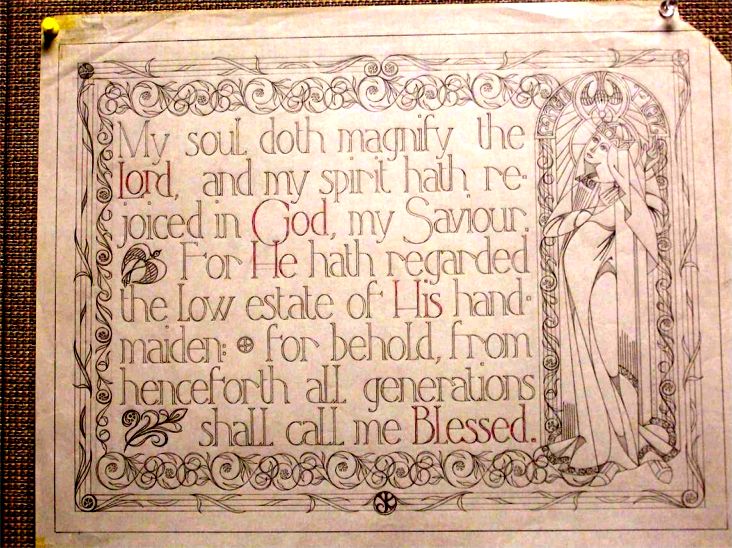
            This week, we read one of the most familiar of the narratives in the New Testament. From the first chapter of Luke:  “In the sixth month of Elizabeth’s pregnancy, God sent the angel Gabriel to Nazareth, a town in Galilee, to a virgin pledged to be married to a man named Joseph, a descendant of David. The virgin’s name was Mary. The angel went to her and said, “Greetings, you who are highly favored! The Lord is with you.”

            Imagine yourself as Mary, a teenage girl. Perhaps doing housework, cooking in the kitchen, or folding laundry. When, out of nowhere, an angel appears. Out of the clear blue sky, something completely supernatural happens! She is wondering at the angel’s words. What kind of a greeting is this, anyway? Here she was, probably in the middle of an ordinary day, with the angel Gabriel paying a surprise visit to her!

            I would like to compare Mary’s surprise situation to many people, in the current day. Specifically, to my friend, several years ago. Out of the clear blue sky, she found out that she needed surgery. Before the beginning of October, she was traveling along, blithely, no serious cares or concerns. After the first week in October? Her life was turned upside down, with a serious medical situation, followed by major surgery.

            How often does something like that happen? Perhaps not a medical emergency in your life, or a loved one’s life, but some other situation out of a clear blue sky.

            But let’s return to Mary. Or, more directly, to the angel Gabriel and what the next words out of his mouth are: “Do not be afraid, Mary; you have found favor with God.”

            I should think, if I had the opportunity to see an angel, I probably would be afraid, too! Practically every time an angel visits someone in the Bible, “Do not be afraid!” is one of the first things out of their mouths! Gabriel continues: “You will conceive and give birth to a son, and you are to call him Jesus. He will be great and will be called the Son of the Most High.”

            Understandably, Mary’s response—quite sensible, under the circumstances—“How will this be,” Mary asked the angel, ‘since I am a virgin?”

            I can see Mary’s point. Truth to tell, it’s hard to beat a virgin birth! We can look at other places in the Scriptures, and see other miracles. We can look at the life and ministry of our Lord Jesus when He was an adult, and acknowledge the fact that He did miracles, regularly. But—here we have Mary, herself, wondering how on earth this miracle is going to happen to her?

            The angel has an answer for Mary, sure enough. “The angel answered, “The Holy Spirit will come upon you, and the power of the Most High will overshadow you. So the holy one to be born will be called the Son of God.” In brief, here we have the angel describing the divine plan for a miraculous conception. Mary expresses doubt, Gabriel explains God’s plan in greater detail, Mary consents, and the angel departs.

This whole narrative makes me want to ask Mary so many questions.

How soon did you tell your parents you were pregnant? Did you tell Joseph about the pregnancy yourself, or did the gossipmongers of Nazareth take care of that for you? Was there anyone in the village who believed your story? For that matter, after the angel Gabriel left, did you doubt his visitation to you? Did you think it was a dream? What about the townspeople’s response—did you fear for your life, since people could have thought you were an adulteress?

The Gospel of Luke is silent on this matter. It leaves us with so many unanswered questions! All we know is what Mary said to the angel. “I am the Lord’s servant,” she answered. “May your word to me be fulfilled,” was her response.

An unmarried girl who was pregnant was not just looked down on but actively persecuted. She knows that she takes the risk of being rejected as a slut, as a tramp, as unworthy of polite company, as a result of this new openness to God’s surprise activity in her life.

            Yet, we can see that Mary exemplifies the kind of response to God’s surprises that I would like in my own life.

Though—out of a clear blue sky—God completely spun Mary’s life around, though Mary knew that her life would never be what she expected it to be before, she nevertheless said “yes” to God in faith. Yes, she worshiped God (especially in her prayer, which comes after our Scripture reading for today.) She models the heart of worship, the giving of ourselves to the one who has given everything to us.

Mary’s example challenges and encourages us to have the courage to say to the Lord: “Be it to me according to Your word!” Remember, Mary realizes there is something special about to happen, that God’s plan must take precedence over her own. She accepts the challenge with hope and faith as she realizes she will be carrying the Messiah her people have longed for.

            I’d like to remind all of us here today that Mary—a normal, ordinary teenager—was visited by an angel out of a clear blue sky. She was an ordinary person who was willing to say “yes” to God, to respond to God’s call willingly and with courage, and go forward in faith.

            It doesn’t matter what our situations are, today. God can come into any of our lives out of the clear blue sky. God can rush right in, abruptly, with no warning. We all—each one of us—are encouraged to respond to God in the same way as Mary did. To agree with God willingly, with hope, and go forward in faith. Are you ready to say “yes” to God, when God calls? Say yes, in faith!  

@chaplaineliza

(Suggestion: visit me at my regular blog for 2020: matterofprayer: A Year of Everyday Prayers. #PursuePEACE – and my other blog,  A Year of Being Kind . Thanks!

Unknown's avatar

The Least of These

“The Least of These”

Matthew 25:37-40 (25:37) – November 22, 2020

            As you and I have been living through these past months of upheaval, uncertainty and pandemic, it might seem like the end of the world is quickly approaching. Does it seem like that to you? Perhaps our Lord Jesus will come very soon, as a king on His throne. (If He does, amen!)

This parable is from the last sermon that Jesus preaches, in the middle of the Passion Week. Jesus knows His time is very short. I suspect He is really impatient with His followers. So, Jesus talks straight – as straight to His friends as ever He could. Many people think these words of Jesus are harsh. God is going to judge humanity like a mean taskmaster or stern overlord. At least, that is what we might think if we look at a surface view.

Let’s set the stage. In this parable, we have a king on his throne, at the end of all things. At the end of ages. Many people are powerfully fearful of the mighty king on his throne, and consider this the eternal judgement at the end of all things.

These words of Jesus do not tell us that the biggest thing in the world is to give away tens of thousands of dollars. Or, to make sure each of us writes our important name in the pages of history. No! Jesus tells us no such thing! What does Jesus really want us to do, anyhow?

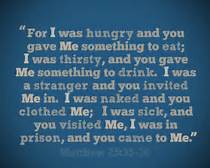
Amazingly enough, Jesus does not demand His followers to do anything especially mighty, or courageous, or daring. No! Instead, Jesus mentions simple things. Helpful, straightforward things. Things just about anyone can do. Can you give a hungry person a meal, or a thirsty person a drink? Can you welcome the stranger – any stranger, no matter who? What about cheering the sick or visiting the prisoner in jail?

Jesus talks about giving simple help to the people we might meet every day. People on street corners, or shaking a cup downtown. Neighbors hiding in their cold, dark apartments or weary from searching for work. Friends suffering from food insecurity, living in food or medical deserts in the inner city, or a new refugee family settling here, from a war-torn country far away.

About 20 years ago, I attended a larger church in a nearby suburb. This church had a ministry to take children of incarcerated women to visit their moms in prison, downstate. Since I have a commercial driver’s license, I started driving the church bus to transport the children and their adult relatives. Grandmas, aunties, sometimes grandpas. These extended families had very little money, and it was almost impossible for these children to see their moms unless they had some help – like from this church, sending the church bus downstate nine or ten times a year.

I drove these children for many hours on Saturdays to see their moms. I considered it one of the most worthwhile ministries that I have ever been involved with. Ever.     

            Commentator David Lose asks the penetrating question: “in this time of isolation and division and unrest and wondering how we’re going to get by and whether there’s anything we can do… might we during all this remind our people of the promise – and it is a promise – that Jesus is really and truly available to us in the real and concrete needs of those around us and that God takes all of this so very seriously, blessing our efforts and meeting our deepest needs when we reach out to those who are struggling.[1]

“What our Gospel writer is proposing here should not be understood as some kind of works righteousness. These are works of neighbourly love done – or not done – not with the intention of putting oneself right with God, or earning God’s favour, but done – or not done – because of the person’s fundamental attitude towards the world. They are, in the language of Reformation theology, not works intended to earn justification, but the fruits of justification, the outpouring of the believer’s love of God.” [2]

            This is Jesus, telling us to do acts of neighborly love – often! And, reminding us that it is our internal attitude, the inside part, that is truly important before God.

To those with ears to hear, let them hear!

            May we join in the prayer of Teresa of Avila (1515-82):“Christ has no body on earth now but yours, no hands but yours, no feet but yours; yours are the eyes through which he looks with compassion on the world; yours are the feet with which he walks to do good; yours are the hands with which he blesses all the world.”

            No matter where they were born, no matter what faith tradition they follow, no matter what side of the tracks these friends happened to be born on, these diverse, multi-racial, multi-ethnic brothers and sisters have already been welcomed by God. Can we do any less?

            May we find joy in offering a cup of cold water to anyone who is thirsty, visiting those in prison, extending a hand to those who need it, always doing what we can for “the least of these,” our true brothers and sisters in Christ. Alleluia, amen!


[1] http://www.davidlose.net/2020/11/christ-the-king-a-the-third-sacrament/?utm_source=feedburner&utm_medium=email&utm_campaign=Feed%3A+davidlose%2FIsqE+%28…In+the+Meantime%29

[2] https://www.churchofscotland.org.uk/__data/assets/pdf_file/0012/71202/22-November_Christ-the-King-V2.pdf

@chaplaineliza

(Suggestion: visit me at my regular blog for 2020: matterofprayer: A Year of Everyday Prayers. #PursuePEACE – and my other blog,  A Year of Being Kind . Thanks!

Unknown's avatar

Cheerful Givers

“Cheerful Givers”

2 Corinthians 9:7-12 (9:7) – November 15, 2020

            Have you started thinking about Thanksgiving yet? Thoughts of Thanksgiving turkeys full of seasoned stuffing, mashed potatoes heaped high, creamy green bean casserole and tangy cranberry sauce bring sure-fire memories to many, many people at this generous, giving-time of the year. Except – will anything like an ordinary Thanksgiving celebration be possible this year? Can anything save this beloved holiday from the ravages of this pandemic and the stress and anxiety that seem to accompany it at every turn?

            Yet – with all the personal trials and tribulations that were continuing to happen to the apostle Paul, how could he even focus on generosity? Just two short chapters after today’s reading, in chapter 11, Paul talks about the dozens of times he was beaten, stoned, jailed, shipwrecked, and repeatedly denied freedom of religion. Yes, I suspect Paul had a close acquaintance with stress, fear and anxiety. Perhaps he did not allow them to take root and settle down in his head and heart, but I suspect Paul knew these deep feelings pretty well.

What did the apostle Paul write just before our reading for today? In the paragraphs before today’s reading, Paul asks for a collection to be gathered together. This collection of money is to be given to the persecuted, needy church in Jerusalem. The Christian friends in Jerusalem certainly knew what it was like to be in distress, too! It’s then Paul tells more about giving. How to give, and why. How not to give, too.  

            Of course we are preoccupied. Many things are on people’s minds. Not only the coronavirus, and public health, but stress, uncertainty and political upheaval. Is there any reason stress, fear and anxiety would NOT be running rampant in the United States today?

            Who can possibly turn our minds to giving and generosity, with so much going on in our lives? How can each of us follow this command from God to give generously? Paul would remind us that many, many Christians in his day had lots of things going on in their personal lives, too. Many were truly persecuted in a way that would make our skin crawl; many were in trouble with the imperial forces and government, too. Yet – Paul praised his former church members for remembering the faithful believers in Jerusalem – sending them a much needed financial gift.

            There is a clear difference between certain people who give freely and generously, and other people who give like their arms are twisted behind their backs – out of a matter of grudging obligation. And oh! Can we tell the difference!  

            We have a proverb of Paul’s day included here, in verse 6: “the one who sows sparingly will also reap sparingly, and the one who sows bountifully will also reap bountifully.” Here Paul uses a common saying of the day to illustrate his point. Talking about bounty, about being generous, and about grudging giving out of obligation—being stingy.

            Do you know someone who is really stingy? Someone who is really pained to spend even one dollar of his or her own money? When I was young, there was an older man in our neighborhood who was exactly like this. So stingy he would creak when he walked. So stingy he couldn’t think of putting a penny in a Salvation Army kettle at the holidays.

            I suspect all of us know a tight-fisted person like this. Not at all the generous, open-handed way of giving that the Lord Jesus models for us. God never gives out of an attitude of grudging obligation, and neither should we.

            As each person purposes – or decides in their own heart, that is why we are to give. Did you ever think of giving because you want to give and because God has put it in your heart to give? To give out of the pure joy of giving? Paul had churchgoers remember the church – by sending a much needed financial gift.

One of my acquaintances knew a stingy old woman. So stingy, she would cut coupons and live on the bare minimum in her tiny house. But, she surprised us all after she died. Her will left $50 million dollars to Monmouth College. She never experienced the joy of giving away that money. She never experienced Thanks-GIVING. Don’t miss the joy of giving.
            Our giving “reveals the purposes in our own heart. “If we say we love the Lord more than surfing, but spend all our money on surfboards and do not give as we should to the Lord’s work, then the way we spend our money shows the purposes of our own heart more accurately than our words do. Jesus said it simply: ‘For where your treasure is, there your heart will be also.’” [1]

But, wait! If we have this generous attitude towards giving, being open-handed, positive and cheerful, then God will bless us abundantly with every blessing. Isn’t a warm heart and abundant blessings what we all really want?

What a marvelous promise. What wonderful words. And, this is not “maybe,” or “I hope so,” but it is a blessed promise from God! This is not only for our gifts of treasure, for our gifts of money. This blessing is for our gifts of time and of talents, as well.

For the person who comes and volunteers on Sunday mornings to start the coffee, sets out the bulletins, does the pandemic safety checks, or turns on the lights in the sanctuary—thank you. For the person who bakes a cake or makes a table decoration or repairs the church building—thank you. These are the gifts of time and of talent, and God is so pleased with that, too. God is pleased with whatever gifts you sincerely, truly offer with all your heart.

Alleluia, amen!


[1] https://www.blueletterbible.org/Comm/guzik_david/StudyGuide2017-2Cr/2Cr-9.cfm

@chaplaineliza

(Suggestion: visit me at my regular blog for 2020: matterofprayer: A Year of Everyday Prayers. #PursuePEACE – and my other blog,  A Year of Being Kind . Thanks!
Unknown's avatar

Encourage Each Other

“Encourage Each Other” – November 8, 2020

1 Thessalonians 4:15-18

            Today’s lectionary Scripture readings show us more about the times to come. Or, some say, the end times. Wouldn’t it be wonderful if we hurried up and got to the end of days and met the Lord in the air? That is exactly what our Scripture reading describes today.

            Here the apostle Paul calms the fears of his Thessalonian church. His former church members are mourning the deaths of some of their congregation, and they wrote to Paul to ask what happened to their friends and loved ones. Where did they go after they died?

            That is a great question! As a hospital chaplain, I was sometimes asked that very question. What happens after we die? Sometimes I’d be asked by a loved one, sitting by the bed of a dying patient. But, sometimes the patient – who had just received the worst news you can possibly receive – would ask me that question, in all sincerity. With all their heart.

            When we are talking about life and death matters, many other things pale in comparison. I have walked the halls in the intensive care unit, or cardiac care, late at night or early in the morning. I have seen loved ones keeping vigil next to patients’ beds. I have hesitated, not wanting to disturb their intimate time with their precious family member. Yet, Paul’s words go straight to the heart of this vital question. What happens when we die?

            Considering our Bible reading today, commentator Scott Hoezee says, “Probably the Thessalonians did not know Jesus’ words from John 11, but if they could hear Jesus telling Martha that ’anyone who believes in me will never die,’ they may have heard that as confirming this idea that being a Christian meant not dying.  Ever.

“And then members of their church started dying.  Funerals were being held after all.  A cloud of painful questions arose: were these people not Christians after all?  Had they had inadequate faith?  If so, how can any of us be sure we are good and faithful enough?  Paul had said it was all faith, all grace, all Jesus.  But is it?  Or, far more darkly, was Paul just wrong?  Is the Gospel a hoax?  Is there no true victory of life over death?[1]

            Again, Paul reminds us: “Brothers and sisters, we do not want you to be uninformed about those who sleep in death, so that you do not grieve like the rest of humankind, who have no hope. 14 For we believe that Jesus died and rose again, and so we believe that God will bring with Jesus those who have fallen asleep in him.”

            As I write this sermon, the nation is still on tenterhooks, wondering who the next President of the United States will be. This nation is more divided now than in any time I can remember in recent history. Whoever “wins” will have an extremely difficult next four years in office, with all of the upheaval and dissention in this country. How will we manage to bridge such a cavernous gap? “Regardless of what we read in the headlines, whether or not it goes the way we hoped, how it brings discord, how can there be a place of peace in us, even in the midst of upheaval?” [2] How can we continue to live Godly lives in such a turbulent time?

            Are these not similar to the serious questions that the Thessalonian congregation brought to their pastor Paul? Paul brought words of encouragement and comfort to his former church. Yes, and words of great hope, too! “For the Lord himself will come down from heaven, with a loud command, with the voice of the archangel and with the trumpet call of God, and the dead in Christ will rise first. 17 After that, we who are still alive and are left will be caught up together with them in the clouds to meet the Lord in the air. And so we will be with the Lord forever.”

            I am not minimizing the turbulent times we are living through, right now. This past week. These next weeks and months ahead. Yet, I am taking Paul at his word. He tells us to encourage each other with these supremely hopeful words to the Thessalonians.

Yes, we are living through times of great distress and tumult. Yes, many may feel like the mountains are crumbling and falling into the sea, as Psalm 46 tells us. I preached on Psalm 46 just two weeks ago, and we found hope and encouragement through that sermon. This precious psalm also grounds us, always giving space to both feel the turmoil and to have a center of peace, unshaken by the headlines and the prevailing news of the day.

This center of peace is not a forced peace brought on by force of arms or oppression, but a peace that grows from the very nature of the One who rules with justice and joy, our Lord Jesus Christ. This is the peace that passes all understanding, God’s peace that knows no boundaries, no divisions, no human separation or dissention.

Let us visualize, for just a moment, God’s peace that passes all understanding. Now, God’s hope that fills our hopeless and helpless lives and hearts. And now, God’s love that is so all encompassing, it can fill the whole universe. That is one mighty and powerful God.

Yes, Paul tells us to encourage each other with these words.

Alleluia. Amen.


[1] https://cep.calvinseminary.edu/sermon-starters/proper-27a-2/?type=lectionary_epistle

The Center for Excellence in Preaching, resources from Calvin Theological Seminary: Comments & Observations, Textual Points, Illustration Ideas, 2017.

[2] https://www.missioalliance.org/a-nation-waits-seeking-a-center-of-peace/?utm_source=feedburner&utm_medium=email&utm_campaign=Feed%3A+missioalliance%2FEQtW+%28Missio+Alliance%29

@chaplaineliza

(Suggestion: visit me at my regular blog for 2020: matterofprayer: A Year of Everyday Prayers. #PursuePEACE – and my other blog,  A Year of Being Kind . Thanks!

Unknown's avatar

Becoming—Like Christ

“Becoming—Like Christ” – November 1, 2020

1 John 3:1-3 – All Saints Sunday

            Simple words go straight to the heart. Words can echo and re-echo deep within. Have you experienced that? The elderly apostle John uses simple, straightforward words to communicate deep, eternal truths. Like, right here, in our Scripture reading today.

In today’s reading, John urges the Christian community to hold fast to what we have been taught, persevere in leading a moral life, and love one another.

You do know that you are God’s beloved child? Yes! Each of us has been chosen by God. We are the Saints of God! Not only in the eyes of this church on this corner, but in the eyes of all churches that observe All Saints Day or All Saints Sunday.

Today is All Saints Day. It is a special day in the life of the Church. A day to remember those who were persecuted, and those who died to keep the faith. And, a day to celebrate the living saints: you and me.

Sometimes, you and I may not feel especially saint-like. Yes, the age-old problem of sin does creep into our lives, and cause some disruption. Sin can make us feel far away from God, and like everything is turning topsy-turvy.

            Can other things happen in our lives, other kinds of disruptions make us feel like we are unworthy of God? Absolutely. All kinds of circumstances, trouble, losses of various kinds, calamities, and all manner of tumult can strain our nerves, our bodies and our souls to the very breaking point.

            The pandemic is also a perfect opportunity for Satan to turn our lives topsy-turvy. Churches closing, isolation from our communities; with fear and anxiety, we become afraid of the stranger. We end up not setting aside time for regular worship and prayer.

            Perhaps the apostle John did not have a pandemic to worry about. However, John would have seen the passing of many believers. John wrote this letter of encouragement because Dissenters wanted to lead astray the community of faith. Maybe these troublemakers were even trying to convince John’s followers to forsake Jesus Christ and throw their lot in with someone or something else. He was witness to many people leaving the faith, because their own beliefs had changed.

As believers in Christ, we know who we can depend on. The Lord has called us children of God. We can always turn to our heavenly Parent – or, heavenly Father, as John says.

Yet—today is All Saints Day, a day for us to remember our loved ones, who we miss and mourn. Yes, the Lord is our heavenly Parent. But, everything here on this earth seems to be turned upside down.

The Rev Janet Hunt reflects on her church’s traditions of All Saints Day. At her church, this has long been a day for gathering together. This is a day “which begins with the resounding strains of ‘For All the Saints’ and ends with the dancing percussion of ‘When the Saints Go Marching In…’  And in the middle, we read the names, sound the bells, light the candles one by one by countless one until the whole place is alight with palpable memory and almost tangible hope. And it, along with so many precious rituals which help to tie us to all who we have been and all we will one day be, will simply not be ours this year. At least not here where the COVID-19 numbers are rising.” [1]

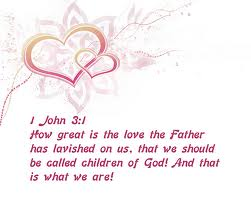
             Do as John tells you: turn to our trustworthy God. What marvelous love our God has extended to us! John reminds us that God has already called us children! We have already been adopted into God’s family, [2] We can be hesitant, or disbelieving, or fearful. The Lord still loves us, and has already called us God’s children, without any pleading or whining, without special offerings or mystical midnight services on our part. This gift is already ours. John affirms so, right here.

            This is the extravagant welcome that God provides. God so loves the world. Period.

            We all have places where we fall short, where we sin in thought, word and deed. Places where we are not Christ-like—yet.

            John says, “What we know is that when Christ is openly revealed, we’ll see him—and in seeing him, become like him.” Each of us should strive to become more and more Christ-like. Do not surrender to the evil world of the pandemic. Seek help if you are struggling. God is here. I am here. Call, write, e-mail, pray.

            What a glorious gift. What a marvelous hope. We may not see our Lord Jesus now, but that glorious day that is quickly coming. We shall see Jesus in glory – just as our loved ones, saints in Christ who have died, are seeing Him right now. And, that is a promise that is faithful and true. Alleluia, amen!


[1] https://dancingwiththeword.com/all-saints-day-2020-blessed-are-those-w-ho-mourn/

[2] https://wordpress.com/posts/pastorpreacherprayer.wordpress.com 

Commentary, 1 John 3:1-7, Nijay Gupta, Preaching This Week, WorkingPreacher.org, 2015. 

@chaplaineliza

(Suggestion: visit me at my regular blog for 2020: matterofprayer: A Year of Everyday Prayers. #PursuePEACE – and my other blog,  A Year of Being Kind . Thanks!

Unknown's avatar

Be Like Martin Luther

“Be Like Martin Luther” – October 25, 2020

Psalm 46:1-3 – Reformation Sunday

Here we are at Reformation Sunday, the week of the year when we remember Martin Luther posting his list of grievances against the church establishment of the Catholic Church, more than 500 years ago in 1517. These 95 grievances against the Church sparked a movement of protest that was felt around the world. And thus, the Protestant Church was born.

Father Martin Luther – for he was a Catholic priest – was a sincere, devout follower of Jesus Christ. He thought long and hard about sin and confession, faith and grace. He also thought a lot about God’s Word, and eventually translated the whole Bible – both Old and New Testaments – into German, the common tongue of his day and area of Germany.

The Catholic Church establishment certainly had it in for Martin Luther! After defending himself against strident criticism from scholars and theologians, and legal challenges for years, the official verdict was not in Luther’s favor. Because he would not recant his views on God, salvation by faith, and the Bible, Luther was officially on the run from the establishment.

Which brings us to our Scripture reading for today. Psalm 46. Martin had a very difficult time of it for a number of years, running in fear for his life. Is it any wonder that this marvelous psalm recounting God’s strength and refuge was Luther’s favorite psalm?

This is Reformation Sunday, after all. What could be more appropriate than to read Luther’s favorite psalm? Except – this was not only a favorite Scripture reading of Martin Luther. He also was a composer and poet. /Luther wrote the words and music for our opening hymn, “A Mighty Fortress Is Our God.” He used this psalm of comfort and refuge as a basis for this marvelous hymn.

In German, this hymn is called “Ein Feste Burg,” “a fortification that holds fast against any assault, a castle that can withstand every onslaught, a citadel that keeps those on the inside safe and secure from all attacks.” [1] Is anyone surprised that Martin Luther considered this comforting psalm his favorite? Even though everything is falling apart on all sides, he can stand safe and secure in his Lord.

I know Luther regularly prayed to God for protection and care, both internally as well as externally. Is that similar to us, today? In this year of the pandemic, with all the extreme weather events, the political disruption, and the wildfires of the past several months – the present situation resembles Psalm 46. “though the earth give way and the mountains fall into the heart of the sea, though its waters roar and foam and the mountains quake with their surging.”

Sure, with everything going on in the world today, we have reason to be scared half to death! Yet, we have “a God who has been time-tested and, over and over again, can be trusted upon to keep you secure in your time of trouble. Either way – and in all times and circumstances – you have a God who has got you covered. That is what Psalm 46 declares. And that is what Luther wanted to proclaim in “A Mighty Fortress is Our God.”” [2]

This precious hymn written by Luther was not only a refuge from earthly disasters, but is also personal in nature. Rev. Janet Hunt, a Lutheran minister, mentions that she hears it “as much more personal now, knowing as we do that ‘the old satanic foe’ threatened him with the sorts of ‘woes’ one could only begin to understand if one has been there. The heart-wrenching, life altering death of a child, to name but one. The days and nights of struggling to hold on to faith when the Church which had borne the faith to him no longer lived up to its promises. The fear which must have possessed Luther as his very life was threatened.” [3]

Thinking back to last week’s sermon, where Moses and the Lord were hanging out on top of the mountain, Moses wanted to see the Lord. God told Moses straight out that Moses would die if he beheld the Lord face to face. Isn’t that the God we have right here, in Psalm 46? Even though the all-powerful God could make the earth melt, and destroy us if we simply look at Him.

That is one mighty, all-powerful God! And to think, that is also the God who has chosen us, called us by name, and named us God’s beloved children. The Lord is a God who is Lord Almighty, maker of heaven and earth. Plus, the Lord is also a safe refuge, a comfort, one we can run to in times of great need. Praise God, I do not need to control everything.

Can we – you and I – loosen our tight grip on all we are clutching to our chests, knowing that God indeed holds everything? Including us?

This Reformation Sunday, I am not focused on God as our Mighty Fortress. Instead, Psalm 46 talks of a refuge, and a help in our great need.

Yes, God is indeed our refuge and strength, an ever-present help in trouble. That’s something to truly celebrate. Alleluia, amen.


[1] http://www.workingpreacher.org/preaching.aspx?commentary_id=754

Commentary, Psalm 46, Hans Weirsma, Reformation Day, Preaching This Week, WorkingPreacher.org, 2010.

[2] “A Mighty Fortress is our God” is not the only English translation of Luther’s “Ein Feste Burg.” Thomas Carlyle, the nineteenth century Scottish commentator, offered this version: “A safe stronghold our God is still, a trusty shield and weapon.” Carlyle’s contemporary, George MacDonald, rendered stanza one, verse one, in this way: “Our God he is a castle strong, a good mailcoat and weapon.”

[3] https://dancingwiththeword.com/being-still-letting-go/

@chaplaineliza

(Suggestion: visit me at my regular blog for 2020: matterofprayer: A Year of Everyday Prayers. #PursuePEACE – and my other blog,  A Year of Being Kind . Thanks!
Unknown's avatar

When God Shields Us

“When God Shields Us” – October 18, 2020

Exodus 33:12-23 (33:19-22)

Have you ever known someone who was really important? I mean, really, really a V.I.P.?

Moses was personally acquainted with the biggest V.I.P. in the whole world. Even, in the whole universe. Eileen just read today’s Scripture lesson from Exodus 33, and we heard what an awesome experience Moses had on top of that mountain. Just him and the Lord, they had personal one-on-one time.

Let’s take a closer look at this reading. An overview, so we can understand exactly what is at stake. We can simply take Exodus 33 as a striking word-picture of how awesome, mighty and all-powerful God is, and we would be absolutely correct. Our God is indeed an Awesome God. But, there is so much more involved here.   

Moses and the Lord talk about the presence of God. This is huge! The presence of God is a continuing theme in the book of Exodus, and right here is a particularly important exchange between our two protagonists.  

We could simply watch Moses and the Lord, almost like we are in the audience, or viewing on a television screen. Reading this story from Exodus, we might say “What does this story have to do with me?”  But, we can relate this to our personal situation – each one of us.

To come before the physical presence of God is truly rare – but it was something Moses greatly desired! What is more, he also wanted to be able to reassure the people of Israel with the reality of God’s presence. Is that something that reassures you, today?

Throughout the Hebrew Scriptures, again and again, we hear about how dangerous it is to approach the Lord. God’s presence is so fearsome that a number of people are immediately struck dead for daring to come in contact with the Lord. For much of Exodus, the Lord is not even sure whether Israel is even worthy enough to sit by and receive that Godly presence. Yet, Moses sees God’s presence and blessing as a beneficial thing, a good and necessary thing.

Have you ever been given the silent treatment? This could be by a parent or other grown-up when you were younger, or perhaps by a sibling or a friend? The silent treatment is particularly sad and jarring, especially when you really respect, even love the person giving you the silent treatment.

That is pretty close to what the Lord wanted to do to the whole nation of Israel by removing God’s presence and blessing from Israel. That would be horrible! Like, drinking water, and finding it was dry water. Or, going outside in the middle of the day, and finding there was an eclipse of the sun – permanently. What a traumatic, even cataclysmic event, having the Lord discuss permanently removing God’s presence and blessing from Israel. [1]

Yet – God said to Moses, ‘I know you by name and you have found favor with me.’ And, even further, “the Lord said to Moses, “I will do the very thing you have asked, because I am pleased with you and I know you by name.” That must be so heartwarming, hearing God say, “I know you by name and you have found favor with me.”

I remind you, looking on the face of God was fatal, for a number of those in the Hebrew Scriptures. I wonder: is it a fatal act to think that we see God’s glory, that we fully comprehend God, today? The hazard of thinking you’ve got it all figured out becomes a sign of our self-centered, self-involved problem. The idea that we’ve got it figured out, because once we figure that, WE become God to ourselves – our self-centered delusion is that WE are greater than God. This was certainly part of what was going on with the self-involved people of Israel, periodically thinking they were much more important than the presence of God.

If we step back from being self-centered and self-involved, we realize we are invited into a relationship – a relationship with the Lord. Moses knew that to become more aware of the presence of God, he needed to spend time with God. That is exactly what he and God were doing on top of that mountain. And, God and Moses had a number of one-on-one encounters that helped Moses get through his life’s journey.

Knowing that we are always in the presence of God will help us get through many difficult things. Though complicated questions and weighty issues overwhelm us on a regular basis, we can be certain that God walks beside each of us on our journey through life, too. [2]

Are you ready to have a relationship with the Lord? To have one-on-one conversations with God? Sure, our God IS a powerful, mighty, Awesome God. We are also freely invited into the generous, merciful presence of God.

Let us celebrate the presence of God, today. Amen, alleluia.


[1] Brueggemann, Walter, “Exodus,” The New Interpreters Bible Commentary, Vol. I (Abingdon, Nashville, TN: 1994), 938-39.

[2] https://www.umcdiscipleship.org/worship-planning/pressing-on/twentieth-sunday-after-pentecost-year-a-lectionary-planning-notes/twentieth-sunday-after-pentecost-year-a-preaching-notes

@chaplaineliza

(Suggestion: visit me at my regular blog for 2020: matterofprayer: A Year of Everyday Prayers. #PursuePEACE – and my other blog,  A Year of Being Kind . Thanks!

Unknown's avatar

Do We Have Golden Calves?

“Do We Have Golden Calves?” – October 11, 2020

Exodus 32:1-14 (32:2-4)

We are living through great uncertainty. Look at the volatile weather during the past few months! Hurricanes, floods, wildfires, extremes in temperature. What about the COVID-19 pandemic? More than 210,000 people have died in the United States in the last six months, as many as died in all four years of the American Civil War. Added to those anxious statistics, we can name the recent racial tensions and the national political upheaval.

 When you or I are fearful or anxious or uncertain, what do we do? Where do we go for stability or comfort? What is all-important to each one, in such a tumultuous time?

As we consider the people of Israel, we might think of all of them being fearful and anxious, too. After all, they had just left Egypt not many weeks before. They were no longer slaves! Yet – they were also wandering in the wilderness of the Sinai peninsula. A foreign land, with strangeness and uncertainty at every turn!

Their trusted leader Moses had gone on top of the mountain to talk to this God that he said was the God of their ancestors Abraham, Isaac and Jacob. An invisible God they could not see, touch or understand, unlike the Egyptian gods.

“Get up and make gods,” they shout, because this Moses has obviously left us alone to die, and we cannot last another day, another minute, without some sort of God or gods to lead us. As for that guy Moses, well, “we do not know what it is to him,” which I take to mean that they have completely forgotten that he told them he was going up the mountain to chat with YHWH and would return to bring them the divine news of the day. As far as they know, Moses and YHWH are engaged in a handball tournament or a solo beach volleyball game.” [1]

Could you understand the fear, uncertainty and anxiety of the people of Israel? No wonder they begged Moses’ brother Aaron for some tangible god, a god they could see, touch and understand, like the Egyptian gods they knew from their time of slavery in Egypt.  

Aaron knew just what to do. He gathered all the golden rings, earrings and ornaments, melted them into malleable metal, and formed a golden calf. An idol the Israelites could see, touch and understand. Something to give them comfort and stability.

When you or I are fearful or anxious or uncertain, what do we do? Where do we go for stability or comfort? What is all-important to each of us, in such a tumultuous time?

We might scoff at the people of Israel sacrificing to the golden calf. But –is there anything we would sacrifice our time for? How about our money or our health? Anything that is so important in our lives that we might make it an idol? Our own personal golden calf?

Our golden calves might take many forms. I have an acquaintance who I’ve known for a long time. She considers her house to be so important. Of course, it is beautiful, but she has poured money into that house and the large garden—and the coach house out back—for many, many years. I suspect that house might be a golden calf in her life.

Another acquaintance I have owns seven cars. Seven! He is so proud of them! He washes them, waxes them, and considers them to be very valuable possessions. I think we all know someone who has idolized something – or someone – or some substance so much that it has become a golden calf to them. Perhaps each of us may consider something all-important. Something we sacrifice for. More important than God, even?

When you and I think deeply about it, the idea of an invisible God can be scary! Can we blame the people of Israel for wanting a tangible god, one they could see and touch and understand? Of course they wanted Aaron to construct a physical idol. “It is easy to mistake our own creations for our God. It is tempting to shape our plundered riches, our wages, and even the reparations for our losses into an image that pleases our senses, mollifies our anxiety, and invites admiration from our neighbors. But that thing we have made from Egypt’s gold is not our god.” [2]

We heard what happened between Moses and God at the ruckus with the idol. God got angry at the people of Israel, but Moses convinced God to allow God’s anger to subside.

Golden calves or “idols lure us with powerful illusions and misplaced hopes. They make seductive promises. These false gods come in all sizes and shapes. They promise much but deliver little. We can idolize almost anything — career, race, gender, sex, wealth, age, and especially nation. Our personal gods are so petty and pathetic that they would be laughable if they weren’t so insidious and corrosive.” [3]

We can take this example as a warning to us. We need to ask God to forgive us for constructing idols in our lives, too.

However, we also have promises from the Lord. God is always with us, even though we may not see God. Like the sun behind dark clouds, the sun is always present. Even in times of stress, fear and anxiety – such as right now! Even at times when we cannot see the invisible God, God is right there, by our sides. Surely, it is God who saves all of us. Alleluia, amen.  


[1] https://www.patheos.com/progressive-christian/2014/10/you-cant-have-it-both-ways-john-holbert-10-06-2014 

“You Can’t Have It Both Ways,” John C. Holbert, 2014.

[2] http://www.workingpreacher.org/preaching.aspx?commentary_id=3442

Commentary, Exodus 32:1-14, Anathea Portier-Young, Preaching This Week, WorkingPreacher.org, 2017.

[3] https://www.patheos.com/progressive-christian/2014/10/you-cant-have-it-both-ways-john-holbert-10-06-2014 

“You Can’t Have It Both Ways,” John C. Holbert, 2014.

@chaplaineliza

(Suggestion: visit me at my regular blog for 2020: matterofprayer: A Year of Everyday Prayers. #PursuePEACE – and my other blog,  A Year of Being Kind . Thanks!