Unknown's avatar

Everyone Is Called!

“Everyone Is Called!!”

Matthew 4:17-23 (4:17) – January 22, 2023

            I have had a calling from God since I was is undergraduate school. For forty years, if not more! I have felt the Holy Spirit nudging me all those years, and for many of those years I followed the Spirit’s nudging. Sometimes, over those forty years, God would directly point me towards something I knew I ought to do or get involved in. Ministry as a layperson in music, art, Sunday school and youth, mission, bible study. Yes, I was a layperson for thirty of those years, and God called me for all that time.  (And, I was not officially ordained until 2015, almost eight years ago, right here in this sanctuary.)

            Let’s take a closer look at this reading from the beginning of Jesus’ ministry. “17 From that time on Jesus began to preach, ‘Repent, for the kingdom of heaven has come near.’”

            Our Lord Jesus makes a statement at the very beginning of His public life. A summary statement. A headline, to encapsulate why He was there, why He came into the world. All of history is on a continuum, and the earthly Jesus was a part of that. All earthly events “move in tune with God’s redemptive activity. And, indeed, Jesus proclaims the coming kingdom of God and invites those listening to turn around (repent) to receive this kingdom.[1]

            Jesus’s words are compelling. For years, even still now, I wanted to hear and understand! I dearly desired to hearken to Jesus’ own call to the crowds, to perceive and become a part of God’s in-breaking kingdom.

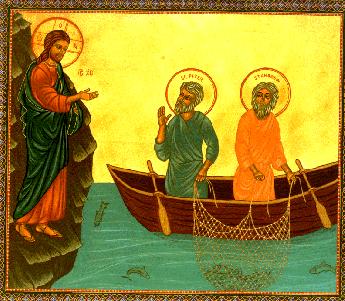
Let us see what Jesus did next, the absolute next thing, after He made this proclamation. “18 As Jesus was walking beside the Sea of Galilee, he saw two brothers, Simon called Peter and his brother Andrew. They were casting a net into the lake, for they were fishermen. 19 “Come, follow me,” Jesus said, “and I will send you out to fish for people.” 20 At once they left their nets and followed him. 21 Going on from there, he saw two other brothers, James son of Zebedee and his brother John. They were in a boat with their father Zebedee, preparing their nets. Jesus called them, 22 and immediately they left the boat and their father and followed him.”

Jesus calls each of us! He calls the clergy among believers, and Jesus calls lay people as well. In other words, Jesus calls everyone – each and every one of us – to follow Him. Do you feel called? Has Jesus picked you out from the crowd, given you a purpose, and given you a new name? (like Peter?) Some churchgoers do feel called by Jesus! However, some do not.

One bible commentator I respect, Dr. David Lose, has this to say: “Some years ago, as part of a Lilly Endowment sponsored grant on vocation, the research team I worked with discovered that while most of the graduates of our seminaries identified “vocation” and “calling” as important theological concepts that were at the center of their preaching and teaching, very few of their parishioners actually felt called. Very few of them, that is, believed that what they did with most of their time mattered to God and the church or made a particular difference in the world.” [2]

            I wonder why? God calls everyone! Taps everyone on the shoulder! Each believer!

Dear Lord, why is this? There are people who attend churches all over the country, even all over the world. Where are all of the people who believe in Jesus, and who claim the name of Jesus, and call themselves believers, even Christians?  Yet, I do not see many church folk who consider themselves called of God in this particular way.

            Let us consider Peter, Andrew, James and John. The first four disciples. What did the new Rabbi Jesus do? He called these four people to follow Him, the first ones to take part in the kingdom of God that starts our Scripture reading today!

            What were Peter, Andrew, James and John doing when Jesus called them to follow Him? They were fishing. Actual fishermen. You remember: “Come, follow me,” Jesus said, “and I will send you out to fish for people.” 20 At once they left their nets and followed him.” These people had nets, boats, and all other equipment used for fishing. They walked away from all that.

We can see how Jesus made His proclamation that “the kingdom of God is near!” And He called helpers, people to come alongside and do the work of fishing for people. Maybe we are coming at this sideways? What if – what if Jesus calling of the disciples was something unexpected? What if – what if the disciples’ calling and our calling is exactly the same?

            What kinds of equipment might we use for “fishing for people?” What kinds of equipment might Jesus have had in mind? The world today is a bit different from the first century, but some equipment people might use today include a Meals On Wheels cooler (to reach people by bringing them food), or extra clothes, coats or shoes (to give out to people in need), or even musical instruments or art supplies (to reach people with the arts). Plus, it’s always appropriate to reach out to others with friendly visits, caring cards, or phone calls or texts. Plus, as our Pastoral Prayer said today, we can also be readers to little children, bandagers of bruised hears, lovers of the forsaken, and pilgrims who show the way to others – with God’s help.

            What if – what if God’s calling is actually plain and simple? “Think about it for a moment: God’s call isn’t simply to do something, but rather to be something, a child of God…. if we can first focus on being – just being – God’s beloved children, and let that grace-filled identify seep into the deepest parts of ourselves.” [3]

            Yes, our call is to follow Jesus!  Our call is to offer God’s words of mercy, grace, hope and love, because we are God’s beloved children. I know I often say “Go and do that. Follow God” at the end of my sermons. I’ll add today, “Go and be that. Be that beloved child of God.” Alleluia, amen.

@chaplaineliza

(Suggestion: visit me at my other blogs: matterofprayer: A Year of Everyday Prayers. #PursuePEACE – and  A Year of Being Kind . Thanks!


[1]  https://www.davidlose.net/2017/01/epiphany-3-a-being-before-doing/

[2]  https://www.davidlose.net/2017/01/epiphany-3-a-being-before-doing/

[3]  https://www.davidlose.net/2017/01/epiphany-3-a-being-before-doing/   

Unknown's avatar

Introductions!

“Introductions!”

John 1:29-42 (1:36) – January 15, 2023

            Have you ever looked in a Where’s Waldo? book? The character we know as Waldo was first drawn in England in 1986 by illustrator Martin Handford, and the first book with the character published in September 1987. “Wally” was his name originally in the UK, although the worldwide popularity of this character often gave him different name changes. Although, he always looked the same, no matter where the books were published, regardless of his name.

            In our Scripture reading today, we have several distinctive names for the brand new teacher and preacher, Jesus of Nazareth. We can see several different people with different ideas about this preacher, too!

            We cannot go to a book and look up an exact photograph or definitive portrait of Jesus of Nazareth, though. Sure, different artists throughout the years have drawn what they think Jesus might have looked like. Or, their impressions of what Jesus might have resembled. But, no one can be exactly sure how Jesus looked.

            This Scripture reading today helps us to understand quite a number of things about Jesus, though. Not exactly how he looked, like a digital photograph, but more importantly, about His character. We have three instances where people introduce others to Jesus. Each one talks about Jesus in a slightly different way.  

            When you introduce someone, do you lead off with an important aspect of their character? Or, telling people what you find most endearing about them?

            Let’s see what John the Baptist said about Jesus: “Look, the Lamb of God, who takes away the sin of the world!” and “I myself did not know him, but the one who sent me to baptize with water told me, ‘The man on whom you see the Spirit come down and remain is the one who will baptize with the Holy Spirit.’ 34 I have seen and I testify that this is God’s Chosen One.” John says some very significant things.

            John the Baptist not only had this calling to baptize people, but he also understood that he was the Messiah’s forerunner. Every day in the Temple in Jerusalem, a lamb was sacrificed for the sins of the people of Israel. John was fully acknowledging that Jesus was the Messiah, born to take away the sins of the world.

            John knew Jesus well. (They were cousins!) What is more than that, John also stated that he saw the Holy Spirit come down and remain on Jesus at His baptism. The Person who had that happen was a special Person, indeed! John names Jesus “God’s Chosen One.” John was the one who pointed people to Jesus the Messiah.

            Do you need an introduction to Jesus? Perhaps, a re-introduction? Maybe you haven’t been following Him much any more. Maybe you have left Jesus behind, and are going your own way. Don’t you think – don’t I think – that we can walk more closely with Jesus from now on?

            The next day, John again goes walking with two of his disciples and identifies Jesus as “the Lamb of God.” We can see that John fully expects God’s chosen Messiah. John’s disciples do, too, because they immediately leave John and start following Jesus.

            Have you – have I – recently thought about ways we learn about Jesus? I know this church and especially this sanctuary is very familiar to many here. But, is there anything here in the sanctuary that tells us more about Jesus? Let’s look around. First and foremost, there is the large cross up above. This reminds us all of Jesus and the whole purpose of Him coming into the world. Jesus willingly became the Lamb of God who takes away the sins of the world.

            But, that is not all! Look at the altar. We see the chalice or cup, and the plate for communion. I know our Scripture reading today comes from the first chapter of John, and this example of communion is the end of the story. This is one of the concrete, tangible ways that Jesus has given us to remember Him. And, it is definitely a way to introduce people to Jesus.

            We also have visual reminders in our church banners, and audible reminders in the church hymns and other music. Everywhere we look and listen we have introductions to Jesus.

            Our Scripture today gives us just a glimpse about Andrew, one of John’s disciples who turns to follow Jesus. It was Andrew who was so excited about meeting God’s chosen Messiah, Jesus, that he immediately got his brother Simon Peter and introduced the two of them. Plus, Andrew was so enthusiastic that he was eager to introduce everyone he could to Jesus.           

Today’s Scripture reading from John’s Gospel “is a story about people who told others what they knew and introduced their friends to important people. They teach about Jesus in everyday situations to people they knew.” [1] I give you a challenge, to be like John the Baptist and Jesus’ disciples! Speak up to our friends, and siblings at home, or neighbors or coworkers, or wherever you are during the week. Even if people have some understanding about God, there is always more to learn, to know and understand! 

            Do we need an introduction to Jesus? Perhaps, a re-introduction? Do we hear the call to follow this Chosen One of God who restores not just a nation but all of creation to right relationship with God?  Do we hear a call to join with Andrew to introduce Jesus to our neighbors and families? I’ve found the one we’ve been looking for, the one in whom our restless hearts will find their rest!   

            Let us take these words to heart, and go and do them. Alleluia, amen.

@chaplaineliza

(Suggestion: visit me at my other blogs: matterofprayer: A Year of Everyday Prayers. #PursuePEACE – and  A Year of Being Kind . Thanks!


[1] http://worshipingwithchildren.blogspot.com/2013/12/year-second-sunday-after-epiphany.html

Unknown's avatar

Joyful, We Adore Thee

“Joyful, We Adore Thee”

Matthew 2:1-12 (2:10) – January 8, 2023            

I love my Christmas tree ornaments. I have many that are very special to me! Quite a number came from my mother, and hung for years on her Christmas tree. A few came from both of my grandmothers. My ornaments are special to me for where and when I got them.            

One ornament I got a few years ago was made by my son Peter. He is skilled at the art of paper folding called origami; he folded this exquisite three-dimensional star. I think of this as my Epiphany star; it is very precious to me. I wonder whether the marvelous star the Magi followed was anything like this star? Bright, multi-colored, shiny from a long distance?             The 2nd chapter of Matthew tells us about these Magi, or wise men from the East. They traveled a long way, following this bright and shining star to Jerusalem. These Magi asked King Herod, “Where is the one who has been born king of the Jews? We saw his star when it rose and have come to worship him.”           

The wise men dearly want to find the child born King of the Jews! But, where are they going? They themselves are not sure! They follow the star towards Jerusalem, but that town is where their books and ancient writings leave them all puzzled. “Where is the one who has been born king of the Jews?”            

We might think of three foreign kings, traveling around Palestine. But, this is most probably a misguided way of thinking. The whole mythology of “We Three Kings of Orient Are” embroidered the simple words found in Matthew chapter 2 into a fanciful tapestry involving three noble kings in rich robes, knocking at the door of the palace in Jerusalem.             

They were not kings, but instead “magi” from Persia. Wise people who studied the stars. Plus, these Persian astronomers (or, astrologers, since they put a great deal of stock in the movements of the stars, planets and other heavenly bodies) included both men and women. There may have been women in the group who followed the special star to Palestine!            

So, these wise men – or, wise people – were not quite sure where they were going. Simply that they were following a sign, a portent in the heavens. A special star that seemed to lead them onward, westward leading, still proceeding.            

Are you – am I – sure of where we are going? We have a good deal more revelation from God, more information from the Bible to guide us. But, do we know where we are being led? What is our path? Where does the Christmas star direct each of us to go, today?            

When the Magi arrived at the palace in Jerusalem, King Herod immediately asked the chief priests and Temple scribes to search the Scriptures and find some direction he could give to these foreign visitors. Herod “asked them where the Messiah was to be born. ‘In Bethlehem in Judea,’ they replied, ‘for this is what the prophet has written.’”           

I find it fascinating that the chief priests and scribes (who wer  e also avidly studying the Scriptures themselves) did not “see” that special star. They did not “get” the message that this brilliant sign in the heavens was a particularly marvelous star. Whatever that brilliant star was had to be huge and visible from a long way away! But, only these foreigners saw something different in the sky and decided to follow it!            

The shining star that the Magi followed is surely a sign from God showing the birth of the Messiah, the newborn King of the Jews, as the Magi said.            

We know one often-repeated symbol for God is light. Since we can’t make a picture of light, we use things that make light like a star, sun, candle, or lamp. I have a lovely origami star ornament here. We can reflect upon the many reasons, the many signs of light that are talked about in the Bible, including the Star of wonder, Star of light. Just think of the Advent wreath and Christmas candle lighting services and note that we light those candles to remind ourselves that God the light is with us.  What’s more, think of the candles here on the chancel. We light the candles every week to remind us of the Light of the World, the Light that shines in the darkness, the magnificent Star in the sky the Magi followed.            

Turning back to our Scripture reading, “After the Magi had heard the king, they went on their way, and the star they had seen when it rose went ahead of them until it stopped over the place where the child was. 10 When they saw the star, they were overjoyed. 11 On coming to the house, they saw the child with his mother Mary, and they bowed down and worshiped him. Then they opened their treasures and presented him with gifts of gold, frankincense and myrrh.”            

The wise people who followed that star found what they were searching for. And, they worshiped, and were overjoyed. Are you – am I – sure of where we are going? Are we following that star, too? We have a good deal more revelation from God, more information to guide us. But, do we know where we are being led? What is our path? What does the Christmas star direct each of us to do, today?            

I ask all of us to consider these words from Howard Thurman, progressive theologian who wrote this poem: The Work of Christmas.

When the song of the angels is stilled, When the star in the sky is gone, When the kings and princes are home, When the shepherds are back with their flock,  The work of Christmas begins: To find the lost, To heal the broken, To feed the hungry, To release the prisoner, To rebuild the nations, To bring peace among others, To make music in the heart. 

            Let us take these words to heart, and go and do them. Alleluia, amen.

@chaplaineliza

(Suggestion: visit me at my other blogs: matterofprayer: A Year of Everyday Prayers. #PursuePEACE – and  A Year of Being Kind . Thanks!

Unknown's avatar

A Time for New Things

“A Time for New Things”

Ecclesiastes 3:1-14 (3:11) – January 1, 2023

            Today is a fresh new year, a brand new calendar, new experiences each and every day. What bright opportunities are ahead of each of us! Just imagine – today is a time for new things, just as our Scripture reading this morning states.

            Today’s Scripture reading from Ecclesiastes talks a great deal about time. All different kinds of time, and lots of ways of marking time, too. “Time feels different to children who have known so little of it. For them years last forever. They are just beginning to sort out the difference between how long a time period feels and the fact that an hour is always 60 minutes long no matter how it feels.” [1]  

            Yet, many of us here have seen the passage of time, and many years go by on the calendar. Many people know that days, months and years can slip by oh, so quickly. When a child is 5 or 6 years old, it can seem like forever before the Christmas holiday finally arrives! But, when someone turns 75 or 86 years of age, the Christmases and the holidays seem to come faster and faster. Time surrounds each of us, here in this world, in this place and time.

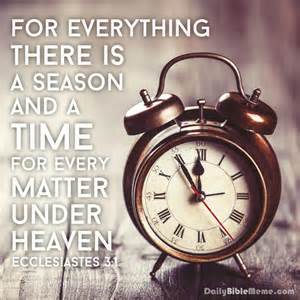
            As we reflect upon this Scripture reading for today, we can also reflect upon what exactly the author of Ecclesiastes meant. “For everything there is a season, and a time for every matter under heaven…” That can mean we ought to be serious and anxious about each little factor, or each tiny decision each of us makes.

Sure, some can go too far, and have a totally fatalistic point of view of life. That is the way some Bible scholars view the author of Ecclesiastes, who often says that everything is absolutely fated and predetermined. Many scholars view the author of Ecclesiastes as the aged King Solomon, and the writing in Ecclesiastes is mostly jaded, disheartened and questioning. Nothing is worth doing, no innovation, no creativity; no one can change anything ever. What a hopeless, helpless point of view. This view takes away free will, human decision, and the possibility of change. Why do anything, ever again?

            But, that way of serious, somber thinking can be really negative. Seconds turn into minutes, hours, days and months. Before we know it, sometimes we can look back at the passage of many days, many existences with sadness and regret.

            As we look through this clear choice each of us has on the New Year’s Day, we can certainly wonder about our personal choices. And, these choices sound like this Scripture reading, too. “A time to be born and a time to die, a time to plant and a time to uproot, a time to kill and a time to heal, a time to tear down and a time to build, a time to weep and a time to laugh, a time to mourn and a time to dance.”  

            We can add “a time to be positive, and a time to be negative, a time to look forward, and a time to look back over our shoulders.” These additions are fully in keeping with the author’s intent, I think. Yet, each of us must think about what each of us is going to do with these words, choices and intentions. Each individual needs to weigh this decision in their own mind. And, what is the Godly decision?

            Another way to reflect upon this fresh, new decision is to consider what has happened to each of us in the past twelve months, and find within an eagerness, looking forward to the future. Again, we can view this new year as a new path in the pristine snow, ready for each of us to walk upon. We can track a fresh path where none has been before!

            Bible commentator Christine Valters Painter tells us that “the human desire [is] for renewal and new beginnings. St. Benedict in his Rule for monasteries writes ‘always we begin again.’  This impulse is the heart of what makes anticipation of the New Year kindle all of our longings for a richer way of being in the world.  There is something so very hopeful to me in this fundamental impulse.” [2]

            Remember, as Dietrich Bonhoeffer tells us repeatedly, we are Christians, together. A congregation is a group of believers gathered together for friendship, fellowship, and most of all, to worship together. We all come together to worship as a group of believers. We all come together to find commonality in this renewal and new beginning each January 1st. And, we all can find comfort, camaraderie and fellowship in the common coming-together as a family of faith.

             Yes, this new calendar page is an opportunity to begin again as individuals. Plus, January 1st is another opportunity to come together as a congregation and find a more hopeful, a richer way of being in the world.

            Just as the concept of time is foundational to each one of us, with this concentration of time so central, so this Scripture reading tells us that God has set eternity in humanity’s heart. Verses 11 and 12: “yet no one can fathom what God has done from beginning to end. 12 I know that there is nothing better for people than to be happy and to do good while they live.”

            What a sentiment! And, what a wonderful way to decide to look at life. As we all begin again this first day of 2023, let us listen to the writer of Ecclesiastes. God has set a foundational sense of time in our human hearts, and God has set for us a task. There is nothing better for us than to be happy and to do good while we live. God has given us this precious gift: a God-given gift of time, and a God-given gift of being happy.

So go – do that. Be well, and be happy.

@chaplaineliza

(Suggestion: visit me at my other blogs: matterofprayer: A Year of Everyday Prayers. #PursuePEACE – and  A Year of Being Kind . Thanks!


[1] http://worshipingwithchildren.blogspot.com/2013/11/new-years-day-years-b-c.html

[2] http://www.patheos.com/Resources/Additional-Resources/New-Year-New-Beginnings

Unknown's avatar

God’s Birth Announcement

(St. Luke’s Church had an electrical outage over the weekend. The radiator pipes burst, and there was no worship service on Sunday, December 25, 2022. This sermon comes from my archives, from December 24, 2003.)

“God’s Birth Announcement”

Luke 2:1-14 – December 24, 2003

            I have several friends who have recently had babies. Welcoming babies into the world is such a joyous occasion. One of the first things most people I know do is spread the news about the new baby, letting other friends and acquaintances know about this new little one who has joined the human race. When and where the baby was born, how big it was, whether it was a girl or a boy, and what the parents decided to name the baby are all details that are joyously spread, as soon as possible.

             I wonder . . . what would God’s birth announcement look like?

            In the fullness of time, God sent His Son. Prophesied in many passages from the Hebrew Scriptures, foretold for centuries before His coming. Looking at the Old Testament passage for today, Isaiah 9, the prophet tells his readers about the Wonderful Counselor, Mighty God, Everlasting Father, and Prince of Peace, who is the coming Messiah.

            Throughout the Advent season, we’ve been preparing for the coming of this Messiah. Well, I have news for you. He’s here. Today is Christmas Eve, and tomorrow we celebrate once again the earthly birthday of the Babe of Bethlehem, the Savior of the World, the only begotten Son of the Heavenly Father. Our Lord Jesus Christ, our savior and redeemer, from age to age the same, came into this fallen world as a baby. Imagine that. Emptying Himself of all His vast, eternal God-ness, and being born as a human baby.

            I wonder: what would God’s birth announcement look like?

            I think we have a pretty good idea, if we take a look at the second chapter of Luke. Doctor Luke gives a full accounting of what went on in those days. This account here is God’s version of a birth announcement, but what an unexpected sort of announcement!

            Let’s look at the parents of the Baby, first of all. The mother, Mary of Nazareth, is not even married yet. Sure, she’s engaged to this carpenter, Joseph, but they haven’t yet been fully joined in marriage. Marriage in those days, in the Jewish culture, was a several-step process. Mary and Joseph hadn’t quite finished the whole marriage thing.

            We read in chapter 1 of Luke that the Holy Spirit came upon Mary, and she conceived. Is Joseph the father of this Baby? No. Joseph could not believe this part of the account at first, until assisted by some heavenly help. An angel came and reassured Joseph that Mary was on the up and up, and that the baby inside of Mary was really the Messiah, the Savior of the world. In other words, the Son of God.

            So, the birth parents are not the usual kind of parents. The circumstances of the birth are not quite the typical birth scenario, either. Imagine the birth of a baby today, here in Evanston. Chances are that the baby would be born either in St. Francis or Evanston Hospitals, with the latest medical technology available, just in case. Not so for Mary, the mother of Jesus. Not only did she have the baby Jesus in less than optimum circumstances, in terms of hygiene and medical needs, but she was also far from her home as well.

            Mary and Joseph were both far away from familiar people, places and things. They were travelers, like many people in the town of Bethlehem at that time. Luke 2 tells us that there wasn’t any place for them to stay–anywhere. Because of the census ordered by Caesar Augustus, the town of Bethlehem was mobbed.

            Since Bethlehem was the ancestral home of King David (who had a lot of children!), that meant that there were quite a lot of people who had to be counted who were descended from David. And not all of them had money. We can see, from the offering that Mary and Joseph offered to the Lord shortly after the birth of the baby Jesus, that they did not have very much money.       

            Bethlehem must have been very crowded indeed, if a woman about to give birth couldn’t find even a room to have her baby in. She and Joseph had to room in a stable. It would be similar to today, where a young woman might have a baby in any common garage. We could even take it a step further, and draw some definite similarities between Mary and Joseph and some other young, homeless couple going to have a new baby, searching for a place to spend the night.

            I don’t know whether any of you have currently had the opportunity to see a sign in front of the First Presbyterian Church in Evanston, but one of the smaller trees near the front door to the sanctuary is practically covered with blue ribbons. There is a sign posted next to the tree, saying “While celebrating One homeless Family, these ribbons ask us to remember the homeless with us today.” I had never thought about the Holy Family in that way before. Again, it’s God’s unexpected way of announcing the birth of His Son.

            While we’re thinking about the stable where Mary had her baby, what about that stable, anyway? Jesus, after all, was a descendant of King David, through both His mother Mary and His adopted father, Joseph. A stable is an unexpected place to find a king. I don’t know about you, but I’d expect royalty to be born in a palace, or at least in a nice house. Not in a stable, anyway.

            And who are the people who first receive this birth announcement? Are they influential members of the community? Rich, movers and shakers? Leaders of the local synagogues and teachers of the Law of Moses? Those would be the kinds of people who I might expect to have a birth announcement sent to them. But God doesn’t work that way. Again, God does the unexpected, and chooses the most unlikely people to receive a hand-delivered message from the Lord of Hosts, the King of Kings.

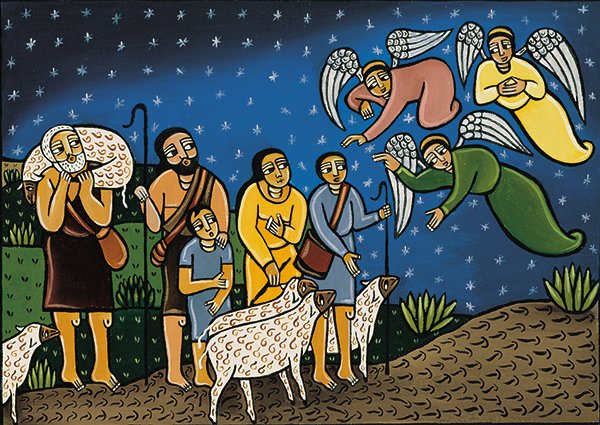
            Some people in the 21st century probably are so accustomed to the Christmas story that their idea of shepherds keeping watch over their flocks by night is somehow associated with Christmas cards. But it was life as usual for these working people. An everyday way of life in Palestine. What’s more, being a shepherd was not a particularly high class job. The lowly vocation of shepherd was on the outskirts of society. A possible comparison today is to think of a person selling “Streetwise,” the paper sold for $1.00 outside of grocery stores and coffee shops here around the Chicago area.

            And suddenly, the angel of the Lord came to these shepherds–came to people in homeless shelters, people selling “Streetwise,” people down on their luck, people on the edge, on the outs of society. The angel of the Lord came to them with good news. Good news. With news of God’s birth announcement. We can see God again breaking through, in an unexpected way, to an unexpected group of people.

            God sends a birth announcement in unexpected ways to unexpected people, in many situations, all over the world. The angel was the first to tell of the newborn Baby, born in Bethlehem, but then the shepherds spread the news about the new Baby, letting other friends and acquaintances know about this new little One who has joined the human race. When and where the Baby was born, the news that it was a boy, and that the parents decided to name this Baby Jesus–for He would save people from their sins–are all details that the shepherds joyously spread, as soon as possible.

            Again, it’s God’s unexpected way of announcing the birth of His Son. Can you think of someone who hasn’t heard about this birth announcement? We today have the opportunity to spread the news about this Baby born in Bethlehem. And we can joyously praise God, for Jesus is the savior and redeemer of the world, as the angel of the Lord proclaimed so long ago.

Unknown's avatar

God with Us, God’s Peace

“God with Us, God’s Peace”

Matthew 1:18-25 (1:23) – December 18, 2022

            Where does your name come from? What do our first names mean? Do you know? Are you named after someone beloved or meaningful in our families? Many parents choose their children’s names carefully, and sometimes name them after someone beloved or meaningful to them or their family. Several of my older brothers and sisters have names like that. I suspect some relatives of yours do, too.

            The name Jesus had a special meaning. But before we get to that, let’s talk about this reading from the Gospel of Matthew. This is not the typical reading associated with Christmas! This is not the reading with Mary or the Magnificat, or with the angels, the shepherds, the star shining in the east, and shepherds rushing to find the Baby in Bethlehem. That is the reading from Luke chapter 2. Instead, we have today’s reading from Matthew chapter 1. This is the Nativity from Joseph’s point of view.

We can’t know much about Joseph and Mary’s marriage preparations, other than some generalities that we understand from cultural and historical studies of their area and the society of the time. But, I have some experience with people. I have learned how many people behave, frequently, on different occasions. I can tell you right now that from my observations, people have not changed much over the centuries.

            Matthew tells us that Joseph observes the Law of God. That is huge! Can you say that about yourself? Can I? Are we faithful to God’s laws? Since Matthew is a faithful Jew, this law-keeping is obviously very important to him. The very next thing we hear is that Mary is pregnant, and not by Joseph! What does that mean to Joseph, who is so faithful to the Law of Moses? Matthew does let his readers know that Joseph wants to dissolve the betrothal quietly.

How often, even today, do we make plans? Trying to fix, manage and control people, places and things? Doing our best to make sure all our ducks are in a row, making sure that everything is just right, trying to orchestrate everything, so that nothing is left to chance?

We can see that Joseph made plans, too! Yes, he cared enough for Mary – pregnant as she was – that he planned to divorce her, to break the betrothal quietly. He wanted to organize what he could of his life, while still being considerate of her. But, what happened next?

            Let’s take a closer look at Matthew’s words: “But after Joseph had considered this, an angel of the Lord appeared to him in a dream and said, “Joseph son of David, do not be afraid to take Mary home as your wife, because what is conceived in her is from the Holy Spirit.”

Sure, Joseph had lots of fear and anxiety, because of the unknown and unexpected. Because of a situation he did not plan for. The angel came to him with words of comfort and hope. Can you imagine how heartwarming this must have been for Joseph, hearing these words from an angel sent from God? Can you imagine how earthshaking it would be for an angel, a messenger sent from God, delivering words of comfort and hope to us?

            We do not know much about Joseph at all, from the biblical record. He does not get very much attention, compared to Mary. But, this appearance of the angel of the Lord is certainly dynamic! In case Joseph had second thoughts about where the baby came from, the angel’s words gave Joseph no doubt: “what is conceived in Mary is from the Holy Spirit.”

            Joseph and Mary were even told what the child’s name would be! As I said a few minutes ago, names can be meaningful. In this case, Jesus’ name means something very important. Let us hear what the angel said: “Mary will give birth to a son, and you are to give him the name Jesus, because he will save his people from their sins.”       

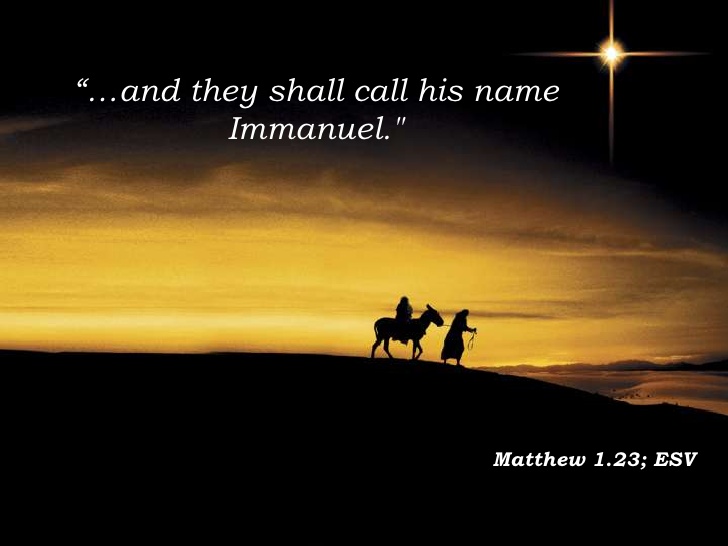
            The name “Jesus” means “the Lord saves,” revealing the birth of the Savior of the world. This statement is an angelic birth announcement of an historic nature, indeed! But, this is not all. Matthew goes on to give the words of the prophet Isaiah: “All this took place to fulfill what the Lord had said through the prophet: 23 “The virgin will conceive and give birth to a son, and they will call him Immanuel” (which means “God with us”).

            My favorite bible commentator Carolyn Brown states, “The name Joseph and Mary are to give this child is Immanuel, “God with us.”  When we want to know what God is like, we look at Jesus.  Jesus once said, “If you have seen me, you have seen God.  What I say is what God says.  What I do is what God does.” [1]  In Isaiah the name Immanuel is defined and connected to God’s promise to be with us, even right by our sides. In the gospel Joseph is instructed to name the baby both Jesus and Immanuel. God-with-us.  

            A preview of what is to come at the end of Matthew’s Gospel is also a reminder to all of us. “The last sentence in Matthew 28 and Jesus’ last words: “remember I am with you always, even to the end of the age.”  “I will be with you” is God’s promise to us always.  It was God’s promise for hundreds of years before Jesus was born, God’s promise was God-with-us when Jesus was alive, and is God’s promise to us forever. [2]

What better source for a name than a God-given name? How amazing is the prophecy from Isaiah that lets us know God will always be right by our sides!

Unexpected situations may come up, but they are not unexpected to God. Human plans may fail, but God never fails. Through it all, God is faithful in all God does, and we can count on the Lord one hundred percent. Immanuel – God with us!


[1] http://worshipingwithchildren.blogspot.com/2013/08/year-fourth-sunday-of-advent-december.html

[2] Ibid.

@chaplaineliza

(Suggestion: visit me at my other blogs: matterofprayer: A Year of Everyday Prayers. #PursuePEACE – and  A Year of Being Kind . Thanks!

Unknown's avatar

Joy, For the Nations

Joy, For the Nations

Isaiah 42:1-9 (42:6) – December 11, 2022            

God has an amazing way of bringing about justice! You and I can think of countless situations where God is walking with faithful believers through all kinds of difficult situations! Yet our God cares for each and every situation, and our God accompanies all these in patient and long-suffering ways.          

  Today’s reading from the prophet Isaiah highlights God’s servant bringing justice, lighting the way to joy, and bringing release to the captives. God usually does not smite the “bad guys,” and we know God doesn’t throw thunderbolts at the people who make life so difficult for everyone else.             

How on earth are we supposed to deal with rotten situations like chronic illness, unemployment, or natural disasters, then? What could you and I do when we are being mistreated or oppressed or trampled, like the people of Israel were by the Babylonians? Because, that was who was beating up on the armies of Israel at the time Isaiah wrote. And, the Babylonians finally conquered the Israelites and took many of them away to the country of Babylon as hostages, and enforced labor.         

    This rotten situation was very real for Isaiah and the country of Israel, in other words! What are the people to do? How should they deal with evil, unfeeling oppressors?            

The prophet writes, speaking for God: “Here is my servant, whom I uphold, my chosen one in whom I delight; I will put my Spirit on him, and he will bring justice to the nations.” “But, Lord,” I can just hear many of the people of Israel say, “When will this be? How long do we need to wait? Why are You taking so long?”           

Waiting is just what we’re doing now. Right now, we are in the season of Advent; we are waiting for the coming of the Messiah, of the Servant of the Lord. The Baby in Bethlehem. Today is the third Sunday of Advent, the Sunday of Joy. The week of continuing expectation, and the week of the Virgin Mary.           

  Several themes of this reading from Isaiah are so similar to the themes of the song of the Virgin Mary – the Magnificat from Luke chapter 1. The angel Gabriel has just told the teenage Mary she will bear the Messiah, the Servant of the Lord. The next thing we know, Mary starts singing this amazing song! Hearkening back to Hannah’s song from 1 Samuel and to this song we read today from chapter 42. Similar to God taking delight in the servant of the Lord, Mary begins her song taking joy in the Lord. As she says, “From now on all generations will call me blessed, for the Mighty One has done great things for me—holy is his name. 50 His mercy extends to those who fear him, from generation to generation.” As God proclaims the promise to “to open eyes that are blind, to free captives from prison and to release from the dungeon those who sit in darkness,” so Mary takes heart in God’s promise that the Lord considers, cares for, and acts on behalf of the lowly.           

  Both of these songs proclaim radical actions! Both of these songs are from a subversive point of view. Both of these songs – the Magnificat of Mary and this servant song from Isaiah – talk of toppling existing unrighteous power structures and erecting a topsy-turvy power structure with the have-nots receiving more than enough from God. Mary goes even further, stating that “it is not for kings or the mighty and powerful that the Lord has regard, rather it is for all the rest that God does great things.” [1]           

Both songs raise the question of justice. Both time periods had the people of Israel under the boot of conquering, oppressive nations: Babylon in the time of Isaiah, and Rome in the time of the Gospel of Luke. I can just hear the people of Israel say, “Has God abandoned us? Are we still God’s people? Is God still God?”  Because of exile and oppression, the people of Israel could only conclude that God had withdrawn favor and allowed the conquerors to punish them for their sins and disobedience. [2]            Yet, into all of this upset and darkness and uncertainty, both songs praise God for being God. Can we do that too, and praise God, today? Both songs address the theme of justice for all people, not just for a few. Can we believe in God’s statement of justice for all, even though every day we see the poor and the downtrodden getting pushed around, and the humble and lowly being overlooked and even discarded?            

“Isaiah reminds this exiled people that God has not abandoned them but is indeed at work among them, restoring them to be a blessing. This is good news! God is still God.” [3]This loving, caring attitude of God is amazing, in God’s approach to bringing justice to all people. Both Isaiah and Mary have strong feelings about justice—especially radical, subversive Mary! Our patient God is working with all of us, gently, gradually, to bring change and justice into this fallen world.

Both Isaiah and Mary sing a song that can be, should be, our song in this Advent season. As we have prepared for the coming of the Christ Child, now we too can sing in thanksgiving, in celebration, in remembrance, and in proclamation of the promise made to our ancestors. And, the promise made to us, too. What can we say but, alleluia!  Come, Lord Jesus!

@chaplaineliza

(Suggestion: visit me at my other blogs: matterofprayer: A Year of Everyday Prayers. #PursuePEACE – and  A Year of Being Kind . Thanks!

Unknown's avatar

Love, For Such a Time

“Love, For Such a Time”

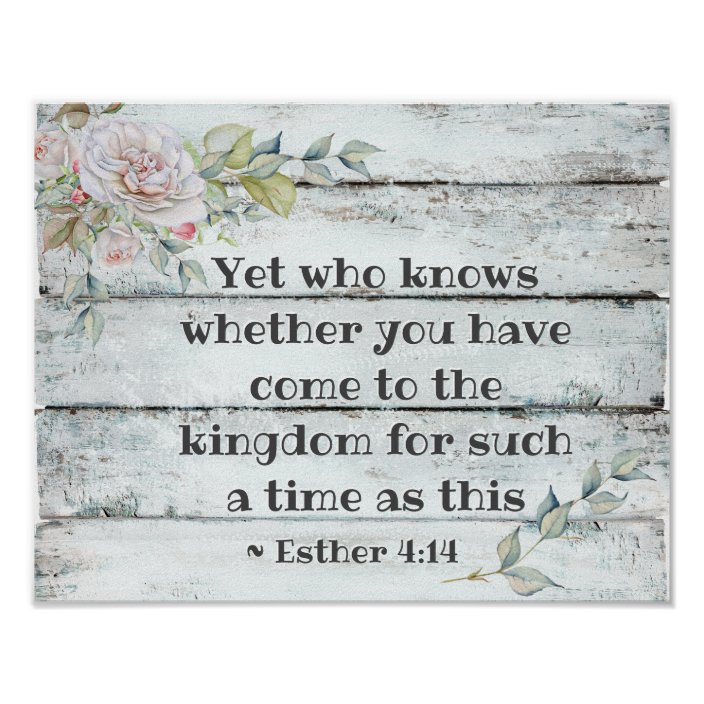
Esther 4:1-17 (4:14) – December 4, 2022

            Do you remember some fairy tales? The scary ones? The ones where the good guys run away from the bad witch, or the evil fairy, or the wicked king? And, then the good guys turn around and stand up to those evil people? Those fairy tales are so much like the story of Esther we heard a little of today in our Scripture reading.  

            What happened just before this chapter in Esther? The evil, wicked counselor Haman convinced the King of Persia to have all of the minority resident aliens, or foreigners, killed on a certain date. These foreigners are the Jews. At this point, about 600 years before the birth of the baby Jesus in Bethlehem, the Jewish people have been conquered.

Many of the Jews have been forcibly taken hundreds of miles away to a foreign land, to Babylon (or Persia). There they are: a foreign minority in a country not their own. What a situation to be in! Yet, the Jew Mordecai has worked hard, and is now an official in the King of Babylon’s palace. What’s more, his younger cousin Esther won a nationwide beauty contest held by the King to choose his next bride.

            Except – remember what I said a few minutes ago? How the good guys in the fairy tales so often keep getting stepped on and beaten up by the evil, bad guys? That is the way it was with the Jewish people, in Babylon. Many of them were forcibly corralled and taken far, far away to a land not their own, to Persia. To work for the Babylonians, like the Jewish official Mordecai did, in the King’s palace. Plus, his young cousin Esther was now queen of the whole country! Except again, Esther is “an outsider in Persian [or Babylonian] culture — especially in the royal city of Susa. Esther is a resident alien, a foreigner, and a member of this peculiar tribe that Persians tolerate unevenly.” [1]

            I can see some clear parallels with the story of the Virgin Mary. She was also a Jew, living under a conquering army, in the occupied country of Palestine. Similar to the situation of Mordecai, Esther and their Jewish friends, living in exile far away from their home. Both women had troubles to face, although Esther’s trouble was magnified because of the autocratic King.

            We focus on Esther and her story today partly because Esther and her bravery are linked closely with Mary and her courage, found in the Gospel of Luke. Preachers have preached sermons on Mary for many years, centuries, even. See Mary and her bravery and willingness to step out into the unknown with God at her side. But, sermons on Esther? Not as often, to be sure. Yet, Queen Esther of Persia did something very similar, in terms of courage, bravery and love.   

            In this chapter from the book of Esther we have grief and dismay from Esther’s cousin Mordecai, certainly! Yet, there is also a time for discernment, an expression of hopes and fears, and a final resolve from Queen Esther as she decides to go and have an audience with her husband, the autocratic, distant King of Persia. For such a time as this she was appointed queen.

            Here’s a big question for us, today. We can see Esther instructing her cousin to gather the expatriate Jews together, those who live in the capital city of Susa. Her countryfolk are to fast and pray for her, just as Esther and her maids fast and pray, as she prepares to see the King. Are we that serious about large challenges, today? Do we fast and pray before significant events in our lives today? And if not, why not? We can certainly see this precedent set for us repeatedly in Scripture, in both the Hebrew Scriptures as well as the New Testament.

            I know certain acquaintances of mine would probably run back and forth when faced with a huge challenge like this one, wringing their hands, maybe even giving up. “It’s no use! I’m too puny, too weak; no one would listen to me, anyway!” Perhaps even hoping that someone else would do something to save my people! Your group! Our bunch of expatriate friends!  

            Remember, young Mary was a teenager when she was approached by Gabriel. She had no idea what was happening until the angel explained. She could have been scared out of her wits, or fainted dead away at the sudden, fearful appearance of the angel. And, telling her that she would become pregnant, without the protection of a marriage, of a husband? Mary must have known other young women who that had happened to, and seen how ostracized and shunned they were in her tight-knit community. It took a great deal of bravery and courage for Mary to accept what the angel told her. Yes, there are real similarities between Mary and Esther.

Esther and Mordecai do what they can with what they have and that is enough to save the day. That makes this a good story with which to encourage worshipers of all ages to look for what they can do about problems they confront rather than what they cannot do.  It is easy for children (and the rest of us) to assume there is nothing they can do about many problems they see around them.  [Young people] see themselves as too young, too small, not smart or knowing or wise enough.” [2] But, isn’t that what so many of us grown ups do, too? We can’t do anything about any of these big, grown-up sized problems because we are too puny, or not smart enough, or wise enough, or knowing enough.

But, isn’t God with us today when we face down problems? Just as God was with Esther and Mordecai! And just as God was with Mary all the days of her pregnancy, and beyond! We can praise God for the name Emmanuel, which means “God with us.” We can praise Jesus for claiming that name, and remaining right by our sides. Through scary and anxious times, as well as fearful and intimidating experiences. Jesus, Emmanuel, God-with-us will be right next to each of us. And for that, we can praise God! For such a time as this.


[1]  https://www.workingpreacher.org/commentaries/narrative-lectionary/esther-2/commentary-on-esther-41-17-2

[2] http://worshipingwithchildren.blogspot.com/2015/08/year-b-proper-21-26th-sunday-in.html

@chaplaineliza

(Suggestion: visit me at my other blogs: matterofprayer: A Year of Everyday Prayers. #PursuePEACE – and  A Year of Being Kind . Thanks!

Unknown's avatar

Hope as a Way of Life

“Hope as a Way of Life”

Habakkuk 1:1-5; 2:1-4 (1:5) –November 27, 2022

            At the end of October, we celebrated Halloween, the day of scary stories, haunted houses, dressing up in all kinds of scary costumes like monsters, ghosts, and other frightening creatures.

Today marks the first Sunday of Advent, the beginning of the church year. Our Scripture reading comes from the Hebrew prophet Habakkuk, on the look out for God’s response to all kinds of scary and frightening things that were going on in the lives of the people of Israel at that time. Long time ago, at the beginning of the 6th century before Christ was born.

Every October, we observe the season of scary things, and every year, many people truly enjoy being scared down to their shoes. Because – isn’t it true that scary things or frightening places are not so scary after all? Especially when we consider that many scary monsters and creatures turn out to be just like us? And, just like the people in Habakkuk’s day, too?

However, Habakkuk talks about not only scary and frightening stuff, but about violence and injustice, causing so much pain in the world. This was not only true many centuries ago. It’s even more true today, with all the fear, uncertainty, anxiety and dread people encounter each day, In our neighborhoods and towns, as well as nationally and internationally.

How about you? How about me? Don’t we regularly see fear, uncertainty, and anxiety in our individual lives? And what about violence? What about injustice? The world just had several instances of shocking, horrible events. Significant recent disasters include mass shootings of multiple people in the past weeks around our country, and the massive earthquake in Indonesia.

Quite different events, but comparable to the many different kinds of situations that the nation of Israel was dealing with during the time of Habakkuk. And, similar to many different kinds of things going on today, like regional wars, famine, drought, rampant inflation and unemployment! What is a person to do, in the face of all this happening? Where is God in the midst of all these tragedies, no matter what their size, big, medium and small? Where is God in your life, or in mine, or in the lives of our beloved relatives and friends?

Today is the first Sunday of Advent. At first glance, this is a different Scripture reading for the beginning of the Advent season! Or, is it? Advent is the season at the beginning of the church year where we – the Church – prepare for the coming of the Christ child, the Baby born in Bethlehem. The prophet Habakkuk’s “message of waiting with hope in the midst of despair offers a powerful word for both the Advent season and for the world we live in today.” [1]

It’s true that the first words of this prophecy are a personal lament. This cry sounds so familiar to us from the Psalms! “O LORD, how long?” This is the opening of a dozen psalms, and repeated again and again in the books of the prophets! I hear this lament from relatives, loved ones, and hospice patients themselves. “O LORD, how long?” People agonize over dire circumstances, and cry out to the Lord again and again. This has happened for millenia, too.

What we can learn from our reading today is – it is okay to complain to God! And, just like Habakkuk, it is okay for us to call God to account. Just like Habakkuk, we too can give voice to what we perceive as God’s refusal to respond to cries for help. Almost as if God is forgetful, or if the Lord has gone on a journey or is asleep.

“That in and of itself is an important reminder for congregations: that being angry at God, or feeling that God seems absent, is “allowed,” and in fact has biblical precedents—and yet those feelings of despair are never the end of the story.” [2]

The things we really fear – that bullies at school or at work will go after us, that something bad will happen to someone we love, that we will lose our jobs, that there will be a war where we live, that we will never be able to do what we want most to do….   If the thinking about fears leads to talking about real, actual fears and anxiety about jobs, the economy, world conflicts, and more, we all can learn that fear is a very real part of life. [3]

Let’s talk straight. In this fallen, imperfect world, people have been fearful and anxious for millenia. But, God promises that fear, anxiety, violence and evil will not be the final word! We can hold this real fear and anxiety in tension with the blessed fact that our God brings hope! Our God is present with us! We can be ready to hear God’s promise to Habakkuk and us in Habakkuk 1:5. ““Look at the nations and watch—and be utterly amazed. For I am going to do something in your days that you would not believe, even if you were told.”  

Do you hear? Do you understand what God is telling us here? “God’s goal in asking Habakkuk to write the message so big was that God wanted everyone to read it and know that God was on the side of the faithful [that’s us!] and against the evil [violence and fear so rampant in the world today].” [4] The Lord wants us to read this message of hope and faith on billboards, or even to have skywriting planes write this hopeful message in the sky above!

God brings hope! As Habakkuk said, God will be with us through the dark valleys and disappointments and tragedies of life, just as God is right beside us through sickness, poverty, conflict, disaster, and whatever other negative things may try to creep in and surround us.

The great good news is our God will not allow these bad things to overcome. God will have the final word, and will prevail. The Lord has promised, and God’s word is sure!

Alleluia, Amen.

@chaplaineliza

(Suggestion: visit me at my other blogs: matterofprayer: A Year of Everyday Prayers. #PursuePEACE – and  A Year of Being Kind . Thanks!


[1] https://www.workingpreacher.org/commentaries/narrative-lectionary/faith-as-a-way-of-life-2/commentary-on-habakkuk-11-4-22-4-33b-6-17-19-2

[2] Ibid.

[3] http://worshipingwithchildren.blogspot.com/2013/10/year-c-proper-26-31st-sunday-in.html

[4] Ibid.

Unknown's avatar

Pray, Petition and Request

“Pray, Petition and Request”

Philippians 4:4-7 (4:6) –November 20, 2022

Sharing together. We share many things together. We share conversations, we share meals, we share good times together. We share sadness, we share worry, we share bad times together. We also share prayer praises and prayer requests together.

            I’m reminded of the time each Sunday we set aside in the services here at St. Luke’s Church, specifically for prayer concerns. We ask for concerns as well as praises. We lift up the joys that happen in our lives as well as the sad times. This time is a time of drawing closer together, of affirmation, and of caring and concern for one other as a community.

            We can see this kind of care and concern here in our Scripture passage for today. The believers in the city of Philippi had real love and concern in their hearts for the Apostle Paul. We see Paul had a deep and warm love for this group of believers in Jesus Christ.

            Paul was not the kind of guy who stayed in one place for very long. He was an itinerant minister, almost a circuit-riding teacher, preacher and evangelist. But, traveling around as Paul did, things came up. From Paul’s own account, a lot of things happened to him, and many of them were very unpleasant, including beatings, stonings, shipwrecks, and other kinds of dangers. If anyone here is interested, a first-person account of some of Paul’s life and journeys as an itinerant preacher can be found in 2 Corinthians 11.

John Lennon once said, “Life is what happens in between the things you plan.” I’m sure the Apostle Paul could relate. Somehow, the Philippian believers found out about the difficulties Paul was having. Without any letter requesting money, without any beneficence inquiry, without anyone from the apostolic development office asking for a donation, the Philippians decided on their own to take up a collection and send it to Paul.

They weren’t close by, so they sent a member of their community to hand-deliver their love-gift to Paul, their pastor, Epaphroditus. There was a complication. Paul was in prison. Not just in some sleepy little backwater of a town. No, Paul was in jail in the capitol city. Serious jail, guarded by career army personnel. The Philippians needed to send their gift all the way to Rome.

As Dr. McGee said in his commentary, the Philippian church was the group who came to Paul’s need when he was in prison. They sent him badly needed support! Paul was their former pastor, and their missionary, too. [1]

            One of the reasons that Paul wrote this letter in response to the Philippian believers was to send a thank-you letter. Sandwiched in among the suggestions and commands Paul gives his friends, long-distance from Rome, is this command—“don’t worry!” What a thing for Paul to say! Of all people, he had good reason to be anxious and concerned about his own situation!

He is waiting in prison—remember, in serious jail—looking at the capital charge of treason and blasphemy for denying that “Caesar is Lord.” At this point, it was quite possible that Paul was going to die, probably from beheading. From our point of view, today, just thinking about all that Paul was dealing with, how could he say “don’t worry!”??

            Worry can be insidious. Gnawing away at our insides. Like acid, eating us up. (And sometimes that is exactly the case, as in stomach ulcers!) You and I have lots we can potentially worry about: the economy, the government, fighting and violence near and far, our health and our loved ones’ health, our homes, our families, even worry about our pets.

            Now that we know a little more about what Paul was facing, let’s listen again to several verses from chapter 4: “6Do not worry about anything, but in everything by prayer and supplication with thanksgiving let your requests be made known to God. 7And the peace of God, which surpasses all understanding, will guard your hearts and your minds in Christ Jesus.”

            Wow! Paul—in prison, mind you!—tells the Philippians “don’t worry!” But instead—pray! Pray, and let your requests be made known to God! Paul says that prayer is the antidote for the problem of worry!

            I am especially intrigued about what Paul says after “Pray!” He says that God’s peace will replace worry. This peace of mind from God, from above, will guard your heart and mind. The Greek word “guard” means “will stand watch over your heart and mind.” In other words, the peace of God will come and occupy the place anxiety once held! Like a nightwatchman, or a soldier keeping watch. God’s peace helping keep us peaceful!

            How many of us know people who worry? How many of us are related to people who worry? . . . How many of us are people who worry? Such a difficult habit to dislodge when worry is so deeply ingrained. Worry and anxiety can become a terrible, negative, corrosive habit. As I said, eating us up, from the inside out. Here, the Apostle Paul gives us the antidote for worry. Prayer! And, we need something to put in the place of worry and anxiety.  

Let us list Paul’s Pointers on Worry. We’ll recap! One, Don’t Worry! Two, Pray! Three, God’s Peace will stand guard over your heart and mind! And now, Four: God is going to help us develop a new mental program, a new way of thinking that will build us up, instead of tearing us down. This new way of thinking will be nurturing and helpful, instead of negative and corrosive.    

Verse 8 tells us, “whatever is true, noble, right, pure, lovely, admirable—if anything is excellent or praiseworthy—think about these things!” God doesn’t want us to be worried and anxious. That is not living life abundantly. God dearly wants us to have positive, helpful, nurturing things on our minds and hearts. To be helpful and loving, inside and out. What a command from Paul!

Don’t worry?? Yes!! And God will help us with this new way of thinking, anytime we want to start! We can leave worry and anxiety behind, and God’s peace will help us guard our minds and hearts. Then, we are freed from worry to live life God’s way. The positive way. Thinking and acting in nurturing, loving, praiseworthy ways. Lord, let it be so. Alleluia, amen!

@chaplaineliza

(Suggestion: visit me at my other blogs: matterofprayer: A Year of Everyday Prayers. #PursuePEACE – and  A Year of Being Kind . Thanks!


[1] McGee, J. Vernon, Through the Bible, Vol. V (Thomas Nelson Publishers: United States of America, 1983), 286.