Unknown's avatar

Peace – God’s Peace

“Peace – God’s Peace”

John 14:23-27 (14:27) – May 25, 2025

            I invite you to turn on the network news, read the news on your cellphone, listen to the news on a podcast, read a computer news website. Take the opportunity to sample any of these news sources. I’m sorry to say, but repeated over and over again are stories, articles, and photos of disquieting and upsetting events in this world.

            These familiar words of our Lord Jesus we have just read sound far away and distant. It seems that on the contrary, every day, we are surrounded by evidence of anger, upset, uproar, catastrophe, and outright fighting.

Peace. I’ll say it again—peace. When I think about the word “peace,” many disparate connections come to mind. Peace on earth. Interior peace. Peace be with you. Peace in the Middle East and in Ukraine. Peace in our time. Visualize world peace.

            Many today are searching for peace in an unpeaceful world. It doesn’t matter where you are located, what you do for a living, who your ancestors are. The drive for a peaceable life is a drive that is deep-seated and heartfelt in many people, a drive for living in a peaceful community, with a stable government, in a peace-filled environment.

There is a realistic, cynical part of me that wants to say, hold it! Come on. This isn’t paradise, you know. Wake up and smell the coffee. Come back to reality. Peace just won’t happen now, not on a worldwide scale. At least, not that kind of peace.

            Let’s go back to the situation of Jesus and His disciples. Jesus was living in what is now the country of Israel. During the first century of our common era, Israel was by no means an independent country. It was a Roman province, under the heel of Roman domination and oppression. In plain terms, Israel was under occupation! Remember the political situation Jesus was operating under! Everything was not hunky-dory in Jesus’ time. Certainly not.

            So, politically, the situation was not good. Personally, in the life of the Rabbi Jesus, this was not a peaceful time, either. Remember where Jesus and His disciples were, here in John 14. This was the Passion Week of our Lord. This chapter from John is part of the Upper Room Discourse, given earlier at the Passover dinner on the night Jesus was betrayed.

I ask again: was Jesus talking about external things? I think not. One big clue I have comes from our Lord Jesus’s phrase “I do not give to you as the world gives.”

            What does the world give? What is big, in the world’s eyes? What is worthwhile, as far as the world is concerned? Money, power, prestige. A big house, a big car, a big job. An attractive spouse, 2.5 well-behaved, cute children, Graduating from “appropriate” schools, living in “appropriate” places, knowing “appropriate” people. Fill in the blanks. These are all external, human attempts to try to get to peace. Many people try to achieve peace with themselves and with others through the world’s methods and by being steered into ways the world proposes.

So, some people turn around and concentrate on the inside! To be more specific, on their insides. The internal person. But, there’s a danger here, too.  If we’re not careful, worry and anxiety can sneak into the picture. Worry and anxiety can gnaw away at us on the insides, as well as our relationships with God and with others around us.

            Has anyone here had any experience with termites? I never have, thank God, but I understand that termites can go through large amounts wood over an extended period of time. If we allow worry and anxiety to eat away at our peace and relationship with God and with others, it’s like termites eating away at a wooden front porch. After a period of time, even though the porch looks stable, and seems like it can hold weight, it collapses.

            It’s the same way with us, when we allow worry and anxiety to get the better of us and take control of our insides. This refers to the second part of verse 14:27, “Do not let your hearts be troubled, and do not let them be afraid.” This is Jesus giving advice to us! He is telling us, just as He told the disciples so long ago. This is an exhortation, not a suggestion.

            What does all that have to do with you and me, today, anyway? Whether we’re talking about 2000 years ago, or whether we’re talking about today, life continues to happen. We can see that things, events, situations just don’t stop. Exterior upset, stress, catastrophic illness, fighting, calamity. All of these can happen, and probably will, at some point or other in our lives.

            Let’s think more about scary things, unpeaceful situations. When you and I are really scared, what happens? Do we have a safe space where we can run? Who do you run to? “We run to someone who loves us and will help us! Does that make us feel better? It does me! I don’t like to be scared and alone…I think that’s what Jesus means by giving us peace, Jesus reminds us that we have each other to help us remember that we are never truly alone.” [1]

It isn’t easy. Jesus didn’t say it was. This was the most event-filled night of our Lord Jesus’ life. He knew what was coming. Yet—He makes the statement, “Peace I leave with you, My peace I give to you.” He gave His disciples the gift of His peace.

            Jesus gives us the same gift, today, too. His peace. It isn’t peace like the world would expect. It isn’t always external peace (although it can very well be that, too!), but it is peace on the inside. Peace where it counts, as far as Jesus is concerned. We have His word on it. He promises to give us peace in our interior selves. Even though life happens, and trials and tribulations come into each one of our lives, we can claim our Lord’s promise and carry His peace with us, wherever we go. We can praise God for these gracious words of peace.

            How can you impart God’s peace to those around you? How can you communicate the good news of the gift of Jesus’ peace to others? My challenge to each one of you is to pray that God will not only encourage your hearts with Godly peace, but also provide opportunities for you to extend the peace of Christ to others.

            What a gift! What a promise! What an opportunity! Thank Jesus for His peace.

            Alleluia, amen.

@chaplaineliza

(Suggestion: visit me at my other blogs: matterofprayer: A Year of Everyday Prayers. #PursuePEACE – and  A Year of Being Kind . Thanks!


[1] https://faithformationjourneys.org/my-peace-i-give-to-you-john-14-23-29-may-1-2016-easter-5c/

Unknown's avatar

Jesus Says: Don’t Worry!

Jesus Says: Don’t Worry!

Matthew 6:25-34 – November 24, 2024

            Some people are real worriers. They worry about their house or apartment, they worry about their children or their parents, they worry about their job, their school, their friends, their car, their health – and that’s just to begin with! All of us know someone like this. And sometimes, worry about one or two, or even more of these things creeps into our hearts, too!

            All of these things are troubles, concerns. Worries. The news on the radio, on the television, different media websites—all depend on worry, anxiety and fear to pull in their viewers.  Here in our bible reading this morning, our Lord Jesus is telling us not to be filled with worry. Worry—anxiety—fear. When we come right down to it, this yucky predicament called worry sounds so familiar! We might not like it, we might be uncomfortable with it, but various yucky, fearful situations still happen to many of us, on a regular basis.

            All the worry and anxiety I just mentioned? That was mostly external. Looking outward. Fear of people, places and things. Yes, common to all of us. Let’s up that worry and anxiety one notch higher. Let’s sprinkle some self-centered fear on it. Does that sound familiar, too?

            Fear of the interior, that’s the inside job. Your insides, my insides. Our feelings and emotions, everything all mixed together like with a blender or a kitchen mixer. I imagine some people are so anxious and worried about what’s going on inside of them that they don’t even want to examine themselves, and do an inventory. They would far rather hide under a blanket. Or check out in ways that involve various addictions.  Emotional insecurity is very real. Lots of people feel alone. All by themselves, and cut off from others. Bitterness and frustration can make things worse. Worry and anxiety can magnify those feelings, way out of control.

            What can anyone do about this huge mountain of worry, fear, insecurity and anxiety?

            Since this Sunday is Thanksgiving Sunday, our Gospel reading has a few things to say about all this worry and negativity. This reading is from the Sermon on the Mount. The second half of Matthew chapter 6 is all about treasure and where we can find it. As is often the case in Scripture, Jesus lets us know that He is summing up this section by beginning with the word “therefore.” “Therefore” is used “to indicate that the writer or speaker is drawing a conclusion. Jesus’ words here are very simple and to the point: worrying is pointless.” [1]

Wait a long minute, there! Worry is part and parcel of the human condition. Anxiety and fear of the unknown (and especially of what IS known, what we recognize coming up!) are so often sad realities. Worry is invasive, like a nasty, invasive plant. Those of you who garden are very much aware of these weeds, these choking, creeping plants that wind around the healthy flowers and vegetables we plant in our gardens.

            I have heard a good deal about worry and anxiety in past years. In my previous job, I worked as a hospital chaplain, and now I am a hospice chaplain. Yes, I would pray with anyone who asked. But, I would also listen. As I listened, I heard about a whole lot of worry, anxiety and concern. And, rightfully so! Anxiety about upcoming treatment, worry about finances, awkward anticipation about losses of various kinds. But I would also hear about depression, anger, and self-pity. I’d hear about these painful emotions mixing and crashing around inside of people. Oftentimes, I would be helpless to do anything about it, except listen.

            In my personal life today, I have concerns. Sure, I have thoughts that sometimes preoccupy my mind. I can live in yesterday for far too long of a time. I sometimes look forward to tomorrow—or next week with some fear and anxiety. I especially have concerns about an upcoming procedure in the hospital, very soon.

But what does Jesus tell us in this paragraph from the Gospel of Matthew? He talks about the beauty and the vastness of God’s creation. He tells us to pick up our heads and look around. Doesn’t God take care of the birds of the air and the beasts of the field? If God takes care of them, think about us. Think about you and me. Do you think for one minute that God would forget about you? Or, that God would forget about me?

            One of my favorite commentators is the Rev. Janet Hunt. She is a Lutheran pastor, serving a church not too far away, in De Kalb – near the Northern Illinois campus. She talks frankly about being a worrier. She carried her fear and anxiety so deeply that her folks had her going to a therapist as a little girl (when that was still pretty unusual!). She said she still worries. She worried about where she put her cell phone the night before, She worried about an upcoming funeral sermon she needed to preach. She even worried about raking the leaves in her large yard!

            Yet, Pastor Janet gets right to the point. She says, “Without a doubt, my worries are small and even when they aren’t they don’t seem to paralyze me as they do some [people].  Still, even my small worries get in the way of my living in the moment God has prepared for me.  They take away from my fully experiencing and appreciating what is right in front of me.” [2]

            This Gospel reading is certainly a challenge for me, today, with the unknown looming ahead of me. Yet, whether our worries are big or small, we can all be reminded of this precious gift Jesus offers us all, in pointing to God’s tender care for all that is in this world.

            Anything can seem overwhelming, if we look at the whole huge thing all at once. Jesus’ words are really wise: “34 So do not worry about tomorrow; it will have enough worries of its own.” In other words, one day at a time. “Don’t worry about tomorrow!” Those aren’t my words—they’re the words of Jesus!

            As we consider this Thanksgiving week, and any week of the year, “these words [of Jesus] are ours this Thanksgiving —  urging us to let go of the worry — and to entrust whatever it is that would rob our lives of peace and joy — urging us to finally give it all back to God who gives us all of that for which we give thanks in the first place.” [3]  Praise God!

Suddenly, in this world not worrying actually becomes an option.

Our God can help each of us deal with worry, fear and anxiety, whenever and wherever they might rise up, in each of our lives. We can all say amen to the Lord’s goodness. We can truly give thanks to God.

@chaplaineliza

(Suggestion: visit me at my other blogs: matterofprayer: A Year of Everyday Prayers. #PursuePEACE – and  A Year of Being Kind . Thanks!


[1] https://lifeprojectblog.com/2024/09/09/worry-5/

[2] http://words.dancingwiththeword.com/2012/11/no-more-worries.html

[3] Ibid.

Unknown's avatar

Gratitude Is—!

“Gratitude Is—!”

Philippians 4:4-7 (4:6) – November 19, 2023

            It’s that thankful time of the year, and this service is one way we all gather to say “thank You” to God. We say thanks for all sorts of good things. Wonderful gifts. Exciting opportunities. We gladly come before God and mention how thankful each of us is—to God.

One of my favorite biblical websites (and, I fully consider her a bible commentator) is “Worshipping with Children,” written by Carolyn Brown. This is what she had to say about Thanksgiving: “One of my favourite times with the children was the year we learned how to say “Thank you” in many languages from our congregation, and ended by using those words for our prayer together.” [1]

I know I taught my children how to say “thank you” when they received gifts, and compliments, and lots of other things. It’s a common thing, for grown-ups, parents, and grandparents to instruct children in these considerate, valuable, and grateful words.

            But, gratitude? Yes, almost everyone knows they are supposed to be thankful at Thanksgiving-time. But, grateful? That is not quite thankful – or is it?  

            Our New Testament Scripture reading for this Sunday is directed toward a group of people – of believers in God. Similarly, the Psalm reading is meant for a group of people, as are our hymns today, too. Isn’t it easier for us to be thankful – jointly? And, to be grateful – together?

            Sometimes being a part of a special group of people is helpful for joining together and agreeing to be in one accord with one another. Especially in terms of encouragement and hope, any group of people makes it easier to show signs of gratitude and thankfulness. Like, in the example of the group of people the apostle Paul addresses through this thank-you note. 

            We all know that being grateful and thankful is not just a head thing, not just something we decide to do one fine day. No, being grateful and thankful is not just an intellectual belief we endorse to be true. Instead, our gratitude and thankfulness ought to be a well-worn habit, a way of living. Most important, our gratitude and thankfulness should be visible, shown in what we do and say, shown in the choices we make and the priorities we set.

            Who remembers thank-you notes? I know I just mentioned thank-you notes written for gifts received (especially written by our children), but this is on a much larger scale. If you like to think so, each of us can be saying “thank you” to God, each and every day. In the same way, each of us has many reasons to be grateful to God each and every day, too.

            We are in a worship service right now. Worship is supposed to be a grateful and thankful time, for sure! What kinds of prayers are grateful and thankful? What about the group that is us, our congregation? “What prayers can we offer that might tap into the sense of interconnectedness and belonging? How can we celebrate the community that we are and the community that we are becoming? Let there be space for saying thank you to one another and to God.” [2]

When Paul wrote this particular letter, he wrote it from prison in Rome. He had been sent to the emperor’s court on a capital charge. He was on trial for his life. And yet—the apostle Paul writes this joyful, thankful, gratitude-filled letter.

Let us count off difficulties and challenges that Paul faced: not only the upcoming trial—for his life, but on top of that, Paul considered himself to be responsible for the churches he had planted on his missionary trips in Asia Minor and throughout Greece. Such heavy burdens on Paul. Yet, here in chapter 4 we see him writing almost blithely to the Philippian believers. He not only writes a thank-you note for a financial gift the Philippian believers sent to him, but Paul also is full of praise, thanksgiving and gratitude to God!

When we look at the people who were on the receiving end of this correspondence, few of them were living comfortable lives. One of the commentaries I consulted said, “Many were poor, many were slaves and few of them would have known the meaning of security. In marked contrast, those of us who live in comparative wealth and luxury today are frequently those who are most worried and anxious.” [3] Isn’t that a true description of us, today?

Sometimes there IS stuff to worry about! A lot of times, people (yes, even Christians) worry about all kinds of stuff! Aren’t we tempted to be worried and anxious when finances are a challenge or the car is giving big problems? Or, how about when we or one of our loved ones is unemployed? Or, in the hospital or dealing with a chronic illness? What about in an accident, or even in jail? Some would say it is natural, even part of the human condition to be worried.

Here is camaraderie, teamwork, and togetherness at work. And, the togetherness, the sense of interconnectedness and belonging of the Christian life is what Paul recommends to us in verses 2 and 3. All of Paul’s commands dovetail into his urging to pray—with gratitude and thanksgiving. “Do not be anxious about anything, but in every situation, by prayer and petition, with thanksgiving, present your requests to God.”   

All too often, our prayers are just a ‘shopping list’ we bring to God, without thanksgiving and seasoned with anxiety and fear. We are urged to be grateful, to count our blessings.

            I encourage all of us – and I am preaching to myself as much as to anyone else – to strive to make it a habit. A way of living, to be thankful and grateful. Not just for this week, for Thanksgiving, but for the rest of the year, too. For always. Let us encourage each other to tap into this praiseworthy sense of interconnectedness and belonging! And celebrate the community that we are and the community that we are becoming!

Be like Paul. Don’t be filled with worry, but instead, be filled with gratitude and thanksgiving! Not just on Thanksgiving, but every day!

@chaplaineliza

(Suggestion: visit me at my other blogs: matterofprayer: A Year of Everyday Prayers. #PursuePEACE – and  A Year of Being Kind . Thanks!

(I would like to express my great appreciation for the observations and commentary from the web page www,umcdiscipleship.org for their brief series on gratitude. I used several quotes and ideas from their useful resources. Thanks so much!)


[1] http://worshipingwithchildren.blogspot.com/2013/09/year-c-thanksgiving-day-october-14-2013.html

[2] https://www.umcdiscipleship.org/worship-planning/our-hymn-of-grateful-praise/twenty-fifth-sunday-after-pentecost-year-a-lectionary-planning-notes

[3] Hooker, Morna D., The New Interpreter’s Bible Commentary (Vol. 12,The Letter to the Philippians), (Nashville, TN: Abingdon Press, 2000), 547-48.

Unknown's avatar

Anxious About Anything?

Anxious About Anything?

Phil 4-6 don't worry

Philippians 4:4-9 (4:6) – September 2, 2018 – from Dave Ivaska’s book Be Not Afraid

Worry. Anxiety. Fear. These are natural emotions, and so common to our human experience! When we are on edge, lonely, filled with anxious thoughts—our minds can play funny games. Some people can think frightening or isolating thoughts. We often talk—or think—ourselves into things that cannot be true. Sometimes we talk—or think—ourselves out of things that are absolutely true. [1]

The Apostle Paul understood about worry, anxiety and fear. When he wrote this letter to the believers in the city of Philippi, he was imprisoned in Rome. Prison in the first century was not at all like the functional, barred jail cells we might think of today, when we consider American prisons. Whether in prison today or 2000 years ago, being in prison must be an awful thing. I have never been in prison. I’ve never been arrested. Several of my friends and acquaintances have, though, and I understand it can be a very frightening experience indeed.

Except, the Apostle Paul was not your normal prisoner. He was a Roman citizen. What’s more, in his first imprisonment, he was allowed to remain confined in a private apartment, although chained and shackled to a Roman soldier as guard. Paul mentions his chains and being confined in this letter to the Philippians.

This scary predicament of Paul’s would probably cause most people a great deal of fear and anxiety. Wouldn’t you be afraid, to be chained and shackled to a Roman soldier? They were no joke military men. Not playing. Not even close. And, it was worth the soldiers’ lives, being responsible for a prisoner and keeping him under close custody. Like I said, serious business.

So, what on earth did Paul mean when he said “Do not be anxious!”

Probably few people here have been arrested or put in prison. However, everyone here knows what it’s like to be anxious and fearful. Let’s take finances. How many here have wondered if their money would last until the next paycheck? What about grocery bills? What about unexpected car repairs? Or, house repairs, like a plumber or washing machine repair?

Let’s talk about health, or lack of it. If not for you, then a loved one. Any broken bones or sudden falls? What about an emergency operation? Or a routine procedure suddenly made much more complicated by the unexpected? What about loved ones with recurring mental health issues? Doesn’t that put a great deal of additional stress on the whole family?

Speaking about our families, what about our loved ones? What if something happens in one of their lives? Fights can get particularly nasty, turning into long-held grudges. What about children or grandchildren? Will they be able to go to school? Go to college? Get a job? Avoid drugs and alcohol, and keep to the straight and narrow?

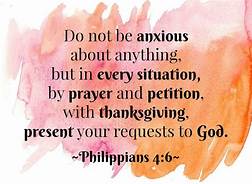
Paul has an answer to growing anxiety, fear and worry: he says to pray! Listen to verse 6: “Do not be anxious about anything, but in every situation, by prayer and petition, with thanksgiving, present your requests to God.”

Wait a minute, Paul! That sounds an awful lot like the tricks Jesus used to pull, when He told His disciples to do something that was next to impossible. How on earth are we supposed to keep that fear, worry and anxiety away? I have heard an old expression: “Worry about nothing; pray about everything.” But, how does that work, exactly?

Some might think they need to do everything themselves, with no assistance. Sort of like a big home improvement project. A huge do-it-yourself project. What’s more, if those same people go to YouTube and look online, they will see handy handymen and handywomen doing amazing things to their homes, all by themselves. But, it very rarely works that way in real life.

If you go to the home improvement mega-stores, you’ll find lots of helpful employees, ready to give advice about all kinds of improvement activities. Except—you don’t need to do it all alone. In fact, there are helpful people to come alongside you and give encouragement and moral support, and even assistance.

Commentator Alyce McKenzie writes, “There are other things that I might be able to do but that it would be so much better to have someone else do. We had a bad storm in our area a few weeks ago. The result is that lots of houses in our neighborhood have to have their roofs redone. Could I do this? It is humanly possible, I suppose, but we are hiring a roofing company that knows what they are doing.” [2]

The apostle Paul could have done this prayer thing all on his own. Except—he had some good friends present with him while he was in captivity in Rome. Dr. Luke was one of Paul’s faithful companions. I suspect they prayed together regularly; Aristarchus was another friend, and probably Tychicus, too. Plus, Paul also mentions a number of others in Rome who came to faith in Jesus Christ. One or two, or perhaps even more of these unknown friends came to see Paul, and to pray with him, for the many months while he awaited his trial.

Alas, along with Dr. McKenzie, I am afraid I might not have the faith. I might be anxious and fearful anyway. As she said, I can psyche myself up in other areas of life. But I need God to bring peace to my soul.” [3]

Just like Dr. McKenzie, I wish Paul had reversed the order of this verse and written it like this instead: “In everything by prayer and supplication with thanksgiving let your requests be made known to God and then you will receive the gift of not worrying about anything.”

Oh, it is so difficult for me to train my heart and not worry or be anxious about things. Things that go bump in the night. Things that are scary, or irritating, or anxiety-producing. Things that can even frighten us to death. Our attitude is often exactly the opposite of the way Paul encourages us to be. Paul wants us to hear: “’Live without anxiety because God cares for you.’ In Philippians 4…the peace of God that comes through prayer counters anxiety because it ‘guards believers’ thoughts and hearts in Christ.’” [4]

The people of Philippi would have understood what it was like to have a guard watching over their thoughts and hearts. There was a Roman garrison in Philippi, so this was a familiar image to them. The Philippians could rejoice—just as we rejoice—because prayer can guard our hearts and minds. Each moment of each day, “in every situation, by prayer and petition, with thanksgiving,” we can present our requests to God. And, we can help each other, support and encourage each other, as we pray.

Requests, joys, concerns, whatever is on our hearts, God wants us to bring these prayers to the throne of grace. “This is the peace of God Paul proposes as an alternative to anxiety. The Philippians are not called to imitate the peace of Christ, but to accept the gift of that peace being offered to them by the Grace of God, accessed through the habit of prayer.” [5]

Verse 4:7 is almost a benediction: “And the peace of God, which transcends all understanding, will guard your hearts and your minds in Christ Jesus.”

Hear the words of the apostle Paul today: the gift of God’s peace is offered to all of us, despite fear and worry. We all can live without anxiety, because God cares deeply for each one of us today. Yes, now, and forever. Amen!

[1] Ivaska, David, Be Not Afraid (Downers Grove, Illinois: InterVarsity Press, 2000), 123.

[2] http://www.patheos.com/progressive-christian/lets-do-this-alyce-mckenzie-10-06-2014.html

“Let’s Do This!” Alyce M McKenzie, Edgy Exegesis, 2014

[3] Ibid.

[4] Ibid.

[5] Ibid.

@chaplaineliza

(Suggestion: visit me at my regular blog for 2018: matterofprayer: A Year of Everyday Prayers. #PursuePEACE – and my other blog,  A Year of Being Kind . Thanks!)

Unknown's avatar

When Abram Believed God

“When Abram Believed God”

Gen 15-1 not afraid

Genesis 15:1-6 (15:6) – June 10, 2018 – from Dave Ivaska’s book Be Not Afraid

Fear. Anxiety. Not knowing which way is up, you’re so worried. I am sadly familiar with these kinds of emotions, since I’d often encounter them in the hospital, working as a chaplain. There is a certain kind of anxiety and worry that sometimes comes with having no one related to you. I have been with and accompanied patients who had no one to be with them as they were extremely sick, or even at the point of death. Family certainly is important.

This is our second week considering the passages where the Bible tells us to “Be Not Afraid!” In one of our Scripture passages today, we read of the Lord telling Abram not to be afraid. But, why? Why did God tell Abram something like that?

For the answer to that, we need to look at what happened in the few chapters before Genesis 15, chapters 11 through 14. Here we learn that Abram and his wife Sarai are recent immigrants from far away who came to the region escaping famine. Abram and his only relative Lot are feuding over wealth, and how to distribute it. Even worse, Lot has been captured in regional fighting, and Abram and his men need to rescue him. [1]

Yet, this is not all. God has made a big promise to Abram that has not come true. Abram is now eighty years old, his wife not far behind him in age. Since God promised Abram would be the father of many nations, and there is no son yet, Abram is probably wondering, what gives? God, what now?

I suspect that Abram must have been more than afraid. He probably was disheartened, too, perhaps even depressed. Long-term depression, too. Here the Almighty God who created heaven and earth had promised Abram that he would have a son, some years before. As time continued, no son. Just think, in Abram’s time, there was no fertility clinic, no medical advisor, nothing at all like that. Except, hoping and praying and perhaps sacrificing to God, pleading and imploring God to be gracious and grant Abram and Sarai a son.

Today, there are also people who pray for children of their own, couples who have difficulty with fertility, or carrying a baby to term. Fertility clinics and specialists certainly aid many couples in fulfilling dreams of a child of their own. But, that is today, with all of the technological and medical advances of the 21st century. Abram and Sarai had nothing at all like these treatments and medical capabilities.

Worry, fear, anxiety. How long, Lord? What gives? Am I doing something wrong? What about my wife, my husband, or my partner? Are any of us doing something wonky, or saying something they shouldn’t? What do I need to do, or say, or sacrifice, in order to get a son?  

I realize this topic of yearning for a child may be a difficult topic for some to hear. I do apologize, if that is the case for you, or for a loved one. I would humbly like to point out that this situation is something that is highlighted in Genesis. It’s referenced a number of times in other places in the Bible, in both Old and New Testaments.

After we find out that Abram is afraid, or fearful, what happens next? God shows up! By the word choice and behavior in Genesis 15:1, we see a particularly special thing is happening. “The word of the Lord came to Abram in a vision.” This construction in Hebrew means that this is a particularly marvelous thing. This is the only time we have these particular words written in the first five books of the Bible, period.

Plus, these words have special significance, wherever they appear in the Bible. These words flag us that God is going to show up, up close and personal. These words can even mean that an appearance of God in a way that humans can understand and deal with. A fancy word called “Theophany,” meaning “Learning from or making an appearance by God.”

And, what super-special thing does the Lord have to say in this super-special appearance? “Be not afraid, Abram!”  This is a momentous occasion, let me tell you. God doesn’t just happen to stop by. God doesn’t just pop in, or make appearances to any random person. No, the Lord really wants to communicate to Abram.

In this situation from long ago in Genesis, Abram is revealed to have a prophetic voice.  “The word of the Lord came to Abram in a vision.”  How awesome is that? God had a special delivery message, just for Abram. (for Abram, and his wife Sarai, too, of course.)

What else does God say to Abram? “I am your shield; your reward will be very great.” Wow! Let me ask you: what would you think if God communicated with you like this? Do you have any fears, any really big anxieties? What would it mean to you to have the Lord tell you that the Lord will shield you from harm? From worry? From evil intent?

What’s more, what would it be like to have God call you by name? By your personal name, not “O, mortal!” or even your family name. God is being extremely intimate with Abram here. That is powerful stuff!

Sure, Abram had been waiting for a long time. Even after this reassurance, he questions God! He has a contingency plan, an heir to all his property, just in case. However, as biblical commentator Sara Koenig points out, “Abram expects — and believes — God will keep God’s word, which is why Abram speaks in the way he does.” [2] God comes back at him with the marvelous statement/repeated promise, “Look up at the sky and count the stars—if indeed you can count them.” Then God said to him, “So shall your offspring be.”

How heartening is that? Such a personal, individualized promise! The next words we read are, “Abram believed the Lord, and God credited it to him as righteousness.” Pretty powerful stuff, indeed.

Even though continuing situations can be telling us that the situation is really bad, almost hopeless, we can still hope in God. Even though Abram went for years with no son, no assurance of this promise from God, God’s faithful promises still came through, in God’s time.

Did Abram have fear and anxiety in his life? Was he probably disheartened, even depressed, long-term? Yes. Did the Lord supernaturally step in and move Abram from fear to faith? Yes. The testimony of Hebrews 11 tells us “By faith Abraham made his home in the promised land like a stranger in a foreign country; 10 For he was looking forward to the city with foundations, whose architect and builder is God. 11 And by faith even Sarah, who was past childbearing age, was enabled to bear children because she[b] considered him faithful who had made the promise. 12 And so from this one man, and he as good as dead, came descendants as numerous as the stars in the sky and as countless as the sand on the seashore.”

Yes, this is the rest of the story. This is how God miraculously continued to work in the lives of Abram and Sarai (that was before God gave them the new names Abraham and Sarah.)

Can the Lord move us from fear to faith, too? Yes! We, too, can look forward to that eternal city, whose architect and builder is God. We can claim the eternal promises of God, by faith, and pass through our fear, anxiety and worry to life in God’s faithful promises.

Alleluia, amen.

[1] Ivaska, David, Be Not Afraid (Downers Grove, Illinois: InterVarsity Press, 2000), 22.

[2] http://www.workingpreacher.org/preaching.aspx?commentary_id=1730

Commentary, Genesis 15:1-6, Sara Koenig, Pentecost 12C Preaching This Week, WorkingPreacher.org, 2013.

@chaplaineliza

(Suggestion: visit me at my regular blog for 2018: matterofprayer: A Year of Everyday Prayers. #PursuePEACE – and my other blog,  A Year of Being Kind . Thanks!)

Unknown's avatar

Our Stronghold, Our Peace

“Our Stronghold, Our Peace”

God, stronghold for the oppressed

March 9, 2016 – Psalm 37:39-40

Most everyone is afraid, at one time or another. And, there are some really powerful things in this world to be afraid of! Worry, anxiety, fear. Those are all things that threaten to take away any peace and serenity in our lives.

One of the enemy’s most powerful weapons that he uses against us?  Worry, anxiety, fear can overwhelm us with a thick shadow of darkness, threatening our every move and decision. Not only the huge things, but also the little things. The personal things. I know we, here at St. Luke’s Church, have a good deal to be concerned about. Things just happen.

Just when I think I’m going in a definite direction, with a specific goal in mind, things can happen. These things can just be accidental, minor bumps along the way. Or, sometimes the situations or accidents can be catastrophic, life-changing. Maybe even life-ending.

Take our psalm for the evening. A psalm of King David, David wrote about evildoers, and about the evil people seem to routinely do. Yes, there’s lots to worry about! Yes, there’s lots for us to be anxious about! Look at all the evil in the world!

No matter what kinds of things happen in our lives—and good things happen as well as bad!! —the psalm we read today is talking about the evil things that happen. Evil things complicate our lives. Make our lives messy, even confront us with dangers. Things to worry about, endlessly.

What can we do when we get into an anxious predicament like this? What if the evil, worrisome things complicate our lives beyond all imagination? It is then that we feel separate from others. What’s more, we can feel separated from God, too. Any peace we had is hopelessly gone. Worry, anxiety and fear take its place.

I have known people who do not face evil, trials, and tribulations very well. I usually didn’t ask at the time, but I think one of the reasons might have been because they were not sure whether God was really in their lives. I know for a fact that several of my acquaintances do not really care about God, and don’t want much to do with Him at all. They are totally separated from God.

There are several ways to face evil; this way is not the wisest way, to my way of thinking.

The psalmist, King David, certainly had cause to be anxious. He had been up against real evil, many times. He had been in a real mess over and over, and he had come through it repeatedly. What’s more, David knew God had been at his side all the way. And, David knew that the evildoers would get their comeuppance, sooner or later.

Remember what David said in the first two verses of this psalm: “Do not fret because of those who are evil or be envious of those who do wrong; for like the grass they will soon wither, like green plants they will soon die away.” This theme runs through this psalm, all the way through. David tells us not to worry! Yes, the evildoers might be prospering right now. Yes, the evildoers might have lots of money, and property, and power, and control. The evildoers might be doing awful things to people. But, that is not the end of the story!

Some scoffers might say, what about things that are even worse than we can imagine? Things like violence, war, rape, bombing. Why do godless people seem to get away with all these horrendous acts?

Marjorie Nelson, a Quaker nurse served with a Friends medical team in Vietnam in the late 1960’s. She is a pacifist. This is part of her story. “Our project was located six miles from My Lai [the site of a massacre by U.S. military forces]. We treated at least one survivor from that massacre. Vietnamese friends told me not only of that event but of five similar incidents perpetrated by American or Korean troops in our province alone. I saw children injured by NLF rockets which exploded near their orphanage. I treated patients in our rehabilitation center who had extremities blown off by land mines planted by both sides in that conflict. Do I under-estimate the power and influence of evil? I think not.” [1]

Some scoffers consider Christians to be naïve and easily manipulated. I don’t think so. I don’t think Marjorie, that Quaker nurse and pacifist, was naïve. Yes, we are aware of the evil that people do. Sometimes, horrible things, so awful we cannot even imagine how horrific. But we are not naïve. We have sin within ourselves, too. Plus, God’s message is to love our enemies, and be kind to them. Even when we are our own worst enemies.

David finishes the psalm with the verse “The salvation of the righteous comes from the Lord; God is their stronghold in time of trouble.”

A stronghold is not only a refuge, a place of safety, but a stronghold is also for our salvation, for offensive purposes, too! We can see that God is not only a safe place for us to hide, but also God is also a strong place to keep us free. No matter the situation, God is there for us.

God is our salvation–and we can come to the Lord at any time. We have not only the ability to come to God, but we have the privilege, too! What an opportunity. And what a thing to celebrate–we can echo the psalmist’s words, “Trust in the Lord and do good; dwell in the land and enjoy safe pasture. Take delight in the Lord, and God will give you the desires of your heart.”


[I’d like to thank Catherine Whitmire and her excellent collection of thoughts on peace found in Practicing Peace (Sorin Books: United States of America, 2007). ]

[1] Whitmire, Catherine, Practicing Peace (Sorin Books: United States of America, 2007), 126.

@chaplaineliza

Suggestion: visit me at my daily blog: matterofprayer: A Year of Everyday Prayers– where I am doing a Lenten journey.  #PursuePEACE – And my other blog,  A Year of Being Kind -Thanks!


Unknown's avatar

Don’t Worry?

“Don’t Worry?”

Matt 6-34 do not worry about tomorrow

Matthew 6:25-34 – November 22, 2015

Worry. Fear. Anxiety. This 21st century urban culture we live in is an extremely anxious culture. People worry about all kinds of things. And, with the recent events in Paris, Beirut, and Baghdad, many people all over the world are even more anxious. For good reason!

Worry about my friends. One of my friends has an elderly parent who is in hospice. Yes, I’m concerned about the whole family! Worry about jobs. Some people worry about their bosses, or their co-workers. I have several friends who are in need of jobs, and wish they could have the luxury of worrying about the situation at work! So, there’s worry about finances in there, too.

Worry about health and about family. One of my sisters had a knee operation several months ago. She lives out of state, and I haven’t heard from her in a while. Worried? Concerned for her and her mobility? Yes, I am, at least a little.

All of these situations are troubles, concerns. Worries. The news on the radio, on the television, different media websites—all depend on worry and anxiety to pull in their viewers. And with recent events, many of the politicians worldwide are having a field day. And the media outlets? Trying to get the public on the edge of their seats, to keep tuning in, or buying their products. A never-ending fearful circus.

Here in our bible verses this morning, our Lord Jesus is telling us not to be filled with worry. Worry—anxiety—fear. When we come right down to it, this yucky predicament sounds familiar. We might not like it, we might be uncomfortable with it, but these various negative situations still happen to many of us, on a regular basis.

All the worry and anxiety just mentioned? That was mostly external. Looking outward. Yes, common to all of us. Let’s up that worry and anxiety one notch higher. Let’s sprinkle some self-centered fear on it. Add a few dashes of worry, and pile on concern about foreign people, faraway places, and strange-looking things? Does that sound familiar, too?

Fear of the interior. That’s the inside job. Your insides, my insides. Our feelings and emotions, everything all mixed together like with a blender or a kitchen mixer. I can imagine some people are so anxious and worried about what’s going on inside of them that they don’t even want to examine themselves, and do an inventory. They would far rather hide under a blanket. Or check out in other ways that involve various preoccupations or addictions. Sure, emotional insecurity is very real. Lots of people feel alone. All by themselves, and cut off from others. Bitterness and frustration can make things worse. Worry and anxiety can magnify those kind of feelings, way out of control.

The last few verses of Matthew 6 is the Gospel reading for Thanksgiving this year. Jesus preaches one of His signature sermons at the beginning of His ministry, the Sermon on the Mount. He deals with a whole bunch of topics here. The Beatitudes, the Law Code of Moses, prayer, judging others, and worry. Our reading for today. How on earth are we supposed to get thankfulness out of worry? Or not worrying? Seems like this is about gratitude’s opposite. Worry. Anxiety. Robbing our lives of peace, joy and serenity.

I have heard a good deal about worry and anxiety in the past few years. In my previous job, I worked as a hospital chaplain. Yes, I would pray with anyone who asked. But, I would also listen. As I listened, I heard about a whole lot of worry, anxiety and concern. And, rightfully so! Anxiety about upcoming treatment, worry about finances, awkward anticipation about losses of various kinds. But I would also hear about depression, anger, and self-pity. I’d hear about these painful emotions mixing and crashing around inside of people, and oftentimes, I would be helpless to do anything about it, except listen.

In personal life today, I have concerns. Sure, I have thoughts that sometimes preoccupy my mind. I can live in yesterday for too long of a time. I sometimes look forward to tomorrow—or next week or next month with some fear and anxiety. But what is the overarching message of this reading? What does Jesus tell us in this paragraph from the Gospel of Matthew?

He talks about the beauty and the vastness of God’s creation. He tells us to lift our heads and look around. Doesn’t God take care of the birds of the air and the beasts of the field? Yes, stuff happens. Life happens—and then some, at times. But if God takes care of the birds and the beasts, think about us. Think about you and me. Do you think for one minute that God would forget about you? Or, that God would forget about me?

In preparing this sermon, I found this wonderful article online. A Lutheran pastor, the Rev. Dr. Janet Hunt says this about this section of Matthew: “Somehow, sometimes, God does use the really terrible things that do happen to many of us to remind us of what is worth worrying about and what isn’t.  Only in Jesus’ words today?  Nothing is worth worrying about, not even the worst tragedies and struggles that are ours, for it is all in God’s hands.  The big things, absolutely. And the small ones, too.”

I think some of you might have heard these little sayings: “It’s hard by the yard, but it’s a cinch by the inch.” And, “How do you eat an elephant? One bite at a time.” Anything can seem overwhelming, if we look at the whole huge thing at once. Sure, life does have challenges. And then some! However, Jesus’ words are really wise: “34 So do not worry about tomorrow; it will have enough worries of its own.” In other words, one day at a time. “Don’t worry about tomorrow!” Those aren’t my words—they’re the words of Jesus!

Some of you might be saying, “That’s all very well, to say those words. Words are pretty, but do they have any action? Do they have any lasting effect on me, on you? How does it work? In real life?” What does worry and concern do to me? To you? In real life?

One way to deal with worry and concern is to practice a breath prayer. A breath prayer has two parts: first, a name of God that fits the prayer and the second a short request for help in dealing with the problem. For example, “God, help me feel okay at the dentist.” We can say God’s name while breathing in, and the request is said while breathing out. Breath prayers can work for little worries, and big concerns, too.

Jesus says these one-day-at-a-time words from Matthew 6 to each of us, today. We can take these words home with us, today. These words urge us to let go of our worry.

Jesus offers us an amazing gift. The possibility of God’s presence, through the challenges of life. God being with us, protecting us from that worry and anxiety. Shielding us from anything that would rob our lives of peace and joy.

Praise God! God continues to help us deal with worry and anxiety, no matter how big our concerns are, or how little. Whenever and wherever they might pop up.

It seems there is nothing greater for us to be thankful for. Gratitude? You bet! Grateful to God for God’s love, protection and tender care. Here, and hereafter.

We can all say amen to that. Alleluia, amen!

@chaplaineliza

Suggestion: visit me at my daily blog for 2015: matterofprayer: A Year of Everyday Prayers. and my other blog,  A Year of Being Kind .  Thanks!