Unknown's avatar

Hope, for Mary and for Us

“Hope, for Mary and for Us”

Luke 1:26-45 (1:38) – November 30, 2025

            I have a secret confession to make. I am greatly thankful that I have never had to take a job in retail. As I said to my husband this past weekend, I would have quit after the first day, simply because of the constant, cheesy, sometimes saccharin-sweet Christmas music that is piped in over the PA system at every retail store I go into. This is done for about two months before Christmas. And, that’s a long, long time to hear Christmas carols and songs, non-stop.

            And yet – and yet, as we consider this alternative Advent Bible reading from Luke chapter 1 today, I invite you to come with me back in time, to a time before there even was a Christmas. We are not only going to time-travel, but we are going to ocean-hop, too. Let us go to the modest home of a teenager named Mary, living with her parents in Palestine, around the beginning of the first century of the Common (or, Christian) Era.

            This teenaged girl – really, young woman, as she was in that time and place – had an angel visitation. We even find out the Angel’s name, Gabriel. The few times that the angel Gabriel appears in the Bible (that we know of), are times of great importance. Especially this appearance, when Gabriel heralds the birth of the coming Messiah! But, we haven’t gotten there yet. Mary is in her parents’ home when the angel suddenly arrives, about to upend everything concerning Mary and her life as she knows it.  

            Another very important fact: the country where Mary is living, and her people, the Jews, are under Roman rule. Palestine is an occupied country, like so many other regions and nations under the boot of Rome and the powerful Roman army. Palestine doesn’t sound much like a “Silent Night, Holy Night,” where “all is calm, all is bright.” Does it?

            Our mighty God does not wait until everything is perfect, or everything is calm and placid, to work wonders and miracles. God sent the angel Gabriel to a teenager in a modest house, in a country under military occupation. Not to the ruling classes, not to the king’s family in his luxurious palace, but to an unlikely young woman in a backwater town.

            Let us shift gears and move our focus to the modern day. Here in the United States, we have a great deal of internal struggle! Things today are certainly not perfect, or calm or placid. As we mark the first Sunday in Advent, the first candle on the Advent wreath is called the candle of Hope. Can you and I possibly find hope in an atmosphere of anxiety? Of uncertainty? Overwhelmed by pervasive negativity, with the American people’s attitudes filled with division, derision and defensiveness?

            Let’s return to Mary and the angel. How does Gabriel lead off in this conversation from Luke chapter 1? 28 The angel went to her and said, “Greetings, you who are highly favored! The Lord is with you.” Admittedly, Mary wonders what on earth is going on! Dr. Luke tells us, Mary “was greatly troubled at his words and wondered what kind of greeting this might be.” I dare say you and I would be greatly troubled, too, if we were to encounter an angel!

            Sure enough, Gabriel announces to Mary that she is highly favored, and that “you will conceive and give birth to a son, and you are to call him Jesus. 32 He will be great and will be called the Son of the Most High. The Lord God will give him the throne of his father David, 33 and he will reign over Jacob’s descendants forever; his kingdom will never end.”

Mary probably knew her place in society of her time, as a female, as a second-class citizen. Mary “is common, ordinary, of little account in her world and definitely not the stuff of legends…and she knows it. Only after expressing her wonder and dismay, and then hearing again Gabriel’s affirmation and promise, does she manage to summon the courage to believe that God has indeed favoring her by working in her and through her for the health of the world.” [1] What was Mary’s response to the angel? 38 “I am the Lord’s servant,” Mary answered. “May your word to me be fulfilled.”

We all know very well that our teenaged Mary became pregnant by the Holy Spirit, and gave birth to the baby Jesus in Bethlehem. We are well used to seeing Mary as a sweet, calm, quiet, almost docile follower of God’s will for her life. However, I would like to suggest that Mary was also a prophet! As a prophet, she would also be a bringer of hope to the world!

This prophetic role, this insight is a new way of looking at Mary for me. New for me, and I hope enlightening to you, too. As we consider the call of the prophets in the Hebrew Scriptures, and consider the call of Mary by the angel Gabriel, we see all the familiar, classic steps: we see God’s initial call, God’s task, the prophet’s objection, God’s reassurance, and the prophet’s acceptance of call. [2]

 I will say more about this next week, when we take a look at the Canticle that Mary sings, but I want to bring before us the earth-shattering idea that “Luke portrays her in a startling role: one that shakes up the way we’ve been brought up to think of her and invites us to stop observing her and start imitating her.” [3]

 I know that the Christmas carol “Once in Royal David’s City” calls mother Mary “mild,” and the typical portrayal of her on Christmas cards is calm, placid and docile. But, how can this mild depiction of Mary cause our hearts to be hopeful, today? Especially when it seems that the whole world is uncertain, the current political situation is contentious, and our society in the United States is fractured and broken?

            While Mary’s specific task is specific to her, the prophetic call remains open to everyone. God can call each one of us to a prophetic role, especially at this time of Advent, at this grateful and expectant time of year when people are looking up, looking outward, looking for hope. We can all be like Mary, the prophet, bearing good news to everyone.

            Alleluia, amen.

@chaplaineliza

(Suggestion: visit me at my other blogs: matterofprayer: A Year of Everyday Prayers. #PursuePEACE – and  A Year of Being Kind . Thanks!


[1] https://www.workingpreacher.org/dear-working-preacher/favored-ones

[2] http://www.patheos.com/progressive-christian/mary-reluctant-prophet-alyce-mckenzie-12-17-2012.html

[3] Ibid.

Unknown's avatar

Favor with God!

“Favor with God!”

Luke 1:26-45 (1:30) – December 3, 2023

            Stories are so important! Do you have family stories that you have told around the dining room table, or that your parents told you, about your family history? I have told my children stories about one grandfather who owned a pharmacy and drug store in Chicago through the Depression and afterwards. And, my other grandfather who emigrated from a shtetl in Eastern Europe early in the 1900’s, seeing the Statue of Liberty from the deck of the steamer.

            I imagine teenaged Mary, and the stories she was told in her family. Not only family stories about her parents and grandparents, but also stories of the Hebrew people – stories of Abraham and Sarah, of Jacob and his sons, of Moses, Miriam, King David, and especially of Hannah and Samuel. I’d imagine Mary thinking hard about Hannah, pregnant with her child of promise Samuel, and it would be difficult not to compare herself to Hannah!  

            I am wondering which such stories have shaped you and me, giving us direction and hope, understanding and wisdom in the midst of uncertain times. [1] Which stories – either our family stories or Bible stories – have helped us along, given us positivity and perseverance when we get discouraged or upset?

            Mary must have been a thoughtful teenager, possibly even mature beyond her years, when the angel Gabriel suddenly appeared to her! The angel greeted Mary with the typical words most recorded in Scripture when an angel makes a visitation: “Don’t be afraid!” Lo and behold, Mary enters into conversation with this heavenly visitor.

            Would you and I have been as thoughtful, or as quick on our feet if we were suddenly confronted with an angel? Even if the angel immediately said, “Don’t be afraid!?”

            Mary must have had some idea of what she was up against, both in her culture and in her traditional society structure. Here she was, a young, unmarried teenager – yes, of marriageable age, but not married yet. And, she willingly took on the task of bearing a child, the Son of God as the angel said. “You have found favor with God. 31 You will conceive and give birth to a son, and you are to call him Jesus.”

            I wonder perhaps if this is why Mary goes to her older cousin Elizabeth in the hill country, because of the societal pressure that was on her in her hometown. I wonder whether Mary was thinking she might receive social judgement from Elizabeth once she gets there? Yet, I also know that cousin Elizabeth had her own experience of being shamed and excluded. “In her culture a woman’s primary purpose in life was to bear children, so as an elderly infertile wife she had endured a lifetime of being treated as a failure. Her response to her miraculous pregnancy emphasizes that God’s grace has reversed her social status.” [2]   

            Just think about it! Both Mary and Elizabeth were in a position of social stigma and even dishonor. Yet, Elizabeth said “This is what the Lord has done for me when he looked favorably on me and took away the disgrace I have endured among my people” (Luke 1:25). Further, by greeting Mary with joy and with honor, the pregnant Elizabeth firmly overturns society’s frowns and shames and clucking of tongues.

            There’s a whole lot in front of Mary and Elizabeth that they do not know. “They do not know why they have been chosen for these roles. They don’t know who their babies will become, though they have some hints. They don’t know how their children will change the world or how the world will change their children.” [3]

            What about today, with migrants, immigrants, or people displaced from war-torn areas or as a result of natural disasters? People are outside of their society’s rules or their cultural expectations, and are regularly in precarious situations. Old people, seniors far from families who need assistance – even a wheelchair – and nothing is available. Children who go hungry because their displaced parents are unable to work because of their host country’s rules.

Pregnant women sometimes are stigmatized by their society, shame, and cultural dishonor. So like Mary and Elizabeth. Do any of these stories resonate inside of you? Which of these ancient stories passed on – even as they were to Mary – do you hold especially close to your heart, especially in December, in this season of Advent? Do one or two of these Biblical stories carry you in dark or uncertain times, and give you encouragement and comfort? [4] Either the story of Hannah and Samuel, or of Mary and Elizabeth? Or another Biblical story?

Sometimes, there are competing stories of hopelessness, or discouragement, or dishonor that come to people’s minds. I would like to tell you that those competing, pessimistic stories are not helpful to our hearts or minds! These stories are not positive or uplifting, and please, please do not let yourselves get bogged down listening to them, internalizing them!

This story of Mary and Elizabeth shows us the positive, nurturing attitude of God reaching down to the least and the lowly. We can be open to the ways that God chooses to act in our world, both two thousand years ago, and today, too! “What is God doing through unexpected people in our society today? Where is God at work through people whom our neighbors and fellow church members often exclude or treat as shameful? Will we listen to the Spirit’s prompting when the bearers of God’s new reality show up on our doorstep?” [5]

I invite us all to consider these positive, miraculous stories and invite the Lord to come alongside of us as we travel through Advent. And perhaps, these stories will help us all to make the world a different place, a more Godly place, where God overrules society’s structure, shame and cultural disapproval! A place where God has arms open wide to all children, all people.

Maranatha, come, Lord Jesus!  

@chaplaineliza

(Suggestion: visit me at my other blogs: matterofprayer: A Year of Everyday Prayers. #PursuePEACE – and  A Year of Being Kind . Thanks!

(I would like to express my great appreciation for the observations and commentary from the Do Not Be Afraid Advent Devotional – © 2022 Illustrated Ministry, LLC.. I used several quotes and ideas from their useful resources. Thanks so much!)


[1] https://dancingwiththeword.com/mary-and-hannah-and-a-woman-in-the-county-jail/

[2] https://www.workingpreacher.org/commentaries/revised-common-lectionary/fourth-sunday-of-advent-3/commentary-on-luke-139-45-46-55-3

[3] Do Not Be Afraid Advent Devotional – © 2022 Illustrated Ministry, LLC.

[4] https://dancingwiththeword.com/mary-and-hannah-and-a-woman-in-the-county-jail/

[5] https://www.workingpreacher.org/commentaries/revised-common-lectionary/fourth-sunday-of-advent-3/commentary-on-luke-139-45-46-55-3

Unknown's avatar

Magnify the Lord with Me!

“Magnify the Lord with Me!”

Luke 1:38-56 (1:46) – December 6, 2020

            Do you know any teenage girls? Any girls with the maturity and balance that teenaged Mary shows to us here? This kind of maturity and balance in one so young is not very plentiful among teens, believe me.

            Socially and culturally, Mary was in an awkward situation. Even, a tight spot. A young woman (for, that was what Mary was considered, in the culture of her day), pledged to be married, who turns up pregnant. Scandalous! I am sure the old biddies in Nazareth were clucking about Mary’s situation—and character—and a whole lot more.

            While we, today, may read this narrative and think, “what a nice bible story!” this reading today is much more than that. Mary decides to go and visit her older cousin Elizabeth, in the hills of Judah. Elizabeth has miraculously gotten pregnant several months earlier. (The angel Gabriel told Mary so!) Two miraculous pregnancies, two women blessed by God. Plus, Elizabeth was an older, wiser woman, able to be a companion and mentor to the teenage Mary.  

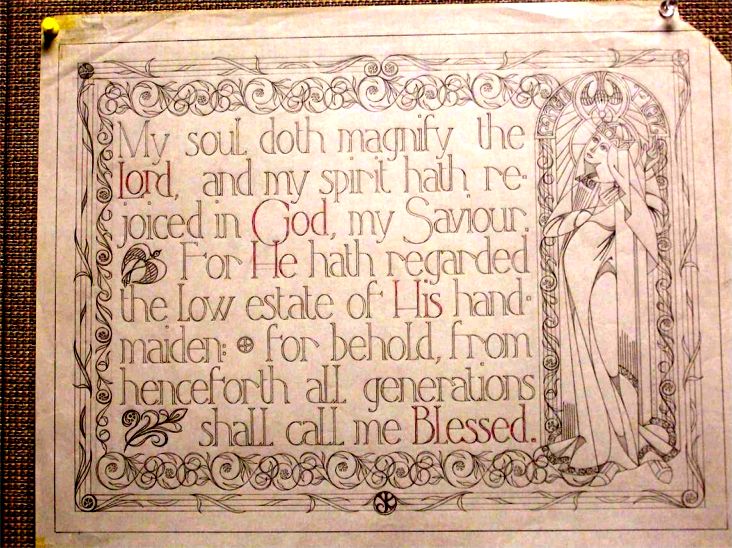
            Yes, Mary’s extended visit to Elizabeth probably was comforting and encouraging to Mary. However, my attention is drawn to Mary’s song. The Magnificat is a tremendous counter-cultural song, turning everything in the political and cultural order upside down and topsy-turvy.

            Do you have any experience with an extended situation turning our world today upside down and topsy-turvy? Any disease or pandemic that is causing nationwide—even worldwide disruption and confusion? These two instances do not have a direct one-to-one correspondence, but there are many similarities here! The political and cultural upheaval Mary sings about in the Magnificat will greatly upend the established order of things. And, in many ways today, so will the COVID pandemic and its surrounding upheaval.

            I am reminded of a fellow professor friend of one of my Bible commentators. She grew up as a missionary kid in a poverty-stricken area in the Philippines. “Growing up among that nation’s poor, Professor Malcolm has reported that when they heard Mary’s Psalm, it was the first time that anyone had told them the good news that God cares about them — the poor, the oppressed.” [1] Some people in poverty have never heard this Good News! “Christ has come to challenge the structures of sin, death, the devil, and oppression. Christ has come in the strength of the Lord to do what the Lord has always done: lift up the lowly, free the enslaved, feed the hungry, give justice to the widow, the orphan, and the sojourner.” [2]

            Imagine Mary, having the maturity and the balance to sing such a radical, counter-cultural song! Is there some secret that Mary knew about, helping her to stay balanced and level-headed during all the upset and disruption of her unexpected pregnancy and the surrounding gossip and backbiting and sometimes outright nastiness of her fellow townspeople? Did Elizabeth aid her in finding this hope and balance, this calmness and serenity?

            Knowing what we do about the marvelous words of the Magnificat, and its similarity to Hannah’s song from 1 Samuel 2, we can learn from Mary. Her strength was in her trust in the Lord. Her faith was in God’s mighty power to overthrow society’s structures and the cultural norms of her day. Although our continuing situation is not exactly similar to Mary’s, we can still rely on God, too. Our strength can be our trust in the Lord. Our faith can be in God’s mighty power to overcome society and cultural norms.

            I’d like to think that Mary had a pleasant voice. Not operatic quality, although I do enjoy the voices of people who have studied and trained their voices into wonderful instruments! I can see how Mary knowingly turned for help to the One who would never leave her nor forsake her. Singing is one deep-seated way to come to God in prayer, in sadness, in hope and in joy.

            As commentator David Lose says, “songs are powerful. Laments express our grief and fear so as to honor these deep and difficult emotions and simultaneously strip them of their power to incapacitate us. Songs of praise and thanksgiving unite us with the One to whom we lift our voices. And canticles of courage and promise not only name our hopes but also contribute to bringing them into being.” [3]

            As we come before God in these next days and weeks ahead, perhaps we may come with trust and faith. Trust and faith in the God who is always with us, even through dark valleys, even through sickness, depression, despair and death.

            And may we, like Mary, lift up Mary’s radical song of resistance. Even though there is so much oppression and evil, and so much disease and despair in the world, God has brought light and hope into the world with the birth of God’s Messiah.

            I pray that you, like Mary, find joy even in the darkness of this particular Advent season of 2020. I also pray that the songs of Advent and Christmas bring light and hope to you as you draw closer to God each day. Alleluia, amen!


[1] https://www.workingpreacher.org/commentaries/revised-common-lectionary/fourth-sunday-of-advent-2/commentary-on-luke-146b-55

Commentary, Luke 1:39-45, (46-55), Rolf Jacobson, Preaching This Week, WorkingPreacher.org, 2014.

[2] Ibid.

[3] https://www.workingpreacher.org/dear-working-preacher/a-promise-that-changes-the-world

“A Promise That Changes the World,” David Lose, WorkingPreacher, 2012.

@chaplaineliza

(Suggestion: visit me at my regular blog for 2020: matterofprayer: A Year of Everyday Prayers. #PursuePEACE – and my other blog,  A Year of Being Kind . Thanks!

Unknown's avatar

Do Not Be Afraid!

“Do Not Be Afraid!”

Luke 1-38 annunciation icon

Luke 1:26-38 (1:30) – December 17, 2017

Pictures of Christmas in the church bring to mind all sorts of things: Joseph and Mary entering a crowded Bethlehem, shepherds abiding in the fields, pictures of the Nativity scene. All manner of different pictures. But—we still haven’t gotten to Christmas. Christmas has not arrived yet. We are still in the waiting period; we are still in the third week of Advent.

Our Gospel reading—and presentation this morning—comes to us from the first chapter of the Gospel of Luke. We look on with Mary, the teenaged girl engaged to Joseph, when she has a heavenly visitation. This Annunciation, or visit from the angel Gabriel, has been the subject of paintings, stained glass windows, mosaics, and other forms of artwork for centuries. About as long as the Gospel of Luke has been written down.

In many of these paintings, the teenaged girl Mary often looks relaxed and comfortable. She’s holding a book, she’s sewing, she’s arranging flowers, she is hardly startled at all. [1] Consider this situation another way. What are the first words out of the angel Gabriel’s mouth? “Do not be afraid, Mary!”

Look at another picture of Mary and the angel Gabriel, in the modern-day image of the Annunciation painted by Benedictine priest, John Giuliani. “In his rendition of the Annunciation, Have No Fear, Father Giuliani depicts Gabriel coming down from heaven, feet first, aimed right at Mary’s face, with a stem of lilies outstretched like a sword. For her part, Mary nearly falls out of her chair as she shields her face from Gabriel’s descent. The chair is pushed back on only two legs, swept over by the force of the messenger’s entry into time. It’s not as pretty a picture as the ones on Christmas cards, but it might be more accurate.” [2]

Before we go further into this Gospel reading, we need to consider Mary. A teenaged girl, can we even consider how frightened Mary must have been after she was greeted this way by a heavenly visitor, an angel? I am not sure, but I suspect I would have been at least as frightened as Mary at the totally unexpected visit of the angel.  How do you think you might feel if an angel appeared to you?

The separate branches of the Christian faith think of Mary in different ways.

I grew up on the northwest side of Chicago. For me, surrounded as I was by Roman Catholics, I knew that Catholics considered the Virgin Mary to be an extra-special woman. It was not until years later that I learned exactly how: “for Roman Catholics, Mary is a Co-Redeemer with Christ whose job description is to act as a go-between with us sinners on earth and God in heaven. During the Middle Ages, Mary became important in the prayer lives of the common folk, as one who could empathize with their plight and mediate forgiveness. In the councils of the Church through the centuries, she gradually gained supernatural qualities.” [3]

Again, we are getting way ahead of ourselves! Here in Luke chapter one, Mary is still a teenager. The angel Gabriel has just left. She travels to see her older cousin, and now we come to another great picture from the life of Mary. We have the Visitation of the Virgin Mary with her cousin Elizabeth, another picture that has been painted countless times throughout the centuries.

Women are so often overlooked, when we consider the Bible. In both the Old and New Testaments, as well as in general society, women are forgotten, ignored, shunted aside, and treated as second-class citizens. That is, unless we are reading the Gospel of Luke. Luke lifts up the characters of Mary and Elizabeth, and provides a memorable exchange.

“God is already at work to overturn the world’s structures and expectations.” [4]

At our neighboring church here in Morton Grove, St. Martha’s Catholic Church and Shrine of All Saints, we would discover something else about Mary—and about her cousin Elizabeth, and about many women of many periods and cultures. We would see that in many pictures at St. Martha’s Church, each woman has a covering on her head. Similar to certain cultural standards of dress today, many religious women cover their heads. Like religious Christian women today—like many Catholic nuns, and like many Orthodox women all over the world. We have religious Jewish women who cover—like observant married Jewish women. And, we know some observant Muslim women today, here in our area as well as in other places, cover their heads. They wear hijab. Head coverings. Just like Mary and Elizabeth did.

Returning to the many pictures and other artworks that portray the Virgin Mary, many of them show Mary interrupted from reading. A book is something that has been in pictures of Mary for centuries. Mary remembered as a literate young woman.

What a wonderful thing to tell our children and our children’s children! We have it on good authority that Mary could, indeed, read. Many Jewish women of that time could, unlike their contemporaries in other places. What a wonderful opportunity for the young Jesus to have both an earthly mother and father who were literate and able to teach their children.

Is there anything better that what Gabriel said?  The angel “assured Mary that God’s Holy Spirit would be with her. Even though she was frightened, Gabriel promised that God would take care of Mary. Mary learned from the Bible about God’s love, so she knew that she could trust the words of the angel when he said “Don’t be afraid!” [5]

Mary’s cousin Elizabeth adds some intelligent and insightful comments.  “When Elizabeth says, ‘Blessed is she who believed that there would be a fulfillment of what was spoken to her by the Lord,’ she implicitly contrasts Mary’s trust in God’s power and promise with her own husband Zechariah’s skeptical questioning.” [6]

The high-powered priest Zechariah was skeptical when the angel came to him, a few months before. He asked for proof that the angel’s word was true. In contrast, Mary asked for an explanation of what was going to happen to her, and then gave her willing consent. Zechariah the religious professional doubted God, but Mary the girl from a poor family believed what the angel Gabriel said. “Her trust in God’s word opened the door for God to bless her and to bless the whole world through her. Elizabeth celebrates Mary’s willingness to say “yes” to God.[7]

We know God’s call is not always convenient. And sometimes, God asks us to set aside everything we think we know about reality in order to accomplish the Divine agenda. Such was the case with Mary. Thankfully, we know the end of the story. All of us can listen to the angel when he tells us “Do not be afraid!” Those are good words for all of us to take to heart.


[1] From An Advent Journey: Devotional Guide, Week Three. This curriculum comes from Illustrated Children’s Ministry.

[2] From An Advent Journey: Devotional Guide, Week Three. This curriculum comes from Illustrated Children’s Ministry.

[3] http://www.patheos.com/progressive-christian/mary-reluctant-prophet-alyce-mckenzie-12-17-2012.html  “Mary, the Reluctant Prophet,” Alyce M. McKenzie, Edgy Exegesis, 2012.

[4] http://www.workingpreacher.org/preaching.aspx?commentary_id=2723  Judith Jones

[5] From An Advent Journey: Devotional Guide, Week Three. This curriculum comes from Illustrated Children’s Ministry.

[6] Ibid.

[7] http://www.workingpreacher.org/preaching.aspx?commentary_id=2723  Judith Jones


(A heartfelt thank you to An Advent Journey: Devotional Guide. Some of these sermon ideas and thoughts came directly from this guide.  I appreciate this intergenerational curriculum, which is the basis for my Advent sermon series. This curriculum comes from Illustrated Children’s Ministry. Thanks so much for such great ideas!)

@chaplaineliza

(Suggestion: visit me at my regular blog for 2017: matterofprayer: A Year of Everyday Prayers. #PursuePEACE – and my other blog,  A Year of Being Kind . Thanks!)