Unknown's avatar

Have Mercy on Us!

“Have Mercy on Us!”

Luke 17:11-19 (17:13) – October 12, 2025

            Ever been to the dentist, or the doctor, with a health complaint? Of course, you have! You all—we all have, at one time or another. Thank goodness, we live here, in the suburbs of Chicago. It is fairly easy to get good—or even, excellent medical and dental care, as opposed to the rural spaces in the United States, where health care is not as accessible. And, can you imagine outside of this country?

            Imagine living in the first century of the Common Era. In Jesus’ day, doctors were rare even in mid- to large-sized towns. When people had health complaints, there were some homeopathic remedies, true. And local healers, people who were good with herbs, poultices, and ointments. But for continuing problems or chronic diseases? There weren’t many options for any other kind of health care.

            Let us set the scene. Dr. Luke tells us, “Now on his way to Jerusalem, Jesus traveled along the border between Samaria and Galilee. 12 As he was going into a village, ten men who had leprosy met him.”  We have a situation with some chronically ill people. These people had skin diseases. Commonly referred to as leprosy, these skin afflictions could be anything from severe eczema to Hansen’s disease, what we now know today as leprosy. And any disfiguring skin problem, in between.chronic

            In Jesus’ day, there were priests and Levites stationed all throughout the land of Israel. These official people were not only on duty for the Sabbath day, for religious observance, but they had several other important duties under the law of Moses. Did you know that the priests and Levites could make rulings on whether a person was too disfigured, too blemished to live in close quarters with the rest of the townspeople?  True facts!

            This was an early example of a health code. The priests and Levites were among the first health inspectors! Because some of these skin diseases were contagious, and so the people who had them would contaminate others, the priests and Levites would have to exile them. Kick these former upstanding people out of town. Out of society, and isolated. Marginalized. Exiled. Called ‘unclean.’ Living far away from everyone and everything they once held dear. Ringing bells to warn others not to come near them. That was the situation for these ten lepers we read about in Luke’s Gospel today. What a lonely existence for these poor people.

            The Rabbi Jesus was on His way to Jerusalem with His disciples when he met these ten men, on the border between Galilee and Samaria. This is yet another time that our Gospel writers tell us that “Jesus is again in a border region, again crossing boundaries and wandering where he probably shouldn’t go, and again healing people with whom he has no business interacting.” [1] Commentator Dr. Davis Lose reminds us that Jesus is again doing something out of the ordinary. In fact, extraordinary!  

            Let us consider that this unconventional Rabbi Jesus is not only crossing geographical boundaries and wandering – traveling where “good, rule-keeping Jews” just don’t go. But, Jesus is also interacting with these ten lepers! These men obviously kept at a distance from all other “normal” or “regular” people, except I am certain they had heard of this miracle-working Rabbi! Can’t you just hear the anguish and the hoping-against-hope in their voices as they cry out, “Jesus, Master, have mercy upon us!”  

            Jesus’ response is simple. Straight-forward. “Go, show yourselves to the priests. I can just imagine these ten men, told by Jesus to go and show themselves to the priests in town. Except, Jesus told them to go before He had done the act of visibly healing them from their skin disease. They needed to act, they needed to start to go before they saw what had happened.

            Have you ever needed to go on faith, and start an action, go on a trip, take a step without knowing for sure that God is right there with you? And, the whole idea of a borderland, an in-between place that is neither one place or the other. Doesn’t God meet us right there, before healing is completely complete?  [2]

That’s all Jesus says to them. The verb in Greek means ‘show, or point out something to someone.’ Remember, I said the priests were the health inspectors of that day? Can you understand these ten guys, isolated, banished, marginalized. And Jesus says, “Go, show yourselves to the priests.”

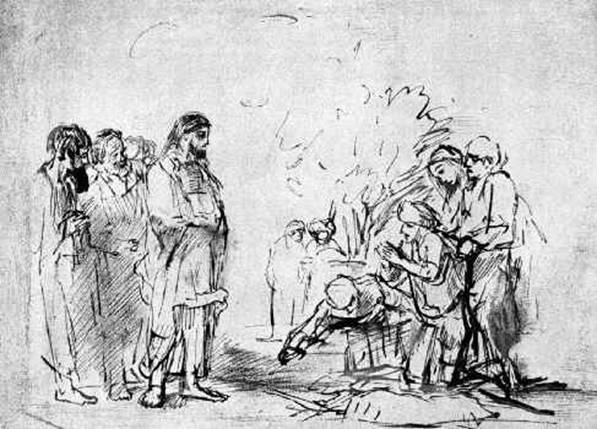
            Lo and behold, “as they went”—that is, in the going—“they were cleansed.” Do you understand? These poor, lonely people believed Jesus, had faith, and were healed as a result. We are not told exactly how they discovered it, but it probably didn’t take too long.

            One ex-leper, out of the original ten—one ex-leper comes back to thank Jesus. Glorifies God! Comes to Jesus and prostrates himself at His feet. Once the Samaritan realized he’d been healed, he couldn’t help but turn back and share his joy and thanksgiving with Jesus.

            Thanksgiving is like that. When it’s genuine, it’s spontaneous—you recognize you’ve been blessed and can’t help but share your joy through thanksgiving.

“Have you ever noticed just how powerful it is not only to receive blessing but also to name it and give thanks for it? Maybe you’re at dinner with family or friends, then you lean over to another, or maybe raise your glass in a toast, and say, “This is great. This time, this meal, you all. Thank you.” And in seeing and giving thanks, the original blessing is somehow multiplied. You’ve been blessed a second time.” [3]

The Samaritan knows he’s been given a gift and can’t help turning around to say something. In doing so, he’s given a second gift: He leaves his encounter with Jesus not only healed but also blessed in his own recognition of healing, blessed at being drawn into deeper relationship with the one he thanks, blessed at hearing himself commended for having great faith.

Imagine the huge difference that must have made in his life. That’s the way thanksgiving works—in giving thanks for gifts given to us, we are blessed again. We can all say alleluia, Thanks be to God!

@chaplaineliza

(Suggestion: visit me at my other blogs: matterofprayer: A Year of Everyday Prayers. #PursuePEACE – and  A Year of Being Kind . Thanks!


[1] https://www.workingpreacher.org/dear-working-preacher/second-blessing

[2] https://www.umcdiscipleship.org/worship-planning/choosing-faith/eighteenth-sunday-after-pentecost-year-c-lectionary-planning-notes/eighteenth-sunday-after-pentecost-year-c-small-groups

[3] https://www.workingpreacher.org/dear-working-preacher/second-blessing
Unknown's avatar

Prescription for Prayer

“Prescription for Prayer”

1 Timothy 2:1-8 (2:1-3) – September 21, 2025

It’s good to be in the habit of doing certain things. Say, going to the gym. Exercise is a beneficial thing, and if I go to the gym on a regular basis, like three times a week, I will be healthier for it. Same for other things—like practicing the piano, practicing swimming or square dancing—it’s beneficial to get into the habit of regular repetition, week in, and week out.   

Worship and prayer are regular, comfortable things, things many churches do the same way, week in and week out. Here in our scripture reading today, Paul gives his younger friend Timothy some words of wisdom. Recommendations, if you will, of some things Timothy’s church can do in worship and prayer that will be beneficial to them all.

Reading again from 1 Timothy 2, “I urge, then, first of all, that petitions, prayers, intercession and thanksgiving be made for all people— for kings and all those in authority, that we may live peaceful and quiet lives in all godliness and holiness. This is good, and pleases God our Savior.”

I’ll stop right there. Not because the rest of the reading is unimportant. No! But, because Paul has so many ideas that are bursting out of him one on top of the other, I am afraid we might be overloaded if I read them all.

I am on social media, daily. I feature some things regularly, including my Daily Prayer posts. I have posted Daily Prayers on my public Facebook page for five years now. I see it as something I can contribute for my Facebook friends, and for friends of friends, too. I post a prayer each evening that I find meaningful, and I hope they can be helpful to others, too.

Other people have regular habits or practices of prayer and meditation. That is what the Apostle Paul talks about here! I am in a doctoral program for Spiritual Direction, which some people refer to as spiritual companionship. That’s coming alongside of another person, or a small group of people, being a long-term companion. Walking with them, sitting with them through their joys and through their difficulties and sorrows. I have a heart for listening to people’s stories, challenges, and difficulties in their lives. Plus, I pray with people through these things.

You recognize that is what we do in church, don’t you? In our Intercessory Prayers each week, we – as a congregation – come alongside of individuals and families and pray with them through their joys, challenges, and various difficulties. That is exactly what Paul tells Timothy to do here! This reading is a prescription for intercessory prayer in a worship service!

I know that believers and followers of Christ, Paul and Timothy were very much in the minority in their communities. The majority opinion and the overwhelming cultural context for both of them was one of a worldly avarice, where people were concerned about “me, first!” and “where’s mine?” This call to intercessory prayer was very counter-cultural!

Let’s look again at what Paul recommends. Paul begins the chapter by encouraging Timothy to offer prayers for all members of the human family during church services.He wants petitions, prayers, intercession and thanksgiving – all integral parts of praying – to be made for all people. That is not just for a few, or a family, or “only for our little, insular group of people.” No! Paul is recommending to Timothy that we pray for ALL people.

He mentions prayer in the terms of: petitions (humble, general requests to God), intercessions (requests, pleading for those in need), supplications (requests for ourselves, especially when faced with a crisis) and thanksgivings (expressing gratitude for blessings we receive). [1] All people need to be held up to God in prayer.

That means for everyone. Period. Even for mean people. Even for people we disagree with. Even for people who don’t look like us. As the modern translation from “The Message” of this reading begins, “Pray every way you know how for everyone you can.” Period.

Especially in the past few years in this country, division, discord, and dissension of large portions of the American population has only speeded up in the last few years, fueled by increasingly divisive rhetoric, shrill podcasts, and fraught news reports, as well as the regional and national conversations.

As Rev. Sharon Blezzard said, “Good news doesn’t usually sell publications or improve ratings. It takes bombast, divisiveness, and catty, snarky repartee to make headlines, not prayerful peacemakers standing in the breach attempting to reknit brokenness in quiet relationship building and listening. But we are called to a different way of being, to a stewardship of self and other that places value on people, on relationships, and on the building up of community.[2]

God has not called us to be snarky or mean, nasty or divisive. God does not want big bullies on God’s team. I have never heard of God approving of or cheering on hateful, spiteful Christians, either.

Instead, when we “Pray every way you know how for everyone you can.,” Paul reminds Timothy that “This is good, and pleases God our Savior, who wants all people to be saved and to come to a knowledge of the truth.”

Remember what the situation was for Paul and Timothy, and for all other believers in that first-century time and place. It is the same for us, today!  “We are called to be counter-cultural witnesses to God’s love, mercy, and saving grace. We cannot be a witness if our hearts are filled with hate. We cannot love our neighbors if we aren’t willing to get to know them, and certainly not if we aren’t willing to stop working violence against one another.” [3]

      Paul tells us we are to pray for all people; and we are to follow Paul’s lead in supplications, prayers, intercessions and thanksgivings. The intention of such prayers is so that we Christians in society will be able to live tranquil and quiet lives. This isn’t me saying it. It’s the apostle Paul! 

Regardless of whether there is peace in our church, peace in our neighborhood, or peace in our country, prayer is always a good idea. Having a close relationship with our Lord and Savior Jesus Christ is the reason we are here. Praise God! Thank You, Jesus. Alleluia, amen.

@chaplaineliza

(Suggestion: visit me at my other blogs: matterofprayer: A Year of Everyday Prayers. #PursuePEACE – and  A Year of Being Kind . Thanks!


[1] http://www.lectionarystudies.com/sunday25ce.html Rev. Bryan Findlayson, Lectionary Bible Studies and Sermons, Pumpkin Cottage Ministry Resources.

[2] https://www.stewardshipoflife.org/2016/09/calling-all-prayerful-peacemakers/

[3] Ibid.

Unknown's avatar

Jesus Says: Don’t Worry!

Jesus Says: Don’t Worry!

Matthew 6:25-34 – November 24, 2024

            Some people are real worriers. They worry about their house or apartment, they worry about their children or their parents, they worry about their job, their school, their friends, their car, their health – and that’s just to begin with! All of us know someone like this. And sometimes, worry about one or two, or even more of these things creeps into our hearts, too!

            All of these things are troubles, concerns. Worries. The news on the radio, on the television, different media websites—all depend on worry, anxiety and fear to pull in their viewers.  Here in our bible reading this morning, our Lord Jesus is telling us not to be filled with worry. Worry—anxiety—fear. When we come right down to it, this yucky predicament called worry sounds so familiar! We might not like it, we might be uncomfortable with it, but various yucky, fearful situations still happen to many of us, on a regular basis.

            All the worry and anxiety I just mentioned? That was mostly external. Looking outward. Fear of people, places and things. Yes, common to all of us. Let’s up that worry and anxiety one notch higher. Let’s sprinkle some self-centered fear on it. Does that sound familiar, too?

            Fear of the interior, that’s the inside job. Your insides, my insides. Our feelings and emotions, everything all mixed together like with a blender or a kitchen mixer. I imagine some people are so anxious and worried about what’s going on inside of them that they don’t even want to examine themselves, and do an inventory. They would far rather hide under a blanket. Or check out in ways that involve various addictions.  Emotional insecurity is very real. Lots of people feel alone. All by themselves, and cut off from others. Bitterness and frustration can make things worse. Worry and anxiety can magnify those feelings, way out of control.

            What can anyone do about this huge mountain of worry, fear, insecurity and anxiety?

            Since this Sunday is Thanksgiving Sunday, our Gospel reading has a few things to say about all this worry and negativity. This reading is from the Sermon on the Mount. The second half of Matthew chapter 6 is all about treasure and where we can find it. As is often the case in Scripture, Jesus lets us know that He is summing up this section by beginning with the word “therefore.” “Therefore” is used “to indicate that the writer or speaker is drawing a conclusion. Jesus’ words here are very simple and to the point: worrying is pointless.” [1]

Wait a long minute, there! Worry is part and parcel of the human condition. Anxiety and fear of the unknown (and especially of what IS known, what we recognize coming up!) are so often sad realities. Worry is invasive, like a nasty, invasive plant. Those of you who garden are very much aware of these weeds, these choking, creeping plants that wind around the healthy flowers and vegetables we plant in our gardens.

            I have heard a good deal about worry and anxiety in past years. In my previous job, I worked as a hospital chaplain, and now I am a hospice chaplain. Yes, I would pray with anyone who asked. But, I would also listen. As I listened, I heard about a whole lot of worry, anxiety and concern. And, rightfully so! Anxiety about upcoming treatment, worry about finances, awkward anticipation about losses of various kinds. But I would also hear about depression, anger, and self-pity. I’d hear about these painful emotions mixing and crashing around inside of people. Oftentimes, I would be helpless to do anything about it, except listen.

            In my personal life today, I have concerns. Sure, I have thoughts that sometimes preoccupy my mind. I can live in yesterday for far too long of a time. I sometimes look forward to tomorrow—or next week with some fear and anxiety. I especially have concerns about an upcoming procedure in the hospital, very soon.

But what does Jesus tell us in this paragraph from the Gospel of Matthew? He talks about the beauty and the vastness of God’s creation. He tells us to pick up our heads and look around. Doesn’t God take care of the birds of the air and the beasts of the field? If God takes care of them, think about us. Think about you and me. Do you think for one minute that God would forget about you? Or, that God would forget about me?

            One of my favorite commentators is the Rev. Janet Hunt. She is a Lutheran pastor, serving a church not too far away, in De Kalb – near the Northern Illinois campus. She talks frankly about being a worrier. She carried her fear and anxiety so deeply that her folks had her going to a therapist as a little girl (when that was still pretty unusual!). She said she still worries. She worried about where she put her cell phone the night before, She worried about an upcoming funeral sermon she needed to preach. She even worried about raking the leaves in her large yard!

            Yet, Pastor Janet gets right to the point. She says, “Without a doubt, my worries are small and even when they aren’t they don’t seem to paralyze me as they do some [people].  Still, even my small worries get in the way of my living in the moment God has prepared for me.  They take away from my fully experiencing and appreciating what is right in front of me.” [2]

            This Gospel reading is certainly a challenge for me, today, with the unknown looming ahead of me. Yet, whether our worries are big or small, we can all be reminded of this precious gift Jesus offers us all, in pointing to God’s tender care for all that is in this world.

            Anything can seem overwhelming, if we look at the whole huge thing all at once. Jesus’ words are really wise: “34 So do not worry about tomorrow; it will have enough worries of its own.” In other words, one day at a time. “Don’t worry about tomorrow!” Those aren’t my words—they’re the words of Jesus!

            As we consider this Thanksgiving week, and any week of the year, “these words [of Jesus] are ours this Thanksgiving —  urging us to let go of the worry — and to entrust whatever it is that would rob our lives of peace and joy — urging us to finally give it all back to God who gives us all of that for which we give thanks in the first place.” [3]  Praise God!

Suddenly, in this world not worrying actually becomes an option.

Our God can help each of us deal with worry, fear and anxiety, whenever and wherever they might rise up, in each of our lives. We can all say amen to the Lord’s goodness. We can truly give thanks to God.

@chaplaineliza

(Suggestion: visit me at my other blogs: matterofprayer: A Year of Everyday Prayers. #PursuePEACE – and  A Year of Being Kind . Thanks!


[1] https://lifeprojectblog.com/2024/09/09/worry-5/

[2] http://words.dancingwiththeword.com/2012/11/no-more-worries.html

[3] Ibid.

Unknown's avatar

Give Thanks Every Day!

“Give Thanks Every Day!”

John 6:5-23 (6:11) – November 26, 2023

            “We gather together to ask the Lord’s blessing!”

            Those words from a beloved, traditional Thanksgiving hymn are so familiar, and so appropriate for this thankful time of the year. Our family just had a Thanksgiving celebration a few days ago, and for many who are followers of faith traditions throughout the United States, Thanksgiving was indeed a day to ask the Lord’s blessing!

            Our Scripture reading is from the Gospel of John, chapter 6. Yet, we could also read about this same miracle from the other three Gospels. This miracle is the only miracle that appears in all four Gospel accounts of the life of Christ.

            This miracle from John 6 is about providing food to a large group of people, yes, and a whole lot more. Let us set the stage. The crowds gathered around the Rabbi Jesus more and more now, because Jesus was gaining a reputation for performing miracles!

            What do you think it would be like, to stand in the crowd and actually see a miracle performed by Jesus? How would you react, or your friends or family react? Would you believe that this Rabbi could actually perform miracles? Or, would you be more skeptical?   

            Each Gospel writer tells a similar narrative. For example, here we have a waiting crowd, eager to see what this unconventional Rabbi is going to do now, and perhaps even get up close to this miracle-worker!

“Here they come, down the road toward Jesus. Can you hear their voices getting louder as they approach and taste the dust that has risen from the tramping of their feet? They are coming closer and closer and they are hungry.” [1]

But, what makes the Gospel of John’s account of this miracle different?

            Think small and simple. Jesus is found in the ordinary and everyday stuff of life. John also called the “miracles” Jesus performed “signs.” This week’s Gospel reading reminds us of John pointing to Jesus in the simple sign of bread. In these verses Jesus uses a few loaves of bread to sustain and calm hungry and fearful folk. Yes, bread says a lot about Jesus’ identity and presence, not only in the sacrament of communion but in daily life. [2]

            Getting down to the specifics of the miracle, the disciples have much discussion about how all of this huge crowd is going to be fed. In the midst of this animated discussion, the disciple Andrew brings a little boy’s lunch to Jesus. But then, he says “How will this little amount go so far among so many?

            Perhaps you and I are like the disciples. Perhaps we get caught up in the limitations, in our fears, in the worry and concern about “how much?” and “what if?” and “what now?” How on earth are we ever going to have enough? And, how can you and I explain exactly how this miracle happened?    

            That is not the important part, which was about a “who,” not a “how.” Jesus is the focus of this sign, “the meeter of needs, the worker of miracles.” The second “who” is us, or them, “the 5,000 hungry ones on the side of the mountain. Who are us too, by the way, John says with an elbow to the ribs. Get it? We are hungry for something we can’t provide for ourselves.” [3]

            Sure, we can intellectualize this miracle, and talk about the exact number fed, and whether the 5,000 were just men, or whether there were additional women and children, and how many, and where they all came from, and who exactly distributed the food. Or, we can theologize this reading, and talk about the differences between the fine points of the translation of the different readings, or how this reading from John is another metaphor for the Eucharist, the bread or manna of heaven, the communion that Jesus provided for these people in the huge crowd without a thought for the exact theological terms used for this picnic lunch.

            Then, John puts in his occasional editorial comment at the end of this narrative. Perhaps John was the only disciple who actually got the point that our Lord Jesus was making! “We know that by how he describes the event. Did you see it? It’s there in the final verse of our text. The people were hanging out in the place where it happened. The miracle place. But John doesn’t call it a miracle place. [In verse 23] He says that it is the place where they had eaten the bread after the Lord had given thanks.[4]

The first thing Jesus did when he received the little boy’s lunch was to thank God for it. He gave thanks for having the food to offer the crowd of people. Jesus gave thanks for feeding the hungry people crowded around Him. Gratitude and generosity come from a way of seeing and being in the world. [5]

            Perhaps that is our grand takeaway for today. Perhaps that is exactly why there was a miracle, a sign from God, precisely because our Lord Jesus looked up to heaven and gave thanks before He broke the bread and shared out the pieces of fish.

Think about it. That’s what John wants us to remember: that this meal, this miracle happened after gratitude was expressed. Gratitude for the abundance that didn’t look like abundance. Gratitude for the satisfaction that came out of hunger. Gratitude becomes a way of seeing and a way of being in the world. We give thanks to God for what is about to happen. We give thanks for what we might not yet see, but what we trust God will provide.” [6]

            Jesus showed us – just as much as He showed His disciples and the crowd of people – that He is able, and He will provide for us our daily bread. We can truly have thanks, truly have gratitude for all that God has done, and is continuing to do in each of our lives. Alleluia, amen.

@chaplaineliza

(Suggestion: visit me at my other blogs: matterofprayer: A Year of Everyday Prayers. #PursuePEACE – and  A Year of Being Kind . Thanks!

(I would like to express my great appreciation for the observations and commentary from the web page www,umcdiscipleship.org for their brief series on gratitude. I used several quotes and ideas from their useful resources. Thanks so much!)


[1] https://www.patheos.com/progressive-christian/mind-the-gap-alyce-mckenzie-07-20-2012

[2] https://www.stewardshipoflife.org/2012/07/bread-water-and-signs-of-god/

[3] https://www.umcdiscipleship.org/worship-planning/our-hymn-of-grateful-praise/christ-the-king-reign-of-christ-sunday-year-a-lectionary-planning-notes/christ-the-king-reign-of-christ-sunday-year-a-preaching-notes

[4] https://www.umcdiscipleship.org/worship-planning/our-hymn-of-grateful-praise/christ-the-king-reign-of-christ-sunday-year-a-lectionary-planning-notes/christ-the-king-reign-of-christ-sunday-year-a-preaching-notes

[5] https://www.umcdiscipleship.org/worship-planning/our-hymn-of-grateful-praise/christ-the-king-reign-of-christ-sunday-year-a-lectionary-planning-notes/christ-the-king-reign-of-christ-sunday-year-a-childrens-message

[6] Ibid.

Unknown's avatar

Gratitude Is—!

“Gratitude Is—!”

Philippians 4:4-7 (4:6) – November 19, 2023

            It’s that thankful time of the year, and this service is one way we all gather to say “thank You” to God. We say thanks for all sorts of good things. Wonderful gifts. Exciting opportunities. We gladly come before God and mention how thankful each of us is—to God.

One of my favorite biblical websites (and, I fully consider her a bible commentator) is “Worshipping with Children,” written by Carolyn Brown. This is what she had to say about Thanksgiving: “One of my favourite times with the children was the year we learned how to say “Thank you” in many languages from our congregation, and ended by using those words for our prayer together.” [1]

I know I taught my children how to say “thank you” when they received gifts, and compliments, and lots of other things. It’s a common thing, for grown-ups, parents, and grandparents to instruct children in these considerate, valuable, and grateful words.

            But, gratitude? Yes, almost everyone knows they are supposed to be thankful at Thanksgiving-time. But, grateful? That is not quite thankful – or is it?  

            Our New Testament Scripture reading for this Sunday is directed toward a group of people – of believers in God. Similarly, the Psalm reading is meant for a group of people, as are our hymns today, too. Isn’t it easier for us to be thankful – jointly? And, to be grateful – together?

            Sometimes being a part of a special group of people is helpful for joining together and agreeing to be in one accord with one another. Especially in terms of encouragement and hope, any group of people makes it easier to show signs of gratitude and thankfulness. Like, in the example of the group of people the apostle Paul addresses through this thank-you note. 

            We all know that being grateful and thankful is not just a head thing, not just something we decide to do one fine day. No, being grateful and thankful is not just an intellectual belief we endorse to be true. Instead, our gratitude and thankfulness ought to be a well-worn habit, a way of living. Most important, our gratitude and thankfulness should be visible, shown in what we do and say, shown in the choices we make and the priorities we set.

            Who remembers thank-you notes? I know I just mentioned thank-you notes written for gifts received (especially written by our children), but this is on a much larger scale. If you like to think so, each of us can be saying “thank you” to God, each and every day. In the same way, each of us has many reasons to be grateful to God each and every day, too.

            We are in a worship service right now. Worship is supposed to be a grateful and thankful time, for sure! What kinds of prayers are grateful and thankful? What about the group that is us, our congregation? “What prayers can we offer that might tap into the sense of interconnectedness and belonging? How can we celebrate the community that we are and the community that we are becoming? Let there be space for saying thank you to one another and to God.” [2]

When Paul wrote this particular letter, he wrote it from prison in Rome. He had been sent to the emperor’s court on a capital charge. He was on trial for his life. And yet—the apostle Paul writes this joyful, thankful, gratitude-filled letter.

Let us count off difficulties and challenges that Paul faced: not only the upcoming trial—for his life, but on top of that, Paul considered himself to be responsible for the churches he had planted on his missionary trips in Asia Minor and throughout Greece. Such heavy burdens on Paul. Yet, here in chapter 4 we see him writing almost blithely to the Philippian believers. He not only writes a thank-you note for a financial gift the Philippian believers sent to him, but Paul also is full of praise, thanksgiving and gratitude to God!

When we look at the people who were on the receiving end of this correspondence, few of them were living comfortable lives. One of the commentaries I consulted said, “Many were poor, many were slaves and few of them would have known the meaning of security. In marked contrast, those of us who live in comparative wealth and luxury today are frequently those who are most worried and anxious.” [3] Isn’t that a true description of us, today?

Sometimes there IS stuff to worry about! A lot of times, people (yes, even Christians) worry about all kinds of stuff! Aren’t we tempted to be worried and anxious when finances are a challenge or the car is giving big problems? Or, how about when we or one of our loved ones is unemployed? Or, in the hospital or dealing with a chronic illness? What about in an accident, or even in jail? Some would say it is natural, even part of the human condition to be worried.

Here is camaraderie, teamwork, and togetherness at work. And, the togetherness, the sense of interconnectedness and belonging of the Christian life is what Paul recommends to us in verses 2 and 3. All of Paul’s commands dovetail into his urging to pray—with gratitude and thanksgiving. “Do not be anxious about anything, but in every situation, by prayer and petition, with thanksgiving, present your requests to God.”   

All too often, our prayers are just a ‘shopping list’ we bring to God, without thanksgiving and seasoned with anxiety and fear. We are urged to be grateful, to count our blessings.

            I encourage all of us – and I am preaching to myself as much as to anyone else – to strive to make it a habit. A way of living, to be thankful and grateful. Not just for this week, for Thanksgiving, but for the rest of the year, too. For always. Let us encourage each other to tap into this praiseworthy sense of interconnectedness and belonging! And celebrate the community that we are and the community that we are becoming!

Be like Paul. Don’t be filled with worry, but instead, be filled with gratitude and thanksgiving! Not just on Thanksgiving, but every day!

@chaplaineliza

(Suggestion: visit me at my other blogs: matterofprayer: A Year of Everyday Prayers. #PursuePEACE – and  A Year of Being Kind . Thanks!

(I would like to express my great appreciation for the observations and commentary from the web page www,umcdiscipleship.org for their brief series on gratitude. I used several quotes and ideas from their useful resources. Thanks so much!)


[1] http://worshipingwithchildren.blogspot.com/2013/09/year-c-thanksgiving-day-october-14-2013.html

[2] https://www.umcdiscipleship.org/worship-planning/our-hymn-of-grateful-praise/twenty-fifth-sunday-after-pentecost-year-a-lectionary-planning-notes

[3] Hooker, Morna D., The New Interpreter’s Bible Commentary (Vol. 12,The Letter to the Philippians), (Nashville, TN: Abingdon Press, 2000), 547-48.

Unknown's avatar

Attitude of Gratitude!

“Attitude of Gratitude!”

Psalm 100 – November 12, 2023

            Gratitude! Be grateful! Have an attitude of gratitude! But, how on earth do we do that? Great question!

With November, all of us here in the United States enter a time of thanksgiving, a season of gratitude. We can think of the Thanksgiving story, that thankful meal shared several centuries ago in New England. This was a means of showing gratitude for the harvest gathered in, and for the blessings of the bounty of nature God bestows upon those who farm the land.

I’ve lived in the Chicago area all my life. I’ve never lived in a small town, or a farming community, or had anything to do with gathering in crops. The most I’ve ever done is go to an apple orchard in the fall to pick apples – and that was just twice in my life. I know that whole communities rely on the harvest! Except – I have never been a direct part of that process.   

            What we all share, both city folks and country folks, is gratitude. Yes, we all can be thankful and grateful. Yes, we all can lift our hearts to the Holy One to say “thank you” for the bounty of nature, and we can come to God in praise for the interconnectedness of life.  

Autumn is, indeed, a thankful time of the year. But, how can each of us generate an attitude of gratitude? What does a life of gratitude look like? Or perhaps more importantly, what does a life of gratitude feel like?

            I want us to focus on our Scripture reading for today, and take special note of verse 4: “Enter God’s gates with thanksgiving and his courts with praise; give thanks to him and praise his name.” Psalm 100 is a praise psalm or song, the last in a small collection of special psalms of praise and worship. Do these verses get you in the mood of worship? Of praise? Could we see ourselves marching to our particular house of worship looking forward to meeting with God? To serve and praise and bless and be thankful to God? That is exactly what this Psalm is encouraging—no, even more strongly—is commanding us to do.

            The ancient superscription – or introduction – to this psalm simply says “a psalm of thanksgiving.” “On the one hand, there is the idea that thankfulness covers all of life; it is our way of approaching the world and the attitudes with which we choose to live. On the other hand, there is a clear indication that we are making a commitment to God in our choice to live a grateful life.” [1]

A number of verbs, or action words in this short psalm, are clear commands. In the first three verses, “Raise a shout!” “Serve!” “Come!” and “Know!” Verse four has “Enter!” “Be thankful!” and “Bless!” All of these verbs—and they are many of the chief action words in this Psalm—are instantly recognizable as an imperative, a command to anyone who spoke Hebrew!

This grateful commitment to God is quite serious if we follow these commands found in this psalm of praise. The grateful, thankful life shown to each of us in this short psalm is more than just a possibility. It becomes a blessed reality, if we follow through on the commands and promises highlighted by these few verses!

            We look to verse 4 again. We are commanded to “Enter the gates with thanksgiving!” “But what does that mean? Do we come to church with grateful hearts? Well, of course, we do. But more than that, we pass through every door with gratitude in our minds and hearts.” [2] Except, it’s more than that. Yes, we enter every door with thanksgiving and gratitude! And – plus – moreover – we can take the opportunity to incorporate this gratitude into each interaction we have throughout our day. When we enter our homes, we can be grateful for the family of which we are a part. When we go out and about, into the neighborhood or the community, we can be grateful for the abundance we all take for granted far too often. [3]

            And, what about those we encounter in our daily lives? Perhaps we haven’t even thought that far. Could it be that God would be pleased if we are grateful for each person we meet? Each one is a precious child of God, too – even the ones we sometimes struggle to get along with. Perhaps that attitude of gratitude is helpful for bridging the gap, for helping each of us be thankful for every interaction we have, every single day.

            I was so amazed to read about a senior’s daily practice in the preaching notes for this Sunday’s Scripture reading. Listen to this description: “Every morning, Amy Kawahara, ninety-four years old, opens her eyes and thanks God for another day to live. She knows she belongs to God. She reads devotion, prays, and seeks ways to share joy. She sings in the choir to make a joyful noise to the Lord. She leads a prayer group and senior exercise ministry. In every way, she worships the Lord with gladness.” [4]

            Isn’t the attitude of this senior Amy Kawahara a model attitude of gratitude to God?

            What are you thankful for, at this thankful time of year? What is each of us grateful for? There is something behind all this gratitude and thankfulness! We belong! We not only belong to God, but we belong to our church, to our fellowship of believers. “We are a part of something that is infinitely bigger than we can see. Of course, gratitude is the only proper response.” [5]

            This psalm ends with a powerful description: we have a the good God who loves each of us – all of us! Praise-filled, and thankful! May we all come into God’s loving, faithful presence with a joyful noise, giving thanks from the bottom of our hearts. Let us have an attitude of gratitude every day of the year, not only on Thanksgiving Day.    Alleluia, amen.

@chaplaineliza

(Suggestion: visit me at my other blogs: matterofprayer: A Year of Everyday Prayers. #PursuePEACE – and  A Year of Being Kind . Thanks!

(I would like to express my great appreciation for the observations and commentary from the web page www,umcdiscipleship.org for their brief series on gratitude. I used a number of quotes and ideas from their useful resources. Thanks so much!)


[1] https://www.umcdiscipleship.org/worship-planning/our-hymn-of-grateful-praise/twenty-fourth-sunday-after-pentecost-year-a-lectionary-planning-notes/twenty-fourth-sunday-after-pentecost-year-a-preaching-notes

[2] Ibid. 

[3] Ibid.

[4] https://www.umcdiscipleship.org/worship-planning/our-hymn-of-grateful-praise/twenty-fourth-sunday-after-pentecost-year-a-lectionary-planning-notes/twenty-fourth-sunday-after-pentecost-year-a-small-groups

[5] https://www.umcdiscipleship.org/worship-planning/our-hymn-of-grateful-praise/twenty-fourth-sunday-after-pentecost-year-a-lectionary-planning-notes/twenty-fourth-sunday-after-pentecost-year-a-preaching-notes

Unknown's avatar

Guard Your Hearts and Minds!

“Guard Your Hearts and Minds!”

Philippians 4:4-9 – October 15, 2023

            Anxiety is commonplace, today. Practically everyone is anxious about something! Whether it’s work or unemployment, school or health (yours or someone else’s) – anxiety is prevalent in this world today. Just like an automatic setting on your washer or dryer, we can even call anxiety an automatic emotional setting for many, many people.

            Being anxious is very real, very automatic for a whole lot of people. When we consider things like climate change, or gun violence, or the changes in weather, or inflation, or the state of politics today, any one of those things is enough to make anyone worried, at least a little.

            Add to that widespread wildfires, droughts in large areas of continents, catastrophic floods, earthquakes and the devastation that follows, plus wars and conflicts and political instability over large portions of the world today. If we consider all of these problems and calamities, even on our own continent, much less other continents, what on earth are we to do? How are we to feel? Just about anyone would be really worried and anxious, especially if loved ones were in serious danger or in harm’s way.

            The apostle Paul was very much in harm’s way. He was in prison when he wrote this letter to the Philippian believers, in Rome, the capital city of the Roman empire. He was chained to a Roman soldier constantly. That means all the time. Paul was in serious danger of being found guilty of sedition against the emperor, which crime had a penalty of death.

            And yet, Paul writes this joy-filled letter to his friends from his former church in Philippi. Instead of being fearful, glum, or downright depressed, Paul tells his friends to rejoice!

            As Paul says from his prison cell, do not be anxious! Instead, rejoice! And again, Paul says, rejoice! A double dose of rejoicing, so to speak. Paul was not a fool, and not a Pollyanna, not thinking of pie in the sky and wearing rose-colored glasses. No, he was very much a realist in many ways. Paul faced facts, and talked straight. And – he told his friends to rejoice! Twice!

              If you and I consider our personal situations, or those of our friends, or members of our families, I am sure we would come up with quite a list of things to concern ourselves with. We do not call these requests “prayer concerns” for nothing, you know!  

            After Paul’s strong injunction (and it is almost a command!) to rejoice twice, he goes on to say “Do not be anxious about anything, but in every situation, by prayer and petition, with thanksgiving, present your requests to God.”

            Paul does not make light of our very real prayer concerns. In fact, he urges us to bring those concerns – those worries! – before God! “Paul is not saying that there is nothing to worry about or that the things we worry about are unimportant. Rather he places our anxieties, fears, and concerns in the context of our relationship to God. We are invited to make ourselves known to God, and to ourselves, at our points of greatest vulnerability.” [1]

            God does understand when we have concerns – for ourselves or friends or for loved ones. And, we are invited numerous times in the Bible to bring those concerns, those worries, those anxieties, before our God.  

            What a relief and what a help to us and to our loved ones to know we can always come before the throne of grace and bring our cares and troubles to God.

            And, that is not all! This short reading from Paul’s letter is jam-packed with positive, joy-filled, impactful statements from this man in prison. Amazing to me is how positive Paul can be in this letter. Not only does Paul encourage prayer and thanksgiving in the midst of negative situations, sometimes even dire, ominous circumstances, but there’s more! He also emphasizes peace. The reality of a peace beyond human understanding. God’s peace.

            Yes, we certainly can expect trouble in this world. Our faith will be tested. Some may even suffer as Paul suffered. But, Paul reminds us all about Jesus Christ. We are urged to “think like Jesus who stood in solidarity with the oppressed by taking on the form of a slave. Yes, Jesus died on a cross. Yes, the powers killed him… But a far greater power exalted him and bestowed upon him the name which is above every name. [That at the name of Jesus every knee will bow and every tongue confess Jesus Christ.] This God did not abandon Jesus and will not abandon [us].” [2] Do you hear? Do you believe?

            This peace is not simply calmness or the absence of anxiety. A more literal or direct translation of the word is “having power over” or “being superior to.” In other words, “peace has power over, excels, and surpasses reasoning. It is superior to human understanding because peace comes from God.” [3]  Peace from God is truly a guard against fear, worry and anxiety.      

            How awesome is that? Yes, the world is powerful, but God has overcome the world. We have God on our side. Not to be a quick fix, or a magic incantation, or a Santa Claus in the sky. Prayer is not magic, not mumbo jumbo. Instead, Paul talks about developing a relationship with this God. An ongoing, deepening, intimate relationship with this God of peace. [4]

            This can be a blessed reality! And if you wish to know more about how to be in a close relationship like this with God, ask me! I’ll introduce you to our wonderful God.

In difficult times, in times of trial, and in the good times – at all times – we can draw near to this marvelous God of peace. God of love, and joy, and grace, and mercy, too!

The result will be that God’s peace stands guard over our hearts and minds in Christ Jesus our Lord. Believe this blessed truth! Alleluia, amen.

@chaplaineliza

(Suggestion: visit me at my other blogs: matterofprayer: A Year of Everyday Prayers. #PursuePEACE – and  A Year of Being Kind . Thanks!


[1] https://www.workingpreacher.org/commentaries/revised-common-lectionary/third-sunday-of-advent-3/commentary-on-philippians-44-7-4

[2] https://www.workingpreacher.org/commentaries/revised-common-lectionary/third-sunday-of-advent-3/commentary-on-philippians-44-7-5

[3] Ibid.

[4] https://bible.org/seriespage/lesson-24-answer-anxiety-philippians-46-7

Unknown's avatar

Pray, Petition and Request

“Pray, Petition and Request”

Philippians 4:4-7 (4:6) –November 20, 2022

Sharing together. We share many things together. We share conversations, we share meals, we share good times together. We share sadness, we share worry, we share bad times together. We also share prayer praises and prayer requests together.

            I’m reminded of the time each Sunday we set aside in the services here at St. Luke’s Church, specifically for prayer concerns. We ask for concerns as well as praises. We lift up the joys that happen in our lives as well as the sad times. This time is a time of drawing closer together, of affirmation, and of caring and concern for one other as a community.

            We can see this kind of care and concern here in our Scripture passage for today. The believers in the city of Philippi had real love and concern in their hearts for the Apostle Paul. We see Paul had a deep and warm love for this group of believers in Jesus Christ.

            Paul was not the kind of guy who stayed in one place for very long. He was an itinerant minister, almost a circuit-riding teacher, preacher and evangelist. But, traveling around as Paul did, things came up. From Paul’s own account, a lot of things happened to him, and many of them were very unpleasant, including beatings, stonings, shipwrecks, and other kinds of dangers. If anyone here is interested, a first-person account of some of Paul’s life and journeys as an itinerant preacher can be found in 2 Corinthians 11.

John Lennon once said, “Life is what happens in between the things you plan.” I’m sure the Apostle Paul could relate. Somehow, the Philippian believers found out about the difficulties Paul was having. Without any letter requesting money, without any beneficence inquiry, without anyone from the apostolic development office asking for a donation, the Philippians decided on their own to take up a collection and send it to Paul.

They weren’t close by, so they sent a member of their community to hand-deliver their love-gift to Paul, their pastor, Epaphroditus. There was a complication. Paul was in prison. Not just in some sleepy little backwater of a town. No, Paul was in jail in the capitol city. Serious jail, guarded by career army personnel. The Philippians needed to send their gift all the way to Rome.

As Dr. McGee said in his commentary, the Philippian church was the group who came to Paul’s need when he was in prison. They sent him badly needed support! Paul was their former pastor, and their missionary, too. [1]

            One of the reasons that Paul wrote this letter in response to the Philippian believers was to send a thank-you letter. Sandwiched in among the suggestions and commands Paul gives his friends, long-distance from Rome, is this command—“don’t worry!” What a thing for Paul to say! Of all people, he had good reason to be anxious and concerned about his own situation!

He is waiting in prison—remember, in serious jail—looking at the capital charge of treason and blasphemy for denying that “Caesar is Lord.” At this point, it was quite possible that Paul was going to die, probably from beheading. From our point of view, today, just thinking about all that Paul was dealing with, how could he say “don’t worry!”??

            Worry can be insidious. Gnawing away at our insides. Like acid, eating us up. (And sometimes that is exactly the case, as in stomach ulcers!) You and I have lots we can potentially worry about: the economy, the government, fighting and violence near and far, our health and our loved ones’ health, our homes, our families, even worry about our pets.

            Now that we know a little more about what Paul was facing, let’s listen again to several verses from chapter 4: “6Do not worry about anything, but in everything by prayer and supplication with thanksgiving let your requests be made known to God. 7And the peace of God, which surpasses all understanding, will guard your hearts and your minds in Christ Jesus.”

            Wow! Paul—in prison, mind you!—tells the Philippians “don’t worry!” But instead—pray! Pray, and let your requests be made known to God! Paul says that prayer is the antidote for the problem of worry!

            I am especially intrigued about what Paul says after “Pray!” He says that God’s peace will replace worry. This peace of mind from God, from above, will guard your heart and mind. The Greek word “guard” means “will stand watch over your heart and mind.” In other words, the peace of God will come and occupy the place anxiety once held! Like a nightwatchman, or a soldier keeping watch. God’s peace helping keep us peaceful!

            How many of us know people who worry? How many of us are related to people who worry? . . . How many of us are people who worry? Such a difficult habit to dislodge when worry is so deeply ingrained. Worry and anxiety can become a terrible, negative, corrosive habit. As I said, eating us up, from the inside out. Here, the Apostle Paul gives us the antidote for worry. Prayer! And, we need something to put in the place of worry and anxiety.  

Let us list Paul’s Pointers on Worry. We’ll recap! One, Don’t Worry! Two, Pray! Three, God’s Peace will stand guard over your heart and mind! And now, Four: God is going to help us develop a new mental program, a new way of thinking that will build us up, instead of tearing us down. This new way of thinking will be nurturing and helpful, instead of negative and corrosive.    

Verse 8 tells us, “whatever is true, noble, right, pure, lovely, admirable—if anything is excellent or praiseworthy—think about these things!” God doesn’t want us to be worried and anxious. That is not living life abundantly. God dearly wants us to have positive, helpful, nurturing things on our minds and hearts. To be helpful and loving, inside and out. What a command from Paul!

Don’t worry?? Yes!! And God will help us with this new way of thinking, anytime we want to start! We can leave worry and anxiety behind, and God’s peace will help us guard our minds and hearts. Then, we are freed from worry to live life God’s way. The positive way. Thinking and acting in nurturing, loving, praiseworthy ways. Lord, let it be so. Alleluia, amen!

@chaplaineliza

(Suggestion: visit me at my other blogs: matterofprayer: A Year of Everyday Prayers. #PursuePEACE – and  A Year of Being Kind . Thanks!


[1] McGee, J. Vernon, Through the Bible, Vol. V (Thomas Nelson Publishers: United States of America, 1983), 286.

Unknown's avatar

Give Thanks? For What?

“Give Thanks? For What?”

Psalm 100:1-5 (100:4) – November 24, 2021 (preached at the Morton Grove Interfaith Thanksgiving Eve service, held at St. Martha of Bethany Catholic Church campus)

            What are you thankful for? I don’t know whether you or your family come up with a “gratitude” before you eat your Thanksgiving feast tomorrow. Except, it is becoming more and more common that as families and friends gather around the festive table that they go around the table and say what each one is grateful for. Sometimes, even before they begin to eat. The religious writer Diana Butler Bass calls this “the Turkey Hostage Situation.” No food until everyone comes up with a gratitude!   

            Some years we are more grateful and thankful than others. The psalm we read tonight features thankfulness as a highlight of worship. When we come into our houses of worship, we are supposed to be thankful. Grateful. Especially now, at this Thanksgiving time of the year.

I want to dig more deeply into Psalm 100, and see what else we can discover.

I love language. I loved English classes when I was in middle school and high school. Of course, I loved literature! I was – and still am – fascinated with the way language functions and is put together. This great interest in languages helped me when I went to seminary and studied biblical Hebrew and Greek, the original languages our Bible was written in.   

One helpful tip I remember when looking at the nuts and bolts of a Bible verse or paragraph is to break it down. Look at the different parts of speech: nouns, adjectives, and especially verbs. The verbs in Psalm 100 give us a great deal of insight into this psalm, or song.

Speaking of songs, this reading IS a song. This song gives us instruction of how to come into God’s presence – the how-to’s of worship. The African-American Lectionary commentary says, “The psalmist uses seven different verbs to call to the community to worship: make, serve, come, know, enter, give thanks, and bless. Although there are moments when we need to be still and quiet in the presence of the LORD, this is not one of them.” [1]

I really appreciate and enjoy those times when I worshiped in African-American congregations. Since I lead a congregation now myself, I miss those other opportunities to go, and see other congregations, and enjoy different praise structures and faith traditions in worship.

Yet, I wonder – what is it about this psalm that makes it so marvelous as a template for worship? If we go back to the verbs used in this song, this hymn of praise and worship takes on a more wonderful meaning. And institutional meaning.

True, I have attended worship in a number of different settings, over the years. In many of these, the basic outline of worship remains the same. The worshipers come together, and they know, they understand (as best as they are able) that God is the reason they gather. Then – and this is important to any worship service – they give thanks.

I remember a small, intimate worship service some years ago while I was on a retreat. About 15 people were gathered together. We did not have any of the outside trappings of a building, no special glass, no carved woodwork or stone, no music or musicians. Yet, that was a meaningful worship experience for me, and for many others in that group.

That retreat was not at Thanksgiving-time, yet we were all thankful and grateful the group of us had gathered together. Can you relate? Have you had a feeling like that, a similar experience where you and the other members of your group felt thankful about this holy experience? This worship opportunity where you felt thankful and grateful you and the other people in your group (any group – family, friends, congregation, retreat group) felt the same way? Indescribable, worshipful, beyond words, even divine.  

This psalm talks about experiences like that in worship, and says that giving thanks is an integral part of worshiping God. We can give thanks that God is our God. And, we can give thanks for all that God has given to us.

            I agree with commentator Larry Broding that thanksgiving is one of our primary attitudes of worship. “We are to be happy when we present ourselves to God. We are to be thankful when we are in [God’s] presence. Other attitudes are possible (sorrow, need, intercession, surrender, peace, etc.) but joy and thanksgiving should be our primary focus.” [2] And, this isn’t just at Thanksgiving. It’s at any time of the year.

For those among us who do not feel like gathering with family or friends at a dinner table tomorrow, I relate. Thanksgiving can be a difficult occasion, a complicated time. Know that there are friends who stand with you, or sit beside you, in your discomfort, grief or longing.

            Specifically, what about the upcoming feast tomorrow? Similar to writer Diana Butler Bass, are you and I familiar with the Turkey Hostage Situation? Are we going to hold our turkey – or whatever other kind of main course – hostage while each one around the table scrambles to come up with something they are grateful for? We are grateful for the stuff, the things of our lives! That is turning our annual day of thanks into a commodity-based occasion. [3] It is not helpful for us to twist or force “thankful” feelings and behavior in this way

            Going back to my great interest in language, I found Butler Bass’s alternative for this round-robin of “gratitude” to be a fascinating option. Instead, an alternative suggestion: Perhaps this Thanksgiving is a good time to ask some different questions regarding gratitude:

To whom or what are you grateful?
What challenges have you been grateful through?
Have you been grateful with others?
Where have you discovered gratitude within?
Has something in your life been changed by being grateful?
In
what circumstances have you experienced thankfulness?

            Any or all of these are marvelous ideas to ponder. Situations to consider. Again, this may or may not work for the group gathered around your Thanksgiving table. But, it certainly takes our minds off of the tangible, material things, the clutter of forced gratitude at Thanksgiving, and the myriad of stuff we might have randomly filling up our lives, like the stuffing inside of a turkey.

            Tonight, I hope and pray we all can “Enter God’s gates with thanksgiving and his courts with praise;” may we all “give thanks to God and praise his name.”

             I pray a blessed and thankful holiday upon us all. Amen.

@chaplaineliza

(Suggestion: visit me at my other blogs: matterofprayer: A Year of Everyday Prayers. #PursuePEACE – and  A Year of Being Kind . Thanks!


[1] http://www.theafricanamericanlectionary.org/PopupLectionaryReading.asp?LRID=98

Commentary, Psalm 100, Alfie Wines, The African American Lectionary, 2009

[2] http://www.word-sunday.com/Files/Psalms/100.html

·  “How To Prepare for Worship,”Larry Broding’s Word-Sunday.Com: A Lectionary Resource for Catholics.

[3] https://dianabutlerbass.substack.com/about

Unknown's avatar

No Need to Worry!

“No Need to Worry!”

Matthew 6:25-34 (6:27, 34) – November 21, 2021

            There is no need to worry!

            What? You have GOT to be kidding. If your everyday life is anything like mine, there is A LOT to worry about. Worries at work (look at the church office roof!), worries at home (with family members sick), worries about everything under the sun, like a friend’s daughter, another’s brother, several people going through physical therapy. That’s not mentioning making ends meet, supply chain issues, and worries about healthcare. What isn’t there to worry about?    

            Our Lord Jesus was very serious here. He’s in the middle of one of His great sermons from the Gospel of Matthew, the Sermon on the Mount. This is early in His ministry; the Rabbi Jesus teaches about the Law of Moses to a Jewish audience. Lots of rabbis did exactly that! Giving their own understanding about the Hebrew Scriptures and the Law of Moses.

            Jesus spends the first half of Matthew 6 talking about prayer. He even gives us that prayer template we say every week! The Lord’s Prayer. After that, Jesus talks about the attitude we are supposed to have. How we ought to think – and act.

            Let’s think more deeply about our Scripture reading for today. Wonderful Scripture! But, not quite our usual Scripture reading for Thanksgiving Sunday. Or, is it? Commentator Rev. Janet Hunt said “these words which come to us this Thanksgiving aren’t first about giving thanks, are they?  No, they seem to get at gratitude’s opposite – or at least that which keeps us from being grateful, namely worry.” [1] Especially during a pandemic. What is Jesus thinking of? How can He say “don’t be anxious!” “Don’t worry!” and really mean it?

            Worry is invasive, like a nasty, invasive plant. Those of you who garden are very much aware of these weeds, these choking, creeping plants that wind around the healthy flowers and vegetables we plant in our gardens. That worry weed can choke the life out of the good plants, if we give them half a chance. What can we possibly do about worry?

            Janet Hunt makes a confession: “In all truth, I am a worrier.  This is nothing new.  I carried my anxiety so deep that at the age of six I had nearly developed an ulcer and my folks had me going to a therapist (in a time when that was still pretty unusual) — with whom I never did honestly share the fears that troubled my little girl’s heart.” [2] 

            I have several friends with severe anxiety, too. They worry about a lot of stuff, all the time. This anxiety can be very real, and very debilitating.

One of my favorite commentators, David Lose, notices something important about this reading. He said it hit him like a two by four! How hard is it to hear Jesus say “Do not worry about your life.” David Lose does not think it is just about him! He thinks “we live in an incredibly anxious culture. The evening news certainly depends upon worries at home and abroad to attract viewers. Commercials are constantly inviting us to worry about one more thing — usually about ourselves! — the sponsored product should supposedly solve.” [3]

David Lose wrote these words about ten years ago. Since we are eighteen months into the pandemic, with all of its attendant fear, anxiety, distress and upset, how much more is worry an everyday companion for all of us! Plus, so many people – not only across the United States, but also across the world are seeking some way out, some way to alleviate that worry. Usually by waving some commercially sponsored magic wand or using some sponsored product.

Isn’t it simpler than that? I mean, simpler, in a straightforward kind of way? Not necessarily easier, but some way that Jesus can help us not to worry?

You remember that I said the Rabbi Jesus talks about the attitudes we are supposed to have. How we ought to think – and act. What does He say here in Matthew 6, just before telling us not to worry? He gives us a choice. We can’t serve two masters: we can’t serve both God and money. Serving money is another name for looking out for security. Giving our allegiance to money and security. Making money our lord – running after security at all costs.

If we make money and security our lord – our God, in fact – what does that do to the real God, the God of the Bible? As David Lose says, “Once we believe that money can satisfy our deepest needs, then we suddenly discover that we never have enough. Money, after all, is finite. No wonder we worry – in a world of scarcity, there is simply never enough.” [4]

So, how on earth are we supposed to NOT worry? The alternative Jesus invites us to consider is entering into a real, authentic relationship with God. Live in this relationship of real, true love and trust. Is there an end to love? I think you know the answer. You have love for all your families, for other close loved ones. When one is added – a niece, nephew, grandchild, in-law – your capacity to love extends, even doubles. We love to overflowing! Even more, as God is infinite, and whose love for us and all creation infinitely overflows, as well.

Jesus’s words “do not worry!” are a command! When we live in this relationship with God, this possible life of abundance, this life of love, caring and trust, all things become possible! Even the possibility of NOT worrying, even through a pandemic.

“Suddenly, in this world — Jesus calls it the “kingdom of God” — not worrying actually becomes an option.” [5] With a loving, authentic relationship with God.

Thank You, Jesus! Alleluia, amen.

@chaplaineliza

(Suggestion: visit me at my other blogs: matterofprayer: A Year of Everyday Prayers. #PursuePEACE – and  A Year of Being Kind . Thanks!

(Thanks to Rev. David Lose and his commentary article from Working Preacher, “Picture This,”

I took a number of ideas and several quotes from that article on Matthew 6:25-34.)


[1] http://words.dancingwiththeword.com/2012/11/no-more-worries.html

“No More Worries,” the Rev. Dr. Janet H. Hunt, Dancing with the Word, 2012.

[2] Ibid.

[3] https://www.workingpreacher.org/dear-working-preacher/picture-this

“Picture This,” David Lose, Working Preacher, 2011.

[4] Ibid.

[5] Ibid.