Unknown's avatar

Peace, from Generation to Generation

“Peace, from Generation to Generation”
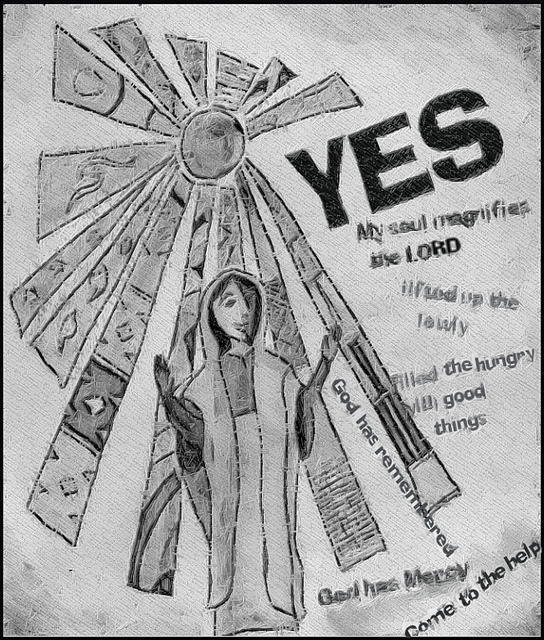
Luke 1:44-56 (1:50) – December 8, 2024

People have been writing songs about the Virgin Mary for centuries. Songs of praise, songs of worship, songs honoring God, and lifting up Mary for saying “yes” to God. Christmas carols might be the first thing that come to mind—but I am also thinking of music from centuries past. From the familiar first part of Handel’s Messiah, to the various settings of the Magnificat, with lyrics from the first chapter of Luke—our Gospel reading for this morning.

            Some Protestants might not be as familiar with the Virgin Mary as many Catholics and Orthodox Christians are. Mary is held in extremely high esteem in many denominations and faith traditions throughout the world, and for excellent reasons. I honor her greatly.

If we look at our modern world today, the situation here in our country, we have a great deal of uncertainty, and very little peace. Does our world today have some strong similarities to the world that Mary inhabited? I wonder, and I would say yes.

Mary sings about the mighty work of God. Yes, personally, in her life. But also in the lives of all the people in the world. “What will this work of God look like?  Something revolutionary is about to happen. God will turn the world upside down. The rich and the powerful will be brought low, and those living on the margins will be raised up. This isn’t a vision that fits very well with a Christian world that values success and power.[1]

For, that is definitely what a large portion of the so-called “Christian world” values today. At least, here in this country, and among a large number of people who claim to follow Christian values and practices religiously. Even if certain Christian denominations do not say it outright, the “Health, Wealth and Happiness Gospel” is a high priority in many people’s lives today.

Let us take a look at what Mary’s situation consisted of. Did you know that Mary—an unwed teenager from an oppressed people-group in an occupied country under crushing Roman rule—was also a radical? A subversive? Was plotting to overthrow the existing oppressive government and replace it with the rule of God?

            What surprising, even shocking things to say about the sweet, innocent Virgin Mary! Everyone associates her with travel to Bethlehem while nine months pregnant, and needing to deliver the infant Jesus in a stable, because there was no room for them in the inn.

That Mary? Radical? Subversive? Absolutely, yes.

Think about the modern Christmas season from another direction. Contrast Mary’s situation with today. Is there any place we can go where we are not bombarded with commercial messages shouting for us to “Buy, buy, buy!” and reminding us of big sales, and markdowns, and half-price! Not to mention all the pressure to be “merry and bright” all the time. Even when going to yet another event or concert or dinner or celebration is the last thing you want to do!

Let us reflect on the first chapter of Luke, on Mary’s song. The last thing on Mary’s mind was commercialism. “Mary’s song, often called the Magnificat, is a welcome contrast to the hyped-up speed of the commercialism that is too often the dominant theme in our culture during the Advent season. Her lyrics are an invitation to approach Christmas with a slower, more contemplative pace.” [2] Is it possible to slow down the frenetic pace of the holidays, to get off the commercial merry-go-round, and instead sit still and worship the coming Messiah?

Sure, the wonderful classical settings of the Magnificat were often sung in a foreign language, like Latin. Or, in text from the King James version of the Bible, full of “thee’s” and “thou’s” and all manner of archaic words. Listen to the first part of her Magnificat, as translated in the modern version by Eugene Peterson, “The Message.” 

“I’m bursting with God-news; I’m dancing the song of my Savior God. God took one good look at me, and look what happened—I’m the most fortunate woman on earth! What God has done for me will never be forgotten, the God whose very name is holy, set apart from all others. His mercy flows in wave after wave on those who are in awe before Him.”

 One well-known depiction of the Virgin Mary is one that is meek, docile, sweet, and not raising a fuss at all. But, wait a moment. Do we realize what Mary is going to sing next? How revolutionary were many of the statements in her song?

             “Even more importantly, Mary’s song is an overture to the Gospel of Luke as a whole. Mary’s lyrics set the tone for Jesus’s radical and controversial ministry that is to come:

You have shown strength with your arm;

You have scattered the proud in the thoughts of their hearts.

You have brought down the powerful from their thrones, and lifted up the lowly;

You have filled the hungry with good things, and sent the rich away empty.

“In contrast, the Christmas season leaves too many still hungry, and too many even further in debt.” [3]

            Do you hear what radical things Mary is saying? If these lyrics of her song were more well-known, would our understanding of Mary be changed? Here Mary is advocating social change, rescuing victims—neglected women, forgotten elders and children, abused strangers and refugees—from being trodden underfoot, even ground under the heel of bragging, bluffing tyrants and braggarts. Turning all society as it was in her day—and ours—upside down.

            What subversive idea is our revolutionary Mary advocating now? Feeding the starving? Giving the poor a banquet? Turning the unfeeling, callous rich people out into the cold? Yes, these radical words are the words found in Luke chapter 1, before we rush on to the narrative of the birth of the Baby in Bethlehem from Luke 2. 

Just looking at this Magnificat, we can see how subversive it was for the infant Messiah to be born to the Virgin Mary. And, we can begin to realize how radical it is for us to say, “O come, let us adore Him, Christ the Lord!” For Jesus truly will bring peace on earth, and He will truly turn the world upside down, just as Mary sang two thousand years ago.

But, this is still only the second Sunday of Advent. We still wait for the baby Jesus to be born in Bethlehem. We still hold our collective breath with all the rest of creation as we wait—and wait. And with Mary, we can rejoice in the promise of the coming Messiah.

Are we overwhelmed with the superficial, commercial glitz and bling of the holidays? Or, are we focused on what really matters – on the coming of our Messiah, our Lord, in God’s peace and wholeness? Let us focus on Jesus, today. Alleluia, amen.

@chaplaineliza

(Suggestion: visit me at my other blogs: matterofprayer: A Year of Everyday Prayers. #PursuePEACE – and  A Year of Being Kind . Thanks!


[1] http://www.bobcornwall.com/2015/12/blessed-are-you-among-women-lectionary.html

[2] http://www.patheos.com/blogs/carlgregg/2011/12/magnificat-learning-to-sing-mary%E2%80%99s-song-a-progressive-christian-lectionary-commentary-on-luke-146-55/

[3] http://www.patheos.com/blogs/carlgregg/2011/12/magnificat-learning-to-sing-mary%E2%80%99s-song-a-progressive-christian-lectionary-commentary-on-luke-146-55/

“Magnificat! Learning to Sing Mary’s Song,” Carl Gregg, Patheos, 2011.

Unknown's avatar

Joy, For the Nations

Joy, For the Nations

Isaiah 42:1-9 (42:6) – December 11, 2022            

God has an amazing way of bringing about justice! You and I can think of countless situations where God is walking with faithful believers through all kinds of difficult situations! Yet our God cares for each and every situation, and our God accompanies all these in patient and long-suffering ways.          

  Today’s reading from the prophet Isaiah highlights God’s servant bringing justice, lighting the way to joy, and bringing release to the captives. God usually does not smite the “bad guys,” and we know God doesn’t throw thunderbolts at the people who make life so difficult for everyone else.             

How on earth are we supposed to deal with rotten situations like chronic illness, unemployment, or natural disasters, then? What could you and I do when we are being mistreated or oppressed or trampled, like the people of Israel were by the Babylonians? Because, that was who was beating up on the armies of Israel at the time Isaiah wrote. And, the Babylonians finally conquered the Israelites and took many of them away to the country of Babylon as hostages, and enforced labor.         

    This rotten situation was very real for Isaiah and the country of Israel, in other words! What are the people to do? How should they deal with evil, unfeeling oppressors?            

The prophet writes, speaking for God: “Here is my servant, whom I uphold, my chosen one in whom I delight; I will put my Spirit on him, and he will bring justice to the nations.” “But, Lord,” I can just hear many of the people of Israel say, “When will this be? How long do we need to wait? Why are You taking so long?”           

Waiting is just what we’re doing now. Right now, we are in the season of Advent; we are waiting for the coming of the Messiah, of the Servant of the Lord. The Baby in Bethlehem. Today is the third Sunday of Advent, the Sunday of Joy. The week of continuing expectation, and the week of the Virgin Mary.           

  Several themes of this reading from Isaiah are so similar to the themes of the song of the Virgin Mary – the Magnificat from Luke chapter 1. The angel Gabriel has just told the teenage Mary she will bear the Messiah, the Servant of the Lord. The next thing we know, Mary starts singing this amazing song! Hearkening back to Hannah’s song from 1 Samuel and to this song we read today from chapter 42. Similar to God taking delight in the servant of the Lord, Mary begins her song taking joy in the Lord. As she says, “From now on all generations will call me blessed, for the Mighty One has done great things for me—holy is his name. 50 His mercy extends to those who fear him, from generation to generation.” As God proclaims the promise to “to open eyes that are blind, to free captives from prison and to release from the dungeon those who sit in darkness,” so Mary takes heart in God’s promise that the Lord considers, cares for, and acts on behalf of the lowly.           

  Both of these songs proclaim radical actions! Both of these songs are from a subversive point of view. Both of these songs – the Magnificat of Mary and this servant song from Isaiah – talk of toppling existing unrighteous power structures and erecting a topsy-turvy power structure with the have-nots receiving more than enough from God. Mary goes even further, stating that “it is not for kings or the mighty and powerful that the Lord has regard, rather it is for all the rest that God does great things.” [1]           

Both songs raise the question of justice. Both time periods had the people of Israel under the boot of conquering, oppressive nations: Babylon in the time of Isaiah, and Rome in the time of the Gospel of Luke. I can just hear the people of Israel say, “Has God abandoned us? Are we still God’s people? Is God still God?”  Because of exile and oppression, the people of Israel could only conclude that God had withdrawn favor and allowed the conquerors to punish them for their sins and disobedience. [2]            Yet, into all of this upset and darkness and uncertainty, both songs praise God for being God. Can we do that too, and praise God, today? Both songs address the theme of justice for all people, not just for a few. Can we believe in God’s statement of justice for all, even though every day we see the poor and the downtrodden getting pushed around, and the humble and lowly being overlooked and even discarded?            

“Isaiah reminds this exiled people that God has not abandoned them but is indeed at work among them, restoring them to be a blessing. This is good news! God is still God.” [3]This loving, caring attitude of God is amazing, in God’s approach to bringing justice to all people. Both Isaiah and Mary have strong feelings about justice—especially radical, subversive Mary! Our patient God is working with all of us, gently, gradually, to bring change and justice into this fallen world.

Both Isaiah and Mary sing a song that can be, should be, our song in this Advent season. As we have prepared for the coming of the Christ Child, now we too can sing in thanksgiving, in celebration, in remembrance, and in proclamation of the promise made to our ancestors. And, the promise made to us, too. What can we say but, alleluia!  Come, Lord Jesus!

@chaplaineliza

(Suggestion: visit me at my other blogs: matterofprayer: A Year of Everyday Prayers. #PursuePEACE – and  A Year of Being Kind . Thanks!

Unknown's avatar

My Soul Magnifies the Lord!

“My Soul Magnifies the Lord!”

Luke 1-46 Mary Magnificat, colors

Luke 1:46-55 (1:46) – December 24, 2017

People have been writing songs about the Virgin Mary for centuries. Songs of praise, songs of worship, songs honoring God, and lifting up Mary for saying “yes” to God. Christmas carols might be the first thing that come to mind—but I am also thinking of music from centuries past. From the familiar first part of Handel’s Messiah, to the various settings of the Magnificat, with lyrics from the first chapter of Luke—our Gospel reading for this morning.

Some Protestants might not be as familiar with the Virgin Mary as many Catholics and Orthodox Christians. Mary is held in extremely high esteem in many denominations and faith traditions throughout the world, and for excellent reasons. I honor her greatly.

Did you know that Mary—an unwed teenager from an oppressed people-group in an occupied country under crushing Roman rule—was also a radical? A subversive? Was plotting to overthrow the existing oppressive government and replace it with the rule of God?

What surprising, even shocking things to say about the sweet, innocent Virgin Mary! Everyone associates her with travel to Bethlehem while nine months pregnant, and needing to deliver the infant Jesus in a stable, because there was no room for them in the inn.

That Mary? Radical? Subversive? Yes.

Let’s back up. Go back to last week’s sermon, where the angel Gabriel surprises Mary and tells her God would like for her to be the mother of the Messiah.

But, what about Mary’s opinion? For a teenager, Mary must have been mature and sensible. She acknowledges the angel’s statement and God’s will. Mary says “Yes, I see it all now: I’m the Lord’s maid, ready to serve. Let it be with me just as you say.”

Sure, the wonderful classical settings of the Magnificat were often sung in a foreign language, like Latin. Or, in text from the King James version of the Bible, full of “thee’s” and “thou’s” and all manner of archaic words. Listen to the first part of her Magnificat, as translated in the modern version by Eugene Peterson, “The Message.”

“I’m bursting with God-news; I’m dancing the song of my Savior God. God took one good look at me, and look what happened—I’m the most fortunate woman on earth! What God has done for me will never be forgotten, the God whose very name is holy, set apart from all others. His mercy flows in wave after wave on those who are in awe before Him.”

One well-known depiction of the Virgin Mary is one that is meek, docile, sweet, and not raising a fuss at all. But, wait a moment. Do we realize what Mary is going to sing next? How revolutionary were many of the statements in her song?

“Even more importantly, Mary’s song is an overture to the Gospel of Luke as a whole. Mary’s lyrics set the tone for Jesus’s radical and controversial ministry that is to come:

You have shown strength with your arm;

You have scattered the proud in the thoughts of their hearts.

You have brought down the powerful from their thrones, and lifted up the lowly;

You have filled the hungry with good things, and sent the rich away empty.

“In contrast, the Christmas season leaves too many still hungry, and too many even further in debt.” [1]

Do you hear what radical things Mary is saying? If these lyrics of her song were more well-known, would our understanding of Mary be changed? Here Mary is advocating social change, rescuing victims—neglected women, forgotten elders and children, abused strangers and refugees—from being trodden underfoot, even ground under the heel of bragging, bluffing tyrants and braggarts. Turning all society as it was in her day—and ours—upside down.

What subversive idea is our revolutionary Mary advocating now? Feeding the starving? Giving the poor a banquet? Turning the unfeeling, callous rich people out into the cold? Yes, these radical words are the words found in Luke chapter 1, before we rush on to the narrative of the birth of the Baby in Bethlehem from Luke 2.

Mary was singing two thousand years ago. But, things haven’t changed much. Political leaders are still calling one another names while people starve. “Refugees struggle to find a home in a world with increasingly closed doors. The poor sleep under bridges while the rich build homes with rooms they will never need. And Abraham’s descendants—Jews, Christians, and Muslims—continue to fight over the lands where God’s messengers first spoke to all humanity.”[2]

As the Rev. Dr. Carl Gregg stated in his article on the radical nature of Mary’s Magnificat, “The Christmas story has, over time, too frequently come to have a sense of ‘preciousness,’ of saccharine sentimentality, of almost sickening sweetness as if you had eaten all the candy in your stocking all at once on Christmas morning. When this super-sweetening of the story happens, we can miss the radicality of the claim that God is found, not as the royal child of a queen in a palace, but as the son of an unwed teenager, born in a stable in a religiously-conservative small town.” [3]

Sure, we can see this saccharine sweetness of Luke chapter 2, once it is pointed out to us. But, in reality, life was not so pretty for teenaged Mary, pregnant without the benefit of marriage.

We are still in the season of Advent, the season of waiting. Today is the fourth Sunday of Advent. We still watch as Joseph and his greatly pregnant wife Mary walk one hundred miles to the town of Joseph’s ancestors (and Mary’s, too).

We still wait for the baby Jesus to be born in Bethlehem. We still hold our collective breath with all the rest of creation as we wait—and wait.

Luke, the writer of our Gospel, has a different take on things. Yes, he waits, too. But he waits with songs. Mary’s song—Mary’s Magnificat is a great example.

As Dr. David Lose says in his commentary, “Have you ever noticed how often Luke employs songs in the first several chapters of his story about Jesus? Mary sings when she is greeted by her cousin Elizabeth. Zechariah sings when his son John is born and his tongue is finally loosened. The angels sing of peace and goodwill when they share their “good news of great joy” with the shepherds. And Simeon sings his song of farewell once he has seen God’s promises to Israel kept in the Christ child.” [4]

These songs are deep expressions of the heart and soul to God and to the listeners—including us. These songs are hymns, psalms, songs of praise and exaltation, and even songs of resistance. Mary combined all of these into her song.

I’d like to close with a portion of a modern song written to Mary, asking her if she knew her infant son would truly be the Messiah, the Son of God. This song was written by Mark Lowry, and asks: “Mary, did you know that your baby boy is Lord of all creation? Mary, did you know that your baby boy would one day rule the nations?
Did you know that your baby boy is heaven’s perfect Lamb?
This sleeping child you’re holding is the great I am!

Mary, did you know? Mary, did you know?”  [5]

We are still waiting…


[1] http://www.patheos.com/blogs/carlgregg/2011/12/magnificat-learning-to-sing-mary%E2%80%99s-song-a-progressive-christian-lectionary-commentary-on-luke-146-55/

“Magnificat! Learning to Sing Mary’s Song,” Carl Gregg, Patheos, 2011.

[2] From An Advent Journey: Devotional Guide, Week Four. This curriculum comes from Illustrated Children’s Ministry.

[3] http://www.patheos.com/blogs/carlgregg/2011/12/magnificat-learning-to-sing-mary%E2%80%99s-song-a-progressive-christian-lectionary-commentary-on-luke-146-55/

“Magnificat! Learning to Sing Mary’s Song,” Carl Gregg, Patheos, 2011.

[4] http://www.davidlose.net/2015/12/advent-4-c-singing-as-an-act-of-resistance/

“Singing as an Act of Resistance,” David Lose, …in the Meantime, 2015.

[5] http://www.lyricsmode.com/lyrics/m/mark_lowry/mary_did_you_know.html

Mary Did You Know lyrics

(A heartfelt thank you to An Advent Journey: Devotional Guide. Some of these sermon ideas and thoughts came directly from this guide.  I appreciate this intergenerational curriculum, which is the basis for my Advent sermon series. This curriculum comes from Illustrated Children’s Ministry. Thanks so much for such great ideas!)

@chaplaineliza

(Suggestion: visit me at my regular blog for 2017: matterofprayer: A Year of Everyday Prayers. #PursuePEACE – and my other blog,  A Year of Being Kind . Thanks!)