Unknown's avatar

Hope, for Mary and for Us

“Hope, for Mary and for Us”

Luke 1:26-45 (1:38) – November 30, 2025

            I have a secret confession to make. I am greatly thankful that I have never had to take a job in retail. As I said to my husband this past weekend, I would have quit after the first day, simply because of the constant, cheesy, sometimes saccharin-sweet Christmas music that is piped in over the PA system at every retail store I go into. This is done for about two months before Christmas. And, that’s a long, long time to hear Christmas carols and songs, non-stop.

            And yet – and yet, as we consider this alternative Advent Bible reading from Luke chapter 1 today, I invite you to come with me back in time, to a time before there even was a Christmas. We are not only going to time-travel, but we are going to ocean-hop, too. Let us go to the modest home of a teenager named Mary, living with her parents in Palestine, around the beginning of the first century of the Common (or, Christian) Era.

            This teenaged girl – really, young woman, as she was in that time and place – had an angel visitation. We even find out the Angel’s name, Gabriel. The few times that the angel Gabriel appears in the Bible (that we know of), are times of great importance. Especially this appearance, when Gabriel heralds the birth of the coming Messiah! But, we haven’t gotten there yet. Mary is in her parents’ home when the angel suddenly arrives, about to upend everything concerning Mary and her life as she knows it.  

            Another very important fact: the country where Mary is living, and her people, the Jews, are under Roman rule. Palestine is an occupied country, like so many other regions and nations under the boot of Rome and the powerful Roman army. Palestine doesn’t sound much like a “Silent Night, Holy Night,” where “all is calm, all is bright.” Does it?

            Our mighty God does not wait until everything is perfect, or everything is calm and placid, to work wonders and miracles. God sent the angel Gabriel to a teenager in a modest house, in a country under military occupation. Not to the ruling classes, not to the king’s family in his luxurious palace, but to an unlikely young woman in a backwater town.

            Let us shift gears and move our focus to the modern day. Here in the United States, we have a great deal of internal struggle! Things today are certainly not perfect, or calm or placid. As we mark the first Sunday in Advent, the first candle on the Advent wreath is called the candle of Hope. Can you and I possibly find hope in an atmosphere of anxiety? Of uncertainty? Overwhelmed by pervasive negativity, with the American people’s attitudes filled with division, derision and defensiveness?

            Let’s return to Mary and the angel. How does Gabriel lead off in this conversation from Luke chapter 1? 28 The angel went to her and said, “Greetings, you who are highly favored! The Lord is with you.” Admittedly, Mary wonders what on earth is going on! Dr. Luke tells us, Mary “was greatly troubled at his words and wondered what kind of greeting this might be.” I dare say you and I would be greatly troubled, too, if we were to encounter an angel!

            Sure enough, Gabriel announces to Mary that she is highly favored, and that “you will conceive and give birth to a son, and you are to call him Jesus. 32 He will be great and will be called the Son of the Most High. The Lord God will give him the throne of his father David, 33 and he will reign over Jacob’s descendants forever; his kingdom will never end.”

Mary probably knew her place in society of her time, as a female, as a second-class citizen. Mary “is common, ordinary, of little account in her world and definitely not the stuff of legends…and she knows it. Only after expressing her wonder and dismay, and then hearing again Gabriel’s affirmation and promise, does she manage to summon the courage to believe that God has indeed favoring her by working in her and through her for the health of the world.” [1] What was Mary’s response to the angel? 38 “I am the Lord’s servant,” Mary answered. “May your word to me be fulfilled.”

We all know very well that our teenaged Mary became pregnant by the Holy Spirit, and gave birth to the baby Jesus in Bethlehem. We are well used to seeing Mary as a sweet, calm, quiet, almost docile follower of God’s will for her life. However, I would like to suggest that Mary was also a prophet! As a prophet, she would also be a bringer of hope to the world!

This prophetic role, this insight is a new way of looking at Mary for me. New for me, and I hope enlightening to you, too. As we consider the call of the prophets in the Hebrew Scriptures, and consider the call of Mary by the angel Gabriel, we see all the familiar, classic steps: we see God’s initial call, God’s task, the prophet’s objection, God’s reassurance, and the prophet’s acceptance of call. [2]

 I will say more about this next week, when we take a look at the Canticle that Mary sings, but I want to bring before us the earth-shattering idea that “Luke portrays her in a startling role: one that shakes up the way we’ve been brought up to think of her and invites us to stop observing her and start imitating her.” [3]

 I know that the Christmas carol “Once in Royal David’s City” calls mother Mary “mild,” and the typical portrayal of her on Christmas cards is calm, placid and docile. But, how can this mild depiction of Mary cause our hearts to be hopeful, today? Especially when it seems that the whole world is uncertain, the current political situation is contentious, and our society in the United States is fractured and broken?

            While Mary’s specific task is specific to her, the prophetic call remains open to everyone. God can call each one of us to a prophetic role, especially at this time of Advent, at this grateful and expectant time of year when people are looking up, looking outward, looking for hope. We can all be like Mary, the prophet, bearing good news to everyone.

            Alleluia, amen.

@chaplaineliza

(Suggestion: visit me at my other blogs: matterofprayer: A Year of Everyday Prayers. #PursuePEACE – and  A Year of Being Kind . Thanks!


[1] https://www.workingpreacher.org/dear-working-preacher/favored-ones

[2] http://www.patheos.com/progressive-christian/mary-reluctant-prophet-alyce-mckenzie-12-17-2012.html

[3] Ibid.

Unknown's avatar

God’s Law in Our Hearts

“God’s Law in Our Hearts”

Jeremiah 31:31-34 (31:33) – October 26, 2025

            Relationships are foundational to life. Positive, negative, distant, close.  Both of my parents are gone now, but I had a relationship with both of them. My sisters and brothers—again, I have relationships with them. Members of my extended family, too, are included in my list of relationships. Also my friends, acquaintances, colleagues, even my enemies. All of these people have relationships with me. Think about yourself. You have relationships with many, many people, too. Most of these people I just mentioned, if not all of them. Positive or negative, distant or close. We all have relationships—or friendships—with many people.

            But what about God? What kind of relationship do you and I have with God? Is that relationship good? Even wonderful? Is it close? Or distant? Bumpy at times?

            Our scripture reading for today talks about this relationship. Here. On this Reformation Sunday, we celebrate our clear relationship with God, the relationship that Martin Luther celebrated! But, the prophet is talking about it from God’s perspective. God’s view of the relationship, or the friendship, if you will.

            God wants to be friends. We’re not talking about a distant God, a God Who wound up the universe like a watch, put it on some shelf, and then walked away and promptly forgot all about it. No!! God wants to be in a relationship.

            If we look at this passage, we see that God had a relationship—a friendship, we could say—with the nation of Israel. God was the one Who started it. See what verse 32 says? God took the nation of Israel by the hand when God led them out of Egypt. God wanted the friendship. Israel did not start the relationship.

            We can compare that friendship to God’s friendship with us. God wants us as friends, too!  Just like the nation of Israel, God goes out of His way to make friends with us. You and me. Each and every one of us. God approaches us.

            But something happened. Something awful! The nation of Israel was not a faithful friend to God. The relationship was disrupted, broken. But God didn’t break it. No! Israel did. Remember the many, many times in the Hebrew Scriptures that Israel ran away from God? Or forgot about God? Or just plain ignored God? Time after time, we can read about how the nation stumbled, resisted, or was unfaithful to their friendship. Their relationship.

            A number of times in the various prophets’ writings, the relationship between God and Israel is pictured as a marriage. God is the husband, and Israel is the wife. God is always faithful, and Israel is not. Israel stumbles, falls, ignores her God, or just plain runs away in disobedience. Here in verse 32, the prophet tells us that Israel is unfaithful.

            What about us? What about you and me, in our on-again, off-again relationship with God? That is what Martin Luther talked about, so often. He had a real and abiding sense of his own sinfulness, his own unfaithfulness to God.

Isn’t it a lot the same with us? Don’t we stumble, or fall? Haven’t we forgotten about God a lot of the time, or even been unfaithful to our Lord? I’m thinking of sin. Putting other things in God’s place. Making other things or other people in our lives more important to us than God. 

            Our relationship with God is broken! Disrupted. Sometimes we grow so used to sinning, to being apart from God, that you and I cannot choose to do anything else.

            What a predicament! Our relationship with God—under the Old Covenant—is gone. Destroyed. We are sunk, there is not a chance for you and for me. But, wait! God does not leave us there! God still wants to be friends with us! With you, and with me.

God loves us so much that God is ready and willing to forgive our sin. Forgive us when we stumble and fall, when we put other things or other people in God’s place. God is ready to forgive absolutely. Unconditionally.

God’s nature is not punishing or arbitrary, but instead loving and forgiving. As Rev. Sharon Blezzard says, “as a Lutheran Christian I am called to re-formation on a continual basis. Even though I do die daily to sin, I also rise to newness of life; therefore, I am indeed always being made new. Thanks to the amazing gift of grace in Christ Jesus, I have options! I have a future, right here and right now.” [1]

            Just like Joseph, ruler of Egypt, freely forgave his brothers at the end of Genesis when they stood before him, God is more than willing to forgive us. Joseph’s brothers did some awful things to Joseph, but Joseph was ready and willing to forgive their treachery because of his love for them and for his father Jacob. How much more then is God able to forgive us for our falling short, for our running away, even for our disobedience! God loves us so much! . . .  God loves us this much! (spreads arms wide)

            This forgiveness is heart language, from God. The foundation of this forgiveness comes from our new knowledge of God, written on our hearts. And what is our response to God’s love? God’s forgiveness? God’s reconciling embrace? You and I have the opportunity to live changed lives, as changed people—from the inside out. God is not willing that anyone should be strangers, but instead that all would have the opportunity to be friends with God. Best friends.

God says it! Our Lord will be our God. We will be God’s people. And that’s a promise. That’s forgiveness. That’s the opportunity that each of us has to be with God, forever.

            Alleluia, amen.

@chaplaineliza

(Suggestion: visit me at my other blogs: matterofprayer: A Year of Everyday Prayers. #PursuePEACE – and  A Year of Being Kind . Thanks!


[1] https://www.stewardshipoflife.org/2015/10/oh-the-options/

Unknown's avatar

Unfailing Love and Faithfulness!

“Unfailing Love and Faithfulness!”

Psalm 138:1-8 (138:2) – June 9, 2024 

Individualism certainly is the end-all and be-all of the modern mindset. The rugged individual is presented to us in television commercials as a rugged adventurer, or someone hiking or skiing or sailing on their own. Whatever they’re involved in, they are grabbing all the gusto they can! Some people do indeed reject the offer of any help, for any number of reasons. “I can do it, myself!” Is that statement something that sounds familiar to you? And, perhaps to me, too?

Our psalmist is certainly not an individualist. This modern mindset is just not applicable here in the Biblical mindset. In Psalm 138, our psalmist (most probably King David) is clearly thankful and grateful that he has such support from a mighty, caring God! Just from looking at one verse from this psalm, we can see David’s loving gratitude! “Though I walk in the midst of trouble, you preserve my life. You stretch out your hand against the anger of my foes; with your right hand you save me.”

When individuals or loners are out there, all by themselves, they can run into some trouble. Our psalmist calls it “a day of trouble,” in fact! Really tough times. Have we ever kit times of trouble, when things just did not go the right way? I am not sure what kind of “day of trouble” you may have had, or even still be going through a “day of trouble” right now. All kinds of things could be going on. Physical illness, spiritual struggle, financial peril, military threat. All of these times are legitimate times of crisis! [1]

King David had some real times of struggle, and more than a few times of crisis, too! We get a very personal viewpoint on his struggles, from his intensely personal psalms, too. He does not pull any punches here, either. Except – Psalm 138 is a retrospective psalm. He states that he has indeed been through a “day of trouble,” but that day is past. David is not specific here about whatever crisis he was thinking of.

And, that is the point of this psalm. Our singer says, “On the day I called, you answered me.” What a wonderful statement! We can see from these very personal psalms, that when David came up against a time of crisis or despair, time after time he came before the Lord in prayer. Because – times of crisis are also times of concerted prayer!

Is that how things are for you, and for me? Do we come before God in prayer when we are in deep distress? Or, do we try to “tough” it through, all by ourselves?

Let’s think a bit more deeply about today’s situation. Or perhaps, it wasn’t today. But, recently. You were in a tight spot. Something awful had happened, and you just didn’t know how you were going to pull through. It may have been a health crisis, or a financial situation, or even a natural disaster. Maybe even a flood in your basement! (That counts, too!)

I don’t know about you, but when things like that happen, I can feel all alone. All by myself. Even if I have others in my family nearby, sometimes they are just not available to help out, either. Let me tell you – Psalm 138 is a wonderful reminder that God will be there for us, when we are in distress! Verse 3 tells us, “When I called, You answered me!”  

Some people have lots of friends! Fair-weather friends, that is. They are friendly enough when the sun is shining and the road ahead is straight with no curves or bumps. But, good friends? True-blue friends? Those kinds of friends are hard to find. “A good friend is a treasure, for he or she will stand by you through the tough times, even from a long distance. This is the kind of person that will support you and help you throughout life.” [2]

Yes, it’s a blessing to have true-blue friends like this, sitting by our sides, journeying with us, running to the grocery store or throwing in a load of laundry for us when we need it. We all need a good friend with work boots on, sometimes! Commentator Larry Broding says, “God is this kind of friend. Our Creator not only made us and sustains us, he actively works in our lives for our ultimate good. God is present through times of blessing and tragedy. God deserves our thanks and praise for his constant care.” [3]

In Psalm 135, the psalm writer says, “great is the LORD, our God, our Lord, more than all the gods.” I do not know if you caught this expression, but in this particular psalm, he says, “I will praise you, Lord, with all my heart; before the “gods” I will sing your praise.” In both instances, our psalmist mentions other gods. Because, at the time these psalms or songs were written, there were lots of gods! Local gods, tribal gods, gods of the harvest, gods of war, gods of hearth and home. Lots of gods! But, right here, King David praises the LORD above every other god – with a small “g!” Our God, the LORD who made heaven and earth, is far, far greater than any other god who comes up against our God, the LORD!

Finally, King David punctuates this psalm with “unfailing love and faithfulness!” I would be grateful to any friend who not only comes alongside of me when I need a hand, but God is stated to be a good-hearted, loving and faithful friend by none other than King David!

 “The two terms — steadfast love (Hebrew, hesed) and faithfulness (Hebrew, ’emet) — describe God’s character. It is a character that is trustworthy, which means that the promises God makes can be trusted.” [4] This is what David says in this psalm. This is his heartfelt affirmation of his God. If we looked at all the psalms, and boiled down the witness of this marvelous book to one phrase, it would be this: The Lord is faithful.  

I started out today by talking about individualism, being captain of her own soul, or master of his own fate. “Biblical faith starts with admitting our own weakness — and of accepting the gracious mercy and fidelity of the Savior who comes among us to serve rather than to be served. The psalm ends with a request for continued help: ‘Do not forsake the work of your hands.’ Each of us is the work of God’s hands. And to be a follower of the Lord means to know that we cannot and need not do it all on our own.” [5]

Thank God for that! We are never alone, and that’s a promise. A promise from King David, and a promise from our loving God. Alleluia, amen!

@chaplaineliza

(Suggestion: visit me at my other blogs: matterofprayer: A Year of Everyday Prayers. and  A Year of Being Kind . Thanks!


[1] https://www.workingpreacher.org/commentaries/revised-common-lectionary/ordinary-21/commentary-on-psalm-1381-8-2

[2] http://www.word-sunday.com/Files/Psalms/138.html

Thank You, God, For Standing By Me,” Larry Broding’s Word-Sunday.Com

[3] Ibid.

[4] https://www.workingpreacher.org/commentaries/revised-common-lectionary/ordinary-21/commentary-on-psalm-1381-8-2

[5] Ibid.

Unknown's avatar

Joy, For the Nations

Joy, For the Nations

Isaiah 42:1-9 (42:6) – December 11, 2022            

God has an amazing way of bringing about justice! You and I can think of countless situations where God is walking with faithful believers through all kinds of difficult situations! Yet our God cares for each and every situation, and our God accompanies all these in patient and long-suffering ways.          

  Today’s reading from the prophet Isaiah highlights God’s servant bringing justice, lighting the way to joy, and bringing release to the captives. God usually does not smite the “bad guys,” and we know God doesn’t throw thunderbolts at the people who make life so difficult for everyone else.             

How on earth are we supposed to deal with rotten situations like chronic illness, unemployment, or natural disasters, then? What could you and I do when we are being mistreated or oppressed or trampled, like the people of Israel were by the Babylonians? Because, that was who was beating up on the armies of Israel at the time Isaiah wrote. And, the Babylonians finally conquered the Israelites and took many of them away to the country of Babylon as hostages, and enforced labor.         

    This rotten situation was very real for Isaiah and the country of Israel, in other words! What are the people to do? How should they deal with evil, unfeeling oppressors?            

The prophet writes, speaking for God: “Here is my servant, whom I uphold, my chosen one in whom I delight; I will put my Spirit on him, and he will bring justice to the nations.” “But, Lord,” I can just hear many of the people of Israel say, “When will this be? How long do we need to wait? Why are You taking so long?”           

Waiting is just what we’re doing now. Right now, we are in the season of Advent; we are waiting for the coming of the Messiah, of the Servant of the Lord. The Baby in Bethlehem. Today is the third Sunday of Advent, the Sunday of Joy. The week of continuing expectation, and the week of the Virgin Mary.           

  Several themes of this reading from Isaiah are so similar to the themes of the song of the Virgin Mary – the Magnificat from Luke chapter 1. The angel Gabriel has just told the teenage Mary she will bear the Messiah, the Servant of the Lord. The next thing we know, Mary starts singing this amazing song! Hearkening back to Hannah’s song from 1 Samuel and to this song we read today from chapter 42. Similar to God taking delight in the servant of the Lord, Mary begins her song taking joy in the Lord. As she says, “From now on all generations will call me blessed, for the Mighty One has done great things for me—holy is his name. 50 His mercy extends to those who fear him, from generation to generation.” As God proclaims the promise to “to open eyes that are blind, to free captives from prison and to release from the dungeon those who sit in darkness,” so Mary takes heart in God’s promise that the Lord considers, cares for, and acts on behalf of the lowly.           

  Both of these songs proclaim radical actions! Both of these songs are from a subversive point of view. Both of these songs – the Magnificat of Mary and this servant song from Isaiah – talk of toppling existing unrighteous power structures and erecting a topsy-turvy power structure with the have-nots receiving more than enough from God. Mary goes even further, stating that “it is not for kings or the mighty and powerful that the Lord has regard, rather it is for all the rest that God does great things.” [1]           

Both songs raise the question of justice. Both time periods had the people of Israel under the boot of conquering, oppressive nations: Babylon in the time of Isaiah, and Rome in the time of the Gospel of Luke. I can just hear the people of Israel say, “Has God abandoned us? Are we still God’s people? Is God still God?”  Because of exile and oppression, the people of Israel could only conclude that God had withdrawn favor and allowed the conquerors to punish them for their sins and disobedience. [2]            Yet, into all of this upset and darkness and uncertainty, both songs praise God for being God. Can we do that too, and praise God, today? Both songs address the theme of justice for all people, not just for a few. Can we believe in God’s statement of justice for all, even though every day we see the poor and the downtrodden getting pushed around, and the humble and lowly being overlooked and even discarded?            

“Isaiah reminds this exiled people that God has not abandoned them but is indeed at work among them, restoring them to be a blessing. This is good news! God is still God.” [3]This loving, caring attitude of God is amazing, in God’s approach to bringing justice to all people. Both Isaiah and Mary have strong feelings about justice—especially radical, subversive Mary! Our patient God is working with all of us, gently, gradually, to bring change and justice into this fallen world.

Both Isaiah and Mary sing a song that can be, should be, our song in this Advent season. As we have prepared for the coming of the Christ Child, now we too can sing in thanksgiving, in celebration, in remembrance, and in proclamation of the promise made to our ancestors. And, the promise made to us, too. What can we say but, alleluia!  Come, Lord Jesus!

@chaplaineliza

(Suggestion: visit me at my other blogs: matterofprayer: A Year of Everyday Prayers. #PursuePEACE – and  A Year of Being Kind . Thanks!

Unknown's avatar

Do We Have Golden Calves?

“Do We Have Golden Calves?” – October 11, 2020

Exodus 32:1-14 (32:2-4)

We are living through great uncertainty. Look at the volatile weather during the past few months! Hurricanes, floods, wildfires, extremes in temperature. What about the COVID-19 pandemic? More than 210,000 people have died in the United States in the last six months, as many as died in all four years of the American Civil War. Added to those anxious statistics, we can name the recent racial tensions and the national political upheaval.

 When you or I are fearful or anxious or uncertain, what do we do? Where do we go for stability or comfort? What is all-important to each one, in such a tumultuous time?

As we consider the people of Israel, we might think of all of them being fearful and anxious, too. After all, they had just left Egypt not many weeks before. They were no longer slaves! Yet – they were also wandering in the wilderness of the Sinai peninsula. A foreign land, with strangeness and uncertainty at every turn!

Their trusted leader Moses had gone on top of the mountain to talk to this God that he said was the God of their ancestors Abraham, Isaac and Jacob. An invisible God they could not see, touch or understand, unlike the Egyptian gods.

“Get up and make gods,” they shout, because this Moses has obviously left us alone to die, and we cannot last another day, another minute, without some sort of God or gods to lead us. As for that guy Moses, well, “we do not know what it is to him,” which I take to mean that they have completely forgotten that he told them he was going up the mountain to chat with YHWH and would return to bring them the divine news of the day. As far as they know, Moses and YHWH are engaged in a handball tournament or a solo beach volleyball game.” [1]

Could you understand the fear, uncertainty and anxiety of the people of Israel? No wonder they begged Moses’ brother Aaron for some tangible god, a god they could see, touch and understand, like the Egyptian gods they knew from their time of slavery in Egypt.  

Aaron knew just what to do. He gathered all the golden rings, earrings and ornaments, melted them into malleable metal, and formed a golden calf. An idol the Israelites could see, touch and understand. Something to give them comfort and stability.

When you or I are fearful or anxious or uncertain, what do we do? Where do we go for stability or comfort? What is all-important to each of us, in such a tumultuous time?

We might scoff at the people of Israel sacrificing to the golden calf. But –is there anything we would sacrifice our time for? How about our money or our health? Anything that is so important in our lives that we might make it an idol? Our own personal golden calf?

Our golden calves might take many forms. I have an acquaintance who I’ve known for a long time. She considers her house to be so important. Of course, it is beautiful, but she has poured money into that house and the large garden—and the coach house out back—for many, many years. I suspect that house might be a golden calf in her life.

Another acquaintance I have owns seven cars. Seven! He is so proud of them! He washes them, waxes them, and considers them to be very valuable possessions. I think we all know someone who has idolized something – or someone – or some substance so much that it has become a golden calf to them. Perhaps each of us may consider something all-important. Something we sacrifice for. More important than God, even?

When you and I think deeply about it, the idea of an invisible God can be scary! Can we blame the people of Israel for wanting a tangible god, one they could see and touch and understand? Of course they wanted Aaron to construct a physical idol. “It is easy to mistake our own creations for our God. It is tempting to shape our plundered riches, our wages, and even the reparations for our losses into an image that pleases our senses, mollifies our anxiety, and invites admiration from our neighbors. But that thing we have made from Egypt’s gold is not our god.” [2]

We heard what happened between Moses and God at the ruckus with the idol. God got angry at the people of Israel, but Moses convinced God to allow God’s anger to subside.

Golden calves or “idols lure us with powerful illusions and misplaced hopes. They make seductive promises. These false gods come in all sizes and shapes. They promise much but deliver little. We can idolize almost anything — career, race, gender, sex, wealth, age, and especially nation. Our personal gods are so petty and pathetic that they would be laughable if they weren’t so insidious and corrosive.” [3]

We can take this example as a warning to us. We need to ask God to forgive us for constructing idols in our lives, too.

However, we also have promises from the Lord. God is always with us, even though we may not see God. Like the sun behind dark clouds, the sun is always present. Even in times of stress, fear and anxiety – such as right now! Even at times when we cannot see the invisible God, God is right there, by our sides. Surely, it is God who saves all of us. Alleluia, amen.  


[1] https://www.patheos.com/progressive-christian/2014/10/you-cant-have-it-both-ways-john-holbert-10-06-2014 

“You Can’t Have It Both Ways,” John C. Holbert, 2014.

[2] http://www.workingpreacher.org/preaching.aspx?commentary_id=3442

Commentary, Exodus 32:1-14, Anathea Portier-Young, Preaching This Week, WorkingPreacher.org, 2017.

[3] https://www.patheos.com/progressive-christian/2014/10/you-cant-have-it-both-ways-john-holbert-10-06-2014 

“You Can’t Have It Both Ways,” John C. Holbert, 2014.

@chaplaineliza

(Suggestion: visit me at my regular blog for 2020: matterofprayer: A Year of Everyday Prayers. #PursuePEACE – and my other blog,  A Year of Being Kind . Thanks!

Unknown's avatar

No Longer Orphans

“No Longer Orphans”

John 14-18 not leave you

John 14:15-21 (14:18) – May 17, 2020

When I used to read lots of fiction novels, especially when I was young, a favorite theme was making the protagonist an orphan. Sometimes abandoned, sometimes ignored, sometimes desolate, this setting provided a rich background for the author’s writing.

Today’s Gospel reading from John 14 seems especially pertinent in these uncertain times of pandemic. Here Jesus promises the Holy Spirit’s coming to be with us. The Holy Spirit now is present with believers, both with them and in them. Jesus says He will not leave us all alone, the way orphans are left all alone.

When some people think of orphans, they think of children, huddled in orphanages, housed in drafty attics, or in poky little rooms. Imagine Orphan Annie at the beginning of the musical “Annie,” or Harry Potter in the first few chapters of “Harry Potter and the Sorcerer’s Stone.” Just thinking about orphans in that way feels desolate.

Except—most of us are orphans, too. We lose parents to many things: to cancer, strokes, diabetes, or accidents, among others. Most people are at least half-orphans. I was—my dad died when I was in college. In July, it will have been forty years since I lost my dad, and became a half-orphan. At least I had my mom until the early 2000’s. But, that loss of my father to cancer was a sad blow. I missed my dad very much, and now I miss both of my parents.

When Jesus said to His disciples “I will not leave you as orphans,” I would imagine that Jesus’s words were comforting to many if not all of His disciples.

Death and sickness were everyday facts of life 2000 years ago. I don’t read very much about the individual disciples in commentaries and other reference books, for the main reason we are not told very much in the Biblical record. But, I do know the human condition, for people in the present day, and other common situations many people are familiar with.

Thinking again about the human condition, and people we encounter every day—whether in person, on social media, or in the news—what is their situation? What are they dealing with?

We are all sadly familiar with people dealing with financial trauma, job loss, physical illness, spiritual desperation, emotional isolation, instability, want, disrupted relationships, abandonment, violence … the list goes on and on. These elements of the human condition are bad enough. But, when we add our current emotional and psychological climate, especially in this unprecedented time of pandemic, individuals can feel overwhelmed. Whole communities can be disheartened and desolated, particularly in hot spots affected by the coronavirus. Interesting that Jesus uses the word “orphaned” in this week’s text, as it is such a potent metaphor for what he was about to do, which was to leave his beloved disciples and go and die. [1]

Jesus just got finished promising the coming of the Holy Spirit. Many people love this promise, and grab onto it with both hands. Yes, it is a marvelous reality in believers’ lives.

But—sometimes—especially in uncertain times like right now—individuals can feel like orphans! Isolated, alone, disheartened, even desolated. I am particularly thinking of seniors I know who are in fragile health, confined to their homes or apartments. I shop for two households of seniors right now, in this time of shelter-in-place in Illinois. A senior couple, and a widower. Two of my relatives are both seniors, both living alone in Chicago. I’ve heard expressions like squirrelly, stir-crazy, isolated, even though we live in a time of computer access and social media connections.

Is this what Jesus was thinking of?

Jesus, I want to be able to communicate to people some hope, some feeling of togetherness, some kind of kindness, compassion and coming-alongside.

I know, the promise of the Holy Spirit may sound like an empty promise if you’re locked down and in quarantine. But, perhaps one way the coming of the Holy Spirit can be expressed is when we look at the words and actions of Jesus’s followers. Maybe another way to look at the work of the Holy Spirit is a way that animates and encourages people to reach out to one another.

Before I came to St. Luke’ Church, when I was a hospital chaplain, I was a listening ear to patients or loved ones or staff. I came alongside of these people in difficult situations – like a Paraclete, in a similar way to the Holy Spirit coming alongside each of us in difficult times.

In a practical sense, the way the Holy Spirit sometimes works may be the kindness we extend to each other. Yes, the Holy Spirit is with us and in us. And, yes, in these times when many people find themselves desperately alone or lonely, the Holy Spirit moves or sends others to be God’s hands and feet, God’s listening ear, the person who shows up at your door delivering groceries, or the volunteers who drop off baked goods or canned goods at a food pantry.

I am blessed with a pleasant smile – it just happens. I was told a number of times by patients and loved ones that my smile lit up a hospital room. Could your smile, your kind words, your compassion and helpfulness be the Holy Spirit’s working in all of our lives?

Listen to Jesus—God will give us another advocate to help us and be with us forever— the Spirit of truth, the Holy Spirit indwelling each believer. The Holy Spirit works through each of us, through all of us, sometimes at the most unexpected times.

Are we called to be the hands and feet of Jesus? Is God pleased when we spread kindness and help others? As we show love to each other, we show love to Jesus. And, the Holy Spirit bears witness within. What a wonderful promise from Jesus. What a wonderful opportunity to do God’s work. Go, and do likewise.

[1] https://www.patheos.com/progressive-christian/orphaned-anna-hosemann-butler-05-20-2014.html

@chaplaineliza

(Suggestion: visit me at my regular blog for 2020: matterofprayer: A Year of Everyday Prayers. #PursuePEACE – and my other blog,  A Year of Being Kind . Thanks!

Unknown's avatar

Together with Christ

“Together with Christ”

John 14-3 prepare a place, words

John 14:1-7 (14:3-4) – May 10, 2020

When I was in middle school and high school, I attended a Girl Scout camp in Wisconsin for several years. I vividly remember the girls who got so homesick while they were there. Several really missed home, and needed lots of TLC, tender loving care, for a few days. Have you ever been homesick? Can you relate to the frightened, heartsore feelings of these girls?

I don’t remember being homesick, but I can remember feeling scared at camp. I can remember being really scared on other occasions, too. I wonder if the disciples got scared while they traveled with the Rabbi Jesus from place to place? From what we know about Him, Jesus was an itinerant Rabbi, with no real home, no place to call home base.

What must that have been like, not having anywhere to call home? The Rabbi Jesus and His followers, His disciples kept moving from place to place. Different people react to being on the road a lot in different ways. It can be stressful and cause people considerable anxiety.

Added to that, all of the disciples knew very well that their Rabbi was not viewed positively by many Jewish leaders. Repeatedly, prominent Jewish teachers and lawyers had argued with Jesus. A group of leaders actively opposed this upstart Rabbi with the radical ideas and preaching, even if Jesus was a miracle worker.

The situation when the band of disciples entered Jerusalem must have been tense, to be sure. That Passover dinner on that Thursday night was not the most comfortable, I imagine. Yet, what does our Lord Jesus say to His disciples at that meal? How does He deal with this tense situation? Jesus says, “Don’t be worried! Have faith in Me!”

Have faith? Don’t worry? Listen, Jesus, Your friends have been on the road with You for many months. They are tired, they are tense, they have no home base to go back to. What do You mean, saying to them, Have faith and don’t worry!? Isn’t that expecting a lot from these guys? Isn’t that expecting a lot from us, Your followers today?

The next words are nothing but reassurance, comfort. He says, “There are many rooms in my Father’s house. I wouldn’t tell you this unless it was true. I’m going to prepare a place for you. And if I go, I will come back and take you with Me. And then, we will be together.” Total reassurance and comfort. Jesus encourages His disciples just as much as He encourages us.

However—Jesus’s disciples just don’t understand. They can’t get their minds around the metaphor Jesus is using. They mistake His reference to a heavenly house to a real, geographical space. Thomas—who likes concrete explanations, remember—asks for exact directions to plug into his GPS. [1]        How often are we like Thomas?

How often do we need (or want) exact directions, or latitude and longitude, or a detailed list of bullet-pointed things to do? And how often are we told by Jesus that we already know the way? We know Jesus, who is the Way. Precisely because Thomas knows Jesus—precisely because we know Jesus—we cannot become irrevocably lost.

Last week was Good Shepherd Sunday. We talked about the psalm for that week, Psalm 23. I can see definite tie-ins for that beloved psalm with this week’s Gospel reading, as well. Who does not relate to the idea of God shepherding us when we are lost? Who yearns for God to spread a feast in front of us, and to welcome us to the Good Shepherd’s heavenly home?

This week is the Fifth Sunday of Easter. Today is also Mother’s Day, traditionally celebrated on the second Sunday of May. This heartwarming adaptation of Psalm 23 is not only a reminder of that beloved psalm, but also a celebration of mothers.

It was written by Laurie Hays Coffman, and is called A Child Learns to Trust. [2] It says:

“My Mom is my shepherd; I shall not want. She makes me lie down under cool, downy comforters. She watches me play beside still waters. She restores my soul. She leads me in paths of respect, responsibility, and goodness, for I am her namesake! Yea, even though I walk past monsters in the dark, I will not be scared, because my mom is always near me. Her hands and her voice, they comfort me. Mama sets the table and cheerfully calls me to dinner even in front of big, mean bullies. She anoints my skinned knees and broken heart with kisses. She smiles and throws me a towel when my cup runneth over. Surely God’s peace, power, and mercy shall uphold me all the days of my life, for my Mother taught me to dwell in the house of God forever.

Yes, this is an imaginative way to think of Psalm 23. And, this adaptation gets across several of the same ideas that Jesus communicated to His disciples at that Passover dinner, too.

Do we take Jesus’s word as true? Even though it’s an anxious time right now, do we trust Jesus to carry us and remain with us—walk with us, even through the dark valleys?

We are in uncharted territory right now, quarantined, apart from each other. Can we hold on to Jesus’s promise that between now and whenever we are all together again, Jesus is showing us the way? His way! Yes, we may walk through dark places and shadowy spaces now, but Jesus our Good Shepherd stays right by our side.

Jesus also said He’d prepare a place for us—a room for us in His Heavenly Father’s house. Jesus assured us we would be reunited with Him at that heavenly banquet. What a celebration that will be! Jesus said so. We can count on it. Praise the name of Jesus!


@chaplaineliza

(Suggestion: visit me at my regular blog for 2020: matterofprayer: A Year of Everyday Prayers. #PursuePEACE – and my other blog,  A Year of Being Kind . Thanks!

[1] http://www.workingpreacher.org/craft.aspx?post=3218

David Lose, Dear Working Preacher, 2014.

[2] https://www.desperatepreacher.com/mothersday.htm

Unknown's avatar

Fleeing to Egypt

“Fleeing to Egypt”

Matthew 2:13-21 – December 29, 2019

Matt 2-12 Flucht_nach_Aegypten_Meuhlhausener_Altar_Bamberger_Dom

I have been puzzled by the week between Christmas and New Year for some years. Yes, it’s still the holiday season, and yes, lots of people are on reduced schedules, or even taking the whole week as a holiday. But, I realize some people need to keep working regular shifts, to do necessary things that keep the wheels of society rolling and things continuing to happen. As we all know, holidays do not last forever…or sometimes even for a few days.

Remember back to last Sunday? The fourth Sunday of Advent? I talked about the shepherds, and how they got ready to visit the Baby the Angel told them about. Only thing—the shepherds couldn’t afford to take a lot of time off to see the Baby. I doubt whether they could even take more than a few hours, at most a day, to go and see the Baby in Bethlehem. And, the angels in the angel chorus? The angels had gone back to heaven in an instant. They had already left before the shepherds even decided to check out this fantastic story.

Between last Sunday and today, Christmas happened. We sang “Away in a Manger,” “Silent Night” and lit our candles around the Advent wreath. But, what does our Scripture reading say happened? How on earth did we get from shepherds adoring the Baby at the manger to the horrible reading we had just now, from Matthew chapter 2?

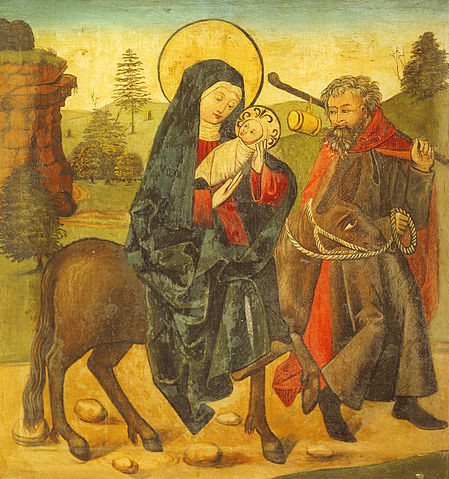
Thank goodness for the Angel, again! Thank God the Angel came to Joseph—again—in a dream, and told him to flee to a different country, with Mary and the Baby. The Holy Family was fleeing for their lives; or, at least, for their Baby’s life.

Today, when young couples here in the United States have a new baby, even a toddler, usually the extended family, good friends, and often the church family members gather around in a fond shower of gifts, sometimes bringing dinner or other good things to eat. Somehow, I doubt whether Joseph, Mary and the Baby Jesus had much of a baby shower before Mary went into labor. Our reading from Matthew 2 tells us a whole lot more serious than just not having a baby shower. Matthew describes an evil, manipulative king who was extremely jealous and anxious. He worried about attacks against his power structure.

From all accounts of Herod and his life and reign, he was a tyrant. Looking at writings from contemporary authors of that period, Herod was cruel and bloodthirsty. He was also two-faced, as we can see from a few verses before our lectionary passage today, from his response to the Magi. He sent the Magi to Bethlehem, and requested that they come back after they find this “King of the Jews,” because Herod wished to “worship” this King as well.

I have a pretty good idea of exactly what Herod wished to do to the baby Jesus from what follows. What is even worse is King Herod has demanded that his soldiers go and slaughter all infant and toddler boys in and around Bethlehem. This reading of the slaughter of the innocents? Why this massive horror and carnage to happen? Why now? Isn’t it still the holidays? Didn’t we just celebrate Christmas? We just sang “O Little Child of Bethlehem” just a few days ago.

Sure, those soldiers were military men. I know those in the military have to do some really unpleasant things. But, ordered to kill babies and toddlers? Well. Just look who was giving that horrible order: the cruel, bloodthirsty King Herod.

We can see why the Holy Family left Judea. They fled. They became refugees.

As I have been thinking about this Scripture reading from Matthew 2 this past week, I wondered about the term “refugee.” I know many people use this term, not only in this country, but also internationally, and some of these people are misusing the term. What is the actual definition of the term “refugee?”

For this definition, I went to the United Nations website, where the UN describes and defines a great many words and terms that concern millions of people, worldwide. According to the migrant and refugee section of the official website, “Refugees are persons who are outside their country of origin for reasons of feared persecution, conflict, generalized violence, or other circumstances that have seriously disturbed public order and, as a result, require international protection.” [1] From everything described in Matthew chapter 2, that definition of refugees describes the Holy Family all too well. Sadly, too well.

As one of my favorite commentators Carolyn Brown said, “It would be nice if everyone had gone happily home and watched Jesus grow up safe and secure with angels watching over him and no problems for anyone.  But it didn’t work that way.  It doesn’t work out that way for any of us.  We all have all sorts of problems to worry about and work on.” [2]

Here in the United States, people are sometimes forced to relocate or are made homeless because of natural disasters or floods or fires – which certainly are on the UN’s list in their definition of the term “refugee.” We know about these refugees, or migrants.

A young man was shot on the Howard St. El platform just a few weeks ago. He had moved from the Englewood neighborhood on Chicago’s south side to Rogers Park, because he did not want to be actively recruited by gangs. And—he was shot in the back, execution-style, by a rival gang member. He tried to migrate. He tried to get away from feared persecution, conflict and violence by moving to the relatively safer area of Rogers Park.

This is not the sweet story of Christmas we heard on Christmas Eve. This wasn’t the gentle story of a young woman giving birth to a Baby, and angels giving a birth announcement to shepherds, including the words “Peace on earth, and good will to all!” Where—we heard about God breaking into the world, coming to be Emmanuel, God-with-us.

The narrative from Matthew 2, though jarring and heart-breaking, helps us know that God is truly with us. Just look at the state of the world, and the sad—even violent situations people encounter all over. Day in and day out, the days are dark more often than not. People like this young man from Englewood get shot, and stabbed. So many feeling separations of race and class and religion and so many other dividing lines.

Yet—nothing surprises God. Yes, the Holy Family did need to run away to escape from Herod the King. “So God understands when we and our families have scary problems.  God is with us and loves us not just when things are Christmas Eve wonderful but also when nothing is going right.  Right now, on the Sunday after Christmas, that is really good to know.  Christmas is over for this year.  But, soon it’s back to school [and work] and all the old problems and people we will struggle with.  It’s a good time to remember that God was with Jesus and His family in the peaceful stable AND on the scary road to Egypt.” [3]
            He is able to not only help us through our times of trouble, but also to be God with us. Jesus is there with us, even though homes are destroyed and children are slaughtered. Jesus is there with us through all the pain and suffering, through all the wailing and lamentation. We have His word on it. Jesus said “I will never leave you nor forsake you.” What a precious promise! What a wonderful Christmas gift! Jesus is our Emmanuel, God with us.

Alleluia, amen.

[1] https://refugeesmigrants.un.org/definitions

[2] http://worshipingwithchildren.blogspot.com/2013/11/year-first-sunday-after-christmas.html

Worshiping with Children, Christmas 1, Including children in the congregation’s worship, using the Revised Common Lectionary, Carolyn C. Brown, 2013.

[3] Ibid.

@chaplaineliza

(Suggestion: visit me at my regular blog for 2019: matterofprayer: A Year of Everyday Prayers. #PursuePEACE – and my other blog,  A Year of Being Kind . Thanks!

Unknown's avatar

Transforming Creation

“Transforming Creation”

isa-35-word-cloud

Isaiah 35:1-6, 10 – December 11, 2016

Expectation. Anticipation. Sitting on the edge of one’s seat in excitement. That sounds like we just hardly can wait another minute for a long-expected, awaited event! Can you think of events which were so exciting for you? A long-awaited trip to a far-away place, a well-deserved promotion at work, or finally celebrating a wonderful wedding or a significant anniversary. Can you remember being so excited about these things that you were sitting on the edge of your seat in preparation and anticipation?

“O come, O come, Emmanuel.” This is a familiar hymn we sing in the month of December, in the weeks leading up to Christmas. It is an Advent hymn, full of hope, preparation, and expectation about the Messiah’s coming. Are you sitting on the edge of your seat, waiting for the arrival of Christmas, of the Baby born in Bethlehem? Or, is this just another ho-hum, not-so-exciting occurrence for you?

We all know the Messiah is long-expected. Time and again in the Hebrew scriptures, we hear the prophets declaring their marvelous news, that the Savior and Redeemer of Israel is coming. The heir to King David’s throne is coming to reign over Israel. But, this week, this passage from the prophet is a little different. We turn to the prophecy from Isaiah 35, starting at verse 1: “The wilderness and the dry land shall be glad, the desert shall rejoice and blossom; like the crocus it shall blossom abundantly, and rejoice with joy and singing.” Here, the prophet is talking about what will happen in the future.

Here, the prophet talks about all creation: the wilderness, the dry land, and the desert. Large parts of the land of Israel was parched, inhospitable to both humans and animals. Here, in these verses, we hear about what is going to happen to the land, to creation itself.

As Dr. Michael Chan, one of my commentators, said, “The general theme is that desolate, dry places will be transformed into paradise. Those who live in desert environs can appreciate the transformative power of water on the desert. Overnight, even a small amount of rain can change a dry desert into a vibrant landscape. But Isaiah’s poem moves far beyond the natural consequences of water on the desert. Creation itself will “be glad,” “rejoice,” and sing (verses 1-2). Creation’s praise joins human praise, in recognition of God’s marvelous work.” [1]

Death Valley, a large desert area in southern California, has wildflower blooms every year. Once every ten (or so) years, Death Valley receives an unusual amount of rain from storms that are way out of the ordinary. This causes what is known as a “super bloom,” as happened in spring of 2016. For a number of days, the valley was covered in an unusually huge amount of wildflowers. [2] Talk about anticipation for the coming of the Messiah! Thinking of the super-bloom in Death Valley gives us a foretaste of what we read here in Isaiah, certainly.

Looking at verses 3 and 4: “Strengthen the weak hands, and make firm the feeble knees.
Say to those who are of a fearful heart, “Be strong, do not fear! Here is your God.” The prophecy not only refers to creation, it also is talking to the people of this world, the people of our God. According to commentator Dr. Chan, “Like so many other texts in Isaiah, Isaiah 35 confronts fear with promise: “Here is your God … He will come with vengeance … He will come and save you.” In switching to the second person, the prophet leaves nothing to chance, making sure that his audience knows that this message is ‘for you.’[3]

But, what was the situation of these people of Israel? A huge group of them were in exile. Israel was occupied territory, and the occupying forces had been the strong, conquering forces. They took a large number of the people as prisoners back with them to Babylon, to force the good behavior of the whole nation of Israel.

So, the prophet encourages his listeners “to be strong and not be afraid no matter how bad things look at the moment because God will come to their rescue.” [4]  Just think of how so many of them felt, being prisoners of war in a foreign country.  As you can imagine, life for them was lousy. The prophet urged the Israelites to be strong because God will always have the last word. It does not matter, not for the people of Israel, not for us, either. God is in the process of overcoming, and the end result will be a wonderful thing.

May I point out that though we are not prisoners of war like the people of Israel, we face lots of really hard situations in our lives. Personally, in my extended family, we are facing a difficult and sad situation right now. Especially hard on my husband and his sisters. Their elderly father is gradually dying; slipping away. Yes, it is particularly tough for me and my whole family right now. And yes, God is a refuge and strength for our family, a very present help in times of our trouble and difficulty.

This is a challenging time of the year for many people. Carolyn Brown so helpfully reminds us that “many congregations have become sensitive to people for whom it is hard to rejoice at this time of year.” [5] Since her ministry focus is on children, she mentions that this group includes children as well as adults. Imagine how difficult, how confusing, even overwhelming the holidays can be for children, sometimes. (And for adults, too.)

“Children face the same problems that daunt the adults, but do so with different twists.  For one thing, they lack the experience of many Christmases that the adults can draw on to keep a sense of balance.  For another, they feel that as a child they should be totally into the season.  It feels even more unfair to them than to the adults that they are not going to have special gifts or fun family gatherings or decorations.” [6]

I am going to our sister church, Epiphany United Church of Christ, to assist for their Blue Christmas service this coming Wednesday. And, Pastor Kevin will assist me here at St. Luke’s Church for our Blue Christmas service a week from tomorrow, on Monday, Dec. 19th. Often- times, people get overwhelmed by the holidays. Perhaps they have lost a loved one during the past year, and this is the first Christmas with that empty chair. Perhaps there has been some other significant change or major move in their lives. No matter what the event or grief or situation, sometimes people need a refuge, they need a quiet gathering for support in this very busy time.

May I say that Isaiah’s promise is for us—all of us. No matter how hard things seem at the moment, we know that God will eventually win and God’s peace will come to the whole world. God will send joy to us all, despite the difficulties we all go through, on a daily basis. Knowing that, we can be strong and patient.

We can praise God for the witness of the prophet: “Then the eyes of the blind shall be opened, and the ears of the deaf unstopped; then the lame shall leap like a deer, and the tongue of the speechless sing for joy. For waters shall break forth in the wilderness, and streams in the desert;” Do you hear? Creation will be transformed, both the world and the people therein.

We can look forward to that, when Christ comes again in His glory. Soon and very soon, we will see Him face to face. We can sit on the edge of our seats as we await this wonderful, marvelous event. Praise God! The Messiah, the King is coming. We all can sing, “O come, O come, Emmanuel,” and really mean it, truly wait with anticipation and excitement.

Alleluia, amen.

[1] Michael J. Chan, http://www.workingpreacher.org/preaching.aspx?commentary_id=3118 

[2] http://news.nationalgeographic.com/2016/03/160302-death-valley-super-bloom-wildflowers-weather/

[3] hael J. Chan, http://www.workingpreacher.org/preaching.aspx?commentary_id=3118 

[4] http://worshipingwithchildren.blogspot.com/2013/08/year-third-sunday-of-advent-december-15.html

[5] http://worshipingwithchildren.blogspot.com/2013/08/year-third-sunday-of-advent-december-15.html

[6] http://worshipingwithchildren.blogspot.com/2013/08/year-third-sunday-o

f-advent-december-15.html 

@chaplaineliza

(Suggestion: visit me at my regular blog for 2016: matterofprayer: A Year of Everyday Prayers. #PursuePEACE – and my other blog,  A Year of Being Kind . Thanks!)