Unknown's avatar

He Is Not Here!

Matthew 28:1-10 (28:6) – April 16, 2017
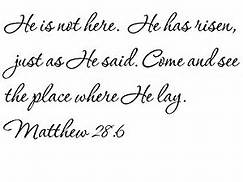
Matt 28-6 He is not here, cursive

“He Is Not Here!”

Birds. butterflies, and flowers all have something in common: they are all surprises! You might not expect a brightly colored cardinal or peacock to hatch from a plain old egg, but, it does! You might not expect a lovely Monarch butterfly to come out of a drab cocoon, but, it does! You might not expect a colorful tulip or sweet-smelling hyacinth to grow from the lumpy bulb you planted last fall, but, it does!

Birds, butterflies and flowers are very common things. We have become used to their small surprises, every time they emerge from the dull former things to the bright, new life. What kind of surprise do we have, at Easter time? What great big thing has changed?

Let’s go back three days, from Easter Sunday to Good Friday. The priests and religious leaders finally thought they beat Jesus. That upstart Rabbi, false Messiah, calling Himself the Son of God—the religious leaders finally got that Galilean troublemaker arrested. About time, some might say! That Jesus was just a rabble-rouser, speaking against the Romans, stirring up trouble, and protesting against the established order of things. Serves Him right. (Or, so some people said.)

We know the Passion narrative, how our Lord Jesus was arrested by Roman soldiers, tried, beaten, jeered at, spat upon, and finally brought before Pilate for the sentence of execution to be delivered by the ruling governor.

We know the Way of the Cross, how our Lord Jesus walked the Via Dolorosa, the way of sorrows, carrying that cruel cross on His back through Jerusalem. And, the many women and others in the crowd, watching Jesus walk that road out of the city.

We know the Crucifixion, how our Lord Jesus was nailed to that cross, hoisted up, and hung there for hours that Good Friday morning and afternoon. Until, at last, He died on that cross amidst the thunder and earthquake.

What some do not know is that our Lord Jesus was taken down from that cross later Friday afternoon and laid in a new tomb. Quickly, quickly, before night fell on that Friday evening, and the Jewish Sabbath began. A time of God-ordained rest when no work could be done, not even to bury a dearly loved one.

Friday night passed. All day Saturday—the Jewish Sabbath—passed. Saturday night, and nothing could be done. No work, certainly. It was dark, after all!

On Sunday morning, the first day of the week, the two Marys came to the new tomb. I’d imagine they came early, early in the morning, creeping—coming on tiptoe toward the tomb. I’d also imagine that they might have been frightened to come into a graveyard.

We don’t know much about the other Mary (other than her name, which was a very common name for that time), but we do know several things about Mary Magdalene. When Jesus met her, a year or two before, she had a number of demons residing in her. Jesus, the Messiah, the Son of God, cast the demons out of her! The old, horrible existence she had been living was—gone. Everything had become new. The demons were gone, Mary was healed and free to live the abundant life. The very life she lived was proof of God’s abundant power in her life. [1]

I don’t know about you, but if Jesus had done something that awesomely powerful in my life, I may have followed Him, too, no matter what!

Both Marys were going to the tomb to perform a solemn, loving ritual for their Rabbi, teacher and leader, a ritual of anointing with precious oils and expensive spices. They had not had time to do this loving anointing when they so hurriedly placed Him in the tomb late Friday afternoon.

I suspect the women were also concerned about how to roll away the stone. Possibly, they meant to ask the Roman soldiers. The last thing the two Marys were expecting was an Easter surprise!

As Matthew tells us in his Gospel, an Angel of the Lord had rolled away the stone, and sat upon it. “[The Angel’s] appearance was like lightning, and his clothes were white as snow. The guards were so afraid of him that they shook and became like dead men.”

What about the two Marys? The Angel said to them, first thing, “Do not be afraid!”

Do you notice that? Almost every single time that angels appear in the Bible, they first have to caution people: “Do not be afraid!” Angels must really be fearsome creatures, since they always are saying, “Do not be afraid!”

Let’s go a few verses further. The risen Jesus greets the two women with the same words: “Do not be afraid!” Here, I am certain the women were scared half to death when they encountered Jesus!

Talk about an Easter surprise! No one expected their Rabbi Jesus to be alive again.

What on earth does this mean for us, today? “For children, this simply means ‘don’t be afraid of anything.  I am stronger than the worst evil there is.  And, no matter what happens I will be with you always.’” And for us big people, it can mean exactly the same thing. Jesus tells all of us, “Don’t be afraid!” This is a message we can tell each other again and again. This is a message that we can unpack repeatedly.  “On Easter for children it begins with knowing that no one could kill Jesus forever” and, it’s a celebration of God’s cosmic, unbeatable power. [2] On Easter for us big people it means that Jesus has conquered death once and for all, and lives forever.

We go back to birds, butterflies and flowers, these very common things. God has created them to hatch, to burst forth, to bloom. We have become used to their small surprises, every time they emerge from the dull former things to their bright, new lives.

“Tradition has it that Christ was raised from death to life in the springtime, when the ground and the trees are waking up from the dead of winter and showing the unmistakable signs of rebirth that come every year. But the new life that is in Christ is not really like the new life in nature in spring.” [3] New life in Christ is not only a physical matter, but a spiritual matter.

On Easter, we have a great big surprise, a huge surprise: a dead body coming out a tomb, alive again. Jesus has overcome death. God has done the biggest miracle in the world—in the universe. Our Lord Jesus is alive again. This is the greatest Good News of all!

Alleluia! He is risen! Alleluia!

[1] https://www.umcdiscipleship.org/worship/lectionary-calendar/easter-sunday-festival-of-gods-creation

Worship Planning Helps (Easter): Worship & Preaching Notes, Hymn Suggestions and Worship Resources from the United Methodist Church General Board of Discipleship.

[2] http://worshipingwithchildren.blogspot.com/2014/03/year-easter-sunday-april-21-2014.html

Worshiping with Children, Easter Sunday, Including children in the congregation’s worship, using the Revised Common Lectionary, Carolyn C. Brown, 2014.

[3] https://www.umcdiscipleship.org/worship/lectionary-calendar/easter-sunday-festival-of-gods-creation

Worship Planning Helps (Easter): Worship & Preaching Notes, Hymn Suggestions and Worship Resources from the United Methodist Church General Board of Discipleship.

@chaplaineliza

(Suggestion: visit me at my regular blog for 2017: matterofprayer: A Year of Everyday Prayers. #PursuePEACE – and my other blog,  A Year of Being Kind . Thanks!)

Unknown's avatar

But Now I See

John 9:1-41 (9:25) – March 26, 2017

John 9 word cloud

“But Now I See”

In the first century, when Jesus walked the earth, people commonly believed a number of things that have since been proven mistaken, including something mentioned here in our Gospel passage today. When babies were born with a handicap or impediment—like born with a club foot, born with a cleft palate, or born blind—many, many people thought this was a punishment from God.

The parents were at fault. Sin was the reason the child was born that way!

In the encounter we have today in our Gospel lesson from John, Jesus deals with that kind of thinking. Let’s set the scene. “9 As Jesus was walking along, he saw a man who had been born blind. His disciples asked him, “Teacher, whose sin caused him to be born blind? Was it his own or his parents’ sin?”

In certain parts of the world today, people still think like that. Sad state of events, but that is the way it is. Some people mistakenly assign the “blame” for a “disability” or “illness.” Let’s see how Jesus responds.

Jesus answered, “His blindness has nothing to do with his sins or his parents’ sins. He is blind so that God’s power might be seen at work in him. As long as it is day, we must do the work of him who sent me; night is coming when no one can work. While I am in the world, I am the light for the world.”

Jesus rejects this blaming kind of talk! He “suggests that this man’s blindness offers the opportunity for God’s power to be revealed…. There is, in this case, physical blindness, but it’s not the only kind of blindness.  There are those who can see just fine, but live in spiritual darkness.” [1] More on that, later.

Plus, Jesus goes from talking about blindness, to God’s power, to Jesus being the light for the world. Can you follow Him in the progression of His thought? Actual, physical blindness, leading to God’s power made manifest by our Lord Jesus, who is God’s Light for the world, enlightening everyone. Back to the story.

After he said this, Jesus spat on the ground and made some mud with the spittle; he rubbed the mud on the man’s eyes and told him, “Go and wash your face in the Pool of Siloam.” (This name means “Sent.”) So the man went, washed his face, and came back seeing.

A man, born blind, made to see? This is a miracle, by anyone’s estimation! But, this is not quite a happily-ever-after story. By no means the end of our story.

13 Then they took to the Pharisees the man who had been blind. 14 The day that Jesus made the mud and cured him of his blindness was a Sabbath. 15 The Pharisees, then, asked the man again how he had received his sight. He told them, “He put some mud on my eyes; I washed my face, and now I can see.” Here is a clear statement of facts, as reported by the man who formerly was born blind.

We can tell the Pharisees believed the commonly held theological position of the day: illness and disability were God’s punishment for sin. What is more, people disagreed about whose sin was responsible for this former baby’s (now grown man’s) blindness. Most thought it was the parents. However, some thought that the newborn baby had somehow sinned! (Hard to believe, but true.)

On top of that, the Pharisees had some unkind words for this upstart Rabbi Jesus. Imagine, healing on a Sabbath! Who does He think He is?

16 Some of the Pharisees said, “The man who did this cannot be from God, for he does not obey the Sabbath law.” Others, however, said, “How could a man who is a sinner perform such miracles as these?” And there was a division among them. 17 So the Pharisees asked the man once more, “You say he cured you of your blindness—well, what do you say about him?” “He is a prophet,” the man answered. 18 The Jewish authorities, however, were not willing to believe that he had been blind and could now see, until they called his parents 19 and asked them, “Is this your son? You say that he was born blind; how is it, then, that he can now see?”

The Pharisees could not see past the noses on their faces. All they could see was healing, or work being done on the Sabbath, which was forbidden in their strict interpretation of the Law of Moses. That was huge, in their eyes. Hugely wrong!

Looking for additional people to cast blame on, the Pharisees just did not believe this guy who was formerly blind—so they called his parents!

20 His parents answered, “We know that he is our son, and we know that he was born blind. 21 But we do not know how it is that he is now able to see, nor do we know who cured him of his blindness. Ask him; he is old enough, and he can answer for himself!” 22 His parents said this because they were afraid of the Jewish authorities, who had already agreed that anyone who said he believed that Jesus was the Messiah would be expelled from the synagogue. 23 That is why his parents said, “He is old enough; ask him!”

24 A second time they called back the man who had been born blind, and said to him, “Promise before God that you will tell the truth! We know that this man who cured you is a sinner.” 25 “I do not know if he is a sinner or not,” the man replied. “One thing I do know: I was blind, and now I see.”

One of the most familiar and beloved traditional hymns is “Amazing Grace.” This hymn talks about several important things, including salvation. The hymn also talks about blindness, and the change that comes into a person’s life when they receive sight—spiritual sight. “Was blind, but now I see.” What a theological truth. What a profound insight. Jesus wasn’t blinded at all to seeing this man born blind.

It is the Pharisees who have been blind—spiritually blind—and they don’t even know it. “The religious leaders remain spiritually blind, still contending that the work of Jesus is demonic.  In their resistance to [Jesus,] their blindness – their sin – is revealed.” [2]

Is this just some nice bible story, or could it apply to us, today? Similar to the Pharisees, are we so preoccupied with our own holiness and righteousness that we are blinded? I mean, spiritually blinded to seeing signs of God’s work right here in our midst? [3]

“How does Jesus open our eyes to the things of God?  How does he reveal our blind spots so that we can let go of them and give glory to God? The good news is that there is amazing grace available to us.” [4] We can testify, along with this formerly blind man, “One thing I do know: I was blind, and now I see.”

This is something to celebrate! Jesus can open our eyes to those around us. We can be healed of our spiritual blindness and come into the light of God’s presence, and be able to testify to others of God’s light-giving and grace-giving. Praise God! Amen.

[1] http://www.bobcornwall.com/2014/03/who-is-really-blind-lectionary.html

[2] http://www.bobcornwall.com/2014/03/who-is-really-blind-lectionary.html

[3] https://www.umcdiscipleship.org/worship/lectionary-calendar/fourth-sunday-in-lent-one-great-hour-of-sharing#preaching

[4] http://www.bobcornwall.com/2014/03/who-is-really-blind-lectionary.html

@chaplaineliza

(Suggestion: visit me at my regular blog for 2017: matterofprayer: A Year of Everyday Prayers. #PursuePEACE – and my other blog,  A Year of Being Kind . Thanks!)

Unknown's avatar

His Name: Emmanuel

“His Name: Emmanuel”

emmanuel-plainsong

Isaiah 7:10-14  – December 18, 2016

So many people love babies. Look at just about any gathering of people. Church congregation, senior center, exercise group, book club. When anyone mentions that someone has just had a baby, what happens? Lots of comments like, “What did she have? Boy or girl?” How big is the baby?” And, especially, “Oh, I hope mom and baby are happy and healthy!”

Common, everyday occurrences, like young women getting pregnant and babies being born. That is exactly what the prophet spoke of in our passage today. The prophet gave a lot of background, but he finished this passage by talking about the clear promise from God. Let’s go back to the beginning of the passage from the prophet: “Again the Lord spoke to King Ahaz, saying, Ask a sign of the Lord your God; let it be deep as Sheol or high as heaven.” It sounds like the Lord God wants to give King Ahaz a really big message. But, wait. Why is this stuff happening?

A little backstory. The kings of Syria and Israel (Northern Kingdom) join together to go to war with the Assyrians. They ask King Ahaz of Judah (Southern Kingdom) to join with them, but Ahaz refuses. Both countries send armies to march on Jerusalem to dethrone Ahaz and put a puppet king on the throne.

We have big political intrigue going on in Jerusalem at this time! Remember, it’s about seven centuries before the birth of Jesus in Bethlehem. The Lord sends Isaiah to Ahaz a second time, this time offering to give Ahaz a sign so that he will believe God. From Isaiah 7: “12 But Ahaz said, I will not ask, and I will not put the Lord to the test,” and once again Ahaz refuses.

One of the commentators I consulted said, “King Ahaz received an oracle from Yahweh, directing him to ask for a sign as deep as Sheol or as high as heaven. This may refer to a sign announced by an earthquake or in lightning. With seeming piety, Ahaz refuses to ask for a sign lest it put Yahweh to a test. Isaiah, however, treats his answer as a refusal to trust God and announces that God will give him a sign anyway.” [1]

What is this sign? A common, everyday sign. There may have likely been just a young woman who was at Ahaz’s court, to whom Isaiah could literally point a finger and say, “Look, she’s pregnant. She’s going to have a son. That birth is the sign that God is with us.” We can see this as a sign that God is in the common, everyday things, the simple, ordinary passages of life.

Do the simple, small things that come into our lives change our course? These verses give us an interesting image. God would save the people of Israel through the sign of something so common and ordinary as a pregnant woman. Isaiah began by offering the opportunity for a great big, splashy sign, but instead gave the king a common image of everyday, ordinary happenings.

The sign was certainly not for the mighty and powerful. Rejected by those in power, God would work wonders among the humble and lowly. In other words, the simple common folk. The original reference for Isaiah was to a child born in his time, and in the near future. For the prophet, the message is that in a few years, both the kingdoms threatening Judah will be no longer a problem. This indeed is historically what happened.

Some centuries pass. The Book of Isaiah was originally written in Hebrew, which was the common language of Israel during the 700’s BCE. By the time we arrive at 300 BCE, there has been a huge turnover in the world. Now, the Greeks under Alexander the Great have conquered most of the known world, and they have spread the Greek language far and wide. Plus, the Jewish people had been scattered all over the Middle East and into Asia Minor.

Many of the scattered Jewish people could hardly read and understand their own Scriptures any more! So, a large group of Jewish scholars translated the whole of the Hebrew Scriptures into Greek. It is that translation that Matthew uses when he says, “22 All this took place to fulfill what had been spoken by the Lord through the prophet: 23 “Look, the virgin shall conceive and bear a son, and they shall name him Emmanuel,” which means, “God is with us.”

Believers from the time of Matthew’s gospel have pointed to these verses as Messianic prophecies. Yes, there is a technical difference between “young woman” and “virgin.” This tension is evident if we closely examine the difference between the Hebrew words and the Greek translation. Yet—what is the same? It is a message of God’s caring and love that sees pregnancy and birth—simple, everyday happenings—as signs of God’s care and concern for God’s people.

Emmanuel. God with us. Was that true in Isaiah’s day, with the Assyrian armies breathing down the necks of the people of Israel? Of course! Isaiah gave the king a special oracle to let him know so. Emmanuel. God with us. Was that true in the time of Jesus’s birth, with the occupying Roman armies breathing down the necks of the people of Israel? Of course it was!

God has always had concern and love for God’s people, no matter where and no matter when. No matter if the persecuted Christians were running from the Romans, or being chased and persecuted by any one of the occupying forces in the centuries in between.

Jesus came from humble origins. Yet, He changed the world. Likewise, the birth of this child, was a sign that even in the midst of the chaos and destruction surrounding Jerusalem in the uncertain time of Isaiah and the uncertain time of the baby Jesus, God was still with them. Life still did go on. In a very real sense, that was (and is!) a miracle.

What is the simple message we receive from these words of the prophet? God will be with us, no matter what. That is the message to King Ahaz and the people of Israel, that is the message to occupied Israel in the newborn Jesus’s day. And, it’s the message we can take home with us this day.

“Look, she’s pregnant. She’s going to have a son. That birth is the sign that God is with us.” We can see this as a joyful sign that God is in the common, everyday things, like the simple, ordinary passages of life. Like a baby being born, displayed to all of us as a wonderful sign from the Lord God. Praise God! God is concerned about the smallest and every day and ordinary, like babies and new moms and children, like you and like me.

Alleluia, amen!

[1] http://fontes.lstc.edu/~rklein/Documents/adventa.htm#Advent4, Studies on Old Testament texts from Series A, Ralph W. Klein, Lutheran School of Theology at Chicago.

@chaplaineliza

(Suggestion: visit me at my regular blog for 2016: matterofprayer: A Year of Everyday Prayers. #PursuePEACE – and my other blog,  A Year of Being Kind . Thanks!)
Unknown's avatar

God’s Abundance

“God’s Abundance”

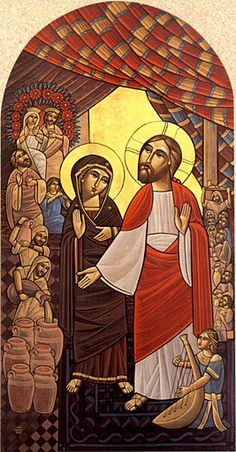
John 2-8 Miracle Wedding at Cana Coptic icon

John 2:8 – January 17, 2016

Weddings are so often a joyful time! Busy, yes. Stressful, yes. But joy-filled, too!

Have you ever known a wedding where something unexpected happened? I mean, a mistake happened, or something just went plain wrong? These are just a few things that actually happened to a real-life pastor, the Rev. Dr. Alyce McKenzie.

  • The groom and best man got to the church on time, but they forgot to bring the suit for the 6-year-old ring bearer.
  • The matron of honor had surgery a little too recently to be standing for a long time and collapsed during the vows.
  • The pastor got the time wrong and showed up an hour late for the wedding.
  • People on the guest list didn’t bother to rsvp for the reception, but showed up anyway, assuming there would be enough food and drink for them. And there wasn’t. [1]

This last one happened at the commentator’s daughter’s wedding a few years ago. Can you imagine what kinds of consternation this might cause at a wedding? Surprise? Frustration? Embarrassment?

Imagine that wedding in the town of Cana, at the very beginning of the ministry of Jesus. It doesn’t so much matter when the wedding was celebrated, then or now. An awful problem, no matter where or when. Except, even more so in the Middle East, where hospitality is such an important, foundational part of life.

Today, we know how important it is to offer guests something to eat or drink when they come to our homes for a visit. Think of that, and then multiply it. Times ten, and even more. I suspect not only many of the local townspeople were there, but also friends and relatives from near-by towns. We read in the Gospel record that the Rabbi Jesus was also there, with His disciples. And, His mother was invited, too. Large crowd of people!

Reminding everyone, in the first century, Jewish custom held that most any wedding would be an event of celebration for several days. Our Scripture passage today shows a wealthy Jewish family—with a number of servants and a household steward.

Imagine the huge amount of time and the money that went into a celebration of that size. Plus, the logistics! We read that the family provided extravagant feasting for days. In the case of today’s Scripture, if there were any miscalculation or lack in provisions in food or drink, not only the bride and groom but also their families would most likely suffer great humiliation. And what if—God forbid—something should go very wrong? What then? The surprise, the frustration, the embarrassment that potentially could happen at that wedding celebration in Cana.

John begins his narrative in the middle of things. He opens the scene on the third day of the wedding feast. The party is in full swing! And it is a party. Huge celebration.

The miracles in John’s gospel are called signs; they show everyone Jesus the Son of God, and His Godly power, might and glory. As commentator Nancy Rockwell said, John’s signs deal with ordinary human things, set in the course of human events. Like, a wedding feast. [2] And the Son of God, the Divine Word made flesh, is human, too! He enjoys Himself at a big party, with His friends and family.

We aren’t sure, since the Gospel writer does not say. Perhaps Jesus’s mother Mary is related to the family, or is good friends with one or more family members. Regardless, she is concerned about the situation. “Weddings epitomize the fact that even the best planned and most auspicious of human scenarios are imperfect, flawed, and lacking. Something always goes wrong. Something is always askew. It is the role of the mother of Jesus to express that reality and to look expectantly (I imagine) in the direction of her Son.” [3]

His mother Mary comes to her Son—I suspect quietly. “When the wine was gone, Jesus’ mother said to him, ‘They have no more wine.’” What’s to be done? This is a huge problem, and a terrible embarrassment to both families! Talk about public humiliation! Mary knows very well what is going on. So, she goes to Jesus for assistance.

When we have problems, or embarrassment, or difficulty today, how do we handle it? Do we keep it to ourselves? How about sweeping awkward problems under the rug? Or do we do what Mary did? Do we go to Jesus?

Our commentator Nancy Rockwell says, “Consistent with the other signs in John’s gospel, and in keeping with John’s exact words, would be this: Mary cannot stand by and watch an injustice, will not watch the groom and his bride be disgraced;  she does not want their marriage celebration to have a lasting shame as its memory. And in response to her compassion for them Jesus does what Mary, in her famous song in Luke’s gospel proclaimed:  he fills the hungry with a good thing.  He replenishes the wine.” [4]

Yes, I could tell you about the expression Jesus uses to address His mother—“Woman,” which can be a term of respect. I could talk about the way Mary sidles up to the servants and tells them “Do whatever he tells you.” But, instead, I want to focus on the large stone jars that Jesus used. These were six large containers of water with anywhere from twenty to thirty gallons apiece. There was a large crowd gathered at the party—or, banquet. Jewish ceremonial tradition demanded that there be a large amount of water nearby for observant Jews to wash ceremonially before they ate.

Jesus knew all about this custom, and He told the servants to fill the jars. Let’s say there were twenty gallons in each one. That was one hundred twenty gallons of water, just waiting!

As Nancy Rockwell said so well, Jesus responded to His mother’s compassion for her friends. Jesus replenished the wine! Notice He did not shake His finger at the crowd for enjoying some wine. Neither did Jesus sneak out the back door, not wanting to have anything to do with such a “shameful happening.” Imagine, not having enough wine for a big, multi-day celebration like this!

Instead, Jesus replenished the wine. Over one hundred gallons of it! He allowed the party, the feasting, the celebration to continue. He stepped into potential humiliation and family embarrassment at a significant event in the town of Cana. Jesus transformed it into something abundant.

Jesus worked a miracle! Another way of looking at it is that God abundantly provided for this situation at the wedding party. God reached out and touched this event, transforming it into something miraculous. Jesus transformed the potential injustice and embarrassment of these families into something wonderful.

I remember another situation, another place, another time, where injustice, frustration and embarrassment were gradually transformed into something amazing. Dr. Martin Luther King Jr. and his words, and his actions? Transformed our country through the miracles of what was accomplished through the civil rights marches, through Dr. King’s earthshaking speeches and sermons. What a transformation, taking something hurtful and potentially embarrassing, and transcending the flawed and faulty world.

Thank God! God’s Son saw fit to provide for this family situation at the wedding. Jesus can provide for us when we get into embarrassing situations, or difficult situations. Let’s thank Jesus for His love and care for each one of us. For reaching out and giving abundantly from God’s overflowing resources.

Amen, alleluia!


[1] http://www.patheos.com/Progressive-Christian/Wedding-Mishaps-Alyce-McKenzie-01-14-2013

[2] http://www.patheos.com/blogs/biteintheapple/cana-an-unexpected-time/ Nancy Rockwell

[3] http://www.patheos.com/Progressive-Christian/Wedding-Mishaps-Alyce-McKenzie-01-14-2013

[4] http://www.patheos.com/blogs/biteintheapple/cana-an-unexpected-time/ Nancy Rockwell

@chaplaineliza

Suggestion: visit me at my sometimes-blog: matterofprayer: A Year of Everyday Prayers. and my other blog,  A Year of Being Kind .  Thanks!

Unknown's avatar

We Cannot Keep from Speaking!

“We Cannot Keep from Speaking!”

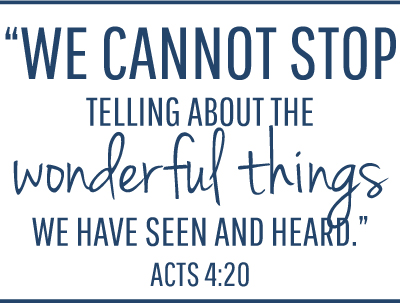
Peter - cannot stop Acts-4-20_2

Acts 4:1-20 – June 21, 2015

Ever had this situation happen to you? Just when you thought you had taken care of some pesky problem, here it comes, all over again! Sort of like the carnival game Whack-a-Mole. Just when you whack at all the moles, and think that they are all gone—that your problems are all solved—here they come again! Popping up all over the place.

I suspect the ruling council in Jerusalem felt this way just about now. Here they had rid themselves of that troublesome Rabbi Yeshua, or Jesus, some weeks ago. They had even gone to their Roman governor, Pontius Pilate, to get his permission to put this upstart Rabbi to death. They got some people to accuse Jesus of insurrection and treason, so He would be killed by crucifixion. That was it! Done! One great, big, pesky problem taken care of!

True, there were some rumors about Jesus coming back to life a few days later, but that was just a rumor. Resurrection? Hah! Sounds pretty far-fetched to me. It was far-fetched to the ruling council, to the Sanhedrin, too.

They didn’t figure on Peter, John, and the rest of the disciples. They didn’t figure on the blowing of the Holy Spirit at Pentecost, or the energy of the new believers in the Risen Jesus.

Our summer sermon series, Postcards from the Early Church, reminds me a bit of a radio serial. You might remember those! “When last we left our intrepid heroes . . . “ Last week, we saw Peter and John about to enter the Temple in Jerusalem for daily afternoon prayers. A long-time beggar, lame from birth, asked Peter and John for alms—for money. Peter made that extraordinary statement to the lame beggar: “Silver and gold I have none, but what I have I give to you. In the name of Jesus of Nazareth, stand up and walk!”

As I mentioned in my sermon last week, Peter suits the words to his action. He leans forward, grasps the lame man’s right hand, and raises him to his feet.

What happens next? “Immediately his feet and ankles were made strong.” Whatever congenital defect there was in his feet and ankles was immediately, miraculously healed. The ex-lame-beggar could walk. And not only totter around, but leap in the air! He praised God right there inside the Temple, giving immediate public testimony to God’s mighty power!

This was a big problem for the Jewish leaders in Jerusalem, believe me! Just when they thought that pesky Rabbi Jesus was all gone, permanently taken care of, they have even more miracle-workers on their hands. The disciples, the friends who had been with Jesus.

The Sanhedrin—the Jewish leaders—quickly grabbed Peter and John, and threw them into prison. Right after this marvelous miracle! I am sure the bystanders were asking, “What gives? These men did a miracle! Why are you arresting them?”

But—are we surprised? Looking at the Hebrew Scriptures, many of the miracle-working prophets were misunderstood, mistreated, imprisoned. Exiled, and even put to death, sometimes.

The Jewish leaders needed to get on this miracle stuff right away. Try to hush it up. See whether they could sweep the whole business under the rug. But—there was a problem. This was a very public miracle, done in downtown Jerusalem, at the height of rush hour. Or, the equivalent. Afternoon prayer time at the Temple in the city center.

We see from this reading today that the leaders had Peter and John thrown into prison overnight. For working a miracle! For doing what God had called them to do!

This makes me think of the Civil Rights movement and marches of the 1950’s and 1960’s. A friend of mine, Ken, (a recently retired seminary professor) marched alongside of African-American activists. A good friend of this church, Pastor Gordon, attended several marches in the South during the 1960’s. It was a tense, even dangerous time. Both my friends were jailed in the aftermath of the marches. Both are proud to say that they were imprisoned for standing up for a Godly cause.

Back in Jerusalem, the day after the miracle occurred, Peter and John were hauled out of prison and brought in front of the Sanhedrin. The ex-lame-beggar was there, too! The Jewish leaders could not deny that this man—who everyone knew as lame from birth—now had full use of his fully-restored feet and ankles. The news of the miracle was traveling around Jerusalem like wildfire! The leaders knew they had to let Peter and John go free.

But Peter wasn’t done yet! Just like the carnival game Whack-a-Mole, where the Sanhedrin desperately wanted to make all those pesky miracle-working moles go away, Peter kept on popping up. And, he spoke to the learned Jewish leaders and teachers, too.

Peter quoted from Psalm 118 in his defense of the miracle he and John had done. He said to the Sanhedrin, “by the name of Jesus Christ the Nazarene, whom you crucified, whom God raised from the dead—by this name this man stands here before you in good health. 11 He is the stone which was rejected by you, the builders, but which became the chief corner stone. 12 And there is salvation in no one else; for there is no other name under heaven that has been given among men by which we must be saved.”

Talk about in your face! Peter had a lot of guts, speaking to the ruling leaders of his country like that!

As commentator Scott Hoezee brings out, “the Spirit led them to a lowly little textual nugget embedded deep inside one of the lesser known of all the psalms and prompted Peter to use that little verse as the perfect summary of what God’s ways are all about.” This idea is something that Peter repeats again and again. The stone which the builders rejected has become the cornerstone of the building. The most important part of the whole structure. “That’s my Rabbi, Jesus of Nazareth. Oh, and by the way? You Jewish leaders crucified Him!” (That’s guts.)

By Peter quoting this psalm, he reminded these leaders of an unpleasant confrontation between Jesus and the Jewish leaders, shortly before His death. I appreciate another commentator’s words: “It was to say, in effect, “Jesus told you so.” How this citation must have stung in the ears of the Sanhedrin. The One they thought they had rid themselves of was still speaking to them, through the apostles.” The Jewish leaders didn’t have just one pesky problem any longer. The problem had multiplied.

Oh, my goodness. The Sanhedrin tries to tell Peter and John and the rest to shut up. To keep quiet about this Jesus person!

But it does just as much good as attempting to hold back the wild waves of the ocean. In other words, it doesn’t work at all. There is far too much power, far too much momentum behind that crashing ocean wave of testimony.

Despite the stern orders to “pipe down! Sit down and shut up!” Peter and John refuse. Their response? “Whether it is right in the sight of God to give heed to you rather than to God, you be the judge; 20 for we cannot stop speaking about what we have seen and heard.”

What about us? Are we eager to tell people about what we have seen or heard? What about the mighty deeds we have experienced? Or, perhaps you haven’t had God do anything extraordinary in your life lately. Can you tell people about how God has been faithful? God has continued to walk with you, each and every day. I encourage you to tell someone! Amen!

Praise God, each of us can talk about something God has done—for each of us. God has given each of us a new day, each and every day. Praise God! That is truly something to praise and thank God about. Can we all say Amen? Amen! And again! Amen!

@chaplaineliza

(Suggestion: visit me at my daily blog for 2015: matterofprayer: A Year of Everyday Prayers. and my other blog,  A Year of Being Kind .  Thanks!)
Unknown's avatar

What I Have I Give You

“What I Have I Give You”

Peter healing lame man - Acts 3-6

Acts 3:1-10 – June 14, 2015

Expectations! When people expect some situation to turn out a particular way, anything else is a big upset, or even a huge disappointment. Perhaps the expectation is negative; sometimes, a different outcome is not expected. Expectations about work, or about family. Did we expect the Blackhawks to win another game in the Stanley Cup series last night?

Let’s not go off on a tangent—though discussing hockey is tempting. Back to the book of Acts. We continue this summer sermon series with a miracle recorded for us in Chapter 3 of the book of Acts. Dr. Luke—a medical man—gives us lots of detail and description. This healing miracle comes right out of the Acts photo album. Showing memorable photos, distinctive times to remember. Or, if not the most wonderful times, at least the most significant times.

Not long after Pentecost and its immediate aftermath, right after the great big revival meeting in the city of Jerusalem, Dr. Luke focuses on Peter and John going to daily prayers at the Temple. He even mentions the time: it’s 3:00 in the afternoon.

But Dr. Luke’s attention doesn’t stay on Peter and John. Instead, he wants us to change our focus and take a closer look at the lame man they encountered. Again, Dr. Luke gets specific and gives us some detailed information about this man. Verse 2 tells us “A man lame from birth was being carried in. People would lay him daily at the gate of the temple called the Beautiful Gate so that he could ask for alms from those entering the temple.” Important information. We get a snapshot of what this lame man’s life must have been like. Even though the term is not politically correct now, he was crippled. And, he begged. Day after day, every single day.

I have a question for all of us, today. How many here have had physical therapy? Or, if not you specifically, has anyone in your family had physical or occupational therapy? The therapists today are just wonderful. They know how to instruct patients in specific exercises to improve movement, and increase range of motion. And, after patients have completed their physical therapy, they almost always experience fantastic rehabilitation!

How different would this man’s life have been, if he had been born in America, in the 20th century! With all of the medical advances in the past few decades, I suspect he would have had a much more mobile, worthwhile life than just being a beggar.

I’d like us to think hard about this man with a congenital defect in his feet and ankles. Either lying on a mat, or perhaps sitting by one of the gates of the Temple in Jerusalem. He is called “a beggar” by Dr. Luke. What do you think were his expectations in life? Pretty low, I suspect. Perhaps all he hoped for was a good take, a sizable number of donations. Maybe a decent meal when he got home to his mother or sister. But not a lot else. He couldn’t even stand up, not even for a second.

Imagine his perspective. Ignored by almost everyone. Always close to the ground physically, not to mention his sense of low self-esteem. Not able to look people in the eye, or carry on a relatively normal conversation. I feel extremely sad about his situation, just thinking about it for this short time! And, we are told this lame man was not quite in position yet, next to the gate. His friends were still in the process of positioning him for his daily task of begging.

In most places in the world today, I am sorry to say, this is a common sight. My friend Cody, another mission connector like my other friend Dan, served overseas in Asia for some years. He speaks of beggars on the streets as a common, sad, depressing matter of course.

On a sermon preparation website, I recently found this heartbreaking description of present-day beggars: “On my two trips to India, I saw a large number of beggars. There were so many beggars there was no way one could respond to all of them. The solution was often not to “see” any of them. But the beggars made this difficult. Those who were mobile would press themselves on you. They would approach your taxi at an intersection, tugging at your sleeve and pleading for help. Those not mobile would call out for charity. The beggars would be aggressive, something like the salesmen as you try to walk through the appliance section at Sears. You would concentrate on not seeing them as they converged on you, and you hurried to get through the section before you were trapped.”

Feeling uncomfortable yet? Feeling like hurrying, rushing by, not even noticing the beggars pulling at your sleeves?

Let’s go back to our beggar, to the man mentioned in Acts 3, starting at verse 4: “When the man saw Peter and John about to go into the temple, he asked them for alms. Peter looked intently at him, as did John, and said, “Look at us.” And he fixed his attention on them, expecting to receive something from them.”

What was this man’s expectation? Was it optimistic and positive? Or, pessimistic and downhearted? What did he expect from Peter and John? Alms? Money? A blessing?

How does Peter respond? “Peter said, “I have no silver or gold, but what I have I give you; in the name of Jesus Christ of Nazareth, stand up and walk.”

This wasn’t what this lame man was expecting, at all!

I dare say the beggar was disappointed at the initial response. “Sorry, guy. I don’t have any silver or gold.” Money was what the beggar asked for, day in and day out. Begging was the only thing he knew. Peter and John didn’t have a single cent, by Peter’s own admission.

But let’s hurry up and get to the second half of Peter’s statement: “but what I have I give you; in the name of Jesus Christ of Nazareth, stand up and walk.” Peter suits the words to his action. He leans forward, grasps the lame man’s right hand, and raises him to his feet.

What happens next? “Immediately his feet and ankles were made strong.”  (I suspect the man felt strength and health flowing into his withered muscles, joints and tendons.) “Jumping up, the man stood and began to walk, and he entered the temple with them, walking and leaping and praising God.

I don’t know what kind of congenital defect this ex-lame-beggar had in his feet and ankles, but it was suddenly and immediately gone. The next thing you know, this ex-beggar went into the Temple with Peter and John. Not just entering, but walking, leaping, and praising God! A miracle! Praise God!

Again, this wasn’t what this ex-beggar was expecting, at all! Peter’s miraculous healing went far above and beyond anything this man could imagine! Far beyond anything the man could possibly have expected, too.

A follow-up question is directed toward each of us: what do we expect today? What is our expectation from this sermon? From this worship service? From God, on a daily basis?

God is a God who goes way above and beyond expectation! We can praise God with this ex-beggar because his feet and ankles were miraculously made strong, so long ago. But there are miracles that happen on a regular basis, today. Look at Levi, our growing, developing miracle boy. He is a testament to God’s mighty acts today. Look at my tracheotomy scar. Remind me to tell you the miraculous story behind that. And I am sure each of you can relate similar stories in your lives, or your loved ones’ lives. Expect wonderful things from God!

Yes, we can expect God’s gracious hand in our lives, every day. God reaches down to touch us, to provide for our needs, our lives, and our expectations, too. Praise God! Amen!


@chaplaineliza

(Suggestion: visit me at my daily blog for 2015: matterofprayer: A Year of Everyday Prayers. and my other blog,  A Year of Being Kind .  Thanks!)

Unknown's avatar

Generous with Our Faith

“Generous with Our Faith” – March 29, 2015

Jesus raising Lazarus John 11

John 11:25-27

Some people strive to be punctual. Even, early. My grandfather was like that. If he wasn’t fifteen minutes early for an appointment, he would consider himself late! Then, some people have a more fluid idea of time. They see a more relaxed framework of the spectrum of late- versus-early. These come down at different points on this spectrum. And then, we have Jesus.

Our Gospel reading is quite long today, from the 11th chapter of the Gospel of John. I wanted to read this whole passage in the context of this sermon. At the beginning of the reading, we have Jesus and His disciples, some distance from the town of Bethany, where His friends Mary, Martha and Lazarus lived. Let me set the scene. I will be using the awesome, modern version of the Gospel, translated by Eugene Peterson, called The Message.

1-3 A man was sick, Lazarus of Bethany, the town of Mary and her sister Martha. This was the same Mary who massaged the Lord’s feet with aromatic oils and then wiped them with her hair. It was her brother Lazarus who was sick. So the sisters sent word to Jesus, “Master, the one you love so very much is sick.”

When Jesus got the message, he said, “This sickness is not fatal. It will become an occasion to show God’s glory by glorifying God’s Son.”

5-7 Jesus loved Martha and her sister and Lazarus, but oddly, when he heard that Lazarus was sick, he stayed on where he was for two more days.


Here’s the situation in Bethany. We receive quite a lot of information here! Jesus was very close to all three siblings, to Lazarus, Mary and Martha. Lazarus became very sick! So sick, that his sisters sent an emergency message, a call for help, to Jesus. The request to Jesus has been made. A sincere request, made by the loved ones of Lazarus. I suspect we all can relate to this earnest request. We’ve made similar prayers from time to time. Any number of us have sent SOS messages to Jesus, too!

Jesus made mention of showing God’s glory through Lazarus’ sickness. Obviously, He made this comment to His disciples, and I suspect to whomever else was there, listening to Him, at the time. And, as was often the case with Jesus and some of the cryptic things He said, people just did not understand what He meant, at the time. Back to Jesus:

After the two days, Jesus said to his disciples, “Let’s go back to Judea.” They said, “Rabbi, you can’t do that. The Jews are out to kill you, and you’re going back?” 11 Jesus replied, “Our friend Lazarus has fallen asleep. I’m going to wake him up.”

12-13 The disciples said, “Master, if he’s gone to sleep, he’ll get a good rest and wake up feeling fine.” Jesus was talking about death, while his disciples thought he was talking about taking a nap.

14-15 Then Jesus became explicit: “Lazarus died. And I am glad for your sakes that I wasn’t there. You’re about to be given new grounds for believing. Now let’s go to him.”

Jesus knows. I mean, Jesus really knows the situation some miles away. His disciples are confused, and at first think Lazarus is just asleep. But, no! Is this a major complication, or what? Sure, there are miracles all over the Old and New Testaments, but miracles of healing, or of feeding large groups of people. Not of reversing death itself! And, especially, after several days!

On top of the disciples’ confusion at the words and behavior of Jesus, Jesus wants to go back to Bethany, which is a town just down the road from Jerusalem. “Jesus, You can’t go there! The Jewish leaders are going to arrest You. Probably try to kill You, too!” Jesus goes anyway.

17-20 When Jesus finally got there, he found Lazarus already four days dead. Bethany was near Jerusalem, only a couple of miles away, and many of the Jews were visiting Martha and Mary, sympathizing with them over their brother. Martha heard Jesus was coming and went out to meet him. Mary remained in the house.

We see Mary and Martha, in the house of mourning. Two very different women, mourning in two very different ways. Many of their friends and acquaintances are with them, too. Sympathizing and mourning with them, as was the custom of the time. Martha goes to meet Jesus while her sister stays put.

21-22 Martha said, “Master, if you’d been here, my brother wouldn’t have died. Even now, I know that whatever you ask God he will give you.”

23 Jesus said, “Your brother will be raised up.”

24 Martha replied, “I know that he will be raised up in the resurrection at the end of time.”

25-26 “You don’t have to wait for the End. I am, right now, Resurrection and Life. The one who believes in me, even though he or she dies, will live. And everyone who lives believing in me does not ultimately die at all. Do you believe this?”

27 “Yes, Master. All along I have believed that you are the Messiah, the Son of God who comes into the world.”

What a statement! What a testimony! Even though Martha is distraught at the death of her dear brother, she still has deep faith. As we’ve just heard, she states that her brother will be raised in the resurrection at the end of time. What does Jesus say? He does her one better.

I am the Resurrection and the Life.” Did you hear? Did everyone hear these words of faith? Words of hope? Words of new life? “The one who believes in me, even though he or she dies, will live.” And then Martha responds again, with great faith. “All along I have believed that you are the Messiah, the Son of God.”

I could preach a solid sermon on this statement of Martha’s, alone. This ringing declaration, these great words of a rock-solid faith were made at such a devastating time for Martha. On top of everything, in the middle of mourning her brother, we can see that this is not just an intellectual admission or assent for Martha, but heartfelt belief. But wait, there’s more! Much more!

28 After saying this, Martha went to her sister Mary and whispered in her ear, “The Teacher is here and is asking for you.”

29-32 The moment Mary heard that, she jumped up and ran out to him. Jesus had not yet entered the town but was still at the place where Martha had met him. When her sympathizing Jewish friends saw Mary run off, they followed her, thinking she was on her way to the tomb to weep there. Mary came to where Jesus was waiting and fell at his feet, saying, “Master, if only you had been here, my brother would not have died.”

33-34 When Jesus saw her sobbing and the Jews with her sobbing, a deep anger welled up within him. He said, “Where did you put him?”

34-35 “Master, come and see,” they said. Now Jesus wept. 36 The Jews said, “Look how deeply he loved him.”

37 Others among them said, “Well, if he loved him so much, why didn’t he do something to keep him from dying? After all, he opened the eyes of a blind man.”

We can tell, from these few scenes in the Gospel, that Martha, Mary and Lazarus had a close, intimate relationship. Mary even fell at Jesus’ feet, sobbing. Saying, “if only! If only You had been here!” The words of deep, gut-wrenching emotion are here, too. “Jesus wept.” We know that Jesus felt with Mary and Martha! We can see from this account that Jesus felt so badly and grieved with them, even though He knew what He was intending to do!

How often do we get into a situation where we have the opportunity to come alongside of someone who is devastated, a friend, a relative. Grieve alongside of them, and walk with them down that sorrowful road of mourning, loss, anger, anxiety. Grieve over the deep pain and loss in the reality of death. That’s why I think Jesus cried with Mary. And with Martha, and with the rest of the mourning people. Back to Jesus.

38-39 Then Jesus, the anger again welling up within him, arrived at the tomb. It was a simple cave in the hillside with a slab of stone laid against it. Jesus said, “Remove the stone.”

The sister of the dead man, Martha, said, “Master, by this time there’s a stench. He’s been dead four days!”

40 Jesus looked her in the eye. “Didn’t I tell you that if you believed, you would see the glory of God?” 41-42 Then, to the others, “Go ahead, take away the stone.”

Practical Martha. “Master, by this time there’s a stench. He’s been dead four days.” Wouldn’t that be something you might think of, too? I probably would have thought of it, too.

They removed the stone. Jesus raised his eyes to heaven and prayed, “Father, I’m grateful that you have listened to me. I know you always do listen, but on account of this crowd standing here I’ve spoken aloud so that they might believe that you sent me.”

43-44 Then he shouted, “Lazarus, come out!” And he came out, a cadaver, wrapped from head to toe, and with a kerchief over his face. Jesus told them, “Unwrap him and let him loose.”

45-48 That was a turnaround for many of the Jews who were with Mary. They saw what Jesus did, and believed in him.


Because of this display of resurrection power, because Lazarus was brought back to life, we see that many believed that Jesus was, indeed, the Messiah! The Son of God!

Let me ask: what do you believe? Do you think Jesus was just a great man? Did He preach great sermons, and live an exemplary life? Or, do you think Jesus was a prophet of God? A miracle-worker, like the prophets of the Old Testament, or like the Apostles? Or, the third option. Or—do you think Jesus was, indeed, the Messiah? The Son of God? As Jesus Himself said, the Resurrection and the Life?

Hear the words of Jesus! “The one who believes in Me, even though he or she dies, will live. And everyone who lives believing in Me does not ultimately die at all. Do you believe this?” Just as Jesus asked Martha so long ago, He is asking us, today, too. Can we respond with Martha, “Yes, Master. Yes, Lord. I believe.” With great faith. “All along I have believed that you are the Messiah, the Son of God.” Jesus is asking. Do we, really, believe?

Jesus was generous, giving life abundantly to Lazarus. Can we do any less in our lives? We are encouraged to be generous with our faith! To believe Jesus. To take Him at His word, and to trust in Him. Like Martha. Like Mary. We find out that we can believe Him, we can trust Jesus when times are hard, difficult, through storms and suffering. We are also happy to trust Jesus when times are happy, when everything is going our way. Whatever is happening in your life today, can you believe Jesus? Can you be generous? Believe the good news of the Gospel. Have faith! Believe Jesus!


Thanks to Eugene Peterson for his wonderful translation The Message. I read most of John chapter 11, around which I have interwoven this message. “Scripture taken from The Message. Copyright © 1993, 1994, 1995, 1996, 2000, 2001, 2002. Used by permission of NavPress Publishing Group.”

@chaplaineliza

Thanks to the kind friends at http://www.40acts.org.uk – I am using their sermon suggestions for Lent 2015. #40acts Do Lent generously!

(Suggestion: visit me at my daily blog for 2015: matterofprayer: A Year of Everyday Prayers. Thanks!)