
Unknown's avatar

In Christ Alone

“In Christ Alone”

Acts 4-12 salvation, sun

Acts 4:1-17 (4:12) – October 15, 2017

“How many of you remember a time when you were so excited about something that you could barely wait to share that news with another person? Maybe it was getting accepted to the university you dreamed of attending? Or maybe it was that you are finally pregnant after years of waiting? Or maybe it was that you have now been confirmed to be cancer free after lengthy treatment? Or maybe it was when your special someone asked you to marry him? Or maybe you got the job you so desperately hoped for? This exciting news is changing your life, and you want to shout it from the mountaintop!” [1]

With exciting news of that magnitude of importance, who wouldn’t want to share something so earthshaking that is turning your life upside down?

That’s the case here in Acts chapters 3 and 4, where Peter and John are in Jerusalem, telling people about the Messiah Yeshua, the risen Jesus, risen from the dead. Do you know? Have you heard? This news is so exciting that it’s changing my life! Anyway, that is the story that Peter, John, and the rest of the disciples are sharing in downtown Jerusalem at the beginning of Acts 4.

But then, there’s a hitch. A problem, a complication.  Reading from Acts 4:1-2, “The priests and the captain of the temple guard and the Sadducees came up to Peter and John while they were speaking to the people. 2 They were greatly disturbed because the apostles were teaching the people, proclaiming in Jesus the resurrection of the dead.” In fact, these religious leaders are so upset, they toss Peter and John in prison.

Peter and John—and countless others throughout the centuries—were thrown into prison because of their beliefs, and because of their witness. It doesn’t matter whether it’s during the persecutions of the Roman emperors, the upheavals and persecutions of the religious wars of the 1500’s and 1600’s, or more modern persecutions and executions of the 20th and 21st centuries, people are still imprisoned for their beliefs. People are still persecuted for naming the name of Jesus Christ in a public forum.

This good news is an extremely important thing to proclaim. In many places in the world today and throughout history, this message of Jesus Christ crucified and risen from the dead is an extremely dangerous one to proclaim, too.

There must be something behind this God-sent boldness that energizes so many people!

“Solus Christus,” or “By Christ Alone” is another one of the foundational principles that sets Protestants apart. Another of the rallying cries of the Reformation, this important principle means Jesus Christ alone is the mediator between God and humanity. Not the priests as mediator between us and God, and not the sacrifices in the Temple as a necessary covering to allow us to come to God, but salvation comes through Jesus Christ alone.

Certain other faith traditions put extra emphasis on the saints, or the Virgin Mary, or on the church hierarchy. Yes, these ought to be honored. Absolutely we have the saints and Mary the mother of Jesus as our blessed examples and those we hold up as special before God. Plus, as the apostle Paul and Doctor Luke tell us repeatedly in the New Testament, we are all called saints of God, so we are all examples for one another.

Back to our passage from Acts 4. What happened to Peter and John? “The next day the rulers, the elders and the teachers of the law met in Jerusalem. They had Peter and John brought before them and began to question them: “By what power or what name did you do this?”

The religious leaders of Israel had thought they had gotten rid of their problem some weeks ago when they had a rabble-rousing rabbi called Jesus crucified. But, no! More and more problems kept cropping up, ever since they had “misplaced” this rabbi’s body, and then there were some scattered reports of Him being raised from the dead, being alive again.

The religious leaders brought Peter and John before them, and asked point blank: “By what power or what name did you do this?”
What is the foundational principle for Peter and John? Just as Acts 4:12 tells us, “Salvation is found in no one else, for there is no other name under heaven given to mankind by which we must be saved.”

What is another way of saying this great Good News? “The message of Jesus entails “salvation” (soteria) — a divine reality that generates wholeness, restoration, and reversal of societal norms (“healed” in Acts 4:9 is literally “saved,” sesotai)” [2]

We can say for sure that Peter, John and the other disciples would absolutely agree with the Reformers: “Solus Christus,” or “By Christ Alone” are we saved.

That was one principle that Protestants were willing to die for, and did.

What about you? What about me? Are we willing to proclaim Christ? Why does Peter say it so clearly? Because he has been with Jesus. So, too, we are with Jesus. “By Christ Alone” we are saved, we are restored, and we are walking by His side.

Praise God, alleluia, amen.

[1] https://www.umcdiscipleship.org/worship/lectionary-calendar/fourth-sunday-of-easter7#preaching

Preaching Helps and Worship Resources, Rev. Dawn Chesser, Prayers, Lectionary Hymns, United Methodist Church General Board of Discipleship, 2015.

[2] http://www.workingpreacher.org/preaching.aspx?commentary_id=2388  Commentary, Acts 4:5-12, Troy Troftgruben, Preaching This Week, WorkingPreacher.org, 2015.

@chaplaineliza

(Suggestion: visit me at my regular blog for 2017: matterofprayer: A Year of Everyday Prayers. #PursuePEACE – and my other blog,  A Year of Being Kind . Thanks!)


Unknown's avatar

They Recognized Jesus!

Luke 24:19-35 (24:31) – April 30, 2017

Luke 24 Supper at Emmaus, Rembrandt

“They Recognized Jesus!”

In centuries past, people did not have many options when it came to traveling places over land. Sometimes, when they had a little more money, they would ride horses, or donkeys—or, use wagons or carriages. However, most people did not have that luxury. So, people would walk.

We are going to consider our Gospel lesson this morning. It is a lengthy reading, most of Luke 24. Luke talks about two disciples who are walking to a nearby village called Emmaus, which was seven miles from Jerusalem. Does anyone here know how far seven miles is? I wanted to give you all a real-life example. If you left St. Luke’s Church here in Morton Grove and walked seven miles east down Dempster, you would end up in Evanston. Right about at Dempster and Ridge, at the Jewish synagogue Beth Emet. It would take me between two and a half to three hours to walk that far, at a moderate pace. (Just so we all know how far the two disciples walked.)

From Luke 24, this is a reading about two people on the road. (start walking from the front of the church)  “13-16 That same day two of them were walking to the village Emmaus, about seven miles out of Jerusalem. They were deep in conversation, going over all these things that had happened. In the middle of their talk and questions, Jesus came up and walked along with them. But they were not able to recognize who He was.

17-18 He asked, “What’s this you’re discussing so intently as you walk along?’ (full stop)

Ah. We can see that they were busy talking, pouring over the information, and trying to understand what had happened.  These disciples were people who both knew the need for and had hope for the coming of a Messiah who could redeem God’s people. [1]

“They just stood there, long-faced, like they had lost their best friend.”

How often have we been hoping against hope for something wonderful? Something dynamic, that will knock everyone back on their backsides? And then—and then—hope fizzles. Hope is gone. The Messiah, their leader is put to death on Good Friday (what a misnomer!), and nothing more is possible.

“Then one of them, his name was Cleopas, said, ‘Are you the only one in Jerusalem who hasn’t heard what’s happened during the last few days?’

Cleopas is not mentioned in any other biblical reference. He and his unnamed companion had been followers of Jesus. There must have been a number of these lesser-known people, disciples who knew Jesus as a prophet mighty in deed and word. A Miracle Worker whom they had hoped would be the Messiah, the one to redeem Israel. [2]

(Then, Jesus asked a leading question.) ”19-24 Jesus said, “What has happened?”

(Continue walking and reading.) “They said, “The things that happened to Jesus the Nazarene. He was a man of God, a prophet, dynamic in work and word, blessed by both God and all the people. Then our high priests and leaders betrayed Him, got Him sentenced to death, and crucified Him. We had our hopes up that He was the One, the One about to deliver Israel. And it is now the third day since it happened. But now some of our women have completely confused us. Early this morning they were at the tomb and couldn’t find His body. They came back with the story that they had seen a vision of angels who said He was alive. Some of our friends went off to the tomb to check and found it empty just as the women said, but they didn’t see Jesus.”

(Be at the back of the church by now.) Did everyone hear? Jesus chose to appear to some women, first thing. And now, Jesus appears to two unimportant, minor followers. Not even the big three disciples, Peter, James, and John. How Jesus cares for and is concerned for those who are unimportant, and sometimes shunted aside. The risen Jesus comes to them, especially! (Continue walking.) The seeming unimportant, the ones behind the scenes, the forgotten ones.

25-27 Then He said to them, “So thick-headed! So slow-hearted! Why can’t you simply believe all that the prophets said? Don’t you see that these things had to happen, that the Messiah had to suffer and only then enter into His glory?” Then Jesus started at the beginning, with the Books of Moses, and went on through all the Prophets, pointing out everything in the Scriptures that referred to Him.”

Wouldn’t you like to be on that trip, with Jesus and the two lesser-known disciples? Imagine, Jesus Himself, explaining how the scarlet thread of salvation is found throughout the Hebrew Scriptures. What insights! What glory! (Walk up to the front.)

Now, we arrive at the village of Emmaus: “28-31 They came to the edge of the village where they were headed. He acted as if He were going on but they pressed Him: “Stay and have supper with us. It’s nearly evening; the day is done.”

These two caring disciples were people who were concerned for others—or at least for this traveling companion of theirs who thought He’d continue on in the evening.  “Cleopas and his friend knew how unsafe the roads were.  Surely the man who had spent so much time with them talking about Scripture would be better served by a simple meal and safe accommodations for the night.” [3]

“So Jesus went in with them. And here is what happened: He sat down at the table with them. Taking the bread, He blessed and broke and gave it to them. At that moment, open-eyed, wide-eyed, they recognized Him. And then—He disappeared.”

What was that all about? Were these two men dreaming? All the talking, all the pondering of what-ifs, suppositions, different theological opinions, pro and con. There is a kind of resignation in all this, both in Luke’s story and often in our own lives.  Can’t you hear the cynical, long-suffering comments? “Get real.”  “Grow up.”  “Back to work.”  We can only imagine how the families and friends of Cleopas would offer snippy, unsolicited advice and opinions when the two got home to long untended work and family obligations. [4]

And then—and then—Jesus makes Himself known to them. Something nebulous, some intellectual and theoretical story changes in the twinkling of an eye to something real, wonderful, and concrete. Something these two men are eyewitnesses of, and can testify to.

32 Back and forth they talked. “Didn’t we feel on fire as He conversed with us on the road, as He opened up the Scriptures for us?” 33-34 They didn’t waste a minute. They were up and on their way back to Jerusalem. They found the Eleven and their friends gathered together, talking away: “It’s really happened! The Master has been raised up—Simon Peter saw him!” 35 Then the two went over everything that happened on the road and how they recognized Him when He broke the bread.”

As we look back on the movement of this narrative from Luke: 1) the two travelers are met on the road, 2) have the Scriptures opened, 3) and share in a meal that reveals the identity and presence of Christ. Then, 4) the travelers are sent out to share and live the Good News. [5] Isn’t that what happens as the two lesser-known disciples waste no time in going back to Jerusalem to share their story?

Remember, these two disciples had been on the road. Aren’t we all traveling? All on the road through life? Doesn’t Jesus come alongside of each of us, as He opens the Scriptures and explains how He has come into the world to reconcile us to God? And then, Jesus enters the house (or, church) with us, and we recognize Him when He breaks the bread of life, for us, too?

The last, and most important part, is sharing the Good News. We can tell others how Jesus has risen from the dead. We can tell others how He has changed our lives through His Word, the Bible. We can tell others how He comes to be with us each time we break bread, too. Just like Cleopas and his friend, just like Peter and the other disciples, we can turn the world upside down, too.

I close with the words of a special prayer—the Collect for today, the third Sunday of Easter, from the Episcopal Church’s Book of Common Prayer. “O God, whose blessed Son made himself known to His disciples in the breaking of bread: Open the eyes of our faith, that we may behold Him in all His redeeming work; who lives and reigns with You, in the unity of the Holy Spirit, one God, now and for ever. Amen.”


(The Gospel reading is from the modern translation The Message, by Eugene Peterson. With gratitude, I appreciate Rev. Peterson’s translation and use his words in my sermon today.)

(I thank Carolyn Brown for her wonderful idea of traveling, of walking around the congregation in my sermon today. From Worshiping with Children, Easter 3, Including children in the congregation’s worship, using the Revised Common Lectionary, Carolyn C. Brown, http://worshipingwithchildren.blogspot.com/2014/03/year-the-third-sunday-of-easter-may-4.html )

[1]  http://www.workingpreacher.org/preaching.aspx?commentary_id=933  Commentary, Luke 24:13-35, (Easter3A), Sarah Henrich, Preaching This Week, WorkingPreacher.org, 2011.

[2] Ibid, Sarah Henrich, Preaching This Week, WorkingPreacher.org, 2011.

[3] Ibid, Sarah Henrich, Preaching This Week, WorkingPreacher.org, 2011.

[4] Ibid, Sarah Henrich, Preaching This Week, WorkingPreacher.org, 2011.

[5] https://www.workingpreacher.org/craft.aspx?post=3188 David Lose President, Lutheran Theological Seminary at Philadelphia


Unknown's avatar

Your King Comes to You

Matthew 21:1-11 – April 9, 2017

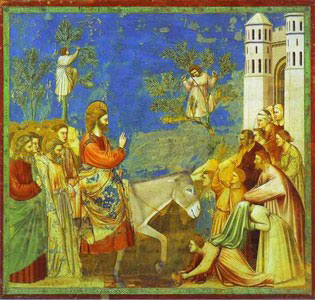
Jesus Palm Sunday - Giotto di Bonde, Entry into Jerusalem 1304-06, Fresco, Cappella Scrovegni Arena Chapel, Padua

“Your King Comes to You”

Has anyone here ever been at a really big “welcome home” celebration? I am thinking really, really big! Like, after the Cubs won the World Series last fall, and they returned to Chicago in triumphant victory. Or, after the Black Hawks, the White Sox or the Bulls won their championships. Has anyone experienced the joyful, expectant feeling of the crowd? The wild cheering and celebration as the focal point of the parade came into view?

Imagine that level of celebration, and then add an additional layer. The country of Israel had been under the heel of various world powers for several centuries. The Roman government was the current dominating overlords, and an ever-present occupying force. By Jesus entering Jerusalem in the way He did, He fulfilled a well-known prophecy from the Hebrew Scriptures. In addition, by doing this He was claiming the mantle of Messiah, the Anointed One of God. As Zechariah said, “Tell the city of Zion, ‘Look, your king is coming to you! He is humble and rides on a donkey.”

What about the crowd gathered there in Jerusalem, for the Passover holiday? Emotions run high when you are in the midst of a crowd. Higher highs, lower lows, all kinds of extremes. As Rev. Adam Copeland said, “Whether they are for sport, political protest, or public worship, gathering with thousands inevitably changes our mood and actions. I have never felt as alone as in a rival team’s stadium filled with thousands of home-team fans. I rarely feel as important as when I’ve gathered with others to protest unjust laws or call for social action. I get Goose bumps when I’m able to recite the Lord’s Prayer with a few thousand other worshipers.” [1]

What was the crowd looking for from Rabbi Jesus? This Messiah, Anointed One?    

A companion question: what were the disciples looking for from Jesus? From their Rabbi and leader, whom they had been following for months, even years? I remind everyone that there were more than just twelve men following after Jesus. There were more. Maybe Peter’s wife, maybe others’ wives or sisters. Women, other men, maybe even some children and youths. Many of these had been faithful in following Jesus for some time, and they were true believers. Faithful followers.

St. Ignatius of Loyola was a man of deep prayer. He instructed many in the way of deep, significant prayer. He had a special way of praying, which can also be used for reading the Bible. Ignatian spirituality, prayer and bible reading have been adapted from his instructions.

St. Ignatius would have us put ourselves into the biblical scene. Imagine yourself right there, on that Palm Sunday morning. I invite you to choose a place to stand: either among the crowd, observing, cheering; or among the disciples, close in to Jesus and the donkey. Perhaps even take the donkey’s point of view! Let us all immerse ourselves into the narrative. Hear the raucous noises and roar of the crowd. Feel the jostling shoulders as we jockey for position, to get the best view of the parade. Because, that is what it is! A procession! A joyful entrance into Jerusalem, the historic capital city of King David!

Can you feel the energy of that immense crowd? Jerusalem was full to bursting! People of Jewish ancestry had come to Jerusalem from all over the known world, to commemorate the Passover holiday. And, here were people welcoming this Messiah, this Anointed One, into the city like a king.

Can you feel the emotions of your fellow crowd members? What expectations are rising to the fore? Some desperate to throw off the heavy yoke of the Roman occupation, and so are delighted to see someone, at last, taking up the mantle of the Messiah! To call together the men of Israel and lead the Jewish army to victory! Some, I am sure, leery of this upstart Rabbi, and wondering how far He is going to get before the Romans scare Him off. And others, simply caught up in all the excitement of the moment, welcoming this Holy Man, this Miracle Worker, into the city of Jerusalem.

What were the expectations of those there, on that Palm Sunday morning? Sure, as our Gospel reading tells us, there was a large crowd around the city gate, ready to cheer and wave and make noise. The noise and celebration put the whole city into an uproar, turning things inside out and upside down.  In fact, the Greek verb in that phrase, “uproar,” is the same word used for an earthquake. Jesus shook up the people of Jerusalem, and He certainly stirred up the religious leaders and priests.

Let us fast forward, to the present. What are our expectations, right here, right now? What are we to do with this Jesus, riding in on a donkey?

Sure, there are many people in churches across the world today who are excited to celebrate another Palm Sunday. A highlight of the liturgical year, the beginning of Holy Week. Some are caught up in the pageantry and celebration. Others are content to wave their palms and observe things from the sidelines. Many, even, feel the solemn beginning of that sorrowful Holiest Week of the liturgical year. But, is there more?

The Triumphal Entry into Jerusalem was so typical of Jesus. He did not blindly accept these short-sighted expectations that were foisted upon Him. Instead, Jesus knew who He was, and did not need to clutch any lofty or power-hungry or mean and angry persona to Himself. No, Jesus entered Jerusalem knowing exactly who He was. God’s much beloved Son, the Messiah, the Anointed One of God. He had all that kingly authority already.

Let us remind ourselves exactly why Jesus had come into the world, exactly why He began His preaching, teaching and healing ministry. He came preaching forgiveness and mercy. He came teaching love and reconciliation. He came healing people from physical, emotional, psychological and spiritual diseases. Jesus came to give us life, and life abundantly!

But, today, Jesus’s voice gets drowned out by countless distractions. “Choked as we are by all of our distractions and tranquilizers—our cars, our houses, our 60-inch televisions and 6-inch computers, our smartphones and gizmos and gadgets, all of our conveniences and drugs and entertainment—we are likely to lose sight of the gate into heaven.” [2]

So often today, many people’s attention gets pulled away from things of God. Some are too busy to see Jesus. Some are too worried to listen to His voice. Some today couldn’t even care if Jesus lived or died.

Let’s focus on people within the church, worldwide. Some celebrate and wave palms on Palm Sunday and are content to let the whole rest of Holy Week slide right by without it registering on their hearts, then slide right into the following week’s celebration on Easter Sunday without a second thought. [3]

Jesus rides into our midst today, humble and seated on a donkey. He asks us the pointed question: what is it we seek in Jesus? Have we lost sight of the forgiveness, mercy, love and reconciliation He offers? He offers it to us, freely.

We can ask our Lord Jesus to enter our hearts, and to help us to lay at His feet all that we have and are today.

God willing, may we say “blessed are You who comes in the name of the Lord.”

[1] http://www.huffingtonpost.com/rev-adam-j-copeland/palm-powered-protest_b_5106331.html

“Palm Powered Protest,” Adam Copeland, ON Scripture, Odyssey Networks, 2014

[2] https://www.umcdiscipleship.org/worship/lectionary-calendar/palm-passion-sunday1; The Preaching Notes are written by Dawn Chesser, Director of Preaching Ministries, Discipleship Ministries, dchesser@UMCdiscipleship.org

[3] http://www.workingpreacher.org/craft.aspx?post=1546 ; “To Be Continued…” David Lose, WorkingPreacher, 2011.

Unknown's avatar

Jesus Wept, Too

John 11:1-44 (11:35) – April 2, 2017

John 11-35 Jesus wept, bible

“Jesus Wept, Too”

In hospitals and care centers throughout the country, chaplains are called to the bedsides of dying patients. The families of patients are grief-stricken, and need comfort, and spiritual and emotional care. Imagine the loved ones of the patient, recently deceased, rushing to the hospital from some distance to be with their loved one, one last time. Alas, the deceased patient has, sadly, already been moved from the room.

When I worked as a chaplain, from time to time this would happen. Can you imagine such a sad visit to the hospital? I would walk with the few relatives down to the morgue in the basement of the hospital with the nursing supervisor and we would bring them to see their loved one. Always—always the loved ones would be deeply moved. Sometimes with tears, sometimes with emotion. Their relative had died. I witnessed such raw feelings of deep grief, heartbreak, sometimes anger, and even despair—just as in our reading today from the Gospel of John.

Our Gospel reading today comes from John, chapter 11. I will read most of the chapter. This is about our Lord Jesus in the town of Bethany. I’ll let John fill us in on the details.

11 1-3 A man was sick, Lazarus of Bethany, the brother of Mary and her sister Martha. This was the same Mary who massaged the Lord’s feet with aromatic oils and then wiped them with her hair. So the sisters sent word to Jesus, “Master, the one you love so very much is sick.”

When Jesus got the message, he said, “This sickness is not fatal. It will become an occasion to show God’s glory by glorifying God’s Son.”

From what John says here, we can see how much Jesus cares for Lazarus and Mary and Martha. We may wonder at the cryptic response Jesus gives in response to the urgent message from the sisters, almost an SOS for help. Jesus healed others, Certainly He will heal our brother!

“After two days, Jesus said to his disciples, “Let’s go back to Judea.” They said, “Rabbi, you can’t do that. The Jews are out to kill you, and you’re going back?”

9-10 Jesus replied, “Our friend Lazarus has fallen asleep. I’m going to wake him up.” Jesus was talking about death, while his disciples thought he was talking about taking a nap. 14-15 Then Jesus became explicit: “Lazarus died. And I am glad for your sakes that I wasn’t there. You’re about to be given new grounds for believing. Now let’s go to him.”

This is a complication, to be sure! Bethany is just down the road from Jerusalem. The Jewish leaders were already threatening to kill Rabbi Jesus, and He proposes to walk right into their backyard? Moreover, Jesus knows that His friend Lazarus is dead. But, He goes anyway. And, His disciples go with Him.

17-20 When Jesus finally got there, he found Lazarus already four days dead. Bethany was near Jerusalem, only a couple of miles away, and many of their friends were visiting Martha and Mary. Martha heard Jesus was coming and went out to meet him. Mary remained in the house.

21-22 Martha said, “Master, if you’d been here, my brother wouldn’t have died. Even now, I know that whatever you ask God he will give you.” 23 Jesus said, “Your brother will be raised up.” 24 Martha replied, “I know that he will be raised up in the resurrection at the end of time.”

25-26 “You don’t have to wait for the End. Right now, I am Resurrection and Life. The one who believes in me, even though he or she dies, will live. And everyone who lives believing in me does not ultimately die at all. Do you believe this?” 27 “Yes, Master. All along I have believed that you are the Messiah, the Son of God who comes into the world.”

We see more of this family, and more of their grief. Many of the sisters’ friends and acquaintances are mourning with them at their home. Mary remains in the house while Martha goes out to see her friend Jesus. Martha makes the heartfelt statement that Lazarus will be raised at the end of time. And, Jesus follows that with one of the most striking “I am” statements from the Gospel of John here! I am Resurrection and Life! Jesus not only has power over the present time, but He has power over the future, as well. Martha’s response? It is in the formal language of a confession of faith. In the midst of her grief, she affirms—she confesses—that Jesus is, indeed, Messiah, the Son of God.

28  She went to her sister Mary and whispered in her ear, “The Teacher is here and is asking for you.” 29-32 The moment Mary heard that, she jumped up and ran out to him. Mary came to where Jesus was waiting and fell at his feet, saying, “Master, if only you had been here, my brother would not have died.”

33-34 When Jesus saw her sobbing and the Jews with her sobbing, he was troubled and a deep anger welled up within him. He said, “Where did you all put him?” 34-35 “Master, come and see,” they said. Now Jesus wept.

Some people think Jesus is God. Only God. Not human at all. Yet, we can clearly see here that Jesus had emotions. He was troubled and deeply angry. He was sorrowful and He wept. These are deep feelings, and almost everyone has experienced them sometime in life. Jesus experienced them, too. Yes, He was fully God, and yes, He was fully human, like each of us, all of us. Jesus wept, too. He felt the loss of His friend’s death deeply, and mourned.

36 The Jews said, “Look how deeply he loved him.” 37 Others among them said, “Well, if he loved him so much, why didn’t he do something to keep him from dying? After all, he opened the eyes of a blind man.” 38-39 Then Jesus, the anger again welling up within him, arrived at the tomb. It was a simple cave in the hillside with a slab of stone laid against it. Jesus said, “Remove the stone.” Martha, said, “Master, by this time there’s a stench. He’s been dead four days!”

40 Jesus looked her in the eye. “Didn’t I tell you that if you believed, you would see the glory of God?” 41-42 Then, to the others, “Go ahead, take away the stone.” They removed the stone. Jesus raised his eyes to heaven and prayed, “Father, I’m grateful that you have listened to me. I know you always do listen, but on account of this crowd standing here I’ve spoken so that they might believe that you sent me.”

Everyone dies. Yes, it is incredibly sad. As soon as a baby is born into the world, we all know for certain that that baby will die. Yes, sometimes we say “She died too soon.” Or, “Died in his prime. What a shame!” Yet, death happens to everyone, with no exceptions. As a Rabbi acquaintance of mine said several years ago, “We all have an expiration date.” It just depends on whether it is sooner or later in our lives. Each of us must come to terms with our mortality. [1]

43-44 Then Jesus shouted, “Lazarus, come out!” And Lazarus came out, a cadaver, wrapped from head to toe, and with a kerchief over his face. Jesus told them, “Unwrap him and let him loose.” 45-48 That was a turnaround for many of the Jews who were with Mary. They saw what Jesus did, and believed in him.

            God can come alongside of all of us, whether we are grieving the death of a loved one, the shock of a sudden medical diagnosis, or the loss of a needed job. Jesus weeps with us as we go through all of these experiences. He walks with us through the valley of the shadow.

But, that is not all—oh, no! We see from today’s bible reading that Jesus is much more than just a companion in time of need. John tells us that Jesus brought Lazarus back from the dead. How can that be? How can it be that Jesus brought back to life a man who was dead?” [2] We can affirm that Jesus is not only Lord of creation, but also Life-giver of the living. Not only in the first century, but also today.


How this resurrection can possibly happen is not to be understood with our minds. But we can understand it by faith, with our hearts. Because it is by faith that you and I, like Martha, confess that Jesus is uniquely connected to God. It is by faith that we, like Martha, confess that Jesus is Messiah, the Christ, God incarnate. [3]

This is another blessed aspect of our Gospel message. As I say each Sunday after our confession of sins, “Believe the Good News of the Gospel!” Jesus tells us all today, “Believe My Good News!” Just as Jesus had the power to raise Lazarus, so He will raise us all. Jesus is the Resurrection and the Life. By faith we believe, praise God. Amen.


(The Gospel reading is from the modern translation The Message, by Eugene Peterson. With gratitude, I appreciate Rev. Peterson’s translation and use his words in my sermon today.)

[1] https://www.umcdiscipleship.org/worship/lectionary-calendar/fifth-sunday-in-lent7#preaching

[2] Ibid.

[3] Ibid.

@chaplaineliza

(Suggestion: visit me at my regular blog for 2017: matterofprayer: A Year of Everyday Prayers. #PursuePEACE – and my other blog,  A Year of Being Kind . Thanks!)

Unknown's avatar

But Now I See

John 9:1-41 (9:25) – March 26, 2017

John 9 word cloud

“But Now I See”

In the first century, when Jesus walked the earth, people commonly believed a number of things that have since been proven mistaken, including something mentioned here in our Gospel passage today. When babies were born with a handicap or impediment—like born with a club foot, born with a cleft palate, or born blind—many, many people thought this was a punishment from God.

The parents were at fault. Sin was the reason the child was born that way!

In the encounter we have today in our Gospel lesson from John, Jesus deals with that kind of thinking. Let’s set the scene. “9 As Jesus was walking along, he saw a man who had been born blind. His disciples asked him, “Teacher, whose sin caused him to be born blind? Was it his own or his parents’ sin?”

In certain parts of the world today, people still think like that. Sad state of events, but that is the way it is. Some people mistakenly assign the “blame” for a “disability” or “illness.” Let’s see how Jesus responds.

Jesus answered, “His blindness has nothing to do with his sins or his parents’ sins. He is blind so that God’s power might be seen at work in him. As long as it is day, we must do the work of him who sent me; night is coming when no one can work. While I am in the world, I am the light for the world.”

Jesus rejects this blaming kind of talk! He “suggests that this man’s blindness offers the opportunity for God’s power to be revealed…. There is, in this case, physical blindness, but it’s not the only kind of blindness.  There are those who can see just fine, but live in spiritual darkness.” [1] More on that, later.

Plus, Jesus goes from talking about blindness, to God’s power, to Jesus being the light for the world. Can you follow Him in the progression of His thought? Actual, physical blindness, leading to God’s power made manifest by our Lord Jesus, who is God’s Light for the world, enlightening everyone. Back to the story.

After he said this, Jesus spat on the ground and made some mud with the spittle; he rubbed the mud on the man’s eyes and told him, “Go and wash your face in the Pool of Siloam.” (This name means “Sent.”) So the man went, washed his face, and came back seeing.

A man, born blind, made to see? This is a miracle, by anyone’s estimation! But, this is not quite a happily-ever-after story. By no means the end of our story.

13 Then they took to the Pharisees the man who had been blind. 14 The day that Jesus made the mud and cured him of his blindness was a Sabbath. 15 The Pharisees, then, asked the man again how he had received his sight. He told them, “He put some mud on my eyes; I washed my face, and now I can see.” Here is a clear statement of facts, as reported by the man who formerly was born blind.

We can tell the Pharisees believed the commonly held theological position of the day: illness and disability were God’s punishment for sin. What is more, people disagreed about whose sin was responsible for this former baby’s (now grown man’s) blindness. Most thought it was the parents. However, some thought that the newborn baby had somehow sinned! (Hard to believe, but true.)

On top of that, the Pharisees had some unkind words for this upstart Rabbi Jesus. Imagine, healing on a Sabbath! Who does He think He is?

16 Some of the Pharisees said, “The man who did this cannot be from God, for he does not obey the Sabbath law.” Others, however, said, “How could a man who is a sinner perform such miracles as these?” And there was a division among them. 17 So the Pharisees asked the man once more, “You say he cured you of your blindness—well, what do you say about him?” “He is a prophet,” the man answered. 18 The Jewish authorities, however, were not willing to believe that he had been blind and could now see, until they called his parents 19 and asked them, “Is this your son? You say that he was born blind; how is it, then, that he can now see?”

The Pharisees could not see past the noses on their faces. All they could see was healing, or work being done on the Sabbath, which was forbidden in their strict interpretation of the Law of Moses. That was huge, in their eyes. Hugely wrong!

Looking for additional people to cast blame on, the Pharisees just did not believe this guy who was formerly blind—so they called his parents!

20 His parents answered, “We know that he is our son, and we know that he was born blind. 21 But we do not know how it is that he is now able to see, nor do we know who cured him of his blindness. Ask him; he is old enough, and he can answer for himself!” 22 His parents said this because they were afraid of the Jewish authorities, who had already agreed that anyone who said he believed that Jesus was the Messiah would be expelled from the synagogue. 23 That is why his parents said, “He is old enough; ask him!”

24 A second time they called back the man who had been born blind, and said to him, “Promise before God that you will tell the truth! We know that this man who cured you is a sinner.” 25 “I do not know if he is a sinner or not,” the man replied. “One thing I do know: I was blind, and now I see.”

One of the most familiar and beloved traditional hymns is “Amazing Grace.” This hymn talks about several important things, including salvation. The hymn also talks about blindness, and the change that comes into a person’s life when they receive sight—spiritual sight. “Was blind, but now I see.” What a theological truth. What a profound insight. Jesus wasn’t blinded at all to seeing this man born blind.

It is the Pharisees who have been blind—spiritually blind—and they don’t even know it. “The religious leaders remain spiritually blind, still contending that the work of Jesus is demonic.  In their resistance to [Jesus,] their blindness – their sin – is revealed.” [2]

Is this just some nice bible story, or could it apply to us, today? Similar to the Pharisees, are we so preoccupied with our own holiness and righteousness that we are blinded? I mean, spiritually blinded to seeing signs of God’s work right here in our midst? [3]

“How does Jesus open our eyes to the things of God?  How does he reveal our blind spots so that we can let go of them and give glory to God? The good news is that there is amazing grace available to us.” [4] We can testify, along with this formerly blind man, “One thing I do know: I was blind, and now I see.”

This is something to celebrate! Jesus can open our eyes to those around us. We can be healed of our spiritual blindness and come into the light of God’s presence, and be able to testify to others of God’s light-giving and grace-giving. Praise God! Amen.

[1] http://www.bobcornwall.com/2014/03/who-is-really-blind-lectionary.html

[2] http://www.bobcornwall.com/2014/03/who-is-really-blind-lectionary.html

[3] https://www.umcdiscipleship.org/worship/lectionary-calendar/fourth-sunday-in-lent-one-great-hour-of-sharing#preaching

[4] http://www.bobcornwall.com/2014/03/who-is-really-blind-lectionary.html

@chaplaineliza

(Suggestion: visit me at my regular blog for 2017: matterofprayer: A Year of Everyday Prayers. #PursuePEACE – and my other blog,  A Year of Being Kind . Thanks!)
Unknown's avatar

The First Missionary

John 4:5-42 (4:29) – March 19, 2017

Jesus and woman at well icon

“The First Missionary”

When I say these words: “rotten half-breeds!” what comes to mind? Arguments, animosity, maybe even blood feuds. Fighting going on for years, decades, perhaps even centuries. Certainly, nothing good or positive.

That’s the situation we have here in John chapter 4, with the Jews and their hated half-brothers, the Samaritans. The Samaritans were, indeed, half-breeds who had been settled in the middle of modern-day Israel by the Assyrian occupation, about 700 BCE. The fighting and the hatred between these two closely-related tribes of people had been going on for several centuries.

That’s the backdrop we have as we consider this extended conversation between the Rabbi Jesus and an unnamed Samaritan woman, right smack in the middle of the Samaritan region of the country. Typical Jews would not often cross through Samaria to get from the south part of the country—around Jerusalem, to the north part of the country—around Nazareth and the Sea of Galilee. For the Jews, this encounter was in the middle of enemy territory.

Let’s listen in on Jesus and this woman.

In Samaria Jesus came to a town named Sychar. Jacob’s well was there, and Jesus, tired out by the trip, sat down by the well. It was about noon. A Samaritan woman came to draw some water, and Jesus said to her, “Give me a drink of water.” (His disciples had gone into town to buy food.)

Here is the situation. Jesus has been walking all morning, wants water, and asks for a drink. I am not going to give a long explanation concerning why this woman came to the well when everyone else had gotten their water for the day. No, and I am not going to ask what kinds of behavior might be scaring the other Samaritan townspeople away. I will let you all imagine what kinds of things they might be.

Continuing with John 4: “The woman answered, “You are a Jew, and I am a Samaritan—so how can you ask me for a drink?” 10 Jesus answered, “If you only knew what God gives and who it is that is asking you for a drink, you would ask him, and he would give you life-giving water.” 11 “Sir,” the woman said, “you don’t have a bucket, and the well is deep. Where would you get that life-giving water? 12 It was our ancestor Jacob who gave us this well; he and his children and his flocks all drank from it. You don’t claim to be greater than Jacob, do you?”

According to common Jewish thought at that time, this was a “rotten, half-breed Samaritan woman.” Yet, she goes right to the heart of it, and unerringly puts her finger on the complication in this extended conversation. “Life-giving water:” what kind of water is that? Where does it come from?

Stagnant water sits in a cistern or barrel and harbors deadly bacteria. “Life-giving water” or “living water” means running water, like in a stream or river. “Living water, rushing over rocks, cleans us more thoroughly and is much safer to drink. We build settlements where living water flows at the surface, or where wells can be dug reaching to underground streams or springs of water.” [1]

The woman’s rhetorical question, “You’re not greater than Jacob, are you?” can also imply she is rather skeptical of this Jewish guy sitting by the well. 13 Jesus answered, “Those who drink this water will get thirsty again, 14 but those who drink the water that I will give them will never be thirsty again. The water that I will give them will become in them a spring with life-giving water and give them eternal life.”

15 “Sir,” the woman said, “give me that water! Then I will never be thirsty again, nor will I have to come here to draw water.” Ah. Jesus is upping the stakes, offering this woman living water, and even life-giving water that becomes a spring inside of each person. See how eagerly the woman responds?

16 “Go and call your husband,” Jesus told her, “and come back.” 17 “I don’t have a husband,” she answered. Jesus goes to the heart of the woman (and, the heart of the interaction) by broaching the highly personal subject of the woman’s husband. Some might say it was a sore spot. However, Jesus is revealing Himself further to this woman through this statement. Back to the story.

“Jesus replied, “You are right when you say you don’t have a husband. 18 You have been married to five men, and the man you live with now is not really your husband. You have told me the truth.” 19 “I see you are a prophet, sir,” the woman said.

20 “My Samaritan ancestors worshiped God on this mountain, but you Jews say that Jerusalem is the place where we should worship God.” 21 Jesus said to her, “Believe me, woman, the time will come when people will not worship the Father either on this mountain or in Jerusalem. 22 You Samaritans do not really know whom you worship; but we Jews know whom we worship, because it is from the Jews that salvation comes.

25 The woman said to him, “I know that the Messiah will come, and when he comes, he will tell us everything.” 26 Jesus answered, “I am he, I who am talking with you.”

Do you see the natural steps of interaction Jesus took with this woman? Her surprise at his asking for a drink of water changed to curiosity at the offer of living water. This further changed to wonder and amazement at Jesus knowing all about her past, and her several marriages. Finally, they reach the topic of religion, and Jesus tells her—in plain words—that He is, indeed, the Messiah. All in a short interchange.

In fact, when Jesus reveals Himself to this woman, He speaks the words “I am.” These words make explicit connections with the divine name in Exodus 3:14, which also confirm the words of the first chapter of the Gospel of John: “the Word was God.” In this way, Jesus fulfills this woman’s expectations of the Messiah and transcends them, at the same time. [2]

27 At that moment Jesus’ disciples returned, and they were greatly surprised to find him talking with a woman.” (Jesus, as a Jewish religious leader, was not supposed to talk with a woman in public, much less a Samaritan woman.) “But none of them said to her, “What do you want?” or asked him, “Why are you talking with her?”

28 Then the woman left her water jar, went back to the town, and said to the people there, 29 “Come and see the man who told me everything I have ever done. Could he be the Messiah?” 30 So they left the town and went to Jesus.

Here we have an evangelist. The first Christian missionary! She was so struck by what Jesus had just said to her that she had to go and tell others about it. What is more, she invited all her fellow townspeople to come and see! Come and see this man who told her everything she had done in her life.

Because of this woman’s witness, the number of people who believed in Jesus grows—and not just Jews! The “hated, rotten, half-breed” Samaritans believe, too! Jesus and His words challenge each of us, today.

How do you and I come to believe in Jesus Christ as our Lord, our Savior, our Messiah? Was there some life-changing moment in your life that softened your heart and changed your mind? What was it—what is it that causes us to want to go and tell everyone the Good News? Are we eager to tell others to “Come and see?” [3]

Are we so excited that we forget our water jars—or smart phones—or briefcases—or tool belts? It is important to share our witness and to tell our own story. Jesus encourages us to tell others to “come and see!” Come on, come closer. Come, see the One who knows everything about me, and loves me anyway!

Come and see!  

[1] https://www.umcdiscipleship.org/resources/planning-for-worship-during-lent-year-a-living-our-baptismal-calling

[2] Gail R. O’Day and The New Interpreter’s Bible Commentary (Vol. 10, The Gospel of John), (Nashville, TN: Abingdon Press, 2000), 568.

[3] https://www.umcdiscipleship.org/resources/planning-for-worship-during-lent-year-a-living-our-baptismal-calling

@chaplaineliza

(Suggestion: visit me at my regular blog for 2017: matterofprayer: A Year of Everyday Prayers. #PursuePEACE – and my other blog,  A Year of Being Kind . Thanks!)

Unknown's avatar

Love, Humble and Obedient

“Love, Humble and Obedient”


crucifixion sketch

Luke 19:37-40 – Phil 2:8 – March 16, 2016

Have you ever watched a television show or a movie where there are two different stories going on at the same time? A few scenes of the first story, and it gets to an exciting or a suspenseful part; then the show switches to the other story. The second story goes on for a bit and just gets interesting, and suddenly the show changes back to the first story.

This sermon is going to do just that.

Like many stories, the first story we look at today does not start at the beginning. Instead, it interrupts in the middle of the action. Rabbi, or Teacher Jesus, wanted to enter Jerusalem on a Sunday morning. This was a special week. Observing, believing Jews from not only all over Israel, but from all over the world had come to Jerusalem to celebrate the Passover feast.

People were really starting to talk about this Teacher Jesus! Some people said He was the prophet Elijah who had returned. Others said He was John the Baptist raised from the dead. Even some in Israel said this Jesus might be the Messiah, the Anointed One of God.

So, when Jesus planned His entrance into Jerusalem that day, He knew what people were saying. He wanted to show everyone—the friendly people in the crowds as well as those who doubted or actively disliked Him—that He was the Messiah. Jesus entered Jerusalem on the back of a donkey. He did NOT come in like a conquering king, on a white horse. No, He came in as the Anointed One of God. Humble, and riding on a donkey.

Let’s consider what the Teacher Jesus had been doing for a number of months. Jesus’ words and teaching had authority. He preached with power, which was different from the way the scribes and teachers of the day preached. He healed people, restored sight to the blind and made lame people walk—all of which showed God’s mighty power. And if this wasn’t enough, the Teacher Jesus even forgave sins! He certainly appeared to be from God.

We’re going to shift scenes now. Cut!! Now—instead of looking at a situation two thousand years ago, we are going back before the universe was created. Before God spoke and called anything at all into being. Before the beginning of all things, there was GOD. God the Father, God the Son, and God the Holy Spirit. There was community and fellowship within the Godhead even before anything else was created in the whole universe.

I’ll focus on God the Son. Fully God. He was always in existence. There never was a time when He was NOT. When God the Son took on humanity, when He became Jesus at Christmas two thousand years ago, the human Jesus had an actual, physical birthday. But God the Son always was, always is and always will be. It’s a mystery! I can’t understand it, much less explain it. This is a part of the God we worship and celebrate.

Let’s compare the two stories now. Take God the Son before the foundation of the world, all-powerful, all-knowing. Take Jesus the Teacher in Jerusalem, teaching, preaching, healing, even forgiving sins! Compare them side by side. These are all ways that we can describe God.

Jesus, as He comes into Jerusalem, is greeted by crowds of people waving palms and shouting ‘Hosanna!’ They quoted Psalm 118, ‘Blessed is He who comes in the name of the Lord!’ This is a clear sign of what the crowds who greeted Jesus on that day were thinking. This was the way the people of Jerusalem had greeted the conquering king Jehu several centuries before. They greeted Him as Messiah, the Anointed One, who comes in the name of the Lord.

Consider God the Son, before the foundation of the world. The Apostle Paul tells the believers in the city of Philippi that He set aside His God-ness. He laid it aside. Jesus emptied Himself, willingly, of all things related to being God, to become Man. After being in on the creation of the heavens and the earth, after speaking the world into existence, after being all-knowing and all-powerful, God the Son became a baby. Think of a baby you know, a cute, cuddly, helpless little baby. God the Son willingly became like that.

We all know the Christmas story. Jesus was born in Bethlehem in a barn to a young, homeless couple. Jesus was Jewish, from Israel, an oppressed people-group, in an occupied country. Jesus was marginalized and shunted aside from the very start.

Think about Israel in the first century—occupied territory! People oppressed, terrorized by not only the Roman soldiers, but also by Herod’s soldiers. Looking through history, we can read the fear of occupation and domination from first-person, historical accounts. It doesn’t matter whether it’s a letter written during the time of the Underground Railroad, a diary from Nazi-occupied Holland or a personal account from a victim of human rights abuse from Guatemala today. Horror. Violence. Oppression.

God the Son breaks into this mess of a world. God over all the universe, the Word made flesh, became a baby named Jesus. He became powerless, most vulnerable, least of all. In this fallen world, where power and influence are everything, Jesus came to be with us as a helpless baby.

But I’m not done with the story—yet. Or should I say, the stories? Plural.

Jesus the Teacher could have hidden Himself. He could have just laid low for years, taught quietly, stayed on the outskirts, far away from large towns. But, NO. Jesus did just the opposite. Jesus decided to come to Jerusalem, where there were large crowds, many Jewish leaders, and also many Roman soldiers. He walked into this situation with his eyes wide open.

Some people—I’m thinking of the Pharisees, the Sadducees, the scribes and other temple leaders—were awfully uneasy. For them, Jesus was their worst nightmare. Dr. Luke tells us in chapter 9 of his gospel that Jesus set his face to go to Jerusalem. Our Lord Jesus made up His mind to travel that path. Certain death awaited Him. But He determined to go, nevertheless.

Let’s see what the Apostle Paul says in Philippians 2. Jesus is described as humbling Himself. Humble? The people in Jerusalem that Palm Sunday morning certainly didn’t expect a humble, quiet guy. No! They expected someone who would take charge, rally the people, and mount a rebellion! They wanted someone who would turn things upside down!

Think about the world the Jews were living in. They were subjects of the Romans, the most powerful nation in the world. So the Jews did not like this oppression much at all. People would pop up, claiming to be the Messiah, the Anointed One, and attempt to rally an army to himself. These attempts never went anywhere. The Romans quickly put an end to any rebellion.

When the Apostle Paul wrote about the person and work of our Lord Jesus, he uses terms familiar to his audience. Paul communicates it in simple, matter-of-fact words. Listen to just a part: Jesus “made Himself nothing, taking the form of a servant, and coming in human likeness.” Even at that Passover dinner on Thursday night, Jesus did not lord it over the disciples. He washed their feet. He did not seek to dominate others, like the Romans did. So many people want power over others. Instead, Jesus wanted to serve. Just like the Apostle Paul describes here in Philippians, Jesus took the form of a servant. He humbly, willingly and lovingly decided to serve others.

Wow. I repeat, WOW.

Let’s get back to the story. Back to Jerusalem. While Jesus went through the turbulent events of Passion Week, with all of the confrontations and discussions, and especially Passover dinner on Thursday night, we see only a portion of the events of this week. Almost the highlights of the week, what you might see if you were watching a video or a television show in two parts, and at the beginning of the second part they showed you the story so far, up to this point.

Why did Jesus come to earth, empty and humble Himself? He did it for us. We can’t understand it. It is pure love from Jesus. And, we can praise God that Jesus did this, for us.

Remember the people on that Palm Sunday morning, the ones who said ‘Blessed is He who comes in the name of the Lord!’ They were looking for a savior, a conqueror. Jesus was a savior, He was a conqueror, all right. Just not in the way everyone else expected.

Paul tells us that Jesus became obedient, obedient to death, even the death of the cross. Jesus could have turned away. Jesus could have stepped aside. But He didn’t. We even hear it in what Jesus prayed in the Garden. He said to His Father, “Not My will, but Thine be done.” He became obedient unto death, even death on a cross.

Jesus knew that some of that crowd who cried “Hosanna!” on Palm Sunday morning would be screaming “Crucify Him!” on Good Friday morning. On Palm Sunday morning, He entered Jerusalem. Jesus was preparing Himself to be obedient to the point of death, even death on a cross, one of the most horrible kinds of execution ever thought of by anyone, anywhere.

We can ask . . . WHY? Why did the God over all the universe, the Creator of the heavens and the earth come down from heaven and die a criminal’s death on a cross? It was LOVE.

Jesus shows us a love we could not resist, that melts our hearts. This is what causes us to fall at His feet in worship and praise. As the final step, the culmination of His amazing love for us, Jesus has been raised from the dead and exalted to the right hand of God the Father! Jesus receives the name which is above every name. Jesus Christ is Lord. Did you hear? Do you know? At the name of Jesus every knee should bow! Every knee of those in heaven, and those on earth, and those under the earth. Every tongue shall confess that Jesus Christ is Lord, to the glory of God the Father.

Praise God. Amen, and amen!

@chaplaineliza

Suggestion: visit me at my daily blog: matterofprayer: A Year of Everyday Prayers– where I am doing a Lenten journey.  #PursuePEACE – And my other blog,  A Year of Being Kind -Thanks!

Unknown's avatar

Bringing Gifts

“Bringing Gifts”

Magi bear gifts to an infant Jesus (one of the earliest-known depictions, 3rd century sarcophagus) Vatican Museums - Rome, Italy

Magi bear gifts to an infant Jesus (one of the earliest-known depictions, 3rd century sarcophagus)
Vatican Museums – Rome, Italy

Matthew 2:11 – January 3, 2016 (St. Luke’s Church, Epiphany Sunday)

I remember Christmases when I was very young. I was the youngest of six children, and we lived on the northwest side of Chicago. My father worked for the National Safety Council, which was a not-for-profit organization. He didn’t get paid a huge amount of money, so I remember Christmases when we children wouldn’t have a huge pile of presents under the Christmas tree, like the television commercials of today always seem to show. But I do remember the happiness and joy of those Christmas mornings. A number of gifts were exchanged, and we always had a big dinner later that day at one of my relatives’ houses. Those are warm memories, all of us gathered around the tree, exchanging presents.

Warm memories. I’m sure you all could bring to mind a similar warm memory or two, regarding Christmas. Many of my memories do involve gifts. The Scripture passage we just read mentions gifts, too. It’s from Matthew, Chapter 2, the traditional Epiphany story, when Wise Men from the East came to see the baby Jesus, bearing gifts.

Matthew calls them “Magi,” According to my research, they probably came from the East where the Jews had spent seventy years in the Babylonian captivity, centuries before the birth of Christ. During this period, the Babylonians and Persians probably learned of the promise of the “Messiah” from Daniel the prophet who had lived among them.

The Magi became important first among the Medes and later among the Persians by taking on the priestly functions of the mystery religion Zoroastrianism. By New Testament times, the term “Magi” was broadly used for persons adept in any number of sacred arts, including interpretation of dreams or other divine messages, astrology, magic and divination.

We can tell from the term “Magi” that here are three very important people, who are not Jewish. The consensus among biblical scholars is that Matthew was a Jewish apostle of Jesus who wrote his gospel for the Jewish people. Yet, here, front and center in the beginning of the Gospel of Matthew, we find three non-Jewish V.I.P.s, on their way to see the Child, born King of the Jews.

They know pretty much where they are headed, but not precisely. I suspect that is why the Magi went to see King Herod in Jerusalem. I mean, what better place to find a newborn King than in a palace, in the capital city?

I’ve got to give these Wise Men a lot of credit. Not only were they a little fuzzy as to their destination, and where they were going, but they were not afraid to ask questions and ask for directions. It’s too bad that they had to pick Herod to ask questions of.

“Where is the One having been born King of the Jews?”

The Wise Men saw the bright star announcing the birth of Jesus, and followed the star towards Jerusalem. Notice: they were not Jewish, yet they had heard of the Coming One, and even brought Him gifts. They even wanted to worship and adore Him. They had heard of the birth of Jesus through unconventional methods, by our standards. The Magi had foreseen the birth through signs in the stars, not necessarily through the Hebrew Scriptures, as the Jewish people had.

God understood that these Wise Men made a careful study of the stars, and He sovereignly decided to display signs and wonders in the heavenly places at the time of the birth of Jesus. God reached these Magi where they were at. And the wonderful thing is, God continues to reach out to people in ways they understand, no matter what is happening to them, no matter where they might happen to be.

But, let’s go back to these Wise Men. No one is exactly sure about the number of Magi who arrived in Jerusalem so long ago. Church tradition tells us that the number was three, and that these were not just Wise Men, but also Kings of the East. Assuming that they were at least minor royalty, these three non-Jewish V.I.P.s show up on King Herod’s doorstep, and he was not pleased to see them. He was even less pleased with their line of questioning. “What’da you mean, Child born to be King of the Jews? I’m the only king around here!”

Herod must have known something about the prophecies of a Coming One, of a Messiah, and I bet Herod was upset. The chief priests and scribes came to Herod and told him right away where the Messiah was to be born. The prophet Micah had foretold it several centuries before. In Bethlehem, in Judaea, only a little way down the road from Jerusalem.

From all accounts of Herod and his life and reign, he was a tyrant. Looking at writings from contemporary authors of that period, Herod was cruel and bloodthirsty. He was also two-faced, as we can see from his response to the Magi. He sent the Magi to Bethlehem, and requested that they come back after they find this “King of the Jews,” because Herod wished to “worship” this King as well. I have a pretty good idea of exactly what Herod wished to do to the baby Jesus.

The Gospel of Matthew tells us that Herod secretly found out the time the star had appeared in the sky, and typical of a bloodthirsty despot, he had all boy babies in the area of Bethlehem under the age of two killed. Just in case. This feature of the Christmas story usually isn’t mentioned, since it doesn’t fit into a nice, warm and fuzzy Christmas card. These verses are not included in our lectionary reading for today, either. Yet, this was the kind of world Jesus was born into. The world today hasn’t much changed.

Let’s pick up with these Wise Men. After they found out where the King of the Jews was born, they wasted no time in finding Him. Mary and Joseph must have decided to stay in Bethlehem for a time, since the Wise Men found the Holy Family inside a house. And, the original Greek of the Gospel of Matthew refers to Jesus as a boy, not as an infant, as the Gospel of Luke does. So Jesus may even have been a toddler at the time of the Wise Men’s visit.

Regardless of these minor, yet fascinating, details, the important part is that the Wise Men took the time to find the promised King of the Jews. When they found Jesus, the Wise Men were finally able to offer their gifts—gifts fit for a King, gold, frankincense and myrrh—expensive and costly gifts, to be sure. Then . . . the Wise Men worshiped Jesus, the Promised One, the coming Anointed One of God. And, they returned to their homes, rejoicing that God’s promise had been fulfilled.

What does this story from so long ago have to do with us, today, in the 21st century? God is indeed pleased when we give Him things we very much value, as the Wise Men did. But God doesn’t really want worldly things. What I see repeated in Scripture is that God really wants a relationship with us.

Christina Rossetti’s poem says it so well.

“What can I give Him, Poor as I am?/If I were a shepherd I would bring a lamb;

If I were a wise man, I would do my part;/Yet what can I give Him—give my heart.”


That’s what God wants most of all for Christmas. God wants our hearts. God wants us to come to Him, as small children come to a dear mother or father.

I can remember when my children were small, and they would come to me at night for a last cuddle before bedtime. I think that’s what God wants us to do. Only, better! God is a parent who will never be too busy to take time for us, and never be short-tempered with us. God’s everlasting arms are ready, wide open to receive any who come.

Yes, the Wise Men gave gifts to the baby Jesus, and yes, they stand as an example for us. We can celebrate their example, and remember it as we give our hearts to God, whether as a renewal gift of our lives, or as a sincere gift for the very first time. Give God the best gift you ever could. Yourself.

You are important, so important that Jesus came and gave Himself for you and for me. All He has ever wanted is to give us the chance to know Him as a personal Friend and Companion.

Won’t you give Him what He wants most for Christmas?

@chaplaineliza

Suggestion: visit me at my sometimes-blog: matterofprayer: A Year of Everyday Prayers. and my other blog,  A Year of Being Kind .  Thanks!

Unknown's avatar

Looking for Jesus

“Looking for Jesus”

William Holman Hunt, “Finding of the Saviour in the Temple,” 1854-60

William Holman Hunt, “Finding of the Saviour in the Temple,” 1854-60

Luke 2:48-49 – December 27, 2015

Christmas time is here! Called by some the most wonderful time of the year. Certainly, one of the busiest times, what with parties, social gatherings, visiting at relatives’ homes, and so many extra things on people’s to-do lists. Yes, Christmas is now over, but we are still right smack in the middle of the winter holidays.

Our Gospel reading from Luke today is right smack in the middle of the holidays, too. Except—right in the middle of the Passover holiday, in the spring. An extra special holiday, to be sure! This is one of the rare glimpses we receive of the young Jesus, before the beginning of His ministry. When we do get a glimpse of Jesus as a growing boy, Dr. Luke doesn’t say much more than Jesus was “increasing in wisdom and in years, and in favor with God and people.”

Most people know the Christmas story from Luke chapters 1 and 2 so well. You remember. Angel visitations, miraculous statements, heavenly choruses. And, capped by the birth of the Messiah, the Lord, who will save His people from their sins. And then—we have this sort of addendum. This conclusion of Luke chapter 2.

As Scott Hoezee says in his commentary, “we have a story as mundane, as utterly earthly and simple as they come: lost child. Panicked parents. A frantic search. The whole thing started with angels and it ends . . . paging for a lost child on the P.A. system at Walmart?” [1]

Let’s take a closer look at our passage from Luke chapter 2. This reading is from “The Message,” the excellent version translated by Eugene Peterson, starting at verse 41.

41-45 Every year Jesus’ parents traveled to Jerusalem for the Feast of Passover. When He was twelve years old, they went up as they always did for the Feast. When it was over and they left for home, the child Jesus stayed behind in Jerusalem, but His parents didn’t know it. Thinking He was somewhere in the company of pilgrims, they journeyed for a whole day and then began looking for Jesus among relatives and neighbors. When they didn’t find Him, they went back to Jerusalem looking for Him.”

Now, from Jesus’s point of view, His decision to stay behind in Jerusalem for several days made sense to Him. He may have wanted to get to know God a little better. And, Nazareth was only a small town away up north, far away from the capital city of Jerusalem. I suspect Jesus wanted to talk further with the knowledgeable rabbis and teachers in the Temple, too.

But, from His parents’ point of view? How many of us have served as parents or adults, responsible for young children in our care? Did any of us have a child turn up lost? What must Mary and Joseph have been feeling, during that time when they did not know where Jesus was?

This reminds me of my oldest daughter, when she was just a preschooler. I was at a department store in Chicago with my two children (at that time), my older daughter just turned three, and my second daughter a baby strapped in a stroller. I was looking at clothing on the round metal racks that are common to many department stores. As I looked at clothing and tried to keep track of my young daughter at the same time, she got lost. I could not find her, and she was much too small to see me over the clothing racks.

It only took me about five minutes of searching to discover where she had gone, but that time was desperately anxious for me and traumatic for my daughter—I suspect those five minutes seemed to go on forever. She was lost. She did not know where she was, or where I was. She was all alone, far from her home and familiar things, until I found her and reassured her that everything was all right.

Back to our Gospel text, from Luke 2.

46-48 The next day they found Jesus in the Temple seated among the teachers, listening to them and asking questions. The teachers were all quite taken with Him, impressed with the sharpness of His answers. But His parents were not impressed; they were upset and hurt. His mother said, ‘Young man, why have you done this to us? Your father and I have been half out of our minds looking for you.’”

As one commentary notes, “Mary and Joseph spend 48 hours before finally tumbling to the idea that just maybe they should check the Temple. ‘I can’t imagine he’d be there’ they must have said to each other, ‘but we we’re running out of likely places, so let’s check.’ For his part Jesus is merely confused. The Temple was the first place they should have looked, as it turns out. Jesus was ‘home’ at the Temple. His parents don’t understand, however. They are too flush with a combination of intense relief and a little abiding post-traumatic stress to be able to suss it all out just then.” [2]

Let’s take a closer look at Jesus’s response: “49-50 He said, ‘Why were you looking for me? Didn’t you know that I had to be here, dealing with the things of my Father?’ But they had no idea what he was talking about.”

Many learned biblical scholars have tried to puzzle out this divine mystery. The mystery of Jesus being at once human and divine, at the same time. Here, we have just a glimpse of what this may have been like for Jesus.

The twelve year old boy Jesus probably knew Himself as human. Just as His parents and other family were, and the other children in his town. I wonder whether Jesus was starting to understand by this time that He was fully divine, as well? Yes, some verses in the Gospels tell us He did have an awareness of being divine. Of having Godly attributes. However, I wonder whether He was starting to realize the special call on His life, even now?

We don’t know for sure; we aren’t told. But, do you think this could be why Jesus wanted to stay in the Temple? To talk with those knowledgeable about the Scriptures?

To finish the reading: “51-52 So Jesus went back to Nazareth with them, and lived obediently with them. His mother held these things dearly, deep within herself. And Jesus matured, growing up in both body and spirit, blessed by both God and people.”

Dr. Luke is a faithful reporter. He tells us the facts, as they were related to him. But we don’t know the back story, Jesus’s feelings, His reasoning. Did the Temple have a draw on His life, even at the age of twelve? Did it feel more like home than his family home in Nazareth? Luke doesn’t say.

We know that Mary was a reflective woman. She treasured up these many wonderful things, and also the things that perplexed and troubled her. And, we can ponder these things in our hearts, hold these thoughts dearly, deep within ourselves, just like Mary did.

We know today, from the testimony of all the Scriptures, that Jesus is at the same time fully God and fully man. Yes, that is why He came down from heaven to be born of Mary. This is the good news brought to us by the angel chorus. The Eternal Second Person of the Trinity, Creator of the whole universe, God the Son, emptied Himself of all God-ness. Took on humanity, and was born as a helpless Baby. Good news of great joy for all the people.

Jesus. Messiah. He will save His people from their sins. Fully God, fully human, at the same time. Yes, it’s a mystery. It’s a miracle. For a closing hymn, we will sing “Once in Royal David’s City,” one of my favorite Christmas carols. Please notice the words of verses 2 and 3. Talking about Jesus being human. And then, verse 4 tells us of the future, when we will be with Jesus forever, in heaven.

We can all say alleluia, amen, to that!

(The congregational response to this sermon will be the Nicene Creed.)

@chaplaineliza

Suggestion: visit me at my daily blog for 2015: matterofprayer: A Year of Everyday Prayers. and my other blog,  A Year of Being Kind .  Thanks!

[1] Sermon Starters for the Week, Scott Hoezee, textual notes, illustrations, commentary, Center for Excellence in Preaching, 2015.

[2] Ibid.

My thanks and deep appreciation for Eugene Peterson’s translation of selected verses from Luke 2;  “Scripture taken from The Message. Copyright © 1993, 1994, 1995, 1996, 2000, 2001, 2002. Used by permission of NavPress Publishing Group.”

Unknown's avatar

One Who Brings Peace

“One Who Brings Peace”

Micah 5-5 He will be our peace

Micah 5:5 – December 20, 2015

Peace. Peace is the subject today. Today we light the Advent candle of peace. Here, inside the church, it seems like peace is a realize-able actuality. But—not on the outside. Not out in the cold, cruel world. Peace, peace, is the cry! Here in the 21st century, we have wars and the rumors of war. Fighting, skirmishes, various attacks of various kinds. Will anyone hear our cry for peace? Will anyone—anywhere—heed our cry?

In biblical times, there was always some tribe or country beating up on another tribe or country. Always somebody marching off to war. To enlarge territory, or to gain political advantage, or to right some wrong. So seldom did the nation of Israel have true peace! Much of this book of the prophet Micah deals with war, conflict and fighting. Except for right here.

Our Gospel reading from Luke tells of the pregnant Virgin Mary going to visit her older cousin Elizabeth, who prophecies that Mary has within her the baby Jesus, the Son of God. Usually, the Scripture readings are chosen with great care. Chosen with an eye to common themes. So, what is in common, here? The prophecy of a strong leader to come, from our Old Testament text, and the prophecy of the birth of the Messiah, from our Gospel reading.

Here we are at the fourth Sunday of Advent. We have had Advent for a long time. Since the last week of November. I can just hear the children saying, “When is Christmas finally going to get here?” Some schools have already gotten out for the winter holidays. I know some local churches are featuring a Christmas cantata today, or a Christmas pageant in worship.

Yet here we all are. The last Sunday of Advent. Isn’t Christmas here yet? Isn’t it time for angels and shepherds, Mary and Joseph and the Baby in a manger? Can’t we hurry things along?

As we look at the prophecy in Micah, we can see that the prophet is certainly not thinking about warm and fuzzy Christmas carols. Not about the lion lying down with the lamb, about God reaching down and bringing peace on earth, good will towards all people. Or, is he? What is Micah saying in our reading today?

Yes, a strong leader will rise up. Who do you think Micah’s contemporaries thought the prophet was talking about? I was fascinated to read in one commentary that most people would connect this strong leader to King David. But, wait! David had been dead for two hundred years, by the time that Micah wrote his prophecy. How could the Jewish people think “David” when they heard prophetic words like this?

Because—because of the prophecy of David’s prophet Nathan from 2 Samuel 7. A direct descendant of David would be king. God had promised King David that exact thing. So, who else could this strong leader be but a direct descendant of the great King David?

All well and good! Except, it gets more complicated, fast. Micah mentions “out of you [Bethlehem] will come one who will be ruler over Israel, whose origins are from of old, from ancient times.”

Now, I can understand a strong leader. A ruler, a mighty King. A descendant of King David. I can even understand the prophecy of a baby, from Luke, chapter one. The descendant of David needs to be born. Elizabeth prophecying and praising God that the mother of the Messiah to come was coming to see her. Okay, I’ve got that.

I am so indebted to John C. Holbert’s article on this Scripture reading. [1] I was aware of some of this material from the book of Micah, but by no means all. And never in so much depth!

Micah’s prophecy foretells a strong leader, yes. A descendant of David is presumed. (Micah doesn’t specifically say so.) Adding two and two and two together, from the prophecies of the Hebrew Scriptures, people have ascertained that this prophecy also refers to the Messiah. And then—Micah adds the part about the ruler “whose origins are from of old, from ancient times.” This part definitely needs more explanation.

These phrases are a challenge to translate from Hebrew. The best that anyone can figure is that there are several meanings for these words. “Origins” can also be translated “coming forth” of old! Dr. Holbert says that God put this word ‘olam, or “ancient times,” “into human minds in such a way that they may know a bit of what has happened in the past, and a tiny portion of what may come, but just enough to teach them that they in fact know precious little about either past or future in the end. There the word appears to mean something like a very long time or deep in the past and far into the future, not quite eternity but as much as any puny human mind may conceive.”

Talk about not being able to understand Scripture. These couple of phrases blow me away. I feel small when I read this. Really young, like a preschooler. I realize I do not know very much about God or about the Bible, at all. Period. God surely can flatten me, humble me with a phrase from the prophet Micah.

But, wait! There is more! Let’s unpack this reading, further.

Holbert continues: “Who then does Micah have in mind? This is no simple heir of David; here is someone primordial, someone from the most ancient of times yet also uniquely prepared to act decisively in the present.” In other words, Micah is talking about Someone more than human. Looking forward to the future, talking about Someone who not only is the promised Messiah to come, the promised descendant of David, but also looking back to the far distant past. To the beginning of time, even beyond the beginning.

Then, in Micah 5:3, the prophet brings up the image of a woman in labor. What is our Gospel reading from Luke for today? It’s about two pregnant women. Elizabeth prophecying about the Child Mary is carrying. The Child is the Lord. The Son of God. The next verse, Micah 5:4 speaks of the promised one who will be a shepherd. Just like King David! A powerful and godly shepherd who keeps the flock safely; “and they will live securely, for then his greatness will reach to the ends of the earth.” Again, this is Messiah language, and more!

Who is this Messiah, anyway? Descendant of David, check. Born in Bethlehem, which is David’s ancestral home. Check. But, Micah says from ancient of days? Luke calls Him the Son of God? The Lord God Almighty?

This great Shepherd will not only be concerned with the flock of Israel, but also the flock of the entire world. And—this is the most important part to me, right now. This strong leader, this Shepherd will be our peace.

This Messiah will not just be peaceful for Israel’s sake. No! Our Messiah, our Christ, from ancient of days, will act peacefully for the safety and well-being of the whole world!

Do you hear the Good News from the prophet Micah today? This Messiah was not going to act in the way that so many other Middle Eastern potentates did. Or, for that matter, like any other earthly ruler ever has. Instead, we are told in our Scripture passage today that He will feed His flock. The Messiah’s flock will have the opportunity of living secure, safe, and peacefully under Messiah’s mighty protection. I thank God that I am one of the worldwide flock.

God extends that opportunity to everyone, so that we all can have the security and care of the Messiah, the Good Shepherd, the Babe of Bethlehem, the ruling King. Praise God for God’s wonderful gift of protection and care.

[1] http://www.patheos.com/Progressive-Christian/Who-Is-This-Peaceful-One-John-C-Holbert-12-11-2015

(Many thanks and much appreciation to Dr. Holbert! Wonderful article on Micah.)

@chaplaineliza

Suggestion: visit me at my daily blog for 2015: matterofprayer: A Year of Everyday Prayers. and my other blog,  A Year of Being Kind .  Thanks!