Unknown's avatar

Peace, from Generation to Generation

“Peace, from Generation to Generation”
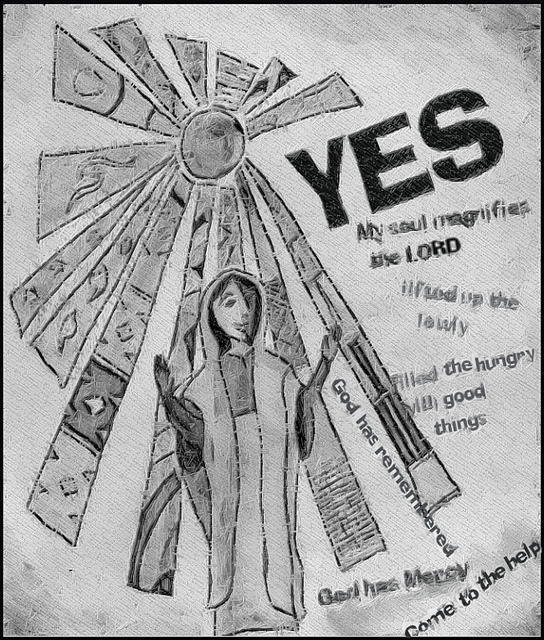
Luke 1:44-56 (1:50) – December 8, 2024

People have been writing songs about the Virgin Mary for centuries. Songs of praise, songs of worship, songs honoring God, and lifting up Mary for saying “yes” to God. Christmas carols might be the first thing that come to mind—but I am also thinking of music from centuries past. From the familiar first part of Handel’s Messiah, to the various settings of the Magnificat, with lyrics from the first chapter of Luke—our Gospel reading for this morning.

            Some Protestants might not be as familiar with the Virgin Mary as many Catholics and Orthodox Christians are. Mary is held in extremely high esteem in many denominations and faith traditions throughout the world, and for excellent reasons. I honor her greatly.

If we look at our modern world today, the situation here in our country, we have a great deal of uncertainty, and very little peace. Does our world today have some strong similarities to the world that Mary inhabited? I wonder, and I would say yes.

Mary sings about the mighty work of God. Yes, personally, in her life. But also in the lives of all the people in the world. “What will this work of God look like?  Something revolutionary is about to happen. God will turn the world upside down. The rich and the powerful will be brought low, and those living on the margins will be raised up. This isn’t a vision that fits very well with a Christian world that values success and power.[1]

For, that is definitely what a large portion of the so-called “Christian world” values today. At least, here in this country, and among a large number of people who claim to follow Christian values and practices religiously. Even if certain Christian denominations do not say it outright, the “Health, Wealth and Happiness Gospel” is a high priority in many people’s lives today.

Let us take a look at what Mary’s situation consisted of. Did you know that Mary—an unwed teenager from an oppressed people-group in an occupied country under crushing Roman rule—was also a radical? A subversive? Was plotting to overthrow the existing oppressive government and replace it with the rule of God?

            What surprising, even shocking things to say about the sweet, innocent Virgin Mary! Everyone associates her with travel to Bethlehem while nine months pregnant, and needing to deliver the infant Jesus in a stable, because there was no room for them in the inn.

That Mary? Radical? Subversive? Absolutely, yes.

Think about the modern Christmas season from another direction. Contrast Mary’s situation with today. Is there any place we can go where we are not bombarded with commercial messages shouting for us to “Buy, buy, buy!” and reminding us of big sales, and markdowns, and half-price! Not to mention all the pressure to be “merry and bright” all the time. Even when going to yet another event or concert or dinner or celebration is the last thing you want to do!

Let us reflect on the first chapter of Luke, on Mary’s song. The last thing on Mary’s mind was commercialism. “Mary’s song, often called the Magnificat, is a welcome contrast to the hyped-up speed of the commercialism that is too often the dominant theme in our culture during the Advent season. Her lyrics are an invitation to approach Christmas with a slower, more contemplative pace.” [2] Is it possible to slow down the frenetic pace of the holidays, to get off the commercial merry-go-round, and instead sit still and worship the coming Messiah?

Sure, the wonderful classical settings of the Magnificat were often sung in a foreign language, like Latin. Or, in text from the King James version of the Bible, full of “thee’s” and “thou’s” and all manner of archaic words. Listen to the first part of her Magnificat, as translated in the modern version by Eugene Peterson, “The Message.” 

“I’m bursting with God-news; I’m dancing the song of my Savior God. God took one good look at me, and look what happened—I’m the most fortunate woman on earth! What God has done for me will never be forgotten, the God whose very name is holy, set apart from all others. His mercy flows in wave after wave on those who are in awe before Him.”

 One well-known depiction of the Virgin Mary is one that is meek, docile, sweet, and not raising a fuss at all. But, wait a moment. Do we realize what Mary is going to sing next? How revolutionary were many of the statements in her song?

             “Even more importantly, Mary’s song is an overture to the Gospel of Luke as a whole. Mary’s lyrics set the tone for Jesus’s radical and controversial ministry that is to come:

You have shown strength with your arm;

You have scattered the proud in the thoughts of their hearts.

You have brought down the powerful from their thrones, and lifted up the lowly;

You have filled the hungry with good things, and sent the rich away empty.

“In contrast, the Christmas season leaves too many still hungry, and too many even further in debt.” [3]

            Do you hear what radical things Mary is saying? If these lyrics of her song were more well-known, would our understanding of Mary be changed? Here Mary is advocating social change, rescuing victims—neglected women, forgotten elders and children, abused strangers and refugees—from being trodden underfoot, even ground under the heel of bragging, bluffing tyrants and braggarts. Turning all society as it was in her day—and ours—upside down.

            What subversive idea is our revolutionary Mary advocating now? Feeding the starving? Giving the poor a banquet? Turning the unfeeling, callous rich people out into the cold? Yes, these radical words are the words found in Luke chapter 1, before we rush on to the narrative of the birth of the Baby in Bethlehem from Luke 2. 

Just looking at this Magnificat, we can see how subversive it was for the infant Messiah to be born to the Virgin Mary. And, we can begin to realize how radical it is for us to say, “O come, let us adore Him, Christ the Lord!” For Jesus truly will bring peace on earth, and He will truly turn the world upside down, just as Mary sang two thousand years ago.

But, this is still only the second Sunday of Advent. We still wait for the baby Jesus to be born in Bethlehem. We still hold our collective breath with all the rest of creation as we wait—and wait. And with Mary, we can rejoice in the promise of the coming Messiah.

Are we overwhelmed with the superficial, commercial glitz and bling of the holidays? Or, are we focused on what really matters – on the coming of our Messiah, our Lord, in God’s peace and wholeness? Let us focus on Jesus, today. Alleluia, amen.

@chaplaineliza

(Suggestion: visit me at my other blogs: matterofprayer: A Year of Everyday Prayers. #PursuePEACE – and  A Year of Being Kind . Thanks!


[1] http://www.bobcornwall.com/2015/12/blessed-are-you-among-women-lectionary.html

[2] http://www.patheos.com/blogs/carlgregg/2011/12/magnificat-learning-to-sing-mary%E2%80%99s-song-a-progressive-christian-lectionary-commentary-on-luke-146-55/

[3] http://www.patheos.com/blogs/carlgregg/2011/12/magnificat-learning-to-sing-mary%E2%80%99s-song-a-progressive-christian-lectionary-commentary-on-luke-146-55/

“Magnificat! Learning to Sing Mary’s Song,” Carl Gregg, Patheos, 2011.

Unknown's avatar

Uncertain? Hope!

“Uncertain? Hope!”

Luke 1:26-38 (1:37) – December 1, 2024

This week, we read one of the most familiar of the narratives in the New Testament, perhaps even of the whole Bible. From the first chapter of Luke, here is the first part of the reading:  “In the sixth month of Elizabeth’s pregnancy, God sent the angel Gabriel to Nazareth, a town in Galilee, to a virgin pledged to be married to a man named Joseph, a descendant of David. The virgin’s name was Mary. The angel went to her and said, “Greetings, you who are highly favored! The Lord is with you.”

            Let’s take a closer look at this situation. Imagine yourself as Mary, a teenaged girl. Perhaps doing housework, cooking in the kitchen, or folding laundry. When, out of nowhere, an angel appears. My goodness! Out of the clear blue sky, something completely supernatural happens! And not only that, but to be greeted by the angel with such words?

            Mary’s response is one of puzzlement: “Mary was greatly troubled at the angel’s words and wondered what kind of greeting this might be.” Let’s face it—Mary is perplexed! She is wondering at the angel’s words: “the Lord is with you.” What kind of a greeting is this, anyway?

            We can be fairly sure that Mary (or, as was probably her name, for a young Jewish woman, Miriam) Mary knew her Hebrew scriptures. The phrase “The Lord is with you” is repeated several times in the Hebrew scriptures, primarily expressing the Lord’s help or assistance. This would puzzle Mary even further—why on earth did she need the Lord’s help?

            We see Mary, probably in the middle of an ordinary day, with the angel Gabriel paying a surprise visit to her! What gives? What is going on?

           I know this is not exactly the same, but I would like to compare Mary’s surprise situation to ours, today. Specifically, to my friend Anita, some time ago now. Out of the clear blue sky, she found out that she needed surgery. Before the beginning of October, she was traveling along, blithely, no serious cares or concerns. After the first week in October? Her life was turned upside down, with a serious medical situation, quickly followed by major surgery.

            How often does something like that happen? Perhaps not a medical emergency in your life, or a loved one’s life, but some other serious situation out of a clear blue sky.

            But, let’s return to Mary. Or, more directly, to the angel Gabriel and what the next words out of the angel’s mouth are: “Do not be afraid, Mary; you have found favor with God.”

            I suspect, if I had the opportunity to see an angel, I probably would be afraid, too! Practically every time an angel visits someone in the Bible, “Do not be afraid!” is one of the first things out of their mouths! Gabriel continues: “You will conceive and give birth to a son, and you are to call him Jesus. He will be great and will be called the Son of the Most High.”

            Understandably, Mary is even more puzzled, hearing this! Her response—quite sensible, under the circumstances—“How will this be,” Mary asked the angel, ‘since I am a virgin?”

            I can see Mary’s point. The word from the angel? Surprise! Truth to tell, it’s hard to top a virgin birth! We can look at other places in the Scriptures, and see other miracles. We can look at the life and ministry of our Lord Jesus when He was an adult, and acknowledge the fact that He did miracles, regularly. But—here we have Mary, herself, wondering how on earth this miracle is going to happen to her?

            The angel has an answer for Mary, sure enough. “The angel answered, “The Holy Spirit will come upon you, and the power of the Most High will overshadow you. So the holy one to be born will be called the Son of God.” In brief, here we have the angel describing the divine plan for a miraculous conception. Mary expresses doubt and uncertainty, Gabriel explains God’s plan in greater detail, Mary consents, and the angel departs.

This whole narrative makes me want to ask Mary so many questions.

How soon did you tell your parents you were pregnant? Did you tell Joseph about the pregnancy yourself, or did the gossipmongers of Nazareth take care of that for you? Was there anyone in the village who believed your story? For that matter, after the angel Gabriel left, did you doubt his visitation to you? Did you think it was a dream? Question your sanity? And what about the townspeople’s response—did you fear for your life, since people probably thought you committed adultery?

The Gospel of Luke is silent on this matter. It leaves us with so many unanswered questions! All we know is what Mary said to the angel. “I am the Lord’s servant,” she answered. “May your word to me be fulfilled,” was her response.

I feel deeply for Mary. An unmarried girl who happened to be pregnant was not just looked down on but actively persecuted. Sure, she knows that she takes the risk of being rejected as a slut, as a tramp, as unworthy of polite company, as a result of this new openness to God’s surprise activity in her life.  I would not blame her one bit for being uncertain!

            Yet, we can see that Mary exemplifies the kind of response to God’s surprises that I would like in my own life. We can see from the Gospel that Mary afterwards goes to see her older cousin Elizabeth, who also is pregnant, miraculously. (I bet they have a good deal to say to each other, too!)

Though—out of a clear blue sky—God completely spun Mary’s life around, though Mary knew that her life would never be what she expected it to be before, she nevertheless said “yes” to God in faith. Yes, she worshiped God (especially in her prayer, which comes after our Scripture reading for today.) She models the heart of worship, the giving of ourselves to the one who has given everything to us.

Mary’s example challenges and encourages us to have the courage to say to the Lord: “Be it to me according to Your word!” This is blessed hope in God’s word!

Remember, Mary may have had thoughts about how this would affect the life she had planned out. However, she realizes there is something special about to happen, that God’s plan must take precedence over her own. She accepts the challenge with hope and faith as she realizes she will be carrying the Messiah her people have longed for.

            I’d like to remind all of us today that Mary—an ordinary Jewish teenager—was visited by an angel out of a clear blue sky. Mary was an ordinary person who was willing to say “yes” to God, to respond to God’s call willingly and with courage, and go forward in faith.

            It doesn’t matter what our situations are, today. God can come into any of our lives, seemingly out of nowhere. God can rush right in, abruptly, with no warning. We all—each one of us—are encouraged to respond to God in the same way as Mary did. To agree with God, to say “yes” to God, willingly, with hope, and go forward in faith.    

@chaplaineliza

(Suggestion: visit me at my other blogs: matterofprayer: A Year of Everyday Prayers. #PursuePEACE – and  A Year of Being Kind . Thanks!

Unknown's avatar

Jesus Says: Don’t Worry!

Jesus Says: Don’t Worry!

Matthew 6:25-34 – November 24, 2024

            Some people are real worriers. They worry about their house or apartment, they worry about their children or their parents, they worry about their job, their school, their friends, their car, their health – and that’s just to begin with! All of us know someone like this. And sometimes, worry about one or two, or even more of these things creeps into our hearts, too!

            All of these things are troubles, concerns. Worries. The news on the radio, on the television, different media websites—all depend on worry, anxiety and fear to pull in their viewers.  Here in our bible reading this morning, our Lord Jesus is telling us not to be filled with worry. Worry—anxiety—fear. When we come right down to it, this yucky predicament called worry sounds so familiar! We might not like it, we might be uncomfortable with it, but various yucky, fearful situations still happen to many of us, on a regular basis.

            All the worry and anxiety I just mentioned? That was mostly external. Looking outward. Fear of people, places and things. Yes, common to all of us. Let’s up that worry and anxiety one notch higher. Let’s sprinkle some self-centered fear on it. Does that sound familiar, too?

            Fear of the interior, that’s the inside job. Your insides, my insides. Our feelings and emotions, everything all mixed together like with a blender or a kitchen mixer. I imagine some people are so anxious and worried about what’s going on inside of them that they don’t even want to examine themselves, and do an inventory. They would far rather hide under a blanket. Or check out in ways that involve various addictions.  Emotional insecurity is very real. Lots of people feel alone. All by themselves, and cut off from others. Bitterness and frustration can make things worse. Worry and anxiety can magnify those feelings, way out of control.

            What can anyone do about this huge mountain of worry, fear, insecurity and anxiety?

            Since this Sunday is Thanksgiving Sunday, our Gospel reading has a few things to say about all this worry and negativity. This reading is from the Sermon on the Mount. The second half of Matthew chapter 6 is all about treasure and where we can find it. As is often the case in Scripture, Jesus lets us know that He is summing up this section by beginning with the word “therefore.” “Therefore” is used “to indicate that the writer or speaker is drawing a conclusion. Jesus’ words here are very simple and to the point: worrying is pointless.” [1]

Wait a long minute, there! Worry is part and parcel of the human condition. Anxiety and fear of the unknown (and especially of what IS known, what we recognize coming up!) are so often sad realities. Worry is invasive, like a nasty, invasive plant. Those of you who garden are very much aware of these weeds, these choking, creeping plants that wind around the healthy flowers and vegetables we plant in our gardens.

            I have heard a good deal about worry and anxiety in past years. In my previous job, I worked as a hospital chaplain, and now I am a hospice chaplain. Yes, I would pray with anyone who asked. But, I would also listen. As I listened, I heard about a whole lot of worry, anxiety and concern. And, rightfully so! Anxiety about upcoming treatment, worry about finances, awkward anticipation about losses of various kinds. But I would also hear about depression, anger, and self-pity. I’d hear about these painful emotions mixing and crashing around inside of people. Oftentimes, I would be helpless to do anything about it, except listen.

            In my personal life today, I have concerns. Sure, I have thoughts that sometimes preoccupy my mind. I can live in yesterday for far too long of a time. I sometimes look forward to tomorrow—or next week with some fear and anxiety. I especially have concerns about an upcoming procedure in the hospital, very soon.

But what does Jesus tell us in this paragraph from the Gospel of Matthew? He talks about the beauty and the vastness of God’s creation. He tells us to pick up our heads and look around. Doesn’t God take care of the birds of the air and the beasts of the field? If God takes care of them, think about us. Think about you and me. Do you think for one minute that God would forget about you? Or, that God would forget about me?

            One of my favorite commentators is the Rev. Janet Hunt. She is a Lutheran pastor, serving a church not too far away, in De Kalb – near the Northern Illinois campus. She talks frankly about being a worrier. She carried her fear and anxiety so deeply that her folks had her going to a therapist as a little girl (when that was still pretty unusual!). She said she still worries. She worried about where she put her cell phone the night before, She worried about an upcoming funeral sermon she needed to preach. She even worried about raking the leaves in her large yard!

            Yet, Pastor Janet gets right to the point. She says, “Without a doubt, my worries are small and even when they aren’t they don’t seem to paralyze me as they do some [people].  Still, even my small worries get in the way of my living in the moment God has prepared for me.  They take away from my fully experiencing and appreciating what is right in front of me.” [2]

            This Gospel reading is certainly a challenge for me, today, with the unknown looming ahead of me. Yet, whether our worries are big or small, we can all be reminded of this precious gift Jesus offers us all, in pointing to God’s tender care for all that is in this world.

            Anything can seem overwhelming, if we look at the whole huge thing all at once. Jesus’ words are really wise: “34 So do not worry about tomorrow; it will have enough worries of its own.” In other words, one day at a time. “Don’t worry about tomorrow!” Those aren’t my words—they’re the words of Jesus!

            As we consider this Thanksgiving week, and any week of the year, “these words [of Jesus] are ours this Thanksgiving —  urging us to let go of the worry — and to entrust whatever it is that would rob our lives of peace and joy — urging us to finally give it all back to God who gives us all of that for which we give thanks in the first place.” [3]  Praise God!

Suddenly, in this world not worrying actually becomes an option.

Our God can help each of us deal with worry, fear and anxiety, whenever and wherever they might rise up, in each of our lives. We can all say amen to the Lord’s goodness. We can truly give thanks to God.

@chaplaineliza

(Suggestion: visit me at my other blogs: matterofprayer: A Year of Everyday Prayers. #PursuePEACE – and  A Year of Being Kind . Thanks!


[1] https://lifeprojectblog.com/2024/09/09/worry-5/

[2] http://words.dancingwiththeword.com/2012/11/no-more-worries.html

[3] Ibid.

Unknown's avatar

God’s Faithful Promises

“God’s Faithful Promises”

Hebrews 10:15-25 (10:24-25) – Sunday, November 17, 2024

            Have you ever thought of all the different kinds of churches? Big churches, small churches, fancy places with lots of stained glass and stone carvings, or plain buildings with wooden pews and earnest prayers, plus house churches, all over the world!

            My friend Tiffany used to attend church at the National Cathedral in Washington. She grew up there. She remembers running around in that gorgeous building along with the other children in their renowned youth choir. Up and down the corridors, and even playing hide and seek in the building. Imagine having that glorious cathedral as a familiar, home church!

            I would like for us to focus on one particular idea in this Scripture reading from the letter to the Hebrews, today. “And let us consider how we may spur one another on toward love and good deeds, 25 not giving up meeting together, as some are in the habit of doing, but encouraging one another—and all the more as you see the Day approaching.”

I have worshiped at churches in a number of different faith traditions, in all different kinds of church buildings, and they all proclaimed the same Lord, Jesus Christ. The same God receives all the glory! Some churches pray in a more rambunctious manner than we do here. Yet, in every church, believers come together to worship God, and to encourage each other.

This letter to the Hebrews is a circulating letter. That means it and other circulating letters were sent from place to place in Asia Minor, so the small, struggling groups of believers could receive encouragement and teaching in writing from the Apostles and other newer church leaders. This particular letter was sent to Jews who lived a long way from Jerusalem, and possibly had rarely been to Palestine. Right here in chapter 10, this letter to the Hebrews gives the command to keep up meeting together.

Remember, the Christian community was extremely small at this point! In these towns and cities in Asia Minor and all over the Roman Empire, the Jewish community was decidedly small, too. Except, the Jewish religion at this time was known and accepted by the Roman government. Since Christianity was such a brand new religion, the Roman government did not recognize it, and in fact in some places, wanted to persecute followers of Christ!

I want everyone here to understand: in these early days, followers of Christ were not going to worship in large building dedicated to the Lord, set apart to the worship of our God. Not at all! This gathering together we read about in Hebrews 10 is in very early days of the church. We are talking about small house churches! Gathering together took place in each others’ homes, and maybe, perhaps, in a large spare room belonging to one of their number.

I’ve attended some African-American worship services. They are often quite different from the more quiet, sedate way we worship here at St. Luke’s Church. I had the privilege to preach in one service some years ago, at a Baptist church on the west side of Chicago. In a converted building, three storefronts put together. The building did not look like much from the outside. But, inside? A whole different thing.

The spirit of God came down and transformed that worship space – and the worshipers. Marvelous to experience. They truly encouraged one another, cared for one another, and helped one another show good to others. In their own context, familiar to them, on the west side of Chicago.

“After all, God has graciously adopted us into God’s family. God has transformed you and me from God’s enemies into God’s children, and from strangers into siblings. So when Christians meet together, we come to a kind of family reunion.” [1] When we meet together, whether it’s in a soaring cathedral or just where two or three are gathered together, God is present with us. And, God can draw us close. Closer to God, and closer to each other.

Now, this is only the first part of what happens when we gather together. What else can happen? What is another command from Hebrews chaplain 10? “And let us consider how we may spur one another on toward love and good deeds.”

So often, we as believers are told to be nice and gentle, meek and mild. And, that is one side of our Lord Jesus, certainly. But, the Rabbi Jesus when He was here on this earth was not just a meek, mild, retiring kind of guy. He often stepped out, and stepped up. Jesus actively worked on behalf of the poor, the forgotten, those left behind, in both love and good deeds!

How often are we called to be bold in the Scripture? To spur one another on to expressions of love and caring, to strike out and be bold and courageous? Yes, we are also called to be bold, and outspoken, and hard-working – like our Lord Jesus! This connects to the gospel call to face dangerous or difficult times bravely knowing that God is in charge. [2]

There is one important factor here, though. It’s very difficult to be brave, bold and courageous all alone. But – it helps if we do it together.

I would like to point out that all of these pronouns in these verses are plural. In the original Greek, the writer to the Hebrews is talking to “you all” when he mentions “you,” and especially when mentioning “we.” In all of these instances, all of these commands, these verses are talking to us Christians as a group. That is, all of us followers of Christ. Eugene Peterson’s excellent translation The Message interprets this as a summons to “be inventive … in encouraging love and helping out.”

As we come to the end of the church year, we consider a number of Scripture readings that talk about the end of our time here on Earth, when we look forward to our Lord Jesus returning. This Scripture reading from Hebrews is no exception. Listen again: “encouraging one another—and all the more as you see the Day approaching.”

Just as Boy Scouts are required to do a community service project to earn their Eagle Scout award, they need to organize others to help them do their special project. In the process of completing the project, they learn how to spur one another on to accomplish that goal, to join in together on good works that benefit their community. [3]

In the same way, we Christians are called to be faithful, to encourage each other, and to spur one another on! And, as each of us is drawn closer together to other believers, we are drawn closer to our God.

We followers of Christ are all called to actively work on behalf of the poor, the forgotten, those left behind, in both love and good deeds! And, all the more, as we all look forward to that Day when our Lord returns in glory.  We practice, we love each other, and we work together, looking forward to that Day when “every knee shall bow and every tongue confess that Jesus Christ is Lord.” What marvelous blessings for ourselves, for each other, for our communities, and for the world.  Alleluia, amen!

@chaplaineliza

(Suggestion: visit me at my other blogs: matterofprayer: A Year of Everyday Prayers. #PursuePEACE – and  A Year of Being Kind . Thanks!


[1] https://cepreaching.org/commentary/2018-11-12/hebrews-1011-14-15-18-19-25/

[2] http://worshipingwithchildren.blogspot.com/2015/10/year-b-proper-28-33rd-sunday-in.html

[3] Ibid.

Unknown's avatar

Out of Their Abundance?

“Out of Their Abundance?”

Mark 12:38-44 (12:44) – November 10, 2024

Just think, for a moment, about the sound two coins make as they clink into each other. I have two coins here. I’m going to take them both in my hand and shake them. Can you hear that? What does that sound bring to mind? Do you feel satisfied, or scary? Is that the sound of abundance, or scarcity? What do you think of that sound? [1]

We turn to the Gospel reading for today, from Mark 12. The Rabbi Jesus and His disciples are in Jerusalem, and Jesus is having another in those continuing discussions with the chief leaders and teachers of the Jewish Law. They happen to be in the rear of the Temple. Large sanctuary, many people walked and talked, and went to and fro. Business being transacted, multiple conversations and commotion going on. Except – the sound of two coins shaken together would be easily drowned out.

Listen again to a portion of today’s Gospel reading: “a poor widow came and put two very small copper coins into the temple treasury, worth only a few cents. 43 Calling his disciples to him, Jesus said, “Truly I tell you, this poor widow has put more into the treasury than all the others. 44 They all gave out of their abundance; but she, out of her poverty, put in everything—all she had to live on.”

Yes, I realize that our Lord Jesus was talking primarily about giving money. But, I have always thought of giving and being generous to count just as much for giving our time, and our talents, and our generosity in many other kinds of ways. Not simply in terms of money. I have a friend who has been retired for almost ten years now. He goes around town, quietly, and does good. He was raised in the church, but that was many years ago. Yes, he does have a belief in God, and he expresses that faith by doing good for others and being faithful.

Sometimes that means driving a friend to a doctor’s appointment. Or volunteering at a local not-for-profit organization. Sometimes that means picking up the left-over baked goods from a business at the end of the day, at closing time. And then, delivering those baked goods to a homeless shelter. He does all of this without thanks, with little or no fanfare. He is faithful. He is dependable. He contributes, in any way he can. And, I am so glad he is my friend.

Except, this is not the way that many religious people operate. Many religious folks – good, church-going folks – have been taught is that God works through deals. You do this, and I’ll do that. We do our bit, and then God will follow through with God’s part. “Pay a little extra and get a better seat at God’s table. Put in some overtime, split hairs on the detail of the law and you’ll get a nice long robe and watch everyone in the marketplace bow to you as you pass. Sure, maybe they had to foreclose on a widow or two, but business is business after all. And to make up for it look how much they gave, how much went into the offering box. Isn’t that what we want, more in the [offering] plate?” [2]

I know there are multiple ways to give, to be generous, including online giving – which is a wonderful thing. Here in the United States and in many other places around the world, we can give at the touch of a computer key or by pressing a cell phone button.

A number of years ago, at another church, I remember walking by the room next to the sanctuary where two trustees would be counting the offering after the worship service. But today, we don’t hear the offering. “The clink of coins is lost. Perhaps the value we place in pennies, nickels, and dimes has been lost, too. We no longer hear, see, or feel the weight of what happens when our small offerings come together in praise and honor of the God of abundant life.” [3]

But, back to our widow, the woman our Lord Jesus specifically points out. She had next to nothing to live on. God sees this woman, and many, many just like her. God cares about her, and about the countless others around the world. Along with commentator David Lose, I doubt anyone else, including the religious elite parading around the Temple that day and dropping in their token offerings and spare change, noticed this woman.

            Don’t you think that God also sees our struggles today, recognizes our challenges, cares about where we are hard pressed to make ends meet? And, isn’t God inviting each of us? This congregation knows I do not bring divisive politics into this pulpit. I preach what the Gospel teaches, what our Lord Jesus tells each of us to do.

I’m exhorting each of us to have open ears to what God is saying. God invites us to look around and see each other, those in our community we know and those we don’t.  I mean really see each other – the pain of those who are discriminated against because of their ethnicity, the desolation of those who cannot find work and have been abandoned to fend for themselves, the despair of those who have given up on finding work and have lost hope, the anguish of those who have been exploited by unfair employers, abusive landlords, or even detestable sex traffickers. God is inviting us to see them, to care for them, and to advocate for a system that does not leave anyone behind.[4]

This vignette from the Gospel of Mark is just a slice of the widow’s life. But, I’d like to follow the widow home. See how she treats her neighbors. Does she bring over a pot of soup to a sick friend? Does she clean the apartment of someone who has fallen and broken their leg? And what about her listening skills? Is she someone people come to, to talk about their troubles? Giving to God is so much more than just dollars and cents. So much more than just the coins the show-offy rich people put into the collection box in the Temple.

What about us, today? How can we take this scripture lesson today, and apply it to our lives? Is it just a nice story about what happened to people in Jesus’s day? Or, is it much more?

Today, we all can be like the widow in Jerusalem. This widow gave extravagantly. She gave over and above. She gave, trusting in God’s abundance. And, this widow decides that everything she is and has belongs to God. Like my friend I told you about, who does lots of things without thanks, with little or no fanfare. We all can be faithful. We all can be dependable. We all can contribute, in any way we can, to God and to God’s kingdom.

God willing, I’ll contribute to God’s kingdom. Will you contribute, too? Alleluia, amen.

@chaplaineliza

(Suggestion: visit me at my other blogs: matterofprayer: A Year of Everyday Prayers. #PursuePEACE – and  A Year of Being Kind . Thanks!


[1] https://www.umcdiscipleship.org/worship-planning/truth-telling/twenty-fifth-sunday-after-pentecost-year-b-lectionary-planning-notes

[2] https://www.umcdiscipleship.org/worship-planning/truth-telling/twenty-fifth-sunday-after-pentecost-year-b-lectionary-planning-notes/twenty-fifth-sunday-after-pentecost-year-b-preaching-notes

[3] https://www.umcdiscipleship.org/worship-planning/truth-telling/twenty-fifth-sunday-after-pentecost-year-b-lectionary-planning-notes

[4] https://www.davidlose.net/2015/11/pentecost-24-b-surprisingly-good-news/

Unknown's avatar

Who Does Jesus Love?

“Who Does Jesus Love?”

John 11:32-44 – Sunday, November 3, 2024

            Today is All Saints Sunday. A lot of people think of “saints” as super-holy people. Like St. Francis of Assisi, or Mother Teresa, or St. Ignatius of Loyola. These people and many other titled saints are super-stars (or, super-saints) of the faith! What kinds of things do you think about when you consider these super-holy people? Do they pray all the time? Do they do good works for God all the time? Or, what exactly do they do all day long? And when they get to heaven, do they play harps all the time?

            When we consider the people of the Bible, many of them are considered saints. Yet, if we read more closely, almost every person recorded in the Bible – either in the Hebrew Scriptures or the New Testament – displays very human characteristics! They show very human emotions, grieve, cry, get mad, say or do stupid things, and sometimes even worse.  

            Listen to Mary of Bethany as she pours out her agonized heart to her friend the Rabbi Jesus, and the following, very human exchange: “Mary came to where Jesus was waiting and fell at his feet, saying, “Master, if only you had been here, my brother would not have died.”

 When Jesus saw her sobbing and the Jews with her sobbing, a deep anger welled up within him. He said, “Where did you put him?”“Master, come and see,” they said. Now Jesus wept.”

            Merriam-Webster’s Dictionary has several definitions for “saint,” including “one of the spirits of the departed in heaven” and “one of God’s chosen and usually Christian people.” [1] This definition is more broad than what people often think of, when they think about saints. If we take this broader definition to heart, we can think of all Christians as being saints, and all of the people in the Hebrew Scripture as being saints, too.  

            Our Scripture reading today from the Gospel of John is often read during Lent, during the period right before Easter. However, this reading is also read on All Saints Sunday, as a witness to the power of our Lord Jesus over death. This reading is also lifted up in the African American tradition in a service of healing, for those suffering emotional distress, grief, divorce, and physical ailments. This healing also “speaks to a range of human issues and concerns. Suffering often drives individuals to petition for God’s healing.” [2]

            Whether we come to the Gospel of John expecting healing, or in preparation for Easter, or to commemorate all the saints, this reading remains one of the most hopeful, one of the most triumphant proclamations in the Bible. Our Lord Jesus has power over the living and the dead.

            Yet, here we are, on All Saints Sunday. Consider our Lord Jesus – or, the Rabbi Jesus, as He was considered then. His reaction to the death of Lazarus brings the reality of death close to us all. Jesus wept! He wept over his friend Lazarus. As our commentator Karoline Lewis says, “death is inevitable, and its pain, its loss, its cause for anger is all true and real.” She is speaking to preachers, like me. We are working professionals, who bear the hard part of death, being in the business of tending its consequences to those we professionally care for, yet so often do not take the time for our own personal sadness and grief. [3]

            How often do we tell ourselves that we will grieve “later on,” after we finish this necessary paperwork, or after we make these phone calls, or after we do these needed errands, putting off the grieving, the pain, the loss of our loved ones.

            The message we receive from the Gospel of John today tells us in detail about the raising of Lazarus. But before that happens, his sisters are devastated! Who wouldn’t be? A loved one’s death is devastating, even if death is a blessed release or a welcome and final end of pain.

I know, in my life, it is difficult for me to get up and get going when I feel devastated. It’s so hard to continue doing the normal, everyday things that need to get done in my life.  Have you ever experienced this kind of an invisible wall? Or, has someone close to you ever come up against something like this? These kinds of deep feelings happen with sad regularity among people who have just lost a loved one, a dear relative.

So many people let us down, here in this world. Either on purpose, or accidentally. Even unconsciously, sometimes. I know, it still happens. We get let down, time and again. It feels like a punch in the gut, sometimes! It hurts!

Here is where this Scripture reading comes in. It works on our hearts, draws each of us closer. We see the grief Jesus clearly felt, being disturbed at death and at the brokenness of this world, as we see Him approach the tomb. The wonder of Lazarus stepping out and the command to unbind him is a certain and sure symbol and promise of the freedom we will all know one day! And surely, this points to God’s Power, God’s Grace and God’s Gifts, for all of us. [4]

            We gather together here, in this place, to remember our friends and relatives each of us has lost, whether in this past year or in years past. Yes, we grieve and mourn. It is fitting and right that we do so. We are reminded that Jesus wept at the grave of Lazarus.

There is a tension we hold – holding many complicated emotions, holding grief and mourning, and at the same time joy and gratitude as we sit with the stark fact of missing our friends, our relatives who have died. And yes, we can rejoice as we consider “the promise and hope of the Resurrection and that even as Lazarus and his beloved family are privileged to live into that promise in this life even now, so are we [for the resurrection life to come]. So are we. Thank God, so are we.” [5]

Our Scripture reading today asks us to reflect that Jesus is, indeed, the Resurrection and the Life, not just for the crisis moment of death, but for all moments in life. Jesus announces that the world is definitively under God’s care and power. And, John chapter 11 offers all of us the promise about how each of us can live our lives today, not just about how our days will end. [6]

Is there someone you particularly remember, or especially miss? Someone who has crossed that river Jordan to join our Lord Jesus in the heavenly places? We have candles here. I invite anyone who wishes to come, to light candles for those loved ones. Light them in your hearts as well, as we come together in gentle comfort and encouragement of each other.

As we lean on relationship with each other in this life, even when faced with death itself, we see with eyes of hope that new life can spring up, through faith in Jesus Christ.  Yes, there is a balm in Gilead to heal the sin-sick soul, to make the wounded whole, and His name is Jesus. Alleluia, amen!  

@chaplaineliza

(Suggestion: visit me at my other blogs: matterofprayer: A Year of Everyday Prayers. #PursuePEACE – and  A Year of Being Kind . Thanks!


[1] https://www.merriam-webster.com/dictionary/saint

[2] http://www.theafricanamericanlectionary.org/PopupLectionaryReading.asp?LRID=64

[3] https://www.workingpreacher.org/dear-working-preacher/for-all-the-saints-2

[4] http://dancingwiththeword.com/these-precious-gifts-of-all-saints-day/

[5] Ibid.

[6] O’Day, Gail R., Gospel of John, New Interpreter’s Bible Commentary, Vol. 9 (Abington Press, 1996) 695.

Unknown's avatar

God’s Free Gift!

“God’s Free Gift!”

Romans 3:19-31 (3:24) – October 27, 2024

I have a confession to make. I was raised a Lutheran. Baptized and confirmed in a Lutheran church on the northwest side of Chicago, I loved everything about that church. learned all I could about being a Lutheran, and about Martin Luther. I studied Luther’s Small Catechism during my two years of confirmation classes in seventh and eighth grades. I know a thing or two about Martin Luther and about the church that to this day bears his name.

            This Thursday, October 31st, is the 507th anniversary of the day Martin Luther tacked up the 95 Theses, his 95 points of disagreement he had with the Catholic Church. In 1517, the priest and doctor of theology Martin Luther posted his 95 Theses on the chapel door in Wittenberg, Germany, at the university where he served as professor. Thanks to the printing press, these 95 points of disagreement spread like wildfire. Not only in Germany, but throughout Europe. The Reformation began in earnest. 

            Why was Martin so upset? When he was a very young man, Martin Luther felt unworthy of God’s love. He felt lower than a worm sometimes, and tried his hardest to get into God’s good graces! He would go to confession several times a week, do penance after penance, and he made several pilgrimages. All of these things and more to stop feeling unworthy and sinful.  

            Taking a quick look at the letter the Apostle Paul wrote to the Roman church, you and I might get that same message, too. From chapter three, “There is no difference between Jew and Gentile, 23 for all have sinned and fall short of the glory of God.” All have sinned! Martin felt that so deeply! All fall short of God’s glory! All means everyone. All of us.

            Romans 3:23 is pretty bad news. Rotten news. Really hopeless news. That is the news Martin Luther faced, the more and more he read and studied the Bible, meditated, and prayed.

            Martin was right. According to the Law of Moses, given to the nation of Israel in the Hebrew Scriptures, no one can follow the Law one hundred percent. Not the Jews in the time of Moses, not Jews in Jesus’s day, not Martin Luther, five hundred years ago. And, not you and me, today, either. There is no way anyone can keep every single one of God’s commands!

            That was what I felt, when I was a teenager. I knew I couldn’t keep all of God’s rules, even if I tried really, really hard. Remember Romans 3:23? “For all have sinned and fall short of the glory of God.”  When I was a teenager, I was a particularly studious teen. I would read books on the Bible and on theology when I was in high school. I prayed regularly, and tried my hardest to get closer to God. I felt sinful, unlovely and unlovable a good deal of the time. 

Martin Luther tried even harder to get close to God! He did a ton of good works. He got a university degree in theology, and started teaching from the Old and New Testament at the university in Wittenberg. He studied even more about God, and preached regularly in a church in town. And yet—Martin still felt sinful and far from God! He still felt unlovable!

            Can anyone relate to Martin? Are there times when you—when I—feel unlovable?
            I remember hearing the story of a woman, horribly burned in a fire. Her husband came to see her in the hospital and was disgusted and horrified. “You are not the woman I married,” he said, and divorced her. Are we so unlovable? Is that what we are afraid God might do to us?

            What’s more, even after lots and lots of good works and all these years of reading and study, Martin still felt so inadequate. He felt God could not possibly love or forgive him. That is—until he was reading the letter to the Romans, chapter 1, verse 17: “ For in the gospel the righteousness of God is revealed—a righteousness that is by faith from first to last, just as it is written: ‘The righteous will live by faith.’” 

            Do you hear? Do you understand? It wasn’t about how sinful or unlovable Martin was. Or, how hard he tried to do good things, or tried to get on God’s good side, or tried to live by good works. God’s righteousness comes by faith. Faith alone! Faith in God!

            Remember Romans 3:23? “For all have sinned and fall short of the glory of God.” That is true. But—that isn’t the whole story! From verse 3:21: “21 But now apart from the law the righteousness of God has been made known, to which the Law and the Prophets testify. 22 This righteousness is given through faith in Jesus Christ to all who believe. There is no difference between Jew and Gentile, 23 for all have sinned and fall short of the glory of God, 24 and all are justified freely by His grace through the redemption that came by Christ Jesus.”

“From Paul’s declaration that we have all been justified by grace to Luther’s hammering his theses against the Wittenburg Church door to remind us that grace reigns supreme, the whole darn Reformation-thing was intended to tell us that, in the end, we don’t need to do anything, earn anything, say anything, accomplish anything, or buy anything to earn God’s love. That we already have it, and that most of the Church’s problems – and, indeed, the world’s problems – start when we forget we already have love and worth and dignity as a gift from God and try to earn it or take it from someone else.” [1]

I can almost see Martin falling off his chair, once he realizes how huge this is. Our sin is taken away through the redeeming that came through Jesus. We are made lovable through God’s grace. Our low self-worth and low self-esteem is now viewed by God through Jesus.

God looks at all of us, each one of us, through Jesus-tinted lenses.  We are brothers and sisters of Jesus, God’s beloved children! We are redeemed freely. By His grace, through faith, through the redemption that came by and through Christ Jesus.

The best part of this gift? It’s a free, undeserved gift, so that no one can pridefully boast about it. Another way to look at this gift from God comes from a sermon study board online I follow. I recently read this, written a few years ago by a pastor named Erik in Wisconsin.       

“This Sunday we celebrate confirmation. As a part of their confirmation requirements, students have to meet with me for a brief discussion/interview. I ask them about faith, life, God, etc. – see if they learned anything during confirmation. One question I always ask is “How will you get into heaven? How are you saved?” Most often I get the answers – “Pray. Go to church. Do good deeds.” And I shake my head and ask myself “Didn’t I emphasize grace enough?”

            “Finally, I said to the class, “Listen, you are saved purely by God’s grace as a gift. I will ask you how you are saved in your confirmation interview. If you don’t remember anything else I’ve taught during these two years, remember this: “You are saved by God’s grace!” Why is it so hard to remember? Probably because we’ve been taught not to trust anything we might get for free, even if it is from God.”

            As Martin Luther studied scripture, he finally discovered he was saved by grace, not because of anything he did or deserved. The Rev. David Hansen tells us, “He discovered a God who would send the only Son—not for the perfect people, but for the sinners. He discovered, above all else, a God and a Savior that will NEVER abandon us, that will stand by our side no matter how often we fail or how short we fall.” [2] Isn’t that good news? Jesus died for our sins. Jesus showed us radical, God-sized grace, and radical, God-sized love.

As I proclaim each week after the Confession of Sin during the Assurance of Pardon, “Believe the Good News of the Gospel: in Jesus Christ, we are forgiven!”

Alleluia, amen!


Thanks to Rev. David L. Hansen and Pastor Erik from Wisconsin for their assistance in the formulation of this sermon!

@chaplaineliza

(Suggestion: visit me at my other blogs: matterofprayer: A Year of Everyday Prayers. #PursuePEACE – and  A Year of Being Kind . Thanks!


[1] https://www.davidlose.net/2015/10/reformationpen-22-freedom/

[2] from http://www.gmi.org/services/missiographics/library/world-refugee-day

Unknown's avatar

On Eagle’s Wings

“On Eagle’s Wings” – Memorial Meditation

Isaiah 40:28-31 – Sunday, October 20, 2024

            My husband Kevin is a homebody – most of the time. However, he does enjoy occasionally hitting the road. I suggested to him about two months ago that we take a road trip, so we planned to go to the Smokies National Park next week. That is, until Hurricane Helene blasted right through that region, causing devastation all the way from landfall in Florida to many points north. The official Smokies park service website now pleads with prospective visitors not to visit, at least for a while, because of the massive clean-up that needs to be done.

            So, since I have PTO time reserved away from work already, my husband and I made a quick switch to someplace closer to home. On Wednesday, we are heading to Cahokia Mounds near St. Louis, to Pere Marquette State Park, on the Mississippi River, and to Starved Rock State Park. I know this is not prime time to see eagles, but I hope that perhaps we will catch a glimpse of these magnificent birds on their migration south to open waters for the winter! 

One of Carol Metler’s favorite church hymns was “On Eagle’s Wings.” This lovely, newer gospel song was originally written as a verse and refrain for Psalm 91, which affirms that we find refuge under God’s wings. The refrain of this gospel song is most sung in Protestant congregations – “And God will raise you up on eagles’ wings, bear you on the breath of dawn, make you to shine like the sun and hold you in the palm of God’s hand.” 

            Whether we consider Psalm 91 or Isaiah chapter 40, both sections of the Bible talk about God’s protecting hand – and more! Listen to the words of the prophet again: those who hope in the Lord will renew their strength. They will soar on wings like eagles; they will run and not grow weary, they will walk and not be faint.”

This chapter in Isaiah especially mentions the followers of God soaring on wings like eagles. You know and I know the followers of God often do not have an easy time of it. Life is not a walk in the park. Life is a challenge, sometimes. Even, more often than that, sometimes.

            I suspect our dear Carol knew that life was a challenge, many times in her life. She was stubborn, and persistent, and she made it through – with God’s help!

            However, I would like to step back and consider the historical context of this biblical passage. Isaiah chapter 40 was written while the Jewish people were in exile in Babylon, and it is  in the section of the book that deals with comfort. This reading comes from the very middle of Exile.  The Jewish people had been stuck in the foreign country long enough to feel like everything was going wrong and God wasn’t doing anything to help them. [1]

Commentator Dr. Steed Davidson stresses God’s power at work. The prophet does a compare/contrast thing here. Human people are inadequate to change the long distances of history and the circumstances of life. But – but – God is the Creator of heaven and earth! God has strength and power that transcends faulty human striving. Plus, verse 31 calls on “listeners to participate in God’s processes in order to experience transformation.” [2]

            God gives strength to the weary to continue. God comes alongside those who are bone tired, so weak and dispirited that, of themselves, they could not take even one more step. But, God! But – God! Have you ever been so tired, or worn out, or anxious, fearful, discouraged – or one of a dozen other downhearted emotions? And then – but, God!

            Imagine trying your hardest on a challenging project, and feeling like you got to the end of yourself. You can’t give any more. And then, but, God! Or, imagine you are sitting by the bed of a loved one recovering from serious surgery or in the middle of chemotherapy, and you feel so helpless to help your dear loved one. And then, but, God! God transforms everything.

            “But” is usually a negative, a placeholder, a frowny face kind of a word, in so many situations. “But” so often has negative connotations – except for this one, here – but, God!

            God transcends the negative language that we use. God transforms any downhearted stammering of “but, but, but…” into a positive, blooming, blessing of “but – God!” Showing the renewing, revitalizing possibilities of our Lord. Like the Refuge we run to, like a sturdy, safe Rock in the wilderness, God is so much more than we can possibly ask or think.

            The pastoral musician Father Michael Joncas wrote this song in the 1970’s, and it has been sung countless times, and in some very harrowing situations. Imagine the ultimate shock, horror and heart-rending grief of the September 11th attacks; this song was performed at many of the funerals of the victims of that attack. This song is often performed during or at the end of a Catholic funeral mass. And, we will have this song played later on in this worship service, too.

Countless people have been touched by the words and music of this hymn, and many of those same grieving, hurting people would testify that God did indeed come close to them through their difficult times, just as this song tells us.

            This is just what the authors of our two sections of Scripture wanted us to remember. Time and again, stories and narratives from the Bible remind us that the saints of old had challenges – difficulties – they had to deal with – walk through – even, soar above, on eagle’s wings. Can you relate? Hoping in the Lord is expecting that God’s promise of strength is a reality. God can come alongside. God can comfort and strengthen. Just as it was when our prophet wrote these words, just as it is now, today. God can assist us when we are alone as well as when we are together in one group, one congregation, one family.

“Do you not know? Have you not heard?” Praise the Lord, we know God’s protection and care is always with us, always holding us in the palm of God’s hand.

And to that, we all may say, alleluia, amen.

@chaplaineliza

(Suggestion: visit me at my other blogs: matterofprayer: A Year of Everyday Prayers. #PursuePEACE – and  A Year of Being Kind . Thanks!


[1] http://worshipingwithchildren.blogspot.com/2015/01/year-b-5th-sunday-after-epiphany-5th.html

[2] https://www.workingpreacher.org/commentaries/revised-common-lectionary/fifth-sunday-after-epiphany-2/commentary-on-isaiah-4021-31

Unknown's avatar

Who Then Can Be Saved?

“Who Then Can Be Saved?”

Mark 10:17-27 (10:26) – October 13, 2024

If we turn on the television, read a book, or listen to a podcast or talk radio, sometimes we might hear experts giving advice. These knowledgeable experts are often from well-known places. This week I am thinking about advice on how to live the “right” way. That’s sometimes thought to be a fruitful life, or a healthy life, or a spiritual life. Wouldn’t you be interested if you heard a radio program with a noted author or well-known expert in just this subject?

            That’s the case with Rabbi Jesus, today. In today’s scripture lesson, we get just a hint of what our Lord Jesus had to deal with much of the time. Can you see this situation? I love St. Ignatius and his prayer suggestion to put ourselves into the narrative. Let us imagine ourselves being there, right with our Lord Jesus the itinerant Rabbi, and His disciples.

The Rabbi Jesus was about to travel somewhere, and a number of His disciples are getting ready to accompany Him. It is significant to read what our commentator David Lose has to say about this journey. “In Mark, this is not merely “a journey” in general (per the NRSV), but rather represents the road to Jerusalem and the cross.” [1] And, repeatedly, our Gospel writer Mark tells us that Jesus has His face set to go to Jerusalem.

When, what happens? “17 As Jesus went out into the street, a man came running up, greeted him with great reverence, and asked, “Good Teacher, what must I do to get eternal life?” That is a pretty big question, isn’t it? Many people throughout the ages have wondered exactly that! The Rabbi Jesus was a widely acknowledged wise person, an expert in the interpretation of the Hebrew Scriptures, the Law of Moses and in lots of things associated with religious and spiritual life.

After all, you don’t get an expert in religion and spiritual life coming to your town just any old day.

The Rabbi Jesus is matter-of-fact, and responds (as many Rabbis would), “You know the commandments: Don’t murder, don’t commit adultery, don’t steal, don’t lie, don’t cheat, honor your father and mother.”

This is a shortened list of some of the Ten Commandments from the book of Exodus. These commands from God are revered as being the shorthand version of God’s rules for living. Now, while we have our imagining caps on, imagine we are watching this whole scene play out. Our teacher, the Rabbi Jesus, is involved in conversation with this earnest young man.

Except, something is different about this young man. He’s well-dressed, and looks to be really rich. Plus, he answers the Rabbi Jesus in all seriousness! “He said, “Teacher, I have—from my youth—kept them all!” 21 Jesus looked him hard in the eye—and loved him!”

 What do we see here? “Jesus looks at him with love (verse 21). He does not treat him as insincere or mock him as self-righteous, but rather loves him. Every interpretation we may offer must therefore take seriously Jesus’ absolute regard and unconditional love for this man.” [2]

I am still looking at this whole scene through my imagination, too. I am right there, watching everything go on. Watching the gathered crowd in the dusty afternoon in one of the towns of Palestine. And, we can see the love shining out of our Rabbi’s eyes!

But, let us get back to our rich young man who asked Rabbi Jesus this serious question. “’Jesus said, “There’s one thing left: Go sell whatever you own and give it to the poor. All your wealth will then be heavenly wealth. And come follow me.’ 22 The man’s face clouded over. This was the last thing he expected to hear, and he walked off with a heavy heart. He was holding on tight to a lot of things, and not about to let go.”

Dr. David Lose said about this point in the reading, “what Jesus really meant was that we needed to unburden ourselves of whatever might be keeping us from relying on God.” [3] Yes, the rich man had a great deal of difficulty hearing these words of Jesus.

            Let’s face it: these are difficult words for many people to hear. We love our stuff, don’t we? Or, if not most of our stuff, at least some of our stuff. I would really have difficulty giving up my computer and my car. I think I am not the only one in this room today for whom that is true. Others might have difficulty unburdening themselves of whatever might be keeping each one from God.

“Jesus knew that the only thing that could overcome the gravity of the riches of this life is a force stronger, a greater pull. Love redeems; love rescues; love wins. He knew that. He knows that. Jesus loved him even though it didn’t seem to work. The young man walked away, grieving. The burden on his heart increased, instead of lightened. He had the antidote; he had the prescription. But the medicine was too bitter for him to swallow.” [4]

Let me ask, as we still consider us being there, right next to Jesus. What would it be like to have Jesus look upon each of us with that same love? What is more, Jesus asks each of us the same question about our stuff, about following Jesus. And, what is our response to Jesus?

All of our stuff gets in the way between us and God’s kingdom. All of this clutter and distraction in our lives keeps us at a distance from God. We know what Jesus has asked us to do, just like this young man did. When you don’t do what God has asked you to do, how do you picture God responding to you? Do you imagine God looks at you—at us—with loving compassion like Jesus did in this story? What’s more, we all will see how all of our “small steps” in loving and giving combine to create a beautiful impact of compassion in God’s world.

            And, maybe, just maybe “God’s gift of salvation can actually free us to do something: to love each other, to care for God’s people and world, to share the good news…right here, right now, wherever it may be that God has placed us.” [5]  

            God willing, we can all show love, giving, and compassion, every day. Alleluia, amen.

@chaplaineliza

(Suggestion: visit me at my other blogs: matterofprayer: A Year of Everyday Prayers. #PursuePEACE – and  A Year of Being Kind . Thanks!


[1] https://www.workingpreacher.org/commentaries/revised-common-lectionary/ordinary-28-2/commentary-on-mark-1017-31-3

[2] Ibid.

[3] http://www.davidlose.net/2015/10/pentecost-20-b-curing-our-heartsickness/

[4] https://www.umcdiscipleship.org/worship-planning/walking-with-jesus/twenty-first-sunday-after-pentecost-year-b-lectionary-planning-notes/twenty-first-sunday-after-pentecost-year-b-preaching-notes

[5] http://www.davidlose.net/2015/10/pentecost-20-b-curing-our-heartsickness/

Unknown's avatar

How Majestic is God’s Name!

“How Majestic is God’s Name!”

Psalm 8 (8:4) – October 6, 2024

            How many here can think of a truly unforgettable experience you have had? Maybe going on vacation, and seeing an unforgettable sunset or rainbow? Or perhaps taking a trip to a National Park, and experiencing some unforgettable scenery, like a spectacular waterfall? Or maybe traveling by boat or ship and seeing unforgettable sea creatures, whales, or sea lions? The world is full of marvelous, unforgettable things, and God created them all!

            But, we can’t go on vacation every day. Very few of us are able to see marvelous scenery or go to exotic places on a regular basis In the every-day, ordinary kind of way, I wonder if you and I really think the world is majestic? Awesome? God has made the world, and I think the Lord has done a pretty good job. But, how many of us think the Lord is majestic? Awesome? I mean, on an every-day basis. Are we stunned, at a loss for words by the majesty of the Lord?

            Let’s hear how our psalm today starts, again. “Lord, our Lord,  how majestic is your name in all the earth! You have set your glory in the heavens.” Wow! And, that is just the first verse! The Lord is OUR Lord, and the Lord’s name is majestic. Not just so-so, not pretty good, but majestic! Not to mention, the Lord has set glory and majesty in the heavens!

            I can see the stars on a clear night, but not quite as many here in Chicago as I can up in Wisconsin or in Michigan, far from the city. My husband Kevin spent two years in the mountains of Colorado, a number of years ago. He said the stars regularly put on an amazing display in the mountains, on a clear night. And, the moon, too! Truly majestic to see.

            Our psalmist marvels at the heavens, too – and more! “When I consider your heavens, the work of your fingers, the moon and the stars, which you have set in place, what is humankind that you are mindful of them, human beings that you care for them?

Our psalmist King David started out contemplating the heavens, and the awesome majesty of God. Now, he shifts to considering humanity. “In comparison to the grandeur of the universe, the psalmist questions why God would be mindful of humanity and care for them.” [1] Really, this is a valid question! After God created the heavens, and the stars and moons and all the other heavenly bodies, we humans are like grains of sand. Maybe even smaller, maybe microscopic. Who are we that God is even mindful, even aware of us? 

From time to time, maybe even more often than that, it is so easy to get caught up in the pressures and expectations of the world! You and I can know that very well. Such feelings of loneliness, insecurity and doubt can threaten to overwhelm us. Imagine, not being sure that we are worth anything, and feeling that we are like tiny grasshoppers or worms.

I don’t know about you, but just reading this description of humanity makes me feel so insignificant, especially in the face of such glory, such grandeur of all creation. However, isn’t this an opportunity to affirm, to witness to the blessed fact that this God who is described here by King David is also my God? In fact, our God?

            We have reassurance from King David! “Psalm 8 reminds us of our unique identity as children of God and the incredible value and purpose we have in Him. This psalm teaches us to look beyond ourselves and recognize the greatness of our Creator, who has entrusted us with the responsibility to care for [God’s] creation.” [2]

            Listen to the next verses of this psalm, and see how much trust the Lord gives to us, how much happiness and at the same time, responsibility: “You have made thema little lower than the angelsand crowned them with glory and honor You made them rulers over the works of your hands; you put everything under their feet:”

            How amazing that we – we puny humans – are crowned by God with glory and honor! And, that is all humanity we are talking about. Not just a few humans, not just the humans in our particular group or from our particular country. No! This psalm says ALL. Everyone. What a Godly proclamation to give each of us a worthy opinion of ourselves!

But wait, there’s more! God not only has made a royal proclamation that crowns all of us with glory and honor, the Lord has also made each of us heaven-appointed stewards of this marvelous world we all inhabit.

We all have a task to do, simply by nature of being born on this earth. Just as in the beginning of Genesis, Adam and Eve were assigned tasks by God to tend and keep the Garden of Eden, so with each person today. Whether we garden, or recycle and pick up trash, or choose responsibly-sourced food items and clothing, we all can be good stewards of this beautiful earth God has created for each of us and given us to live in.   
            One of my favorite people I follow on social media comes from the Peak District in northern England. She is a brilliant photographer of her native Peak district, and her handle is “Peaklass.” I love the description and the advice she gives: “In our rush through life, moving faster, working smarter, we miss so much. We miss the drift of seasons and the gentle ebb and flow of nature. We miss patterns, colours, changing light. We miss beauty and quiet. Sometimes we all need to stop and just watch the clouds roll.” [3]

            This psalm ends as it begins, “Lord, our Lord, how majestic is your name in all the earth!” Can you think of a more wonderful praise and prayer to our God than to enjoy the beauty and majesty of God’s creation, today? Yes, God’s name is majestic in all the earth! Each of us can stop where we are today, and praise God for all creation, all creatures great and small.  

            Two days ago was the feast day of St. Francis of Assisi; many faith traditions celebrate with a Blessing of the Animals this weekend. St. Francis is not only a patron saint of animals, he is also the patron of all creation, or the natural world. I want to end today with a benediction, a verse from the hymn that is attributed to Francis, “All Creatures of Our God and King.”

Let all things their Creator bless,
And worship Him in humbleness,
O praise Him! Alleluia!

Praise, praise the Father, praise the Son,
And praise the Spirit, Three in One!

            O, let us praise God, indeed! Alleluia, amen.

@chaplaineliza

(Suggestion: visit me at my other blogs: matterofprayer: A Year of Everyday Prayers. #PursuePEACE – and  A Year of Being Kind . Thanks!


[1] https://youthgroupministry.com/lessons/youth-ministry-lesson-on-psalm-8-embracing-our-identity-in-christ/

[2] Ibid.

[3] https://x.com/peaklass1/status/1842835391595905259/photo/1