Unknown's avatar

Ganging Up on a Neighbor

“Ganging Up on a Neighbor”
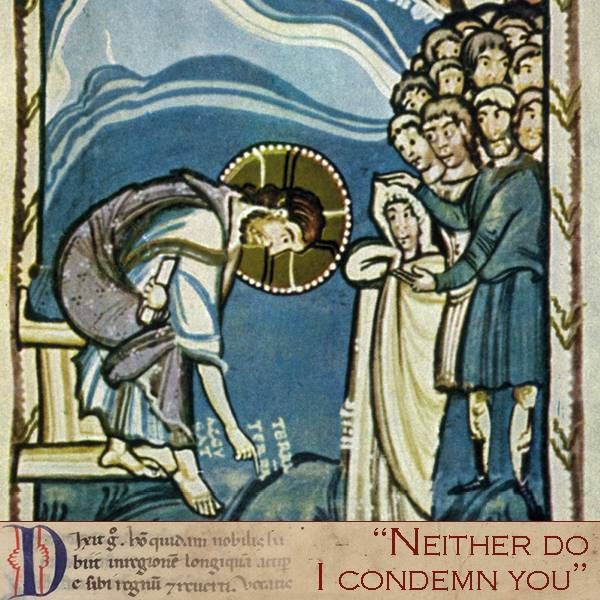
John 8:1-11 (8:7) – August 3, 2025

Have you ever watched a bunch of people gang up on one poor person? I’m thinking in elementary school, in the playground. Or, what about at the lunch table in high school? Even in the break room at work? A few mean words can turn nasty, fast! Sometimes if it goes too far, a group of people really start to pick on one poor person, or shun them, even ostracize them! And worst of all, the people doing the shunning can be such hypocrites!

Now we are entering the sketchy neighborhood of our Scripture reading for this morning. We have a group of Jewish leaders, big shots in their synagogues. You know what happened. These Jewish leaders have grabbed a woman in the very act of adultery. She may have been a married woman, and she was having sex with a man who was not her husband.  

The Rabbi Jesus has been talking with and discussing with groups of these leaders for some time. And, Jesus has been very successful at dialoging with these leaders, too! But, wait – they finally think they have got a situation that the Rabbi Jesus cannot squirm out of!

“Imagine the sense of urgency and the heightened emotions of the crowd swarming in on Jesus as he taught in the temple. They put this woman in front of the crowd. The Pharisees used her as an item, an object, a thing to entrap Jesus. I can imagine the contempt in the Pharisee’s voice as he asked, ‘Teacher, this woman was caught in the act of adultery. . . . Moses commanded us to stone such women. Now what do you say?’” [1]

Now, wait just a moment! The Jewish leaders have dragged this woman in front of Jesus, in front of the crowd in the Temple, and are accusing her, with baited breath! I can just see the crowd getting all agitated and upset! “Of course the Law of Moses tells us that adultery is bad! Of course this woman is guilty – our Jewish leaders say so! Of course she should be punished!” I can just hear the voices and noises of the crowd becoming more and more frantic and angry!

And, what does Jesus do? Nothing. He does not respond. He does not fly off the handle, as some people would. He does not react abruptly to the leaders or the crowd, either. Instead, Jesus stooped down and began writing on the ground with His finger. Finally, after the Jewish leaders kept badgering Him with questions, the Rabbi Jesus does respond.

Except, that makes me wonder. I know in our culture, in the United States, we do not stone people. Except, we still will ignore, and even jeer at people sometimes. We still practice shunning individuals in this country, sometimes.

These Jewish leaders and big shots at their synagogues seemed to have it all together. Except, these men were hypocrites, all the way! Saying one thing and doing another is the height of hypocrisy! I suspect these men – because the Jewish leaders were all men – these men felt fully justified in themselves. Fully self-righteous, and they couldn’t be bothered with pesky little things like their own repeated sin, or their conscience pricking them on the inside.

 I want each of us to understand how damaging it is to say one thing but do something totally different. “Do as I say, not as I do!” This is definitely the work of a hypocrite.

 “Hypocrisy creates barriers, harms relationships, and leads people away from God. In Matthew 23:27, Jesus calls out the Pharisees, saying, ‘Woe to you, scribes and Pharisees, hypocrites! You are like whitewashed tombs, which appear beautiful on the outside, but inside are full of dead men’s bones.’ The Pharisees focused on appearing holy, while ignoring God’s call to live with integrity and compassion.” [2]

The angry leaders who brought the woman to Jesus clearly were accusing and vicious towards the unnamed woman, and considered her simply a thing, an object of sin. I wonder whether they even considered the fact that this woman was a person of worth, or that she was created by God, just as much as each of them were? These were ways in which these leaders of the community could certainly live out God’s call to live each day with integrity and compassion – which the Rabbi Jesus did each day.

Jesus did not suddenly react or defend either Himself or the woman. Instead, He slowed down the frenetic emotion and action. Jesus reflected, and listened. Finally, Jesus made a comment. I imagine Him making that comment in a quiet but firm voice: “Let any one of you who is without sin be the first to throw a stone at her.” Then, “those who heard began to go away one at a time, the older ones first, until only Jesus was left, with the woman still standing there.”

Our summer sermon series features Fred Rogers, of Mister Rogers’ Neighborhood. We have considered several serious narratives from the Gospels during this series, and this week is no exception. Fred Rogers was no stranger to serious matters. A number of his television shows discussed very serious things – to children, yes, but also to adults. Divorce, death, war, and even the terrorist activity in 2001, on 9/11.

Fred Rogers excelled at listening to people. “Reflective listening, which does not imply agreement, pauses your agenda and aims to understand first. Fred listened intently and often agreed with the children since he was tuned into their fears and frustrations. [One of Fred’s signature messages,] ‘I like you just the way you are’ can’t get any more validating – pure emotional gold.” [3]

When Jesus practiced reflective listening in this extremely emotional situation in the Temple, we can see how tuned in Jesus was to the crowd’s fears and frustrations. And then, He turned the situation around, even turned it on its head by stating to the accusers in a quiet but firm voice: “Let any one of you who is without sin be the first to throw a stone at her.”

Jesus saw this woman as someone worthy of respect, a creation of God, unlike the men who accused her. Jesus’ words and actions offers this woman self-reflection and changed behavior at the realization of sin, just as He offered to the Jewish leaders and the crowds, multiple times throughout His ministry.  “Jesus’s actions were scandalous because they broadened acceptance, extended mercy and forgiveness to the undeserving, and brought justice to the overpowered and abused. Will the church ever do the same?[4]

Yes, today’s Scripture reading is extremely serious. And yes, Jesus makes His offer of grace and mercy, forgiveness and compassion to this woman, to the Jewish leaders who accused her, to the crowd, and to each one of us today. We can live honest, compassionate lives, with kindness and humility, today.

Here’s a challenge: “try to pay close attention to any moments when you might feel yourself slipping into judgment or hypocrisy. Maybe it’s a small thought about someone’s behavior, or a reaction to something they said. When you notice this, take a step back and remind yourself that we aren’t perfect either. Instead of letting judgment grow, try saying a silent prayer—for that person and for yourself. Ask God to help you see them through His eyes, with compassion and understanding.” [5]

I know I often ask in my sermons “what would Jesus do?” Who would Jesus forgive?

This week, I am going to change up my question, and ask “what would Fred Rogers do?” Who would Fred listen to? Who would Fred call his neighbor? I think, everyone. Each and every person, no matter who. Go. Go, and do that.

Alleluia, amen.

(A big thank you to the online resources for Mr. Rogers Day – the Sunday nearest March 20th, Fred Rogers’ birthday. These resources come from the Presbyterian Church (USA). https://www.pcusastore.com/Content/Site119/Basics/13792MrRogersIG_00000154465.pdf )

@chaplaineliza

(Suggestion: visit me at my other blogs: matterofprayer: A Year of Everyday Prayers. #PursuePEACE – and  A Year of Being Kind . Thanks!


[1] https://www.cbeinternational.org/resource/four-important-lessons-we-can-learn-from-jesus-and-the-woman-in-john-8/

[2] https://young-catholics.com/14808/exploring-hypocrisy-free-lesson-plan/

[3] https://www.psychologytoday.com/us/blog/the-full-picture/202302/mister-rogers-remembered-since-we-need-him-now

[4] https://www.cbeinternational.org/resource/four-important-lessons-we-can-learn-from-jesus-and-the-woman-in-john-8/

[5] https://young-catholics.com/14808/exploring-hypocrisy-free-lesson-plan/

Unknown's avatar

The Poor Widow’s Gift

“The Poor Widow’s Gift”

Mark 12-42 widow, mite mosaic

Mark 12:38-44 – November 11, 2018

You know celebrities? Many of us follow their activities. Look at popular tabloids, magazines, television, and computer screens. It seems like the richer the celebrity, the better. So many celebrities give away a lot of money, or a lot of stuff, and they get a lot of applause. Look at Oprah Winfrey, Taylor Swift, Bono, and Angelina Jolie. All of them are very open in their giving, and they are to be commended, even applauded.

Many people watch celebrities, to see what they do, and even how they give. This is not a new activity. People have been doing it for centuries. In our Gospel reading today, people were watching, too. The offering box for the Temple was in the back, by the exit door. In the first century, apparently it was common for people to sit or stand near the offering box and watch as the faithful put in their offerings.

In the first century, all money clinked. All money was in coins. That means, no paper money. When anyone threw money in the offering box, the money made a metallic sound. I suspect there even were some who knew what kinds of noises different coins made. They possibly could keep “score,” regarding what kinds of coins were given by which people.

In the first part of our Gospel reading, our Lord Jesus calls out the temple leaders. Jesuse tells His disciples that the teachers of the Law of Moses are hypocrites. “They like to walk around in flowing robes and be greeted with respect in the marketplaces, 39 and have the most important seats in the synagogues and the places of honor at banquets. 40 They devour widows’ houses and for a show make lengthy prayers. These men will be punished most severely.”

Whoa! This is judging! And, judging pretty severely, too. Notice, please, where Jesus mentions “devouring widows’ houses.”

Does everyone here understand what happened to a widow, after her husband died? She had no way to earn money, and very quickly she would become poor, sometimes even losing the house she lived in. That’s a direct condemnation of the group Jesus was talking about in the first verses. He’s weighing one group of people against another.

These religious leaders had special clothing that actually was very different from the clothing of the other, “blue-collar” workers around them. The leaders had fancy long sleeves and elaborate cloaks that came down to the ground, which would just get in the way for the blue-collar workers. What is more, the synagogue leaders just loved to sit at the head table for public events or at synagogue functions.

“While those actions may have seemed spiritual, Jesus warns they’re signs that the religious leaders especially enjoy the attention they receive from people. However, Jesus also points out that the religious leaders of his day don’t just crave attention.  They’re also hungry for material things.  Jesus grieves, for example, how they “devour widow’s houses,” exploiting these defenseless people.” [1]

So, these religious leaders are two-faced and hypocrites. What else is new? The way the scribes/Pharisees treat the widows. That is, the poor, the indigent. Horrible example for others. They were throwing their pocket change (jingle, jingle) in the giving box in the back of the synagogue, so everyone could see AND hear how MUCH they gave, all the while neglecting and even robbing the widows of what the Temple offering would have given the poor.

This sermon is about so much more than the poor widow and her tiny gift. But, now that I’m referring to that, what about her gift, anyway?

If they were lucky, some widows had a small next egg saved up for a rainy day. And when that was gone, they had nothing. Zero. Talk about living on a fixed income! With no life insurance, Social Security or other government safety nets, these widows were often sunk, Out of luck, unless the synagogue chipped in or helped out, that is.

Jesus pointed out that ““Truly I tell you, this poor widow has put more into the treasury than all the others. 44 They all gave out of their wealth; but she, out of her poverty, put in everything—all she had to live on.”

What a contrast! On one hand, the show-off religious leaders, with their ostentatious gifts of money they can easily afford. On the other hand, we have people like this widow, giving her all.

But, what about the attitude of giving we see here?  One of the commentators says, “Some of the happiest, most fulfilled people on the face of this planet have the fewest resources and choice. These same people are also some of the most generous. They don’t seem convinced that hoarding their meager resources is the best use of them, and they appear to find more joy and possibility in sharing with others and in building relationship capital.” [2]

Another way of saying a similar thing? In the archives on a pastor’s chat-board, a Pastor JD from Washington DC gave the following example. “The widow gave from her “poverty” it says. Think about people who have given from their vulnerable experiences, from their “poverty” and, in so doing, have helped others beyond measure. An alcoholic revealing to a problem drinker his or her life’s story; A woman who has survived breast cancer shares her struggle with someone newly diagnosed; A Christian shares his faith doubts and journey revealing a realistic and growing faith.” [3]

Think about it. Those who knowingly share in their poverty are truly the most giving and trusting individuals of the world. God doesn’t want 10%, God wants 100%, regardless of whether we have less than others or more than others. God wants it all.

Each week we sing “We give thee but thine own, what-e’er the gift may be; All that we have is thine alone, a trust O Lord, from thee.” All we have is from God and we are to use all for the Glory of God. Giving our all, and trusting in God to take care of us.

May we all strive to follow this Godly example. So help us, God. Amen.

[1] http://cep.calvinseminary.edu/sermon-starters/proper-27b/?type=the_lectionary_gospel

The Center for Excellence in Preaching commentary and sermon illustrations, Scott Hoezee, 2015.

[2] http://www.stewardshipoflife.org/2015/11/the-abundant-life/

“The Abundant Life,” Sharron R. Blezard, Stewardship of Life, 2015.

[3] http://desperatepreacher.com//bodyii.htm 

@chaplaineliza

(Suggestion: visit me at my regular blog for 2018: matterofprayer: A Year of Everyday Prayers. #PursuePEACE – and my other blog,  A Year of Being Kind . Thanks!

Unknown's avatar

When We Fast

“When We Fast”

Matt 6-16 when you fast, script

Matthew 6:1-6, 16-21 (6:16) – February 14, 2018

The church season of Lent is a season of penitence, a forty-day period of time where we contemplate our inner selves, our sins, our shortcomings, and our position before God. But, it’s not all about us. Not by a long shot.

This Ash Wednesday service tonight is—similarly—a contemplative time where we are called to repentance. This day is the beginning of Lent. In our service we make a special effort to show God that we are sorry for our sins. We approach God through special prayers and readings of repentance, and through the visible sign of the cross of ashes.

When I was growing up on the northwest side of Chicago, our family was the only family on our block with children who attended Chicago public schools. All of the other families were Catholic, and all of the other children attended St. Ferdinand’s Catholic school. I remember them getting ash crosses on their heads. I did not. I was not Catholic.

Our Gospel reading tonight comes from the Gospel of Matthew, in the middle of the Sermon on the Mount, where Jesus talks about how we approach God. There are good ways to approach God, and not-so-good ways. Jesus talks about charity, prayer, and fasting. Good ways to do all of these things, and not-so-good ways.

Let’s focus on the third way Jesus talked about. Fasting. Not a particularly fashionable thing to do today. (Unless you need to do it for health reasons, in which case I absolutely agree with the medical professionals. I fully support them.)

People would fast to show sorrow for sin and repentance, as well as their humility before God. Years ago, centuries ago, fasting was almost a badge of honor among religious people. What was up with this? Why so much attention paid to fasting?

Those super-spiritual super heroes of Judaism, the Pharisees, practically turned fasting into performance art. They were particularly skilled at it. They even advocated fasting twice a week—on Tuesdays and Thursdays. They recommended looking tired and hungry and even dumping ashes on yourself, on the days you were fasting. That way, everyone would know you were fasting. Also, the fasting process had tight guidelines and rules on “how-to-fast.”  (That way, you could earn extra brownie points with the Lord, too!)

What is the matter with this kind of fasting? Is this the best kind of approach to God? Can we really please God if we go about it in such a rigidly controlled manner?

What did Jesus say? Reading from Matthew 6, “And when you fast, do not put on a sad face as the hypocrites do. They neglect their appearance so that everyone will see that they are fasting. I assure you, they have already been paid in full.”

I suspect Jesus would not be particularly happy with the way the Pharisees fasted. Sure, the way they treated the outward body portrayed the inner way they were trying to follow God, but in such a hypocritical fashion.

Since we are beginning Lent today, many Christians all over the world commit themselves to fasting in some way, or deny themselves some food, drink or activity during these forty days. It’s meant to remember Jesus and His withdrawal into the wilderness for forty days to prepare Himself for His public ministry. Other people read a Lenten devotional. Or, some follow various Lenten calendars or Lenten task lists to try to follow God more closely.

I remember when I was a child, the other children—Catholic schoolchildren—would give up something for Lent. Chocolate or cakes and cookies would often be selected, as would soda. A few jokesters would suggest they were giving up homework for Lent, but that would quickly be frowned upon by both the religious sisters and by their parents.

The other children would sometimes boast about what difficulties they were having, “giving up” something for Lent. Today, there is even a term for it: “humble-brag.”

Is this what Jesus wants us to do, in order to follow Him more closely? No! Other people were (and are) not to know that we are fasting! This is a way that Jesus suggests to follow God more nearly.

We have many options to follow Jesus during Lent. We can follow a daily Lenten prayer and bible reading. We can meditate and pray every day.

What are we as a congregation going to do, on Sundays in Lent? I have a small Jesus-figure, and I’ll be featuring it in the children’s sermons in the weeks ahead. I will use this figure as a visual aid, helping the children understand Jesus and His journey to the cross. Plus, we will follow Jesus all around the sanctuary.

We can all strive to love God more dearly and follow Jesus more nearly, as we journey with Jesus through Lent. Amen.

@chaplaineliza

(Suggestion: visit me at my regular blog for 2018: matterofprayer: A Year of Everyday Prayers. #PursuePEACE – and my other blog,  A Year of Being Kind . Thanks!)