Unknown's avatar

Wisdom from Above!

“Wisdom from Above!”

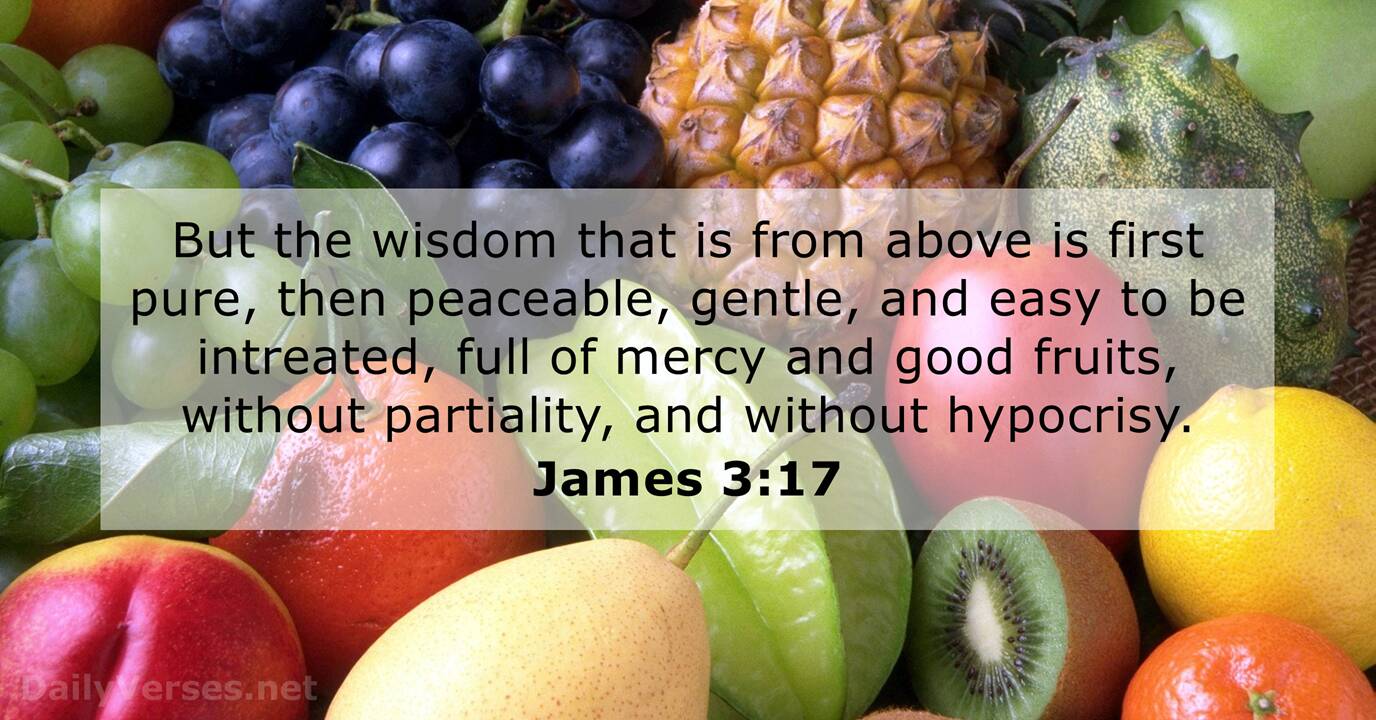
James 3:13-4:3 (3:17) – September 22, 2024

            I wonder if you can think of people who are called the best at something? The greatest athlete in a sport? The smartest student at your school? The best chef or best writer or best driver or best of anything? Just imagine how much bitter jealousy that comment can promote. Or, how much selfishness and blind ambition all this empty striving and competition leads to!

Worldly “wisdom” is anything but wise, according to our letter writer James. I am sure you recognize these jealous, covetous people. They regularly moan and kvetch and sometimes outright quarrel about what they have or about what they don’t have. James tells us about these dissatisfied, disgruntled people in our Scripture reading today.  

            Just listen to his description: “If in your heart you are jealous, bitter, and selfish, don’t sin against the truth by boasting of your wisdom. 15 Such wisdom does not come down from heaven; it belongs to the world, it is unspiritual and demonic. 16 Where there is jealousy and selfishness, there is also disorder and every kind of evil.”  

This kind of worldly striving, dog-eat-dog attitude is definitely not what James has in mind for us, as believers in Christ. He shines the spotlight on how believers ought to live. Listen! “13 Are there any of you who are wise and understanding? You are to prove it by your good life, by your good deeds performed with humility and wisdom.”

Can there be a sharper contrast between the dissatisfied, selfish, boastful worldly “wisdom” and the Godly, humble, beneficial wisdom and way of life that James talks about here? Not likely. Remember, in this practical letter, this how-to manual, James advises his friends on how to live in a way pleasing to God.

            It’s true that this fancy, flashy excitement can be attractive, even seductive, on the surface! But, all that is just for show, simply surface, an inch deep, and nothing more than worldly dissatisfaction, boastfulness and jealously. But, let’s be truthful – which of us is not tempted, sometimes, by the alluring or bright and shiny trappings of the way of worldly “wisdom?” Which of us doesn’t fall in step with others who might be jealous, or bitter, or selfish – sometimes? Most important, which of us leaves the simple, quiet, godly life of contentment for the flashy, glitzy (and shallow) excitement that so soon fades?

            Let’s consider the worldly, flawed way of thinking and being, for a moment. Carolyn Brown, retired Children’s Ministry Director, has written a prayer for this reading. Listen, if you would, and see whether these words from Ms. Brown do not resonate in our hearts.

Dear God, we want to look amazing.  

We want great clothes, cool shoes, a great haircut. We want our homes filled with our stuff.

We want all the best people to be our friends. We want to be the first, the best, the most, the greatest. So we grab and hold and demand. We even kick and punch to get what we want.

Forgive us.

Teach us to let go, to open our hands and hearts to others. Teach us to be content with what we have and to share it.

Teach us to think as much about what OTHERS want as what WE want. Teach us to be as loving as Jesus. Amen. [1]

            This prayer penetrates straight to the heart, let me tell you! I want to ask God for forgiveness, and to help me live in a loving way, like Jesus. I hope you do, too.

            This prayer makes me think of the Jewish High Holidays, which are quickly approaching. During the month before Rosh Hashanah and Yom Kippur, faithful Jews prepare for these holidays by examining their hearts. They meditate and pray, and ask forgiveness of God, of others, and of themselves for the sins and shortcomings of the past year.

            We also have a weekly time of confession and prayer at the beginning of each worship service. Thank God we receive the assurance of pardon each Sunday from our loving Lord! Yet, we keep on sinning. We still need to keep confessing our sins and shortcomings, and receive that assurance of pardon and forgiveness. Is it any wonder that we have this very practical how-to manual of how to live the Christian life by our letter-writer James, in the New Testament?  

            James assures his readers of Godly wisdom, because he describes its results. “Believers need to submit to the wise rule of God through the Spirit of God, a rule which purifies from within.” [2] The practical consequences of this wise rule of God are easy to observe. People who live God’s way are peaceable, considerate, gentle and non-combative! Does this sound very worldly to you? Certainly not selfish or jealous or bitter!

            What I wonder: how is the life of Jesus any mirror to our personal lives? Jesus is certainly recorded as merciful and loving. That is displayed over and over again in the Gospel record! When I think of our Lord Jesus during that three-year period of time in Palestine, I cannot think of anyone more sincere, honest or peaceable. More real and yet penetrating to the heart. I would love to have just a fraction of that Godly attitude and lifestyle as part of mine!

What – practically – can we take away from this reading today? Can we concentrate on living like Jesus? Living the Jesus way is peaceable, considerate, gentle and non-combative. Jesus is sincere, honest, and real. Can we make a commitment to live like Jesus?

This is the how-to of living a life pleasing to God, being filled with the presence of God. “[You and I] are works in process. This isn’t about completion and the satisfaction of a job well done; it is about a journey of discovery and transformation. But peace [gentleness, mercy, and lovingkindness] can be our companions in the journey to keep our feet on the path.” [3]

            Practical James would wholeheartedly agree! Keep on keeping on. Live in God’s way, in the wonderful, honest presence of Jesus. It’s a sure-fire way to have God draw near to each one of us. Alleluia, amen.

@chaplaineliza

(Suggestion: visit me at my other blogs: matterofprayer: A Year of Everyday Prayers. #PursuePEACE – and  A Year of Being Kind . Thanks!


[1] http://worshipingwithchildren.blogspot.com/2012/08/year-b-proper-20-25th-sunday-in_30.html

Worshiping with Children

[2] http://www.lectionarystudies.com/sunday25bee.html  

[3]  https://www.umcdiscipleship.org/worship-planning/doers-of-the-word/seventeenth-sunday-after-pentecost-year-b-lectionary-planning-notes

Unknown's avatar

The Humility of the King

“The Humility of a King”

Matthew 21:1-10 – April 2, 2023 (March 20, 2005)

            Do you all have experiences of someone who is well-known? Someone whose name is on everybody’s lips? Someone who everybody is talking about? Whenever you hear the buzz, chances are it’s about that person. And when that well-known person, that person of greatness makes a big entrance, we know what to expect, don’t we? Well-known people are supposed to enter a city with pomp and ceremony: black limos, bands, waving, cheering crowds lining the streets, live coverage on television.

            That is just what we have here in the Gospel reading for today (minus the limousines and the television coverage). The name of Jesus was on just about everyone’s lips. Some people were glad He had come to Jerusalem, and some people were mad He had come, and some people weren’t sure what to think. But, I suspect almost everyone in Jerusalem that day had some sort of idea or opinion, one way or another.

            I bet a common question on people’s lips on that Sunday centuries ago was, “Who is this guy, anyway?” Let’s consider. The Rabbi Jesus had options. He could have quietly snuck into Jerusalem in the middle of the night, avoiding notice and controversy, and not making a fuss or bother. But that wouldn’t have been very kingly, would it?

            Jesus could have entered Jerusalem boldly and proudly, seated on a big white horse, like other triumphant generals or kings. A conquering king on a horse is the very image of war and forcing submission. But—that wouldn’t have struck quite the right note, not with everything we know about Jesus.

            What were people expecting? In other words, “Who is this guy, anyway?”

            At that time, the country of Israel in general, and the area surrounding Jerusalem in particular, was under enemy occupation. They were under the oppressive thumb of the Roman government, subdued by the Roman army, and had been in that position for many, many years. I know for a fact that around the time of Jesus, several people had proclaimed themselves “Messiahs”—meaning political leaders—for the purpose of overthrowing the Roman government and authority. So, this was not the first time this had been done. We can even see among Jesus’ disciples there was movement in this direction, and several of His disciples tried to persuade Jesus to be that powerful political leader.

            So, on that Palm Sunday, some people fully expected Jesus to make good on His claim to be Messiah—a claim to be a strong political leader, come to free the Israelite people from the tyranny of the Romans. True, Jesus had repeatedly proclaimed Himself the Messiah, the Anointed One of God. He used the title “Son of David” for Himself, which was a plain statement of His kingly claim, His claim to be Messiah. But with the Roman occupation and the messianic expectations of the day, a peaceful Messiah was not what anyone was expecting.

            Some people–I’m thinking of the Pharisees, the Sadducees, the scribes and other temple leaders—were  awfully uneasy about Jesus. For them, Jesus was their worst nightmare. This rogue rabbi from Nazareth was saying things that penetrated right to the heart. Usually it was right to the hearts of the religious leaders—in a negative way. And, those things Rabbi Jesus was saying did not make the religious leaders feel good about themselves at all. Which made them want to get rid of Jesus even more.

            But, wait a minute! Jesus had also consistently healed the sick, given sight to the blind made the lame walk, and preached God’s good news to the poor. What about that part of His ministry? He certainly appeared to many to be a mighty prophet of God, and lots and lots of people were following Him as a result. Jesus’ words and teaching had authority. Jesus’ person had great credibility. Jesus’ healing showed God’s mighty power, and people even called the works He did miracles! Many people expected great things out of Jesus as a result of this aspect of His ministry.

            Who is this guy, anyway?

            Jesus entered Jerusalem the way He did as a fulfillment of prophecy. He didn’t just do this because He felt like it. No. I believe He fully understood what was prophesied in Zechariah 9 and Isaiah 62. So, the Lord Jesus entered Jerusalem just as the prophets said He would, on a donkey, as a visible sign of His coming in peace. The donkey was the image of peace. And that was what Jesus was bringing. He came to bring peace to people’s hearts, not a popular uprising, and not war to the streets of Jerusalem.

            Yes, Jesus entered Jerusalem as a king, and what I’d like to emphasize, as a humble and peaceful king. Humility is brought out as an attribute of this Messiah, this Anointed One of God, in three places. First, in the prophecy from Zechariah; second, in our gospel text this morning in Matthew 21 (which is a quote from Zechariah); and third, in our epistle passage today from Philippians.

            Jesus not only entered Jerusalem as a king, but as a humble king. Jesus could have been mighty and powerful. Jesus could have entered Jerusalem at the head of a mighty army of angels, ready for war. But, NO. Jesus entered Jerusalem in humility. He humbled Himself.

            Humility gets a bum rap today. I can’t imagine big, burly sports stars regularly being humble. Or, look at Hollywood actors and actresses—the very opposite of humility! Or, think of our political leaders—can any of them be described as humble? Our Lord Jesus presents us with a very, very different picture of humility.

            Just by coming to this earth, being born as a baby in Bethlehem, putting Himself under the authority of His earthly parents, Mary and Joseph, Jesus showed us how much He humbled Himself. Jesus showed how much He cared for us. Jesus’ willingness to become human, to humble Himself, to become obedient, to the point of death–even death on a cross–this is love. This is obedience. This is humility.

            As our Lord Jesus—Messiah—Son of David—Lamb of God—Savior of the world—was seated on that donkey, He knew what was going to happen later that week. He knew about the arrest and the crucifixion. He knew that some of that crowd who cried “Hosanna!” on Palm Sunday morning would be screaming “Crucify Him!” on Good Friday morning. He had set His face and steeled His heart to go to Jerusalem, and on Palm Sunday morning, He was there. Jesus was preparing Himself to be obedient to the point of death, even death on a cross, one of the most horrible kinds of execution ever thought of by anyone, anywhere.

            So—the question of the morning—who is this guy?—is a question that needs to be answered in each and every person’s heart. The hearts of the people in Jerusalem were in turmoil. Are our hearts any different today?

            Who is Jesus, anyway? Is He a great Teacher? Is He a troublemaker? Is He a prophet of God? Is He the fulfillment of prophecy? Or . . . is He something much more?

            The one who embodied the peace of heaven died just outside a city that was AND is blind to peace. Yet that one who died—Jesus—Son of David—Savior of the world—came to be King of our hearts, not King of a small territory on the coast of the Mediterranean Sea. That one who died—Jesus—Messiah—Lamb of God—brings peace to all who trust in Him.

            Through all the pain and suffering of Holy Week, Jesus brings peace. Despite the horror of crucifixion, Jesus brings peace. Through the glorious resurrection of Easter Sunday, Jesus brings peace. I trusted Jesus to bring peace to my heart over thirty years ago, and I praise God for that peace and security, and for His presence always at my side.

            What about you? Have you trusted Jesus to bring peace to your heart? Trust Him today. And praise God that Jesus is King of our hearts, King of Kings, and Lord of Lords.

            Amen, and amen.

@chaplaineliza

(Suggestion: visit me at my other blogs: matterofprayer: A Year of Everyday Prayers. #PursuePEACE – and  A Year of Being Kind . Thanks!

Unknown's avatar

Joy in Humility

“Joy in Humility” – August 16, 2020

Phil 2-5 same mind

Philippians 2:3-11 (2:3-5)

When you see a child dressing up like their mom, dad, older brother or sister, or other trusted adult, what immediately pops into your mind? What I immediately think of is that this dear child is dressing up as a beloved older person because they really want to be that person! It’s not just wearing Mom’s or Grandma’s high heeled shoes. Whether it’s dressing up in a nurse’s scrubs, a mechanic’s coveralls or a scientist’s lab coat, that child is trying their hardest to be just like that grown-up.

As we consider the Scripture reading read to us today, we might think of something like this – imitating our beloved grown-ups. But, can you and I actually do what Paul suggests here? Paul, you are making a huge leap, expecting us little, insignificant humans to be like – have a mindset like – think the same way as our Lord Jesus! That is asking for the moon! Isn’t it?

That is what Paul says in verse 5, yes. Let’s go back further. He says a similar thing in verses 3 and 4: our attitude – on the inside! – is supposed to change. Radically!

We are not just to play dress-up, we are not supposed to simply put on a nurse’s uniform or a firefighter’s coat. Paul calls each of us to be humble. Paul wants us to pay attention to our insides! It’s an internal job, where each of us changes our attitude to one of humility.

What is humility, anyhow? If we examine the cultural backdrop of Paul’s words more closely, humility had a very different connotation in the first century. Humility – the act of being humble was not considered in a positive light, at all! The widespread, worldly view of being humble went along with being a menial, a servant, even a slave.

However … that was not the way the Bible looked at this way of thinking. No, some religious groups viewed being humble as “the appropriate attitude both toward God and toward other members of the community.” [1] Plus, the apostle Paul here reminds the Philippian believers to consider others before we think about ourselves; to recognize the abilities, rights and achievements of others! This is exactly how Paul describes Jesus Christ several verses later.

Paul tells his friends – and by extension, us! – that we are to have the same attitude and same mindset as our Lord! That completely blows me away. Wow. Double wow!

Lots of situations, differences and conflicts can pull people away from the Lord. We can see these happening all around us, on a regular basis. Some of these feelings, emotions and situations are so powerful! Not only pulling us away from each other, but also away from the Lord. It is so difficult to focus, to have our mindset and attitude the same as our Lord Jesus!

Paul’s words “seem carefully chosen, no doubt to make a lasting impression on his readers. He then evokes by contrast some of the root causes of division and finally returns to the image of having a ‘same mind’. Only now, this mind is not theirs but Christ’s.” [2]

Paul was not just speaking to an individual here. The word “you” Paul uses (every time!) is a plural “you!” This attitude, this mindset is for the whole group of the Philippian believers. Paul did not mean for his friends, the believers in Philippi, to be solo Christians. No Lone Rangers! It’s possible to lean on each other when some get tired. We all depend on each other. We seek to be Christians together, and to have a mindset like Christ, together!

One of my favorite expressions is “What would Jesus do?” What would our Lord do in a situation like this? How would He react? How would He treat others? Would Jesus be selfish? Would Jesus be mean? Would Jesus snub people or be disrespectful to others? I think we all know the answer: certainly not!

Paul does not stop here. These next verses are among the most significant and moving descriptions of our Lord Jesus Christ in the whole New Testament. Paul goes back in time, to the time before the human Jesus was born in Bethlehem, and he talks about the pre-incarnate, eternal Son, the Second Person of the Trinity. The Eternal Son, the Word that was in the beginning, voluntarily gave up all Godhood. Jesus became the Word made flesh, setting aside the form of God. Jesus emptied Himself and became a helpless human baby.

Jesus humbled Himself! Just as Paul tells us to do! We are to strive to have the attitude, the mindset of our Lord Jesus Christ!

But, wait! That is not all. Not by a long shot! After Jesus became obedient to God, even to the point of death on a cross for our sins, God highly exalted Him! Jesus was—is given the name that is above every name! At the name of Jesus, every knee should bow, and every tongue confess that Jesus is Lord, to the glory of God!

Do we believe that? What does that mean to you? To me? What does it really mean? Are you – am I ready to bow the knee and confess that Jesus is Lord? Are we to strive to have the mindset and attitude of Jesus? Conventional, worldly attitudes scoff at this humility. What, be a servant? Where does this guy Paul get off, telling me to act like a slave, a menial, and not do anything for myself? That’s plain silly! That’s stupid, even!

Except, that is EXACTLY what Paul is saying here. We are not to act selfishly, have out-of-line ambition, or act in a conceited way. Again, “what would Jesus do?” Jesus would have concern for all people! Jesus would serve and love and care for all people, whether He is humble or exalted. No matter who, no matter where, no matter what!  

Let us strive to have the mindset and attitude of our Lord Jesus. Remember to check: “What would Jesus do?” And then, go! Have an attitude like Jesus, to the glory of God.

@chaplaineliza

(Suggestion: visit me at my regular blog for 2020: matterofprayer: A Year of Everyday Prayers. #PursuePEACE – and my other blog,  A Year of Being Kind . Thanks!

[I would like to express deep appreciation for Dr. Hooker’s invaluable commentary on chapter 2 of “The Letter to the Philippians.” (Hooker, Morna D., “The Letter to the Philippians,” The New Interpreters Bible Commentary, Vol. XI (Abingdon, Nashville, TN: 2000). I have used several concepts she wrote about in sections 2:1-4 and 2:5-11. Thanks so much for contributing to my personal understanding of this foundational passage for the study of the person of our Lord Jesus Christ.]

[1] Hooker, Morna D., “The Letter to the Philippians,” The New Interpreters Bible Commentary, Vol. XI (Abingdon, Nashville, TN: 2000), 499.

[2] https://www.taize.fr/en_article167.html?date=2009-10-01

“Living As Friends,” Commented Bible Passages from Taize, 2009.

Unknown's avatar

The Coming King

“The Coming King”

Jesus Palm Sunday - Giotto di Bonde, Entry into Jerusalem 1304-06, Fresco, Cappella Scrovegni Arena Chapel, Padua

Luke 19:35-40 – April 14, 2019

The most powerful person in the world. Ever hear that expression? I suspect it is familiar to most of us from movies, from comic books, from historical fiction. With the release of super hero blockbusters every few months, we certainly have the opportunity to see the clash of titans on the big screen, and the super hero of the movie conquering the huge threat or the big bad guy—or big bad girl. The thing is…can we imagine Jesus as the most powerful person in the world?

Our Gospel reading today from Luke 19 tells us that a huge crowd of people thought the Rabbi Jesus was a really important person, a really powerful person. He was a Miracle Worker, He preached with authority, and just to be in His presence—wow! The crowd was hailing Him as the long-awaited King, the Anointed One of God, the Messiah.  

Jesus, Himself, had been telling His disciples that He had to go to Jerusalem for some time now. Even though His friends kept telling Him that the Jewish leaders and the Sanhedrin had it in for Him and wanted to kill Him, Jesus still “determined to go to Jerusalem,” as Luke tells us back in chapter 9.

Today’s story has all the makings of a great drama. (And, the narrative of the Passion Week has been recorded a number of times in motion pictures.) As commentator Alyce McKenzie tells us, “Good stories, screenwriters tell us, have a compelling protagonist, a believable supporting cast, a series of vivid scenes, and plenty of dramatic tension.” [1] Dr. Luke’s telling of the Palm Sunday story has all that, and more.

Here we are on Palm Sunday, and the weeks of Lent are almost over. That means that our series on the Lord’s Prayer is almost over, too. What sentence are we going to look at today, with our Scripture readings of Luke’s Triumphal Entry into Jerusalem, and the Apostle Paul’s hymn of Christ’s humility? We take a closer look at “for Thine is the kingdom, the power and the glory, forever and ever, amen.”  What more glorious Scripture readings to examine!

As we think of our great Divine drama, Jesus not only is a marvelous protagonist, but we can see He displays Divine foreknowledge. “Jesus knows ahead of time where the colt will be and what the response of the owner will be to being told, “The Lord needs it.” Luke shares with the other evangelists a portrait of Jesus as a true prophet whose prophecies are fulfilled and who has access to the secret knowledge of human hearts.” [2]

The second necessary feature of a great drama is a believable supporting cast. Look at the disciples—human, and distinctive. Listen again to Luke’s story: “Go to the village ahead of you, and as you enter it, you will find a colt tied there, which no one has ever ridden. Untie it and bring it here. 31 If anyone asks you, ‘Why are you untying it?’ say, ‘The Lord needs it.’” 32 Those who were sent ahead went and found it just as he had told them. 35 They brought it to Jesus, threw their cloaks on the colt and put Jesus on it “

We notice the rest of the supporting cast here, in the next verses. “As he went along, people spread their cloaks on the road. 37 When he came near the place where the road goes down the Mount of Olives, the whole crowd of disciples began joyfully to praise God in loud voices for all the miracles they had seen: 38 “Blessed is the king who comes in the name of the Lord!” “Peace in heaven and glory in the highest!”

From time to time we have talked about putting ourselves into a Scripture reading, and viewing it from the inside. Where would you be, in our Gospel reading from Luke? Are you an excited disciple or crowd member, waving your arms and picking up a palm to welcome the Messiah Jesus into the city of Jerusalem? Or, are you one of the skeptical ones on the road, holding back, with a wait-and-see attitude?

“The people were obviously weary of the Roman occupation. They had been hearing rumors of a great teacher from Nazareth who healed the sick, fed the hungry, and made the scriptures come alive. Some of them had seen miracles first hand and had heard parables straight from Jesus’ mouth. Now, they had a deliverer; their long-awaited Messiah and Savior, King Jesus, was with them.” [3]

The third necessary element in any great drama is dramatic tension. Boy, does the Triumphal Entry have that! Even down to the antagonistic Jewish leaders who come up against the Messiah Jesus, this has drama all over the place.

It is almost too difficult for me to put myself into the narrative, I know this story all too well. Yes, I am tempted to rush right through the Palm Sunday celebration, go once-over-lightly through the several events recorded in the other Gospels during Holy Week, and cry again because of the Crucifixion this Friday night. Or, was it two thousand years ago?

Switching to the New Testament reading from Philippians, the apostle Paul has a slightly different point of view. Paul is writing from the other side of the Crucifixion, the Resurrection and Jesus’ ascension into heaven—as we know from the Apostles Creed, Jesus has taken His seat at God’s right hand in heaven.

As we start this reading to the church in Philippi, Paul tells us of Jesus, before His incarnation and birth in Bethlehem. The eternal Christ humbled Himself, emptied Himself of all Godhood, all Godly prerogatives, and became a helpless human baby. Imagine the most powerful person in the whole world, in the whole universe, even. The eternal Christ put aside the kingdom of the universe, the ultimate power and the infinite glory, to become human.

Another way of looking at this is that Jesus put aside all of that kingdom, power and glory so He could communicate better with us, so He could come along side of us and be Emmanuel, God-with-us, as we have talked about at Christmas. But, that is not the end. Oh, no! Certainly not!

We see this progression: the preincarnate Christ, in all His kingdom, power and glory. Amen! “Christ emptied himself of inherent divinity, and for his supreme obedience unto crucified death, he was exalted by God for unending glory. Philippians 2:5-11 keeps the focus Christologically and theologically tight. On Passion Sunday [today, this Sunday], Paul keeps us grounded in what God, through Christ Jesus, is doing.” [4]

We do not look at the institution of Communion on Maundy Thursday and the Crucifixion of Good Friday. We are skipping the additional drama, trauma, anguish and grief today. Paul does mention those things briefly, but he looks to the amazing ending. “God exalted him to the highest place and gave him the name that is above every name, 10 that at the name of Jesus every knee should bow, in heaven and on earth and under the earth, 11 and every tongue acknowledge that Jesus Christ is Lord, to the glory of God the Father.”

If that is not a proclamation of the last line of the Lord’s Prayer, I don’t know what is. “For Thine is the kingdom, and the power, and the glory, forever and ever, amen.” Have you bowed the knee to our ascended and exalted Jesus the Messiah? Is your tongue acknowledging Him as Lord and Savior? Yes, Jesus was crucified on our account. It was for our sins He was crucified. His arms are open. His pierced hands are extended. Come to Jesus, today.

[1] https://www.patheos.com/Progressive-Christian/Palm-Sunday-Alyce-McKenzie-03-18-2013.html

Rewriting the Palm Sunday Story: Reflections on Luke 19:28-40, Alyce McKenzie, Edgy Exegesis, 2013.

[2] https://www.patheos.com/Progressive-Christian/Palm-Sunday-Alyce-McKenzie-03-18-2013.html

Rewriting the Palm Sunday Story: Reflections on Luke 19:28-40, Alyce McKenzie, Edgy Exegesis, 2013.

[3] http://www.theafricanamericanlectionary.org/PopupLectionaryReading.asp?LRID=15           

Commentary, Zechariah 9:9-13 / Luke 19:28-40, Rodney S. Sadler, Jr., The African American Lectionary, 2008.

[4] http://www.workingpreacher.org/preaching.aspx?commentary_id=284

Commentary, Philippians 2:5-11 (Passion Sunday), C. Clifton Black, Preaching This Week, WorkingPreacher.org, 2009.

@chaplaineliza

(Suggestion: visit me at my regular blog for 2019: matterofprayer: A Year of Everyday Prayers. #PursuePEACE – and my other blog,  A Year of Being Kind . Thanks!

Unknown's avatar

Cup of Cold Water

(I preached this sermon last September at St. Luke’s Christian Community Church. I delivered it again yesterday, as part of the Big Soul series on Jesus in the Gospels at Epiphany UCC.)

“Cup of Cold Water”

mark-9-41-cup-of-cold-water-word-cloud

Mark 9:39-41 – (from a sermon of September 27, 2015) September 25, 2016, preached to Epiphany UCC, Chicago

This weekend is the first weekend of autumn, here in the Northern Hemisphere. The baseball playoffs are around the corner. Football season is with us again. And who isn’t interested in team rankings? The Chicago Cubs have made it to the playoffs! And whether you enjoy college football or pro ball, rankings are certainly something much discussed, in news columns, on television, and in personal conversation.

What if you do not care for sports? Have you or one of your relatives looked at Yelp lately, to check out that new restaurant down the street, and see how many stars the restaurant gets? What about U.S. News and World Report’s rankings of the top colleges in the country?

Face it, this mentality has transferred to the church, too. Who’s the top ranked preacher in the country? Does the church down the road make it on to the list of best churches in Illinois? Or what about the top ten children’s ministries in the Chicago area?

In our Gospel reading today, we see that the disciples were not immune to this kind of thinking. Even though they didn’t have the Internet, or Yelp, football, or even the printing press, we can still tell that the disciples were jockeying for position. Arguing and trying to figure out which one of them was the “best.” Who was the “greatest,” anyway?

I think Jesus made them sad, even ashamed of themselves. We can see they got very quiet when He asked them what they were arguing about on the road, just before they reached their destination for the evening. They didn’t want to admit they were arguing over superficial or unimportant things like rankings! Who was the “best,” or the “greatest.” Striving for superficial, unimportant things.  I suspect they already knew what Jesus would say about that kind of thinking and striving.

To make His point with the disciples, Jesus brought a small child into the middle of their group. Mark tells us that Jesus took the child into His arms. And then said, “Whoever welcomes one of these little children in My name welcomes me; and whoever welcomes Me does not welcome Me but the One who sent Me.”

Wow! Pretty pointed remarks, let me tell you! In other words, Jesus said that being kind to the least of society (for that was what children were, in the first century) was far better than seeking status or striving to be the “best” or the “greatest.” The disciples were right to quiet down in embarrassment when Jesus asked them why they were arguing on the road.

But, all of that is preamble. Setting the stage for what I really wanted to talk about today. And yet, this sermon topic is a continuation of Jesus speaking about being kind, thinking about, and being of service to the least of society.

The disciples just didn’t get it. Jesus makes His point clearly, repeatedly. Being kind to those who are overlooked or ignored? Helping out those who have little or nothing, with no thought for a “return on your investment?” The disciples misunderstand or get confused, over and over and over again. Like right here.

A year ago, the people of the United States had a rare opportunity to see the head of the worldwide Roman Catholic Church, in the flesh. For real. Pope Francis was here, in this country. He arrived in Washington D.C. The President, Vice President, their families, and many other members of Congress and other people in Washington were among those who had the opportunity to hear his Holiness speak to a joint session of Congress. Oh, and the Pope ate lunch with the homeless, instead of with the bigwigs at the White House.

Pope Francis then went to New York City, celebrated Mass at Madison Square Garden, drove along Central Park, and visited a Catholic grammar school in a poor, Latino and Black area of the Bronx. Then, he flew to Philadelphia. And, he celebrated a huge open-air Mass in the middle of downtown Philly. Plus, he visited a prison, as well.

I don’t know how much anyone here follows news of Pope Francis, but he is a very unusual man for someone holding one of the highest religious positions in the world. A man of humility, who does not care for the spotlight. Who loves and engages with children and goes out of his way to take “selfies” with young people. He makes a special effort to visit disabled people wherever he goes. Pope Francis is fervent about being pro-life—that’s for all life, including ending abortion as well as capital punishment. He is fervent about protecting the environment—worldwide. He does not wish to be elevated or made much of. So, of course people recognize his humility, good humor, engaging behavior, and respond to him all the more!

(I am not advocating for or against his deeply felt convictions. I’m trying to give a snapshot of Pope Francis, so that we might see how real, genuine and compassionate he is.)

I think Pope Francis would understand immediately what Jesus was saying here. Jesus wanted His disciples to think about others, first and foremost. Not jockey for position, seek high status, or try to be the “best” or “greatest.” Not to go out of our way for standing or high rank.

Jesus goes on to say, “41 Truly I tell you, anyone who gives you a cup of water in my name because you belong to the Messiah will certainly not lose their reward.” Wait a minute. What’s this? First he’s talking about considering those on the bottom rung in society as fully human, too. Not second-class citizens! Children certainly qualify for that, as do women, the elderly, the disabled, and handicapped. As do immigrants, migrants and refugees.

Let me tell you about a college student bible fellowship in Europe, to give an example of what Jesus was telling His disciples. This comes from the prayer email sent out last September from the International Fellowship of Evangelical Students, IFES Global Communications.
            “Students with SXEF Greece are mobilising to help throughout the country. Grigoris, a staff worker in Thessaloniki, writes: ‘Greece has been one of the places on the global map where a lot of quite painful changes have taken place. Little did we realize that, in our own “neighborhood”, there was place for more suffering, until we saw the caravans of refugees and migrants crossing the borders holding their babies in their arms.

We saw this situation as an opportunity to show that the Christianity we preach is practical. So we went to the northern borders where migrants are gathering, to help in any way we can.’

Sophia, a student, helping there, agreed with Grigoris. ‘Our daily missions gave us the opportunity not to just speak for God but to do something for him. Many times I felt that our actions had the biggest impact, whether with the migrants, the local authorities or humanitarian organizations.’

‘Just with a smile, a bottle of water or some food, I realized better why God wants to serve him with our actions. I think it is because that is also [God’s] own heart for us, to take away our fears and minister to our needs.’
Quite literally, we are sometimes called to give a cup of cold water to people in need. Like these college students did, in northern Greece. Giving a smile, and an encouraging touch. A handshake. Holding a cranky baby or a fretful toddler, so a tired mother can have a short break.

Are these big actions, or expensive things? Often times, no. But, they are human things. We can each do the small things we are able to do. And with a little help from everyone, we can do a whole lot!

I think of what Pope Francis said to the joint session of Congress last September: “Our world is facing a refugee crisis of a magnitude not seen since the Second World War. . . . On this continent, too, thousands of persons are led to travel north in search of a better life for themselves and for their loved ones, in search of greater opportunities. Is this not what we want for our own children? We must not be taken aback by their numbers, but rather view them as persons, seeing their faces and listening to their stories, trying to respond as best we can to their situation.”

Isn’t this exactly the same thing that Jesus said to His disciples, in our Gospel reading today? Isn’t this what the college student bible fellowship found when they ministered to the hungry, thirsty and tired refugees crossing through their country? Giving a cup of cold water in Jesus’ name has a huge impact. The action is not a huge deed. But the smile and handshake that accompany the water, or the food, or the supplies? Priceless. And welcoming.

Showing the least of these that someone cares. Someone is concerned. They are not all alone. Each of them is made in the image of God. Just like me. Just like you.

Remember, for God so loved the world. That is, the whole world. Not just part of it. Not two thirds of it. Not just people in the Northern Hemisphere, or people who are right handed. Not just people born to married parents, or the people who are sighted and can hear. But, everyone.

What’s more, Jesus is calling for each of us, all of us, to look at each other and see God’s image in each person’s heart. For God so loved you. For God so loved me. For God so loved . . . each person. In Chicago. In Illinois. In the United States. Yes, even the whole world.

@chaplaineliza

(Suggestion: visit me at my regular blog for 2016: matterofprayer: A Year of Everyday Prayers. #PursuePEACE – and my other blog,  A Year of Being Kind . Thanks!)


Unknown's avatar

Cup of Cold Water

“Cup of Cold Water”

Mark 9-41 cup of cold water, photo

Mark 9:33-41 – September 27, 2015

This weekend is the first weekend of autumn, here in the Northern Hemisphere. The baseball playoffs are around the corner. Football season is with us again. And who isn’t interested in team rankings? The Chicago Cubs—fingers crossed!—are in the playoffs, in a wildcard spot! And whether you enjoy college football or pro ball, rankings are certainly something much discussed, in news columns, on television, and in personal conversation.

What if you do not care for sports? Have you or one of your relatives looked at Yelp lately, to check out that new restaurant down the street, and see how many stars the restaurant gets? What about U.S. News and World Report’s rankings of the top colleges in the country?

Face it, this mentality has transferred to the church, too. Who’s the top ranked preacher in the country? Does the church down the road make it on to the list of best churches in Illinois? Or what about the top ten children’s ministries in the Chicago area?

In our Gospel reading today, we see that the disciples were not immune to this kind of thinking. Even though they didn’t have the Internet, or Yelp, football, or even the printing press, we can still tell that the disciples were jockeying for position. Arguing and trying to figure out which one of them was the “best.” Who was the “greatest,” anyway?

I think Jesus made them ashamed of themselves, since they got very quiet when He asked them what they were arguing about on the road, just before they reached their destination for the evening. They didn’t want to admit they were arguing over superficial or unimportant things like rankings! Who was the “best,” or the “greatest.” Striving for superficial, unimportant things. I suspect they already knew what Jesus would say about that kind of thinking and striving.

To make His point with the disciples, Jesus brought a small child into the middle of their group. Mark tells us that Jesus took the child into His arms. And then said, “Whoever welcomes one of these little children in My name welcomes me; and whoever welcomes Me does not welcome Me but the One who sent Me.”

Wow! Pretty pointed remarks, let me tell you! In other words, Jesus said that being kind to the least of society (for that was what children were, in the first century) was far better than seeking status or striving to be the “best” or the “greatest.” The disciples were right to quiet down in embarrassment when Jesus asked them why they were arguing on the road.

But, all of that is preamble. Setting the stage for what I really wanted to talk about today. And yet, this sermon topic is a continuation of Jesus speaking about being kind, thinking about, and being of service to the least of society.

The disciples just didn’t get it. Jesus makes His point clearly, repeatedly. Being kind to those who are overlooked or ignored? Helping out those who have little or nothing, with no thought for a “return on your investment?” The disciples misunderstand or get confused, over and over and over again. Like right here.

This past week, the people of the United States had a rare opportunity to see the head of the worldwide Roman Catholic Church, in the flesh. For real. Pope Francis is here now, in this country. He arrived earlier in the week, in Washington D.C. The President, Vice President, their families, and many other members of Congress and other people in Washington were among those who had the opportunity to hear his Holiness speak to a joint session of Congress. Oh, and the Pope ate lunch with the homeless, instead of with the bigwigs at the White House.

Pope Francis then went to New York City, celebrated Mass at Madison Square Garden, drove along Central Park where thousands greeted him, and visited a Catholic grammar school in a poor, Latino and Black area of the Bronx.

Then, he flew to Philadelphia. Yes, he is celebrating a huge open-air Mass in the middle of town today, but he also visited a prison, as well.

I don’t know how much anyone here follows news of Pope Francis, but he is a very unusual man for someone holding one of the highest religious positions in the world. A man of humility, who does not care for the spotlight. Who loves and engages with children and goes out of his way to take “selfies” with young people. He makes a special effort to visit disabled people wherever he goes. Pope Francis is fervent about being pro-life—that’s for all life, including ending abortion as well as capital punishment. He is fervent about protecting the environment—worldwide. He does not wish to be elevated or made much of. So, of course people recognize his humility, good humor, engaging behavior, and respond to him all the more!

(I am not advocating for or against his deeply felt convictions. I’m trying to give a snapshot of Pope Francis, so that we might see how real, genuine and compassionate he is.)

I think Pope Francis would understand immediately what Jesus was saying here. Jesus wanted His disciples to think about others, first and foremost. Not jockey for position, seek high status, or try to be the “best” or “greatest.” Not to go out of our way for standing or high rank.

Jesus goes on to say, “41 Truly I tell you, anyone who gives you a cup of water in my name because you belong to the Messiah will certainly not lose their reward.” Wait a minute. What’s this? First he’s talking about considering those on the bottom rung in society as fully human, too. Not second-class citizens! Children certainly qualify for that, as do women, the elderly, the disabled, and handicapped. As do immigrants, migrants and refugees.

Let me tell you about a college student bible fellowship in Europe, to give an example of what Jesus was telling His disciples. This comes from the prayer email sent out just a few days ago from the International Fellowship of Evangelical Students, IFES Global Communications.
            “Students with SXEF Greece are mobilising to help throughout the country. G., a staff worker in Thessaloniki, writes: ‘Greece has been one of the places on the global map where a lot of quite painful changes have taken place. Little did we realize that, in our own “neighborhood”, there was place for more suffering, until we saw the caravans of refugees and migrants crossing the borders holding their babies in their arms.

We saw this situation as an opportunity to show that the Christianity we preach is practical. So we went to the northern borders where migrants are gathering, to help in any way we can.’

S., a student, helping there, agrees with G. ‘Our daily missions gave us the opportunity not to just speak for God but to do something for him. Many times I felt that our actions had the biggest impact, whether with the migrants, the local authorities or humanitarian organizations.’

‘Just with a smile, a bottle of water or some food, I realized better why God wants to serve him with our actions. I think it is because that is also [God’s] own heart for us, to take away our fears and minister to our needs.’
Quite literally, we are sometimes called to give a cup of cold water to people in need. Like these college students did, in northern Greece. Giving a smile, and an encouraging touch. A handshake. Holding a cranky baby or a fretful toddler, so a tired mother can have a short break.

Are these big actions, or expensive things? Sometimes, no. But, they are human things. We can do what we are able to do. And with a little help from everyone, we can do a lot!

I think of what Pope Francis said to the joint session of Congress several days ago: “Our world is facing a refugee crisis of a magnitude not seen since the Second World War. . . . On this continent, too, thousands of persons are led to travel north in search of a better life for themselves and for their loved ones, in search of greater opportunities. Is this not what we want for our own children? We must not be taken aback by their numbers, but rather view them as persons, seeing their faces and listening to their stories, trying to respond as best we can to their situation.”

Isn’t this exactly the same thing that Jesus said to His disciples, in our Gospel reading today? Isn’t this what the college student bible fellowship found when they ministered to the hungry, thirsty and tired refugees crossing through their country? Giving a cup of cold water in Jesus’ name has a huge impact. The action is not a huge deed. But the smile and handshake that accompany the water, or the food, or the supplies? Priceless. And welcoming.

Showing the least of these that someone cares. Someone is concerned. They are not all alone. Each of them is made in the image of God. Just like me. Just like you.

Remember, for God so loved the world. That is, the whole world. Not just part of it. Not two thirds of it. Not just people in the Northern Hemisphere or people with four good limbs. Not just people born to married parents, or the people who are sighted and can hear. But, everyone.

What’s more, Jesus is calling for each of us, all of us, to look at each other and see God’s image in each person’s heart. For God so loved you. For God so loved me. For God so loved . . . each person. In Morton Grove. In Illinois. In the United States. Yes, even the whole world.

@chaplaineliza

Suggestion: visit me at my daily blog for 2015: matterofprayer: A Year of Everyday Prayers. and my other blog,  A Year of Being Kind .  Thanks!

[I appreciate the International Fellowship of Evangelical Students, IFES Global Communications, for the quote from their prayer email from last week. And thanks to Paul Nyquist and TODAY IN THE WORD (Daily Devotions) for inspiration for a starting point for the sermon on this Scripture passage.]