Unknown's avatar

Today!

(I attended a denominational national assembly this weekend, and was not leading worship. Here is a sermon from my archives! I hope it touches your heart and spirit.)

“Today” – 2 Corinthians 5:20-6:2

June 28, 2006

            Once upon a time, there was a loving Father with abundant wealth, property and resources. He loved His many children dearly and did everything in His power to provide abundantly for them.

            Does this story line sound familiar? It should. That loving Father is God, our Heavenly Father. He created the world in the beginning, including humanity. Our loving God gave humans abundant resources, and provided many good and gracious gifts for them, doing everything possible to provide a rich and rewarding life for them.

I’d especially like to focus on the love. God’s love for humanity, for the world, for us. I dare say that many of us here today could quote John 3:16—“For God so loved the world that He gave His only begotten Son, that whoever believes in Him should not perish, but have everlasting life.”

From this verse, can we tell how much God loves the world? How much does God love us? This much?     (spread arms and pause)  

There was a problem, way back when, when God lavished such good and loving care on humans, on His children. That problem was and is SIN.

Face it, humanity—and that includes you and me—is fallen. I usually hesitate when I make sweeping statements, but not in this area. We are sinful. As Romans 3:23 says, “For all have sinned and fall short of the glory of God.” That is ALL. Not a few, not even most, but ALL. Everyone. All humanity. We don’t sin all the time, or in every situation. There are plenty of times when members of the human race act in kind ways, and think loving thoughts, but that troublesome sin nature is alive and kicking in each one of us.

Can you see a toddler or preschooler, stamping her feet, crossing her arms across her chest, and shouting, “No!!” Can you see a teenager, disrespectful and angry, slouching away from the dinner table without a word? Can you see the prodigal mentioned in the Gospel of Luke, wishing that his father would kick the bucket already, so he could get his inheritance? Do these selfish, proud, disrespectful, ungrateful actions (and thoughts, I might add) have anything in common? I would say, yes, they do. The sin nature that is part and parcel of all humanity is readily evident, in all of these situations. We are human, therefore we sin—by thought, word, or deed—by omission or by commission.

It would be really bad news if the story ended there, wouldn’t it? Humanity would be both hopeless and helpless, stuck in the miry clay of our own sinfulness. BUT, that is not the end of the story. God still loves us. Remember John 3:16? “For God so loved the world?” That love still comes to us, regardless of our sinfulness, regardless of our selfishness, regardless of how much we have disregarded the abundant love and the lavish care that God showers upon us each and every day.

As our passage from 2 Corinthians says, we humans trespass. We sin. We mess up. We make mistakes. But God loves us anyhow! God doesn’t keep a tally sheet, a ledger of all our good deeds and bad deeds. God does not count these mistakes against us. In fact, God goes above and beyond our mistakes, reconciling the world to Himself.

It’s not that God is estranged from the world, from humanity. It’s the other way round. It is humanity—it is you and me—that is estranged from God. God created humans, and He loves humans. He created each of us with our foibles and quirks and personality flaws as well as our individual strengths. He created each one of us as individuals to give glory to His name in our own individual ways. God knows us so much better than we know ourselves, and He still loves us just the same! God reconciled the world—that’s you and me—to Himself, out of love.

Like I said, that is wonderful news! Amen! Praise God! Thank You, Jesus!

Jesus was sinless, but He was made to be sin for us. Jesus took all of our collective sin upon Himself on the cross so that in Him we might become righteous before God. Can we tell how much God loves the world? How much does God love us? Is it this much?     (spread arms and pause)  

So, now that we know about God’s abundant love that He lavishes upon each of us, what are we going to do about it? Listen to the words of our passage again. “’At an acceptable time I have listened to you, and on a day of salvation I have helped you.’ See, now is the acceptable time; see, now is the day of salvation!”

D.L. Moody, noted evangelist during the 1800’s and founder of Moody Bible Institute, did much of his evangelistic work around Chicago. One Sunday evening in September 1871, Mr. Moody closed his sermon with the injunction for the congregation to evaluate their relationship with God over the next week and to return the following Sunday. When Mr. Moody was on his way home after the evening service, he heard the fire alarms all over and saw the flames against the sky, turning the night sky red and orange. That meeting hall where the service was held burnt to the ground, along with most of the city of Chicago. The Great Chicago Fire happened that night.

Mr. Moody was horrified, knowing that he had not told his listeners the full message of the love of God, for each one of them. He vowed from that day on to tell the whole story, to always let people know the good news of salvation in every sermon he preached.

What about you? Are you still thinking about God’s offer of salvation? You may have been a church member all your life, faithful and hard at work for many years. But you may have never realized that God’s joyful message of reconciliation was especially for you. You may have been born into a loving Christian family, maybe even a pastor’s kid or missionary’s kid, and been surrounded by God’s abundant love all your life. But just because I may be born in the room behind a bakery doesn’t make me a biscuit . . . and just because I may be born into a Christian family doesn’t make me a Christian by birthright or by osmosis. God has no grandchildren. There are only children of God.

God has been loving us—you and me—all of our lives, even when we turned our backs on Him. If this is that day for you, that acceptable time, that day of salvation, praise God! Enter into the joy of a loving relationship with God, a close friendship with God.

If God had a refrigerator, your picture would be on it. If God had a wallet, your photo would be in it. God can live anywhere in the universe, and He wants to live in your heart. If you have never, truly experienced God’s love for you, individually, there is no time like the present. We can indeed enter into the joy of our Father’s loving embrace and experience His abundant love for each one of us. Today is the day of salvation! God is ready. Are you?
@chaplaineliza

(Suggestion: visit me at my other blogs: matterofprayer: A Year of Everyday Prayers. and  A Year of Being Kind . Thanks!

Unknown's avatar

Life on God’s Terms

“Life on God’s Terms” – July 12, 2020

Rom 8_11 Spirit of God

Romans 8:1-11 (8:10)

Does anyone know what this is? [motioning towards the garbage can] You’re right. This is a garbage can. Good for being a container for all the garbage – refuse – junk – from our homes, workplaces, and communities. All kinds of worthless garbage that is not needed or wanted goes right in here. The apostle Paul talks about all kinds of garbage in our lives, on our insides, here in the letter to the church in Rome.

Imagine, if you will, all the internal junk in a person’s life, and mind, and heart. All of that meanness, and selfishness, gossip and swearing, bullying and arguing. And, what about the times people cheat? Or, blow off assignments or obligations? Or, stretch the truth just a little – or, perhaps a lot? Oh, it’s not much. But, do you think God keeps track of each and every time?

Just think of a person’s life. Perhaps, your life, or mine. If all the years and decades of those junky, selfish, stubborn, or mean thoughts, words or deeds were piled in this garbage can, I’d imagine it would be pretty full. Even, perhaps, full to overflowing.

Life on the inside, our internal selves without God can be pretty hopeless. Worthless. Just like garbage – refuse – junk that goes into this garbage can. Another word that Paul uses for all the stuff in these garbage cans is sin. I suspect many of us here can quote Romans 3:23, where Paul says “For all have sinned and fall short of the glory of God.” Paul does not say, “For some have sinned,” or even “For many have sinned.” No, we all have our internal selves filled up with meanness, selfishness, gossip, swearing, bullying, arguing. And, then some.

God does have laws. Many of these laws are common sense, and others are in keeping with moral codes that many civilizations have held for millenia. We know the big 10, the Ten Commandments, and many of the other laws of Moses that are found in the Hebrew Scriptures. Right before Paul writes these marvelous words in Romans 8, he talks about the huge problem with law and sin. We know about that. Sin and the law of God do not get along.

What do I do now? I know a lot of these laws of God, sure. But I still fall into sin, even though I know the rules. Another way of looking at sin is separation from God. When you—I—when all of us sin, we are separated from God. What’s more than that, sometimes people don’t even think of the Lord. God does not even enter their minds. Can you imagine? Ignoring God? Yet, so many people do just that.

So many people today are running on that treadmill of self will run riot, of selfish, mean, resentful living. I have seen a number of these kinds of persons, and they keep running, running, running on that treadmill of separation from God.

I have one particular person in mind. An acquaintance, from some years ago. To all outward appearances, she was very successful. She had designer clothes, a successful job, a luxury car, a fancy house. But, on the inside? All kinds of resentment, anger, greed, envy, gossiping and backbiting. She cut corners on her integrity and honesty, and just did not have a moral compass. Do you know someone like that? I have a feeling we all might have more in common with this unhappy lady than any of us might like to admit.

I’d like all of you to think of a sin in your life. I suspect you have thought of a sin that is really obvious to you, right now. the one thing you feel worst about. The one regret or misdeed or misfortune that you wear like a snail does its shell. The one part of your life that forever threatens sin and condemnation. Could you write it down? Or, if you don’t have a pen and paper, could you think really hard of that particular sin right now?

Paul does not leave us in that horrible place. Yes, all of Romans chapter 7 is talking about sin, and separation from God, and how much difficulty all of us have with these sinful thoughts, words and deeds. We might think that we are stuck at the bottom of one of these smelly, stinky, filthy garbage cans, with no way out. Who will rescue me from this body of sin and death? How can I – can we – get in a place where we can possibly have access to God?

Paul has good news for us. In fact, it’s great news! We do not have to stay in this garbage dump for the rest of our lives. No, Jesus reaches down from heaven and rescues us from sin and death. Jesus takes each of us out of that separated, filthy garbage can and brings us into the glorious presence of God!

Here is the best part of all. God’s Holy Spirit helps us to stay free from the power of sin and death. We no longer need to reflect on what we have done – or said – or thought that was wrong. No! Jesus Christ delivers us from sin and the Law.

I want to invite all of us to—virtually—toss that sin we wrote down into the garbage can right here. Jesus can clean us up from the inside, and help us to sin less and less. Amen!

One last thing. I invite each of you to take another piece of paper, and write what you are free to do now that you do not have that condemnation in your life and inside your very self. What challenge will God bring into your life, now that you know you are beloved by God and filled with God’s Spirit? What kindness or generosity will you attempt? What will you do with all the love and grace God can give you? [1]

God promises to be with us, yes! And, even more, God promises to use each of us for the sake of the people and the world God loves so much. Go out into the world for God, today.

[1] http://www.workingpreacher.org/craft.aspx?post=1571

“What Willl You Do…?” David Lose, Dear Working Preacher, 2011.

@chaplaineliza

(Suggestion: visit me at my regular blog for 2020: matterofprayer: A Year of Everyday Prayers. #PursuePEACE – and my other blog,  A Year of Being Kind . Thanks!


Unknown's avatar

Green Pastures, Quiet Waters

Psalm 23:2, John 10:4 – May 7, 2017

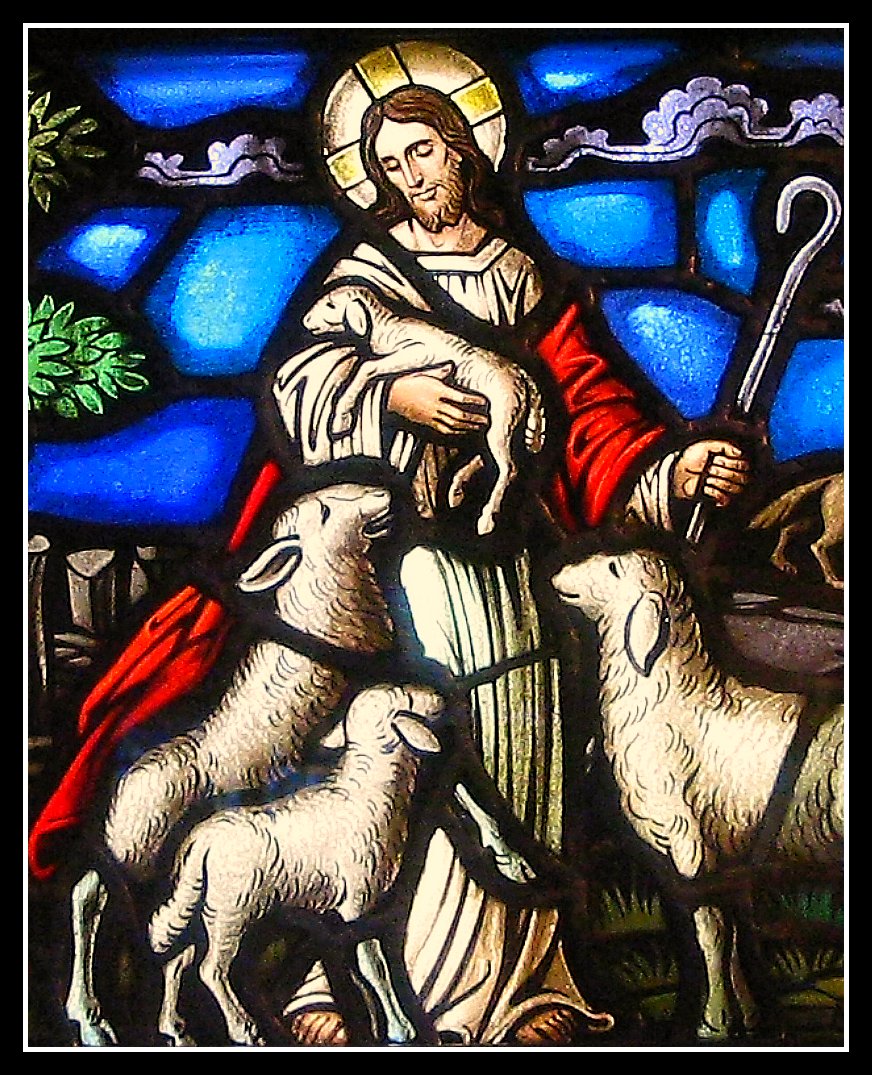
John 14 Good Shepherd, stained glass

“Green Pastures, Quiet Waters”

If I mention images of sheep and green pastures, what comes to your mind, on that video screen in your head? For some people, it might be something on the Nature channel on cable television, with verdant, green grass and gently rolling hills, dotted with fluffy white sheep. For others, it’s a painting at an art museum, with lush green meadows under brilliant blue skies. Again, dotted with sheep feeding on that green grass.

In Psalm 23, our psalm writer is King David. He is writing about his youth as a shepherd for his father’s sheep, long before he ever became king. That time as a shepherd must have been vivid in his mind, because David’s poetic description of sheep and shepherd remains one of the most striking, beloved, and relatable passages in the Bible, in either the Hebrew Scriptures or the New Testament.

Here is another way of saying the first verse of Psalm 23: Because the Lord is my Shepherd, I have everything that I need.

Wait, that makes me a sheep, and sheep are not particularly intelligent. Now, I am okay with that. As I have said in the past, this is a common analogy in the Bible. The nation of Israel is referred to as sheep several times in the Hebrew Scriptures. Different biblical writers refer to people who believe in God as sheep. Several times in the Gospels—as in our Gospel passage from John 10, today—Jesus talks about Himself as Shepherd, and His followers as sheep.

I figure God must know a few things about people, being the Creator of the Universe, and all. Since God uses this common analogy of sheep and shepherd so many times in the Bible, and since sheep have been known to be stubborn and timid and sometimes even foolish, I guess I might have a few things in common with sheep. Maybe you do, too.

Sheep need stuff. They need grass, water, nurture, and protection against enemies. They depend on their Shepherd to provide all of these things for them. But, what if there is no Shepherd? What if there is no one to provide all of this good stuff for us—I mean, for sheep?

Sometimes bible study leaders and bible teachers have their students do an exercise. They write a reverse psalm. That is, writing the reverse of what the verses say. One of the bible commentators I read used this process. She said, “I’ve been led in this process, and led my Bible Study in it. At first you might ask, ‘Why do it this way?’ But, especially when in a group, reading back all the hopeless examples of our life without God, we see the power of this psalm more clearly.” [1]

I’m going to read just the first few verses of Psalm 23, written in reverse. It was written by a then-15 year old named Anna Thompson.

“I have no shepherd, I need a shepherd./I am caught in the desert.
I am thirsty/and no one is telling me where to go.
I am lost and no one cares./I am scared of evil, because I am alone.”  [2]

This is truly a hopeless example of our life without God! What would happen to a few little sheep, huddling in the wilderness or the desert, with no one to guide them, take care of them, or to shepherd them? I don’t think they would last very long. Some predator might come along and have some lamb and mutton for dinner. That’s what probably would happen. This is a far cry from the green pastures and the quiet waters the psalm describes for us, and quite different from the Good Shepherd who supplies our wants and needs.

Jesus takes this image of sheep and a Shepherd from Psalm 23, and enlarges on it.

Notice what is not mentioned in either Psalm 23 or John 10. Is there any mention of the sheep needing all the stuff we see on television? I must have this new outfit or latest electronic gadget or trendy pair of shoes. I absolutely need to be healthy, beautiful, entertained, wealthy and successful. No, neither of these bible readings have anything of the kind.

Psalm 23 has a basic set of wants that “the shepherd provides for his sheep. That list includes food, drink, tranquility, rescue when lost, freedom from the fear of evil and death, a sense of being surrounded by the grace of the Lord, and a permanent dwelling place in the house of God. An ever-rising mountain of material possessions is not on the list.” [3]

.           Let’s think about the reverse psalm again. I have no shepherd. I am caught in the desert. I am thirsty. I am lost. I am all alone.

Doesn’t that hit you right in the gut? Hopeless, helpless, life without God. Where are You, God? I’m all alone out here, and I am lost and scared!

One of my favorite commentators is Carolyn Brown, a Christian educator who’s worked with children for decades. She writes about the Bible and our worship being filled with metaphors. We try to help children understand them “when we carefully explore the details of a few key ones, expecting them to become familiar with the concrete part of the metaphor and some of the spiritual realities it embodies, but not fully making the connection until later [when they are older].  The Good Shepherd is definitely one of those key metaphors. [Doctor and educator] Maria Montessori reports that while working in a children’s hospital she found that when she told sick children stories about the Good Shepherd using small wooden figures, they almost all grabbed the figure and held onto it ‘for keeps.’” [4]

It doesn’t matter if we are talking about the Shepherd of Psalm 23, or the Good Shepherd of John 10. The Shepherd helps the sheep to feel safe, to feel protected and full, able to rest and feel content. Not to feel hungry, thirsty, frightened, lost and alone.

In our Gospel reading this morning, Jesus adds something to the picture of the Good Shepherd that is not in the 23rd Psalm. Jesus talks about the sheep knowing the Shepherd’s voice. That means whether sheep are in green pastures or brown ones, in the desert or high in the hills, the sheep will recognize the shepherd’s voice and call. As Jesus said, “When he has brought out all his own, he goes on ahead of them, and his sheep follow him because they know his voice. But they will never follow a stranger; in fact, they will run away from him because they do not recognize a stranger’s voice.”

In Palestine, in the mid 1930’s, a village near Haifa had some internal conflict. The occupying British soldiers confiscated all the villagers’ animals and put them in a central pen, mixing them all up. The animals’ owners were permitted to redeem their animals, if they could identify them. An orphan shepherd boy whose only possessions were six sheep and goats came to the officer in charge, and asked for his animals. The officer ridiculed the idea that the shepherd boy could possibly pick out his “little flock” from among the hundreds of animals in the pen. The shepherd boy had his pipe and gave his own “call”—his unique call for his animals. “His own” separated from all the others and trotted out around him. [5]

The sheep know the Shepherd. They follow the Good Shepherd’s voice, and willingly go with Him to green pastures, and by the quiet waters. Jesus is the Good Shepherd, and He will be with us in green pastures as well as desert places, by quiet waters as well as in thirsty times. And, Jesus will walk with us through those dark and scary valleys of the shadow, too.

Even when we walk though the valley of the shadow more than we like, praise God, our Good Shepherd will always be there beside us, to help, nourish, protect and nurture us.

Yes, I am a sheep. I freely admit that.

I know if the Good Shepherd is my Shepherd, surely His goodness and love will follow me all the days of my life, and I will dwell in the house of the Lord forever.

[1] http://bethquick.blogspot.de/2011/05/lectionary-notes-for-fourth-sunday-of.html

[2] Psalm 23: “I Have No Shepherd” https://re-worship.blogspot.com/2011/05/psalm-23-i-have-no-shepherd.html

[3] Bailey, Kenneth E., The Good Shepherd (Downers Grove: IVP Academic, 2014), 39.

[4] http://worshipingwithchildren.blogspot.com/2014/03/year-fourth-sunday-of-easter-may-11-2014.html

Worshiping with Children, Easter 4A, Including children in the congregation’s worship, using the Revised Common Lectionary, Carolyn C. Brown, 2014. 2011.

[5] Bishop, Eric F. F., Jesus of Palestine (London: Lutterworth, 1955), 297-98. Quoted by Kenneth E. Bailey in The Good Shepherd, 42.


@chaplaineliza

(Suggestion: visit me at my regular blog for 2017: matterofprayer: A Year of Everyday Prayers. #PursuePEACE – and my other blog,  A Year of Being Kind . Thanks!)

Unknown's avatar

By Grace through Faith

“By Grace through Faith”

grace = by grace through faith Lutheran

Romans 3:24 – October 25, 2015

I have a confession to make. I was raised a Lutheran. Baptized and confirmed in a Lutheran church on the northwest side of Chicago, I loved everything about that church. When I was in grammar school and high school, I learned all I could about my church, about being a Lutheran, and even about Martin Luther. I studied Luther’s Small Catechism during my two years of confirmation classes in seventh and eighth grades. So, you could say I know a thing or two about Martin Luther and about the church that to this day bears his name.

This Saturday, October 31st, is the 498th anniversary of the day Martin Luther tacked up the 95 Theses, his 95 points of disagreement he had with the Catholic Church. In 1517, the priest and doctor of theology Martin Luther posted his 95 Theses on the chapel door in Wittenberg, Germany, at the university where he served as professor. Thanks to the printing press, these 95 points of disagreement spread like wildfire. Not only in Germany, but throughout Europe. The Reformation began in earnest.

Why was Martin so upset? To understand that, we need to take a closer look at Martin’s beginnings. When he was a very young man, Martin Luther felt unworthy of God’s love. He felt lower than a worm sometimes, and tried his hardest to get into God’s good graces! He would go to confession several times a week, do penance after penance, and he made several pilgrimages. All of these things and more to stop feeling unworthy and sinful.

Taking a quick look at the letter the Apostle Paul wrote to the Roman church, you and I might get that same message, too. From chapter three, “There is no difference between Jew and Gentile, 23 for all have sinned and fall short of the glory of God.” Martin felt that so deeply! All have sinned! All fall short of God’s glory! All means everyone. All of us.

Romans 3:23 is not good news! This verse is pretty bad news. Rotten news. Really hopeless news, if you ask me. And, that is the news Martin Luther faced, the more and more he read and studied the Bible, meditated, and prayed.

Martin was right. According to the Law of Moses, given to the nation of Israel in the Old Testament, there is no one who can follow the Law one hundred percent. Not the Old Testament Jews, not Jews in Jesus’s day, not Martin Luther, five hundred years ago. And, not you and me, today, either. There is no way anyone can keep every single one of God’s commands! (Even though the Pharisees of Jesus’s day—and the Pharisees of today—try their very hardest.)

Martin Luther regularly reflected on his life and his thoughts, and how far short he fell, compared to where he knew that God wanted him to be. That was what I felt, when I was a teenager, too. I knew I couldn’t keep all of God’s rules, even if I tried really, really hard. Remember Romans 3:23? “For all have sinned and fall short of the glory of God.”

When I was a teenager, I was a particularly studious teen. I would read books on the Bible and on theology when I was in high school. I prayed regularly, and tried my hardest to get closer to God. I had low self-esteem. I felt sinful, unlovely and unlovable a good deal of the time.

Martin Luther tried even harder to get close to God! He did a ton of good works. He got a university degree in theology, and started teaching from the Old and New Testament at the university in Wittenberg. He studied even more about God, and preached regularly in a church in town. And yet—he still felt sinful and far from God! He still felt unlovable!

Can anyone relate to Martin? Are there times when you—when I—feel unlovable?
I remember hearing the story of a woman, horribly burned in a fire. Her husband came to see her in the hospital and was disgusted and horrified by what he saw. “You are not the woman I married,” he said, and promptly divorced her. Are we so unlovable? Is that what we are afraid God might do to us?

Martin felt sinful and unlovable, too. What’s more, even after lots and lots of good works and all these years of reading and study, he still felt so inadequate. He felt God could not possibly love or forgive him. That is—until he was reading the letter to the Romans, chapter 1, verse 17: “ For in the gospel the righteousness of God is revealed—a righteousness that is by faith from first to last, just as it is written: ‘The righteous will live by faith.’”

Do you hear? Do you understand? It wasn’t about Martin. It wasn’t about how sinful or unlovable he was. Or, how hard he tried to do good things, or tried to get on God’s good side, or tried to live by good works. God’s righteousness comes by faith. Faith alone! Faith in God!

Remember Romans 3:23? “For all have sinned and fall short of the glory of God.” Yes. Yes! That is true. But—that isn’t the whole story! Reading, starting from 3:21: “21 But now apart from the law the righteousness of God has been made known, to which the Law and the Prophets testify. 22 This righteousness is given through faith in Jesus Christ to all who believe. There is no difference between Jew and Gentile, 23 for all have sinned and fall short of the glory of God, 24 and all are justified freely by His grace through the redemption that came by Christ Jesus.”

I can almost see Martin falling off his chair, once he realizes how huge this is. Our sin is taken away through the redeeming that came through Jesus. We are made lovable through God’s grace. Our low self-worth and low self-esteem is now viewed by God through Jesus. God looks at all of us, each one of us, through Jesus-tinted lenses.

We are now brothers and sisters of Jesus, God’s beloved children! We are now redeemed freely. By His grace, through faith, through the redemption that came by and through Christ Jesus. The best part of this gift? It’s a free, undeserved gift, so that no one can pridefully boast about it.

Another way to look at this gift from God comes from a sermon study board online I follow. I recently read this, written a few years ago by a preacher named Erik in Wisconsin.

“This Sunday we celebrate confirmation. As a part of their confirmation requirements, students have to meet with me for a brief discussion/interview. I ask them about faith, life, God, etc. – see if they learned anything during confirmation. One question I always ask is “How will you get into heaven? How are you saved?” Most often I get the answers – “Pray. Go to church. Do good deeds.” And I shake my head and ask myself “Didn’t I emphasize grace enough?”

“Finally, I said to the class, “Listen, you are saved purely by God’s grace as a gift. I will ask you how you are saved in your confirmation interview. If you don’t remember anything else I’ve taught during these two years, remember this: “You are saved by God’s grace!” Why is it so hard to remember? Probably because we’ve been taught not to trust anything we might get for free, even if it is from God.”

Martin Luther found out that we are saved by faith alone, through grace alone. No good works! No trying and trying really, really hard, and not making it after all that! Salvation is all from God and God’s grace! Romans 3:24 says,” and all are justified freely by His grace through the redemption that came by Christ Jesus.”

As Martin Luther studied scripture, he finally discovered he was saved by grace, not because of anything he did or deserved. The Rev. David Hansen tells us, “He discovered a God who would send the only Son—not for the perfect people, but for the sinners. He discovered, above all else, a God and a Savior that will NEVER abandon us, that will stand by our side no matter how often we fail or how short we fall.”

Is that good news? Jesus died for our sins. Jesus showed us radical, God-sized grace, and radical, God-sized love.

As I proclaim each week after the Confession of Sin during the Assurance of Pardon, “Believe the Good News of the Gospel: in Jesus Christ, we are forgiven!”

Alleluia, amen!

Thanks to Rev. David L. Hansen and Pastor Erik from Wisconsin for their assistance in the formulation of this sermon!

@chaplaineliza

Suggestion: visit me at my daily blog for 2015: matterofprayer: A Year of Everyday Prayers. and my other blog,  A Year of Being Kind .  Thanks!