Unknown's avatar

Keeping the Faith

“Keeping the Faith”

2 Tim 4-7 kept faith, purple

2 Timothy 4:6-9 – October 27, 2019

Happy Reformation Sunday! Yes, we celebrate and commemorate the beginning of the Reformation on the last Sunday of October each year. It is that time of year when the Rev. Dr. Martin Luther tacked up his 95 Theses, or complaints, against the Catholic Church. He put them up on the chapel door at the University of Wittenberg, where he was a professor of theology, on All Hallows Eve, 1517—or, Halloween, October 31st.

Among other things, Martin Luther wanted the Catholic Church to be faithful to God in many practices. Being faithful was really important to Martin Luther! You know who else being faithful was important to? The Apostle Paul. Eileen read the end of the second letter Paul wrote to Timothy, and Paul strongly stressed being faithful to God. Just like him. Just like Martin Luther. Just like countless saints throughout the centuries. Keeping the faith, through thick or thin, through good times or bad, no matter what.

I always get sad when I read the second letter to Timothy, and especially the fourth chapter. That is the part where Paul is being up front with Timothy. He realizes he does not have very much time left here in this world. Paul was in prison in Rome for the second time, and this time, Paul did not have much hope of being freed. This is one of the last letters he expects to write to his good friend and protégé Timothy. What kinds of important things does Paul say in these last few paragraphs?

When other people know they are going to die soon—because of illness or other tragedy, somehow time becomes much more precious. Their internal and external focus becomes more acute. I think this was happening with the Apostle Paul, right here, where he told Timothy what was most on his heart.

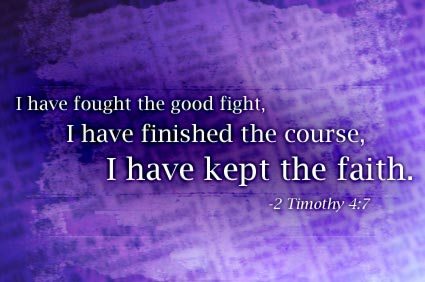
What did he want to communicate to Timothy? Looking at this last chapter, we find so much on Paul’s mind. I would like to focus on two verses in chapter 4: “For I am already being poured out like a drink offering, and the time for my departure is near. I have fought the good fight, I have finished the race, I have kept the faith.”

Paul had been through the wringer, as we read when Paul wrote about many of his experiences in the second letter to the church at Corinth. He lists that he has been put in prison repeatedly, been whipped, beaten with rods, given thirty-nine lashes, shipwrecked, then adrift on the sea for a day and a night, not to mention being cold, starved and thirsty repeatedly, in danger and on the run from all manner of people, for years at a time. What is more, Paul said he would do it all again for the sake of preaching the Good News, and knowing Jesus Christ crucified.

I don’t know about you, but when I hear Paul describe everything he has been through, I am in awe. And yes, I feel so insignificant, so unworthy even to be in Paul’s presence. Paul’s whole life is one huge example of keeping the faith.

As we come forward through the centuries, and learn more about Martin Luther, we can see that for years Martin was on the run from a bunch of different groups and from people sent by the Catholic Church. These wily guys wanted to prosecute Luther before a church court, and he argued his case again and again. Martin Luther was put through the wringer repeatedly.

True story: 1521, Martin was put on trial yet again, and finally offered the “opportunity” to say he recanted what he said and had written. Luther knew his response would get him in even deeper trouble, but that did not stop him. He boldly told the emperor, his officers and some leaders of the Catholic Church that he would not move. Martin said he was captive to the Bible, the Word of God, and he could not go against God. Many people remember Martin’s famous words, “Here I stand. I can do no other.” Martin kept the faith and stayed true to God.

Have you—have I—ever felt put through the wringer for the sake of Jesus Christ? Just thinking about what the Apostle Paul and what Martin Luther went through, being put through the wringer is definitely not fun. Standing up for what is right and Godly and the God-honoring thing to do, or a certain way to pray, or even a specific way to worship God? All over the world, for centuries, any of these things could get you imprisoned or perhaps even executed. I am serious. This is not a joke.

According to Professor Dirk Lange, “Faith is not faith in one’s own abilities but God’s faith planted within us that turns us, despite the upheavals and setbacks and failures of life, into faithful workers in the vineyard.” [1] God-given and God-planted faith helped Paul and Martin to keep on going, and to keep the faith. Can that God-given faith help us to continue on, as well?

Professor Michael Jackson had such an intriguing idea about this verse. Let me share it with you: “I have fought the good fight, I have finished the race, I have kept the faith… all three verbs are in the perfect [tense]. Even though Paul is still alive and writing these words, he views his life lived for Christ as complete… and as my Greek teacher, Roger Hahn always loved to point out for the perfect tense – completed action that has continuing and ongoing repercussions… I like that idea – our finished lives continue to speak, to influence, to make a difference in the lives of those we have served. That’s how we leave a legacy!” [2]

Whether we have been on this earth only a few years or are in the later decades of life, how have our lives been used for God? What kind of legacy are you and I leaving? Have we—as Paul commanded Timothy—fought the good fight? Finished the race? Kept the faith in Christ Jesus? These are not simple questions. They are reflection questions, questions to ponder, and questions that I hope and pray we all bring to God.

I would like to close with some words of reflection from Joseph, Cardinal Bernadin, Cardinal of this Chicago archdiocese for a number of years. He was diagnosed with a rapidly moving cancer, which took his life. In the months before he died, Cardinal Bernadin wrote a final, short book: The Gift of Peace. I’ve read it, and it is so poignant.

I would like to read from the last chapter. “As I conclude this book, I am both exhausted and exhilarated. Exhausted because the fatigue caused by the cancer is overwhelming. Exhilarated because I have finished a book that is very important to me. As I write these final words, my heart is filled with joy. I am at peace…. I will soon experience life in a different way. Although I do not know what to expect in the afterlife, I do know that just as God has called me to serve Him to the best of my ability throughout my life on earth, He is now calling me home.” [3]

So similar to what Cardinal Bernadin wrote, Paul tells us God is leading him home, in these verses we are considering today. Just like Martin Luther, Paul tells us to keep the faith, just as he did. Just as Martin Luther kept the faith, just as Cardinal Bernadin did, too.

What is Paul’s charge to all of us, on this Reformation Sunday? Keep the faith. Know the faith, preserve the faith and see that faith in God gets passed on.

God willing, I will follow Paul’s charge. Will you, too?

Alleluia, amen.

[1] Commentary, 2 Timothy 4:6-8, 16-18, Pentecost 22C, Dirk G. Lange, Preaching This Week, WorkingPreacher.org, 2010. http://www.workingpreacher.org/preaching.aspx?commentary_id=740

[2] Commentary, 2 Timothy 4:6-8, 16-18 | Michael Jackson | Associate Professor of Homiletics, TNU | A Plain Account, 2016, http://www.aplainaccount.org/copy-of-proper-25c-psalm

[3] Bernadin, Cardinal Joseph, The Gift of Peace, (Image Book: New York NY, 1998) 151-52.

@chaplaineliza

(Suggestion: visit me at my regular blog for 2019: matterofprayer: A Year of Everyday Prayers. #PursuePEACE – and my other blog,  A Year of Being Kind . Thanks!

Unknown's avatar

Suit Yourselves!

“Suit Yourselves!”

2 Tim 4-3 itching ears

2 Timothy 4:1-5 – October 20, 2019

Have you seen the comics lately? I’m sure everyone here is familiar with the comics section of the newspapers—the daily comics in black and white, and the Sunday comics in full color—even if you don’t read them regularly. Can you picture this scene from the comics? A single panel, showing two business men by an office water cooler. One looks like a boss, and he says to the other, “If there’s one thing I hate, it’s a yes-man. Isn’t that right, Baxter?”

We chuckle, because we all are familiar with that kind of attitude. I’m sure we can recognize that tendency in other forms. Getting some yes-man to tell us what we want to hear . . . not what’s good for us to hear, not what we need to hear, but instead what we want to hear.

With all the worry and anxiety, trouble and danger in this modern world, people are actively searching for good news. Many are searching in all the wrong places. Commercialism and consumerism are rampant, with many people accumulating more and more stuff and always needing to get something else, something more, something new.

Sometimes, some people search for thrills, for that adrenaline rush, for some kind of excitement in life. It doesn’t matter if thrills come from drag racing, gambling, or risky behavior, like a wild bender at the local bar. Oftentimes, these people are trying to fill a hole deep inside.

Other people turn inward, searching for spiritual fulfilment. There are many ways of experiencing some kind of spirituality, like through the martial arts, or through meditative practices. Fung shui, the Chinese method of arranging furniture is an attempt to try to find balance and proper order in this life. Sure, doing an inside job, concentrating on the inside of ourselves is a great place to start, but . . . searching for inward, spiritual fulfillment on our own just won’t work. Anyway, not without God.

We have the assurance, from our scripture passage today, that Timothy had the opportunity to know God. Timothy was instructed, from the time he was very young, in the way of salvation through Jesus Christ. His mother and grandmother were both women of faith, and Timothy grew up in a believing household, a household that put God first.

As we read further in our passage today, we find there are people who will not put up with sound doctrine. They will not even want to listen to the truth! Even when the truth is as clear as day, and presented to them in a straight-forward manner, still, some will turn away.

You probably are all familiar with that modern phenomenon—tele-evangelists, some of whom are worthy people of God. However, there are those who are frauds. Charlatans. Fakes. Preachers not of sound doctrine or biblical teaching, but instead telling their listeners exactly what they—the listenerswant to hear.

Are you familiar with the health, wealth and happiness gospel, which focuses on only a few isolated passages from scripture? This false gospel tell the listeners that God wants us all to be healthy, wealthy and happy! All the time! And even shows us the example of Job—why, didn’t God give back to Job everything that was taken away? But . . . we must have faith! And if anything is wrong in our lives, or if our house burns down, or if we get sick, or if someone we love loses a job, or if our child gets in trouble, or . . . or . . . or . . . you get the picture. Well, we just didn’t have enough faith. Oh, and we didn’t send enough money to the tele-evangelist. So, God apparently must be withholding His blessing because of our lack of faith and our stinginess.

Not so!! This is a perverse, yet skillful, twisting of the truth! I bet you can see parts of the true Gospel here in what I’ve just described, but the rest is so skillfully bent and twisted, It sounds so similar to the Good News of God we have come to know and to understand and to love. Like, and yet unlike. The true Gospel tells us that God does indeed want to bless us abundantly! And, it is an inside job! God wants to change us, to help us change ourselves, to make us new creations from the inside out, through faith in Jesus Christ.

But, what about unsuspecting folks, who get turned away from the truth in God’s Word? What did our scripture passage today say about this sort of people? It mentions that they have “itching ears.” This is a Greek phrase that can be translated several ways—another way is “having their ears tickled.” In other words, having the preacher tell you exactly what you want to hear! These people with the itching ears, who wanted nice, warm, soft, fuzzy things said to them, nonthreatening, reassuring things preached to them from the pulpit, these people turned their backs on the truth of God’s Word and of sound doctrine.

These people with the itching ears had an agenda—and that was to hear only what they wanted to hear, at all times. None of the challenging words, none of the admonishing words, none of the emotional words of Scripture. This is another form of idolatry: putting themselves first, putting God aside as an afterthought. You know the attitude—me, me, me! I’m the most important person around here! Everything needs to go my way! Nobody else counts!

As I was thinking about this text over the past days, it came to me—what would Calvin say? John Calvin was one of the foremost theologians in the Reformed tradition, the tradition we in the UCC adhere to. What would Calvin say about these false teachers, preaching a “health, wealth and happiness” gospel, or any other sort of false gospel, for that matter?

How would he deal with these false teachers, leading people astray? Checking the Institutes, I find that Calvin spoke strong words against these false teachers, saying that they, in fact, pose the greatest danger to the church. They lead people away from true scripture and sound doctrine, and are responsible for bringing in destructive heresies. [1]

But . . . that’s not what we learned. That’s not what Timothy learned. We have the “sacred writings that are able to instruct us for salvation through faith in Christ Jesus.” We have the opportunity to come into a relationship with Jesus Christ. How wonderful, how awesome, and how sobering that Jesus entrusted us with the message of His Good News.

Now what? The different New Testament letters do indeed tell us definite things about doctrine, about theology . . . but then . . . what do we do with all of this information? How do we put it into practice? How do we live the Christian life? Now what, in other words?

I consider the commands in this passage to be good advice to anyone wanting to follow Christ more nearly. We are to proclaim the message. Communicate the Good News!

This command may give some people pause. How can I preach the Good News? Am I supposed to go to some cable television station and get on the air as yet another tele-evangelist? Or how about standing out on a street corner, preaching with a megaphone? Both of these are valid ways of preaching God’s Good News, but I don’t think most of us here in this church could ever see ourselves doing either of these things. But there are other ways to proclaim the message.

Preach the Good News. Another way of thinking about it is . . . telling what God has done in your life. What has God done for you? How has God made a difference in your life? How has God made a difference in mine? What new things have you and I learned from the Lord lately? What an opportunity to share these things with others, with our friends, with those who might not know God in a personal way.

Do we need advanced degrees in divinity or theology to do this? To share what God has done for us? No! Oftentimes, we are excited to tell people about other things, like who won the latest ball game, or about the neighbor next door spraining her ankle, or what exciting story we just heard on the news. Why can’t I tell people about Jesus, and what He’s done for me? Why can’t you?     I can tell about God’s faithfulness in my busy, hectic life. I can praise God for helping me to walk the Christian walk, one day at a time.

Thank God we have been given this Good News! What a opportunity! What a thing to celebrate! Praise God, we have been granted salvation through faith in Jesus Christ. That’s truly something to celebrate. That’s truly Good News to share.             Alleluia, Amen.

[1] Calvin, John, Institutes of the Christian Religion, edited by John T. McNeill (Westminster Press: Philadelphia, 1960), IV.9.4.

@chaplaineliza

(Suggestion: visit me at my regular blog for 2019: matterofprayer: A Year of Everyday Prayers. #PursuePEACE – and my other blog,  A Year of Being Kind . Thanks!
Unknown's avatar

How to Worship?

“How to Worship?”

1 Tim 2-2 pray, message

1 Timothy 2:1-4 – September 22, 2019

Have you ever been to a different kind of worship service? A service where people prayed differently, sang different kinds of songs, played different instruments, and even spoke in different languages? I have attended a number of different kinds. Worship of God can be diverse and different, depending on where we live, what each of us grows up with, and what kind of faith tradition we come from.

In today’s reading from the first letter to Timothy, we hear about instructions for prayer and worship. This letter to Timothy is one of the pastoral letters from the New Testament. In other words, this letter contains instructions for a church leader on how to be a better pastor and leader of a congregation. Including—recommendations for corporate worship and prayer.

This is not like the instructions from the Sermon on the Mount in Matthew or the Sermon on the Plain from Luke, where our Lord Jesus gives specific instructions for personal, private prayer. No, this letter is from several decades later, when there were established groups of believers, and they needed structure and direction on corporate worship and prayer.

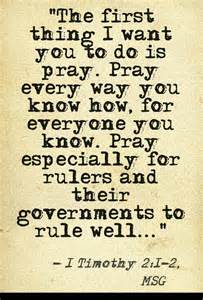
From 1 Timothy 2: “I urge, then, first of all, that petitions, prayers, intercession and thanksgiving be made for all people—” This sounds wonderful! I have experienced this aspect of prayer in practically every worship service I have ever attended. I suspect you have, too.

Whether prayer happens from the pulpit or lectern, or from the floor of the church, whether the prayer is offered by members of the congregation from the pews or seated in a circle, extemporaneously or written out, Paul’s recommendation of unified prayer is definitely one that has gone on as long as believers in Christ have gathered together.

However, the prayers we offer are not just generic prayers. I want to remind everyone (and I am reminding myself, too!), that we are encouraged to “offer prayers for all members of the human family during church services; prayer in the terms of: petitions (general requests to God), Intercessions (requests for those in need), supplications (requests for ourselves), and thanksgivings.” [1]  The apostle Paul is quite specific here! All of these different kinds of prayer!

I wonder: are your prayers—are my prayers—as far-ranging and thorough as these? Are these recommendations something we all can get on board with? Something we all follow?

Let’s continue with this reading from chapter 2. Who should we pray for? “for kings and all those in authority, that we may live peaceful and quiet lives in all godliness and holiness.”

We are not talking about good-tempered rulers. No, the kings, rulers and those in authority in the later half of the first century were not nice guys. What happens when we have mean rulers and cruel leaders, those in authority who do such wicked things as throw people out of their homes, put them in jail, even force them into exile, or even death?

Let’s take a look at the Roman emperors Tiberias, Caligula and Nero. None of them were particularly “good or nice,” several showed signs of mental instability, and these men were at the pinnacle of power in the Roman Empire for over 25 years. Yet, the apostle Paul recommended that his fellow believers pray for them, for other rulers, and “for those in authority, that we may live peaceful and quiet lives in all godliness and holiness.”

This was an instruction Timothy received for his regular worship services! What was the apostle thinking of? The Rev. Bryan Findlayson suggests “Such prayer seeks to restrain the powers of evil and so encourage peace and security. When society is in a state of peace, believers can freely serve both God and mankind.” [2]

Again, what about rulers and those in authority who persecute Christians? What about governments that destroy churches, jail church leaders and ministers, and make it impossible for Christians to live and raise families? What about those governments? Do we still need to pray for those wicked people? We are to pray for peace, but what kind of peace?

I would say, yes, especially for those wicked people in government who persecute Christians. “Most often our prayers for peace concern our own personal well-being. When society is at peace, life can go well for us and we can build that extra barn. Yet, the peace Paul has in mind is a positive environment for the proclamation and hearing of the gospel.” [3]

September 21st is the International Day of Peace. The website specifically for this day states: “Established in 1981 by unanimous United Nations resolution, Peace Day provides a globally shared date for all humanity to commit to Peace above all differences and to contribute to building a Culture of Peace.” [4] What a wonderful thing to contribute to building: peace.

Moreover, as the apostle Paul reminds us, peace in the world involves a positive environment for proclaiming and hearing the Good News of our Lord Jesus Christ. Is our government corrupt? We need to pray for the members of a wicked and corrupt administration, then. What matters even more is that we are safe to proclaim the Good News of the Lord, and to provide for a way to let everyone know the Good News of salvation through His name.

Division and divisiveness is not conducive to spreading the Good News. This current-day division and animosity between people who call themselves believers must make God very sad. Christians of all communities and all ethnicities ought to have their wonderful belief in Christ to unite them. But, no. Sadly, believers all over the world allow politics to divide them.

The Rev. J. Vernon McGee had this to say: “We need to pray for our country, and we need to pray for those who have authority over us. If you are a Republican and a Democrat is in office, pray for him. If you are a Democrat and a Republican is in office, pray for him.” [5]

We have been thinking about the unity of believers from all parts of the world for several weeks now. In our bible study, we are studying the book of Philippians, and talking about how the apostle Paul and his friends preached the Good News to a diverse and different population in the regional capital of Macedonia, Philippi. Diverse and different individuals came together to worship the Lord Jesus Christ, and God made it possible for them all to join in worship.

What a wonderful example to lift up! Can we do the same, here, now? We here at St. Luke’s Church can strive for the same unity and friendship, despite differences in our families, the languages we spoke as children, or the towns where we were born. We can also come together in worship, despite differences in worship styles, or singing, or prayer.

I pray at the beginning of most services here for God to bless our time in worship, and especially to aid us in lifting our vices in words, prayer and song. This is truly what God calls us all to do. Moreover, God looks upon every voice raised in prayer, praise, or song as legitimate worship, no matter what, no matter where, no matter how. We are all encouraged to do the same. We have God’s word on it!

Alleluia, amen!

@chaplaineliza

(Suggestion: visit me at my regular blog for 2019: matterofprayer: A Year of Everyday Prayers. #PursuePEACE – and my other blog,  A Year of Being Kind . Thanks!


[1] http://www.lectionarystudies.com/sunday25ce.html    “Worship in the Church,” Rev. Bryan Findlayson, Lectionary Bible Studies and Sermons, Pumpkin Cottage Ministry Resources.

[2] Ibid.

[3] Ibid.

[4] https://internationaldayofpeace.org/

[5] McGee, J. Vernon, Thru the Bible: 1 Corinthians through Revelation, Vol 5, (Nashville TN: Thomas Nelson Publishing, 1983) 436.

Unknown's avatar

Dynamic Spirit Power!

“Dynamic Spirit Power!”

Acts 2 Pentecost mural

Acts 2:2-4 – June 9, 2019

Have you ever been outside in hurricane-force winds? Either you, or a loved one you know and who is very dear to you? How about a massive storm that has huge bolts of lightning, and loud cracks of thunder? Can you imagine God’s mighty power displayed, for everyone to see and hear and feel? Anyone who has ever been caught in such a powerful storm can tell you, such a dynamic panorama can be earthshaking, literally. That mighty God-sent power is just what I’ll be preaching about today.

Most of us, perhaps even all of us are familiar with the disciples’ fearful reaction after our Lord Jesus ascended into heaven. And, for good reason! The Roman authorities were still hunting for the body of the Rabbi Jesus that disappeared from the tomb, some weeks before. Remember what happened on Easter morning? Not only the Roman authorities but also Jewish leaders were still demanding to see the body of this itinerant rabbi that they said was stolen from the tomb! Of course, we know better.

God’s mighty, miraculous power intervened, by way of the Resurrection and Ascension. Our Lord rose from the dead, walked and taught on this earth in His resurrected body for seven weeks, followed by His bodily ascension into heaven. What is more, the last instructions of Jesus to wait for power, to stay put in Jerusalem, were still fresh in people’s ears.

But—still, God left the disciples very much afraid, and very much in hiding. At least, after the risen Jesus went away for good. That’s what humans thought, anyhow.

Here we are, on Pentecost morning, waiting with the disciples. As was their custom, they were gathered for prayer in the Upper Room. Can you imagine a large group of disciples, with Jesus’ mother Mary in the midst of them? Talk about a prayer meeting! Still, they were huddled, in hiding. These disciples were being faithful, as best as they could. When, on Pentecost morning, a God-sent happening occurred. But, you don’t need to take my word for it!

Listen to what Dr. Luke says at the beginning of Acts 2: “When the day of Pentecost came, they were all together in one place. Suddenly a sound like the blowing of a violent wind came from heaven and filled the whole house where they were sitting. They saw what seemed to be tongues of fire that separated and came to rest on each of them.

Now, today, if something like that happened, we might look around for the fancy special effects team in the background. We might wonder where the cameras were placed when those tongues of fire wondrously appeared above each person—marking them, letting everyone know that God was director, and God wrote the script.

Getting back to a description of a display of God’s mighty power, that other-worldly power was certainly on display in the sound like the blowing of a violent wind from heaven. In keeping with my analogy, God was also producer and certainly handled all special effects.

The Koine Greek word for “power” is dunamis, which the Analytical Lexicon of the Greek New Testament defines as: able to produce a strong effect power, might, strength” and “as supernatural manifestations of power, miracle, wonder, powerful deed.” This is the same word that is used ten times in the book of Acts to refer to God’s mighty power or acts. Plus, dunamis is the root word for dynamite: the mighty, powerful dynamite of God!

This dynamic power was on display to the disciples, in the upper room. Dr. Luke mentions that “All of them were filled with the Holy Spirit and began to speak in other tongues as the Spirit enabled them.” On display only among the disciples—at first. But, soon, other people started to get in on the action!

Let’s hear from Dr. Luke: “Now there were staying in Jerusalem God-fearing Jews from every nation under heaven. When they heard this sound, a crowd came together in bewilderment, because each one heard their own language being spoken. Utterly amazed, they asked: “Aren’t all these who are speaking Galileans? Then how is it that each of us hears them in our native language?”

Once the dynamic Holy Spirit blows in on the disciples with tongues of fire, and their physical tongues are loosened in many other languages, what an awesome display of power! Passersby from other countries off the street gathered around. They heard the violent wind of the Spirit and the expression of many languages that quickly followed. All of the disciples were telling the Good News, that Jesus our Messiah is risen from the dead—in many different languages. And, probably because of the regional pronunciation, the expat onlookers were able to tell that many of those who were speaking different languages were Galileans. Is it any wonder that these onlookers were totally amazed?

I am reminded of a flash mob in some public place, like a mall or in a downtown square. Just as passersby are engrossed in the performance the flash mob does, in a similar way, the onlookers are fascinated by the whole God-sent operation that happened in Jerusalem on Pentecost morning, especially by the sharing of the Good News of our Lord Jesus Christ in their own heart-language, their own mother tongue. And, since the Holy Spirit was present in mighty power on that Pentecost morning, many came to believe in Jesus as their Messiah that day.

But, Pentecost was not just a one-time event. You know, an event that happened just in the distant past, in Bible times, never to be repeated. No! Whenever anyone believes on the name of the Lord Jesus Christ, a Pentecost happens! The Holy Spirit blows through that person, that beloved one of God. The Holy Spirit blows into each of our lives, and the power and possibility of God acting with and through each one of us is an amazing and awesome truth!

Commentator Rev. Gary Simpson brings out the fact “I am more aware of the numerous ways the Holy Spirit comes into people’s lives and affects positive change. No longer is my understanding of Pentecost simply wrapped around the phonetic languages we speak out of our mouths. Rather, I am aware of the many ways the Holy Spirit speaks through us and to us through sounds, pictures, ideas and even hope.” [1]

I am reminded that some people think Pentecost was just a day, an event that happened two thousand years ago. But, no! Wait a minute! Are these well-meaning people putting limits on the mighty power of God? What about that violent wind of the Holy Spirit that blew through the house on that first Pentecost? Are these well-meaning people trying to put God in a little box of their own devising and understanding?

As the Rev. Simpson reminds us, Pentecost is not simply a day to remember the birth of the Church, but it is also a day to celebrate the mighty power of the Holy Spirit, the dynamite of God, active and present in each believer’s life and heart. It is God’s power working in us and through us, so we can be witnesses to what the risen Lord Jesus has done for us. Yes, we are changed, too! And we have the opportunity to change the world, just as much as the first-century disciples of Christ—by the power of the God-sent dynamite of the Holy Spirit.

Alleluia! Amen.

[1] http://www.theafricanamericanlectionary.org/PopupLectionaryReading.asp?LRID=88

Lectionary Commentary, Acts 2:1-8, Gary V. Simpson, The African American Lectionary, 2009.

@chaplaineliza

(Suggestion: visit me at my regular blog for 2019: matterofprayer: A Year of Everyday Prayers. #PursuePEACE – and my other blog,  A Year of Being Kind . Thanks!


Unknown's avatar

You Had to Be There!

“You Had to Be There!”

Acts 16-14 Lydia, words

Acts 16:14-15 – May 26, 2019

Sometimes, you had to be there. Consider my daughter Rachel. As part of her music studies, she is taking an intensive summer course in Broadway musicals. Right now, she, her small class of graduate students, and her professor are all in New York City—studying Broadway musicals, in depth. She has told me a little about two of the performances she has seen, and they sound wonderful. So wonderful, she could not even do them justice in describing them. I can imagine her saying “You had to be there!”

The power of narrative, of story. That is what a Broadway play or musical is all about. That is what personal testimonies are all about. As we hear personal stories, we can become immersed in the happenings, the events, the trials and tribulations of the person we are listening to—sometimes to the point of having a personal stake in the events we hear and see.

Consider the apostle Paul. He and his friends Silas, Dr. Luke and several others were traveling around Asia Minor—present-day Turkey—on Paul’s second missionary journey. When, all of a sudden, Paul receives a vision from God. A man from Macedonia—northern Greece—appears to Paul. He begs for Paul to come to Macedonia and preach the Gospel to the people there. This dream or vision was God-sent, and Paul and his friends got on a ship immediately and set sail for Greece.

Ever been in that situation, where you had a dream or vision or message from God that was so strong, you just had to obey? Apparently, this sort of thing happened more frequently in Bible times. And, the followers of Jesus hearkened to Paul and his words about the vision. It wasn’t a second-hand or even a third-hand recounting of some vision some guy had, no. Paul’s first-person account of his amazing vision was so much more compelling!

The narrow stretch of water Paul and his friends crossed to get into Macedonia was the same strip of water that many, many refugees from the Middle East recently crossed to get away from life-threatening danger. Imagine their relief to finally cross the water and be physically separated from war, starvation, political persecution, and loss of life and property. That was the first-person story of the refugees in recent times, their personal testimony.

Let us return to Paul and his friends, and their personal story. Dr. Luke is with them at this time, and he makes note of the place where they are staying: Philippi, a leading city in that area of Macedonia. Not anywhere else in Macedonia, “it is straight to Philippi. In places just like that God planted (and still plants) the church to the community that says ‘no’ to the ways of imperial power and offers a different way of life, a different story, and a different promise.” [1] We have the opportunity to hear a different kind of first-person account, a different sort of personal testimony from people from the imperial city of Philippi, in Europe—not in Asia.

Paul and his friends stay there for some days before any serious preaching or teaching goes on. Then, as is Paul’s habit when in a new town, today’s reading tells us “On the Sabbath we went outside the city gate to the river, where we expected to find a place of prayer. We sat down and began to speak to the women who had gathered there.”

Hold it right there! I see a couple of things right off the bat that make this a different kind of situation. There is no synagogue, no ordered gathering of Jews in this large town. Plus, Paul and his friends meet with a bunch of women. Not even a mixed gathering of men and women, but a group of Gentile women. How open-minded of Paul!

Something further: the Bible hardly ever mentions a gathering of only women. Now, this was not in Israel, where things were culturally sensitive. How fascinating “that this well-known Pharisee and teacher from Jerusalem would carry on a serious discussion with a group of women.” [2] Yes, aspects of this whole situation were completely new, almost alien for Paul and his friends. All the same, Paul still preached and taught the Gospel of the Lord Jesus. He still preached Christ crucified. He still told his own personal story.

As Paul discusses spiritual and theological things with the group of women, Dr. Luke tells us about one in particular: “One of those listening was a woman from the city of Thyatira named Lydia, a dealer in purple cloth. She was a worshiper of God. The Lord opened her heart to respond to Paul’s message.”

God does the totally unexpected. “When God does begin to work in Philippi, it comes with a surprise. Paul’s vision had involved a Macedonian man. But the first to welcome the gospel in Philippi was a woman, and in fact a woman from the area that Paul had just left in the east.” [3] We saw several weeks ago when we considered the Easter morning testimony that God chose women to be the first ones to hear and believe the Good News of the Resurrection. Now, here in Europe, the first one to hear and believe the message of the Good News of the Resurrection is also a woman, and a prominent one for this time, too.

Lydia is a business-woman, a dealer in purple cloth. This is a luxury item, which only the upper class was allowed to wear. In today’s terms, she could be seen as a high-end clothing designer and manufacturer. She owns a large house, and has a number of servants and/or employees. Plus, she is held in high enough esteem that when she believes the Good News of the Gospel, her whole household is led to believe in the Good News, too. A pretty persuasive woman! And, a leading citizen of Philippi.

What a turn of events! The first convert in Europe is not a sober Jewish man of stature, a leader of a local synagogue, but a savvy Gentile business-woman, wealthy and significant in the community. Any expectations Paul and his friends had of their missionary trip to Greece were certainly turned on their heads. This reminds me not to make meticulous plans set in concrete for any operation, because God will often surprise us with unexpected outcomes.

But, that is not all. Dr. Luke tells us, “When she and the members of her household were baptized, she invited us to her home. ‘If you consider me a believer in the Lord,” she said, “come and stay at my house.’ And she persuaded us.” Imagine, Paul and his friends invited into a large, spacious, wealthy home. Not only that, Lydia probably invited them to make her house a base of operations for their mission to the whole region. A good friend and follower of Christ, indeed.

Remember what I said about having plans set in concrete? “It is not the charismatic personality of the pastor or preacher that has the power to create faith; it must come from God’s own merciful activity. From beginning to end, this [Scripture passage] stresses that it is God who is in charge of the mission, God who sets its direction, and God who determines its results.” [4]

Can we show hospitality like Lydia? Like Paul, can we persuade others to consider the claims of Christ? We are still in the Easter season, a wonderful opportunity to tell others our personal story. God can use any personal testimony, to God’s glory. Praise the Lord, we can invite friends, neighbors and acquaintances into a relationship with God. Let us not miss this wonderful, God-given opportunity. To God be the glory. Amen.

[1] http://www.workingpreacher.org/preaching.aspx?commentary_id=1627

Commentary, Acts 16:9-15, Brian Peterson, Preaching This Week, WorkingPreacher.org, 2013.

[2] Walaskay, Paul W., Exegetical Perspective on Acts 16:9-15, 6th Sunday of Easter, Feasting on the Word: Preaching the Revised Common Lectionary, Year C, Vol. 2 (Louisville KY: Westminster John Knox, 2009), 479.

[3] http://www.workingpreacher.org/preaching.aspx?commentary_id=1627

Commentary, Acts 16:9-15, Brian Peterson, Preaching This Week, WorkingPreacher.org, 2013.

[4] Ibid.

@chaplaineliza

(Suggestion: visit me at my regular blog for 2019: matterofprayer: A Year of Everyday Prayers. #PursuePEACE – and my other blog,  A Year of Being Kind . Thanks!
Unknown's avatar

Too Good to Be True?

“Too Good to Be True?”

Easter He is risen

Luke 24:1-12 – April 21, 2019

Advertisements often promise us marvelous things. If we wash our clothes with this special detergent, our clothes will be whiter than white, cleaner than clean. The brand new car we see advertised is so shiny and the ride is amazingly smooth. If we buy this fancy shampoo, our hair will become unbelievably sleek and silky. The reality never lives up to the hype. We even have an expression for this: “Too good to be true.”

I wonder whether the disciples felt like this on that Easter morning, so long ago?

We need to go back to Friday, to get a better idea of what was happening. The women did not have time to take proper care of the body of Jesus when it was quickly buried late Friday afternoon, just before sunset. And then after Friday night came, it was the Sabbath. All observant Jews rested on the Sabbath day, as prescribed in the Jewish Law. More than that, it was the time of the Passover, an especially sacred time.

This Sabbath observance must have been especially sad and sorrowful for the followers of the Rabbi Jesus, dispersed as they were. I can imagine some huddling together in the upper room where so short a time before Jesus had led them in that Passover dinner on Thursday evening. Perhaps, a couple more hiding in the home of Mary, Martha and Lazarus, a few miles down the road in Bethany. What must have been going through their minds?

The Easter morning story was read for us by Eileen: about the women going to the tomb, shocked to find Jesus’s body gone, and angels there instead. The angels tell the women the Good News, the Gospel message that Jesus is alive again. When they run back to tell the disciples, the men do not believe the women. Here again is what Dr. Luke says: “10 It was Mary Magdalene, Joanna, Mary the mother of James, and the others with them who told this to the apostles. 11 But they did not believe the women, because their words seemed to them like nonsense.” As we said before, the disciples thought, “Too good to be true.”

The New Revised Standard Version translates verse 11 like this: “11 But these words seemed to them an idle tale, and they did not believe them.” Rev. Rick Morley, one of the commentators on our Scripture reading from Luke said, “And the disciples thought it was an “idle tale?” How condescending, right? There go those excitable women again…<eye-roll> <knowing-glance to another disciple> <raise of the eyebrows> [1]

Let’s consider historical context: women in Palestine were second class citizens. They had very prescribed roles in life and in the family, had no standing in court, and could not even be witnesses in a court of law.

However—when Jesus called His disciples, He called both men and women. Both men and women followed Him. The Gospels say Mary sat and learned from Jesus’s teaching just as much as any of the male disciples, and when Martha complained to Jesus about how Mary was not “doing her woman’s job” in serving and doing kitchen duty, Jesus corrected Martha. Not to mention His courteous, egalitarian treatment of women throughout the Gospels—the woman at the well, the woman with the flow of blood, the widow of Nain, just to mention a few. Extremely significant to treat women as equals, especially in that time and place.

So, when the women followers—or, disciples—of Jesus ran back to the others with this witness to the Good News, the Gospel that Jesus is alive!—are we surprised to have the women’s witness dismissed as an “idle tale?” “Too good to be true!”

There is another, sadder side to this “idle tale” business. Rick Morley reflects further: “It’s a popular position in the world and an increasingly popular position in the church. I mean how many people—how many self-professed Christians—take Easter as a nice little hopey-springy cute-bunny-loving pastel-wardrobe-opportunity? How many people who almost never come to church, will come on Easter either because their spouse or mother forced them to—and while they’ll play the game and sing the hymns, they see the Resurrection of Jesus as a metaphor at best, or at worst a cute little myth?” [2]

Yet—this Gospel, this Good News was the women’s real experience! Dr. Luke reports “When they came back from the tomb, they told all these things to the Eleven and to all the others.” When they ran back to their friends, they did not spout deep theology. They did not expound profound sermons. No, they reported the facts. They told what had happened to them.

Some of these women were at the foot of the Cross on Friday. They had seen Jesus in agony. They witnessed Him suffering for hours, and saw Him die. Some of these same women were now swearing that Jesus was alive again. The angels said so, too!

Rev. Janet Hunt, a Lutheran pastor who has a church in De Kalb, a few dozen miles to the west of us, reflects on this Easter Good News, this Easter promise. She looks at it from a sorrowful perspective. “How will the Resurrection Promise resound in the ears of one whose winter has been long and death has seemed to have had the last say too many times?

“What will it sound like in the ears of one whose week-end is spent in a hospital bed waiting for a risky surgery first thing Monday morning, to the one who has just been arrested for his third DUI and who is waiting his court date, hoping the whole town did not read the police blotter last week, to the one who is afraid to hope that finally this pregnancy will hold?

“What would the gift of life where death has seemed to hold sway mean to those whose fleeing for their lives has left them at our southern border with futures still uncertain? To those whose livelihoods have been destroyed by flooding across our nation’s midsection? To already desperately poor people whose meager existence has been wiped out by natural disaster or disease?

“What does it mean to any and all of these and also to you and me to know that the story does not end with the closing of the tomb on Friday afternoon? Indeed, what if having heard it and believed it, we actually began to live like it was so?[3]

You and I do not need to preach a sermon, or give deep theological reasons why Jesus is alive. People today need to hear that Jesus IS alive. His life makes a difference. Jesus changes lives—he turns them upside down, and your life—my life—will never be the same again.

Is this first-person testimony too good to be true?

“‘I have seen the Lord’ insists that the ways of love will win over the ways of hate. ‘I have seen the Lord’ confirms that the truth of kindness can be heard over the din of ruthless, callous, and vindictive rhetoric. ‘I have seen the Lord’ gives witness to the fact that there is another way of being in the world — a way of being that is shaped by resurrection, that embodies anything and everything that is life-giving, a way of being that is so counter-cultural, so demonstrative of mercy, so exemplary of the truth of Easter that others will listen to you, watch you, wonder about you and say, ‘Wait a minute. Did I just see the Lord?’[4]

This—this right here—is where the Gospel begins, with this first-person testimony—the great Good News that Jesus is alive! This great Good News changes everything, for each of us, and for the whole world.

[1] http://www.rickmorley.com/archives/2546

“Idle Talk,” Rick Morley, 2013.

[2] http://www.rickmorley.com/archives/2546

“Idle Talk,” Rick Morley, 2013.

[3] http://dancingwiththeword.com/needing-the-easter-promise-now/

Janet Hunt has served as a Lutheran pastor in a variety of contexts in Northern Illinois. Currently she serves as pastor at First Lutheran, DeKalb, IL.

[4] http://www.workingpreacher.org/craft.aspx?post=4571

“True Resurrection,” Karoline Lewis, Dear Working Preacher, 2016.

@chaplaineliza

(Suggestion: visit me at my regular blog for 2019: matterofprayer: A Year of Everyday Prayers. #PursuePEACE – and my other blog,  A Year of Being Kind . Thanks!
 

Unknown's avatar

Who Is a Disciple?

“Who Is a Disciple?”

Jesus fish

Luke 5:1-11 (5:10) – February 10, 2019

When did God become real to you? Were you sitting in Sunday school, when you felt deep within that God was real, and you felt wonder? Or, were you at a camp or retreat, around a campfire, when something let you know God was the real thing, and you felt nothing but awe? Or, perhaps, were you praying next to a loved one’s bed in the hospital, and you powerfully understood that God is real, and you felt deep comfort? Have you had a God-encounter?

The situation here today is where God becomes real for these people. Eileen just read the Gospel lesson from Luke 5 to us, and we heard about Jesus calling the first disciples. But, we need to back up in this reading, before the Rabbi Jesus calls anyone to be a disciple.

We break into the action quite early in the public ministry of Jesus. So early, in fact, that He has not even called anyone to follow Him, to be His disciples. We see Jesus, alone, teaching, preaching, healing, and beginning His ministry. Luke starts off with the phrase “One day as Jesus was standing by the Lake of Gennesaret.” I think Luke meant this to say that this was a typical day in the life of Jesus. Teaching, preaching, doing miracles. All in a day’s activities, for Jesus.

But, this is early on. The crowds who have gathered to hear Jesus teach and preach—and watch the miracles!—I suspect are filled with wonder, curiosity, and questions. Who is this rabbi with such clarity in teaching the word of God? Who is this rabbi with such power and authority? Yes, we see the people crowding around Jesus so much that He got in a boat by the seashore, put out a little way, and then preached to the crowd.

(Did you know—little known fact—that Jesus was using the natural amplification of the water to make His voice heard better? When someone is out in the water a little distance from shore, their voice can be heard as naturally amplified because of the sound waves bouncing off or echoing off of the surface of the water and traveling on towards the shore.)

Back to Jesus. The boat Jesus used to preach was Simon Peter’s boat. He and Simon Peter must have been acquainted a little, as we can see from their interaction. “When he had finished speaking, he said to Simon, “Put out into deep water, and let down the nets for a catch.” Simon answered, “Master, we’ve worked hard all night and haven’t caught anything.”

Have you ever worked hard all night, with nothing to show for it? How about all week, or all month? Or, even, all year, with nothing concrete to show for it? Like, in the fisherman Simon Peter’s case, no fish at all?

There are some professions where there are fewer concrete markers to show how much a worker has done. At least Simon Peter had a definite marker to show “success” in his profession: the number of fish caught. However, he also must have had periods of time when he caught no fish, or very little fish.

Do you think Simon Peter got depressed, or frustrated, or anxious, or just plain angry? How did he deal with failure? He was a professional fisherman, after all. He had fished in those waters for many years, so I suspect he knew the territory, was familiar with the places the fish liked to hang out, and understood when was the best time of day to go fishing. Which leads us to the next comment by Simon Peter, made to the Rabbi Jesus: “Master, we’ve worked hard all night and haven’t caught anything. But because you say so, I will let down the nets.”

Remember, “Peter, a fisherman, might have known that Jesus was a carpenter. He might have thought that a carpenter did not know anything about fishing.  But he surrendered his prejudice and let down the nets. Peter was the one who sat on the boat with Jesus while he was preaching and heard the good news of Jesus.” [1] “But because you say so.” Against his better judgment, Simon Peter agrees to traipse out to the deep water to go fishing, even though they have worked hard all night, because Jesus requested that he and his co-workers go out and try fishing again.

We know what happened. Hardly had the nets gone into the water, but the fish came swimming into the nets. The nets were filled to bursting! It was a miracle. Simon Peter and his co-workers experienced it—were eye witnesses.

What was the surprising response? Continuing from Luke 5: “When Simon Peter saw this, he fell at Jesus’ knees and said, “Go away from me, Lord; I am a sinful man!” For he and all his companions were astonished at the catch of fish they had taken, 10 and so were James and John, the sons of Zebedee, Simon’s partners.”

Yes, we can see that Simon Peter confessed he was a sinful person. But, I want to lift up another deep feeling within Simon Peter. God became tangibly real to him, at that moment. Too real, because he was filled with feelings of sin and inadequacy,

We already know some feelings going through Peter’s head. He felt ashamed and guilty of falling short of God’s mark. He came to Jesus in sorrow—probably with frustration, fear and sadness. He suspected that Jesus would indeed be able to forgive him his sins.

What happened? Simon Peter had a God-encounter, there in the boat. God became real to him. Simon Peter deeply experienced God as very real to his life, but couldn’t handle it.

What is Jesus’s unexpected response? Jesus tells Simon Peter and his co-workers, “Don’t be afraid; from now on you will fish for people.” Jesus calls them into a God-encounter.

I ask again: do you remember when God became real to you? When did you encounter God? This is just the first of many occasions that God became real to Simon Peter. Can you remember a situation where God showed up in power, or in encouragement, or comfort? For you, or for a loved one?

For Simon Peter and his co-workers, his friends, this was decision-time. They decided to drop their nets on the shore, leave their boats where they were, and follow Jesus. There were many, many people in the crowd who also had the opportunity to follow Jesus, but they did not. At least, not at this time. They only stayed for the good preaching and the miracles, not the following-Jesus-part.

How about you? Has Jesus struck you to the heart and soul, like Peter? Has God become real to you, through this Scripture reading today? If you have never taken the step of following Jesus, I encourage you to follow Him today. Thank Him for forgiving your shortcomings and sins. Thank Jesus for inviting you to come with Him for the journey.

What can we do with this newfound, exciting relationship with God? Become a disciple. Go out and talk about how God became real in your life. Talk about God’s Good News, today, to anyone you meet. God will be wonderfully praised by all who tell how God has become very real to them, and changed their hearts and lives.

How has God become real to you? Become a disciple. Go and tell.

[1] https://www.umcdiscipleship.org/worship/season-after-epiphany-2019-part-2-worship-planning-series/february-10-fifth-sunday-after-the-epiphany-year-c/fifth-sunday-after-the-epiphany-2019-year-c-preaching-notes

(Many thanks to the Rev. Dr. Kwangki David Kim and http://www.umcdiscipleship.org for ideas and assistance for this series on discipleship.)

@chaplaineliza

(Suggestion: visit me at my regular blog for 2019: matterofprayer: A Year of Everyday Prayers. #PursuePEACE – and my other blog,  A Year of Being Kind . Thanks!
Unknown's avatar

Proclaim Good News!

“Proclaim Good News!”

Luke 4:14-21 (4:18) and Romans 12:1-13 – January 20, 2019 – Ecumenical Prayer Service for Christian Unity, St. Martha’s Catholic Church, Morton Grove, Illinois

luke 4-18 proclaim good news

[The (Ecumenical) John 17 Fellowship is an informal group of Catholic and Protestant churches in the northwest Chicago suburbs. We celebrated the Week of Ecumenical Christian Unity with a prayer service for unity this afternoon, on Sunday, January 20. I was asked to preach. Here is my sermon.]

What do you want to be when you grow up? That is a familiar question to many children and young people. I dare say lots of people wonder what they will be as adults, today.

I wonder whether Jesus was asked that question while He was growing up? In our Gospel reading today from St. Luke, our Lord Jesus makes some bold statements while at worship with His fellow townsfolk in Nazareth. But first, we ought to set the scene.

Sure, this was the very beginning. Jesus was just starting to make a name for Himself as an itinerant rabbi. And, He came to His hometown, the place where He grew up. Maybe where the butcher and baker down the street were good friends with His parents from way back. Maybe the real estate agent across the square sold His parents their house some years before, the house where His mother Mary still lives. In other words—I suspect everyone in that town was there in the synagogue that day to hear what the Rabbi Jesus—their hometown boy!—had to say.

Jesus already had generated some buzz in the greater Nazareth area. “Have you heard the latest about that Jesus? The one who says He is a Rabbi? The one who was baptized in the River Jordan by that Baptizer fellow? And, there was something about the heavens cracking open, a dove flying out of a clear blue sky—and a voice from heaven! I’m not saying all this was for real or not, but that is what people are saying about this Jesus. You know, the guy from our town.”

Our Lord Jesus had hardly started to do His public ministry, and people were already talking about Him and what had happened in His life. Especially in Nazareth, the town where He had grown up.

In this scene from the synagogue in Luke chapter 4, the townsfolk did what they habitually did every week in worship. In addition to the prayers, the townsfolk read from the Bible, and then someone made an interpretation of the reading. Biblical exegesis, or midrash.

Isn’t that what we do in worship each week? In addition to the prayers, we also read from the Bible, and then someone (usually the priest or pastor or minister, but not always) makes an interpretation of the reading.

The Bible is so important, to all of us. Here in our Gospel reading today, the Rabbi Jesus reads from the book of the prophet Isaiah. Ecumenically, all of us here from different church traditions and even various places across the globe can agree that the Bible—the Word of God—is one important way that God communicates with us all.

When I was younger, a teenager and in my twenties, I memorized a number of verses from the Bible, from both the Hebrew Scriptures and from the New Testament. I have not kept up with my bible memorization, but I still remember a good deal. Like, for example, two verses from Psalm 119. Verse 11, “Your Word have I hid in my heart, that I may not sin against You.” And Verse 105, “Your Word is a lamp to my feet and a light to my path.”

These verses are just two of the many places in the Bible that remind us of the importance of God’s Word, and what a central role the Bible ought to have in our lives. Our Lord Jesus tells us so. What’s more, He shows us what we are to do.

Our Lord Jesus was attending worship services—as was His custom. He was reading the Bible. What’s more, Jesus always lived out what the Bible said to do. Always.

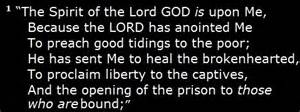
Listen again to what our Lord Jesus read: “He found the place where it is written:  “The Spirit of the Lord is on me, because God has anointed me to proclaim good news to the poor. He has sent me to proclaim freedom for the prisoners and recovery of sight for the blind, to set the oppressed free, and to proclaim the year of the Lord’s favor.”

In another sermon two and a half years ago, I preached on this same Gospel reading. I told my congregation that this was where our Lord Jesus preaches His first recorded sermon. It is quite a bit like political campaigns. The various candidates all have their position distilled down to a simple message. What they stand for. What they will strive to do. Just so, with Jesus. Jesus is here to proclaim the Gospel. Share the Good News, indeed!

The Apostle Paul was so moved and energized by the risen Jesus that he made it his life’s work to share that Good News. Paul went to endless places and preached the Gospel to just about everyone he met. What is more, he used his organizational skills to help the growing gatherings of believers, as we can see from our second reading from the book of Romans today.

These words from St. Paul not only tell his fellow believers about their gifts and how much God has blessed each of them, individually, but also to let them know how they ought to live together, and bless each other as a church community. We can take that one step further, and see how Paul’s fellow believers—that is all of us, as Christians—ought to live in love and justice in our neighborhoods, and with our fellow citizens.

Let’s go back to Luke chapter 4. My first thought is, I’m not poor! Or, a prisoner, or blind, or oppressed, either. I am not any of those things. Seriously, what is the Rabbi Jesus saying here? Does He have some kind of secret message? If these are the types of people Jesus says He is going to preach and minister to, I am not sure I would be comfortable with it.

All that talk about the poor and blind, grief-stricken and oppressed, that is giving me some hesitation about following this new Rabbi Jesus.

But, let’s take a closer, deeper look. Here Jesus is addressing the poor. Could that be the poor in spirit, as well as poor, materially-speaking? Next up, He addresses the prisoners. Perhaps, prisoners of sin? Then, speaking to the blind; blind to the love and gifts of God in their lives? And, our Lord Jesus came for the oppressed. Oppressed by anxiety, doubt, fear, anger, self-loathing, self-pity, self-righteousness. (I could go on, but I think you all have the idea.)

That is why Jesus has come to earth. That is His message. Our Lord gives His purpose statement, distilled down to the pure essence.  

Our Lord Jesus speaks to each one of us, as individuals. The Apostle Paul speaks to us as a group, to the church.

So—what do you want to be when you grow up? Do the words of Paul or the purpose statement of Jesus make a difference to you? Do these words change your life or your path? Following God’s Word can make all the difference in the world. It did for our Lord. It did for Paul. Will following God’s Word make a difference for you and me today?

            God willing, may it be so.

Alleluia, amen.


Unknown's avatar

Suit Yourselves

(I would like to post this sermon from October 2004. It seems applicable today. Sadly.)

“Suit Yourselves”

2 tim 4-3 ears tickled

2 Timothy 4:1-5  –  October 17, 2004

Have you seen the comics lately? I’m sure everyone here is familiar with the comics section of the newspapers–the daily comics in black and white, and the Sunday comics in full color–even if you don’t read them regularly.

Can you picture this scene from the comics? A single panel, showing two business men by an office water cooler. One looks like a boss, and he says to the other, “If there’s one thing I hate, it’s a yes-man. Isn’t that right, Baxter?”

We chuckle, because we all are familiar with that kind of attitude. I’m sure we can recognize that tendency in other guises, other forms. Getting some yes-man to tell us what we want to hear . . . not what’s good for us to hear, not what we need to hear, but instead what we want to hear.

Many people have a yearning to hear good news today. With all the worry and anxiety, trouble and danger in this modern world, people are actively searching for good news. Many don’t know where to start. Many are searching in all the wrong places. Commercialism and consumerism are rampant, with many people accumulating more and more stuff and always needing to get something else, something more, something new. Oftentimes, these people are trying to fill a hole deep inside.

Sometimes, some people search for thrills, for that adrenaline rush, for some kind of excitement in life. It doesn’t matter if thrills come from drag racing, gambling, or risky behavior, like a wild bender at the local bar. Regardless of how hard people try or how much they want a good time, something is lacking.

Other people turn inward, searching for spiritual fulfillment. There are many ways of experiencing some kind of spirituality, like through the martial arts, or through meditative practices. Fung shui, the Chinese method of arranging furniture (and other things in this material world) is an attempt to try to find balance and proper order in this life. Sure, doing an inside job, concentrating on the inside of ourselves is a great place to start, but . . . searching for inward, spiritual fulfillment on our own just won’t work. Anyway, not without God.

We have the assurance, from our scripture passage today, that Timothy had the opportunity to know God. He had the opportunity to read some of the same texts we have to read today! Timothy was instructed, from the time he was very young, in the way of salvation through Jesus Christ. His mother and grandmother were both women of faith, and Timothy grew up in a believing household, a household that put God first.

As we read further in our passage today, we find there are people who will not put up with sound doctrine. They will not even want to listen to the truth! Even when the truth is as clear as day, and presented to them in a straight-forward manner, still, some will turn away and disregard the truth.

You probably are all familiar with that modern phenomenon–tele-evangelists, some of whom are worthy people of God. However, there are those who are frauds. Charlatans. Fakes. Preaching not of sound doctrine or biblical teaching, but instead telling their listeners exactly what they –the listenerswant to hear.

Are you familiar with the health, wealth and happiness gospel, which focuses on only a few isolated passages from scripture? Most renditions of this false gospel tell the listeners that God wants us all to be healthy, wealthy and happy! All the time! And even shows us the example of Job–why, didn’t God give back to Job everything that was taken away? And in good measure, overflowing, in superabundance? But . . . and this is a big but here . . . we must have faith! And if anything is wrong in our lives, or if our house burns down, or if we get sick, or if someone we love loses a job, or if our child gets in trouble, or . . . or . . . or . . . you get the picture. Well, then, we just didn’t have enough faith, that’s our problem. Oh, and we didn’t send enough money to the tele-evangelist, either. So, God apparently must be withholding His blessing because of our lack of faith and our stinginess.

Not so!! No way!! This is a perverse, yet skillful, twisting of the truth! I bet you can see parts of the true Gospel here in what I’ve just described, but the rest is so skillfully bent and twisted!! It sounds so similar to the Good News of God we have come to know and to understand and to love. Like, and yet unlike. The true Gospel tells us that God does indeed want to bless us abundantly! And, it is an inside job! God wants to change us, to help us change ourselves, to make us new creations from the inside out, through faith in Jesus Christ.

This twisted health, wealth and happiness gospel is just one of the horrible perversions that is out there, on television, on the radio, on the Internet, just waiting to snare unsuspecting folks, and especially people who want to turn away from the truth in God’s Word.

What did our scripture passage today say about this sort of people? It mentions that they have “itching ears.” This is a Greek phrase that can be translated several ways–another way is “having their ears tickled.” In other words, having the preacher tell you exactly what you want to hear! These people with the itching ears, who wanted nice, warm, soft, fuzzy things, nonthreatening, reassuring things preached to them from the pulpit, these people turned their backs on the truth of God’s Word and of sound doctrine.

These rebellious people with the itching ears had an agenda–and that was to hear only what they wanted to hear, at all times. None of the challenging words, none of the admonishing words, none of the emotional words of Scripture. This is another form of idolatry–putting themselves first, putting God aside as an afterthought. You know the attitude–me, me, me! I’m the most important person around here! Everything needs to go my way! Nobody else counts!

As I was thinking and praying about this text over these past days, it came to me–what would Calvin say? John Calvin was one of the foremost theologians in the Reformed tradition, the tradition we as Presbyterians follow and adhere to. What would Calvin say about these false teachers, preaching a “health, wealth and happiness” gospel, or any other sort of false gospel, for that matter?

I would like to give you some background about me, since I am still new around here. In my early 20’s, I had a strong sense of God’s power and presence in my life. I read all kinds of books on bible and theology. One summer, I especially remember reading Calvin’s Institutes, his great systematic presentation of the Christian faith. I said an internal “yes!” to the biblical and theological concepts as presented by Calvin, and since that time, my personal theology began travelling down a Reformed path in earnest.

Since that time, I have always had a great appreciation for the great number of writings that John Calvin left to us. And so, it is natural for me to wonder, what would Calvin say? How would he deal with these false teachers, leading people astray? Checking the Institutes, I find that Calvin spoke strong words against these false teachers, saying that they, in fact, pose the greatest danger to the church! These false teachers take the lead! They lead people away from true scripture and sound doctrine, and are responsible for bringing in destructive heresies!

But . . . that’s not what we learned. That’s not what Timothy learned. We have the “sacred writings that are able to instruct us for salvation through faith in Christ Jesus.” We have the opportunity to come into a relationship with Jesus Christ. We have the Good News, in and through Jesus Christ our Lord. How wonderful, how awesome, and how sobering that Jesus entrusted us with the message of His Good News.


Now what? I’ve been teaching the adult Sunday school class here for several weeks, and I’ve said this phrase–now what?–each week as I’ve taught. The different New Testament letters do indeed tell us definite things about doctrine, about theology . . . but then . . . what do we do with all of this information? How do we put it into practice? How do we live the Christian life? Now what, in other words?

I consider the commands in this passage to be good advice to anyone wanting to follow Christ more nearly. We are to proclaim the message. Communicate the Good News! In whatever way we can.

This command may give some people pause. How can  I  preach the Good News? Am I supposed to go to some cable television station and get on the air as yet another tele-evangelist? Or how about standing out on a street corner, preaching with a megaphone? Both of these are perfectly valid ways of proclaiming God’s Good News, but I don’t think most of us here in this church could ever see ourselves doing either of these things. But there are other ways to proclaim the message.

Preach the Gospel. Proclaim the message. Every believer in Jesus Christ is told this! Another way of thinking about it is . . . telling what God has done in your life. What has God done for you? How has God made a difference in your life? How has God made a difference in mine? What new things have you and I learned from the Lord lately? What an opportunity it is to share these things with others, with our friends, with those who might not know God in a personal way.

Do we need advanced degrees in divinity or theology to do this? To share what God has done for us? No!! Oftentimes, we are excited to tell people about other things, like who won the latest ball game, or about the neighbor next door spraining her ankle, or what exciting story we just heard on the news. Why can’t I tell people about Jesus, and what He’s done for me?

 I  can tell about answers to prayer I’ve gotten recently–and I have gotten some exciting ones! And if anyone wants to hear about them, I’d be happy to tell you after the service. I can tell about God’s faithfulness in my busy, hectic life. I can praise God for helping me to walk the Christian walk, one day at a time.

Thank God we have been given this Good News! What a opportunity! What a thing to celebrate! Praise God, we have been granted salvation through faith in Jesus Christ. That’s truly something to celebrate. That’s truly Good News to share.

Alleluia, Amen.

@chaplaineliza

(Suggestion: visit me at my regular blog for 2019: matterofprayer: A Year of Everyday Prayers. #PursuePEACE – and my other blog,  A Year of Being Kind . Thanks!

Unknown's avatar

Saved by Grace through Faith

“Saved by Grace through Faith”


Rom 3-24 justified by grace

Romans 3:23-24 – October 28, 2018

I have been called for jury duty four times. Yes, one of those times I did serve on a jury, and I was one of that jury in a murder trial. I vividly remember the judge and his instructions to us as the jury. This particular judge had quite a presence. I could see everyone in that courtroom sitting up a little straighter, or paying more close attention when he spoke.

Is that your idea of a judge? Someone in black robes, sitting in judgment on a case with fairness and equity? A judge, someone evenhanded, listening to both sides of the legal question at hand before making a final decision on the case?

I am afraid that not all people think of judges in this way. In some parts of the world, judges can be less than fair, not exactly honest, and even mean or hurtful. I wanted to point out that this kind of flawed judge was certainly not what the Apostle Paul was thinking about here. Not here in Romans chapter 3.

We need to consider some background, if we are going to look at the book of Romans. This letter was written by Paul at a time when he was in prison. Paul had never been to Rome, even though he was born a Roman citizen. He knew a number of people who had over the years relocated to Rome. In fact, the small group of believers in Rome had probably written to Paul first, and they asked Paul to answer some theological and religious questions, and give them some of the Godly wisdom that comes from above.

The majority of Christ-followers at this time were Jewish, but not all of them. Paul started this section of the letter with a discussion of the Mosaic Law. I can just hear the responding comments by the Roman Christians who are also Gentiles: “Why are you talking about the Jewish Law Code?” In these beginning chapters of Romans, Paul is setting up an argument. He tells the Roman believers that ALL have sinned. Not just the Jews, under the Jewish or Mosaic Law Code. ALL have fallen short of God’s expectations.

Here in Romans 3 Paul highlighted the Law of Moses, and how difficult it is that anyone could be considered righteous. Another way of saying this is: The Law, in which the Jew boasted and the possession of which the Jew took for righteousness, is not able to make any one righteous but only to show them to be unrighteous. [1]

Sure, there is a whole lot of talk about unrighteousness in Romans. Paul comes right out and says, “For all have sinned and fall short of the glory of God.” Romans 3:23 is a verse countless Christians have used over the centuries to let people know what a rotten state we are all in. Notice that this verse does not say “For some have sinned,” or even “For most have sinned.” No. we ALL have sinned. We ALL have shown how unrighteous we are. We ALL fall short of the glory of God, that glory that goes so far beyond words.

Just between you and me, I am very glad we do not use the Mosaic Law to be our rulebook now for the believers’ faith. Paul even says so a couple of verses before, “Therefore no one will be declared righteous in God’s sight by the works of the law; rather, through the law we become conscious of our sin.” In other words, ALL have fallen short of God’s expectations.

If that were the case, I do not know how anyone could pass through such strong judgment and find reconciliation with God. That is, without Jesus. He is the whole point of Romans, and Paul returns to Him again and again. Thank God we do not need to stop at Romans 3:23! Paul does not stop there, either, but instead goes on: “ 24 and all are justified freely by his grace through the redemption that came by Christ Jesus.”

That is good news! I don’t know whether we fully understand it, but that’s good news!

Grace. That word is a simple enough word. However, I don’t want to put anyone on the spot and ask them what exactly “grace” means. I do remember an acrostic definition, from years ago. Grace is God’s Riches At Christ’s Expense.

Notice, please, that these two verses of Romans 3 tell us the whole Gospel. The whole Good News. The first, Romans 3:23, tells us why we are sunk, separated from God for eternity. The second, Romans 3:24, tells us we are justified by grace. We are drawn back into God’s presence, and are redeemed by Christ Jesus our Lord.

I’ve related this before, I am proud to say that I was raised as a Lutheran on the northwest side of Chicago. I was baptized and confirmed at that Lutheran church. I was fascinated by Martin Luther, the founder of the Lutheran denomination. When I was in high school, I learned as much as I could about Martin and his soul-wrenching journey to better understand this blessed fact—that he was saved by grace through faith.

Martin was a learned theologian, yes. But Martin felt sinful and unlovable, too. What’s more, even after lots and lots of good works and all these years of reading and study, he still felt so inadequate. Martin felt God could not possibly love or forgive him. He knew lots of things about Jesus intellectually, but he still did not grasp this central understanding.

Remember Romans 3:23? “For all have sinned and fall short of the glory of God.” Yes. Yes! That is true. But—that isn’t the whole story! Reading, starting from 3:21: “21 But now apart from the law the righteousness of God has been made known, to which the Law and the Prophets testify. 22 This righteousness is given through faith in Jesus Christ to all who believe. There is no difference between Jew and Gentile, 23 for all have sinned and fall short of the glory of God, 24 and all are justified freely by His grace through the redemption that came by Christ Jesus.”

I can almost see Martin falling off his chair, once he realizes how huge this is. Our sin is taken away through the redeeming that came through Jesus. We are made lovable through God’s grace. Our low self-worth and low self-esteem is now viewed by God through Jesus. God looks at all of us, each one of us, through Jesus-tinted lenses.

            We are all saved by grace, through faith. What tremendous Good News. No, it’s Great News! It’s the most marvelous News of all time!

We will not be tried in a court of law, with all of our sins playing out on a huge screen behind us as God the Judge bangs the gavel in some heavenly courtroom. Jesus took our sins upon Himself, so we do not have to carry them any longer.

That is the best of all possible Good News! Jesus died for our sins. Jesus showed us radical, God-sized grace, and radical, God-sized love.

As I proclaim each week after the Confession of Sin during the Assurance of Pardon, “Believe the Good News of the Gospel: in Jesus Christ, we are forgiven!”

Alleluia, amen!

[1] https://bible.org/seriespage/b-righteousness-it%E2%80%99s-not-what-you-know-or-who-you-are-romans-11-326

@chaplaineliza

(Suggestion: visit me at my regular blog for 2018: matterofprayer: A Year of Everyday Prayers. #PursuePEACE – and my other blog,  A Year of Being Kind . Thanks!